


Abstract
Although a pulse-width modulation (PWM) technique controls nozzle flow rate with minimal pressure variation, its effects on droplet size distribution and flow regulation when combined with low-drift nozzle designs are still not well documented. Therefore, the objective of this research was to investigate the effects of PWM on droplet size distribution and flow rate of low-drift nozzles used in pesticide application systems. Experiments were conducted under controlled laboratory conditions to evaluate eight flat-fan nozzles with different designs to increase spray droplet sizes. Each nozzle was coupled with a PWM valve, and tested at duty cycles (DUC) from 20% to 100% in 20% increments, and operating pressures of 276 and 414 kPa. Droplet size distribution was determined using a laser diffraction technique, and nozzle flow rate was evaluated to assess the effects of DUC on spray characteristics. PWM operation showed a strong linear relationship between DUC and flow rate (R2 ≥ 0.99). In addition, measured flow rates showed good agreement with theoretical values at DUCs ≥ 60%, whereas substantial deviations were observed at lower DUCs. The effects of DUC on droplet size characteristics varied by nozzle design, pressure, and the parameter evaluated. Low DUCs tended to increase droplet size heterogeneity and the proportion of drift-prone droplets (<150 µm), although these effects were dependent on nozzle type and operating pressure and were not observed consistently across all nozzles. Overall, excessively low DUCs may compromise flow accuracy and spray quality in PWM systems.
1. Introduction
The efficacy of crop protection products is closely linked to the quality of their field application. Even when products with the appropriate active ingredients for targeted pests are selected, inadequate spray delivery can limit biological efficacy and increase unintended losses to the environment [1]. For this reason, pesticide application technology remains a central topic within agricultural engineering, particularly in relation to decreasing spray drift and increasing application accuracy [2].
In conventional hydraulic sprayers, variations in nozzle flow rate are typically achieved by modifying operating pressure using rate controllers. While this method offers simplicity, it affects droplet formation processes [3] because increasing pressure influences droplet breakup, leading to smaller droplets with greater drift potential. Conversely, operation at reduced pressures generally results in larger droplets, which may compromise spray pattern consistency and coverage [4]. This dependency between pressure and spray characteristics restricts the ability of the sprayer to maintain stable spray quality when application rates must be adjusted, such as in variable-rate or site-specific spraying systems [5].
Pulse-width modulation (PWM) technology has been developed as an alternative means of regulating nozzle output without continuous pressure adjustment. According to Zhang et al. [6], it is currently the most widely used variable spray system worldwide. In PWM-based systems, electronically controlled solenoid valves operate at high switching frequencies, and the effective flow rate of the system is determined by the proportion of time the valve remains open during each PWM cycle. By decoupling flow rate control from pressure changes, PWM systems enable sprayers to operate at a relatively constant pressure over a broad range of application rates [3,7]. This capability has contributed to the increasing adoption of PWM systems in precision agriculture, particularly in applications requiring individual nozzle control.
Meanwhile, spray nozzle design has evolved considerably, resulting in a wide array of commercially available nozzle types with distinct droplet size distributions [4]. Low-drift nozzles have gained prominence due to their capacity to shift the droplet size spectrum towards coarser sprays while reducing the volume of fine droplets prone to off-target movement [8]. Among the low-drift nozzles, air-induction nozzles have been widely used by applicators because these nozzles are designed to greatly reduce the production of fine droplets to significantly reduce drift potential [9,10]. However, despite their widespread adoption, the operational characteristics of low-drift nozzles when coupled with the PWM system are not well documented.
One concern associated with PWM operation is the intermittent nature of the liquid flow delivered to the nozzle. This intermittent flow may interact differently with internal nozzle processes [11], particularly in designs that rely on air entrainment, potentially influencing droplet formation and discharge stability. Experimental evidence suggests that the effects of PWM operation on droplet size distribution and flow stability remain inconclusive. For example, air-induction nozzles may exhibit different droplet size characteristics when operated with PWM systems [7], however, minimal effects on droplet size distribution, depending on the nozzle model, have also been reported [12].
These inconsistent findings indicate that, although PWM effects have been previously investigated, comparative assessments across different low-drift nozzle designs under standardized PWM operating conditions remain limited. As both technologies are increasingly used to improve spray efficiency and reduce drift, a clearer understanding of their combined effects is needed [13]. In particular, differences in nozzle design, such as pre-orifice, Venturi systems, and non-Venturi ultra-coarse droplet technologies, may lead to distinct responses to PWM modulation, making it difficult to generalize performance among nozzle types.
Based on nozzle design and the operating principles of PWM systems, nozzle responses to pulsed flow conditions were expected to vary according to internal design characteristics, particularly at low duty cycles (DUC), due to differences in internal pressure stability and air entrainment processes. It was also expected that droplet-related variables (Dv50, Span, and V150) would respond differently to PWM operation, with greater variability occurring at lower DUCs.
Therefore, the objective of this research was to investigate the effects of a PWM system on droplet size distribution and flow rate of low-drift nozzles, providing technical insights into their performance under PWM-controlled conditions and contributing to a more consistent understanding of how different nozzle technologies respond to this spray modulation approach. A conventional flat-fan nozzle (XR) was included as a reference.
2. Materials and Methods
The experiment was conducted in the Laboratory for Pest Control Application Technology, located at The Ohio State University, College of Food, Agricultural, and Environmental Sciences, Wooster campus (Wooster, OH, USA).
2.1. Nozzles
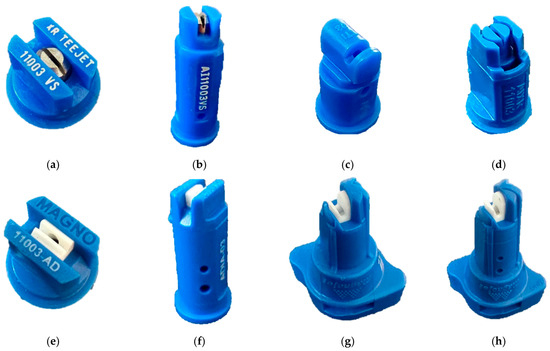
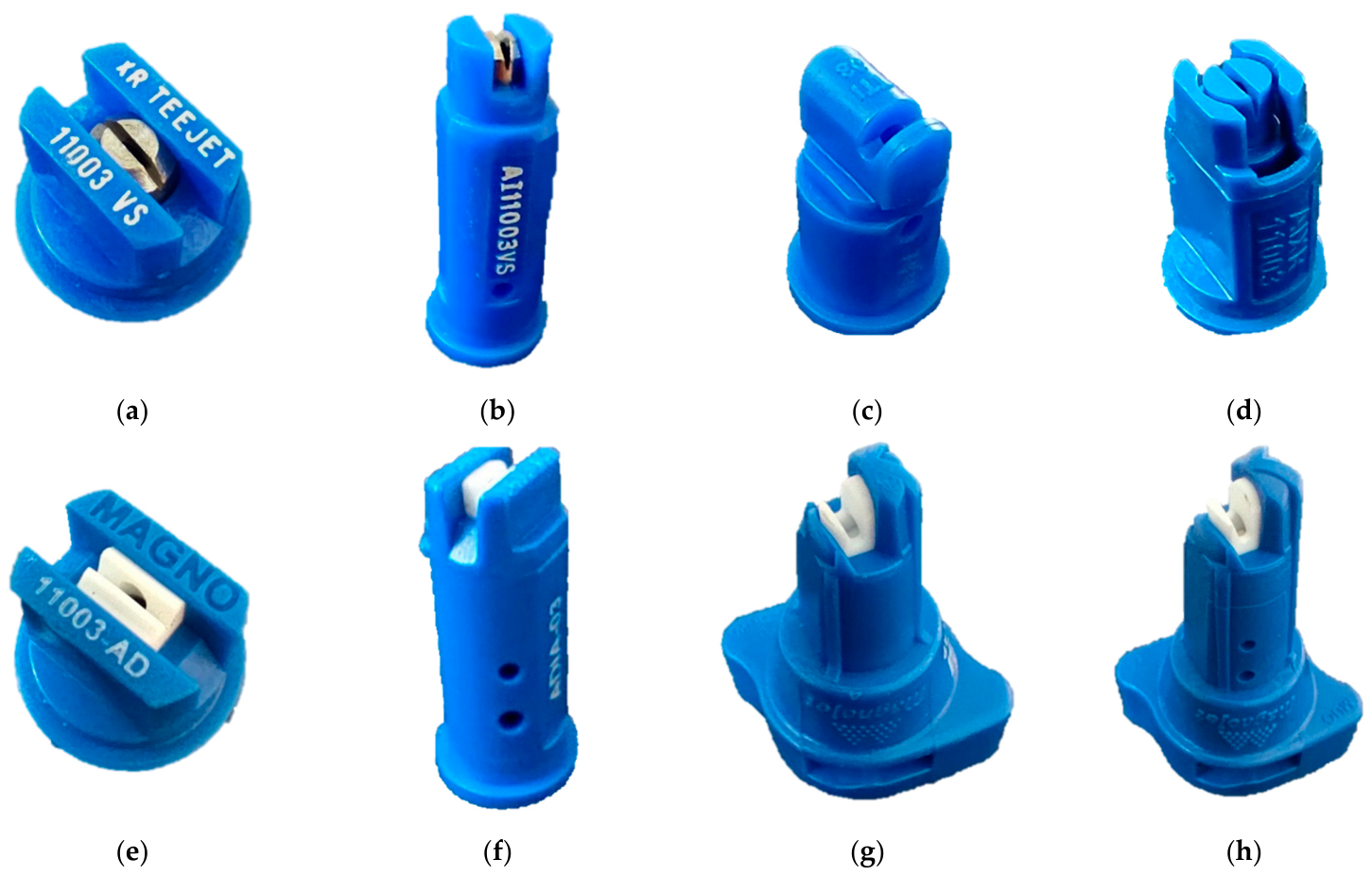
Eight flat-fan spray nozzles were evaluated (Table 1 and Figure 1), and all nozzles had a nominal 03 orifice size, corresponding to a flow rate of 1.2 L min−1 at 300 kPa, according to ISO 10625 Standard [14]. These nozzles were selected based on their widespread use in agricultural broadcast applications and their different design characteristics. Although the main focus of this study is on low-drift nozzle technologies, the XR 11003 nozzle was intentionally included as a reference treatment. This nozzle produces a fine droplet spectrum and represents a conventional extended-range flat-fan nozzle, providing a reference for contextual interpretation of the results in relation to low-drift nozzle designs. It should be noted that droplet size classifications provided by the manufacturers (Table 1) are typically determined under steady-flow conditions and standard reference pressures, and may differ from those observed under PWM operation.
Table 1.
Characteristics of the nozzles used in the experiment.
Figure 1.
Spray nozzles used in the experiment: (a) XR 11003; (b) AI 11003; (c) TTI 11003; (d) AIXR 11003; (e) AD 11003; (f) ADIA 11003; (g) MUGSI 11003; and (h) MUG 11003.
2.2. Droplet Size and Flow Rate Measurement
Spray droplet size and flow rate measurements were conducted at two operating pressures (276 kPa (40 psi) and 414 kPa (60 psi)) and five duty cycles (DUC) (20%, 40%, 60%, 80%, and 100%). An air-pressurized stainless-steel tank with local tap water was used as the liquid supply. Only water was used as the spray liquid in this study; formulated pesticide spray solutions containing adjuvants or active ingredients were not evaluated. For each operating pressure, droplet size and flow rate measurements were initially performed at 100% DUC to establish and verify stable operating pressure and flow conditions. The target pressure was set and verified using a pressure gauge positioned immediately upstream of the PWM valve. No further pressure adjustments were made during measurements conducted at other DUCs of the PWM system. The remaining DUC levels were then evaluated in randomized order for each nozzle–pressure combination.
It should be noted that pressure was monitored upstream of the PWM valve and was not measured at the nozzle tip after PWM modulation; therefore, local pressure dynamics at the nozzle level were not directly characterized. In addition, pressure was not recorded at a high temporal resolution during PWM operation, and potential transient fluctuations induced by valve pulsing could not be resolved. A true non-PWM control (i.e., a conventional nozzle body operating without PWM hardware) was not included in the experimental design. Instead, the 100% DUC condition was used as a reference within the PWM-equipped system; however, this configuration does not fully replicate a conventional non-PWM nozzle, as the PWM valve and associated components remain in the flow path.
A custom-made microcontroller modulated the DUCs of PWM electrical signals [15]. The modulated DUC signal was fed to an N-channel power MOSFET (IRLB4132, Infineon Technologies AG, Neubiberg, Germany) to actuate the internal piston of the PWM valve (55295-1-12, TeeJet Technologies, Glendale Heights, IL, USA) electromagnetically. When it was an off cycle, a spring-based return mechanism moved the piston to a closed position. The nozzle flow rate was modulated by regulating the opening duration of the PWM valve. The microcontroller modulated the PWM valve at a frequency of 10 Hz and a supply voltage of 12.8 VDC. A PWM frequency of 10 Hz was selected because it represents a typical operating condition commonly used in agricultural PWM systems and provides a representative basis for evaluating nozzle responses under PWM control.
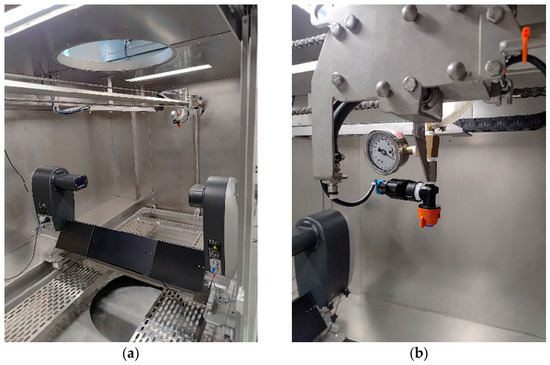
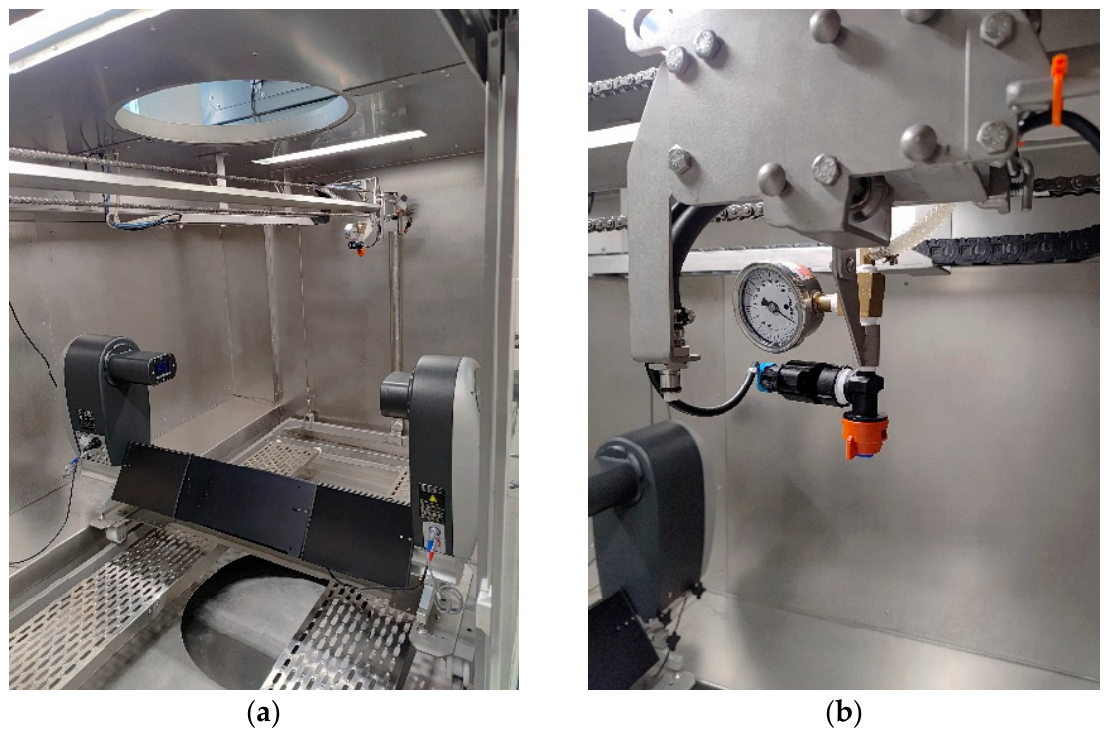
Detailed information regarding the spray chamber configuration, instrumentation, and measurement procedure is provided in Jeon & Zhu [16], which describes the same laboratory setup and measurement system used in the present study. However, key aspects of the droplet measurement procedure are summarized here to ensure the manuscript is self-contained. A laser diffraction particle sizing system (S/N: MAL1268848, Spraytec, Malvern Instruments Ltd., Worcestershire, UK) equipped with a 750 mm lens (nominal measurement range: 2 to 2000 µm) was used in a track spray chamber (Figure 2a).
Figure 2.
Experimental setup for droplet size measurement of spray nozzles operated under PWM control: (a) particle sizing system inside the spray chamber; (b) PWM valve attached to the nozzle body.
The system operated under a standard operating procedure (SOP). The SOP configured the system with optical properties for water spray in air, and background measurements (dark and light) were performed prior to each set of measurements and automatically subtracted from the raw signal. Obscuration levels were maintained within the recommended range for laser diffraction measurements (approximately 5–20%) to ensure adequate signal intensity while minimizing multiple scattering effects. While the system was continuously monitoring the transmission rates after background measurement, a nozzle with the PWM valve (Figure 2b) travelled over the measurement area of the Spraytec along a linear track in the chamber at 0.4 m s−1. When the rate was below 98% (the trigger point), the system was acquiring diffraction data at 50 Hz. To ensure that the edge portion of the spray fan was included, the diffraction data from 1.2 s before the trigger point were also acquired. This procedure ensured the measurement of diffraction data across the entire spray pattern. The nozzle was mounted approximately 0.35 m above the measurement area of the Spraytec. For each nozzle, four replications were performed. Tests were conducted under environmentally controlled conditions, with the mean ambient temperature kept at 25 °C.
Each reported measurement consisted of droplet size distribution (DSD) records acquired sequentially at 50 Hz, with each DSD representing an instantaneous snapshot of the spray of each measurement. The reported droplet size distributions represent time-averaged spray characteristics under each operating condition, based on sequentially acquired DSD records. Considering the pulsed nature of the spray generated by the PWM system (10 Hz), the data acquisition frequency (50 Hz) corresponds to approximately five samples per PWM cycle on average. However, as the measurements were not synchronized with the PWM signal, the acquired data represent randomly sampled points across multiple cycles. Therefore, the measurements represent time-averaged droplet size distributions under each PWM operating condition to show the overall effect of DUC on spray characteristics, rather than resolving transient variations within individual PWM cycles.
Spray droplet size data were determined for the following parameters: Dv10, Dv50, and Dv90 (volumetric diameters at which 10%, 50%, and 90% of the spray volume are made up of smaller droplets, respectively); V150 (volume percentage of droplets smaller than 150 µm); and the relative span index (Span) (a measure of droplet size uniformity, calculated as (Dv90 − Dv10)/Dv50). The droplet size distribution parameters (Dv10, Dv50, Dv90, and relative span index) are also presented in the Supplementary Materials (Tables S1 and S2) to provide a more complete characterization of the droplet spectrum. In particular, the supplementary Dv10 and Dv90 data support interpretation of Span by providing information on changes in the lower and upper tails of the droplet size distribution.
The nozzle flow rate was determined by collecting the spray output in a graduated cylinder over a 30 s interval. The percent change in flow rate was then calculated as the difference between the measured flow rate and the calculated flow rate based on the theoretical flow rate under PWM operation (Equation (1)):
where Qc is the calculated flow rate (L min−1), Qₜ is the theoretical flow rate (L min−1), DUC is the corresponding duty cycle (%), %ΔQ is the percent change in flow rate (%), and Qₘ is the measured flow rate (L min−1).
Qc = Qt × DUC
%ΔQ = (Qₘ − Qc)/Qc × 100
2.3. Data Analysis
Flow rate, Dv50, relative span index, and V150 were analyzed using one-way analysis of variance (ANOVA) to assess the effects of DUC for each nozzle and pressure, with four replications. Statistical analyses were conducted separately for each nozzle and pressure combination, with DUC treated as the main factor within each condition.
Although the experiment involved factors of nozzle type, pressure, and DUC, the objective of this study was intentionally conditional, focusing on DUC effects within each nozzle–pressure operating condition rather than on inference regarding interactions across all factor combinations. Therefore, separate one-way ANOVAs were used to evaluate within-combination responses. Formal testing of factorial interactions was considered outside the scope of the present study.
Prior to ANOVA, data were tested for normality of residuals using the Shapiro-Wilk test and for homogeneity of variances using Levene’s test. Statistical analyses were performed using R software version 4.2.1 at a 95% confidence level (p < 0.05). The assumptions of normality and homogeneity of variances were met across the evaluated conditions; therefore, no data transformation was required. Outliers were evaluated through residual analysis, and no observations were identified as outliers. Therefore, all data points were retained in the analysis.
When significant effects were detected, linear and quadratic regression models were evaluated using replicate-level data rather than treatment means. Model selection was based on the statistical significance of fitted models (p < 0.05), coefficient of determination (R2), and the principle of parsimony. When both models were significant, the linear model was retained unless the quadratic model provided a meaningful improvement in fit, thereby avoiding overfitting. Higher-order models were not considered because the discrete number of DUC levels evaluated was limited, and the analysis was intended to describe observed trends through simple empirical relationships. Models with modest explanatory power were retained only as descriptive summaries of observed trends and were interpreted cautiously, without implying strong predictive capability.
3. Results and Discussion
3.1. Flow Rate
Table 2 shows the measured flow rates at different duty cycles (DUC) for eight nozzle types operated at pressures of 276 and 414 kPa, along with the percent deviation from the calculated flow rate (calculated as the theoretical nozzle flow rate multiplied by the DUC). Negative values indicate that the measured flow rate was lower than the expected nozzle output at the specified application pressure.
Table 2.
Mean flow rates discharged by eight different nozzles coupled with a PWM solenoid valve at duty cycles (DUC) ranging from 20% to 100% and operating pressures of 276 and 414 kPa. Differences (%) between calculated and mean measured flow rates are shown in parentheses.
Across nozzle types and pressures, measured flow rates generally aligned with theoretical predictions at DUCs of 60% and above. Under these operating conditions, deviations were typically small, mostly less than 8%. From a practical perspective, such small variations in flow rate were unlikely to significantly affect field application rates or spray distribution. These results indicate that the PWM system provided stable flow regulation when valve open times represented a substantial portion of each modulation cycle, a trend also reported in previous experimental evaluations of PWM-controlled systems [17].
Similarly, Wei et al. [18] recommended increasing calculated DUCs to ensure the expected spray output. However, Salcedo et al. [19] demonstrated that different PWM solenoid valve designs exhibit distinct DUC ranges over which discharge flow rates vary linearly, highlighting the need to evaluate nozzle flow rates under different PWM valve configurations to achieve accurate variable-rate applications.
As DUC decreased, the agreement between calculated and measured flow rates gradually worsened. Deviations began to increase at 40% DUC and became significant at 20%, where differences often exceeded 25%, especially at 276 kPa. Previous studies attribute this behavior to the increasing influence of transient flow conditions at low DUCs, where short valve open times prevent the establishment of fully developed flow and amplify the effects of valve actuation dynamics [17].
Differences among nozzle designs became more noticeable under low DUC conditions. Nozzles incorporating air-induction, including AI-, ADIA-, and MUG-type designs, tended to show larger deviations from nominal flow rates, especially at the lower pressure. For example, at a 40% DUC, these nozzles showed more than 10% differences between calculated and mean measured flow rates. In contrast, some air-induction nozzles, such as AIXR and TTI, produced results comparable to those of non-air-induction nozzles, with deviations below 10%.
Increasing the operating pressure from 276 to 414 kPa resulted in higher measured flow rates, as expected, and, in several cases, led to a moderate reduction in percent deviations at intermediate DUCs. However, at a 20% DUC, substantial discrepancies persisted regardless of pressure, indicating that increases in operating pressure alone are insufficient to offset the nonlinear effects associated with PWM operation at very low DUCs.
The linear regression equations presented in Table 3 revealed a strong relationship between nozzle flow rates and DUC across all nozzle types and operating pressures. Coefficients of determination (R2) were high in all cases (≥0.99), indicating that a linear model adequately describes the observed trends within the evaluated range (20–100% DUC). However, this linearity does not necessarily imply agreement with theoretical flow rates, as deviations were observed, particularly at lower DUCs. In addition, the positive intercepts obtained from the linear fits imply non-zero flow at 0% DUC, which is not physically meaningful. This behavior likely reflects the influence of valve dynamics and transient effects at low DUC, which are not fully captured by a simple linear model. Therefore, the regressions should be interpreted as empirical relationships valid within the stable operating range. This corresponds to the DUC interval most relevant for practical field operation of PWM-controlled spraying systems, rather than as physically rigorous representations of system behavior across the full DUC spectrum. These results further demonstrate that linearity and physical accuracy are distinct aspects of PWM flow control.
Table 3.
Linear regression equations for flow rate (y, L min−1) as a function of duty cycle (x, %) for different nozzles coupled with a PWM solenoid valve.
The slopes of the regression equations increased with operating pressure, reflecting the expected increase in flow rate per unit increase in DUC at higher pressures. This behavior aligns with the proportional control principle of PWM-based systems, in which flow rate is primarily governed by the fraction of time the solenoid valve remains open during each cycle [17].
Despite the overall linearity, differences among nozzle designs were noted in the intercept and slope values, particularly for air-induction nozzles. Models associated with nozzles such as ADIA and MUG exhibited slightly lower R2 values or higher intercepts, suggesting greater sensitivity to low DUC operation. These deviations may reflect differences in internal nozzle geometry and flow stabilization, although these mechanisms were not directly evaluated in the present study.
3.2. Droplet Size Distribution
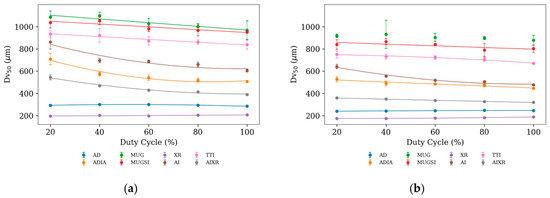
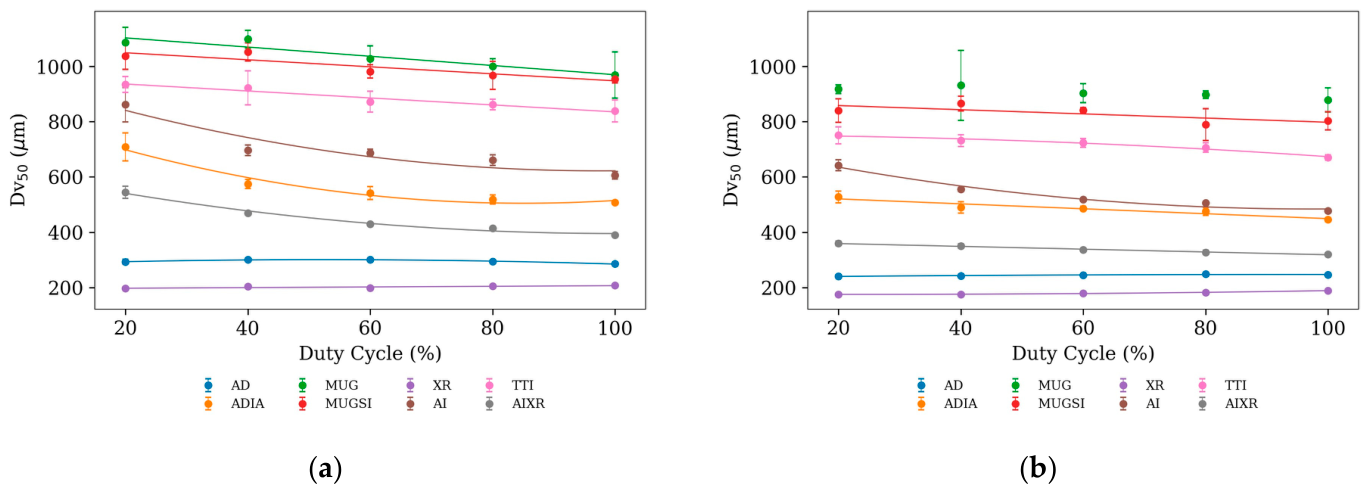
Figure 3 shows the volume median diameter (Dv50), a standard parameter used to characterize droplet size, across different DUCs for eight nozzles operated at pressures of 276 and 414 kPa. The Dv50 represents the droplet diameter at which 50% of the spray volume is composed of smaller droplets and 50% of larger droplets. Trend lines indicate statistically significant regression models (Table 4) used as descriptive summaries of observed responses to DUC, rather than predictive relationships.
Figure 3.
Volume median diameter (Dv50) of eight spray nozzles coupled with a PWM solenoid valve, evaluated at duty cycles from 20% to 100% and operating pressures of 276 kPa (a) and 414 kPa (b). Error bars represent the standard error.
Table 4.
Regression equations for volume median diameter (y, µm) as a function of duty cycle (x, %) for different nozzles coupled with a PWM solenoid valve.
The response of Dv50 to DUC varied depending on the nozzle design and operating pressure, displaying distinct linear and quadratic behaviors. At 276 kPa, most nozzles showed a reduction in Dv50 as DUC increased, especially among the air-induction models. Linear Dv50 decreases were observed for TTI, MUG, and MUGSI, indicating a consistent reduction in droplet size as the valve open time increased. This trend may be associated with pulsed operation at lower DUC, which could lead to pressure fluctuations within the nozzle body and promote the formation of coarser droplets. However, it is important to note that nozzle-tip pressure was not directly measured in this study, and this interpretation is based on mechanisms suggested in previous studies. This behavior aligns with prior research reporting that lower DUCs produced coarser droplets, possibly due to incomplete liquid sheet development and reduced effective pressure at the nozzle tip under PWM modulation [18].
Quadratic responses were identified for AI, AIXR, AD, and ADIA, indicating non-linear changes in droplet size across the DUC range; however, these fitted relationships should be interpreted as descriptive representations of mean trends rather than evidence of mechanistic response patterns. Generally, these nozzles had relatively large Dv50 at 20% DUC and showed a marked Dv50 reduction above 60% DUC. Dv50 values showed stabilization at higher DUCs. This pattern suggests that nozzle designs developed to produce coarser droplets may not be optimized for short-duration pulsed liquid flow generated by PWM systems.
The influence of DUC on Dv50 persisted for most nozzles even with higher pressure but tended to be less pronounced in magnitude. Where supported statistically, quadratic models provided descriptive representations of the observed nonlinear variations in droplet size as DUC changed for XR, AI, TTI, and AD. In contrast, AIXR and ADIA showed decreasing linear trends. No significant regression models were identified for MUG and MUGSI at 414 kPa, indicating that no consistent relationship between DUC and Dv50 was established under this pressure condition. Increasing pressure from 276 to 414 kPa generally resulted in lower Dv50 values across nozzle types as expected due to enhanced liquid sheet instability and droplet fragmentation at higher hydraulic energy levels [20]. However, the magnitude and direction of the response to DUC varied based on the nozzle type.
These results indicated that PWM-based flow control can alter droplet size distribution depending on nozzle type and pressure, in agreement with the initial hypothesis. The effect of DUCs appeared more pronounced on Dv50 at lower pressure, possibly due to greater relative pressure changes during pulsed operation, as suggested in previous studies. At higher pressures, droplet formation may be more strongly governed by hydraulic energy, potentially reducing the proportional influence of DUC modulation. Therefore, the interaction among pressure, DUC, and nozzle design should be carefully considered in PWM variable-rate spraying systems to avoid unintended changes in droplet distribution that could influence spray coverage and drift potential. For example, Salcedo et al. [19] stated that, to avoid significant variations in droplet size in variable-rate sprayers equipped with PWM valves for flow rate control, pressures lower than 276 kPa may not be suitable for spray applications. However, the authors evaluated only hollow cone nozzles, which prevents a direct comparison with the present study.
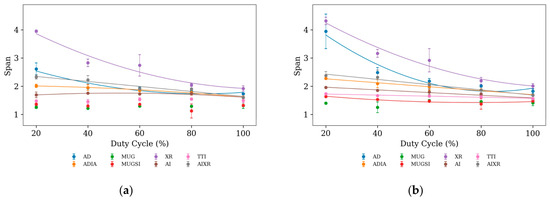
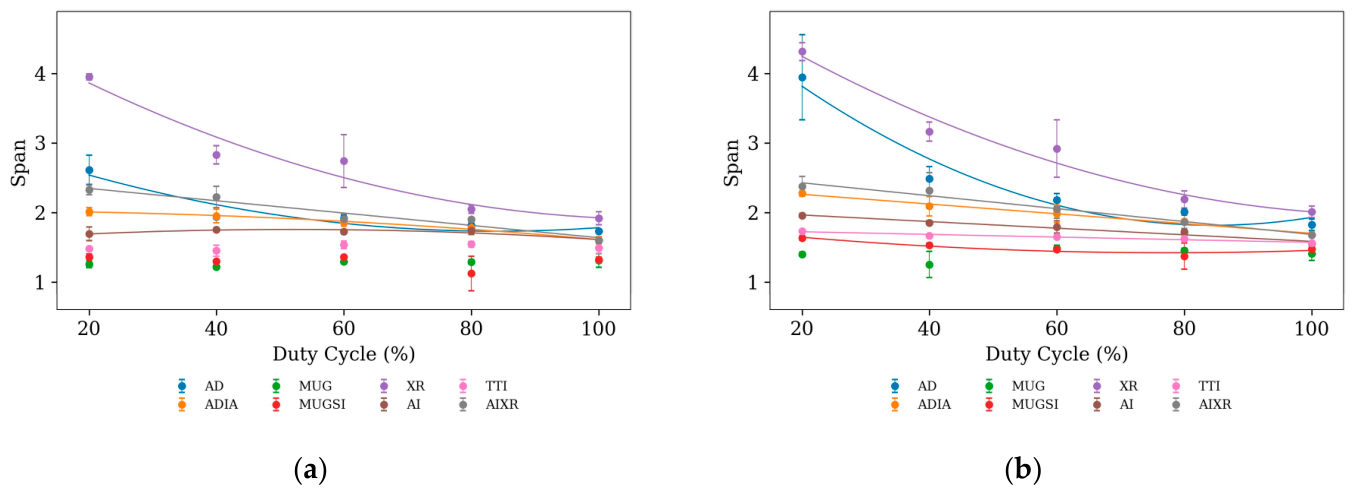
Figure 4 shows the relative span index (Span) of the nozzles evaluated at DUCs ranging from 20% to 100% and operating pressures of 276 kPa and 414 kPa, and Table 5 presents the regression models that best fit the data when they are statistically significant (p < 0.05).
Figure 4.
Relative span index (Span) of eight nozzles coupled with a PWM solenoid valve at duty cycles ranging from 20% to 100% and operating pressures of 276 kPa (a) and 414 kPa (b). Error bars represent the standard error.
Table 5.
Regression equations for relative span index (y) as a function of duty cycle (x, %) for different nozzles coupled with a PWM solenoid valve.
DUC influences on Span varied by nozzle design and operating pressure. Lower DUCs, especially 20%, increased Span values, indicating greater droplet size heterogeneity under pulsed operation, consistent with the findings of Salcedo et al. [19].
At 276 kPa, XR, AIXR, AI, AD, and ADIA nozzles showed significant relationships with DUC. For AIXR, Span decreased linearly as DUC increased, indicating that shorter open times promoted greater droplet size heterogeneity. At 414 kPa, XR, AD, and MUGSI nozzles exhibited quadratic behavior, and the magnitude of change in Span was more pronounced, especially for XR and AD. This indicates that higher pressure may intensify interactions between PWM pulsing and internal nozzle hydraulics, although this interpretation should be treated with caution given the limited number of evaluated DUC levels.
The increase in Span at low DUCs may be associated with unstable flow conditions caused by PWM systems. Short valve opening times may hinder complete stabilization of internal pressure and liquid sheet formation, resulting in the simultaneous production of finer and coarser droplets. However, these mechanisms were not directly evaluated in this study and are inferred based on previous findings. Similar effects of pressure fluctuation and unsteady flow on droplet size distribution have been reported in studies evaluating pulsed spray systems and variable-rate technologies [19], which observed greater variability in droplet distribution under low DUC.
Conversely, MUG at both pressures and MUGSI at 276 kPa did not show significant regression models, indicating that no consistent relationship was observed between DUC and Span. This behavior was likely related to the inherently coarser droplet size produced by these nozzles, which tends to be less sensitive to possible pressure variations under PWM operation, as previously discussed for nozzle designs generating larger droplets [19].
These results indicate that very low DUCs can compromise spray uniformity for certain nozzle types. Because Span reflects droplet size variability, higher values may increase both drift risk (due to fine droplets) and uneven target coverage (due to coarse droplets). From a practical standpoint, these effects may become particularly relevant under field conditions where uniform coverage and drift control are critical. Therefore, when using PWM-based systems, avoiding excessively low DUCs may help maintain a more uniform droplet distribution and improve application consistency.
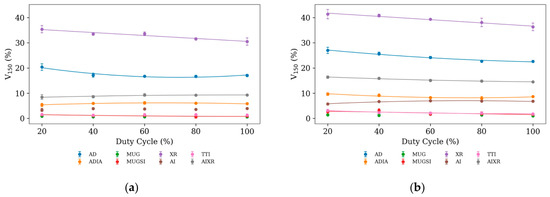
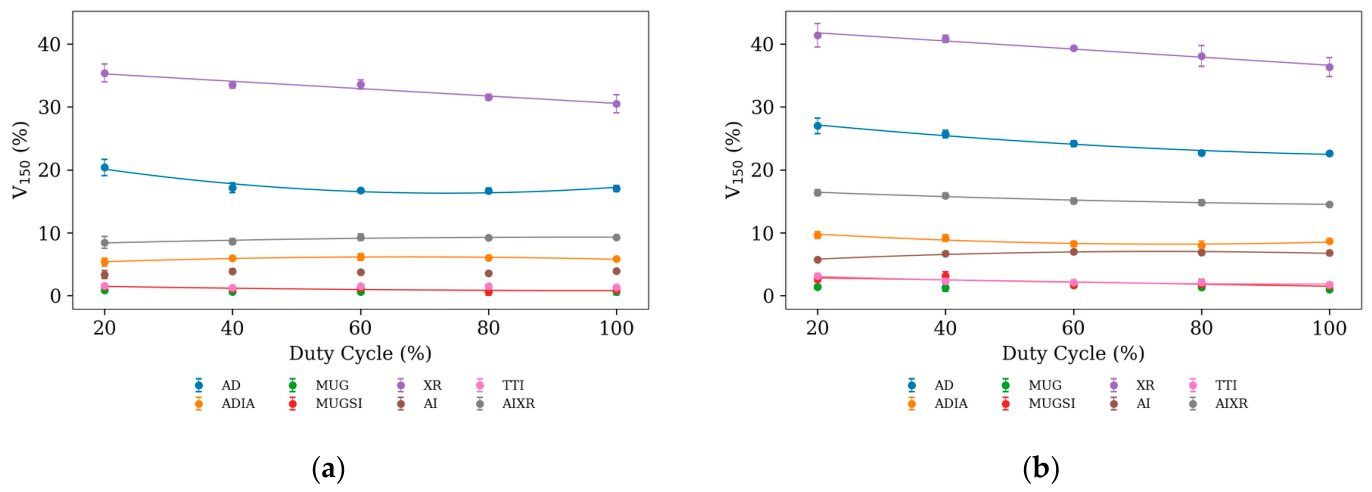
Figure 5 shows the volume percentage of droplets smaller than 150 µm for the nozzles evaluated at DUCs ranging from 20% to 100% and operating pressures of 276 and 414 kPa, while Table 6 presents the regression models that best fit the data when they are statistically significant (p < 0.05).
Figure 5.
Volume percentage of droplets smaller than 150 µm (V150) of eight nozzles coupled with a PWM solenoid valve at duty cycles ranging from 20% to 100% and operating pressures of 276 kPa (a) and 414 kPa (b). Error bars represent the standard error.
Table 6.
Regression equations for the volume percentage of droplets smaller than 150 µm (y, %) as a function of duty cycle (x, %) for different nozzles coupled with a PWM solenoid valve.
The V150 was also significantly influenced by DUC, depending on nozzle design and operating pressure. Overall, lower DUCs tended to increase V150 for specific nozzle types, especially XR, indicating a greater proportion of drift-prone droplets under pulsed operation.
At 276 kPa, XR showed a significant linear increase in V150 as DUC decreased, indicating that very low DUCs intensified the formation of fine droplets. Because Dv50 stayed fairly constant but Span increased as DUC decreased, the results indicate an increase in the fraction of fine droplets. Short valve opening times might prevent stabilization of the liquid sheet, leading to irregular atomization and increased production of small droplets [21]. For the low-drift nozzles, V150 was less affected by DUC, leading to a steadier response across the tested conditions.
At 414 kPa, more nozzles showed significant responses to DUC. Since driftable droplets are widely recognized as highly susceptible to spray drift [22], increases in V150 at low DUCs may suggest a higher potential for spray drift, although this inference remains indirect because drift was not directly measured.
Conversely, the MUG nozzle did not show significant relationships between DUC and V150 at either pressure. Its inherently large droplet size might reduce the formation of fine droplets even during transient pressure oscillations. Previous studies have shown that air-induction nozzles substantially reduce the fraction of driftable fines, making them less affected by operational changes [23].
In practical field applications, increases in V150 are generally associated with greater drift risk, as droplets smaller than 150 µm are more susceptible to off-target movement. Even moderate increases in this fraction may be operationally important under field conditions, particularly in the presence of wind or unstable atmospheric conditions. Thus, the increases observed at low DUCs for certain nozzle types may plausibly indicate greater drift potential under field conditions, although this inference was not directly validated in the present study.
Overall, these results support the initial hypothesis that droplet characteristics under PWM operation are influenced by DUC, with lower DUCs leading to greater variability and changes in the droplet spectrum. However, the magnitude and direction of these effects varied among nozzle types, indicating that nozzle design plays a key role in modulating the response to pulsed flow conditions.
4. Conclusions
This research investigated the effects of a PWM flow control system on nozzle flow rate, droplet size distribution, and drift potential across different nozzle designs and operating pressures under controlled laboratory conditions. The experiments were conducted using flat-fan nozzles with a nominal 03 orifice size, water as the spray liquid, a PWM frequency of 10 Hz, a supply voltage of 12.8 VDC, a single valve model, two operating pressures, and five duty cycle (DUC) levels.
Within these experimental conditions, consistent flow regulation was achieved at DUCs around 60% and higher, as measured flow rates showed good agreement with theoretical values across nozzle types and operating pressures. Conversely, very low DUCs (e.g., 20%) caused significant deviations regardless of pressure, with air-induction nozzles showing greater sensitivity. These results indicate that, for the evaluated configuration, operating PWM systems at low DUCs may lead to reduced flow accuracy.
The effects of DUC on droplet characteristics depended on nozzle design, operating pressure, and the parameter evaluated. Under the tested conditions, increasing DUC tended to reduce Dv50 at lower pressure, while droplet size remained more stable at higher pressure. Very low DUCs were associated with increased droplet size variability and, in some cases, a higher proportion of drift-prone droplets, with stronger effects observed for specific nozzle types such as XR and AD.
Overall, avoiding excessively low DUCs (e.g., 20%) improved flow stability, helped preserve droplet uniformity, and reduced the proportion of fine droplets commonly associated with spray drift potential. However, these findings are limited to the evaluated system and should not be directly extrapolated to other PWM frequencies, nozzle sizes, spray liquids, valve designs, or field conditions. In addition, the 100% DUC condition represented an internal reference within the PWM-equipped system and should not be interpreted as equivalent to conventional non-PWM nozzle operation. The experiments were conducted under controlled laboratory conditions, without field validation under wind and turbulence or numerical simulation, which limits direct practical extrapolation. Future research should address these conditions to support broader recommendations.
Supplementary Materials
The following supporting information can be downloaded at: https://www.mdpi.com/article/10.3390/agrochemicals5020025/s1, Table S1: Droplet size distribution parameters (Dv10, Dv50, Dv90, and relative span index) for different nozzles and duty cycles (DUC) at 276 kPa; Table S2: Droplet size distribution parameters (Dv10, Dv50, Dv90, and relative span index) for different nozzles and duty cycles (DUC) at 414 kPa.
Author Contributions
Conceptualization, J.P.A.R.d.C.; methodology, J.P.A.R.d.C. and H.J.; formal analysis, J.P.A.R.d.C.; writing—original draft preparation, J.P.A.R.d.C.; writing—review and editing, E.O. and H.J. All authors have read and agreed to the published version of the manuscript.
Funding
This research was partially funded by National Council for Scientific and Technological Development—Brazil (CNPq) (Processes number 402512/2024-3 and 304383/2026-0).
Institutional Review Board Statement
Not applicable.
Informed Consent Statement
Not applicable.
Data Availability Statement
The original contributions presented in this study are included in the article. Further inquiries can be directed to the corresponding author.
Acknowledgments
The authors express their gratitude to Adam Clark, Andy Doklovic, and Barry Nudd for their technical assistance during the laboratory tests. Mention of company or trade names is for description only and does not imply endorsement by either The Ohio State University or the USDA. The USDA is an equal opportunity provider and employer.
Conflicts of Interest
The authors declare no conflicts of interest.
References
- Cieniawska, B.; Pentoś, K.; Łuczycka, D. Neural Modeling and Optimization of the Coverage of the Sprayed Surface. Bull. Pol. Acad. Sci. Tech. Sci. 2020, 68, 713–723. [Google Scholar] [CrossRef] [Scilit]
- Khan, F.A.; Khorsandi, F.; Ali, M.; Ghafoor, A.; Khan, R.A.R.; Umair, M.; Shahzaib; Rehman, A.; Hussain, Z. Spray Drift Reduction Management in Agriculture: A Review. Prog. Agric. Eng. Sci. 2024, 20, 1–36. [Google Scholar] [CrossRef] [Scilit]
- Meena, R.; Virk, S.; Rains, G.; Porter, W. Comparative Performance of a Sprayer Rate Controller and Pulse Width Modulation (PWM) Systems for Site-Specific Pesticide Applications. AgriEngineering 2024, 6, 3312–3326. [Google Scholar] [CrossRef] [Scilit]
- Makhnenko, I.; Alonzi, E.R.; Fredericks, S.A.; Colby, C.M.; Dutcher, C.S. A Review of Liquid Sheet Breakup: Perspectives from Agricultural Sprays. J. Aerosol Sci. 2021, 157, 105805. [Google Scholar] [CrossRef] [Scilit]
- Mao, Z.; Xue, X.; Sun, Z.; Xu, Y.; Zhou, Q.; Jiao, Y.; Zhou, H.; Ding, S. Design and Testing of a PLC-Controlled Pressure Stabilization System for Targeted Spraying on Heading Vegetables. Agriculture 2025, 15, 452. [Google Scholar] [CrossRef] [Scilit]
- Zhang, C.; Zhai, C.; Zhang, M.; Zhang, C.; Zou, W.; Zhao, C. Staggered-Phase Spray Control: A Method for Eliminating the Inhomogeneity of Deposition in Low-Frequency Pulse-Width Modulation (PWM) Variable Spray. Agriculture 2024, 14, 465. [Google Scholar] [CrossRef] [Scilit]
- Butts, T.R.; Butts, L.E.; Luck, J.D.; Fritz, B.K.; Hoffmann, W.C.; Kruger, G.R. Droplet Size and Nozzle Tip Pressure from a Pulse-Width Modulation Sprayer. Biosyst. Eng. 2019, 178, 52–69. [Google Scholar] [CrossRef] [Scilit]
- Wang, S.; Li, X.; Nuyttens, D.; Zhang, L.; Liu, Y.; Li, X. Evaluation of Compact Air-Induction Flat Fan Nozzles for Herbicide Applications: Spray Drift and Biological Efficacy. Front. Plant Sci. 2023, 14, 1018626. [Google Scholar]
- Liao, J.; Luo, X.; Wang, P.; Zhou, Z.; O’Donnell, C.C.; Zang, Y.; Hewitt, A.J. Analysis of the Influence of Different Parameters on Droplet Characteristics and Droplet Size Classification Categories for Air Induction Nozzle. Agronomy 2020, 10, 256. [Google Scholar] [CrossRef] [Scilit]
- Yan, M.; Chen, F.; Gong, C.; Kang, C. Characteristics of the Liquid Sheet of Air-Induction Spray. Agronomy 2025, 15, 1270. [Google Scholar] [CrossRef] [Scilit]
- Fabula, J.; Sharda, A.; Luck, J.D.; Brokesh, E. Nozzle Pressure Uniformity and Expected Droplet Size of a Pulse Width Modulation (PWM) Spray Technology. Comput. Electron. Agric. 2021, 190, 106388. [Google Scholar] [CrossRef] [Scilit]
- Giles, D.K.; Henderson, G.W.; Funk, K. Digital Control of Flow Rate and Spray Droplet Size from Agricultural Nozzles for Precision Chemical Application. In Precision Agriculture, Proceedings of the 3rd International Conference, Minneapolis, MN, USA, 23–26 June 1996; Robert, P.C., Rust, R.H., Larson, W.E., Eds.; American Society of Agronomy, Crop Science Society of America, Soil Science Society of America: Madison, WI, USA, 1996; pp. 729–738. [Google Scholar]
- Singh, R.; Fabula, J.; Shende, K.; Sharda, A. Spray Coverage and Droplet Size Uniformity of Pulse Width Modulation (PWM) Systems at Different Duty Cycles and Frequencies. Appl. Eng. Agric. 2025, 41, 119–124. [Google Scholar] [CrossRef] [Scilit]
- ISO 10625:2018; Equipment for Crop Protection—Sprayer Nozzles—Colour Coding for Identification. ISO International Organization for Standardization: Geneva, Switzerland, 2018.
- Jeon, H.; Zhu, H. Stereo Vision Controlled Variable Rate Sprayer for Specialty Crops: Part I. Controller Development. J. ASABE 2022, 65, 1397–1410. [Google Scholar] [CrossRef] [Scilit]
- Jeon, H.; Zhu, H. Performance of a Tower Sprayer with an Electric Variable Air Assist System for Tree Crops. J. ASABE 2025, 68, 321–333. [Google Scholar] [CrossRef] [Scilit]
- Schrock, M.D.; Grimm, J.J.; Oard, D.L.; Taylor, R.K.; Kolb, T.C.; Anderson, J.D. Performance of a Multipoint Pulse-Width Modulation Metering System for Ammonia. Trans. ASAE 2001, 44, 211–216. [Google Scholar] [CrossRef] [Scilit]
- Wei, Z.; Zhu, H.; Zhang, Z.; Salcedo, R.; Duan, D. Droplet Size Spectrum, Activation Pressure, and Flow Rate Discharged from PWM Flat-Fan Nozzles. Trans. ASABE 2021, 64, 313–325. [Google Scholar] [CrossRef] [Scilit]
- Salcedo, R.; Zhu, H.; Jeon, H.; Ozkan, E.; Wei, Z.; Gil, E.; Campos, J.; Román, C. Droplet Size Distributions from Hollow-Cone Nozzles Coupled with PWM Valves. Trans. ASABE 2022, 65, 695–706. [Google Scholar] [CrossRef] [Scilit]
- Cerruto, E.; Manetto, G.; Papa, R.; Longo, D. Modelling Spray Pressure Effects on Droplet Size Distribution from Agricultural Nozzles. Appl. Sci. 2021, 11, 9283. [Google Scholar] [CrossRef] [Scilit]
- Jiang, Y.H.; Zhang, L.J.; Liu, G.Y.; Shi, W.N. Experiment on Dynamic Spray Deposition Uniformity for PWM Variable Spray of Single Nozzle. Trans. Chin. Soc. Agric. Mach. 2017, 48, 41–46. [Google Scholar]
- Chen, S.; Lan, Y.; Zhou, Z.; Ouyang, F.; Wang, G.; Huang, X.; Deng, X.; Cheng, S. Effect of Droplet Size Parameters on Droplet Deposition and Drift of Aerial Spraying by Using Plant Protection UAV. Agronomy 2020, 10, 195. [Google Scholar] [CrossRef] [Scilit]
- Ferguson, J.; Chechetto, R.G.; O’Donnell, C.; Dorr, G.; Moore, J.H.; Baker, G.; Powis, K.J.; Hewitt, A. Determining the Drift Potential of Venturi Nozzles Compared with Standard Nozzles across Three Insecticide Spray Solutions in a Wind Tunnel. Pest Manag. Sci. 2016, 72, 1468–1477. [Google Scholar] [CrossRef] [Scilit] [PubMed]

Disclaimer/Publisher’s Note: The statements, opinions and data contained in all publications are solely those of the individual author(s) and contributor(s) and not of MDPI and/or the editor(s). MDPI and/or the editor(s) disclaim responsibility for any injury to people or property resulting from any ideas, methods, instructions or products referred to in the content. |
© 2026 by the authors. Licensee MDPI, Basel, Switzerland. This article is an open access article distributed under the terms and conditions of the Creative Commons Attribution (CC BY) license.