

A One Health Approach Involving Composting and Compost: Balancing Human Health Risks and Agricultural Benefits



Abstract
1. Introduction
2. Data Collection and Database Sources
3. Human Risks Associated with Overuse of Agrochemicals
4. Sanitary Risks of Mismanaged Organic Wastes
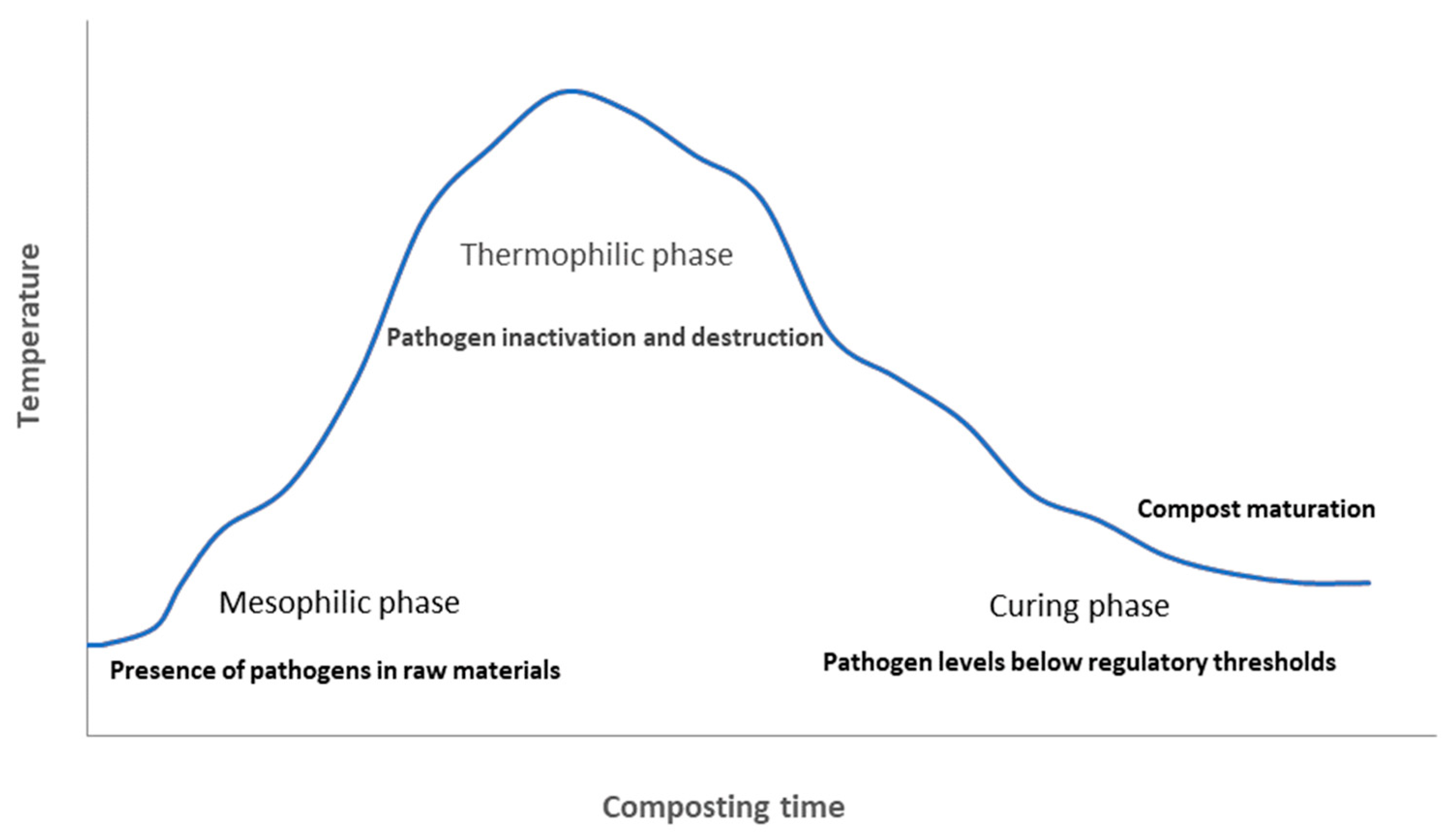
5. Composting for Human Pathogen Control and Production of Safe Organic Fertilizer
6. Agronomic Beneficial Effects of Compost
6.1. Soil Properties
6.1.1. Soil Organic Matter
6.1.2. Soil Mineral Nutrients
6.1.3. Soil Physical Properties
6.1.4. Soil Biological Properties
6.2. Plant Productivity
6.3. Control of Plant Pathogens
6.3.1. Biotic Effect
- Spatial and nutritional competition
- Production of antimicrobial substances
- Hyperparasitism
- Induction of systematic resistance
6.3.2. Abiotic Effect
7. Compost Maturity and Quality Indicators
7.1. Sensory Indicators
7.2. Physico-Chemical Characteristics
7.2.1. Moisture
7.2.2. pH
7.2.3. Cation Exchange Capacity (CEC)
7.2.4. Carbon to Nitrogen Ratio
7.2.5. Humification
7.3. Biological Characteristics
7.3.1. Biological Oxygen Demand
7.3.2. Phytotoxicity Level
7.3.3. Sanitary Quality
7.3.4. Weed Seeds
8. Compost Tea
8.1. Production Process
8.1.1. Compost Source
8.1.2. Aeration
8.1.3. Compost to Water Ratio
8.1.4. Brewing Time
8.1.5. Nutrient Additives
8.2. Compost Tea as Biofertilizer
8.3. Compost Tea as Biocontrol Solution
9. Recommendations and Prospects for Human Health and Environmentally Safe Composting
- -
- Strengthen the enforcement and monitoring of existing compost sanitation standards to ensure reliable pathogen reduction and better protect public and environmental health.
- -
- Develop standardized, long-term epidemiological and biomonitoring studies to clarify causal links between both agrochemical exposure and mismanaged organic wastes and health outcomes as well as to address current evidence gaps.
- -
- Avoid the direct use of raw manures as organic amendment due to their probable impacts on soil, plant, environment, and human health.
- -
- Adopt composting as a safe process to manage organic wastes, principally manure;
- -
- Maintain appropriate composting conditions to mitigate environmental risks such as gas emissions, leaching, and nutrient losses.
- -
- Incorporate mature compost into fertilization and plant protection programs to reduce over-reliance on synthetic fertilizers and pesticides.
- -
- Apply strict conditions during the preparation of compost teas to produce high-quality and safe products.
- -
- Consider the interrelationship between human health, environmental protection, and agricultural productivity within the One Health perspective, with the aim of ensuring that composting simultaneously protects public health, maintains ecosystem quality, and supports sustainable agricultural production.
10. Conclusions
Author Contributions
Funding
Institutional Review Board Statement
Informed Consent Statement
Data Availability Statement
Conflicts of Interest
References
- Duhamel, M.; Vandenkoornhuyse, P. Sustainable Agriculture: Possible Trajectories from Mutualistic Symbiosis and Plant Neodomestication. Trends Plant Sci. 2013, 18, 597–600. [Google Scholar] [CrossRef]
- Food and Agriculture Organization. World Fertilizer Trends and Outlook to 2022; FAO: Rome, Italy, 2019; ISBN 978-92-5-131894-2. [Google Scholar]
- Tagkas, C.F.; Rizos, E.C.; Markozannes, G.; Karalexi, M.A.; Wairegi, L.; Ntzani, E.E. Fertilizers and Human Health—A Systematic Review of the Epidemiological Evidence. Toxics 2024, 12, 694. [Google Scholar] [CrossRef]
- Essien, E.E.; Said Abasse, K.; Côté, A.; Mohamed, K.S.; Baig, M.M.F.A.; Habib, M.; Abbas, M. Drinking-Water Nitrate and Cancer Risk: A Systematic Review and Meta-Analysis. Arch. Environ. Occup. Health 2022, 77, 51–67. [Google Scholar] [CrossRef]
- Naz, S.; Fazio, F.; Habib, S.S.; Nawaz, G.; Attaullah, S.; Ullah, M.; Ahmed, I. Incidence of Heavy Metals in the Application of Fertilizers to Crops (Wheat and Rice), a Fish (Common carp) Pond and a Human Health Risk Assessment. Sustainability 2022, 14, 13441. [Google Scholar] [CrossRef]
- Kim, K.H.; Kabir, E.; Jahan, S.A. Exposure to Pesticides and the Associated Human Health Effects. Sci. Total Environ. 2017, 575, 525–535. [Google Scholar] [CrossRef]
- Asghar, U.; Malik, M.F.; Javed, A. Pesticide Exposure and Human Health: A Review. J. Ecosyst. Ecography 2016, S5, 5. [Google Scholar]
- Polley, S.; Biswas, S.; Kesh, S.S.; Maity, A.; Batabyal, S. The Link Between Animal Manure and Zoonotic Disease. In Animal Manure; Mahajan, S., Varma, A., Eds.; Soil Biology; Springer International Publishing: Cham, Switzerland, 2022; Volume 64, pp. 297–333. ISBN 978-3-030-97290-5. [Google Scholar]
- Islam, M.K.; Yaseen, T.; Traversa, A.; Kheder, M.B.; Brunetti, G.; Cocozza, C. Effects of the Main Extraction Parameters on Chemical and Microbial Characteristics of Compost Tea. Waste Manag. 2016, 52, 62–68. [Google Scholar] [CrossRef]
- Kumar, A.; Verma, J.P. Does Plant—Microbe Interaction Confer Stress Tolerance in Plants: A Review? Microbiol. Res. 2018, 207, 41–52. [Google Scholar] [CrossRef]
- Cogger, C.G. Potential Compost Benefits for Restoration of Soils Disturbed by Urban Development. Compos. Sci. Util. 2005, 13, 243–251. [Google Scholar] [CrossRef]
- Donn, S.; Wheatley, R.E.; McKenzie, B.M.; Loades, K.W.; Hallett, P.D. Improved Soil Fertility from Compost Amendment Increases Root Growth and Reinforcement of Surface Soil on Slopes. Ecol. Eng. 2014, 71, 458–465. [Google Scholar] [CrossRef]
- Ou-Zine, M.; Symanczik, S.; Rachidi, F.; Fagroud, M.; Aziz, L.; Abidar, A.; Mäder, P.; Achbani, E.H.; Haggoud, A.; Abdellaoui, M.; et al. Effect of Organic Amendment on Soil Fertility, Mineral Nutrition, and Yield of Majhoul Date Palm Cultivar in Drâa-Tafilalet Region, Morocco. J. Soil Sci. Plant Nutr. 2021, 21, 1745–1758. [Google Scholar] [CrossRef]
- Agegnehu, G.; Bass, A.M.; Nelson, P.N.; Bird, M.I. Benefits of Biochar, Compost and Biochar-Compost for Soil Quality, Maize Yield and Greenhouse Gas Emissions in a Tropical Agricultural Soil. Sci. Total Environ. 2016, 543, 295–306. [Google Scholar] [CrossRef]
- Aşkin, T.; Aygün, S. Does Hazelnut Husk Compost (HHC) Effect on Soil Water Holding Capacity (WHC)? An Environmental Approach. Eurasian J. Soil Sci. 2018, 7, 87–92. [Google Scholar] [CrossRef]
- Mohamed, O.Z.; Yassine, B.; El Hassan, A.; Abdellatif, H.; Rachid, B. Evaluation of Compost Quality and Bioprotection Potential against Fusarium Wilt of Date Palm. Waste Manag. 2020, 113, 12–19. [Google Scholar] [CrossRef] [PubMed]
- Ou-Zine, M.; El Hilali, R.; Haggoud, A.; Achbani, E.H.; Bouamri, R. Effects and Relationships of Compost Dose and Organic Additives on Compost Tea Properties, Efficacy Against Fusarium oxysporum and Potential Effect on Endomycorrhization and Growth of Zea mays L. Waste Biomass Valorization 2022, 13, 4431–4445. [Google Scholar] [CrossRef]
- Chalwe, H.M.; Lungu, O.I.; Mweetwa, A.M.; Phiri, E.; Njoroge, S.M.C.; Brandenburg, R.L.; Jordan, D.L. Effects of Compost Manure on Soil Microbial Respiration, Plant-Available-Water, Peanut (Arachis hypogaea L.) Yield and Pre-Harvest Aflatoxin Contamination. Peanut Sci. 2019, 46, 42–49. [Google Scholar] [CrossRef]
- Marzouk, H.A.; Kassem, H.A. Improving Fruit Quality, Nutritional Value and Yield of Zaghloul Dates by the Application of Organic and/or Mineral Fertilizers. Sci. Hortic. 2011, 127, 249–254. [Google Scholar] [CrossRef]
- D’Hose, T.; Cougnon, M.; Vliegher, A.; Vandecasteele, B.; Viaene, N.; Cornelis, W. The Positive Relationship between Soil Quality and Crop Production: A Case Study on the Effect of Farm Compost Application. Appl. Soil Ecol. 2014, 75, 189–198. [Google Scholar] [CrossRef]
- Barje, F.; Meddich, A.; El Hajjouji, H.; El Asli, A.; Ait Baddi, G.; El Faiz, A.; Hafidi, M. Growth of Date Palm (Phoenix dactylifera L.) in Composts of Olive Oil Mill Waste with Organic Household Refuse. Compos. Sci. Util. 2016, 24, 273–280. [Google Scholar] [CrossRef]
- Abdou, G.; Ewusi-Mensah, N.; Nouri, M.; Tetteh, F.M.; Safo, E.Y.; Abaidoo, R.C. Nutrient Release Patterns of Compost and Its Implication on Crop Yield under Sahelian Conditions of Niger. Nutr. Cycl. Agroecosystems 2016, 105, 117–128. [Google Scholar] [CrossRef]
- Abdel-Razzak, H.; Alkoaik, F.; Rashwan, M.; Fulleros, R.; Ibrahim, M. Tomato Waste Compost as an Alternative Substrate to Peat Moss for the Production of Vegetable Seedlings. J. Plant Nutr. 2019, 42, 287–295. [Google Scholar] [CrossRef]
- Zhang, X.; Davidson, E.A.; Mauzerall, D.L.; Searchinger, T.D.; Dumas, P.; Shen, Y. Managing Nitrogen for Sustainable Development. Nature 2015, 528, 51–59. [Google Scholar] [CrossRef]
- Raun, W.R.; Johnson, G.V. Improving Nitrogen Use Efficiency for Cereal Production. Agron. J. 1999, 91, 357–363. [Google Scholar] [CrossRef]
- Syers, J.K.; Johnston, A.E.; Curtin, D. Efficiency of Soil and Fertilizer Phosphorus Use: Reconciling Changing Concepts of Soil Phosphorus Behaviour with Agronomic Information; FAO Fertilizer and Plant Nutrition Bulletin; FAO: Rome, Italy, 2008; ISBN 978-92-5-105929-6. [Google Scholar]
- Pimentel, D. Amounts of Pesticides Reaching Target Pests: Environmental Impacts and Ethics. J. Agric. Environ. Ethics 1995, 8, 17–29. [Google Scholar] [CrossRef]
- Anderson, S.E.; Meade, B.J. Potential Health Effects Associated with Dermal Exposure to Occupational Chemicals. Environ. Health Insights 2014, 8s1, EHI.S15258. [Google Scholar] [CrossRef]
- Collin, M.S.; Venkatraman, S.K.; Vijayakumar, N.; Kanimozhi, V.; Arbaaz, S.M.; Stacey, R.S.; Swamiappan, S. Bioaccumulation of Lead (Pb) and Its Effects on Human: A Review. J. Hazard. Mater. Adv. 2022, 7, 100094. [Google Scholar] [CrossRef]
- Tasleem, S.; Masud, S.; Habib, S.S.; Naz, S.; Fazio, F.; Aslam, M.; Attaullah, S. Investigation of the Incidence of Heavy Metals Contamination in Commonly Used Fertilizers Applied to Vegetables, Fish Ponds, and Human Health Risk Assessments. Environ. Sci. Pollut. Res. 2023, 30, 100646–100659. [Google Scholar] [CrossRef] [PubMed]
- Correa, P. A Human Model of Gastric Carcinogenesis. Cancer Res. 1988, 48, 3554–3560. [Google Scholar]
- Zhou, W.; Li, M.; Achal, V. A Comprehensive Review on Environmental and Human Health Impacts of Chemical Pesticide Usage. Emerg. Contam. 2025, 11, 100410. [Google Scholar] [CrossRef]
- S, K.K.; Ibrahim, M.H.; Quaik, S.; Ismail, S.A. Introduction to Organic Wastes and Its Management. In Prospects of Organic Waste Management and the Significance of Earthworms; Springer International Publishing: Cham, Switzerland, 2016; pp. 1–21. ISBN 978-3-319-24706-9. [Google Scholar]
- Black, Z.; Balta, I.; Black, L.; Naughton, P.J.; Dooley, J.S.G.; Corcionivoschi, N. The Fate of Foodborne Pathogens in Manure Treated Soil. Front. Microbiol. 2021, 12, 781357. [Google Scholar] [CrossRef]
- Hermans, T.; Jeurissen, L.; Hackert, V.; Hoebe, C. Land-Applied Goat Manure as a Source of Human Q-Fever in the Netherlands, 2006–2010. PLoS ONE 2014, 9, e96607. [Google Scholar] [CrossRef]
- Hembach, N.; Bierbaum, G.; Schreiber, C.; Schwartz, T. Facultative Pathogenic Bacteria and Antibiotic Resistance Genes in Swine Livestock Manure and Clinical Wastewater: A Molecular Biology Comparison. Environ. Pollut. 2022, 313, 120128. [Google Scholar] [CrossRef]
- Atidégla, S.C.; Huat, J.; Agbossou, E.K.; Saint-Macary, H.; Glèlè Kakai, R. Vegetable Contamination by the Fecal Bacteria of Poultry Manure: Case Study of Gardening Sites in Southern Benin. Int. J. Food Sci. 2016, 2016, 4767453. [Google Scholar] [CrossRef]
- Zhu, L.; Lian, Y.; Lin, D.; Huang, D.; Yao, Y.; Ju, F.; Wang, M. Insights into Microbial Contamination in Multi-Type Manure-Amended Soils: The Profile of Human Bacterial Pathogens, Virulence Factor Genes and Antibiotic Resistance Genes. J. Hazard. Mater. 2022, 437, 129356. [Google Scholar] [CrossRef]
- Luna, S.; Krishnasamy, V.; Saw, L.; Smith, L.; Wagner, J.; Weigand, J.; Tewell, M.; Kellis, M.; Penev, R.; McCullough, L.; et al. Outbreak of E. coli O157:H7 Infections Associated with Exposure to Animal Manure in a Rural Community—Arizona and Utah, June–July 2017. MMWR Morb. Mortal. Wkly. Rep. 2018, 67, 659–662. [Google Scholar] [CrossRef]
- Ferronato, N.; Torretta, V. Waste Mismanagement in Developing Countries: A Review of Global Issues. Int. J. Environ. Res. Public Health 2019, 16, 1060. [Google Scholar] [CrossRef] [PubMed]
- Torretta, V.; Ferronato, N.; Katsoyiannis, I.; Tolkou, A.; Airoldi, M. Novel and Conventional Technologies for Landfill Leachates Treatment: A Review. Sustainability 2016, 9, 9. [Google Scholar] [CrossRef]
- Karak, T.; Bhattacharyya, P.; Das, T.; Paul, R.K.; Bezbaruah, R. Non-Segregated Municipal Solid Waste in an Open Dumping Ground: A Potential Contaminant in Relation to Environmental Health. Int. J. Environ. Sci. Technol. 2013, 10, 503–518. [Google Scholar] [CrossRef]
- Azim, K.; Soudi, B.; Boukhari, S.; Perissol, C.; Roussos, S.; Alami, I.T. Composting Parameters and Compost Quality: A Literature Review. Org. Agric. 2018, 8, 141–158. [Google Scholar] [CrossRef]
- Pergola, M.; Persiani, A.; Palese, A.M.; Meo, V.; Pastore, V.; D’Adamo, C.; Celano, G. Composting: The Way for a Sustainable Agriculture. Appl. Soil Ecol. 2018, 123, 744–750. [Google Scholar] [CrossRef]
- Zucconi, F.; Bertoldi, M. Compost Specifications for the Production and Characterization of Compost from Municipal Solid Waste. In Compost: Production, Quality and Use; De Bertoldi, M., Ferranti, M.P., L′Hermite, M.P., Zucconi, F., Eds.; Elsevier: London, UK, 1987; pp. 30–50. [Google Scholar]
- Berry, E.D.; Millner, P.D.; Wells, J.E.; Kalchayanand, N.; Guerini, M.N. Fate of Naturally Occurring Escherichia coli O157:H7 and Other Zoonotic Pathogens during Minimally Managed Bovine Feedlot Manure Composting Processes. J. Food Prot. 2013, 76, 1308–1321. [Google Scholar] [CrossRef]
- Hutchison, M.L.; Walters, L.D.; Avery, S.M.; Moore, A. Decline of Zoonotic Agents in Livestock Waste and Bedding Heaps. J. Appl. Microbiol. 2005, 99, 354–362. [Google Scholar] [CrossRef]
- Khadra, A.; Ezzariai, A.; Kouisni, L.; Hafidi, M. Helminth Eggs Inactivation Efficiency by Sludge Co-Composting under Arid Climates. Int. J. Environ. Health Res. 2021, 31, 530–537. [Google Scholar] [CrossRef]
- Manga, M.; Muoghalu, C.C.; Acheng, P.O. Inactivation of Faecal Pathogens during Faecal Sludge Composting: A Systematic Review. Environ. Technol. Rev. 2023, 12, 150–174. [Google Scholar] [CrossRef]
- Lepesteur, M. Human and Livestock Pathogens and Their Control during Composting. Crit. Rev. Environ. Sci. Technol. 2022, 52, 1639–1683. [Google Scholar] [CrossRef]
- Xu, W.; Reuter, T.; Inglis, G.D.; Larney, F.J.; Alexander, T.W.; Guan, J.; McAllister, T.A. A Biosecure Composting System for Disposal of Cattle Carcasses and Manure Following Infectious Disease Outbreak. J. Environ. Qual. 2009, 38, 437–450. [Google Scholar] [CrossRef]
- Feller, C.; Blanchart, E.; Bernoux, M.; Lal, R.; Manlay, R. Soil Fertility Concepts over the Past Two Centuries: The Importance Attributed to Soil Organic Matter in Developed and Developing Countries. Arch. Agron. Soil Sci. 2012, 58, S3–S21. [Google Scholar] [CrossRef]
- Adugna, G. A Review on Impact of Compost on Soil Properties, Water Use and Crop Productivity. Acad. Res. J. Agric. Sci. Res. 2016, 4, 93–104. [Google Scholar]
- Chehab, H.; Tekaya, M.; Ouhibi, M.; Gouiaa, M.; Zakhama, H.; Mahjoub, Z.; Mechri, B. Effects of Compost, Olive Mill Wastewater and Legume Cover Crops on Soil Characteristics, Tree Performance and Oil Quality of Olive Trees Cv. Chemlali grown under organic farming system. Sci. Hortic. 2019, 253, 163–171. [Google Scholar] [CrossRef]
- Lee, S.B.; Lee, C.H.; Jung, K.Y.; Do Park, K.; Lee, D.; Kim, P.J. Changes of Soil Organic Carbon and Its Fractions in Relation to Soil Physical Properties in a Long-Term Fertilized Paddy. Soil Tillage Res. 2009, 104, 227–232. [Google Scholar] [CrossRef]
- Garratt, M.P.; Bommarco, R.; Kleijn, D.; Martin, E.; Mortimer, S.R.; Redlich, S. Enhancing Soil Organic Matter as a Route to the Ecological Intensification of European Arable Systems. Ecosystems 2018, 21, 1404–1415. [Google Scholar] [CrossRef]
- Bouajila, K.; Sanaa, M. Effects of Organic Amendments on Soil Physico-Chemical and Biological Properties. J. Mater. Environ. Sci. 2011, 2, 485–490. [Google Scholar]
- Wei, W.; Yan, Y.; Cao, J.; Christie, P.; Zhang, F.; Fan, M. Effects of Combined Application of Organic Amendments and Fertilizers on Crop Yield and Soil Organic Matter: An Integrated Analysis of Long-Term Experiments. Agric. Ecosyst. Environ. 2016, 225, 86–92. [Google Scholar] [CrossRef]
- Roghanian, S.; Hosseini, H.M.; Savaghebi, G.; Halajian, L.; Jamei, M.; Etesami, H. Effects of Composted Municipal Waste and Its Leachate on Some Soil Chemical Properties and Corn Plant Responses. Int. J. Agric. Res. Rev. 2012, 2, 801–814. [Google Scholar]
- Mohamedelnour, A.; Taşkin, M.B.; Elamin, E.A. Influence of Composted Mesquite on Growth, Yield, Nutrients Content of Maize (Zea mays L.) and Some Soil Properties in Sudan. Int. J. Agric. Policy Res. 2019, 7, 41–47. [Google Scholar]
- Argaw, A. Organic and Inorganic Fertilizer Application Enhances the Effect of Bradyrhizobium on Nodulation and Yield of Peanut (Arachis hypogea L.) in Nutrient Depleted and Sandy Soils of Ethiopia. Int. J. Recycl. Org. Waste Agric. 2017, 6, 219–231. [Google Scholar] [CrossRef]
- Dhaliwal, M.K.; Dhaliwal, S.S. Impact of Manure and Fertilizers on Chemical Fractions of Zn and Cu in Soil under Rice-Wheat Cropping System. J. Indian Soc. Soil Sci. 2019, 67, 85–91. [Google Scholar] [CrossRef]
- Fernández-Hernández, A.; Roig, A.; Serramiá, N.; Civantos, C.G.O.; Sánchez-Monedero, M.A. Application of Compost of Two-Phase Olive Mill Waste on Olive Grove: Effects on Soil, Olive Fruit and Olive Oil Quality. Waste Manag. 2014, 34, 1139–1147. [Google Scholar] [CrossRef] [PubMed]
- Noor, R.S.; Hussain, F.; Abbas, I.; Umair, M.; Sun, Y. Effect of Compost and Chemical Fertilizer Application on Soil Physical Properties and Productivity of Sesame (Sesamum indicum L.). Biomass Convers. Biorefinery 2020, 13, 905–915. [Google Scholar] [CrossRef]
- Kranz, C.N.; McLaughlin, R.A.; Johnson, A.; Miller, G.; Heitman, J.L. The Effects of Compost Incorporation on Soil Physical Properties in Urban Soils—A Concise Review. J. Environ. Manag. 2020, 261, 110209. [Google Scholar] [CrossRef] [PubMed]
- Mohammadshirazi, F.; Brown, V.K.; Heitman, J.L.; McLaughlin, R.A. Effects of Tillage and Compost Amendment on Infiltration in Compacted Soils. J. Soil Water Conserv. 2016, 71, 443–449. [Google Scholar] [CrossRef]
- Mohammadshirazi, F.; McLaughlin, R.A.; Heitman, J.L.; Brown, V.K. A Multi-Year Study of Tillage and Amendment Effects on Compacted Soils. J. Environ. Manag. 2017, 203, 533–541. [Google Scholar] [CrossRef]
- Sax, M.S.; Bassuk, N.; Es, H.; Rakow, D. Long-Term Remediation of Compacted Urban Soils by Physical Fracturing and Incorporation of Compost. Urban For. Urban Green. 2017, 24, 149–156. [Google Scholar] [CrossRef]
- Somerville, P.D.; May, P.B.; Livesley, S.J. Effects of Deep Tillage and Municipal Green Waste Compost Amendments on Soil Properties and Tree Growth in Compacted Urban Soils. J. Environ. Manag. 2018, 227, 365–374. [Google Scholar] [CrossRef]
- Tittarelli, F.; Petruzzelli, G.; Pezzarossa, B.; Civilini, M.; Benedetti, A.; Sequi, P. Quality and Agronomic Use of Compost. In Waste Management Series; Elsevier: Amsterdam, The Netherlands, 2007; Volume 8, pp. 119–157. [Google Scholar]
- Sayara, T.; Basheer-Salimia, R.; Hawamde, F.; Sánchez, A. Recycling of Organic Wastes through Composting: Process Performance and Compost Application in Agriculture. Agronomy 2020, 10, 1838. [Google Scholar] [CrossRef]
- Somerville, P.D.; Farrell, C.; May, P.B.; Livesley, S.J. Biochar and Compost Equally Improve Urban Soil Physical and Biological Properties and Tree Growth, with No Added Benefit in Combination. Sci. Total Environ. 2020, 706, 135736. [Google Scholar] [CrossRef]
- Brown, S.; Cotton, M. Changes in Soil Properties and Carbon Content Following Compost Application: Results of on-Farm Sampling. Compos. Sci. Util. 2011, 19, 87–96. [Google Scholar] [CrossRef]
- Zhen, Z.; Liu, H.; Wang, N.; Guo, L.; Meng, J.; Ding, N. Effects of Manure Compost Application on Soil Microbial Community Diversity and Soil Microenvironments in a Temperate Cropland in China. PLoS ONE 2014, 9, 108555. [Google Scholar] [CrossRef]
- Caporale, A.G.; Vingiani, S.; Palladino, M.; El-Nakhel, C.; Duri, L.G.; Pannico, A.; Rouphael, Y.; Pascale, S.; Adamo, P. Geo-Mineralogical Characterisation of Mars Simulant MMS-1 and Appraisal of Substrate Physico-Chemical Properties and Crop Performance Obtained with Variable Green Compost Amendment Rates. Sci. Total Environ. 2020, 720, 137543. [Google Scholar] [CrossRef]
- Filipović, V.; Ugrenović, V.; Popović, V.; Dimitrijević, S.; Popović, S.; Aćimović, M.; Pezo, L. Productivity and Flower Quality of Different Pot Marigold (Calendula officinalis L.) Varieties on the Compost Produced from Medicinal Plant Waste. Ind. Crops Prod. 2023, 192, 116093. [Google Scholar] [CrossRef]
- Meddich, A.; Oufdou, K.; Boutasknit, A.; Raklami, A.; Tahiri, A.; Ben-Laouane, R.; Baslam, M. Use of Organic and Biological Fertilizers as Strategies to Improve Crop Biomass, Yields and Physicochemical Parameters of Soil. In Nutrient Dynamics for Sustainable Crop Production; Springer: Singapore, 2020; pp. 247–288. [Google Scholar]
- Benabderrahim, M.A.; Elfalleh, W.; Belayadi, H.; Haddad, M. Effect of Date Palm Waste Compost on Forage Alfalfa Growth, Yield, Seed Yield and Minerals Uptake. Int. J. Recycl. Org. Waste Agric. 2018, 7, 1–9. [Google Scholar] [CrossRef]
- Caporale, A.G.; Paradiso, R.; Liuzzi, G. Green Compost Amendment Improves Potato Plant Performance on Mars Regolith Simulant as Substrate for Cultivation in Space. Plant Soil 2023, 486, 217–233. [Google Scholar] [CrossRef]
- Eissa, M.A.; Al-Yasi, H.M.; Ghoneim, A.M. Nitrogen and Compost Enhanced the Phytoextraction Potential of Cd and Pb from Contaminated Soils by Quail Bush [Atriplex lentiformis (Torr.) S.Wats]. J. Soil Sci. Plant Nutr. 2022, 22, 177–185. [Google Scholar] [CrossRef]
- Anli, M.; Baslam, M.; Tahiri, A.; Raklami, A.; Symanczik, S.; Boutasknit, A.; Meddich, A. Biofertilizers as Strategies to Improve Photosynthetic Apparatus, Growth, and Drought Stress Tolerance in the Date Palm. Front. Plant Sci. 2020, 11, 516818. [Google Scholar] [CrossRef]
- El Kinany, S.; Achbani, E.; Faggroud, M.; Ouahmane, L.; El Hilali, R.; Haggoud, A.; Bouamri, R. Effect of Organic Fertilizer and Commercial Arbuscular Mycorrhizal Fungi on the Growth of Micropropagated Date Palm Cv. Feggouss. J. Saudi Soc. Agric. Sci. 2019, 18, 411–417. [Google Scholar] [CrossRef]
- Zhang, X.; Wang, H.; Hui, X.; Wang, Z.; Liu, J. Effects of Different Fertilization and Fallowing Practices on Soil Carbon and Nitrogen Mineralization in a Dryland Soil with Low Organic Matter. J. Soil Sci. Plant Nutr. 2019, 19, 108–116. [Google Scholar] [CrossRef]
- Reddy, N.; Crohn, D.M. Effect of Composted Greenwaste and Rockwool on Plant Growth of Okra, Tomato, and Chili Peppers. Compos. Sci. Util. 2018, 26, 217–224. [Google Scholar] [CrossRef]
- Hoitink, H.A.J.; Schmitthenner, A.F.; Herr, L.J. Composted Bark for Control of Root Rot in Ornamentals. J. Arboric. 1975, 1, 217. [Google Scholar] [CrossRef]
- Corato, U. Disease-suppressive compost enhances natural soil suppressiveness against soil-borne plant pathogens: A critical review. Rhizosphere 2020, 13, 100192. [Google Scholar] [CrossRef]
- Mehta, C.M.; Palni, U.; Franke-Whittle, I.H.; Sharma, A.K. Compost: Its Role, Mechanism and Impact on Reducing Soil-Borne Plant Diseases. Waste Manag. 2014, 34, 607–622. [Google Scholar] [CrossRef]
- Yogev, A.; Raviv, M.; Hadar, Y.; Cohen, R.; Katan, J. Plant Waste-Based Composts Suppressive to Diseases Caused by Pathogenic Fusarium Oxysporum. Eur. J. Plant Pathol. 2006, 116, 267–278. [Google Scholar] [CrossRef]
- Noble, R.; Coventry, E. Suppression of Soil-Borne Plant Diseases with Composts: A Review. Biocontrol Sci. Technol. 2005, 15, 3–20. [Google Scholar] [CrossRef]
- Milinković, M.; Lalević, B.; Jovičić-Petrović, J.; Golubović-Ćurguz, V.; Kljujev, I.; Raičević, V. Biopotential of Compost and Compost Products Derived from Horticultural Waste—Effect on Plant Growth and Plant Pathogens’ Suppression. Process Saf. Environ. Prot. 2019, 121, 299–306. [Google Scholar] [CrossRef]
- Hoitink, H.A.J.; Changa, C.M. Managing soil-borne pathogens. Acta Hortic. 2004, 635, 87–92. [Google Scholar] [CrossRef]
- Diánez, F.; Santos, M.; Tello, J.C. Suppression of Soilborne Pathogens by Compost: Suppressive Effects of Grape Marc Compost on Phytopathogenic Oomycetes. In Proceedings of the International Symposium on Soilless Culture and Hydroponics 697, Almería, Spain, 14–19 November 2004; pp. 441–460. [Google Scholar]
- You, M.P.; Sivasithamparam, K. Changes in Microbial Populations of an Avocado Plantation Mulch Suppressive of Phytophthora cinnamomi. Appl. Soil Ecol. 1995, 2, 33–43. [Google Scholar] [CrossRef]
- Kyselková, M.; Moënne-Loccoz, Y. Pseudomonas and Other Microbes in Disease-Suppressive Soils. Org. Fertil. Soil Qual. Hum. Health-Sustain. Agric. Rev. 2012, 9, 93–140. [Google Scholar]
- San Fulgencio, N.S.; Suárez-Estrella, F.; López, M.J.; Jurado, M.M.; López-González, J.A.; Moreno, J. Biotic Aspects Involved in the Control of Damping-off Producing Agents: The Role of the Thermotolerant Microbiota Isolated from Composting of Plant Waste. Biol. Control 2018, 124, 82–91. [Google Scholar] [CrossRef]
- Heydari, A.; Pessarakli, M. A Review on Biological Control of Fungal Plant Pathogens Using Microbial Antagonists. J. Biol. Sci. 2010, 10, 273–290. [Google Scholar] [CrossRef]
- Pal, K.K.; Gardener, B.M. Biological Control of Plant Pathogens. Plant Health Instr. 2006, 2, 1117–1142. [Google Scholar] [CrossRef]
- Zhang, W.; Dick, W.A.; Hoitink, H.A.J. Compost-Induced Systemic Acquired Resistance in Cucumber to Pythium Root Rot and Anthracnose. Phytopathology 1996, 86, 1066–1070. [Google Scholar] [CrossRef]
- Bahramisharif, A.; Rose, L.E. Efficacy of Biological Agents and Compost on Growth and Resistance of Tomatoes to Late Blight. Planta 2019, 249, 799–813. [Google Scholar] [CrossRef] [PubMed]
- Avilés, M.; Borrero, C.; Trillas, M.I. Review on Compost as an Inducer of Disease Suppression in Plants Grown in Soilless Culture. Dyn. Soil Dyn. Plant 2011, 5, 1–10. [Google Scholar]
- Pane, C.; Spaccini, R.; Piccolo, A.; Scala, F.; Bonanomi, G. Compost Amendments Enhance Peat Suppressiveness to Pythium ultimum, Rhizoctonia solani and Sclerotinia minor. Biol. Control 2011, 56, 115–124. [Google Scholar] [CrossRef]
- Siddiqui, Y.; Meon, S.; Ismail, M.R.; Ali, A. Trichoderma-Fortified Compost Extracts for the Control of Choanephora Wet Rot in Okra Production. Crop Prot. 2008, 27, 385–390. [Google Scholar] [CrossRef]
- Spatafora, C.; Tringali, C. Valorization of Vegetable Waste: Identification of Bioactive Compounds and Their Chemo-Enzymatic Optimization. Open Agric. J. 2012, 6, 9–16. [Google Scholar] [CrossRef]
- California Compost Quality Council. Compost Maturity Index; California Compost Quality Council: Nevada City, CA, USA, 2001. [Google Scholar]
- Lasaridi, K.; Protopapa, I.; Kotsou, M.; Pilidis, G.; Manios, T.; Kyriacou, A. Quality Assessment of Composts in the Greek Market: The Need for Standards and Quality Assurance. J. Environ. Manag. 2006, 80, 58–65. [Google Scholar] [CrossRef] [PubMed]
- Stoffella, P.J.; Kahn, B.A. (Eds.) Compost Utilization in Horticultural Cropping Systems; Jewil Publishers: Nanning, China; CRC Press LLC: Boca Raton, FL, USA, 2001. [Google Scholar]
- Larbi, M. Influence de la Qualité des Composts et de Leurs Extraits sur la Protection des Plantes Contre les Maladies Fongiques. Doctoral Dissertation, University of Neuchâtel, Neuchâtel, Switzerland, 2006. [Google Scholar]
- Wichuk, K.M.; McCartney, D. Compost Stability and Maturity Evaluation—A Literature Review. J. Environ. Eng. Sci. 2013, 8, 601–620. [Google Scholar] [CrossRef]
- Harada, Y.; Inoko, A. The Measurement of the Cation-Exchange Capacity of Composts for the Estimation of the Degree of Maturity. Soil Sci. Plant Nutr. 1980, 26, 127–134. [Google Scholar] [CrossRef]
- Ko, H.J.; Kim, K.Y.; Kim, H.T.; Kim, C.N.; Umeda, M. Evaluation of Maturity Parameters and Heavy Metal Contents in Composts Made from Animal Manure. Waste Manag. 2008, 28, 813–820. [Google Scholar] [CrossRef]
- Golueke, G.C. Principles of Biological Resource Recovery. BioCycle 1981, 22, 36–40. [Google Scholar]
- Bernal, M.P.; Sommer, S.G.; Chadwick, D.; Qing, C.; Guoxue, L.; Michel, F.C. Current Approaches and Future Trends in Compost Quality Criteria for Agronomic, Environmental, and Human Health Benefits. In Advances in Agronomy; Elsevier: Amsterdam, The Netherlands, 2017; Volume 144, pp. 143–233. ISBN 978-0-12-812419-2. [Google Scholar]
- Kapanen, A.; Itävaara, M. Ecotoxicity Tests for Compost Applications. Ecotoxicol. Environ. Saf. 2001, 49, 1–16. [Google Scholar] [CrossRef]
- Barral, M.T.; Paradelo, R. A Review on the Use of Phytotoxicity as a Compost Quality Indicator. Dyn. Soil Dyn. Plant 2011, 5, 36–44. [Google Scholar]
- Zucconi, F.; Forte, M.; Monaco, A.; Bertoldi, M. Biological Evaluation of Compost Maturity. BioCycle 1981, 22, 27–29. [Google Scholar]
- Jones, P.; Martin, M. A Review of the Literature on the Occurrence and Survival of Pathogens of Animals and Humans in Green Compost; WRAP Standard Report; Waste Resources Action Programme: Newbury, UK, 2003. [Google Scholar]
- Bernal-Vicente, A.; Ros, M.; Tittarelli, F.; Intrigliolo, F.; Pascual, J.A. Citrus Compost and Its Water Extract for Cultivation of Melon Plants in Greenhouse Nurseries. Evaluation of nutriactive and biocontrol effects. Bioresour. Technol. 2008, 99, 8722–8728. [Google Scholar] [CrossRef]
- Liu, T.; Wang, M.; Awasthi, M.K.; Chen, H.; Awasthi, S.K.; Duan, Y.; Zhang, Z. Measurement of Cow Manure Compost Toxicity and Maturity Based on Weed Seed Germination. J. Clean. Prod. 2020, 245, 118894. [Google Scholar] [CrossRef]
- Grundy, A.C.; Green, J.M.; Lennartsson, M. The Effect of Temperature on the Viability of Weed Seeds in Compost. Compos. Sci. Util. 1998, 6, 26–33. [Google Scholar] [CrossRef]
- Eudoxie, G.; Martin, M. Compost Tea Quality and Fertility. In Organic Fertilizers-History, Production and Applications; IntechOpen: London, UK, 2019. [Google Scholar]
- Ingham, E. The Compost Tea Brewing Manual; Soil Food Web Incorporated: Corvallis, OR, USA, 2005. [Google Scholar]
- Kannangara, T.; Forge, T.; Dang, B. Effects of Aeration, Molasses, Kelp, Compost Type, and Carrot Juice on the Growth of Escherichia Coli in Compost Teas. Compos. Sci. Util. 2006, 14, 40–47. [Google Scholar] [CrossRef]
- Shrestha, K.; Shrestha, P.; Walsh, K.B.; Harrower, K.M.; Midmore, D.J. Microbial Enhancement of Compost Extracts Based on Cattle Rumen Content Compost–Characterisation of a System. Bioresour. Technol. 2011, 102, 8027–8034. [Google Scholar] [CrossRef] [PubMed]
- Naidu, Y.; Meon, S.; Kadir, J.; Siddiqui, Y. Microbial Starter for the Enhancement of Biological Activity of Compost Tea. Int. J. Agric. Biol 2010, 12, 51–56. [Google Scholar]
- Pant, A.P.; Radovich, T.J.; Hue, N.V.; Talcott, S.T.; Krenek, K.A. Vermicompost Extracts Influence Growth, Mineral Nutrients, Phytonutrients and Antioxidant Activity in Pak Choi (Brassica rapa Cv. Bonsai, Chinensis Group) Grown under Vermicompost and Chemical Fertiliser. J. Sci. Food Agric. 2009, 89, 2383–2392. [Google Scholar] [CrossRef]
- Carballo, T.; Gil, M.V.; Calvo, L.F.; Morán, A. The Influence of Aeration System, Temperature and Compost Origin on the Phytotoxicity of Compost Tea. Compos. Sci. Util. 2009, 17, 127–139. [Google Scholar] [CrossRef]
- Scheuerell, S.J.; Mahaffee, W.F. Compost Tea as a Container Medium Drench for Suppressing Seedling Damping-off Caused by Pythium ultimum. Phytopathology 2004, 94, 1156–1163. [Google Scholar] [CrossRef] [PubMed]
- Weltzien, H.C. The Use of Composted Materials for Leaf Disease Suppression in Field Crops. In Monograph—British Crop Protection Council; British Crop Protection Council: London, UK, 1990; pp. 115–120. [Google Scholar]
- Xu, D.; Zhao, S.; Xiong, Y.; Peng, C.; Xu, X.; Si, G. Biological, Physicochemical, and Spectral Properties of Aerated Compost Extracts: Influence of Aeration Quantity. Commun. Soil Sci. Plant Anal. 2015, 46, 2295–2310. [Google Scholar] [CrossRef]
- Zhang, W.; Han, D.Y.; Dick, W.A.; Davis, K.R.; Hoitink, H.A.J. Compost and Compost Water Extract-Induced Systemic Acquired Resistance in Cucumber and Arabidopsis. Phytopathology 1998, 88, 450–455. [Google Scholar] [CrossRef]
- Scheuerell, S.; Mahaffee, W.F. Compost Tea: Principles and Prospects for Plant Disease Control. Compos. Sci. Util. 2002, 10, 313–338. [Google Scholar] [CrossRef]
- Visser, S.A. Physiological Action of Humic Substances on Microbial Cells. Soil Biol. Biochem. 1985, 17, 457–462. [Google Scholar] [CrossRef]
- Pant, A.P.; Radovich, T.J.; Hue, N.V.; Paull, R.E. Biochemical Properties of Compost Tea Associated with Compost Quality and Effects on Pak Choi Growth. Sci. Hortic. 2012, 148, 138–146. [Google Scholar] [CrossRef]
- González-Hernández, A.I.; Suárez-Fernández, M.B.; Pérez-Sánchez, R.; Gómez-Sánchez, M.Á.; Morales-Corts, M.R. Compost Tea Induces Growth and Resistance against Rhizoctonia solani and Phytophthora capsici in Pepper. Agronomy 2021, 11, 781. [Google Scholar] [CrossRef]
- Samet, M.; Charfeddine, M.; Kamoun, L.; Nouri-Ellouze, O.; Gargouri-Bouzid, R. Effect of Compost Tea Containing Phosphogypsum on Potato Plant Growth and Protection against Fusarium Solani Infection. Environ. Sci. Pollut. Res. 2018, 25, 18921–18937. [Google Scholar] [CrossRef] [PubMed]
- Osman, H.S.; Rady, A.M.S.; Awadalla, A.; Omara, A.E.-D.; Hafez, E.M. Improving the Antioxidants System, Growth, and Sugar Beet Quality Subjected to Long-Term Osmotic Stress by Phosphate Solubilizing Bacteria and Compost Tea. Int. J. Plant Prod. 2022, 16, 119–135. [Google Scholar] [CrossRef]
- Villecco, D.; Pane, C.; Ronga, D.; Zaccardelli, M. Enhancing Sustainability of Tomato, Pepper and Melon Nursery Production Systems by Using Compost Tea Spray Applications. Agronomy 2020, 10, 1336. [Google Scholar] [CrossRef]
- Nofal, A.M.; Abd El-Rahman, M.; Alharbi, A.A.; Abdelghany, T.M. Ecofriendly Method for Suppressing Damping-off Disease Caused by Rhizoctonia solani Using Compost Tea. BioResources 2021, 16, 6378–6391. [Google Scholar] [CrossRef]


| Compost Rate | Compost Composition (%) | Experimental Conditions | Crop | Yield | Plant Growth | Mineral Nutrition | Soil Fertility | Stress Mitigation | Reference |
|---|---|---|---|---|---|---|---|---|---|
| 30% (v/v; compost/poor-nutrient substrate) | OM 45.2 N 2.1 (Calculated basing on mixture rate) | Greenhouse conditions using Mars regolith simulant as substrate | Potato | + | + | ND | + | ND | [79] |
| 10 g kg−1 soil | OM 70.0 N 1.5 P 0.4 K 0.7 | Pot experiment conducted for 1 year | Quail Bush | + | + | + | ND | + (Cd and Pb contaminated soil) | [80] |
| 100 kg/tree | OM 32.4 N 0.9 P 2.1 K 1.5 | Field trail conducted for 2 years | Date palm | + | ND | + | + | ND | [13] |
| 5% (w/w; compost/soil) | OM 46.9 N 1.3 P 0.3 | Greenhouse conditions | Date palm | ND | + | + | + | + hydric stress) | [81] |
| 25% (v/v; compost/soil) | OM 32.5 N 1.3 P 1.7 K 1.2 | 12-month trial under greenhouse conditions | Date palm | ND | + | + | ND | ND | [82] |
| 5 ton ha−1 | OM 18.4 N 10.6 P 2.5 K 14.7 | Field trial conducted for 3 years | Olive | + | + | + | + | ND | [54] |
| 15 ton ha−1 | OM 62.4 N 1.1 P 0.1 K 0.8 | Field trial conducted for 3 years | Pear | + | ND | ND | + | ND | [83] |
| 25 ton ha−1 | OM 78.0 N 0.6 P 0.3 K 0.7 | 3-month trial under greenhouse conditions | Tomato | ND | + | ND | ND | ND | [84] |
| Compost Source | Compost to Water Ratio | Additive | Brewing Time (h) | Result | Reference |
|---|---|---|---|---|---|
| Arboreal wood, cattle and poultry manure, and olive pomace | 1/5 1/10 | Date syrup (0.5%) + humic acid (0.1%) Molasses (0.5%) + humic acid (0.1%) | 24 48 |
| [17] |
| Olive pruning residues, bovine manure, and wheat straw | 1/2.5 1/5 1/10 | Not added | 48 96 144 |
| [9] |
| Dairy manure Swine manure Horse manure | 1/40 | Molasses + kelp (0.4%) Carrot juice | 48 |
| [122] |
| Cattle rumen | 1/10 1/100 1/1000 | Molasses (0.5%) + kelp and fish hydrolysate (1%) | 48 |
| [123] |
| Agricultural wastes | 1/5 | Humic acid (0.8%) + yeast extract (1.4%) Peptone (1.4%) Brown sugar (0.8%) Kelp (0.8%) Corn meal (1.4%) | 72 |
| [124] |
| Chicken manure | 1/10 | Humic acid (0.1%) + kelp extract (0.3%) | 12 |
| [125] |
| Bovine manure and municipal solid waste | 1/10 | Not added | 48 |
| [126] |
| Chicken manure | 1/25 | Molasses (0.3%) Hydrolyzed yeast (0.3%) | 36 |
| [127] |
Disclaimer/Publisher’s Note: The statements, opinions and data contained in all publications are solely those of the individual author(s) and contributor(s) and not of MDPI and/or the editor(s). MDPI and/or the editor(s) disclaim responsibility for any injury to people or property resulting from any ideas, methods, instructions or products referred to in the content. |
© 2026 by the authors. Licensee MDPI, Basel, Switzerland. This article is an open access article distributed under the terms and conditions of the Creative Commons Attribution (CC BY) license.
Share and Cite
Ou-Zine, M.; El Kinany, S.; Ezrari, S.; Bouamri, R. A One Health Approach Involving Composting and Compost: Balancing Human Health Risks and Agricultural Benefits. Agrochemicals 2026, 5, 4. https://doi.org/10.3390/agrochemicals5010004
Ou-Zine M, El Kinany S, Ezrari S, Bouamri R. A One Health Approach Involving Composting and Compost: Balancing Human Health Risks and Agricultural Benefits. Agrochemicals. 2026; 5(1):4. https://doi.org/10.3390/agrochemicals5010004
Chicago/Turabian StyleOu-Zine, Mohamed, Said El Kinany, Said Ezrari, and Rachid Bouamri. 2026. "A One Health Approach Involving Composting and Compost: Balancing Human Health Risks and Agricultural Benefits" Agrochemicals 5, no. 1: 4. https://doi.org/10.3390/agrochemicals5010004
APA StyleOu-Zine, M., El Kinany, S., Ezrari, S., & Bouamri, R. (2026). A One Health Approach Involving Composting and Compost: Balancing Human Health Risks and Agricultural Benefits. Agrochemicals, 5(1), 4. https://doi.org/10.3390/agrochemicals5010004