Case Report

Intracranial Mesenchymal Tumors with FET::CREB Fusion: Case Report and Systematic Review of the Literature


1
Department of Neurosurgery, National Neuroscience Institute, 11 Jalan Tan Tock Seng, Singapore 308433, Singapore
2
Department of Pathology, Tan Tock Seng Hospital, 11 Jalan Tan Tock Seng, Singapore 308433, Singapore
3
Department of Pathology and Laboratory Medicine, KK Women’s and Children’s Hospital, 100 Bukit Timah Road, Singapore 229899, Singapore
4
Neurosurgical Service, KK Women’s and Children’s Hospital, 100 Bukit Timah Road, Singapore 229899, Singapore
5
SingHealth Duke-NUS Neuroscience Academic Clinical Program, 11 Jalan Tan Tock Seng, Singapore 308433, Singapore
*
Author to whom correspondence should be addressed.
Targets 2026, 4(2), 17; https://doi.org/10.3390/targets4020017
Submission received: 27 February 2026 / Revised: 29 April 2026 / Accepted: 7 May 2026 / Published: 11 May 2026

Abstract

Intracranial mesenchymal tumors (IMTs) with FET::CREB fusion are rare mesenchymal neoplasms that rely on the confirmation of the molecular hallmark FET::CREB gene fusion for diagnosis. We report a case of a 53-year-old female presenting with neurocognitive decline and seizures. Neuroimaging demonstrated a heterogeneously enhancing solid-cystic lesion in the left frontal lobe. Gross total resection (GTR) of the tumor was achieved and the patient recovered to premorbid status. Definitive diagnosis was achieved via next-generation sequencing that identified an EWSR1 (exon 7)::CREM (exon 7) fusion transcript. A systematic literature review of 72 IMTs with FET::CREB-positive cases was performed in accordance with the Preferred Reporting Items for Systematic Reviews and Meta-Analyses (PRISMA) 2020 guidelines. Publications reporting confirmed FET::CREB fusion-positive IMTs, without restriction on year of publication, were included to analyze clinicopathological correlations and prognostic determinants. Mean age at diagnosis was 27.8 (±18.3). Patients who underwent GTR demonstrated a significantly lower rate of recurrence compared to those who underwent subtotal resection (STR) (p < 0.001), suggesting that extent of resection may be an important prognostic factor; however, causal inference is precluded by the observational nature of the data. Patients who received adjuvant therapy had a higher rate of recurrence (p = 0.043); however, this association is likely attributable to confounding by indication, as adjuvant treatment was predominantly administered to patients with subtotal resection or more aggressive disease. No causal inference regarding adjuvant therapy efficacy can be drawn from these data. Our study results corroborate that accurate diagnosis relies on molecular interrogation and the extent of resection appears to be an important prognostic factor for IMTs with FET::CREB fusion.

1. Introduction

Intracranial mesenchymal tumors (IMTs) with FET::CREB fusion are exceptionally rare primary intracranial neoplasms; fewer than 80 confirmed cases have been reported in the medical literature to date [1,2,3]. To date, the largest published systematic datasets include Mezzacappa et al. [1] who identified 74 cases through a literature review up to September 2023, and Rajan et al. [4] who characterized 81 cases via integrative methylation profiling. Our own systematic literature review, extending the search to January 2026, independently identified 71 cases from the published literature (with our index patient comprising the 72nd case in our cohort). Given the methodological and temporal overlap between these datasets, a non-overlapping cumulative total cannot be reliably stated; rather, these figures collectively reflect the overall rarity of this tumor entity. A slight female predominance (female versus male ratio approximately 1.5) and a median age at diagnosis of approximately 23 years old (range 4 to 79 years) are consistently reported across the literature [5,6,7].
Broadly speaking, mesenchymal tumors are soft tissue neoplasms arising from organs of mesodermal origin, typically localized to the subcutaneous tissue of limb extremities in young adults [8]. Tumor involvement of the central nervous system (CNS) is uncommon. Insights from molecular research have identified a distinct, primary IMT with fusion of FET protein family members to the cyclic adenosine monophosphate response element-binding protein (CREB) family of transcription factors (henceforth, known as IMT with FET::CREB fusion). Molecular investigations have established that this rare subset of mesenchymal tumors possesses unique molecular and immunohistochemical profiles [9]. Historically, tumors were termed as intracranial angiomatoid fibrous histiocytoma (AFH); following that, they are currently referred to as intracranial myxoid mesenchymal tumors—a unique subset of intracranial mesenchymal tumors (IMT) that harbor EWSR1-CREB1, EWSR1-CREM, or EWSR1-ATF1 fusions and morphologically overlap with AFH [5,6].
Recently, IMT became a recognized entity in the World Health Organization (WHO) 2021 Classification of Tumors of the Central Nervous System [1,2]. This updated classification distinguishes IMT with FET::CREB fusion tumors as a separate histo-molecular neoplasm under mesenchymal, non-meningothelial tumors, under a subcategory named ‘tumors of uncertain differentiation’ [10]. Owing to its infrequency, diagnosis based on conventional clinico-radiological and histopathology approaches is often misleading. Common misdiagnosed differentials include meningioma, solitary fibrous tumor and primary intracranial sarcoma (DICER1-mutant) [11,12]. Specific knowledge gaps remain, including: (i) the prognostic significance of individual FET::CREB fusion subtypes (e.g., EWSR1::ATF1 vs. EWSR1::CREM vs. EWSR1::CREB1) is incompletely defined; (ii) optimal thresholds and modalities for adjuvant therapy following subtotal resection (STR) are not established; (iii) the role of epigenetic subclassification (subclass A versus B) in guiding treatment decisions is under active investigation; and (iv) multi-ethnic cohort data are lacking, limiting the generalizability of published prognostic estimates to non-Western populations [1,2,3].
We herein report a diagnostically challenging case of intracranial mesenchymal tumor with FET::CREB fusion, in which definitive diagnosis was achieved with next-generation sequencing (NGS). A concurrent systematic literature review was performed to corroborate our findings. The purpose of this study is two-fold: first, to describe a diagnostically challenging case of IMT with FET::CREB fusion in which definitive diagnosis was achieved through RNA-based NGS, highlighting the indispensable role of molecular testing; and next, to perform a systematic literature review to characterize the clinicopathological correlates and prognostic determinants of this rare entity. The latter specifically emphasizes the association between extent of surgical resection, use of adjuvant therapy, and disease recurrence, with the aim of informing clinical decision-making in the absence of formal treatment guidelines.

2. Case Description

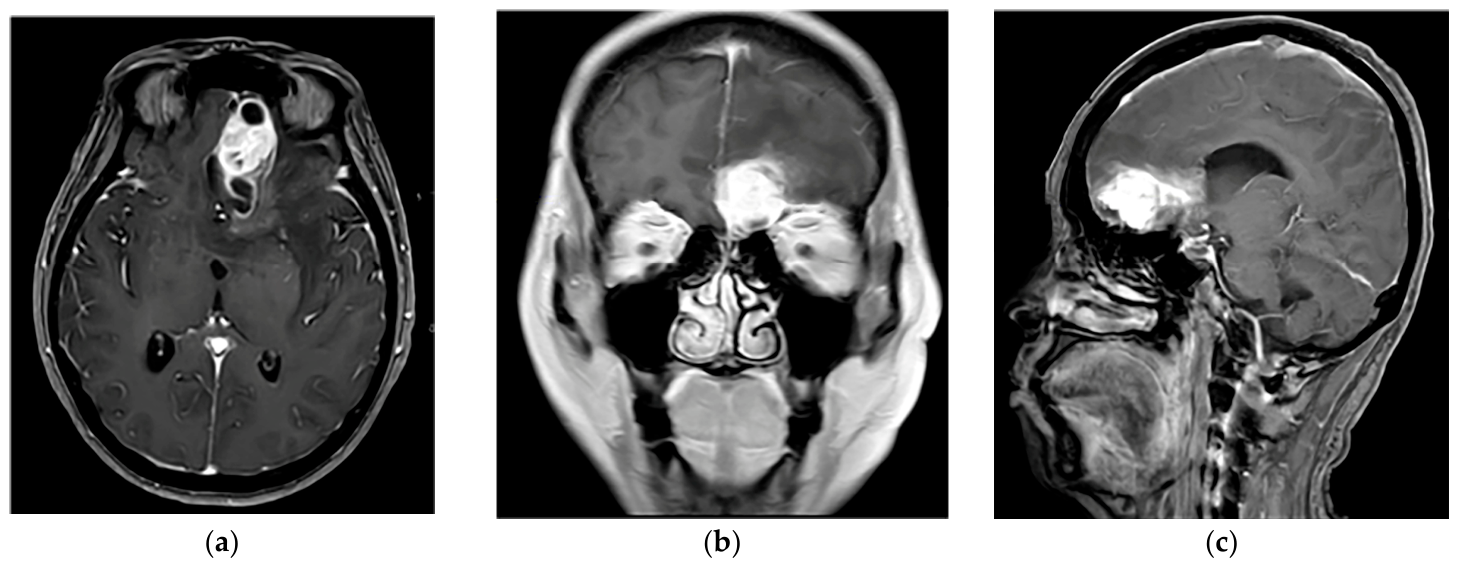
A previously well 53-year-old female with no significant prior medical history was not taking any regular systemic medications at the time of presentation. No prior radiotherapy or chemotherapy exposure was documented. Immunosuppressive states were not present, and there was no clinical or biochemical evidence of a paraneoplastic syndrome. She had no family history of malignancy, hereditary cancer syndromes, or known genetic predispositions, including neurofibromatosis type 1 or 2, Li-Fraumeni syndrome, or DICER1 syndrome. Germline testing was not performed as part of the routine clinical workup, which is consistent with the current understanding that IMTs with FET::CREB fusion arise sporadically without a recognized hereditary predisposition [13]. She presented with new-onset unprovoked seizures to the emergency department. Detailed history-taking from her family revealed that she had progressively worsening neurocognitive decline associated with psychomotor retardation, unsteady gait and urinary incontinence over a period of 2 months. Magnetic resonance imaging (MRI) of her brain reported a heterogeneously enhancing intra-axial solid-cystic mass in the left basifrontal lobe, measuring 4.5 × 2.9 × 2.5 cm. The solid component of the tumor showed intermediate T2-weighted signal with a few focal intra-tumoral susceptibility signals. Extensive perilesional edema was noted in the left frontal lobe, extending via the corpus callosum to the parasagittal right frontal lobe, left basal ganglia, left insula and the left parietotemporal lobes. Mass effect was evident with effacement of the left cerebral sulci, rightward subfalcine herniation, and distortion of the left lateral ventricle with midline shift. There was no hydrocephalus, and basal cisterns were not effaced. No other abnormal meningeal enhancement was observed (Figure 1). Radiological differentials included a high-grade glioma or a solitary cerebral metastasis. To exclude a primary tumor from elsewhere, a computed tomographic (CT) scan of her thorax, abdomen and pelvis was arranged. This reported no suspicious visceral or musculoskeletal lesions.
A decision was made for craniotomy and resection of the left frontal lobe tumor. Intraoperatively, the lesion was found to be extra-axial and originating from the antero-medial skull base. Macroscopically, it was well-defined with a firm capsule and a fibrous consistency similar to that of a meningioma. Frozen section favored a spindle cell neoplasm. Tumor resection was performed via a piecemeal approach, and GTR was achieved. The patient’s postoperative period was uneventful, and her neurological status recovered fully to premorbid status.
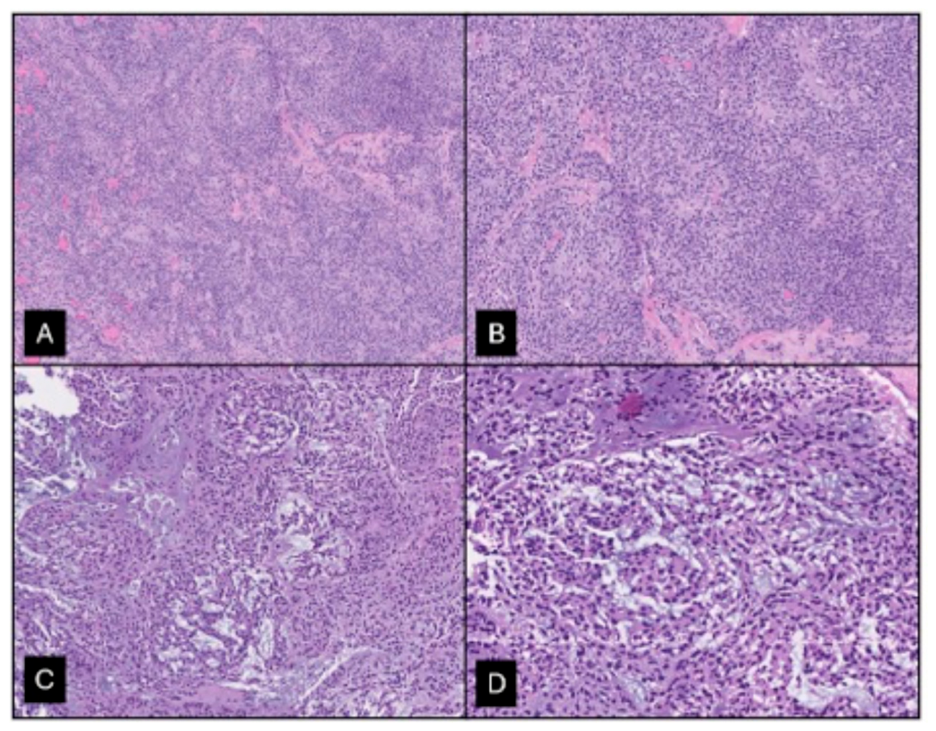
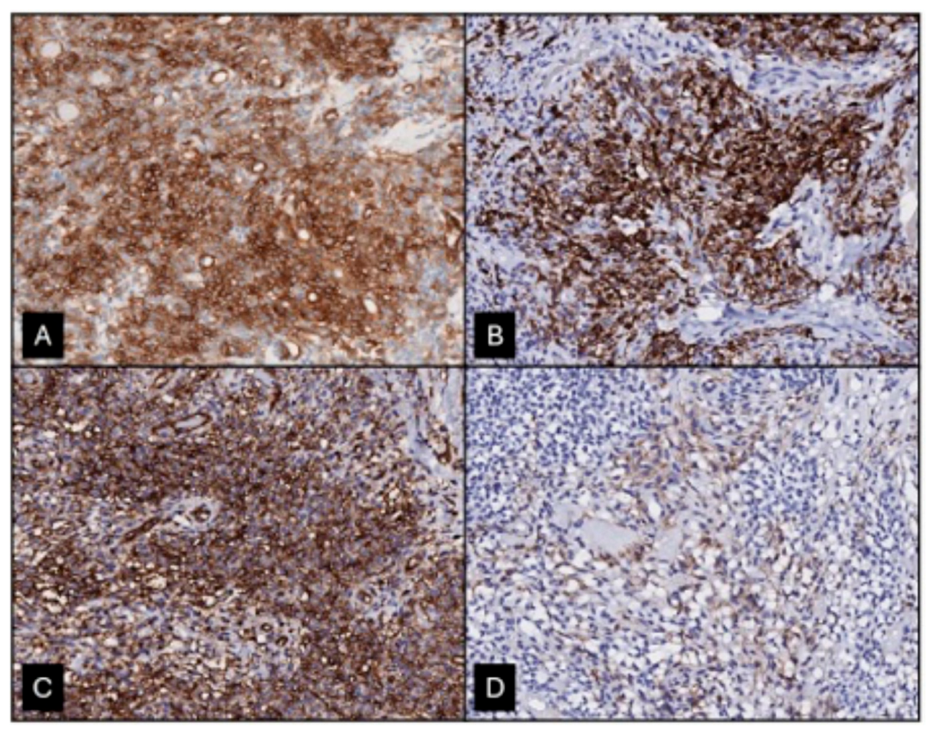
The pathology team received multiple fragments of lesional tissue consistent with the previously described neurosurgical approach. Cumulatively, the combined segments measured approximately 3.5 × 3.0 × 1.0 cm. Histologically, microscopic sections showed a cellular tumor composed of fascicles and loose whorls of spindle cells. The spindle cells were bland with evenly dispersed chromatin, inconspicuous nucleoli and pale eosinophilic cytoplasm. These tumor cells were present within a prominent myxoid stroma. In some areas, the tumor showed a chordoid appearance, with cords and trabeculae of tumor cells surrounded by myxoid stroma. Up to one mitotic figure was identified in 10 consecutive high-power fields of 0.16 mm2 each. There were no areas of necrosis (Figure 2). Further immunohistochemical (IHC) tests were prepared from 4-micron sections from a formalin-fixed, paraffin-embedded (FFPE) block, which were stained with the relevant antibodies using the Ventana BenchMark Ultra automated slide staining system, detected with the OptiView DAB IHC Detection Kit, and visualized by light microscopy. These tests showed staining of the tumor cells for somatostatin receptor 2 (SSTR2), desmin and CD99. Epithelial membrane antigen (EMA) was focally positive in the tumor cells. Cytokeratin Cam5.2, glial fibrillary acid protein, olig2, S100 protein, SOX10, STAT6, brachyury, smooth muscle actin, h-caldesmon, myogenin and MyoD1 were negative in the tumor cells. Glial fibrillary acid protein showed focal brain invasion (Figure 3). The Archer FusionPlex Pan-Solid V2 Assay (Invitae, San Francisco, CA, USA) was performed, and this molecular investigation detected a EWSR1 (exon 7)::CREM (exon 7) gene fusion. Briefly, this is a commercially available, high-throughput NGS panel that identifies gene translocations and internal tandem duplications across solid tumors and sarcomas in 137 genes [14]. Here, total RNA was extracted from FFPE tissue sections of this case and quantified with a fluorometer. RNA was then used for library preparation with the Archer® FusionPlex® panel. The prepared library was sequenced using an Illumina MiniSeq sequencer (San Diego, CA, USA). FASTQ data obtained were analyzed with the Archer Analysis (version 6.2.3) online portal (Figure 4).
Put together, the findings supported a diagnosis of intracranial mesenchymal tumor, FET::CREB fusion-positive. During the neuro-oncology multidisciplinary tumor (MDT) board discussion, a consensus was reached to offer the patient adjuvant radiotherapy (RT). However, the patient declined RT and opted for close radiological surveillance instead. Her latest interval imaging at 12 months post-surgery demonstrated no tumor recurrence, and she remains clinically stable.

3. Systematic Literature Review

3.1. Database Search

A systematic literature review was performed up to 14 January 2026, in accordance with the Preferred Reporting Items for Systematic Reviews and Meta-Analyses (PRISMA) 2020 guidelines [15]. This comprised a comprehensive search across databases including PubMed and Google Scholar. Owing to the paucity of literature on the tumor of interest, the search effort aimed to identify English-language publications only, without limitations on the year range of publication. A combination of medical subjective headings (MeSH) terms and free keywords, including “intracranial”, “intracerebral”, “mesenchymal”, “FET::CREB fusion”, “EWSR1”, “EWS”, along with their respective expansions, was utilized during the search.

3.2. Eligibility Criteria, Study Selection and Data Analysis

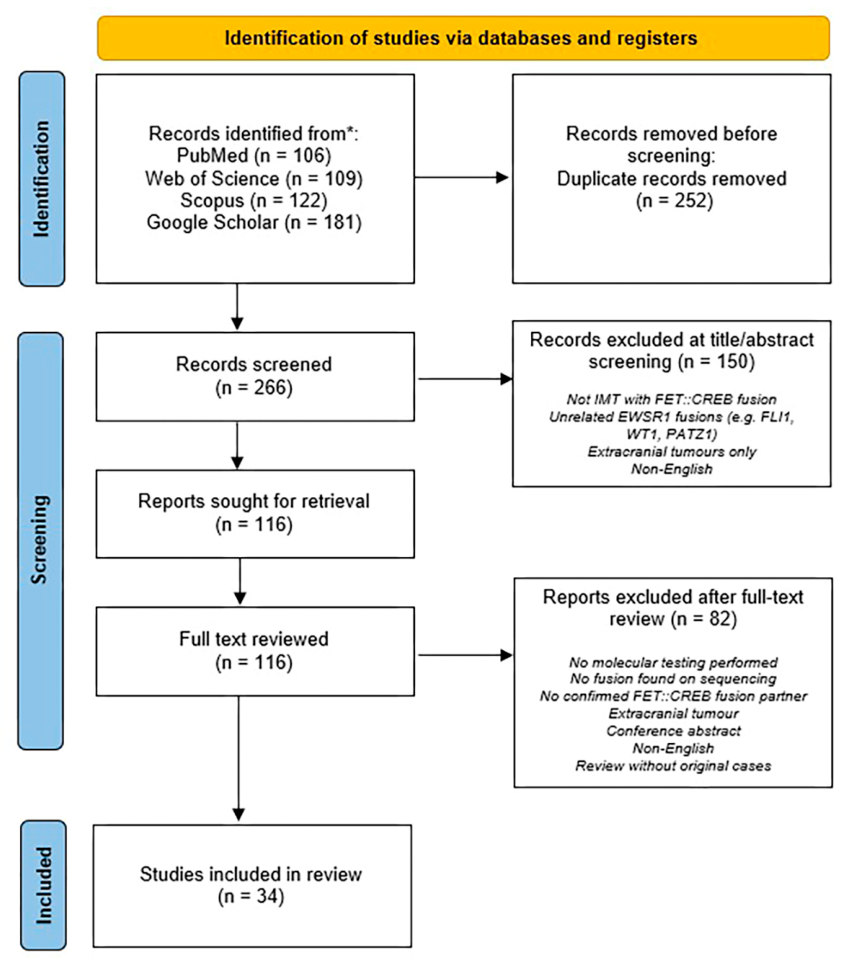
This study included all original peer-reviewed research focusing on IMTs with FET::CREB fusion, with a confirmed fusion gene partner. We did not impose limitations on the healthcare settings where the research was conducted, nor on the total number of patients in the included studies. The following were excluded: non-English studies, studies on extracranial mesenchymal tumors with FET::CREB fusion, studies on IMTs with FET::CREB fusion with no confirmed fusion gene partner, and conference abstracts. A systematic literature review was conducted in accordance with the Preferred Reporting Items for Systematic Reviews and Meta-Analyses (PRISMA) 2020 guidelines. Four electronic databases were searched up to 14 January 2026: PubMed, Web of Science (Core Collection), Scopus, and Google Scholar. The following search strategy was applied across all databases, adapted to each platform’s syntax. In PubMed, the search string was: (“EWSR1”[tiab] OR “EWS”[tiab]) AND “intracranial”[tiab], with no date restriction and language limited to English. In Scopus, the Advanced Search query was: TITLE-ABS-KEY((“EWSR1” OR “EWS”) AND “intracranial”), with language restricted to English. In Web of Science Core Collection, the Advanced Search query was: TS = (“EWSR1” OR “EWS”) AND TS = (“intracranial”), with language restricted to English and timespan set to all years. In Google Scholar, the search was conducted via Publish or Perish software version 8 (https://harzing.com/resources/publish-or-perish; URL accessed on 28 April 2026) using the keyword string EWSR1 OR EWS intracranial, with results limited to the first 200 records in accordance with standard systematic review practice. Records published after 14 January 2026 were excluded (Figure 5).
All studies selected based on our predefined inclusion and exclusion criteria were reviewed in full. Following that, relevant data from the included studies were extracted and included in an electronic document. From each study, we gathered the following information: age, gender, type of FET::CREB fusion, extent of resection, type of adjuvant therapy (if used), and whether there was tumor recurrence. Cases in which the extent of resection (EOR) was not reported or could not be determined from the published source (15.7%, n = 11 of 70 surgical cases) were excluded from EOR-specific analyses; statistical comparisons involving EOR were therefore performed on the 59 cases with documented EOR. As a sensitivity measure, we confirmed that the demographic characteristics of the excluded cases (age, sex, fusion subtype) did not differ significantly from those with documented EOR, reducing the likelihood of systematic exclusion bias. All statistical analyses were conducted using SPSS version 31 (Statistical Package for the Social Sciences Statistics version 31, IBM Corporation, Armonk, NY, USA). Descriptive statistics and correlation analyses including independent samples t-test and chi-square analyses were used to examine the relationships between variables of interest. As this systematic review is based entirely on retrospective, observational case-level data, causal relationships between surgical extent and clinical outcomes cannot be established, and all reported associations should be interpreted accordingly. The complete search strategy, including database-specific syntax and controlled vocabulary terms, is reproduced in Supplementary Table S1 [15,16].

3.3. Results

Thirty-four published studies with a total of 71 FET::CREB-positive patient cases for analysis of clinicopathological correlations and prognostic determinants were selected for this study [1,2,3,5,6,7,8,11,13,17,18,19,20,21,22,23,24,25,26,27,28,29,30,31,32,33,34,35,36,37,38,39,40,41]. Figure 4 illustrates the PRISMA flowchart of the systematic literature process.
From our systematic review of 71 patients, we observed that these tumors had a female predilection (60.5%, n = 43), and the mean age of diagnosis was 28.4 (±18.4) years old [1,2,3,5,6,7,11,13,17,18,19,20,21,22,23,24,25,26,27,28,29,30,31,32,33,34,35,36,37,38,39,40,41,42,43]. Most patients had surgical resection (98.6%, n = 70), except for one who only underwent chemotherapy and proton beam radiotherapy (PBT). In the surgical cohort, gross total resection (GTR) was achieved in 60% (n = 42) of cases, followed by subtotal resection (STR) in 24.3% (n = 17) of cases. For the remainder (15.7%, n = 11), the extent of resection (EOR) was not specified. No adjuvant treatment was administered to a large proportion of patients (83.1%, n = 59). Overall, the literature suggests that local treatments such as surgical resection and PBT trended towards favorable outcomes and prognosis [44]. Here, patients who underwent gross total resection (GTR) had significantly less recurrence compared to those who underwent subtotal resection (STR) (p < 0.001). Nonetheless, this association is observational and does not establish a causal relationship. It was less likely that patients who underwent GTR received adjuvant treatment such as chemotherapy or radiation therapy compared to those who underwent STR (p < 0.001).
Pertaining to adjuvant therapy, 10 patients (14.1%) received radiotherapy after the initial resection (6 after STR, 3 after GTR, 1 after unspecified EOR). Five (7.0%) received chemotherapy after the initial resection, 4 of which were part of combined chemotherapy with radiation therapy, and 1 with chemotherapy only. Up to 39.4% of patients with this tumor had disease recurrence (median 10.5 months, range 0 to 120 months) [1], for which gamma knife stereotactic radiosurgery and PBT was used for salvage treatment [11]. Furthermore, IMTs with FET::CREB fusion may progress to cause metastasis, as illustrated in a few cases, requiring multiple treatment modalities for disease control [8,11]. Chemotherapy examples of sarcoma-based regimens have also been described for the treatment of IMTs, such as ifosfamide in combination with vincristine and doxorubicin, or carboplatin and etoposide [13,45]. Owing to the lack of definitive treatment guidelines, there is, expectedly, significant heterogeneity in the type and timing of adjuvant therapy, including different chemotherapy agents and radiation approaches. We postulate that such variations are likely context-dependent on the individual patient’s age, medical comorbidities, tumor location, healthcare infrastructure, and so forth.
Of interest, we note that gender was highly associated with use of adjuvant therapy (p = 0.051). Otherwise, there was no association between age, subtype of FET::CREB fusion, EOR, use of adjuvant therapy, or recurrence. Also, there was no significant association between subtype of FET::CREB fusion and EOR, whether adjuvant therapy was given, or recurrence. Via Kaplan–Meier analysis, it has been shown in one study that subtotal resection was found to be an independent risk factor associated with significantly shorter progression-free survival (PFS), with a median of 12 months compared to GTR with a median of 60 months. Other risk factors for poorer PFS include younger age (less than 14 years), infratentorial location, and EWSR1:ATF fusion [1]. Put together, our patient’s clinical journey corroborates that EOR plays an important role in reducing recurrence risk, as well as potentially extenuating the need for emergent adjuvant therapy. Last but not least, a common theme emphasized in the literature review was the ability of IMTs to mimic other brain neoplasms, especially meningiomas, both radiologically and intraoperatively. This scenario was similarly encountered in our patient. Therefore, physicians need to be mindful to maintain a high index of suspicion for this tumor as a differential diagnosis in the clinical setting. A summary of the cases from our systematic literature review is featured in Supplementary Table S2.

4. Discussion

4.1. IMT with FET::CREB Fusion: Diagnostic Challenges

Intracranial mesenchymal tumors with FET::CREB fusion are a relatively novel diagnosis in neuro-oncology. In the pre-molecular era, these neoplasms were cited to be morphologically confusing on traditional histology investigations. Histologically, they are reported to exhibit a triad that includes a fibrous pseudocapsule, lymphoplasmacytic cuffing, and pseudoangiomatoid spaces [17,46]. Other studies describe myxoid changes with absence of lymphoid cuffing [18]. Immunohistochemically, they are positive for desmin, but negative for skeletal muscle markers including smooth muscle actin, caldesmon, and calponin. They are also positive for epithelial membrane antigen (EMA) and cluster of differentiation (CD) 99. Lastly, they are usually negative for melanocytic markers including S100 and human melanoma black (HMB) 45, and glial markers including glial fibrillary acid protein (GFAP) and oligodendrocyte transcription factor 2 (OLIG2) [13]. Pertaining to our case, although immunostaining for desmin, epithelial membrane antigen (EMA), and cluster of differentiation (CD) 99 was positive, somatostatin receptor 2A (SSTR2A) was also positive. The histopathological findings of a spindle cell tumor with whorls and chordoid areas and staining for SSTR2A raise the differential diagnostic consideration of meningioma, particularly a chordoid meningioma. Due to the positivity of desmin, which is not usually seen in meningioma, further examination of the tumor specimen with NGS to identify potential molecular aberrations was initiated. In view of the immunopositivity for desmin and the presence of a FET::CREB fusion, we favored the diagnosis of an IMT, even in the presence of SSTR2A staining. This is because IMTs with FET::CREB fusion have also been previously reported to be negative for SSTR2A [1,13].
Comparing our patient against the broader systematic review cohort, several parallels merit explicit discussion. First, the unexpected SSTR2A positivity in our case highlights a recognized diagnostic pitfall: although SSTR2A immunoreactivity is considered a hallmark of meningioma, it has been documented in a minority of IMTs with FET::CREB fusion and should not preclude this diagnosis when desmin positivity and a confirming FET::CREB fusion are present [5,39]. Second, our patient’s age at diagnosis (53 years) contrasts markedly with the cohort mean of 27.8 years old; this outlier status may correspond to the recently described epigenetic subclass A, which occurs preferentially in older individuals and may carry a distinct biological profile [4]. Third, the GTR achieved in our patient directly parallels the statistically significant association between GTR and reduced recurrence in the systematic review cohort (p < 0.001), reinforcing the operative strategy as the most impactful clinical decision in the management of this case. Finally, our patient’s decision to forgo adjuvant radiotherapy is consistent with the pattern observed across the reviewed literature, whereby 83.1% of patients did not receive adjuvant treatment. Here, the higher recurrence rate among adjuvant-treated patients in the cohort most likely reflects confounding by indication rather than a deleterious treatment effect, as adjuvant therapy was predominantly administered to those with STR or more aggressive disease.

4.2. Overview of FET::CREM Gene Fusions in Oncology

The FET family (FUS, EWSR1 and TAF15) consists of a group of highly conserved, multifunctional RNA-binding proteins that contribute to transcription control, RNA processing, and DNA damage response [47,48]. These ubiquitous proteins are of medical interest because point mutations in FUS or TAF15 have been implicated in neurodegenerative diseases such as amyotrophic lateral sclerosis and frontotemporal lobar dementia. Additionally, oncology research has led to the discovery that chromosomal rearrangements of FET family genes promote various sarcomas, including IMT [47,48]. Separately, the CREB family includes CREB1, CREM, and ATF1 [47,49]. They are a group of DNA-binding transcription factors that bind to the cyclic adenosine monophosphate (cAMP) DNA region. Here, cAMP acts as an important intracellular signal messenger to influence multiple vital cell functions [47,49]. Currently, FET::CREB fusions have been detected across a wide range of phenotypically and histologically diverse soft tissue and visceral neoplasms, and in recent years, intracranially as well [50,51,52,53,54,55,56,57,58,59,60,61,62]. In most of the proven FET::CREB-positive tumors, the most frequently encountered fusion between EWSR1 and the CREB family is EWSR1::ATF30, followed by EWSR1::CREM and EWSR1::CREB1. Here, the Ewing sarcoma breakpoint region 1 (EWSR1) belongs to the FET family of proteins, which also includes Fused in Sarcoma/Translocated in Liposarcoma (FUS/TLS) and TATA-box binding protein Associated Factor 15 (TAF15). The FET family shares highly homologous amino acid sequences and are expressed in most cell and tissue types and predominantly reside within the nucleus [63,64]. First described in Ewing sarcoma, EWSR1 is the most rearranged gene in soft tissue tumors [65,66]. EWSR1 possesses a potent transcriptional activation domain, which synergizes with its fusion gene partner, typically a transcriptional factor. Fusion genes involving EWSR1 thus encode aberrant proteins that alter transcription, which may consequently drive tumorigenesis [67]. In view of the ambiguity faced in the diagnosis of these phenotypically diverse tumors, the use of molecular investigations is paramount. Relevant techniques in clinical settings include sequencing methods that augment the detection of fusion genes such as NGS, as featured in our patient’s case.

4.3. Therapeutic Options for IMT with FET::CREB Fusion: What Is the Current Evidence?

To date, there are no defined guidelines for these tumors beyond establishment of correct diagnosis. Presently, uncertainty exists regarding the role of adjuvant treatment for microscopic disease control and prevention of recurrence. This is especially challenging for patients whose intracranial tumors occur in eloquent or deep-seated regions, where high risks of operative morbidity are encountered. Based on our literature review, we observe that patients with the diagnosis of IMT with FET::CREM fusion tend to be younger adults (mean age 27.8 years). The most favorable prognostic factor for progression free survival is GTR. Of note, patients who received GTR are less likely to receive adjuvant treatment. Overall, patients with STR alone or STR followed by adjuvant treatment in the form of chemotherapy and/or radiotherapy are still more likely to have tumor recurrence. Nonetheless, we highlight that adjuvant treatment regimens are heterogeneous in the selected literature and thus may contribute to the poorer outcomes of this cohort. For our patient, GTR was achieved. Despite the recommendations of our neuro-oncology MDT to follow up with adjuvant radiotherapy, the patient declined and elected close surveillance. At 12 months post-surgery, there is no radiological evidence of recurrence. Of note, our patient’s age at presentation (i.e., 53 years old) is a marked outlier against the cohort mean of 27.8 years reported in the systematic review. At the time of this writing, we believe this may be relevant in the context of the recently described epigenetic subclasses, whereby subclass A occurs preferentially in older individuals and potentially carries a distinct biological and prognostic profile from the younger-onset subclass B tumors [4].
Regarding the broader treatment landscape, GTR remains the mainstay of treatment [1,2], and GTR is associated with significantly lower recurrence rates in our reviewed cohort (p < 0.001). For cases whereby GTR is not achievable—such as in eloquent cortex, or deep-seated tumors—stereotactic radiosurgery (such as Gamma Knife) and proton beam therapy (PBT) have been reported as salvage modalities, with the latter showing particular promise given the favorable dose distribution profile in proximity to critical neural structures [44]. Systemic chemotherapy is typically reserved for recurrent or metastatic disease; sarcoma-adapted regimens including ifosfamide with vincristine and doxorubicin, and carboplatin with etoposide have been described [44]. More recently, MET inhibitor monotherapy has been explored in isolated EWSR1-rearranged cases, though evidence remains anecdotal [20]. The emergence of molecular subtyping—specifically the two epigenetic subclasses (A and B), may eventually allow risk-stratified adjuvant therapy decisions, with subclass A occurring preferentially in older individuals and subclass B in younger patients with female predominance [3,4]. The observed association between adjuvant therapy and higher recurrence rates in this cohort is most parsimoniously explained by indication bias. Examples include patients with STR, tumor recurrence, or histological features of aggressive behavior are disproportionately selected for adjuvant treatment, creating an inverse correlation between treatment and favorable outcome that is an artifact of disease severity rather than a treatment effect [68]. This phenomenon has been formally demonstrated to resist correction by standard multivariable techniques when confounding by unmeasured prognostic factors is present [69]. Put together, the data in our systematic literature review is insufficient to permit causal inference regarding adjuvant therapy efficacy, and prospective or registry-based studies with pre-specified treatment allocation criteria are required to address this question definitively. Furthermore, adjuvant treatment regimens are noted to be heterogeneous in the selected literature, which compounds the difficulty of drawing conclusions about efficacy across different modalities and patient subgroups.

4.4. Study Limitations

Several limitations of this study and the available literature must be acknowledged. First, all included studies are retrospective case reports or small case series; in the absence of controlled trials or prospective cohorts, no causal inferences regarding the efficacy of specific treatments can be drawn. Second, cases with rare diagnoses and favorable outcomes are disproportionately represented in the published literature. Here, we refer to early cases of likely misdiagnosis due to the unavailability of genomic technologies. Third, EOR was not reported in 15.7% of surgical cases, and adjuvant therapy details were heterogeneous across publications, limiting the statistical power and generalizability of subgroup analyses. Fourth, the types, doses, and timing of adjuvant chemotherapy and radiotherapy varied substantially across the reviewed studies, precluding any pooled estimate of adjuvant therapy efficacy. Finally, the majority of published cases originate from Western and East Asian centers; this present case of a 53-year-old female is of Southeast Asian origin. Hence, the overall dataset remains insufficient for population-level generalizations regarding incidence or prognosis across ethnic groups.

4.5. Clinical Implications

Based on the available evidence, we offer the following practical recommendations. First, molecular testing with RNA-based NGS should be strongly considered for any intracranial extra-axial spindle cell or myxoid tumor that does not conform to a standard IHC-defined diagnosis, particularly when desmin immunopositivity, EMA expression, or myxoid stromal change are present alongside negative GFAP, OLIG2, and STAT6 staining; awaiting formal molecular confirmation before finalizing the diagnosis prevents misclassification and inappropriate treatment allocation [39,70]. Second, where GTR is technically feasible, it should be the primary surgical goal, as it is the factor most consistently associated with prolonged recurrence-free survival [1,2]. In cases where GTR cannot be safely achieved, such as tumors abutting eloquent cortex or deeply intraventricular, the multidisciplinary team should consider early adjuvant treatment; proton beam therapy represents a rational adjuvant modality for pediatric and young adult patients given its superior dose conformality [44]. Third, international data sharing and registry-based case enrolment are strongly encouraged to generate the sample sizes required for meaningful prospective analysis.

5. Conclusions

IMTs with FET::CREB fusion are locally aggressive tumors with a documented recurrence rate of approximately 39.4% across the reviewed cohort (median time to recurrence 10.5 months, range 0 to 120 months), underscoring the need for ongoing surveillance following surgical resection. Our patient’s case corroborates the existing literature that the EOR appears to be an important prognostic factor for IMTs with FET::CREB fusion, with GTR significantly associated with lower rates of recurrence. Owing to the inherent limitations of retrospective case-level data, these findings should be interpreted with caution and should not be taken to establish a causal treatment effect. Molecular confirmation via RNA-based NGS is essential for definitive diagnosis, as the histopathological and immunohistochemical features of IMTs with FET::CREB fusion substantially overlap with those of meningioma, solitary fibrous tumor, primary intracranial sarcoma (DICER1-mutant), and other spindle cell neoplasms. Diagnosis without demonstration of the pathognomonic FET::CREB fusion cannot be made with confidence [13,39]. As the way forward, we advocate for international collaborative efforts to better understand this rare tumor and to guide consensus on optimal clinical management.

Supplementary Materials

The following supporting information can be downloaded at: https://www.mdpi.com/article/10.3390/targets4020017/s1, Table S1: Complete search strategy for Systematic Literature Review. Table S2: Summary of 72 IMT with FET::CREB fusion-positive cases (including our patient).

Author Contributions

Conceptualization, B.W.Q.L., F.H.Z.C. and S.Y.Y.L.; methodology, B.W.Q.L. and S.Y.Y.L.; software, B.W.Q.L., H.Y.L., K.T.E.C., S.J.A. and S.Y.Y.L.; validation, B.W.Q.L. and S.Y.Y.L.; formal analysis, H.Y.L., K.T.E.C. and B.W.Q.L.; investigation, H.Y.L. and F.H.Z.C.; resources, B.W.Q.L., S.Y.Y.L. and F.H.Z.C.; data curation, B.W.Q.L., S.J.A., S.J.A. and S.Y.Y.L.; writing—original draft preparation, B.W.Q.L. and F.H.Z.C.; writing—review and editing, S.Y.Y.L.; visualization, H.Y.L., K.T.E.C., S.J.A. and B.W.Q.L.; supervision, F.H.Z.C. and S.Y.Y.L.; project administration, F.H.Z.C. and S.Y.Y.L. All authors have read and agreed to the published version of the manuscript.

Funding

This research received no external funding.

Institutional Review Board Statement

Ethical review and approval were waived for this single patient case report by the hospital ethics review board [SingHealth Central Institutional Review Board (CIRB)]. https://www.singhealthdukenus.com.sg/research/rice/cirb-faqs (accessed on 1 February 2026).

Informed Consent Statement

Informed consent for publication was waived for this single patient case report as per SingHealth Central Institutional Review Board (CIRB). https://www.singhealthdukenus.com.sg/research/rice/cirb-faqs.

Data Availability Statement

The original contributions presented in this study are included in the article. Further inquiries can be directed to the corresponding author.

Acknowledgments

Preliminary results of this paper were accepted as a poster for the 2026 American Association of Neurological Surgeons (AANS) Annual Scientific Meeting held in San Antonio, Texas, USA from 1 May to 4 May 2026.

Conflicts of Interest

The authors declare no conflicts of interest.

References

  1. Mezzacappa, F.M.; Smith, F.K.; Zhang, W.; Gard, A.; Cabuk, F.K.; Gonzalez-Gomez, I.; Monforte, H.L.; Liang, J.; Singh, O.; Quezado, M.M.; et al. Potential prognostic determinants for FET::CREB fusion-positive intracranial mesenchymal tumor. Acta Neuropathol. Commun. 2024, 12, 17. [Google Scholar] [CrossRef] [PubMed]
  2. Sloan, E.A.; Gupta, R.; Koelsche, C.; Chiang, J.; Villanueva-Meyer, J.E.; Alexandrescu, S.; Eschbacher, J.M.; Wang, W.; Mafra, M.; Ud Din, N.; et al. Intracranial mesenchymal tumors with FET-CREB fusion are composed of at least two epigenetic subgroups distinct from meningioma and extracranial sarcomas. Brain Pathol. 2022, 32, e13037. [Google Scholar] [CrossRef]
  3. Tauziède-Espariat, A.; Sievers, P.; Larousserie, F.; Benzakoun, J.; Guillemot, D.; Pierron, G.; Duchesne, M.; Uro-Coste, E.; Roux, A.; Vasiljevic, A.; et al. An integrative histopathological and epigenetic characterization of primary intracranial mesenchymal tumors, FET:CREB-fused broadening the spectrum of tumor entities in comparison with their soft tissue counterparts. Brain Pathol. 2022, 32, e13010. [Google Scholar] [CrossRef]
  4. Rajan, S.; Chung, H.-J.; Wu, Z.; Singh, O.; Dazelle, K.; Abdullaev, Z.; Tyagi, M.; Ferrone, C.K.; Raffeld, M.; Lee, I.; et al. Intracranial mesenchymal tumor, FET::CREB fusion-positive: An integrative analysis of 81 cases. Neuro-Oncology 2026, 28, 939–951. [Google Scholar] [CrossRef]
  5. Kao, Y.C.; Sung, Y.S.; Zhang, L.; Chen, C.L.; Vaiyapuri, S.; Rosenblum, M.K.; Antonescu, C.R. EWSR1 Fusions with CREB Family Transcription Factors Define a Novel Myxoid Mesenchymal Tumor With Predilection for Intracranial Location. Am. J. Surg. Pathol. 2017, 41, 482–490. [Google Scholar] [CrossRef]
  6. Bale, T.A.; Oviedo, A.; Kozakewich, H.; Giannini, C.; Davineni, P.K.; Ligon, K.; Alexandrescu, S. Intracranial myxoid mesenchymal tumors with EWSR1-CREB family gene fusions: Myxoid variant of angiomatoid fibrous histiocytoma or novel entity? Brain Pathol. 2018, 28, 183–191. [Google Scholar] [CrossRef]
  7. Aghajan, Y.; Malicki, D.M.; Levy, M.L.; Crawford, J.R. Atypical central neurocytoma with novel EWSR1-ATF1 fusion and MUTYH mutation detected by next-generation sequencing. BMJ Case Rep. 2019, 12, bcr-2018-226455. [Google Scholar] [CrossRef] [PubMed]
  8. D’Antonio, F.; Rossi, S.; Giovannoni, I.; Alaggio, R.; Carai, A.; Milano, G.M.; Cacchione, A.; Cancellieri, A.; Gessi, M.; Antonelli, M.; et al. Case Report: Remarkable breakthrough: Successful treatment of a rare intracranial mesenchymal, FET::CREB fusion-positive tumor treated with patient-tailored multimodal therapy. Front. Oncol. 2023, 13, 1203994. [Google Scholar] [CrossRef]
  9. WHO Classification of Tumours Editorial Board (Ed.) WHO Classification of Tumours, 5th edition: Central Nervous System Tumours, 5th ed.; International Agency for Research on Cancer: Lyon, France, 2021; p. 568. [Google Scholar]
  10. Louis, D.N.; Perry, A.; Wesseling, P.; Brat, D.J.; Cree, I.A.; Figarella-Branger, D.; Hawkins, C.; Ng, H.K.; Pfister, S.M.; Reifenberger, G.; et al. The 2021 WHO Classification of Tumors of the Central Nervous System: A summary. Neuro Oncol. 2021, 23, 1231–1251. [Google Scholar] [CrossRef]
  11. Ozkizilkaya, H.I.; Johnson, J.M.; O’Brien, B.J.; McCutcheon, I.E.; Prabhu, S.S.; Ghia, A.J.; Fuller, G.N.; Huse, J.T.; Ballester, L.Y. Intracranial mesenchymal tumor, FET::CREB fusion-positive in the lateral ventricle. Neuro-Oncol. Adv. 2023, 5, vdad026. [Google Scholar] [CrossRef] [PubMed]
  12. Sono, K.; Enomoto, T.; Kobayashi, H.; Takemoto, K.; Morishita, T.; Aoki, M.; Hamasaki, M.; Abe, H. A Case of Intracranial Mesenchymal Tumor, FET::CREB Fusion-positive, Diagnosed by Genomic Profiling with FoundationOne CDx. NMC Case Rep. J. 2025, 12, 33–39. [Google Scholar] [CrossRef]
  13. Sloan, E.A.; Chiang, J.; Villanueva-Meyer, J.E.; Alexandrescu, S.; Eschbacher, J.M.; Wang, W.; Mafra, M.; Ud Din, N.; Carr-Boyd, E.; Watson, M.; et al. Intracranial mesenchymal tumor with FET-CREB fusion-A unifying diagnosis for the spectrum of intracranial myxoid mesenchymal tumors and angiomatoid fibrous histiocytoma-like neoplasms. Brain Pathol. 2021, 31, e12918. [Google Scholar] [CrossRef] [PubMed]
  14. Aw, S.J.; Goh, J.Y.; Esguerra, J.M.; Tan, T.S.E.; Tan, E.E.K.; Low, S.Y.Y. An FGFR1-Altered Intramedullary Thoracic Tumor with Unusual Clinicopathological Features: A Case Report and Literature Review. Neuroglia 2025, 6, 39. [Google Scholar] [CrossRef]
  15. Page, M.J.; McKenzie, J.E.; Bossuyt, P.M.; Boutron, I.; Hoffmann, T.C.; Mulrow, C.D.; Shamseer, L.; Tetzlaff, J.M.; Akl, E.A.; Brennan, S.E.; et al. The PRISMA 2020 statement: An updated guideline for reporting systematic reviews. BMJ 2021, 372, n71. [Google Scholar] [CrossRef]
  16. Rethlefsen, M.L.; Kirtley, S.; Waffenschmidt, S.; Ayala, A.P.; Moher, D.; Page, M.J.; Koffel, J.B. PRISMA-S: An extension to the PRISMA statement for reporting literature searches in systematic reviews. J. Med. Libr. Assoc. 2021, 109, 174–200. [Google Scholar] [CrossRef]
  17. Dunham, C.; Hussong, J.; Seiff, M.; Pfeifer, J.; Perry, A. Primary intracerebral angiomatoid fibrous histiocytoma: Report of a case with a t(12;22)(q13;q12) causing type 1 fusion of the EWS and ATF-1 genes. Am. J. Surg. Pathol. 2008, 32, 478–484. [Google Scholar] [CrossRef] [PubMed]
  18. Vizcaino, M.A.; Giannini, C.; Chang, H.T.; Kipp, B.R.; Fritchie, K.; Vaubel, R. Intracranial angiomatoid fibrous histiocytoma with rhabdoid features: A mimic of rhabdoid meningioma. Brain Tumor Pathol. 2021, 38, 138–144. [Google Scholar] [CrossRef]
  19. Ballester, L.Y.; Meis, J.M.; Lazar, A.J.; Prabhu, S.S.; Hoang, K.B.; Leeds, N.E.; Fuller, G.N. Intracranial Myxoid Mesenchymal Tumor With EWSR1-ATF1 Fusion. J. Neuropathol. Exp. Neurol. 2020, 79, 347–351. [Google Scholar] [CrossRef]
  20. Santos, Y.; Shin, D.; Malnik, S.; Rivera-Zengotita, M.; Tran, D.; Ghiaseddin, A.; Lee Kresak, J. Intracranial myxoid mesenchymal neoplasms with EWSR1 gene rearrangement: Report of 2 midline cases with one demonstrating durable response to MET inhibitor monotherapy. Neuro-Oncol. Adv. 2021, 3, vdab016. [Google Scholar] [CrossRef]
  21. Domingo, R.A.; Vivas-Buitrago, T.; Jentoft, M.; Quinones-Hinojosa, A. Intracranial Myxoid Mesenchymal Tumor/Myxoid Subtype Angiomatous Fibrous Histiocytoma: Diagnostic and Prognostic Challenges. Neurosurgery 2020, 88, E114–E122. [Google Scholar] [CrossRef] [PubMed]
  22. Gareton, A.; Pierron, G.; Mokhtari, K.; Tran, S.; Tauziède-Espariat, A.; Pallud, J.; Louvel, G.; Meary, E.; Capelle, L.; Chrétien, F.; et al. ESWR1-CREM Fusion in an Intracranial Myxoid Angiomatoid Fibrous Histiocytoma-Like Tumor: A Case Report and Literature Review. J. Neuropathol. Exp. Neurol. 2018, 77, 537–541. [Google Scholar] [CrossRef] [PubMed]
  23. Ghanbari, N.; Lam, A.; Wycoco, V.; Lee, G. Intracranial Myxoid Variant of Angiomatoid Fibrous Histiocytoma: A Case Report and Literature Review. Cureus 2019, 11, e4261. [Google Scholar] [CrossRef]
  24. Gilbert, A.R.; Yan, L.; McDougall, C.M. Broadening the Age of Incidence of Intracranial Angiomatoid Fibrous Histiocytoma With EWSR1-CREM Fusion: A Case Report. J. Neuropathol. Exp. Neurol. 2020, 79, 1244–1246. [Google Scholar] [CrossRef]
  25. Hojo, K.; Furuta, T.; Komaki, S.; Yoshikane, Y.; Kikuchi, J.; Nakamura, H.; Ide, M.; Shima, S.; Hiyoshi, Y.; Araki, J.; et al. Systemic inflammation caused by an intracranial mesenchymal tumor with a EWSR1::CREM fusion presenting associated with IL-6/STAT3 signaling. Neuropathology 2023, 43, 244–251. [Google Scholar] [CrossRef] [PubMed]
  26. Kambe, A.; Kuwamoto, S.; Shimizu, T.; Amisaki, H.; Sakamoto, M.; Inagaki, H.; Kurosaki, M. A case of intracranial myxoid mesenchymal tumor with EWSR1:CREM fusion in an adult female: Extensive immunohistochemical evaluation. Neuropathology 2021, 41, 315–323. [Google Scholar] [CrossRef]
  27. Kim, N.R.; Kim, S.I.; Park, J.W.; Park, C.K.; Chung, C.K.; Choi, S.H.; Yun, H.; Park, S.H. Brain parenchymal angiomatoid fibrous histiocytoma and spinal myxoid mesenchymal tumor with FET: CREB fusion, a spectrum of the same tumor type. Neuropathology 2022, 42, 257–268. [Google Scholar] [CrossRef]
  28. Komatsu, M.; Yoshida, A.; Tanaka, K.; Matsuo, K.; Sasayama, T.; Kojita, Y.; Kanda, T.; Kodama, Y.; Itoh, T.; Hirose, T. Intracranial myxoid mesenchymal tumor with EWSR1-CREB1 gene fusion: A case report and literature review. Brain Tumor Pathol. 2020, 37, 76–80. [Google Scholar] [CrossRef] [PubMed]
  29. Konstantinidis, A.; Cheesman, E.; O’Sullivan, J.; Pavaine, J.; Avula, S.; Pizer, B.; Kilday, J.P. Intracranial Angiomatoid Fibrous Histiocytoma with EWSR1-CREB Family Fusions: A Report of 2 Pediatric Cases. World Neurosurg. 2019, 126, 113–119. [Google Scholar] [CrossRef]
  30. Lemnos, L.; Salle, H.; Caire, F.; Duchesne, M. Angiomatoid fibrous histiocytoma: An atypical brain location newly described as intracranial mesenchymal tumor FET-CREB fusion-positive. Acta Neurol. Belg. 2023, 123, 691–694. [Google Scholar] [CrossRef]
  31. Levy, A.S.; Sakellakis, A.; Luther, E.; Morell, A.A.; Rosenberg, A.; Saad, A.G.; Ivan, M.; Komotar, R.J. Concurrent intraventricular intracranial myxoid mesenchymal tumor and ependymoma in a long-term Ewing sarcoma survivor. Neuropathology 2022, 42, 534–539. [Google Scholar] [CrossRef]
  32. Libbrecht, S.; Van Der Meulen, J.; Mondelaers, V.; Baert, E.; Vande Walle, C.; Van Dorpe, J.; Creytens, D. Intracranial myxoid mesenchymal tumor with EWSR1-CREB1 fusion. Pathol. Res. Pract. 2020, 216, 153239. [Google Scholar] [CrossRef]
  33. Liu, C.; Liu, Y.; Zhao, Y.; Wei, J.; Ma, Y.; Liu, Y.; Huang, J. Primary Intracranial Mesenchymal Tumor with EWSR1-CREM Gene Fusion: A Case Report and Literature Review. World Neurosurg. 2020, 142, 318–324. [Google Scholar] [CrossRef]
  34. Sasaki, M.; Hirono, S.; Gao, Y.; Suda, I.; Matsutani, T.; Ota, M.; Kishimoto, T.; Ikeda, J.I.; Yokoo, H.; Iwadate, Y. Clinicopathological and Genomic Features of Pediatric Intracranial Myxoid Mesenchymal Tumor with both of EWSR1-CREM Gene Fusion and MAP3K13 Mutation: A Case Report and Comparison with Adult Cases in the Literature. NMC Case Rep. J. 2022, 9, 101–109. [Google Scholar] [CrossRef]
  35. Sciot, R.; Jacobs, S.; Calenbergh, F.V.; Demaerel, P.; Wozniak, A.; Debiec-Rychter, M. Primary myxoid mesenchymal tumour with intracranial location: Report of a case with a EWSR1-ATF1 fusion. Histopathology 2018, 72, 880–883. [Google Scholar] [CrossRef] [PubMed]
  36. Shaikh, S.T.; Hajra, D.; Singh, S.; Nagaraju, S.; El-Maghraby, H. Intracranial Myxoid Mesenchymal Tumour with EWSR1-ATF1 Fusion Sans Myxoid Stroma—Report of A Newer Entity with Brief Review of Literature. Neurol. India 2022, 70, 1639–1642. [Google Scholar] [CrossRef]
  37. Tan, N.J.H.; Pratiseyo, P.D.; Wahjoepramono, E.J.; Kuick, C.H.; Goh, J.Y.; Chang, K.T.E.; Tan, C.L. Intracranial myxoid angiomatoid fibrous histiocytoma with "classic" histology and EWSR1:CREM fusion providing insight for reconciliation with intracranial myxoid mesenchymal tumors. Neuropathology 2021, 41, 306–314. [Google Scholar] [CrossRef] [PubMed]
  38. Valente Aguiar, P.; Pinheiro, J.; Lima, J.; Vaz, R.; Linhares, P. Myxoid mesenchymal intraventricular brain tumour with EWSR1-CREB1 gene fusion in an adult woman. Virchows Arch. 2021, 478, 1019–1024. [Google Scholar] [CrossRef] [PubMed]
  39. Velz, J.; Agaimy, A.; Frontzek, K.; Neidert, M.C.; Bozinov, O.; Wagner, U.; Fritz, C.; Coras, R.; Hofer, S.; Bode-Lesniewska, B.; et al. Molecular and Clinicopathologic Heterogeneity of Intracranial Tumors Mimicking Extraskeletal Myxoid Chondrosarcoma. J. Neuropathol. Exp. Neurol. 2018, 77, 727–735. [Google Scholar] [CrossRef]
  40. White, M.D.; McDowell, M.M.; Pearce, T.M.; Bukowinski, A.J.; Greene, S. Intracranial Myxoid Mesenchymal Tumor with Rare EWSR1-CREM Translocation. Pediatr. Neurosurg. 2019, 54, 347–353. [Google Scholar] [CrossRef]
  41. Ward, B.; Wang, C.P.; Macaulay, R.J.B.; Liu, J.K.C. Adult Intracranial Myxoid Mesenchymal Tumor with EWSR1-ATF1 Gene Fusion. World Neurosurg. 2020, 143, 91–96. [Google Scholar] [CrossRef]
  42. Sion, A.E.; Tahir, R.A.; Mukherjee, A.; Rock, J.P. Cranial angiomatoid fibrous histiocytoma: A case report and review of literature. Surg. Neurol. Int. 2020, 11, 295. [Google Scholar] [CrossRef]
  43. Garnier, L.; Fenouil, T.; Pissaloux, D.; Ameli, R.; Ducray, F.; Meyronet, D.; Honnorat, J. Intracranial non-myxoid angiomatoid fibrous histiocytoma with EWSR1-CREB1 transcript fusion treated with doxorubicin: A case report. Mol. Clin. Oncol. 2021, 15, 131. [Google Scholar] [CrossRef] [PubMed]
  44. Thway, K.; Fisher, C. Tumors with EWSR1-CREB1 and EWSR1-ATF1 fusions: The current status. Am. J. Surg. Pathol. 2012, 36, e1–e11. [Google Scholar] [CrossRef]
  45. Davis, J.L.; Tihan, T.; Kilpatrick, S.E. Mesenchymal tumors of the central nervous system in practical surgical neuropathology: A diagnostic approach. Pract. Surg. Neuropathol. A Diagn. Approach 2018, 299–322. [Google Scholar] [CrossRef]
  46. Thway, K.; Fisher, C. Angiomatoid fibrous histiocytoma: The current status of pathology and genetics. Arch. Pathol. Lab. Med. 2015, 139, 674–682. [Google Scholar] [CrossRef]
  47. Agaimy, A.; Blakely, M.; Breimer, G.E.; Hölsken, A.; Koppes, S.A.; Meidenbauer, N.; Rijken, J.A.; Schad, A.; Simon, A.G.; Stoehr, R.; et al. Extra-abdominal and intra-abdominal FET::CREM fusion mesenchymal neoplasms: Comparative clinicopathological study of 9 new cases further supporting a distinct potentially aggressive sarcoma and report of novel sites. Virchows Arch. 2024, 485, 1007–1019. [Google Scholar] [CrossRef]
  48. Schwartz, J.C.; Cech, T.R.; Parker, R.R. Biochemical Properties and Biological Functions of FET Proteins. Annu. Rev. Biochem. 2015, 84, 355–379. [Google Scholar] [CrossRef]
  49. Thomson, D.M.; Herway, S.T.; Fillmore, N.; Kim, H.; Brown, J.D.; Barrow, J.R.; Winder, W.W. AMP-activated protein kinase phosphorylates transcription factors of the CREB family. J. Appl. Physiol. 2008, 104, 429–438. [Google Scholar] [CrossRef]
  50. Antonescu, C.R.; Dal Cin, P.; Nafa, K.; Teot, L.A.; Surti, U.; Fletcher, C.D.; Ladanyi, M. EWSR1-CREB1 is the predominant gene fusion in angiomatoid fibrous histiocytoma. Genes Chromosomes Cancer 2007, 46, 1051–1060. [Google Scholar] [CrossRef] [PubMed]
  51. Antonescu, C.R.; Nafa, K.; Segal, N.H.; Dal Cin, P.; Ladanyi, M. EWS-CREB1: A recurrent variant fusion in clear cell sarcoma--association with gastrointestinal location and absence of melanocytic differentiation. Clin. Cancer Res. 2006, 12, 5356–5362. [Google Scholar] [CrossRef]
  52. Antonescu, C.R.; Katabi, N.; Zhang, L.; Sung, Y.S.; Seethala, R.R.; Jordan, R.C.; Perez-Ordoñez, B.; Have, C.; Asa, S.L.; Leong, I.T.; et al. EWSR1-ATF1 fusion is a novel and consistent finding in hyalinizing clear-cell carcinoma of salivary gland. Genes Chromosomes Cancer 2011, 50, 559–570. [Google Scholar] [CrossRef] [PubMed]
  53. Antonescu, C.R.; Tschernyavsky, S.J.; Woodruff, J.M.; Jungbluth, A.A.; Brennan, M.F.; Ladanyi, M. Molecular diagnosis of clear cell sarcoma: Detection of EWS-ATF1 and MITF-M transcripts and histopathological and ultrastructural analysis of 12 cases. J. Mol. Diagn. JMD 2002, 4, 44–52. [Google Scholar] [CrossRef]
  54. Argani, P.; Harvey, I.; Nielsen, G.P.; Takano, A.; Suurmeijer, A.J.H.; Voltaggio, L.; Zhang, L.; Sung, Y.S.; Stenzinger, A.; Mechtersheimer, G.; et al. EWSR1/FUS-CREB fusions define a distinctive malignant epithelioid neoplasm with predilection for mesothelial-lined cavities. Mod. Pathol. 2020, 33, 2233–2243. [Google Scholar] [CrossRef] [PubMed]
  55. Desmeules, P.; Joubert, P.; Zhang, L.; Al-Ahmadie, H.A.; Fletcher, C.D.; Vakiani, E.; Delair, D.F.; Rekhtman, N.; Ladanyi, M.; Travis, W.D.; et al. A Subset of Malignant Mesotheliomas in Young Adults Are Associated With Recurrent EWSR1/FUS-ATF1 Fusions. Am. J. Surg. Pathol. 2017, 41, 980–988. [Google Scholar] [CrossRef]
  56. Ferrari, A.; Casanova, M.; Bisogno, G.; Mattke, A.; Meazza, C.; Gandola, L.; Sotti, G.; Cecchetto, G.; Harms, D.; Koscielniak, E.; et al. Clear cell sarcoma of tendons and aponeuroses in pediatric patients: A report from the Italian and German Soft Tissue Sarcoma Cooperative Group. Cancer 2002, 94, 3269–3276. [Google Scholar] [CrossRef]
  57. Skálová, A.; Weinreb, I.; Hyrcza, M.; Simpson, R.H.; Laco, J.; Agaimy, A.; Vazmitel, M.; Majewska, H.; Vanecek, T.; Talarčik, P.; et al. Clear cell myoepithelial carcinoma of salivary glands showing EWSR1 rearrangement: Molecular analysis of 94 salivary gland carcinomas with prominent clear cell component. Am. J. Surg. Pathol. 2015, 39, 338–348. [Google Scholar] [CrossRef]
  58. Thway, K.; Nicholson, A.G.; Lawson, K.; Gonzalez, D.; Rice, A.; Balzer, B.; Swansbury, J.; Min, T.; Thompson, L.; Adu-Poku, K.; et al. Primary pulmonary myxoid sarcoma with EWSR1-CREB1 fusion: A new tumor entity. Am. J. Surg. Pathol. 2011, 35, 1722–1732. [Google Scholar] [CrossRef]
  59. Waters, B.L.; Panagopoulos, I.; Allen, E.F. Genetic characterization of angiomatoid fibrous histiocytoma identifies fusion of the FUS and ATF-1 genes induced by a chromosomal translocation involving bands 12q13 and 16p11. Cancer Genet. Cytogenet. 2000, 121, 109–116. [Google Scholar] [CrossRef]
  60. Yoshida, A.; Wakai, S.; Ryo, E.; Miyata, K.; Miyazawa, M.; Yoshida, K.I.; Motoi, T.; Ogawa, C.; Iwata, S.; Kobayashi, E.; et al. Expanding the Phenotypic Spectrum of Mesenchymal Tumors Harboring the EWSR1-CREM Fusion. Am. J. Surg. Pathol. 2019, 43, 1622–1630. [Google Scholar] [CrossRef] [PubMed]
  61. Giacomini, C.P.; Sun, S.; Varma, S.; Shain, A.H.; Giacomini, M.M.; Balagtas, J.; Sweeney, R.T.; Lai, E.; Del Vecchio, C.A.; Forster, A.D.; et al. Breakpoint analysis of transcriptional and genomic profiles uncovers novel gene fusions spanning multiple human cancer types. PLoS Genet. 2013, 9, e1003464. [Google Scholar] [CrossRef]
  62. The AACR Project GENIE Consoritium; André, F.; Arnedos, M.; Baras, A.S.; Baselga, J.; Bedard, P.L.; Berger, M.F.; Bierkens, M.; Calvo, F.; Cerami, E.; et al. AACR Project GENIE: Powering Precision Medicine through an International Consortium. Cancer Discov. 2017, 7, 818–831. [Google Scholar] [CrossRef] [PubMed]
  63. Morohoshi, F.; Ootsuka, Y.; Arai, K.; Ichikawa, H.; Mitani, S.; Munakata, N.; Ohki, M. Genomic structure of the human RBP56/hTAFII68 and FUS/TLS genes. Gene 1998, 221, 191–198. [Google Scholar] [CrossRef]
  64. Andersson, M.K.; Ståhlberg, A.; Arvidsson, Y.; Olofsson, A.; Semb, H.; Stenman, G.; Nilsson, O.; Aman, P. The multifunctional FUS, EWS and TAF15 proto-oncoproteins show cell type-specific expression patterns and involvement in cell spreading and stress response. BMC Cell Biol. 2008, 9, 37. [Google Scholar] [CrossRef]
  65. Grünewald, T.G.P.; Cidre-Aranaz, F.; Surdez, D.; Tomazou, E.M.; de Álava, E.; Kovar, H.; Sorensen, P.H.; Delattre, O.; Dirksen, U. Ewing sarcoma. Nat. Rev. Dis. Primers 2018, 4, 5. [Google Scholar] [CrossRef]
  66. Flucke, U.; van Noesel, M.M.; Siozopoulou, V.; Creytens, D.; Tops, B.B.J.; van Gorp, J.M.; Hiemcke-Jiwa, L.S. EWSR1-The Most Common Rearranged Gene in Soft Tissue Lesions, Which Also Occurs in Different Bone Lesions: An Updated Review. Diagnostics 2021, 11, 1093. [Google Scholar] [CrossRef]
  67. Riggi, N.; Cironi, L.; Suvà, M.L.; Stamenkovic, I. Sarcomas: Genetics, signalling, and cellular origins. Part 1: The fellowship of TET. J. Pathol. 2007, 213, 4–20. [Google Scholar] [CrossRef]
  68. Bosco, J.L.; Silliman, R.A.; Thwin, S.S.; Geiger, A.M.; Buist, D.S.; Prout, M.N.; Yood, M.U.; Haque, R.; Wei, F.; Lash, T.L. A most stubborn bias: No adjustment method fully resolves confounding by indication in observational studies. J. Clin. Epidemiol. 2010, 63, 64–74. [Google Scholar] [CrossRef] [PubMed]
  69. Varga, A.N.; Guevara Morel, A.E.; Lokkerbol, J.; van Dongen, J.M.; van Tulder, M.W.; Bosmans, J.E. Dealing with confounding in observational studies: A scoping review of methods evaluated in simulation studies with single-point exposure. Stat. Med. 2023, 42, 487–516. [Google Scholar] [CrossRef]
  70. Fei, F.; Kunder, C.A.; Ho, C.; Zehnder, J.L.; Tomasello, G.; Fung, E.; Suarez, C.J. Diagnostic impact of RNA-based next-generation sequencing fusion panel for solid tumors: A single-institution experience. Am. J. Clin. Pathol. 2024, 161, 329–341. [Google Scholar] [CrossRef] [PubMed]
Figure 1. Representative MRI images in T1-weighted, post-contrast sequence in (a) axial, (b) coronal and (c) sagittal views. Images depict a well-circumscribed, heterogeneously enhancing solid-cystic mass centered in the base of the left frontal lobe. There is associated local mass effect on the surrounding parenchyma, vasogenic edema and midline shift.
Targets 04 00017 g001
Figure 2. Representative hematoxylin and eosin (H & E) images of tumor tissue that show it consists of fascicles and loose whorls of spindle cells in a myxoid stroma in (A) ×50 and (B) ×100 power, respectively. In some areas, the tumor shows a chordoid appearance, with cords and trabeculae of tumor cells surrounded by myxoid stroma in (C) H & E, ×50 and (D) H & E, ×100 power, respectively.
Targets 04 00017 g002
Figure 3. Representative slides of immunohistochemistry tests performed on tumor tissue: (A) Somatostatin receptor 2 (SSTR2) is positive within the tumor cells (×200). (B) Desmin is positive in the tumor cells (×200). (C) CD99 is positive in the tumor cells (×200). (D) Epithelial membrane antigen (EMA) is focally positive in the tumor cells (×200).
Targets 04 00017 g003
Figure 4. Next-generation sequencing analysis readout of the Archer FusionPlex Pan-Solid V2 Assay (Invitae, San Francisco, CA, USA) that confirms the EWSR (exon 7):: CREM (exon 7) gene fusion with 8.7% of unique reads.
Targets 04 00017 g004
Figure 5. PRISMA flow diagram depicting results of the systematic review (adapted from [15]). (Abbreviations: EWSR1 = Ewing Sarcoma Breakpoint Region 1; IMT = Intracranial mesenchymal tumor).
Targets 04 00017 g005
Disclaimer/Publisher’s Note: The statements, opinions and data contained in all publications are solely those of the individual author(s) and contributor(s) and not of MDPI and/or the editor(s). MDPI and/or the editor(s) disclaim responsibility for any injury to people or property resulting from any ideas, methods, instructions or products referred to in the content.