Review

Amplification-Free CRISPR Diagnostics for Point-of-Care Testing

1
School of Life Sciences, South China Normal University, Guangzhou 510631, China
2
MOE Key Laboratory of Laser Life Science & Guangdong Provincial Key Laboratory of Laser Life Science, College of Biophotonics, South China Normal University, Guangzhou 510631, China
*
Authors to whom correspondence should be addressed.
Targets 2026, 4(2), 16; https://doi.org/10.3390/targets4020016
Submission received: 2 March 2026 / Revised: 23 April 2026 / Accepted: 29 April 2026 / Published: 6 May 2026

Abstract

CRISPR-based diagnostics integrated with nucleic acid pre-amplification have demonstrated profound potential for single-molecule detection. However, the pervasive risk of aerosol contamination during amplification significantly hinders their translation to point-of-care testing (POCT). Although amplification-free CRISPR diagnostics promise a streamlined “sample-to-answer” workflow, their development remains in the nascent stages due to the sluggish cleavage kinetics of natural Cas enzymes and the diffusion limitations of trace targets in homogeneous systems. This review systematically summarizes recent core technological advancements, including molecular engineering of CRISPR/Cas systems, novel signal transduction enhancement mechanisms, and digital detection methodologies based on spatial confinement effects. Furthermore, addressing the “matrix effect” that often compromises analytical sensitivity in clinical scenarios, we highlight advanced pre-treatment strategies for complex biological samples. Finally, we propose that the future of POCT relies on the synergy of multiplexed detection, AI-assisted analysis, and microfluidic integration to ultimately bridge the gap between laboratory innovation and clinical application.

1. Introduction

Global public health security is currently confronting persistent and unprecedented challenges [1], necessitating a paradigm shift in pathogen diagnostics from centralized laboratory testing toward decentralized POCT [2,3]. Although polymerase chain reaction (PCR) [4] remains the “gold standard” for infectious disease diagnosis due to its exceptional sensitivity and specificity, its heavy reliance on sophisticated thermal cyclers, stringent laboratory infrastructure, and highly trained personnel constitutes a significant barrier to its widespread accessibility. In this context, the development of instrumentation-free nucleic acid detection platforms that maintain high sensitivity and specificity has become a paramount priority.
The emergence of CRISPR-based technologies has fundamentally reshaped the landscape of molecular diagnostics [5,6,7,8,9], a revolution underpinned by the discovery and characterization of Cas effectors possessing collateral cleavage activity, most notably Cas12 [10] and Cas13 [11,12]. Mechanistically, these diagnostic approaches rely on the programmable target recognition of CRISPR nucleases and the conversion of target binding into a measurable signal. Cas12 effectors typically recognize DNA targets and, upon activation, exhibit trans-cleavage activity against single-stranded DNA reporter probes [10]; in contrast, Cas13 effectors recognize RNA targets and activate trans-cleavage of single-stranded RNA reporters [11,12]. These functional properties define the core framework of CRISPR diagnostics. Landmark studies represented by SHERLOCK [13] and DETECTR [10] demonstrated that the integration of CRISPR’s high specificity with the exponential amplification power of isothermal techniques [14,15] has successfully pushed the limits of detection(LOD) to unprecedented levels [16,17]. Most early CRISPR diagnostic systems still relied on upstream nucleic acid amplification to achieve clinically relevant sensitivity. However, this “amplification-dependent” modality faces inherent limitations in POCT settings: the inevitable generation of aerosols during nucleic acid amplification frequently leads to environmental contamination, resulting in high rates of false-positive results. While various “one-pot” strategies—utilizing physical isolation [18,19,20], chemical regulation [21,22,23], or photo-controlled modifications [24,25,26,27]—have emerged to mitigate these risks, they often come at the expense of reaction efficiency or increased reagent costs, and the pre-amplification step inherently prolongs the turnaround time [22]. Such constraints fundamentally deviate from the core requirements of POCT: portability, universality, and rapid response.
Given these challenges, a new CRISPR diagnostic paradigm that is more suitable for POCT is still needed. Amplification-free CRISPR diagnostics have therefore attracted considerable attention, as they avoid upstream nucleic acid amplification and may help simplify workflows, shorten detection time, and reduce contamination risk. Still, the removal of amplification does not automatically solve the broader problems that limit POCT application. Instead, it exposes a number of new challenges for assay design and practical implementation. Much of the recent work in this field has focused on tackling these issues through molecular engineering, improved signal transduction, digital confinement, and sample pretreatment. For this reason, amplification-free CRISPR diagnostics should still be viewed as a developing field rather than a ready-to-use POCT solution. The major challenges and current attempts to address them are discussed below.

2. Translational Challenges of Amplification-Free CRISPR Diagnostics for POCT

Theoretically, amplification-free CRISPR diagnostics align seamlessly with the core mandates of POCT, specifically regarding instrumentation-free operation and rapid response times. However, their practical clinical translation is currently stymied by several formidable bottlenecks. First is the intrinsic sensitivity limitation: by decoupling the detection process from exponential nucleic acid pre-amplification, the LOD of native CRISPR/Cas systems typically remains confined to the picomolar (10−12 M) to femtomolar (10−15 M) range [28]. This performance exhibits a significant order-of-magnitude gap compared to the stringent requirements for detecting ultra-low-abundance clinical targets, which often necessitate attomolar (10−18 M) or even single-molecule sensitivity. Second, diffusion-limited kinetics in homogeneous assays present a major hurdle; at extremely low target concentrations, the interaction between Cas ribonucleoprotein (RNP) complexes and targets relies on stochastic passive collisions governed by Brownian motion. This random binding mechanism severely restricts the probability of effective molecular encounters, creating a fundamental physical contradiction with the rapid turnaround time (typically <30 min) required for POCT. Third, a pronounced discrepancy exists between analytical and diagnostic sensitivity. While high-sensitivity performance is frequently reported in idealized buffers, complex matrix interference and sample volume mismatch in clinical specimens often compromise the fidelity and robustness of the assay. Overall, amplification-free CRISPR diagnostics are constrained by multiple intrinsic factors, including enzyme turnover rates, target search dynamics, collateral cleavage kinetics, and matrix effects in complex samples. These limitations become the technical challenges that must be considered in both experimental design and the interpretation of reported results. The following sections provide a detailed analysis of these mechanistic constraints and review the various strategies proposed to mitigate them, including molecular engineering, signal transduction optimization, digital confinement, and sample pretreatment approaches.

3. Molecular Engineering Strategies for Optimizing CRISPR/Cas Sensing Performance

Building on the identified mechanistic constraints, the strategies reviewed in this chapter address these limitations to varying degrees. Due to the inherent performance constraints of natural CRISPR/Cas systems for direct detection, extensive research has been dedicated to accelerating their reaction kinetics in recent years. The rapid advancement of cryo-electron microscopy in recent years has successfully elucidated the structural basis and mechanistic underpinnings of numerous Cas effectors [11,29,30]. Protein engineering approaches, such as point mutations near the active site [31,32] and domain fusions [33], have been introduced to enhance local catalytic dynamics or stabilize active conformations, thereby increasing the effective turnover rate of Cas enzymes. However, such activity modulation may inadvertently alter enzyme specificity or conformation, potentially leading to off-target cleavage or reduced enzyme stability. Moreover, the several-fold performance improvements achieved by a single protein engineering strategy are insufficient to fundamentally overcome the intrinsic catalytic efficiency (kcat/Km) limitations of Cas proteins. Addressing this challenge, a transition from random mutagenesis toward continuous directed evolution systems offers a transformative opportunity to breach the limits of enzymatic activity. A prominent example is Phage-Assisted Continuous Evolution (PACE), which couples the cleavage activity of Cas proteins to the expression of protein III (pIII), an essential factor for M13 phage infectivity. Within a continuous-flow mutagenic culture system, the imposition of rigorous selection pressure based on cleavage activity compels Cas effectors to undergo hundreds of generations of evolutionary iteration in a remarkably short timeframe, ensuring they resist washout and are effectively enriched [34]. However, high-intensity selection pressure in a single dimension often leads to an imbalance between the sensitivity and specificity of the evolved Cas variants. Therefore, constructing a screening system with appropriately calibrated selection pressure is the critical key to overcoming this limitation.
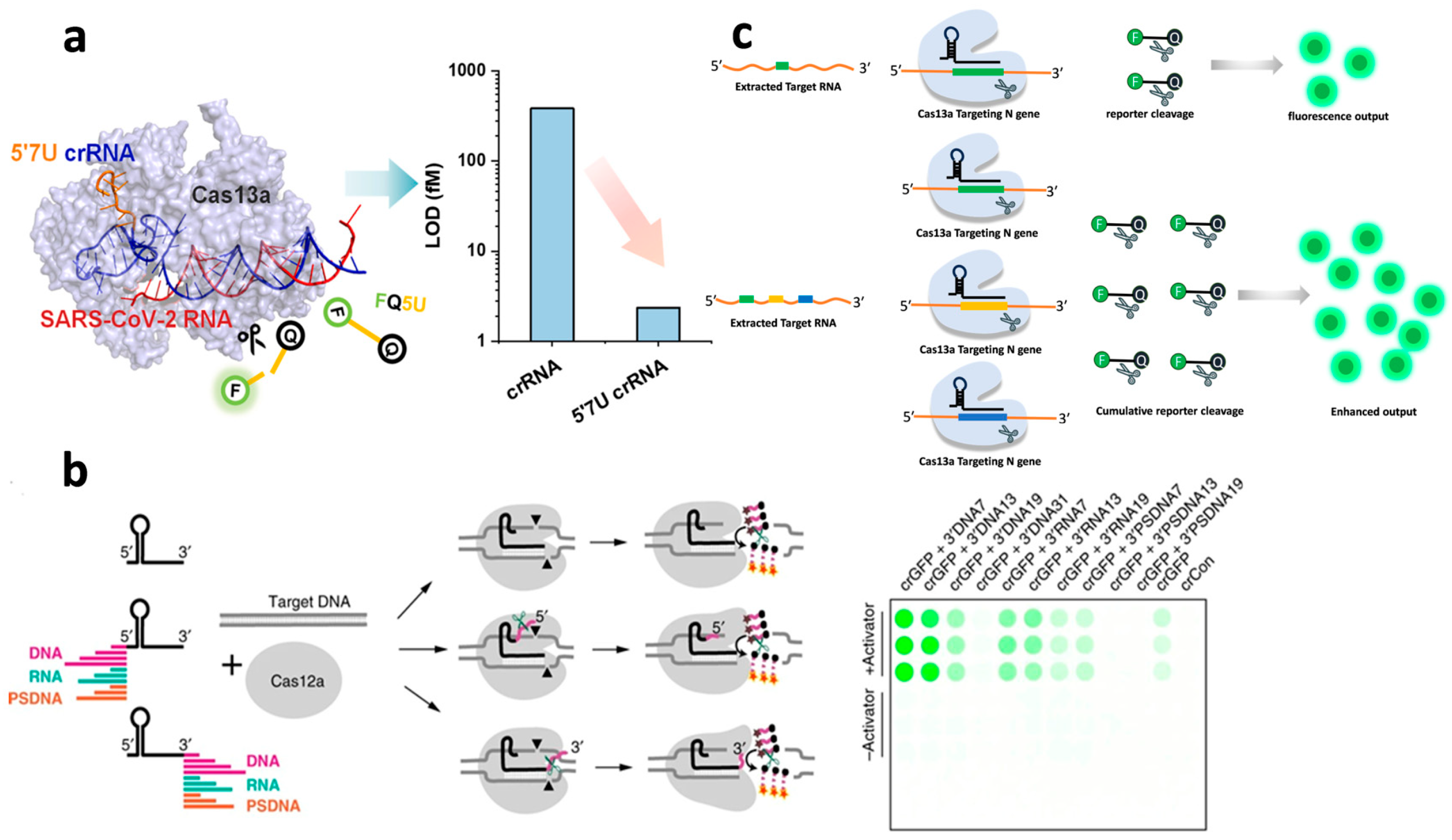
As the other cornerstone of Cas-based diagnostics, crRNA engineering strategies are likewise designed to augment the intrinsic performance of the Cas system, thereby narrowing the sensitivity disparity relative to clinical diagnostic requirements. A paradigmatic approach involves crRNA sequence extension. Taking LbuCas13a as an example, the introduction of a 5′-terminal U-rich extension leverages structural anchoring effects to significantly bolster the stability of the RNP complex, achieving an enhancement in overall detection performance of over 100-fold [35] (as depicted in Figure 1a). Similarly, research focused on the 3′-terminal extension of Cas12a crRNA demonstrated that a 7-nt ssDNA extension at the 3′ end induces LbCas12a to maintain an activated conformation. Leveraging this mechanism, the developed “Enhance” technology simultaneously amplifies detection sensitivity and single-nucleotide polymorphism (SNP) specificity [36], effectively circumventing the long-standing trade-off between sensitivity and specificity inherent in conventional methodologies (Figure 1b). Beyond structural modifications, the employment of multi-crRNA strategies has been reported to directly elevate detection sensitivity [28] without the necessity for sophisticated instrumentation (Figure 1c). Despite the marked improvement in the LOD through the collective signal amplification of multiple crRNAs, the substantially increased costs associated with RNA synthesis remain a critical factor for consideration. Furthermore, the rational design of crRNA length and sequence constitutes a fundamental prerequisite for ensuring the robustness of amplification-free diagnostic systems and warrants rigorous.
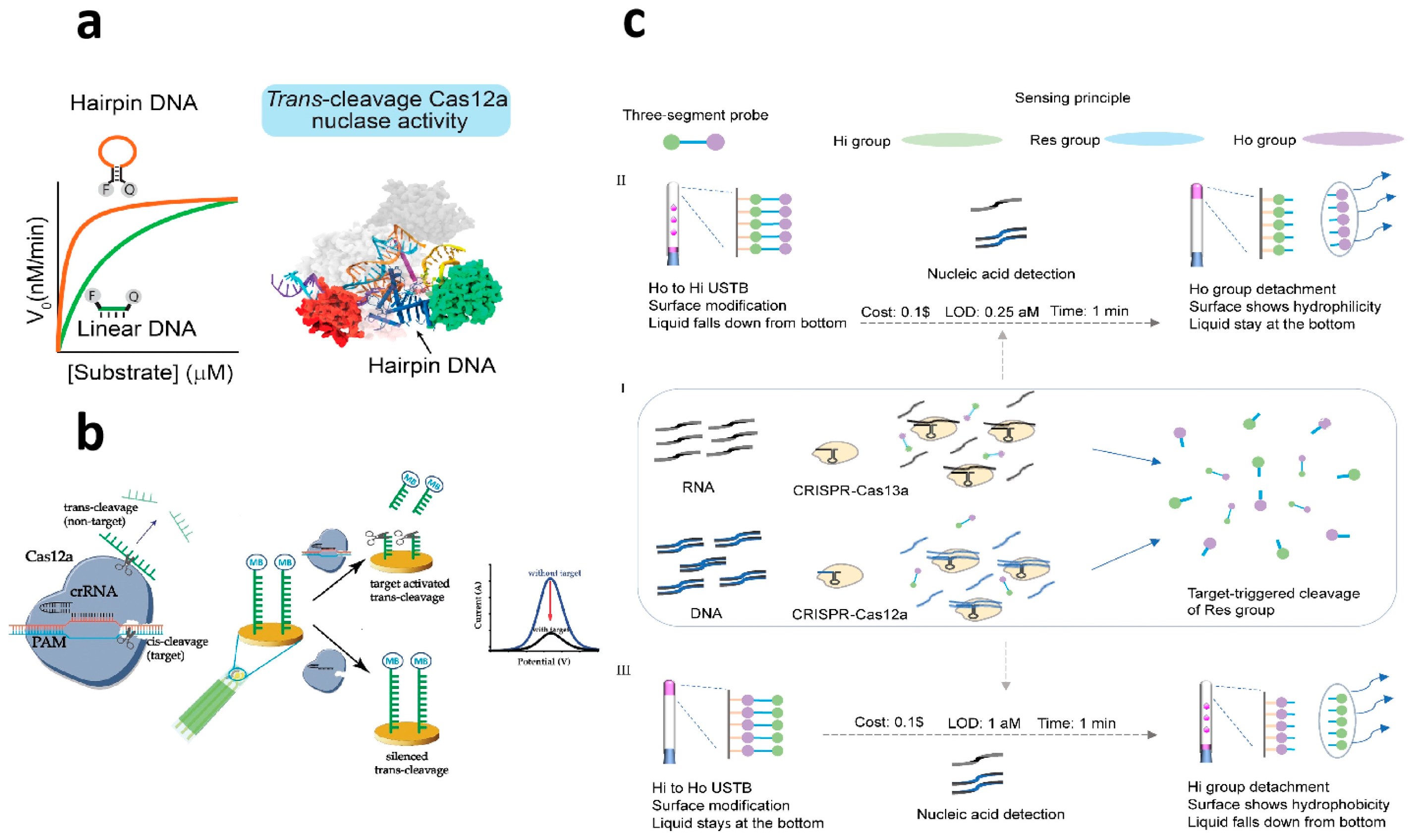
CRISPR-based nucleic acid detection predominantly relies on fluorescent readouts, a process mediated by the collateral cleavage activity of Cas effectors. Upon the cleavage of reporter probes modified with fluorophore and quencher moieties at their respective termini, the spatial separation of these groups relieves the fluorescence resonance energy transfer (FRET) quenching effect, thereby generating a detectable fluorescent signal. To address the inherent limitations of conventional single-stranded reporter probes, such as susceptibility to degradation and high background noise, recent research has focused on various optimization strategies, including length and sequence refinement [37,38], hairpin probe architectures [39] (Figure 2a), orthogonal probe designs [38] (Figure 2b), electrochemical sensing probes [40], and anti-CRISPR-tagged reporters [41]. Notably, a recent study introduced an Ultra-Sensitive Single-Tube Biosensor (USTB) that incorporates a tripartite “hydrophilic-responsive-hydrophobic” probe. By leveraging the target-activated collateral cleavage of Cas12/Cas13 to trigger a transition in surface wettability, this platform ingeniously transduces microscopic molecular recognition events into macroscopic liquid displacement (Figure 2c). This methodology circumvents the need for sophisticated instrumentation while offering the combined advantages of low cost ($0.1), rapid turnaround (1 min), and exceptional sensitivity (1 aM) [42], providing a novel paradigm for the on-site visual detection of DNA and RNA. In summary, while molecular engineering can adjust catalytic kinetics and target binding efficiency to alleviate some core mechanistic barriers of natural Cas enzymes, each modification introduces trade-offs between activity, specificity, and system complexity that require rigorous empirical validation in amplification-free diagnostic contexts.

4. Detection Enhancement Systems Based on Signal Cascades and Physical Sensing

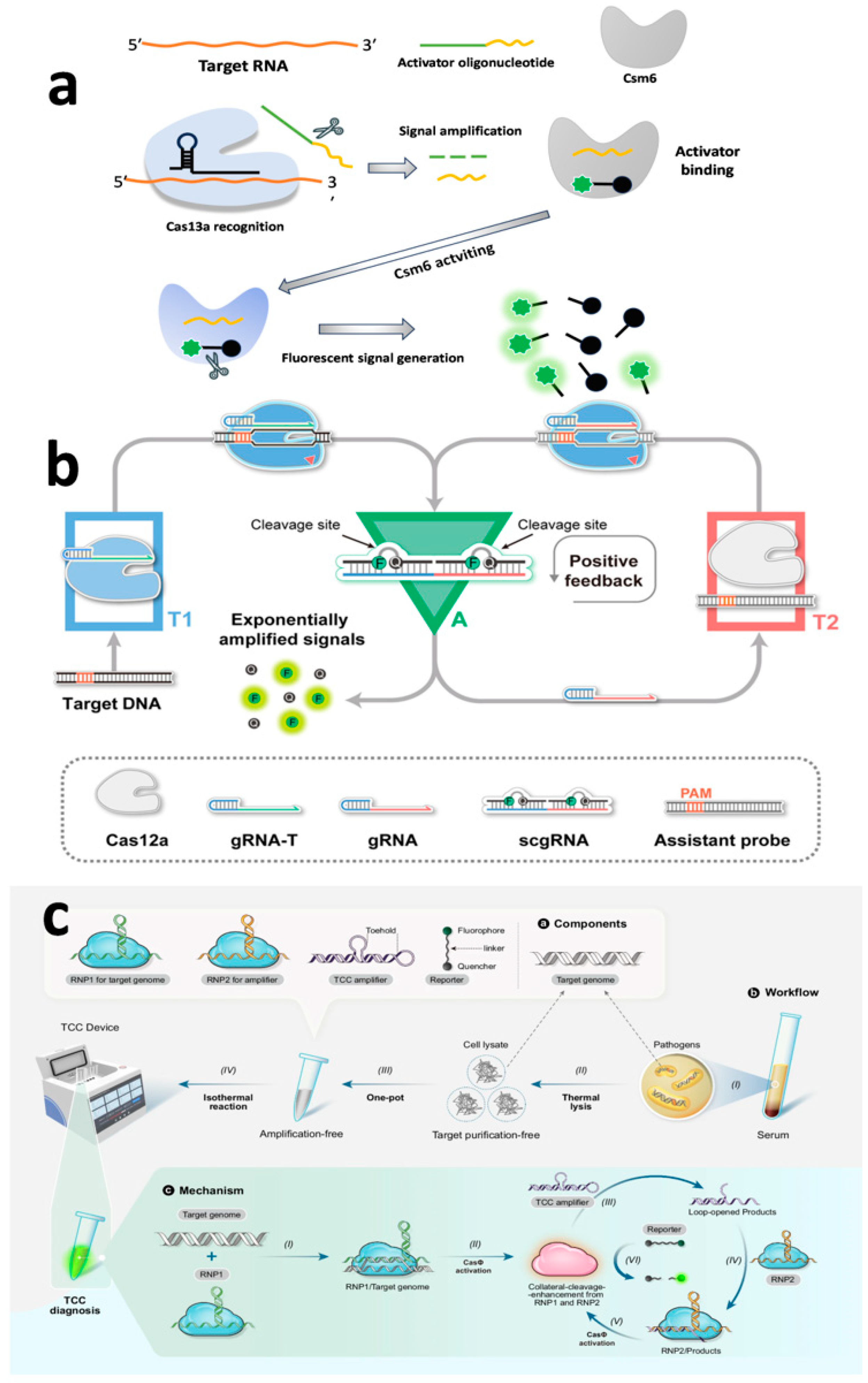
While the aforementioned approaches focusing on the core components of the Cas system establish a research paradigm for addressing the inherent performance challenges of amplification-free CRISPR diagnostics in POCT, they often struggle to generate discernible and stable signals when targeting low-abundance clinical analytes through unimodal linear amplification. Consequently, the research focus has transitioned from optimizing the intrinsic performance of Cas systems toward integrating synergistic ultra-sensitive modalities for enhanced sensing. For instance, multi-step signal cascade strategies have been introduced to progressively amplify trace initial signals generated by the CRISPR system into a detectable superposition of multiple signals. These strategies primarily encompass multi-enzyme tandem cascades and nucleic acid circuit-mediated cascades. A paradigmatic multi-enzyme approach is FIND-IT [43] (Figure 3a), which constructs a tandem cascade between Cas13 and Csm6. In this system, the collateral cleavage of Cas13 triggers the release of cyclic oligoadenylates—the specific activators for Csm6—thereby achieving potent secondary signal enhancement. Nevertheless, such multi-enzyme reaction systems are frequently contested due to their intrinsic complexity and the elevated risk of false positives stemming from non-specific activators [44]. A paradigmatic nucleic acid circuit strategy is exemplified by the CONAN technology [45], which hinges on the collateral cleavage activity of Cas12a to shear caged-guide RNAs (scgRNA) and release mature sgRNAs. These liberated sgRNAs subsequently recruit additional free Cas12a within the system to catalyze the cleavage of the remaining scgRNAs, thereby achieving recursive multilevel signal amplification (Figure 3b). Although CONAN achieves a LOD as low as the aM level under amplification-free conditions, its prolonged turnaround time of up to 240 min severely constrains its applicability for POCT. Recently, a new generation of nucleic acid circuit technologies have emerged, such as TCC [46] (Figure 3c) and gated CRISPR-Cascade [47], which significantly compress the detection timeframe to under 40 min while maintaining aM sensitivity. Similarly, these circuit-based cascade technologies remain susceptible to false positives induced by non-specific signals; consequently, the integration of advanced pre-treatment strategies is a fundamental prerequisite for enhancing diagnostic robustness prior to analysis.
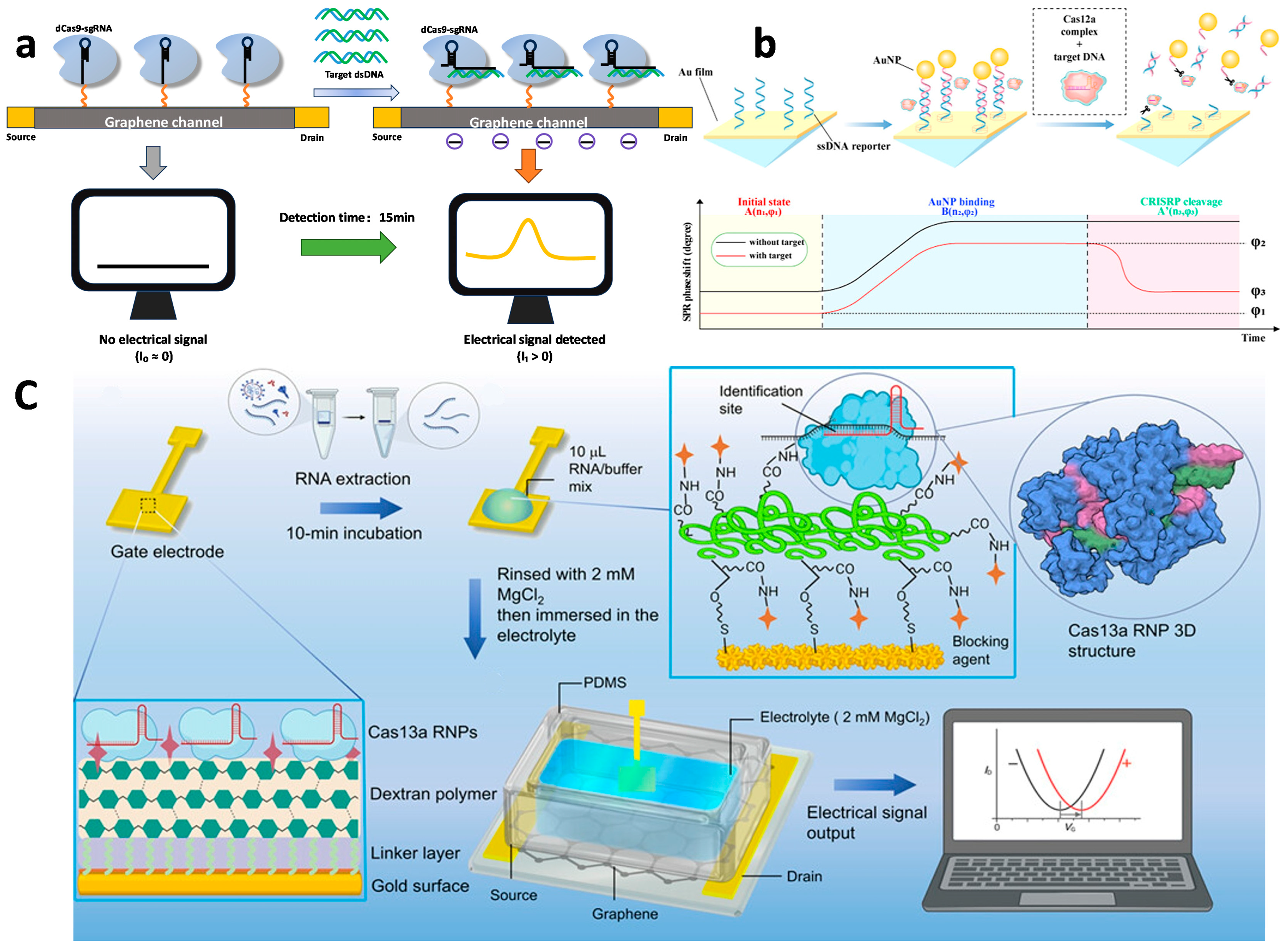
Furthermore, the integration of field-effect transistor (FET) technology and surface-enhanced spectroscopic techniques has introduced new technical paradigms to CRISPR-based diagnostics. Distinct from conventional fluorescence-based readouts, FET technology detects charge fluctuations resulting from the binding or cleavage events between Cas proteins and targets, transducing these events into highly sensitive, rapid, and directly readable electrochemical signals. A prototypical example is the CRISPR-Chip technology [48] (Figure 4a), which anchors catalytically deactivated Cas9 (dCas9) proteins onto a graphene surface. This platform utilizes the surface charge alterations induced by target-dCas9 binding to generate an instantaneous response in the drain current signal. This approach not only significantly compresses the detection timeframe and eliminates the requirement for sophisticated optical instrumentation but also effectively circumvents background fluorescence interference. However, constrained by the charge screening effect (Debye screening) exerted by high-ionic-strength samples on binding-induced charges, the CRISPR-Chip often necessitates additional buffer exchange steps. To address this, the recently developed solution-gated graphene transistor (SGGT) sensing technology decouples the Cas ribonucleoprotein (RNP) complexes onto an independent gold gate. By leveraging an electric double-layer (EDL) capacitive coupling mechanism, it ingeniously mitigates the charge screening effect in high-ionic-strength solutions. This enables rapid (<10 min) and ultra-sensitive (LOD down to aM) detection in complex biofluid samples without tedious buffer exchange procedures [49] (Figure 4c). Regarding surface-enhanced spectroscopic techniques, such as surface-enhanced Raman scattering (SERS), these platforms offer potential for single-molecule signal amplification by exploiting the localized surface plasmon resonance (LSPR) effect [50] (Figure 4b). Nevertheless, as these technologies remain highly dependent on precision optical excitation and collection instrumentation, the anti-interference capability and signal reproducibility of their nanostructured substrates in complex biological matrices still face formidable challenges.

5. Surmounting Molecular Diffusion Limits: Digital Detection Based on Spatial Confinement Effects

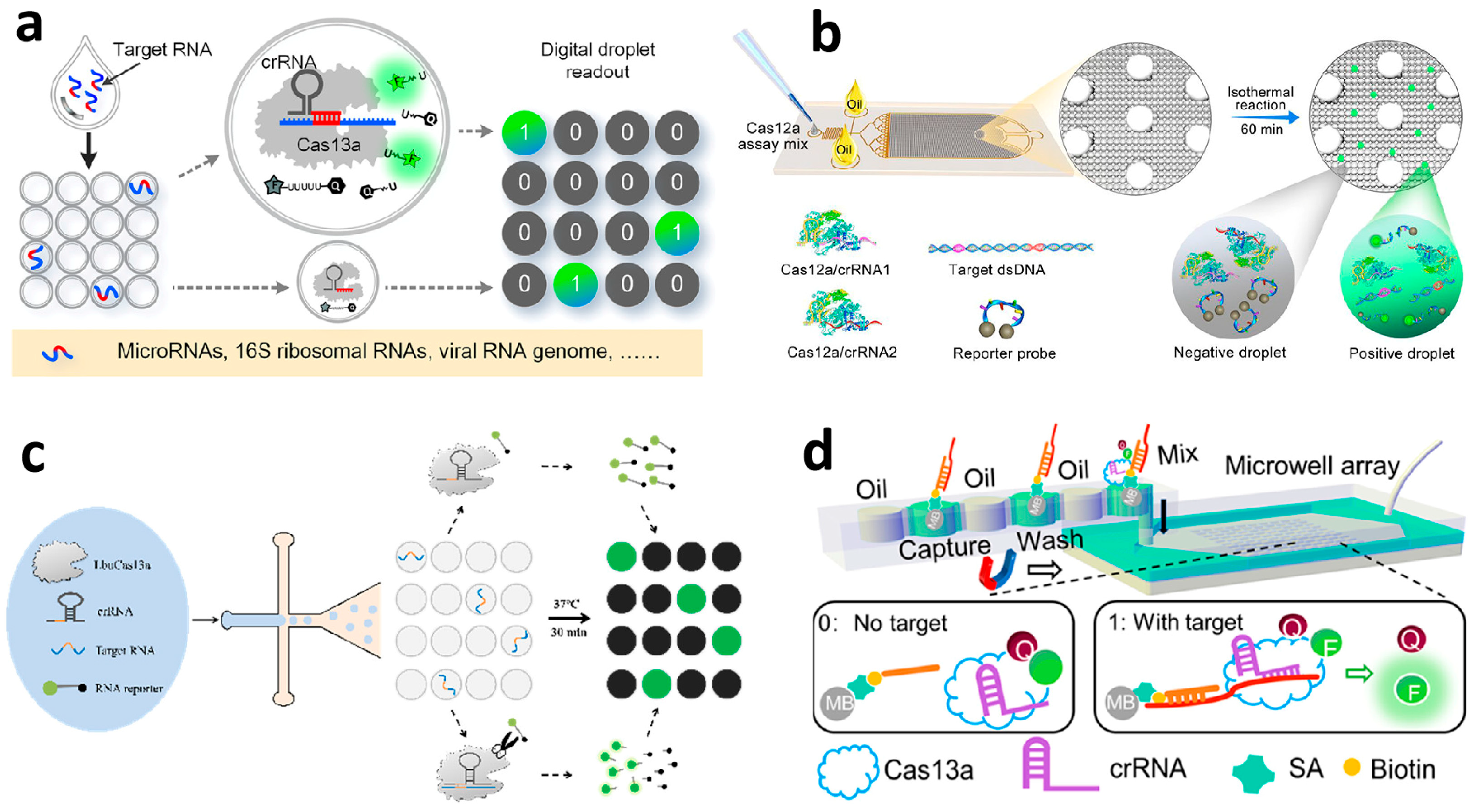
The aforementioned methods for enhancing amplification-free CRISPR diagnostics address inherent sensitivity limitations by improving Cas system performance, optimizing reporting probes, or coupling multi-dimensional ultrasensitive mechanisms. However, in detection systems, efficient Cas catalysis and diverse signal amplification mechanisms alone cannot overcome the constraints imposed by diffusion limitations during trace detection. Consequently, an alternative solution involves constructing spatially confined reactions to increase the local reaction concentration and shorten molecular diffusion times [51,52]. We initially pioneered a micro-droplet digital diagnostic platform based on CRISPR/Cas13a [53] (Figure 5a), which achieved precise single-molecule quantification of RNA targets with a sensitivity over 10, 000-fold higher than that of conventional Cas13a detection methods [12]. Inspired by this, we further extended the digital diagnostic platform to Cas12a by optimizing critical reaction parameters, including substrate probes [54], reaction temperature, and buffers. This enabled the direct quantification of various viral DNA samples in clinical serum under amplification-free conditions [55] (Figure 5b), representing a sensitivity improvement of more than 50-fold compared to standard CRISPR assays [10,56]. These studies demonstrate the potential of digital CRISPR diagnostic platforms for the quantitative detection of trace nucleic acids and have catalyzed subsequent research on the optimization and application of microwell array devices. For example, the SATORI platform utilizes an array chip containing 240,000 femtoliter-scale (~3 fL) microwells, allowing for the detection of nucleic acid targets as low as 10 fM within 5 min without amplification [57]. Another study developed a negative-pressure-driven microfluidic chip capable of rapidly generating thousands of monodisperse droplets within 2 min. By coupling this portable and rapid-response microfluidic technology with the high sensitivity of the CRISPR system, accurate quantification of RNA as low as 470 aM was achieved within 30 min [58] (Figure 5c). Although these advancements highlight the significant potential of spatially confined reactions in mitigating diffusion limitations, the issue of volume mismatch caused by extreme array miniaturization often leads to frequent false-negative results in digital trace detection. In view of this, several studies have introduced nucleic acid enrichment techniques to enhance digital diagnostic performance. For instance, a recent independent study utilized magnetic beads modified with capture probes to achieve efficient target enrichment, followed by resuspension and dispersion into millions of femtoliter-scale arrays. This ‘capture-enrichment-confined detection’ mechanism effectively circumvents sampling errors due to volume mismatch, further pushing the sensitivity of amplification-free diagnostics to 2 aM [59] (Figure 5d). Overall, digital CRISPR diagnostics utilize micro-scale physical constraints and droplet partitioning to not only significantly enhance detection sensitivity and absolute quantification capabilities but also greatly advance POCT through advantages such as ease of integration and portability.

6. Reconciling Analytical and Clinical Sensitivities: Sample Pretreatment and Enrichment in Complex Matrices

Currently, numerous amplification-free CRISPR diagnostic platforms have achieved ultra-high sensitivity, with some reaching aM LOD [42,45,46,47,58,59]. However, a significant order-of-magnitude gap persists between the practical sensitivity achieved in POCT applications and the analytical sensitivity measured in idealized buffers. This discrepancy is primarily attributed to the complex matrices found in clinical specimens, such as nucleases, antibodies, and various ions, which directly compromise the enzymatic activity of Cas ribonucleoprotein (RNP) complexes or the integrity of reporter probes [60]. Consequently, rather than merely enhancing Cas sensing performance, the development of advanced sample pretreatment methodologies has emerged as the cornerstone for resolving the imbalance between analytical and clinical sensitivities. One of the earliest representative approaches is HUDSON [61] (heating unextracted diagnostic samples to obliterate nucleases), a thermochemical pretreatment strategy developed to enable CRISPR-based detection directly from crude clinical samples. In this workflow, raw samples are treated with chemical additives and then subjected to controlled heating, so that viral or cellular structures are disrupted, nucleic acids are released, and endogenous nucleases are inactivated before downstream analysis. Through this simplified pretreatment process, HUDSON addresses three major barriers in direct nucleic acid detection, namely target degradation by nucleases, insufficient nucleic acid release, and partial inhibition of downstream CRISPR reactions. Nevertheless, its reliance on heating instrumentation and the sensitivity loss incurred during sample dilution limit its utility in resource-constrained settings. A subsequent approach, STOP-COVID, implemented magnetic bead-mediated enrichment to actively concentrate targets [62], thereby circumventing dilution-induced sensitivity loss while significantly mitigating matrix interference. However, this multi-step enrichment modality increases operational complexity and demands high technical proficiency. Moreover, the inherent risk of aerosol contamination poses a substantial barrier to its integration with fully enclosed automated diagnostic architectures. To overcome these bottlenecks, a recent independent study [63] integrated isotachophoresis (ITP) with CRISPR diagnostics. By utilizing an electrokinetic focusing system established with leading and terminating electrolytes, this technique creates a high-intensity electric field gradient within microfluidic channels. This gradient forcibly compresses trace targets into a picoliter (pL) interface, achieving thousand-fold enrichment while simultaneously segregating inhibitory components, such as nucleases, based on their distinct electrophoretic mobilities. It is noteworthy, however, that several limitations hinder its practical translation. For instance, the stringent requirements for buffer ionic stability often necessitate pre-loading sample dilution or buffer exchange. Furthermore, the high field strengths required for efficient enrichment frequently induce significant Joule heating, posing a latent risk of thermal inactivation for Cas enzymes and fundamentally constraining further breakthroughs in analytical sensitivity.

7. Conclusions and Future Perspectives

We have summarized various amplification-free CRISPR diagnostic methods employing physicochemical or molecular engineering strategies (Table 1). Centered on the three core bottlenecks of current amplification-free CRISPR diagnostics for POCT applications, we have evaluated the advantages and limitations of existing technologies. Although these studies have achieved performance breakthroughs under optimized laboratory conditions, further technological innovation remains essential to meet the rigorous standards required for practical POCT translation. Consequently, the following section summarizes the current status of amplification-free CRISPR diagnostics and provides a perspective on future development directions.
Existing diagnostic technologies primarily focus on the detection of single targets; however, recent POCT applications have increasingly emphasized the potential for multiplexed detection, especially in the context of rapid infectious disease outbreaks. For instance, the prompt identification of different pathogens presenting similar clinical symptoms plays a pivotal role in guiding timely treatment and intervening in disease progression. Furthermore, detecting multiple pathogen genotypes to enable researchers to rapidly monitor evolutionary variations is of great significance for formulating precision treatment regimens and curbing the rapid spread of epidemics. Although current amplification-free CRISPR diagnostics have achieved high sensitivity for single targets, the non-discriminatory nature of trans-cleavage activity often results in significant interference when multiple targets are present. Recently, our study demonstrated that the distinct trans-cleavage substrate preferences of Cas12a and Cas13a can be harnessed for dual detection [64]. Nonetheless, as structural and mechanistic insights into Cas effectors deepen, both Cas12a and Cas13a have been reported to possess potential collateral activities toward both RNA and DNA [65,66,67,68,69]. Therefore, the operational robustness of this detection strategy still requires rigorous evaluation. In the future, protein molecular engineering may facilitate the acquisition of diversified, high-performance Cas enzymes with orthogonal detection capabilities. Notably, a primary factor contributing to the high specificity of CRISPR diagnostics is the precise recognition of target nucleic acid sequences containing PAM or PFS motifs. On one hand, this inherent sequence dependency restricts the design space, particularly as PAM sequences often occur with low frequency in biological genomes. On the other hand, if clinical pathogens undergo continuous single nucleotide polymorphism (SNP) mutations under host immune pressure, any mutation disrupting the PAM sequence will lead to a sharp decline in Cas activity, resulting in severe false-negative results. Consequently, this design ‘blind spot’ represents a potential vulnerability in the development of CRISPR diagnostic technologies that cannot be ignored.
Additionally, most CRISPR-based diagnostic technologies utilize fluorescent probes for signal reporting. Existing fluorescent probes, when optimized, can maintain high reporting efficiency and low background levels in idealized buffers. However, samples in POCT applications are predominantly solutions containing complex matrices; whether these optimized probes can resist non-specific or spontaneous degradation caused by the sample matrix remains a critical concern. Once such non-specific background signals are generated, solely pursuing the inherent detection limit of the Cas system lacks any practical application value. One strategy is to develop advanced sample pretreatment technologies to remove background-inducing matrix components, such as isotachophoresis-based concentration and enrichment [63], or to directly inactivate matrix components through physicochemical means, exemplified by the early-developed HUDSON technology [61]. Nevertheless, these two approaches only mitigate interference from non-nucleic acid components and struggle to address the challenge of low discrimination between host and pathogen nucleic acids, which share similar physicochemical properties. Consequently, another recent direction in sample pretreatment involves the development of technologies for host nucleic acid depletion and target pathogen enrichment. An alternative approach focuses on the CRISPR system itself, integrating chemical modifications [27,70,71] to construct diagnostic systems with robust resistance to matrix interference. At the current stage, however, there remains significant room for improvement in these technologies—for instance, ensuring the steady enhancement of diagnostic performance while improving stability through chemical modification, and exploring whether novel pretreatment technologies for specific pathogen enrichment can be developed to ensure the complete removal of all background substances from the sample.
Although amplification-free CRISPR diagnostics remain at a developmental stage, their substantial potential for POCT is undeniable. It must be emphasized, however, that the evaluation of CRISPR diagnostic performance should not be confined to highly sensitive detection of low-abundance targets; analytical specificity is an equally indispensable metric. In POCT settings, false-positive results or erroneous genotyping outcomes often compromise clinical utility more severely than insufficient sensitivity. Recent studies have shown that the ability of Cas13a to discriminate single-base mismatches is highly dependent on spacer length, mismatch position, and target concentration: when a 28-nt spacer was used, LbuCas13a exhibited almost no single-base mismatch discrimination under the tested conditions, and many mismatch types still generated strong activation signals even when the target concentration was reduced to 100 pM; shortening the spacer to 20 nt improved mismatch sensitivity at certain positions, but this was often accompanied by reduced detection sensitivity [72]. These findings indicate that native Cas13a does not inherently provide reliable single-nucleotide discrimination in diagnostic systems. More recently, a dual-guide Cas13 study explicitly noted that conventional Cas13 systems display a certain degree of tolerance to single-nucleotide mismatches, and that only by increasing the activation threshold through cooperative guide recognition could mismatch-triggered activation be partially suppressed [73]. For Cas12a, one study [74] suggested that SNP discrimination in this system should not be judged solely by endpoint fluorescence, because partially mismatched targets may still produce measurable trans-cleavage signals. In that work, the deliberate introduction of synthetic mismatches into the crRNA–target system improved the discrimination of single-nucleotide variants, indirectly indicating that native Cas12a may lack sufficient single-base specificity in many diagnostic contexts. In parallel, the specificity of Cas12a is not fixed, but can shift with changes in Mg2+ concentration, such that the effects of seed-region and PAM-distal mismatches on cleavage defects vary with the chemical environment of the reaction system [75]. This issue is particularly relevant to POCT, because real samples are not ideal buffer systems; fluctuations in ions and biochemical components within sample matrices may substantially alter the specificity profile of Cas12a-based assays. Collectively, these studies indicate that matrix-associated background signals constitute an important factor limiting the translation of amplification-free CRISPR diagnostics to POCT. If these specificity-related issues are not adequately addressed, simply increasing reagent concentrations, extending incubation times, or incorporating multi-effector systems to strengthen signal output may not improve assay reliability accordingly; instead, such measures may amplify the cumulative effects of non-specific signals, increase overlap between positive and negative readouts, and reduce the stability and reproducibility of the assay across different sample types. Therefore, for amplification-free CRISPR diagnostics intended for POCT applications, only by achieving both high sensitivity and high specificity can these platforms be expected to deliver stable, interpretable, and clinically actionable results.
In recent years, the convergence of artificial intelligence (AI) and bioinformatics has presented new opportunities for the field of molecular diagnostics. The development of traditional CRISPR diagnostic technologies has historically relied on time-consuming and labor-intensive empirical screening processes. In contrast, AI-driven CRISPR diagnostics leverage algorithmic power to achieve precise predictions of Cas system performance, enabling the rapid identification of optimal crRNA sequences or Cas protein variants. For instance, deep learning-based models such as DeepCut and EasyDesign [76,77] can accurately predict gRNA cleavage efficiency by extracting sequence features from large-scale in vitro cleavage or detection datasets, thereby guiding the design of gRNA sequences with superior diagnostic efficacy. Importantly, the role of artificial intelligence in amplification-free CRISPR diagnostics extends well beyond sequence design. Given that these systems often produce weak signals and are highly vulnerable to background interference in real clinical samples, AI-assisted analysis can further enhance signal interpretation, reduce noise, and enable automated classification across multiple output formats, including fluorescence, imaging, digital counting, and electrochemical signals. Such capabilities are particularly valuable in POCT, where they can minimize dependence on subjective human judgment and improve analytical robustness in decentralized and resource-constrained settings. Accordingly, future CRISPR-based POCT will likely evolve not only toward increased portability, but also toward intelligent diagnostic platforms that integrate molecular design, automated analysis, and clinically adaptive decision-making. It is anticipated that future CRISPR-based POCT applications will transition from tedious, high-cost, and inefficient workflows toward a novel paradigm characterized by intelligent, portable, and highly precise diagnostic solutions.
Overall, breakthroughs in a single technical dimension alone are insufficient to transition amplification-free CRISPR diagnostics from laboratory settings to translational POCT applications. This represents a highly challenging multi-objective optimization goal, requiring diagnostic systems to simultaneously achieve high sensitivity, high specificity, rapidity, portability, and low cost. Consequently, the future development of amplification-free diagnostics will not be confined to the extreme optimization of a single metric, such as sensitivity, but will instead focus on constructing integrated strategies to achieve a multi-dimensional technical optimum.

Author Contributions

Conceptualization, writing: M.L.; reviewing, and editing: M.H. and X.Z. All authors have read and agreed to the published version of the manuscript.

Funding

This work was supported by the National Key R&D Program of China (2023YFC2307400), grants from the National Natural Science Foundation of China (22504039, 32150019), the Basic and Applied Basic Research Foundation of Guangdong Province (2025A1515011002), China Postdoctoral Science Foundation (2024M760985, GZB20240235).

Institutional Review Board Statement

Not applicable.

Informed Consent Statement

Not applicable.

Data Availability Statement

No new data were created or analyzed in this study.

Conflicts of Interest

The authors declare no conflicts of interest.

References

  1. GBD 2019 Antimicrobial Resistance Collaborators. Global mortality associated with 33 bacterial pathogens in 2019: A systematic analysis for the Global Burden of Disease Study 2019. Lancet 2022, 400, 2221–2248. [Google Scholar] [CrossRef]
  2. Jani, I.V.; Peter, T.F. How point-of-care testing could drive innovation in global health. N. Engl. J. Med. 2013, 368, 2319–2324. [Google Scholar] [CrossRef]
  3. Christodouleas, D.C.; Kaur, B.; Chorti, P. From Point-of-Care Testing to eHealth Diagnostic Devices (eDiagnostics). ACS Cent. Sci. 2018, 4, 1600–1616. [Google Scholar] [CrossRef]
  4. Mullis, K.; Faloona, F.; Scharf, S.; Saiki, R.; Horn, G.; Erlich, H. Specific enzymatic amplification of DNA in vitro: The polymerase chain reaction. Cold Spring Harb. Symp. Quant. Biol. 1986, 51, 263–273. [Google Scholar] [CrossRef]
  5. Chertow, D.S. Next-generation diagnostics with CRISPR. Science 2018, 360, 381–382. [Google Scholar] [CrossRef]
  6. Kaminski, M.M.; Abudayyeh, O.O.; Gootenberg, J.S.; Zhang, F.; Collins, J.J. CRISPR-based diagnostics. Nat. Biomed. Eng. 2021, 5, 643–656. [Google Scholar] [CrossRef]
  7. Ghouneimy, A.; Mahfouz, M. Streamlined detection of SARS-CoV-2 via Cas13. Nat. Biomed. Eng. 2022, 6, 925–927. [Google Scholar] [CrossRef]
  8. Li, Y.; Li, S.; Wang, J.; Liu, G. CRISPR/Cas Systems towards Next-Generation Biosensing. Trends Biotechnol. 2019, 37, 730–743. [Google Scholar] [CrossRef]
  9. Qiu, M.; Glass, Z.; Chen, J.; Haas, M.; Jin, X.; Zhao, X.; Rui, X.; Ye, Z.; Li, Y.; Zhang, F. Nucleic Acid Nanostructure for Delivery of CRISPR/Cas9-Based Gene Editing System. Interdiscip. Med. 2022, 1, e220220014. [Google Scholar] [CrossRef]
  10. Chen, J.S.; Ma, E.; Harrington, L.B.; Da Costa, M.; Tian, X.; Palefsky, J.M.; Doudna, J.A. CRISPR-Cas12a target binding unleashes indiscriminate single-stranded DNase activity. Science 2018, 360, 436–439. [Google Scholar] [CrossRef]
  11. Liu, L.; Li, X.; Ma, J.; Li, Z.; You, L.; Wang, J.; Wang, M.; Zhang, X.; Wang, Y. The Molecular Architecture for RNA-Guided RNA Cleavage by Cas13a. Cell 2017, 170, 714–726.e10. [Google Scholar] [CrossRef]
  12. East-Seletsky, A.; O’Connell, M.R.; Knight, S.C.; Burstein, D.; Cate, J.H.; Tjian, R.; Doudna, J.A. Two distinct RNase activities of CRISPR-C2c2 enable guide-RNA processing and RNA detection. Nature 2016, 538, 270–273. [Google Scholar] [CrossRef]
  13. Gootenberg, J.S.; Abudayyeh, O.O.; Lee, J.W.; Essletzbichler, P.; Dy, A.J.; Joung, J.; Verdine, V.; Donghia, N.; Daringer, N.M.; Freije, C.A. Nucleic acid detection with CRISPR-Cas13a/C2c2. Science 2017, 356, 438–442. [Google Scholar] [CrossRef]
  14. Notomi, T.; Okayama, H.; Masubuchi, H.; Yonekawa, T.; Watanabe, K.; Amino, N.; Hase, T. Loop-Mediated Isothermal Amplification of DNA. Nucleic Acids Res. 2000, 28, e63. [Google Scholar] [CrossRef]
  15. Piepenburg, O.; Williams, C.H.; Stemple, D.L.; Armes, N.A. DNA detection using recombination proteins. PLoS Biol. 2006, 4, e204. [Google Scholar] [CrossRef]
  16. Pardee, K.; Green, A.A.; Takahashi, M.K.; Braff, D.; Lambert, G.; Lee, J.W.; Ferrante, T.; Ma, D.; Donghia, N.; Fan, M. Rapid, Low-Cost Detection of Zika Virus Using Programmable Biomolecular Components. Cell 2016, 165, 1255–1266. [Google Scholar] [CrossRef]
  17. Broughton, J.P.; Deng, X.; Yu, G.; Fasching, C.L.; Servellita, V.; Singh, J.; Miao, X.; Streithorst, J.A.; Granados, A.; Sotomayor-Gonzalez, A. CRISPR-Cas12-based detection of SARS-CoV-2. Nat. Biotechnol. 2020, 38, 870–874. [Google Scholar] [CrossRef]
  18. Wang, B.; Wang, R.; Wang, D.; Wu, J.; Li, J.; Wang, J.; Liu, H.; Wang, Y. Cas12aVDet: A CRISPR/Cas12a-Based Platform for Rapid and Visual Nucleic Acid Detection. Anal. Chem. 2019, 91, 12156–12161. [Google Scholar] [CrossRef]
  19. Wang, R.; Qian, C.; Pang, Y.; Li, M.; Yang, Y.; Ma, H.; Zhao, M.; Qian, F.; Yu, H.; Liu, Z. opvCRISPR: One-pot visual RT-LAMP-CRISPR platform for SARS-CoV-2 detection. Biosens. Bioelectron. 2021, 172, 112766. [Google Scholar] [CrossRef]
  20. Pang, B.; Xu, J.; Liu, Y.; Peng, H.; Feng, W.; Cao, Y.; Wu, J.; Xiao, H.; Pabbaraju, K.; Tipples, G. Isothermal Amplification and Ambient Visualization in a Single Tube for the Detection of SARS-CoV-2 Using Loop-Mediated Amplification and CRISPR Technology. Anal. Chem. 2020, 92, 16204–16212. [Google Scholar] [CrossRef]
  21. Cheng, Z.H.; Luo, X.Y.; Yu, S.S.; Min, D.; Zhang, S.X.; Li, X.F.; Chen, J.J.; Liu, D.F.; Yu, H.Q. Tunable control of Cas12 activity promotes universal and fast one-pot nucleic acid detection. Nat. Commun. 2025, 16, 1166. [Google Scholar] [CrossRef]
  22. Lin, M.; Yue, H.; Tian, T.; Xiong, E.; Zhu, D.; Jiang, Y.; Zhou, X. Glycerol Additive Boosts 100-fold Sensitivity Enhancement for One-Pot RPA-CRISPR/Cas12a Assay. Anal. Chem. 2022, 94, 8277–8284. [Google Scholar] [CrossRef]
  23. Yin, N.; Yu, H.; Zhang, L.; Luo, F.; Wang, W.; Han, X.; He, Y.; Zhang, Y.; Wu, Y.; Pu, J. Regulation of CRISPR trans-cleavage activity by an overhanging activator. Nucleic Acids Res. 2025, 53, gkaf117. [Google Scholar] [CrossRef]
  24. Hu, M.; Qium, Z.; Bi, Z.; Tian, T.; Jiang, Y.; Zhou, X. Photocontrolled crRNA activation enables robust CRISPR-Cas12a diagnostics. Proc. Natl. Acad. Sci. USA 2022, 119, e2202034119. [Google Scholar] [CrossRef]
  25. Hu, M.; Liu, R.; Qiu, Z.; Cao, F.; Tian, T.; Lu, Y.; Jiang, Y.; Zhou, X. Light-Start CRISPR-Cas12a Reaction with Caged crRNA Enables Rapid and Sensitive Nucleic Acid Detection. Angew. Chem. Int. Ed. 2023, 62, e202300663. [Google Scholar] [CrossRef]
  26. Hu, M.; Zhang, B.; Shan, Y.; Cao, F.; Wang, Y.; Qi, W.; Wang, X.; Shen, Y.; Guo, X.; Zhang, M. Scalable modulation of CRISPR-Cas enzyme activity using photocleavable phosphorothioate DNA. Nat. Commun. 2025, 16, 5939. [Google Scholar] [CrossRef]
  27. Liu, P.; Lin, Y.; Zhuo, X.; Zeng, J.; Chen, B.; Zou, Z.; Liu, G.; Xiong, E.; Yang, R. Universal crRNA Acylation Strategy for Robust Photo-Initiated One-Pot CRISPR-Cas12a Nucleic Acid Diagnostics. Angew. Chem. Int. Ed. 2024, 63, e202401486. [Google Scholar] [CrossRef]
  28. Fozouni, P.; Son, S.; Díaz de León Derby, M.; Knott, G.J.; Gray, C.N.; D’Ambrosio, M.V.; Zhao, C.; Switz, N.A.; Kumar, G.R.; Stephens, S.I. Amplification-free detection of SARS-CoV-2 with CRISPR-Cas13a and mobile phone microscopy. Cell 2021, 184, 323–333.e9. [Google Scholar] [CrossRef]
  29. Dong, D.; Ren, K.; Qiu, X.; Zheng, J.; Guo, M.; Guan, X.; Liu, H.; Li, N.; Zhang, B.; Yang, D. The crystal structure of Cpf1 in complex with CRISPR RNA. Nature 2016, 532, 522–526. [Google Scholar] [CrossRef]
  30. Nishimasu, H.; Ran, F.A.; Hsu, P.D.; Konermann, S.; Shehata, S.I.; Dohmae, N.; Ishitani, R.; Zhang, F.; Nureki, O. Crystal structure of Cas9 in complex with guide RNA and target DNA. Cell 2014, 156, 935–949. [Google Scholar] [CrossRef]
  31. Tong, X.; Li, T.; Zhang, K.; Zhao, D.; Zhang, Y.; Yin, H. Structure-Guided design of Cas12a variants improves detection of nucleic acids. Cell Insight 2025, 4, 100228. [Google Scholar] [CrossRef]
  32. Sinha, S.; Molina Vargas, A.M.; Arantes, P.R.; Patel, A.; O’Connell, M.R.; Palermo, G. Unveiling the RNA-mediated allosteric activation discloses functional hotspots in CRISPR-Cas13a. Nucleic Acids Res. 2024, 52, 906–920. [Google Scholar] [CrossRef]
  33. Yang, J.; Song, Y.; Deng, X.; Vanegas, J.A.; You, Z.; Zhang, Y.; Weng, Z.; Avery, L.; Dieckhaus, K.D.; Peddi, A. Engineered LwaCas13a with enhanced collateral activity for nucleic acid detection. Nat. Chem. Biol. 2023, 19, 45–54. [Google Scholar] [CrossRef]
  34. Hu, J.H.; Miller, S.M.; Geurts, M.H.; Tang, W.; Chen, L.; Sun, N.; Zeina, C.M.; Gao, X.; Rees, H.A.; Lin, Z. Evolved Cas9 variants with broad PAM compatibility and high DNA specificity. Nature 2018, 556, 57–63. [Google Scholar] [CrossRef]
  35. Yang, Y.; Sun, L.; Zhao, J.; Jiao, Y.; Han, T.; Zhou, X. Improving trans-cleavage activity of CRISPR-Cas13a using engineered crRNA with a uridinylate-rich 5′-overhang. Biosens. Bioelectron. 2024, 255, 116239. [Google Scholar] [CrossRef]
  36. Nguyen, L.T.; Smith, B.M.; Jain, P.K. Enhancement of trans-cleavage activity of Cas12a with engineered crRNA enables amplified nucleic acid detection. Nat. Commun. 2020, 11, 4906. [Google Scholar] [CrossRef]
  37. Lee, S.; Nam, D.; Park, J.S.; Kim, S.; Lee, E.S.; Cha, B.S.; Park, K.S. Highly Efficient DNA Reporter for CRISPR/Cas12a-Based Specific and Sensitive Biosensor. Biochip J. 2022, 16, 463–470. [Google Scholar] [CrossRef]
  38. Gootenberg, J.S.; Abudayyeh, O.O.; Kellner, M.J.; Joung, J.; Collins, J.J.; Zhang, F. Multiplexed and portable nucleic acid detection platform with Cas13, Cas12a, and Csm6. Science 2018, 360, 439–444. [Google Scholar] [CrossRef]
  39. Rossetti, M.; Merlo, R.; Bagheri, N.; Moscone, D.; Valenti, A.; Saha, A.; Arantes, P.R.; Ippodrino, R.; Ricci, F.; Treglia, I. Enhancement of CRISPR/Cas12a trans-cleavage activity using hairpin DNA reporters. Nucleic Acids Res. 2022, 50, 8377–8391. [Google Scholar] [CrossRef]
  40. Dai, Y.; Somoza, R.A.; Wang, L.; Welter, J.F.; Li, Y.; Caplan, A.I.; Liu, C.C. Exploring the Trans-Cleavage Activity of CRISPR-Cas12a (cpf1) for the Development of a Universal Electrochemical Biosensor. Angew. Chem. Int. Ed. 2019, 58, 17399–17405. [Google Scholar] [CrossRef]
  41. Moon, J.; Zhang, J.; Guan, X.; Yang, R.; Guo, C.; Schalper, K.T.; Avery, L.; Banach, D.; LaSala, R.; Warrier, R.; et al. CRISPR anti-tag-mediated room-temperature RNA detection using CRISPR/Cas13a. Nat. Commun. 2025, 16, 9142. [Google Scholar] [CrossRef]
  42. Sun, Y.; Liu, K.; Zhang, H.; Zhao, Y.; Wen, J.; Zhao, M.; Li, X.; Li, Z. A tube-based biosensor for DNA and RNA detection. Sci. Adv. 2025, 11, eadu2271. [Google Scholar] [CrossRef]
  43. Liu, T.Y.; Knott, G.J.; Smock, D.C.J.; Desmarais, J.J.; Son, S.; Bhuiya, A.; Jakhanwal, S.; Prywes, N.; Agrawal, S.; Díaz de León Derby, M. Accelerated RNA detection using tandem CRISPR nucleases. Nat. Chem. Biol. 2021, 17, 982–988. [Google Scholar] [CrossRef]
  44. Johnston, M.; Dissanayake-Perera, S.; Collins, J.J.; Stevens, M.M.; Dincer, C. Convergence of nanotechnology and CRISPR-based diagnostics. Nat. Nanotechnol. 2025, 20, 1365–1373. [Google Scholar] [CrossRef]
  45. Shi, K.; Xie, S.; Tian, R.; Wang, S.; Lu, Q.; Gao, D.; Lei, C.; Zhu, H.; Nie, Z. A CRISPR-Cas autocatalysis-driven feedback amplification network for supersensitive DNA diagnostics. Sci. Adv. 2021, 7, eabc7802. [Google Scholar] [CrossRef]
  46. Chen, H.; Song, F.; Wang, B.; Huang, H.; Luo, Y.; Han, X.; He, H.; Lin, S.; Wan, L.; Huang, Z. Ultrasensitive detection of clinical pathogens through a target-amplification-free collateral-cleavage-enhancing CRISPR-CasΦ tool. Nat. Commun. 2025, 16, 3929. [Google Scholar] [CrossRef]
  47. Lim, J.; Van, A.B.; Koprowski, K.; Wester, M.; Valera, E.; Bashir, R. Amplification-free, OR-gated CRISPR-Cascade reaction for pathogen detection in blood samples. Proc. Natl. Acad. Sci. USA 2025, 122, e2420166122. [Google Scholar] [CrossRef]
  48. Hajian, R.; Balderston, S.; Tran, T.; DeBoer, T.; Etienne, J.; Sandhu, M.; Wauford, N.A.; Chung, J.Y.; Nokes, J.; Athaiya, M. Detection of unamplified target genes via CRISPR-Cas9 immobilized on a graphene field-effect transistor. Nat. Biomed. Eng. 2019, 3, 427–437. [Google Scholar] [CrossRef]
  49. Yu, H.; Zhang, H.; Li, J.; Zhao, Z.; Deng, M.; Ren, Z.; Li, Z.; Xue, C.; Li, M.G.; Chen, Z. Rapid and Unamplified Detection of SARS-CoV-2 RNA via CRISPR-Cas13a-Modified Solution-Gated Graphene Transistors. ACS Sens. 2022, 7, 3923–3932. [Google Scholar] [CrossRef]
  50. Dai, X.; Meng, C.; Huang, S.; Wang, Y.; He, J.; Chen, Z.; Ji, Y.; Tai, J.; Zhang, J.; Ni, H. Attomolar Nucleic Acid Detection Using CRISPR Enhanced Phase-Sensitive Surface Plasmon Resonance Imaging. Anal. Chem. 2025, 97, 16296–16303. [Google Scholar] [CrossRef]
  51. Agapakis, C.M.; Boyle, P.M.; Silver, P.A. Natural strategies for the spatial optimization of metabolism in synthetic biology. Nat. Chem. Biol. 2012, 8, 527–535. [Google Scholar] [CrossRef]
  52. Ellis, R.J. Macromolecular crowding: An important but neglected aspect of the intracellular environment. Curr. Opin. Struct. Biol. 2001, 11, 114–119. [Google Scholar] [CrossRef]
  53. Tian, T.; Shu, B.; Jiang, Y.; Ye, M.; Liu, L.; Guo, Z.; Han, Z.; Wang, Z.; Zhou, X. An Ultralocalized Cas13a Assay Enables Universal and Nucleic Acid Amplification-Free Single-Molecule RNA Diagnostics. ACS Nano 2021, 15, 1167–1178. [Google Scholar] [CrossRef]
  54. Gong, J.; Kan, L.; Zhang, X.; He, Y.; Pan, J.; Zhao, L.; Li, Q.; Liu, M.; Tian, J.; Lin, S. An enhanced method for nucleic acid detection with CRISPR-Cas12a using phosphorothioate modified primers and optimized gold-nanopaticle strip. Bioact. Mater. 2021, 6, 4580–4590. [Google Scholar] [CrossRef]
  55. Yue, H.; Shu, B.; Tian, T.; Xiong, E.; Huang, M.; Zhu, D.; Sun, J.; Liu, Q.; Wang, S.; Li, Y. Droplet Cas12a Assay Enables DNA Quantification from Unamplified Samples at the Single-Molecule Level. Nano Lett. 2021, 21, 4643–4653. [Google Scholar] [CrossRef]
  56. Huang, D.; Qian, J.; Shi, Z.; Zhao, J.; Fang, M.; Xu, Z. CRISPR-Cas12a-Assisted Multicolor Biosensor for Semiquantitative Point-of-Use Testing of the Nopaline Synthase Terminator in Genetically Modified Crops by Unaided Eyes. ACS Synth. Biol. 2020, 9, 3114–3123. [Google Scholar] [CrossRef]
  57. Shinoda, H.; Taguchi, Y.; Nakagawa, R.; Makino, A.; Okazaki, S.; Nakano, M.; Muramoto, Y.; Takahashi, C.; Takahashi, I.; Ando, J. Amplification-free RNA detection with CRISPR-Cas13. Commun. Biol. 2021, 4, 476. [Google Scholar] [CrossRef] [PubMed]
  58. Shan, X.; Gong, F.; Yang, Y.; Qian, J.; Tan, Z.; Tian, S.; He, Z.; Ji, X. Nucleic Acid Amplification-Free Digital Detection Method for SARS-CoV-2 RNA Based on Droplet Microfluidics and CRISPR-Cas13a. Anal. Chem. 2023, 95, 16489–16495. [Google Scholar] [CrossRef]
  59. Wang, D.; Wang, X.; Ye, F.; Zou, J.; Qu, J.; Jiang, X. An Integrated Amplification-Free Digital CRISPR/Cas-Assisted Assay for Single Molecule Detection of RNA. ACS Nano 2023, 17, 7250–7256. [Google Scholar] [CrossRef]
  60. Al-Soud, W.A.; Rådström, P. Purification and characterization of PCR-inhibitory components in blood cells. J. Clin. Microbiol. 2001, 39, 485–493. [Google Scholar] [CrossRef] [PubMed]
  61. Myhrvold, C.; Freije, C.A.; Gootenberg, J.S.; Abudayyeh, O.O.; Metsky, H.C.; Durbin, A.F.; Kellner, M.J.; Tan, A.L.; Paul, L.M.; Parham, L.A. Field-deployable viral diagnostics using CRISPR-Cas13. Science 2018, 360, 444–448. [Google Scholar] [CrossRef] [PubMed]
  62. Joung, J.; Ladha, A.; Saito, M.; Kim, N.G.; Woolley, A.E.; Segel, M.; Barretto, R.P.J.; Ranu, A.; Macrae, R.K.; Faure, G. Detection of SARS-CoV-2 with SHERLOCK One-Pot Testing. N. Engl. J. Med. 2020, 383, 1492–1494. [Google Scholar] [CrossRef]
  63. Ramachandran, A.; Huyke, D.A.; Sharma, E.; Sahoo, M.K.; Huang, C.; Banaei, N.; Pinsky, B.A.; Santiago, J.G. Electric field-driven microfluidics for rapid CRISPR-based diagnostics and its application to detection of SARS-CoV-2. Proc. Natl. Acad. Sci. USA 2020, 117, 29518–29525. [Google Scholar] [CrossRef]
  64. Tian, T.; Qiu, Z.; Jiang, Y.; Zhu, D.; Zhou, X. Exploiting the orthogonal CRISPR-Cas12a/Cas13a trans-cleavage for dual-gene virus detection using a handheld device. Biosens. Bioelectron. 2022, 196, 113701. [Google Scholar] [CrossRef]
  65. Wu, X.; Luo, S.; Guo, C.; Zhao, Y.; Zhong, J.; Hu, R.; Yang, X.; Liu, C.; Zhang, Q.; Zhuang, S. LbuCas13a directly targets DNA and elicits strong trans-cleavage activity. Nat. Biomed. Eng. 2025, 9, 2141–2154. [Google Scholar] [CrossRef]
  66. Dmytrenko, O.; Neumann, G.C.; Hallmark, T.; Keiser, D.J.; Crowley, V.M.; Vialettom, E.; Mougiakos, I.; Wandera, K.G.; Domgaard, H.; Weber, J. Cas12a2 elicits abortive infection through RNA-triggered destruction of dsDNA. Nature 2023, 613, 588–594. [Google Scholar] [CrossRef] [PubMed]
  67. Li, J.; Luo, T.; He, Y.; Liu, H.; Deng, Z.; Bu, J.; Long, X.; Zhong, S.; Yang, Y. Discovery of the Rnase activity of CRISPR-Cas12a and its distinguishing cleavage efficiency on various substrates. Chem. Commun. 2022, 58, 2540–2543. [Google Scholar] [CrossRef]
  68. Wei, Y.; Yang, Z.; Zong, C.; Wang, B.; Ge, X.; Tan, X.; Liu, X.; Tao, Z.; Wang, P.; Ma, C. trans Single-Stranded DNA Cleavage via CRISPR/Cas14a1 Activated by Target RNA without Destruction. Angew. Chem. Int. Ed. 2021, 60, 24241–24247. [Google Scholar] [CrossRef]
  69. Zhang, J.; Li, Z.; Guo, C.; Guan, X.; Avery, L.; Banach, D.; Liu, C. Intrinsic RNA Targeting Triggers Indiscriminate DNase Activity of CRISPR-Cas12a. Angew. Chem. Int. Ed. 2024, 63, e202403123. [Google Scholar] [CrossRef]
  70. Sun, K.; Pu, L.; Chen, C.; Chen, M.; Li, K.; Li, X.; Li, H.; Geng, J. An autocatalytic CRISPR-Cas amplification effect propelled by the LNA-modified split activators for DNA sensing. Nucleic Acids Res. 2024, 52, e39. [Google Scholar] [CrossRef]
  71. McMahon, M.A.; Prakash, T.P.; Cleveland, D.W.; Bennett, C.F.; Rahdar, M. Chemically Modified Cpf1-CRISPR RNAs Mediate Efficient Genome Editing in Mammalian Cells. Mol. Ther. J. Am. Soc. Gene Ther. 2018, 26, 1228–1240. [Google Scholar] [CrossRef] [PubMed]
  72. Molina Vargas, A.M.; Sinha, S.; Osborn, R.; Arantes, P.R.; Patel, A.; Dewhurst, S.; Hardy, D.J.; Cameron, A.; Palermo, G.; O’Connell, M.R. New design strategies for ultra-specific CRISPR-Cas13a-based RNA detection with single-nucleotide mismatch sensitivity. Nucleic Acids Res. 2024, 52, 921–939. [Google Scholar] [CrossRef]
  73. Aguilar-González, A.; Martos-Jamai, I.; Ramos-Hernández, I.; Molina-Estévez, F.J.; Villao, N.V.; Puig-Serra, P.; Rodríguez-Perales, S.; Torres, R.; Labun, K.; Sánchez-Martín, R.M. A novel Dual-guide CRISPR-Cas13 strategy improves specificity for single-nucleotide variant detection. Nucleic Acids Res. 2026, 54, gkag161. [Google Scholar] [CrossRef]
  74. Kohabir, K.A.V.; Linthorst, J.; Nooi, L.O.; Brouwer, R.; Wolthuis, R.M.F.; Sistermans, E.A. Synthetic mismatches enable specific CRISPR-Cas12a-based detection of genome-wide SNVs tracked by ARTEMIS. Cell Rep. Methods 2024, 4, 100912. [Google Scholar] [CrossRef]
  75. Nguyen, G.T.; Schelling, M.A.; Raju, A.; Buscher, K.A.; Sritharan, A.; Sashital, D.G. CRISPR-Cas12a exhibits metal-dependent specificity switching. Nucleic Acids Res. 2024, 52, 9343–9359. [Google Scholar] [CrossRef] [PubMed]
  76. Qu, Y.; Huang, K.; Yin, M.; Zhan, K.; Liu, D.; Yin, D.; Cousins, H.C.; Johnson, W.A.; Wang, X.; Shah, M. CRISPR-GPT for agentic automation of gene-editing experiments. Nat. Biomed. Eng. 2026, 10, 245–258. [Google Scholar] [CrossRef]
  77. Huang, B.; Guo, L.; Yin, H.; Wu, Y.; Zeng, Z.; Xu, S.; Lou, Y.; Ai, Z.; Zhang, W.; Kan, X. Deep learning enhancing guide RNA design for CRISPR/Cas12a-based diagnostics. iMeta 2024, 3, e214. [Google Scholar] [CrossRef] [PubMed]
Figure 1. Molecular engineering strategies for crRNA enhancement in CRISPR-based amplification-free diagnostics. This figure summarizes representative crRNA engineering approaches that improve the sensing performance of CRISPR systems under amplification-free conditions, mainly by enhancing ribonucleoprotein complex stability, promoting target recognition, or increasing trans-cleavage efficiency. (a). Schematic illustration of the optimization strategy for Cas13a crRNA via 5′-end U-rich sequence extension, which improves the stability of the Cas13a–crRNA complex and enhances trans-cleavage activity [35] © 2024 Elsevier, B.V. (b). Schematic illustration of the optimization strategy for Cas12a crRNA via 3′-end sequence extension, which helps maintain the activated conformation of Cas12a and thereby improves both detection sensitivity and specificity [36] © 2026 Springer Nature Limited. (c). Schematic workflow of multi-crRNA detection strategies designed for specific targets, where multiple crRNAs collectively contribute to signal amplification and improved analytical sensitivity [28].
Targets 04 00016 g001
Figure 2. Optimization strategies for signal reporting in amplification-free CRISPR diagnostics. This figure summarizes representative signal-reporting designs that improve readout sensitivity, reduce background interference, or enable alternative signal transduction modes for amplification-free CRISPR assays. (a). Schematic illustration of the hairpin probe strategy for enhanced signal reporting relative to conventional linear probes, showing how probe structure optimization can improve signal-to-background performance [39] Copyright © 2026 Oxford University Press. (b). Schematic illustration of the signal transduction principles of electrochemical probes, which convert CRISPR-triggered cleavage events into measurable electrochemical outputs [40] Copyright © 2026 John Wiley & Sons, Inc. (c). Schematic illustration of the detection principle of an ultrasensitive tubular biosensor (USTB), in which CRISPR activity is translated into macroscopic signal output for rapid and instrument-free visual detection.(I) Target nucleic acids bind to the Cas12/Cas13-crRNA complex, activating collateral cleavage. (II) Collateral cleavage triggers a “hydrophilic–responsive–hydrophobic” transition in the surface-modified probe. (III) Macroscopic liquid movement occurs as a result of surface wettability change, enabling rapid, instrument-free visual detection of DNA or RNA at attomolar concentrations [42] © 2026 American Association for the Advancement of Science.
Targets 04 00016 g002
Figure 3. Biochemical cascade strategies for amplification-free CRISPR diagnostics. This figure illustrates representative cascade amplification systems that enhance weak initial CRISPR signals through tandem enzymatic reactions or nucleic acid circuits, thereby improving analytical sensitivity while also increasing reaction complexity. (a). Schematic illustration of the FIND-IT strategy based on multi-enzyme cascades, in which Cas13-triggered activation of downstream nucleases enables secondary signal amplification [43]. (b). CONAN platform based on a nucleic acid circuit, where CRISPR-mediated cleavage initiates an autocatalytic feedback network for recursive signal enhancement [45] © 2026 American Association for the Advancement of Science. (c). TCC strategy based on a collateral-cleavage-enhancing nucleic acid circuit, enabling faster ultrasensitive pathogen detection under amplification-free conditions. (I) Target nucleic acid recognition. (II) Collateral cleavage activation. (III) Triggering the nucleic acid circuit. (IV) Signal amplification cascade. (V) Readout generation [46] © 2026 Springer Nature Limited.
Targets 04 00016 g003
Figure 4. Amplification-free CRISPR diagnostic strategies integrated with ultrasensitive optoelectronic physical sensing. These platforms couple CRISPR target recognition with electrical or optical signal transduction, providing alternatives to conventional fluorescence readout for rapid and highly sensitive detection. (a). CRISPR-Chip platform, in which target binding by immobilized CRISPR complexes induces measurable changes in transistor output [48]. (b). CRISPR-PSPRi platform, which integrates CRISPR recognition with phase-sensitive plasmonic sensing for ultrasensitive optical detection [50] Copyright © 2025, American Chemical Society. (c). SGGT platform, where solution-gated graphene transistor sensing converts CRISPR activity into rapid electrical signals and improves performance in complex sample matrices [49] Copyright © 2026, American Chemical Society.
Targets 04 00016 g004
Figure 5. Digital CRISPR diagnostic strategies based on spatial confinement effects. By partitioning reactions into confined microenvironments, digital CRISPR platforms increase local reaction probability, reduce diffusion constraints, and improve the sensitivity of amplification-free detection for low-abundance nucleic acid targets. (a). Schematic illustration of the principle of ultra-localized Cas13a digital detection platform [53] Copyright © 2021, American Chemical Society. (b). Schematic illustration of the principle of ultra-localized Cas12a digital detection platform, extending confined digital detection to DNA targets under amplification-free conditions [55] Copyright © 2021, American Chemical Society. (c). Negative-pressure-driven microfluidic digital CRISPR platform, which integrates rapid and controlled droplet generation with amplification-free Cas13a detection, thereby improving assay speed, compartment uniformity, and practical operability for sensitive RNA quantification [58] Copyright © 2023, American Chemical Society. (d). Magnetic bead-enrichment-based digital CRISPR platform, in which target capture and pre-enrichment are coupled with digital compartmentalization to reduce sampling bias caused by volume mismatch and further enhance the sensitivity of amplification-free detection for trace nucleic acid targets [59] Copyright © 2023, American Chemical Society.
Targets 04 00016 g005
Table 1. Performance comparison of various amplification-free CRISPR diagnostic platforms.
StrategyPlatformProteinReadoutLODTimeTargetsRef.
Cas System Optimization5′ U-rich crRNA extensionCas13aFluorescence16.25 fM<40 minSARS-CoV-2[35]
3′ crRNA sequence extensionCas12aFluorescence/
LFA
25 fM40–60 minPCA3/
SARS-CoV-2/
HCoV63
[36]
Multi-crRNA strategyCas13aFluorescence30 copies/μL<30 minSARS-CoV
2
[28]
Signal Reporting OptimizationHairpin probeCas12aFluorescence10 pM60 minSalmonela Ty-phimurium[39]
Electrochemical probeCas13aAmperometric50 pM<60 minPB-19/
HPV-16
[40]
Anti-CRISPR tagCas13aFluorescence10 aM<60 minHIV/HCV[41]
USTBCas12a, Cas13aNaked-eye0.25 aM1 minASFV[42]
Biochemical CascadesFIND-ITCas13a, Csm6Fluorescence30 copies/μL<20 minSARS-CoV-2[43]
CONANCas12aFluorescence5 aM240 minHBV[45]
TCCCas12jFluorescence0.11 copies/μL<40 minS. aureus[46]
Cas-Cascade gatingCas12aFluorescence1 copy/μL10 minMRSA/MSSA/E.coli/HBV[47]
Integrated Physical SensingCRISPR-ChipdCas9Potentiometric1.7 fM<15 minDMD[48]
SGGTCas13aPotentiometric13 aM10 minSARS-CoV-2[49]
CRISPR-PSPRiCas12aOptical Phase1 aM150 minmonkeypox[50]
Digital CRISPRUltra-localized Cas13a DetectionCas13aFluorescence6 copies/μL<75 min16SrRNA/
SARS-CoV-2
[53]
Ultra-localized Cas12a DetectionCas13aFluorescence17.5 copies/μL<45 minASFV/
EBV/
HBV
[55]
SATORICas13aFluorescence10 fM<5 minSARS-CoV-2[57]
Negative-pressure-driven microfluidic Cas13a platformCas13aFluorescence470 aM<30 minSARS-CoV-2[58]
Magnetic-enrichme
-nt dCRISPR
Cas13aFluorescence2 aM<50 minSARS-CoV-2[59]
Disclaimer/Publisher’s Note: The statements, opinions and data contained in all publications are solely those of the individual author(s) and contributor(s) and not of MDPI and/or the editor(s). MDPI and/or the editor(s) disclaim responsibility for any injury to people or property resulting from any ideas, methods, instructions or products referred to in the content.