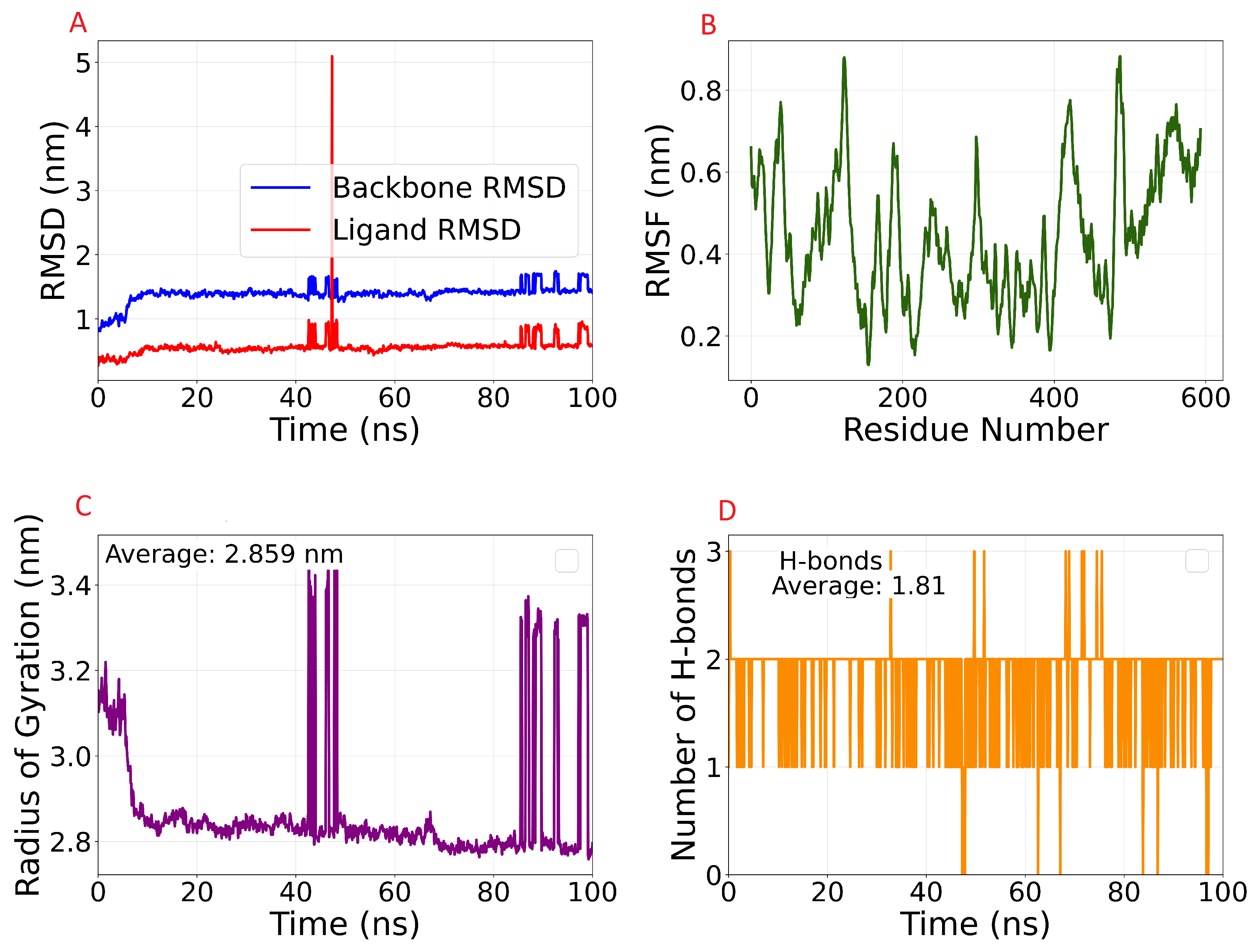
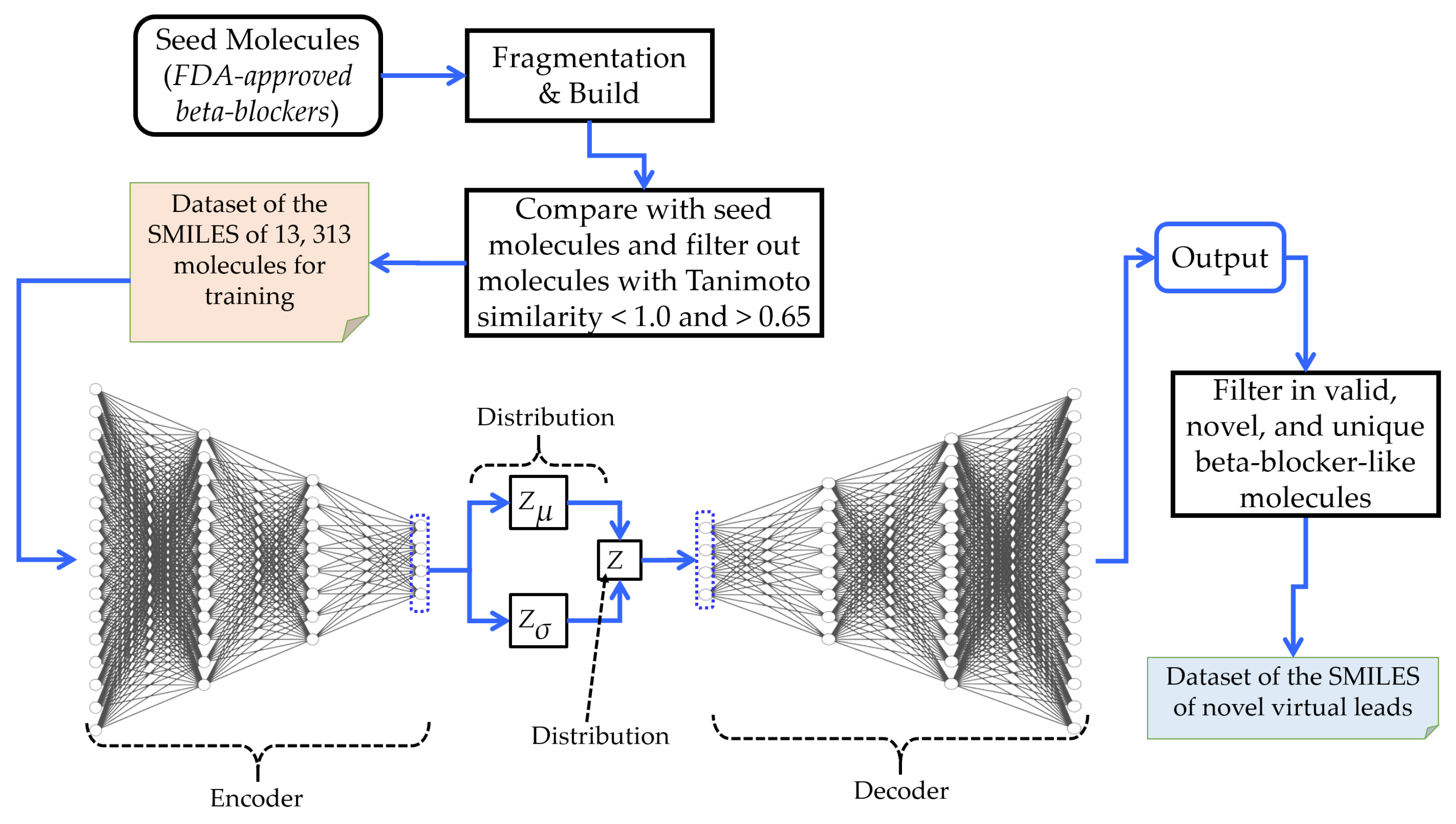
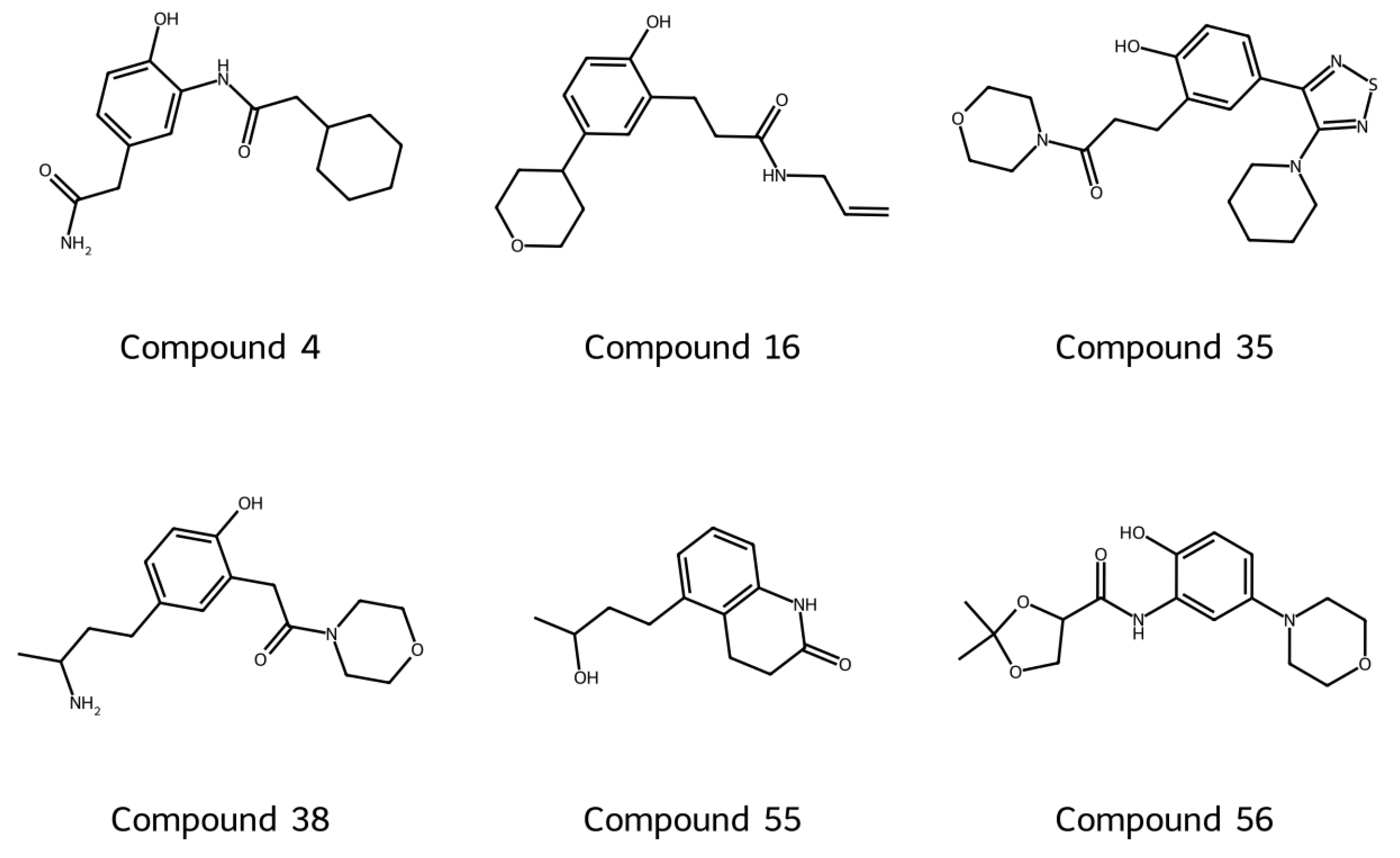
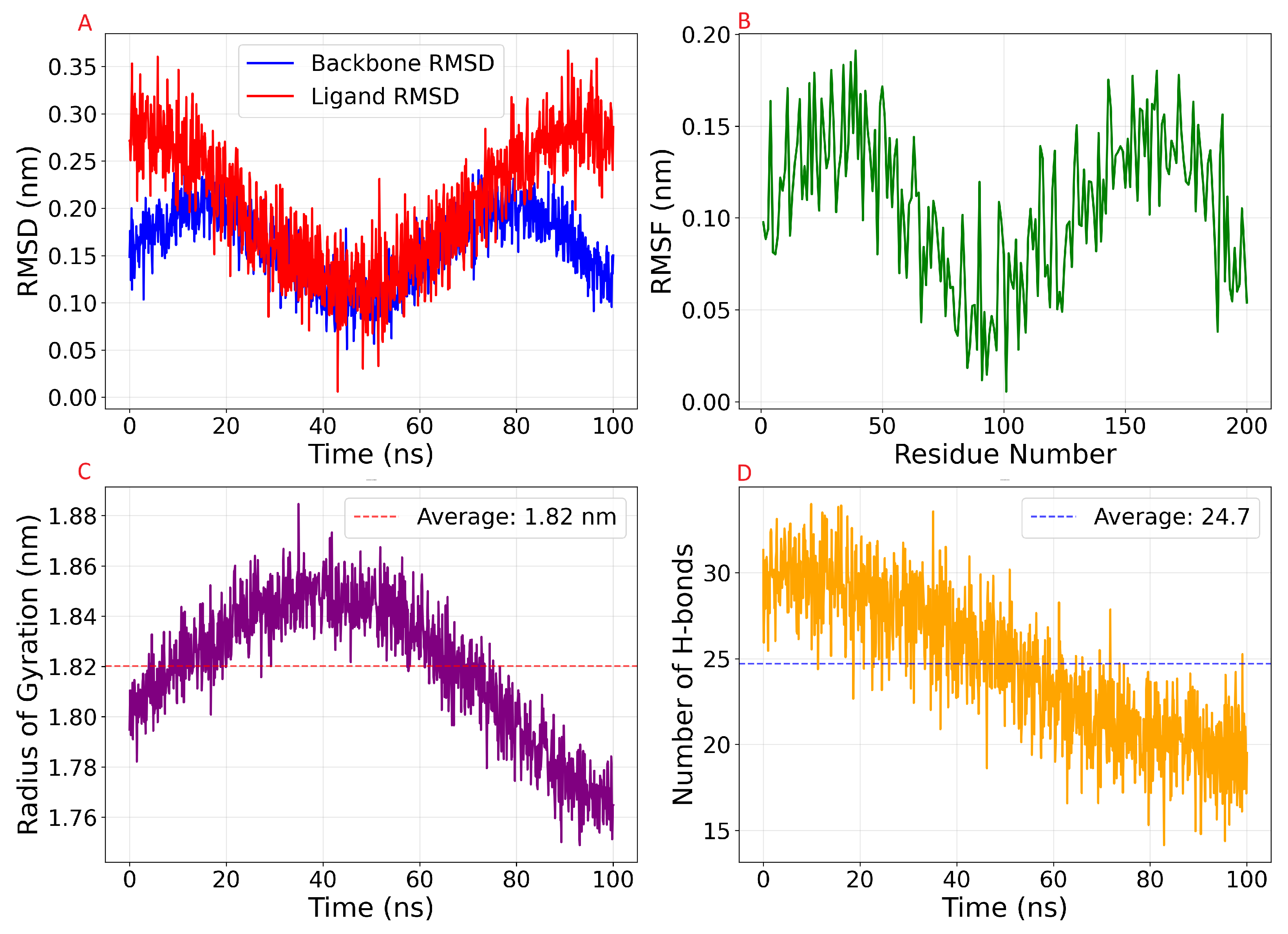
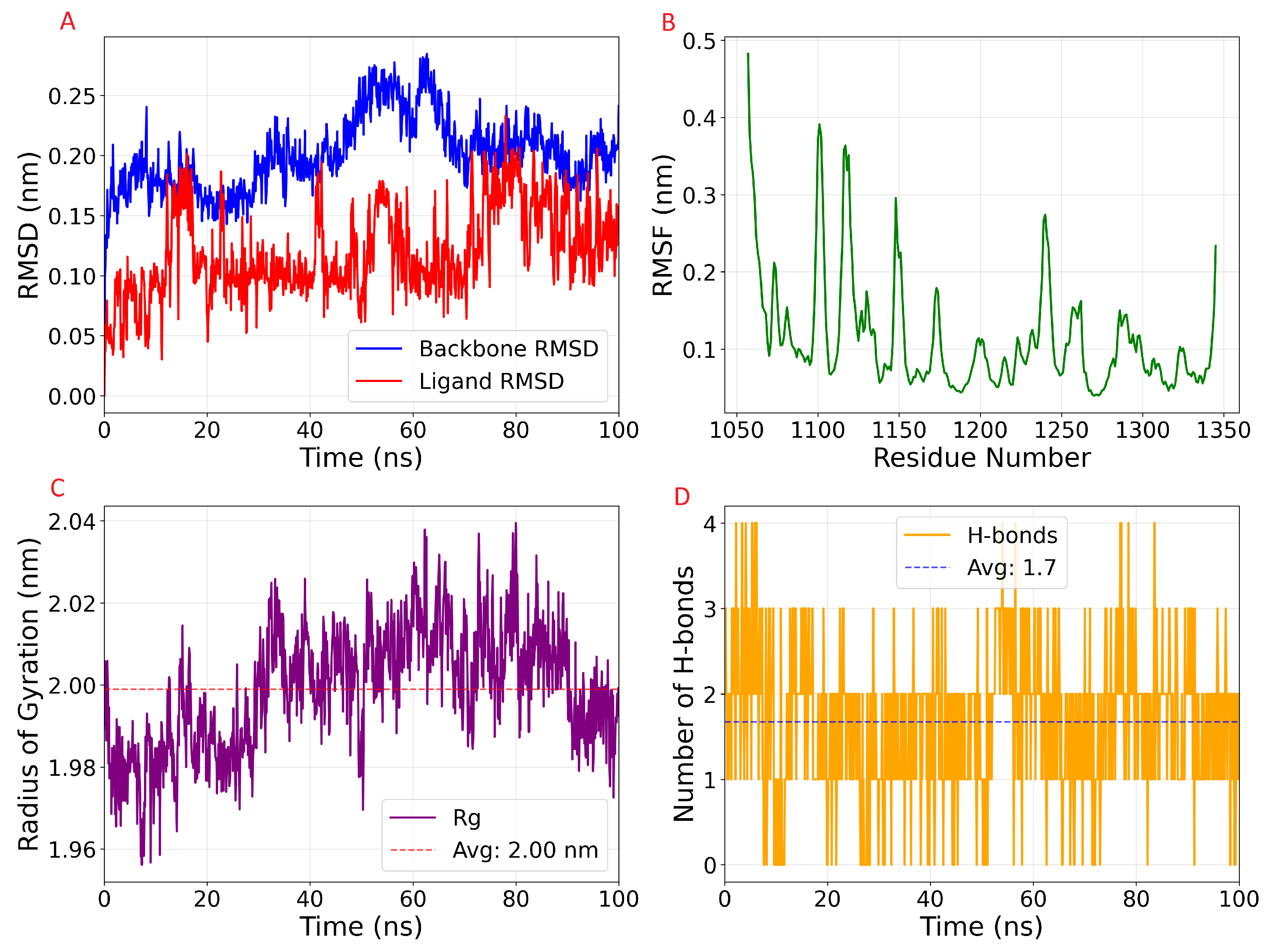
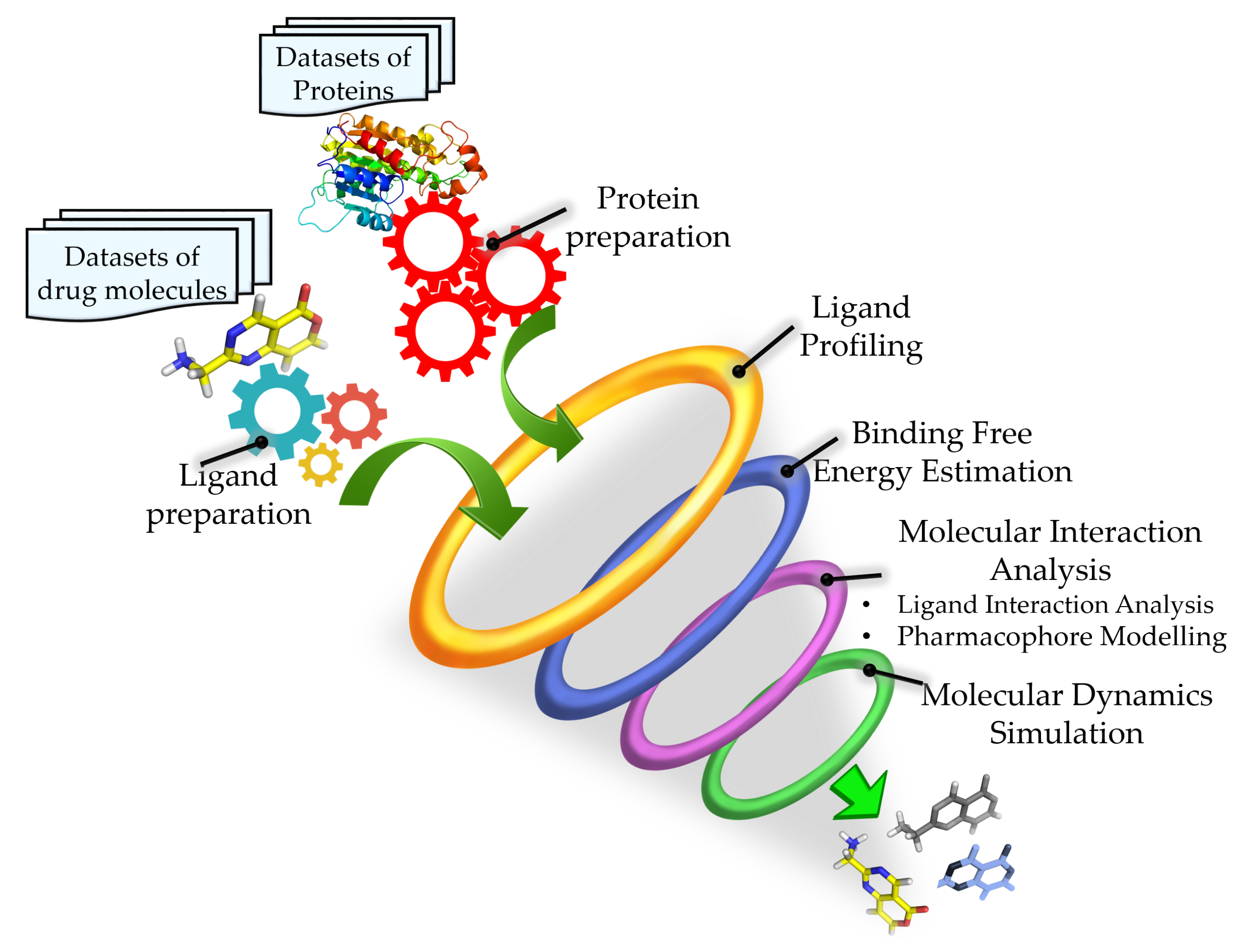
Here, following Figure 22, we screen the 60 AI-generated molecules for their potential to modulate cancerous cells. Firstly, we evaluated the drug-likeness and ADMET properties of the 60 molecules to determine their suitability as drug molecules. Secondly, the molecules that passed the ligand profiling tests are subjected to virtual screening, and their docking scores and MM-GBSA estimates are evaluated against each of the cancer target proteins listed in Table 7. Also, we performed molecular interaction mapping and pharmacophore modeling of the two most promising ligands, which exhibit multi-target characteristics. Finally, to observe and analyze the stability, fluctuations, and conformational changes of the molecules over time, MD simulations are carried out on the two most promising ligands that have multi-target characteristics.
2.2. Molecular Docking and MM-GBSA Analysis of the Twenty Five (25) Compounds
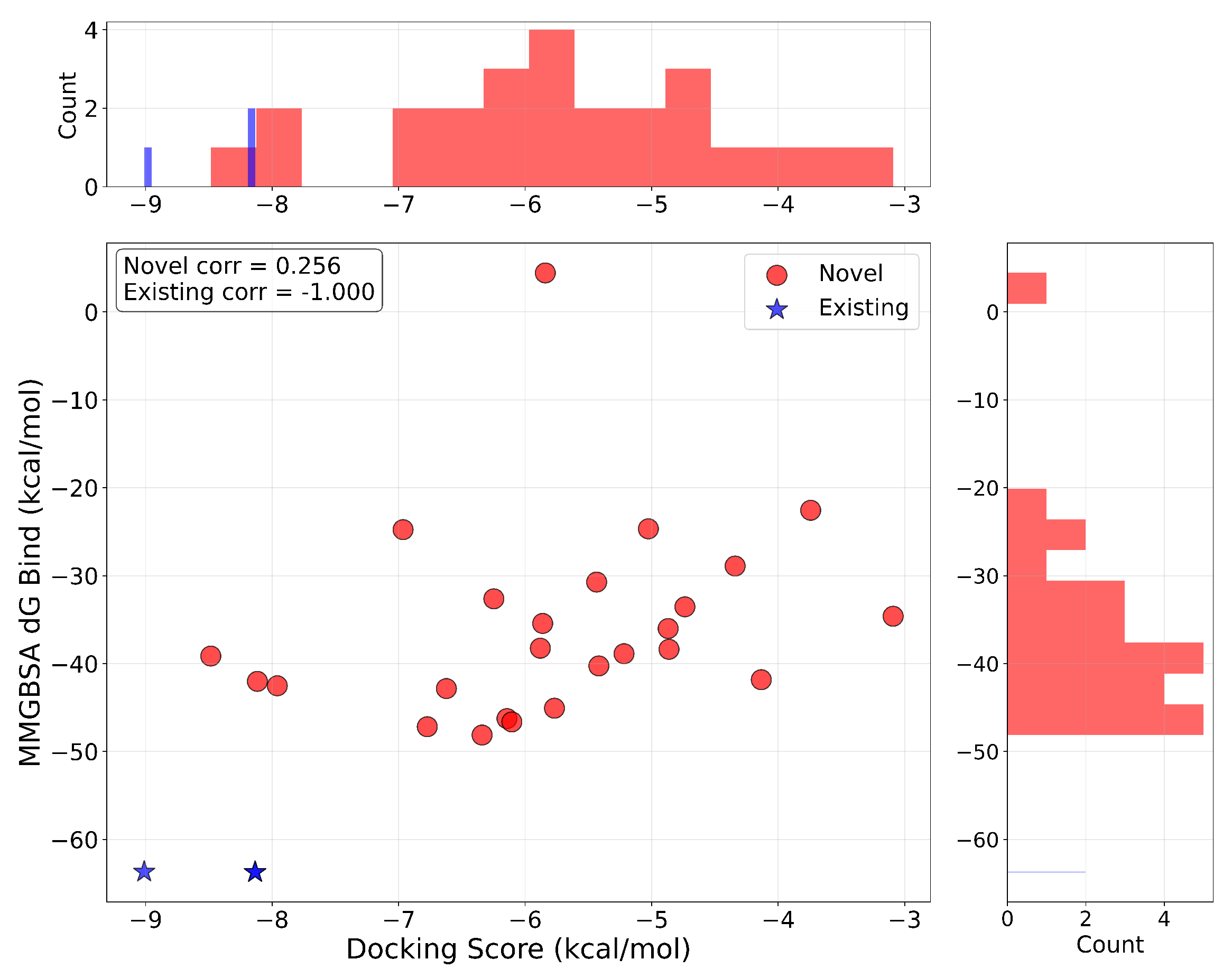
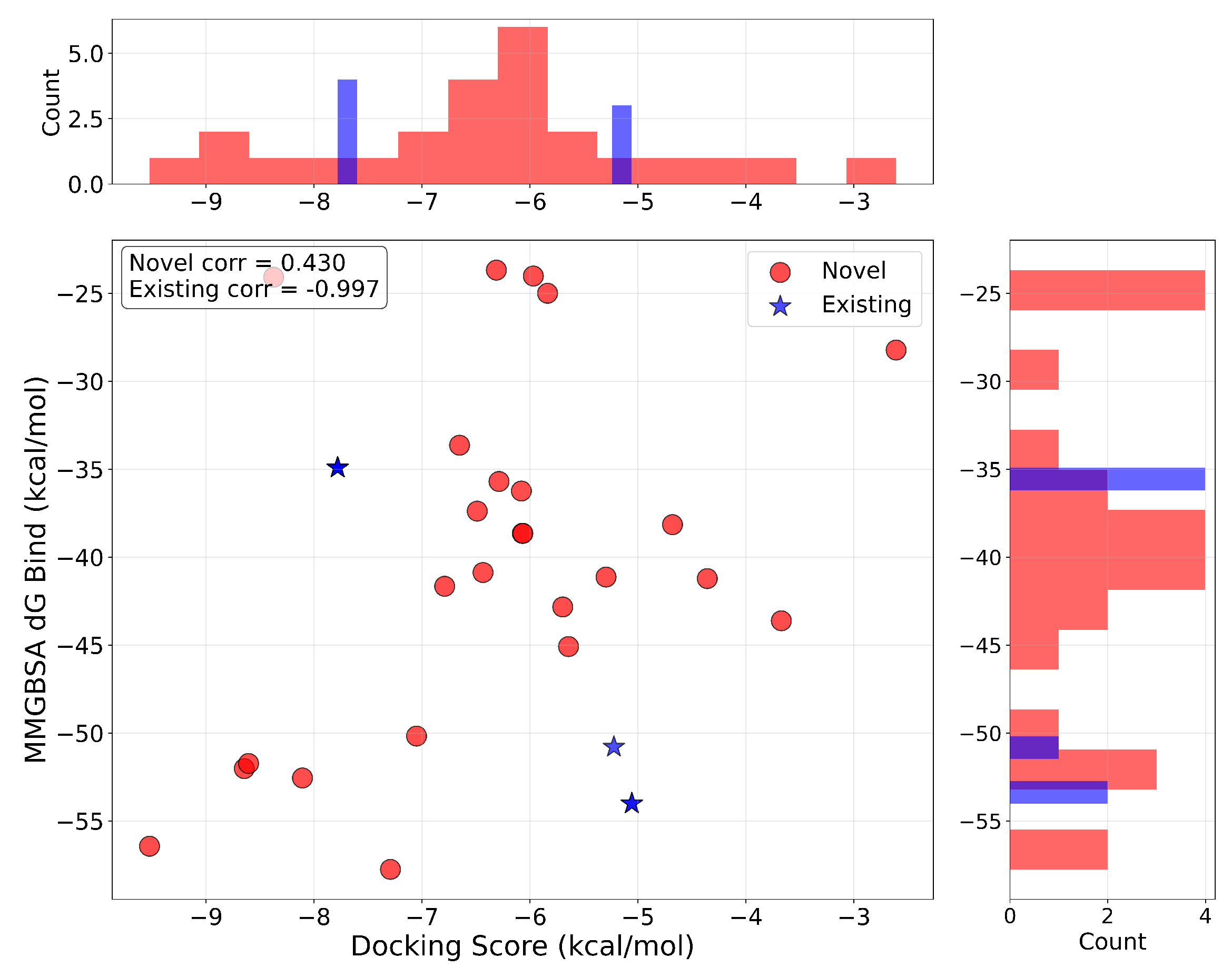
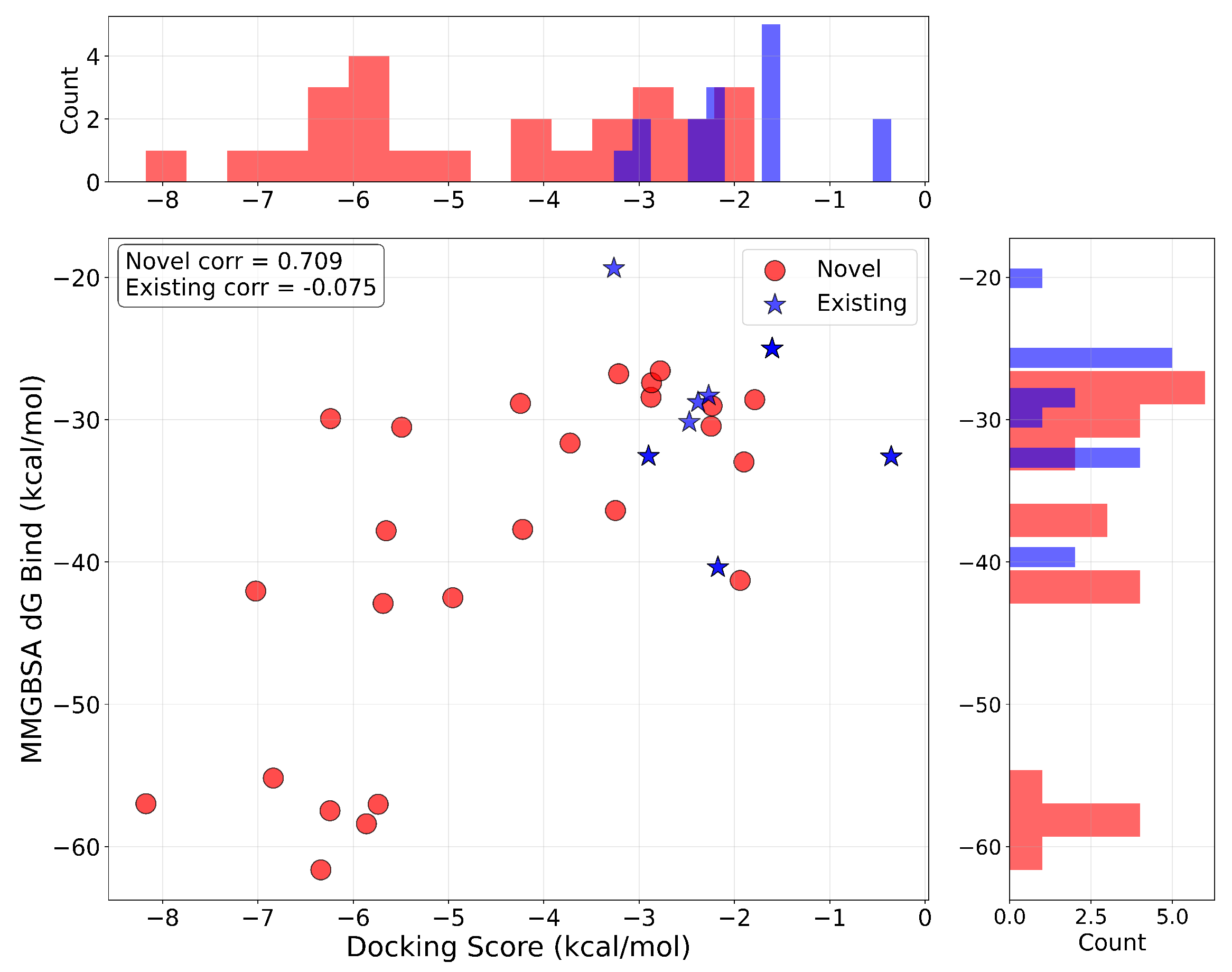
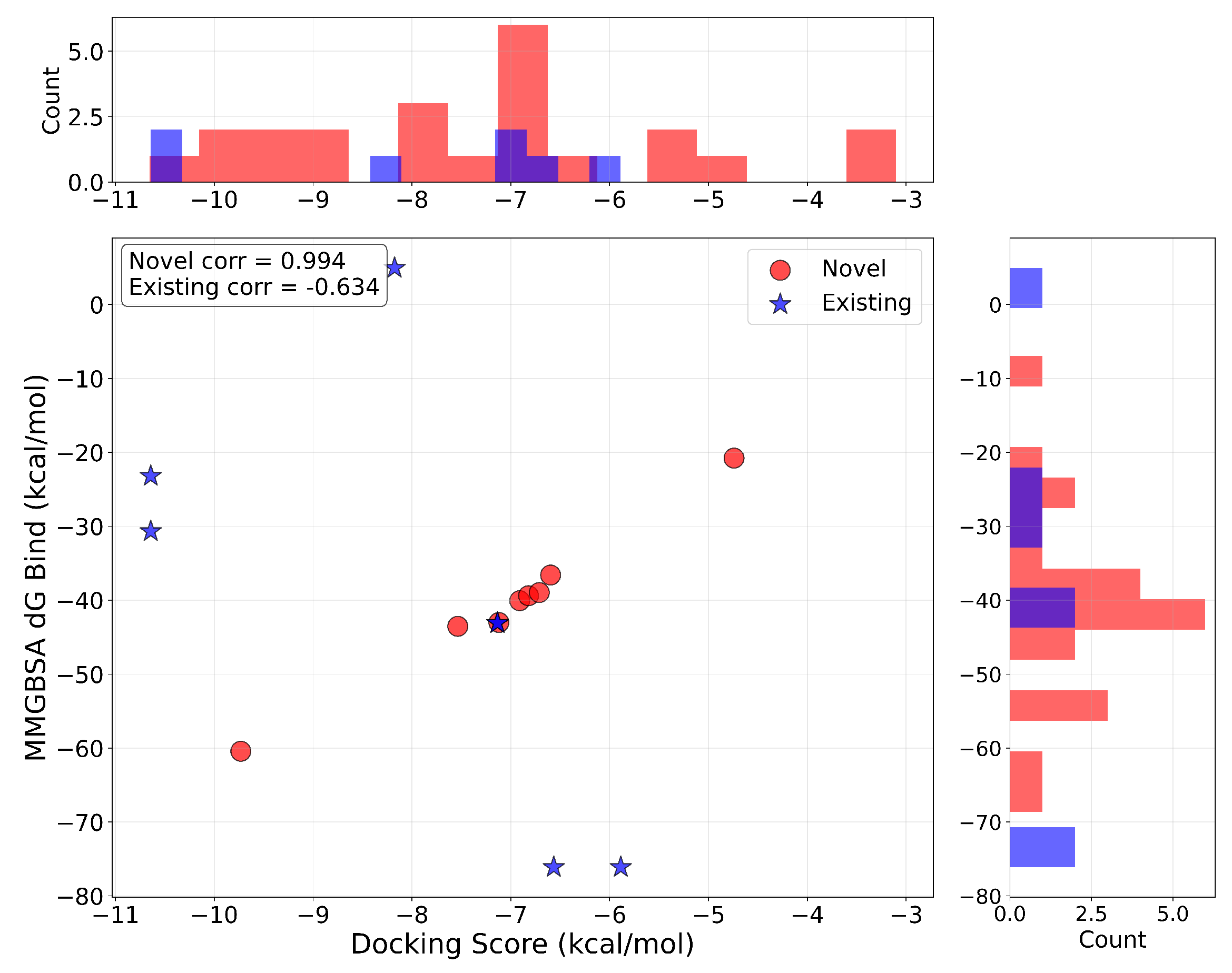
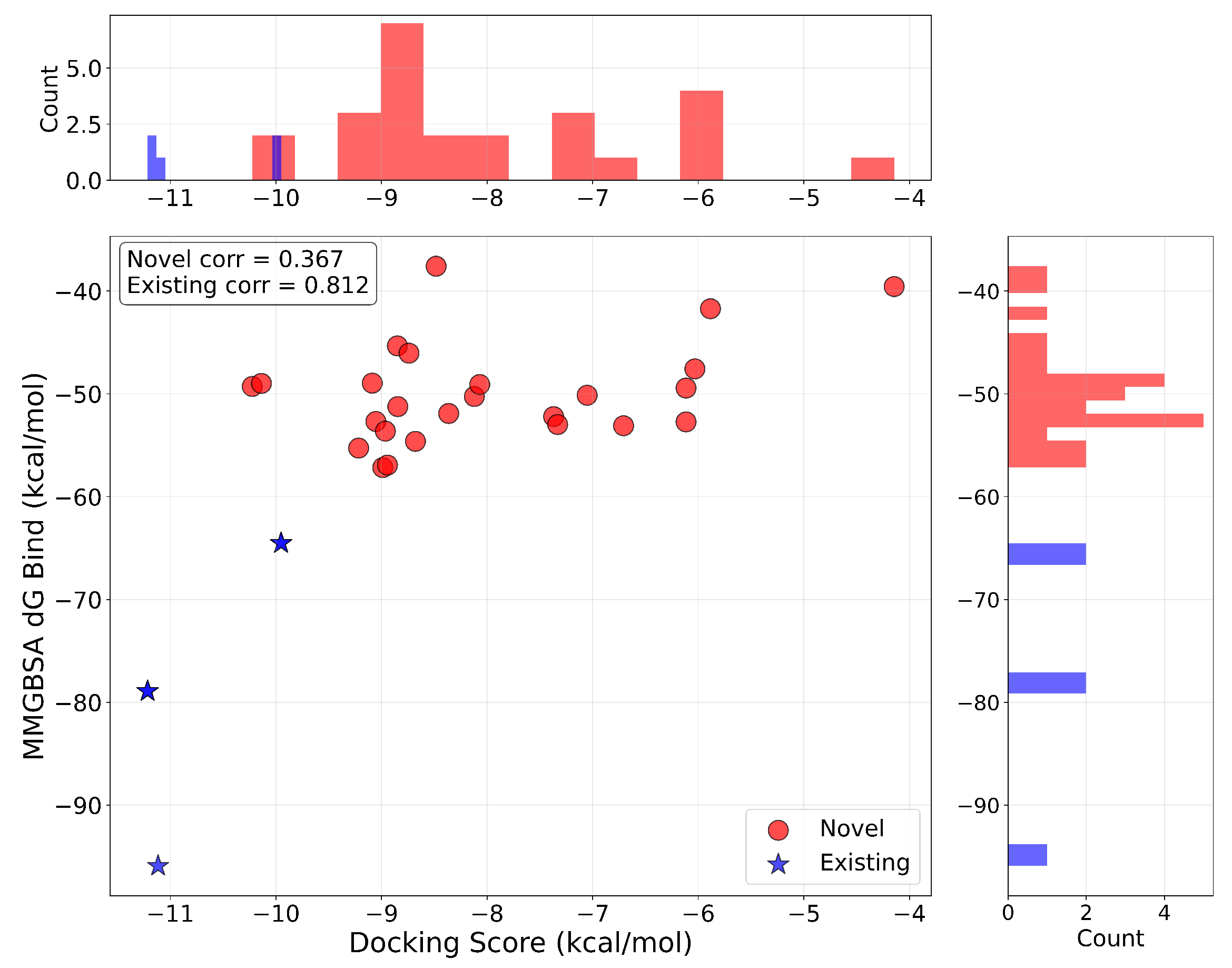
Here, the molecular docking and MM-GBSA analyses of the twenty five (25) compounds that passed the ligand profiling test are provided. The compounds are docked on the PDB identifiers, namely, 5U1X, 7U9A, 5EW3, 5YA5, and 8XRR. The corresponding molecular docking scores–MM-GBSA scatter plots are shown in
Figure 1,
Figure 2,
Figure 3,
Figure 4 and
Figure 5. Each plots shows the comparison between the values of the 25 compounds and those of the known cancer drug molecules.
In some of the figures, the novel molecules show a strong positive correlation between docking score and MM-GBSA, indicating that compounds predicted to dock well also tend to have more favorable binding free energies. However, in others, the correlation coefficient is quite low, suggesting that while the initial docking score provided a starting point, the more accurate, energy-intensive MM−GBSA calculation was crucial in ranking the final candidates.
In
Figure 1, the marginal histograms show that several novel molecules achieve substantially more favorable MM-GBSA energies (−50 to −60 kcal/mol) than any existing compound, while also maintaining competitive docking scores. This combined profile suggests that the new molecules may have stronger predicted binding interactions, making them promising therapeutic candidates that warrant further molecular dynamics and experimental validation.
In
Figure 2, the marginal histograms indicate that while the existing molecules have stronger predicted binding interactions, the novel molecules occupy a wider and more favorable range of predicted binding energies (approximately −40 to −50 kcal/mol). This suggests these new molecules could offer a starting point for further optimization and experimental testing against the 7U9A target.
In
Figure 3, critically, the marginal histograms reveal that the novel compounds achieve superior predicted binding affinities with 5EW3, with MM-GBSA values reaching −60 to −70 kcal/mol—far beyond the range of existing compounds. They also maintain strong docking scores. This combination of an outstanding computational correlation and vastly improved predicted binding energy suggests the novel molecules are promising therapeutic candidates.
The marginal histograms in
Figure 4 show that, while the existing molecules have stronger predicted binding interactions with 5YA5, the novel molecules occupy a wider and more favorable range of predicted binding energies (approximately −40 to −50 kcal/mol). This implies that the novel compounds might serve as a starting point for future optimization and experimental testing against the 5YA5 target.
In
Figure 5, the marginal histograms reveal that the novel compounds achieve significantly more favorable predicted binding energies for 8XRR, with MM-GBSA values ranging from −50 to −55 kcal/mol, which is beyond the range of the existing compounds. They also occupy a wider and more favorable range of docking scores.
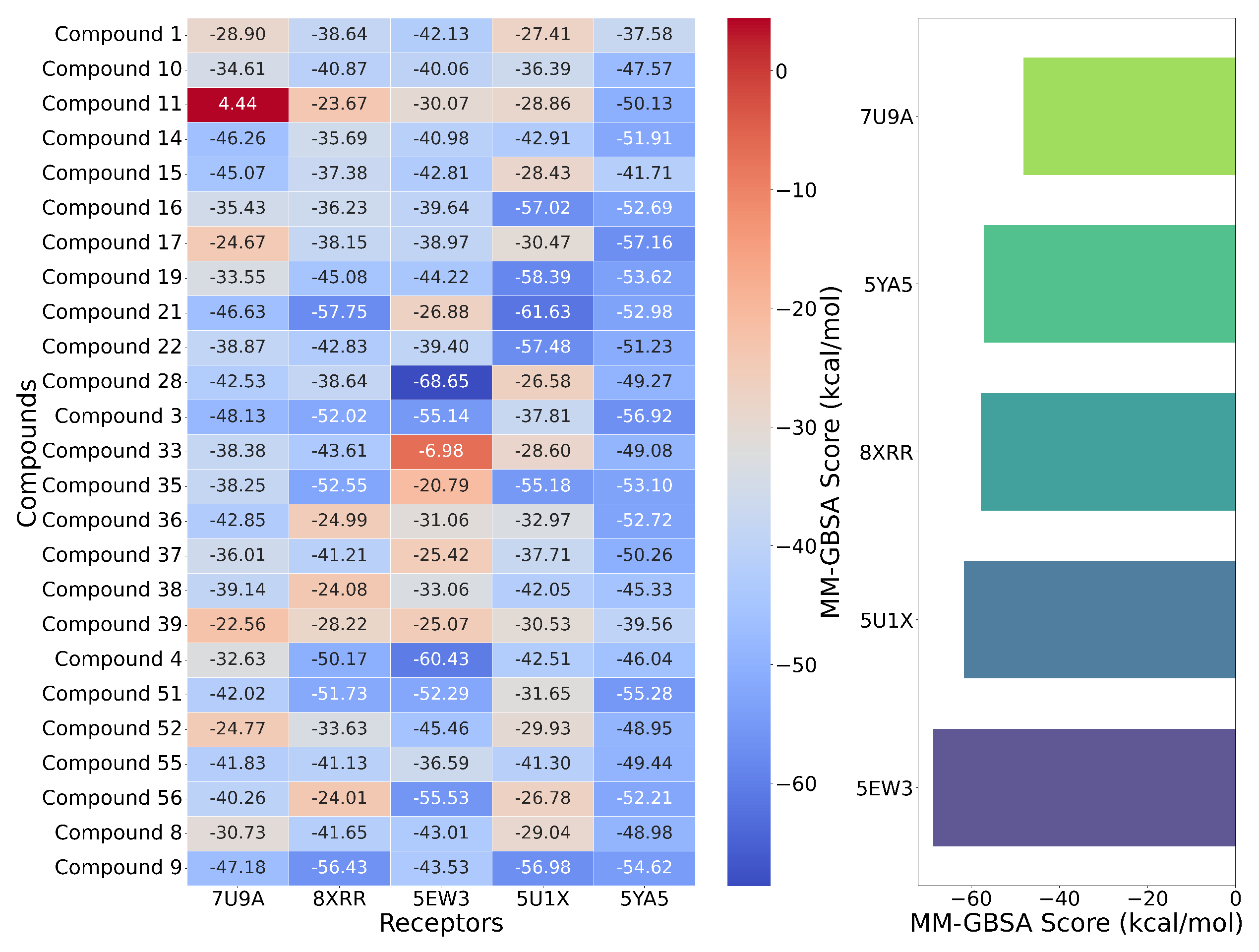
To better contextualize the performance of their AI-generated leads, we compare the MM-GBSA of the leads to known standard inhibitors. For the P2X7 standard antagonists GSK1482160 and JNJ-42253432, their interactions with 5U1X are estimated to be −30.17 kcal/mol and −25.01 kcal/mol, respectively, in MM-GBSA. Comparatively, several of the AI-generated leads outperform GSK1482160 and JNJ-42253432 in their interactions with 5U1X in MM-GBSA terms. For instance, compounds 19, 21, 22, and 35 have MM-GBSA scores between −55 kcal/mol and −62 kcal/mol.
The MM-GBSA scores of Tepotinib and Savolitinib with 5YA5 are −95.92 kcal/mol and −64.52 kcal/mol, respectively. Comparatively, the best leads cluster for the AI-generated compounds is around −52 to −57 kcal/mol, which are relatively weaker than Tepotinib and comparable but slightly weaker than Savolitinib. For the VEGFR2 standard inhibitors represented by Pazopanib and Lenvatinib, their interactions with 5EW3 are estimated to be −30.68 kcal/mol and −43.11 kcal/mol, respectively. Comparatively, several AI-generated leads outperform both inhibitors, with compounds 28, 4, and 56 having MM-GBSA scores between −55 kcal/mol and −69 kcal/mol.
Considering Avapritinib and Sunitinib as standard inhibitors of PDGFRA, their MM-GBSA estimates against the 8XRR are −34.91 kcal/mol and −50.79 kcal/mol, respectively. Comparatively, several of the AI-generated leads fall between or beyond the two reference drugs, and the MM-GBSA scores of compounds such as compound 3, 21, 35, 51, and 9 exceed both references. For the standard EGFR inhibitors, represented by Dacomitinib, its MM-GBSA estimate against 7U9A is at −63.68 kcal/mol, which is better than the best AI-generated lead (−45 kcal/mol), indicating moderate affinity.
Table 4 summarizes the comparison between the MM-GBSA scores of known molecules and the presented virtual leads that target specific proteins.
2.4. Molecular Interaction Analysis of Novel Compounds
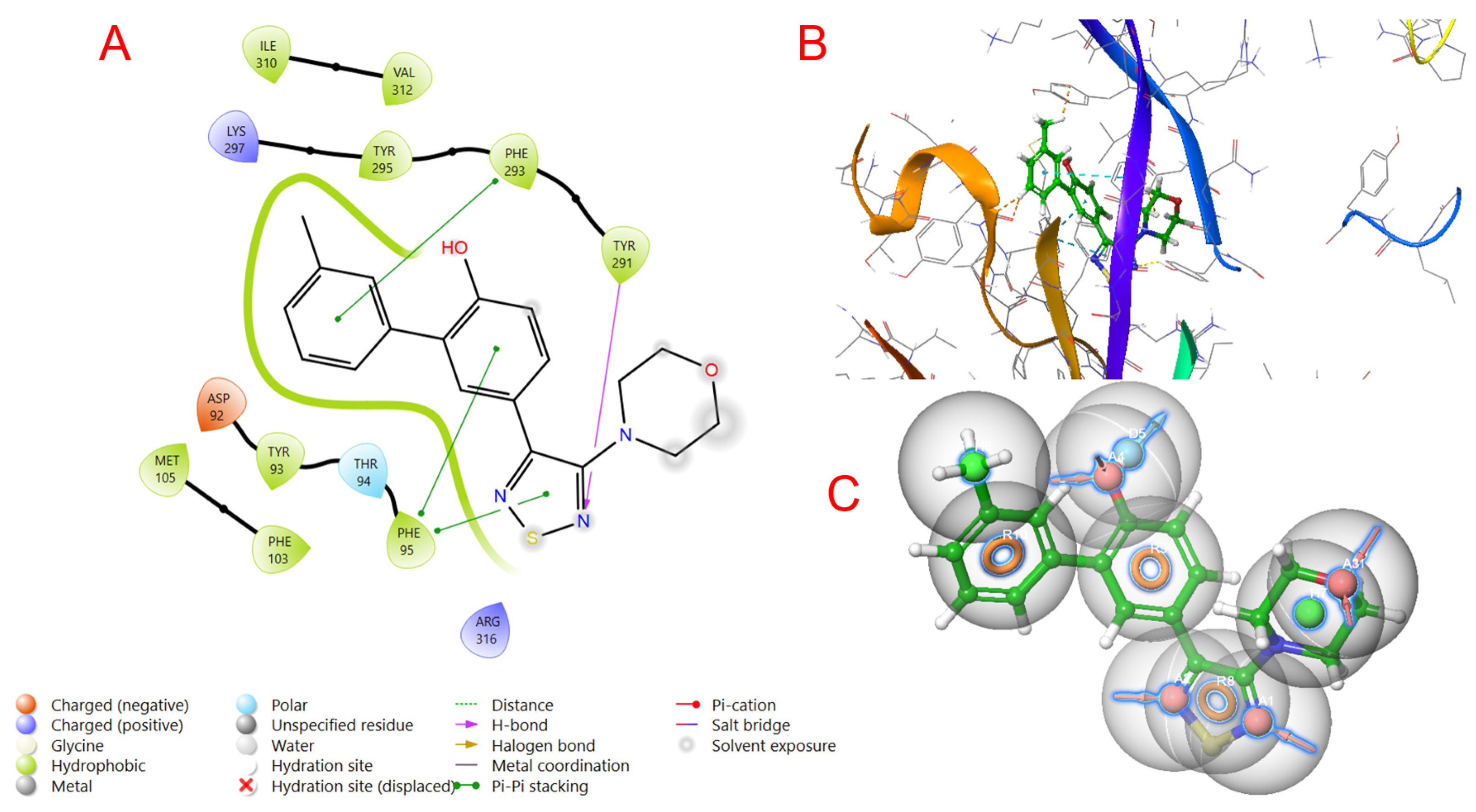
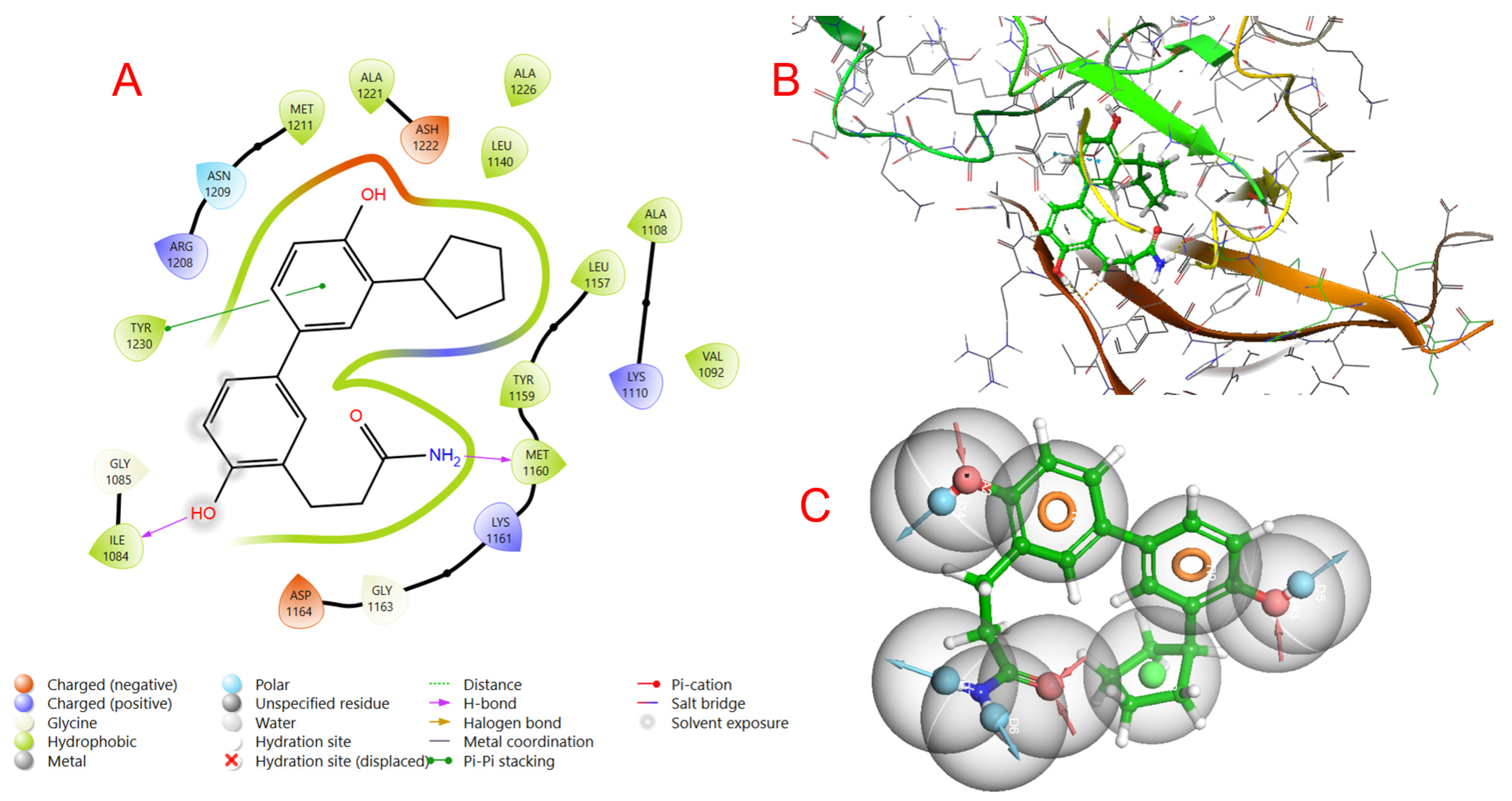
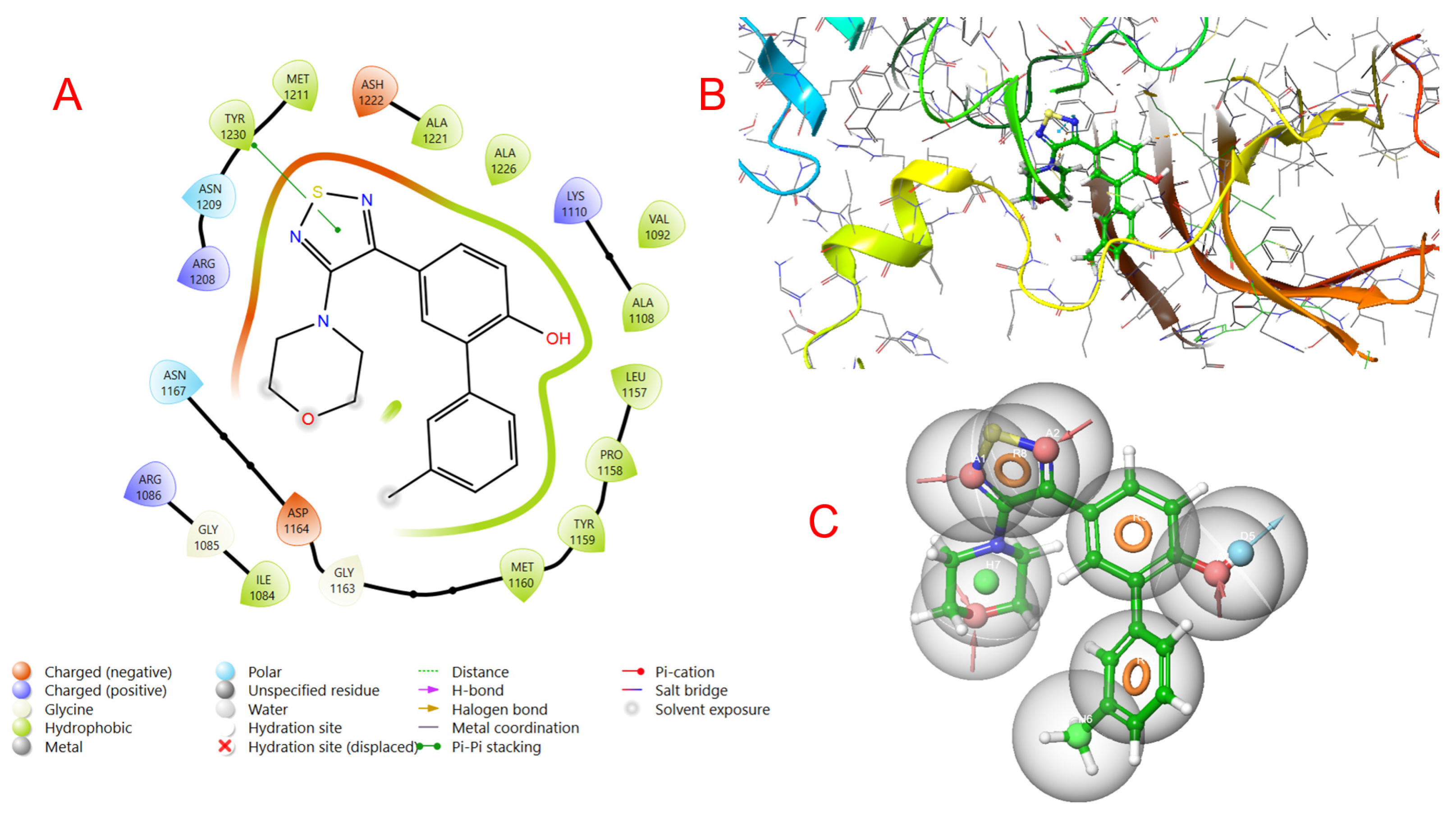
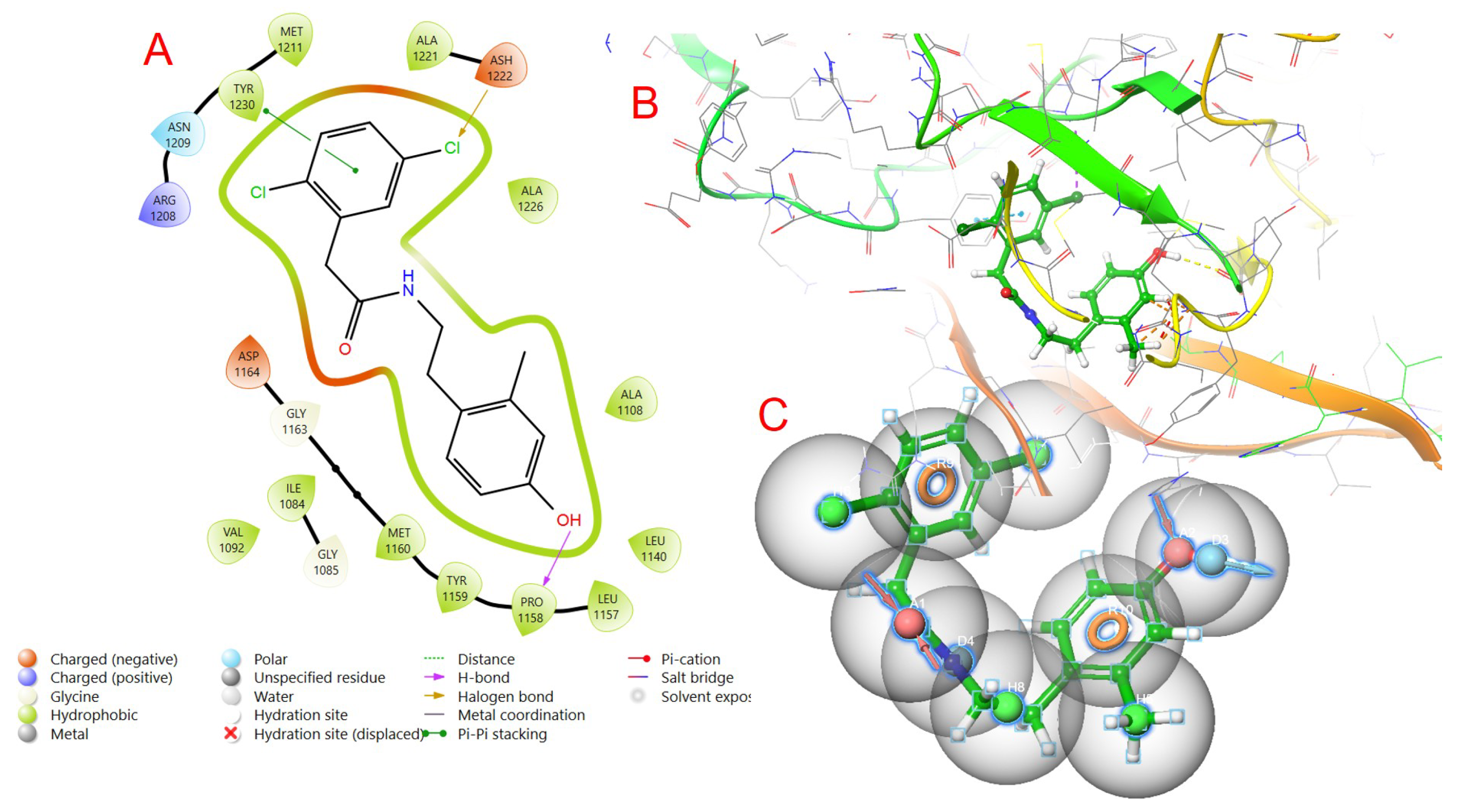
In
Figure 7,
Figure 8,
Figure 9 and
Figure 10, we present the molecular interaction analysis of Compound
9 and Compound
21 in complex with 5U1X and 5YA5. The ligand–protein interaction diagrams and pharmacophore model of 5U1X–Compound
9, 5U1X–Compound
21, 5YA5–Compound
9, and 5YA5–Compound
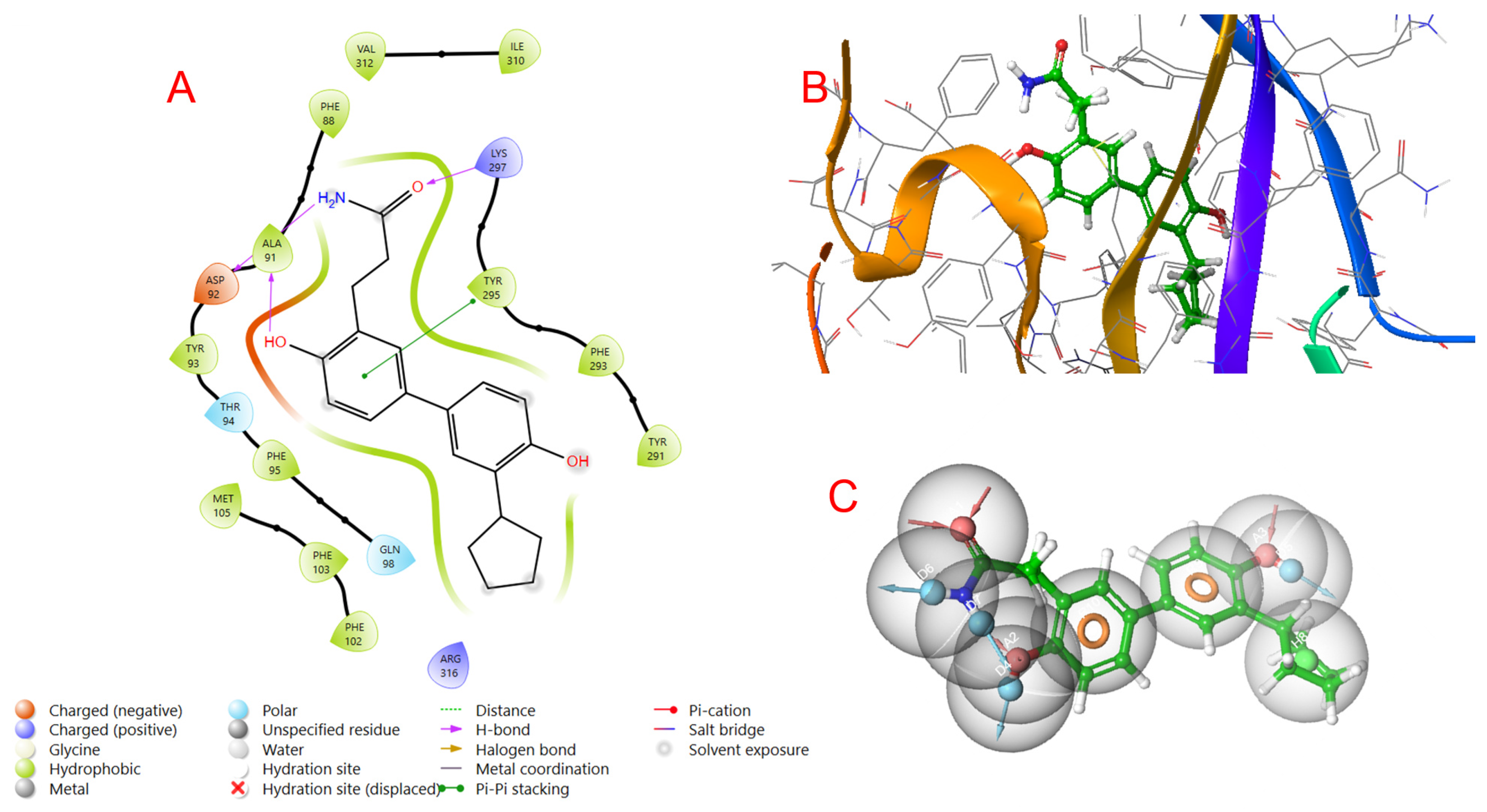
21 complexes are presented. The protein is shown as colored ribbons, the ligand in green sticks, and key interacting residues in thin sticks. For the pharmacophore models, hydrogen-bond acceptors are shown in pink spheres/arrows, hydrogen-bond donors are shown in sky blue spheres/arrows, hydrophobic regions are shown in green spheres, and aromatic rings are depicted with orange circles.
Figure 7A shows that Compound
9 forms multiple stabilizing interactions within the binding pocket of 5U1X. Hydrogen bonds are formed with TYR 295, ASP 92, and possibly THR 94 or backbone atoms. The compound also formed aromatic and hydrophobic contacts of
stacking type with PHE 88, PHE 95, and PHE 102. It forms hydrophobic packing with VAL 312, ILE 310, MET 105. An electrostatic/salt bridge potential also exists between the compound and ARG 316/ASP 92. The predicted binding mode of Compound
9 in the orthosteric site of 5U1X is shown in
Figure 7B. The pharmacophore summary for Compound
9–5U1X interaction aligns well with the observed interactions in
Figure 7C. The four (4) hydrogen donors and three (3) hydrogen acceptors matches multiple hydrogen bonds seen with polar/charged residues (ASP, TYR, THR). The two (2) aromatic rings corresponds to
stacking with PHE 88, 95, 102. The single hydrophobic region fits the hydrophobic cluster VAL 312, ILE 310, MET 105. The high count of four hydrogen donors and three hydrogen acceptors defines the binding motive as highly dependent on polar anchoring within the active site.
Figure 8A shows that the interaction of Compound
21 and 5U1X utilizes a mix of crucial non-covalent interactions. Hydrogen bonds are formed with residues such as TYR 295, TYR 93, THR 94, and possibly backbone atoms of MET 105 or ASP 92. Aromatic contacts are formed utilizing the
stacking with PHE 293, PHE 95, and possibly PHE 103, and hydrophobic contacts are established using hydrophobic packing with ILE 310, VAL 312, and MET 105. There also exist electrostatic/charged interactions with LYS 297 (positive) and ASP 92 (negative). The predicted binding mode of Compound
9 in the orthosteric site of 5U1X is shown in
Figure 8B. The corresponding pharmacophore model in
Figure 7C highlights a single hydrogen donor and five (5) hydrogen acceptors, indicating a highly acceptor-driven binding mode, likely formed with tyrosine/hydroxy residues (TYR 295, TYR 93, THR 94). The presence of three (3) aromatic rings matches a strong
stacking network with multiple phenylalanines (PHE 293, 95, 103). The two (2) hydrophobic regions present correspond to aliphatic/aromatic packing with ILE 310, VAL 312, and MET 105. This model mandates a structure that anchors with a hydrogen bond donor in the shallow pocket (the phenolic OH), is stabilized by two stacked aromatic rings (
pocket and the thiazole ring), and extends into the solvent-exposed region with a strong acceptor (the morpholine oxygen or nitrogen).
Figure 9 shows that Compound
21 forms multiple stabilizing interactions (
Figure 9A), the docking position (
Figure 9B), and a pharmacophore model (
Figure 9C) within the binding pocket of 5YA5. A diverse bonding network comprising hydrogen bonds, Pi-interactions, hydrophobic interactions, and electrostatic/polar anchors. Multiple hydrogen bonds are mapped with ASP, TYR, ASN, and GLY residues. This aligns perfectly with the pharmacophore model’s three (3) hydrogen bond donors and three (3) hydrogen bond acceptors. The presence of
interactions with TYR 1230 and TYR 1159 suggest engagement with aromatic residues, crucial for specificity and affinity. The compound engages multiple hydrophobic/van der Waals contacts with ILE, LEU, MET, VAL residues. This matches the pharmacophore’s one hydrophobic region requirement, likely a conserved pocket in the target.
In
Figure 10, the ligand–protein interaction diagram, docking pose, and the pharmacophore counts of Compound
21 in complex with 5YA5 are shown. The interaction pattern in
Figure 10A indicates that Compound
21 engages multiple polar/charged residues, including ASP1164, ASN1167, and backbone carbonyls near GLY1163/GLY1085. This suggests that the binding pocket presents several hydrogen-bond donor sites, which the ligand satisfies via the four acceptor atoms, indicated in the pharmacophore model (
Figure 10C). The compound poses well in the pocket, as shown in
Figure 10B. Three aromatic rings on the Compound
21 indicated in the pharmacophore model form
interactions/stacking with aromatic residues such as TYR1159 and TYR1230, and provide a hydrophobic/aromatic anchor that positions the polar groups into the donor pockets. The two hydrophobic vectors shown in the pharmacophore model engage aliphatic side chains such as ILE1084, LEU1157, and MET1160 to improve shape complementarity.
The molecular interaction analysis of Compound
3 in complex with 5YA5 is presented in
Figure 11.
Figure 11A shows that the interaction of Compound
3 and 5YA5 utilizes hydrophobic contacts that are established using hydrophobic packing with LEU1157, VAL1092, ILE1084, ALA1108, PRO1158, and MET1160. Strong hydrogen bonds are formed from the ligand amide NH bond with the backbone carbonyl of MET1160 and between the phenolic OH forms and TYR1159. There are also
cation interaction of the LYS1161 with the aromatic ring system and
stacking between the ligand’s aromatic rings and with TYR1222 or TYR1159. The predicted binding mode of Compound
3 in the orthosteric site of 5YA5 is shown in
Figure 11B. The corresponding pharmacophore model in
Figure 11C highlights two (2) hydrogen bond donors and two (2) hydrogen bond acceptors, consistent with interactions involving polar residues. The model identifies two (2) aromatic rings, which align with a strong
stacking network involving multiple phenylalanine residues.
In
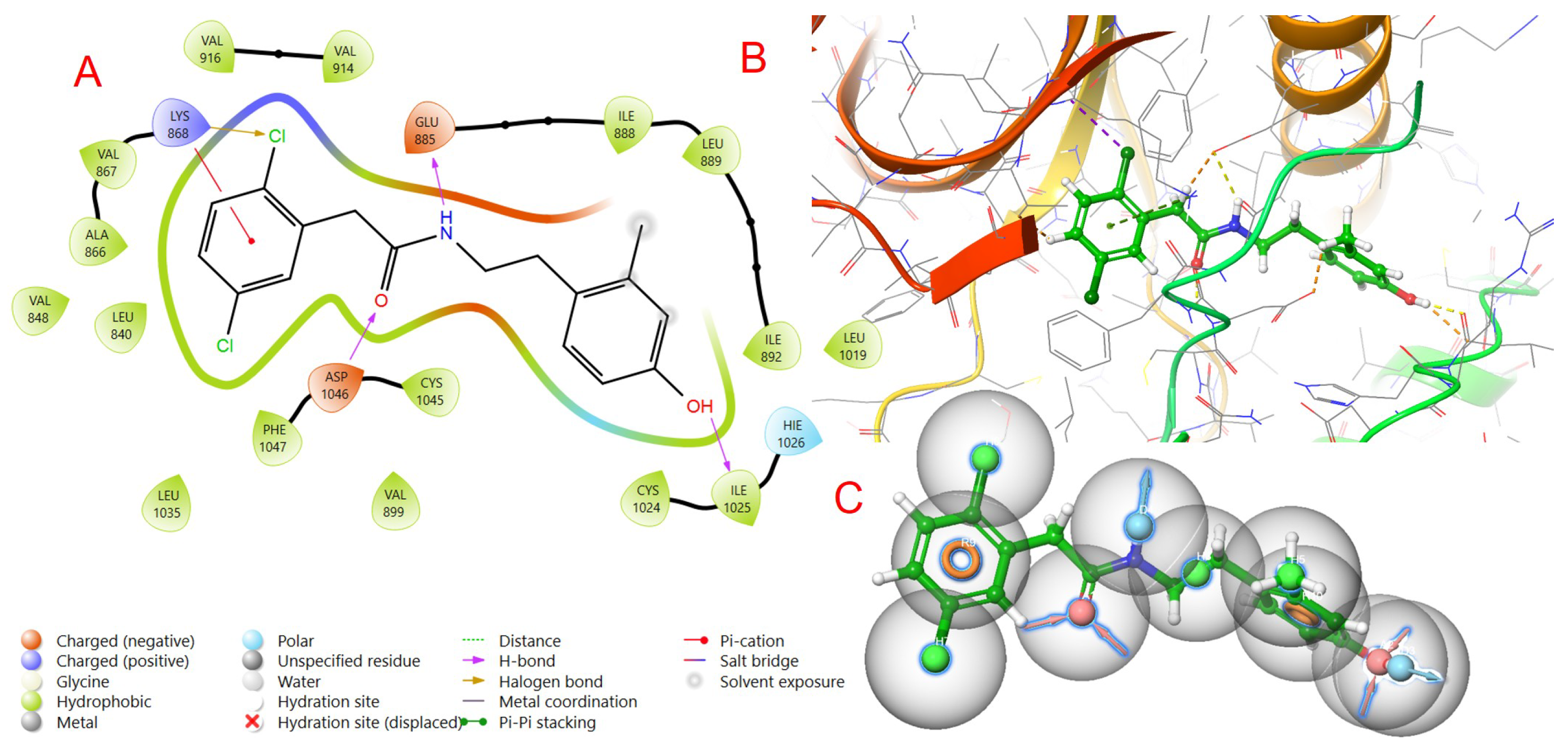
Figure 12, the molecular interaction analysis of Compound
3 in complex with 5EW3 is presented.
Figure 12A indicates the presence of a hydrogen bond from the amide carbonyl oxygen to a backbone NH and the phenolic OH donation of a hydrogen bond to a polar residue (possibly GLU885 or ASP1046). The positively charged LYS868 interacts with one of the aromatic rings for
cation stabilization. The chlorophenyl and terminal phenyl rings engage in
stacking with PHE1047 and possibly ILE1024/ILE1025. There are also the hydrophobic contacts indicated by the extensive green regions, which indicate tight packing with a large hydrophobic cluster, such as VAL914, VAL916, VAL867, ILE888, LEU889, LEU1035, ILE892, VAL848, and LEU889. The predicted binding mode of Compound
3 in the active site of 5EW3 is shown in
Figure 12B. The corresponding pharmacophore model in
Figure 12C highlights two (2) hydrogen bond donors and two (2) hydrogen bond acceptors, consistent with interactions involving polar residues. The model identifies two (2) aromatic rings, which align with a strong
stacking network involving multiple phenylalanine residues. The presence of four (4) hydrogen bonds agrees with the strong hydrogen bond interaction observable in the ligand interaction diagram.
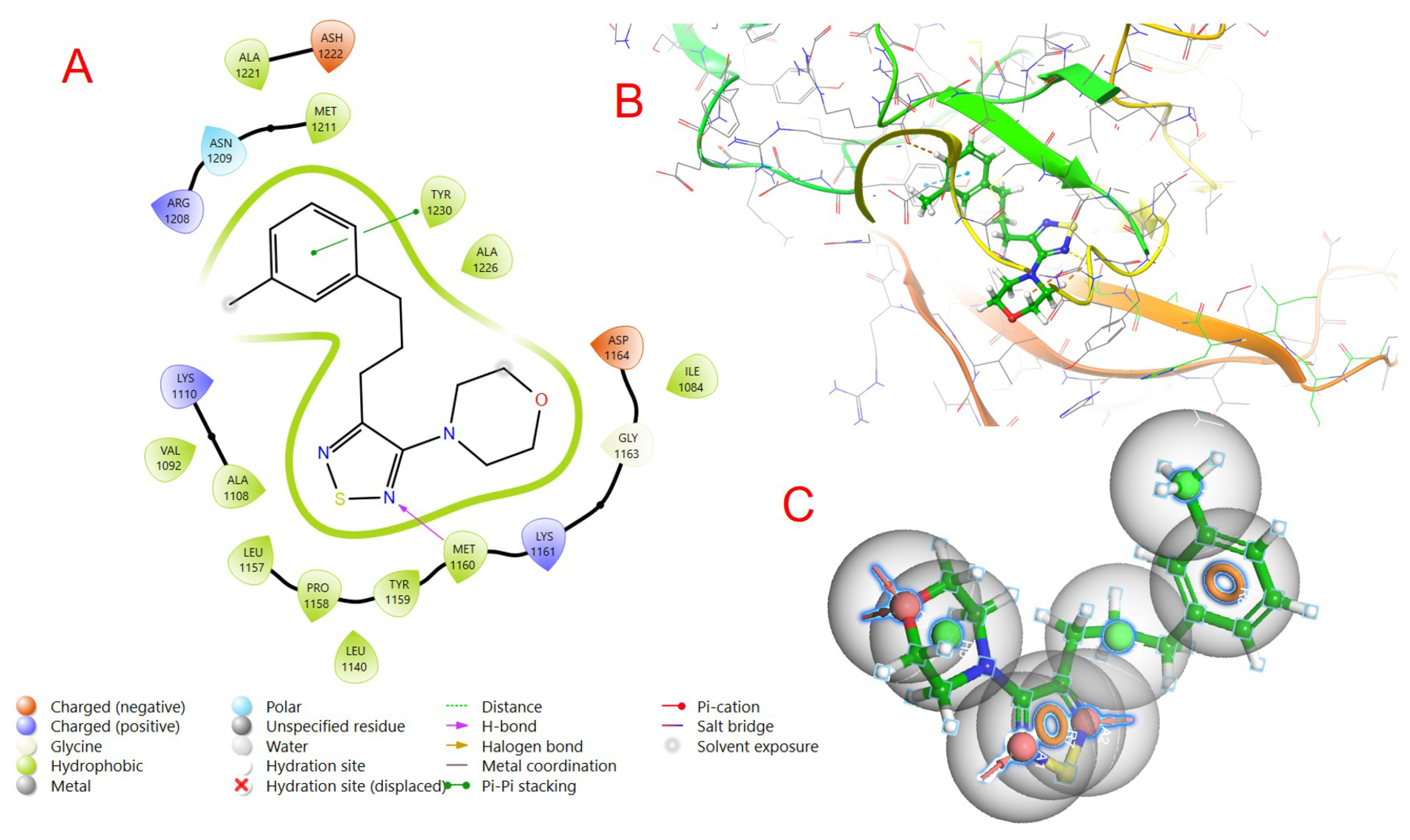
Figure 13A shows that the critical interaction of Compound
19 with 5YA5 is a hydrogen bond between a nitrogen atom in the ligand’s heterocyclic core and the MET 1160 residue. The ligand also engages in a
stacking interaction with TYR 1230 through its terminal phenyl ring. This stabilizes the aromatic portion of the molecule within that specific sub-pocket. The ligand is extensively establishing hydrophobic contacts with key residues, including LEU 1157, PRO 1158, VAL 1092, and ILE 1084. The predicted binding mode of Compound
3 in the active site of 5YA5 is shown in
Figure 13B. The corresponding pharmacophore model in
Figure 13C highlights two (2) hydrogen bond acceptors, which likely drive polar anchoring on the MET 1160 residue. The model identifies two (2) aromatic rings (chlorophenyl and central fused ring), which are positioned for
stacking or
cation interactions with TYR/PHE residues. The presence of three (3) hydrogen bonds correspond to the chlorophenyl ring, central fused heterocycle, and aliphatic linker/morpholine tail.