
Protocol

School Nurse Interventions for Children with Special Health Care Needs: A Scoping Review Protocol

by
Fernanda Pombal
1,2,3,*,
Lia Sousa
4,5,
Alexandra Pereira
6,
Marta Catarino
2,7,8 and
Constança Festas
2,3
1
Polytechnic Institute of Health of the North, CESPU School of Health of the Ave Valley, Rua José António Vidal, 81, 4760-409 Vila Nova de Famalicão, Portugal
2
Center for Interdisciplinary Research in Health, Universidade Católica Portuguesa, 1649-023 Lisbon, Portugal
3
Faculty of Health Sciences and Nursing, Universidade Católica Portuguesa, 4169-005 Porto, Portugal
4
School of Health, Polytechnic Institute of Viana do Castelo, Rua Moisés Alves Pinho, 4900, 4910-023 Viana do Castelo, Portugal
5
CINTESIS@RISE, Rua Dr. Plácido da Costa, 4200-450 Porto, Portugal
6
Community Care Unit, Tâmega e Sousa Health Unit, Rua Santo Tirso 70, 4620-848 Meinedo, Portugal
7
São João de Deus School of Nursing, Universidade de Évora, Largo do Senhor da Pobreza 2B, 7000-811 Évora, Portugal
8
Faculty of Health Sciences and Nursing, Universidade Católica Portuguesa, 1649-023 Lisbon, Portugal
*
Author to whom correspondence should be addressed.
Submission received: 27 August 2025 / Revised: 19 December 2025 / Accepted: 29 December 2025 / Published: 5 January 2026

Abstract

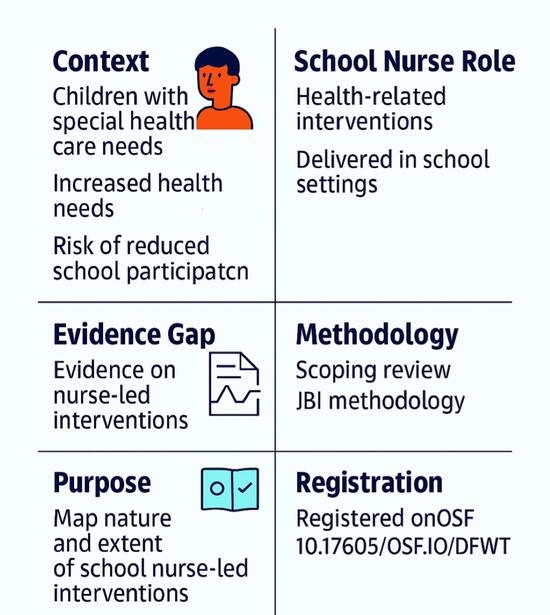
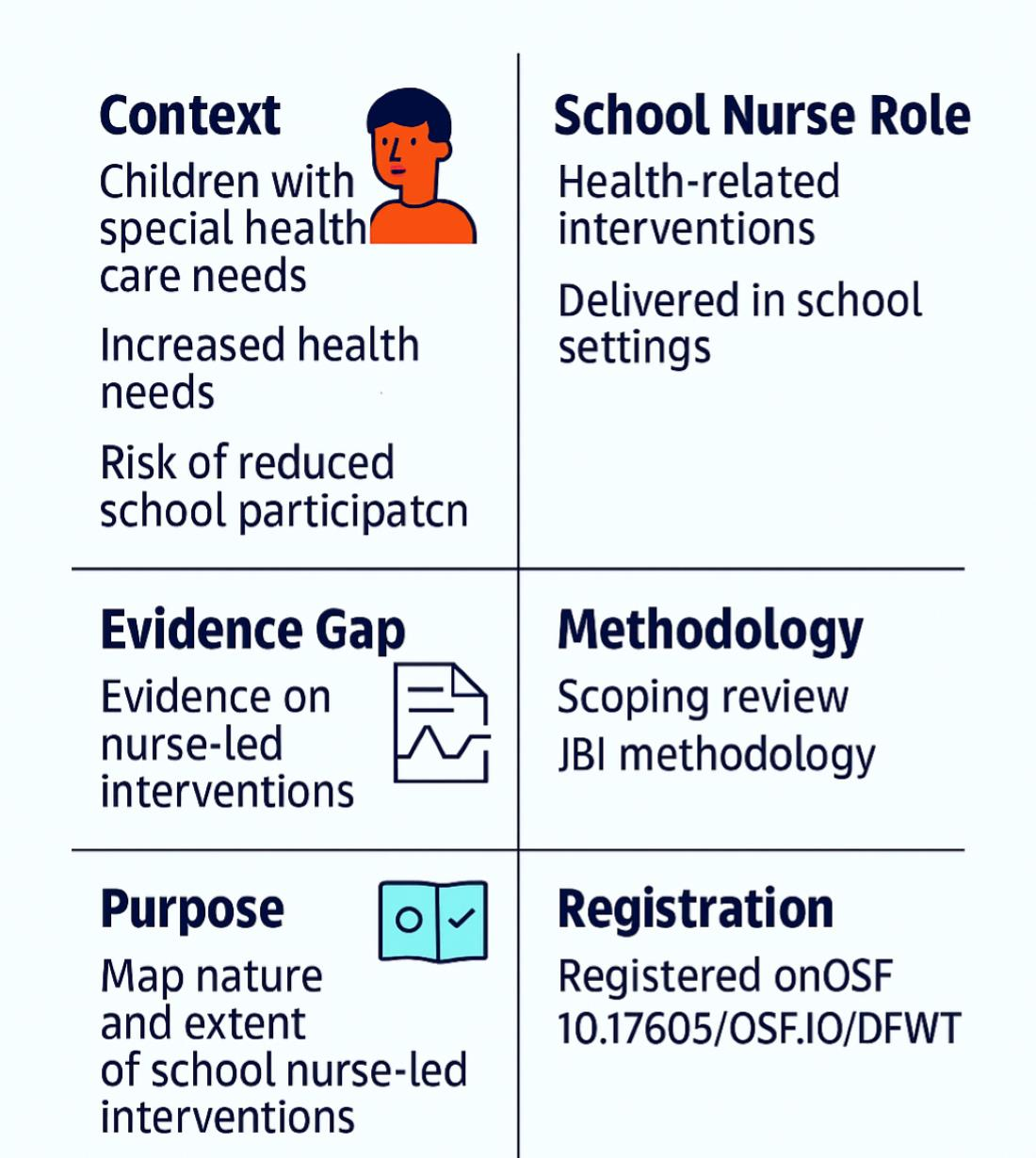
Children with special health care needs require health and related services beyond those required by children in general, which may affect their participation and inclusion in school. School nurses play a key role in supporting these children through a range of health-related interventions within the school setting. However, evidence on school nurse–led interventions for this population remains fragmented. This scoping review will follow the JBI methodology and aims to map the nature and extent of interventions developed by school nurses for children with special health care needs in school settings worldwide. The review will provide an overview of current practices and may inform the development of school health policies and evidence-informed nursing interventions. This research is registered on the Open Science Framework platform since 10 June 2024, with data updated on 26 August 2025.

Graphical Abstract

1. Introduction

Since the beginning of the 21st century, advances in medicine and public health have substantially changed the epidemiological profile of children. The significant reduction in infectious diseases, largely attributable to vaccination programmes, improved socioeconomic conditions, technological developments in healthcare, and enhanced professional training, has led to increased survival rates among children with conditions that were previously fatal, such as prematurity, cancer, congenital malformations, and other formerly unviable conditions. As a result, a growing number of children and adolescents now live with chronic health conditions, increased health risks, and more complex care needs, which are increasingly present within the school environment [1].
Historically, people with disabilities were considered uneducable, and many children with chronic diseases were institutionalised or confined to their homes, with their educational needs often undervalued or inadequately addressed [1]. This marginalising perspective was progressively challenged by key international policy documents, including the Convention on the Rights of the Child, the World Declaration on Education for All, and the United Nations Standard Rules on the Equalization of Opportunities for Persons with Disabilities [2,3,4]. These frameworks affirmed the rights of people with disabilities to education, full citizenship, and non-discrimination. A major milestone in this process was the Salamanca World Conference (1994), which established principles and guidelines to guarantee inclusive education through the creation of “schools for all”, capable of embracing diversity and responding to individual needs [5].
The increasing prevalence of chronic conditions and disabilities among children, together with the growing diversity and complexity of health-related needs, has placed additional demands on families and on health and education systems. These changes have highlighted the need for more coordinated, comprehensive, and tailored responses. In the United States of America, epidemiological shifts in child health revealed that existing service delivery systems were insufficient, exposing gaps, redundancies, and fragmentation in healthcare organisation. In response, the Maternal and Child Health Bureau established a working group in 1989 to expand programmes targeting Children with Special Health Care Needs (CSHCN) and to promote the development of community-based support systems. Within this context, McPherson et al. (1998) defined CSHCN as “those who have or are at increased risk for a chronic physical, developmental, behavioral, or emotional condition and who also require health and related services of a type or amount beyond that required by children generally” [6] (p. 138).
CSHCN frequently require increased access to clinical services, specialised therapies, educational support, and, in some cases, supervision for medication administration within the school setting. The complexity of these needs places them at higher risk of academic difficulties; paradoxically, these children are also those who benefit most from remaining in school rather than being excluded from the educational environment [7]. Epidemiological data from the United Kingdom and the United States indicate that approximately one in five children has one or more special health care needs, with many requiring medication or additional health monitoring [8,9]. These children exhibit higher rates of school absenteeism approximately 1.37 times higher than their peers, particularly when functional limitations or emotional, behavioural, or developmental difficulties are present. Such findings support the hypothesis that school absenteeism may act as a mediating factor between special health care needs and poorer academic performance [10].
Despite these challenges, many CSHCN successfully attend mainstream education. This success is largely attributable to collaborative efforts between teachers, special education professionals, and school nurses, who provide continuous, individualised support. International literature consistently emphasises that multidisciplinary and interprofessional collaboration is essential to improving health outcomes, reducing risks, and strengthening school inclusion for CSHCN [11,12,13]. Frequently reported school nurse–led interventions include care coordination, case management, individualised counselling, clinical monitoring, safe medication administration, and motivational interviewing. These strategies, particularly in the management of chronic conditions such as asthma, diabetes, epilepsy, and allergies, have been shown to reduce avoidable acute episodes, improve clinical control, and enhance disease self-management among children and their families [14,15,16]. Moreover, collaboration between nurses, teachers, families, and health services promotes healthier behaviours, improves treatment adherence, and supports emotional well-being, resulting in reduced absenteeism and greater continuity of learning [1,15,17,18,19,20,21].
The practices of school nurses are increasingly grounded in well-established theoretical and conceptual frameworks, reflecting the complexity and scope of their contribution to health promotion and educational inclusion. Fleming and Willgerodt (2017) describe school-based interventions as being structured around interdisciplinary models that guide the management of complex health needs [22]. Similarly, the National Association of School Nurses (NASN, 2024), through the School Nursing Practice Framework™, outlines a comprehensive framework for specialised school nursing practice, emphasising student-centred care, evidence-based decision-making, and alignment with health and educational goals [23]. More recently, Kaden and Berger-Höger (2025) systematised the conceptual foundations of school nursing practice, highlighting core functions such as care coordination, leadership of interprofessional teams, and systematic evaluation of interventions within integrated theoretical–practical frameworks that promote professional autonomy and strengthen the interface between health and education sectors [24].
Within this context, international literature not only documents the positive impact of school nurse interventions but also underscores the importance of anchoring practice in robust conceptual models, such as the nursing metaparadigm of Person, Health, Environment, and Nursing. This metaparadigm offers an integrative lens for understanding the multifaceted needs of CSHCN by articulating the child as the central focus of care (Person), their health status and functional needs (Health), the school setting as a modifiable context that can promote safety and inclusion (Environment), and nursing practice as an integrated set of care, educational, managerial, and leadership functions (Nursing) [14,15,23,24,25,26]. Explicitly adopting this framework ensures coherence between the conceptual foundations, the research questions, and the objectives of the present protocol.
Despite the growing body of research on school nursing, the existing evidence regarding interventions for children with special health care needs remains fragmented and methodologically heterogeneous. Many studies focus on specific conditions, restricted age groups, or particular national contexts, limiting the ability to obtain a comprehensive overview of school nurse–led interventions. This fragmentation hampers cross-contextual comparisons, constrains the development of evidence-based guidelines, and weakens the formulation of consistent school health policies. In response to this gap, a scoping review is warranted to systematically identify and synthesise the available evidence on interventions implemented by school nurses for CSHCN in the school environment. This review aims to map the types of interventions described in the literature, the contexts in which they are delivered, and their reported impacts on health, well-being, and school participation. Additionally, it seeks to examine how these interventions align with the domains of the nursing metaparadigm, thereby contributing to a more coherent and theoretically grounded understanding of school nursing practice and supporting the development of equitable, evidence-informed care.

2. Experimental Design with Materials and Methods

This protocol was developed in accordance with the PRISMA Extension for Scoping Reviews (PRISMA-ScR) guidelines [27] (see Supplementary Materials, File S1). The scoping review will be conducted following the methodological guidance recommended by the JBI [27,28,29]. The PRISMA flow diagram will be presented in the final review manuscript upon completion of the study selection process.
This research is registered on the Open Science Framework platform since 10 June 2024, with data updated and accessed on 26 August 2025, https://doi.org/10.17605/OSF.IO/DFHWT.

2.1. Question of Review

The guiding question of this study was defined as follows: “What evidence exists in the literature regarding school nurses’ interventions for CSHCN in the school setting?”
During the development of the study, the following sub-questions emerged:
  • What are the nursing interventions implemented by the school nurse for CSHCN?
  • How are the interventions carried out by the school nurse for these children evaluated?
  • What care strategies or specific programs are used by the school nurse to support CSHCN?
  • What outcomes related to health, well-being, or school inclusion are reported in studies describing these interventions?
  • What health or education professionals collaborate with the school nurse in implementing these interventions?

2.2. Inclusion Criteria

To address the research questions and guide the process of selecting bibliographic sources, eligibility criteria were established based on the PCC mnemonic: P (Population—CSHCN), C (Concept—nursing interventions for CSHCN), and C (Context—school). The review will include studies on nursing interventions for CSHCN in the school setting in any geographic area of the world.

2.2.1. Population

The review will include studies that address children. To define the concept of child, we opted for the definition of the Convention on the Child Rights, which considers any person under the age of 18 to be a child [30].
According to the National School Health Program of 2015 and Decree-Law 54/2018, CSHCN are considered to be the needs that result from problems of either physical or mental health, which may have an impact on functionality, producing marked limitations in any body or system, which imply irregularity in school attendance or the need for special conditions for school attendance and the need for intervention in the school environment, with a negative impact on the learning process or individual development, which may thus compromise the learning process [31,32].

2.2.2. Concept

To include different realities of School Nursing, studies will be included that address the intervention of the School Nurse, General Care Nurse or Specialist Nurse in any area of specialization in Nursing.
According to the International Classification for Nursing Practice, Nursing Intervention is considered to be the action taken in response to a nursing diagnosis in order to produce a nursing result [33]. These actions may be autonomous, when carried out by nurses, under their sole and exclusive initiative and responsibility, in accordance with their respective professional qualifications, or interdependent when carried out by nurses in accordance with their respective professional qualifications, together with other technicians, to achieve a common objective [34]. In this study, studies that address nursing interventions (autonomous or interdependent), general or specialized care for CSHCN will be considered.

2.2.3. Context

Studies will be included that address nursing interventions aimed at CSHCN, within school activities (face-to-face or distance activities—curricular and extracurricular), from pre-school education to the end of secondary education in any geographic area of the world.

2.2.4. Type of Studies

This scope revision will primarily include original, peer-reviewed, full-text studies, regardless of their access status, provided that the full text can be obtained through legitimate academic channels, without time restrictions, of a qualitative, quantitative, and mixed nature, as well as grey literature, including institutional reports, government documents, dissertations, theses, unpublished academic papers, professional guidelines, and materials from scientific organizations or school nursing associations. Opinion pieces and news articles will be excluded.
To guarantee quality in the selection of studies, only studies in Portuguese, English and Spanish will be considered as they are the languages understood by the researchers. Articles written in other languages will be excluded, but included in the Scoping Review, describing the reason for their exclusion.

2.3. Exclusion Criteria

Studies that do not focus on CSHCN or that do not describe nursing interventions will be excluded, including those focused exclusively on educational policies, medical interventions without nurse participation, or care provided in hospital or home settings. Publications unrelated to the school environment will also be excluded, namely studies conducted in hospitals, clinics, community centers, or virtual environments without a link to educational institutions.

2.4. Research Strategy

The search strategy was designed to identify both published and unpublished studies. It was developed independently by two reviewers and reviewed by a third reviewer, in accordance with the Peer Review of Electronic Search Strategies (PRESS) guidelines, conducted in three phases, as recommended by JBI [35].
An initial exploratory search was conducted in MEDLINE (via PubMed) to identify keywords and index terms commonly used in the titles and abstracts of relevant studies [35]. Subsequently, identified keywords and index terms were combined and adapted to the specific requirements of each database and repository to develop a comprehensive search strategy.
The search strategy included MeSH terms such as child, adolescent, pediatrics, infant, students, school, and nurses, as well as related free-text terms, including school nursing, nursing assessment, nurse’s role, chronic disease, chronic condition, chronic illness, complex chronic illness and children with special health care needs.
Truncation symbols (nurs, child, chronic illness, school) and the Boolean operators AND and OR were applied as appropriate. Searches were conducted across title, abstract, subject headings, MeSH terms, and keyword fields. The initial search was conducted in June 2024 and updated in November 2025 to ensure that the evidence base remains current and comprehensive (Table 1).
To identify additional studies of potential relevance, the reference lists of all included studies will be screened. The comprehensive search will be conducted across the following databases: MEDLINE (via PubMed), CINAHL Complete (via EBSCOhost), Academic Search Complete (via EBSCOhost), MedicLatina (via EBSCOhost), Nursing & Allied Health Collection (via EBSCOhost), SciELO, Scopus, LILACS, the Cochrane Database of Systematic Reviews, and the JBI Database of Systematic Reviews.
In addition, an electronic search of dissertations and theses will be conducted in the Scientific Open Access Repositories of Portugal (RCAAP), CAPES Theses and Dissertations Catalog, OpenGrey, ProQuest Dissertations & Theses Global, and the Brazilian Digital Library of Theses and Dissertations (BDTD), in order to identify unpublished studies.

2.5. Selection of Evidence Sources

The identified studies will later be exported to the EndNote Web software (version 2025.1) (Clarivate, Analytics, PA, USA), with the aim of removing duplicate articles. The selection of studies will be carried out in two steps using the Rayyan developed by the Qatar Computing Research Institute (QCRI) [36]. In the first stage, titles and abstracts will be screened independently by two reviewers, applying the predefined eligibility criteria. In the second stage, full-text articles of potentially relevant studies will be assessed, also independently, by the same two reviewers. Any disagreements at either stage will be solved through discussion and consensus; if consensus cannot be achieved, a third reviewer will be consulted. All decisions and reasons for exclusion will be documented in accordance with JBI methodology.
All studies that meet the previously established eligibility criteria will be read in full, following the full text analysis process, by the same two independent researchers. The screening results will be presented according to the recommendations of the PRISMA Extension for Scoping Reviews [29].

2.6. Data Extraction

Data extraction will be conducted using a data charting form developed by the research team, in accordance with the Joanna Briggs Institute (JBI) recommendations for scoping reviews [27]. The data extraction tool may be refined during the review process if necessary, and any modifications will be clearly documented and reported in the final manuscript (Table 2).
For each included study, relevant information related to bibliographic characteristics, study design, participants, intervention characteristics, implementation context, and outcomes will be systematically extracted.
Data extraction will be performed independently by two reviewers. Any disagreements will be resolved through discussion, with the involvement of a third reviewer when consensus cannot be reached. When required, corresponding authors of the included studies may be contacted to obtain missing or unclear information.

2.7. Data Analysis and Presentation

The data extracted from the included studies will be presented descriptively and synthesized using visual formats such as diagrams, tables, and charts (Table 2). This approach aims to facilitate the mapping of key information in alignment with the objectives and scope of the review. The synthesis process will be conducted collaboratively by two independent reviewers, following the methodological framework proposed by JBI for scoping reviews [27,28,29].
To ensure transparent and collaborative data management, the extracted information will be organized using the Google Sheets platform. Visual representations will be supplemented by a narrative summary that interprets the findings and discusses their relevance to the research questions and objectives. Furthermore, additional tables, charts, and figures may be developed to enhance the clarity and accessibility of cross-study comparisons.

3. Expected Results

By conducting a systematic mapping of the scientific evidence on school nurse interventions for CSHCN, this scoping review is expected to generate a coherent analytical framework synthesizing the main contributions and trends identified in the literature.
Firstly, a detailed characterization of the types of interventions implemented by school nurses is expected. This analysis will clarify the objectives, core components, and operational modalities of these interventions within the school context. Identified interventions may include individualized care plans, structured protocols for the management of chronic conditions, and educational programs aimed at health promotion, inclusion, and self-care support.
In parallel, the review is expected to identify and synthesize the methodological approaches used to evaluate these interventions. This includes a description of the indicators and outcome measures applied to assess effectiveness. The included studies are expected to employ a wide range of metrics, encompassing clinical, psychosocial, behavioral, educational, and academic indicators, allowing a multidimensional understanding of intervention outcomes.
In terms of reported outcomes, the review is expected to highlight effects described in the literature, such as improvements in physical health, emotional well-being, school participation, and overall functioning of CSHCN. Additional outcomes may include reductions in school absenteeism, enhanced self-management of health conditions, and improved integration into school routines, highlighting the potential impact of school nursing interventions in educational settings.
Furthermore, the analysis is expected to identify factors that facilitate or hinder the implementation of school nurse interventions. These factors may include organizational structures, availability of resources, models of interprofessional coordination, and levels of family involvement. Mapping these elements is expected to contribute to a clearer understanding of the contextual conditions that support effective practices, as well as the persistent barriers to implementation.
Finally, the review is expected to document collaborative practices established between school nurses and other professionals, including physicians, psychologists, teachers, social workers, and families. In addition, gaps and limitations in existing literature are expected to be identified, such as limited evidence in specific educational contexts, insufficient exploration of innovative collaborative models, and a lack of studies assessing long-term outcomes. These findings are expected to inform future research, evidence-based practice, and the development of more robust health and education policies.

4. Conclusions

This scoping review is expected to contribute significantly to the knowledge of school nursing interventions aimed at children with special educational needs, offering a broad, systematic, and up-to-date overview of the state of the art. The anticipated synthesis will allow for the identification of intervention types, evaluation methods, reported impacts, as well as the mapping of facilitating factors, barriers, and collaborative practices that influence the implementation of care in the school context. The results may support the formulation of evidence-based policies and guidelines, promote a more equitable educational response and strengthening the role of school nursing at the interface between health and education. Simultaneously, the review may highlight gaps in the literature, such as the scarcity of longitudinal studies, the absence of research in certain educational contexts, and the need to deepen innovative models of interdisciplinary collaboration. Taken together, the expected contributions reinforce the relevance of the scoping review to inform clinical practice, support strategic decisions in school health policies, and guide future research priorities, promoting the quality and sustainability of care provided to CSHCN.

Supplementary Materials

The following supporting information can be downloaded at: https://www.mdpi.com/article/10.3390/future4010004/s1, File S1: Preferred Reporting Items for Systematic reviews and Meta-Analyses extension for Scoping Reviews (PRISMA-ScR) Checklist (Reference [27] is cited in the Supplementary Material).

Author Contributions

Conceptualization, F.P. and C.F.; methodology, F.P. and C.F.; software, F.P.; validation, F.P., L.S., A.P., M.C. and C.F.; formal analysis, F.P., A.P. and M.C.; investigation, F.P., A.P. and C.F.; resources, F.P. and C.F.; data curation, F.P., A.P. and M.C.; writing—original draft preparation, F.P. and M.C.; writing—review and editing, F.P. and C.F.; visualization, F.P.; supervision, C.F.; project administration, C.F. All authors have read and agreed to the published version of the manuscript.

Funding

This research received no external funding.

Institutional Review Board Statement

It is not applicable.

Informed Consent Statement

It is not applicable.

Data Availability Statement

It is not applicable, as no new data were generated.

Conflicts of Interest

The authors declare no conflicts of interest.

Abbreviations

The following abbreviations are used in this manuscript:
CSHCNChildren with special health care needs
EBSCOElton Bryson Stephens Company
MEDLINEMedical Literature Analysis and Retrieval System Online
NASNNorth American Association of School Nurses
JBIJoanna Briggs Institute
OSFOpen Science Framework
PRESSPeer Review of Electronic Search Strategies
PWDPeople with Disabilities
SENSpecial Educational Needs
SHCNSpecial Health Care Needs

References

  1. McClanahan, R.; Weismuller, P. School Nurses and Care Coordination for Children with Complex Needs: An Integrative Review. J. Sch. Nurs. 2015, 31, 34–43. [Google Scholar] [CrossRef] [PubMed]
  2. Comité Português para a UNICEF. Convenção sobre os Direitos da Criança e Protocolos Facultativos; Edição Revista 2019; Comité Português para a UNICEF: Lisboa, Portugal, 2019. [Google Scholar]
  3. Organização das Nações Unidas para a Educação, a Ciência e a Cultura (UNESCO). Declaração Mundial sobre Educação para Todos: Satisfação das Necessidades Básicas de Aprendizagem; UNESCO: Paris, France, 1998; Available online: https://www.ie.uminho.pt/pt/Instituto/PublishingImages/Paginas/Nucleo-de-Educacao-para-os-Direitos-HumanosNEDHIEUM/declaracaoEducacaoTodosr.pdf (accessed on 6 March 2024).
  4. Organização das Nações Unidas (ONU). Normas para Equiparação de Oportunidades para Pessoas com Deficiência; ONU: Nova Iorque, NY, USA, 1993. [Google Scholar]
  5. Organização das Nações Unidas (ONU). Conferência Mundial sobre Necessidades Educativas Especiais: Acesso e Qualidade; ONU: Salamanca, Spain, 1994. Available online: https://pnl2027.gov.pt/np4/%7B$clientServletPath%7D/?newsId=1011&fileName=Declaracao_Salamanca.pdf (accessed on 6 March 2024).
  6. McPherson, M.; Arango, P.; Fox, H.; Lauver, C.; McManus, M.; Newacheck, P.; Strickland, B. A New Definition of Children with Special Health Care Needs. Pediatrics 1998, 102, 137–140. [Google Scholar] [CrossRef] [PubMed]
  7. Schumacher, C. Lina Rogers: A Pioneer in School Nursing. J. Sch. Nurs. 2002, 18, 247–249. [Google Scholar] [CrossRef] [PubMed]
  8. Hulbert, S.; Eida, T.; Ferris, E.; Hrytsenko, V.; Kendall, S. HBSC England National Report: Findings from the 2001–2022 HBSC Study for England; University of Kent: Canterbury, UK, 2023; Available online: https://hbscengland.org/wp-content/uploads/2024/01/2022_FULL_REPORT_final_02.01.24_non-interactive.pdf (accessed on 14 March 2024).
  9. Health Resources and Services Administration’s Maternal and Child Health Bureau. National Survey of Children’s Health: Children and Youth with Special Health Care Needs, 2019–2020; HRSA: Rockville, MD, USA, 2022. Available online: https://mchb.hrsa.gov/sites/default/files/mchb/data-research/nsch-data-brief-cyshcn-2019-2020.pdf (accessed on 14 March 2024).
  10. Schlecht, J.; König, J.; Kuhle, S.; Urschitz, M. School Absenteeism in Children with Special Health Care Needs: Results from the Prospective Cohort Study ikidS. PLoS ONE 2023, 18, e0287408. [Google Scholar] [CrossRef]
  11. Baker, D.L.; Hebbeler, K.; Davis-Alldritt, L.; Anderson, L.S.; Knauer, H. School Health Services for Children with Special Health Care Needs in California. J. Sch. Nurs. 2015, 31, 318–325. [Google Scholar] [CrossRef]
  12. Georgiadi, M.; Lithoxopoulou, M.; Plexousakis, S.; Tomprou, D.M.; Loizidou-Ieridou, N.; Lyra, O. The Role of School Nurses in the School Inclusion of Children with Chronic Health Conditions in Greece. Int. J. Spec. Educ. 2023, 38, 28–36. [Google Scholar] [CrossRef]
  13. Frazão, J.M.; Arruda, F.J.L.; Alves, F.S. Revisão Integrativa sobre a importância da inserção do enfermeiro nas escolas. Res. Soc. Dev. 2022, 11, e10611527978. [Google Scholar] [CrossRef]
  14. Best, N.C.; Oppewal, S.; Travers, D. Exploring School Nurse Interventions and Health and Education Outcomes: An Integrative Review. J. Sch. Nurs. 2018, 34, 14–27. [Google Scholar] [CrossRef]
  15. Engelke, M.K.; Guttu, M.; Warren, M.B.; Swanson, M. School Nurse Case Management for Children with Chronic Illness: Health, Academic, and Quality of Life Outcomes. J. Sch. Nurs. 2008, 24, 205–214. [Google Scholar] [CrossRef]
  16. Yoon, J.; Seo, H.-J.; Cho, J.; Lee, S.J.; Lee, J.S.; Choi, Y.; Noh, S. Effects of school nurse-led asthma interventions for students: A systematic review. J. Sch. Nurs. 2025. [Google Scholar] [CrossRef]
  17. Procter, S.; Brooks, F.; Wilson, P.; Crouchman, C.; Kendall, S. A Case Study of Asthma Care in School-Age Children Using Nurse-Coordinated Multidisciplinary Collaborative Practices. J. Multidiscip. Healthc. 2015, 8, 181–188. [Google Scholar] [CrossRef]
  18. Council on School Health; Holmes, B.W.; Sheetz, A.; Allison, M.; Ancona, R.; Attisha, E.; Beers, N.; De Pinto, C.; Gorski, P.; Kjolhede, C.; et al. Role of the School Nurse in Providing School Health Services. Pediatrics 2016, 137, e20160852. [Google Scholar] [CrossRef]
  19. Uhm, J.-Y.; Choi, M.-Y.; Lee, H. School nurses’ perceptions regarding barriers and facilitators in caring for children with chronic diseases in school settings: A mixed studies review. Nurs. Health Sci. 2020, 22, 868–880. [Google Scholar] [CrossRef] [PubMed]
  20. Isik, E.; Fredland, N.M.; Freysteinson, W.M. School and Community-Based Nurse-Led Asthma Interventions for School-Aged Children and Their Parents: A Systematic Literature Review. J. Pediatr. Nurs. 2019, 44, 107–114. [Google Scholar] [CrossRef] [PubMed]
  21. Stone, E.; Hampton, D.; Hager, K.K. The Effect of a School Nurse Intervention Program on Student Absenteeism. Int. J. Educ. Reform 2023, 35, 58–72. [Google Scholar] [CrossRef]
  22. Fleming, R.; Willgerodt, M.A. Interprofessional Collaborative Practice and School Nursing: A Model for Improved Health Outcomes. J. Issues Nurs. 2017, 22. [Google Scholar] [CrossRef]
  23. National Association of School Nurses. A contemporary framework update for today’s school nursing landscape: Introducing the School Nursing Practice Framework. NASN Sch. Nurse 2024, 39, 140–147. [Google Scholar] [CrossRef]
  24. Kaden, J.; Berger-Höger, B. Theories, models and frameworks of school nursing—A scoping review. BMC Nurs. 2025, 24, 1164. [Google Scholar] [CrossRef]
  25. Lineberry, M.J.; Ireson, C.L. The role of school nurses in the delivery of coordinated school health programs. J. Sch. Nurs. 2020, 36, 10–22. [Google Scholar] [CrossRef]
  26. Ferro Carvajalino, M.C.; Fuentes Ramírez, A.; Chinchilla Salcedo, T.C.; Sánchez Herrera, B. Education and Health: A Care Bond. School-Nursing Model for Colombia. Investig. Educ. Enferm. 2020, 38, e05. [Google Scholar] [CrossRef]
  27. Tricco, A.C.; Lillie, E.; Zarin, W.; O’Brien, K.K.; Colquhoun, H.; Levac, D.; Moher, D.; Peters, M.D.; Horsley, T.; Weeks, L.; et al. PRISMA Extension for Scoping Reviews (PRISMA-ScR): Checklist and Explanation. Ann. Intern. Med. 2018, 169, 467–473. [Google Scholar] [CrossRef]
  28. Peters, M.D.; Marnie, C.; Tricco, A.C.; Pollock, D.; Munn, Z.; Alexander, L.; McInerney, P.; Godfrey, C.; Khalil, H. Updated Methodological Guidance for the Conduct of Scoping Reviews. JBI Evid. Synth. 2020, 18, 2119–2126. [Google Scholar] [CrossRef]
  29. Peters, M.D.J.; Godfrey, C.; McInerney, P.; Munn, Z.; Tricco, A.C.; Khalil, H. Scoping Reviews. In JBI Manual for Evidence Synthesis; Aromataris, E., Lockwood, C., Porritt, K., Pilla, B., Jordan, Z., Eds.; JBI: Adelaide, SA, Australia, 2024. [Google Scholar] [CrossRef]
  30. Organização das Nações Unidas para a Educação, a Ciência e a Cultura (UNESCO). Manual para Garantir Inclusão e Equidade na Educação; UNESCO: Paris, France, 2019; Available online: https://www.unicef.pt/media/2766/unicef_convenc-a-o_dos_direitos_da_crianca.pdf (accessed on 14 March 2024).
  31. Portugal. Ministério da Educação. Decreto-Lei n.º 54/2018 de 6 de julho. Diário da República n.º 126—I Série; Ministério da Educação: Lisboa, Portugal, 2018. Available online: https://files.diariodarepublica.pt/1s/2018/07/12900/0292802943.pdf (accessed on 14 March 2024).
  32. Direção-Geral da Saúde. Programa Nacional de Saúde Escolar; DGS: Lisboa, Portugal, 2015. [Google Scholar]
  33. International Council of Nurses. CIPE® Versão 2015—Classificação Internacional para a Prática de Enfermagem; Ordem dos Enfermeiros: Lisboa, Portugal, 2015. [Google Scholar]
  34. Portugal. Ministério da Saúde. Decreto-Lei n.º 161/96 de 4 de Setembro. Diário da República n.º 205—I Série A; Ministério da Saúde: Lisboa, Portugal, 1996.
  35. McGowan, J.; Sampson, M.; Salzwedel, D.M.; Cogo, E.; Foerster, V.; Lefebvre, C. PRESS Peer Review of Electronic Search Strategies: 2015 Guideline Statement. J. Clin. Epidemiol. 2016, 75, 40–46. [Google Scholar] [CrossRef]
  36. Ouzzani, M.; Hammady, H.; Fedorowicz, Z.; Elmagarmid, A. Rayyan—A Web and Mobile App for Systematic Reviews. Syst. Rev. 2016, 5, 210. [Google Scholar] [CrossRef]

Table 1. Search strategy used in one of databases—MEDLINE (via PubMed).
SearchQuery 1Records Retrieved
1(“Child” [MeSH Terms] OR “Adolescent” [MeSH Terms] OR “Infant” [MeSH Terms] OR “Students” [MeSH Terms] OR child * [tiab] OR adolescent * [tiab] OR pediatric * [tiab] OR infant * [tiab] OR student * [tiab] OR youth * [tiab] OR “young people” [tiab] OR school * [tiab])5,383,529
2(“Nursing Care” [MeSH Terms] OR “Nurse’s Role” [MeSH Terms] OR “Nursing Assessment” [MeSH Terms] OR “School Nursing” [MeSH Terms] OR “School Health Services” [MeSH Terms] OR “nursing care” [tiab] OR “nurse’s role” [tiab] OR “role of nurse *” [tiab] OR “nursing assessment *” [tiab] OR “school nursing” [tiab] OR “school health services” [tiab] OR “nursing intervention *” [tiab])257,412
3(“chronic disease” [MeSH Terms] OR “chronic disease *” [Title/Abstract] OR “chronic condi-tion *” [Title/Abstract] OR “chronic illness *” [Title/Abstract] OR “chronically ill” [Title/Abstract] OR “complex chronic illness” [Title/Abstract] OR “complex chronic condition *” [Title/Abstract] OR “Special health care needs” [Title/Abstract] OR “medically complex” [Title/Abstract] OR “children with medical complexity” [Title/Abstract] OR “Children with Special health care needs” [Title/Abstract])795,012
4(“Schools” [MeSH Terms] OR “Education” [MeSH Terms] OR “Educational Status” [MeSH Terms] OR school* [tiab] OR education [tiab] OR “primary education” [tiab] OR “secondary education” [tiab] OR “primary school *” [tiab] OR “secondary school *” [tiab])1,665,211
51 AND 2 AND 3 AND 4867
1 Limited to the following languages: English, Portuguese, Spanish. * indicates truncation, allowing retrieval of terms that share the same root.
Table 2. Data extraction tool.
Data Extraction Tool
Review title: School Nurse Interventions for Children with Special Health Care Needs: a scoping review protocol
Review aims: To map in the scientific literature the nature and extent of the interventions developed by school nurses for CSHN, in the school context, worldwide
Question of investigation: What is the published scientific evidence on school nurses’ interventions for CSHCN in the school context?
Sub-questions of investigations:
  • What nursing interventions are implemented by the school nurse for children with special health needs?
  • How are the interventions carried out by the school nurse for these children evaluated?
  • What care strategies or specific programs are used by the school nurse to support children with special health needs?
  • What outcomes related to health, well-being, or school inclusion are reported in studies describing these interventions?
  • Which health or education professionals collaborate with the school nurse in implementing these interventions?
Eligibility Criteria:
Participants: children with special health care needs
Concept: nursing interventions for children with special health care needs
Context: School
Types of studies: Published scientific articles and gray literature, including qualitative, quantitative, and mixed-methods studies, as well as systematic reviews and case studies.
Details and Characteristics of the Study
Citation details (Citation Details (author/s, date, title, journal, volume, edition, pages) Country, Language
Participants (age/gender and sample size)
Aims
Study analysis (type of study and main methodological details)
Implementation context (from pre-school education to the end of secondary education in any geographic area of the world where interventions were performed)
Details/results extracted from the evidence source
Description of interventions (type of interventions implemented by school nurses)
Facilitating and limiting factors for the implementation of school nursing interventions in children with special health care needs
Results (main effects associated with interventions)
Future perspectives/recommendations
Comments
Disclaimer/Publisher’s Note: The statements, opinions and data contained in all publications are solely those of the individual author(s) and contributor(s) and not of MDPI and/or the editor(s). MDPI and/or the editor(s) disclaim responsibility for any injury to people or property resulting from any ideas, methods, instructions or products referred to in the content.