Review

Classical Immune Pattern Recognition Receptors Involved in Inflammatory Trigger of Sickle Cell Anemia


by
Hershiley Oliveira Jácome
1,†,
Jonatas Alencar Castro Campelo
2,3,† and
Alexander Leonardo Silva-Junior
2,3,*
1
Curso de Biomedicina, Faculdade Metropolitana de Manaus (FAMETRO), Manaus 69050-000, AM, Brazil
2
School of Medical Sciences, University of Campinas, Campinas 13083-887, SP, Brazil
3
Hematology and Hemotherapy Center, University of Campinas, Campinas 13083-878, SP, Brazil
*
Author to whom correspondence should be addressed.
These authors contributed equally to this work.
Receptors 2026, 5(2), 14; https://doi.org/10.3390/receptors5020014
Submission received: 15 December 2025 / Revised: 28 January 2026 / Accepted: 2 April 2026 / Published: 21 April 2026

Abstract

Sickle cell anemia (SCA) is a genetic disorder characterized by chronic hemolysis, primarily driven by red blood cell lysis. Its pathophysiology is centered, though not exclusively, on the increased release of intracellular components, such as hemoglobin degradation products, which are known to stimulate innate immune responses and promote prothrombotic states. Current therapies alleviate symptoms, yet patients remain exposed to a chronic inflammatory milieu punctuated by episodes of acute pain. The recurrence of these crises can be life-threatening due to ischemia–reperfusion injury, hypercoagulability, and respiratory complications. Central mechanisms are marked by elevated hemolysis, heightened inflammatory signaling, and increased procoagulant activity, largely driven by soluble molecules released into the plasma, such as hemoglobin, nuclear molecules and other products. These compounds are recognized from sensors on immune and endothelial cells, named Pattern Recognition Receptors (PRRs), and constitute canonical pathways for intracellular activation. Four main types have been extensively studied in the literature over recent years in both infectious and sterile inflammatory contexts; still, only a few have elucidated the mechanisms underlying acute and chronic inflammation in patients with SCA. Although Toll receptors were shown to be major in triggering immunity, other receptors were found to be important regarding this function, which suggested a multifactorial mechanism for this triggering. Therefore, here, we propose a comprehensive review of previously published findings regarding the expression, activation, and dynamics of Toll-like, NOD-like, and RIG-I–like receptors in the progression of SCA and its associated inflammatory features.

1. Introduction

Sickle cell anemia (SCA) is an autosomal recessive disease and represents the most severe form within a hereditary group of disorders affecting the β-globin gene [1,2]. It is caused by a point mutation in the β-globin gene located on chromosome 11, specifically at the sixth codon, where an adenine-to-thymine substitution leads to the replacement of glutamic acid with valine (Glu → Val). This amino acid changes the structure of sickle hemoglobin S (HbS) and increases the capacity of binding to other proteins [3,4,5].
It is estimated that more than 75% of SCA cases worldwide occur in low- and middle-income countries, particularly in sub-Saharan Africa and India [2,6]. Due to limited access to basic healthcare services, many children die before receiving a confirmed diagnosis. In contrast, in high-income countries, approximately 94% of newborns with SCA survive into adulthood because of robust newborn screening programs, early diagnosis, and timely medical intervention [7,8]. Patients with SCA exhibit morphological and rheological alterations in the red blood cell (RBC) membrane, which becomes more pronounced under low oxygen tension, such as when RBCs transit through capillaries [8,9].
During deoxygenation, HbS polymerizes, leading to increased oxidative stress, alterations in RBC shape, greater membrane fragility, and intravascular hemolysis [7]. These events contribute to vaso-occlusion, acute painful crises, ischemia–reperfusion injury, and, importantly, chronic inflammation [2,10].
During the chronic inflammatory steady-state condition, patients with SCA exhibit persistently elevated baseline expression of adhesion molecules and inflammatory mediators, reflecting sustained endothelial activation. However, during vaso-occlusive crises (VOC), an additional and abrupt increase in neutrophil activation occurs, accompanied not only by higher expression but also by enhanced functional affinity and recruitment of integrins, thrombospondin receptors, adhesion molecules, and inflammatory cytokines [5,11]. This transient hyper adhesive state intensifies interactions among neutrophils, sickled red blood cells, platelets, monocytes, and endothelial cells, which promotes multicellular aggregate formation and ultimately leads to acute clinical manifestations such as generalized pain, acute chest syndrome (ACS), and stroke [5,12]. These components promote interactions between neutrophils and sickle RBCs, platelets, monocytes, and the endothelium, resulting in acute clinical manifestations such as generalized pain, ACS and stroke [13,14,15].
The inflammatory profile, easily converted to acute and recurrent VOC episodes, has long been associated with immune dysregulation, particularly the prominent involvement of neutrophils in both acute and chronic conditions. Dysregulated immune responses, cell–cell interactions, and the release of inflammatory mediators contribute to progressive organ damage and the spectrum of clinical complications observed throughout patients’ lives [7,10,16].
Although many aspects of immune dynamics in SCA have been clarified in recent years, important questions remain regarding the diverse roles of PRRs and their contribution to sterile inflammation and chronic hemolysis. Our objective in this review is to examine the role of PRRs, focused on Toll-like Receptors (TLRs), NOD-Like Receptors (NLRs), RIG-Like Receptors (RLRs) and Receptors for Advanced Glycation End Products (RAGE) in the trigger of the immune system associated with the biological product derived from SCA pathophysiology. These insights may support the development of new acute and chronic therapeutic strategies, describe their mechanisms in modulating clinical manifestations, and ultimately improve in patients’ quality of life.

2. Overview of Systemic Inflammation in SCA

Primary alterations in the β-globin gene, although associated with numerous clinical complications, do not fully account for the inflammatory process in SCA, which is directly influenced by the release of danger-associated molecular patterns (DAMPs) and the activation of innate immune pathways [17,18]. Intravascular hemolysis leads to the release of inflammatory mediators into plasma, particularly free hemoglobin, heme moieties, iron, and intranuclear components such as DNA fragments and High-Mobility Group Box 1 (HMGB1), all of which have been previously identified as key inflammatory markers in this population [16,19].
The release of intracellular erythrocyte components during hemolysis markedly reduces nitric oxide (NO) bioavailability. It is known that erythrocytes, especially those younger RBCs, are rich in arginase, and during hemolysis, this arginase culminates into the consumption of L-Arginine from plasma. L-Arginine is a precursor of NO production, and this consumption leads to less capacity of SCA to produce NO. This profile is seen during the steady-state condition and enhanced in VOC [20]. Further, the lower NO availability impairs in its vasodilatory and anti-inflammatory effects [11,16,21]. Depletion of NO promotes vasoconstriction, increases interactions between coagulation factors and circulating immune cells, and facilitates the formation of multicellular aggregates, which further obstructs microcirculation and prolongs RBC transit time [17]. Under physiological conditions, NO production exerts antithrombotic control by inhibiting platelet activation and aggregation through the stimulation of soluble guanylate cyclase and increased cyclic guanosine monophosphate (cGMP) levels, which contributes to the reduction in intracellular Ca2+ within platelets and limits integrin-mediated adhesion. NO also modulates coagulation by attenuating thrombin generation and altering the function of procoagulant factors through post-translational nitrosative modifications. Finally, NO promotes fibrinolysis by increasing the endothelial expression of tissue plasminogen activator (t-PA) while negatively regulating plasminogen activator inhibitor-1 (PAI-1), thereby ensuring vascular fluidity and limiting thrombus formation and propagation [22,23,24].
Elevated plasma concentrations of oxidized hemoglobin catalyze the formation of reactive oxygen species (ROS) and act as a positive feedback mechanism for immune activation, particularly by inducing neutrophil DNA release and the formation of neutrophil extracellular traps (NETs). These structures amplify intense inflammatory responses that can cause tissue and organ injury [2,7,18].
Both free hemoglobin and heme function as potent proinflammatory molecules by binding to and activating PRRs [25] naturally located on the intracellular and extracellular surfaces of circulating leukocytes and endothelial cells [26]. These receptors participate in the regular mediation of innate immune response and were shown to have an essential role in DAMP recognition and signaling, besides homeostasis maintenance. In the SCA context, however, the persistence of exposure to hemolysis-derived DAMP culminates in dysregulation on triggering of these pathways, which intensifies the inflammatory response.
Beyond chronic systemic inflammation, SCA is characterized by a persistent state of thrombo-inflammation, in which inflammatory processes and coagulation activation are closely interconnected. Continuous hemolysis promotes the chronic release of bioactive products that activate endothelial cells, platelets and leukocytes. This chronic activation is well regulated with patient pharmacological treatment; however, during acute episodes, there is an increase in tissue factor expression, platelet activation, and thrombin generation, which contributes positively to the prothrombotic condition, tissue damage and increased positive stimuli for inflammation. This positive loop amplifies the thromboinflammatory response through cellular recruitment, innate immune activation, vascular dysfunction and higher susceptibility to vascular adhesion [27,28].
Among the major PRRs involved in innate immunity, four families play major roles in initiating inflammation: (i) TLRs; (ii) NLRs; (iii) RLRs; and (iv) RAGE [5,29,30]. Direct interaction between DAMPs and PRRs triggers intracellular signaling cascades that activate several biological pathways, to be detailed later in this review [18]. This activation promotes not only the reactive production of proinflammatory cytokines, chemokines, and growth factors but also the upregulation of endothelial adhesion molecules, which, together with other mediators, enhance leukocyte recruitment and activation at inflammatory sites [31,32,33].
In SCA, two major inflammatory conditions must be highlighted, both frequently observed among patients. (i) Chronic inflammation, commonly known in the literature as a steady-state condition, characterized by elevated hemoglobin S levels, usually after five years of age, with an absence of acute symptoms, production on inflammatory milieu and procoagulant properties [5]. This condition is extensively described in the literature and will be adopted in the present review [13]. (ii) Acute inflammatory episodes, known as VOC episodes, which may occur throughout the patient’s lifetime and are associated with both intrinsic and extrinsic triggers that exacerbate the characteristic erythrocyte rheological alterations, including increased erythrocyte rigidity and adhesiveness, platelet and leukocyte activation, endothelial dysfunction, and nitric oxide depletion, leading to a worsening in patients’ clinical manifestations, including a higher risk of stroke and death [34,35].
Clinically, these risk factors contribute to the development of acute pain episodes, which may be presented as localized or systemic, and accompanied by changes in laboratory parameters such as elevated C-reactive protein (CRP), ferritin, lactate dehydrogenase (LDH), and indirect bilirubin [14,36]. Additionally, reductions in biomarkers such as haptoglobin and NO directly promote endothelial dysfunction and a systemic proinflammatory state, which characterizes the VOC. Like steady-state, VOC episodes and markers for both conditions will be examined throughout this review in association with other clinical and laboratory markers observed in SCA patients [13,37].
The steady-state condition is characterized by a chronic inflammatory profile, typically without major clinical implications [13]. Patients exhibit elevated levels of cytokines such as TNF-α, IL-1β, IL-6, IL-17A, IL-18, and IL-10, as well as increased concentrations of several chemokines, particularly CXCL8, when compared with individuals without SCA [1,5,38,39]. Circulating adhesion molecules including ICAM-1, VCAM-1, P-selectin, and E-selectin are also heightened. Although these molecules reflect the baseline chronic condition, they have been recognized as important contributors to endothelial activation [40,41].
During VOC, this chronic baseline shifts to an acute inflammatory episode, marked by the intense activation of neutrophils and monocytes, increased ROS generation, and NET release [1,5,42]. This microenvironment amplifies inflammation and markedly enhances cellular adhesive properties beyond those observed in the steady-state condition. Regulatory cytokines such as IL-10, IL-4, and IL-5 are also elevated [35,39], contributing to increased interactions between circulating cells and platelets, which promote the formation of aggregates that worsen inflammatory status and drive VOC [15,43]. Table 1 summarizes the main components of inflammation and tissue damage found to be increased in SCA, alongside the major roles of the molecules reported in general functions and also in SCA patients. We must highlight that other molecules from many other biological systems are important, and must be explored extensively, in a multisystemic approach, together with the different clinical parameters seen in SCA patients.
This inflammatory milieu induces excessive ROS production and, together with the acute neutrophil-mediated response, contributes to the adverse outcomes observed in SCA pathophysiology, including increased mortality due to the intensification of local and systemic inflammation [29,57]. Modulation of immune mediators can improve patient quality of life, and understanding the physiological dynamics underlying clinical manifestations enables the development of novel therapeutic strategies. Mechanistic pathways are still being elucidated, especially those that initiate inflammatory cascades and contribute to the transition from chronic to acute [29,41]. Studies aimed at unraveling these mechanisms may support the development of pharmacological and innovative therapeutic approaches capable of blocking or improving the management of canonical inflammatory pathways in these patients, with a focus on modulating the key mediators involved.

3. Pattern Recognition Receptors (PRRs) in Sickle Cell Disease Dynamics

3.1. DAMPs Produced in SCA Trigger Inflammation via TLR2/TLR4 Activation

TLRs are a family of PRRs expressed in several cell types, capable of mediating innate immune responses and activating key inflammatory pathways [19,29]. To date, ten functional TLRs have been identified in humans, and they play a major role in recognizing DAMPs and pathogen-associated molecular patterns (PAMPs), subsequently triggering intracellular signaling pathways in a responsive manner [58]. In the context of SCA, the most extensively studied TLRs are TLR2 and TLR4. Their activation occurs primarily in immune cells such as neutrophils and monocytes, where they play a central role in amplifying the chronic inflammatory state and even more prominently VOC [58,59,60].
Although patients retain the ability to recognize PAMPs, immune cells display a chronic and persistent inflammatory state due to the continuous hemolytic process [29,61]. Intravascular hemolysis plays a key role in sustaining the overall inflammatory response [62], and although it becomes more pronounced during VOC, it remains chronically active in the steady-state condition [63,64].
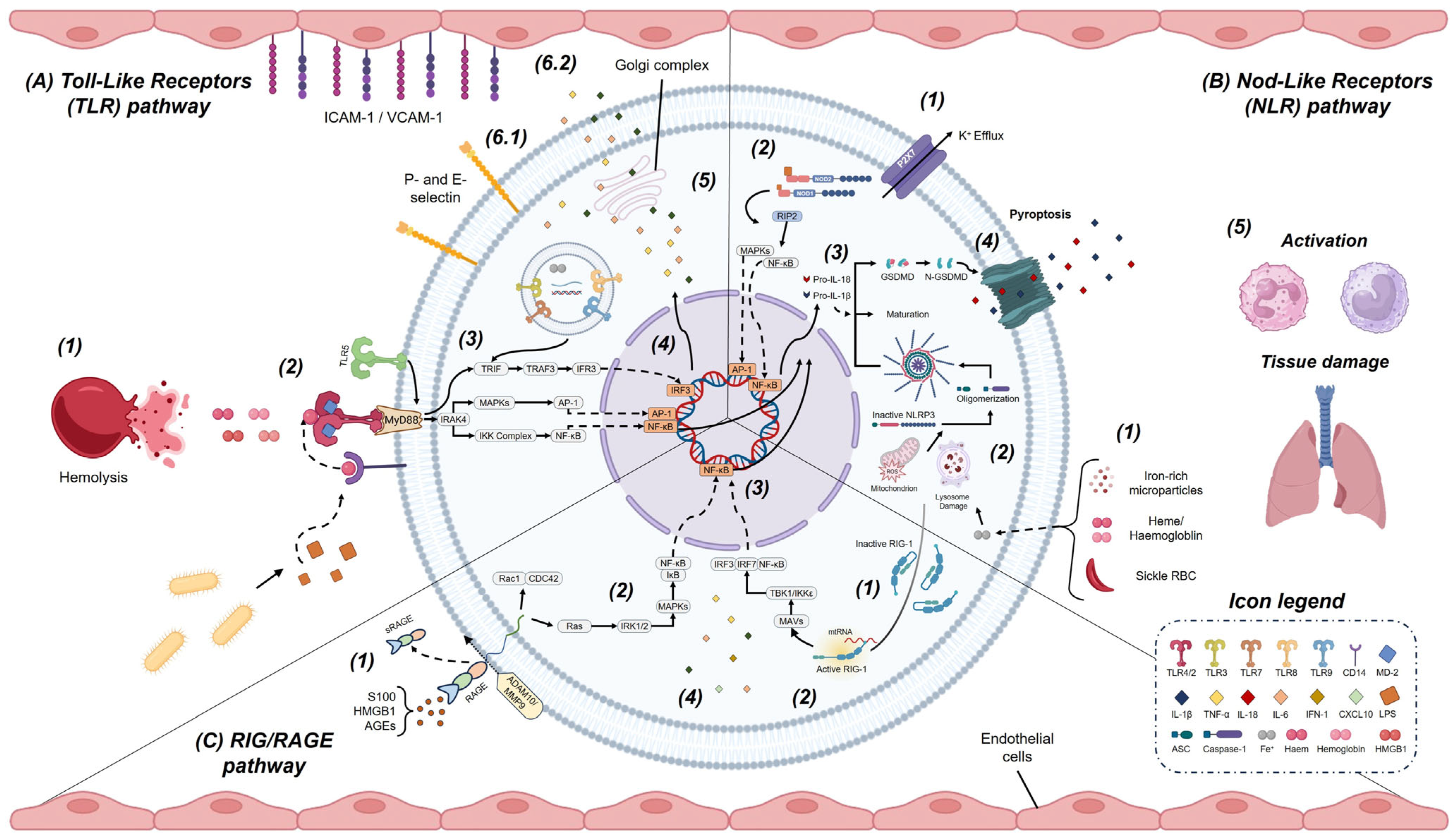
Previous studies have shown that hemoglobin, free heme, and hemin (a degradation product of hemoglobin) can be recognized by TLRs, particularly TLR2 and TLR4 when complexed with myeloid differentiation factor 2 (MD-2) [14,26,58] (Figure 1A (1–2)). Despite TLR4 being known for its recognition on LPS and bacterial compounds, it was seen that SCA products derived from cell damage also mediate immunity mainly by this receptor. This recognition activates classical downstream mechanisms, including the upregulation of pro-inflammatory transcription factors genes leading to IL-1β and TNF-α production, and increased expression of adhesion molecules such as ICAM-1, VCAM-1, E-selectin, and P-selectin. These alterations enhance cell–cell and cell–endothelium interactions, as well as the expression of tissue factor [51,65,66]. Although several hemoglobin-derived products can activate immune responses through these pathways, evidence suggests that hemoglobin S possesses a heightened immunomodulatory effect compared with other subproducts [29]. It is important to emphasize that, although TLR2 and TLR4 constitute the central and classical receptors involved in immune activation in SCA, the potential roles of other TLRs, as well as the impact of genetic variability on their function and effectiveness, remain poorly understood [25,67].
Major TLRs induce inflammation primarily through subsequent activation of the MyD88-dependent pathway, while TLR4 is the only receptor also capable of activating the TRIF-dependent (IFN-β–inducing) pathway [33,58,68]. MyD88-mediated signaling is essential for the activation of the transcription factors NF-κB and MAPKs, as well as for inducing the production of proinflammatory mediators [67]. In neutrophils, activation of both TLR2 and TLR4 further amplifies the NF-κB pathway, intensifying the inflammatory response through the increased production of cytokines and chemokines such as TNF-α, IL-1β, IL-6, CCL2 and CXCL8 [5,69,70]. It was shown that in a SCA context, TLRs activate the NF-κB pathway, but also the MAPK and TRIF pathways, due to the intense production of molecules derived from all pathways (Figure 1A (3–5)). This process contributes to a positive feedback loop, recruiting additional neutrophils and monocytes and exacerbating the imbalance between tissue damage and protective mechanisms [61]. Research in hepatocytes has shown that TLR4 activation induces the release of xanthine oxidase, which binds to circulating free heme and facilitates its clearance from the body [71]. Although TLR activation plays a crucial antimicrobial role, it also promotes increased multicellular adhesion (neutrophils, sickle RBCs, platelets and endothelial cells), thereby intensifying microvascular obstruction and contributing to frequent VOCs and sterile inflammation [15,19].
SCA mice lacking TLR4 show reduced expression of inflammatory mRNAs such as CCL3, CXCL2 and IL-6, as well as lower expression of VCAM-1, ICAM-1 and E-selectin following hemin stimulation compared with TLR4-sufficient SCA mice [25,65]. Also, HMGB1, a common DAMP released during hemolysis, was shown to activate cells not only through TLR4 but also through other pathways such as P2Y12 [29,72].
Recently, evidence has suggested that endothelial TLR4 (non-hematopoietic) plays a central role in the adhesion mechanisms underlying VOC pathophysiology, while TLR4 expressed in circulating cells primarily enhances adhesive properties and inflammatory mediator production [58,69]. However, the findings remain divergent in the literature. Stimulation of HUVECs with hemoglobin and its subproducts has shown that activation depends on TLR4 signaling, leading to the production not only of inflammatory molecules but also those involved in coagulation, supporting its role in immunothrombosis in SCA [25,66,71].
Monocytes also directly contribute to amplifying inflammation in SCA [73]. These cells exhibit an inflammatory phenotype, especially during VOC, characterized by increased CD11b expression, upregulation of TLR4 and enhanced production of IL-6, IL-1β and TNF-α compared with healthy individuals [65,66]. Although heme is a potent TLR4 agonist, studies indicate that free hemoglobin S, unlike hemoglobin A, binds TLR4/MD-2 with greater affinity, promoting stronger monocyte activation and inducing higher endothelial expression of adhesive properties. In both circulating and endothelial cells, increased expression of P-selectin, E-selectin, VCAM-1 and ICAM-1 contributes to higher interactions and formation of VOC episodes [74,75] (Figure 1A (6.1 and 6.2)). In SCA transgenic mice, HbS significantly increased monocyte inflammatory markers, an effect more pronounced during VOC episodes [11,29,76].
The TRIF pathway, activated mainly by TLR3 and TLR4, elicits immune responses through activation of the transcription factors IRF3 and NF-κB, ultimately increasing type I Interferon (IFN-I) production [14,68,69]. Although TRIF signaling may exert chronic effects, it contributes positively to the inflammatory feedback loop. Notably, IFN-I displays immunomodulatory functions on neutrophils and monocytes, prolonging their survival and promoting higher expression of adhesion molecules and secondary mediators [77]. IFN-I may also promote dendritic cell maturation, subsequently activating CD4+ T cells and enhancing chemotaxis within inflammatory microenvironments, further maintaining the inflammatory response [11,49,78].
Although less explored, certain TLRs beyond TLR2 and TLR4 have shown relevance. TLR5, typically associated with pathogen recognition, has been implicated in chronic inflammation [79,80]. In SCA, mononuclear cells exhibit increased TLR5 mRNA expression but not TLR9, suggesting a broader activation profile beyond classical receptors [61,65,79]. However, stimulation of monocytes with sickle RBCs enhanced TLR9 (but not TLR5) expression, supporting the hypothesis that TLR9 responds primarily to acute stimuli, whereas TLR5 is more relevant to chronic inflammation [37]. Another study showed increased TLR9 expression in neutrophils and monocytes from SCA patients in chronic and stable condition, especially among patients with better prognosis, who also exhibited lower platelet and reticulocyte counts and reduced mortality risk [51].
Transcriptomic profiling of PBMCs from SCA patients revealed increased TLR7 expression, particularly in individuals with elevated iron levels [36]. TLR7 is associated with the recognition of single-stranded RNA, but its role in SCA pathophysiology remains poorly understood [29,40,67,69].
The participation of other TLRs remains largely unclear. TLR3, localized in intracellular vesicles, recognizes microbial nucleic acids, especially viral RNA [81]. However, TLR3-deficient mice exhibit impaired inflammatory responses to necrotic cell-derived products, indicating a role in recognizing extracellular damage signals [37]. The scarcity of studies involving non-classical TLRs highlights the need to better understand mechanisms driving sterile inflammation in SCA and the susceptibility of these patients to infectious complications.
Overall, TLR activation and signaling amplify multiple inflammatory responses strongly associated with disease severity in SCA [13,82]. Excessive neutrophil activation, NET and ROS overproduction, combined with inefficient clearance, cause endothelial injury, progressive vascular dysfunction, organ failure and stroke through increased multicellular aggregate formation [14,65]. Therapeutic strategies targeting TLR inhibition or blockade have emerged as promising approaches to reduce sterile inflammation and mitigate vascular complications in SCA [25,73].

3.2. NLRP3 Assumes the Central Role in Inflammation and Interacts with Other Immune Receptors to Maturate the Inflammatory Cytokines

NLRs are immune sensors located in the cytoplasm, whereas TLRs activate inflammatory pathways at the cell surface or in endosomes [61]. These receptors are widely recognized for their ability to induce cytokine production and rapidly initiate inflammation, as well as for their interactions with other intracellular complexes. A major mechanism involves NOD1 and NOD2, which recognize components present in the extracellular milieu, mainly from microorganisms, and activate NF-κB-dependent molecules such as pro-IL-1β, IL-6 and TNF, functioning similarly to TLRs [38,83]. Other mechanisms, more recently explored, involve the recognition of cell-damage-associated components by NLRP family members, particularly NLRP3 [83,84]. This environment promotes NLRP3 interaction with apoptosis-associated speck-like protein containing a CARD (ASC) and Caspase-1, leading to inflammasome assembly. The resulting complex enables the maturation of IL-1β and IL-18 and enhances their release from the cell [85].
Chronic hemolysis and DAMP production constitute the initial trigger for inflammasome activation in SCA, and in this section, we primarily focus on the NLRP3 inflammasome due to the larger body of available literature supporting its role, in contrast to the more limited evidence regarding NOD1/NOD2 mechanisms in SCA.
Recent studies have investigated intracellular mechanisms in immune cells from SCA patients [36]. Although elevated levels of inflammatory and angiogenic mediators have been described during steady-state, these responses intensify during VOC [39,86], which correlates with the clinical and laboratory findings in these episodes [39]. Omics analyses have identified that IL-1β and IL-18 activation mechanisms contribute not only to the canonical pathways of SCA pathophysiology but also to acute clinical events such as acute chest syndrome [48,87] and acute pain crises [88].
Beyond classical inflammatory pathways, components associated with T-cell and NK-cell activation, as well as angiogenesis, are also present during acute inflammatory states [86]. Patients with higher circulating iron levels exhibit increased expression of inflammasome-related genes, including NLRP3, NLRC4 and CASP1 [36]. These multifactorial interactions drive ischemia–reperfusion, cellular damage, iron overload and a positive inflammatory feedback loop, further reinforcing the involvement of the inflammasome in SCA.
Although NLR expressions have been described in several cell types, particular attention has been given to platelets [76]. Studies frequently examine platelet receptor expression and interactions due to their ability to form platelet–endothelium aggregates, an especially relevant process in SCA [76,89]. NLRs detect DAMPs such as adenosine triphosphate (ATP), ROS, free heme and iron, which promote indirectly to NLRP3 oligomerization, full inflammasome formation and Caspase-1 activation (Figure 1B (1)). The internalization of iron, derived from multiple sources, promotes damage in organelles such as mitochondria and lysosome.
One of the key factors in intracellular stimuli of inflammation relies on oxidative stress. Chronic exposure to free heme, which is highly redox-active, damages mitochondrial membranes and impairs respiration, leading to the accumulation of mitochondrial ROS (mtROS) [90]. mtROS damage cellular components and also act as danger signals, promoting mitochondrial DNA release into the cytoplasm and triggering NLRP3 activation (Figure 1B (2)). This facilitates ASC-dependent oligomerization and enhances K+ efflux, stabilizing the inflammasome complex [91].
A less explored but relevant mechanism is lysosomal damage induced by free heme. This may occur through three main pathways: (i) phagocytosis of damaged or senescent cells in SCA; (ii) direct recognition and uptake of extracellular heme; and (iii) internalization of heme-rich microvesicles (MVs). All these processes disrupt intracellular iron balance, increasing iron concentration within the lysosome, and when combined with hydroxyl radicals generated from the Fenton reaction, it results in lysosomal injury [92] (Figure 1B (2)). Excess ROS, mtROS or otherwise promotes lipid peroxidation of lysosomal membranes, which increases the permeability to the damage reported in a process known as lysosomal membrane permeabilization (LMP) [93]. LMP leads to the cytoplasmic release of hydrolytic enzymes, including cathepsins B and D, which act as additional damage sensors and contribute to NLRP3 activation (Figure 1B (3)).
NLRP3 oligomerization is a tightly regulated process dependent on multiple intracellular signals. Potassium K+ efflux is one of the earliest and most essential triggers for inflammasome activation [94]. ATP released during hemolysis activates the P2X7 ion channel, facilitating K+ efflux; however, heme-induced K+ efflux appears to occur independently of P2X7 [92]. The abrupt drop in intracellular K+ is perceived as a danger signal and destabilizes NLRP3, exposing its oligomerization domains [94] (Figure 1B (1–3)).
With inflammasome formation, it leads to further functions of: (i) maturation on proinflammatory cytokines, and (ii) activation on cathepsins that enhance cytokine release (Figure 1B (3)). The first mechanism is mediated by Caspase-1 that subsequently converts pro-IL-1β and pro-IL-18 into their active proinflammatory forms [90,95]. Notably, free heme activates NLRP3 not only in circulating monocytes/macrophages but also in endothelial cells, resulting in robust IL-1β production. Its inflammatory effect is enhanced when heme is unbound, such as when not associated with hemoglobin or albumin [90]. Studies using MVs have shown that heme-enriched MVs can deliver heme and iron intracellularly, enabling direct receptor activation that might not occur otherwise [64,96,97].
Beyond the maturation of IL-1β and IL-18, activation of the NLRP3 inflammasome initiates additional critical cellular processes that amplify the inflammatory response in SCA. Caspase-1’s main participation is to activate cytokines, but as mentioned before, it also cleaves lysosomal proteins such as cathepsins and, most importantly, the substrate gasdermin-D (GSDMD). This last molecule acts by releasing its active N-terminal domain (N-GSDMD) that will then form pores in the cell membrane to enable cytokine release in a pyroptosis manner [98,99] (Figure 1B (4)). In environments with intense production of DAMPs, this process is exacerbated. Thus, the involvement of cathepsins and GSDMD adds an additional layer to tissue damage, systemic inflammation, and endothelial dysfunction, reinforcing the understanding that inflammasome activation suggests a self-perpetuating inflammatory cycle centered on multifactorial compounds in SCA, and it extends well beyond IL-1β and IL-18 release. It must be mentioned that it also involves cytolytic pathways that perpetuate even other responses to the inflammatory and vaso-occlusive cycle [100,101,102]. Although few studies relate the production of inflammatory mediators to the clinical manifestations seen in VOC, it is known that the molecules described here were previously related to circulating immune cell activation and tissue damage, especially in lungs, which contribute to ACS manifestations (Figure 1B (5)).
Circulating mononuclear cells from SCA patients in a steady-state showed increased NLRP3 and IL-1β mRNA expression, although not for soluble levels of Caspase-1 or IL-18 [37]; nevertheless, the activated form of Caspase-1 is elevated in steady-state and further was demonstrated to increase during VOC [19]. The inflammatory environment is strongly dependent on Caspase-1, which promotes IL-1β activation, including in platelets. Inhibition assays, with YVAD, demonstrated that Caspase-1 was shown to reduce extracellular platelet-derived MVs, IL-1β content in these MVs, and neutrophil–endothelium aggregates, and ultimately decrease pulmonary VOC events [76].
Conversely, stimulation of healthy monocytes with sickle RBCs increases all four markers, NLRP3, Caspase-1, IL-18 and IL-1β, indicating an acute activation profile. Surprisingly, Caspase-1 activation in this context was shown to be driven by the HMGB1/TLR4 pathway, which is not canonically associated with inflammasome assembly [19]. Although these findings warrant further investigation, they highlight the complex and interdisciplinary nature of receptor signaling and intracellular pathways in SCA.
Comparing steady-state, chronic inflammation, with VOC, widely known as acute inflammation, VOC episodes were characterized by elevated IL-6 and IL-1β, whereas IL-18 levels do not differ significantly. However, IL-18 correlated with severity markers such as reticulocyte count, LDH, direct bilirubin, TNF and FASLG [37].
Understanding how NLRs shape this chronic inflammatory background, either positively or negatively, is essential for identifying therapeutic targets. Genetic studies have shown that variants in NLRP1 (rs11651270 T>C) and IL-1β (rs16944 G>A), but not in NLRP3, NLRC4 or CARD8, were associated with more favorable clinical outcomes in SCA. Furthermore, variant-specific associations were identified with mortality (NLRP1 rs11651270), nephropathy and LDH (NLRP3 rs35829419) and acute chest syndrome/stroke (IL-1β rs16944) [103].
Recent research has focused on therapeutic strategies to reduce iron overload and mitigate inflammasome activation [82]. In SCA, chronic hemolysis and transfusion therapies contribute to non-transferrin-bound iron, promoting oxidative stress, inflammation and hepatotoxicity [36,104]. Experimental studies in mice have shown that chrysin, a flavonoid, exerts hepatoprotective effects by reducing liver enzymes and proinflammatory cytokines through inhibition of the NLRP3 pathway and NF-κB acetylation, while increasing antioxidant proteins such as Nrf2 and heme oxygenase 1 (HO-1) [105,106]. Another study using the NLRP3 inhibitor MCC950 demonstrated reduced platelet aggregate formation, reinforcing the role of the inflammasome in cell–cell and cell–endothelium interactions [107]. Similarly, flurbiprofen inhibited cleavage of pro-IL-1β and pro-Caspase-1 in the spleen, liver and lungs, reducing pain episodes in mice [82]. Spleen tyrosine kinase (Syk), an effective inhibitor of NLRP3, was shown to reduce some markers related to the major inflammasome, like Caspase-1, but also related to hemostasis, like thrombus area, P-selectin, ATP production and platelet aggregation [108]. A clinical trial with canakinumab, an IL-1β inhibitor, was shown to reduce anti-inflammatory markers in young SCA patients, which further impacted hospital visit duration, pain intensity, and fatigue, and improved participation in social activities [109].
In addition to inflammasome-mediated mechanisms, patrolling monocytes have emerged as critical components of vascular inflammation in SCA. These cells play a central role in endothelial surveillance by continuously monitoring vascular integrity and responding to damage-associated signals arising from chronic hemolysis. In SCA, persistent activation of patrolling monocytes may contribute both to the clearance of cellular debris and to the amplification of sterile inflammation through the production of proinflammatory cytokines and direct interactions with the endothelium, thereby influencing cellular adhesion and vascular dysfunction [110,111].
Interestingly, although NOD1/NOD2 activation is generally associated with inflammation, in SCA models, it exhibited anti-inflammatory effects, promoting monocyte polarization toward a patrolling phenotype. This rheologic shift reduced vascular stasis and systemic tissue damage and identified CSF-1/CCL2-related pathways, linked to hemolysis recognition, as potential therapeutic targets [112]. Patrolling monocytes’ ability to recognize and phagocytose sickle RBCs may represent an effective mechanism to reduce local and systemic injury.
Finally, as with TLRs, other caspases contribute to inflammatory processes. Caspases-4 and -5 also respond to free heme [113,114], and although they are likely to participate in the sterile inflammation associated with SCA, their involvement has not yet been described. This highlights the need to further explore the heterogeneous mechanisms regulating inflammasome activity and the diverse systemic responses triggered by DAMPs.

3.3. RAGE Acts in a Balance on Inflammation/Oxidative Stress Versus Inflammatory Regulation Through Soluble Release of Molecules

RAGE belongs to the immunoglobulin superfamily and plays a central role in sustaining inflammation and oxidative stress [115]. Its main ligands include Advanced Glycation End Products (AGEs), but also HMGB1, S100 proteins (S100A8/A9), oxidized lipids, and even free heme, establishing RAGE as a sensor of metabolic and oxidative damage [116] (Figure 1C (1)).
In SCA, RAGE ligands are abundantly present, with free heme being the most prominent. When free heme binds to RAGE, the receptor undergoes oligomerization and triggers an intracellular cascade that leads to the production of proinflammatory molecules [116]. This mechanism is strongly stimulated by hemolysis-derived free heme but may also be enhanced during necrotic conditions, such as pyroptosis, which release HMGB1 and S100 proteins, further sustaining the inflammatory signal [115,117]. Persistent RAGE activation contributes to excessive cytokine production, increased expression of vascular adhesion molecules, and endothelial injury, which are closely associated with VOCs [118].
Mechanistically, RAGE engagement activates several intracellular pathways that maintain chronic inflammation. RAGE recruits DIAPH1, which subsequently activates MAPK and NF-κB pathways (Figure 1C (2)), inducing the transcription of inflammatory cytokines and adhesion molecules, particularly ICAM-1 and VCAM-1 [115,119] (Figure 1C (3–4)). Additionally, MAP kinases, including ERK, p38, and JNK, are activated, promoting ROS generation through NADPH oxidases (NOX2/NOX4) and mitochondrial metabolism. This signaling cascade amplifies the proinflammatory response and contributes to endothelial dysfunction [115].
Regarding inflammatory regulation, two main soluble forms of RAGE are found in plasma: soluble RAGE (sRAGE) and endogenous soluble RAGE (esRAGE). sRAGE is generated by the proteolytic cleavage of membrane-bound RAGE by enzymes such as ADAM10 and MMP9. Conversely, esRAGE is produced by alternative splicing and released directly by cells. Both soluble forms act as decoy receptors, competing with membrane-bound RAGE for ligand binding, thereby exerting anti-inflammatory effects and reducing systemic inflammation [115,120,121,122].
In SCA patients, sRAGE levels have been positively associated with disease severity and vascular dysfunction markers. However, results across studies have been heterogeneous, suggesting that the balance between membrane-bound and soluble RAGE may vary depending on ligand overload and disease stage. RAGE also interacts with other biological systems through at least two key mechanisms: (i) soluble AGEs can enhance MMP9 activity, and (ii) AGE–RAGE binding induces ROS production. Both mechanisms contribute to increased inflammation and oxidative stress, exacerbating complications in SCA [123,124].
The vascular consequences of RAGE activation in SCA are particularly harmful. The ROS-driven positive feedback loop decreases NO availability, promoting endothelial dysfunction and leukocyte adhesion [2]. Moreover, RAGE-mediated inflammation enhances NET formation and monocyte recruitment, further fueling oxidative stress and the generation of AGEs, ultimately perpetuating vascular damage [116].

3.4. The RIG Pathway Contributes to the Multisystemic Effects of SCA

RLRs are intracellular immune sensors that primarily recognize PAMPs, such as viral RNA, but can also detect DAMPs [60,125]. These receptors are widely expressed across multiple cell types and, upon detecting RNA, activate the mitochondrial antiviral signaling (MAVS) protein located on the outer mitochondrial membrane [70,83] (Figure 1C (1–2)). Activation of this pathway triggers a signaling cascade that involves the transcription factors IRF3 and IRF7, which, together with NF-κB, promote an inflammatory response centered on IFN-I production [58,126] (Figure 1C (3–4)). Additionally, this pathway leads to the secretion of TNF-α, IL-6, IL-1β, and CXCL10, mediators largely associated with neutrophil recruitment and activation of the acute inflammatory phase [5,33].
Although RLRs have not been extensively investigated in the context of SCA, recent studies suggest increased activation of this pathway both in chronic inflammatory conditions and in association with disease complications [70,114]. Even though SCA is not a viral disease, RLR activation may be enhanced by endogenous danger signals derived from cell injury, such as mitochondrial RNA fragments, which stimulate IFN-I production and propagate inflammation [125,127,128].
RIG-I-mediated signaling also interacts with other inflammatory pathways, including TLRs and the NLRP3 inflammasome [14]. This crosstalk indicates that IFN-I production can promote NLRP3 activation, creating a positive feedback loop that enhances the release of mature IL-1β and IL-18 and further contributes to the inflammatory milieu [129,130].
Recent studies have also shown that RIG-I activation in human platelets can trigger prothrombotic responses and sterile inflammation, two central phenomena in the pathophysiology of VOCs [70]. Thus, RLRs do not function solely as viral sensors; they also amplify sterile inflammatory responses and play a relevant role in cell damage and chronic hemolysis.
Many triggers were previously described in SCA. Most of them can be recognized by several receptors, in a canonical or non-canonical way, but we would like to highlight that the ligands and receptors described here participate in a complex biological system. We acknowledge that there are many other ligands and receptors involved in other functions, that can participate in SCA pathophysiology and related complications. Our major findings are summarized in Table 2.

4. Major Conclusions

Considering the availability and completeness of the data, we highlight the heterogeneous inflammatory processes in SCA mediated by PRRs. Endogenous compounds produced as part of the disease’s baseline pathophysiology play a central role in shaping immune responses and appear to be major drivers of inflammation. We recognize that patients face a multisystemic condition, consistent with previous reports describing prothrombotic and infectious complications. Recent studies have also demonstrated the interplay between biological systems, such as how coagulation-related factors can activate immune pathways, which highlights the importance of a multidisciplinary vision to the pathophysiology of SCA.
In this context, the inflammatory response appears to be predominantly triggered by the TLR2 and TLR4 axes, although other receptors may also contribute. Interestingly, most of these receptors converge on common downstream pathways mediated by MyD88 and NF-κB. Pharmacological approaches that modulate these pathways may offer promising strategies to control inflammation and its consequences in SCA. However, this must be balanced against the need to preserve the host’s ability to respond effectively to its microbiota and to environmental pathogens. This balance between immune activation and regulation remains a central challenge in SCA therapy.
Among the limitations of our study, we note the scarcity of data on other receptors in the literature and how they may influence disease severity or function within this chronic and sterile inflammatory environment. Studies with heterogeneous methodologies inevitably carry both strengths and weaknesses, underscoring the importance of validating the reported findings. Many of the multisystemic observations presented here should be interpreted as exploratory, rather than as direct clinical guidance. Nonetheless, the complexity of immune dysregulation in SCA highlights the need for continued investigation to better understand not only immune mechanisms themselves but also their interactions with other physiological systems.

Author Contributions

Conceptualization and writing—original draft preparation, H.O.J. and J.A.C.C.; writing—review and editing, A.L.S.-J.; visualization, J.A.C.C.; supervision, A.L.S.-J.; project administration, A.L.S.-J.; and funding acquisition, A.L.S.-J. All authors have read and agreed to the published version of the manuscript.

Funding

This research was funded by São Paulo Research Foundation (FAPESP), Coordenação de Aperfeiçoamento de Pessoal de Nível Superior (CAPES) and Conselho Nacional de Desenvolvimento Científico e Tecnológico (CNPq). A.L.S.-J. has a PD scholarship (#2025/04429-9) from FAPESP. J.A.C.C. receives scholarships from CAPES (MSc). The funders had no role in the study design, decision to publish, or preparation of the manuscript.

Institutional Review Board Statement

Not applicable.

Informed Consent Statement

Not applicable.

Data Availability Statement

No new data were created or analyzed in this study. Data sharing is not applicable to this article.

Acknowledgments

The authors would like to express their gratitude to all laboratory staff for their support in this research, especially to Erich Vinicius de Paula, from the Laboratory of Hemostasis and Inflammation at UNICAMP, Campinas, SP, Brazil, for his kind review and valuable comments on this manuscript.

Conflicts of Interest

The authors declare no conflicts of interest.

Abbreviations

The following abbreviations are used in this manuscript:
SCASickle Cell Anemia
PRRsPattern Recognition Receptors
HbSSickle Hemoglobin S
RBCRed Blood Cell
VOCVaso-Occlusive Crisis
ACSAcute Chest Syndrome
TLRsToll-Like Receptors
NLRsNOD-Like Receptors
RLRsRIG-Like Receptors
RAGEReceptors for Advanced Glycation End Products
DAMPsDanger-Associated Molecular Patterns
HMGB1High-Mobility Group Box 1
NONitric Oxide
cGMPCyclic Guanosine Monophosphate
t-PATissue Plasminogen Activator
PAI-1Plasminogen Activator Inhibitor-1
ROSReactive Oxygen Species
NETsNeutrophil Extracellular Traps
CRPC-Reactive Protein
LDHLactate Dehydrogenase
MPOMyeloperoxidase
PAMPsPathogen-Associated Molecular Patterns
MD-2Myeloid Differentiation factor 2
IFN-IType I Interferon
NLRP3Nucleotide-binding oligomerization domain, Leucine-rich Repeat and Pyrin domain-containing 3
MAVSMitochondrial Antiviral Signaling
MAPKMitogen Activated Protein Kinases
ASCApoptosis-Associated Speck-Like Protein Containing a CARD
ATPAdenosine Triphosphate
mtROSMitochondrial ROS
MVsMicrovesicles
LMPLysosomal Membrane Permeabilization
GSDMDGasdermin-D
N-GSDMDN-terminal Domain of GSDMD
HO-1Heme Oxygenase 1
SykSpleen Tyrosine Kinase
AGEsAdvanced Glycation End Products
sRAGESoluble RAGE
esRAGEEndogenous soluble RAGE

References

  1. Sarray, S.; Saleh, L.R.; Lisa Saldanha, F.; Al-Habboubi, H.H.; Mahdi, N.; Almawi, W.Y. Serum IL-6, IL-10, and TNFα Levels in Pediatric Sickle Cell Disease Patients during Vasoocclusive Crisis and Steady State Condition. Cytokine 2015, 72, 43–47. [Google Scholar] [CrossRef] [PubMed]
  2. Kato, G.J.; Piel, F.B.; Reid, C.D.; Gaston, M.H.; Ohene-Frempong, K.; Krishnamurti, L.; Smith, W.R.; Panepinto, J.A.; Weatherall, D.J.; Costa, F.F.; et al. Sickle Cell Disease. Nat. Rev. Dis. Primers 2018, 4, 18010. [Google Scholar] [CrossRef] [PubMed]
  3. Sundd, P.; Mark, T.; Gladwin, E.M.N. Pathophysiology of Sickle Cell Disease Prithu. Physiol. Behav. 2019, 176, 139–148. [Google Scholar] [CrossRef]
  4. Chakravorty, S.; Williams, T.N. Sickle Cell Disease: A Neglected Chronic Disease of Increasing Global Health Importance. Arch. Dis. Child. 2015, 100, 48–53. [Google Scholar] [CrossRef]
  5. Barbu, E.A.; Mendelsohn, L.; Samsel, L.; Thein, S.L. Pro-Inflammatory Cytokines Associate with NETosis during Sickle Cell Vaso-Occlusive Crises. Cytokine 2020, 127, 154933. [Google Scholar] [CrossRef]
  6. Gardner, R.V. Sickle Cell Disease: Advances in Treatment. Ochsner J. 2018, 4, 377–389. [Google Scholar] [CrossRef]
  7. Connes, P.; Alexy, T.; Detterich, J.; Romana, M.; Hardy-Dessources, M.D.; Ballas, S.K. The Role of Blood Rheology in Sickle Cell Disease. Blood Rev. 2016, 30, 111–118. [Google Scholar] [CrossRef]
  8. Souza, R.C.; Neto, P.A.D.M.; Santos, J.R.N.; Monteiro, S.G.; Gonçalves, M.C.; Silva, F.B.; Holanda, R.A.; Santos, J.R.A. Sickle Cell Anaemia Prevalence among Newborns in the Brazilian Amazon-Savanna Transition Region Rayane. Int. J. Environ. Res. Public Health 2019, 16, 1638. [Google Scholar] [CrossRef]
  9. Abdul-Hussein, H.K.; Al-Mammori, H.S.; Hassan, M.K. Evaluation of the Expression of Red Blood Cell CD36, Interleukin-6 and Interleukin-8 in Sickle Cell Anemia Pediatric Patients. Cytokine 2021, 143, 155534. [Google Scholar] [CrossRef]
  10. Vilas-Boas, W.; Veloso Cerqueira, B.A.; Figueiredo, C.V.B.; Santiago, R.P.; da Guarda, C.C.; Pitanga, T.N.; Santana, S.S.; Dias Zanette, A.M.; Goncalves, M.d.S. Association of Homocysteine and Inflammatory-Related Molecules in Sickle Cell Anemia. Hematology 2016, 21, 126–131. [Google Scholar] [CrossRef]
  11. Allali, S.; Maciel, T.T.; Hermine, O.; De Montalembert, M. Innate Immune Cells, Major Protagonists of Sickle Cell Disease Pathophysiology. Haematologica 2020, 105, 273–283. [Google Scholar] [CrossRef]
  12. Adegoke, S.A.; Kuti, B.P.; Omole, K.O.; Smith, O.S.; Oyelami, O.A.; Adeodu, O.O. Acute Chest Syndrome in Sickle Cell Anaemia: Higher Serum Levels of Interleukin-8 and Highly Sensitive C-Reactive Proteins Are Associated with Impaired Lung Function. Paediatr. Int. Child Health 2018, 38, 244–250. [Google Scholar] [CrossRef] [PubMed]
  13. Li, W.; Pucka, A.Q.; Debats, C.; Reyes, B.A.; Syed, F.; O’Brien, A.R.W.; Mehta, R.; Manchanda, N.; Jacob, S.A.; Hardesty, B.M.; et al. Inflammation and Autoimmunity Are Interrelated in Patients with Sickle Cell Disease at a Steady-State Condition: Implications for Vaso-Occlusive Crisis, Pain, and Sensory Sensitivity. Front. Immunol. 2024, 15, 1288187. [Google Scholar] [CrossRef] [PubMed]
  14. Tozatto-Maio, K.; Rós, F.A.; Weinlich, R.; Rocha, V. Inflammatory Pathways and Anti-inflammatory Therapies in Sickle Cell Disease. Hemasphere 2024, 8, e70032. [Google Scholar] [CrossRef] [PubMed]
  15. Zhang, D.; Xu, C.; Manwani, D.; Frenette, P.S. Neutrophils, Platelets, and Inflammatory Pathways at the Nexus of Sickle Cell Disease Pathophysiology. Blood J. 2016, 127, 801–810. [Google Scholar] [CrossRef]
  16. Nader, E.; Romana, M.; Connes, P. The Red Blood Cell—Inflammation Vicious Circle in Sickle Cell Disease. Front. Immunol. 2020, 11, 454. [Google Scholar] [CrossRef]
  17. Camus, S.M.; De Moraes, J.A.; Bonnin, P.; Abbyad, P.; Le Jeune, S.; Lionnet, F.; Loufrani, L.; Grimaud, L.; Lambry, J.C.; Charue, D.; et al. Circulating Cell Membrane Microparticles Transfer Heme to Endothelial Cells and Trigger Vasoocclusions in Sickle Cell Disease. Blood 2015, 125, 3805–3814. [Google Scholar] [CrossRef]
  18. Van Avondt, K.; Schimmel, M.; Bulder, I.; Van Mierlo, G.; Nur, E.; Van Bruggen, R.; Biemond, B.J.; Luken, B.M.; Zeerleder, S. Circulating Iron in Patients with Sickle Cell Disease Mediates the Release of Neutrophil Extracellular Traps. Transfus. Med. Hemotherapy 2023, 50, 321–329. [Google Scholar] [CrossRef]
  19. Vogel, S.; Arora, T.; Wang, X.; Mendelsohn, L.; Nichols, J.; Allen, D.; Shet, A.S.; Combs, C.A.; Quezado, Z.M.N.; Thein, S.L. The Platelet NLRP3 Inflammasome Is Upregulated in Sickle Cell Disease via HMGB1/TLR4 and Bruton Tyrosine Kinase. Blood Adv. 2018, 2, 2672–2680. [Google Scholar] [CrossRef]
  20. Mack, A.K.; Kato, G.J. Sickle Cell Disease and Nitric Oxide: A Paradigm Shift? Int. J. Biochem. Cell Biol. 2006, 38, 1237–1243. [Google Scholar] [CrossRef]
  21. Torres, L.S.; Okumura, J.V.; Silva, D.G.H.; Mimura, K.K.O.; Belini, É.; Oliveira, R.G.; Lobo, C.L.C.; Oliani, S.M.; Bonini-Domingos, C.R. Inflammation in Sickle Cell Disease: Differential and down-Expressed Plasma Levels of Annexin A1 Protein. PLoS ONE 2016, 11, e0165833. [Google Scholar] [CrossRef] [PubMed]
  22. Loscalzo, J. Nitric Oxide Insufficiency, Platelet Activation, and Arterial Thrombosis. Circ. Res. 2001, 88, 756–762. [Google Scholar] [CrossRef]
  23. Malfertheiner, M.V.; Garrett, A.; Passmore, M.; Haymet, A.B.; Webb, R.I.; Von Bahr, V.; Millar, J.E.; Schneider, B.A.; Obonyo, N.G.; Black, D.; et al. The Effects of Nitric Oxide on Coagulation and Inflammation in Ex Vivo Models of Extracorporeal Membrane Oxygenation and Cardiopulmonary Bypass. Artif. Organs 2023, 47, 1581–1591. [Google Scholar] [CrossRef] [PubMed]
  24. Sun, J.; Zhang, S.; Wang, Y.; Sheng, D.; Liu, S.; Rao, Y.; Li, A.; Pan, Y.; Brash, J.L.; Liu, X.; et al. A Multifunctional Endothelial-Mimetic Surface: Synergistically Combating Thrombus Formation by Releasing Nitric Oxide, Promoting Fibrinolysis, and Enhancing Endothelialization. Colloid Interface Sci. Commun. 2025, 67, 100847. [Google Scholar] [CrossRef]
  25. Lei, J.; Paul, J.; Wang, Y.; Gupta, M.; Vang, D.; Thompson, S.; Jha, R.; Nguyen, J.; Valverde, Y.; Lamarre, Y.; et al. Heme Causes Pain in Sickle Mice via Toll-Like Receptor 4-Mediated Reactive Oxygen Species- and Endoplasmic Reticulum Stress-Induced Glial Activation. Antioxid. Redox Signal. 2021, 34, 279–293. [Google Scholar] [CrossRef]
  26. Hebbel, R.P.; Vercellotti, G.M. Multiple Inducers of Endothelial NOS (ENOS) Dysfunction in Sickle Cell Disease. Am. J. Hematol. 2021, 96, 1505–1517. [Google Scholar] [CrossRef]
  27. Shet, A.S.; Lizarralde-iragorri, M.A.; Naik, R.P. The Molecular Basis for the Prothrombotic State in Sickle Cell Disease. Haematologica 2020, 105, 2368–2379. [Google Scholar] [CrossRef]
  28. Conran, N.; De Paula, E.V. Thromboinflammatory Mechanisms in Sickle Cell Disease—Challenging the Hemostatic Balance. Haematologica 2020, 105, 2380–2390. [Google Scholar] [CrossRef]
  29. Allali, S.; Rignault-Bricard, R.; de Montalembert, M.; Taylor, M.; Bouceba, T.; Hermine, O.; Maciel, T.T. HbS Promotes TLR4-Mediated Monocyte Activation and Proinflammatory Cytokine Production in Sickle Cell Disease. Blood 2022, 140, 1972–1982. [Google Scholar] [CrossRef]
  30. Carvalho, M.O.S.; Araujo-Santos, T.; Reis, J.H.O.; Rocha, L.C.; Cerqueira, B.A.V.; Luz, N.F.; Lyra, I.M.; Lopes, V.M.; Barbosa, C.G.; Fiuza, L.M.; et al. Inflammatory Mediators in Sickle Cell Anaemia Highlight the Difference between Steady State and Crisis in Paediatric Patients. Br. J. Haematol. 2018, 182, 933–936. [Google Scholar] [CrossRef]
  31. Purohit, A.; Huda, R.K.; Mohanty, S.S.; Babu, B.V. Epidemiology of Sickle Cell Disease in Tribal Population of Southern Rajasthan, India. Sci. Rep. 2025, 15, 2196. [Google Scholar] [CrossRef]
  32. Siransy, L.K.; Yapo-Crézoit, C.C.A.; Diane, M.K.; Goore, S.; Kaboré, S.; Koffi-Kabran, B.; Konaté, S. Th1 and Th2 Cytokines Pattern among Sickle Cell Disease Patients in Côte d’ivoire. Clin. Immunol. Res. 2018, 2, 2–7. [Google Scholar] [CrossRef]
  33. Dorrington, M.G.; Fraser, I.D.C. NF-ΚB Signaling in Macrophages: Dynamics, Crosstalk, and Signal Integration. Front. Immunol. 2019, 10, 705. [Google Scholar] [CrossRef] [PubMed]
  34. Morikis, V.A.; Hernandez, A.A.; Magnani, J.L.; Sperandio, M.; Simon, S.I. Targeting Neutrophil Adhesive Events to Address Vaso-Occlusive Crisis in Sickle Cell Patients. Front. Immunol. 2021, 12, 663886. [Google Scholar] [CrossRef]
  35. Ansari, J.; Gavins, F.N.E. Ischemia-Reperfusion Injury in Sickle Cell Disease from Basics to Therapeutics. Am. J. Pathol. 2019, 189, 706–718. [Google Scholar] [CrossRef] [PubMed]
  36. Van Beers, E.J.; Yang, Y.; Raghavachari, N.; Tian, X.; Allen, D.; Nichols, J.; Mendelsohn, L.; Nekhai, S.; Gordeuk, V.; Taylor, J.G.; et al. Iron, Inflammation and Early Death with Sickle Cell Disease. Circ Res. 2015, 116, 298–306. [Google Scholar] [CrossRef]
  37. Pitanga, T.N.; Oliveira, R.R.; Zanette, D.L.; Guarda, C.C.; Santiago, R.P.; Santana, S.S.; Nascimento, V.M.L.; Lima, J.B.; Carvalho, G.Q.; Maffili, V.V.; et al. Sickle Red Cells as Danger Signals on Proinflammatory Gene Expression, Leukotriene B4 and Interleukin-1 Beta Production in Peripheral Blood Mononuclear Cell. Cytokine 2016, 83, 75–84. [Google Scholar] [CrossRef]
  38. Yao, J.; Sterling, K.; Wang, Z.; Zhang, Y.; Song, W. The Role of Inflammasomes in Human Diseases and Their Potential as Therapeutic Targets. Signal Transduct. Target. Ther. 2024, 9, 10. [Google Scholar] [CrossRef]
  39. Silva-Junior, A.L.; Garcia, N.P.; Cardoso, E.C.; Dias, S.; Tarragô, A.M.; Fraiji, N.A.; Gomes, M.S.; Amaral, L.R.; Teixeira-Carvalho, A.; Martins-Filho, O.A.; et al. Immunological Hallmarks of Inflammatory Status in Vaso-Occlusive Crisis of Sickle Cell Anemia Patients. Front. Immunol. 2021, 12, 559925. [Google Scholar] [CrossRef]
  40. Small, S.; Numan, Y.; Platanias, L.C. Innate Immune Mechanisms and Immunotherapy of Myeloid Malignancies. Biomedicines 2021, 9, 1631. [Google Scholar] [CrossRef]
  41. Alagbe, A.E.; Justo Junior, A.S.; Ruas, L.P.; Tonassé, W.V.; Santana, R.M.; Batista, T.H.C.; Domingos, I.F.; Araujo, A.S.; Bezerra, M.A.C.; Santos, M.N.N.; et al. Interleukin-27 and Interleukin-37 Are Elevated in Sickle Cell Anemia Patients and Inhibit in Vitro Secretion of Interleukin-8 in Neutrophils and Monocytes. Cytokine 2018, 107, 85–92. [Google Scholar] [CrossRef] [PubMed]
  42. Conran, N.; Belcher, J.D. Inflammation in Sickle Cell Disease. Clin. Hemorheol. Microcirc. 2018, 68, 263–299. [Google Scholar] [CrossRef] [PubMed]
  43. Uhelski, M.L.; Li, Y.; Fonseca, M.M.; Romero-Snadoval, E.A.; Dougherty, P.M. Role of Innate Immunity in Chemotherapy-Induced Peripheral Neuropathy. Neurosci. Lett. 2021, 755, 135941. [Google Scholar] [CrossRef] [PubMed]
  44. Alagbe, A.E.; Olaniyi, J.A.; Aworanti, O.W. Adult Sickle Cell Anaemia Patients in Bone Pain Crisis Have Elevated Pro-Inflammatory Cytokines. Mediterr. J. Hematol. Infect. Dis. 2018, 10, e2018017. [Google Scholar] [CrossRef]
  45. Cajado, C.S.; Cerqueira, B.A.V.; Barbosa, C.G.; Lyra, I.M.; Adorno, E.V.; Gonçalves, M.S. IL-8 e TNF-ALFA: Marcadores Imunológicos Da Anemia Falciforme. Gaz. Médica Bahia 2010, 80, 56–61. [Google Scholar]
  46. Owusu-Ansah, A.; Ihunnah, C.A.; Walker, A.L.; Ofori-Acquah, S.F. Inflammatory Targets of Therapy in Sickle Cell Disease. Transl. Res. 2016, 167, 281–297. [Google Scholar] [CrossRef]
  47. Cajado, C.; Cerqueira, B.A.V.; Couto, F.D.; Moura-Neto, J.P.; Vilas-Boas, W.; Dorea, M.J.; Lyra, I.M.; Barbosa, C.G.; Reis, M.G.; Goncalves, M.S. TNF-Alpha and IL-8: Serum Levels and Gene Polymorphisms (-308G>A and -251A>T) Are Associated with Classical Biomarkers and Medical History in Children with Sickle Cell Anemia. Cytokine 2011, 56, 312–317. [Google Scholar] [CrossRef][Green Version]
  48. Cerqueira, B.A.V.; Boas, W.V.; Zanette, A.D.; Reis, M.G.; Goncalves, M.S. Cytokine Increased Concentrations of IL-18 and Uric Acid in Sickle Cell Anemia: Contribution of Hemolysis, Endothelial Activation and the Inflammasome. Cytokine 2011, 56, 471–476. [Google Scholar] [CrossRef]
  49. Lekpor, C.E.; Botchway, F.A.; Driss, A.; Bashi, A.; Abrahams, A.D.; Kusi, K.A.; Futagbi, G.; Alema-Mensah, E.; Agbozo, W.; Solomon, W.; et al. Circulating Biomarkers Associated with Pediatric Sickle Cell Disease. Front. Mol. Biosci. 2024, 11, 1481441. [Google Scholar] [CrossRef]
  50. Deshmane, S.L.; Kremlev, S.; Amini, S.; Sawaya, B.E. Monocyte Chemoattractant Protein-1 (MCP-1): An Overview. J. Interferon Cytokine Res. 2009, 29, 313–325. [Google Scholar] [CrossRef]
  51. Garcia, N.P.; Júnior, A.L.S.; Soares, G.A.S.; Costa, T.C.C.; dos Santos, A.P.C.; Costa, A.G.; Tarragô, A.M.; Martins, R.N.; do Carmo Leäo Pontes, F.; De Almeida, E.G.; et al. Sickle Cell Anemia Patients Display an Intricate Cellular and Serum Biomarker Network Highlighted by TCD4+CD69+ Lymphocytes, IL-17/MIP-1β, IL-12/VEGF, and IL-10/IP-10 Axis. J. Immunol. Res. 2020, 2020, 4585704. [Google Scholar] [CrossRef] [PubMed]
  52. Dutra, F.F.; Bozza, M.T. Heme on Innate Immunity and Inflammation. Front. Pharmacol. 2014, 5, 115. [Google Scholar] [CrossRef] [PubMed]
  53. Castanheira, F.V.S.; Kubes, P. Neutrophils and NETs in Modulating Acute and Chronic Inflammation. Blood 2019, 133, 2178–2185. [Google Scholar] [CrossRef] [PubMed]
  54. Pitanga, T.N.; Vilas-Boas, W.; Cerqueira, B.A.V.; Seixas, M.O.; Barbosa, C.G.; Adorno, E.V.; Goncalves, M.S. Cytokine Profiles in Sickle Cell Anemia: Pathways to Be Unraveled. Adv. Biosci. Biotechnol. 2013, 4, 6–12. [Google Scholar] [CrossRef]
  55. Tuono, R.D.M.; Simo, J.L.; Biapa Nya, P.C.; Tayou, C.T.; Pieme, C.A. Inflammation and Iron Profile in Children with Sickle Cell Disease in Cameroon: Frequency and Associated Factors, an Analytical Cross-Sectional Study. Health Sci. Rep. 2025, 8, e70773. [Google Scholar] [CrossRef]
  56. Makulo, J.R.; Itokua, K.E.; Lepira, R.K.; Bundutidi, G.M.; Aloni, M.N.; Ngiyulu, R.M.; Gini, J.L.; Lepira, F.B. Magnitude of Elevated Iron Stores and Risk Associated in Steady State Sickle Cell Anemia Congolese Children: A Cross Sectional Study. BMC Hematol. 2019, 19, 3. [Google Scholar] [CrossRef]
  57. Torres, L.S.; Chweih, H.; Fabris, F.C.Z.; Gotardo, E.M.F.; Leonardo, F.C.; Olalla Saad, S.T.; Costa, F.F.; Conran, N. TGF-Β1 Reduces Neutrophil Adhesion and Prevents Acute Vaso-Occlusive Processes in Sickle Cell Disease Mice. Cells 2022, 11, 1200. [Google Scholar] [CrossRef]
  58. Belcher, J.D.; Zhang, P.; Nguyen, J.; Kiser, Z.M.; Nath, K.A.; Hu, J.; Trent, J.O.; Vercellotti, G.M. Identification of a Heme Activation Site on the MD-2/TLR4 Complex. Front. Immunol. 2020, 11, 1370. [Google Scholar] [CrossRef]
  59. Gibb, D.R.; Hudson, K.E. Sickle Cell Inflammation: Is HbS the Answer? Blood 2022, 140, 1921–1923. [Google Scholar] [CrossRef]
  60. Tumburu, L.; Ghosh-Choudhary, S.; Seifuddin, F.T.; Barbu, E.A.; Yang, S.; Ahmad, M.M.; Wilkins, L.H.W.; Tunc, I.; Sivakumar, I.; Nichols, J.S.; et al. Circulating Mitochondrial DNA Is a Proinflammatory DAMP in Sickle Cell Disease. Blood 2021, 137, 3116–3126. [Google Scholar] [CrossRef]
  61. Duan, T.; Du, Y.; Xing, C.; Wang, H.Y.; Wang, R. Toll-Like Receptor Signaling and Its Role in Cell-Mediated Immunity. Front. Immunol. 2022, 13, 812774. [Google Scholar] [CrossRef] [PubMed]
  62. Novelli, E.M.; Gladwin, M.T. Crises in Sickle Cell Disease. Chest 2016, 149, 1082–1093. [Google Scholar] [CrossRef] [PubMed]
  63. Brito, P.L.; Gushiken, L.F.S.; Gotardo, E.M.F.; Alberto, V.F.; Leonardo, F.C.; Becerra, A.; Zamboni, D.S.; Costa, F.F.; Conran, N. Caspase-1 Activation Drives Vascular Inflammatory Processes and Hypoperfusion in Intravascular Hemolysis. Am. J. Physiol. Heart Circ. Physiol. 2025, 329, H920–H938. [Google Scholar] [CrossRef] [PubMed]
  64. Belcher, J.D.; Chen, C.; Nguyen, J.; Milbauer, L.; Abdulla, F.; Alayash, A.I.; Smith, A.; Nath, K.A.; Hebbel, R.P.; Vercellotti, G.M. Heme Triggers TLR4 Signaling Leading to Endothelial Cell Activation and Vaso-Occlusion in Murine Sickle Cell Disease. Blood 2014, 123, 377–390. [Google Scholar] [CrossRef]
  65. Beckman, J.D.; Abdullah, F.; Chen, C.; Kirchner, R.; Rivera-Rodriguez, D.; Kiser, Z.M.; Nguyen, A.; Zhang, P.; Nguyen, J.; Hebbel, R.P.; et al. Endothelial TLR4 Expression Mediates Vaso-Occlusive Crisis in Sickle Cell Disease. Front. Immunol. 2021, 11, 613278. [Google Scholar] [CrossRef]
  66. Hounkpe, B.W.; Roberta, C.; Moraes, P.; Lanaro, C.; Nueldo, M.; Santos, N.; Costa, F.F.; De Paula, E.V. Highlight Article Evaluation of the Mechanisms of Heme-Induced Tissue Factor Activation: Contribution of Innate Immune Pathways. Exp. Biol. Med. 2022, 247, 1542–1547. [Google Scholar] [CrossRef]
  67. Wicherska-Pawłowska, K.; Wróbel, T.; Rybka, J. Toll-Like Receptors (TLRs), NOD-Like Receptors (NLRs), and RIG-I-Like Receptors (RLRs) in Innate Immunity. TLRs, NLRs, and RLRs Ligands as Immunotherapeutic Agents for Hematopoietic Diseases. Int. J. Mol. Sci. 2021, 22, 13397. [Google Scholar] [CrossRef]
  68. Hu, L.; Cheng, Z.; Chu, H.; Wang, W.; Jin, Y. TRIF-Dependent Signaling and Its Role in Liver Diseases. Front. Cell Dev. Biol. 2024, 12, 1370042. [Google Scholar] [CrossRef]
  69. Ciesielska, A.; Matyjek, M.; Kwiatkowska, K. TLR4 and CD14 Trafficking and Its Influence on LPS—Induced pro—Inflammatory Signaling. Cell. Mol. Life Sci. 2021, 78, 1233–1261. [Google Scholar] [CrossRef]
  70. Liu, T.; Zhang, L.; Joo, D.; Sun, S.C. NF-ΚB Signaling in Inflammation. Signal Transduct. Target. Ther. 2017, 2, 17023. [Google Scholar] [CrossRef]
  71. Schimmel, M.; Nur, E.; Biemond, B.J.; van Mierlo, G.J.; Solati, S.; Brandjes, D.P.; Otten, H.M.; Schnog, J.J.; Zeerleder, S. Nucleosomes and Neutrophil Activation in Sickle Cell Disease Painful Crisis. Haematologica 2013, 98, 1797–1803. [Google Scholar] [CrossRef] [PubMed]
  72. Nolfi-Donegan, D.; Annarapu, G.K.; Croix, C.S.; Calderon, M.; Hillery, C.A.; Shiva, S. High-Mobility Group Box 1 Increases Platelet Surface P2Y12 and Platelet Activation in Sickle Cell Disease. JCI Insight 2024, 9, 14–17. [Google Scholar] [CrossRef]
  73. Zhang, P.; Nguyen, J.; Abdulla, F.; Nelson, A.T.; Beckman, J.D.; Vercellotti, G.M.; Belcher, J.D. Soluble MD-2 and Heme in Sickle Cell Disease Plasma Promote Pro-Inflammatory Signaling in Endothelial Cells. Front. Immunol. 2021, 12, 632709. [Google Scholar] [CrossRef] [PubMed]
  74. Jang, T.; Poplawska, M.; Cimpeanu, E.; Mo, G.; Dutta, D.; Lim, S.H. Vaso-Occlusive Crisis in Sickle Cell Disease: A Vicious Cycle of Secondary Events. J. Transl. Med. 2021, 19, 397. [Google Scholar] [CrossRef]
  75. Gotardo, E.M.F.; Torres, L.S.; Zaidan, B.C.; Gushiken, L.F.S.; Brito, P.L.; Leonardo, F.C.; Pellizzon, C.H.; Millholland, J.; Agoulnik, S.; Kovarik, J.; et al. Targeting P-Selectin and Interleukin-1b in Mice with Sickle Cell Disease: Effects on Vaso-Occlusion, Liver Injury and Organ Iron Deposition. Haematologica 2025, 110, 725–738. [Google Scholar] [CrossRef]
  76. Vats, R.; Brzoska, T.; Bennewitz, M.F.; Jimenez, M.A.; Pradhan-sundd, T.; Tutuncuoglu, E.; Jonassaint, J.; Gutierrez, E.; Watkins, S.C.; Shiva, S.; et al. Platelet Extracellular Vesicles Drive Inflammasome—IL-1b–Dependent Lung Injury in Sickle Cell Disease. Am. J. Respir. Crit. Care Med. 2020, 201, 33–46. [Google Scholar] [CrossRef]
  77. Dinauer, M.C. Inflammatory Consequences of Inherited Disorders Affecting Neutrophil Function. Blood 2019, 133, 2130–2139. [Google Scholar] [CrossRef]
  78. Mendonça, R.; Silveira, A.A.; Pericole, F.V.; Seguin, C.; Leonardo, F.C.; Olalla Saad, S.T.; Costa, F.F.; Conran, N. Inflammasome-Dependent IL-1β Release from Neutrophils in Human Sickle Cell Anemia. Blood 2016, 128, 854. [Google Scholar] [CrossRef]
  79. Pimentel-Nunes, P.; Afonso, L.; Lopes, P.; Roncon-Albuquerque, R.; Gonçalves, N.; Henrique, R.; Moreira-Dias, L.; Leite-Moreira, A.F.; Dinis-Ribeiro, M. Increased Expression of Toll-like Receptors (TLR) 2, 4 and 5 in Gastric Dysplasia. Pathol. Oncol. Res. 2011, 17, 677–683. [Google Scholar] [CrossRef]
  80. Sheridan, J.; Mack, D.R.; Amre, D.K.; Israel, D.M.; Cherkasov, A.; Li, H.; Grimard, G.; Steiner, T.S. A Non-Synonymous Coding Variant (L616F) in the TLR5 Gene Is Potentially Associated with Crohn’s Disease and Influences Responses to Bacterial Flagellin. PLoS ONE 2013, 8, e61326. [Google Scholar] [CrossRef]
  81. Cavassani, K.A.; Ishii, M.; Wen, H.; Schaller, M.A.; Lincoln, P.M.; Lukacs, N.W.; Hogaboam, C.M.; Kunkel, S.L. TLR3 Is an Endogenous Sensor of Tissue Necrosis during Acute Inflammatory Events. J. Exp. Med. 2008, 205, 2609–2621. [Google Scholar] [CrossRef]
  82. Kour, D.; Ali, M.; Khajuria, P.; Sharma, K.; Ghosh, P.; Kaur, S.; Mahajan, S.; Ramajayan, P.; Bharate, S.S.; Bhardwaj, S.; et al. Flurbiprofen Inhibits Heme Induced NLRP3 Inflammasome in Berkeley Sickle Cell Disease Mice. Front. Pharmacol. 2023, 14, 1123734. [Google Scholar] [CrossRef] [PubMed]
  83. Swanson, K.V.; Deng, M.; Ting, J.P.-Y. The NLRP3 Inflammasome: Molecular Activation and Regulation to Therapeutics. Nat. Rev. Immunol. 2019, 19, 477–489. [Google Scholar] [CrossRef] [PubMed]
  84. Machado Júnior, P.A.B.; Lass, A.; Pilger, B.I.; Fornazari, R.; Moraes, T.P.; Pinho, R.A. SGLT2 Inhibitors and NLRP3 Inflammasome: Potential Target in Diabetic Kidney Disease. Braz. J. Nephrol. 2024, 46, e20230187. [Google Scholar] [CrossRef]
  85. Pinzón-Fernández, M.V.; Saavedra-Torres, J.S.; Garzón, N.A.L.; Pachon-Bueno, J.S.; Tamayo-Giraldo, F.J.; Gomez, M.C.R.; Arias-Intriago, M.; Gaibor-Pazmiño, A.; López-Cortés, A.; Izquierdo-Condoy, J.S. NLRP3 and beyond: Inflammasomes as Central Cellular Hub and Emerging Therapeutic Target in Inflammation and Disease. Front. Immunol. 2025, 16, 1624770. [Google Scholar] [CrossRef]
  86. de Ligt, L.A.; Gaartman, A.E.; Konté, K.; Thakoerdin, S.; Fijnvandraat, K.; Kuijpers, T.W.; van Bruggen, R.; Biemond, B.J.; Nur, E. Plasma Inflammatory and Angiogenic Protein Profiling of Patients with Sickle Cell Disease. Br. J. Haematol. 2025, 206, 954–964. [Google Scholar] [CrossRef]
  87. Creary, S.; Shrestha, C.L.; Kotha, K.; Minta, A.; James, F.; Jaramillo, L.; Shuzhong, Z.; Pinto, S.; Thompson, R.; Ramilo, O.; et al. Baseline and Disease-Induced Transcriptional Profiles in Children with Sickle Cell Disease. Sci. Rep. 2020, 10, 9013. [Google Scholar] [CrossRef]
  88. Katunaric, L.M.; Jia, S.; Singh, A.; Roethle, M.F.; Panepinto, J.A.; Brousseau, D.C.; Hessner, M.J.; Brandow, A.M. Molecular Inflammatory Expression Profiles Associated with the Frequency of Pain in Individuals with Sickle Cell Disease. Blood Adv. 2025, 9, 3790–3800. [Google Scholar] [CrossRef]
  89. Dib, P.R.B.; Quirino-Teixeira, A.C.; Merij, L.B.; Pinheiro, M.B.M.; Rozini, S.V.; Andrade, F.B.; Hottz, E.D. Innate Immune Receptors in Platelets and Platelet-Leukocyte Interactions. J. Leukoc. Biol. 2020, 108, 1157–1182. [Google Scholar] [CrossRef]
  90. Erdei, J.; Tóth, A.; Balogh, E.; Nyakundi, B.B.; Bányai, E.; Ryffel, B.; Paragh, G.; Cordero, M.D.; Jeney, V. Induction of NLRP3 Inflammasome Activation by Heme in Human Endothelial Cells. Oxid. Med. Cell. Longev. 2018, 2018, 4310816. [Google Scholar] [CrossRef]
  91. Ramasamy, J.; Kannan, P.K.P.; Dhavamani, S.; Palanimuthu, S.; Molokie, R.; Rivers, A. Mitochondrial Retention and Autophagy Dysregulation Drive Oxidative Stress in Sickle Cell Disease Erythrocytes. Exp. Hematol. 2025, 152, 105269. [Google Scholar] [CrossRef]
  92. Dutra, F.F.; Alves, L.S.; Rodrigues, D.; Fernandez, P.L.; De Oliveira, R.B.; Golenbock, D.T.; Zamboni, D.S.; Bozza, M.T. Hemolysis-Induced Lethality Involves Inflammasome Activation by Heme. Proc. Natl. Acad. Sci. USA 2014, 111, E4110–E4118. [Google Scholar] [CrossRef] [PubMed]
  93. Kurz, T.; Gustafsson, B.; Brunk, U.T. Intralysosomal Iron Chelation Protects against Oxidative Stress-Induced Cellular Damage. FEBS J. 2006, 273, 3106–3117. [Google Scholar] [CrossRef] [PubMed]
  94. Paik, S.; Kim, J.K.; Silwal, P.; Sasakawa, C.; Jo, E.-K. An Update on the Regulatory Mechanisms of NLRP3 Inflammasome Activation. Cell. Mol. Immunol. 2021, 18, 1141–1160. [Google Scholar] [CrossRef] [PubMed]
  95. Eltzschig, H.K.; Eckle, T. Ischemia and Reperfusion—From Mechanism to Translation. Nat. Med. 2011, 17, 1391–1401. [Google Scholar] [CrossRef]
  96. Vercellotti, G.M. Special Delivery: Microparticles Convey Heme. Blood 2015, 125, 3677–3678. [Google Scholar] [CrossRef][Green Version]
  97. Amorim, C.S.; Moraes, J.A.; Magdalena, I.d.J.; López, S.G.; Carneiro, A.C.D.; Nunes, I.K.D.C.; Pizzatti, L.; Sardela, V.F.; Aquino Neto, F.R.; Mirotti, L.C.; et al. Extracellular Vesicles from Stored Red Blood Cells Convey Heme and Induce Spic Expression on Human Monocytes. Front. Immunol. 2022, 13, 833286. [Google Scholar] [CrossRef]
  98. Xie, Z.; Zhao, M.; Yan, C.; Kong, W.; Lan, F.; Narengaowa; Zhao, S.; Yang, Q.; Bai, Z.; Qing, H.; et al. Cathepsin B in Programmed Cell Death Machinery: Mechanisms of Execution and Regulatory Pathways. Cell Death Dis. 2023, 14, 255. [Google Scholar] [CrossRef]
  99. Takahashi, M. NLRP3 Inflammasome as a Key Driver of Vascular Disease. Cardiovasc. Res. 2022, 118, 372–385. [Google Scholar] [CrossRef]
  100. Song, Z.; Gong, Q.; Guo, J. Pyroptosis: Mechanisms and Links with Fibrosis. Cells 2021, 10, 3509. [Google Scholar] [CrossRef]
  101. Liu, C.; Tang, J.; Liu, S.; Shen, C.; Zhou, X.; Lu, J.; Li, M.; Zhu, L. Cathepsin B/NLRP3/GSDMD Axis-Mediated Macrophage Pyroptosis Induces Inflammation and Fibrosis in Systemic Sclerosis. J. Dermatol. Sci. 2022, 108, 127–137. [Google Scholar] [CrossRef] [PubMed]
  102. Lin, Y.; Epstein, D.L.; Liton, P.B. Intralysosomal Iron Induces Lysosomal Membrane Permeabilization and Cathepsin D—Mediated Cell Death in Trabecular Meshwork Cells Exposed to Oxidative Stress. Investig. Ophthalmol. Vis. Sci. 2010, 51, 6483–6495. [Google Scholar] [CrossRef] [PubMed]
  103. Dutra, V.d.F.; Leal, V.N.C.; Fernandes, F.P.; Souza, C.R.L.; Figueiredo, M.S.; Pontillo, A. Genetic Contribution and Functional Impairment of Inflammasome in Sickle Cell Disease. Cytokine 2022, 149, 155717. [Google Scholar] [CrossRef] [PubMed]
  104. Elalfy, M.S.; Hamdy, M.; El-Beshlawy, A.; Ebeid, F.S.E.; Badr, M.; Kanter, J.; Inusa, B.; Adly, A.A.M.; Williams, S.; Kilinc, Y.; et al. Deferiprone for Transfusional Iron Overload in Sickle Cell Disease and Other Anemias: Open-Label Study of up to 3 Years. Blood Adv. 2023, 7, 611–619. [Google Scholar] [CrossRef]
  105. Russo, A.; Patanè, G.T.; Calderaro, A.; Barreca, D.; Tellone, E.; Putaggio, S. Crosstalk Between Sickle Cell Disease and Ferroptosis. Int. J. Mol. Sci. 2025, 26, 3675. [Google Scholar] [CrossRef]
  106. Alanazi, S.T.; Salama, S.A.; El-ebiary, A.M.; Altowairqi, A.K.; Alharthi, A.T.; Alzahrani, S.M.; Althagafi, S.H.; Alotaibi, R.A.; Tammam, A.A.E. Targeting SIRT1, NLRP3 Inflammasome, and Nrf2 Signaling with Chrysin Alleviates the Iron-Triggered Hepatotoxicity in Rats. Toxicology 2024, 504, 153766. [Google Scholar] [CrossRef]
  107. Vogel, S.; Kamimura, S.; Arora, T.; Smith, M.L.; Almeida, L.E.F.; Combs, C.A.; Lay, S.; Quezado, Z.M.N. NLRP3 Inflammasome and Bruton Tyrosine Kinase Inhibition Interferes with Upregulated Platelet Aggregation and in Vitro Thrombus Formation in Sickle Cell Mice. Biochem. Biophys. Res. Commun. 2021, 555, 196–201. [Google Scholar] [CrossRef]
  108. Vogel, S.; Kamimura, S.; Smith, M.L.; Almeida, L.E.F.; Cui, X.; Combs, C.A.; Quezado, Z.M.N. Syk Inhibition Suppresses NLRP3 Inflammasome Activation in Platelets from Sickle Cell Mice Leading to Decreased Platelet Secretion, Aggregation, Spreading, and in Vitro Thrombus Formation. Thromb Res. 2025, 237, 18–22. [Google Scholar] [CrossRef]
  109. Rees, D.C.; Kilinc, Y.; Unal, S.; Dampier, C.; Pace, B.S.; Kaya, B.; Trompeter, S.; Odame, I.; Mahlangu, J.; Unal, S.; et al. A Randomized, Placebo-Controlled, Double-Blind Trial of Canakinumab in Children and Young Adults with Sickle Cell Anemia. Blood 2022, 139, 2642–2652. [Google Scholar] [CrossRef]
  110. Liu, Y.; Jing, F.; Yi, W.; Mendelson, A.; Shi, P.; Walsh, R.; Friedman, D.F.; Minniti, C.; Manwani, D.; Chou, S.T.; et al. Regular Article HO-1hi Patrolling Monocytes Protect against Vaso-Occlusion in Sickle Cell Disease. Blood 2018, 131, 1600–1610. [Google Scholar] [CrossRef]
  111. Liu, Y.; Zhong, H.; Vinchi, F.; Mendelson, A.; Yazdanbakhsh, K. Patrolling Monocytes in Sickle Cell Hemolytic Conditions. Transfus. Clin. Biol. 2019, 26, 128–129. [Google Scholar] [CrossRef]
  112. Liu, Y.; Zhong, H.; Bao, W.; Mendelson, A.; An, X.; Shi, P.; Chou, S.T.; Manwani, D.; Yazdanbakhsh, K. Patrolling Monocytes Scavenge Endothelial-Adherent Sickle RBCs: A Novel Mechanism of Inhibition of Vaso-Occlusion in SCD. Blood 2019, 134, 579–590. [Google Scholar] [CrossRef]
  113. Bolívar, B.E.; Brown-Suedel, A.N.; Rohrman, B.A.; Charendoff, C.I.; Yazdani, V.; Belcher, J.D.; Vercellotti, G.M.; Flanagan, J.M.; Bouchier-Hayes, L. Noncanonical Roles of Caspase-4 and Caspase-5 in Heme-Driven IL-1β Release and Cell Death. J. Immunol. 2021, 206, 1878–1889. [Google Scholar] [CrossRef] [PubMed]
  114. Salgar, S.; Bolívar, B.E.; Flanagan, J.M.; Anum, S.J.; Bouchier-hayes, L. The NLRP3 Inflammasome Fires up Heme-Induced Inflammation in Hemolytic Conditions. Transl. Res. 2023, 252, 34–44. [Google Scholar] [CrossRef] [PubMed]
  115. Yue, Q.; Song, Y.; Liu, Z.; Zhang, L.; Yang, L.; Li, J. Receptor for Advanced Glycation End Products (RAGE): A Pivotal Hub in Immune Diseases. Molecules 2022, 27, 4922. [Google Scholar] [CrossRef] [PubMed]
  116. May, O.; Yatime, L.; Merle, N.S.; Delguste, F.; Howsam, M.; Daugan, M.V.; Paul-Constant, C.; Billamboz, M.; Ghinet, A.; Lancel, S.; et al. The Receptor for Advanced Glycation End Products Is a Sensor for Cell-Free Heme. FEBS J. 2021, 288, 3448–3464. [Google Scholar] [CrossRef]
  117. van Beijnum, J.R.; Buurman, W.A.; Griffioe, A.W. Convergence and Amplification of Toll-like Receptor (TLR) and Receptor for Advanced Glycation End Products (RAGE) Signaling Pathways via High Mobility Group B1 (HMGB1). Angiogenesis 2008, 11, 91–99. [Google Scholar] [CrossRef]
  118. Xu, H.; Wandersee, N.J.; Guo, Y.; Jones, D.W.; Holzhauer, S.L.; Hanson, M.S.; Machogu, E.; Brousseau, D.C.; Hogg, N.; Densmore, J.C.; et al. Sickle Cell Disease Increases High Mobility Group Box 1: A Novel Mechanism of in Flammation. Blood 2014, 124, 3978–3982. [Google Scholar] [CrossRef]
  119. Ramasamy, R.; Shekhtman, A.; Schmidt, A.M. The RAGE/DIAPH1 Signaling Axis & Implications for the Pathogenesis of Diabetic Complications. Int. J. Mol. Sci. 2022, 23, 4579. [Google Scholar] [CrossRef]
  120. Oh, S.; Son, M.; Choi, J.; Lee, S.; Byun, K. SRAGE Prolonged Stem Cell Survival and Suppressed RAGE-Related Inflammatory Cell and T Lymphocyte Accumulations in an Alzheimer’s Disease Model. Biochem. Biophys. Res. Commun. 2017, 495, 807–813. [Google Scholar] [CrossRef]
  121. Chiappalupi, S.; Salvadori, L.; Donato, R.; Riuzzi, F.; Sorci, G. Hyperactivated Rage in Comorbidities as a Risk Factor for Severe COVID-19—The Role of Rage-Ras Crosstalk. Biomolecules 2021, 11, 876. [Google Scholar] [CrossRef]
  122. Eleazu, C.; Omar, N.; Lim, O.Z.; Yeoh, B.S.; Hussain, N.H.N.; Mohamed, M. Obesity and Comorbidity: Could Simultaneous Targeting of EsRAGE and SRAGE Be the Panacea? Front. Physiol. 2019, 10, 787. [Google Scholar] [CrossRef] [PubMed]
  123. Schmidt, A.M. Soluble RAGEs—Prospects for Treating & Tracking Metabolic and Inflammatory Disease. Vascul. Pharmacol. 2015, 72, 1–8. [Google Scholar] [CrossRef] [PubMed]
  124. Zhang, F.; Banker, G.; Liu, X.; Suwanabol, P.A.; Lengfeld, J.; Yamanouchi, D.; Kent, K.C.; Liu, B. The Novel Function of Advanced Glycation End Products in Regulation of MMP-9 Production. J. Surg. Res. 2011, 171, 871–876. [Google Scholar] [CrossRef] [PubMed]
  125. Kell, A.M.; Gale, M., Jr. RIG-I in RNA Virus Recognition. Virology 2015, 479–480, 110–121. [Google Scholar] [CrossRef]
  126. Domingos, I.F.; Pereira-Martins, D.A.; Sobreira, M.J.V.C.; Oliveira, R.T.D.; Alagbe, A.E.; Lanaro, C.; Albuquerque, D.M.; Blotta, M.H.S.L.; Araujo, A.S.; Costa, F.F.; et al. High Levels of Proinflammatory Cytokines IL-6 and IL-8 Are Associated with a Poor Clinical Outcome in Sickle Cell Anemia. Ann. Hematol. 2020, 99, 947–953. [Google Scholar] [CrossRef]
  127. Wang, W.; Pyle, A.M. The RIG-I Receptor Adopts Two Different Conformations for Distinguishing Host from Viral RNA Ligands. Mol. Cell 2022, 82, 4131–4144. [Google Scholar] [CrossRef]
  128. van Huizen, M.; Gack, M.U. The RIG-I-like Receptor Family of Immune Proteins. Mol. Cell 2025, 85, 3793–3806. [Google Scholar] [CrossRef]
  129. Solstad, A.; Hogaboam, O.; Forero, A.; Hemann, E.A. RIG-I–like Receptor Regulation of Immune Cell Function and Therapeutic Implications. J. Immunol. 2022, 209, 845–854. [Google Scholar] [CrossRef]
  130. Dömer, D.; Walther, T.; Möller, S.; Behnen, M.; Laskay, T. Neutrophil Extracellular Traps Activate Proinflammatory Functions of Human Neutrophils. Front. Immunol. 2021, 12, 636954. [Google Scholar] [CrossRef]
Figure 1. PRR pathway activation and dynamics occur in several circulating and endothelial cells. In SCA, the DAMPs produced play a key role in triggering these pathways and perpetuating the inflammatory response. (A) TLR pathway involvement starts with hemolysis (A1) and subproducts being released in the plasma, then with recognition of DAMPs and/or PAMPs mainly by the TLR4/TLR2 axis (A2) from extracellular compounds, but also from internalized components in vesicles, to induce pathways MyD88 to activate IFR3, MAPK and NF-κB (A3). These transcription factors then transcribe inflammatory mediators (A4) to be exported (A5), and mechanistically act as both intracellular, increasing expression of adhesion molecules (A6.1), and extracellular, inducing an increase in the expression of ICAM-1 and VCAM-1 (A6.2). (B) NLRs can be triggered by several mechanisms, derived from dysregulation on K+ concentration intracellularly, but also internalization on iron-rich microparticles, heme/hemoglobin or even sickle RBCs (B1). Inside the pathway, the molecules themselves, or the iron from these molecules, can enhance organelle damage that will prompt nucleotide-binding oligomerization domain, Leucine-rich Repeat and Pyrin domain-containing 3 (NLRP3) oligomerization and activate the transcription factors to produce the pro-IL-1β and pro-IL-18 (B2). Once this occurs, these inactive forms are converted into active form by inflammasome complex (B3). Then, the proinflammatory cytokines are externalized. Other molecules activated in the process are also released from the cells through the pyroptosis channel (B4). The molecules released then enhance, mainly, but not exclusively, activation on innate immune cells and tissue damage, especially in the lungs, contributing to ACS (B5). (C) RIG and RAGE pathways have different triggers but culminate to activate the same transcription factor. DAMPs, due to mitochondrial and lysosomal damage, can activate RIG pathways, while S100, HMGB1 and Advanced Glycation End Products (AGEs) activate the RAGE pathway (C1). The inactive forms of the proteins induce Mitochondrial Antiviral Signaling (MASV) and Mitogen Activated Protein Kinases (MAPK), respectively, to further activate NF-κB transcription factors (C2). Then, NF-κB moves to the nucleus (C3) and induces production of inflammatory cytokines and chemokines as TNF-α, IFN-I and CXCL10 (C4). Continuous lines represent subsequent pathway activation, while dashed lines represent molecule migration inside the cell.
Receptors 05 00014 g001
Table 1. Immunological and tissue damage biomarkers increased in SCA.
BiomarkerChronic InflammationAcute Episode of InflammationRole in SCA PathophysiologyRef.
TNF-α, IL-1β, IFN-γ, IL-6↑↑Cell recruitment, inflammation and increase in endothelial inflammation.[5,14,39,44,45,46]
IL-8/CXCL8↑↑Neutrophil and monocyte recruitment. Previously associated with worse outcomes in VOC.[9,14,44,46,47]
IL-18, IL-17A↑↑Cell recruitment, persistent acute inflammatory response.[5,48]
IL-10, IL-4, IL-5↑↑Regulation of inflammation.[9,14]
VCAM-1, ICAM-1, P- E-selectin↑↑Activation marker, high adhesion to endothelial cells and cell–cell aggregation.[5,13,14,16]
MCP-1, MIP-1α/β, RANTES↑↑Monocyte recruitment and cell damage marker.[49,50,51]
MPO and Neutrophil elastase↑↑Tissue damage, and marker for chronic inflammation.[13,52,53]
CRP↑↑General marker of inflammation and liver damage.[52,54,55,56]
Ferritin↑↑Increase in ROS production, marker of inflammatory response.[52,56]
MPO: Myeloperoxidase; CRP: C-Reactive Protein; ROS: Reactive Oxygen Species; ↑: Increased chronically compared to healthy individuals; ↑↑: Increased in acute inflammation compared to chronic.
Table 2. Major ligands released in SCA patients and their respective source, target cells and biological effects.
Hemolysis-Derived LigandPrimary SourcePRR ActivatedTarget CellsMain Biological Effects
Free hemeSickled RBCsTLR4, NLRP3Endothelium, monocytes, neutrophilsEndothelial activation, cytokine production, sterile inflammation
Oxidized hemoglobinIntravascular hemolysisTLR4, RAGEEndothelium, macrophagesOxidative stress, vascular dysfunction
HMGB1Damaged cellsTLR2, TLR4, RAGEMonocytes, dendritic cellsInflammatory amplification, immune activation
Cell-free DNANETs, necrotic cellsTLR9, cGAS–STINGNeutrophils, monocytesSterile inflammation, immunothrombosis
Extracellular RNADamaged RBCs and cellsTLR3, RLRsEndothelium, immune cellsAntiviral-like signaling, inflammation
Extracellular ATPDamaged cellsP2X7 NLRP3Monocytes, macrophagesInflammasome activation, IL-1β release
Exposed phosphatidylserineSickled RBCsRAGE, scavenger receptorsEndothelium, macrophagesCell adhesion, thrombo-inflammation
Free hemeSickled RBCsTLR4, NLRP3Endothelium, monocytes, neutrophilsEndothelial activation, cytokine production, sterile inflammation
Oxidized hemoglobinIntravascular hemolysisTLR4, RAGEEndothelium, macrophagesOxidative stress, vascular dysfunction
PRR: Patters Recognition Receptor; HMGB1: High-Mobility Group Box 1; TLR: Toll-Like Receptor; ATP: Adenosine triphosphate; NET: Neutrophil Extracellular Traps; RBC: Red Blood Cells; NLRP: Nucleotide-binding oligomerization domain, Leucine-rich Repeat and Pyrin domain-containing; RAGE: Receptor for Advanced Glycation End Products; RLR: RIG Like Receptors; and IL: Interleukin.
Disclaimer/Publisher’s Note: The statements, opinions and data contained in all publications are solely those of the individual author(s) and contributor(s) and not of MDPI and/or the editor(s). MDPI and/or the editor(s) disclaim responsibility for any injury to people or property resulting from any ideas, methods, instructions or products referred to in the content.