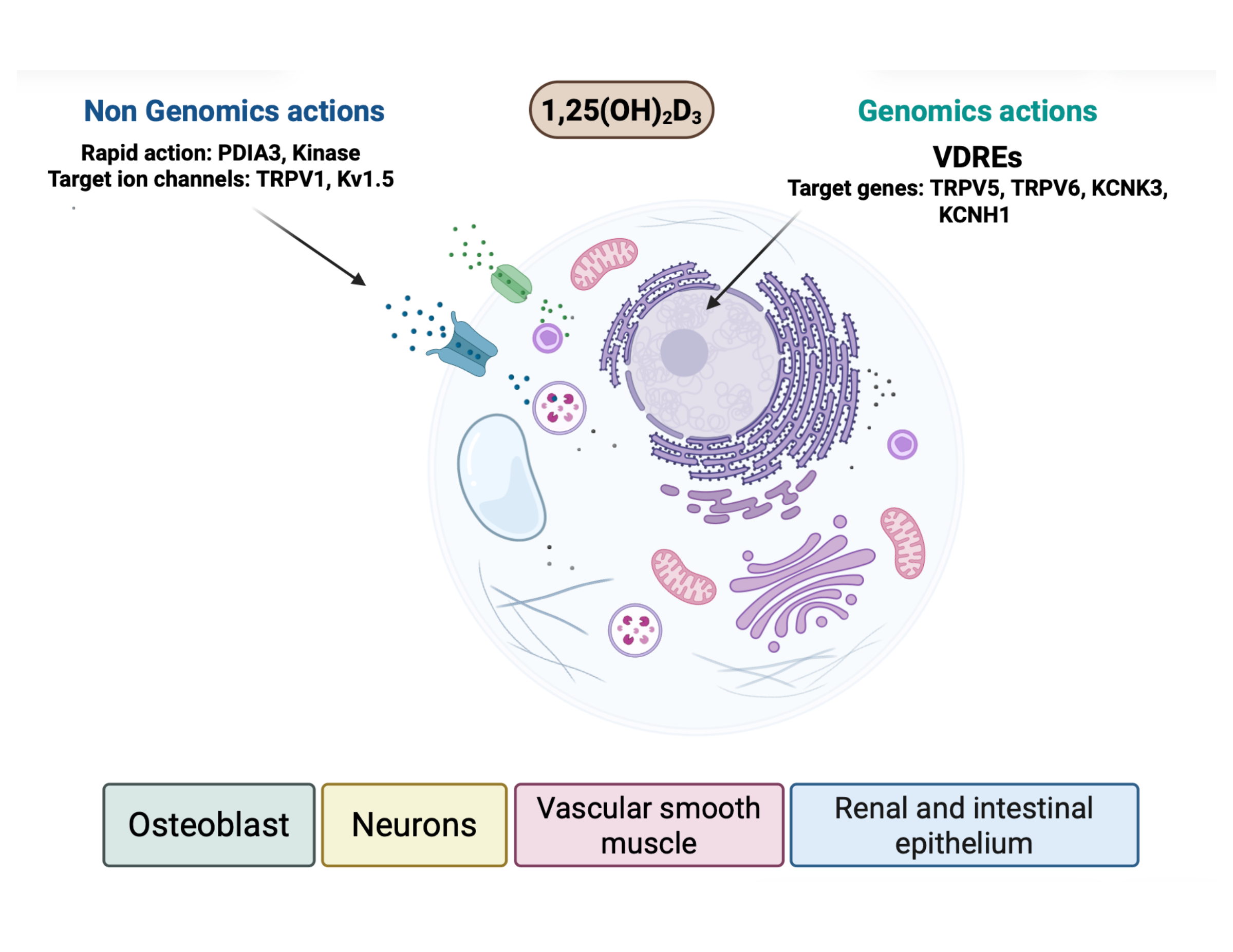
Ion Channels as Targets of the Vitamin D Receptor: A Long Journey with a Promising Future

 ,
,  ,
, 
 and
and
Abstract
1. Introduction
2. VDR: Genomic and Non-Genomic Mechanisms
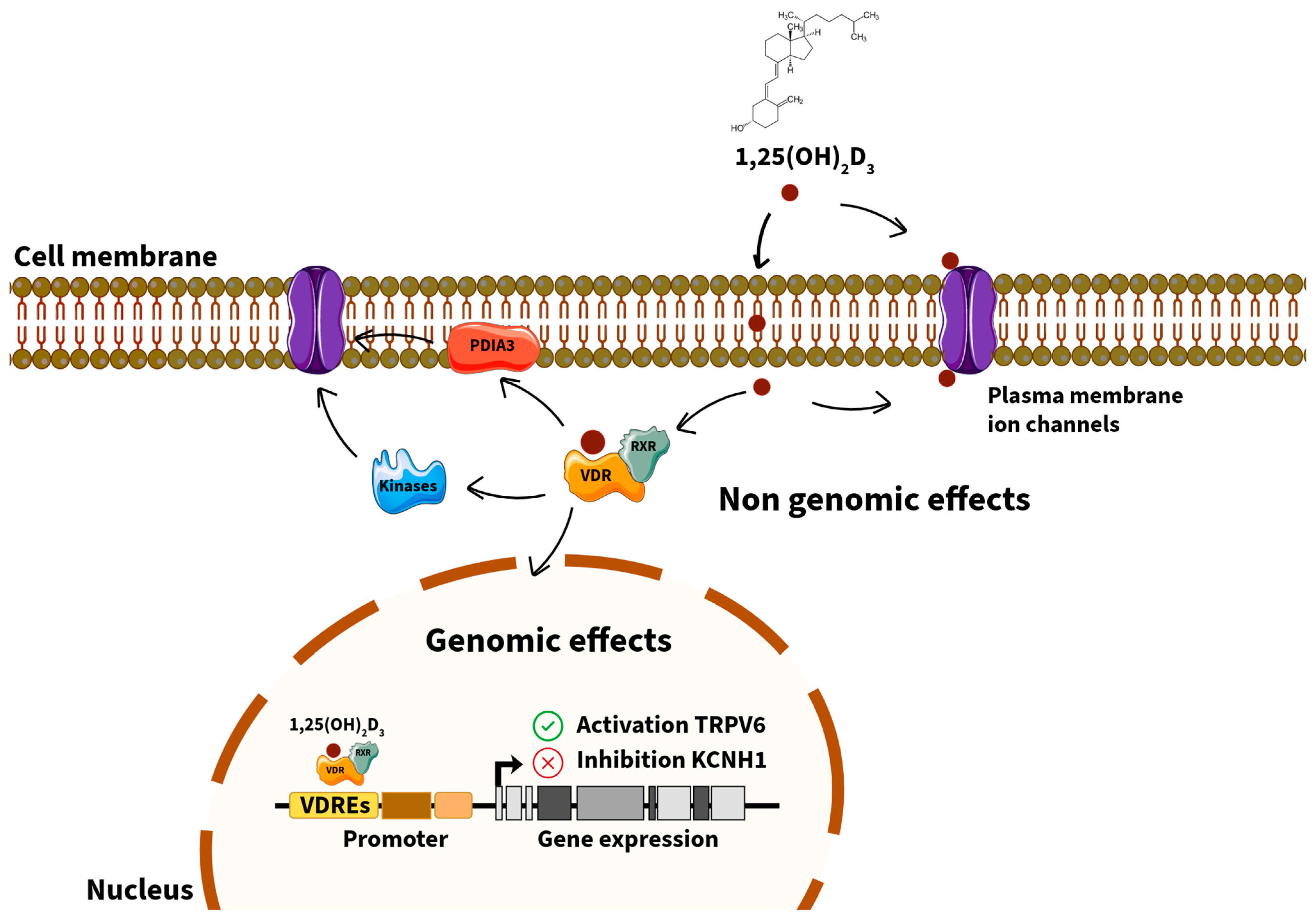
2.1. The VDR Functions as Both a Nuclear Transcription Factor and a Non-Genomic Mediator
2.2. Structural Domains and Isoforms of VDR
2.3. Regulation by 1,25(OH)2D3 and Its Synthetic Analogs
2.4. Interactions with Co-Regulators and Membrane-Associated Signaling Proteins
3. VDR Signaling and Ion Channels: Mechanistic Insights
3.1. Transcriptional Regulation of Ion Channel Genes via VDREs
3.2. Indirect Modulation Through Second Messengers and Kinase Cascades
3.3. Epigenetic and Post-Transcriptional Regulation
4. Regulation of Ion Channel Function by VDR in Different Cellular Contexts
4.1. Osteoblast Cells
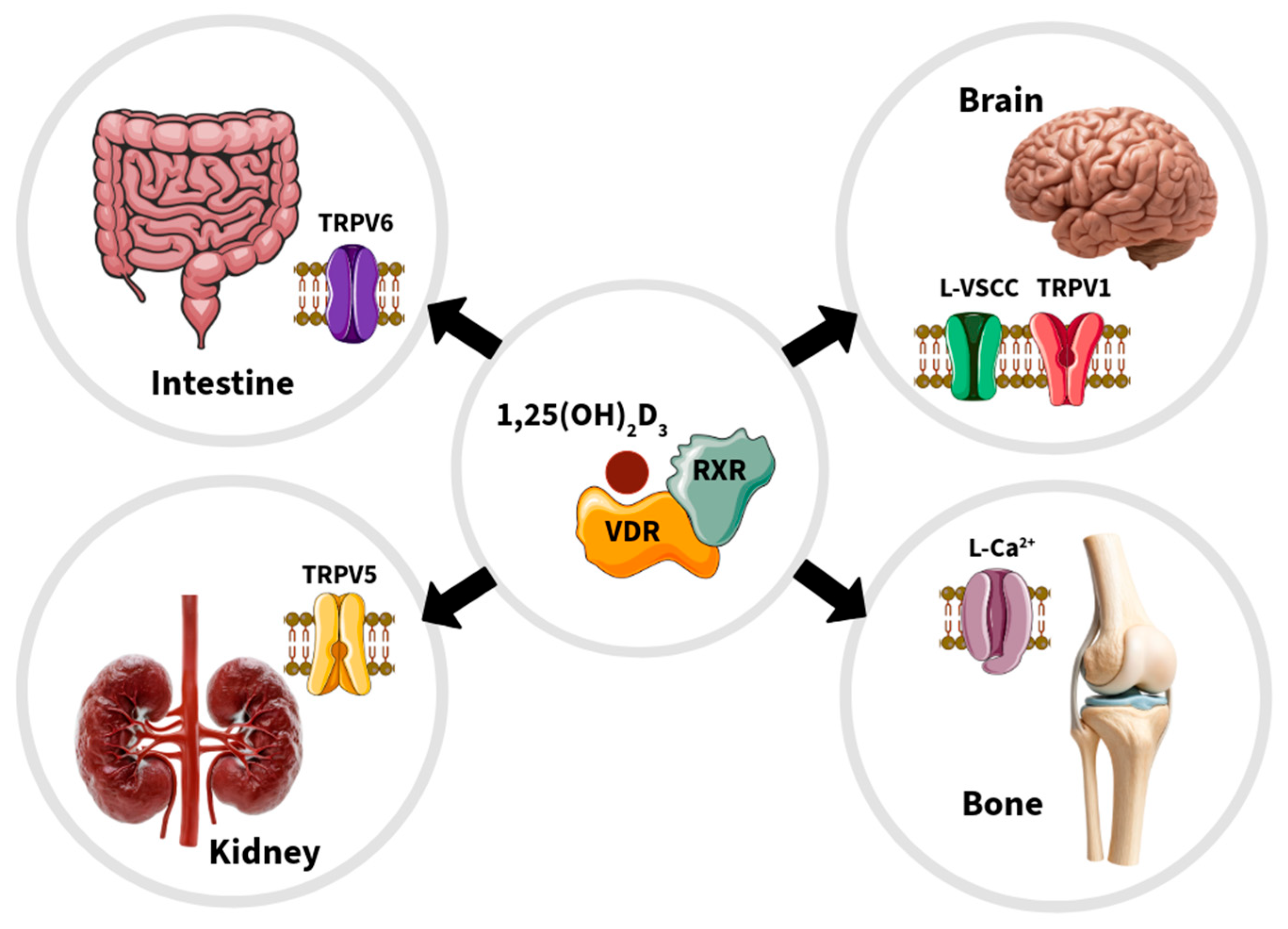
4.2. Intestinal and Kidney Cells
4.3. Neurons or Neuronal Cells
4.4. Ion Channels from the Plasma and Mitochondrial Membranes
5. Pathophysiological Relevance of VDR–Ion Channel Interactions
5.1. Cancer
5.2. Renal Cell Carcinoma (RCC)
5.3. Breast and Cervical Cancer
5.4. Pulmonary Arterial Hypertension
5.5. Osteoporosis
6. Conclusions and Perspectives
Author Contributions
Funding
Institutional Review Board Statement
Informed Consent Statement
Data Availability Statement
Conflicts of Interest
Abbreviations
| 1,25(OH)2D3 | 1,25-dihydroxyvitamin D3 |
| 25(OH)D3 | 25-hydroxyvitamin D3 |
| BMD | Bone mineral density |
| CYP | Cytochrome P450 |
| DRIP | Vitamin D receptor interacting protein |
| EAG | Ether-à-go-go |
| ER | Estrogen receptor |
| HAT | Histone acetyltransferase |
| KCN | Potassium channel |
| KO | knockout |
| LCA | Lithocholic acid |
| OPG | osteoprotegerin |
| PDIA3 | Protein disulfide isomerase A3 |
| PA | Pulmonary artery |
| PAH | Pulmonary artery hypertension |
| PASMC | Pulmonary artery smooth muscle cell |
| PKC | Protein kinase C |
| RANKL | Receptor activator of nuclear factor kB ligand |
| RCC | Renal cell carcinoma |
| RXR | Retinoic X receptor |
| SRC | Steroid receptor coactivator |
| TCM | Traditional Chinese medicine |
| TRP | Transient receptor potential |
| TRPV | Transient receptor potential vanilloid |
| VDR | Vitamin D receptor |
| VDRE | Vitamin D response element |
References
- Windaus, A.; Hess, A. Sterine und antirachitisches Vitamin. Nachrichten Ges. Wiss. Zu Gott. 1926, 1926, 175–184. [Google Scholar]
- Windaus, A.; Schenck, F.; von Werder, F. Über das antirachitisch wirksame Bestrahlungsprodukt aus 7-Dehydrocholesterol. Z. Physiol. Chem. 1936, 241, 100–103. [Google Scholar] [CrossRef]
- Holick, M.F.; MacLaughlin, J.A.; Clark, M.B.; Holick, S.A.; Potts, J.T., Jr.; Anderson, R.R.; Blank, I.H.; Parrish, J.A.; Elias, P. Photosynthesis of previtamin D3 in human skin and the physiologic consequences. Science 1980, 210, 203–205. [Google Scholar] [CrossRef]
- Wolf, G. The Discovery of Vitamin D: The Contribution of Adolf Windaus. J. Nutr. 2004, 134, 1299–1302. [Google Scholar] [CrossRef]
- González-Duarte, R.J. Una vitamina que no es vitamina. Rev. Cómo Ves. 2013, 174, 30–33. [Google Scholar]
- Voltan, G.; Ceccato, F.; Cannito, M.; Camozzi, V.; Ferrarese, M. Vitamin D: An Overview of Gene Regulation, Ranging from Metabolism to Genomic Effects. Genes 2023, 14, 1691. [Google Scholar] [CrossRef]
- Zanello, L.P.; Norman, A. 1α,25(OH)2 Vitamin D3 actions on ion channels in osteoblasts. Steroids 2006, 71, 291–297. [Google Scholar] [CrossRef]
- Olszewska, A.M.; Zmijewski, M.A. Genomic and non-genomic action of vitamin D on ion channels—Targeting mitochondria. Mitochondrion 2024, 77, 101891. [Google Scholar] [CrossRef]
- Mcdonnell, D.P.; Mangelsdorf, D.J.; Haussler, M.R.; O’Malley, B.W.; Pike, J.W. Molecular cloning of complementary DNA encoding the avian receptor for vitamin D. Science 1987, 235, 1214–1217. [Google Scholar] [CrossRef] [PubMed]
- Makishima, M.; Lu, T.T.; Xie, W.; Whitfield, G.K.; Domoto, H.; Evans, R.M.; Haussler, M.R.; Mangelsdorf, D.J. Vitamin D receptor as an intestinal bile acid sensor. Science 2002, 296, 1313–1316. [Google Scholar] [CrossRef] [PubMed]
- Rosen, C.J.; Adams, J.S.; Bikle, D.D.; Black, D.M.; Demay, M.B.; Manson, J.E.; Murad, M.H.; Kovacs, C.S. The nonskeletal effects of vitamin D: An Endocrine Society scientific statement. Endocr. Rev. 2012, 33, 456–492. [Google Scholar] [CrossRef]
- Walters, M.R. Newly identified actions of the vitamin D endocrine system. Endocr. Rev. 1992, 13, 719–764. [Google Scholar] [PubMed]
- Kurokawa, R.; Yu, V.C.; Näär, A.; Kyakumoto, S.; Han, Z.; Silverman, S.; Rosenfeld, M.G.; Glass, C.K. Differential orientations of the DNA-binding domain and carboxy-terminal dimerization interface regulate binding site selection by nuclear receptor heterodimers. Genes Dev. 1993, 7, 1423–1435. [Google Scholar] [CrossRef] [PubMed]
- Donati, S.; Palmini, G.; Aurilia, C.; Falsetti, I.; Miglietta, F.; Iantomasi, T.; Brandi, M.L. Rapid Nontranscriptional Effects of Calcifediol and Calcitriol. Nutrients 2022, 14, 1291. [Google Scholar] [CrossRef] [PubMed]
- Rochel, N.; Wurtz, J.M.; Mitschler, A.; Klaholz, B.; Moras, D. The Crystal Structure of the Nuclear Receptor for Vitamin D Bound to Its Natural Ligand. Mol. Cell 2000, 5, 173–179. [Google Scholar] [CrossRef]
- Masuno, H.; Ikura, T.; Morizono, D.; Orita, I.; Yamada, S.; Shimizu, M.; Ito, N. Crystal structures of complexes of vitamin D receptor ligand-binding domain with lithocholic acid derivatives. J. Lipid Res. 2013, 54, 2206–2213. [Google Scholar] [CrossRef]
- Rachez, C.; Gamble, M.; Chang, C.P.B.; Atkins, G.B.; Lazar, M.A.; Freedman, L.P. The DRIP complex and SRC-1/p160 coactivators share similar nuclear receptor binding determinants but constitute functionally distinct complexes. Mol. Cell. Biol. 2000, 20, 2718–2726. [Google Scholar] [CrossRef]
- Gardiner, E.M.; Esteban, L.M.; Fong, C.; Allison, S.J.; Flanagan, J.L.; Kouzmenko, A.P.; Eisman, J.A. Vitamin D receptor B1 and exon 1d: Functional and evolutionary analysis. J. Steroid Biochem. Mol. Biol. 2004, 89, 233–238. [Google Scholar] [CrossRef]
- Esteban, L.M.; Fong, C.; Amr, D.; Cock, T.A.; Allison, S.J.; Flanagan, J.L.; Liddle, C.; Eisman, J.A.; Gardiner, E.M. Promoter-, cell-, and ligand-specific transactivation responses of the VDRB1 isoform. Biochem. Biophys. Res. Commun. 2005, 334, 9–15. [Google Scholar] [CrossRef] [PubMed]
- Ebihara, K.; Masuhiro, Y.; Kitamoto, T.; Suzawa, M.; Uematsu, Y.; Yoshizawa, T.; Ono, T.; Harada, H.; Matsuda, K.; Hasegawa, T.; et al. Intron retention generates a novel isoform of the murine vitamin D receptor that acts in a dominant negative way on the vitamin D signaling pathway. Mol. Cell. Biol. 1996, 16, 3393–3400. [Google Scholar] [CrossRef] [PubMed][Green Version]
- Gennari, L.; Becherini, L.; Falchetti, A.; Masi, L.; Massart, F.; Brandi, M.L. Genetics of osteoporosis: Role of steroid hormone receptor gene polymorphisms. J. Steroid Biochem. Mol. Biol. 2002, 81, 1–24. [Google Scholar] [CrossRef]
- Grundberg, E.; Brändstrom, H.; Ribom, E.; Ljunggren, O.; Mallmin, H.; Kindmark, A. Genetic variation in the human vitamin D receptor is associated with muscle strength, fat mass and body weight in Swedish women. Eur. J. Endocrinol. 2004, 150, 323–328. [Google Scholar] [CrossRef]
- Howarth, D.L.; Law, S.H.W.; Barnes, B.; Hall, J.M.; Hinton, D.E.; Moore, L.; Maglich, J.M.; Moore, J.T.; Kullman, S.W. Paralogous Vitamin D Receptors in Teleosts: Transition of Nuclear Receptor Function. Endocrinology 2008, 149, 2411–2422. [Google Scholar] [CrossRef]
- Umesono, K.; Murakami, K.K.; Thompson, C.C.; Evans, R.M. Direct repeats as selective response elements for the thyroid hormone, retinoic acid, and vitamin D3 receptors. Cell 1991, 65, 1255–1266. [Google Scholar] [CrossRef]
- Thummel, K.E.; Brimer, C.; Yasuda, K.; Thottassery, J.; Senn, T.; Lin, Y.; Ishizuka, H.; Kharasch, E.; Schuetz, J.; Schuetz, E. Transcriptional control of intestinal cytochrome P-4503A by 1α,25-dihydroxy vitamin D3. Mol. Pharmacol. 2001, 60, 1399–1406. [Google Scholar] [CrossRef]
- Kubodera, N.A. New Look at the Most Successful Prodrugs for Active Vitamin D (D Hormone): Alfacalcidol and Doxercalciferol. Molecules 2009, 14, 3869–3880. [Google Scholar] [CrossRef]
- Kobayashi, T.; Tsugawa, N.; Okano, T.; Masuda, S.; Takeuchi, A.; Kubodera, N.; Nishii, Y. The binding properties, with blood proteins, and tissue distribution of 22-oxa-1α,25-dihydroxyvitamin D3, a noncalcemic analogue of 1α, 25-dihydroxyvitamin D3, in rats. J. Biochem. 1994, 115, 373–380. [Google Scholar] [CrossRef]
- Uchiyama, Y.; Higuchi, Y.; Takeda, S.; Masaki, T.; Shiraishi, A.; Sato, K.; Kubodera, N.; Ikeda, K.; Ogata, E. ED-71, a vitamin D analog, is a more potent inhibitor of bone resorption than alfacalcidol in an estrogen-deficient rat model of osteoporosis. Bone 2002, 30, 582–588. [Google Scholar] [CrossRef] [PubMed]
- Ono, Y. Multifunctional and potent roles of the 3-hydroxypropoxy group provide eldecalcitol’s benefit in osteoporosis treatment. J. Steroid Biochem. Mol. Biol. 2013, 139, 88–97. [Google Scholar] [CrossRef] [PubMed]
- Ono, K.; Yoshida, A.; Saito, N.; Fujishima, T.; Honzawa, S.; Suhara, Y.; Kishimoto, S.; Sugiura, T.; Waku, K.; Takayama, H.; et al. Efficient synthesis of 2-modified 1α,25-dihydroxy-19-norvitamin D3 with Julia olefination: High potency in induction of differentiation on HL-60 cells. J. Org. Chem. 2003, 68, 7407–7415. [Google Scholar] [CrossRef] [PubMed]
- Yasuda, K.; Ikushiro, S.; Kamakura, M.; Takano, M.; Saito, N.; Kittaka, A.; Chen, T.C.; Ohta, M.; Sakaki, T. Human cytochrome P450-dependent differential metabolism among three 2α-substituted-1α,25-dihydroxyvitamin D3 analogs. J. Steroid Biochem. Mol. Biol. 2012, 133, 84–92. [Google Scholar] [CrossRef] [PubMed]
- Ma, Y. Identification and characterization of noncalcemic, tissue-selective, nonsecosteroidal vitamin D receptor modulators. J. Clin. Investig. 2006, 116, 892–904. [Google Scholar] [CrossRef]
- Adachi, R.; Honma, Y.; Masuno, H.; Kawana, K.; Shimomura, I.; Yamada, S.; Makishima, M. Selective activation of vitamin D receptor by lithocholic acid acetate, a bile acid derivative. J. Lipid Res. 2005, 46, 46–57. [Google Scholar] [CrossRef]
- Ishizawa, M.; Matsunawa, M.; Adachi, R.; Uno, S.; Ikeda, K.; Masuno, H.; Shimizu, M.; Iwasaki, K.-I.; Yamada, S.; Makishima, M. Lithocholic acid derivatives act as selective vitamin D receptor modulators without inducing hypercalcemia. J. Lipid Res. 2008, 49, 763–772. [Google Scholar] [CrossRef]
- Sasaki, H.; Masuno, H.; Kawasaki, H.; Yoshihara, A.; Numoto, N.; Ito, N.; Ishida, H.; Yamamoto, K.; Hirata, N.; Kanda, Y.; et al. Lithocholic Acid Derivatives as Potent Vitamin D Receptor Agonists. J. Med. Chem. 2020, 64, 516–526. [Google Scholar] [CrossRef] [PubMed]
- Spencer, T.E.; Jenster, G.; Burcin, M.M.; Allis, C.D.; Zhou, J.; Mizzen, C.A.; McKenna, N.J.; Onate, S.A.; Tsai, S.Y.; Tsai, M.J.; et al. Steroid receptor coactivator-1 is a histone acetyltransferase. Nature 1997, 389, 194–198. [Google Scholar] [CrossRef]
- Ogryzko, V.V.; Schiltz, R.L.; Russanova, V.; Howard, B.H.; Nakatani, Y. The Transcriptional Coactivators p300 and CBP Are Histone Acetyltransferases. Cell 1996, 87, 953–959. [Google Scholar] [CrossRef] [PubMed]
- Chiba, N.; Suldan, Z.; Freedman, L.P.; Parvin, J.D. Binding of Liganded Vitamin D Receptor to the Vitamin D Receptor Interacting Protein Coactivator Complex Induces Interaction with RNA Polymerase II Holoenzyme. J. Biol. Chem. 2000, 275, 10719–10722. [Google Scholar] [CrossRef] [PubMed]
- Savkur, R.S.; Bramlett, K.S.; Stayrook, K.R.; Nagpal, S.; Burris, T.P. Coactivation of the human vitamin D receptor by the peroxisome proliferator-activated receptor γ coactivator-1 α. Mol. Pharmacol. 2005, 68, 511–517. [Google Scholar] [CrossRef]
- Baudino, T.A.; Kraichely, D.M.; Jefcoat, S.C.; Winchester, S.K.; Partridge, N.C.; Macdonald, P.N. Isolation and Characterization of a Novel Coactivator Protein, NCoA-62, Involved in Vitamin D-mediated Transcription. J. Biol. Chem. 1998, 273, 16434–16441. [Google Scholar] [CrossRef]
- Yanagisawa, J.; Yanagi, Y.; Masuhiro, Y.; Suzawa, M.; Watanabe, M.; Kashiwagi, K.; Toriyabe, T.; Kawabata, M.; Miyazono, K.; Kato, S. Convergence of transforming growth factor-β and vitamin D signaling pathways on SMAD transcriptional coactivators. Science 1999, 283, 1317–1321. [Google Scholar] [CrossRef] [PubMed]
- Tolón, R.M.; Castillo, A.I.; Jiménez-Lara, A.M.; Aranda, A. Association with Ets-1 causes ligand- and AF2-independent activation of nuclear receptors. Mol. Cell. Biol. 2000, 20, 8793–8802. [Google Scholar] [CrossRef] [PubMed]
- Hörlein, A.J.; Näär, A.M.; Heinzel, T.; Torchia, J.; Gloss, B.; Kurokawa, R.; Ryan, A.; Kamei, Y.; Söderström, M.; Glass, C.K.; et al. Ligand-independent repression by the thyroid hormone receptor mediated by a nuclear receptor co-repressor. Nature 1995, 377, 397–404. [Google Scholar] [CrossRef]
- Chen, J.D.; Evans, R.M. A transcriptional co-repressor that interacts with nuclear hormone receptors. Nature 1995, 377, 454–457. [Google Scholar] [CrossRef] [PubMed]
- Perissi, V.; Jepsen, K.; Glass, C.K.; Rosenfeld, M.G. Deconstructing repression: Evolving models of co-repressor action. Nat. Rev. Genet. 2010, 11, 109–123. [Google Scholar] [CrossRef]
- Xie, Z.; Oda, Y.; Chang, S.; Bikle, D.D. Hairless Suppresses Vitamin D Receptor Transactivation in Human Keratinocytes. Endocrinology 2006, 147, 314–323. [Google Scholar] [CrossRef]
- Polly, P.; Herdick, M.; Moehren, U.; Baniahmad, A.; Heinzel, T.; Carlberg, C. VDR-Alien: A novel, DNA-selective vitamin D3 receptor-corepressor partnership. FASEB J. 2000, 14, 1455–1463. [Google Scholar] [PubMed]
- Nemere, I.; Safford, S.E.; Rohe, B.; DeSouza, M.M.; Farach-Carson, M.C. Identification and characterization of 1,25D3-membrane-associated rapid response, steroid (1,25D3-MARRS) binding protein. J. Steroid Biochem. Mol. Biol. 2004, 89, 281–285. [Google Scholar] [CrossRef] [PubMed]
- Civitelli, R.; Kim, Y.S.; Gunsten, S.L.; Fujimori, A.; Huskey, M.; Avioli, L.V.; Hruska, K.A. Nongenomic Activation of the Calcium Message System by Vitamin D Metabolites in Osteoblast-like Cells. Endocrinology 1990, 127, 2253–2262. [Google Scholar] [CrossRef] [PubMed]
- Nemere, I.; Farach-Carson, M.C.; Rohe, B.; Sterling, T.M.; Norman, A.W.; Boyan, B.D.; Safford, S.E. Ribozyme knockdown functionally links a 1,25(OH)2D3 membrane binding protein (1,25D3-MARRS) and phosphate uptake in intestinal cells. Proc. Natl. Acad. Sci. USA 2004, 101, 7392–7397. [Google Scholar] [CrossRef] [PubMed]
- Nemere, I.; Garbi, N.; Hämmerling, G.J.; Khanal, R.C. Intestinal Cell Calcium Uptake and the Targeted Knockout Of the 1,25D3-MARRS Receptor/PDIA3/Erp57. FASEB J. 2010, 24, 917.1. [Google Scholar] [CrossRef]
- Wang, Y.; Chen, J.; Lee, C.S.D.; Nizkorodov, A.; Riemenschneider, K.; Martin, D.; Hyzy, S.; Schwartz, Z.; Boyan, B.D. Disruption of Pdia3 gene results in bone abnormality and affects 1α,25-dihydroxy-vitamin D3-induced rapid activation of PKC. J. Steroid Biochem. Mol. Biol. 2010, 121, 257–260. [Google Scholar] [CrossRef] [PubMed]
- Boyan, B.D.; Sylvia, V.L.; McKinney, N.; Schwartz, Z. Membrane actions of vitamin D metabolites 1α,25(OH)2D3 and 24R,25(OH)2D3 are retained in growth plate cartilage cells from vitamin D receptor knockout mice. J. Cell. Biochem. 2003, 90, 1207–1223. [Google Scholar] [CrossRef]
- Chen, J.; Doroudi, M.; Cheung, J.; Grozier, A.L.; Schwartz, Z.; Boyan, B.D. Plasma membrane Pdia3 and VDR interact to elicit rapid responses to 1α,25(OH)2D3. Cell. Signal. 2013, 25, 2362–2373. [Google Scholar] [CrossRef] [PubMed]
- Li, J.; Witonsky, D.; Sprague, E.; Alleyne, D.; Bielski, M.C.; Lawrence, K.M.; Kupfer, S.S. Genomic and epigenomic active vitamin D responses in human colonic organoids. Physiol. Genom. 2021, 53, 235–248. [Google Scholar] [CrossRef]
- Okano, T.; Tsugawa, N.; Morishita, A.; Kato, S. Regulation of gene expression of epithelial calcium channels in intestine and kidney of mice by 1α,25-dihydroxyvitamin D3. J. Steroid Biochem. Mol. Biol. 2004, 89, 335–338. [Google Scholar] [CrossRef]
- Meyer, M.B.; Watanuki, M.; Kim, S.; Shevde, N.K.; Pike, J.W. The Human Transient Receptor Potential Vanilloid Type 6 Distal Promoter Contains Multiple Vitamin D Receptor Binding Sites that Mediate Activation by 1,25-Dihydroxyvitamin D3 in Intestinal Cells. Mol. Endocrinol. 2006, 20, 1447–1461. [Google Scholar] [CrossRef] [PubMed]
- Weber, K.; Erben, R.G.; Rump, A.; Adamski, J. Gene Structure and Regulation of the Murine Epithelial Calcium Channels ECaC1 and 2. Biochem. Biophys. Res. Commun. 2001, 289, 1287–1294. [Google Scholar] [CrossRef] [PubMed]
- Van Cromphaut, S.J.; Dewerchin, M.; Hoenderop, J.G.; Stockmans, I.; Van Herck, E.; Kato, S.; Bindels, R.J.; Collen, D.; Carmeliet, P.; Bouillon, R.; et al. Duodenal calcium absorption in vitamin D receptor-knockout mice: Functional and molecular aspects. Proc. Natl. Acad. Sci. USA 2001, 98, 13324–13329. [Google Scholar] [CrossRef]
- Song, Y.; Peng, X.; Porta, A.; Takanaga, H.; Peng, J.-B.; Hediger, M.A.; Fleet, J.C.; Christakos, S. Calcium transporter 1 and epithelial calcium channel messenger ribonucleic acid are differentially regulated by 1,25 dihydroxyvitamin D3 in the intestine and kidney of mice. Endocrinology 2003, 144, 3885–3894. [Google Scholar] [CrossRef]
- Taketani, Y.; Segawa, H.; Chikamori, M.; Morita, K.; Tanaka, K.; Kido, S.; Yamamoto, H.; Iemori, Y.; Tatsumi, S.; Tsugawa, N.; et al. Regulation of Type II Renal Na+-dependent Inorganic Phosphate Transporters by 1,25-Dihydroxyvitamin D3: Identification of a Vitamin D-Responsive Element in the Human Napi-3 Gene. J. Biol. Chem. 1998, 273, 14575–14581. [Google Scholar] [CrossRef]
- Claro Da Silva, T.; Hiller, C.; Gai, Z.; Kullak-Ublick, G.A. Vitamin D3 transactivates the zinc and manganese transporter SLC30A10 via the Vitamin D receptor. J. Steroid Biochem. Mol. Biol. 2016, 163, 77–87. [Google Scholar] [CrossRef]
- Ahmad, T.R.; Higuchi, S.; Bertaggia, E.; Hung, A.; Shanmugarajah, N.; Guilz, N.C.; Gamarra, J.R.; Haeusler, R.A. Bile acid composition regulates the manganese transporter Slc30a10 in intestine. J. Biol. Chem. 2020, 295, 12545–12558. [Google Scholar] [CrossRef]
- Ajibade, D.V.; Dhawan, P.; Fechner, A.J.; Meyer, M.B.; Pike, J.W.; Christakos, S. Evidence for a Role of Prolactin in Calcium Homeostasis: Regulation of Intestinal Transient Receptor Potential Vanilloid Type 6, Intestinal Calcium Absorption, and the 25-Hydroxyvitamin D3 1α Hydroxylase Gene by Prolactin. Endocrinology 2010, 151, 2974–2984. [Google Scholar] [CrossRef] [PubMed]
- Castillo, A.I.; Jimenez-Lara, A.M.; Tolon, R.M.; Aranda, A. Synergistic activation of the prolactin promoter by vitamin D receptor and GHF-1: Role of the coactivators, CREB-binding protein and steroid hormone receptor coactivator-1 (SRC-1). Mol. Endocrinol. 1999, 13, 1141–1154. [Google Scholar] [CrossRef]
- Ishizawa, M.; Akagi, D.; Yamamoto, J.; Makishima, M. 1α,25-Dihydroxyvitamin D3 enhances TRPV6 transcription through p38 MAPK activation and GADD45 expression. J. Steroid Biochem. Mol. Biol. 2017, 172, 55–61. [Google Scholar] [CrossRef]
- Qi, X.; Pramanik, R.; Wang, J.; Schultz, R.M.; Maitra, R.K.; Han, J.; DeLuca, H.F.; Chen, G. The p38 and JNK Pathways Cooperate to trans-Activate Vitamin D Receptor via c-Jun/AP-1 and Sensitize Human Breast Cancer Cells to Vitamin D3-induced Growth Inhibition. J. Biol. Chem. 2002, 277, 25884–25892. [Google Scholar] [CrossRef] [PubMed]
- Jurutka, P.W.; Hsieh, J.C.; MacDonald, P.N.; Terpening, C.M.; Haussler, C.A.; Haussler, M.R.; Whitfield, G.K. Phosphorylation of serine 208 in the human vitamin D receptor. The predominant amino acid phosphorylated by casein kinase II, in vitro, and identification as a significant phosphorylation site in intact cells. J. Biol. Chem. 1993, 268, 6791–6799. [Google Scholar] [CrossRef]
- Arriagada, G.; Paredes, R.; Olate, J.; van Wijnen, A.; Lian, J.B.; Stein, G.S.; Stein, J.L.; Onate, S.; Montecino, M. Phosphorylation at serine 208 of the 1α,25-dihydroxy Vitamin D3 receptor modulates the interaction with transcriptional coactivators. J. Steroid Biochem. Mol. Biol. 2007, 103, 425–429. [Google Scholar] [CrossRef] [PubMed]
- Ting, H.J.; Yasmin-Karim, S.; Yan, S.-J.; Hsu, J.-W.; Lin, T.-H.; Zeng, W.; Messing, J.; Sheu, T.J.; Bao, B.Y.; Li, W.X.; et al. A Positive Feedback Signaling Loop between ATM and the Vitamin D Receptor Is Critical for Cancer Chemoprevention by Vitamin D. Cancer Res. 2012, 72, 958–968. [Google Scholar] [CrossRef] [PubMed]
- Hsieh, J.C.; Jurutka, P.W.; Galligan, M.A.; Terpening, C.M.; Haussler, C.A.; Samuels, D.S.; Shimizu, Y.; Shimizu, N.; Haussler, M.R. Human vitamin D receptor is selectively phosphorylated by protein kinase C on serine 51, a residue crucial to its trans-activation function. Proc. Natl. Acad. Sci. USA 1991, 88, 9315–9319. [Google Scholar] [CrossRef] [PubMed]
- Hsieh, J.C.; Jurutka, P.W.; Nakajima, S.; Galligan, M.A.; Haussler, C.A.; Shimizu, Y.; Shimizu, N.; Whitfield, G.K.; Haussler, M.R. Phosphorylation of the human vitamin D receptor by protein kinase C. Biochemical and functional evaluation of the serine 51 recognition site. J. Biol. Chem. 1993, 268, 15118–15126. [Google Scholar] [CrossRef]
- Jurutka, P.W.; Hsieh, J.C.; Haussler, M.R. Phosphorylation of the Human 1,25-Dihydroxyvitamin D3 Receptor by cAMP-Dependent Protein-Kinase, In Vitro, and in Transfected COS-7 Cells. Biochem. Biophys. Res. Commun. 1993, 191, 1089–1096. [Google Scholar] [CrossRef] [PubMed]
- Hsieh, J.C.; Dang, H.T.L.; Galligan, M.A.; Whitfield, G.K.; Haussler, C.A.; Jurutka, P.W.; Haussler, M.R. Phosphorylation of human vitamin D receptor serine-182 by PKA suppresses 1,25(OH)2D3-dependent transactivation. Biochem. Biophys. Res. Commun. 2004, 324, 801–809. [Google Scholar] [CrossRef]
- Khattar, V.; Wang, L.; Peng, J.B. Calcium selective channel TRPV6: Structure, function, and implications in health and disease. Gene 2022, 817, 146192. [Google Scholar] [CrossRef] [PubMed]
- Van Cromphaut, S.J.; Rummens, K.; Stockmans, I.; Van Herck, E.; Dijcks, F.A.; Ederveen, A.G.H.; Carmeliet, P.; Verhaeghe, J.; Bouillon, R.; Carmeliet, G. Intestinal calcium transporter genes are upregulated by estrogens and the reproductive cycle through vitamin D receptor-independent mechanisms. J. Bone Miner. Res. 2003, 18, 1725–1736. [Google Scholar] [CrossRef]
- Kim, M.H.; Lee, G.S.; Jung, E.M.; Choi, K.C.; Jeung, E.B. The negative effect of dexamethasone on calcium-processing gene expressions is associated with a glucocorticoid-induced calcium-absorbing disorder. Life Sci. 2009, 85, 146–152. [Google Scholar] [CrossRef]
- Inoue, J.; Choi, J.M.; Yoshidomi, T.; Yashiro, T.; Sato, R. Quercetin Enhances VDR Activity, Leading to Stimulation of Its Target Gene Expression in Caco-2 Cells. J. Nutr. Sci. Vitaminol. 2010, 56, 326–330. [Google Scholar] [CrossRef][Green Version]
- Fukushima, A.; Aizaki, Y.; Sakuma, K. Short-Chain Fatty Acids Induce Intestinal Transient Receptor Potential Vanilloid Type 6 Expression in Rats and Caco-2 Cells. J. Nutr. 2009, 139, 20–25. [Google Scholar] [CrossRef]
- Sopjani, M.; Kunert, A.; Czarkowski, K.; Klaus, F.; Laufer, J.; Föller, M.; Lang, F. Regulation of the Ca2+ Channel TRPV6 by the Kinases SGK1, PKB/Akt, and PIKfyve. J. Membr. Biol. 2009, 233, 35–41. [Google Scholar] [CrossRef] [PubMed]
- Zhu, X.; Wu, S.; Guo, H. Active Vitamin D and Vitamin D Receptor Help Prevent High Glucose Induced Oxidative Stress of Renal Tubular Cells via AKT/UCP2 Signaling Pathway. BioMed Res. Int. 2019, 2019, 9013904. [Google Scholar] [CrossRef]
- Masuyama, H.; Macdonald, P.N. Proteasome-mediated degradation of the vitamin D receptor (VDR) and a putative role for SUG1 interaction with the AF-2 domain of VDR. J. Cell. Biochem. 1998, 71, 429–440. [Google Scholar] [CrossRef]
- Chi, Y.; Hong, Y.; Zong, H.; Wang, Y.; Zou, W.; Yang, J.; Kong, X.; Yun, X.; Gu, J. CDK11 p58 represses vitamin D receptor-mediated transcriptional activation through promoting its ubiquitin–proteasome degradation. Biochem. Biophys. Res. Commun. 2009, 386, 493–498. [Google Scholar] [CrossRef] [PubMed]
- Zhang, W.; Na, T.; Wu, G.; Jing, H.; Peng, J.B. Down-regulation of Intestinal Apical Calcium Entry Channel TRPV6 by Ubiquitin E3 Ligase Nedd4-2. J. Biol. Chem. 2010, 285, 36586–36596. [Google Scholar] [CrossRef] [PubMed]
- Mohri, T.; Nakajima, M.; Takagi, S.; Komagata, S.; Yokoi, T. MicroRNA regulates human vitamin D receptor. Int. J. Cancer 2009, 125, 1328–1333. [Google Scholar] [CrossRef]
- Li, F.; Zhang, A.; Shi, Y.; Ma, Y.; Du, Y. 1α,25-Dihydroxyvitamin D3 prevents the differentiation of human lung fibroblasts via microRNA-27b targeting the vitamin D receptor. Int. J. Mol. Med. 2015, 36, 967–974. [Google Scholar] [CrossRef]
- Jena, S.; Lee, W.P.; Doherty, D.; Thompson, P.D. PIAS4 represses vitamin D receptor-mediated signaling and acts as an E3-SUMO ligase towards vitamin D receptor. J. Steroid Biochem. Mol. Biol. 2012, 132, 24–31. [Google Scholar] [CrossRef]
- Lee, W.P.; Jena, S.; Doherty, D.; Ventakesh, J.; Schimdt, J.; Furmick, J.; Widener, T.; Lemau, J.; Jurutka, P.W.; Thompson, P.D. Sentrin/SUMO Specific Proteases as Novel Tissue-Selective Modulators of Vitamin D Receptor-Mediated Signaling. PLoS ONE 2014, 9, e89506. [Google Scholar] [CrossRef][Green Version]
- Chesnoy-Marchais, D.; Fritsch, J. Voltage-gated sodium and calcium currents in rat osteoblasts. J. Physiol. 1988, 398, 291–311. [Google Scholar] [CrossRef] [PubMed]
- Gosling, M.; Smith, J.W.; Poyner, D.R. Characterization of a volume-sensitive chloride current in rat osteoblast-like (ROS 17/2.8) cells. J. Physiol. 1995, 485, 671–682. [Google Scholar] [CrossRef]
- Caffrey, J.M.; Farach-Carson, M.C. Vitamin D3 Metabolites Modulate Dihydropyridine-sensitive Calcium Currents in Clonal Rat Osteosarcoma Cells. J. Biol. Chem. 1989, 264, 20265–20274. [Google Scholar] [CrossRef]
- Zanello, L.P.; Norman, A.W. Stimulation by 1α,25(OH)2-Vitamin D3 of Whole Cell Chloride Currents in Osteoblastic ROS 17/2.8 Cells: A Structure-Function Study. J. Biol. Chem. 1997, 272, 22617–22622. [Google Scholar] [CrossRef] [PubMed][Green Version]
- Zanello, L.P.; Norman, A.W. Rapid modulation of osteoblast ion channel responses by 1α,25(OH)2-vitamin D3 requires the presence of a functional vitamin D nuclear receptor. Proc. Natl. Acad. Sci. USA 2004, 101, 1589–1594. [Google Scholar] [CrossRef]
- Feher, J.J. Facilitated calcium diffusion by intestinal calcium-binding protein. Am. J. Physiol.-Cell Physiol. 1983, 244, C303–C307. [Google Scholar] [CrossRef] [PubMed]
- Wasserman, R.H. Intestinal absorption of calcium and phosphorus. Fed. Proc. 1981, 40, 68–72. [Google Scholar] [PubMed]
- Den Dekker, E.; Hoenderop, J.G.J.; Nilius, B.; Bindels, R.J.M. The epithelial calcium channels, TRPV5 & TRPV6: From identification towards regulation. Cell Calcium 2003, 33, 497–507. [Google Scholar] [CrossRef]
- Tomilin, V.N.; Cherezova, A.L.; Negulyaev, Y.A.; Semenova, S.B. TRPV5/V6 Channels Mediate Ca2+ Influx in Jurkat T Cells Under the Control of Extracellular pH. J. Cell. Biochem. 2015, 117, 197–206. [Google Scholar] [CrossRef] [PubMed]
- Fleet, J.C.; Eksir, F.; Hance, K.W.; Wood, R.J. Vitamin D-inducible calcium transport and gene expression in three Caco-2 cell lines. Am. J. Physiol.-Gastrointest. Liver Physiol. 2002, 283, G618–G625. [Google Scholar] [CrossRef]
- Wood, R.J.; Tchack, L.; Taparia, S. 1,25-Dihydroxyvitamin D3 increases the expression of the CaT1 epithelial calcium channel in the Caco-2 human intestinal cell line. BMC Physiol. 2001, 1, 11. [Google Scholar] [CrossRef]
- Bouillon, R.; Van Cromphaut, S.; Carmeliet, G. Intestinal calcium absorption: Molecular vitamin D mediated mechanisms. J. Cell. Biochem. 2003, 88, 332–339. [Google Scholar] [CrossRef]
- Kubis, A.M.; Piwowar, A. The new insight on the regulatory role of the vitamin D3 in metabolic pathways characteristic for cancerogenesis and neurodegenerative diseases. Ageing Res. Rev. 2015, 24, 126–137. [Google Scholar] [CrossRef]
- Brewer, L.D.; Thibault, V.; Chen, K.C.; Langub, M.C.; Landfield, P.W.; Porter, N.M. Vitamin D Hormone Confers Neuroprotection in Parallel with Downregulation of L-Type Calcium Channel Expression in Hippocampal Neurons. J. Neurosci. 2001, 21, 98–108. [Google Scholar] [CrossRef] [PubMed]
- Caterina, M.J.; Schumacher, M.A.; Tominaga, M.; Rosen, T.A.; Levine, J.D.; Julius, D. The capsaicin receptor: A heat-activated ion channel in the pain pathway. Nature 1997, 389, 816–824. [Google Scholar] [CrossRef] [PubMed]
- Lee, L.Y.; Gu, Q. Role of TRPV1 in inflammation-induced airway hypersensitivity. Curr. Opin. Pharmacol. 2009, 9, 243–249. [Google Scholar] [CrossRef]
- Bertin, S.; Aoki-Nonaka, Y.; de Jong, P.R.; Nohara, L.L.; Xu, H.; Stanwood, S.R.; Srikanth, S.; Lee, J.; To, K.; Abramson, L.; et al. The ion channel TRPV1 regulates the activation and proinflammatory properties of CD4+ T cells. Nat. Immunol. 2014, 15, 1055–1063. [Google Scholar] [CrossRef]
- Long, W.; Fatehi, M.; Soni, S.; Panigrahi, R.; Philippaert, K.; Yu, Y.; Kelly, R.; Boonen, B.; Barr, A.; Golec, D.; et al. Vitamin D is an endogenous partial agonist of the transient receptor potential vanilloid 1 channel. J. Physiol. 2020, 598, 4321–4338. [Google Scholar] [CrossRef] [PubMed]
- Long, W.; Johnson, J.; Kalyaanamoorthy, S.; Light, P. TRPV1 channels as a newly identified target for vitamin D. Channels 2021, 15, 360–374. [Google Scholar] [CrossRef]
- Olszewska, A.M.; Sieradzan, A.K.; Bednarczyk, P.; Szewczyk, A.; Żmijewski, M.A. Mitochondrial potassium channels: A novel calcitriol target. Cell. Mol. Biol. Lett. 2022, 27, 3. [Google Scholar] [CrossRef]
- Deeb, K.K.; Johnson, C.S.; Trump, D.L. Vitamin D signalling pathways in cancer: Potential for anticancer therapeutics. Nat. Rev. Cancer 2007, 7, 684–700. [Google Scholar] [CrossRef]
- Strzykalska-Augustyniak, A.; Psurski, M.; Zachary, H.; Filip-Psurska, B.; Kłopotowska, D.; Milczarek, M.; Świtalska, M.; Stachowicz-Suhs, M.; Łabędź, N.; Ziemblicka, A.; et al. Calcitriol and Tacalcitol Modulate Th17 Differentiation Through Osteopontin Receptors: Age-Dependent Insights from a Mouse Breast Cancer Model. ImmunoTargets Ther. 2025, 14, 877–899. [Google Scholar] [CrossRef]
- González-Duarte, R.J.; Cázares-Ordoñez, V.; Romero-Córdoba, S.; Díaz, L.; Ortíz, V.; Freyre-González, J.A.; Hidalgo-Miranda, A.; Larrea, F.; Avila, E. Calcitriol increases Dicer expression and modifies the microRNAs signature in SiHa cervical cancer cells. Biochem. Cell Biol. 2015, 93, 376–384. [Google Scholar] [CrossRef] [PubMed]
- González-Duarte, R.J.; Cázares-Ordoñez, V.; Díaz, L.; Ortíz, V.; Larrea, F.; Avila, E. The expression of RNA helicase DDX5 is transcriptionally upregulated by calcitriol through a vitamin D response element in the proximal promoter in SiHa cervical cells. Mol. Cell. Biochem. 2015, 410, 65–73. [Google Scholar] [CrossRef]
- Hoenderop, J.G.J.; Müller, D.; Van Der Kemp, A.W.C.M.; Hartog, A.; Suzuki, M.; Ishibashi, K.; Imai, M.; Sweep, F.; Willems, P.H.G.M.; Os, C.H.V.; et al. Calcitriol controls the epithelial calcium channel in kidney. J. Am. Soc. Nephrol. JASN 2001, 12, 1342–1349. [Google Scholar] [CrossRef]
- Chen, Y.; Liu, X.; Zhang, F.; Liao, S.; He, X.; Zhuo, D.; Huang, H.; Wu, Y. Vitamin D receptor suppresses proliferation and metastasis in renal cell carcinoma cell lines via regulating the expression of the epithelial Ca2+ channel TRPV5. PLoS ONE 2018, 13, e0195844. [Google Scholar] [CrossRef]
- Oeggerli, M.; Tian, Y.; Ruiz, C.; Wijker, B.; Sauter, G.; Obermann, E.; Güth, U.; Zlobec, I.; Sausbier, M.; Kunzelmann, K.; et al. Role of KCNMA1 in Breast Cancer. PLoS ONE 2012, 7, e41664. [Google Scholar] [CrossRef] [PubMed]
- Khatun, A.; Kito, H.; Fujimoto, M.; Niwa, S.; Ohya, S.; Suzuki, T. Down-Regulation of Ca2+-Activated K+ Channel KCa1.1 in Human Breast Cancer MDA-MB-453 Cells Treated with Vitamin D Receptor Agonists. Int. J. Mol. Sci. 2016, 17, 2083. [Google Scholar] [CrossRef]
- García-Becerra, R.; Díaz, L.; Camacho, J.; Barrera, D.; Ordaz-Rosado, D.; Morales, A.; Ortiz, C.S.; Avila, E.; Bargallo, E.; Arrecillas, M.; et al. Calcitriol inhibits Ether-à go-go potassium channel expression and cell proliferation in human breast cancer cells. Exp. Cell Res. 2009, 316, 433–442. [Google Scholar] [CrossRef]
- Avila, E.; García-Becerra, R.; Rodríguez-Rasgado, J.A.; Díaz, L.; Ordaz-Rosado, D.; Zügel, U.; Steinmeyer, A.; Barrera, D.; Halhali, A.; Larrea, F.; et al. Calcitriol down-regulates human ether a go-go 1 potassium channel expression in cervical cancer cells. Anticancer. Res. 2010, 30, 2667–2672. [Google Scholar]
- Cázares-Ordoñez, V.; Pardo, L.A. Kv10.1 potassium channel: From the brain to the tumors. Biochem. Cell Biol. 2017, 95, 531–536. [Google Scholar] [CrossRef] [PubMed]
- Muller, D.C.; Fanidi, A.; Midttun, Ø.; Steffen, A.; Dossus, L.; Boutron-Ruault, M.C.; Severi, G.; Kühn, T.; Katzke, V.; de la Torre, R.A.; et al. Circulating 25-hydroxyvitamin D3 in relation to renal cell carcinoma incidence and survival in the EPIC cohort. Am. J. Epidemiol. 2014, 180, 810–820. [Google Scholar] [CrossRef] [PubMed]
- Muller, D.C.; Scelo, G.; Zaridze, D.; Janout, V.; Holcatova, I.; Navratilova, M.; Mates, D.; Midttun, Ø.; Ueland, P.M.; Brennan, P.; et al. Circulating 25-hydroxyvitamin D3 and survival after diagnosis with kidney cancer. Cancer Epidemiol. Biomark. Prev. 2015, 24, 1277–1281. [Google Scholar] [CrossRef]
- Blomberg Jensen, M.; Andersen, C.B.; Nielsen, J.E.; Bagi, P.; Jørgensen, A.; Juul, A.; Leffers, H. Expression of the vitamin D receptor, 25-hydroxylases, 1α-hydroxylase and 24-hydroxylase in the human kidney and renal clear cell cancer. J. Steroid Biochem. Mol. Biol. 2010, 121, 376–382. [Google Scholar] [CrossRef] [PubMed]
- Obara, W.; Konda, R.; Akasaka, S.; Nakamura, S.; Sugawara, A.; Fujioka, T. Prognostic Significance of Vitamin D Receptor and Retinoid X Receptor Expression in Renal Cell Carcinoma. J. Urol. 2007, 178, 1497–1503. [Google Scholar] [CrossRef] [PubMed]
- Stachowicz-Suhs, M.; Łabędź, N.; Milczarek, M.; Kłopotowska, D.; Filip-Psurska, B.; Maciejczyk, A.; Matkowski, R.; Wietrzyk, J. Vitamin D3 reduces the expression of M1 and M2 macrophage markers in breast cancer patients. Sci. Rep. 2024, 14, 22126. [Google Scholar] [CrossRef]
- Pardo, L.A.; Stühmer, W.; Camacho, J.; Brüggemann, A. Cell Cycle–related Changes in the Conducting Properties of r-eag K+ Channels. J. Cell Biol. 1998, 143, 767–775. [Google Scholar] [CrossRef] [PubMed]
- Pardo, L.A. Oncogenic potential of EAG K+ channels. EMBO J. 1999, 18, 5540–5547. [Google Scholar] [CrossRef]
- Toplak, Ž.; Hendrickx, L.A.; Abdelaziz, R.; Shi, X.; Peigneur, S.; Tomašič, T.; Tytgat, J.; Peterlin-Mašič, L.; Pardo, L.A. Overcoming challenges of HERG potassium channel liability through rational design: Eag1 inhibitors for cancer treatment. Med. Res. Rev. 2022, 42, 183–226. [Google Scholar] [CrossRef]
- Cázares-Ordoñez, V.; González-Duarte, R.J.; Díaz, L.; Ishizawa, M.; Uno, S.; Ortíz, V.; Ordoñez-Sánchez, M.L.; Makishima, M.; Larrea, F.; Avila, E. A cis-acting element in the promoter of human ether à go-go 1 potassium channel gene mediates repression by calcitriol in human cervical cancer cells. Biochem. Cell Biol. 2014, 93, 94–101. [Google Scholar] [CrossRef]
- Callejo, M.; Mondejar-Parreño, G.; Esquivel-Ruiz, S.; Olivencia, M.A.; Moreno, L.; Blanco, I.; Escribano-Subias, P.; Cogolludo, A.; Barbera, J.A.; Perez-Vizcaino, F. Total, Bioavailable, and Free Vitamin D Levels and Their Prognostic Value in Pulmonary Arterial Hypertension. J. Clin. Med. 2020, 9, 448. [Google Scholar] [CrossRef]
- Tanaka, H.; Kataoka, M.; Isobe, S.; Yamamoto, T.; Shirakawa, K.; Endo, J.; Satoh, T.; Hakamata, Y.; Kobayashi, E.; Motoaki, S.; et al. Therapeutic impact of dietary vitamin D supplementation for preventing right ventricular remodeling and improving survival in pulmonary hypertension. PLoS ONE 2017, 12, e0180615. [Google Scholar] [CrossRef]
- Callejo, M.; Morales-Cano, D.; Olivencia, M.A.; Mondejar-Parreño, G.; Barreira, B.; Tura-Ceide, O.; Martínez, V.G.; Serrano-Navarro, A.; Moreno, L.; Morrell, N.; et al. Vitamin D receptor and its antiproliferative effect in human pulmonary arterial hypertension. Sci. Rep. 2024, 14, 27445. [Google Scholar] [CrossRef]
- Fei, J.; Fu, L.; Cao, W.; Hu, B.; Zhao, H.; Li, J.B. Low Vitamin D Status Is Associated with Epithelial-Mesenchymal Transition in Patients with Chronic Obstructive Pulmonary Disease. J. Immunol. 2019, 203, 1428–1435. [Google Scholar] [CrossRef] [PubMed]
- Tzilas, V.; Bouros, E.; Barbayianni, I.; Karampitsakos, T.; Kourtidou, S.; Ntassiou, M.; Ninou, I.; Aidinis, V.; Bouros, D.; Tzouvelekis, A. Vitamin D prevents experimental lung fibrosis and predicts survival in patients with idiopathic pulmonary fibrosis. Pulm. Pharmacol. Ther. 2019, 55, 17–24. [Google Scholar] [CrossRef] [PubMed]
- Milani, C.; Katayama, M.L.; de Lyra, E.C.; Welsh, J.; Campos, L.T.; Brentani, M.M.; Maciel, M.doS.; Roela, R.A.; del Valle, P.R.; Góes, J.C.; et al. Transcriptional effects of 1,25 dihydroxyvitamin D3 physiological and supra-physiological concentrations in breast cancer organotypic culture. BMC Cancer 2013, 13, 119. [Google Scholar] [CrossRef] [PubMed]
- Shalhoub, V.; Shatzen, E.M.; Ward, S.C.; Young, J.I.; Boedigheimer, M.; Twehues, L.; McNinch, J.; Scully, S.; Twomey, B.; Baker, D.; et al. Chondro/osteoblastic and cardiovascular gene modulation in human artery smooth muscle cells that calcify in the presence of phosphate and calcitriol or paricalcitol. J. Cell. Biochem. 2010, 111, 911–921. [Google Scholar] [CrossRef] [PubMed]
- Campos, L.T.; Brentani, H.; Roela, R.A.; Katayama, M.L.; Lima, L.; Rolim, C.F.; Milani, C.; Folgueira, M.A.; Brentani, M.M. Differences in transcriptional effects of 1α,25 dihydroxyvitamin D3 on fibroblasts associated to breast carcinomas and from paired normal breast tissues. J. Steroid Biochem. Mol. Biol. 2012, 133, 12–24. [Google Scholar] [CrossRef]
- Callejo, M.; Mondejar-Parreño, G.; Morales-Cano, D.; Barreira, B.; Esquivel-Ruiz, S.; Olivencia, M.A.; Manaud, G.; Perros, F.; Duarte, J.; Moreno, L.; et al. Vitamin D deficiency downregulates TASK-1 channels and induces pulmonary vascular dysfunction. Am. J. Physiol.-Lung Cell. Mol. Physiol. 2020, 319, L627–L640. [Google Scholar] [CrossRef]
- Antigny, F.; Hautefort, A.; Meloche, J.; Belacel-Ouari, M.; Manoury, B.; Rucker-Martin, C.; Péchoux, C.; Potus, F.; Nadeau, V.; Tremblay, E.; et al. Potassium Channel Subfamily K Member 3 (KCNK3) Contributes to the Development of Pulmonary Arterial Hypertension. Circulation 2016, 133, 1371–1385. [Google Scholar] [CrossRef]
- Gurney, A.M.; Osipenko, O.N.; MacMillan, D.; McFarlane, K.M.; Tate, R.J.; Kempsill, F.E. Two-pore domain K channel, TASK-1, in pulmonary artery smooth muscle cells. Circ. Res. 2003, 93, 957–964. [Google Scholar] [CrossRef] [PubMed]
- Lambert, M.; Boet, A.; Rucker-Martin, C.; Mendes-Ferreira, P.; Capuano, V.; Hatem, S.; Adão, R.; Brás-Silva, C.; Hautefort, A.; Michel, J.B.; et al. Loss of KCNK3 is a hallmark of RV hypertrophy/dysfunction associated with pulmonary hypertension. Cardiovasc. Res. 2018, 114, 880–893. [Google Scholar] [CrossRef] [PubMed]
- Yuan, X.J.; Wang, J.; Juhaszova, M.; Gaine, S.P.; Rubin, L.J. Attenuated K+ channel gene transcription in primary pulmonary hypertension. Lancet 1998, 351, 726–727. [Google Scholar] [CrossRef]
- Mondejar-Parreño, G.; Perez-Vizcaino, F.; Cogolludo, A. Kv7 Channels in Lung Diseases. Front. Physiol. 2020, 11, 634. [Google Scholar] [CrossRef]
- Barrese, V.; Stott, J.B.; Greenwood, I.A. KCNQ-Encoded Potassium Channels as Therapeutic Targets. Annu. Rev. Pharmacol. Toxicol. 2017, 58, 625–648. [Google Scholar] [CrossRef]
- Mackie, A.R.; Byron, K.L. Cardiovascular KCNQ (Kv7) potassium channels: Physiological regulators and new targets for therapeutic intervention. Mol. Pharmacol. 2008, 74, 1171–1179. [Google Scholar] [CrossRef] [PubMed]
- Wang, T.T.; Tavera-Mendoza, L.E.; Laperriere, D.; Libby, E.; MacLeod, N.B.; Nagai, Y.; Bourdeau, V.; Konstorum, A.; Lallemant, B.; Zhang, R.; et al. Large-Scale in Silico and Microarray-Based Identification of Direct 1,25-Dihydroxyvitamin D3 Target Genes. Mol. Endocrinol. 2005, 19, 2685–2695. [Google Scholar] [CrossRef]
- Olivencia, M.A.; Villegas-Esguevillas, M.; Sancho, M.; Barreira, B.; Paternoster, E.; Adão, R.; Larriba, M.J.; Cogolludo, A.; Perez-Vizcaino, F. Vitamin D Receptor Deficiency Upregulates Pulmonary Artery Kv7 Channel Activity. Int. J. Mol. Sci. 2023, 24, 12350. [Google Scholar] [CrossRef] [PubMed]
- Chandra, A.; Rajawat, J. Skeletal Aging and Osteoporosis: Mechanisms and Therapeutics. Int. J. Mol. Sci. 2021, 22, 3553. [Google Scholar] [CrossRef]
- Salari, N.; Darvishi, N.; Bartina, Y.; Larti, M.; Kiaei, A.; Hemmati, M.; Shohaimi, S.; Mohammadi, M. Global prevalence of osteoporosis among the world older adults: A comprehensive systematic review and meta-analysis. J. Orthop. Surg. Res. 2021, 16, 609. [Google Scholar] [CrossRef] [PubMed]
- Chakkalakal, D.A. Alcohol-Induced Bone Loss and Deficient Bone Repair. Alcohol. Clin. Exp. Res. 2005, 29, 2077–2090. [Google Scholar] [CrossRef] [PubMed]
- Pedrera-Canal, M.; Moran, J.M.; Vera, V.; Roncero-Martin, R.; Lavado-Garcia, J.M.; Aliaga, I.; Pedrera-Zamorano, J.D. Lack of Influence of Vitamin D Receptor BsmI (rs1544410) Polymorphism on the Rate of Bone Loss in a Cohort of Postmenopausal Spanish Women Affected by Osteoporosis and Followed for Five Years. PLoS ONE 2015, 10, e0138606. [Google Scholar] [CrossRef][Green Version]
- Tang, C.H. Osteoporosis: From Molecular Mechanisms to Therapies. Int. J. Mol. Sci. 2020, 21, 714. [Google Scholar] [CrossRef]
- Hao, Y.; Yang, S.; Chen, X.; Sun, M.; Yang, N. The role of calcium channels in osteoporosis and their therapeutic potential. Front Endocrinol. 2024, 15, 1450328. [Google Scholar] [CrossRef] [PubMed]
- Xu, X.H.; Dong, S.S.; Guo, Y.; Yang, T.L.; Lei, S.F.; Papasian, C.J.; Zhao, M.; Deng, H.W. Molecular genetic studies of gene identification for osteoporosis: The 2009 update. Endocr. Rev. 2010, 31, 447–505. [Google Scholar] [CrossRef]
- Li, Y.; Zhao, P.; Jiang, B.; Liu, K.; Zhang, L.; Wang, H.; Tian, Y.; Li, K.; Liu, G. Modulation of the vitamin D/vitamin D receptor system in osteoporosis pathogenesis: Insights and therapeutic approaches. J. Orthop. Surg. Res. 2023, 18, 860. [Google Scholar] [CrossRef]
- Nakamichi, Y.; Udagawa, N.; Horibe, K.; Mizoguchi, T.; Yamamoto, Y.; Nakamura, T.; Hosoya, A.; Kato, S.; Suda, T.; Takahashi, N. VDR in Osteoblast-Lineage Cells Primarily Mediates Vitamin D Treatment-Induced Increase in Bone Mass by Suppressing Bone Resorption. J. Bone Miner. Res. 2017, 32, 1297–1308. [Google Scholar] [CrossRef] [PubMed]
- Yamamoto, Y.; Yoshizawa, T.; Fukuda, T.; Shirode-Fukuda, Y.; Yu, T.; Sekine, K.; Sato, T.; Kawano, H.; Aihara, K.; Nakamichi, Y. Vitamin D receptor in osteoblasts is a negative regulator of bone mass control. Endocrinology 2013, 154, 1008–1020. [Google Scholar] [CrossRef]
- Ansari, M.G.A.; Mohammed, A.K.; Wani, K.A.; Hussain, S.D.; Alnaami, A.M.; Abdi, S.; Aljohani, N.J.; Al-Daghri, N.M. Vitamin D Receptor Gene Variants Susceptible to Osteoporosis in Arab Post-Menopausal Women. Curr. Issues Mol. Biol. 2021, 43, 1325–1334. [Google Scholar] [CrossRef] [PubMed]
- Jiang, L.L.; Zhang, C.; Zhang, Y.; Ma, F.; Guan, Y. Associations between polymorphisms in VDR gene and the risk of osteoporosis: A meta-analysis. Arch. Physiol. Biochem. 2020, 128, 1637–1644. [Google Scholar] [CrossRef]
- Li, H. TRP Channel Classification. Adv. Exp. Med. Biol. 2017, 976, 1–8. [Google Scholar]
- He, L.H.; Liu, M.; He, Y.; Xiao, E.; Zhao, L.; Zhang, T.; Yang, H.Q.; Zhang, Y. TRPV1 deletion impaired fracture healing and inhibited osteoclast and osteoblast differentiation. Sci. Rep. 2017, 7, 42385. [Google Scholar] [CrossRef]
- Chen, F.; Ni, B.; Yang, Y.O.; Ye, T.; Chen, A. Knockout of TRPV6 Causes Osteopenia in Mice by Increasing Osteoclastic Differentiation and Activity. Cell. Physiol. Biochem. 2014, 33, 796–809. [Google Scholar] [CrossRef] [PubMed]
- Chamoux, E.; Bisson, M.; Payet, M.D.; Roux, S. TRPV-5 Mediates a Receptor Activator of NF-κB (RANK) Ligand-induced Increase in Cytosolic Ca2+ in Human Osteoclasts and Down-regulates Bone Resorption. J. Biol. Chem. 2010, 285, 25354–25362. [Google Scholar] [CrossRef] [PubMed]
- van der Eerden, B.C.; Hoenderop, J.G.; de Vries, T.J.; Schoenmaker, T.; Buurman, C.J.; Uitterlinden, A.G.; Pols, H.A.; Bindels, R.J.; van Leeuwen, J.P. The epithelial Ca2+ channel TRPV5 is essential for proper osteoclastic bone resorption. Proc. Natl. Acad. Sci. USA 2005, 102, 17507–17512. [Google Scholar] [CrossRef]
- Ma, J.; Zhu, L.; Zhou, Z.; Song, T.; Yang, L.; Yan, X.; Chen, A.; Ye, T.W. The calcium channel TRPV6 is a novel regulator of RANKL-induced osteoclastic differentiation and bone absorption activity through the IGF–PI3K–AKT pathway. Cell Prolif. 2020, 54, e12955. [Google Scholar] [CrossRef]
- Yao, M.; Oduro, P.K.; Akintibu, A.M.; Yan, H. Modulation of the vitamin D receptor by traditional Chinese medicines and bioactive compounds: Potential therapeutic applications in VDR-dependent diseases. Front Pharmacol. 2024, 15, 1298181. [Google Scholar] [CrossRef]
- Nowak, J.I.; Olszewska, A.M.; Piotrowska, A.; Myszczyński, K.; Domżalski, P.; Żmijewski, M.A. PDIA3 modulates genomic response to 1,25-dihydroxyvitamin D3 in squamous cell carcinoma of the skin. Steroids 2023, 199, 109288. [Google Scholar] [CrossRef] [PubMed]
- Kito, H.; Morihiro, H.; Sakakibara, Y.; Endo, K.; Kajikuri, J.; Suzuki, T.; Ohya, S. Downregulation of the Ca2+-activated K+ channel KCa3.1 in mouse preosteoblast cells treated with vitamin D receptor agonist. Am. J. Physiol.-Cell Physiol. 2020, 319, C345–C358. [Google Scholar] [CrossRef]
- Taneera, J.; Yaseen, D.; Youssef, M.; Khalique, A.; Al Shehadat, O.S.; Mohammed, A.K.; Bustanji, Y.; Madkour, M.I.; El-Huneidi, W. Vitamin D augments insulin secretion via calcium influx and upregulation of voltage calcium channels: Findings from INS-1cells and human islets. Mol. Cell. Endocrinol. 2025, 599, 112472. [Google Scholar] [CrossRef] [PubMed]
- Leung, P.C.; Siu, W.S. Herbal Treatment for Osteoporosis: A Current Review. J. Tradit. Complement. Med. 2013, 3, 82–87. [Google Scholar] [CrossRef]
- Ren, S.J.; Xing, G.L.; Hu, N.W.; Xu, W.M.; Wang, Y.Q.; Dong, Q.P.; Jiang, Y.C. Bu-Shen-Jian-Pi-Yi-Qi Therapy Prevents Alcohol-Induced Osteoporosis in Rats. Am. J. Ther. 2016, 23, e1135–e1142. [Google Scholar] [CrossRef] [PubMed]



| Ion Channel/Protein | Type of Regulation (Genomic/Non-Genomic) | Functional/Physiological Effect | References |
|---|---|---|---|
| TRPV5 | Genomic. Vitamin D response elements (VDREs) present in TRPV5 promoter region; transcriptional regulation by VDR. | Maintains calcium transport in renal cells; VDR acts as a tumor suppressor in renal cell carcinoma by modulating TRPV5 to inhibit proliferation, migration, and invasion. | [59,113,114] |
| KCa1.1 (BKCa, KCNMA1) | Genomic. Transcriptional repression mediated by VDR activation. | Decreases depolarization responses and inhibits cell proliferation in breast cancer cells. | [115,116] |
| Kv10.1 | Genomic. Negative VDRE (E-box) identified in KCNH1 promoter. | Reduces potassium channel expression, leading to lower proliferation and oncogenic potential in breast and cervical cancer cells. | [111,117,118,119] |
| Ion Channel/Protein | Type of Regulation (Genomic/Non-Genomic) | Functional/Physiological Effect | References |
|---|---|---|---|
| TASK-1 | Genomic. VDRE identified in promoter. | Improves repolarization; partial antiproliferative effect. However, KCNK3 inhibition does not block 1,25(OH)2D3-induced antiproliferation. | [131,134,135,136,137] |
| Kv7 regulatory subunit 4 | Genomic. VDRE present in KCNE4 promoter | Overexpression enhances Kv7 activity and K+ currents, increasing PASMC relaxation. | [145,146] |
| Kv7.x (KCNQ1, KCNQ3, Kv7.1–Kv7.5) | Genomic. Predicted VDREs | Activation causes K+ efflux, hyperpolarization, and relaxation with antiproliferative effects in PASMCs. | [142,143,144,145] |
| Kv1.5 | Non-genomic/indirect (no VDRE reported) | Loss of Kv1.5 currents favors depolarization and PASMC proliferation. | [138,139,140,141] |
| TASK-1/K2P (two-pore domain K+ channels) | Genomic. VDRE present in KCNK3 promoter | Regulates pulmonary arterial tone and PASMC proliferation. | [130,137] |
| Ion Channel/Protein | Type of Regulation (Genomic/Non-Genomic) | Functional/Physiological Effect | References |
|---|---|---|---|
| TRPV1 | Non-genomic/indirect. Ca2+-mediated signaling. | Increases osteoclastogenesis and bone resorption via Ca2+ influx. | [160] |
| TRPV5 | Genomic. VDRE present in promoter; transcriptional activation by VDR. | Controls osteoclast size and Ca2+ transport; deficiency reduces calcium reabsorption and bone mineralization. | [161,163] |
| TRPV6 | Genomic. VDRE-dependent regulation. | Reduces osteoclast activity; TRPV6 knockdown increases bone resorption. | [161,162,164] |
| TRP Channel Family (TRPC, TRPV, TRPM, TRPA, TRPML) | Mixed genomic and non-genomic. | Regulate Ca2+ influx, osteoclast differentiation, and osteocyte signaling for bone remodeling. | [152,159] |
Disclaimer/Publisher’s Note: The statements, opinions and data contained in all publications are solely those of the individual author(s) and contributor(s) and not of MDPI and/or the editor(s). MDPI and/or the editor(s) disclaim responsibility for any injury to people or property resulting from any ideas, methods, instructions or products referred to in the content. |
© 2026 by the authors. Licensee MDPI, Basel, Switzerland. This article is an open access article distributed under the terms and conditions of the Creative Commons Attribution (CC BY) license.
Share and Cite
Cázares-Ordoñez, V.; González-Duarte, R.J.; Ishizawa, M.; Pardo, L.A.; Makishima, M. Ion Channels as Targets of the Vitamin D Receptor: A Long Journey with a Promising Future. Receptors 2026, 5, 10. https://doi.org/10.3390/receptors5020010
Cázares-Ordoñez V, González-Duarte RJ, Ishizawa M, Pardo LA, Makishima M. Ion Channels as Targets of the Vitamin D Receptor: A Long Journey with a Promising Future. Receptors. 2026; 5(2):10. https://doi.org/10.3390/receptors5020010
Chicago/Turabian StyleCázares-Ordoñez, Verna, Ramiro José González-Duarte, Michiyasu Ishizawa, Luis A. Pardo, and Makoto Makishima. 2026. "Ion Channels as Targets of the Vitamin D Receptor: A Long Journey with a Promising Future" Receptors 5, no. 2: 10. https://doi.org/10.3390/receptors5020010
APA StyleCázares-Ordoñez, V., González-Duarte, R. J., Ishizawa, M., Pardo, L. A., & Makishima, M. (2026). Ion Channels as Targets of the Vitamin D Receptor: A Long Journey with a Promising Future. Receptors, 5(2), 10. https://doi.org/10.3390/receptors5020010