
Coevolution Between Three-Finger Toxins and Target Receptors



Abstract

1. Introduction
2. Evolutionary Origin and Diversification of 3FTxs
2.1. Ly6/uPAR Ancestry and Recruitment into Venom
2.1.1. Evolutionary Origin of Venom 3FTxs from Membrane-Anchored LU Ancestors
2.1.2. Genomic Neighbourhood and Synteny as Evidence for Co-Option from LU-Rich Regions
2.1.3. Stepwise Recruitment Model: Domain Architecture, Secretion, and Venom-Gland Expression
2.1.4. Functional Diversification of LU-Derived Toxins: Early Venom Recruitment and Subfamilial Radiation
2.1.5. Limitations and Unresolved Questions
2.2. Gene Duplication, Birth-and-Death Evolution and Exon Segment Dynamics
2.3. Patterns of Positive Selection: RAVER vs. ASSET
Interspecific Diversification of Micrurus spp. 3FTxs
2.4. Expansion of Three-Finger Toxins Across Snake Lineages
2.5. Functional Innovation and Neofunctionalisation Within the Three-Finger Toxin Scaffold
3. Structural and Functional Basis of 3FTx–Receptor Interactions
3.1. Canonical α-Neurotoxins and Muscle-Type nAChR α1
3.2. Non-Classical Three-Finger Toxins: Muscarinic, Nav-Targeting and Synergistic Toxins
3.3. Mapping Positively Selected Residues onto Toxin–Receptor Interfaces
4. Molecular Evolution of Target Receptors and Toxin Resistance
4.1. Structural Determinants of α-Neurotoxin Binding to nAChR
4.2. Convergent Evolution of Molecular Resistance in Vertebrate nAChR α1-Subunit
4.3. Mechanistic Classes of Resistance: Steric, Electrostatic and Conformational
4.4. Constraints and Trade-Offs in Receptor Evolution
5. Integrated Evidence for Coevolution Between Three-Finger Toxins and Receptors
5.1. Mimotope-Based Binding and Prey-Selectivity Assays
5.2. Coevolution in Specific Predator–Prey Systems
5.3. Toxin Diversification Shaped by Receptor Variability
6. Ecological and Macroevolutionary Context of Three-Finger Toxin–Receptor Interactions
6.1. Venom Phenotype Convergence and Ecological Filtering
6.2. Spatial Heterogeneity and Community Context
6.3. Coevolution in Multi-Species Networks Versus Pairwise Arms Races
7. Methodological Perspectives and Limitations
7.1. dN/dS-Based Tests of Selection and Their Interpretation
7.2. Cophylogeny, Ancestral Reconstruction and Network Approaches
7.3. Integrating Structural, Functional and Ecological Data
8. Knowledge Gaps and Future Directions
8.1. Under-Sampled Taxa and Targets
8.2. From Species-Level Comparisons to Population Genomics
8.3. Toward Predictive Models of Toxin–Receptor Coevolution
9. Conclusions
Author Contributions
Funding
Institutional Review Board Statement
Informed Consent Statement
Data Availability Statement
Acknowledgments
Conflicts of Interest
References
- Koludarov, I.; Senoner, T.; Jackson, T.N.W.; Dashevsky, D.; Heinzinger, M.; Aird, S.D.; Rost, B. Domain loss enabled evolution of novel functions in the snake three-finger toxin gene superfamily. Nat. Commun. 2023, 14, 4861. [Google Scholar] [CrossRef]
- Utkin, Y.N. Last decade update for three-finger toxins: Newly emerging structures and biological activities. World J. Biol. Chem. 2019, 10, 17–27. [Google Scholar] [CrossRef]
- Leth, J.M.; Leth-Espensen, K.Z.; Kristensen, K.K.; Kumari, A.; Lund Winther, A.M.; Young, S.G.; Ploug, M. Evolution and Medical Significance of LU Domain-Containing Proteins. Int. J. Mol. Sci. 2019, 20, 2760. [Google Scholar] [CrossRef]
- Loughner, C.L.; Bruford, E.A.; McAndrews, M.S.; Delp, E.E.; Swamynathan, S.; Swamynathan, S.K. Organization, evolution and functions of the human and mouse Ly6/uPAR family genes. Hum. Genom. 2016, 10, 10. [Google Scholar] [CrossRef]
- Kini, R.M.; Doley, R. Structure, function and evolution of three-finger toxins: Mini proteins with multiple targets. Toxicon 2010, 56, 855–867. [Google Scholar] [CrossRef]
- Tasoulis, T.; Wang, C.R.; Ellis, S.; Pukala, T.L.; Sumner, J.; Murphy, K.; Dunstan, N.; Isbister, G.K. The Venom Proteome of the Ecologically Divergent Australian Elapid, Southern Death Adder Acanthophis antarcticus. Toxins 2025, 17, 352. [Google Scholar] [CrossRef]
- Nguyen, G.T.T.; O’Brien, C.; Wouters, Y.; Seneci, L.; Gallissa-Calzado, A.; Campos-Pinto, I.; Ahmadi, S.; Laustsen, A.H.; Ljungars, A. High-throughput proteomics and in vitro functional characterization of the 26 medically most important elapids and vipers from sub-Saharan Africa. Gigascience 2022, 11, giac121. [Google Scholar] [CrossRef]
- Tasoulis, T.; Wang, C.R.; Sumner, J.; Dunstan, N.; Pukala, T.L.; Isbister, G.K. The Unusual Metalloprotease-Rich Venom Proteome of the Australian Elapid Snake Hoplocephalus stephensii. Toxins 2022, 14, 314. [Google Scholar] [CrossRef] [PubMed]
- Zhao, H.Y.; Sun, Y.; Du, Y.; Li, J.Q.; Lv, J.G.; Qu, Y.F.; Lin, L.H.; Lin, C.X.; Ji, X.; Gao, J.F. Venom of the Annulated Sea Snake Hydrophis cyanocinctus: A Biochemically Simple but Genetically Complex Weapon. Toxins 2021, 13, 548. [Google Scholar] [CrossRef] [PubMed]
- Zhao, H.Y.; Wen, L.; Miao, Y.F.; Du, Y.; Sun, Y.; Yin, Y.; Lin, C.X.; Lin, L.H.; Ji, X.; Gao, J.F. Venom-gland transcriptomic, venomic, and antivenomic profiles of the spine-bellied sea snake (Hydrophis curtus) from the South China Sea. BMC Genom. 2021, 22, 520. [Google Scholar] [CrossRef] [PubMed]
- Lomonte, B.; Rey-Suarez, P.; Fernandez, J.; Sasa, M.; Pla, D.; Vargas, N.; Benard-Valle, M.; Sanz, L.; Correa-Netto, C.; Nunez, V.; et al. Venoms of Micrurus coral snakes: Evolutionary trends in compositional patterns emerging from proteomic analyses. Toxicon 2016, 122, 7–25. [Google Scholar] [CrossRef] [PubMed]
- Jiang, Y.; Li, Y.; Lee, W.; Xu, X.; Zhang, Y.; Zhao, R.; Zhang, Y.; Wang, W. Venom gland transcriptomes of two elapid snakes (Bungarus multicinctus and Naja atra) and evolution of toxin genes. BMC Genom. 2011, 12, 1. [Google Scholar] [CrossRef] [PubMed]
- Correa-Netto, C.; Junqueira-de-Azevedo Ide, L.; Silva, D.A.; Ho, P.L.; Leitao-de-Araujo, M.; Alves, M.L.; Sanz, L.; Foguel, D.; Zingali, R.B.; Calvete, J.J. Snake venomics and venom gland transcriptomic analysis of Brazilian coral snakes, Micrurus altirostris and M. corallinus. J. Proteom. 2011, 74, 1795–1809. [Google Scholar] [CrossRef]
- Roman-Ramos, H.; Prieto-da-Silva, A.R.B.; Delle, H.; Floriano, R.S.; Dias, L.; Hyslop, S.; Schezaro-Ramos, R.; Servent, D.; Mourier, G.; de Oliveira, J.L.; et al. The Cloning and Characterization of a Three-Finger Toxin Homolog (NXH8) from the Coralsnake Micrurus corallinus That Interacts with Skeletal Muscle Nicotinic Acetylcholine Receptors. Toxins 2024, 16, 164. [Google Scholar] [CrossRef]
- Tsetlin, V.I.; Kasheverov, I.E.; Utkin, Y.N. Three-finger proteins from snakes and humans acting on nicotinic receptors: Old and new. J. Neurochem. 2021, 158, 1223–1235. [Google Scholar] [CrossRef]
- Ho, T.N.T.; Abraham, N.; Lewis, R.J. Structure-Function of Neuronal Nicotinic Acetylcholine Receptor Inhibitors Derived from Natural Toxins. Front. Neurosci. 2020, 14, 609005. [Google Scholar] [CrossRef]
- Maeda, S.; Xu, J.; FM, N.K.; Clark, M.J.; Zhao, J.; Tsutsumi, N.; Aoki, J.; Sunahara, R.K.; Inoue, A.; Garcia, K.C.; et al. Structure and selectivity engineering of the M(1) muscarinic receptor toxin complex. Science 2020, 369, 161–167. [Google Scholar] [CrossRef]
- Lyukmanova, E.N.; Shenkarev, Z.O.; Shulepko, M.A.; Paramonov, A.S.; Chugunov, A.O.; Janickova, H.; Dolejsi, E.; Dolezal, V.; Utkin, Y.N.; Tsetlin, V.I.; et al. Structural Insight into Specificity of Interactions between Nonconventional Three-finger Weak Toxin from Naja kaouthia (WTX) and Muscarinic Acetylcholine Receptors. J. Biol. Chem. 2015, 290, 23616–23630. [Google Scholar] [CrossRef]
- Segalas, I.; Roumestand, C.; Zinn-Justin, S.; Gilquin, B.; Menez, R.; Menez, A.; Toma, F. Solution structure of a green mamba toxin that activates muscarinic acetylcholine receptors, as studied by nuclear magnetic resonance and molecular modeling. Biochemistry 1995, 34, 1248–1260. [Google Scholar] [CrossRef] [PubMed]
- Marquer, C.; Fruchart-Gaillard, C.; Letellier, G.; Marcon, E.; Mourier, G.; Zinn-Justin, S.; Menez, A.; Servent, D.; Gilquin, B. Structural model of ligand-G protein-coupled receptor (GPCR) complex based on experimental double mutant cycle data: MT7 snake toxin bound to dimeric hM1 muscarinic receptor. J. Biol. Chem. 2011, 286, 31661–31675. [Google Scholar] [CrossRef]
- Chung, C.; Wu, B.N.; Yang, C.C.; Chang, L.S. Muscarinic toxin-like proteins from Taiwan banded krait (Bungarus multicinctus) venom: Purification, characterization and gene organization. Biol. Chem. 2002, 383, 1397–1406. [Google Scholar] [CrossRef] [PubMed]
- AlShammari, A.K.; Abd El-Aziz, T.M.; Al-Sabi, A. Snake Venom: A Promising Source of Neurotoxins Targeting Voltage-Gated Potassium Channels. Toxins 2023, 16, 12. [Google Scholar] [CrossRef]
- Rivera-Torres, I.O.; Jin, T.B.; Cadene, M.; Chait, B.T.; Poget, S.F. Discovery and characterisation of a novel toxin from Dendroaspis angusticeps, named Tx7335, that activates the potassium channel KcsA. Sci. Rep. 2016, 6, 23904. [Google Scholar] [CrossRef]
- Kessler, P.; Marchot, P.; Silva, M.; Servent, D. The three-finger toxin fold: A multifunctional structural scaffold able to modulate cholinergic functions. J. Neurochem. 2017, 142, 7–18. [Google Scholar] [CrossRef] [PubMed]
- Karlsson, E.; Mbugua, P.M.; Rodriguez-Ithurralde, D. Fasciculins, anticholinesterase toxins from the venom of the green mamba Dendroaspis angusticeps. J. Physiol. 1984, 79, 232–240. [Google Scholar]
- Bittenbinder, M.A.; van Thiel, J.; Cardoso, F.C.; Casewell, N.R.; Gutierrez, J.M.; Kool, J.; Vonk, F.J. Tissue damaging toxins in snake venoms: Mechanisms of action, pathophysiology and treatment strategies. Commun. Biol. 2024, 7, 358. [Google Scholar] [CrossRef] [PubMed]
- Dyba, B.; Rudolphi-Szydlo, E.; Kreczmer, B.; Barbasz, A.; Petrilla, V.; Petrillova, M.; Legath, J.; Bocian, A.; Hus, K.K. Exploring the effects of three-finger toxins from Naja ashei venom on neuronal and immunological cancer cell membranes. Sci. Rep. 2024, 14, 18570. [Google Scholar] [CrossRef]
- Dyba, B.; Rudolphi-Szydlo, E.; Barbasz, A.; Czyzowska, A.; Hus, K.K.; Petrilla, V.; Petrillova, M.; Legath, J.; Bocian, A. Effects of 3FTx Protein Fraction from Naja ashei Venom on the Model and Native Membranes: Recognition and Implications for the Mechanisms of Toxicity. Molecules 2021, 26, 2164. [Google Scholar] [CrossRef]
- Tamiya, N.; Yagi, T. Studies on sea snake venom. Proc. Jpn. Acad. Ser. B Phys. Biol. Sci. 2011, 87, 41–52. [Google Scholar] [CrossRef]
- Nguyen, T.T.; Folch, B.; Letourneau, M.; Vaudry, D.; Truong, N.H.; Doucet, N.; Chatenet, D.; Fournier, A. Cardiotoxin-I: An unexpectedly potent insulinotropic agent. Chembiochem 2012, 13, 1805–1812. [Google Scholar] [CrossRef]
- Sun, D.; Yu, Y.; Xue, X.; Pan, M.; Wen, M.; Li, S.; Qu, Q.; Li, X.; Zhang, L.; Li, X.; et al. Cryo-EM structure of the ASIC1a-mambalgin-1 complex reveals that the peptide toxin mambalgin-1 inhibits acid-sensing ion channels through an unusual allosteric effect. Cell Discov. 2018, 4, 27. [Google Scholar] [CrossRef]
- Diochot, S.; Alloui, A.; Rodrigues, P.; Dauvois, M.; Friend, V.; Aissouni, Y.; Eschalier, A.; Lingueglia, E.; Baron, A. Analgesic effects of mambalgin peptide inhibitors of acid-sensing ion channels in inflammatory and neuropathic pain. Pain 2016, 157, 552–559. [Google Scholar] [CrossRef]
- Salinas, M.; Besson, T.; Delettre, Q.; Diochot, S.; Boulakirba, S.; Douguet, D.; Lingueglia, E. Binding site and inhibitory mechanism of the mambalgin-2 pain-relieving peptide on acid-sensing ion channel 1a. J. Biol. Chem. 2014, 289, 13363–13373. [Google Scholar] [CrossRef] [PubMed]
- Brzezicki, M.A.; Zakowicz, P.T. Mambalgins, the Venom-origin Peptides as a Potentially Novel Group of Analgesics: Mini Review. CNS Neurol. Disord. Drug Targets 2018, 17, 87–97. [Google Scholar] [CrossRef] [PubMed]
- Cristofori-Armstrong, B.; Budusan, E.; Rash, L.D. Mambalgin-3 potentiates human acid-sensing ion channel 1b under mild to moderate acidosis: Implications as an analgesic lead. Proc. Natl. Acad. Sci. USA 2021, 118, e2021581118. [Google Scholar] [CrossRef]
- Koh, C.Y.; Kini, R.M. Orphan Three-Finger Toxins from Snake Venoms: Unexplored Library of Novel Biological Ligands with Potential New Structures and Functions. Int. J. Mol. Sci. 2025, 26, 8792. [Google Scholar] [CrossRef] [PubMed]
- Zhang, Z.Y.; Lv, Y.; Wu, W.; Yan, C.; Tang, C.Y.; Peng, C.; Li, J.T. The structural and functional divergence of a neglected three-finger toxin subfamily in lethal elapids. Cell Rep. 2022, 40, 111079. [Google Scholar] [CrossRef]
- Kini, R.M. Accelerated evolution of toxin genes: Exonization and intronization in snake venom disintegrin/metalloprotease genes. Toxicon 2018, 148, 16–25. [Google Scholar] [CrossRef]
- Doley, R.; Mackessy, S.P.; Kini, R.M. Role of accelerated segment switch in exons to alter targeting (ASSET) in the molecular evolution of snake venom proteins. BMC Evol. Biol. 2009, 9, 146. [Google Scholar] [CrossRef]
- Kini, R.M.; Koh, C.Y. Variations in “Functional Site” Residues and Classification of Three-Finger Neurotoxins in Snake Venoms. Toxins 2025, 17, 364. [Google Scholar] [CrossRef]
- Sunagar, K.; Jackson, T.N.; Undheim, E.A.; Ali, S.A.; Antunes, A.; Fry, B.G. Three-fingered RAVERs: Rapid Accumulation of Variations in Exposed Residues of snake venom toxins. Toxins 2013, 5, 2172–2208. [Google Scholar] [CrossRef]
- Srodawa, K.; Cerda, P.A.; Davis Rabosky, A.R.; Crowe-Riddell, J.M. Evolution of Three-Finger Toxin Genes in Neotropical Colubrine Snakes (Colubridae). Toxins 2023, 15, 523. [Google Scholar] [CrossRef]
- Nys, M.; Zarkadas, E.; Brams, M.; Mehregan, A.; Kambara, K.; Kool, J.; Casewell, N.R.; Bertrand, D.; Baenziger, J.E.; Nury, H.; et al. The molecular mechanism of snake short-chain alpha-neurotoxin binding to muscle-type nicotinic acetylcholine receptors. Nat. Commun. 2022, 13, 4543. [Google Scholar] [CrossRef] [PubMed]
- Shenkarev, Z.O.; Chesnokov, Y.M.; Zaigraev, M.M.; Chugunov, A.O.; Kulbatskii, D.S.; Kocharovskaya, M.V.; Paramonov, A.S.; Bychkov, M.L.; Shulepko, M.A.; Nolde, D.E.; et al. Membrane-mediated interaction of non-conventional snake three-finger toxins with nicotinic acetylcholine receptors. Commun. Biol. 2022, 5, 1344. [Google Scholar] [CrossRef] [PubMed]
- Gulsevin, A.; Meiler, J. An Investigation of Three-Finger Toxin-nAChR Interactions through Rosetta Protein Docking. Toxins 2020, 12, 598. [Google Scholar] [CrossRef]
- Vincent, A.; Jacobson, L.; Curran, L. Alpha-Bungarotoxin binding to human muscle acetylcholine receptor: Measurement of affinity, delineation of AChR subunit residues crucial to binding, and protection of AChR function by synthetic peptides. Neurochem. Int. 1998, 32, 427–433. [Google Scholar] [CrossRef] [PubMed]
- Chandrasekara, U.; Mancuso, M.; Shea, G.; Jones, L.; Kwiatkowski, J.; Trembath, D.; Chowdhury, A.; Bertozzi, T.; Gardner, M.G.; Hoskin, C.J.; et al. Make Acetylcholine Great Again! Australian Skinks Evolved Multiple Neurotoxin-Proof Nicotinic Acetylcholine Receptors in Defiance of Snake Venom. Int. J. Mol. Sci. 2025, 26, 7510. [Google Scholar] [CrossRef]
- Harris, R.J.; Fry, B.G. Electrostatic resistance to alpha-neurotoxins conferred by charge reversal mutations in nicotinic acetylcholine receptors. Proc. Biol. Sci. 2021, 288, 20202703. [Google Scholar] [CrossRef]
- Khan, M.A.; Dashevsky, D.; Kerkkamp, H.; Kordis, D.; de Bakker, M.A.G.; Wouters, R.; van Thiel, J.; Op den Brouw, B.; Vonk, F.; Kini, R.M.; et al. Widespread Evolution of Molecular Resistance to Snake Venom alpha-Neurotoxins in Vertebrates. Toxins 2020, 12, 638. [Google Scholar] [CrossRef]
- Takacs, Z.; Wilhelmsen, K.C.; Sorota, S. Cobra (Naja spp.) nicotinic acetylcholine receptor exhibits resistance to Erabu sea snake (Laticauda semifasciata) short-chain alpha-neurotoxin. J. Mol. Evol. 2004, 58, 516–526. [Google Scholar] [CrossRef]
- Harris, R.J.; Nekaris, K.A.; Fry, B.G. Monkeying around with venom: An increased resistance to alpha-neurotoxins supports an evolutionary arms race between Afro-Asian primates and sympatric cobras. BMC Biol. 2021, 19, 253. [Google Scholar] [CrossRef]
- de Weille, J.R.; Schweitz, H.; Maes, P.; Tartar, A.; Lazdunski, M. Calciseptine, a peptide isolated from black mamba venom, is a specific blocker of the L-type calcium channel. Proc. Natl. Acad. Sci. USA 1991, 88, 2437–2440. [Google Scholar] [CrossRef]
- Gao, S.; Yao, X.; Chen, J.; Huang, G.; Fan, X.; Xue, L.; Li, Z.; Wu, T.; Zheng, Y.; Huang, J.; et al. Structural basis for human Ca(v)1.2 inhibition by multiple drugs and the neurotoxin calciseptine. Cell 2023, 186, 5363–5374 e5316. [Google Scholar] [CrossRef] [PubMed]
- Garcia, M.C.; Hernandez-Gallegos, Z.; Escamilla, J.; Sanchez, J.A. Calciseptine, a Ca2+ channel blocker, has agonist actions on L-type Ca2+ currents of frog and mammalian skeletal muscle. J. Membr. Biol. 2001, 184, 121–129. [Google Scholar] [CrossRef]
- Mesirca, P.; Chemin, J.; Barrere, C.; Torre, E.; Gallot, L.; Monteil, A.; Bidaud, I.; Diochot, S.; Lazdunski, M.; Soong, T.W.; et al. Selective blockade of Ca(v)1.2 (alpha1C) versus Ca(v)1.3 (alpha1D) L-type calcium channels by the black mamba toxin calciseptine. Nat. Commun. 2024, 15, 54. [Google Scholar] [CrossRef]
- Zheng, H.; Wang, J.; Fan, H.; Wang, S.; Ye, R.; Li, L.; Wang, S.; Li, A.; Lu, Y. Comparative Venom Multiomics Reveal the Molecular Mechanisms Driving Adaptation to Diverse Predator-Prey Ecosystems in Closely Related Sea Snakes. Mol. Biol. Evol. 2023, 40, msad125. [Google Scholar] [CrossRef]
- Jackson, T.N.; Sunagar, K.; Undheim, E.A.; Koludarov, I.; Chan, A.H.; Sanders, K.; Ali, S.A.; Hendrikx, I.; Dunstan, N.; Fry, B.G. Venom down under: Dynamic evolution of Australian elapid snake toxins. Toxins 2013, 5, 2621–2655. [Google Scholar] [CrossRef] [PubMed]
- Drabeck, D.H.; Holt, J.; McGaugh, S.E. Widespread convergent evolution of alpha-neurotoxin resistance in African mammals. Biol. Lett. 2022, 18, 20220361. [Google Scholar] [CrossRef] [PubMed]
- Hus, K.K.; Buczkowicz, J.; Pietrowska, M.; Petrilla, V.; Petrillova, M.; Legath, J.; Litschka-Koen, T.; Bocian, A. Venom diversity in Naja mossambica: Insights from proteomic and immunochemical analyses reveal intraspecific differences. PLoS Neglected Trop. Dis. 2024, 18, e0012057. [Google Scholar] [CrossRef]
- Senji Laxme, R.R.; Attarde, S.; Khochare, S.; Suranse, V.; Martin, G.; Casewell, N.R.; Whitaker, R.; Sunagar, K. Biogeographical venom variation in the Indian spectacled cobra (Naja naja) underscores the pressing need for pan-India efficacious snakebite therapy. PLoS Neglected Trop. Dis. 2021, 15, e0009150. [Google Scholar] [CrossRef]
- Rashmi, U.; Bhatia, S.; Nayak, M.; Khochare, S.; Sunagar, K. Elusive elapids: Biogeographic venom variation in Indian kraits and its repercussion on snakebite therapy. Front. Pharmacol. 2024, 15, 1443073. [Google Scholar] [CrossRef]
- Hargreaves, A.D.; Swain, M.T.; Hegarty, M.J.; Logan, D.W.; Mulley, J.F. Restriction and recruitment-gene duplication and the origin and evolution of snake venom toxins. Genome Biol. Evol. 2014, 6, 2088–2095. [Google Scholar] [CrossRef] [PubMed]
- Sanz, L.; Calvete, J.J. Insights into the Evolution of a Snake Venom Multi-Gene Family from the Genomic Organization of Echis ocellatus SVMP Genes. Toxins 2016, 8, 216. [Google Scholar] [CrossRef] [PubMed]
- Yang, D.C.; Deuis, J.R.; Dashevsky, D.; Dobson, J.; Jackson, T.N.; Brust, A.; Xie, B.; Koludarov, I.; Debono, J.; Hendrikx, I.; et al. The Snake with the Scorpion’s Sting: Novel Three-Finger Toxin Sodium Channel Activators from the Venom of the Long-Glanded Blue Coral Snake (Calliophis bivirgatus). Toxins 2016, 8, 303. [Google Scholar] [CrossRef]
- Aoki-Shioi, N.; Jobichen, C.; Sivaraman, J.; Kini, R.M. Unusual quaternary structure of a homodimeric synergistic-type toxin from mamba snake venom defines its molecular evolution. Biochem. J. 2020, 477, 3951–3962. [Google Scholar] [CrossRef]
- Osipov, A.V.; Kasheverov, I.E.; Makarova, Y.V.; Starkov, V.G.; Vorontsova, O.V.; Ziganshin, R.; Andreeva, T.V.; Serebryakova, M.V.; Benoit, A.; Hogg, R.C.; et al. Naturally occurring disulfide-bound dimers of three-fingered toxins: A paradigm for biological activity diversification. J. Biol. Chem. 2008, 283, 14571–14580. [Google Scholar] [CrossRef] [PubMed]
- Jiang, Y.; Lin, L.; Chen, S.; Jiang, L.; Kriegbaum, M.C.; Gardsvoll, H.; Hansen, L.V.; Li, J.; Ploug, M.; Yuan, C.; et al. Crystal Structures of Human C4.4A Reveal the Unique Association of Ly6/uPAR/alpha-neurotoxin Domain. Int. J. Biol. Sci. 2020, 16, 981–993. [Google Scholar] [CrossRef]
- Mallya, M.; Campbell, R.D.; Aguado, B. Characterization of the five novel Ly-6 superfamily members encoded in the MHC, and detection of cells expressing their potential ligands. Protein Sci. 2006, 15, 2244–2256. [Google Scholar] [CrossRef]
- Kong, H.K.; Park, J.H. Characterization and function of human Ly-6/uPAR molecules. BMB Rep. 2012, 45, 595–603. [Google Scholar] [CrossRef]
- Alfano, D.; Franco, P.; Stoppelli, M.P. Modulation of Cellular Function by the Urokinase Receptor Signalling: A Mechanistic View. Front. Cell Dev. Biol. 2022, 10, 818616. [Google Scholar] [CrossRef]
- Montuori, N.; Cosimato, V.; Rinaldi, L.; Rea, V.E.; Alfano, D.; Ragno, P. uPAR regulates pericellular proteolysis through a mechanism involving integrins and fMLF-receptors. Thromb. Haemost. 2013, 109, 309–318. [Google Scholar] [CrossRef]
- Wen, J.; Wu, L.; Zhong, S.; Shan, H.; Luo, J.L. The role of GPI-anchored LY6/uPAR family proteins in connecting membrane microdomains with immune regulation and diseases. Crit. Rev. Oncol. Hematol. 2025, 216, 104971. [Google Scholar] [CrossRef]
- Fry, B.G. From genome to “venome”: Molecular origin and evolution of the snake venom proteome inferred from phylogenetic analysis of toxin sequences and related body proteins. Genome Res. 2005, 15, 403–420. [Google Scholar] [CrossRef]
- Fry, B.G.; Wuster, W. Assembling an arsenal: Origin and evolution of the snake venom proteome inferred from phylogenetic analysis of toxin sequences. Mol. Biol. Evol. 2004, 21, 870–883. [Google Scholar] [CrossRef] [PubMed]
- Suryamohan, K.; Krishnankutty, S.P.; Guillory, J.; Jevit, M.; Schroder, M.S.; Wu, M.; Kuriakose, B.; Mathew, O.K.; Perumal, R.C.; Koludarov, I.; et al. The Indian cobra reference genome and transcriptome enables comprehensive identification of venom toxins. Nat. Genet. 2020, 52, 106–117. [Google Scholar] [CrossRef]
- Gong, N.; Armugam, A.; Jeyaseelan, K. Molecular cloning, characterization and evolution of the gene encoding a new group of short-chain alpha-neurotoxins in an Australian elapid, Pseudonaja textilis. FEBS Lett. 2000, 473, 303–310. [Google Scholar] [CrossRef] [PubMed]
- Chang, L.S.; Lin, S.K.; Chung, C. Molecular cloning and evolution of the genes encoding the precursors of taiwan cobra cardiotoxin and cardiotoxin-like basic protein. Biochem. Genet. 2004, 42, 429–440. [Google Scholar] [CrossRef] [PubMed]
- Nachtigall, P.G.; Hamilton, B.R.; Kazandjian, T.D.; Stincone, P.; Petras, D.; Casewell, N.R.; Undheim, E.A.B. The gene regulatory mechanisms shaping the heterogeneity of venom production in the Cape coral snake. Genome Biol. 2025, 26, 130. [Google Scholar] [CrossRef]
- Chang, L.S.; Chung, C.; Lin, J.; Hong, E. Organization and phylogenetic analysis of kappa-bungarotoxin genes from Bungarus multicinctus (Taiwan banded krait). Genetica 2002, 115, 213–221. [Google Scholar] [CrossRef]
- Xu, J.; Guo, S.; Yin, X.; Li, M.; Su, H.; Liao, X.; Li, Q.; Le, L.; Chen, S.; Liao, B.; et al. Genomic, transcriptomic, and epigenomic analysis of a medicinal snake, Bungarus multicinctus, to provides insights into the origin of Elapidae neurotoxins. Acta Pharm. Sin. B 2023, 13, 2234–2249. [Google Scholar] [CrossRef]
- Junqueira-de-Azevedo, I.L.; Ching, A.T.; Carvalho, E.; Faria, F.; Nishiyama, M.Y., Jr.; Ho, P.L.; Diniz, M.R. Lachesis muta (Viperidae) cDNAs reveal diverging pit viper molecules and scaffolds typical of cobra (Elapidae) venoms: Implications for snake toxin repertoire evolution. Genetics 2006, 173, 877–889. [Google Scholar] [CrossRef]
- Doley, R.; Pahari, S.; Mackessy, S.P.; Kini, R.M. Accelerated exchange of exon segments in Viperid three-finger toxin genes (Sistrurus catenatus edwardsii; Desert Massasauga). BMC Evol. Biol. 2008, 8, 196. [Google Scholar] [CrossRef]
- Fry, B.G.; Wuster, W.; Kini, R.M.; Brusic, V.; Khan, A.; Venkataraman, D.; Rooney, A.P. Molecular evolution and phylogeny of elapid snake venom three-finger toxins. J. Mol. Evol. 2003, 57, 110–129. [Google Scholar] [CrossRef]
- Dashevsky, D.; Fry, B.G. Ancient Diversification of Three-Finger Toxins in Micrurus Coral Snakes. J. Mol. Evol. 2018, 86, 58–67. [Google Scholar] [CrossRef]
- Casola, C.; Hahn, M.W. Gene conversion among paralogs results in moderate false detection of positive selection using likelihood methods. J. Mol. Evol. 2009, 68, 679–687. [Google Scholar] [CrossRef]
- Li, M.; Fry, B.G.; Kini, R.M. Eggs-only diet: Its implications for the toxin profile changes and ecology of the marbled sea snake (Aipysurus eydouxii). J. Mol. Evol. 2005, 60, 81–89. [Google Scholar] [CrossRef]
- Li, M.; Fry, B.G.; Kini, R.M. Putting the brakes on snake venom evolution: The unique molecular evolutionary patterns of Aipysurus eydouxii (Marbled sea snake) phospholipase A2 toxins. Mol. Biol. Evol. 2005, 22, 934–941. [Google Scholar] [CrossRef]
- Margres, M.J.; Aronow, K.; Loyacano, J.; Rokyta, D.R. The venom-gland transcriptome of the eastern coral snake (Micrurus fulvius) reveals high venom complexity in the intragenomic evolution of venoms. BMC Genom. 2013, 14, 531. [Google Scholar] [CrossRef]
- Sanz, L.; Quesada-Bernat, S.; Ramos, T.; Casais, E.S.L.L.; Correa-Netto, C.; Silva-Haad, J.J.; Sasa, M.; Lomonte, B.; Calvete, J.J. New insights into the phylogeographic distribution of the 3FTx/PLA(2) venom dichotomy across genus Micrurus in South America. J. Proteom. 2019, 200, 90–101. [Google Scholar] [CrossRef]
- Fernandez, J.; Vargas-Vargas, N.; Pla, D.; Sasa, M.; Rey-Suarez, P.; Sanz, L.; Gutierrez, J.M.; Calvete, J.J.; Lomonte, B. Snake venomics of Micrurus alleni and Micrurus mosquitensis from the Caribbean region of Costa Rica reveals two divergent compositional patterns in New World elapids. Toxicon 2015, 107, 217–233. [Google Scholar] [CrossRef]
- Mena, G.; Chaves-Araya, S.; Chacon, J.; Torok, E.; Torok, F.; Bonilla, F.; Sasa, M.; Gutierrez, J.M.; Lomonte, B.; Fernandez, J. Proteomic and toxicological analysis of the venom of Micrurus yatesi and its neutralization by an antivenom. Toxicon X 2022, 13, 100097. [Google Scholar] [CrossRef]
- Sanz, L.; de Freitas-Lima, L.N.; Quesada-Bernat, S.; Graca-de-Souza, V.K.; Soares, A.M.; Calderon, L.A.; Calvete, J.J.; Caldeira, C.A.S. Comparative venomics of Brazilian coral snakes: Micrurus frontalis, Micrurus spixii spixii, and Micrurus surinamensis. Toxicon 2019, 166, 39–45. [Google Scholar] [CrossRef] [PubMed]
- Lomonte, B.; Camacho, E.; Fernandez, J.; Salas, M.; Zavaleta, A. Three-finger toxins from the venom of Micrurus tschudii tschudii (desert coral snake): Isolation and characterization of tschuditoxin-I. Toxicon 2019, 167, 144–151. [Google Scholar] [CrossRef]
- Sanz, L.; Pla, D.; Perez, A.; Rodriguez, Y.; Zavaleta, A.; Salas, M.; Lomonte, B.; Calvete, J.J. Venomic Analysis of the Poorly Studied Desert Coral Snake, Micrurus tschudii tschudii, Supports the 3FTx/PLA(2) Dichotomy across Micrurus Venoms. Toxins 2016, 8, 178. [Google Scholar] [CrossRef] [PubMed]
- Lomonte, B.; Sasa, M.; Rey-Suarez, P.; Bryan, W.; Gutierrez, J.M. Venom of the Coral Snake Micrurus clarki: Proteomic Profile, Toxicity, Immunological Cross-Neutralization, and Characterization of a Three-Finger Toxin. Toxins 2016, 8, 138. [Google Scholar] [CrossRef]
- Shan, L.L.; Gao, J.F.; Zhang, Y.X.; Shen, S.S.; He, Y.; Wang, J.; Ma, X.M.; Ji, X. Proteomic characterization and comparison of venoms from two elapid snakes (Bungarus multicinctus and Naja atra) from China. J. Proteom. 2016, 138, 83–94. [Google Scholar] [CrossRef]
- Pahari, S.; Bickford, D.; Fry, B.G.; Kini, R.M. Expression pattern of three-finger toxin and phospholipase A2 genes in the venom glands of two sea snakes, Lapemis curtus and Acalyptophis peronii: Comparison of evolution of these toxins in land snakes, sea kraits and sea snakes. BMC Evol. Biol. 2007, 7, 175. [Google Scholar] [CrossRef]
- Tan, C.H.; Tan, K.Y. De Novo Venom-Gland Transcriptomics of Spine-Bellied Sea Snake (Hydrophis curtus) from Penang, Malaysia-Next-Generation Sequencing, Functional Annotation and Toxinological Correlation. Toxins 2021, 13, 127. [Google Scholar] [CrossRef] [PubMed]
- Li, A.; Wang, J.; Sun, K.; Wang, S.; Zhao, X.; Wang, T.; Xiong, L.; Xu, W.; Qiu, L.; Shang, Y.; et al. Two Reference-Quality Sea Snake Genomes Reveal Their Divergent Evolution of Adaptive Traits and Venom Systems. Mol. Biol. Evol. 2021, 38, 4867–4883. [Google Scholar] [CrossRef]
- Modahl, C.M.; Frietze, S.; Mackessy, S.P. Adaptive evolution of distinct prey-specific toxin genes in rear-fanged snake venom. Proc. Biol. Sci. 2018, 285, 20181003. [Google Scholar] [CrossRef]
- Yang, C.; Ding, L.; He, Q.; Chen, X.; Zhu, H.; Chen, F.; Yang, W.; Pan, Y.; Tai, Z.; Zhang, W.; et al. Proteomic Profiling of Venoms from Bungarus suzhenae and B. bungaroides: Enzymatic Activities and Toxicity Assessment. Toxins 2024, 16, 494. [Google Scholar] [CrossRef]
- Osipov, A.V.; Utkin, Y.N. Snake Toxins Affecting Blood Vessel Walls: Mode of Action and Biological Significance. Int. J. Mol. Sci. 2025, 26, 9439. [Google Scholar] [CrossRef] [PubMed]
- Luddecke, T.; Avella, I.; Damm, M.; Schulte, L.; Eichberg, J.; Hardes, K.; Schiffmann, S.; Henke, M.; Timm, T.; Lochnit, G.; et al. The Toxin Diversity, Cytotoxicity, and Enzymatic Activity of Cape Cobra (Naja nivea) Venom. Toxins 2024, 16, 438. [Google Scholar] [CrossRef]
- Travers, S.L.; Hutter, C.R.; Austin, C.C.; Donnellan, S.C.; Buehler, M.D.; Ellison, C.E.; Ruane, S. VenomCap: An exon-capture probe set for the targeted sequencing of snake venom genes. Mol. Ecol. Resour. 2024, 24, e14020. [Google Scholar] [CrossRef]
- Alonso, L.L.; Slagboom, J.; Casewell, N.R.; Samanipour, S.; Kool, J. Categorization and Characterization of Snake Venom Variability through Intact Toxin Analysis by Mass Spectrometry. J. Proteome Res. 2025, 24, 1329–1341. [Google Scholar] [CrossRef]
- Mochales-Riano, G.; Hirst, S.R.; Talavera, A.; Burriel-Carranza, B.; Pagone, V.; Estarellas, M.; Busschau, T.; Boissinot, S.; Hogan, M.P.; Tena-Garces, J.; et al. Chromosome-level reference genome for the medically important Arabian horned viper (Cerastes gasperettii). Gigascience 2025, 14, giaf030. [Google Scholar] [CrossRef] [PubMed]
- Liu, B.; Cui, L.; Deng, Z.; Ma, Y.; Yang, D.; Gong, Y.; Xu, Y.; Lan, T.; Yang, S.; Huang, S. The genome assembly and annotation of the many-banded krait, Bungarus multicinctus. GigaByte 2023, 2023, gigabyte82. [Google Scholar] [CrossRef]
- Ludington, A.J.; Hammond, J.M.; Breen, J.; Deveson, I.W.; Sanders, K.L. New chromosome-scale genomes provide insights into marine adaptations of sea snakes (Hydrophis: Elapidae). BMC Biol. 2023, 21, 284. [Google Scholar] [CrossRef] [PubMed]
- Dashevsky, D.; Rokyta, D.; Frank, N.; Nouwens, A.; Fry, B.G. Electric Blue: Molecular Evolution of Three-Finger Toxins in the Long-Glanded Coral Snake Species Calliophis bivirgatus. Toxins 2021, 13, 124. [Google Scholar] [CrossRef]
- Servent, D.; Blanchet, G.; Mourier, G.; Marquer, C.; Marcon, E.; Fruchart-Gaillard, C. Muscarinic toxins. Toxicon 2011, 58, 455–463. [Google Scholar] [CrossRef]
- Servent, D.; Fruchart-Gaillard, C. Muscarinic toxins: Tools for the study of the pharmacological and functional properties of muscarinic receptors. J. Neurochem. 2009, 109, 1193–1202. [Google Scholar] [CrossRef] [PubMed]
- Liang, J.S.; Carsi-Gabrenas, J.; Krajewski, J.L.; McCafferty, J.M.; Purkerson, S.L.; Santiago, M.P.; Strauss, W.L.; Valentine, H.H.; Potter, L.T. Anti-muscarinic toxins from Dendroaspis angusticeps. Toxicon 1996, 34, 1257–1267. [Google Scholar] [CrossRef]
- Rondinelli, S.; Nareoja, K.; Nasman, J. Molecular conversion of muscarinic acetylcholine receptor M(5) to muscarinic toxin 7 (MT7)-binding protein. Toxins 2011, 3, 1393–1404. [Google Scholar] [CrossRef]
- Bourne, Y.; Talley, T.T.; Hansen, S.B.; Taylor, P.; Marchot, P. Crystal structure of a Cbtx-AChBP complex reveals essential interactions between snake alpha-neurotoxins and nicotinic receptors. EMBO J. 2005, 24, 1512–1522. [Google Scholar] [CrossRef]
- Ji, X.H.; Zhang, S.F.; Gao, B.; Zhu, S.Y. Receptor variability-driven evolution of snake toxins. Zool. Res. 2018, 39, 431–436. [Google Scholar] [CrossRef] [PubMed]
- Grant, G.A.; Chiappinelli, V.A. kappa-Bungarotoxin: Complete amino acid sequence of a neuronal nicotinic receptor probe. Biochemistry 1985, 24, 1532–1537. [Google Scholar] [CrossRef] [PubMed]
- Chiappinelli, V.A.; Wolf, K.M. Kappa-neurotoxins: Heterodimer formation between different neuronal nicotinic receptor antagonists. Biochemistry 1989, 28, 8543–8547. [Google Scholar] [CrossRef]
- Takacs, Z.; Wilhelmsen, K.C.; Sorota, S. Snake alpha-neurotoxin binding site on the Egyptian cobra (Naja haje) nicotinic acetylcholine receptor Is conserved. Mol. Biol. Evol. 2001, 18, 1800–1809. [Google Scholar] [CrossRef]
- Hague, M.T.J.; Stokes, A.N.; Feldman, C.R.; Brodie, E.D., Jr.; Brodie, E.D., III. The geographic mosaic of arms race coevolution is closely matched to prey population structure. Evol. Lett. 2020, 4, 317–332. [Google Scholar] [CrossRef]
- Roy, A.; Zhou, X.; Chong, M.Z.; D’Hoedt, D.; Foo, C.S.; Rajagopalan, N.; Nirthanan, S.; Bertrand, D.; Sivaraman, J.; Kini, R.M. Structural and functional characterization of a novel homodimeric three-finger neurotoxin from the venom of Ophiophagus hannah (king cobra). J. Biol. Chem. 2010, 285, 8302–8315. [Google Scholar] [CrossRef]
- Dellisanti, C.D.; Yao, Y.; Stroud, J.C.; Wang, Z.Z.; Chen, L. Structural determinants for alpha-neurotoxin sensitivity in muscle nAChR and their implications for the gating mechanism. Channels 2007, 1, 234–237. [Google Scholar] [CrossRef]
- Drabeck, D.H.; Dean, A.M.; Jansa, S.A. Why the honey badger don’t care: Convergent evolution of venom-targeted nicotinic acetylcholine receptors in mammals that survive venomous snake bites. Toxicon 2015, 99, 68–72. [Google Scholar] [CrossRef]
- Chandrasekara, U.; Mancuso, M.; Sumner, J.; Edwards, D.; Zdenek, C.N.; Fry, B.G. Sugar-coated survival: N-glycosylation as a unique bearded dragon venom resistance trait within Australian agamid lizards. Comp. Biochem. Physiol. C Toxicol. Pharmacol. 2024, 282, 109929. [Google Scholar] [CrossRef]
- Chandrasekara, U.; Broussard, E.M.; Rokyta, D.R.; Fry, B.G. High-Voltage Toxin’Roll: Electrostatic Charge Repulsion as a Dynamic Venom Resistance Trait in Pythonid Snakes. Toxins 2024, 16, 176. [Google Scholar] [CrossRef]
- Dashevsky, D.; Harris, R.J.; Zdenek, C.N.; Benard-Valle, M.; Alagon, A.; Portes-Junior, J.A.; Tanaka-Azevedo, A.M.; Grego, K.F.; Sant’Anna, S.S.; Frank, N.; et al. Red-on-Yellow Queen: Bio-Layer Interferometry Reveals Functional Diversity Within Micrurus Venoms and Toxin Resistance in Prey Species. J. Mol. Evol. 2024, 92, 317–328. [Google Scholar] [CrossRef]
- Harris, R.J.; Zdenek, C.N.; Harrich, D.; Frank, N.; Fry, B.G. An Appetite for Destruction: Detecting Prey-Selective Binding of alpha-Neurotoxins in the Venom of Afro-Asian Elapids. Toxins 2020, 12, 205. [Google Scholar] [CrossRef] [PubMed]
- Zdenek, C.N.; Harris, R.J.; Kuruppu, S.; Youngman, N.J.; Dobson, J.S.; Debono, J.; Khan, M.; Smith, I.; Yarski, M.; Harrich, D.; et al. A Taxon-Specific and High-Throughput Method for Measuring Ligand Binding to Nicotinic Acetylcholine Receptors. Toxins 2019, 11, 600. [Google Scholar] [CrossRef]
- Harris, R.J.; Youngman, N.J.; Zdenek, C.N.; Huynh, T.M.; Nouwens, A.; Hodgson, W.C.; Harrich, D.; Dunstan, N.; Portes-Junior, J.A.; Fry, B.G. Assessing the Binding of Venoms from Aquatic Elapids to the Nicotinic Acetylcholine Receptor Orthosteric Site of Different Prey Models. Int. J. Mol. Sci. 2020, 21, 7377. [Google Scholar] [CrossRef] [PubMed]
- Mancuso, M.; Zaman, S.; Maddock, S.T.; Kamei, R.G.; Salazar-Valenzuela, D.; Wilkinson, M.; Roelants, K.; Fry, B.G. Resistance Is Not Futile: Widespread Convergent Evolution of Resistance to Alpha-Neurotoxic Snake Venoms in Caecilians (Amphibia: Gymnophiona). Int. J. Mol. Sci. 2023, 24, 11353. [Google Scholar] [CrossRef]
- Barchan, D.; Kachalsky, S.; Neumann, D.; Vogel, Z.; Ovadia, M.; Kochva, E.; Fuchs, S. How the mongoose can fight the snake: The binding site of the mongoose acetylcholine receptor. Proc. Natl. Acad. Sci. USA 1992, 89, 7717–7721. [Google Scholar] [CrossRef] [PubMed]
- Asher, O.; Lupu-Meiri, M.; Jensen, B.S.; Paperna, T.; Fuchs, S.; Oron, Y. Functional characterization of mongoose nicotinic acetylcholine receptor alpha-subunit: Resistance to alpha-bungarotoxin and high sensitivity to acetylcholine. FEBS Lett. 1998, 431, 411–414. [Google Scholar] [CrossRef] [PubMed]
- Barua, A.; Mikheyev, A.S. Many Options, Few Solutions: Over 60 My Snakes Converged on a Few Optimal Venom Formulations. Mol. Biol. Evol. 2019, 36, 1964–1974. [Google Scholar] [CrossRef] [PubMed]
- Junqueira-de-Azevedo, I.L.; Campos, P.F.; Ching, A.T.; Mackessy, S.P. Colubrid Venom Composition: An -Omics Perspective. Toxins 2016, 8, 230. [Google Scholar] [CrossRef] [PubMed]
- Tan, C.H.; Wong, K.Y.; Tan, K.Y.; Tan, N.H. Venom proteome of the yellow-lipped sea krait, Laticauda colubrina from Bali: Insights into subvenomic diversity, venom antigenicity and cross-neutralization by antivenom. J. Proteom. 2017, 166, 48–58. [Google Scholar] [CrossRef]
- Yang, Z. PAML 4: Phylogenetic analysis by maximum likelihood. Mol. Biol. Evol. 2007, 24, 1586–1591. [Google Scholar] [CrossRef]
- Yang, Z.; Nielsen, R.; Goldman, N.; Pedersen, A.M. Codon-substitution models for heterogeneous selection pressure at amino acid sites. Genetics 2000, 155, 431–449. [Google Scholar] [CrossRef]
- Conow, C.; Fielder, D.; Ovadia, Y.; Libeskind-Hadas, R. Jane: A new tool for the cophylogeny reconstruction problem. Algorithms Mol. Biol. 2010, 5, 16. [Google Scholar] [CrossRef]
- Libeskind-Hadas, R. Tree Reconciliation Methods for Host-Symbiont Cophylogenetic Analyses. Life 2022, 12, 443. [Google Scholar] [CrossRef]
- Arbuckle, K.; Rodriguez de la Vega, R.C.; Casewell, N.R. Coevolution takes the sting out of it: Evolutionary biology and mechanisms of toxin resistance in animals. Toxicon 2017, 140, 118–131. [Google Scholar] [CrossRef]
- Thornton, J.W. Resurrecting ancient genes: Experimental analysis of extinct molecules. Nat. Rev. Genet. 2004, 5, 366–375. [Google Scholar] [CrossRef]
- Delmas, E.; Besson, M.; Brice, M.H.; Burkle, L.A.; Dalla Riva, G.V.; Fortin, M.J.; Gravel, D.; Guimaraes, P.R., Jr.; Hembry, D.H.; Newman, E.A.; et al. Analysing ecological networks of species interactions. Biol. Rev. Camb. Philos. Soc. 2019, 94, 16–36. [Google Scholar] [CrossRef] [PubMed]
- Xie, B.; Dashevsky, D.; Rokyta, D.; Ghezellou, P.; Fathinia, B.; Shi, Q.; Richardson, M.K.; Fry, B.G. Dynamic genetic differentiation drives the widespread structural and functional convergent evolution of snake venom proteinaceous toxins. BMC Biol. 2022, 20, 4. [Google Scholar] [CrossRef] [PubMed]
- Terrat, Y.; Sunagar, K.; Fry, B.G.; Jackson, T.N.; Scheib, H.; Fourmy, R.; Verdenaud, M.; Blanchet, G.; Antunes, A.; Ducancel, F. Atractaspis aterrima toxins: The first insight into the molecular evolution of venom in side-stabbers. Toxins 2013, 5, 1948–1964. [Google Scholar] [CrossRef] [PubMed]



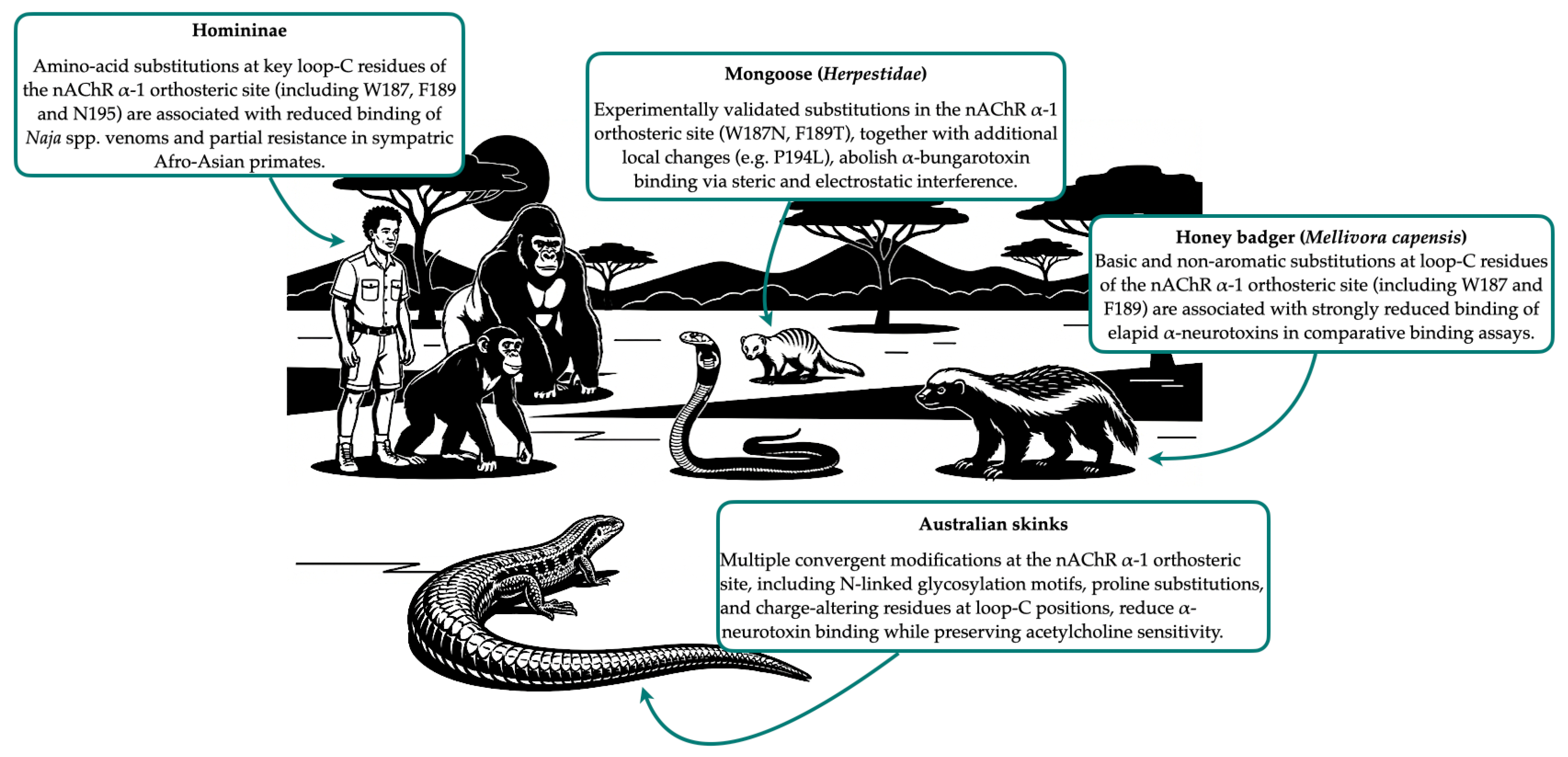
| Elapid–Counterparty Interaction | Ecological Interaction | Analyte Tested | Toxin Class Implicated | Mechanistic Effect on Binding | Experimental Approach | Ref. |
|---|---|---|---|---|---|---|
| Homininae vs. Naja spp. | Long-term sympatry and primate predation | Whole venoms | α-Neurotoxins (3FTx; inferred driver) | Reduced venom binding due to combined electrostatic and steric effects | Comparative BLI venom-binding assays across primate mimotopes; phylogenetic analysis | [51] |
| Honey badger (Mellivora capensis) vs. African elapids | Repeated ecological exposure to elapid venoms | Whole venoms | α-Neurotoxins (3FTx; inferred driver) | Altered electrostatic landscape reduces venom α-neurotoxin affinity | Comparative sequence analyses linked to venom-binding resistance patterns | [48] |
| Mongoose (Herpestidae) vs. αBgTx | Frequent predation on elapids | Purified toxin | α-Bungarotoxin | Steric obstruction abolishes toxin access to the binding interface | α-Bungarotoxin binding assays using receptor fragments and mutational analysis | [130,131] |
| Australian elapids vs. Australian skinks | Chronic predation by neurotoxic elapids | Purified toxins | α-Neurotoxins | Reduced toxin binding without compromising acetylcholine sensitivity | Functional receptor assays with purified toxins | [47] |
Disclaimer/Publisher’s Note: The statements, opinions and data contained in all publications are solely those of the individual author(s) and contributor(s) and not of MDPI and/or the editor(s). MDPI and/or the editor(s) disclaim responsibility for any injury to people or property resulting from any ideas, methods, instructions or products referred to in the content. |
© 2026 by the authors. Licensee MDPI, Basel, Switzerland. This article is an open access article distributed under the terms and conditions of the Creative Commons Attribution (CC BY) license.
Share and Cite
de Oliveira, J.L.; Roman-Ramos, H. Coevolution Between Three-Finger Toxins and Target Receptors. Receptors 2026, 5, 7. https://doi.org/10.3390/receptors5010007
de Oliveira JL, Roman-Ramos H. Coevolution Between Three-Finger Toxins and Target Receptors. Receptors. 2026; 5(1):7. https://doi.org/10.3390/receptors5010007
Chicago/Turabian Stylede Oliveira, Jéssica Lopes, and Henrique Roman-Ramos. 2026. "Coevolution Between Three-Finger Toxins and Target Receptors" Receptors 5, no. 1: 7. https://doi.org/10.3390/receptors5010007
APA Stylede Oliveira, J. L., & Roman-Ramos, H. (2026). Coevolution Between Three-Finger Toxins and Target Receptors. Receptors, 5(1), 7. https://doi.org/10.3390/receptors5010007