

NR4A Receptors in Immunity: Bridging Neuroendocrine and Inflammatory Pathways


Abstract
1. Introduction
- The variable N-terminal A/B domain, which contains the activation function-1 (AF-1) region and mediates interactions with coactivators and corepressors.
- The highly conserved central C domain, housing the DNA-binding domain (DBD) for gene regulation via homo-/heterodimers or monomers.
- The flexible hinge D domain, connecting the DBD to the ligand-binding domain (LBD) and facilitating LBD rotation; it also contains a nuclear localisation signal (NLS).
2. General Characteristics of NR4A Subfamily
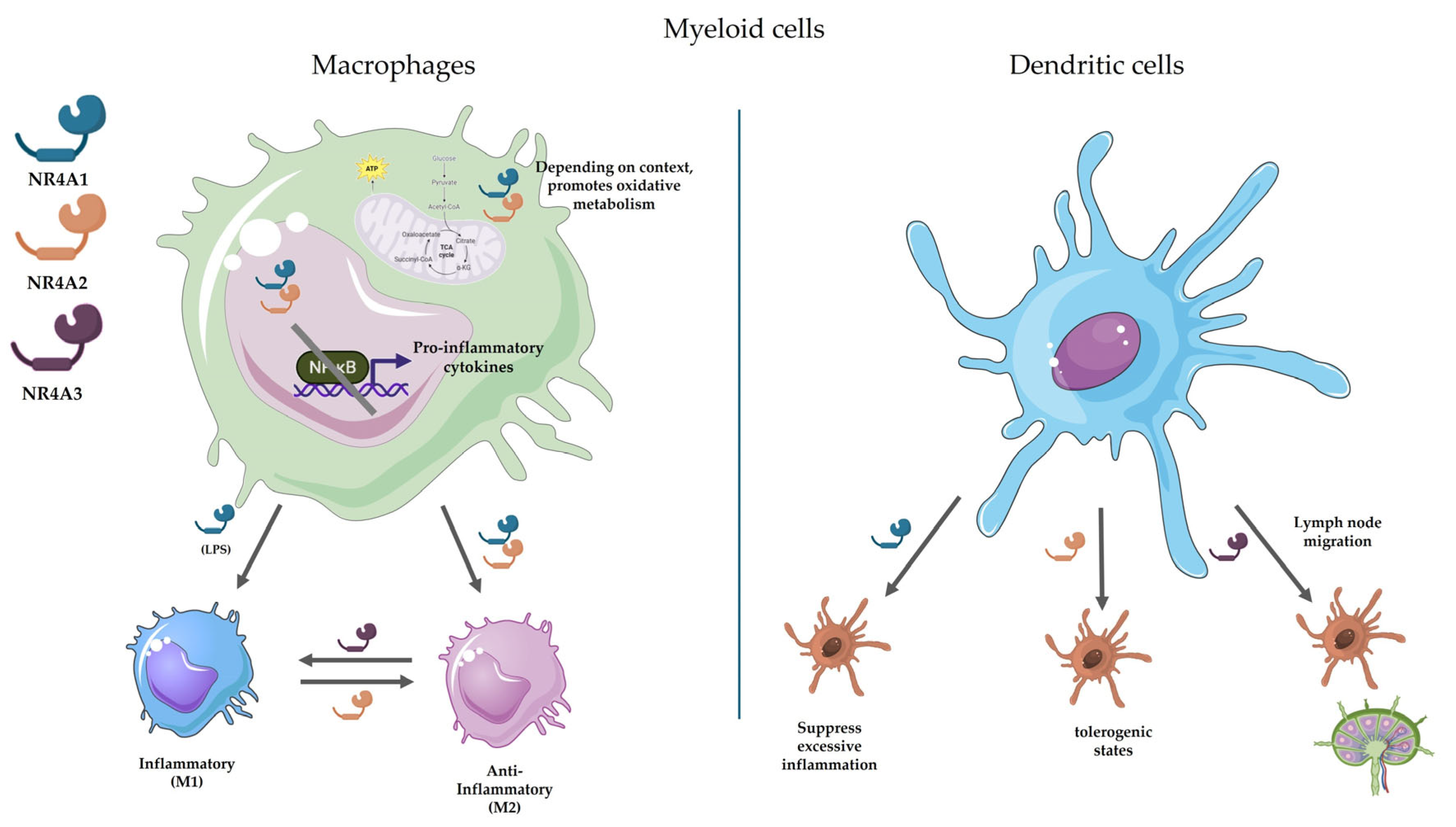
3. NR4A Receptors in Myeloid Cells
3.1. Macrophages
3.1.1. NR4A1
3.1.2. NR4A2
3.1.3. NR4A3
3.2. Dendritic Cells
3.2.1. NR4A1
3.2.2. NR4A2
3.2.3. N34A3
4. NR4A Receptors in Lymphoid Cells
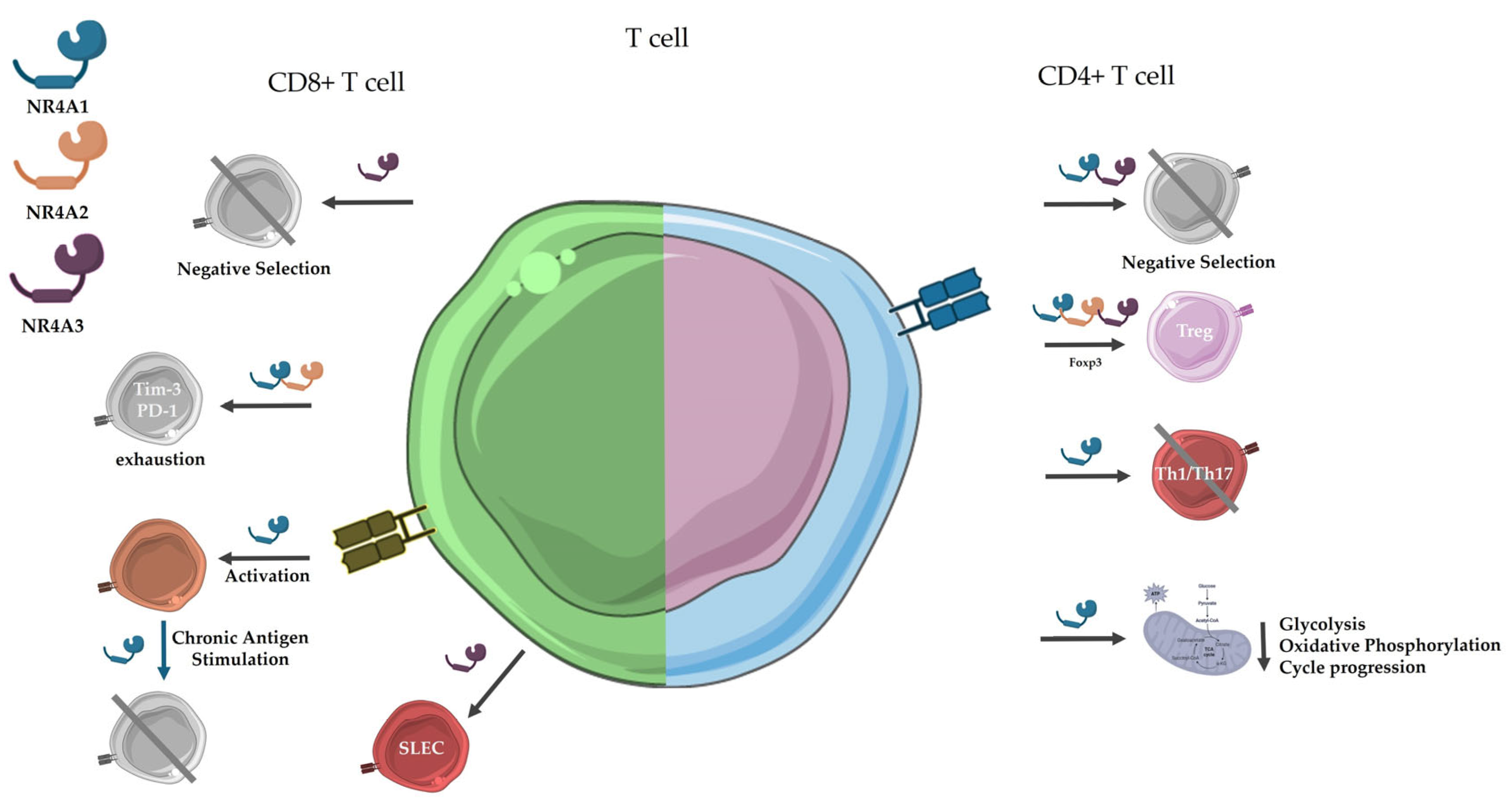
4.1. NR4A Receptors in T-Cell Biology
4.1.1. CD4+ T-Cells
NR4A1
NR4A2
NR4A3
4.1.2. CD8+ T-Cells
NR4A1
NR4A2
NR4A3
4.2. NR4A Receptors Function in B-Cell Responses
4.3. NKT Cell
5. NR4A Receptors at the Immune-Neuroendocrine Interface
6. NR4A Receptors in Pathology

| Feature | NR4A1 (Nur77) | NR4A2 (Nurr1) | NR4A3 (NOR1) |
|---|---|---|---|
| Gene Symbol/Synonyms | NR4A1/Nur77, TR3, NGFI-B | NR4A2/Nurr1, NOT, RNR1 | NR4A3/NOR1, TEC, MINOR, CHN |
| Expression Type | Immediate early gene | Immediate early gene | Immediate early gene |
| DNA Binding | Monomer (NBRE), homodimer or heterodimer (NurRE), RXR dimerization [114,115] | Monomer (NBRE), homodimer or heterodimer (NurRE), RXR dimerization [86,115] | Monomer (NBRE); low affinity for NurRE; does not dimerise with RXR [116] |
| Ligand Binding Domain (LBD) | Atypical, constitutively active; binds synthetic ligands [19,109] | Atypical but dynamic; binds Docosahexaenoic Acid (DHA, Anandamide (AEA), and synthetic molecules [16,22] | Atypical; potential interaction with unsaturated fatty acids and prostaglandins [19,117] |
| Tissue Expression | Broad (thymus, spleen, liver, brain, immune cells) [118,119] | CNS (midbrain dopaminergic neurons), cartilage, and immune tissues [8,44,103] | Heart, skeletal muscle, immune cells, CNS [119] |
| Canonical Functions | Apoptosis regulation, T-cell development, inflammation modulation [55] | Dopaminergic neuron maintenance, anti-inflammatory roles, immune regulation [42,69,120] | Vascular remodeling, metabolic regulation, immune homeostasis [56] |
| Role in Immune Response | Suppresses NF-κB signalling, regulates T-cell activation and macrophage polarization [36,38,39,121] | Restricts DC immunogenicity, promotes anti-inflammatory macrophage phenotypes [21,65] | Modulates DC migration, neutrophil survival, anti-inflammatory effects in monocytes/macrophages [46,49,50] |
| Neurological Role | Neuroprotective; expressed in cortex and hippocampus [28,33,122,123]. Mediates depressive behaviour in chronic stress [124] | Essential for dopaminergic neuron development; mutations linked to Parkinson’s disease [41,125] | Implicated in hippocampal development, inner ear formation, depressive behaviour [126,127] |
| Cardiovascular Involvement | Attenuates vascular inflammation, promotes endothelial homeostasis [128] | Limited but protective role in atherosclerosis [27] | Regulates Vascular Smooth Muscle Cells (VSMC) proliferation, modulates atherosclerosis progression, promotes cardiac hypertrophy [45] |
| Cancer-Related Functions | Dual role: tumor suppressor or promoter depending on context; modulates immune microenvironment [80,81,105,128] | Tumor suppressor; may inhibit angiogenesis and inflammatory gene expression [31,81] | Tumour suppressor in Acute Myeloid Leukaemia (AML); involved in oncogenic fusion proteins (e.g., Ewing Sarcoma Breakpoint EWS–NR4A3 in sarcomas) [104,129] |
| Metabolic Regulation | Modulates glucose and lipid metabolism, mitochondrial function [13,97,130,131] | Regulates insulin gene expression and β-cell function [13] | Controls lipid/glucose homeostasis in skeletal muscle, insulin secretion [130] |
| Modulators/Ligands | CsnB, 6-mercaptopurine, Phorbol-Diester [19,107,110,113,132] | AEA, DHA, CsnB, prostaglandins (PG) [22,103,133,134] | 6-mercaptopurine, Arachidonic acid, PGA1/PGA2, synthetic fatty acids [117,135] |
| Therapeutic Potential | Immunotherapy, cancer, inflammation, cardiovascular disease, osteoarthritis [81,107,118,128,136,137,138] | Parkinson’s disease, rheumatoid arthritis, sepsis, inflammatory disorders [42,103,139,140,141] | Cardiovascular disease, AML, metabolic syndrome, neurodegeneration [104,130,142] |
7. Concluding Remarks
Author Contributions
Funding
Institutional Review Board Statement
Informed Consent Statement
Data Availability Statement
Acknowledgments
Conflicts of Interest
References
- Volle, D.H. Nuclear Receptors in Physiology and Pathophysiology. Mol. Asp. Med. 2021, 78, 100956. [Google Scholar] [CrossRef] [PubMed]
- Xu, P. Nuclear Receptors in Health and Diseases. Int. J. Mol. Sci. 2023, 24, 9153. [Google Scholar] [CrossRef] [PubMed]
- Sever, R.; Glass, C.K. Signaling by Nuclear Receptors. Cold Spring Harb. Perspect. Biol. 2013, 5, a016709. [Google Scholar] [CrossRef]
- Volle, D.H. Nuclear Receptors as Pharmacological Targets, Where Are We Now? Cell Mol. Life Sci. 2016, 73, 3777–3780. [Google Scholar] [CrossRef] [PubMed]
- Kiss, M.; Czimmerer, Z.; Nagy, L. The Role of Lipid-Activated Nuclear Receptors in Shaping Macrophage and Dendritic Cell Function: From Physiology to Pathology. J. Allergy Clin. Immunol. 2013, 132, 264–286. [Google Scholar] [CrossRef]
- Fan, R.; Pineda-Torra, I.; Venteclef, N. Editorial: Nuclear Receptors and Coregulators in Metabolism and Immunity. Front. Endocrinol. 2021, 12, 10–12. [Google Scholar] [CrossRef]
- Milbrandt, J. Nerve Growth Factor Induces a Gene Homologous to the Glucocorticoid Receptor Gene. Neuron 1988, 1, 183–188. [Google Scholar] [CrossRef]
- Law, S.W.; Conneely, O.M.; DeMayo, F.J.; O’Malley, B.W. Identification of a New Brain-Specific Transcription Factor, NURR1. Mol. Endocrinol. 1992, 6, 2129–2135. [Google Scholar] [CrossRef]
- Ohkura, N.; Hijikuro, M.; Yamamoto, A.; Miki, K. Molecular Cloning of a Novel Thyroid/Steroid Receptor Superfamily Gene from Cultured Rat Neuronal Cells. Biochem. Biophys. Res. Commun. 1994, 205, 1959–1965. [Google Scholar] [CrossRef]
- Murphy, E.P.; Crean, D. Molecular Interactions between NR4A Orphan Nuclear Receptors and NF-kB Are Required for Appropriate Inflammatory Responses and Immune Cell Homeostasis. Biomolecules 2015, 5, 1302–1318. [Google Scholar] [CrossRef]
- Crean, D.; Murphy, E.P. Targeting NR4A Nuclear Receptors to Control Stromal Cell Inflammation, Metabolism, Angiogenesis, and Tumorigenesis. Front. Cell Dev. Biol. 2021, 9, 589770. [Google Scholar] [CrossRef]
- Ranhotra, H.S. The NR4A Orphan Nuclear Receptors: Mediators in Metabolism and Diseases. J. Recept. Signal Transduct. 2015, 35, 184–188. [Google Scholar] [CrossRef] [PubMed]
- Herring, J.A.; Elison, W.S.; Tessem, J.S. Function of Nr4a Orphan Nuclear Receptors in Proliferation, Apoptosis and Fuel Utilization across Tissues. Cells 2019, 8, 1373. [Google Scholar] [CrossRef] [PubMed]
- Yu, X.; He, Y.; Kamenecka, T.M.; Kojetin, D.J. Towards a Unified Molecular Mechanism for Liganddependent Activation of NR4A-RXR Heterodimers. bioRxiv 2025. [Google Scholar] [CrossRef]
- Maira, M.; Martens, C.; Philips, A.; Drouin, J. Heterodimerization between Members of the Nur Subfamily of Orphan Nuclear Receptors as a Novel Mechanism for Gene Activation. Mol. Cell. Biol. 1999, 19, 7549–7557. [Google Scholar] [CrossRef]
- De Vera, I.M.S.; Munoz-Tello, P.; Zheng, J.; Dharmarajan, V.; Marciano, D.P.; Matta-Camacho, E.; Giri, P.K.; Shang, J.; Hughes, T.S.; Rance, M.; et al. Defining a Canonical Ligand-Binding Pocket in the Orphan Nuclear Receptor Nurr1. Structure 2019, 27, 66–77.e5. [Google Scholar] [CrossRef]
- Safe, S.; Karki, K. The Paradoxical Roles of Orphan Nuclear Receptor 4A (NR4A) in Cancer. Mol. Cancer Res. 2021, 19, 180–191. [Google Scholar] [CrossRef]
- Boulet, S.; Le Corre, L.; Odagiu, L.; Labrecque, N. Role of NR4A Family Members in Myeloid Cells and Leukemia. Curr. Res. Immunol. 2022, 3, 23–36. [Google Scholar] [CrossRef]
- Kurakula, K.; Koenis, D.S.; van Tiel, C.M.; de Vries, C.J.M. NR4A Nuclear Receptors Are Orphans but Not Lonesome. Biochim. Biophys. Acta (BBA)-Mol. Cell Res. 2014, 1843, 2543–2555. [Google Scholar] [CrossRef]
- Zárraga-Granados, G.; Muciño-Hernández, G.; Sánchez-Carbente, M.R.; Villamizar-Gálvez, W.; Peñas-Rincón, A.; Arredondo, C.; Andrés, M.E.; Wood, C.; Covarrubias, L.; Castro-Obregón, S. The Nuclear Receptor NR4A1 Is Regulated by SUMO Modification to Induce Autophagic Cell Death. PLoS ONE 2020, 15, e0222072. [Google Scholar] [CrossRef]
- McMorrow, J.P.; Murphy, E.P. Inflammation: A Role for NR4A Orphan Nuclear Receptors? Biochem. Soc. Trans. 2011, 39, 688–693. [Google Scholar] [CrossRef] [PubMed]
- Munoz-Tello, P.; Lin, H.; Khan, P.; De Vera, I.M.S.; Kamenecka, T.M.; Kojetin, D.J. Assessment of NR4A Ligands That Directly Bind and Modulate the Orphan Nuclear Receptor Nurr1. J. Med. Chem. 2020, 63, 15639–15654. [Google Scholar] [CrossRef] [PubMed]
- Liu, Z.G.; Smith, S.W.; McLaughlin, K.A.; Schwartz, L.M.; Osborne, B.A. Apoptotic Signals Delivered through the T-Cell Receptor of a T-Cell Hybrid Require the Immediate-Early Gene Nur77. Nature 1994, 367, 281–284. [Google Scholar] [CrossRef] [PubMed]
- Woronicz, J.D.; Calnan, B.; Ngo, V.; Winoto, A. Requirement for the Orphan Steroid Receptor Nur77 in Apoptosis of T-Cell Hybridomas. Nature 1994, 367, 277–281. [Google Scholar] [CrossRef]
- Hiwa, R.; Brooks, J.F.; Mueller, J.L.; Nielsen, H.V.; Zikherman, J. NR4A Nuclear Receptors in T and B Lymphocytes: Gatekeepers of Immune Tolerance. Immunol. Rev. 2022, 307, 116–133. [Google Scholar] [CrossRef]
- Sekiya, T.; Kashiwagi, I.; Yoshida, R.; Fukaya, T.; Morita, R.; Kimura, A.; Ichinose, H.; Metzger, D.; Chambon, P.; Yoshimura, A. Nr4a Receptors Are Essential for Thymic Regulatory T Cell Development and Immune Homeostasis. Nat. Immunol. 2013, 14, 230–237. [Google Scholar] [CrossRef]
- Bonta, P.I.; Van Tiel, C.M.; Vos, M.; Pols, T.W.H.; Van Thienen, J.V.; Ferreira, V.; Arkenbout, E.K.; Seppen, J.; Spek, C.A.; Van Der Poll, T.; et al. Nuclear Receptors Nur77, Nurr1, and NOR-1 Expressed in Atherosclerotic Lesion Macrophages Reduce Lipid Loading and Inflammatory Responses. Arter. Thromb. Vasc. Biol. 2006, 26, 2288–2294. [Google Scholar] [CrossRef]
- Jeanneteau, F.; Barrére, C.; Vos, M.; De Vries, C.J.M.; Rouillard, C.; Levesque, D.; Dromard, Y.; Moisan, M.P.; Duric, V.; Franklin, T.C.; et al. The Stress-Induced Transcription Factor NR4a1 Adjusts Mitochondrial Function and Synapse Number in Prefrontal Cortex. J. Neurosci. 2018, 38, 1335–1350. [Google Scholar] [CrossRef]
- Odagiu, L.; May, J.; Boulet, S.; Baldwin, T.A.; Labrecque, N. Role of the Orphan Nuclear Receptor NR4A Family in T-Cell Biology. Front. Endocrinol. 2021, 11, 624122. [Google Scholar] [CrossRef]
- Raveney, B.J.E.; Oki, S.; Yamamura, T. Nuclear Receptor NR4A2 Orchestrates Th17 Cell-Mediated Autoimmune Inflammation via IL-21 Signalling. PLoS ONE 2013, 8, e56595. [Google Scholar] [CrossRef]
- Hibino, S.; Chikuma, S.; Kondo, T.; Ito, M.; Nakatsukasa, H.; Omata-Mise, S.; Yoshimura, A. Inhibition of Nr4a Receptors Enhances Antitumor Immunity by Breaking Treg-Mediated Immune Tolerance. Cancer Res. 2018, 78, 3027–3040. [Google Scholar] [CrossRef] [PubMed]
- Bandukwala, H.S.; Rao, A. ‘Nurr’ishing Treg Cells: Nr4a Transcription Factors Control Foxp3 Expression. Nat. Immunol. 2013, 14, 201–203. [Google Scholar] [CrossRef] [PubMed]
- Wang, L.M.; Zhang, Y.; Li, X.; Zhang, M.L.; Zhu, L.; Zhang, G.X.; Xu, Y.M. Nr4a1 Plays a Crucial Modulatory Role in Th1/Th17 Cell Responses and CNS Autoimmunity. Brain Behav. Immun. 2018, 68, 44–55. [Google Scholar] [CrossRef] [PubMed]
- Seo, H.; Chen, J.; González-Avalos, E.; Samaniego-Castruita, D.; Das, A.; Wang, Y.H.; López-Moyado, I.F.; Georges, R.O.; Zhang, W.; Onodera, A.; et al. TOX and TOX2 Transcription Factors Cooperate with NR4A Transcription Factors to Impose CD8+ T Cell Exhaustion. Proc. Natl. Acad. Sci. USA 2019, 116, 12410–12415. [Google Scholar] [CrossRef]
- Tan, C.; Mueller, J.L.; Noviski, M.; Huizar, J.; Lau, D.; Dubinin, A.; Molofsky, A.; Wilson, P.C.; Zikherman, J. Nur77 Links Chronic Antigen Stimulation to B Cell Tolerance by Restricting the Survival of Self-Reactive B Cells in the Periphery. J. Immunol. 2019, 202, 2907–2923. [Google Scholar] [CrossRef]
- Koenis, D.S.; Medzikovic, L.; van Loenen, P.B.; van Weeghel, M.; Huveneers, S.; Vos, M.; Evers-van Gogh, I.J.; Van den Bossche, J.; Speijer, D.; Kim, Y.; et al. Nuclear Receptor Nur77 Limits the Macrophage Inflammatory Response through Transcriptional Reprogramming of Mitochondrial Metabolism. Cell Rep. 2018, 24, 2127–2140.e7. [Google Scholar] [CrossRef]
- Ryan, D.G.; O’Neill, L.A.J. Krebs Cycle Rewired for Macrophage and Dendritic Cell Effector Functions. FEBS Lett. 2017, 591, 2992–3006. [Google Scholar] [CrossRef]
- Li, L.; Liu, Y.; Chen, H.Z.; Li, F.W.; Wu, J.F.; Zhang, H.K.; He, J.P.; Xing, Y.Z.; Chen, Y.; Wang, W.J.; et al. Impeding the Interaction between Nur77 and P38 Reduces LPS-Induced Inflammation. Nat. Chem. Biol. 2015, 11, 339–346. [Google Scholar] [CrossRef]
- Hanna, R.N.; Shaked, I.; Hubbeling, H.G.; Punt, J.A.; Wu, R.; Herrley, E.; Zaugg, C.; Pei, H.; Geissmann, F.; Ley, K.; et al. NR4A1 (Nur77) Deletion Polarizes Macrophages toward an Inflammatory Phenotype and Increases Atherosclerosis. Circ. Res. 2012, 110, 416–427. [Google Scholar] [CrossRef]
- Murphy, E.P.; Crean, D. NR4A1-3 Nuclear Receptor Activity and Immune Cell Dysregulation in Rheumatic Diseases. Front. Med. 2022, 9, 874182. [Google Scholar] [CrossRef]
- Saijo, K.; Winner, B.; Carson, C.T.; Collier, J.G.; Boyer, L.; Rosenfeld, M.G.; Gage, F.H.; Glass, C.K. A Nurr1/CoREST Pathway in Microglia and Astrocytes Protects Dopaminergic Neurons from Inflammation-Induced Death. Cell 2009, 137, 47–59. [Google Scholar] [CrossRef] [PubMed]
- Mahajan, S.; Saini, A.; Chandra, V.; Nanduri, R.; Kalra, R.; Bhagyaraj, E.; Khatri, N.; Gupta, P. Nuclear Receptor Nr4a2 Promotes Alternative Polarization of Macrophages and Confers Protection in Sepsis. J. Biol. Chem. 2015, 290, 18304–18314. [Google Scholar] [CrossRef] [PubMed]
- Solís-Barbosa, M.A.; Santana, E.; Muñoz-Torres, J.R.; Segovia-Gamboa, N.C.; Patiño-Martínez, E.; Meraz-Ríos, M.A.; Samaniego, R.; Sánchez-Mateos, P.; Sánchez-Torres, C. The Nuclear Receptor Nurr1 Is Preferentially Expressed in Human Pro-Inflammatory Macrophages and Limits Their Inflammatory Profile. Int. Immunol. 2024, 36, 111–128. [Google Scholar] [CrossRef] [PubMed]
- De Paoli, F.; Eeckhoute, J.; Copin, C.; Vanhoutte, J.; Duhem, C.; Derudas, B.; Dubois-Chevalier, J.; Colin, S.; Zawadzki, C.; Jude, B.; et al. The Neuron-Derived Orphan Receptor 1 (NOR1) Is Induced upon Human Alternative Macrophage Polarization and Stimulates the Expression of Markers of the M2 Phenotype. Atherosclerosis 2015, 241, 18–26. [Google Scholar] [CrossRef]
- Zhao, Y.; Howatt, D.A.; Gizard, F.; Nomiyama, T.; Findeisen, H.M.; Heywood, E.B.; Jones, K.L.; Conneely, O.M.; Daugherty, A.; Bruemmer, D. Deficiency of the NR4A Orphan Nuclear Receptor NOR1 Decreases Monocyte Adhesion and Atherosclerosis. Circ. Res. 2010, 107, 501–511. [Google Scholar] [CrossRef]
- Boulet, S.; Daudelin, J.F.; Odagiu, L.; Pelletier, A.N.; Yun, T.J.; Lesage, S.; Cheong, C.; Labrecque, N. The Orphan Nuclear Receptor NR4A3 Controls the Differentiation of Monocyte-Derived Dendritic Cells Following Microbial Stimulation. Proc. Natl. Acad. Sci. USA 2019, 116, 15150–15159. [Google Scholar] [CrossRef]
- Tel-Karthaus, N.; Kers-Rebel, E.D.; Looman, M.W.; Ichinose, H.; de Vries, C.J.; Ansems, M. Nuclear Receptor Nur77 Deficiency Alters Dendritic Cell Function. Front. Immunol. 2018, 9, 1797. [Google Scholar] [CrossRef]
- Saini, A.; Mahajan, S.; Gupta, P. Nuclear Receptor Expression Atlas in BMDCs: Nr4a2 Restricts Immunogenicity of BMDCs and Impedes EAE. Eur. J. Immunol. 2016, 46, 1842–1853. [Google Scholar] [CrossRef]
- Park, K.; Mikulski, Z.; Seo, G.Y.; Andreyev, A.Y.; Marcovecchio, P.; Blatchley, A.; Kronenberg, M.; Hedrick, C.C. The Transcription Factor NR4A3 Controls CD103+ Dendritic Cell Migration. J. Clin. Investig. 2016, 126, 4603–4615. [Google Scholar] [CrossRef]
- Nagaoka, M.; Yashiro, T.; Uchida, Y.; Ando, T.; Hara, M.; Arai, H.; Ogawa, H.; Okumura, K.; Kasakura, K.; Nishiyama, C. The Orphan Nuclear Receptor NR4A3 Is Involved in the Function of Dendritic Cells. J. Immunol. 2017, 199, 2958–2967. [Google Scholar] [CrossRef]
- Liu, X.; Wang, Y.; Lu, H.; Li, J.; Yan, X.; Xiao, M.; Hao, J.; Alekseev, A.; Khong, H.; Chen, T.; et al. Genome-Wide Analysis Identifies NR4A1 as a Key Mediator of T Cell Dysfunction. Nature 2019, 567, 525–529. [Google Scholar] [CrossRef] [PubMed]
- Dejean, A.S.; Joulia, E.; Walzer, T. The Role of Eomes in Human CD4 T Cell Differentiation: A question of context. Eur. J. Immunol. 2019, 49, 38–41. [Google Scholar] [CrossRef]
- Savino, W.; Mendes-Da-Cruz, D.A.; Lepletier, A.; Dardenne, M. Hormonal Control of T-Cell Development in Health and Disease. Nat. Rev. Endocrinol. 2016, 12, 77–89. [Google Scholar] [CrossRef] [PubMed]
- Hamburg, J.P.V.; Tas, S.W. Molecular Mechanisms Underpinning T Helper 17 Cell Heterogeneity and Functions in Rheumatoid Arthritis. J. Autoimmun. 2018, 87, 69–81. [Google Scholar] [CrossRef] [PubMed]
- Boulet, S.; Odagiu, L.; Dong, M.; Lebel, M.-È.; Daudelin, J.-F.; Melichar, H.J.; Labrecque, N. NR4A3 Mediates Thymic Negative Selection. J. Immunol. 2021, 207, 1055–1064. [Google Scholar] [CrossRef]
- Nielsen, H.V.; Yang, L.; Mueller, J.L.; Ritter, A.J.; Hiwa, R.; Proekt, I.; Rackaityte, E.; Aylard, D.; Gupta, M.; Scharer, C.D.; et al. Nr4a1 and Nr4a3 Redundantly Control Clonal Deletion and Contribute to an Anergy-like Transcriptome in Auto-Reactive Thymocytes to Impose Tolerance in Mice. Nat. Commun. 2025, 16, 784. [Google Scholar] [CrossRef]
- Fujii, Y.; Matsuda, S.; Takayama, G.; Koyasu, S. ERK5 Is Involved in TCR-Induced Apoptosis through the Modification of Nur77. Genes Cells 2008, 13, 411–419. [Google Scholar] [CrossRef]
- Liebmann, M.; Hucke, S.; Koch, K.; Eschborn, M.; Ghelman, J.; Chasan, A.I.; Glander, S.; Schädlich, M.; Kuhlencord, M.; Daber, N.M.; et al. Nur77 Serves as a Molecular Brake of the Metabolic Switch during T Cell Activation to Restrict Autoimmunity. Proc. Natl. Acad. Sci. USA 2018, 115, E8017–E8026. [Google Scholar] [CrossRef]
- Moran, A.E.; Holzapfel, K.L.; Xing, Y.; Cunningham, N.R.; Maltzman, J.S.; Punt, J.; Hogquist, K.A. T Cell Receptor Signal Strength in Treg and INKT Cell Development Demonstrated by a Novel Fluorescent Reporter Mouse. J. Exp. Med. 2011, 208, 1279–1289. [Google Scholar] [CrossRef]
- Hiwa, R.; Nielsen, H.V.; Mueller, J.L.; Mandla, R.; Zikherman, J. NR4A Family Members Regulate T Cell Tolerance to Preserve Immune Homeostasis and Suppress Autoimmunity. JCI Insight 2021, 6, e151005. [Google Scholar] [CrossRef]
- Sekiya, T.; Kondo, T.; Shichita, T.; Morita, R.; Ichinose, H.; Yoshimura, A. Suppression of Th2 and Tfh Immune Reactions by Nr4a Receptors in Mature T Reg Cells. J. Exp. Med. 2015, 212, 1623–1640. [Google Scholar] [CrossRef] [PubMed]
- Yoshimura, A.; Ito, M.; Mise-Omata, S.; Ando, M. SOCS: Negative Regulators of Cytokine Signaling for Immune Tolerance. Int. Immunol. 2021, 33, 711–716. [Google Scholar] [CrossRef] [PubMed]
- Ashouri, J.F.; Weiss, A. Endogenous Nur77 Is a Specific Indicator of Antigen Receptor Signaling in Human T and B Cells. J. Immunol. 2017, 198, 657–668. [Google Scholar] [CrossRef] [PubMed]
- Bending, D.; Zikherman, J. Nr4a Nuclear Receptors: Markers and Modulators of Antigen Receptor Signaling. Curr. Opin. Immunol. 2023, 81, 102285. [Google Scholar] [CrossRef]
- Park, T.Y.; Jang, Y.; Kim, W.; Shin, J.; Toh, H.T.; Kim, C.H.; Yoon, H.S.; Leblanc, P.; Kim, K.S. Chloroquine Modulates Inflammatory Autoimmune Responses through Nurr1 in Autoimmune Diseases. Sci. Rep. 2019, 9, 15559. [Google Scholar] [CrossRef]
- Won, H.Y.; Shin, J.H.; Oh, S.; Jeong, H.; Hwang, E.S. Enhanced CD25+Foxp3+ Regulatory T Cell Development by Amodiaquine through Activation of Nuclear Receptor 4A. Sci. Rep. 2017, 7, 16946. [Google Scholar] [CrossRef]
- Ogawa, C.; Tone, Y.; Tsuda, M.; Peter, C.; Waldmann, H.; Tone, M. TGF-β–Mediated Foxp3 Gene Expression Is Cooperatively Regulated by Stat5, Creb, and AP-1 through CNS2. J. Immunol. 2014, 192, 475–483. [Google Scholar] [CrossRef]
- Takahashi, H.; Tsuboi, H.; Asashima, H.; Hirota, T.; Kondo, Y.; Moriyama, M.; Matsumoto, I.; Nakamura, S.; Sumida, T. CDNA Microarray Analysis Identifies NR4A2 as a Novel Molecule Involved in the Pathogenesis of Sjögren’s Syndrome. Clin. Exp. Immunol. 2017, 190, 96–109. [Google Scholar] [CrossRef]
- Zhang, W.; Cao, X.; Zhong, X.; Wu, H.; Feng, M.; Gwack, Y.; Noah, I.; Sun, Z. Steroid Nuclear Receptor Coactivator 2 Controls Immune Tolerance by Promoting Induced Treg Differentiation via Up-Regulating Nr4a2. Sci. Adv. 2022, 8, eabn7662. [Google Scholar] [CrossRef]
- Bending, D.; Martín, P.P.; Paduraru, A.; Ducker, C.; Marzaganov, E.; Laviron, M.; Kitano, S.; Miyachi, H.; Crompton, T.; Ono, M. A Timer for Analyzing Temporally Dynamic Changes in Transcription during Differentiation in Vivo. J. Cell Biol. 2018, 217, 2931–2950. [Google Scholar] [CrossRef]
- Jennings, E.; Elliot, T.A.E.; Thawait, N.; Kanabar, S.; Yam-Puc, J.C.; Ono, M.; Toellner, K.M.; Wraith, D.C.; Anderson, G.; Bending, D. Nr4a1 and Nr4a3 Reporter Mice Are Differentially Sensitive to T Cell Receptor Signal Strength and Duration. Cell Rep. 2020, 33, 108328. [Google Scholar] [CrossRef] [PubMed]
- Scott-Browne, J.P.; López-Moyado, I.F.; Trifari, S.; Wong, V.; Chavez, L.; Rao, A.; Pereira, R.M. Dynamic Changes in Chromatin Accessibility Occur in CD8+ T Cells Responding to Viral Infection. Immunity 2016, 45, 1327–1340. [Google Scholar] [CrossRef] [PubMed]
- Kurd, N.S.; He, Z.; Louis, T.L.; Milner, J.J.; Omilusik, K.D.; Jin, W.; Tsai, M.S.; Widjaja, C.E.; Kanbar, J.N.; Olvera, J.G.; et al. Early Precursors and Molecular Determinants of Tissue-Resident Memory CD8+ T Lymphocytes Revealed by Single-Cell RNA Sequencing. Sci. Immunol. 2020, 5, eaaz6894. [Google Scholar] [CrossRef] [PubMed]
- Odagiu, L.; Boulet, S.; de Sousa, D.M.; Daudelin, J.F.; Nicolas, S.; Labrecque, N. Early Programming of CD8+ T Cell Response by the Orphan Nuclear Receptor NR4A3. Proc. Natl. Acad. Sci. USA 2020, 117, 24392–24402. [Google Scholar] [CrossRef]
- Nowyhed, H.N.; Huynh, T.R.; Thomas, G.D.; Blatchley, A.; Hedrick, C.C. Cutting Edge: The Orphan Nuclear Receptor Nr4a1 Regulates CD8+ T Cell Expansion and Effector Function through Direct Repression of Irf4. J. Immunol. 2015, 195, 3515–3519. [Google Scholar] [CrossRef]
- Nowyhed, H.N.; Huynh, T.R.; Blatchley, A.; Wu, R.; Thomas, G.D.; Hedrick, C.C. The Nuclear Receptor Nr4a1 Controls CD8 T Cell Development Through Transcriptional Suppression of Runx3. Sci. Rep. 2015, 5, 9059. [Google Scholar] [CrossRef]
- Woolf, E.; Xiao, C.; Fainaru, O.; Lotem, J.; Rosen, D.; Negreanu, V.; Bernstein, Y.; Goldenberg, D.; Brenner, O.; Berke, G.; et al. Runx3 and Runx1 Are Required for CD8 T Cell Development during Thymopoiesis. Proc. Natl. Acad. Sci. USA 2003, 100, 7731–7736. [Google Scholar] [CrossRef]
- Chen, J.; López-Moyado, I.F.; Seo, H.; Lio, C.W.J.; Hempleman, L.J.; Sekiya, T.; Yoshimura, A.; Scott-Browne, J.P.; Rao, A. NR4A Transcription Factors Limit CAR T Cell Function in Solid Tumours. Nature 2019, 567, 530–534. [Google Scholar] [CrossRef]
- Lith, S.C.; van Os, B.W.; Seijkens, T.T.P.; de Vries, C.J.M. ‘Nur’turing Tumor T Cell Tolerance and Exhaustion: Novel Function for Nuclear Receptor Nur77 in Immunity. Eur. J. Immunol. 2020, 50, 1643–1652. [Google Scholar] [CrossRef]
- Kleberg, J.; Nataraj, A.; Xiao, Y.; Podder, B.R.; Jin, Z.; Tithi, T.I.; Zheng, G.; Smalley, K.S.M.; Moser, E.K.; Safe, S.; et al. Targeting Lineage-Specific Functions of NR4A1 for Cancer Immunotherapy. Int. J. Mol. Sci. 2025, 26, 5266. [Google Scholar] [CrossRef]
- Srirat, T.; Hayakawa, T.; Mise-Omata, S.; Nakagawara, K.; Ando, M.; Shichino, S.; Ito, M.; Yoshimura, A. NR4a1/2 Deletion Promotes Accumulation of TCF1+ Stem-like Precursors of Exhausted CD8+ T Cells in the Tumor Microenvironment. Cell Rep. 2024, 43, 113898. [Google Scholar] [CrossRef] [PubMed]
- Brooks, J.F.; Tan, C.; Mueller, J.L.; Hibiya, K.; Hiwa, R.; Vykunta, V.; Zikherman, J. Negative Feedback by NUR77/Nr4a1 Restrains B Cell Clonal Dominance during Early T-Dependent Immune Responses. Cell Rep. 2021, 36, 109645. [Google Scholar] [CrossRef] [PubMed]
- Tan, C.; Hiwa, R.; Mueller, J.L.; Vykunta, V.; Hibiya, K.; Noviski, M.; Huizar, J.; Brooks, J.F.; Garcia, J.; Heyn, C.; et al. NR4A Nuclear Receptors Restrain B Cell Responses to Antigen When Second Signals Are Absent or Limiting. Nat. Immunol. 2020, 21, 1267–1279. [Google Scholar] [CrossRef] [PubMed]
- Kumar, A.; Hill, T.M.; Gordy, L.E.; Suryadevara, N.; Wu, L.; Flyak, A.I.; Bezbradica, J.S.; Van Kaer, L.; Joyce, S. Nur77 Controls Tolerance Induction, Terminal Differentiation, and Effector Functions in Semi-Invariant Natural Killer T Cells. Proc. Natl. Acad. Sci. USA 2020, 117, 17156–17165. [Google Scholar] [CrossRef]
- Honkaniemi, J.; Kononen, J.; Kainu, T.; Pyykönen, I.; Pelto-Huikko, M. Induction of Multiple Immediate Early Genes in Rat Hypothalamic Paraventricular Nucleus after Stress. Mol. Brain Res. 1994, 25, 234–241. [Google Scholar] [CrossRef]
- Fernandez, P.M.; Brunel, F.; Jimenez, M.A.; Saez, J.M.; Cereghini, S.; Zakin, M.M. Nuclear Receptors Nor1 and NGFI-B/Nur77 Play Similar, Albeit Distinct, Roles in the Hypothalamo-Pituitary-Adrenal Axis. Endocrinology 2000, 141, 2392–2400. [Google Scholar] [CrossRef]
- Helbling, J.C.; Minni, A.M.; Pallet, V.; Moisan, M.P. Stress and Glucocorticoid Regulation of NR4A Genes in Mice. J. Neurosci. Res. 2014, 92, 825–834. [Google Scholar] [CrossRef]
- Jiang, L.; Wei, H.; Yan, N.; Dai, S.; Li, J.; Qu, L.; Chen, X.; Guo, M.; Chen, Z.; Chen, Y. Structural Basis of NR4A1 Bound to the Human Pituitary Proopiomelanocortin Gene Promoter. Biochem. Biophys. Res. Commun. 2020, 523, 1–5. [Google Scholar] [CrossRef]
- Murphy, E.P.; Conneely, O.M. Neuroendocrine Regulation of the Hypothalamic Pituitary Adrenal Axis by the Nurr1/Nur77 Subfamily of Nuclear Receptors. Mol. Endocrinol. 1997, 11, 39–47. [Google Scholar] [CrossRef]
- Zhang, D.; Heaney, A.P.; Zhang, D.; Heaney, A.P. Nuclear Receptors as Regulators of Pituitary Corticotroph Pro-Opiomelanocortin Transcription. Cells 2020, 9, 900. [Google Scholar] [CrossRef]
- Wilson, T.E.; Mouw, A.R.; Weaver, C.A.; Milbrandt, J.; Parker, K.L. The Orphan Nuclear Receptor NGFI-B Regulates Expression of the Gene Encoding Steroid 21-Hydroxylase. Mol. Cell. Biol. 1993, 13, 861–868. [Google Scholar] [CrossRef] [PubMed][Green Version]
- Philips, A.; Maira, M.; Mullick, A.; Chamberland, M.; Lesage, S.; Hugo, P.; Drouin, J. Antagonism between Nur77 and Glucocorticoid Receptor for Control of Transcription. Mol. Cell. Biol. 1997, 17, 5952–5959. [Google Scholar] [CrossRef] [PubMed]
- Martens, C.; Bilodeau, S.; Maira, M.; Gauthier, Y.; Drouin, J. Protein-Protein Interactions and Transcriptional Antagonism between the Subfamily of NGFI-B/Nur77 Orphan Nuclear Receptors and Glucocorticoid Receptor. Mol. Endocrinol. 2005, 19, 885–897. [Google Scholar] [CrossRef] [PubMed]
- Lavoie, O.; Michael, N.J.; Caron, A. A Critical Update on the Leptin-Melanocortin System. J. Neurochem. 2023, 165, 467–486. [Google Scholar] [CrossRef]
- Chen, Y.; Wu, R.; Chen, H.Z.; Xiao, Q.; Wang, W.J.; He, J.P.; Li, X.X.; Yu, X.W.; Li, L.; Wang, P.; et al. Enhancement of Hypothalamic STAT3 Acetylation by Nuclear Receptor Nur77 Dictates Leptin Sensitivity. Diabetes 2015, 64, 2069–2081. [Google Scholar] [CrossRef]
- Herring, J.A.; Crabtree, J.E.; Hill, J.T.; Tessem, J.S. Loss of Glucose-Stimulated β-Cell Nr4a1 Expression Impairs Insulin Secretion and Glucose Homeostasis. Am. J. Physiol. Cell Physiol. 2024, 327, C1111–C1124. [Google Scholar] [CrossRef]
- Pu, Z.Q.; Liu, D.; Lobo Mouguegue, H.P.P.; Jin, C.W.; Sadiq, E.; Qin, D.D.; Yu, T.F.; Zong, C.; Chen, J.C.; Zhao, R.X.; et al. NR4A1 Counteracts JNK Activation Incurred by ER Stress or ROS in Pancreatic β-Cells for Protection. J. Cell. Mol. Med. 2020, 24, 14171–14183. [Google Scholar] [CrossRef]
- Chen, L.; Fan, F.; Wu, L.; Zhao, Y. The Nuclear Receptor 4A Family Members: Mediators in Human Disease and Autophagy. Cell. Mol. Biol. Lett. 2020, 25, 48. [Google Scholar] [CrossRef]
- Safe, S.; Jin, U.-H.; Morpurgo, B.; Abdayyeh, A.; Singh, M.; Tjalkens, R.B. Nuclear Receptor 4A (NR4A) Family–Orphans No More. J. Steroid Biochem. Mol. Biol. 2016, 157, 48–60. [Google Scholar] [CrossRef]
- Doi, Y.; Oki, S.; Ozawa, T.; Hohjoh, H.; Miyake, S.; Yamamura, T. Orphan Nuclear Receptor NR4A2 Expressed in T Cells from Multiple Sclerosis Mediates Production of Inflammatory Cytokines. Proc. Natl. Acad. Sci. USA 2008, 105, 8381–8386. [Google Scholar] [CrossRef]
- Yan, J.; Huang, J.; Wu, J.; Fan, H.; Liu, A.; Qiao, L.; Shen, M.; Lai, X. Nur77 Attenuates Inflammatory Responses and Oxidative Stress by Inhibiting Phosphorylated IκB-α in Parkinson’s Disease Cell Model. Aging 2020, 12, 8107–8119. [Google Scholar] [CrossRef] [PubMed]
- Liu, T.Y.; Yang, X.Y.; Zheng, L.T.; Wang, G.H.; Zhen, X.C. Activation of Nur77 in Microglia Attenuates Proinflammatory Mediators Production and Protects Dopaminergic Neurons from Inflammation-Induced Cell Death. J. Neurochem. 2017, 140, 589–604. [Google Scholar] [CrossRef] [PubMed]
- Hammond, S.L.; Safe, S.; Tjalkens, R.B. A Novel Synthetic Activator of Nurr1 Induces Dopaminergic Gene Expression and Protects against 6-Hydroxydopamine Neurotoxicity in Vitro. Neurosci. Lett. 2015, 607, 83–89. [Google Scholar] [CrossRef] [PubMed]
- Deutsch, A.J.A.; Rinner, B.; Pichler, M.; Prochazka, K.; Pansy, K.; Bischof, M.; Fechter, K.; Hatzl, S.; Feichtinger, J.; Wenzl, K.; et al. NR4A3 Suppresses Lymphomagenesis through Induction of Proapoptotic Genes. Cancer Res. 2017, 77, 2375–2386. [Google Scholar] [CrossRef]
- Fechter, K.; Feichtinger, J.; Prochazka, K.; Unterluggauer, J.J.; Pansy, K.; Steinbauer, E.; Pichler, M.; Haybaeck, J.; Prokesch, A.; Greinix, H.T.; et al. Cytoplasmic Location of NR4A1 in Aggressive Lymphomas Is Associated with a Favourable Cancer Specific Survival. Sci. Rep. 2018, 8, 14528. [Google Scholar] [CrossRef]
- Li, Q.X.; Ke, N.; Sundaram, R.; Wong-Staal, F. NR4A1, 2, 3—An Orphan Nuclear Hormone Receptor Family Involved in Cell Apoptosis and Carcinogenesis. Histol. Histopathol. 2006, 21, 533–540. [Google Scholar] [CrossRef]
- Wang, J.R.; Gan, W.J.; Li, X.M.; Zhao, Y.Y.; Li, Y.; Lu, X.X.; Li, J.M.; Wu, H. Orphan Nuclear Receptor Nur77 Promotes Colorectal Cancer Invasion and Metastasis by Regulating MMP-9 and E-Cadherin. Carcinogenesis 2014, 35, 2474–2484. [Google Scholar] [CrossRef]
- Zhang, C.; Zhang, B.; Zhang, X.; Sun, G.; Sun, X. Targeting Orphan Nuclear Receptors NR4As for Energy Homeostasis and Diabetes. Front. Pharmacol. 2020, 11, 587457. [Google Scholar] [CrossRef]
- Safe, S.; Shrestha, R.; Mohankumar, K. Orphan Nuclear Receptor 4A1 (NR4A1) and Novel Ligands. Essays Biochem. 2021, 65, 877–886. [Google Scholar] [CrossRef]
- Lee, M.; Upadhyay, S.; Mariyam, F.; Martin, G.; Hailemariam, A.; Lee, K.; Jayaraman, A.; Chapkin, R.S.; Lee, S.O.; Safe, S. Flavone and Hydroxyflavones Are Ligands That Bind the Orphan Nuclear Receptor 4A1 (NR4A1). Int. J. Mol. Sci. 2023, 24, 8152. [Google Scholar] [CrossRef]
- Hu, M.; Luo, Q.; Alitongbieke, G.; Chong, S.; Xu, C.; Xie, L.; Chen, X.; Zhang, D.; Zhou, Y.; Wang, Z.; et al. Celastrol-Induced Nur77 Interaction with TRAF2 Alleviates Inflammation by Promoting Mitochondrial Ubiquitination and Autophagy. Mol. Cell 2017, 66, 141–153.e6. [Google Scholar] [CrossRef] [PubMed]
- Safe, S. Natural Products and Synthetic Analogs as Selective Orphan Nuclear Receptor 4A (NR4A) Modulators. Histol. Histopathol. 2023, 39, 543–556. [Google Scholar] [CrossRef]
- Zhan, Y.; Du, X.; Chen, H.; Liu, J.; Zhao, B.; Huang, D.; Li, G.; Xu, Q.; Zhang, M.; Weimer, B.C.; et al. Cytosporone B Is an Agonist for Nuclear Orphan Receptor Nur77. Nat. Chem. Biol. 2008, 4, 548–556. [Google Scholar] [CrossRef] [PubMed]
- Philips, A.; Lesage, S.; Gingras, R.; Maira, M.-H.; Gauthier, Y.; Hugo, P.; Drouin, J. Novel Dimeric Nur77 Signaling Mechanism in Endocrine and Lymphoid Cells. Mol. Cell. Biol. 1997, 17, 5946–5951. [Google Scholar] [CrossRef] [PubMed]
- Perlmann, T.; Jansson, L. A Novel Pathway for Vitamin A Signaling Mediated by RXR Heterodimerization with NGFI-B and NURR1. Genes Dev. 1995, 9, 769–782. [Google Scholar] [CrossRef]
- Zetterström, R.H.; Solomin, L.; Mitsiadis, T.; Olson, L.; Perlmann, T. Retinoid X Receptor Heterodimerization and Developmental Expression Distinguish the Orphan Nuclear Receptors NGFI-B, Nurr1, and Nor1. Mol. Endocrinol. 1996, 10, 1656–1666. [Google Scholar] [CrossRef]
- Kagaya, S.; Ohkura, N.; Tsukada, T.; Miyagawa, M.; Sugita, Y.; Tsujimoto, G.; Matsumoto, K.; Saito, H.; Hashida, R. Prostaglandin A2 Acts as a Transactivator for NOR1 (NR4A3) within the Nuclear Receptor Superfamily. Biol. Pharm. Bull. 2005, 28, 1603–1607. [Google Scholar] [CrossRef]
- Maxwell, M.A.; Muscat, G.E.O. The NR4A Subgroup: Immediate Early Response Genes with Pleiotropic Physiological Roles. Nucl. Recept. Signal. 2006, 4, e002. [Google Scholar] [CrossRef]
- Safe, S. NR4A1 Acts as a Nutrient Sensor That Inhibits the Effects of Aging. Nutrients 2025, 17, 2709. [Google Scholar] [CrossRef]
- Sekiya, T.; Kashiwagi, I.; Inoue, N.; Morita, R.; Hori, S.; Waldmann, H.; Rudensky, A.Y.; Ichinose, H.; Metzger, D.; Chambon, P.; et al. The Nuclear Orphan Receptor Nr4a2 Induces Foxp3 and Regulates Differentiation of CD4+ T Cells. Nat. Commun. 2011, 2, 269. [Google Scholar] [CrossRef]
- Pei, L.; Castrillo, A.; Tontonoz, P. Regulation of Macrophage Inflammatory Gene Expression by the Orphan Nuclear Receptor Nur77. Mol. Endocrinol. 2006, 20, 786–794. [Google Scholar] [CrossRef]
- Shaked, I.; Hanna, R.N.; Shaked, H.; Chodaczek, G.; Nowyhed, H.N.; Tweet, G.; Tacke, R.; Basat, A.B.; Mikulski, Z.; Togher, S.; et al. Transcription Factor Nr4a1 Couples Sympathetic and Inflammatory Cues in CNS-Recruited Macrophages to Limit Neuroinflammation. Nat. Immunol. 2015, 16, 1228–1234. [Google Scholar] [CrossRef]
- Rothe, T.; Ipseiz, N.; Faas, M.; Lang, S.; Perez-Branguli, F.; Metzger, D.; Ichinose, H.; Winner, B.; Schett, G.; Krönke, G. The Nuclear Receptor Nr4a1 Acts as a Microglia Rheostat and Serves as a Therapeutic Target in Autoimmune-Driven Central Nervous System Inflammation. J. Immunol. 2017, 198, 3878–3885. [Google Scholar] [CrossRef] [PubMed]
- Trudler, D.; Levy-Barazany, H.; Nash, Y.; Samuel, L.; Sharon, R.; Frenkel, D. Alpha Synuclein Deficiency Increases CD4+ T-Cells pro-Inflammatory Profile in a Nurr1-Dependent Manner. J. Neurochem. 2020, 152, 61–71. [Google Scholar] [CrossRef] [PubMed]
- Pönniö, T.; Conneely, O.M. Nor-1 Regulates Hippocampal Axon Guidance, Pyramidal Cell Survival, and Seizure Susceptibility. Mol. Cell. Biol. 2004, 24, 9070–9078. [Google Scholar] [CrossRef] [PubMed]
- Hong, H.; Su, J.; Huang, C.; Lu, X.; Cui, Z. Comprehensive Insights into the Function and Molecular and Pharmacological Regulation of Neuron-Derived Orphan Receptor 1, an Orphan Receptor. Front. Pharmacol. 2022, 13, 981490. [Google Scholar] [CrossRef]
- Lu, L.; Jang, S.; Zhu, J.; Qin, Q.; Sun, L.; Sun, J. Nur77 Mitigates Endothelial Dysfunction through Activation of Both Nitric Oxide Production and Anti-Oxidant Pathways. Redox Biol. 2024, 70, 103056. [Google Scholar] [CrossRef]
- Jin, M.; Wang, Y.; Song, M.; Guo, W.; Li, S.; Pu, Z. Targeting the Nuclear Orphan Receptor NR4A1: A Key Target in Lung Cancer Progression and Therapeutic Resistance. Front. Oncol. 2025, 15, 1566598. [Google Scholar] [CrossRef]
- Mullican, S.E.; Zhang, S.; Konopleva, M.; Ruvolo, V.; Andreeff, M.; Milbrandt, J.; Conneely, O.M. Abrogation of Nuclear Receptors Nr4a3 AndNr4a1 Leads to Development of Acute Myeloid Leukemia. Nat. Med. 2007, 13, 730–735. [Google Scholar] [CrossRef]
- Veum, V.L.; Dankel, S.N.; Gjerde, J.; Nielsen, H.J.; Solsvik, M.H.; Haugen, C.; Christensen, B.J.; Hoang, T.; Fadnes, D.J.; Busch, C.; et al. The Nuclear Receptors NUR77, NURR1 and NOR1 in Obesity and during Fat Loss. Int. J. Obes. 2012, 36, 1195–1202. [Google Scholar] [CrossRef]
- Kim, B.Y.; Kim, H.; Cho, E.J.; Youn, H.D. Nur77 Upregulates HIF-Alpha by Inhibiting PVHL-Mediated Degradation. Exp. Mol. Med. 2008, 40, 71–83. [Google Scholar] [CrossRef]
- Ismaiel, M.; Murphy, B.; Aldhafiri, S.; Giffney, H.E.; Thornton, K.; Mukhopadhya, A.; Keogh, C.E.; Fattah, S.; Mohan, H.M.; Cummins, E.P.; et al. The NR4A Agonist, Cytosporone B, Attenuates pro-Inflammatory Mediators in Human Colorectal Cancer Tissue Ex Vivo. Biochem. Biophys. Res. Commun. 2021, 554, 179–185. [Google Scholar] [CrossRef] [PubMed]
- Willems, S.; Kilu, W.; Ni, X.; Chaikuad, A.; Knapp, S.; Heering, J.; Merk, D. The Orphan Nuclear Receptor Nurr1 Is Responsive to Non-Steroidal Anti-Inflammatory Drugs. Commun. Chem. 2020, 3, 85. [Google Scholar] [CrossRef] [PubMed]
- Teichmann, T.; Pflüger-Müller, B.; Giménez, V.M.M.; Sailer, F.; Dirks, H.; Zehr, S.; Warwick, T.; Brettner, F.; Munoz-Tello, P.; Zimmer, A.; et al. The Endocannabinoid Anandamide Mediates Anti-Inflammatory Effects through Activation of NR4A Nuclear Receptors. Br. J. Pharmacol. 2025, 182, 1164–1182. [Google Scholar] [CrossRef] [PubMed]
- Wansa, K.D.S.A.; Harris, J.M.; Yan, G.; Ordentlich, P.; Muscat, G.E.O. The AF-1 Domain of the Orphan Nuclear Receptor NOR-1 Mediates Trans-Activation, Coactivator Recruitment, and Activation by the Purine Anti-Metabolite 6-Mercaptopurine. J. Biol. Chem. 2003, 278, 24776–24790. [Google Scholar] [CrossRef]
- Moyer, C.L.; Brown, P.H. Targeting Nuclear Hormone Receptors for the Prevention of Breast Cancer. Front. Med. 2023, 10, 1200947. [Google Scholar] [CrossRef]
- Chen, Z.; Zhang, D.; Yan, S.; Hu, C.; Huang, Z.; Li, Z.; Peng, S.; Li, X.; Zhu, Y.; Yu, H.; et al. SAR Study of Celastrol Analogs Targeting Nur77-Mediated Inflammatory Pathway. Eur. J. Med. Chem. 2019, 177, 171–187. [Google Scholar] [CrossRef]
- Xiong, Y.; Ran, J.; Xu, L.; Tong, Z.; Adel Abdo, M.S.; Ma, C.; Xu, K.; He, Y.; Wu, Z.; Chen, Z.; et al. Reactivation of NR4A1 Restrains Chondrocyte Inflammation and Ameliorates Osteoarthritis in Rats. Front. Cell Dev. Biol. 2020, 8, 158. [Google Scholar] [CrossRef]
- Ralph, J.A.; Ahmed, A.U.; Santos, L.L.; Clark, A.R.; McMorrow, J.; Murphy, E.P.; Morand, E.F. Identification of NURR1 as a Mediator of MIF Signaling during Chronic Arthritis: Effects on Glucocorticoid-Induced MKP1. Am. J. Pathol. 2010, 177, 2366–2378. [Google Scholar] [CrossRef]
- Murphy, E.P.; McEvoy, A.; Conneely, O.M.; Bresnihan, B.; Fitzgerald, O. Involvement of the Nuclear Orphan Receptor NURR1 in the Regulation of Corticotropin-Releasing Hormone Expression and Actions in Human Inflammatory Arthritis. Arthritis Rheum. 2001, 44, 782–793. [Google Scholar] [CrossRef]
- Mix, K.S.; McMahon, K.; McMorrow, J.P.; Walkenhorst, D.E.; Smyth, A.M.; Petrella, B.L.; Gogarty, M.; Fearon, U.; Veale, D.; Attur, M.G.; et al. Orphan Nuclear Receptor NR4A2 Induces Synoviocyte Proliferation, Invasion, and Matrix Metalloproteinase 13 Transcription. Arthritis Rheum. 2012, 64, 2126–2136. [Google Scholar] [CrossRef]
- Paillasse, M.R.; de Medina, P. The NR4A Nuclear Receptors as Potential Targets for Anti-Aging Interventions. Med. Hypotheses 2015, 84, 135–140. [Google Scholar] [CrossRef]


Disclaimer/Publisher’s Note: The statements, opinions and data contained in all publications are solely those of the individual author(s) and contributor(s) and not of MDPI and/or the editor(s). MDPI and/or the editor(s) disclaim responsibility for any injury to people or property resulting from any ideas, methods, instructions or products referred to in the content. |
© 2025 by the authors. Licensee MDPI, Basel, Switzerland. This article is an open access article distributed under the terms and conditions of the Creative Commons Attribution (CC BY) license.
Share and Cite
Lemes Ferreira, S.; Santucci, N. NR4A Receptors in Immunity: Bridging Neuroendocrine and Inflammatory Pathways. Receptors 2026, 5, 3. https://doi.org/10.3390/receptors5010003
Lemes Ferreira S, Santucci N. NR4A Receptors in Immunity: Bridging Neuroendocrine and Inflammatory Pathways. Receptors. 2026; 5(1):3. https://doi.org/10.3390/receptors5010003
Chicago/Turabian StyleLemes Ferreira, Simone, and Natalia Santucci. 2026. "NR4A Receptors in Immunity: Bridging Neuroendocrine and Inflammatory Pathways" Receptors 5, no. 1: 3. https://doi.org/10.3390/receptors5010003
APA StyleLemes Ferreira, S., & Santucci, N. (2026). NR4A Receptors in Immunity: Bridging Neuroendocrine and Inflammatory Pathways. Receptors, 5(1), 3. https://doi.org/10.3390/receptors5010003