Review

The GLI3–Androgen Receptor Axis: A Feedback Circuit Sustaining Shh Signaling in Prostate Cancer

by
Stephanie I. Nuñez-Olvera
1,
Enoc Mariano Cortés-Malagón
2,3,
Isela Montúfar-Robles
2,
José Javier Flores-Estrada
2,
María Elizbeth Alvarez-Sánchez
4 and
Jonathan Puente-Rivera
2,4,*
1
Departamento de Biología Celular y Fisiología, Instituto de Investigaciones Biomédicas, Universidad Nacional Autónoma de México, Mexico City 04510, Mexico
2
División de Investigación, Hospital Juárez De México, Mexico City 07760, Mexico
3
Genetics Laboratory, Hospital Nacional Homeopático, Mexico City 06800, Mexico
4
Laboratorio de Patogénesis Celular Humana y Veterinaria Posgrado en Ciencias Genómicas, Universidad Autónoma de la Ciudad de México (UACM), San Lorenzo, Mexico City 09790, Mexico
*
Author to whom correspondence should be addressed.
Receptors 2026, 5(1), 4; https://doi.org/10.3390/receptors5010004
Submission received: 29 November 2025 / Revised: 28 December 2025 / Accepted: 14 January 2026 / Published: 19 January 2026

Abstract

The Hedgehog (Hh) signaling pathway regulates key cellular processes, such as proliferation, differentiation, and morphogenesis. Although its canonical activation involves ligand binding to PTCH1, which activates Smoothened (SMO), noncanonical features of the pathway significantly contribute to cancer progression, particularly in prostate cancer (PCa). GLI3, a central transcription factor in the Hh pathway, can act as a repressor or activator depending on posttranslational modifications. In androgen-deprived PCa, GLI3 plays a critical role in driving castration-resistant phenotypes by interacting with the androgen receptor (AR), particularly the AR-V7 variant. This interaction enhances tumor survival and growth even under androgen deprivation therapy (ADT). Aberrant GLI3 activity is further driven by mutations in upstream regulators such as SPOP and MED12, which contribute to the progression of both prostate and other malignancies. Preclinical studies have shown promise in reducing tumor cell proliferation and migration, and in inducing apoptosis, by pharmacologically inhibiting the GLI3 pathway with SMO antagonists or GSK3β inhibitors. Recent evidence also highlights reciprocal interactions between Sonic Hedgehog (Shh) signaling and the AR that sustain tumor growth under ADT. GLI3 engagement with AR reinforces AR-dependent transcription, supporting tumor progression through noncanonical pathways. These findings suggest that targeting GLI3, particularly in combination with AR inhibition, could effectively overcome castration resistance and improve outcomes in patients with castration-resistant prostate cancer (CRPC). This review explores the role of GLI3 in both canonical and noncanonical Hh signaling, its potential as a therapeutic target, and future directions for overcoming resistance in Hh-driven cancers.

1. Introduction

Prostate cancer (PCa) is the second most commonly diagnosed malignancy in men and a leading cause of cancer-related mortality worldwide [1]. Although androgen-deprivation therapy (ADT) remains the cornerstone of treatment for advanced disease, most patients eventually progress to castration-resistant prostate cancer (CRPC), which is characterized by tumor growth despite testosterone being at castrate levels [2,3]. At the molecular level, CRPC arises through diverse mechanisms that sustain androgen receptor (AR) signaling, including AR gene amplification, splice variants, mutations that broaden ligand specificity, intratumoral androgen synthesis, and the activation of alternative pathways that bypass direct AR dependence [4]. In addition to AR signaling, developmental pathways such as the Shh pathway have gained attention for their role in sustaining PCa growth under androgen-deprived conditions [5]. Current data suggest that Shh signaling within PCa can drive proliferation, sustain survival, and enable cellular adaptation [6,7]. Central to this pathway are GLI transcription factors, among which GLI family zinc finger 3 (GLI3) plays a particularly complex role because of its dual capacity as an activator or repressor [8]. Emerging evidence suggests that GLI3 not only mediates canonical Hh signaling but also engages in noncanonical interactions with AR, generating feedback loops that reinforce the transcriptional programs associated with castration resistance [9,10]. Understanding the interplay between AR and GLI3 provides new insight into how PCa adapts to therapy and highlights potential vulnerabilities that could be exploited therapeutically. This review discusses the molecular mechanisms by which GLI3 integrates Hh and AR signaling, its oncogenic functions in prostate and other cancers, and the implications of the AR–GLI3 feedback circuit as a driver of resistance and a promising target for intervention.
Unlike previous overviews that mainly prioritize the canonical Hh axis (ligand–PTCH1–SMO) with GLI1/GLI2/GLI3 as the main effectors in cancer [11,12], our review focuses on GLI3 as an integrator between Shh signaling and the AR program in PCa. We emphasize three points that, to our view, are underdeveloped in the literature: (i) noncanonical, SMO-independent activation of GLI3 emerging under androgen deprivation; (ii) posttranslational control of GLI3 including PKA/CK1/GSK3β phosphorylation, SUFU binding, βTrCP recruitment, and regulation by SPOP/MED12 as a switch between full-length activator GLI3 (GLI3-FL), repressor GLI3 (GLI3-R), and truncated GLI3 (t-GLI3) activator species; and (iii) selective cooperation with AR variants, especially AR-V7, to maintain prosurvival transcription when androgen signaling is pharmacologically suppressed. This framework provides a mechanistic rationale for the limited efficacy of SMO inhibitors in CRPC. It suggests rational combination strategies involving anti-AR and GLI/kinase modulators that influence GLI3 processing as well as pragmatic biomarkers such as SPOP status, nuclear GLI3, and AR-V7 positivity for patient stratification.

2. The Shh Pathway and Its Expression in Prostate Cancer

The Shh pathway is a highly conserved cell signaling mechanism that plays a critical role in embryonic development by regulating proliferation, differentiation, and tissue organization. In adult tissues, this pathway is inactive; however, its reactivation has been associated with the development of various cancers, including PCa. Of the three Hh ligands identified in humans—Shh, Indian (IHh), and Desert Hedgehog (DHh)—Shh is the most extensively studied [13,14]. The signaling cascade is initiated when Shh binds to its twelve-pass transmembrane receptor Patched (PTCH1/2), which relieves the repression of Smoothened (SMO). This activates the GLI transcription factors (GLI1, GLI2, and GLI3), which can function as activators (GLI-A) or repressors (GLI-R). Once activated, GLI proteins translocate to the nucleus and direct a target–gene program that includes feedback regulation via GLI1 and PTCH1, as well as the induction of genes involved in proliferation (e.g., CYCLIN D1/2, N-MYC), survival (BCL2), angiogenesis (VEGF, ANG1/2), epithelial–mesenchymal transition (EMT) (SNAIL, MMP9), and self-renewal (NANOG, OCT4, SOX2), together with the modulation of other developmental pathways, such as the Wnt pathway [15,16]. In PCa, activation of the Shh pathway is common in advanced disease. Specifically, high levels of Hh target genes, such as PTCH1 and Hh-interacting protein (HHIP/HIP), are detected in over 70% of PCa with a Gleason score of 8–10 but in only around 22% of PCa tumors with a Gleason score of 3–6 [17]. Consistently, the overexpression of these targets has also been reported in four PCa cell lines—TSU, DU145, LNCaP, and PC-3 [17]. While some studies have reported no clear correlation between Shh expression levels and Gleason grades 6–9, they concur that Shh, PTCH1, GLI1, GLI2, and GLI3 are upregulated in PCa compared with normal tissue [18]. Collectively, these data position Shh signaling as a central regulator of the prostatic tumor microenvironment and AR activation, highlighting it as a promising target for combination therapies aimed at curbing disease progression and overcoming resistance to AR-directed treatments.

3. Androgen Receptor-Mediated Activation of Sonic Hedgehog Signaling in Prostate Cancer

Previous studies have shown that androgen deprivation induces Shh signaling, which promotes the growth of PCa cells in the absence of androgens. Notably, Shh signaling has been associated with CRPC through a functional interaction with the AR. In PCa, androgens have been reported to regulate the Hh pathway. In general, when tumor cells are exposed to androgens such as the synthetic analog R1881, the expression of Hh ligands (Shh, Ihh, and Dhh) is markedly suppressed in LNCaP cells. In contrast, under androgen-deprived conditions, these cells increase the expression of Hh ligands. Interestingly, androgen-deprived cells can activate the paracrine pathway and release Shh, Ihh, and Dhh ligands into the medium. This leads to increased expression of target genes such as PTCH1 and GLI2 [5]. Similarly, another study found that the activation of the Shh pathway in prostatic stromal cells through paracrine signaling can induce the expression of steroidogenic enzymes and promote local androgen production within the PCa tumor microenvironment (TME) [19].
Benign prostatic stromal cells (PrSCs) treated with SMO agonists such as Ag1.5 exhibited significant induction of steroidogenic enzymes and increased testosterone production from precursors such as 22-OH cholesterol. Conversely, treatment with the SMO antagonist TAK-441 delayed progression to CRPC in murine models bearing LNCaP xenografts [19]. Similarly, another study suggested that activation of the Shh pathway may play a pivotal role in progression toward androgen independence. In a cellular model of castration resistance, LNCaP and C4-2B cells exhibited marked overexpression of PTCH, GLI1, and AR. On the other hand, pharmacologic inhibition of Shh signaling with cyclopamine (an SMO antagonist) for 48 h significantly reduced PTCH and GLI1 expression. Notably, cyclopamine impaired the growth of androgen-independent LNCaP and C4-2B cells but not that of androgen-dependent LNCaP cells [20].
An increase in PTCH and AR expression has also been observed in xenograft models in athymic mice. In these models, elevated AR expression levels were found in PCa tumors following castration and androgen withdrawal, indicating tumor adaptation to androgen-deprived conditions. Shh signaling is activated in advanced PCa—as evidenced by increased expression of target genes such as PTCH1 and GLI1—and that pharmacological inhibition with cyclopamine reduces cell proliferation and invasiveness in androgen-independent LNCaP models [21]. Similar findings have been reported in androgen-deprivation cellular models, in which Shh signaling contributes to AR signaling and the development of castration resistance. Consistently, treatment with cyclopamine reduces the expression of androgen-regulated genes in both androgen-deprived and androgen-independent cells.
Furthermore, the overexpression of GLI1 or GLI2 in androgen-deprived LNCaP cells increases the expression of AR-regulated genes and enables cell growth in the absence of androgens. This suggests that GLI can activate AR signaling under androgen-deprived conditions [22]. An in silico study supporting this relationship reported that two germline mutations—in PTCH1 and AXIN2—are associated with androgen receptor copy-number gain (ARgain+). Patients with PTCH1/AXIN2 mutations in the ARgain+ group had twice the AR gene expression as those in the ARgain group. These mutations also showed a higher prevalence in this CRPC cohort than in the general population, as reflected in allele frequencies [23]. Considering these findings, it is increasingly plausible that Shh signaling contributes to PCa progression through AR signaling and that inhibiting it could be an effective therapeutic strategy for CRPC.
With respect to therapeutic strategies, vismodegib, an FDA-approved SMO inhibitor developed initially for basal cell carcinoma, significantly suppresses the growth of CRPC cells, such as PC-3 cells. Consistently, vismodegib also reduces AR expression [24]. In another related approach, inhibition of the Shh signaling pathway has been investigated to increase the efficacy of the chemotherapeutic agent docetaxel in the treatment of CRPC. In PC-3 cells, blocking of Shh with GDC-0449, another SMO inhibitor, in combination with docetaxel, significantly reduced cell viability and migratory capacity. It also increased apoptosis induction by activating the caspase cascade [25]. Similar effects have been observed in DU145 and PC-3 cells treated with tegaserod, a drug that acts as a selective partial agonist of the 5-HT4 receptor and an antagonist of the 5-HT2B receptor.
Tegaserod decreases GLI2 expression, thereby inhibiting Shh signaling. Its effects include the inhibition of proliferation, colony formation, migration, and invasion, as well as the promotion of apoptosis and cell-cycle arrest [26]. Another potential therapy is enzalutamide, a second-generation AR inhibitor. Interestingly, a molecular mechanism contributing to treatment resistance in CRPC has been described: PLK1 phosphorylates the tumor suppressor PDCD4 at Ser239, leading to its degradation. The loss of PDCD4 activates Shh signaling via c-MYC. Combined inhibition of Shh with vismodegib and AR blockade with enzalutamide resulted in a significant reduction in tumor volume [27]. Taken together, these findings suggest that androgen deprivation induces Shh signaling, which reciprocally enhances AR gene expression and supports PCa growth in the absence of androgens. Mechanistically, this crosstalk appears to operate via autocrine and/or paracrine Shh signaling within the tumor microenvironment. It likely involves direct AR/GLI interactions, contributing to progression toward CRPC.
However, early clinical studies in PCa indicate that pharmacodynamic Hh suppression does not necessarily translate into clinical benefit. In patients with metastatic CRPC, vismodegib suppressed GLI1 mRNA in tumor biopsies in only a subset of evaluable cases. Yet, no patient achieved PSA declines or measurable tumor responses (median PFS ~2 months), supporting limited single-agent activity in advanced disease [28]. Similarly, in a neoadjuvant pharmacodynamic trial in high-risk localized PCa, sonidegib (LDE225) achieved robust intraprostatic GLI1 suppression and detectable tissue drug levels. Still, disease-free survival was comparable to observation, underscoring the gap between pathway inhibition and meaningful clinical endpoints [29].
These results align with translational hurdles that include heterogeneous target engagement/pathway dependence, class toxicities that can limit sustained exposure (notably muscle spasms, dysgeusia, and alopecia; and for sonidegib, creatine kinase elevations), and acquired resistance driven by SMO alterations that reduce inhibitor binding (e.g., D473H) [30,31]. Therefore, downstream GLI inhibition is being considered as a complementary strategy: the GLI inhibitor GANT61 shows preclinical activity in PCa/CRPC models and can sensitize CRPC cells to enzalutamide, supporting combination approaches that target both AR and the Hh/GLI axis [32].
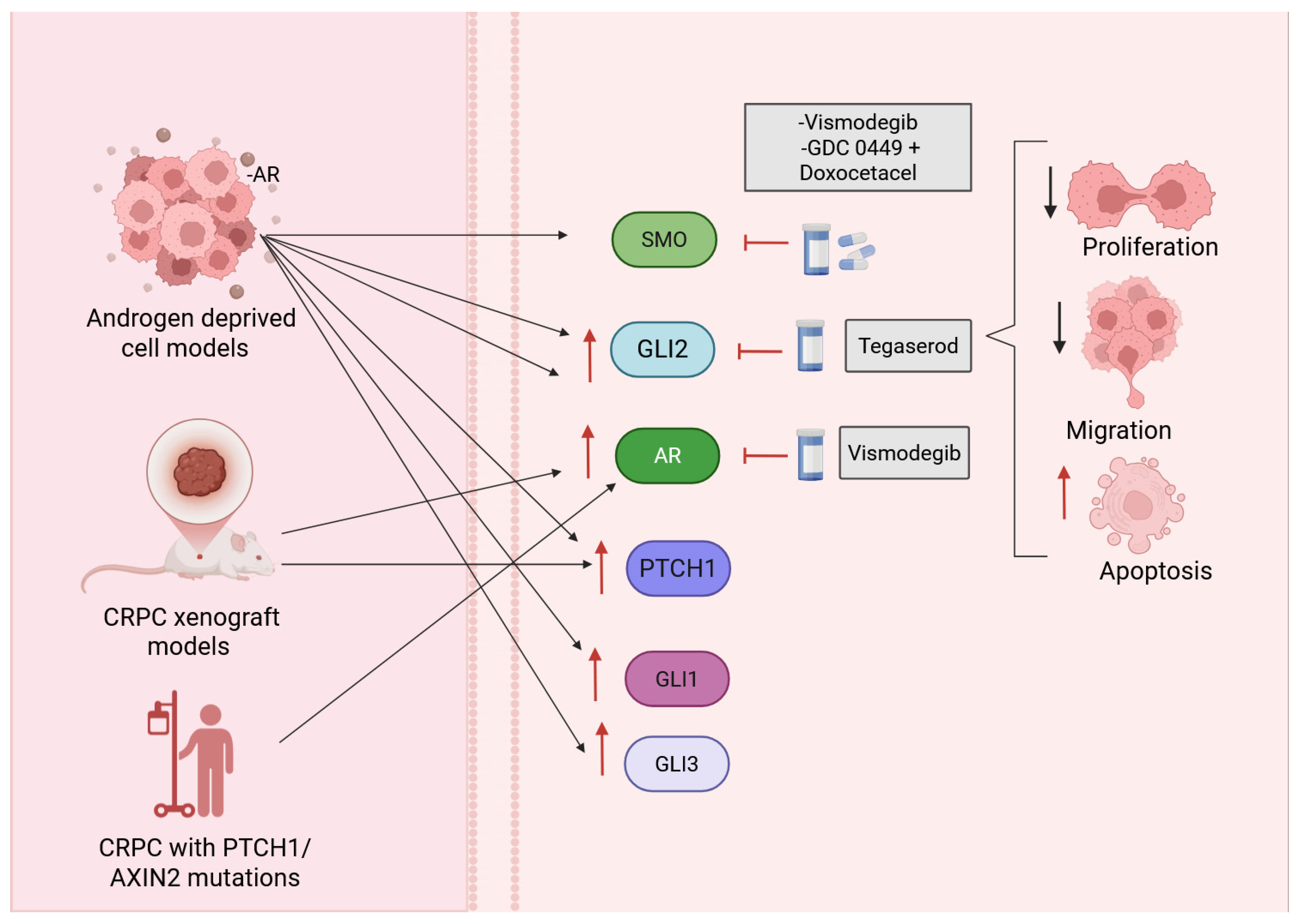
These observations also have therapeutic implications. In patients undergoing ADT, prolonged androgen loss may activate the Hh pathway in the tumor microenvironment. This implies Hh reactivation could drive CRPC progression even as androgens are reduced [5] (Figure 1).

4. GLI3 Expression and Oncogenic Functions

GLI3 is a zinc finger transcription factor that can function as a transcriptional activator (GLI3-FL) or repressor (GLI3-R) depending on tightly controlled proteolytic processing. Beyond its essential developmental roles in the formation of structures such as the brain, lungs, and limbs [33,34], aberrant GLI3 expression and activity have been linked to poor prognosis across several malignancies. In PCa, a human tissue microarray study reported significantly higher nuclear GLI3 levels in tumor samples (Gleason score 7–9) than in normal and adjacent normal tissues [9]. Consistently, GLI3 is reported as the most highly expressed GLI family member in LNCaP and 22Rv1 PCa cell lines, as well as in CWR22 xenografts and human PCa tumors [35]. Significantly, elevated GLI3—particularly the truncated activator isoform t-GLI3—has been associated with advanced PCa and has been implicated in promoting castration-resistant phenotypes [9,36].
Mechanistically, GLI3 oncogenicity is shaped by a multilayered posttranslational regulatory code that controls stability, subcellular localization, and transcriptional output. In addition to phosphorylation-dependent regulation by PKA, CK1, and GSK3β, SETD7-mediated lysine methylation enhances GLI3 stability and transcriptional activation, while PRMT5-dependent arginine methylation promotes nuclear retention and chromatin recruitment, linking GLI3 activity to epigenetic remodeling [8,37]. Ubiquitin-dependent mechanisms also govern GLI3 proteostasis: GLI3 stabilization has been linked to alterations in the SPOP axis [32], while additional E3 ligases contribute to GLI3 turnover and processing, including ITCH and FBXW11 (βTrCP2).
Notably, ITCH can ubiquitinate phosphorylated GLI3 in non-canonical contexts, whereas βTrCP2 preferentially promotes the generation of GLI3-R, suggesting that deregulation of these nodes could phenocopy SPOP-related effects and contribute to therapy-resistant states [38,39]. Together, these interconnected modifications create plausible vulnerabilities in CRPC, where shifts in methylation, phosphorylation, or ubiquitination may bias GLI3 toward oncogenic, activator-dominant forms [8,37].
Beyond cancer cell-intrinsic effects, GLI3 is increasingly recognized as an immunomodulatory node. Recent studies implicate GLI3-related signaling in macrophage polarization and inflammatory programming, including M2 differentiation and Th17-related regulatory axes [40,41]. Across cancer types, GLI3 has been associated with aggressive behavior and poor outcome in multiple contexts: coexpression with EphA10 promotes proliferation, invasion, and migration, and GLI3 has been linked to poor prognosis in breast cancer cohorts and related signaling networks [42]. In PCa, GLI3 stabilization has been linked to mutations in the SPOP gene, indicating its role as an oncogene in cancer progression [43], and GLI3 has been linked to poor prognosis in breast cancer cohorts and related signaling networks [36]. Additional evidence supports broader relevance in other malignancies, including pancreatic cancer, where GLI dysregulation contributes to immune infiltration, tumor aggressiveness, and metastatic behavior [44]. At the same time, GLI3 functions can be context-dependent; in neurodevelopmental tumors such as medulloblastoma, GLI3 expression has been associated with differentiation rather than proliferation [26,27], and tumor-suppressive functions have been reported in settings such as non-small-cell lung cancer [34,45].

5. Integrated Causal Architecture: Canonical and Noncanonical GLI3 Pathways

To avoid oscillation between paracrine, SMO-dependent narratives and SMO-independent activation of GLI3, we propose a single causal backbone that connects upstream triggers to AR programs and phenotypes. In this model, upstream triggers—including androgen-deprivation therapy (ADT), SPOP/MED12 alterations [28,29], and context-dependent GSK3β activity [9,46]—first reshape the posttranslational state of GLI3 through PKA/CK1/GSK3β phosphorylation [9,47], SUFU binding, βTrCP recognition, and SPOP-mediated ubiquitination [28]. These regulatory inputs determine the balance of GLI3 species, including GLI3-FL, GLI3-R, and truncated/activator t-GLI3 [9].
The resulting GLI3 species balance then biases AR program selection, for example, AR-FL versus the AR-V7 cistrome [9,10], ultimately shaping cellular outputs such as proliferation, migration/invasion, and steroidogenesis. Within this axis, canonical paracrine Hh signaling (ligand–PTCH1–SMO) feeds into the same GLI3 processing hub but is not strictly required when noncanonical routes bias GLI3 toward activator forms under androgen deprivation [47,48,49,50,51]. Operationally, this architecture imposes a hierarchy: triggers modulate the GLI3 processing hub, which determines species balance. Species balance then constrains the AR program, which drives phenotypes. Canonical Hh/SMO contributes upstream, but it becomes dispensable when the processing hub is already biased toward the GLI3 activator form [47,48,49,50,51].
Section 6 describes canonical and noncanonical components. However, to provide readers with a clear decision tree, we unify them as follows. Under ADT and/or SPOP/MED12 alterations [35,36], the GLI3 phospho-code (PKA/CK1/GSK3β) [9,46] and the SUFU–βTrCP axis [39] shift the equilibrium from GLI3-R toward activator forms, including t-GLI3 [9]. These activator forms then cooperate more efficiently with AR-V7 than with AR-FL, rerouting the AR cistrome to androgen-resistant enhancers [9,10]. Canonical ligand–PTCH1–SMO signaling can still feed into this processing node, but becomes nonessential once processing bias is established [47,48,49,50,51].
This regulatory hub extends beyond SPOP, and its deregulation may recapitulate or amplify the effects of SPOP loss, thereby reinforcing GLI3 accumulation and promoting transcriptional persistence under androgen-deprived conditions. Furthermore, methyltransferase signaling via SETD7 and PRMT5 integrates into this hub by maintaining GLI3 nuclear stability, suggesting a convergence of ubiquitination, methylation, and kinase pathways in defining GLI3’s transcriptional fate [8,47].

6. GLI3 Is a Regulator of Canonical and Noncanonical Shh Signaling

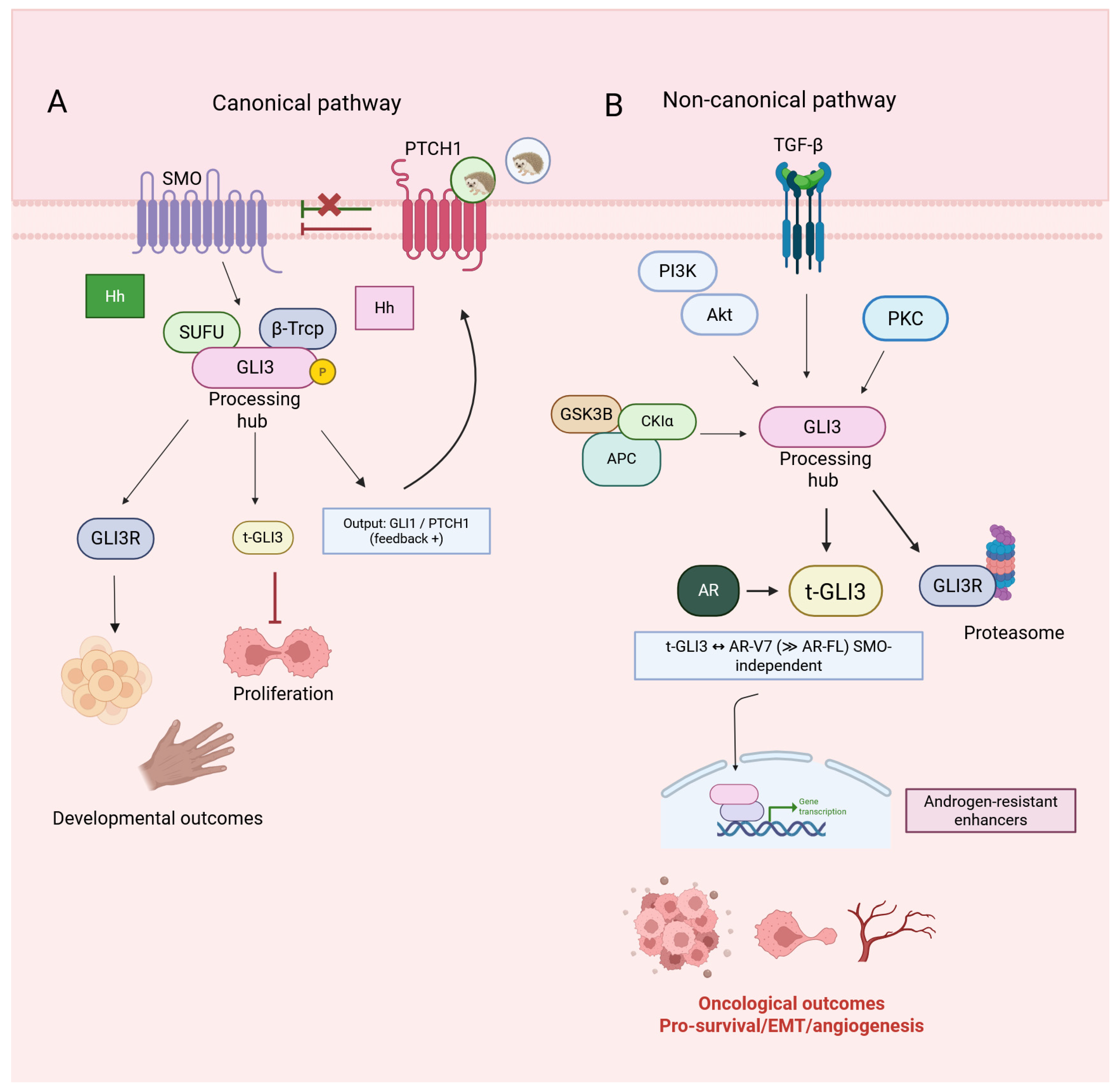
GLI3 regulates Hh signaling through a processing-dependent switch that integrates canonical and noncanonical inputs. In the canonical pathway, Shh ligands bind PTCH1, relieving SMO inhibition and promoting nuclear accumulation of full-length GLI3 (GLI3-FL), which drives target gene expression (Table 1) [47,48,49]. In the absence of Shh ligands, GLI3 is proteolytically processed into its repressor form GLI3-R, which suppresses Hh target genes [50,51]. This processing logic is essential in development—particularly in limb morphogenesis—and pathogenic GLI3 variants are linked to congenital phenotypes such as polydactyly and syndactyly [52,53] (Figure 2A). In cancer, multiple cilia-independent pathways converge on the same GLI3 “processing hub,” thereby enabling SMO-independent control of GLI3 output. For example, GLI3 can be activated by PKC independently of primary cilia and participates in TGF-β-responsive transcriptional programs [34]. In parallel, Wnt/β-catenin signaling intersects with GLI3 via phosphorylation by GSK3β and CK1α, promoting ubiquitination and degradation and thereby modulating transcriptional output [39]. GLI3 also contributes to cellular homeostasis through autophagy-related signaling via the PI3K/AKT axis [54]. Because canonical and noncanonical routes share kinase control of GLI3 processing and stability, upstream kinases such as GSK3β represent practical intervention points in Hh/GLI3-driven contexts [9,46] (Figure 2B).
Targeting these regulatory pathways could modulate aberrant GLI3 activity in cancer and improve therapeutic efficacy. However, this balance is disrupted in cancer, where GLI3 dysregulation contributes to tumor initiation, progression, and therapeutic resistance. GLI3 dysregulation has been associated with various malignancies, including breast, prostate, gastric, and colorectal cancers, where it promotes tumor growth, invasion, and metastasis. In colorectal cancer, GLI3 drives EMT, facilitating metastasis and correlating with poor prognosis [55]. In gastric cancer, GLI3 contributes to angiogenesis, reinforcing its oncogenic role [56]. In PCa, GLI3 interacts with the AR to facilitate noncanonical Shh activation, driving castration-resistant phenotypes [10,35]. A truncated form of GLI3 (t-GLI3) can activate the Smoothened-independent signaling axis (GSK3β/GLI3/AR-V7), promoting resistance to AR-targeted therapies [9]. Recent studies have shown that GLI3 modulates the tumor microenvironment by influencing macrophage polarization and shaping inflammatory responses that support tumor growth [41,55]. Conversely, in certain cancers, such as acute myeloid leukemia (AML) and medulloblastoma, GLI3 may function as a tumor suppressor, reflecting its context-dependent dual role in oncogenesis [51].
GLI3 is therefore a crucial player in developmental biology and cancer, with dual transcriptional roles and interactions with multiple pathways, making it a prime target for cancer therapy. Advances in therapies modulating the Hh/GLI3 axis show promise for improving outcomes in cancers with GLI3 dysregulation. A deeper understanding of GLI3’s molecular mechanisms is essential for developing personalized therapies and advancing precision oncology. Given its central role in cancer progression, GLI3 is emerging as a valuable therapeutic target and diagnostic biomarker. Elevated GLI3 expression is associated with poor clinical outcomes, and its regulation of critical oncogenic pathways highlights its potential for therapeutic interventions [57]. Inhibitors targeting GLI3 or its upstream regulators are being developed to reduce tumor proliferation and overcome drug resistance in Hh-driven cancers. Additionally, GLI3 expression levels may serve as predictive biomarkers for treatment response and prognosis in multiple malignancies [58].
Table 1 summarizes the roles and clinical associations of GLI3 in various malignancies. This highlights the diverse functional readouts observed in different cancer types, particularly the involvement of GLI3 in epithelial–stromal interactions in PCa. Notably, the interplay between GLI3, AR-V7, and SPOP mutations is central to the development of CRPC. These associations underscore the clinical importance of GLI3 as both a biomarker and therapeutic target.
Table 1. Reported roles and clinical associations of GLI3 across human cancers.
Cancer TypeGLI3 Role/AssociationFunctional ReadoutPotential BiomarkersTechniques UsedReferences
MedulloblastomaGLI3-R interaction with HIRA complex alters Gli3 activity.Tumor growth suppression via differentiation induction.GLI3-R, HIRACo-IP, Chromatin Immunoprecipitation (ChIP)[59]
High-grade GliomaGLI3 acts as an activator rather than a repressor.Inhibition of glioma cell proliferation and migration.GLI3-FL (full-length)Immunohistochemistry (IHC), Western blot (WB)[60]
Gastric CancerMutated GLI3 is associated with an invasive/metastatic phenotype. Positive correlation with ACOT1 expressionGLI3 overexpression is associated with invasive/metastatic phenotype, poor prognosisMutated GLI3, ACOT1TCGA and patient cohort, microarray, IHC[61,62]
Colorectal CancerGLI3 drives epithelial–mesenchymal transition (EMT).Increased cell migration, metastasis, and resistance to chemotherapy.GLI3-FL, ERK pathwayRT–PCR, WB, migration assays[55,63,64]
Breast Cancer (Triple-negative breast cancer, HER2-positive (HER2+) subtypes)GLI3 is implicated in aggressive subtypes.Poor prognosis, resistance to conventional therapies.GLI3-FL, ERα, FOXA1RT–PCR, ChIP-seq, IHC[65,66]
Lung CancerGLI3 expression is associated with lower 5-year survival rates.Poor prognosis and resistance to treatment.GLI3-FL, p53IHC, ChIP, RNA-seq[58,67]
Prostate Cancer (CRPC)GLI3 is involved in the progression to castration resistance.Increased proliferation and migration under ADT.GLI3-FL, AR-V7, SPOP mutationsIHC, PCR, WB, Xenografts[9,35]
Hematologic MalignanciesGLI3 downregulation mediates chemotherapy resistance.Resistance to chemotherapy and immune evasion.GLI3R, PDCD4qPCR, WB, Flow cytometry[68]

7. Androgen Receptor–GLI3 Feedback Loop Sustaining Shh Pathway Activation

Previous studies have indicated that GLI3 contributes to Shh pathway activation and the development of CRPC through its functional interaction with AR. Specifically, the physical interaction between GLI3 and AR amplifies an AR-dependent gene expression program, driving castration-resistant growth of the xenografted PCa model. This work also underscores the significance of SPOP mutations as a mechanism leading to GLI3 hyperactivation, thereby reinforcing AR–GLI3 cooperation. Functionally, these mutations impair GLI3 ubiquitination and proteasomal degradation, leading to GLI3 accumulation and increased transcriptional output, particularly under androgen-depleted conditions, where GLI3 is required for proliferation and migration [35].
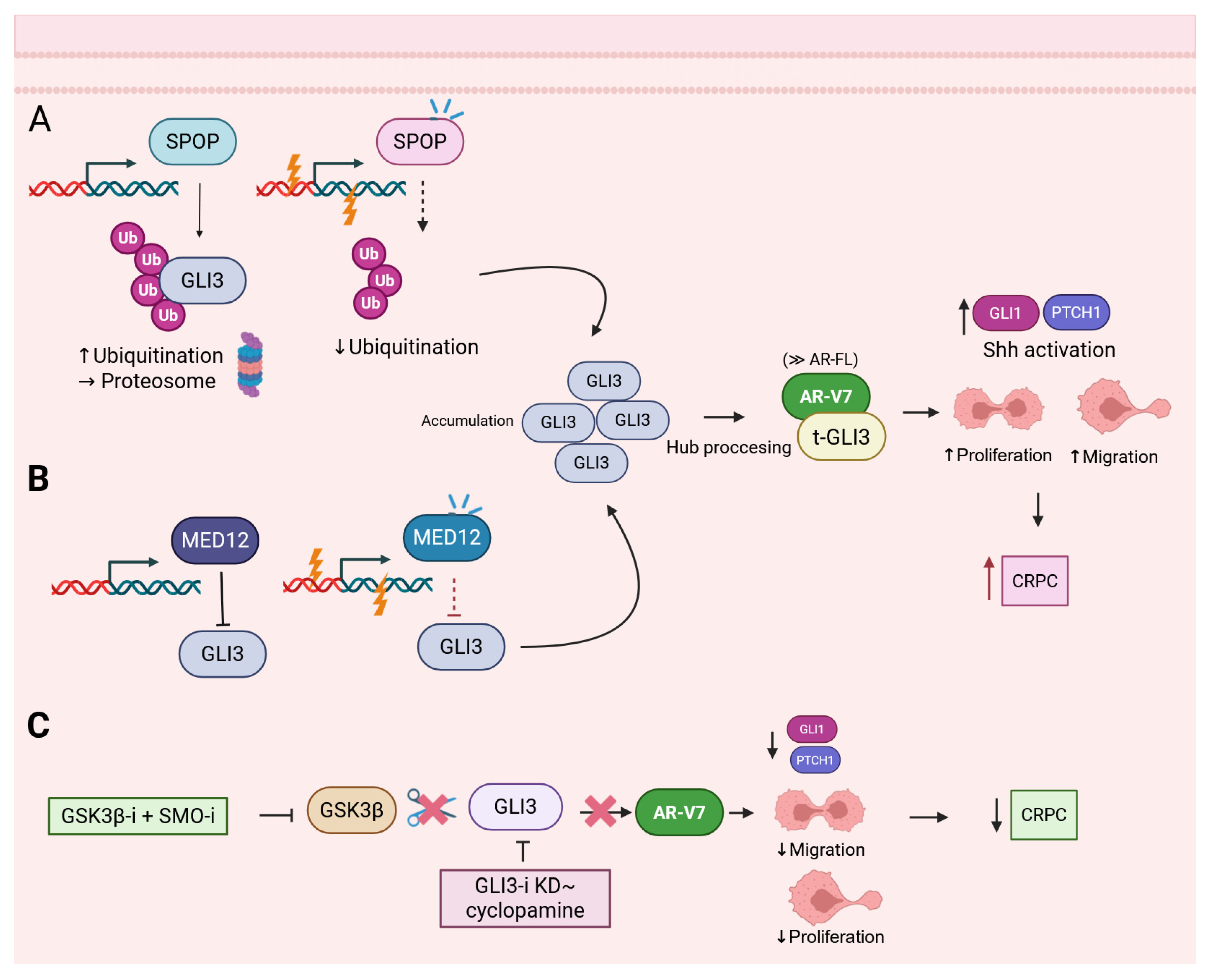
Importantly, SPOP alterations are also expected to potentiate the AR arm of this loop. An et al. demonstrated that wild-type SPOP directly recognizes a degron in the AR hinge domain and promotes ubiquitination and degradation of full-length AR (AR-FL), whereas prostate cancer-associated SPOP mutants fail to bind AR and cannot promote AR destruction; notably, AR splice variants that lack the hinge domain escape SPOP-mediated degradation, and antiandrogens can enhance SPOP-dependent AR degradation when SPOP is intact [69] (Figure 3A).
Consistent with an AR-centric phenotype in vivo, Blattner et al. showed that mutant SPOP activates AR signaling (together with PI3K/mTOR), effectively uncoupling the regular negative feedback between these pathways and promoting prostate tumorigenesis [70]. Collectively, these findings support a “double-hit” model in which SPOP mutation can stabilize both sides of the circuit: (i) increased AR pathway output (via impaired AR-FL turnover and selection for hinge-deficient AR variants) and (ii) increased GLI3 availability/activity (via impaired GLI3 turnover), thereby strengthening AR–GLI3 coupling during progression toward CRPC [35].
It is also noteworthy that independent studies support additional mechanistic layers connecting AR to GLI3 processing. A feedback model involving GSK3β, AR, and GLI3 has been proposed in which GSK3β processes GLI3 into a truncated form (t-GLI3) that selectively interacts with AR-V7. Co-immunoprecipitation experiments in AR-FL/AR-V7-expressing CRPC cells (LNCaP-135 and 22Rv1) showed t-GLI3 interaction with AR-V7, whereas no interaction was observed in AR-V7-negative C4-2B cells, suggesting selective cooperation between t-GLI3 and AR-V7 in AR-V7-positive CRPC. Additionally, combining a GSK3β inhibitor with an anti-SMO significantly inhibited CRPC cell growth (Figure 3) [9]. In a similar vein, a further study demonstrated that the interaction mediates Shh activation between AR and GLI3. In LNCaP cells, AR was shown to bind directly to GLI3, preventing its processing into the repressor form GLI3-R and favoring the activator form (GLI3-FL). This generated truncated polypeptides to reduce GLI3-AR interactions, thereby suppressing GLI1 and PTCH1 mRNA expression in both LNCaP and LNCaP androgen-independent cells. This suggests that a decrease in Shh signaling is induced by disrupting the AR-Gli3 interaction, thereby promoting tumor progression in PCa [10].
In addition, independent studies indicate that genetic alterations in MED12 promote CRPC by modulating GLI3 signaling. In LNCaP cells, shRNA-mediated loss of MED12 increases the expression of GLI3 target genes and drives excessive proliferation in the absence of androgens. These findings support a model in which MED12 functions as a negative regulator of the GLI3 pathway; its disruption removes this restraint, facilitating progression to CRPC [29] (Figure 3B). In parallel, AR-positive ovarian (OVCAR-3) and breast (MDA-MB-453, MDA-MB-231 cancer model cells also display a mutually reinforcing GLI3-AR axis. Loss of GLI3 via shRNA diminishes AR levels, and AR knockdown reciprocally decreases GLI3, supporting a direct regulatory link. This reciprocal regulation results in marked biological effects (Figure 3C). For instance, GLI3 suppression has been shown to markedly reduce proliferation and migration in AR-positive settings, while AR-negative cells, including BT-20 (breast cancer) and TOV-21G (ovarian cancer), remain largely unresponsive [65].

8. Discussion and Physiopathological Hypothesis

The evidence presented here underscores the central role of Shh signaling in PCa progression and the emergence of resistance to development. While this pathway is inactive mainly in adult tissues, its aberrant reactivation contributes to tumor cell proliferation, survival, and adaptation under androgen-deprived conditions. In particular, the AR plays a dual role in regulating and cooperating with Hh signaling, thereby facilitating reciprocal crosstalk that supports tumor growth in advanced stages of the disease. In this context, GLI3 emerges as a pivotal molecular node that can act as either GLI3-FL or GLI3-R. GLI3 integrates canonical Hh signaling with noncanonical regulatory inputs. It is evident that dysregulated GLI3 expression, particularly the truncated isoform t-GLI3, is a consistent predictor of unfavorable outcomes and progression to CRPC. Genetic alterations, including SPOP loss-of-function and MED12 inactivation, further highlight the vulnerability of GLI3 regulation. Both mutations impair the mechanisms that usually restrain GLI3 activity, leading to its accumulation and transcriptional hyperactivation.
Mechanistic studies demonstrate that GLI3 directly interacts with AR, reinforcing an AR-dependent transcriptional program that sustains proliferation, migration, and tumor progression even under androgen-deprived conditions. This cooperation can occur independently of SMO, emphasizing the versatility of the GLI3–AR axis in bypassing canonical regulation. The fact that this feedback circuit has also been documented in AR-positive ovarian and breast cancer cells suggests that the GLI3–AR interplay may represent a broader oncogenic paradigm across hormone-driven malignancies.
From a translational perspective, these insights carry significant therapeutic implications. It is important to note that even during ADT, Shh signaling may remain hyperactivated via GLI3, thereby sustaining tumor growth and driving resistance. This underscores the need to consider Hh/GLI3 reactivation as a potential complementary mechanism in cases of castration resistance. Research has shown that pharmacological inhibition of Hh signaling, either alone or in combination with AR antagonists, can effectively suppress tumor growth, reduce migration and invasion, and enhance apoptosis in preclinical models of CRPC.
Moreover, GLI3 expression patterns have the potential to serve as predictive biomarkers facilitating patient stratification and treatment response. In conclusion, GLI3 is not merely a downstream effector of Hh signaling, but rather a central regulator and oncogenic driver that cooperates with AR to sustain tumor growth under therapeutic pressure. Elucidation of the molecular determinants of this interaction and the development of strategies to disrupt it will be critical steps toward advancing precision medicine in PCa and potentially other AR-driven malignancies.
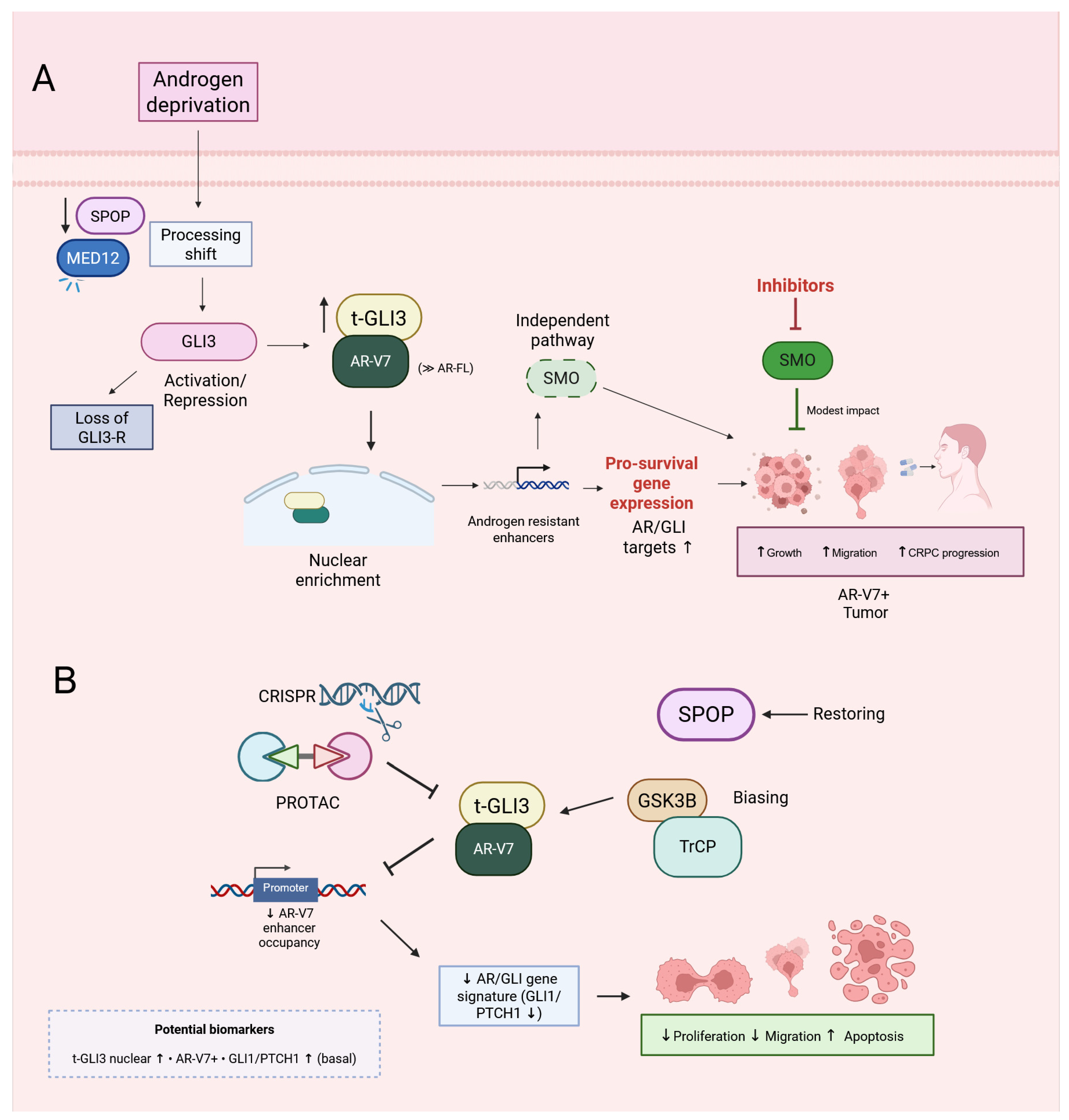
With the above-mentioned, we propose that, under androgen-deprived conditions and/or with alterations in SPOP or MED12, there is a shift in GLI3 processing towards the activation/truncated GLI3 (t-GLI3), with relative loss of GLI3R. This GLI3 population physically and/or functionally cooperates with AR-V7—more than with AR-FL—to redirect the AR cistrome to androgen-resistant enhancers and maintain pro-survival gene expression in a SMO-independent manner (Figure 4A). The following testable predictions can be derived from this: 1. Tumors that are AR-V7 positive will show nuclear/t-GLI3 enrichment and a GLI-dependent signature that is not efficiently suppressed by SMO inhibitors alone. 2. Selective disruption of the GLI3–AR interface (peptidic inhibitor, PROTAC, or CRISPR interference on interaction domains) will reduce AR-V7 enhancer occupancy and viability, even without SMO blockade, with weaker effects in AR-V7-negative models. 3. Restoring SPOP function or biasing GSK3β/βTrCP toward GLI3-R will revert resistance phenotypes (decreased AR/GLI targets, decreased growth), whereas SMO inhibition alone will have a modest impact. This hypothesis would be refuted under the following conditions: GLI3–AR-V7 co-occupancy is absent, GLI3 perturbation fails to alter the AR-V7 program or growth under ADT, SPOP/GLI3-R rescue does not reverse the phenotype, or SMO monotherapy strongly suppresses the AR-V7/GLI3 signature (Figure 4B).
The GLI3-AR feedback circuit has been identified as a driver of castration resistance. However, a coherent physiopathological hypothesis that situates this mechanism within the broader architecture of the TME has yet to be developed. A more integrated model should consider the interplay between epithelial tumor cells and surrounding stromal populations, particularly the prostate stromal fibroblasts (PrSCs) and immune infiltrates. These stromal populations are significant sources of Hh ligands and steroidogenic activity under androgen deprivation [71,72].
Several studies demonstrate that androgen-deprived stromal cells upregulate Sonic, Indian, and Dh ligands, which in turn activate canonical Hh signaling in adjacent epithelial tumor cells [6,19]. This paracrine loop promotes the expression of steroidogenic enzymes (e.g., CYP11A1, HSD3B2, AKR1C3), enabling local androgen biosynthesis. This process sustains AR programs despite castrate serum testosterone levels. Within this framework, GLI3 emerges as a molecular mediator of stromal–epithelial communication: it may drive transcription of steroidogenic enzymes in PrSCs while simultaneously reinforcing AR activity in epithelial cells through its physical and functional coupling with AR-V7. This dual positioning suggests that GLI3-dependent stromal reprogramming contributes to adaptive androgen synthesis, thereby establishing a self-sustaining endocrine niche under ADT.
From a cell-type-specific standpoint, epithelial GLI3 likely operates within the AR cistrome, cooperating with co-regulators such as FOXA1, HOXB13, and NCOA2 (SRC2) to rewire enhancer accessibility and redefine transcriptional outputs during castration resistance. FOXA1 acts as a pioneer factor facilitating AR–chromatin binding, while HOXB13 and NCOA2 function as co-activators that determine lineage fidelity and metabolic adaptation. These interactions could explain how GLI3–AR-V7 complexes redirect transcription toward androgen-independent enhancers associated with lipid metabolism, proliferation, and survival, as recently reported in 3D CRPC cultures. The exclusion of these co-regulators in the current discussion compromises the mechanistic completeness of the feedback model.
Their incorporation would clarify how GLI3 participates not only in signaling crosstalk but also in cistromic reprogramming that defines the resistant phenotype. Furthermore, the hypothesis should integrate immune and stromal contributions. GLI3 has been implicated in macrophage polarization and Th17 differentiation, suggesting that its activity may reshape the inflammatory microenvironment to favor tumor persistence. This implies a broader physiopathological model in which GLI3 coordinates the epithelial, stromal, and immune axes, sustaining local androgen signaling and paracrine tumor networks. Under androgen-deprived conditions or SPOP/MED12 mutations, a refined physiopathological hypothesis could posit that GLI3 is stabilized and transcriptionally active in both epithelial and stromal compartments.
In epithelial cells, GLI3 cooperates with AR-V7 and FOXA1/HOXB13/NCOA2 to maintain an androgen-independent transcriptional landscape. In stromal cells, GLI3 enhances steroidogenesis and paracrine Shh signaling, indirectly restoring AR stimulation. Together, these processes generate a multicellular feedback ecosystem that perpetuates tumor growth and therapeutic resistance (Figure 4B).

9. Conclusions

The complex interplay between the Hh and AR signaling pathways in PCa underscores the dynamic nature of tumor progression, particularly in CRPC. The GLI3 transcription factor, with its dual function as both an activator and a repressor, acts as a pivotal molecular hub at the intersection of these signaling axes. Non-canonical interactions between GLI3 and AR, particularly with the AR-V7 splice variant, promote CRPC by driving tumor cell proliferation, migration, and therapeutic resistance, especially under androgen deprivation. Mutations in SPOP and MED12 reinforce this feedback loop, exacerbating the reactivation of Shh signaling and facilitating tumor adaptation to ADT.
Interestingly, GLI3 operates through both canonical and non-canonical mechanisms, in which post-translational modifications and interactions with co-factors such as GSK3β, PKA, and βTrCP mediate its processing into t-GLI3. This process sustains the AR-driven transcriptional program. This mechanism reveals therapeutic target opportunities, including GLI3 inhibitors and GSK3β modulation, that could disrupt the GLI3–AR interaction and inhibit tumor progression.
Further exploration of the TME, particularly the interaction between epithelial tumor cells and stromal fibroblasts, is essential for designing targeted therapies that address GLI3’s immune-modulatory role. Such insights could be pivotal in overcoming the resistance to androgen-targeted therapies and enhancing patient outcomes in AR-driven malignancies. Future studies should refine these findings and potentially integrate GLI3 expression levels as biomarkers for patient stratification and treatment response. This would advance precision oncology and improve personalized care.

Author Contributions

Conceptualization, S.I.N.-O. and J.P.-R.; software, S.I.N.-O., E.M.C.-M. and J.P.-R.; validation, S.I.N.-O., E.M.C.-M., I.M.-R., J.J.F.-E., M.E.A.-S. and J.P.-R.; formal analysis, J.J.F.-E., S.I.N.-O., E.M.C.-M., M.E.A.-S. and J.P.-R.; investigation, S.I.N.-O., E.M.C.-M., I.M.-R., J.J.F.-E., M.E.A.-S. and J.P.-R.; data curation, S.I.N.-O. and J.P.-R.; writing—original draft preparation, S.I.N.-O., E.M.C.-M., I.M.-R. and J.P.-R.; writing—review and editing S.I.N.-O., E.M.C.-M., I.M.-R. and J.P.-R.; visualization, S.I.N.-O. and J.P.-R.; supervision, J.P.-R.; project administration, J.P.-R. All authors have read and agreed to the published version of the manuscript.

Funding

This research received no external funding.

Institutional Review Board Statement

Not applicable.

Informed Consent Statement

Not applicable.

Data Availability Statement

No new data were created or analyzed in this study. Data sharing does not apply to this article.

Acknowledgments

We acknowledge the División de Investigación for providing the facilities necessary for the completion of this article. This article also contributes to the objectives of the institutional project HJM-073/24-I “Caracterización funcional del microRNA miR-345 en la vía de GLI3 y su impacto en líneas celulares resistentes al cáncer de próstata”. E.M.C.-M., I.M.-R., J.J.F.-E., M.E.A.-S. and J.P.-R. received support from the Sistema Nacional de Investigadores e Investigadoras (SNII) of the Secretaría de Ciencia, Humanidades, Tecnología e Innovación (SECIHTI), Mexico.

Conflicts of Interest

The authors declare no conflicts of interest.

Abbreviations

The following abbreviations are used in this manuscript:
ARAndrogen Receptor
AR-V7Androgen Receptor Variant 7
ADTAndrogen Deprivation Therapy
CRPCCastration-Resistant Prostate Cancer
SMOSmoothened
SPOPSpeckle-Type POZ Protein
MED12Mediator Complex Subunit 12
GLI3GLI Family Zinc Finger 3
GLI1GLI Family Zinc Finger 1
GLI2GLI Family Zinc Finger 2
HhHedgehog
ShhSonic Hedgehog
PTCH1Patched 1
GSK3βGlycogen Synthase Kinase 3 Beta
GDC-0449A Hedgehog Pathway Inhibitor (Vismodegib)
SMO-iSMO Inhibitor
IHCImmunohistochemistry
ISHIn Situ Hybridization
PCaProstate Cancer
LNCaPAndrogen-dependent Human PCa Cell Line
C4-2BAndrogen-Independent Prostate Cancer Cell Line
TMETumor Microenvironment
EMTEpithelial–Mesenchymal Transition

References

  1. Bray, F.; Laversanne, M.; Sung, H.; Ferlay, J.; Siegel, R.L.; Soerjomataram, I.; Jemal, A. Global cancer statistics 2022: GLOBOCAN estimates of incidence and mortality worldwide for 36 cancers in 185 countries. CA Cancer J. Clin. 2024, 74, 229–263. [Google Scholar] [CrossRef]
  2. Aragon-Ching, J.B.; Dahut, W.L. Novel Androgen Deprivation Therapy (ADT) in the Treatment of Advanced Prostate Cancer. Drug Discov. Today Ther. Strateg. 2010, 7, 31–35. [Google Scholar] [CrossRef]
  3. Morote, J.; Aguilar, A.; Planas, J.; Trilla, E. Definition of Castrate Resistant Prostate Cancer: New Insights. Biomedicines 2022, 10, 689. [Google Scholar] [CrossRef]
  4. Watson, P.A.; Arora, V.K.; Sawyers, C.L. Emerging mechanisms of resistance to androgen receptor inhibitors in prostate cancer. Nat. Rev. Cancer 2015, 15, 701–711. [Google Scholar] [CrossRef] [PubMed]
  5. Chen, M.; Tanner, M.; Levine, A.C.; Levina, E.; Ohouo, P.; Buttyan, R. Androgenic regulation of hedgehog signaling pathway components in prostate cancer cells. Cell Cycle 2009, 8, 149–157. [Google Scholar] [CrossRef] [PubMed]
  6. Shigemura, K.; Huang, W.C.; Li, X.; Zhau, H.E.; Zhu, G.; Gotoh, A.; Fujisawa, M.; Xie, J.; Marshall, F.F.; Chung, L.W. Active sonic hedgehog signaling between androgen independent human prostate cancer cells and normal/benign but not cancer-associated prostate stromal cells. Prostate 2011, 71, 1711–1722. [Google Scholar] [CrossRef] [PubMed]
  7. Gonnissen, A.; Isebaert, S.; Haustermans, K. Hedgehog signaling in prostate cancer and its therapeutic implication. Int. J. Mol. Sci. 2013, 14, 13979–14007. [Google Scholar] [CrossRef]
  8. Fu, L.; Wu, H.; Cheng, S.Y.; Gao, D.; Zhang, L.; Zhao, Y. Set7 mediated Gli3 methylation plays a positive role in the activation of Sonic Hedgehog pathway in mammals. Elife 2016, 5, e15690. [Google Scholar] [CrossRef]
  9. Kaushal, J.B.; Raut, P.; Halder, S.; Alsafwani, Z.W.; Parte, S.; Sharma, G.; Abdullah, K.M.; Seshacharyulu, P.; Lele, S.M.; Batra, S.K.; et al. Oncogenic potential of truncated-Gli3 via the Gsk3β/Gli3/AR-V7 axis in castration-resistant prostate cancer. Oncogene 2025, 44, 1007–1023. [Google Scholar] [CrossRef]
  10. Li, N.; Truong, S.; Nouri, M.; Moore, J.; Al Nakouzi, N.; Lubik, A.A.; Buttyan, R. Non-canonical activation of hedgehog in prostate cancer cells mediated by the interaction of transcriptionally active androgen receptor proteins with Gli3. Oncogene 2018, 37, 2313–2325. [Google Scholar] [CrossRef]
  11. Suchors, C.; Kim, J. Canonical Hedgehog Pathway and Noncanonical GLI Transcription Factor Activation in Cancer. Cells 2022, 11, 2523. [Google Scholar] [CrossRef] [PubMed]
  12. Shen, D.; Xia, Y.; Fu, Y.; Cao, Q.; Chen, W.; Zhu, Y.; Guo, K.; Sun, L. Hedgehog pathway and cancer: A new area (Review). Oncol. Rep. 2024, 52, 116. [Google Scholar] [CrossRef]
  13. Marigo, V.; Roberts, D.J.; Lee, S.M.; Tsukurov, O.; Levi, T.; Gastier, J.M.; Epstein, D.J.; Gilbert, D.J.; Copeland, N.G.; Seidman, C.E. Cloning, expression, and chromosomal location of SHH and IHH: Two human homologues of the Drosophila segment polarity gene hedgehog. Genomics 1995, 28, 44–51. [Google Scholar] [CrossRef]
  14. Cong, G.; Zhu, X.; Chen, X.R.; Chen, H.; Chong, W. Mechanisms and therapeutic potential of the hedgehog signaling pathway in cancer. Cell Death Discov. 2025, 11, 40. [Google Scholar] [CrossRef]
  15. Niyaz, M.; Khan, M.S.; Mudassar, S. Hedgehog Signaling: An Achilles’ Heel in Cancer. Transl. Oncol. 2019, 12, 1334–1344. [Google Scholar] [CrossRef]
  16. Stecca, B.; Ruiz i Altaba, A. Context-dependent regulation of the GLI code in cancer by HEDGEHOG and non-HEDGEHOG signals. J. Mol. Cell Biol. 2010, 2, 84–95. [Google Scholar] [CrossRef]
  17. Sheng, T.; Li, C.; Zhang, X.; Chi, S.; He, N.; Chen, K.; McCormick, F.; Gatalica, Z.; Xie, J. Activation of the hedgehog pathway in advanced prostate cancer. Mol. Cancer 2004, 3, 29. [Google Scholar] [CrossRef] [PubMed]
  18. Sanchez, P.; Hernández, A.M.; Stecca, B.; Kahler, A.J.; DeGueme, A.M.; Barrett, A.; Beyna, M.; Datta, M.W.; Datta, S.; Ruiz i Altaba, A. Inhibition of prostate cancer proliferation by interference with SONIC HEDGEHOG-GLI1 signaling. Proc. Natl. Acad. Sci. USA 2004, 101, 12561–12566. [Google Scholar] [CrossRef] [PubMed]
  19. Lubik, A.A.; Nouri, M.; Truong, S.; Ghaffari, M.; Adomat, H.H.; Corey, E.; Cox, M.E.; Li, N.; Guns, E.S.; Yenki, P.; et al. Paracrine sonic hedgehog signaling contributes significantly to acquired steroidogenesis in the prostate tumor microenvironment. Int. J. Cancer 2017, 140, 358–369. [Google Scholar] [CrossRef]
  20. Shaw, G.; Price, A.M.; Ktori, E.; Bisson, I.; Purkis, P.E.; McFaul, S.; Oliver, R.T.; Prowse, D.M. Hedgehog signalling in androgen independent prostate cancer. Eur. Urol. 2008, 54, 1333–1343. [Google Scholar] [CrossRef]
  21. Gowda, P.S.; Deng, J.D.; Mishra, S.; Bandyopadhyay, A.; Liang, S.; Lin, S.; Mahalingam, D.; Sun, L.Z. Inhibition of hedgehog and androgen receptor signaling pathways produced synergistic suppression of castration-resistant prostate cancer progression. Mol. Cancer Res. 2013, 11, 1448–1461. [Google Scholar] [CrossRef] [PubMed]
  22. Chen, M.; Feuerstein, M.A.; Levina, E.; Baghel, P.S.; Carkner, R.D.; Tanner, M.J.; Shtutman, M.; Vacherot, F.; Terry, S.; de la Taille, A.; et al. Hedgehog/Gli supports androgen signaling in androgen deprived and androgen independent prostate cancer cells. Mol. Cancer 2010, 9, 89. [Google Scholar] [CrossRef]
  23. Yan, R.T.; Latourelle, J.; Khalid, O.; Parikh, R.B.; Church, B.W. PTCH1 and AXIN2 modulation of AR copy number effects on AR gene overexpression in metastatic castration resistant prostate cancer (mCRPC). J. Clin. Oncol. 2022, 40, e17026. [Google Scholar] [CrossRef]
  24. Ishii, A.; Shigemura, K.; Kitagawa, K.; Sung, S.Y.; Chen, K.C.; Yi-Te, C.; Liu, M.C.; Fujisawa, M. Anti-tumor Effect of Hedgehog Signaling Inhibitor, Vismodegib, on Castration-resistant Prostate Cancer. Anticancer Res. 2020, 40, 5107–5114. [Google Scholar] [CrossRef]
  25. Mimeault, M.; Rachagani, S.; Muniyan, S.; Seshacharyulu, P.; Johansson, S.L.; Datta, K.; Lin, M.F.; Batra, S.K. Inhibition of hedgehog signaling improves the anti-carcinogenic effects of docetaxel in prostate cancer. Oncotarget 2015, 6, 3887–3903. [Google Scholar] [CrossRef]
  26. Cai, M.; Ge, S.; Hong, Y.; Chen, Y.; Ren, Y.Z.; Zhong, D.; Chen, M.; Liu, Y.; Chen, Z.S.; Feng, N.; et al. Tegaserod maleate exerts anti-tumor effects on prostate cancer via repressing sonic hedgehog signaling pathway. Mol. Med. 2025, 31, 30. [Google Scholar] [CrossRef] [PubMed]
  27. Zhang, Q.; Peng, J.; Zhang, Y.; Liu, J.; He, D.; Zhao, Y.; Wang, X.; Li, C.; Kong, Y.; Wang, R.; et al. The kinase PLK1 promotes Hedgehog signaling-dependent resistance to the antiandrogen enzalutamide in metastatic prostate cancer. Sci. Signal. 2025, 18, eadi5174. [Google Scholar] [CrossRef] [PubMed]
  28. Maughan, B.L.; Suzman, D.L.; Luber, B.; Wang, H.; Glavaris, S.; Hughes, R.; Sullivan, R.; Harb, R.; Boudadi, K.; Paller, C.; et al. Pharmacodynamic study of the oral hedgehog pathway inhibitor, vismodegib, in patients with metastatic castration-resistant prostate cancer. Cancer Chemother. Pharmacol. 2016, 78, 1297–1304. [Google Scholar] [CrossRef]
  29. Ross, A.E.; Hughes, R.M.; Glavaris, S.; Ghabili, K.; He, P.; Anders, N.M.; Harb, R.; Tosoian, J.J.; Marchionni, L.; Schaeffer, E.M.; et al. Pharmacodynamic and pharmacokinetic neoadjuvant study of hedgehog pathway inhibitor Sonidegib (LDE-225) in men with high-risk localized prostate cancer undergoing prostatectomy. Oncotarget 2017, 8, 104182–104192. [Google Scholar] [CrossRef]
  30. Nguyen, A.; Xie, P.; Litvinov, I.V.; Lefrançois, P. Efficacy and Safety of Sonic Hedgehog Inhibitors in Basal Cell Carcinomas: An Updated Systematic Review and Meta-analysis (2009–2022). Am. J. Clin. Dermatol. 2023, 24, 359–374. [Google Scholar] [CrossRef]
  31. Rodon, J.; Tawbi, H.A.; Thomas, A.L.; Stoller, R.G.; Turtschi, C.P.; Baselga, J.; Sarantopoulos, J.; Mahalingam, D.; Shou, Y.; Moles, M.A.; et al. A phase I, multicenter, open-label, first-in-human, dose-escalation study of the oral smoothened inhibitor Sonidegib (LDE225) in patients with advanced solid tumors. Clin. Cancer Res. 2014, 20, 1900–1909. [Google Scholar] [CrossRef]
  32. Sun, W.; Li, L.; Du, Z.; Quan, Z.; Yuan, M.; Cheng, H.; Gao, Y.; Luo, C.; Wu, X. Combination of phospholipase Cε knockdown with GANT61 sensitizes castration-resistant prostate cancer cells to enzalutamide by suppressing the androgen receptor signaling pathway. Oncol. Rep. 2019, 41, 2689–2702. [Google Scholar] [CrossRef] [PubMed]
  33. Ruiz i Altaba, A. Gli proteins encode context-dependent positive and negative functions: Implications for development and disease. Development 1999, 126, 3205–3216. [Google Scholar] [CrossRef]
  34. Matissek, S.J.; Elsawa, S.F. GLI3: A mediator of genetic diseases, development and cancer. Cell Commun. Signal. 2020, 18, 54. [Google Scholar] [CrossRef]
  35. Burleson, M.; Deng, J.J.; Qin, T.; Duong, T.M.; Yan, Y.; Gu, X.; Das, D.; Easley, A.; Liss, M.A.; Yew, P.R.; et al. GLI3 Is Stabilized by SPOP Mutations and Promotes Castration Resistance via Functional Cooperation with Androgen Receptor in Prostate Cancer. Mol. Cancer Res. 2022, 20, 62–76. [Google Scholar] [CrossRef]
  36. Duong, T.M.; Araujo Rincon, M.; Myneni, N.; Burleson, M. Genetic alterations in MED12 promote castration-resistant prostate cancer through modulation of GLI3 signaling. Mol. Biol. Res. Commun. 2023, 12, 63–70. [Google Scholar] [CrossRef] [PubMed]
  37. Abe, Y.; Tanaka, N. Fine-Tuning of GLI Activity through Arginine Methylation: Its Mechanisms and Function. Cells 2020, 9, 1973. [Google Scholar] [CrossRef]
  38. Infante, P.; Lospinoso Severini, L.; Bernardi, F.; Bufalieri, F.; Di Marcotullio, L. Targeting Hedgehog Signalling through the Ubiquitylation Process: The Multiple Roles of the HECT-E3 Ligase Itch. Cells 2019, 8, 98. [Google Scholar] [CrossRef]
  39. Xue, C.; Chu, Q.; Shi, Q.; Zeng, Y.; Lu, J.; Li, L. Wnt signaling pathways in biology and disease: Mechanisms and therapeutic advances. Signal Transduct. Target. Ther. 2025, 10, 106. [Google Scholar] [CrossRef] [PubMed]
  40. Boutilier, A.J.; Raad, M.; Paar, K.E.; Matissek, S.J.; Banks, C.E.; Carl, A.L.; Murray, J.M.; Metzler, A.D.; Koeppen, K.U.; Gupta, M.; et al. GLI3 Is Required for M2 Macrophage Polarization and M2-Mediated Waldenström Macroglobulinemia Growth and Survival. Int. J. Mol. Sci. 2024, 25, 13120. [Google Scholar] [CrossRef]
  41. Hanna, J.; Beke, F.; O’Brien, L.M.; Kapeni, C.; Chen, H.C.; Carbonaro, V.; Kim, A.B.; Kishore, K.; Adolph, T.E.; Skjoedt, M.O.; et al. Cell-autonomous Hedgehog signaling controls Th17 polarization and pathogenicity. Nat. Commun. 2022, 13, 4075. [Google Scholar] [CrossRef]
  42. Riobo-Del Galdo, N.A.; Lara Montero, Á.; Wertheimer, E.V. Role of Hedgehog Signaling in Breast Cancer: Pathogenesis and Therapeutics. Cells 2019, 8, 375. [Google Scholar] [CrossRef]
  43. Zakari, S.; Rotimi, S.O.; Bholah, C.T.; Ogunlana, O.O. Updates on SPOP Gene Mutations in Prostate Cancer and Computational Insights from TCGA cBioPortal Database. Scientifica 2025, 2025, 4084224. [Google Scholar] [CrossRef]
  44. Scales, M.K.; Velez-Delgado, A.; Steele, N.G.; Schrader, H.E.; Stabnick, A.M.; Yan, W.; Mercado Soto, N.M.; Nwosu, Z.C.; Johnson, C.; Zhang, Y.; et al. Combinatorial Gli activity directs immune infiltration and tumor growth in pancreatic cancer. PLoS Genet. 2022, 18, e1010315. [Google Scholar] [CrossRef]
  45. Yi, X.; Chen, X.; Li, Z. miR-200c targeting GLI3 inhibits cell proliferation and promotes apoptosis in non-small cell lung cancer cells. Medicine 2024, 103, e39658. [Google Scholar] [CrossRef]
  46. Tempé, D.; Casas, M.; Karaz, S.; Blanchet-Tournier, M.F.; Concordet, J.P. Multisite protein kinase A and glycogen synthase kinase 3beta phosphorylation leads to Gli3 ubiquitination by SCFbetaTrCP. Mol. Cell Biol. 2006, 26, 4316–4326. [Google Scholar] [CrossRef] [PubMed]
  47. Yang, F.; Wynn, D.T.; Shen, C.; Ayad, N.G.; Robbins, D.J. Multiprotein GLI Transcriptional Complexes as Therapeutic Targets in Cancer. Life 2022, 12, 1967. [Google Scholar] [CrossRef] [PubMed]
  48. Nguyen, T.N.; Tran, G.S.; Hoang, H.D.; Nguyen, L.G. A novel missense variant located within the zinc finger domain of the GLI3 gene was identified in a Vietnamese pedigree with index finger polydactyly. Mol. Genet. Genom. Med. 2024, 12, e2468. [Google Scholar] [CrossRef] [PubMed]
  49. Umair, M.; Wasif, N.; Albalawi, A.M.; Ramzan, K.; Alfadhel, M.; Ahmad, W.; Basit, S. Exome sequencing revealed a novel loss-of-function variant in the GLI3 transcriptional activator 2 domain underlies nonsyndromic postaxial polydactyly. Mol. Genet. Genom. Med. 2019, 7, e00627. [Google Scholar] [CrossRef]
  50. Dai, P.; Akimaru, H.; Tanaka, Y.; Maekawa, T.; Nakafuku, M.; Ishii, S. Sonic Hedgehog-induced activation of the Gli1 promoter is mediated by GLI3. J. Biol. Chem. 1999, 274, 8143–8152. [Google Scholar] [CrossRef]
  51. Chaudhry, P.; Singh, M.; Triche, T.J.; Guzman, M.; Merchant, A.A. GLI3 repressor determines Hedgehog pathway activation and is required for response to SMO antagonist glasdegib in AML. Blood 2017, 129, 3465–3475. [Google Scholar] [CrossRef]
  52. Xiang, Y.; Li, X.; Zhan, Z.; Feng, J.; Cai, H.; Li, Y.; Fu, Q.; Xu, Y.; Jiang, H.; Zhang, X. A Novel Nonsense. Front. Genet. 2020, 11, 542004. [Google Scholar] [CrossRef] [PubMed]
  53. Shen, X.; Zhang, S.; Zhang, X.; Zhou, T.; Rui, Y. Two nonsense GLI3 variants are associated with polydactyly and syndactyly in two families by affecting the sonic hedgehog signaling pathway. Mol. Genet. Genom. Med. 2022, 10, e1895. [Google Scholar] [CrossRef] [PubMed]
  54. Lo Ré, A.E.; Fernández-Barrena, M.G.; Almada, L.L.; Mills, L.D.; Elsawa, S.F.; Lund, G.; Ropolo, A.; Molejon, M.I.; Vaccaro, M.I.; Fernandez-Zapico, M.E. Novel AKT1-GLI3-VMP1 pathway mediates KRAS oncogene-induced autophagy in cancer cells. J. Biol. Chem. 2012, 287, 25325–25334. [Google Scholar] [CrossRef]
  55. Shen, M.; Zhang, Z.; Wang, P. GLI3 Promotes Invasion and Predicts Poor Prognosis in Colorectal Cancer. Biomed Res. Int. 2021, 2021, 8889986. [Google Scholar] [CrossRef] [PubMed]
  56. Tao, B.; Wang, Z.; Wang, X.; Song, A.; Liu, J.; Wang, J.; Zhang, Q.; Chen, Z.; Xu, W.; Sun, M.; et al. An inherited predisposition allele promotes gastric cancer via enhancing deubiquitination-mediated activation of epithelial-to-mesenchymal transition signaling. J. Clin. Investig. 2025, 135, e179617. [Google Scholar] [CrossRef]
  57. Lou, H.; Li, H.; Huehn, A.R.; Tarasova, N.I.; Saleh, B.; Anderson, S.K.; Dean, M. Genetic and Epigenetic Regulation of the Smoothened Gene (SMO) in Cancer Cells. Cancers 2020, 12, 2219. [Google Scholar] [CrossRef]
  58. Ishikawa, M.; Sonobe, M.; Imamura, N.; Sowa, T.; Shikuma, K.; Date, H. Expression of the GLI family genes is associated with tumor progression in advanced lung adenocarcinoma. World J. Surg. Oncol. 2014, 12, 253. [Google Scholar] [CrossRef]
  59. Skarżyńska, W.; Baran, B.; Niewiadomski, P. The Hira complex regulates Gli3R-dependent transcription in Hedgehog signaling and medulloblastoma cell growth and migration. Sci. Rep. 2025, 15, 324. [Google Scholar] [CrossRef]
  60. Volnitskiy, A.; Shtam, T.; Burdakov, V.; Kovalev, R.; Konev, A.; Filatov, M. Abnormal activity of transcription factors gli in high-grade gliomas. PLoS ONE 2019, 14, e0211980. [Google Scholar] [CrossRef]
  61. Zhang, W.; Jin, W.; Wan, H.; Niu, C.; Yan, C.; Wang, C.; Liu, J.; Li, X.; Zong, Q.; Gao, N.; et al. Abstract 4650: The impact of GLI3 mutations and expression on prognosis in gastric cancer. Cancer Res. 2025, 85. [Google Scholar] [CrossRef]
  62. Wang, F.; Wu, J.; Qiu, Z.; Ge, X.; Liu, X.; Zhang, C.; Xu, W.; Hua, D.; Qi, X.; Mao, Y. ACOT1 expression is associated with poor prognosis in gastric adenocarcinoma. Hum. Pathol. 2018, 77, 35–44. [Google Scholar] [CrossRef]
  63. Iwasaki, H.; Nakano, K.; Shinkai, K.; Kunisawa, Y.; Hirahashi, M.; Oda, Y.; Onishi, H.; Katano, M. Hedgehog Gli3 activator signal augments tumorigenicity of colorectal cancer via upregulation of adherence-related genes. Cancer Sci. 2013, 104, 328–336. [Google Scholar] [CrossRef]
  64. Trnski, D.; Sabol, M.; Gojević, A.; Martinić, M.; Ozretić, P.; Musani, V.; Ramić, S.; Levanat, S. GSK3β and Gli3 play a role in activation of Hedgehog-Gli pathway in human colon cancer-Targeting GSK3β downregulates the signaling pathway and reduces cell proliferation. Biochim. Biophys. Acta 2015, 1852, 2574–2584. [Google Scholar] [CrossRef]
  65. Lin, M.; Zhu, H.; Shen, Q.; Sun, L.Z.; Zhu, X. GLI3 and androgen receptor are mutually dependent for their malignancy-promoting activity in ovarian and breast cancer cells. Cell Signal. 2022, 92, 110278. [Google Scholar] [CrossRef]
  66. Peng, J.; Zhang, D. Coexpression of EphA10 and Gli3 promotes breast cancer cell proliferation, invasion and migration. J. Investig. Med. 2021, 69, 1215–1221. [Google Scholar] [CrossRef] [PubMed]
  67. Wu, Y.; Guo, W.; Wang, T.; Liu, Y.; Mullor, M.D.M.R.; Rodrìguez, R.A.; Zhao, S.; Wei, R. The comprehensive landscape of prognosis, immunity, and function of the GLI family by pan-cancer and single-cell analysis. Aging 2024, 16, 5123–5148. [Google Scholar] [CrossRef]
  68. Freisleben, F.; Behrmann, L.; Thaden, V.; Muschhammer, J.; Bokemeyer, C.; Fiedler, W.; Wellbrock, J. Downregulation of GLI3 Expression Mediates Chemotherapy Resistance in Acute Myeloid Leukemia. Int. J. Mol. Sci. 2020, 21, 5084. [Google Scholar] [CrossRef] [PubMed]
  69. An, J.; Wang, C.; Deng, Y.; Yu, L.; Huang, H. Destruction of full-length androgen receptor by wild-type SPOP, but not prostate-cancer-associated mutants. Cell Rep. 2014, 6, 657–669. [Google Scholar] [CrossRef]
  70. Blattner, M.; Liu, D.; Robinson, B.D.; Huang, D.; Poliakov, A.; Gao, D.; Nataraj, S.; Deonarine, L.D.; Augello, M.A.; Sailer, V.; et al. SPOP Mutation Drives Prostate Tumorigenesis In Vivo through Coordinate Regulation of PI3K/mTOR and AR Signaling. Cancer Cell 2017, 31, 436–451. [Google Scholar] [CrossRef] [PubMed]
  71. Domenech, M.; Bjerregaard, R.; Bushman, W.; Beebe, D.J. Hedgehog signaling in myofibroblasts directly promotes prostate tumor cell growth. Integr. Biol. 2012, 4, 142–152. [Google Scholar] [CrossRef] [PubMed]
  72. Bennett, N.C.; Hooper, J.D.; Lambie, D.; Lee, C.S.; Yang, T.; Vesey, D.A.; Samaratunga, H.; Johnson, D.W.; Gobe, G.C. Evidence for steroidogenic potential in human prostate cell lines and tissues. Am. J. Pathol. 2012, 181, 1078–1087. [Google Scholar] [CrossRef] [PubMed]
Figure 1. Androgen receptor-mediated activation of Shh signaling in PCa and effects of pharmacologic blockade. Under ADT, AR-positive tumor cells increase the secretion of Shh ligands (Sonic, Indian, and Desert), which activate paracrine/autocrine Shh–PTCH1–SMO signaling in the tumor microenvironment. This elevates the expression of target genes (PTCH1, GLI1, and GLI2) and AR, thereby supporting growth in the absence of androgens (cell culture and xenograft models). Stromal Shh activation can induce local steroidogenesis, further reinforcing the AR circuit. SMO inhibitors (e.g., TAK-441 and vismodegib/GDC-0449) and rational combinations (e.g., vismodegib and enzalutamide, or SMO-I and docetaxel/tegaserod) attenuate Shh/GLI signaling. These inhibitors are associated with decreased proliferation and migration/invasion, and increased apoptosis in CRPC models. The figure summarizes evidence from in vitro and mouse xenograft model as well as the clinical context, indicating nodes within the Shh/GLI/AR axis with relative upregulation (upward red arrows) and pharmacologic intervention points (vial icons). Up red arrows indicate activation, down black arrows and red inhibition arrow indicates suppression. Created in BioRender.com. Stephanie I Nuñez Olvera (2025).
Receptors 05 00004 g001
Figure 2. The canonical and noncanonical regulation of GLI3 in Hh signaling and cancer implications. (A) canonical pathway: Shh binds PTCH1, activating SMO and the GLI3 processing hub (PKA, CK1, GSK3β, SUFU, βTrCP). This controls the balance between GLI3-FL and GLI3-R, driving nuclear activation or repression and developmental outcomes such as limb morphogenesis. Hh in the red box: Hh pathway off; Hh in the green box: Hh pathway on. (B) (noncanonical): Cilia-independent inputs (PKC, TGF-β, Wnt/β-catenin, and PI3K/AKT) converge on the same hub, regulating GLI3-FL, GLI3-R, and t-GLI3, which engage a SMO-independent GSK3β/GLI3/AR-V7 axis. This pathway promotes oncogenic outputs, including proliferation, EMT/metastasis, and angiogenesis. Arrows indicate signaling directions, and nodes represent key proteins or complexes. Black arrows indicate activation process, red cross indicates suppression. Created in BioRender.com. Stephanie I Nuñez Olvera (2025).
Receptors 05 00004 g002
Figure 3. The AR–GLI3 feedback loop links SPOP/MED12 lesions and GSK3β processing to sustained Shh pathway activation and CRPC progression. (A) SPOP-dependent proteostasis. Wild-type SPOP–CUL3 promotes GLI3 polyubiquitination and proteasomal turnover. SPOP mutations (lighting symbol represents DNA damage and blue radiating lines represents mutated protein) reduce GLI3 ubiquitination, resulting in GLI3 accumulation. The accumulated pool is funneled through the GLI3 processing hub, generating t-GLI3, which preferentially associates with AR-V7 (≫AR-FL). This complex redirects output towards Shh pathway activation (GLI1/PTCH1 increased) and drives proliferation and migration, supporting CRPC growth under androgen deprivation. (B) MED12 loss releases the brake on GLI3. In the canonical setting, MED12 restrains GLI3 activity. Loss-of-function MED12 derepresses GLI3, increasing the GLI3 pool that feeds the hub, thereby amplifying the t-GLI3↔AR-V7 axis and its downstream phenotypes. (C) Therapeutic nodes and functional readouts. GSK3β inhibition combined with SMO blockade curtails growth by limiting t-GLI3 generation and canonical Hh input. Direct GLI3 interference (inhibitor/knockdown) phenocopies cyclopamine, attenuating GLI1/PTCH1 expression and reducing migration and proliferation, ultimately restraining CRPC. Black arrows indicate activation process, red cross indicates suppression and inhibition symbol indicates suppression. Created in BioRender.com. Stephanie I Nuñez Olvera (2025).
Receptors 05 00004 g003
Figure 4. Proposed GLI3–AR axis under androgen deprivation and actionable intervention points (A). Mechanism. Under androgen deprivation and/or alterations in SPOP or MED12, GLI3 processing shifts toward an activating/truncated isoform (t-GLI3), which results in a relative loss of the repressor GLI3-R. t-GLI3 preferentially cooperates with AR-V7 over AR-FL. This promotes nuclear enrichment, redirects the AR cistrome to androgen-resistant enhancers, and sustains a pro-survival transcriptional program (AR/GLI targets increase) that drives growth, migration, and CRPC progression. This axis can bypass canonical SMO signaling, which is consistent with the modest impact of SMO inhibitors in AR-V7/t-GLI3–dominant contexts. (B). Interventions and testable predictions. Selective disruption of the GLI3–AR interface using a peptide inhibitor, a PROTAC, or a CRISPRi is predicted to reduce AR-V7 enhancer occupancy, attenuate the AR/GLI gene signature (e.g., decreased GLI1/PTCH1), and induce decreased proliferation and migration and increased apoptosis even without SMO blockade. Conversely, restoring SPOP function or biasing GSK3β/βTrCP toward GLI3-R is expected to reverse resistance phenotypes (e.g., decreased AR/GLI targets and growth). A Biomarker panel for stratification includes nuclear t-GLI3 enrichment, AR-V7 positivity, and an elevated GLI signature at baseline that decreases upon intervention. Black arrows indicate activation process and inhibition symbol indicates suppression. Created in BioRender.com. Stephanie I Nuñez-Olvera (2025).
Receptors 05 00004 g004
Disclaimer/Publisher’s Note: The statements, opinions and data contained in all publications are solely those of the individual author(s) and contributor(s) and not of MDPI and/or the editor(s). MDPI and/or the editor(s) disclaim responsibility for any injury to people or property resulting from any ideas, methods, instructions or products referred to in the content.