Article

Association Between Self-Reported Faster Walking Pace and Subclinical Hypothyroidism in Relation to the Status of Atherosclerosis


1
Department of General Medicine, Nagasaki University Graduate School of Biomedical Sciences, Nagasaki 852-8501, Japan
2
Epidemiology Section, Division of Public Health, Osaka Institute of Public Health, Osaka 537-0025, Japan
3
Department of Community Medicine, Nagasaki University Graduate School of Biomedical Sciences, Nagasaki 852-8523, Japan
4
Department of Health Society and Statistics, Atomic Bomb Disease Institute, Nagasaki University, Nagasaki 852-8523, Japan
5
Leading Medical Research Core Unit, Nagasaki University Graduate School of Biomedical Sciences, Nagasaki 852-8523, Japan
6
Nagasaki University Health Center, Nagasaki 852-8501, Japan
*
Author to whom correspondence should be addressed.
J. Vasc. Dis. 2026, 5(3), 27; https://doi.org/10.3390/jvd5030027
Submission received: 28 April 2026 / Revised: 15 June 2026 / Accepted: 15 June 2026 / Published: 18 June 2026
(This article belongs to the Section Peripheral Vascular Diseases)

Abstract

Background/Objectives: This study examined the association between self-reported walking pace and subclinical hypothyroidism (SCH) in relation to atherosclerotic status, as both walking pace and SCH have been linked to an increased risk of all-cause mortality and cardiovascular disease. The vascular network underlying atherosclerotic processes may help explain this relationship. Methods: This was a cross-sectional study involving 1719 Japanese with normal thyroid function (free triiodothyronine [T3] and free thyroxine [T4] levels within the normal range). Since all individuals who participated in this study had free T3 and free T4 levels within the normal range, those with elevated TSH levels (>4.01 μIU/mL) were classified as having SCH. Self-reported faster walking pace was identified based on the participants’ responses to whether they perceived themselves as walking faster than their peers of the same age and sex. Logistic regression models were used to calculate the odds ratios (ORs) and 95% confidence intervals (CIs) for SCH. Results: Of the study participants, 166 had atherosclerosis and 98 had SCH. Among individuals without atherosclerosis, a self-reported faster walking pace was significantly inversely associated with SCH but not among those with atherosclerosis. The sex and age-adjusted ORs (95% CIs) of SCH for self-reported faster walking pace were 0.58 (0.37, 0.91) for those without atherosclerosis and 2.35 (0.75, 7.36) for those with atherosclerosis. Atherosclerosis showed a significant interaction with the association between SCH and self-reported faster walking pace, with sex- and age-adjusted p-values of 0.027. These associations persisted, even after adjusting for potential confounding factors. Conclusions: Self-reported faster walking pace is inversely associated with SCH in individuals without atherosclerosis but not in those with atherosclerosis. Atherosclerosis status may influence the association between SCH and self-reported faster walking pace.

1. Introduction

Brisk walking, a form of aerobic exercise, has beneficial effects in reducing cardiovascular risk [1,2]. Self-rated walking pace is also associated with all-cause and cardiovascular disease mortality [3].
Regular aerobic exercise improves vascular endothelial function, partly by increasing the number and function of circulating progenitor cells [4].
A previous meta-analysis has shown that a reduction in the number of circulating progenitor cells, including endothelial progenitor cells, is a risk factor for adverse cardiovascular outcomes and death [5]. Therefore, progenitor cells play an important role in the association between body weight and cardiovascular disease.
Subclinical hypothyroidism (SCH) is a biochemical condition typically characterized by elevated serum thyroid-stimulating hormone (TSH) levels and normal concentrations of peripheral thyroid hormones, such as free triiodothyronine (T3) and free thyroxine (T4). The number of circulating progenitor cells is reportedly lower in individuals with SCH than in healthy controls [6].
SCH, which has been reported to be associated with cardiovascular risk factors [7], is also positively associated with all-cause mortality [8].
Therefore, a self-reported faster walking pace may be inversely associated with SCH, possibly because the circulating progenitor cells mediate this association.
Circulating progenitor cells can differentiate into endothelial cells [9], macrophages, and foam cells [10,11]. Macrophages and foam cells are known sources of atherosclerosis, and the development of atherosclerosis requires progenitor cells [12].
During atherosclerosis development, many circulating progenitor cells differentiate into mature cells [9,10,11], which reduces the number of circulating progenitor cells [13]. Therefore, atherosclerosis status could function as a strong confounder in the association between a self-reported faster walking pace and SCH.
To evaluate the association between a self-reported faster walking pace and SCH, a cross-sectional study of 1719 Japanese individuals with normal thyroid function (within the normal range of T3 and T4) was conducted.

2. Materials and Methods

2.1. Study Population

Comprehensive explanations of the risk-assessment procedures, including the thyroid examination protocol, have been detailed in previous reports [14,15,16].
The present analysis targeted residents of Saza Town in western Japan who were aged between 40 and 74 years and participated in a government-supported annual health check-up conducted in 2014. A total of 1883 individuals initially took part in the survey.
To avoid confounding by preexisting thyroid abnormalities, several exclusion criteria were applied. Participants were removed if they had a known history of thyroid disorders (n = 60), if measurements of thyroid-related hormones (TSH, free T3, or free T4) were unavailable (n = 17), or if their free T3 (2.1–4.1 pg/mL) or free T4 (1.0–1.7 ng/dL) values fell outside the standard reference intervals (n = 77).
Additional exclusion criteria included missing information on body mass index (n = 1), atherosclerosis assessment (n = 1), alcohol consumption (n = 1), smoking status (n = 2), blood pressure (n = 1), Kessler Psychological Distress Scale (K6) scores (n = 3), and self-reported walking pace (n = 1).
After applying all criteria, 1719 participants remained eligible for the analysis. Their mean age was 60.5 years, with a standard deviation of 9.1 years, and their ages ranged from 40 to 74 years.

2.2. Data Collection and Laboratory Measurements

Information on participants’ clinical characteristics was collected through interviews with trained staff members. Self-reported faster walking pace was identified based on the participants’ responses to whether they perceived themselves as walking faster than their peers of the same age and sex. A previous study conducted among obese individuals using the same questionnaire reported that those who walked at a faster pace had lower odds of metabolic disease [17]. These findings support the utility of this questionnaire for assessing faster self-reported walking pace.
Regular exercise habits were determined from answers to a separate question asking whether individuals engaged in light physical activity—sufficient to induce sweating—for at least 30 min per session, a minimum of twice weekly, and were maintained for more than one year.
Body mass index (BMI, kg/m2) was derived from height and weight measurements obtained using an automated body composition device (BF-220; Tanita, Tokyo, Japan). Participants with a BMI of 25 kg/m2 or higher were categorized as overweight.
Blood pressure was assessed in a seated position with an automated sphygmomanometer (HEM-907; Omron, Kyoto, Japan) after participants had rested for at least five minutes. High blood pressure was defined as systolic pressure of 140 mmHg or above, diastolic pressure of 90 mmHg or above, or current use of antihypertensive medication.
Fasting venous blood samples were obtained from all the participants. Serum concentrations of TSH, free T3, and free T4 were determined using chemiluminescent immunoassay techniques performed by LSI Medience Corporation (Tokyo, Japan). The reference intervals for free T3 (2.1–4.1 pg/mL), free T4 (1.0–1.7 ng/dL), and TSH (0.39–4.01 μIU/mL) associated with this assay method have been reported previously [18].
Since all individuals who participated in this study had free T3 and free T4 levels within the normal range, those with elevated TSH levels (>4.01 μIU/mL) were classified as having SCH.
Carotid intima–media thickness (CIMT) was assessed by certified vascular technicians using a LOGIQ Book XP ultrasound system equipped with a 10 MHz probe (GE Healthcare, Milwaukee, WI, USA). The highest CIMT values for both the left and right common carotid arteries were obtained with the aid of semi-automated edge-detection software (Intimascope; Media Cross, Tokyo, Japan), following procedures outlined in earlier methodological reports [19,20].
The highest CIMT values from the right and left common carotid arteries were calculated, excluding any measurements that involved plaques. For statistical analyses, the single highest CIMT value was used. Based on earlier research indicating that CIMT values below 1.1 mm fall within the normal range, atherosclerosis was defined as a CIMT of 1.1 mm or greater [21,22]. Since this study used CIMT as an indicator of systemic vascular status rather than to evaluate stroke risk, carotid plaques and embolic lesions were not included as assessment targets.
Psychological distress was identified using the K6 scale, with scores of five or higher indicating the presence of mental distress [23].

2.3. Statistical Analysis

Comparisons of atherosclerosis-related characteristics were conducted according to whether the participants self-reported engaging in a faster walking pace. Continuous variables are presented as means with standard deviations, and categorical variables are presented as counts and percentages, with the exception of TSH. Because the TSH values showed a non-normal distribution, they were summarized using the median and interquartile range and log-transformed prior to analysis.
Logistic regression models were applied to estimate odds ratios (ORs) and 95% confidence intervals (CIs) for the association between SCH and self-reported faster walking pace.
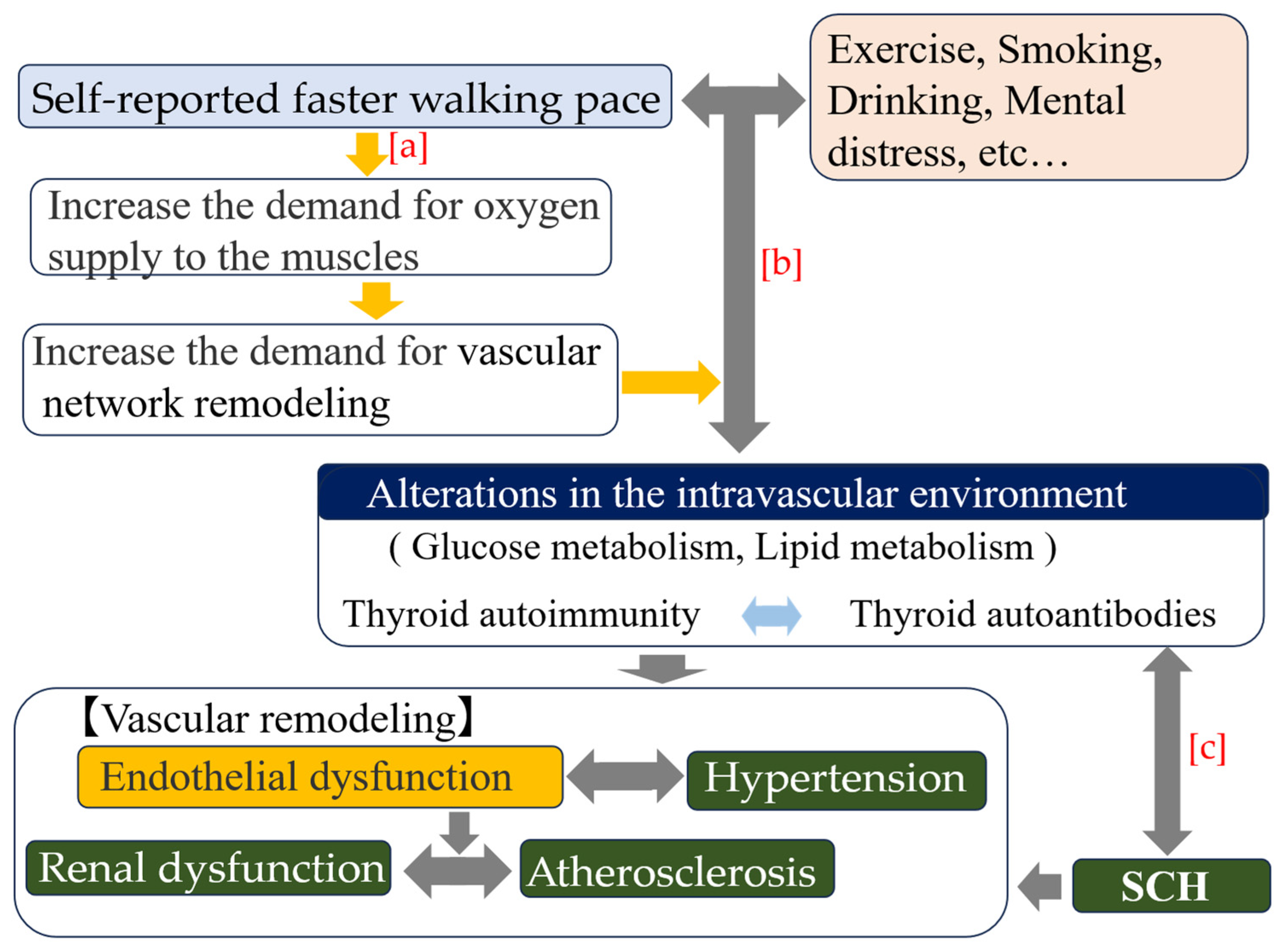
Figure 1 illustrates a causal diagram of the present study. A self-reported faster walking pace may increase the demand for oxygen supply to the muscles [a]. Exercise, smoking, and alcohol consumption influence glucose metabolism, lipid metabolism, and thyroid autoimmunity [b] [24,25,26,27,28,29,30,31,32]. Thyroid function is associated not only with autoimmunity but also with glucose and lipid metabolism [c] [33,34]. Furthermore, mental distress, which is known to affect glucose and lipid metabolism, is also linked to physical exercise [35] and thyroid autoimmunity [b] [36]. This study investigated the impact of the endovascular environment, focusing particularly on vascular remodeling (including hypertension and arteriosclerosis), which are also known to be associated with glucose metabolism (e.g., diabetes) and lipid metabolism [37]. Therefore, while lifestyle factors that indirectly affect the endovascular environment, such as body weight, physical activity, smoking, and alcohol consumption, could serve as confounding factors, conditions such as diabetes and dyslipidemia directly affect the endovascular environment. As these conditions are strongly associated with physical activity, hypertension, and arteriosclerosis, they functioned as mediators rather than confounders in this analysis. For the same reason, even thyroid autoimmunity, such as anti-thyroid peroxidase antibody (TPO-Ab), might influence the levels of TSH [38] and atherosclerosis [39]; thyroid autoimmunity might act as a mediator, but not as a confounder, and TPO-Ab was not treated as a confounder in the present study. Since endothelial dysfunction represents the initial pathophysiological mechanism underlying both CKD and atherosclerosis [40] and thyroid hormone activity has been reported to protect against CKD [41], renal function was not included as an adjustment variable in the present analysis. Therefore, adjusting for renal function raises concerns regarding multicollinearity [42].
Then, four sets of covariate adjustments were considered.
Model 1 included both sex and age. Model 2 additionally incorporated free T3 levels because free T3 is a biologically active thyroid hormone. Previous studies have suggested that SCH may be linked to higher blood pressure [43]. Brisk walking has been reported to exert favorable effects on blood pressure [44], and hypertension has been treated as a potential confounder. Thus, Model 3 was adjusted for sex, age, free T3 levels, and hypertension.
Moreover, as this study focused on the behavioral patterns among individuals with SCH, lifestyle factors that could influence thyroid function were also considered. Model 4 included variables from Model 2, along with mental distress, overweight status, alcohol consumption, smoking status, and regular exercise habits.
To examine whether the status of atherosclerosis modified the association between a self-reported faster walking pace and SCH, we included an interaction term between a self-reported faster walking pace and atherosclerosis in the logistic regression models and evaluated the corresponding interaction p-values.
For sensitivity analysis, the primary models were re-examined separately for men and women.
To assess the robustness of the findings, we conducted a sensitivity analysis using an alternative definition of atherosclerosis based on a maximum CIMT value ≥ 0.96 mm, as suggested by the Suita Study [45]. Individuals with TSH levels below the normal range (<0.39 μIU/mL) were excluded from the analysis.
To assess the adequacy of the model in the present study population, the goodness of fit was evaluated using the Hosmer–Lemeshow test.
All statistical analyses were conducted using SAS software for Windows (version 9.4; SAS Inc., Cary, NC, USA). Statistical significance was set at p < 0.05.

3. Results

Among the study population, 166 individuals had atherosclerosis and 98 had SCH.

3.1. Characteristics of the Study Population

Table 1 shows the atherosclerosis-specific characteristics of the Study Population in relation to a self-reported faster walking pace. Among individuals without atherosclerosis, a significantly higher proportion of men and individuals who performed habitual exercise reported a faster walking pace than those who did not. Among individuals with atherosclerosis, those who reported a faster walking pace had a significantly lower proportion of current smokers and a significantly higher prevalence of habitual exercise than those who did not report a faster walking pace.
Among the study population, 1428 individuals had available data on TPO titers, and no significant differences were observed between those with and without a self-reported faster walking pace in either the non-atherosclerosis or atherosclerosis groups. Among individuals without atherosclerosis, the median [first quartile, third quartile] TPO titers were 1.62 [1.08, 2.35] in those without self-reported faster walking pace (n = 632) and 1.55 [1.08, 2.21] in those with self-reported faster walking pace (n = 655), with a p-value of 0.547 based on log-transformed values. Among individuals with atherosclerosis, the corresponding values were 1.63 [1.18, 2.56] for those without atherosclerosis (n = 77) and 1.53 [1.09, 2.48] for those with a self-reported faster walking pace (n = 64), with a p-value of 0.986.

3.2. Association Between SCH and a Self-Reported Faster Walking Pace

Table 2 shows the ORs (95%CIs) of SCH for self-reported faster walking pace among all subjects. Inverse tendencies between a self-reported faster walking pace and SCH were observed, but these associations did not reach statistical significance.

3.3. Association Between SCH and a Self-Reported Faster Walking Pace by Status of Atherosclerosis

Table 3 shows the atherosclerosis-specific ORs (95%CIs) of SCH for self-reported faster walking pace. All adjusted models showed the same association. Among individuals without atherosclerosis, a self-reported faster walking pace was significantly inversely associated with SCH, whereas among those with atherosclerosis, a positive relationship between SCH and a self-reported faster walking pace was observed, although the statistical power did not reach significance. Atherosclerosis status showed a significant effect on the interaction between self-reported faster walking pace and SCH in all adjusted models.

3.4. Sex Specific Analysis

For the sensitivity analysis, sex-specific ORs (CIs) of SCH in relation to a self-reported faster walking pace stratified by atherosclerosis status were calculated. A similar association was observed between men and women. Among men, the age-adjusted ORs (96% CIs) of SCH for a self-reported faster walking pace were 0.52 (0.25, 1.06) for those without atherosclerosis and 3.30 (0.59, 18.49) for those with atherosclerosis. Among women, the corresponding values were 0.62 (0.35, 1.12) and 2.06 (0.41, 10.20), respectively.

3.5. Association Between SCH and a Self-Reported Faster Walking Pace by Status of Atherosclerosis, Excluding Those with Low TSH Levels Below the Normal Range (<0.39 μIU/mL)

Table 4 presents the atherosclerosis-stratified ORs with 95%CIs for SCH in relation to self-reported faster walking pace, after excluding individuals with TSH levels below the normal range (n = 28). The associations observed across all adjusted models were essentially consistent with those shown in Table 3.

3.6. Analysis Adjustment Further for Diabetes, Dyslipidemia, Chronic Kidney Disease, and TPO-Ab Titer

Among the study population, excluding individuals with low TSH levels, 871 participants (769 without atherosclerosis and 102 with atherosclerosis) had available data on dyslipidemia, diabetes, chronic kidney disease, and TPO-Ab titers. Dyslipidemia was defined as triglycerides ≥ 150 mg/dL, and/or low-density lipoprotein cholesterol ≥ 140 mg/dL, and/or high-density lipoprotein cholesterol < 40 mg/dL, and/or the use of lipid-lowering medication. Diabetes was defined as HbA1c ≥ 6.5% and/or the use of glucose-lowering medication. Chronic kidney disease was defined as an estimated glomerular filtration rate < 60 mL/min/1.73 m2. Although inclusion of these variables as confounders may pose a risk of overadjustment and multicollinearity, we constructed an additional adjusted model that included sex, age, free T3, hypertension, mental distress, overweight status, current drinking, current smoking, exercise habits, dyslipidemia, diabetes, chronic kidney disease, and TPO-Ab titers. The results were essentially consistent with the main findings. The adjusted odds ratios (95% confidence intervals) were 0.46 (0.24–0.90) in participants without atherosclerosis and 3.63 (0.71–18.5) in those with atherosclerosis. Atherosclerosis showed a significant interaction with the association between SCH and self-reported faster walking pace, with p-values of 0.025.

3.7. Sensitivity Analysis Based on Alternative Atherosclerosis Criteria

The Suita Study, which followed 4724 Japanese adults for two years, reported that individuals with maximum CIMT values ≥ 0.96 mm had a significantly increased risk of cardiovascular disease compared with those with values ≤ 0.85 mm [45]. In our study, 28 participants had TSH levels below the normal range (<0.39 μIU/mL). Therefore, as a sensitivity analysis, we repeated the main analysis using the definition of atherosclerosis based on a maximum CIMT value ≥ 0.96 mm, excluding individuals with low TSH levels. The results remain essentially unchanged. The sex- and age-adjusted ORs (95% CIs) of SCH for a self-reported faster walking pace were 0.62 (0.39, 0.98) for individuals without atherosclerosis (n = 1402) and 1.19 (0.48, 2.95) for those with atherosclerosis (n = 289); the adjusted interaction was p = 0.007.

4. Discussion

The major finding of the present study was that a self-reported faster walking pace was significantly inversely associated with SCH among individuals without atherosclerosis but not among those with atherosclerosis. Atherosclerotic status may influence the association between a self-reported faster walking pace and SCH.
A previous observational study in a general population free from prevalent cancer and cardiovascular disease reported that simple self-reported measures of slow walking pace were positively associated with all-cause and cardiovascular mortality [46]. A brisk walking pace has been reported to reduce the risk of major chronic diseases among hypertensive participants [47]. SCH has been reported to be positively associated with all-cause mortality and is a risk factor for cardiovascular disease [7,8]. These studies partly indicated that a self-reported faster walking pace could be inversely associated with SCH, indicating a reduced risk of cardiovascular disease.
In the present study, there was no significant association between self-reported faster walking pace and SCH among all individuals. However, a self-reported faster walking pace was inversely associated with SCH among individuals without atherosclerosis but not among those with atherosclerosis. Atherosclerosis status may influence the association between a self-reported faster walking pace and SCH. However, the underlying mechanisms remain unclear.
A self-reported faster walking pace is an indicator of moderate-intensity aerobic activity. Because aerobic exercise induces skeletal muscle angiogenesis [48], individuals with a self-reported faster walking pace might have a more developed vascular network than those without a self-reported faster walking pace. Angiogenic inhibitors induce hypertension [49]. As an increase in walking pace is inversely associated with the development of hypertension in a healthy population [50], a self-reported faster walking pace might have a beneficial influence on the development of vascular networks. In the present analyses, among individuals without atherosclerosis, although the statistical power did not reach significance for those with a self-reported faster walking pace, the prevalence of hypertension was slightly lower than that of individuals without a self-reported faster walking pace.
Atherosclerosis is associated with microcirculatory dysfunction, resulting in an increased requirement for angiogenesis compared to unaffected individuals. Under conditions of heightened angiogenic demand, a self-reported faster walking pace may further augment the need for skeletal muscle angiogenesis [48]. Because thyroid hormones promote angiogenic activity [51], individuals with atherosclerosis who engage in a self-reported faster walking pace may exhibit elevated TSH levels, leading to the development of SCH. Although the statistical power was insufficient to reach conventional significance, a positive association between a self-reported faster walking pace and SCH was observed among patients with atherosclerosis.
Endothelial progenitor cells, which contribute to angiogenesis [52], are also necessary to develop atherosclerosis [12,13,53]. Therefore, CIMT progression partly indicates the development of angiogenesis [54]. The development of atherosclerosis, which reduces the number of circulating endothelial progenitor cells owing to consumption, causes many of these cells to differentiate into mature cells [55]. Therefore, although thyroid hormones stimulate angiogenesis [51] and endothelial progenitor cells contribute to angiogenesis [52], the number of circulating endothelial progenitor cells might be reduced among SCH individuals with atherosclerosis. A two-year prospective follow-up study of Japanese adults aged 60–69 years reported a significant inverse association between baseline atherosclerosis (CIMT ≥ 1.1 mm) and subsequent active arterial wall thickening (annual CIMT progression ≥ 0.01 mm/year) [12]. In addition, a previous case–control study demonstrated that individuals with SCH have fewer circulating endothelial progenitor cells than healthy controls [6]. Together, these findings partially support the proposed mechanism that among individuals with atherosclerosis and SCH, increased consumption of endothelial progenitor cells may lead to a reduced circulating pool.
As shown in Table 1, the prevalence of hypertension was higher in individuals with atherosclerosis than in those without. The development of atherosclerosis under the influence of hypertension may have a beneficial effect on maintaining muscle strength.
Because, in conjunction with CD34-positive cells, platelets contribute to endothelial repair [9,10,11], platelet count indicates the activity of endothelial repair [56]; higher platelet counts might indicate higher activity of endothelial repair.
A cross-sectional study of 795 elderly hypertensive Japanese subjects aged 60–89 years revealed a positive association between handgrip strength and atherosclerosis, as evaluated by the maximum values of CIMT at and over 1.1 mm in those with higher but not lower platelet counts [57]. Another cross-sectional study of hypertensive Japanese men aged 60 to 89 years reported that atherosclerosis, which was defined as a maximum CIMT of 1.1 mm or more, was revealed to be inversely associated with tongue pressure in those with low platelet count but not in those with high platelet count [58]. CIMT progression is the result of active endothelial repair [55]. Therefore, these studies indicate that among hypertensive individuals, active endothelial repair, which is related to atherosclerosis, might have a beneficial influence on maintaining muscle strength.
Furthermore, because hypertension is closely connected to the development of CIMT [59], a cross-sectional study of Japanese men aged 60–69 years, which reported a positive association between handgrip strength and hypertension limited to those with higher endothelial repair activity, evaluated by the levels of CD34-positive cells [60], might also support the hypothesis that higher endothelial repair activity has a beneficial influence on muscle strength.
A faster walking pace could be associated with greater lower limb strength [61]; therefore, the development of atherosclerosis, as evaluated by CIMT, could have a beneficial influence on maintaining muscle strength related to faster walking speed among those with an increased need for endothelial repair. And because the increased need for endothelial repair might induce SCH [41], while aggressive endothelial repair develops CIMT [13,55], self-reported faster walking pace could be positively associated with SCH among those with atherosclerosis (CIMT ≥ 1.1 mm), as shown in this study.
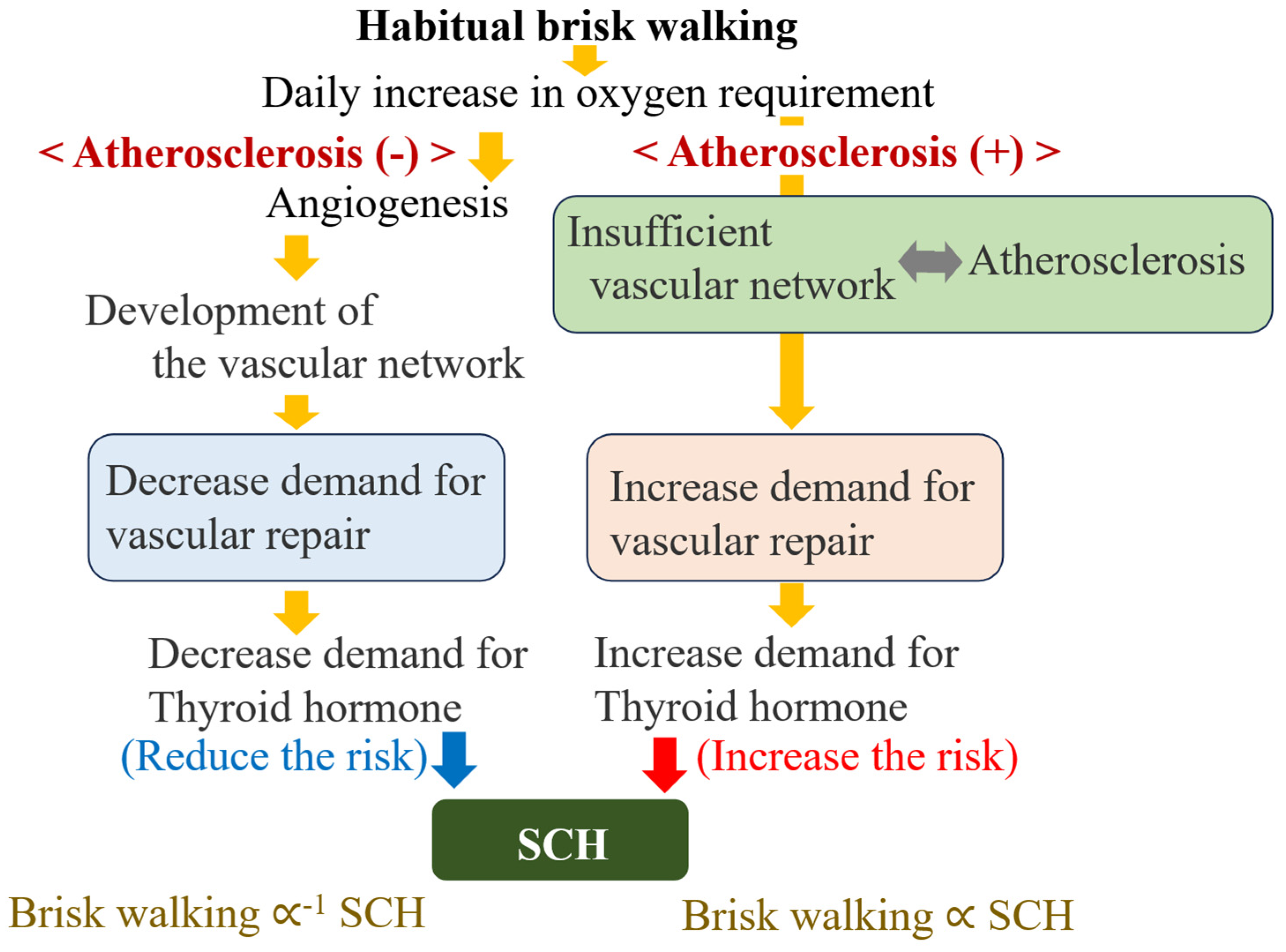
Figure 2 illustrates a potential mechanism linking subclinical hypothyroidism, atherosclerotic status, and a self-reported faster walking pace. Vascular repair demands may play a key role in the association between subclinical hypothyroidism and brisk walking.
In the model adjusting for additional factors considered potential mediators, as well as CKD, which shares a similar pathophysiology with arteriosclerosis, overadjustment and multicollinearity were expected to attenuate the associations. However, despite the reduced sample size in this analysis, significant associations consistent with the main findings were still observed. While this result suggests that the associations identified in the main findings are robust, it also leaves open the possibility that the effects of mediators were not fully accounted for due to the limited number of participants. Further analyses with a larger sample size are required to adequately investigate mediation effects.
The clinical implication of the present study is that a self-reported faster walking pace may be inversely associated with SCH among individuals without atherosclerosis. Although the statistical power was insufficient to achieve statistical significance, a positive association between faster walking pace and SCH was observed, possibly reflecting an increased demand for angiogenesis induced by physical activity. In individuals without atherosclerosis, a faster walking pace may facilitate the development of vascular networks, which could partially explain the observed inverse association with SCH. However, as this study employed a cross-sectional design, causal relationships cannot be established. To further clarify this association, particularly among individuals with atherosclerosis, longitudinal studies are warranted.
The limitations of this study warrant further investigation. First, although angiogenic activity may underlie the present associations, we have no data on angiogenic activity. Further investigations with the data of Vascular Endothelial Growth Factor (VEGF) [62,63] and angiopoietin-2 [64,65] are necessary to clarify the influence of angiogenesis on the present results. In addition, endothelial repair may also contribute to the observed associations. Further investigation involving endothelial progenitor cells is warranted to clarify the role of endothelial repair in these findings [9].
Although a positive relationship between a self-reported faster walking pace and SCH was observed among individuals with atherosclerosis, the statistical power was not significant because of the small number of SCH cases. The number of SCH cases with and without a self-reported faster walking pace was five and nine, respectively. However, atherosclerotic status showed a significant interaction effect on the association between SCH and self-reported faster walking pace. Because data on iodine status were not available, the potential influence of iodine intake on this association could not be evaluated. Due to the cross-sectional nature of this study, a causal relationship could not be established.
The biological mechanisms proposed in this study are hypothetical, and further longitudinal and mechanistic studies are needed to elucidate these mechanisms.

5. Conclusions

In conclusion, a self-reported faster walking pace was significantly inversely associated with SCH among individuals without atherosclerosis but not among those with atherosclerosis. Atherosclerotic status may influence the association between self-reported faster walking pace and SCH. Although further investigations are necessary, angiogenic activity may underlie these associations.

Author Contributions

Conceptualization, Y.S., Y.N. (Yuko Noguchi) and N.H.; methodology, Y.S.; software, Y.S. and Y.N. (Yuko Noguchi); validation, Y.S., A.O. and Y.N. (Yuko Noguchi); formal analysis, Y.S.; investigation, Y.S.; resources, all authors; data curation, all authors; writing—original draft preparation, Y.S.; writing—review and editing, Y.S.; visualization, Y.S.; supervision, Y.S.; project administration, Y.S. and N.H.; funding acquisition, N.H. All authors have read and agreed to the published version of the manuscript.

Funding

This research was funded by a Grant-in-Aid for Scientific Research from the Japan Society for the Promotion of Science (grant number 26K10352).

Institutional Review Board Statement

Ethical approval was obtained from the Ethics Committee of the Nagasaki University Graduate School of Biomedical Sciences (approval ID: 14051404, approved on 25 July 2025).

Informed Consent Statement

Written informed consent was obtained from all the participants after they were adequately informed of the aims of the study. All procedures involving human participants were performed in accordance with the ethical standards of the Institutional Research Committee and the 1964 Declaration of Helsinki and its later amendments for comparable ethical standards.

Data Availability Statement

For the studies described in this review, we cannot publicly provide individual data because of participant confidentiality considerations according to the ethical guidelines in Japan. Additionally, obtaining informed consent does not include a provision for publicly sharing the data. Qualified researchers have access to minimal datasets. Please contact the Office of Data Management at ritouken@vc.fctv-net.jp. Information regarding the data request is available at http://www.med.nagasaki-u.ac.jp/cm/ (accessed on 14 June 2026).

Acknowledgments

We are grateful to the staff of Saza Town Office for their support. This study was supported by the Network-type Joint Usage/Research Center for Radiation Disaster Medical Sciences.

Conflicts of Interest

The authors declare no conflicts of interest.

Abbreviations

The following abbreviations are used in this manuscript:
SCHSubclinical hypothyroidism
T3Triiodothyronine
T4Thyroxine
ORsOdds ratios
CIsConfidence intervals
TSHThyroid-stimulating hormone
BMIBody mass index
SDStandard deviation
K6Kessler Psychological Distress Scale
CIMTCarotid Intima–Media Thickness
VEGFVascular Endothelial Growth Factor

References

  1. Tully, M.A.; Cupples, M.E.; Chan, W.S.; McGlade, K.; Young, I.S. Brisk walking, fitness, and cardiovascular risk: A randomized controlled trail in primary care. Prev. Med. 2005, 41, 622–628. [Google Scholar] [CrossRef] [PubMed]
  2. Murphy, M.; Nevill, A.; Neville, C.; Biddle, S.; Hardman, A. Accumulating brisk walking for fitness, cardiovascular risk, and psychological health. Med. Sci. Sports Exerc. 2002, 34, 1468–1474. [Google Scholar] [CrossRef] [PubMed]
  3. Stamatakis, E.; Kelly, P.; Strain, T.; Murtagh, E.M.; Ding, D.; Murphy, M.H. Self-rated walking pace and all-cause, cardiovascular disease and cancer mortality: Individual participant pooled analysis of 50 225 walkers from 11 population British cohorts. Br. J. Sports Med. 2018, 52, 761–768. [Google Scholar] [CrossRef] [PubMed]
  4. Seals, D.R.; Desouza, C.A.; Donato, A.J.; Tanaka, H. Habitual exercise and arterial aging. J. Appl. Physiol. 2008, 105, 1323–1332. [Google Scholar] [CrossRef] [PubMed]
  5. Rigato, M.; Avogaro, A.; Fadini, G.P. Levels of circulating progenitor cells, cardiovascular outcomes and death: A meta-analysis of prospective observational studies. Circ. Res. 2016, 118, 1930–1939. [Google Scholar] [CrossRef] [PubMed]
  6. Shakoor, S.K.; Aldibbiat, A.; Ingoe, L.E.; Campbell, S.C.; Sibal, L.; Shaw, J.; Home, P.D.; Razvi, S.; Weaver, J.U. Endothelial progenitor cells in subclinical hypothyroidism: The effect of thyroid hormone replacement therapy. J. Clin. Endocrinol. Metab. 2010, 95, 319–322. [Google Scholar] [CrossRef] [PubMed]
  7. Sue, L.Y.; Leung, A.M. Levothyroxine for the treatment of subclinical hypothyroidism and cardiovascular disease. Front. Endocrinol. 2020, 11, 591588. [Google Scholar] [CrossRef] [PubMed]
  8. Inoue, K.; Ritz, B.; Brent, G.A.; Ebrahimi, R.; Rhee, C.M.; Leung, A.M. Association of subclinical hypothyroidism and cardiovascular diseases with mortality. JAMA Netw. Open 2020, 3, e1920745. [Google Scholar] [CrossRef] [PubMed]
  9. Stellos, K.; Langer, H.; Daub, K.; Schoenberger, T.; Gauss, A.; Geisler, T.; Bigalke, B.; Mueller, I.; Schumm, M.; Schaefer, I.; et al. Platelet-derived stromal cell-derived factor-1 regulates adhesion and promotes differentiation of human CD34+ cells to endothelial progenitor cells. Circulation 2008, 117, 206–215. [Google Scholar] [CrossRef] [PubMed]
  10. Stellos, K.; Seizer, P.; Bigalke, B.; Daub, K.; Geisler, T.; Gawaz, M. Platelet aggregates-induced human CD34+ progenitor cell proliferation and differentiation to macrophage and foam cells mediated by stromal cell derived factor 1 in vitro. Semin. Thromb. Hemost. 2010, 36, 139–145. [Google Scholar] [CrossRef] [PubMed]
  11. Daub, K.; Langer, H.; Seizer, P.; Stellos, K.; May, A.E.; Goyal, P.; Bigalke, B.; Schönberger, T.; Geisler, T.; Siegel-Axel, D.; et al. Platelets induce differentiation of human CD34+ progenitor cells into foam cells and endothelial cells. FASEB J. 2006, 20, 2559–2561. [Google Scholar] [CrossRef] [PubMed]
  12. Shimizu, Y.; Kawashiri, S.Y.; Kiyoura, K.; Koyamatsu, J.; Fukui, S.; Tamai, M.; Nobusue, K.; Yamanashi, H.; Nagata, Y.; Maeda, T. Circulating CD34+ cells and active arterial wall thickness among elderly men: A prospective study. Sci. Rep. 2020, 10, 4656. [Google Scholar] [CrossRef] [PubMed]
  13. Shimizu, Y. Mechanism underlying vascular remodeling inn relation to circulating CD34-posistive cells among older Japanese men. Sci. Rep. 2022, 12, 21823. [Google Scholar] [CrossRef] [PubMed]
  14. Shimizu, Y.; Nabeshima-Kimura, Y.; Kawashiri, S.Y.; Noguchi, Y.; Nagata, Y.; Maeda, T.; Hayashida, N. Anti-thyroid peroxidase antibody and thyroid cysts among the general Japanese population: A cross-sectional study. Environ. Health Prev. Med. 2020, 25, 7. [Google Scholar] [CrossRef] [PubMed]
  15. Shimizu, Y.; Nabeshima-Kimura, Y.; Kawashiri, S.Y.; Noguchi, Y.; Nagata, Y.; Maeda, T.; Hayashida, N. Associations between thyroid-stimulating hormone and hypertension according to thyroid cysts status in the general population: A cross-sectional study. Environ. Health Prev. Med. 2020, 25, 69. [Google Scholar] [CrossRef] [PubMed]
  16. Shimizu, Y.; Nabeshima-Kimura, Y.; Kawashiri, S.Y.; Noguchi, Y.; Minami, S.; Nagata, Y.; Maeda, T.; Hayashida, N. Association between thyroid-stimulating hormone (TSH) and proteinuria in relation to thyroid cyst in a euthyroid general population. J. Physiol. Anthropol. 2021, 40, 15. [Google Scholar] [CrossRef] [PubMed]
  17. Yamamoto, Y.; Ikeue, K.; Kanasaki, M.; Yamakage, H.; Oishi, K.; Mori, T.; Satoh-Asahara, N.; Masuda, I.; Ishii, K. Association between subjective walking speed and metabolic diseases in individuals with obesity: A cross-sectional analysis. Sci. Rep. 2024, 14, 28228. [Google Scholar] [CrossRef] [PubMed]
  18. LSI Medience Corporation. Rinsyokensa Jugyo; LSI Medience Corporation: Tokyo, Japan, 2017; Volume 17-04, Available online: https://www.medience.co.jp/clinical/information/parts/pdf/17-04.pdf (accessed on 27 February 2024).
  19. Hara, T.; Takamura, N.; Akashi, S.; Nakazato, M.; Maeda, T.; Wada, M.; Nakashima, K.; Abe, Y.; Kusano, Y.; Aoyagi, K. Evaluation of clinical markers of atherosclerosis in young and elderly Japanese adults. Clin. Chem. Lab. Med. 2006, 44, 824–829. [Google Scholar] [CrossRef] [PubMed]
  20. Yanase, T.; Nasu, S.; Mukuta, Y.; Shimizu, Y.; Nishihara, T.; Okabe, T.; Nomura, M.; Inoguchi, T.; Nawata, H. Evaluation of a new carotid intima-media thickness measurement by B-mode ultrasonography using an innovative measurement software, intimascope. Am. J. Hypertens. 2006, 19, 1206–1212. [Google Scholar] [CrossRef] [PubMed]
  21. Shimizu, Y.; Kawashiri, S.Y.; Noguchi, Y.; Nagata, Y.; Maeda, T.; Hayashida, N. Association between thyroid cysts and hypertension by atherosclerosis status: A cross-sectional study. Sci. Rep. 2021, 11, 13922. [Google Scholar] [CrossRef] [PubMed]
  22. Kawamori, R.; Yamasaki, Y.; Matsushima, H.; Nishizawa, H.; Nao, K.; Hougaku, H.; Maeda, H.; Handa, N.; Matsumoto, M.; Kamada, T. Prevalence of carotid atherosclerosis in diabetic patients Ultrasound high-resolution B-mode imaging on carotid arteries. Diabetes Care 1992, 15, 1290–1294. [Google Scholar] [CrossRef] [PubMed]
  23. Kessler, R.C.; Andrews, G.; Colpe, L.J.; Hiripi, E.; Mroczek, D.K.; Normand, S.L.; Walters, E.E.; Zaslavsky, A.M. Short screening scales to monitor population prevalences and trends in non-specific psychological distress. Psychol. Med. 2002, 32, 959–976. [Google Scholar] [CrossRef] [PubMed]
  24. Sylow, L.; Kleinert, M.; Richter, E.A.; Jensen, T.E. Exercise-stimulated glucose uptake—Regulation and implications for glycaemic control. Nat. Rev. Endocrinol. 2017, 13, 133–148. [Google Scholar] [CrossRef] [PubMed]
  25. Muscella, A.; Stefàno, E.; Lunetti, P.; Capobianco, L.; Marsigliante, S. The Regulation of Fat Metabolism During Aerobic Exercise. Biomolecules 2020, 10, 1699. [Google Scholar] [CrossRef] [PubMed]
  26. Skrzypiec-Spring, M.; Pokrywka, A.; Szeląg, A.; Zembroń-Łacny, A. Autoimmune Thyroid Diseases and Physical Activity and Sports-More Unknowns than Facts. Biomedicines 2025, 13, 2352. [Google Scholar] [CrossRef] [PubMed]
  27. Jung, S.Y.; Papp, J.C.; Sobel, E.M.; Pellegrini, M.; Yu, H. Genetic variants of glucose metabolism and exposure to smoking in African American breast cancer. Endocr. Relat. Cancer 2023, 30, e220184. [Google Scholar] [CrossRef] [PubMed]
  28. Upadhyay, G.; Duong, L.; Kain, V.; Ghobrial, M.; Marimuthu, M.K.; Fouad, A.; Yeatman, T.J.; Herazo-Maya, J.D.; Halade, G.V. Cannabis cigarette smoking disrupts mice multi-organ bioactive lipid metabolism and inflammation-resolution signaling in an obesogenic setting. Life Sci. 2025, 383, 124076. [Google Scholar] [CrossRef] [PubMed]
  29. Wiersinga, W.M. Smoking and thyroid. Clin. Endocrinol. 2013, 79, 145–151. [Google Scholar] [CrossRef] [PubMed]
  30. van de Wiel, A. Diabetes mellitus and alcohol. Diabetes Metab. Res. Rev. 2004, 20, 263–267. [Google Scholar] [CrossRef] [PubMed]
  31. Crabb, D.W.; Liangpunsakul, S. Alcohol and lipid metabolism. J. Gastroenterol. Hepatol. 2006, 21, S56–S60. [Google Scholar] [CrossRef] [PubMed]
  32. Caslin, B.; Mohler, K.; Thiagarajan, S.; Melamed, E. Alcohol as friend or foe in autoimmune diseases: A role for gut microbiome? Gut Microbes 2021, 13, 1916278. [Google Scholar] [CrossRef] [PubMed]
  33. Chidakel, A.; Mentuccia, D.; Celi, F.S. Peripheral metabolism of thyroid hormone and glucose homeostasis. Thyroid 2005, 15, 899–903. [Google Scholar] [CrossRef] [PubMed]
  34. Sinha, R.A.; Singh, B.K.; Yen, P.M. Direct effects of thyroid hormones on hepatic lipid metabolism. Nat. Rev. Endocrinol. 2018, 14, 259–269. [Google Scholar] [CrossRef] [PubMed]
  35. Grasdalsmoen, M.; Eriksen, H.R.; Lønning, K.J.; Sivertsen, B. Physical exercise, mental health problems, and suicide attempts in university students. BMC Psychiatry 2020, 20, 175. [Google Scholar] [CrossRef] [PubMed]
  36. Liu, J.; Li, Z. Autoimmune thyroid disease is a risk factor for mood disorders, a Mendelian randomization study. J. Affect. Disord. 2025, 379, 204–212. [Google Scholar] [CrossRef] [PubMed]
  37. Shimizu, Y.; Nakazato, M.; Sekita, T.; Kadota, K.; Yamasaki, H.; Takamura, N.; Aoyagi, K.; Maeda, T. Association of arterial stiffness and diabetes with triglycerides-to-HDL cholesterol ratio for Japanese men: The Nagasaki Islands Study. Atherosclerosis 2013, 228, 491–495. [Google Scholar] [CrossRef] [PubMed]
  38. Shimizu, Y.; Matsuyama, M.; Noguchi, Y.; Takada, M.; Kawashiri, S.Y.; Fukui, S.; Nakamichi, S.; Nagata, Y.; Maeda, T.; Hayashida, N. Association between anti-thyroid peroxidase antibody and thyroid stimulating hormone: A cross-sectional study. Sci. Rep. 2023, 13, 14358. [Google Scholar] [CrossRef] [PubMed]
  39. Shimizu, Y.; Kawashiri, S.Y.; Noguchi, Y.; Nagata, Y.; Maeda, T.; Hayashida, N. Normal range of anti-thyroid peroxidase antibody (TPO-Ab) and atherosclerosis among eu-thyroid population: A cross-sectional study. Medicine 2020, 99, e22214. [Google Scholar] [CrossRef] [PubMed]
  40. Baaten, C.C.F.M.J.; Vondenhoff, S.; Noels, H. Endothelial cell dysfunction and increased cardiovascular risk in patients with chronic kidney disease. Circ. Res. 2023, 132, 970–992. [Google Scholar] [CrossRef] [PubMed]
  41. Shimizu, Y.; Kawashiri, S.Y.; Noguchi, Y.; Nakamichi, S.; Nagata, Y.; Hayashida, N.; Maeda, T. Associations among ratio of free triiodothyronine to free thyroxine, chronic kidney disease, and subclinical hypothyroidism. J. Clin. Med. 2022, 11, 1269. [Google Scholar] [CrossRef] [PubMed]
  42. Kim, J.H. Multicollinearity and misleading statistical results. Korean J. Anesthesiol. 2019, 72, 558–569. [Google Scholar] [CrossRef] [PubMed]
  43. Cai, Y.; Ren, Y.; Shi, J. Blood pressure levels in patients with subclinical dysfunction: A meta-analysis. Hypertens. Res. 2011, 34, 1098–1105. [Google Scholar] [CrossRef] [PubMed]
  44. Rahmayati, E.; Rahmi, U.; Ilbert, R. Brisk walking for elderly individuals with hypertension. Int. J. Community Based Nurs. Midwifery 2023, 11, 289–290. [Google Scholar] [CrossRef] [PubMed]
  45. Kokubo, Y.; Watanabe, M.; Higashiyama, A.; Nakao, Y.M.; Nakamura, F.; Miyamoto, Y. Impact of intima-media thickness progression in the common carotid arteries on the risk of incident cardiovascular disease in the Suita study. J. Am. Heart Assoc. 2018, 7, e007720. [Google Scholar] [CrossRef] [PubMed]
  46. Yates, T.; Zaccardi, F.; Dhalwani, N.N.; Davies, M.J.; Bakrania, K.; Celis-Morales, C.A.; Gill, J.M.R.; Franks, P.W.; Khunti, K. Association of walking pace and handgrip strength with all-cause, cardiovascular, and cancer mortality: A UK Biobank observational study. Eur. Heart J. 2017, 38, 3232–3240. [Google Scholar] [CrossRef] [PubMed]
  47. Peng, Y.; Liu, F.; Wang, P.; Wang, X.; Si, C.; Gong, J.; Zhou, H.; Zhang, M.; Song, F. Association between walking pace and risks of major chronic disease in individuals with hypertension based on a prospective study in UK Biobank: Involvement of inflammation. Prev. Med. 2024, 184, 107986. [Google Scholar] [CrossRef] [PubMed]
  48. Rodrigues, L.F.; Pelozin, B.R.A.; da Silva Junior, N.D.; Soci, U.P.R.; do Carmo, E.C.; da Mota, G.F.A.; Cachofeiro, V.; Lahera, V.; Oliveira, E.M.; Fernandes, T. Angiotensin II promotes skeletal muscle angiogenesis induced by volume-dependent aerobic exercise training: Effects on miRNAs-27a/b and oxidant-antioxidant balance. Antioxidants 2022, 11, 651. [Google Scholar] [CrossRef] [PubMed]
  49. Camarda, N.; Travers, R.; Yang, V.K.; London, C.; Jaffe, I.Z. VEGF receptor inhibitor-induced hypertension: Emerging mechanism and clinical implications. Curr. Oncol. Rep. 2022, 24, 463–474. [Google Scholar] [CrossRef] [PubMed]
  50. Etzig, C.; Gea, A.; Martínez-González, M.Á.; Sullivan, M.F., Jr.; Sullivan, E.; Bes-Rastrollo, M. The association between self-perceived walking pace with the incidence of hypertension: The ‘Seguimiento Universidad de Navarra’ cohort. J. Hypertens. 2021, 39, 1188–1194. [Google Scholar] [CrossRef] [PubMed]
  51. Luidens, M.K.; Mousa, S.A.; Davis, F.B.; Lin, H.Y.; Davis, P.J. Thyroid hormone and angiogenesis. Vasc. Pharmacol. 2010, 52, 142–145. [Google Scholar] [CrossRef] [PubMed]
  52. Hassanpour, M.; Salybekov, A.A.; Kobayashi, S.; Asahara, T. CD34 positive cells as endothelial progenitor cells in biology and medicine. Front. Cell Dev. Biol. 2023, 11, 1128134. [Google Scholar] [CrossRef] [PubMed]
  53. Sedding, D.G.; Boyle, E.C.; Demandt, J.A.F.; Sluimer, J.C.; Dutzmann, J.; Haverich, A.; Bauersachs, J. Vasa vasorum angiogenesis: Key player in the initiation and progression of atherosclerosis and potential target for the treatment of cardiovascular disease. Front. Immunol. 2018, 9, 706. [Google Scholar] [CrossRef] [PubMed]
  54. Shimizu, Y. Progression of carotid intima-media thickness partly indicates the prevention of hypertension among older individuals in the general population. Life 2023, 13, 1588. [Google Scholar] [CrossRef] [PubMed]
  55. Shimizu, Y.; Yamanashi, H.; Noguchi, Y.; Koyamatsu, J.; Nagayoshi, M.; Kiyoura, K.; Fukui, S.; Tamai, M.; Kawashiri, S.Y.; Kondo, H.; et al. Cardio-ankel vascular index and circulating CD34-positive cell levels as indicators of endothelial repair activity in older Japanese men. Geriatr. Gerontol. Int. 2019, 19, 557–562. [Google Scholar] [CrossRef] [PubMed]
  56. Shimizu, Y.; Sato, S.; Koyamatsu, J.; Yamanashi, H.; Nagayoshi, M.; Kadota, K.; Maeda, T. Platelets as an indicator of vascular repair in elderly Japanese men. Oncotarget 2016, 7, 44919–44926. [Google Scholar] [CrossRef] [PubMed]
  57. Shimizu, Y.; Sato, S.; Koyamatsu, J.; Yamanashi, H.; Nagayoshi, M.; Kadota, K.; Kawashiri, S.Y.; Inoue, K.; Nagata, Y.; Maeda, T. Handgrip strength and subclinical carotid atherosclerosis in relation to platelet levels among hypertensive elderly Japanese. Oncotarget 2017, 8, 69362–69369. [Google Scholar] [CrossRef] [PubMed]
  58. Shimizu, Y.; Sato, S.; Noguchi, Y.; Koyamatsu, J.; Yamanashi, H.; Higashi, M.; Nagayoshi, M.; Kawashiri, S.Y.; Nagata, Y.; Takamura, N.; et al. Association between tongue pressure and subclinical carotid atherosclerosis in relation to platelet levels in hypertensive elderly men: A cross-sectional study. Environ. Health Prev. Med. 2018, 23, 31. [Google Scholar] [CrossRef] [PubMed]
  59. Shimizu, Y.; Kawashiri, S.Y.; Kiyoura, K.; Nobusue, K.; Yamanashi, H.; Nagata, Y.; Maeda, T. Gamma-glutamyl transpeptidase (gamma-GTP) has an ambivalent association with hypertension and atherosclerosis among elderly Japanese men: A cross-sectional study. Environ. Health Prev. Med. 2019, 24, 69. [Google Scholar] [CrossRef] [PubMed]
  60. Shimizu, Y.; Kawashiri, S.Y.; Nobusue, K.; Yamanashi, H.; Nagata, Y.; Maeda, T. Associations between handgrip strength and hypertension in relation to circulating CD34-positive cell levels among Japanese older men: A cross-sectional study. Environ. Health Prev. Med. 2021, 26, 62. [Google Scholar] [CrossRef] [PubMed]
  61. Iwase, H.; Murata, S.; Anami, K.; Matsuo, N.; Yoneyama, T.; Yamasaki, K.; Komatu, N.; Shigeta, Y.; Madoba, K. Relationships among ADL ability, lower limb strength and walking abilities of elderly patients: A comparison of maximum and minimum walking speeds. Rigakuryoho Kagaku 2013, 28, 347–350. (In Japanese) [Google Scholar] [CrossRef][Green Version]
  62. Melincovici, C.S.; Boşca, A.B.; Şuşman, S.; Mărginean, M.; Mihu, C.; Istrate, M.; Moldovan, I.M.; Roman, A.L.; Mihu, C.M. Vascular endothelial growth factor (VEGF)—Key factor in normal and pathological angiogenesis. Rom. J. Morphol. Embryol. 2018, 59, 455–467. [Google Scholar] [PubMed]
  63. Skóra, J.P.; Antkiewicz, M.; Kupczyńska, D.; Kulikowska, K.; Strzelec, B.; Janczak, D.; Barć, P. Local intramuscular administration of ANG1 and VEGF genes using plasmid vectors mobilizes CD34+ cells to peripheral tissues and promotes angiogenesis in an animal model. Biomed. Pharmacother. 2021, 143, 112186. [Google Scholar] [CrossRef] [PubMed]
  64. Tesan, T.; Gustavsson, H.; Welén, K.; Damber, J.E. Differential expression of angiopoietin-2 and vascular endothelial growth factor in androgen-independent prostate cancer models. BJU Int. 2008, 102, 1034–1039. [Google Scholar] [CrossRef] [PubMed]
  65. Lefere, S.; Van de Velde, F.; Hoorens, A.; Raevens, S.; Van Campenhout, S.; Vandierendonck, A.; Neyt, S.; Vandeghinste, B.; Vanhove, C.; Debbaut, C.; et al. Angiopoietin-2 promotes pathological angiogenesis and is a therapeutic target in murine nonalcoholic fatty liver disease. Hepatology 2019, 69, 1087–1104. [Google Scholar] [CrossRef] [PubMed]
Figure 1. Causal diagram of the present study. Associations in red [a] to [c] were explained by previous studies.
Jvd 05 00027 g001
Figure 2. Potential mechanism linking subclinical hypothyroidism, atherosclerosis status, and brisk walking. SCH: subclinical hypothyroidism.
Jvd 05 00027 g002
Table 1. Characteristics of the study population.
Atherosclerosis
(−)(+)
Self-Reported Faster Walking Pace pSelf-Reported Faster Walking Pacep
(−)(+)(−)(+)
No. of participants 773780 9175
Men, %32.238.60.009 48.454.70.421
Age, year 59.6 ± 9.360.4 ± 9.00.062 64.7 ± 7.665.2 ± 7.40.646
TSH, (0.39–4.01), μIU/mL1.62
[1.08, 2.35] *1
1.55
[1.09, 2.21] *1
0.095 *21.63
[1.18, 2.56] *1
1.53
[1.09, 2.48] *1
0.796 *2
free T3, (2.1–4.1), pg/mL3.2 ± 0.33.2 ± 0.30.136 3.1 ± 0.43.2 ± 0.30.611
free T4, (1.0–1.7), ng/mL1.2 ± 0.21.2 ± 0.10.716 1.2 ± 0.21.3 ± 0.20.683
Hypertension, %39.637.20.330 52.7 53.3 0.940
Mental distress, %10.78.20.088 9.9 4.0 0.147
Overweight (≥25 kg/m2),%27.217.9<0.00133.0 25.3 0.286
Current drinker, %37.841.80.106 39.6 49.3 0.209
Current smoker, %12.714.20.370 22.0 5.3 0.002
Exercise, %24.746.8<0.00131.9 48.0 0.034
TSH, thyroid-stimulating hormone; T3, free triiodothyronine; T4, free thyroxine. Values are presented as the mean ± standard deviation. *1 Values are median [first and third quartiles]. *2 Logarithmic transformation was performed. The normal measurement range is ( ).
Table 2. Association between subclinical hypothyroidism (SCH) and self-reported faster walking pace.
Self-Reported Faster Walking Pace p
(−)(+)
No of participants, n864855
No. of SCH cases, n (%)57 (6.6)41 (4.8)
Model 1Ref0.70 (0.46, 1.06)0.090
Model 2Ref 0.71 (0.47, 1.08)0.107
Model 3Ref0.72 (0.48, 1.09)0.124
Model 4Ref0.76 (0.49, 1.16)0.201
Ref: Reference. Model 1: Adjusted for sex and age. Model 2: Adjusted for sex, age, and free triiodothyronine (T3). Model 3: Adjusted for variables in Model 2 plus hypertension. Model 4: Adjusted for variables in Model 2 plus mental distress, overweight, current drinking, current smoking, and exercise habits.
Table 3. Association between subclinical hypothyroidism (SCH) and self-reported faster walking pace by the status of atherosclerosis.
AtherosclerosisInteraction
(−)(+)
Self-Reported Faster Walking Pace pSelf-Reported Faster Walking Pace p
(−)(+)(−)(+)
No of participants, n773780 9175
No. of SCH cases, n (%)52
(6.7)
32
(4.1)
5
(5.5)
9
(12.0)
Model 1Ref0.58
(0.37, 0.91)
0.019 Ref2.35
(0.75, 7.36)
0.143 0.027
Model 2Ref 0.59
(0.38, 0.93)
0.023 Ref 2.34
(0.75, 7.35)
0.144 0.026
Model 3Ref0.60
(0.38, 0.95)
0.030 Ref2.34
(0.75, 7.34)
0.145 0.024
Model 4Ref 0.62
(0.38, 0.98)
0.043 Ref3.11
(0.87,11.07)
0.080 0.036
Ref: Reference. Model 1: Adjusted for sex and age. Model 2: Adjusted for sex, age, and free triiodothyronine (T3). Model 3: Adjusted for variables in Model 2 plus hypertension. Model 4: Adjusted for variables in Model 2 plus mental distress, overweight, current drinking, current smoking, and exercise habits.
Table 4. Association between subclinical hypothyroidism (SCH) and self-reported faster walking pace by the status of atherosclerosis, excluding those with low TSH levels below the normal range (<0.39 μIU/mL).
AtherosclerosisInteraction
(−)(+)
Self-Reported Faster Walking Pace pSelf-Reported Faster Walking Pace p
(−)(+)(−)(+)
No of participants, n761767 9073
No. of SCH cases, n (%)52
(6.8)
32
(4.2)
5
(5.6)
9
(12.3)
Model 1Ref0.58
(0.37, 0.91)
0.019 Ref2.39
(0.76, 7.51)
0.135 0.008
Model 2Ref 0.59
(0.38, 0.93)
0.023 Ref 2.39
(0.76, 7.52)
0.136 0.025
Model 3Ref0.60
(0.38, 0.95)
0.030 Ref2.39
(0.76, 7.51)
0.136 0.023
Model 4Ref 0.62
(0.39, 0.99)
0.043 Ref3.23
(0.90,11.55)
0.072 0.034
Ref: Reference. Model 1: Adjusted for sex and age. Model 2: Adjusted for sex, age, and free triiodothyronine (T3). Model 3: Adjusted for variables in Model 2 plus hypertension. Model 4: Adjusted for variables in Model 2 plus mental distress, overweight, current drinking, current smoking, and exercise habits.
Disclaimer/Publisher’s Note: The statements, opinions and data contained in all publications are solely those of the individual author(s) and contributor(s) and not of MDPI and/or the editor(s). MDPI and/or the editor(s) disclaim responsibility for any injury to people or property resulting from any ideas, methods, instructions or products referred to in the content.