
Type B Aortic Dissection Management Strategies: National Survey, Systematic Review, and Pooled Clinician Perceptions


Abstract
1. Introduction
2. Methods
2.1. Survey Details
2.2. Standard Operating Protocol (SOP) and Guidelines
- Acute Aortic Syndrome (AAS): This term encompasses aortic dissection, penetrating aortic ulcer (PAU), and intramural hematoma (IMH) [16].
- Type B Aortic Dissection (TBAD) and blood pressure management: TBAD is defined as a dissection occurring in the aorta beyond the left subclavian artery, without involving the ascending aorta. Labetalol is the recommended first line antihypertensive for management of hypertension in TBAD [16].
2.3. Statistical Analysis
3. Results
4. Discussions
5. Limitations
Supplementary Materials
Author Contributions
Funding
Institutional Review Board Statement
Informed Consent Statement
Data Availability Statement
Acknowledgments
Conflicts of Interest
References
- Olsson, C.; Thelin, S.; Stahle, E.; Ekbom, A.; Granath, F. Thoracic aortic aneurysm and dissection: Increasing prevalence and improved outcomes reported in a nationwide population-based study of more than 14,000 cases from 1987 to 2002. Circulation 2006, 114, 2611–2618. [Google Scholar] [CrossRef]
- Howard, D.P.; Banerjee, A.; Fairhead, J.F.; Hands, L.; Silver, L.E.; Rothwell, P.M. Population-Based Study of Incidence, Risk Factors, Outcome, and Prognosis of Ischemic Peripheral Arterial Events: Implications for Prevention. Circulation 2015, 132, 1805–1815. [Google Scholar] [CrossRef]
- Sun, Z.; Shen, H.; Li, S.; Yao, C.; Wei, L.; Shi, D.; Tong, C.; Shu, X.; Wang, C. Misdiagnosis of aortic dissection: Experience of 361 patients. J. Clin. Hypertens. 2012, 14, 256–260. [Google Scholar] [CrossRef]
- Hansen, M.S.; Nogareda, G.J.; Hutchison, S.J. Frequency of and inappropriate treatment of misdiagnosis of acute aortic dissection. Am. J. Cardiol. 2007, 99, 852–856. [Google Scholar] [CrossRef] [PubMed]
- Klompas, M. Does this patient have an acute thoracic aortic dissection? JAMA 2002, 287, 2262–2272. [Google Scholar] [CrossRef]
- Nienaber, C.A.; Clough, R.E. Management of acute aortic dissection. Lancet 2015, 385, 800–811. [Google Scholar] [CrossRef] [PubMed]
- Pherwani, A. New Data Highlight Rising Incidence of Aortic Dissection in England. VascularNews. Available online: https://vascularnews.com/new-data-highlight-rising-incidence-of-aortic-dissection-in-england/#:~:text=New%20data%20highlight%20rising%20incidence%20of%20aortic%20dissection%20in%20England,-25th%20April%202024&text=“The%20incidence%20of%20acute%20aortic,April%2C%20London%2C%20UK) (accessed on 25 April 2024).
- Asha, S.E.; Miers, J.W. A Systematic Review and Meta-analysis of D-dimer as a Rule-out Test for Suspected Acute Aortic Dissection. Ann. Emerg. Med. 2015, 66, 368–378. [Google Scholar] [CrossRef] [PubMed]
- Nazerian, P.; Morello, F.; Vanni, S.; Bono, A.; Castelli, M.; Forno, D.; Gigli, C.; Soardo, F.; Carbone, F.; Lupia, E.; et al. Combined use of aortic dissection detection risk score and D-dimer in the diagnostic workup of suspected acute aortic dissection. Int. J. Cardiol. 2014, 175, 78–82. [Google Scholar] [CrossRef]
- Diercks, D.B.; Promes, S.B.; Schuur, J.D.; Shah, K.; Valente, J.H.; Cantrill, S.V.; Brown, M.D.; Burton, J.H.; Gemme, S.R.; Gerardo, C.J.; et al. Clinical policy: Critical issues in the evaluation and management of adult patients with suspected acute nontraumatic thoracic aortic dissection. Ann. Emerg. Med. 2015, 65, 32–42.e12. [Google Scholar] [CrossRef]
- Erbel, R.; Aboyans, V.; Boileaul, C.; Bossone, E.; Bartolomeo, R.D.; Eggebrecht, H.; Evangelista, A.; Falk, V.; Frank, H.; Gaemperli, O.; et al. 2014 ESC Guidelines on the diagnosis and treatment of aortic diseases: Document covering acute and chronic aortic diseases of the thoracic and abdominal aorta of the adult. The Task Force for the Diagnosis and Treatment of Aortic Diseases of the European Society of Cardiology (ESC). Eur. Heart J. 2014, 35, 2873–2926. [Google Scholar] [CrossRef]
- Nazerian, P.; Giachino, F.; Vanni, S.; Veglio, M.G.; Castelli, M.; Lison, D.; Bitossi, L.; Moiraghi, C.; Grifoni, S.; Morello, F. Diagnostic performance of the aortic dissection detection risk score in patients with suspected acute aortic dissection. Eur. Heart J. Acute Cardiovasc. Care 2014, 3, 373–381. [Google Scholar] [CrossRef]
- Body HSSI. Delayed Recognition of Acute Aortic Dissection. Available online: https://www.hssib.org.uk/patient-safety-investigations/delayed-recognition-of-acute-aortic-dissection/investigation-report/ (accessed on 1 October 2025).
- McHugh, M.L. Interrater reliability: The kappa statistic. Biochem. Medica 2012, 22, 276–282. [Google Scholar] [CrossRef]
- Barendregt, J.J.; Doi, S.A.; Lee, Y.Y.; Norman, R.E.; Vos, T. Meta-analysis of prevalence. J. Epidemiol. Community Health 2013, 67, 974–978. [Google Scholar] [CrossRef]
- Riambau, V.; Bockler, D.; Brunkwall, J.; Cao, P.; Chiesa, R.; Coppi, G.; Czerny, M.; Fraedrich, G.; Haulon, S.; Jacobs, M.; et al. Editor’s Choice—Management of Descending Thoracic Aorta Diseases: Clinical Practice Guidelines of the European Society for Vascular Surgery (ESVS). Eur. J. Vasc. Endovasc. Surg. 2017, 53, 4–52. [Google Scholar] [CrossRef] [PubMed]
- Baliga, R.R.; Nienaber, C.A.; Bossone, E.; Oh, J.K.; Isselbacher, E.M.; Sechtem, U.; Fattori, R.; Raman, S.V.; Eagle, K.A. The role of imaging in aortic dissection and related syndromes. JACC Cardiovasc. Imaging 2014, 7, 406–424. [Google Scholar] [CrossRef] [PubMed]
- Mills, A.M.; Raja, A.S.; Marin, J.R. Optimizing diagnostic imaging in the emergency department. Acad. Emerg. Med. 2015, 22, 625–631. [Google Scholar] [CrossRef]
- Morello, F.; Santoro, M.; Fargion, A.T.; Grifoni, S.; Nazerian, P. Diagnosis and management of acute aortic syndromes in the emergency department. Intern. Emerg. Med. 2021, 16, 171–181. [Google Scholar] [CrossRef]
- McHugh, M.L. The chi-square test of independence. Biochem. Medica 2013, 23, 143–149. [Google Scholar] [CrossRef]
- Blettner, M.; Sauerbrei, W.; Schlehofer, B.; Scheuchenpflug, T.; Friedenreich, C. Traditional reviews, meta-analyses and pooled analyses in epidemiology. Int. J. Epidemiol. 1999, 28, 1–9. [Google Scholar] [CrossRef]
- Giavarina, D. Understanding Bland Altman analysis. Biochem. Medica 2015, 25, 141–151. [Google Scholar] [CrossRef]
- Gerke, O. Reporting Standards for a Bland-Altman Agreement Analysis: A Review of Methodological Reviews. Diagnostics 2020, 10, 334. [Google Scholar] [CrossRef]
- Saary, M.J. Radar plots: A useful way for presenting multivariate health care data. J. Clin. Epidemiol. 2008, 61, 311–317. [Google Scholar] [CrossRef]
- Suzuki, T.; Mehta, R.H.; Ince, H.; Nagai, R.; Sakomura, Y.; Weber, F.; Sumiyoshi, T.; Bossone, E.; Trimarchi, S.; Cooper, J.V.; et al. Clinical profiles and outcomes of acute type B aortic dissection in the current era: Lessons from the International Registry of Aortic Dissection (IRAD). Circulation 2003, 108, II-312–II-317. [Google Scholar] [CrossRef]
- Morello, F.; Bima, P.; Pivetta, E.; Santoro, M.; Catini, E.; Casanova, B.; Leidel, B.A.; Soeiro, A.d.M.; Nestelberger, T.; Mueller, C.; et al. Development and Validation of a Simplified Probability Assessment Score Integrated with Age-Adjusted d-Dimer for Diagnosis of Acute Aortic Syndromes. J. Am. Heart Assoc. 2021, 10, e018425. [Google Scholar] [CrossRef]
- Nazerian, P.; Mueller, C.; Soeiro, A.M.; Leidel, B.A.; Salvadeo, S.A.T.; Giachino, F.; Vanni, S.; Grimm, K.; Oliveira, M.T.; Pivetta, E.E.; et al. Diagnostic Accuracy of the Aortic Dissection Detection Risk Score Plus D-Dimer for Acute Aortic Syndromes: The ADvISED Prospective Multicenter Study. Circulation 2018, 137, 250–258. [Google Scholar] [CrossRef]
- von Kodolitsch, Y.; Schwartz, A.G.; Nienaber, C.A. Clinical prediction of acute aortic dissection. Arch. Intern. Med. 2000, 160, 2977–2982. [Google Scholar] [CrossRef]
- Ohle, R.; McIsaac, S.; Van Drusen, M.; Regis, A.; Montpellier, O.; Ludgate, M.; Bodunde, O.; Savage, D.W.; Yadav, K. Evaluation of the Canadian Clinical Practice Guidelines Risk Prediction Tool for Acute Aortic Syndrome: The RIPP Score. Emerg. Med. Int. 2023, 2023, 6636800. [Google Scholar] [CrossRef] [PubMed]
- McLatchie, R.; Reed, M.J.; Freeman, N.; A Parker, R.; Wilson, S.; Goodacre, S.; Cowan, A.; Boyle, J.; Clarke, B.; Clarke, E. Diagnosis of Acute Aortic Syndrome in the Emergency Department (DAShED) study: An observational cohort study of people attending the emergency department with symptoms consistent with acute aortic syndrome. Emerg. Med. J. 2024, 41, 136–144. [Google Scholar] [CrossRef]
- Matsushita, A.; Tabata, M.; Mihara, W.; Shimamoto, T.; Komiya, T.; Takanashi, S.; Tobaru, T.; Nakao, T.; Nakamura, S.; Sato, Y. Risk score system for late aortic events in patients with uncomplicated type B aortic dissection. J. Thorac. Cardiovasc. Surg. 2020, 159, 2173–2183.e1. [Google Scholar] [CrossRef] [PubMed]
- Rogers, A.M.; Hermann, L.K.; Booher, A.M.; Nienaber, C.A.; Williams, D.M.; Kazerooni, E.A.; Froehlich, J.B.; O’Gara, P.T.; Montgomery, D.G.; Cooper, J.V.; et al. Sensitivity of the aortic dissection detection risk score, a novel guideline-based tool for identification of acute aortic dissection at initial presentation: Results from the international registry of acute aortic dissection. Circulation 2011, 123, 2213–2218. [Google Scholar] [CrossRef] [PubMed]
- Hagan, P.G.; Nienaber, C.A.; Isselbacher, E.M.; Bruckman, D.; Karavite, D.J.; Russman, P.L.; Evangelista, A.; Fattori, R.; Suzuki, T.; Oh, J.K.; et al. The International Registry of Acute Aortic Dissection (IRAD): New insights into an old disease. JAMA 2000, 283, 897–903. [Google Scholar] [CrossRef]
- Larson, E.W.; Edwards, W.D. Risk factors for aortic dissection: A necropsy study of 161 cases. Am. J. Cardiol. 1984, 53, 849–855. [Google Scholar] [CrossRef] [PubMed]
- Eagle, K.A.; Isselbacher, E.M.; DeSanctis, R.W.; the International Registry for Aortic Dissection (IRAD) Investigators. Cocaine-Related Aortic Dissection in Perspective. Circulation 2002, 105, 1529–1530. [Google Scholar] [CrossRef]
- Wicky, S.; Wintermark, M.; Schnyder, P.; Capasso, P.; Denys, A. Imaging of blunt chest trauma. Eur. Radiol. 2000, 10, 1524–1538. [Google Scholar] [CrossRef] [PubMed]
- Cambria, R.P.; Brewster, D.C.; Gertler, J.; Moncure, A.C.; Gusberg, R.; Tilson, M.D.; Darling, R.C.; Hammond, G.; Mergerman, J.; Abbott, W.M. Vascular complications associated with spontaneous aortic dissection. J. Vasc. Surg. 1988, 7, 199–209. [Google Scholar] [CrossRef] [PubMed]
- Durham, C.A.; Cambria, R.P.; Wang, L.J.; Ergul, E.A.; Aranson, N.J.; Patel, V.I.; Conrad, M.F. The natural history of medically managed acute type B aortic dissection. J. Vasc. Surg. 2015, 61, 1192–1198. [Google Scholar] [CrossRef]
- Myles, P.S.; Cui, J. Using the Bland-Altman method to measure agreement with repeated measures. Br. J. Anaesth. 2007, 99, 309–311. [Google Scholar] [CrossRef]
- Liu, W.T.; Lin, C.S.; Tsao, T.P.; Lee, C.-C.; Cheng, C.-C.; Chen, J.-T.; Tsai, C.-S.; Lin, W.-S.; Lin, C. A Deep-Learning Algorithm-Enhanced System Integrating Electrocardiograms and Chest X-rays for Diagnosing Aortic Dissection. Can. J. Cardiol. 2022, 38, 160–168. [Google Scholar] [CrossRef]
- Thokala, P.; Goodacre, S.; Cooper, G.; Hinchliffe, R.; Reed, M.J.; Thomas, S.; Wilson, S.; Fowler, C.; Lechene, V. Decision analytical modelling of strategies for investigating suspected acute aortic syndrome. Emerg. Med. J. 2024, 41, 728–735. [Google Scholar] [CrossRef]
- Eysenbach, G. Improving the quality of Web surveys: The Checklist for Reporting Results of Internet E-Surveys (CHERRIES). J. Med. Internet Res. 2004, 6, e34, Erratum in J. Med. Internet Res. 2012, 14, e8. [Google Scholar] [CrossRef]



| Years of Experience | Outcome | What Prompts CTA? | Outcome |
|---|---|---|---|
| 0–4 | 28% (95% CI: 22.1–35.5%) | Normal ECG | 9% (95% CI: 5.4–14.5%) |
| 5–10 | 31% (95% CI: 24.8–38.5%) | Normal Troponin | 10% (95% CI: 6.2–15.8%) |
| >10 | 41% (95% CI: 33.4–47.9%) | Raised D-Dimer | 44% (95% CI: 36.9–51.6%) |
| Prior Involvement (Yes) | 96% (n = 166/173) | Raised Lactate | 25% (95% CI: 19.0–31.8%) |
| Prior Diagnosis | None Of the Above | 35% (95% CI: 28.3–42.2%) | |
| 0–4 | 49% (95% CI: 41.8–56.5%) | All the Above | 12% (95% CI: 8.0–17.8%) |
| 5–10 | 38% (95% CI: 31.0–45.1%) | ||
| >10 | 13% (95% CI: 8.9–18.9%) | Rapid CTA & Reporting: (Yes) | 70% (n = 122/173) |
| A Differential in Chest Pain? (Yes) | 94% (n = 163/173) | First Line Antihypertensive? | |
| Suspecting Symptoms | Labetalol | 88% (95% CI: 82.2–91.9%) | |
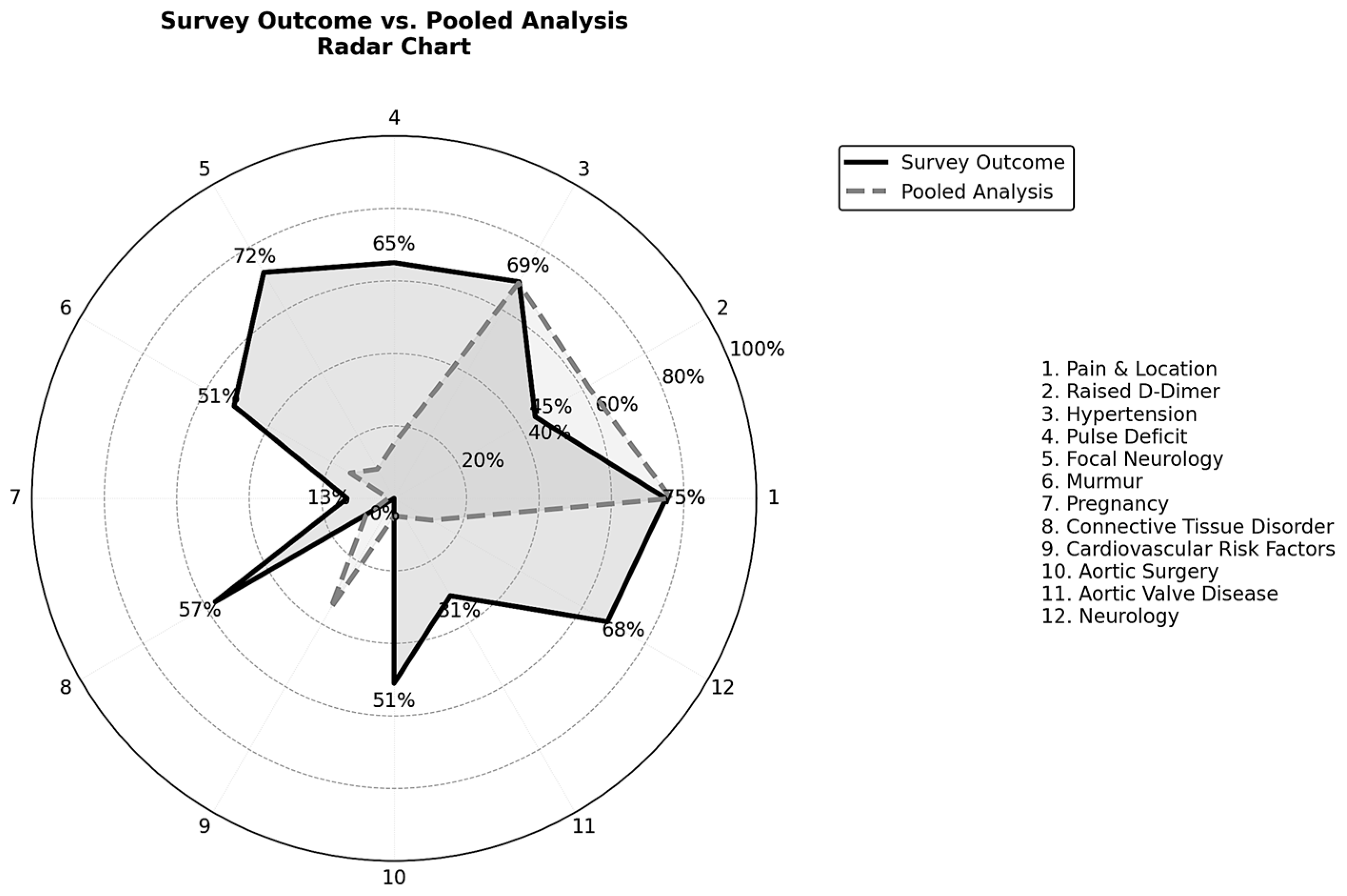
| Severity and Location of Pain | 75% (95% CI: 67.6–80.5%) | GTN | 19% (95% CI: 13.9–25.6%) |
| Neurology | 68% (95% CI: 60.3–74.2%) | Nitroprusside | 1% (95% CI: 0.3–4.1%) |
| Shortness Of Breath | 11% (95% CI: 7.1–16.5%) | Hydralazine | 0% (95% CI: 0.0–2.2%) |
| Nausea And Vomiting | 6% (95% CI: 3.6–11.0%) | I Don’t Start | 2.5% (95% CI: 0.9–5.8%) |
| All the Above | 25% (95% CI: 19.0–31.8%) | Site Management | |
| None Of the Above | 0.5% (95% CI: 0.1–2.5%) | Local | 41% (95% CI: 34.0–48.5%) |
| Suspecting Clinical Signs | Tertiary Centre | 47% (95% CI: 39.9–54.3%) | |
| Hypertension | 69% (95% CI: 61.7–75.2%) | Both | 12% (95% CI: 7.8–17.7%) |
| Pulse Deficit | 65% (95% CI: 57.7–71.6%) | Specialty Management | |
| Focal Neurology | 72% (95% CI: 64.7–78.1%) | Internal Medicine | 33% (95% CI: 26.4–39.9%) |
| Reduced Air Entry | 0.5% (95% CI: 0.1– 2.5%) | Vascular Surgery | 40% (95% CI: 33.4–47.0%) |
| Murmurs | 50% (95% CI: 42.6–57.4%) | Cardiothoracic Surgery | 51% (95% CI: 43.6–58.2%) |
| All the Above | 20% (95% CI: 14.7–26.6%) | Decision Tool Awareness? | |
| Risk Factor? | Aortic Dissection Decision Tool | 26% (95% CI: 20.1–32.9%) | |
| Age | 48% (95% CI: 40.4–55.7%) | ADDR + Age Adjusted D-Dimer | 19% (95% CI: 13.9–25.6%) |
| Gender | 30% (95% CI: 23.8–37.1%) | ADDR + D-Dimer > 500 | 19% (95% CI: 13.9–25.6%) |
| Pregnancy | 13% (95% CI: 8.9–18.7%) | ADDR + Ascending Aorta > 40 | 1.5% (95% CI: 0.5–4.3%) |
| Connective Tissue Disorder | 56% (95% CI: 48.6–62.8%) | None Of the Above | 51% (95% CI: 43.6–58.2%) |
| Cardiovascular Risk Factors | 0% (95% CI: 0.0–2.1%) | All the Above | 0.5% (95% CI: 0.1–2.5%) |
| Aortic Surgery | 51% (95% CI: 43.6–58.2%) | Is Stratification Useful? (Yes) | 85% (n = 147/173) |
| Family History of Aortic Valve Disease | 31% (95% CI: 24.6–38.3%) | Rate Of Misdiagnosis? | |
| All the Above | 39% (95% CI: 31.7–46.5%) | 10–29% | 31% (95% CI: 24.6–38.3%) |
| In Teaching Programme? (Yes) | 93% (n = 161/173) | 30–49% | 39% (95% CI: 31.7–46.5%) |
| Is There a SOP (Yes) | 32% (n = 55/173) | >50% | 30% (95% CI: 23.5–37.3%) |
| Group 1 (0–4 Years) | Group 2 (5–10 Years) | Group 3 (>10 Years) | p-Value | |
|---|---|---|---|---|
| How Many Diagnosed (0–4) | 67.35% (95% CI: 54.22–80.48%) | 57.41% (95% CI: 44.22–70.60%) | 28.99% (95% CI: 18.28–39.69%) | p < 0.001 |
| How Many Diagnosed (5–10) | 26.53% (95% CI: 14.17–38.89%) | 33.33% (95% CI: 20.76–45.91%) | 50.72% (95% CI: 38.93–62.52%) | p < 0.05 |
| How Many Diagnosed (>10) | 6.12% (95% CI: 0.00–12.84%) | 9.26% (95% CI: 1.53–16.99%) | 20.29% (95% CI: 10.80–29.78%) | p < 0.05 |
| Murmurs | 48.98% (95% CI: 34.98–62.98%) | 37.04% (95% CI: 24.16–49.92%) | 65.22% (95% CI: 53.98–76.46%) | p < 0.01 |
| Normal ECG as a Prompt | 4.08% (95% CI: 0.00–9.62%) | 1.85% (95% CI: 0.00–5.45%) | 17.39% (95% CI: 8.45–26.33%) | p < 0.01 |
| Rapid CT & Reporting | 59.18% (95% CI: 45.42–72.95%) | 64.81% (95% CI: 52.08–77.55%) | 82.61% (95% CI: 73.67–91.55%) | p < 0.05 |
| First Line Antihypertensive: Labetalol | 100.00% (95% CI: 100.00–100.00%) | 92.59% (95% CI: 85.61–99.58%) | 86.96% (95% CI: 79.01–94.90%) | p < 0.05 |
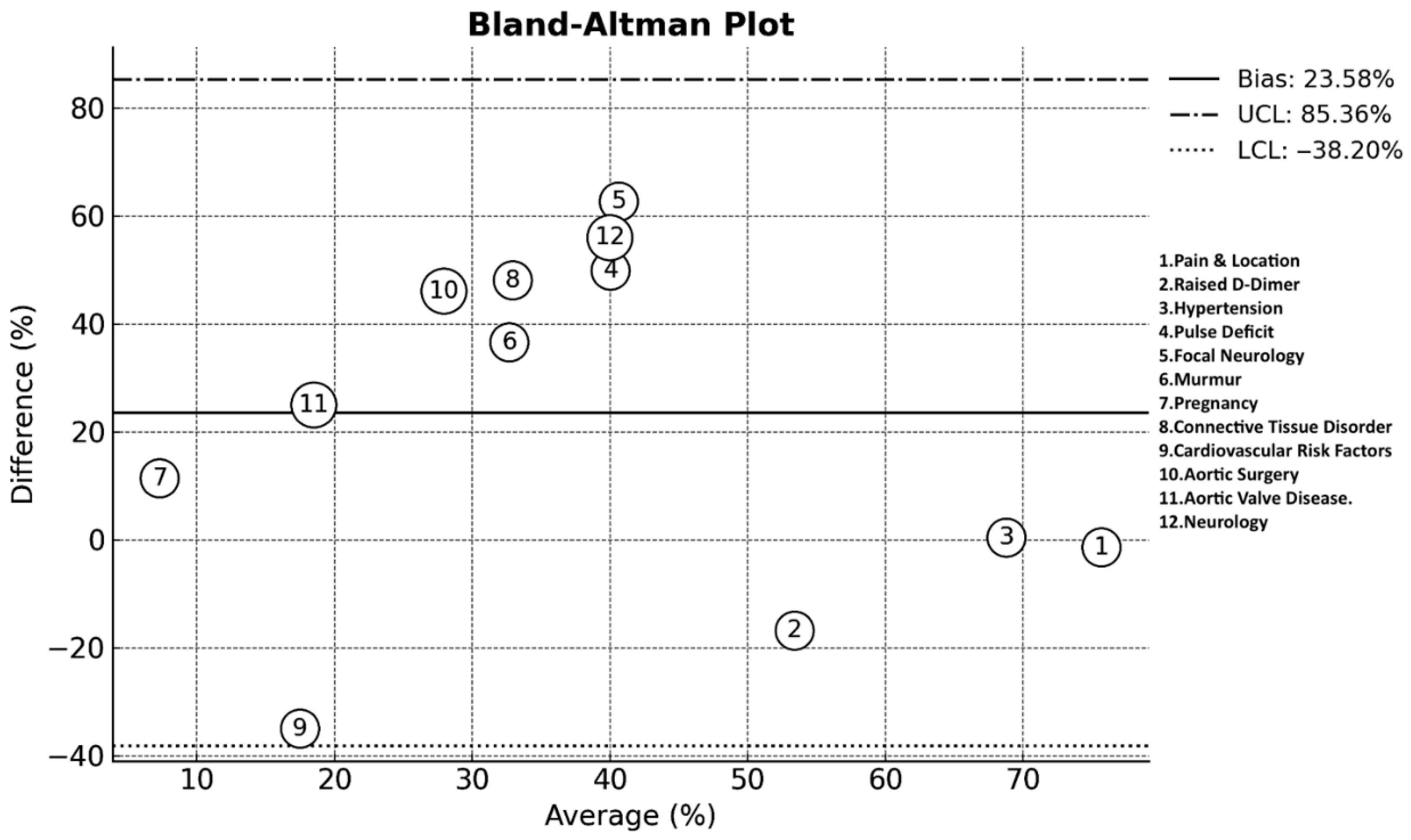
| ESVS | Ohle et al. [29] | Von Kodolitsch et al. [28] | Riambau et al. [16]. | McLatchie et al. [30] | Morello et al. [26] | Rogers et al. [32] | Nazerian et al. [27] | Matsushita et al. [31] | Suzuki et al. [25] | Pooled Analysis | |
|---|---|---|---|---|---|---|---|---|---|---|---|
| Pain and Location | 80% | 81.2% | 79% | 83–89% | 44–86% | - | 72.7–79.3% | - | 44–69% | 86.3–89.2% | 76.4% (95% CI: 72.7–79.8%) |
| Neurology | - | - | 20% | - | 8% | 10.2% | - | - | 6% | - | 11.5% (95% CI: 7.6–17.0%) |
| Shortness of Breath | - | - | - | - | - | - | - | - | - | - | N/A |
| Nausea/Vomiting | - | - | - | - | - | - | - | - | - | - | N/A |
| Hypertension | - | - | 82% | 82.1% | 31% | 69.4% | - | 55.4% | 73% | 69.1% | 68.6% (95% CI: 61.5–74.9%) |
| Pulse Deficit | 9% | 5.3% | 38% | - | 1% | 14.3% | 20.3% | 7.9% | - | 21.1% | 15.1% (95% CI: 10.6–21.1% |
| Focal Neurology | 7% | 10.8% | 13% | - | 5% | 1.41–5.42% | 10.8% | 11.4% | 3% | 4.7% | 9.3% (95% CI: 5.8–14.4%) |
| Reduced Air Entry | - | - | - | - | - | - | - | - | - | - | N/A |
| Murmur | - | 4.2% | 28% | - | 0.2% | 2.7% | 23.6% | - | - | - | 14.4% (95% CI: 9.7–20.8%) |
| Age | Yes * | 68.5 | 57 | 66 | 55 | 70 | - | 62 | 71 | 64.6 | 64.5 (95% CI: 61–69 years) |
| Pregnancy | Yes * | - | - | - | 3% | - | - | - | - | 0.2% | 1.6% (95% CI: 1.1–4.3%) |
| Connective Tissue Disorder | 13–22% | 0.2% | - | - | 0.5% | 5% | 4.3% | - | - | 2.9% | 8.9% (95% CI: 5.6–14.1%) |
| Cardiovascular Risk Factors | - | 6% | - | - | - | 42.9% | - | - | 53% | 42% | 35.0% (CI: 10.7–59.3%) |
| Aortic Surgery | - | 0.3% | - | - | 1% | 2% | 2.8% | - | - | 12.3% | 4.9% (95% CI: 2.6–9.0%) |
| Aortic Valve Disease | - | 1.5% | - | - | 2% | 14.3% | 11.9% | - | - | - | 6.3% (95% CI: 3.4–11.5%) |
| Normal ECG | - | - | - | - | - | - | - | - | - | 31% | N/A |
| Normal Troponin | - | - | - | - | - | - | - | - | - | - | N/A |
| Raised D-Dimer | Yes * | - | - | - | 40% | 18.2–77.8% | Yes * | YES * | 94–97% | Yes * | 61.8% (95% CI: 54.4–68.7%) |
| Raised Lactate | Yes * | - | - | - | Yes * | - | - | - | - | - | N/A |
Disclaimer/Publisher’s Note: The statements, opinions and data contained in all publications are solely those of the individual author(s) and contributor(s) and not of MDPI and/or the editor(s). MDPI and/or the editor(s) disclaim responsibility for any injury to people or property resulting from any ideas, methods, instructions or products referred to in the content. |
© 2026 by the authors. Licensee MDPI, Basel, Switzerland. This article is an open access article distributed under the terms and conditions of the Creative Commons Attribution (CC BY) license.
Share and Cite
Kordzadeh, A.; Rhodes, K.M. Type B Aortic Dissection Management Strategies: National Survey, Systematic Review, and Pooled Clinician Perceptions. J. Vasc. Dis. 2026, 5, 2. https://doi.org/10.3390/jvd5010002
Kordzadeh A, Rhodes KM. Type B Aortic Dissection Management Strategies: National Survey, Systematic Review, and Pooled Clinician Perceptions. Journal of Vascular Diseases. 2026; 5(1):2. https://doi.org/10.3390/jvd5010002
Chicago/Turabian StyleKordzadeh, Ali, and Karen May Rhodes. 2026. "Type B Aortic Dissection Management Strategies: National Survey, Systematic Review, and Pooled Clinician Perceptions" Journal of Vascular Diseases 5, no. 1: 2. https://doi.org/10.3390/jvd5010002
APA StyleKordzadeh, A., & Rhodes, K. M. (2026). Type B Aortic Dissection Management Strategies: National Survey, Systematic Review, and Pooled Clinician Perceptions. Journal of Vascular Diseases, 5(1), 2. https://doi.org/10.3390/jvd5010002