1. Introduction
Percutaneous coronary intervention (PCI) has transformed the management of obstructive coronary artery disease, enabling rapid restoration of coronary flow and symptomatic relief in patients with acute coronary syndromes and chronic stable angina [
1]. Despite advances in device technology and pharmacotherapy, PCI remains associated with mechanical complications, among which intramural hematoma (IMH) is increasingly recognized [
2,
3].
IMH is defined as blood accumulation within the medial space without a visible intimal tear, producing a crescent-shaped lesion that compresses the true lumen and can precipitate acute vessel obstruction [
3]. While spontaneous coronary artery dissection (SCAD) is a well-established cause of IMH [
4], iatrogenic IMH during PCI has gained attention, particularly in complex or calcified lesions. In an intravascular ultrasound (IVUS) study of 905 patients (1025 native lesions), 72 hematomas were identified in 69 arteries (~6.7%) [
3]. Evidence largely comes from smaller case series rather than multicenter registries, and long-term outcomes remain incompletely characterized. Iatrogenic IMH may result from aggressive balloon dilatation, stent deployment, or guidewire manipulation [
5]. Its angiographic appearance is often subtle, manifesting as haziness, tapering, or abrupt closure [
6]. Consequently, intravascular imaging modalities, including IVUS and optical coherence tomography (OCT), have become indispensable for accurate diagnosis and management [
3,
7]. The true incidence of PCI-related IMH is difficult to determine, but intravascular imaging studies suggest it occurs more frequently than angiography alone indicates [
5,
6].
Timely recognition of PCI-induced IMH enhances understanding of procedural vessel injury and challenges the limitations of angiography alone. By synthesizing pathophysiological mechanisms, imaging criteria, and case-based management strategies, this review proposes a pragmatic framework for diagnosis and treatment. Illustrative cases and a management algorithm highlight the role of imaging-guided decision-making in optimizing procedural safety and long-term vessel patency.
2. Pathophysiology and Mechanisms of Intramural Hematoma
The pathophysiological basis of IMH lies in disruption of the coronary vessel wall architecture. Blood enters the medial space through either a micro-tear in the intima or propagation of a dissection flap, leading to hematoma expansion between the internal elastic lamina and the external elastic laminae [
8]. Unlike classic dissections, IMH lacks a clear re-entry point, making natural decompression into the true lumen unlikely. The resultant intramural compression narrows the lumen and can severely compromise coronary blood flow [
9].
Deep guide catheter engagement can also precipitate proximal IMH [
13].
3. Clinical Presentation and Angiographic Appearances
Clinical manifestations of IMH are variable. Hematomas may be angiographically silent and detectable only with intravascular imaging [
14]. When lumen compromise is significant, patients may develop acute chest pain, hemodynamic instability, or angiographic slow-flow/no-reflow [
15]. Electrocardiographic signs of ischemia are common, and abrupt vessel closure may mimic thrombotic stent occlusion.
Angiographically, IMH typically appears as long, smooth vessel tapering, diffuse narrowing without a visible dissection flap, or hazy, ambiguous lesions [
3,
16]. Abrupt cessation of contrast distal to a stent edge is another characteristic finding [
14]. However, these features lack specificity, making angiography alone insufficient to distinguish IMH from thrombus, spasm, or severe negative remodeling. This diagnostic uncertainty underscores the value of intravascular imaging.
4. Diagnosis of Intramural Hematoma
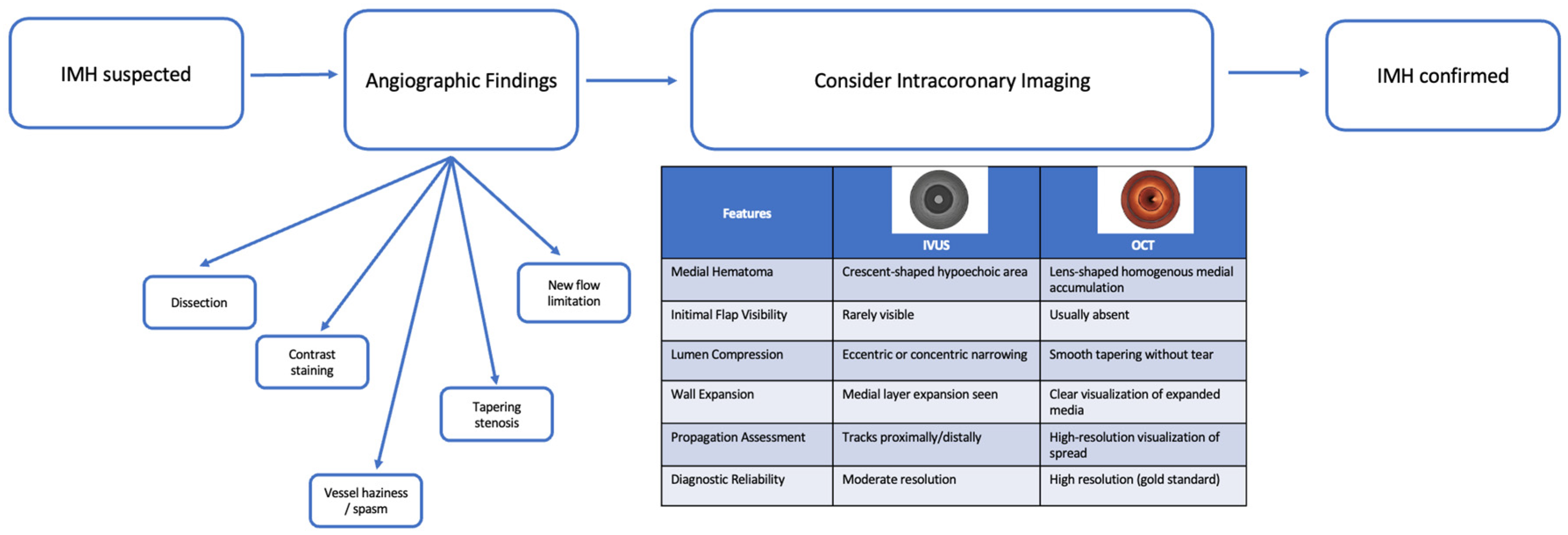
A high index of suspicion for IMH is warranted when angiography demonstrates atypical findings, particularly dissection, contrast staining, vessel haziness, tapering stenosis, or new flow limitation that cannot be accounted for by plaque or spasm. In such situations, intravascular imaging with IVUS or OCT becomes essential to confirm the diagnosis and define the hematoma’s characteristics. Imaging enables accurate assessment of its longitudinal extent, circumferential involvement, and the degree of lumen compression, all of which determine its clinical relevance. These parameters then inform management, guiding the choice between conservative or more definitive therapies. A diagnostic algorithm for PCI-related IMH is shown in
Figure 1.
5. Role of Intravascular Imaging in Diagnosis
Intravascular imaging, particularly the use of IVUS and/or OCT, is essential for confirming IMH. Diagnostic thresholds vary by modality: IVUS typically identifies IMH when a hypoechoic crescent occupies >30° of vessel circumference with true lumen compression, whereas OCT detects low-attenuation medial expansion > 0.3 mm thick or longitudinal propagation > 5 mm. Awareness of these imaging criteria aids differentiation from dissection or thrombus and informs subsequent management strategies. Imaging modalities are compared to angiography in
Table 1 5.1. Intravascular Ultrasound (IVUS)
IVUS demonstrates IMH as a hypoechoic, crescent-shaped area between the intima and media, often with preserved external elastic lamina boundaries [
17]. It allows visualization of hematoma length and its effect on the true lumen. IVUS is less sensitive to small hematomas compared to OCT but offers deeper tissue penetration and is especially useful in large vessels or in the presence of blood attenuation [
18].
5.2. Optical Coherence Tomography (OCT)
OCT provides higher resolution images, identifying IMH as a low-attenuation crescent with sharply demarcated borders [
18]. The presence of intimal tears or entry points can be precisely located. OCT excels at assessing stent edge pathology and distinguishing between thrombus and hematoma. However, its limited depth penetration may underestimate the true hematoma burden in large vessels [
19].
5.3. Emerging Imaging Techniques
Near-infrared spectroscopy and hybrid IVUS-OCT platforms are being explored for better tissue characterization. Although not yet standard in IMH, these modalities may enhance detection and guide therapy [
18,
19].
6. Case Examples
The following case examples highlight the different mechanisms of IMH, implications and management options. They illustrate how imaging not only confirms IMH but also guides tailored intervention.
6.1. Case Example 1: Wire-Induced Hematoma
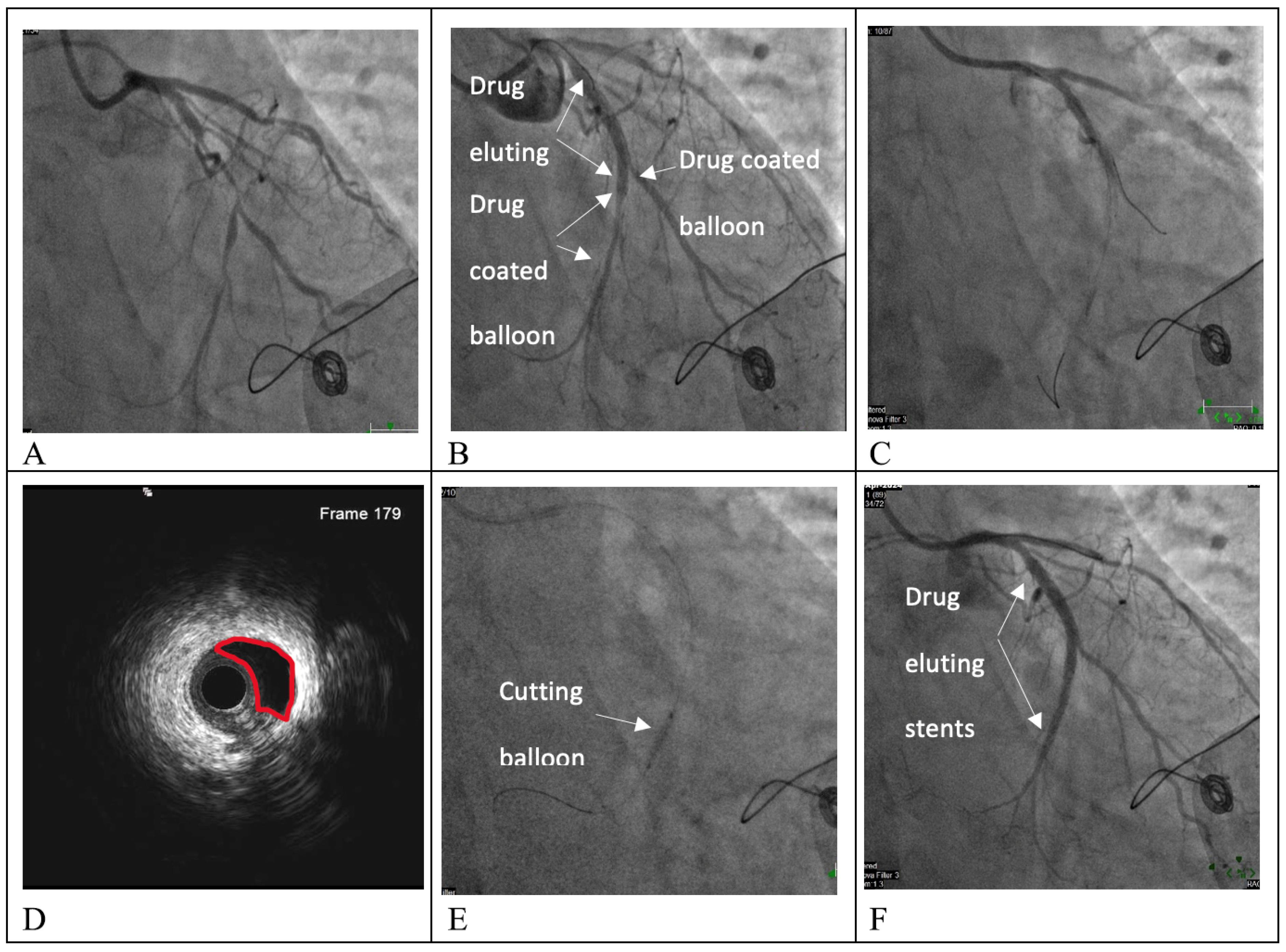
A 79-year-old male presented with subacute ST-elevation myocardial infarction. Coronary angiography revealed chronic total occlusion of the left anterior descending (LAD) artery, critical left circumflex (LCx)/marginal bifurcation stenosis, and severe right coronary artery (RCA) disease (
Figure 2A). Owing to high surgical risk, percutaneous coronary intervention (PCI) of the LCx was performed using a hybrid drug-eluting stent (DES) and drug-coated balloon (DCB) strategy (
Figure 2B). Accidental withdrawal of the LCx wire, and subsequent attempt at rewiring resulted in abrupt loss of distal vessel flow (
Figure 2C). The patient developed ventricular fibrillation and required defibrillation. IVUS confirmed true lumen wire position but demonstrated significant IMH compressing the distal vessel lumen (
Figure 2D, traced in red). A 2.0 mm Wolverine cutting balloon (Boston Scientific, Marlborough, MA, USA) was then inflated at low pressure and gently rotated to create intimal fenestrations (
Figure 2E), decompressing the IMH and restoring flow. The vessel was subsequently secured with an overlapping DES (
Figure 2F). This case highlights the importance of imaging in differentiating hematoma from other complications, allowing for appropriate bailout strategy.
6.2. Case Example 2: IMH After Guide Injury
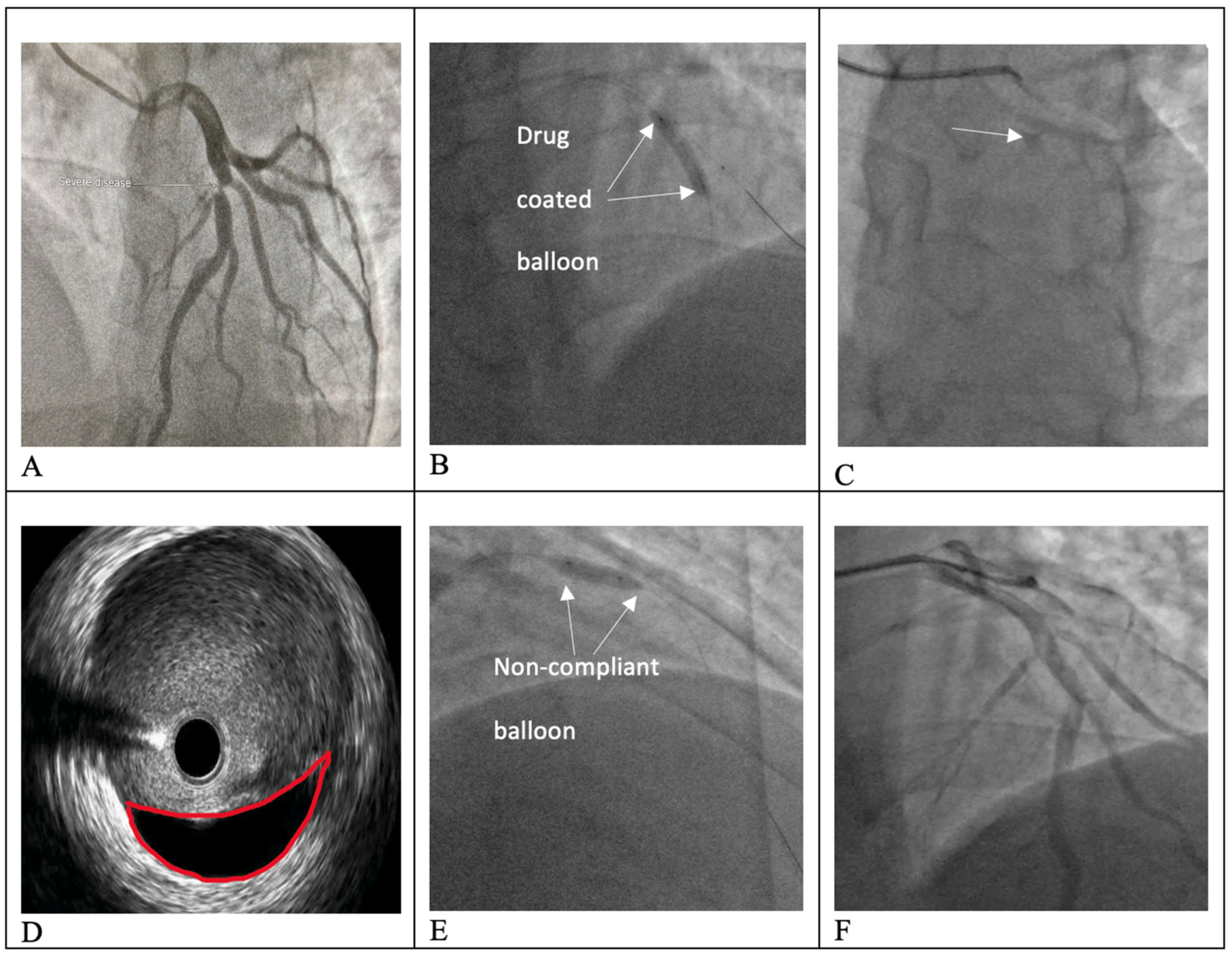
A 60-year-old man with unstable angina was found to have severe mid LAD disease on angiography (
Figure 3A). A DES was deployed from the proximal to mid LAD and subsequently postdilated with a non-compliant balloon. During withdrawal of the used balloon, inadvertent guide catheter trauma resulted in proximal LAD injury, seen as a filling defect (
Figure 3B, indicated by white arrow). IVUS revealed a significant medial dissection with associated IMH (
Figure 3C, traced in red). A second DES was quickly implanted, overlapping the initial stent and extending into the left main, followed by post-dilation to achieve complete sealing of the dissection and IMH (
Figure 3D). This case highlights the importance of meticulous technique and vigilance during PCI, as guide-induced dissection and IMH can lead to potentially catastrophic complications.
6.3. Case Example 3: Longitudinal Hematoma in Mid LAD Post DCB Angioplasty
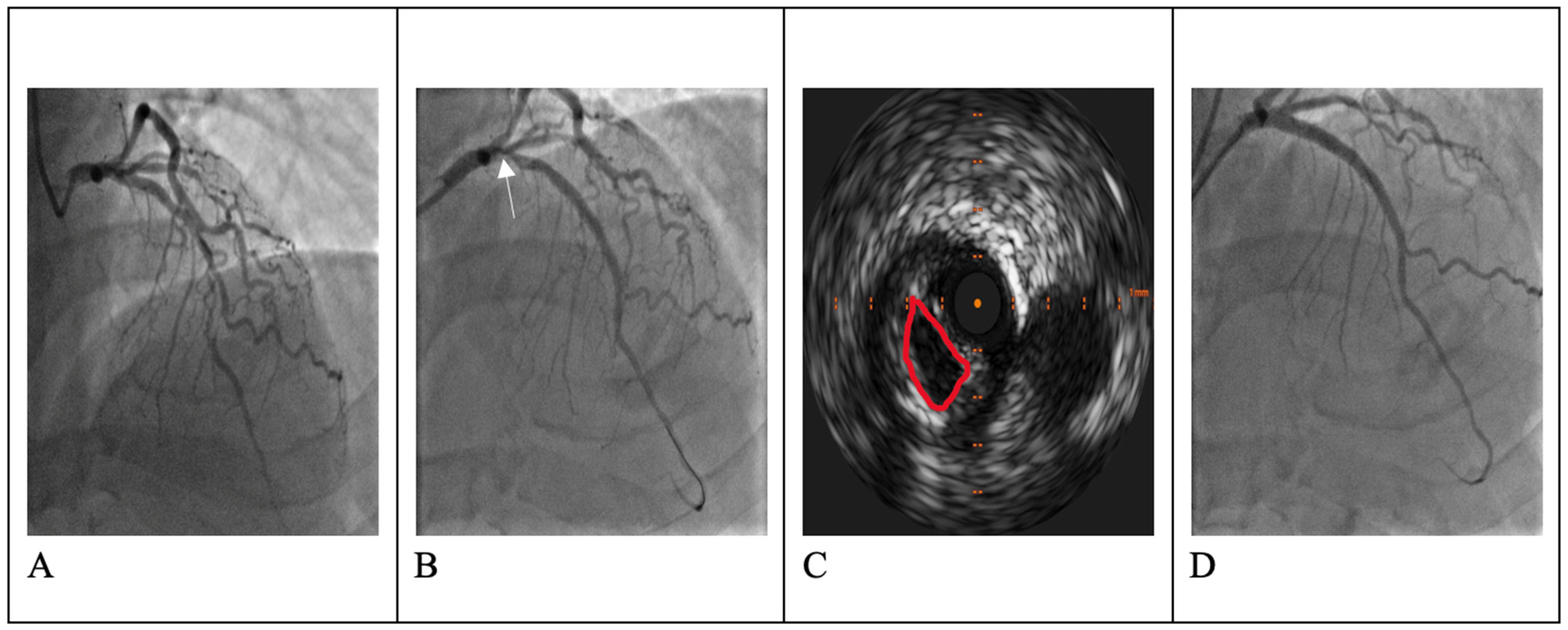
A 31-year-old Chinese male with angina, hyperlipidemia and a significant family history of premature coronary artery disease was referred for evaluation. Coronary computed tomography angiography (CCTA) revealed severe stenosis in the mid LAD artery, despite a calcium score of zero. Invasive coronary angiography confirmed a severe lesion just distal to a large diagonal branch (
Figure 4A). IVUS demonstrated predominantly fibrotic plaque. PCI was initially performed using DCB angioplasty (
Figure 4B). Contrast dye hang-up was noted after wire removal (
Figure 4C, indicated by white arrow). Rewiring and subsequent IVUS revealed the presence of moderate IMH (
Figure 4D, traced in red). To avoid further propagation, prolonged non-compliant balloon inflation was used to decompress the hematoma, leading to resolution and restoration of normal vessel architecture (
Figure 4E,F). This case highlights the role of early recognition of post-angioplasty IMH, with successful management using prolonged balloon inflation.
6.4. Summary of Case Examples
The presented cases demonstrate diverse mechanisms and management strategies for PCI-induced IMH. Wire-induced IMH, typically distal, responds well to cutting balloon fenestration, whereas guide-induced IMH is often proximal and requires stenting to seal entry points. Imaging-guided intervention restored flow in all cases, but treatment selection depended on lesion morphology and flow limitation. Collectively, these examples emphasize early recognition, imaging guidance, and technique selection tailored to mechanism and anatomy.
7. Preventive Strategies
Prevention of iatrogenic IMH requires meticulous procedural planning and careful device use. There are numerous risk factors, as depicted in
Table 2. Adequate lesion preparation with atherectomy or specialty balloons may reduce vessel trauma. Avoidance of high-pressure balloon inflations in fragile vessels, appropriate stent sizing, and cautious guide catheter manipulation are essential [
2,
5]. Intravascular imaging should be considered routinely in high-risk cases, enabling early detection of vessel wall injury [
20]. Operator awareness and anticipation remain critical preventive strategies.
8. Management
Management of PCI-induced IMH is guided by hemodynamic impact, anatomical extent, and intravascular imaging findings, with strategies ranging from conservative observation to aggressive interventional or surgical repair, as summarized in
Table 3. Small, localized IMHs without flow limitation may be managed conservatively, as they can resolve spontaneously with careful hemodynamic monitoring and follow-up imaging. In such cases, optimal medical therapy, including dual antiplatelet therapy and avoidance of further vessel trauma, is essential to prevent progression [
21].
When IMH compromises coronary flow, stent implantation remains the most common approach. By sealing the entry point and compressing the hematoma, stents restore luminal patency, but long hematomas often require multiple overlapping stents, raising concerns regarding late restenosis, thrombosis, and even stent fracture. Alternative techniques such as cutting or scoring balloons can create controlled fenestrations, allowing hematoma decompression into the true lumen, and are particularly useful when long stenting is undesirable [
22]. DCBs are an emerging option in non–flow limiting IMHs, especially when hematomas occur adjacent to stented segments, as they provide antiproliferative therapy while avoiding additional metal layers and their associated long-term complications [
23].
In more refractory cases, operators may employ fenestration techniques using microcatheters or stiff guidewires to create small perforations between the hematoma and the true lumen, thereby decompressing the vessel wall, though these require advanced expertise and carry a risk of perforation [
24]. Surgical revascularization with coronary artery bypass grafting (CABG) is rarely required but remains an option in cases of extensive IMH involving the left main or multiple vessels, particularly when percutaneous strategies fail to restore adequate flow [
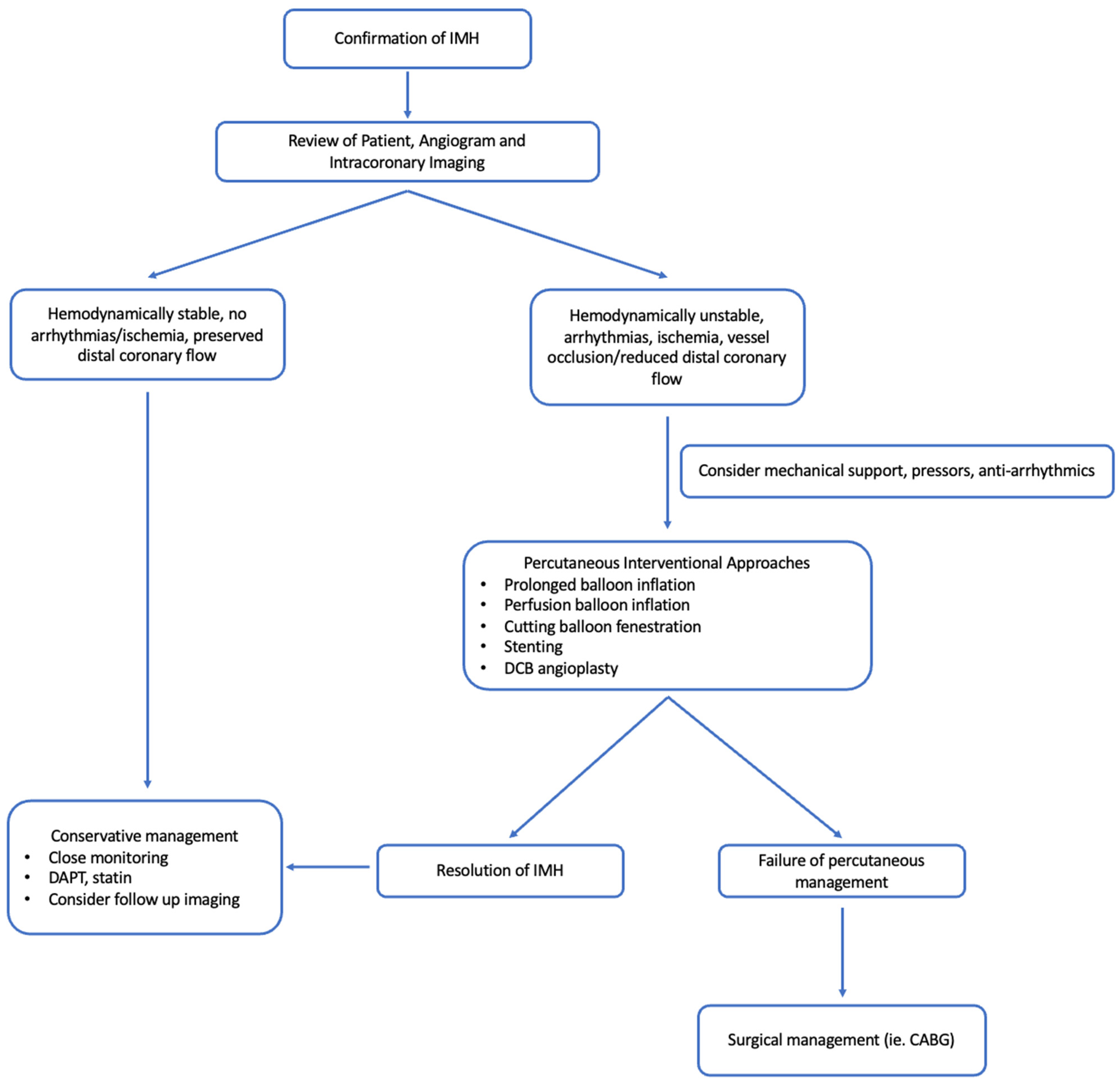
13]. This tiered approach emphasizes individualized management tailored to lesion characteristics and patient stability.
A detailed algorithm, for the management of PCI-related IMH, is attached below (
Figure 5).
9. Prognosis and Outcomes
The natural history of PCI-related IMH remains incompletely understood. While small hematomas may resorb spontaneously, larger ones are associated with adverse outcomes including acute vessel closure, recurrent angina, and need for repeat revascularization [
5,
6]. Intravascular imaging-guided management appears to improve prognosis, as it allows tailored strategies rather than empirical stenting [
14,
18]. Long-term outcomes depend on vessel location, hematoma extent, and therapeutic approach. Importantly, IMH at stent edges has been linked to higher rates of restenosis and target vessel failure compared to uncomplicated PCI [
11,
14].
10. Future Directions
Research on PCI-related intramural hematoma (IMH) remains limited, with most evidence derived from case reports and small series. Prospective registries and imaging-based studies are needed to better define incidence, risk factors, and optimal management strategies. The clinical roles of drug-coated balloons and novel fenestration devices also warrant further investigation.
Emerging technologies are poised to transform IMH management. Artificial intelligence (AI)–assisted imaging algorithms for automated detection on OCT and IVUS datasets show promise for real-time procedural alerts. Trials such as AI-IVUS IMH (NCT05678942) are evaluating deep learning–based pattern recognition for subintimal hematoma mapping. Novel interventional tools, including perfusion balloons, microfenestration catheters and dual-layer drug-coated balloons, aim to minimize vessel trauma while addressing non–flow-limiting hematomas. Moreover, hybrid imaging approaches—integrating IVUS, OCT, and near-infrared spectroscopy (NIRS)—may enhance tissue characterization and guide precision therapy.
Collectively, these advances have the potential to shift IMH management from reactive interventions toward predictive prevention, enabling earlier recognition, tailored therapy, and improved procedural outcomes.
11. Conclusions
IMH during PCI represents an under-recognized but clinically important complication. Angiography alone is insufficient for diagnosis, and intravascular imaging plays a pivotal role in recognition and management. Treatment should be individualized, ranging from conservative observation to stenting, cutting balloons, or drug-coated balloons, depending on anatomical and clinical factors. Preventive measures, including careful lesion preparation and imaging guidance, are crucial. With increasing awareness and better imaging modalities, outcomes of PCI-related IMH are improving. Future research should focus on prospective data collection and evaluation of innovative treatment approaches. Incorporating systematic imaging, awareness of diagnostic thresholds, and leveraging emerging AI-driven tools will likely improve detection, optimize outcomes, and prevent iatrogenic vessel injury in the contemporary PCI era.
Author Contributions
D.Y.—Conceptualization, visualization, writing—original draft, writing—review & editing; E.W.J.S.—Visualization, writing—original draft, writing—review & editing; B.W.—Project administration, writing—original draft, writing—review & editing; S.F.—Writing—original draft, writing—review & editing; C.A.—Project administration, writing—original draft, writing—review & editing; G.T.—Writing—review & editing; B.K.—Conceptualization, visualization, project administration, supervision, validation, writing—original draft, writing—review & editing. All authors have read and agreed to the published version of the manuscript.
Funding
This research received no external funding.
Institutional Review Board Statement
Ethical review and approval were not applicable for this review article.
Informed Consent Statement
Informed consent was obtained from all patients whose clinical cases are described.
Data Availability Statement
No new data were created or analyzed in this study. Data sharing is not applicable.
Conflicts of Interest
The authors declare no conflicts of interest.
References
- Abubakar, M.; Javed, I.; Rasool, H.F.; Raza, S.; Basavaraju, D.; Abdullah, R.M.; Ahmed, F.; Salim, S.S.; Faraz, M.A.; Hassan, K.M.; et al. Advancements in Percutaneous Coronary Intervention Techniques: A Comprehensive Literature Review of Mixed Studies and Practice Guidelines. Cureus 2023, 15, e41311. [Google Scholar] [CrossRef]
- Hussain, B.; Bhavsar, D.; Dhulipala, V. Coronary artery intramural hematoma, a rare complication of percutaneous coronary intervention. Radiol. Case Rep. 2022, 17, 3770–3773. [Google Scholar] [CrossRef]
- Maehara, A.; Mintz, G.S.; Bui, A.B.; Castagna, M.T.; Walter, O.R.; Pappas, C.; Pinnow, E.E.; Pichard, A.D.; Satler, L.F.; Waksman, R.; et al. Incidence, morphology, angiographic findings, and outcomes of intramural hematomas after percutaneous coronary interventions: An intravascular ultrasound study. Circulation 2002, 105, 2037–2042. [Google Scholar] [CrossRef]
- Yip, A.; Saw, J. Spontaneous coronary artery dissection—A review. Cardiovasc. Diagn. Ther. 2015, 5, 37–48. [Google Scholar] [CrossRef]
- Antonsen, L.; Thayssen, P.; Jensen, L.O. Large coronary intramural hematomas: A case series and focused literature review. Cardiovasc. Revasc. Med. 2015, 16, 116–123. [Google Scholar] [CrossRef] [PubMed]
- Moidy, M.; Al Kindi, F. Coronary Intramural Hematoma: Challenges in Diagnosis and Management. Heart Views 2019, 20, 17–20. [Google Scholar] [CrossRef] [PubMed]
- Porto, I.; Aurigemma, C.; Pennestrì, F.; Rebuzzi, A.G. Intravascular ultrasound-documented healing of spontaneous coronary artery dissection. Circ. Cardiovasc. Interv. 2010, 3, 519–522. [Google Scholar] [CrossRef] [PubMed]
- Werner, G.S.; Figulla, H.R.; Grosse, W.; Kreuzer, H. Extensive intramural hematoma as the cause of failed coronary angioplasty: Diagnosis by intravascular ultrasound and treatment by stent implantation. Cathet. Cardiovasc. Diagn. 1995, 36, 173–178. [Google Scholar] [CrossRef] [PubMed]
- Werner, G.; Diedrich, J.; Kreuzer, H. Sonographic and angiographic features of intramural hematoma as a cause of failed coronary angioplasty. J. Invasive Cardiol. 1996, 8, 208–214. [Google Scholar]
- Lee, R.T.; Kamm, R.D. Vascular mechanics for the cardiologist. J. Am. Coll. Cardiol. 1994, 23, 1289–1295. [Google Scholar] [CrossRef]
- Tremmel, J.A.; Koizumi, T.; O’Loughlin, A.; Yeung, A.C. Images in intervention. Intramural hematoma appearing as a new lesion after coronary stenting. JACC Cardiovasc. Interv. 2011, 4, 129–130. [Google Scholar] [CrossRef][Green Version]
- Valdes, P.J.; Nagalli, S.; Diaz, M.A. Rotational Atherectomy. [Updated 3 July 2023]. In StatPearls [Internet]; StatPearls Publishing: Treasure Island, FL, USA, 2025. Available online: https://www.ncbi.nlm.nih.gov/books/NBK499916/ (accessed on 20 September 2025).
- Sharma, A.K.; Roy, S.; Dadarwal, A. Management of Catheter-Induced Coronary Artery Dissection Leading to Extensive Bidirectional Intramural Hematoma. JACC Case Rep. 2025, 30, 103173. [Google Scholar] [CrossRef]
- Sheris, S.J.; Canos, M.R.; Weissman, N.J. Natural history of intravascular ultrasound-detected edge dissections from coronary stent deployment. Am. Heart J. 2000, 139 Pt 1, 59–63. [Google Scholar] [CrossRef]
- Fujikura, H.; Hata, Y.; Morino, Y.; Matsuzaki, A.; Oikawa, K.; Ikari, Y.; Taguchi, J. Images in cardiovascular medicine. Acute coronary syndrome due to intramural hematoma. Circulation 2006, 114, e644–e645. [Google Scholar] [CrossRef]
- Farb, A.; Virmani, R.; Atkinson, J.B. Plaque morphology and pathologic changes in arteries from patients dying after coronary balloon angioplasty. J. Am. Coll. Cardiol. 1990, 16, 1421–1429. [Google Scholar] [CrossRef] [PubMed]
- Hau, W.K.T.; Yan, B.P.Y. Role of Intravascular Imaging in Primary PCI. In Primary Angioplasty; Watson, T.J., Ong, P.J.L., Tcheng, J.E., Eds.; Springer: Singapore, 2018. [Google Scholar] [CrossRef]
- Raja, D.C.; Subban, V.; Livingston, N.; Thenpally, J.; Mullasari, A.S. Optical Coherence Tomography and Intravascular Ultrasound in Diagnosis of Coronary Intramural Hematoma. Heart Views 2019, 20, 32–33. [Google Scholar] [CrossRef] [PubMed]
- Liu, W.; Zhou, Y.J.; Liu, Y.Y.; Shi, D.M. Is this spontaneous coronary intramural hematoma or fibrotic plaque?: An inconsistent finding between optical coherent tomography and intravascular ultrasound. JACC Cardiovasc. Interv. 2013, 6, 983–984. [Google Scholar] [CrossRef] [PubMed]
- Waxman, S.; Bajwa, U.; Tran, M. Intravascular Coronary Imaging Update: Advances, Clinical Applications, and Future Directions. Curr. Cardiol. Rep. 2025, 27, 111. [Google Scholar] [CrossRef]
- Giannino, F.; Carciotto, G.; Pallante, F.; Monciino, G.; Mancuso, M.; Raspanti, D.; Iuvara, G.; Ajello, M.; Lo Giudice, S.; Marchetta, M.; et al. Interventional Management of Intracoronary Dissection/Hematoma: A Comprehensive Review. Curr. Cardiol. Rep. 2025, 27, 90. [Google Scholar] [CrossRef]
- Gasparini, G.L.; Maurina, M.; Regazzoli, D.; Canova, P.; Leone, P.P.; Mangieri, A.; Reimers, B. The “Cuttering (Cutting-Dottering Balloon) Technique” for treatment of flow-limiting coronary intramural hematoma. Catheter. Cardiovasc. Interv. 2024, 104, 952–958. [Google Scholar] [CrossRef]
- Gitto, M.; Leone, P.P.; Gioia, F.; Chiarito, M.; Latini, A.; Tartaglia, F.; Kilic, I.D.; Rossi, M.L.; Regazzoli, D.; Gasparini, G.; et al. Coronary Artery Dissection in Drug-Coated Balloon Angioplasty: Incidence, Predictors, and Clinical Outcomes. Am. J. Cardiol. 2025, 239, 28–35. [Google Scholar] [CrossRef] [PubMed]
- Kovačić, M. Stiff wire scratching to fenestration, de-escalation, and re-entry technique (SSDR): A novel wire-based antegrade dissection/re-entry technique for coronary chronic total occlusion recanalization. Cardiol. J. 2023, 30, 843–845. [Google Scholar] [CrossRef] [PubMed]
| Disclaimer/Publisher’s Note: The statements, opinions and data contained in all publications are solely those of the individual author(s) and contributor(s) and not of MDPI and/or the editor(s). MDPI and/or the editor(s) disclaim responsibility for any injury to people or property resulting from any ideas, methods, instructions or products referred to in the content. |
© 2025 by the authors. Licensee MDPI, Basel, Switzerland. This article is an open access article distributed under the terms and conditions of the Creative Commons Attribution (CC BY) license (https://creativecommons.org/licenses/by/4.0/).



 ,
,