Systematic Review

Psychedelic-Assisted Psychotherapy for the Treatment of PTSD: A Systematic Review and Meta-Analysis


1
West Moreton Health, Queensland Health, Ipswich, QLD 4305, Australia
2
New Farm Clinic, Brisbane, QLD 4005, Australia
3
Faculty of Health, Medicine and Behavioural Sciences, The University of Queensland, Brisbane, QLD 4005, Australia
4
Royal Brisbane and Women’s Hospital, Herston, QLD 4006, Australia
5
Thompson Institute, University of the Sunshine Coast, Sippy Downs, QLD 4556, Australia
*
Author to whom correspondence should be addressed.
These authors contributed equally to this work.
Psychoactives 2026, 5(2), 16; https://doi.org/10.3390/psychoactives5020016
Submission received: 27 March 2026 / Revised: 31 May 2026 / Accepted: 5 June 2026 / Published: 8 June 2026

Abstract

Post-traumatic stress disorder (PTSD) remains inadequately treated by existing pharmacological and psychological interventions, prompting growing interest in psychedelic-assisted psychotherapy. Although randomised controlled trials have evaluated several psychedelic agents for PTSD, to our knowledge, no prior PTSD-specific synthesis has quantitatively examined multiple agent classes within a single review framework. This systematic review and meta-analysis searched PsycINFO, CINAHL, Embase, MEDLINE, and clinical trial registries to identify RCTs of psychedelic-assisted psychotherapy for PTSD. Risk of bias was assessed using the Cochrane Risk of Bias 2 tool, and random-effects meta-analyses were conducted for efficacy outcomes; safety and therapeutic protocols were synthesised narratively. Eleven RCTs involving 358 participants met inclusion criteria, evaluating MDMA, ketamine, and cannabidiol, of which eight contributed to meta-analyses. MDMA-assisted psychotherapy demonstrated a significant moderate-to-large reduction in PTSD symptom severity with negligible heterogeneity, and participants were significantly more likely to achieve clinical response and loss of PTSD diagnosis. The pooled effect for ketamine was small and non-significant, and a single cannabidiol trial showed no clear benefit. All agents were generally well tolerated. MDMA-assisted psychotherapy showed a promising efficacy signal for PTSD symptom reduction, although safety data were heterogenous and remain insufficient for strong comparative conclusions. Evidence for ketamine and cannabidiol remains too limited to support clinical implementation and it is noted that the current evidence base is dominated by MDMA trials. Further adequately powered trials with standardised outcomes and direct comparative studies across agents are needed.

1. Introduction

Psychedelic-assisted psychotherapy is an emerging and rapidly evolving field of research. The study of the potential therapeutic benefits of psychedelic compounds accelerated rapidly between the 1950s and 1970s, but was subsequently restricted by legal, political, and social factors [1,2]. After several decades of relative dormancy, research has resurged, with a growing evidence base for their potential benefits across a range of mental health disorders [3].
Post-traumatic stress disorder (PTSD) is a debilitating psychiatric condition that can develop following exposure to traumatic events [4]. An estimated 11% of Australians experience PTSD in their lifetime [5] with women being at a higher risk than men [6]. PTSD frequently follows a chronic course, is highly comorbid with depression, anxiety, and substance use disorders, and imposes a significant burden on individuals, families and health systems [7].
Current evidence-based treatments for PTSD include trauma-focused psychotherapies and pharmacotherapy with selective serotonin reuptake inhibitors (SSRIs) such as sertraline, paroxetine and fluoxetine as well as serotonin-noradrenaline reuptake inhibitor (SNRI) venlafaxine [8]. Pharmacological treatments yield only modest effect sizes compared to placebo [9], with low remission and response rates [10] and frequent symptom recurrence upon discontinuation [11]. Although trauma-focused psychotherapies have demonstrated greater and more enduring effects than pharmacotherapy [12,13], outcomes remain suboptimal. A recent meta-analysis estimated that approximately 39% of patients do not respond adequately to psychological treatments [14]. These treatment gaps, combined with substantial drop-out rates [15], have prompted a growing interest in novel therapeutic approaches, particularly for treatment-resistant populations.
Psychedelic-assisted psychotherapy involves psychotherapy combined with the use of a psychedelic agent during at least one of the sessions to facilitate psychotherapy [16] and has been hypothesised to enhance outcomes beyond what either modality could achieve alone [17]. Psychedelic compounds may catalyse the psychotherapeutic process through several mechanisms, including facilitating emotional engagement, modifying threat-related learning, supporting memory reconsolidation, and strengthening therapeutic alliance [18]. These properties are of particular relevance to PTSD, where trauma-focused psychotherapy may be challenging due to emotional detachment, memory fragmentation, or difficulty tolerating reexperiencing of traumatic memories during therapy [19]. Using the Australian context as an example, the recent approval of MDMA for treatment-resistant PTSD and psilocybin for treatment-resistant depression by an authorised psychiatrist under strict conditions highlights the expanding evidence base and therapeutic potential of these interventions [20].
For the purposes of this review, the term ‘psychedelic’ is used pragmatically and broadly to include 3,4-methylenedioxymethamphetamine (MDMA), ketamine, classical serotonergic psychedelics (such as psilocybin and lysergic acid diethylamide), N,N-dimethyltryptamine (DMT), cannabinoids, and ibogaine—agents that can induce marked alterations in perception, affect, and sense of self and intensify emotional experiences [2,18]. Hence, our use of the term ‘psychedelic’ reflects more of an operational (rather than a strictly taxonomic) definition of pharmacologically, phenomenologically and clinically distinct agents. It is acknowledged at the outset that our broad grouping is not universally accepted and may lead to conceptual limitations of our work. However, our inclusive definition reflects the emerging clinical literature, in which agents beyond classical serotonergic psychedelics have been investigated within psychotherapy-assisted paradigms for PTSD and are increasingly grouped under this umbrella in reviews [17,18,21,22].
The strongest existing evidence base is for MDMA-assisted psychotherapy, with multiple randomised controlled trials demonstrating significant reductions in PTSD symptom severity and higher rates of clinical response and remission compared with placebo or inactive low-dose MDMA [23,24,25,26,27]. A recent meta-analysis corroborated these findings; however, it noted that some trials were limited by small sample sizes and demographic homogeneity, constraining generalizability [28].
Interest in ketamine-assisted psychotherapy for PTSD has accelerated in recent years. A systematic review [29] reported significant symptom reductions when ketamine was combined with structured psychotherapy, although the evidence base remains limited in size and methodological consistency. Broader reviews of ketamine for PTSD have yielded mixed results, with Almeida et al. [30] finding significant improvements at treatment endpoint, while Borgogna et al. [31] reported that symptom reductions were generally not greater than control conditions.
Findings from several recent studies suggest that classical psychedelics may hold promise for the treatment of PTSD [18]; however, concerns remain regarding heightened arousal in trauma-affected individuals. Similarly, dysregulation of the endocannabinoid system has been implicated in core PTSD symptoms [32,33]. Early clinical data have suggested potential benefits for hyperarousal, nightmares, and general wellbeing [34,35] though safety considerations, including cognitive effects and dependence risk, warrant further investigation.
Although systematic reviews have examined MDMA-assisted psychotherapy and ketamine-assisted therapy for PTSD separately, no prior synthesis has evaluated the evidence across multiple psychedelic agents within this diagnostic group. Broader systematic reviews [17,22] of psychedelic treatments across psychiatric conditions have been completed; however, they omit more recent relevant randomised controlled trials, are not specific to the PTSD context, and therefore provide limited guidance for clinical application. As a result, the current literature remains siloed, making it difficult for clinicians, regulators, and researchers to form a comprehensive view of psychedelic-assisted psychotherapy for PTSD.
This review aims to address these gaps by systematically consolidating the evidence on the efficacy and safety of psychedelic-assisted psychotherapy for PTSD across multiple agents, while also describing therapeutic protocols—including preparation, dosing, and integration. In doing so, it aims to provide a timely and clinically relevant synthesis for psychiatry and allied mental health fields.

2. Materials and Methods

This review was conducted in accordance with the Preferred Reporting Items for Systematic Reviews and Meta-Analysis (PRISMA) guidelines [36] and was registered with the International Prospective Register of Systematic Reviews (PROSPERO: CRD420251196809).

2.1. Data Sources and Search Strategy

Searches were conducted in PsycINFO, CINAHL, Embase, and MEDLINE databases on the 11th of December 2025 with the assistance of the hospital library service (Table S1 provides a detailed list of search terms used). The search was not re-run prior to manuscript submission. Veteran/military-related terms were included as an additional sensitivity-oriented search block because several early PTSD intervention studies enrolled veterans or first responders; these terms were combined with broader PTSD terms and did not restrict retrieval to military populations. Studies were limited to the English language—a restriction that introduces bias (explored further in Section 4)—and there was no date range limit. Grey literature was also searched via ClinicalTrials.gov, Australian and New Zealand Clinical Trials Registry (ANZCTR) and the World Health Organization International Clinical Trials Registry Platform (WHO ICTRP). In addition, manual searches of the reference lists of included studies and recent systematic reviews were conducted.

2.2. Eligibility Criteria

Studies were included if they met the following criteria: (i) they were a randomised controlled trial published in English, with no restriction on publication date; (ii) participants were adults aged 18 years or older; (iii) participants had a diagnosis of PTSD established using standardised diagnostic criteria; (iv) the intervention involved psychedelic-assisted psychotherapy (with the psychotherapy being structured and integrated into the treatment protocol) using a psychedelic agent (as defined in introduction) compared to placebo, active placebo or standard treatment; (v) at least one validated PTSD outcome measure for efficacy was reported using either Clinician Administered PTSD Scale (CAPS-IV or CAPS-5) or the PTSD Checklist (PCL); and (vi) at least one safety measure or adverse event outcome was reported. Studies were excluded if they were non-comparative, non-randomised or quasi-experimental in design, focused exclusively on complex PTSD or non-PTSD diagnoses without a PTSD subgroup analysis, used non-standardised PTSD diagnostic tools, or included participants under 18 years of age. Animal studies were also excluded. Preprints, conference abstracts, dissertations and unpublished datasets were not eligible, whereas trial registries were searched to identify unpublished or incompletely published randomised trials and supplementary outcome data. In practice, the safety outcome criterion did not exclude any studies that otherwise met inclusion criteria, as all eligible RCTs reported at least one safety or adverse event outcome consistent with regulatory and ethical norms for trials of psychoactive agents. It is pertinent to note that the exclusion of studies focused exclusively on complex PTSD was intended to reduce diagnostic and clinical heterogeneity and preserve comparability of outcome measures.

2.3. Selection Process

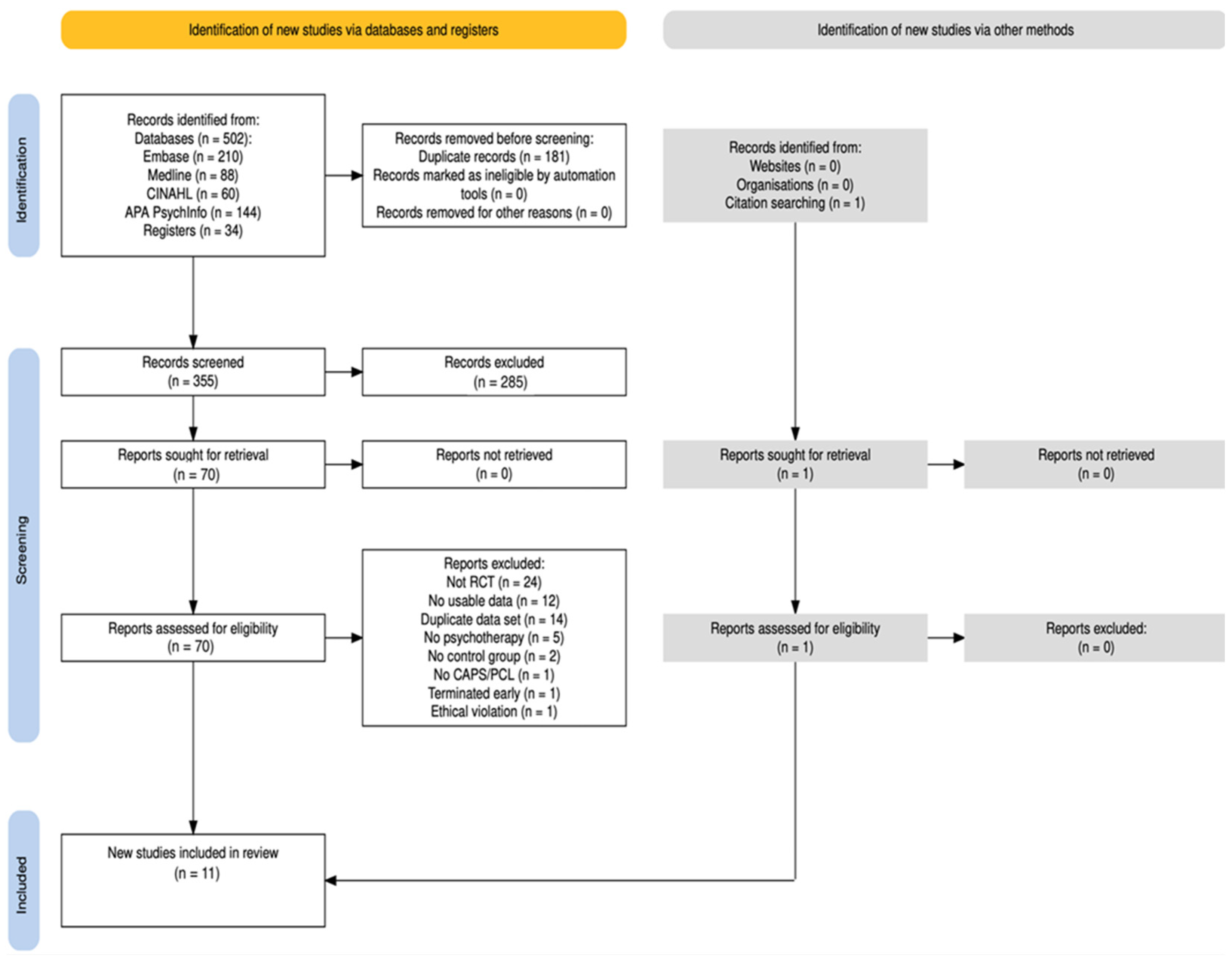
Titles and abstracts were independently screened by two authors (A.S. and F.M.) to determine eligibility. Full-text articles were then independently assessed for inclusion/exclusion. Disagreements at either stage were resolved through discussion and consensus between the authors. Where consensus could not be reached, the study was referred to the third and fourth authors (S.K. and W.A.) The study selection process is presented in a PRISMA flow diagram (Figure 1) [37].

2.4. Data Extraction

Data extraction was performed by one reviewer (F.M.) and independently checked by a second reviewer (A.S.), with disagreements resolved through discussion and consensus and, where necessary, referral to a third author (S.K. or W.A.). A standardised extraction table with prespecified fields was developed a priori based on the review protocol; formal piloting was not undertaken. The following data were collected from each eligible study: (1) study characteristics (first author, year of publication, country, study design, sample size), (2) participant demographics (age, sex, ethnicity, PTSD severity at baseline, comorbidities), (3) intervention and comparator details (psychedelic agent, dose, route and frequency of administration, type of psychotherapy, timing of psychedelic administration in relation to psychotherapy sessions, placebo type, active comparator dose), (4) primary outcomes (PTSD symptom severity scores on validated measures including the CAPS-IV/CAPS-5 and PCL-5, clinical response and remission rates) and (5) adverse events, serious adverse events, withdrawals and reasons for discontinuation.

2.5. Risk of Bias

Risk of bias for each included study was assessed using the Cochrane Risk of Bias 2 (RoB 2) [38] tool for randomised controlled trials. Although Pradhan et al. [39] employed a crossover design, only pre-crossover data were extracted for this review. Each study was evaluated across five domains: bias arising from the randomisation process, bias due to deviations from intended interventions, bias due to missing outcome data, bias in measurement of the outcome, and bias in selection of the reported result. Each domain was rated as low risk of bias, some concerns, or high risk of bias. Risk of bias assessment was performed by two authors (A.S. and F.M.) and disagreements were resolved through discussion.

2.6. Data Analysis

Meta-analyses were conducted using random-effects models with the DerSimonian–Laird estimator as the primary approach. This estimator was retained for consistency with the original analysis and because the number of studies was small and between-study variance was estimated as zero in the primary models. However, because DerSimonian–Laird can underestimate uncertainty when few studies are available, particularly for the ketamine analysis, a Hartung–Knapp sensitivity analysis was additionally performed for the continuous-outcome models (Table S4).
One endpoint per study was selected a priori for meta-analysis, preferentially using the primary between-group PTSD endpoint reported for the blinded comparison; differences in endpoint timing were considered in the interpretation of pooled estimates, particularly where short-term endpoints differed across trials. The selected endpoint from each study, and the reason for its selection, is listed in Table S5.
For continuous outcomes (PTSD symptom severity), standardised mean differences were calculated as Hedges’ g with 95% confidence intervals to enable comparison across different outcome scales (CAPS-IV, CAPS-5, PCL-5). Positive values were coded to indicate benefit of the active intervention. Although the use of Hedges’ g allowed pooling across different validated PTSD measures, this approach did not eliminate the conceptual and interpretive differences between CAPS-IV, CAPS-5, and PCL-5, nor the distinction between clinician-rated and self-report outcomes; pooled standardised effects should therefore be interpreted as the relative magnitude of treatment benefit rather than change in a common clinical unit.
For multi-arm MDMA trials [24,25], active dose groups were pooled in the primary analysis to avoid double-counting the control group; sensitivity analyses using alternative dose-arm selections were undertaken where clinically relevant. Intention-to-treat data were used where available. For dichotomous outcomes (clinical response and loss of PTSD diagnosis), pooled risk ratios with 95% confidence intervals were calculated using the DerSimonian–Laird method applied to log-transformed risk ratios. Between-study heterogeneity was assessed using Cochran’s Q test and quantified with the I2 statistic and between-study variance (τ2). Leave-one-out sensitivity analyses were performed to assess the robustness of pooled estimates.
Formal assessment of publication bias was planned via funnel plots and Egger’s regression test where at least ten studies were available for a given comparison. Where quantitative synthesis was not appropriate due to an insufficient number of comparable studies, narrative synthesis was provided. All analyses were conducted in Python (version 3.11.3) using pandas (version 2.2.3), NumPy (version 1.24.3), SciPy (version 1.10.1), and matplotlib (version 3.10.1), with pooled estimates computed using standard formulae for Hedges’ g and log risk ratios under DerSimonian–Laird random-effects models, with Hartung–Knapp adjustments applied in sensitivity analyses.

3. Results

3.1. Study Selection

The PRISMA flow diagram describing the selection process is presented in Figure 1. The initial search identified 536 records from electronic databases and clinical trial registries. After removing 181 duplicates, 355 records were screened by title and abstract, of which 285 were excluded. One additional record was identified through citation searching [39]. Seventy full-text reports were assessed for eligibility, of which 59 were excluded for reasons detailed in Figure 1. A total of 11 RCTs met all inclusion criteria and were included in the systematic review [23,24,25,26,27,39,40,41,42,43,44]. For one trial [43] data were extracted from the clinical trial registry results record which contained more detailed participant and outcome information than a subsequent peer-reviewed publication reporting the same dataset with a neuroimaging focus [45].
Eight of the 11 included RCTs contributed to the quantitative meta-analyses: six MDMA trials in the primary MDMA analysis and two ketamine trials in the primary ketamine analysis [23,24,25,26,27,40,42,43]. The single cannabidiol (CBD) trial [44] was reported individually because pooling was not possible. The MP9 trial (MP9; NCT01689740) [41] was retained in the systematic review but excluded from the primary MDMA meta-analysis because the blinded comparison involved a very small sample and differed from the main trial set in design features, including an open-label lead-in. To improve transparency, its impact was examined in a supplementary sensitivity analysis. Pradhan et al. [39] and Pradhan et al. [42] reported overlapping ketamine cohorts. Because the 2018 study (n = 20) included all 10 participants from the 2017 pilot, only the larger data set was entered into the primary meta-analysis to avoid double-counting. The handling of multi-arm trials and overlapping cohorts is described in Section 2.6. All 11 studies were assessed for risk of bias assessment irrespective of inclusion in the quantitative synthesis.

3.2. Study Characteristics

The characteristics of the 11 included RCTs are summarised in Table 1. The studies were published between 2011 and 2023 and were conducted across four countries: the United States (n = 9), with one study from Switzerland [40] and one from Israel [41]; two multisite trials [26,27] also included centres in Canada and Israel. Sample sizes ranged from 10 to 104 participants, yielding 358 unique participants in the total review sample split across trials examining three types of psychedelic agents. Mean participant age ranged from 37 to 43 years, and the proportion of female participants varied from 0% to 85%.
All 11 RCTs were double-blind and paired psychotherapy with a psychedelic agent. Seven trials evaluated MDMA-assisted psychotherapy (n = 290), including five phase 2 and two phase 3 studies [23,24,25,26,27,40,41]. Three trials assessed ketamine-assisted psychotherapy [39,42,43] (n = 47), and one trial [44] evaluated CBD as an adjunct to prolonged exposure therapy (n = 21). In the MDMA trials, oral doses of 75 to 125 mg, with supplemental doses, were administered across two to three experimental sessions within a manualised psychotherapy protocol [46]. The two phase 3 trials [26,27] used inactive placebo, while the phase 2 studies used either inactive placebo [23] or low-dose MDMA (25–40 mg) as an active control [24,25,40,41]. The ketamine trials administered a single intravenous infusion of 0.5 mg/kg over 40 min, paired with either Trauma Interventions using Mindfulness Based Extinction and Reconsolidation (TIMBER) psychotherapy [39,42] or prolonged exposure therapy [43]. Comparators were normal saline and midazolam. The CBD trial [44] administered 250 mg oral CBD twice daily for 18 days alongside massed prolonged exposure, compared with matched placebo. PTSD was diagnosed using the CAPS-IV in eight trials and the CAPS-5 in three. Primary outcome measures included the CAPS-IV (n = 7), CAPS-5 (n = 3), and PCL-5 (n = 1). Follow-up durations ranged from one month to 18 months.
Detailed treatment protocols are presented in Table S2.

3.3. Assessment of Risk of Bias

Risk of bias assessments are summarised in Figure S1. Four studies were judged to be at overall low risk of bias, comprising the two phase 3 MDMA trials [26,27] and two ketamine trials [39,42]. The remaining seven studies raised some concerns with respect to risk of bias. Concerns included incomplete reporting of randomisation procedures [40,41], reliance on per-protocol analyses in some studies [23,41,43], and substantial attrition in two clinical trials [43,44].
Functional unblinding was the most frequently identified concern, affecting six studies and reflecting the difficulty of masking psychoactive substances with distinctive subjective effects. This was most pronounced in Mithoefer et al. [23], where 95% of participants correctly guessed treatment allocation. It was partially mitigated in studies using active placebos [24,25,40] and most effectively addressed in the phase 3 trials [26,27] which used centrally pooled independent blinded raters. While these mitigation strategies reduce observer bias, they do not address participant expectancy, which cannot be eliminated when an active agent produces distinctive subjective effects. All seven MDMA trials were funded by the Multidisciplinary Association for Psychedelic Studies, a non-profit organisation that advocates for therapeutic uses of psychedelics. The ketamine and CBD studies had independent funding sources.

3.4. Primary Outcomes

3.4.1. Change in PTSD Symptom Severity

MDMA
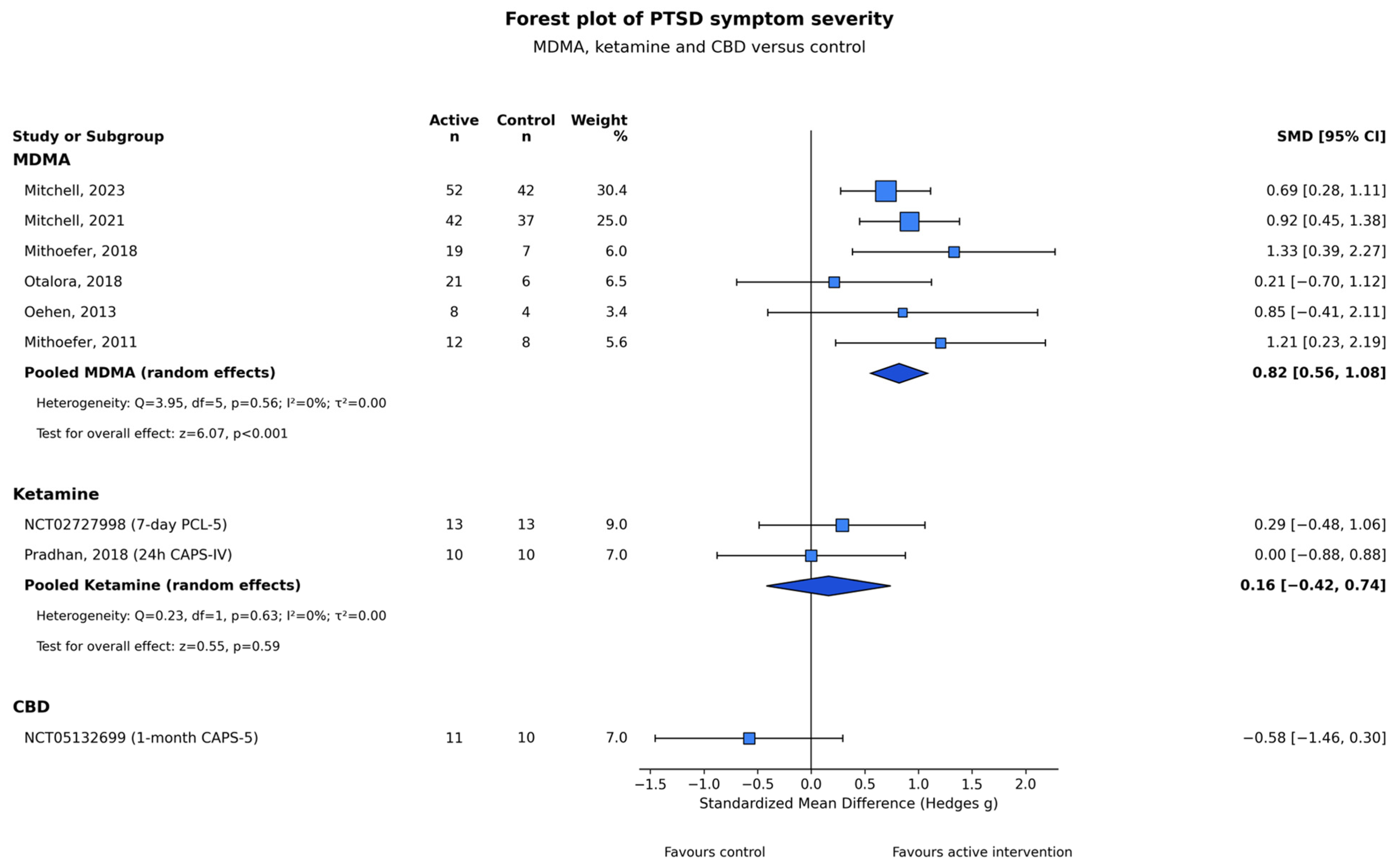
Across six trials (MDMA n = 154, control n = 104), MDMA-assisted psychotherapy was associated with a statistically significant reduction in PTSD symptom severity compared with control (Hedges’ g = 0.82, 95% CI 0.56 to 1.08, p < 0.001), consistent with a moderate-to-large treatment effect (Figure S2). Between-study heterogeneity was negligible (Q = 3.95, df = 5, p = 0.56; I2 = 0%; τ2 = 0). Individual study effects ranged from g = 0.21 (Ot’alora et al.) [25] to g = 1.33 (Mithoefer et al.) [24] with four of six studies producing statistically significant effects individually. The two Phase 3 trials [26,27], which together contributed approximately 65% of the pooled weight, yielded effect sizes of g = 0.69 and g = 0.92 (Figure S2).
Furthermore, sensitivity analyses supported the robustness of the primary MDMA finding. First, repetition of the continuous-outcome model using a Hartung–Knapp adjustment yielded a similar pooled estimate (g = 0.82, 95% CI 0.47 to 1.17) (Table S4). Second, when the Mithoefer 2018 [24] trial was re-analysed using only the highest-dose active arm (125 mg) rather than the pooled 75 mg + 125 mg arms, the pooled estimate remained materially unchanged (g = 0.78, 95% CI 0.52 to 1.05). Third, inclusion of the MP9 trial as a supplementary sensitivity analysis also had minimal impact on the pooled effect (g = 0.83, 95% CI 0.57 to 1.09). Taken together, these analyses suggest that the main MDMA result was not driven by the dose-arm pooling strategy or by exclusion of the small MP9 study.
Ketamine
Across two trials [42,43] (ketamine n = 23, control n = 23), the pooled effect for ketamine-assisted psychotherapy was small and not statistically significant (Hedges’ g = 0.16, 95% CI −0.42 to 0.74, p = 0.59), with no observed heterogeneity (Q = 0.23, df = 1, p = 0.63; I2 = 0%; τ2 = 0) (Figure S3). NCT02727998 [43] showed a modest effect favouring ketamine (g = 0.29, 95% CI [−0.49 to 1.06]) at the 7-day endpoint, while Pradhan et al. [42] showed no between-group difference (g = 0.00, 95%CI [−0.88 to 0.88]) at the 24 h endpoint (Figure S3). Differences in endpoint timing and PTSD symptom severity scale used between these pooled trials limit comparability.
The ketamine findings were more uncertain. In the primary random-effects model, the pooled effect was small and non-significant (g = 0.16, 95% CI −0.42 to 0.74). A Hartung–Knapp sensitivity analysis yielded the same point estimate but a much wider confidence interval (g = 0.16, 95% CI −3.60 to 3.92), reflecting the very small number of studies and limited precision of the evidence base (Table S4). In addition, the pooled ketamine estimate combined an early 24 h endpoint from one study and a 7-day endpoint from another, so this result should be interpreted cautiously as a broad summary of short-term post-treatment effects rather than a tightly harmonised endpoint.
Cannabidiol
The single CBD trial [44] yielded a non-significant effect estimate of g = −0.58 (95% CI [−1.46 to 0.30]), providing no clear evidence of benefit over control (Figure 2). A pooled estimate was not calculated because only one study was available.
Combined
In the combined forest plot (Figure 2) the evidence was strongest for MDMA, with a pooled random effect size substantially larger than effects for ketamine and CBD. No direct head-to-head trials comparing MDMA with ketamine were identified. Figure 2 should not be interpreted as an indirect ranking of agents and is presented for descriptive purposes only. A formal indirect comparison through network meta-analysis was not undertaken because control conditions differed substantially across agent classes.

3.4.2. Clinical Response and Loss of PTSD Diagnosis

Binary outcome meta-analyses were conducted for MDMA only, as the ketamine and CBD studies did not provide sufficient and comparable binary outcome data for these endpoints.
Clinical Response
Four MDMA trials reported clinical response defined as ≥30% reduction in CAPS scores (MDMA n = 60, control n = 25) [23,24,25,40]. The pooled risk ratio significantly favoured MDMA (RR = 3.16, 95% CI 1.50 to 6.67; Q = 0.12, df = 3, p = 0.99; I2 = 0%; τ2 = 0), indicating that participants receiving MDMA were approximately three times more likely to achieve a clinically meaningful response (Figure S4). Mitchell et al. [27] was excluded as they employed a different and less stringent response definition (≥10-point CAPS-5 decrease) and Mitchell et al. [26] was excluded because usable binary data was not included. The exclusion of these larger and methodologically rigorous phase 3 trials substantially limited the representativeness of the binary response estimate. Between-study heterogeneity was not observed (I2= 0%), which suggests that the direction of effect was consistent across the included trials, though several confidence intervals were wide owing to small sample sizes (Figure S4).
Loss of PTSD Diagnosis
Five MDMA trials reported the proportion of participants who no longer met PTSD diagnostic criteria at the primary endpoint (MDMA n = 146, control n = 100) [23,24,25,26,27]. The pooled risk ratio favoured MDMA (RR = 1.73, 95% CI 1.32 to 2.27; Q = 2.66, df = 4, p = 0.62; I2 = 0%; τ2 = 0), indicating a significantly higher rate of diagnostic remission in the MDMA group (Figure S5). Oehen et al. [40] was excluded from this analysis as no participant in either arm lost their PTSD diagnosis at the end of treatment. Between-study heterogeneity was not observed (I2 = 0). Although some confidence intervals were wide mainly due to small sample sizes, the overall direction of effect was consistent (Figure S5).

3.5. Secondary Outcomes

3.5.1. Therapeutic Protocols

The treatment protocols across included studies are detailed in Table S2. The MDMA trials employed a relatively standardised three-phase protocol (preparatory, experimental, and integration sessions) delivered by therapist teams, based on the MAPS treatment manual [46]. The ketamine trials differed considerably in their psychotherapy component: Pradhan et al. [39] and Pradhan et al. [42] used TIMBER, a mindfulness-based extinction and reconsolidation approach administered during and after the ketamine infusion, while NCT02727998 [43] used a rapid prolonged exposure therapy prior to infusion, followed by four daily prolonged exposure therapy sessions. The CBD trial [44] used massed prolonged exposure over two weeks. Given the small number of trials within each agent class and the confounding of protocol variables with agent type, formal analysis of protocol-outcome relationships was not possible.

3.5.2. Safety and Adverse Events

The safety and adverse event outcomes are detailed in Table S3a,b.
No deaths were reported across any of the 11 trials. In the MDMA trials, serious adverse events (SAEs) involving suicidal behaviour occurred in placebo groups [26,27]; between-group comparisons regarding causality cannot be made from the reported description of these SAEs. No drug-related SAEs were reported in the ketamine or CBD studies.
Treatment-emergent adverse effects (TEAEs) were consistent with the known pharmacological profiles of each agent. In the MDMA trials, the most commonly reported effects were jaw tightness, nausea, reduced appetite, muscle tension, and transient elevations in blood pressure and heart rate (Table S3a,b). In the ketamine trials, Pradhan et al. [42] reported mild transient nausea in two participants, and no adverse events were recorded in the NCT02727998 [43] registry. In the CBD trial [44], gastrointestinal symptoms (36%) and sleep disturbance (36%) were more frequent in the CBD group. The differential dropout rate (27% CBD vs. 0% placebo) was notable and potentially biassed the observed efficacy result in favour of placebo (Table S3a,b).
Quantitative pooling of safety data across agents was not undertaken due to substantial heterogeneity in adverse event definitions, reporting formats (per-session vs. per-participant), reporting thresholds, and the different pharmacological profiles of the agents under review.

3.6. Sensitivity Analyses

Leave-one-out sensitivity analyses were done for the MDMA and ketamine meta-analyses. For MDMA, the pooled effect remained positive and statistically significant in all models ranging from g = 0.77 (95% CI 0.45 to 1.09) to g = 0.90 (95% CI 0.56 to 1.24) (Figure S6). Between-study heterogeneity remained zero in all models. These findings indicate that the MDMA result was not driven by any single study (Figure S6). For ketamine, leave-one-out analysis was limited by k = 2 and did not alter the non-significant finding (Figure S7).

3.7. Publication Bias

Publication bias was not formally assessed because each comparison included fewer than ten studies (MDMA k = 6; ketamine k = 2), below the conventional threshold for reliable funnel-plot or regression-based methods.

4. Discussion

This systematic review and meta-analysis presented a pragmatic synthesis of evidence on psychedelic-assisted psychotherapy (defined broadly and inclusively) for PTSD. RCTs examining psychotherapy protocols assisted by three pharmacologically distinct agents—MDMA, ketamine and cannabidiol—were identified by the search strategy. The findings of our quantitative synthesis indicate that MDMA-assisted psychotherapy demonstrates a promising efficacy signal. By contrast, the two identified ketamine-assisted psychotherapy trials were too clinically heterogenous and underpowered to confidently make a claim regarding efficacy. Evidence for cannabidiol was insufficient. Across agents, the interventions were generally well tolerated, with no deaths and few serious adverse events.
Translation of psychedelic-assisted psychotherapy into clinical practice requires evidence not only of efficacy but also of safety, tolerability, and the therapeutic context in which these compounds are delivered [16,18]. This need is especially relevant in Australia, where MDMA and psilocybin have been rescheduled for clinical use under authorised prescriber pathways [20], and amid ongoing international regulatory debate. Our review contributes to this evidence base by examining efficacy and safety across multiple agents while also describing the psychotherapeutic protocols used. Quantitative synthesis was possible for MDMA and ketamine efficacy outcomes and binary outcome analyses for MDMA, whilst narrative syntheses of safety and therapeutic protocols were completed. Cross-agent comparison remained limited to indirect visual comparison in the combined forest plot because the control conditions differed substantially across agent classes. For the primary outcome, MDMA-assisted psychotherapy showed a large pooled effect with no detectable between-study heterogeneity. However, the absence of observed heterogeneity across the small number of MDMA trials should not be causally attributed to pharmacological specificity alone. It is acknowledged that procedural standardisation, therapist training, and treatment-package effects may have contributed to the apparent homogeneity of outcomes and that intervention-component confounding is an important limitation. Nonetheless, these findings for MDMA-assisted psychotherapy were reinforced by the binary analyses: participants who received MDMA were about three times more likely to achieve clinical response (RR = 3.16) and were also more likely to no longer meet PTSD diagnostic criteria at the primary endpoint (RR = 1.73) than controls. While the binary outcome analysis was limited by exclusion of the largest and most robust phase 3 trials, these estimates align with those reported by Shahrour et al. [28] which strengthens confidence in the robustness of the MDMA signal in PTSD.
For ketamine, the pooled effect was small and non-significant, in keeping with Borgogna et al. [31], who concluded that ketamine was generally not superior to control for symptom reduction. However, Hartung–Knapp sensitivity analysis, which preserved the small point estimate but produced a substantially wider confidence interval (−3.60 to 3.92), underscored that the available randomised evidence cannot reliably constrain the magnitude or direction of any ketamine effect. More broadly, in light of the sparsity and varied designs of the included ketamine-assisted psychotherapy trials in our meta-analysis, a confident claim regarding the effectiveness of this therapy in PTSD cannot be made. In contrast, Philipp-Muller et al. [29] reported significant symptom improvement when ketamine was combined with psychotherapy, but their analysis pooled within-group pre–post change scores rather than between-group comparisons, included non-randomised studies, and counted the overlapping Pradhan et al. [39] and Pradhan et al. [42] cohorts separately. Almeida et al. [30] also reported significant between-group effects at the pharmacological endpoint, but their broader inclusion criteria allowed ketamine-only RCTs without a structured psychotherapy component. Notably, in Pradhan et al. [42], the significant between-group difference was seen in duration of sustained response (34 vs. 17 days; p = 0.022) rather than acute symptom reduction, suggesting that conventional fixed-endpoint analyses might underestimate ketamine’s therapeutic contribution in this context. This finding raises an important conceptual issue for ketamine-assisted psychotherapy: namely, that a rapidly acting dissociative agent may exert clinically relevant effects on reconsolidation or durability of response that are not well captured by conventional fixed-endpoint symptom comparisons alone.
The reported safety profiles across agents were broadly reassuring; however, they are more appropriately conceptualised as a measure of short-term physiological tolerability, rather than longer-term psychiatric safety of these time-limited protocols. No deaths were reported, serious adverse events were uncommon, and in the MDMA trials serious adverse events involving suicidal behaviour occurred in placebo groups [26,27]. Treatment-emergent adverse events were consistent with known pharmacological effects and were generally mild, transient, and self-limiting. These observations accord with previous reviews of MDMA [28] and ketamine [30]. The CBD trial [44], however, had higher attrition in the active arm (27% vs. 0%), which might reflect poorer gastrointestinal tolerability. Psychotherapeutic protocols were much more standardised in the MDMA studies than in the ketamine studies. All seven MDMA trials used a manualised three-phase model [46]. The absence of statistical heterogeneity in the pooled MDMA analysis gives rise to the speculative notion that this standardised framework may have supported reproducible outcomes. By contrast, the ketamine trials paired the drug with substantially different psychotherapies (TIMBER versus prolonged exposure) making it difficult to separate the effect of ketamine from that of the psychotherapeutic intervention itself. Cavarra et al. [17] similarly highlighted protocol heterogeneity as a major issue in psychedelic-assisted psychotherapy research. Formal analysis of protocol–outcome relationships was not possible because few trials were available, and protocol characteristics were confounded with agent class.
This review and meta-analysis has several strengths. The cross-agent framework enables comparative appraisal of the evidence across MDMA, ketamine, and CBD within a unified methodology. The analysis incorporates the most recent trial data and includes grey literature from clinical trial registries, providing a more complete representation of the evidence than reviews restricted to peer-reviewed publications. Effect size calculations were cross-checked against source data, and the low between-study heterogeneity across all pooled analyses (I2 = 0%) indicates that the observed effects are consistent and not due to outlier studies.
Several limitations should be acknowledged. We did not update the search to include potential new RCTs after 11 December 2025, which may have excluded more contemporaneous trials in a rapidly evolving field. Of the 11 included RCTs, only eight contributed to quantitative meta-analyses, and the number of studies within each agent class was small, particularly for ketamine (k = 2) and CBD (k = 1), which constrained the precision of pooled estimates and limited meaningful subgroup analyses. In particular, the pooled ketamine estimate reflects different psychotherapeutic models and different acute endpoint timings, which substantially limits interpretability. The pooled result should be interpreted as provisional and exploratory. Furthermore, the diversity of these agents, which produce qualitatively different subjective effects, also complicates cross-agent comparison. Individual study sample sizes were also small, ranging from 10 to 104, and follow-up durations varied considerably, in part due to the crossover designs employed by several trials. No RCTs were identified for other psychedelic agents, meaning this review could only evaluate three of the several agents encompassed by our broader definition of psychedelic-assisted psychotherapy. The included studies were predominantly conducted in the United States and Europe, limiting the generalisability of findings to more diverse global populations; further research in under-represented regions is needed. Restricting eligibility to English-language publications may have introduced language bias by excluding eligible non-English RCTs, which could disproportionately affect representation of studies conducted in non-English-speaking regions. The exclusion of studies focused exclusively on complex PTSD also limits the generalisability of these findings to an important and clinically distinct population, in whom symptom profiles include disturbances of self-organisation that are not fully captured by the PTSD-specific outcome measures used in the included trials. Given that complex PTSD is often more severe and treatment-resistant than classic PTSD, the potential role of psychedelic-assisted psychotherapy in this population represents an important gap in the current evidence base and a priority for future research.
Heterogeneity in comparator conditions ranging from inactive placebo to active pharmacological controls limits the validity of indirect head-to-head comparisons and restricted formal network meta-analysis. Moreover, statistically, the use of Hedges’ g facilitated quantitative synthesis; however, introduced limitations in interpretability and imperfect comparability across CAPS-IV, CAPS-5 and PCL-5 instruments. Functional unblinding remains a structural challenge in this field. Because the included agents produce distinctive subjective effects, participants and therapists can frequently infer allocation, and expectancy effects may therefore have inflated self-reported and possibly clinician-rated improvement. The true pharmacological contribution of these interventions may consequently be smaller than the observed pooled estimate. The type of psychotherapy also varied across studies and there was no ability to evaluate quality. The effectiveness of the psychotherapy type may affect between-group difference, potentially obscuring a genuine pharmacological contribution. Publication bias could not be formally assessed due to the small number of studies in each comparison. Furthermore, the entire MDMA evidence base was funded by a single sponsor, the Multidisciplinary Association for Psychedelic Studies, a non-profit organisation whose stated mission is to advance therapeutic uses of psychedelics. Concentration of sponsorship within one advocacy-oriented organisation can introduce subtle biases through protocol design, outcome selection, and reporting emphasis, even where individual trials are conducted to high methodological standards. This does not invalidate the findings but should temper certainty. Finally, while the inclusion of registry-derived outcome and safety data improved completeness, the lack of peer-review introduces further limitations such as differences in reporting detail and endpoint emphasis. We caution that data from these sources are not directly equivalent to peer-reviewed records and should be interpreted accordingly.
Our systematic review and meta-analysis contributes to the literature a comparison of psychedelic-assisted psychotherapy for PTSD across multiple agent classes within a single quantitative framework. Prior reviews have examined MDMA [28] and ketamine [29,30,31] separately, while broader reviews such as Leone et al. [22] and Cavarra et al. [17] have focused more on psychotherapy modalities, not been PTSD-specific or have not provided quantitative synthesis by diagnosis. This cross-agent perspective directly addresses the siloed nature of the existing literature and provides a comparative evidence base that has not previously been available. The findings demonstrate that MDMA-assisted psychotherapy is associated with significant and clinically meaningful reductions in PTSD symptom severity and may offer a promising treatment option for carefully selected patients with PTSD, particularly where symptoms are severe or resistant to existing interventions. However, translation into routine practice should remain cautious and should only occur within highly structured clinical settings, with trained therapists, careful screening, and ongoing monitoring of safety and functional outcomes. At present, the evidence for ketamine-assisted psychotherapy and cannabidiol augmentation remains too limited to support conclusions of similar confidence, underscoring the need for continued evaluation and research before broader implementation. Future research directions may also be highlighted.

5. Conclusions

This systematic review and meta-analysis identifies a promising efficacy signal for MDMA-assisted psychotherapy in PTSD, but the current evidence remains concentrated in structured specialist settings, while evidence for ketamine- and cannabidiol-assisted models is still too limited and heterogeneous to support implementation-level conclusions. Future research should prioritise larger, adequately powered randomised trials with a longer follow-up, standardised outcome measures, and clearer reporting of psychotherapy protocols. Further comparative studies across psychedelic agents and therapeutic models would help clarify whether observed benefits are primarily driven by the pharmacological intervention, the psychotherapeutic framework, or their interaction. Further work is also needed to identify which patient subgroups are most likely to benefit, and to better characterise durability of response, relapse prevention, and longer-term safety.

Supplementary Materials

The following supporting information can be downloaded at: https://www.mdpi.com/article/10.3390/psychoactives5020016/s1, Figure S1: Risk of Bias Summary; Figure S2: MDMA Forest Plot; Figure S3: Ketamine Forest Plot; Figure S4: Clinical Response Forest Plot; Figure S5: Loss of PTSD Diagnosis Forest Plot; Figure S6: MDMA Leave-One-Out Sensitivity Analysis; Figure S7: Ketamine Leave-One-Out Sensitivity Analysis; Table S1: Systematic Search Strategy; Table S2: Treatment Protocols Across Included Studies; Table S3a: Serious Adverse Events, Deaths, Withdrawals, Cardiovascular Effects, and Suicidality; Table S3b: Treatment-Emergent Adverse Events and Expected Reactions; Table S4: Sensitivity Analyses for Continuous PTSD Symptom Severity Outcomes; Table S5: Endpoint Selection for Quantitative Efficacy Analyses.

Author Contributions

Conceptualisation, F.M., A.S., W.A. and S.K.; methodology, F.M., A.S., W.A. and S.K.; validation, F.M. and A.S.; formal analysis, F.M. and A.S.; investigation, F.M. and A.S.; data curation, F.M. and A.S.; writing—original draft preparation, F.M. and A.S.; writing—review and editing, F.M., A.S., W.A., S.K. and J.L.; supervision, W.A. and S.K. All authors have read and agreed to the published version of the manuscript.

Funding

This research received no external funding.

Data Availability Statement

This study is a systematic review and meta-analysis of previously published data. All primary data are available in the original publications and clinical trial registry records cited in the reference list. The data extraction spreadsheets used in the analyses are available from the corresponding author upon reasonable request.

Acknowledgments

The authors thank Mohammad Ali Moni and Abdullah Al-Mamun Bulbul for statistical assistance with the meta-analysis and associated figure generation. The authors also acknowledge the Ipswich Hospital Library Service for their assistance with the initial database search.

Conflicts of Interest

The authors declare no conflicts of interest.

Abbreviations

The following abbreviations are used in this manuscript:
PTSDPost-Traumatic Stress Disorder
SSRIsSelective Serotonin Reuptake Inhibitors
SNRISerotonin-Noradrenaline Reuptake Inhibitor
MDMA3,4-Methylenedioxymethamphetamine
DMTN,N-Dimethyltryptamine
PRISMAPreferred Reporting Items for Systematic Reviews and Meta-Analyses
PROSPEROInternational Prospective Register of Systematic Reviews
CIConfidence Interval
ANZCTRAustralian New Zealand Clinical Trials Registry
WHO ICTRPWorld Health Organization International Clinical Trials Registry Platform
CAPS-IVClinician-Administered PTSD Scale for DSM-IV
CAPS-5Clinician-Administered PTSD Scale for DSM-5
PCL-5PTSD Checklist for DSM-5
RoB 2Cochrane Risk of Bias 2
RCTsRandomised Controlled Trials
CBDCannabidiol
TIMBERTrauma Interventions using Mindfulness Based Extinction and Reconsolidation
RRRisk Ratio
MAPSMultidisciplinary Association for Psychedelic Studies
SAEsSerious Adverse Events
TEAEsTreatment-Emergent Adverse Effects
C-SSRSColumbia Suicide Severity Rating Scale

References

  1. Stevens, J. Storming Heaven: LSD and the American Dream; Heinemann: London, UK, 1988. [Google Scholar]
  2. Nichols, D.E. Psychedelics. Pharmacol. Rev. 2016, 68, 264–355, Erratum in Pharmacol. Rev. 2016, 68, 356. https://doi.org/10.1124/pr.114.011478err. [Google Scholar] [CrossRef] [Scilit]
  3. Kisely, S.; Connor, M.; Somogyi, A. An Evaluation of the Therapeutic Value, Benefits and Risks of Methylenedioxymethamphetamine (MDMA) and Psilocybin for the Treatment of Mental, Behavioural or Developmental Disorders: A Report to the Therapeutic Goods Administration; Department of Health, Commonwealth of Australia: Canberra, Australia, 2021. Available online: https://www.tga.gov.au/sites/default/files/mmda-and-psilocybin-independent-expert-panel-review-final-report.pdf (accessed on 5 December 2025).
  4. American Psychiatric Association. Diagnostic and Statistical Manual of Mental Disorders, 5th ed.; Text Rev.; American Psychiatric Association: Washington, DC, USA, 2022. [Google Scholar]
  5. Australian Bureau of Statistics. National Study of Mental Health and Wellbeing; ABS: Canberra, Australia, 2023. Available online: https://www.abs.gov.au/statistics/health/mental-health/national-study-mental-health-and-wellbeing/latest-release (accessed on 8 February 2026).
  6. Kessler, R.C.; Aguilar-Gaxiola, S.; Alonso, J.; Benjet, C.; Bromet, E.J.; Cardoso, G.; Degenhardt, L.; de Girolamo, G.; Dinolova, R.V.; Ferry, F.; et al. Trauma and PTSD in the WHO World Mental Health Surveys. Eur. J. Psychotraumatol. 2017, 8, 1353383. [Google Scholar] [CrossRef] [Scilit]
  7. Sherin, J.E.; Nemeroff, C.B. Post-traumatic stress disorder: The neurobiological impact of psychological trauma. Dialogues Clin. Neurosci. 2011, 13, 263–278. [Google Scholar] [CrossRef] [Scilit]
  8. Phoenix Australia—Centre for Posttraumatic Mental Health. Australian Guidelines for the Prevention and Treatment of Acute Stress Disorder, Posttraumatic Stress Disorder and Complex Posttraumatic Stress Disorder; Phoenix Australia: Melbourne, Australia, 2021; Available online: https://www.phoenixaustralia.org/australian-guidelines-for-ptsd/ (accessed on 6 January 2026).
  9. Hoskins, M.; Pearce, J.; Bethell, A.; Dankova, L.; Barbui, C.; Tol, W.A.; van Ommeren, M.; de Jong, J.; Seedat, S.; Chen, H.; et al. Pharmacotherapy for post-traumatic stress disorder: Systematic review and meta-analysis. Br. J. Psychiatry 2015, 206, 93–100. [Google Scholar] [CrossRef] [Scilit]
  10. Koek, R.J.; Schwartz, H.N.; Scully, S.; Langevin, J.P.; Spangler, S.; Korotinsky, A.; Jou, K.; Leuchter, A. Treatment-refractory posttraumatic stress disorder (TRPTSD): A review and framework for the future. Prog. Neuropsychopharmacol. Biol. Psychiatry 2016, 70, 170–218. [Google Scholar] [CrossRef] [Scilit]
  11. Batelaan, N.M.; Bosman, R.C.; Muntingh, A.; Scholten, W.D.; Huijbregts, K.M.; van Balkom, A.J.L.M. Risk of relapse after antidepressant discontinuation in anxiety disorders, obsessive-compulsive disorder, and post-traumatic stress disorder: Systematic review and meta-analysis of relapse prevention trials. BMJ 2017, 358, j3927. [Google Scholar] [CrossRef] [Scilit]
  12. Kline, A.C.; Cooper, A.A.; Rytwinski, N.K.; Feeny, N.C. Long-term efficacy of psychotherapy for posttraumatic stress disorder: A meta-analysis of randomized controlled trials. Clin. Psychol. Rev. 2018, 59, 30–40. [Google Scholar] [CrossRef] [Scilit]
  13. Lee, D.J.; Schnitzlein, C.W.; Wolf, J.P.; Vythilingam, M.; Rasmusson, A.M.; Hoge, C.W. Psychotherapy versus pharmacotherapy for posttraumatic stress disorder: Systematic review and meta-analyses to determine first-line treatments. Depress. Anxiety 2016, 33, 792–806. [Google Scholar] [CrossRef] [Scilit]
  14. Semmlinger, V.; Leithner, C.; Klöck, L.M.; Ranftl, L.; Ehring, T.; Schreckenbach, M. Prevalence and predictors of nonresponse to psychological treatment for PTSD: A meta-analysis. Depress. Anxiety 2024, 2024, 9899034. [Google Scholar] [CrossRef] [Scilit]
  15. Lewis, C.; Roberts, N.P.; Gibson, S.; Bisson, J.I. Dropout from psychological therapies for post-traumatic stress disorder (PTSD) in adults: Systematic review and meta-analysis. Eur. J. Psychotraumatol. 2020, 11, 1709709. [Google Scholar] [CrossRef] [Scilit] [PubMed]
  16. Royal Australian and New Zealand College of Psychiatrists. Psychedelics FAQs; RANZCP: Melbourne, Australia, 2023; Available online: https://www.ranzcp.org/clinical-guidelines-publications/in-focus-topics/psychedelics/psychedelics-faqs (accessed on 3 October 2025).
  17. Cavarra, M.; Falzone, A.; Ramaekers, J.G.; Kuypers, K.P.C.; Mento, C. Psychedelic-assisted psychotherapy—A systematic review of associated psychological interventions. Front. Psychol. 2022, 13, 887255. [Google Scholar] [CrossRef] [Scilit]
  18. Krediet, E.; Bostoen, T.; Breeksema, J.; van Schagen, A.; Passie, T.; Vermetten, E. Reviewing the potential of psychedelics for the treatment of PTSD. Int. J. Neuropsychopharmacol. 2020, 23, 385–400. [Google Scholar] [CrossRef] [Scilit]
  19. Mott, J.M.; Mondragon, S.; Hundt, N.E.; Beason-Smith, M.; Grady, R.H.; Teng, E.J. Characteristics of U.S. veterans who begin and complete prolonged exposure and cognitive processing therapy for PTSD. J. Trauma. Stress 2014, 27, 265–273. [Google Scholar] [CrossRef] [Scilit]
  20. Therapeutic Goods Administration. Change to Classification of Psilocybin and MDMA to Enable Prescribing by Authorised Psychiatrists; Australian Government Department of Health and Aged Care: Canberra, Australia, 2023. Available online: https://www.tga.gov.au/news/media-releases/change-classification-psilocybin-and-mdma-enable-prescribing-authorised-psychiatrists (accessed on 10 January 2026).
  21. Mendes, F.R.; Costa, C.S.; Wiltenburg, V.D.; Morales-Lima, G.; Bonar Fernandes, J.A.; Filev, R. Classic and non-classic psychedelics for substance use disorder: A review of their historic, past and current research. Addict. Neurosci. 2022, 3, 100025. [Google Scholar] [CrossRef] [Scilit]
  22. Leone, L.; McSpadden, B.; DeMarco, A.; Enten, L.; Kline, R.; Fonzo, G.A. Psychedelics and evidence-based psychotherapy: A systematic review with recommendations for advancing psychedelic therapy research. Psychiatr. Clin. N. Am. 2024, 47, 367–398. [Google Scholar] [CrossRef] [Scilit] [PubMed]
  23. Mithoefer, M.C.; Wagner, M.T.; Mithoefer, A.T.; Jerome, L.; Doblin, R. The safety and efficacy of ±3,4-methylenedioxymethamphetamine-assisted psychotherapy in subjects with chronic, treatment-resistant posttraumatic stress disorder: The first randomized controlled pilot study. J. Psychopharmacol. 2011, 25, 439–452. [Google Scholar] [CrossRef] [Scilit]
  24. Mithoefer, M.C.; Mithoefer, A.T.; Feduccia, A.A.; Jerome, L.; Wagner, M.; Wymer, J.; Holland, J.; Hamilton, S.; Yazar-Klosinski, B.; Emerson, A.; et al. 3,4-methylenedioxymethamphetamine (MDMA)-assisted psychotherapy for post-traumatic stress disorder in military veterans, firefighters, and police officers: A randomised, double-blind, dose-response, phase 2 clinical trial. Lancet Psychiatry 2018, 5, 486–497. [Google Scholar] [CrossRef] [Scilit] [PubMed]
  25. Ot’alora, G.M.; Grigsby, J.; Poulter, B.; Van Derveer, J.W., 3rd; Giron, S.G.; Jerome, L.; Feduccia, A.A.; Hamilton, S.; Yazar-Klosinski, B.; Emerson, A.; et al. 3,4-methylenedioxymethamphetamine-assisted psychotherapy for treatment of chronic posttraumatic stress disorder: A randomized phase 2 controlled trial. J. Psychopharmacol. 2018, 32, 1295–1307. [Google Scholar] [CrossRef] [Scilit]
  26. Mitchell, J.M.; Bogenschutz, M.; Lilienstein, A.; Harrison, C.; Kleiman, S.; Parker-Guilbert, K.; Marcela, O.G.; Garas, W.; Paleos, C.; Gorman, I.; et al. MDMA-assisted therapy for severe PTSD: A randomized, double-blind, placebo-controlled phase 3 study. Nat. Med. 2021, 27, 1025–1033. [Google Scholar] [CrossRef] [Scilit] [PubMed]
  27. Mitchell, J.M.; Ot’alora, G.M.; van der Kolk, B.; Shannon, S.; Bogenschutz, M.; Gelfand, Y.; Paleos, C.; Nicholas, C.R.; Quevedo, S.; Balliett, B.; et al. MDMA-assisted therapy for moderate to severe PTSD: A randomized, placebo-controlled phase 3 trial. Nat. Med. 2023, 29, 2473–2480. [Google Scholar] [CrossRef] [Scilit] [PubMed]
  28. Shahrour, G.; Sohail, K.; Elrais, S.; Khan, M.H.; Javeid, J.; Samdani, K.; Mansoor, H.; Hussain, S.I.; Sharma, D.; Ehsan, M.; et al. MDMA-assisted psychotherapy for the treatment of PTSD: A systematic review and meta-analysis of randomized controlled trials (RCTs). Neuropsychopharmacol. Rep. 2024, 44, 672–681. [Google Scholar] [CrossRef] [Scilit]
  29. Philipp-Muller, A.E.; Stephenson, C.J.; Moghimi, E.; Shirazi, A.H.; Milev, R.; Vazquez, G.; Reshetukha, T.; Alavi, N. Combining ketamine and psychotherapy for the treatment of posttraumatic stress disorder: A systematic review and meta-analysis. J. Clin. Psychiatry 2023, 84, 22br14564. [Google Scholar] [CrossRef] [Scilit]
  30. Almeida, T.M.; Lacerda da Silva, U.R.; Pires, J.P.; Borges, I.N.; Martins, C.R.M.; Cordeiro, Q.; Uchida, R.R. Effectiveness of ketamine for the treatment of post-traumatic stress disorder—A systematic review and meta-analysis. Clin. Neuropsychiatry 2024, 21, 22–31. [Google Scholar] [CrossRef] [Scilit]
  31. Borgogna, N.C.; Owen, T.; Vaughn, J.; Johnson, D.A.L.; Aita, S.L.; Hill, B.D. So how special is special K? A systematic review and meta-analysis of ketamine for PTSD RCTs. Eur. J. Psychotraumatol. 2024, 15, 2299124. [Google Scholar] [CrossRef] [Scilit]
  32. Morena, M.; Patel, S.; Bains, J.S.; Hill, M.N. Neurobiological interactions between stress and the endocannabinoid system. Neuropsychopharmacology 2016, 41, 80–102. [Google Scholar] [CrossRef] [Scilit]
  33. Hill, M.N.; Campolongo, P.; Yehuda, R.; Patel, S. Integrating endocannabinoid signaling and cannabinoids into the biology and treatment of posttraumatic stress disorder. Neuropsychopharmacology 2018, 43, 80–102. [Google Scholar] [CrossRef] [Scilit] [PubMed]
  34. Jetly, R.; Heber, A.; Fraser, G.; Boisvert, D. The efficacy of nabilone, a synthetic cannabinoid, in the treatment of PTSD-associated nightmares: A preliminary randomized, double-blind, placebo-controlled cross-over design study. Psychoneuroendocrinology 2015, 51, 585–588. [Google Scholar] [CrossRef] [Scilit] [PubMed]
  35. Roitman, P.; Mechoulam, R.; Cooper-Kazaz, R.; Shalev, A. Preliminary, open-label, pilot study of add-on oral Δ9-tetrahydrocannabinol in chronic post-traumatic stress disorder. Clin. Drug Investig. 2014, 34, 587–591. [Google Scholar] [CrossRef] [Scilit] [PubMed]
  36. Page, M.J.; McKenzie, J.E.; Bossuyt, P.M.; Boutron, I.; Hoffmann, T.C.; Mulrow, C.D.; Shamseer, L.; Tetzlaff, J.M.; Akl, E.A.; Brennan, S.E.; et al. The PRISMA 2020 statement: An updated guideline for reporting systematic reviews. BMJ 2021, 372, n71. [Google Scholar] [CrossRef] [Scilit]
  37. Haddaway, N.R.; Page, M.J.; Pritchard, C.C.; McGuinness, L.A. PRISMA2020: An R package and Shiny app for producing PRISMA 2020-compliant flow diagrams, with interactivity for optimised digital transparency and open synthesis. Campbell. Syst. Rev. 2022, 18, e1230. [Google Scholar] [CrossRef] [Scilit]
  38. Sterne, J.A.C.; Savović, J.; Page, M.J.; Elbers, R.G.; Blencowe, N.S.; Boutron, I.; Cates, C.J.; Cheng, H.Y.; Corbett, M.S.; Eldridge, S.M.; et al. RoB 2: A revised tool for assessing risk of bias in randomised trials. BMJ 2019, 366, l4898. [Google Scholar] [CrossRef] [Scilit]
  39. Pradhan, B.K.; Wainer, I.W.; Moaddel, R.; Torjman, M.C.; Goldberg, M.; Sabia, M.; Parikh, T.; Pumariega, A.J. Trauma Interventions using Mindfulness Based Extinction and Reconsolidation (TIMBER) psychotherapy prolong the therapeutic effects of single ketamine infusion on post-traumatic stress disorder and comorbid depression: A pilot randomized, placebo-controlled, crossover clinical trial. Asia Pac. J. Clin. Trials Nerv. Syst. Dis. 2017, 2, 80–90. [Google Scholar] [CrossRef] [Scilit]
  40. Oehen, P.; Traber, R.; Widmer, V.; Schnyder, U. A randomized, controlled pilot study of MDMA (±3,4-methylenedioxymethamphetamine)-assisted psychotherapy for treatment of resistant, chronic post-traumatic stress disorder (PTSD). J. Psychopharmacol. 2013, 27, 40–52. [Google Scholar] [CrossRef] [Scilit] [PubMed]
  41. ClinicalTrials.gov. A Randomized, Double-Blind, Active Placebo-Controlled Phase 2 Pilot Study of MDMA-Assisted Psychotherapy in People with Chronic, Treatment-Resistant Posttraumatic Stress Disorder (PTSD)—Israel (MP-9). Identifier: NCT01689740; National Library of Medicine (US): Bethesda, MD, USA, 2020. Available online: https://clinicaltrials.gov/study/NCT01689740 (accessed on 20 February 2026).
  42. Pradhan, B.; Mitrev, L.; Moaddel, R.; Wainer, I.W. d-Serine is a potential biomarker for clinical response in treatment of post-traumatic stress disorder using (R,S)-ketamine infusion and TIMBER psychotherapy: A pilot study. Biochim. Biophys. Acta Proteins Proteom. 2018, 1866, 831–839. [Google Scholar] [CrossRef] [Scilit] [PubMed]
  43. ClinicalTrials.gov. Combining Neurobiology and New Learning: Ketamine and Prolonged Exposure: A Potential Rapid Treatment for Post-Traumatic Stress Disorder (PTSD). Identifier: NCT02727998; National Library of Medicine (US): Bethesda, MD, USA, 2022. Available online: https://clinicaltrials.gov/study/NCT02727998 (accessed on 20 February 2026).
  44. ClinicalTrials.gov. Enhancing Prolonged Exposure with Cannabidiol to Treat Posttraumatic Stress Disorder: A Pilot Study. Identifier: NCT05132699; National Library of Medicine (US): Bethesda, MD, USA, 2024. Available online: https://clinicaltrials.gov/study/NCT05132699 (accessed on 20 February 2026).
  45. Duek, O.; Korem, N.; Li, Y.; Kelmendi, B.; Amen, S.; Gordon, C.; Milne, M.; Krystal, J.H.; Levy, I.; Harpaz-Rotem, I. Long term structural and functional neural changes following a single infusion of ketamine in PTSD. Neuropsychopharmacology 2023, 48, 1648–1658. [Google Scholar] [CrossRef] [Scilit] [PubMed]
  46. Mithoefer, M.C. A Manual for MDMA-Assisted Psychotherapy in the Treatment of Posttraumatic Stress Disorder, Version 8.1; Multidisciplinary Association for Psychedelic Studies (MAPS): Santa Cruz, CA, USA, 2017. Available online: https://maps.org/wp-content/uploads/2022/05/MDMA-Assisted-Psychotherapy-Treatment-Manual-V8.1-22AUG2017.pdf (accessed on 26 February 2026).
Figure 1. PRISMA Flow Diagram.
Psychoactives 05 00016 g001
Figure 2. Forest plot of PTSD symptom severity for MDMA, Ketamine and CBD versus control [23,24,25,26,27,40,42,43,44].
Psychoactives 05 00016 g002
Table 1. Characteristics of studies included in the systematic review (n = 11).
StudyCountryDesign N (I/C)PopulationPsychedelic Agent & DosePsychotherapy ComparatorPrimary Outcome MeasureFollow-Up
Mithoefer et al., 2011 [23]USARCT (double-blind) 20 (12/8)Adults with chronic treatment-resistant PTSDMDMA 125 mg + 62.5 mg Manualized MDMA-Assisted Psychotherapy eInactive placebo (lactose)CAPS-IV2 months
Oehen et al., 2013 [40]SwitzerlandRCT (double-blind)12 (8/4)Adults with chronic treatment-resistant PTSDMDMA 125 mg + 62.5 mg Manualized MDMA-Assisted Psychotherapy eActive placebo: MDMA 25 mg + 12.5 mgCAPS-IV12 months
Mithoefer et al., 2018 [24]USARCT (triple-blind)26 (12/7) aVeterans and first responders with PTSDMDMA 125 mg + 62.5 mg
or
MDMA 75 mg + 37.5 mg
Manualized MDMA-Assisted Psychotherapy eActive placebo: MDMA 30 mg + 15 mgCAPS-IV12 months
Ot’alora et al., 2018 [25]USARCT (double-blind)28 (13/6) bAdults with chronic treatment-resistant PTSDMDMA 125 mg + 62.5 mg
or
MDMA 100 mg + 50 mg
Manualized MDMA-Assisted Psychotherapy eActive placebo: MDMA 40 mg + 20 mgCAPS-IV12 months
MP9 (NCT01689740) [41]IsraelRCT (triple-blind)10 (5/3) cAdults with PTSDMDMA 125 mg + 62.5 mg Manualized MDMA-Assisted Psychotherapy eActive placebo: MDMA 25 mg + 12.5 mgCAPS-IV12 months
Mitchell et al., 2021 [26] USA, Canada, IsraelRCT (double-blind)90 (46/44)Adults with severe PTSDMDMA session 1: 80 mg + 40 mg
MDMA sessions 2–3: 120 mg + 60 mg
Manualized MDMA-Assisted Psychotherapy eInactive placeboCAPS-518 weeks (primary endpoint)
Mitchell et al., 2023 [27] USA, IsraelRCT (double-blind)104 (53/51)Adults with moderate-to-severe PTSDMDMA session 1: 80 mg + 40 mg
MDMA sessions 2–3: 120 mg + 60 mg
Manualized MDMA-Assisted Psychotherapy eInactive placeboCAPS-518 weeks (primary endpoint)
Pradhan et al., 2017 [39]USARCT (double-blind)10 (5/5)Adults with refractory PTSDKetamine 0.5 mg/kg IV over 40 min; single infusionTIMBER Inactive placebo PCL
CAPS-IV
18 months
Pradhan et al., 2018 [42] dUSARCT (double-blind)20 (10/10)Adults with refractory PTSDKetamine 0.5 mg/kg IV; single infusionTIMBER Inactive placebo PCL
CAPS-IV
18 months
NCT02727998 [43]USARCT (double-blind)27 (14/13)Adults with chronic PTSD (>1 year)Ketamine 0.5 mg/kg IV; single infusion Prolonged exposure Midazolam 0.045 mg/kg IV PCL-5 90 days (PCL-5)
NCT05132699 [44]USARCT (double-blind)21 (11/10)Adults with PTSDCannabidiol (CBD) 250 mg twice daily oral for 18 daysMassed Prolonged ExposureInactive placebo PCL
CAPS-5
1 month
a 125 mg arm (n = 12) vs. 30 mg active control (n = 7); 75 mg arm (n = 7). b 125 mg arm (n = 13) vs. 40 mg active comparator (n = 6); 100 mg arm (n = 9) also tested. ITT primary analysis was not significant (p = 0.52); PP analysis was significant (p = 0.03). c Total enrolment included two participants in an open-label lead-in phase who were not part of the randomised comparison; only the eight randomised participants (5 intervention, 3 control) were included in the analysis. d Expanded cohort that includes the 10 participants from Pradhan et al. [39] These studies share overlapping participants; only Pradhan 2018 data should be used for meta-analytic pooling to avoid double-counting. e Manualized MDMA-assisted psychotherapy as described in the MAPS treatment manual (versions varied across studies; most recent: version 8.1, 2017) [46]. Abbreviations: CAPS-IV, Clinician-Administered PTSD Scale for DSM-IV (scored 0–136); CAPS-5, Clinician-Administered PTSD Scale for DSM-5 (scored 0–80); CBD, cannabidiol; CSA, childhood sexual abuse; DSM, Diagnostic and Statistical Manual of Mental Disorders; fMRI, functional magnetic resonance imaging; ITT, intention-to-treat; IV, intravenous; MAPS, multidisciplinary association for psychedelic studies, MDMA, 3,4-methylenedioxymethamphetamine; MDMA-AT, MDMA-assisted therapy; mPE, massed prolonged exposure; N, number of participants; PCL, PTSD Checklist; PCL-5, PTSD Checklist for DSM-5; PE, prolonged exposure; PP, per-protocol; PTSD, post-traumatic stress disorder; RCT, randomised controlled trial; TIMBER, Trauma Interventions using Mindfulness Based Extinction and Reconsolidation.
Disclaimer/Publisher’s Note: The statements, opinions and data contained in all publications are solely those of the individual author(s) and contributor(s) and not of MDPI and/or the editor(s). MDPI and/or the editor(s) disclaim responsibility for any injury to people or property resulting from any ideas, methods, instructions or products referred to in the content.