
Understanding Medical Students’ Perceptions of Evolutionary Medicine and Evolution: A Cross-Sectional Analysis of Acceptance, Knowledge, and Barriers in Egypt

 ,
,  ,
,
Abstract
1. Introduction
2. Materials and Methods
2.1. Study Design and Theoretical Framework
2.2. Setting and Participants
2.3. Sampling and Recruitment
2.4. Sample Size Calculation
2.5. Data Collection
- Socio-demographics—including age, gender, nationality, academic year, university, GPA, residential background, religion, religiosity score (1 to 5), parental education (maternal and paternal), self-reported social class, type of secondary education, and English reading proficiency (self-rated on a 10-point scale).
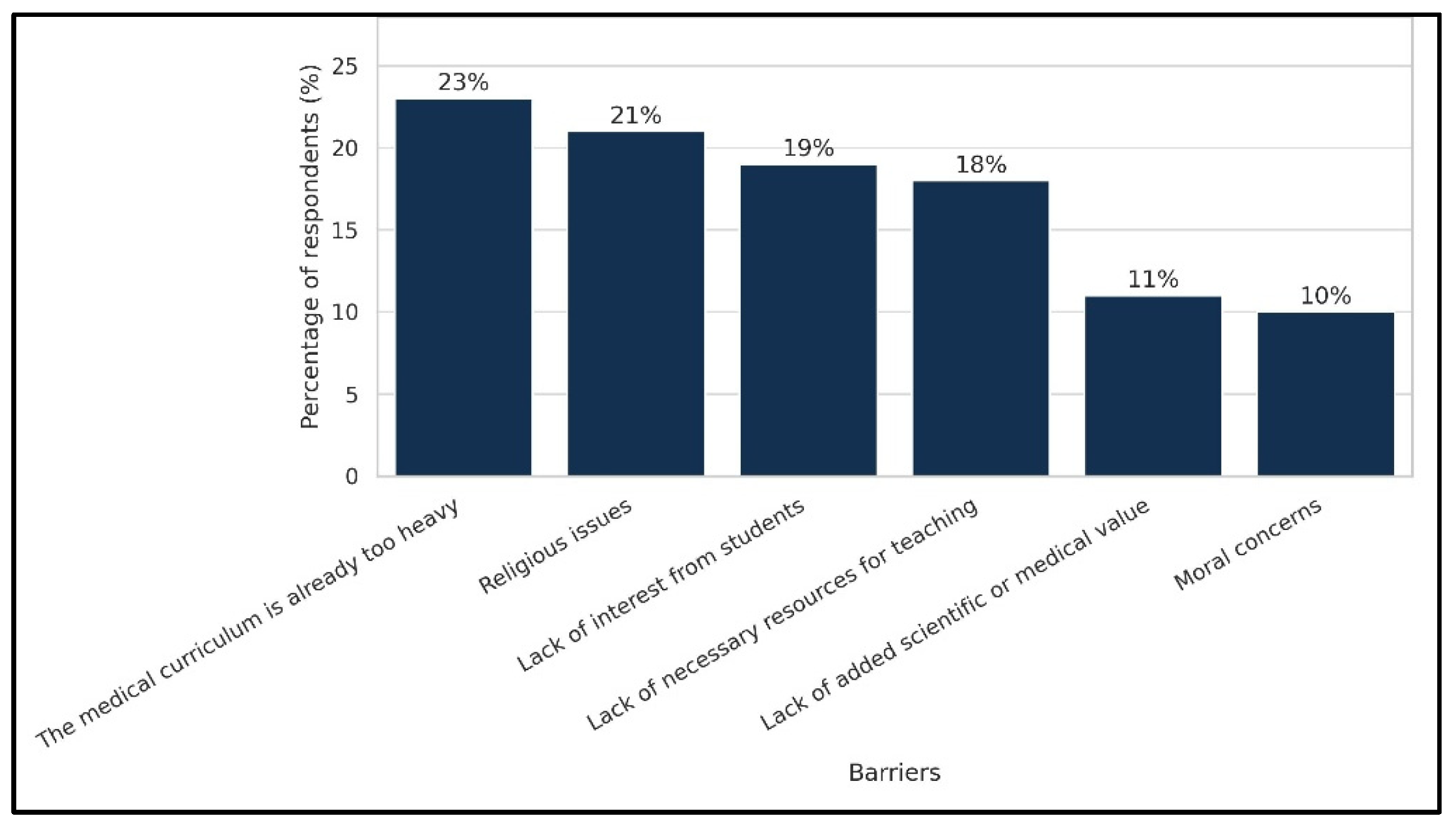
- Attitudes toward Evolutionary Medicine—assessed through custom-designed questions based on a neutral, accessible definition of EM adapted from the Oxford Handbook of Evolutionary Medicine [31]. Questions were adapted from a 2011 cross-sectional study from Pakistan [19], and aimed to understand whether students were exposed to the word “evolutionary medicine”, whether they would advocate for EM integration into medical curricula, and whether EM may help improve clinical or research practices. This section also includes a multiple-choice question to identify barriers to including EM in Egyptian medical curricula.
- Acceptance of Evolution—measured using the Measure of Acceptance of the Theory of Evolution 2.0 (MATE 2.0) [32]. This is a 9-item instrument with a Likert scale of (1) strongly disagree, (2) somewhat disagree, (3) neutral, (4) somewhat agree, and (5) strongly agree, collected the students’ opinions, with reverse-coding on questions 3 and 5, as endorsed by the developers of MATE 2.0.
- Knowledge of Evolution—assessed through the Conceptual Inventory of Natural Selection (CINS) [33]. The CINS questionnaire comprises 20 questions, with each question carrying a point.
2.6. Statistical Analysis
2.7. Ethical Considerations
3. Results
3.1. Participants
3.2. Awareness, Interest, and Perceptions Regarding Evolutionary Medicine
3.3. Comparison of MATE 2.0 and CINS Scores Across Participant Characteristics
3.4. Predictors of Evolution Knowledge (CINS) and Acceptance (MATE 2.0)
3.5. Post Hoc Analyses
4. Discussion
5. Conclusions
Supplementary Materials
Author Contributions
Funding
Institutional Review Board Statement
Informed Consent Statement
Data Availability Statement
Acknowledgments
Conflicts of Interest
Abbreviations
| EM | Evolutionary Medicine |
| MATE | Measure of Acceptance of the Theory of Evolution |
| CINS | Conceptual Inventory of Natural Selection |
| AAMC | Association of American Medical Colleges |
| MENA | Middle East and North Africa |
| CEESU | Conceptual Ecology of Evolutionary Science Understanding |
| NARS | National Academic Reference Standards |
| STROBE | Strengthening the Reporting of Observational Studies in Epidemiology |
References
- Power, M.L.; Snead, C.; Reed, E.G.; Schulkin, J. Integrating evolution into medical education for women’s health care practitioners. Evol. Med. Public Health 2020, 2020, 60–67. [Google Scholar] [CrossRef] [Scilit] [PubMed]
- Nesse, R.M.; Schulkin, J. An evolutionary medicine perspective on pain and its disorders. Philos. Trans. R. Soc. B 2019, 374, 20190288. [Google Scholar] [CrossRef] [Scilit] [PubMed]
- Stearns, S.C.; Ackermann, M.; Doebeli, M.; Kaiser, M. Experimental evolution of aging, growth, and reproduction in fruitflies. Proc. Natl. Acad. Sci. USA 2000, 97, 3309–3313. [Google Scholar] [CrossRef] [Scilit]
- Gluckman, P.; Beedle, A.; Buklijas, T.; Low, F.; Hanson, M. Principles of Evolutionary Medicine; Oxford University Press: Oxford, UK, 2016. [Google Scholar]
- Bolnick, D.I.; Steinel, N.; Reynolds, A.W.; Bolnick, D.A. Learning objectives for weaving evolutionary thinking into medical education. Med. Sci. Educ. 2017, 27, 137–145. [Google Scholar] [CrossRef] [Scilit]
- Nesse, R.M.; Bergstrom, C.T.; Ellison, P.T.; Flier, J.S.; Gluckman, P.; Govindaraju, D.R.; Niethammer, D.; Omenn, G.S.; Perlman, R.L.; Schwartz, M.D. Making evolutionary biology a basic science for medicine. Proc. Natl. Acad. Sci. USA 2010, 107, 1800–1807. [Google Scholar] [CrossRef] [Scilit] [PubMed]
- Labov, J.B. Evolutionary medicine and the medical school curriculum: Meeting students along their paths to medical school. Evol. Educ. Outreach 2011, 4, 561–566. [Google Scholar] [CrossRef] [Scilit]
- Natterson-Horowitz, B.; Aktipis, A.; Fox, M.; Gluckman, P.D.; Low, F.M.; Mace, R.; Read, A.; Turner, P.E.; Blumstein, D.T. The future of evolutionary medicine: Sparking innovation in biomedicine and public health. Front. Sci. 2023, 1, 997136. [Google Scholar] [CrossRef] [Scilit] [PubMed]
- Barnes, M.E.; Roberts, J.A.; Maas, S.A.; Brownell, S.E. Muslim undergraduate biology students’ evolution acceptance in the United States. PLoS ONE 2021, 16, e0255588. [Google Scholar] [CrossRef] [Scilit] [PubMed]
- Stears, M.; Clément, P.; James, A.; Dempster, E. Creationist and evolutionist views of South African teachers with different religious affiliations. S. Afr. J. Sci. 2016, 112, 10. [Google Scholar] [CrossRef] [Scilit] [PubMed]
- Grunspan, D.Z.; Nesse, R.M.; Barnes, M.E.; Brownell, S.E. Core principles of evolutionary medicine: A Delphi study. Evol. Med. Public Health 2018, 2018, 13–23. [Google Scholar] [PubMed]
- Antolin, M.F.; Jenkins, K.P.; Bergstrom, C.T.; Crespi, B.J.; De, S.; Hancock, A.; Hanley, K.A.; Meagher, T.R.; Moreno-Estrada, A.; Nesse, R.M. Evolution and medicine in undergraduate education: A prescription for all biology students. Evolution 2012, 66, 1991–2006. [Google Scholar] [CrossRef] [Scilit] [PubMed]
- Weisberg, D.S.; Landrum, A.R.; Metz, S.E.; Weisberg, M. No missing link: Knowledge predicts acceptance of evolution in the United States. BioScience 2018, 68, 212–222. [Google Scholar] [CrossRef] [Scilit]
- Committee, A.-H. Scientific Foundations for Future Physicians; Association of American Medical Colleges: Washington, DC, USA, 2009. [Google Scholar]
- Rühli, F.; Haeusler, M.; Saniotis, A.; Henneberg, M. Novel modules to teach evolutionary medicine: An Australian and a Swiss experience. Med. Sci. Educ. 2016, 26, 375–381. [Google Scholar] [CrossRef] [Scilit]
- Hidaka, B.H.; Asghar, A.; Aktipis, C.A.; Nesse, R.M.; Wolpaw, T.M.; Skursky, N.K.; Bennett, K.J.; Beyrouty, M.W.; Schwartz, M.D. The status of evolutionary medicine education in North American medical schools. BMC Med. Educ. 2015, 15, 38. [Google Scholar] [CrossRef] [Scilit] [PubMed]
- Nunn, C.L. A roadmap for ‘core concepts’ in evolutionary medicine. Evol. Med. Public Health 2018, 2018, 24–25. [Google Scholar] [CrossRef] [Scilit] [PubMed]
- Grunspan, D.Z.; Nesse, R.M.; Brownell, S.E. EvMedEd: A teaching resource for integrating medical examples into evolution education. Am. Biol. Teach. 2020, 82, 123–126. [Google Scholar] [CrossRef] [Scilit]
- Yousuf, A.; bin Daud, M.A.; Nadeem, A. Awareness and acceptance of evolution and evolutionary medicine among medical students in Pakistan. Evol. Educ. Outreach 2011, 4, 580–588. [Google Scholar] [CrossRef] [Scilit]
- Grunspan, D.Z.; Moeller, K.T.; Nesse, R.M.; Brownell, S.E. The state of evolutionary medicine in undergraduate education. Evol. Med. Public Health 2019, 2019, 82–92. [Google Scholar] [CrossRef] [Scilit] [PubMed]
- Yok, M.C.K.; Clément, P.; Leong, L.K.; Shing, C.L.; Ragem, P.A. Preliminary results on Malaysian teachers conception of evolution. Procedia-Soc. Behav. Sci. 2015, 167, 250–255. [Google Scholar] [CrossRef] [Scilit]
- Unsworth, A.; Voas, D. Attitudes to evolution among Christians, Muslims and the Non-Religious in Britain: Differential effects of religious and educational factors. Public Underst. Sci. 2018, 27, 76–93. [Google Scholar] [CrossRef] [Scilit] [PubMed]
- Hassan, R. On being religious: Patterns of religious commitment in Muslim societies. Muslim World 2005, 97, 437–478. [Google Scholar]
- Silva, E.O. Neutralizing problematic frames in the culture wars: Anti-evolutionists grapple with religion. Symb. Interact. 2014, 37, 226–245. [Google Scholar] [CrossRef] [Scilit]
- Kazempour, M.; Amirshokoohi, A. Evolution education in Iran: Shattering myths about teaching evolution in an Islamic state. In Evolution Education Around the Globe; Springer: Cham, Switzerland, 2018; pp. 281–295. [Google Scholar]
- Deniz, H. Teaching a Socially Controversial Scientific Subject: Evolution. In Approaches and Strategies in Next Generation Science Learning; IGI Global Scientific Publishing: Hershey, PA, USA, 2013; pp. 52–63. [Google Scholar]
- Badrawi, N.; Hosny, S.; Ragab, L.; Ghaly, M.; Eldeek, B.; Tawdi, A.F.; Makhlouf, A.M.; Said, Z.N.; Mohsen, L.; Waly, A.H. Radical reform of the undergraduate medical education program in a developing country: The Egyptian experience. BMC Med. Educ. 2023, 23, 143. [Google Scholar] [CrossRef] [Scilit] [PubMed]
- Mortagy, M.; Abdelhameed, A.; Sexton, P.; Olken, M.; Hegazy, M.T.; Gawad, M.A.; Senna, F.; Mahmoud, I.A.; Shah, J. Online medical education in Egypt during the COVID-19 pandemic: A nationwide assessment of medical students’ usage and perceptions. BMC Med. Educ. 2022, 22, 218. [Google Scholar] [CrossRef] [Scilit] [PubMed]
- Schumann, M.; Dennis, A. House Officers and Junior Residents’ formal and informal learning experience during their practical year compared to the national competency framework, a qualitative study. J. Health Prof. Educ. Innov. 2024, 1, 1. [Google Scholar] [CrossRef] [Scilit]
- Von Elm, E.; Altman, D.G.; Egger, M.; Pocock, S.J.; Gøtzsche, P.C.; Vandenbroucke, J.P.; Initiative, S. The Strengthening the Reporting of Observational Studies in Epidemiology (STROBE) Statement: Guidelines for reporting observational studies. Int. J. Surg. 2014, 12, 1495–1499. [Google Scholar] [CrossRef] [Scilit] [PubMed]
- Brüne, M.; Schiefenhövel, W.; Nesse, R.; Le Duc, D.; Schöneberg, T.; Ewald, P.; Swain Ewald, H.; Bernstein, R.; Bogin, B.; Zhao, X.; et al. Oxford Handbook of Evolutionary Medicine; Oxford University Press: Oxford, UK, 2019. [Google Scholar]
- Barnes, M.E.; Misheva, T.; Supriya, K.; Rutledge, M.; Brownell, S.E. A revised measure of acceptance of the theory of evolution: Introducing the MATE 2.0. CBE Life Sci. Educ. 2022, 21, ar10. [Google Scholar] [CrossRef] [Scilit] [PubMed]
- Anderson, D.L.; Fisher, K.M.; Norman, G.J. Development and evaluation of the conceptual inventory of natural selection. J. Res. Sci. Teach. 2002, 39, 952–978. [Google Scholar] [CrossRef] [Scilit]
- Basile, A.J.; Schwartz, D.B.; Rigdon, J.; Stapell, H. Status of evolutionary medicine within the field of nutrition and dietetics: A survey of professionals and students. Evol. Med. Public Health 2018, 2018, 201–210. [Google Scholar] [PubMed]
- Barnes, M.E.; Supriya, K.; Dunlop, H.M.; Hendrix, T.M.; Sinatra, G.M.; Brownell, S.E. Relationships between the religious backgrounds and evolution acceptance of Black and Hispanic biology students. CBE Life Sci. Educ. 2020, 19, ar59. [Google Scholar] [CrossRef] [Scilit] [PubMed]
- Downie, J.; Barron, N. Evolution and religion: Attitudes of Scottish first year biology and medical students to the teaching of evolutionary biology. J. Biol. Educ. 2000, 34, 139–146. [Google Scholar] [CrossRef] [Scilit]
- Barnes, M.E.; Truong, J.M.; Brownell, S.E. Experiences of Judeo-Christian students in undergraduate biology. CBE Life Sci. Educ. 2017, 16, ar15. [Google Scholar] [CrossRef] [Scilit] [PubMed]
- Athanasiou, K.; Papadopoulou, P. Evolution theory teaching and learning: What conclusions can we get from comparisons of teachers’ and students’ conceptual ecologies in Greece and Turkey? EURASIA J. Math. Sci. Technol. Educ. 2015, 11, 841–853. [Google Scholar] [CrossRef] [Scilit]
- Saefi, M.; Suwono, H.; Hanafi, Y. From conflict to harmony: Changing conceptual ecology of evolution acceptance of muslim students after dialogue in science and religion. Evol. Educ. Outreach 2024, 17, 8. [Google Scholar] [CrossRef] [Scilit]
- BouJaoude, S.; Wiles, J.R.; Asghar, A.; Alters, B. Muslim Egyptian and Lebanese students’ conceptions of biological evolution. Sci. Educ. 2011, 20, 895–915. [Google Scholar] [CrossRef] [Scilit]
- Rissler, L.J.; Duncan, S.I.; Caruso, N.M. The relative importance of religion and education on university students’ views of evolution in the Deep South and state science standards across the United States. Evol. Educ. Outreach 2014, 7, 24. [Google Scholar] [CrossRef] [Scilit]
- Misheva, T.; Nesse, R.M.; Grunspan, D.Z.; Brownell, S.E. The EvMed Assessment: A test for measuring student understanding of core concepts in evolutionary medicine. Evol. Med. Public Health 2023, 11, 353–362. [Google Scholar] [PubMed]
- Hsu, J.L.; Dorner, M.A.; Hill, K.M. Defining evolution: Exploring students’ conceptions of evolution in introductory biology courses. Evol. Educ. Outreach 2024, 17, 14. [Google Scholar] [CrossRef] [Scilit]
- Batac, K.I.T.; Antonio, R.P.; Prudente, M.S. Explicit Instruction about the Nature of Science and Its Impact on Students’ Understanding of Evolution: A Meta-Analysis. Int. J. Educ. Math. Sci. Technol. 2026, 14, 350–368. [Google Scholar] [CrossRef] [Scilit]
- Funkhouser, J.A.; Gregory, M.; Sanz, C. Promoting inclusivity in ecology, evolution, and behavioral biology education through course-based undergraduate research experiences. BioScience 2024, 74, 567–576. [Google Scholar] [CrossRef] [Scilit] [PubMed]
- Buklijas, T.; Low, F.M.; Beedle, A.S.; Gluckman, P.D. Developing a curriculum for evolutionary medicine: Case studies of scurvy and female reproductive tract cancers. Evol. Educ. Outreach 2011, 4, 595–602. [Google Scholar] [CrossRef] [Scilit]




| Variable | MATE 2.0 Scale | CINS Scale | ||||||||||
|---|---|---|---|---|---|---|---|---|---|---|---|---|
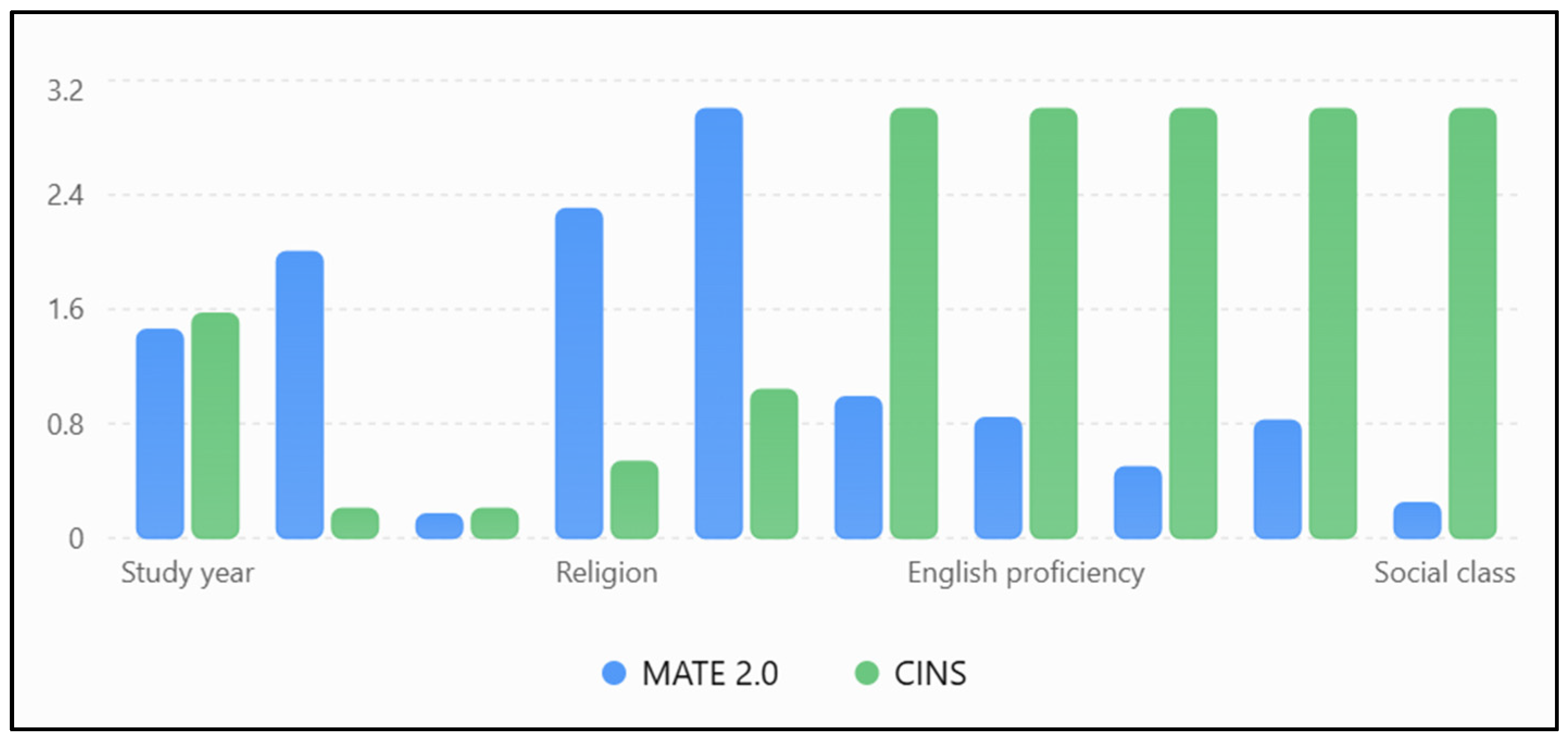
| Sum of Squares | Degrees of Freedom | Mean Square | F-Value | p-Value | Partial Eta Squared (ηp2) | Sum of Squares | Degrees of Freedom | Mean Square | F-Value | p-Value | Partial Eta Squared | |
| Study year | 10.244 | 5 | 2.049 | 2.422 | 0.035 | 0.010 | 201.462 | 5 | 40.292 | 2.545 | 0.027 | 0.020 |
| University | 15.727 | 7 | 2.247 | 2.677 | 0.010 | 0.028 | 96.856 | 7 | 13.837 | 0.861 | 0.537 | 0.013 |
| The grade of the last year | 1.970 | 4 | 0.493 | 0.574 | 0.682 | 0.004 | 41.985 | 4 | 10.496 | 0.653 | 0.625 | 0.002 |
| Religion | 12.674 | 4 | 3.169 | 3.77 | 0.005 | 0.006 | 79.441 | 4 | 19.860 | 1.24 | 0.293 | 0.009 |
| Religiosity (1–5) | 26.304 | 4 | 6.576 | 8.050 | 0.000 | 0.055 | 127.945 | 4 | 31.986 | 2.007 | 0.092 | 0.009 |
| Secondary education (high school) curriculum | 9.004 | 6 | 1.501 | 1.766 | 0.104 | 0.011 | 578.895 | 6 | 96.483 | 6.342 | 0.000 | 0.021 |
| English proficiency (1–10) | 11.452 | 9 | 1.272 | 1.498 | 0.145 | 0.022 | 561.672 | 9 | 62.408 | 4.073 | 0.000 | 0.016 |
| Father’s education | 7.942 | 8 | 0.993 | 1.162 | 0.320 | 0.017 | 433.773 | 8 | 54.222 | 3.495 | 0.001 | 0.010 |
| Mother’s education | 10.266 | 8 | 1.283 | 1.509 | 0.151 | 0.020 | 465.661 | 8 | 58.208 | 1.509 | 0.000 | 0.017 |
| Social class | 2.515 | 4 | 0.629 | 0.733 | 0.570 | 0.010 | 292.570 | 4 | 73.143 | 4.673 | 0.001 | 0.008 |
| Partial eta squared (ηp2) effect size interpretation: 0.01 = small, 0.06 = medium, 0.14 = large. | ||||||||||||
| Variable | MATE Composite Score | CINS Score | |||||
|---|---|---|---|---|---|---|---|
| Mean ± SD | p-Value | Cohen’s-d | Mean ± SD | p-Value | Cohen’s-d | ||
| Gender | Male | 2.7 ± 0.9 | 0.068 | −0.15 | 7.4 ± 4.0 | 0.773 | −0.02 |
| Female | 2.9 ± 0.9 | 7.5 ± 4.0 | |||||
| Nationality | Egyptian | 2.8 ± 0.9 | 0.229 | 0.11 | 7.6 ± 4.1 | 0.473 | 0.07 |
| Non-Egyptian | 2.7 ± 0.9 | 7.3 ± 3.8 | |||||
| Residency | Rural | 2.8 ± 0.9 | 0.689 | −0.04 | 6.3 ± 3.4 | 0.002 | −0.35 |
| Urban | 2.8 ± 0.93 | 7.7 ± 4.1 | |||||
| Cohen’s d effect size interpretation: 0.20 = small, 0.50 = medium, 0.80 = large. The sign indicates the direction of the group difference. | |||||||
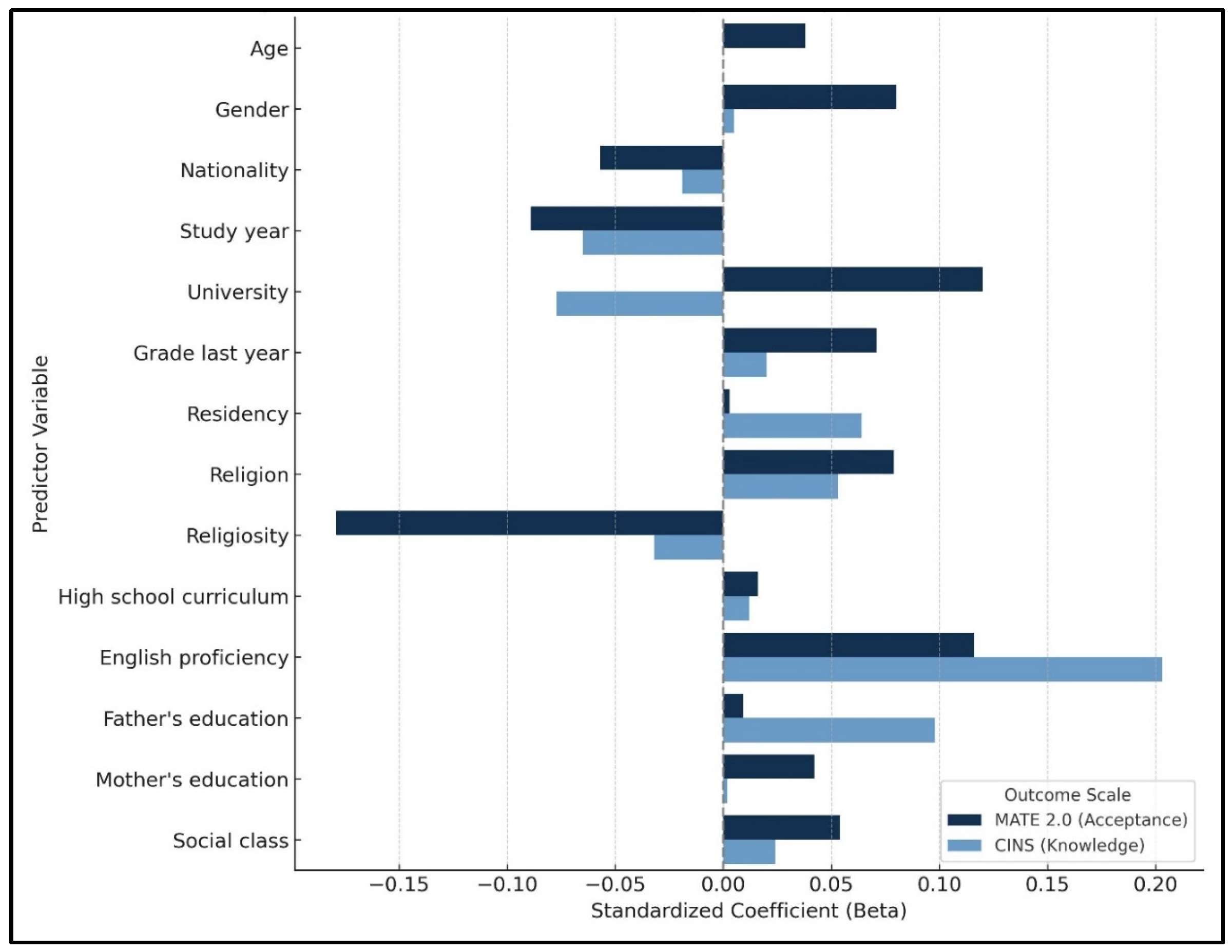
| Variables | Unstandardized Coefficients (B) | Std. Error | Standardized Coefficients (Beta) | t-Statistics | 95% Confidence Interval for B | p-Value |
|---|---|---|---|---|---|---|
| Age | 0.017 | 0.035 | 0.037 | 0.498 | [−0.051, 0.086] | 0.618 |
| Gender | 0.152 | 0.076 | 0.082 | 2.011 | [0.004, 0.300] | 0.045 |
| Nationality | −0.122 | 0.095 | −0.057 | −1.288 | [−0.309, 0.064] | 0.198 |
| Study year | −0.052 | 0.044 | −0.087 | −1.170 | [−0.139, 0.035] | 0.242 |
| University | 0.040 | 0.014 | 0.121 | 2.867 | [0.013, 0.067] | 0.004 |
| The grade of the last year | 0.071 | 0.041 | 0.073 | 1.717 | [−0.010, 0.151] | 0.087 |
| Residency | 0.012 | 0.106 | 0.005 | 0.109 | [−0.196, 0.219] | 0.913 |
| Religion | 0.164 | 0.086 | 0.079 | 1.919 | [−0.004, 0.333] | 0.055 |
| Religiosity (1–5) | −0.187 | 0.044 | −0.181 | −4.286 | [−0.273, −0.101] | 0.000 |
| Secondary education (high school) curriculum | 0.009 | 0.024 | 0.015 | 0.367 | [−0.038, 0.055] | 0.714 |
| English proficiency (1–10) | 0.058 | 0.022 | 0.116 | 2.604 | [0.014, 0.102] | 0.009 |
| Father’s education | 0.006 | 0.030 | 0.010 | 0.211 | [−0.052, 0.064] | 0.833 |
| Mother’s education | 0.025 | 0.030 | 0.041 | 0.849 | [−0.033, 0.084] | 0.396 |
| Social class | 0.068 | 0.055 | 0.055 | 1.246 | [−0.039, 0.176] | 0.213 |
| Dependent Variable: Score of MATE 2.0 | ||||||
| Variables | Unstandardized Coefficients (B) | Std. Error | Standardized Coefficients (Beta) | t-Statistics | 95% Confidence Interval for B | p-Value |
|---|---|---|---|---|---|---|
| Age | 0.000 | 0.152 | 0.000 | −0.003 | [−0.299, 0.298] | 0.998 |
| Gender | 0.037 | 0.327 | 0.005 | 0.114 | [−0.606, 0.680] | 0.909 |
| Nationality | −0.172 | 0.412 | −0.019 | −0.418 | [−0.981, 0.637] | 0.676 |
| Study year | −0.167 | 0.191 | −0.065 | −0.873 | [−0.543, 0.209] | 0.383 |
| University | −0.109 | 0.060 | −0.077 | −1.817 | [−0.228, 0.009] | 0.070 |
| The grade of the last year | 0.084 | 0.178 | 0.020 | 0.471 | [−0.266, 0.434] | 0.638 |
| Residency | 0.686 | 0.458 | 0.064 | 1.496 | [−0.215, 1.588] | 0.135 |
| Religion | 0.477 | 0.371 | 0.053 | 1.285 | [−0.252, 1.205] | 0.199 |
| Religiosity (1–5) | −0.145 | 0.189 | −0.032 | −0.767 | [−0.517, 0.226] | 0.443 |
| Secondary education (high school) curriculum | 0.030 | 0.102 | 0.012 | 0.298 | [−0.170, 0.230] | 0.766 |
| English proficiency (1–10) | 0.441 | 0.097 | 0.203 | 4.544 | [0.250, 0.632] | 0.000 |
| Father’s education | 0.260 | 0.128 | 0.098 | 2.032 | [0.009, 0.511] | 0.043 |
| Mother’s education | 0.006 | 0.129 | 0.002 | 0.044 | [−0.248, 0.259] | 0.965 |
| Social class | 0.130 | 0.238 | 0.024 | 0.548 | [−0.337, 0.598] | 0.584 |
| Dependent Variable: Score of CINS | ||||||
Disclaimer/Publisher’s Note: The statements, opinions and data contained in all publications are solely those of the individual author(s) and contributor(s) and not of MDPI and/or the editor(s). MDPI and/or the editor(s) disclaim responsibility for any injury to people or property resulting from any ideas, methods, instructions or products referred to in the content. |
© 2026 by the authors. Published by MDPI on behalf of the Academic Society for International Medical Education. Licensee MDPI, Basel, Switzerland. This article is an open access article distributed under the terms and conditions of the Creative Commons Attribution (CC BY) license.
Share and Cite
Ibrahim Mohamed, M.; Ashraf Al-Shafey, N.; El-Kholy, O.; ElSourady, Y.; Baraka, A.; Schumann, M. Understanding Medical Students’ Perceptions of Evolutionary Medicine and Evolution: A Cross-Sectional Analysis of Acceptance, Knowledge, and Barriers in Egypt. Int. Med. Educ. 2026, 5, 88. https://doi.org/10.3390/ime5030088
Ibrahim Mohamed M, Ashraf Al-Shafey N, El-Kholy O, ElSourady Y, Baraka A, Schumann M. Understanding Medical Students’ Perceptions of Evolutionary Medicine and Evolution: A Cross-Sectional Analysis of Acceptance, Knowledge, and Barriers in Egypt. International Medical Education. 2026; 5(3):88. https://doi.org/10.3390/ime5030088
Chicago/Turabian StyleIbrahim Mohamed, Mohamed, Nada Ashraf Al-Shafey, Omar El-Kholy, Youssef ElSourady, Azza Baraka, and Marwa Schumann. 2026. "Understanding Medical Students’ Perceptions of Evolutionary Medicine and Evolution: A Cross-Sectional Analysis of Acceptance, Knowledge, and Barriers in Egypt" International Medical Education 5, no. 3: 88. https://doi.org/10.3390/ime5030088
APA StyleIbrahim Mohamed, M., Ashraf Al-Shafey, N., El-Kholy, O., ElSourady, Y., Baraka, A., & Schumann, M. (2026). Understanding Medical Students’ Perceptions of Evolutionary Medicine and Evolution: A Cross-Sectional Analysis of Acceptance, Knowledge, and Barriers in Egypt. International Medical Education, 5(3), 88. https://doi.org/10.3390/ime5030088