Viewpoint

Transforming Medical Education Through International Accreditation: The Case of the Mongolian National University of Medical Sciences (2010–2024)


by
Oyuntugs Byambasukh
1,†,
Usukhbayar Munkhbayar
2,†,
Munkhbaatar Dagvasumberel
3,
Khangai Enkhtugs
2,
Oyungoo Badamdorj
4,
Khandmaa Sukhbaatar
4,
Damdindorj Boldbaatar
5,
Batbaatar Gunchin
5,*,‡ and
Enkhtur Yadamsuren
5,*,‡
1
Department of Endocrinology, School of Medicine, Mongolian National University of Medical Sciences, Ulaanbaatar 14210, Mongolia
2
Department of Family Medicine, School of Medicine, Mongolian National University of Medical Sciences, Ulaanbaatar 14210, Mongolia
3
Department of Radiology, School of Medicine, Mongolian National University of Medical Sciences, Ulaanbaatar 14210, Mongolia
4
Department of Undergraduate Educational Ploicy and Management, Mongolian National University of Medical Sciences, Ulaanbaatar 14210, Mongolia
5
Department of Physiology, School of Bio-Medicine, Mongolian National University of Medical Sciences, Ulaanbaatar 14210, Mongolia
*
Authors to whom correspondence should be addressed.
The first authors contributed equally to this work.
The correspondent authors contributed equally to this work.
Int. Med. Educ. 2026, 5(1), 2; https://doi.org/10.3390/ime5010002
Submission received: 4 November 2025 / Revised: 4 December 2025 / Accepted: 11 December 2025 / Published: 19 December 2025

Abstract

This paper examines the 14-year journey of the Mongolian National University of Medical Sciences (MNUMS) in achieving and sustaining international accreditation for its undergraduate medical program. Beginning in 2010, MNUMS undertook a series of institutional reforms that culminated in full accreditation in 2016 and re-accreditation in 2024 by an international agency recognized by the European Network for Quality Assurance in Higher Education (ENQA). Drawing on institutional self-assessment reports, evaluator feedback, and stakeholder consultations, this case study explores how the accreditation process functioned as a catalyst for educational reform and quality enhancement. The findings reveal major transformations in curriculum design, assessment systems, and institutional governance. MNUMS adopted the European Credit Transfer and Accumulation System (ECTS), introduced outcome-based education and Entrustable Professional Activities (EPAs), expanded its Clinical Skills Center, and implemented a compulsory undergraduate research project. Additionally, the creation of an integrated Bachelor–Master pathway and strengthened international partnerships further advanced the university’s alignment with global medical education standards. This case illustrates how international accreditation can drive systemic improvement in medical education within developing-country contexts. The MNUMS experience highlights the value of sustained institutional commitment, responsiveness to external evaluation, and the strategic use of accreditation as a framework for continuous innovation and global integration.

1. Introduction

Established in 1942, the Mongolian National University of Medical Sciences (MNUMS) has evolved from a Soviet-supported institution into a leading university dedicated to advancing medical education and research in Mongolia [1]. Over the past two decades, MNUMS has undergone a strategic transformation toward internationalization, seeking to align its academic programs with globally recognized standards of quality and accountability. This transformation culminated in the university’s engagement with international accreditation processes, which have served as powerful mechanisms for quality enhancement, institutional reform, and global recognition [1].
International accreditation plays a pivotal role in assuring the quality of medical education and fostering mutual trust among institutions across borders. Through structured self-assessment and external peer review, accreditation promotes transparency, academic integrity, and continuous improvement. For institutions in developing countries, participation in internationally recognized accreditation frameworks also facilitates curriculum modernization, research integration, and alignment with international health-care standards. These processes enhance graduate employability, institutional credibility, and cross-border academic collaboration [2,3].
This case study explores the journey of MNUMS from 2010 to 2024 as it pursued and sustained international accreditation for its undergraduate medical program. Specifically, it examines how the accreditation process acted as a catalyst for curricular reform, competency-based education, and institutional capacity building. The study highlights key milestones-including the adoption of the European Credit Transfer and Accumulation System (ECTS), the introduction of outcome-based and research-oriented learning, and the development of Entrustable Professional Activities (EPAs) that collectively reflect MNUMS’s commitment to continuous improvement [4,5,6]. Ultimately, this analysis offers insights into how international accreditation can drive educational transformation in developing contexts and contribute to the global advancement of medical education quality.

2. International Accreditation in Medical Education

Accreditation serves as a cornerstone of quality assurance in medical education, providing institutions with an external framework for continuous improvement and accountability. International accreditation, in particular, ensures that educational programs align with globally recognized benchmarks and prepares graduates to participate effectively in an increasingly mobile and interconnected health workforce. Unlike national accreditation-which often emphasizes compliance with local regulations and cultural norms-international accreditation focuses on harmonizing curricula, governance, and outcomes with global standards such as those of the World Federation for Medical Education (WFME) [2,3].
Across the world, diverse accreditation systems have evolved to uphold these standards. The Liaison Committee on Medical Education (LCME) in North America and the Accreditation Council for Graduate Medical Education (ACGME) in the United States have long served as models for programmatic accreditation [7]. In Europe, the European Association for Quality Assurance in Higher Education (ENQA) and its member agencies promote continuous quality improvement across disciplines [8,9]. In Asia, emerging frameworks such as the Japan Accreditation Council for Medical Education (JACME) demonstrate growing regional capacity to implement WFME-aligned evaluation systems [10].
For developing countries, international accreditation offers both opportunities and challenges. It demands transparency, data-driven self-assessment, and significant institutional investment-but also provides a powerful catalyst for reform. Countries such as Ghana and Kyrgyzstan have used international accreditation partnerships to strengthen curricula, elevate institutional credibility, and align training outcomes with international expectations [5,11]. Mongolia’s experience illustrates how engagement with an internationally recognized accrediting agency can drive transformation through structured quality assurance.

3. Mongolia’s Experience: The MNUMS Accreditation Journey

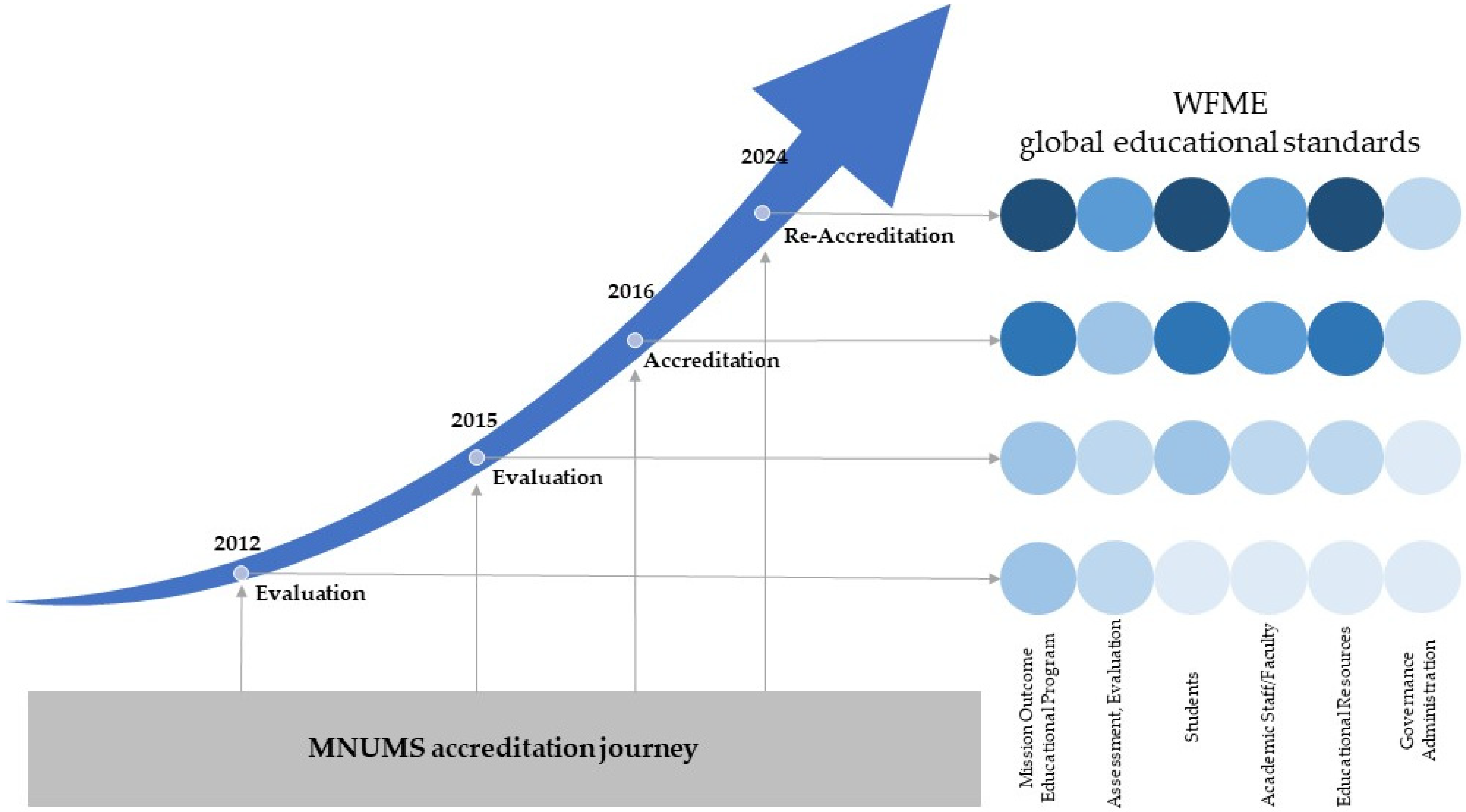
The Mongolian National University of Medical Sciences embarked on its international accreditation journey in 2010, seeking to elevate its “Undergraduate Programme for Medical Doctor” to global standards. Early formative evaluations by the Asia-Pacific Network for Medical Education and Research (AMEWPR) in 2011–2012 and by the University of Groningen in 2015–2017 provided foundational insights that informed the university’s preparation for international review. In 2016, MNUMS achieved its first international accreditation-marking a milestone in Mongolian higher education. The progression of MNUMS across the accreditation cycles is illustrated in Figure 1. The shift from light- to dark-blue indicators between the 2012–2015 formative evaluation, the 2016 accreditation, and the 2024 re-accreditation reflects progressive strengthening across the WFME global standards. These gains are closely linked to deliberate institutional reforms, including the transition from a CanMEDs-based framework to Entrustable Professional Activities (EPAs), the expansion of clinical learning opportunities at sites such as the Mongolia-Japan Hospital (MJH), the development of the Clinical Skills Center and skills laboratory, and the introduction of a compulsory undergraduate thesis within an integrated Bachelor–Master degree structure. A small number of indicators remain in lighter shades, signalling areas where work is still ongoing; however, these relate mainly to evolving international expectations and system-level changes rather than institutional reluctance. Overall, the figure highlights how targeted reforms have translated into measurable improvements in alignment with WFME standards.
By 2022, in preparation for re-accreditation, MNUMS submitted a comprehensive self-assessment report addressing the criteria of an international accreditation agency recognized by ENQA. Although the report demonstrated substantial progress, the evaluators identified specific areas for refinement, including alignment with the Lisbon Convention on credit recognition [12], recalibration of European Credit Transfer and Accumulation System (ECTS) points, and the addition of a mandatory final project to strengthen research and independent learning. The university was granted one year to implement these improvements [12,13].
Responding to this feedback, MNUMS launched a series of structural and curricular reforms. These included the systematic mapping of credit hours to ECTS standards, development of transparent module descriptions, and introduction of a compulsory undergraduate research project requiring 150 h of independent scholarly work. The institution also implemented an integrated “Z-shaped” curriculum that weaves theoretical instruction with progressive clinical immersion. This integration strengthened the continuity between pre-clinical and clinical education and reinforced practical skill development through the expansion of the Clinical Skills Center.
In 2024, following a rigorous re-evaluation, MNUMS successfully achieved re-accreditation by the international agency recognized by ENQA, valid until 2029. This outcome not only validated the institution’s commitment to continuous quality improvement but also positioned MNUMS as a national model for evidence-based educational reform.
As abovementioned, international accreditation has emerged as a key driver of quality enhancement across medical education systems. In Mongolia, this process is exemplified by the 2010–2024 accreditation journey of MNUMS, where coordinated reforms-ECTS alignment, outcome-based education, EPAs, expanded clinical training and strengthened governance-enabled the university to complete two full cycles of accreditation. Compared with this progress, institutions elsewhere in Central Asia continue to face substantial challenges. In Kazakhstan, stakeholders report slow curriculum renewal, limited faculty-development capacity and uneven readiness for international accreditation [14]. Similar constraints appear in Kyrgyzstan, where only a small number of programs have engaged with international accrediting agencies [5]. A regional World Bank analysis further notes that in Armenia and neighboring systems, national QA policies have not yet translated consistently into institutional practice, leaving major implementation gaps [15]. Against this backdrop, the MNUMS experience demonstrates how sustained commitment, external evaluation and structured reforms can support developing-country medical schools in achieving and maintaining international standards.

4. Institutional Transformation and Post-Accreditation Innovations

The re-accreditation process catalyzed a wave of innovation across MNUMS. Three domains of transformation-curriculum design, competency development, and internationalization-have had particularly lasting impacts. Furthermore, the accreditation cycle was accompanied by clear, quantifiable gains across multiple domains. Learning in the Clinical Skills Center also expanded, with simulation-based activities now accounting for 26% of the total student workload. In addition, engagement in faculty development initiatives increased, underscoring the university’s sustained commitment to improving teaching quality.

4.1. Curriculum Integration and ECTS Alignment

The adoption of the European Credit Transfer and Accumulation System (ECTS) established international transparency and student mobility within MNUMS programs. Each module was redesigned with explicit learning outcomes, workload metrics, and assessment criteria, ensuring parity with European standards. This integration also facilitated the creation of a public online course catalog, enhancing transparency for students and external evaluators alike.

4.2. Competency-Based Education and Entrustable Professional Activities (EPAs)

Building on its outcome-based education (OBE) framework introduced in 2015, MNUMS developed the MNUMS Entrustable Professional Activities (MNUMS-EPAs)-a competency model that defines the essential professional tasks graduates must perform independently. This initiative integrates theoretical knowledge, clinical reasoning, and ethical practice, aligning with the WFME and AMEE frameworks [16,17,18]. The introduction of EPAs represents a pivotal shift from knowledge acquisition toward demonstrable professional competence.

4.3. Research Integration and Academic Rigor

The inclusion of a mandatory thesis or project across undergraduate programs institutionalized research training as a core educational outcome. Students now engage in project proposal development, supervised research, and public defense, fostering analytical thinking and scholarly communication. These measures have substantially improved research literacy among graduates and strengthened the academic culture of the institution. The compulsory undergraduate research project, introduced in 2022, reached full implementation in 2024 with a 100% completion rate among graduating students.

4.4. International Collaboration and Academic Mobility

MNUMS has expanded partnerships with over 120 universities in 22 countries, offering exchange programs, joint research, and international clinical placements. These collaborations-such as clerkship training at Hyundai Chung Ang Hospital (Republic of Korea) and Texas-based medical centers-provide students with global exposure and comparative insights into diverse healthcare systems. International mobility strengthened following ECTS alignment, resulting in 14 inbound and 21 outbound exchange students in 2024.

4.5. Legislative and Structural Reform

Following the 2023 revision of Mongolia’s Law on Higher Education [19], MNUMS pioneered the introduction of an integrated Bachelor–Master program in medical education. This pathway enables high-performing students to pursue advanced degrees within an accelerated structure, promoting vertical academic progression and fostering leadership in medical research and practice.

5. Conclusions

The experience of the Mongolian National University of Medical Sciences demonstrates that international accreditation can serve as a transformative mechanism for institutional strengthening in developing-country contexts. Through engagement with an accreditation agency recognized by ENQA and alignment with WFME standards, MNUMS has achieved comprehensive modernization of its curriculum, governance, and assessment systems. The integration of competency-based education, research training, and international mobility has positioned the university as a regional leader in medical education reform. More broadly, this case illustrates that accreditation is not a static endpoint but an evolving process of self-assessment, improvement, and innovation. For medical schools in similar environments, the MNUMS experience underscores that sustained commitment, stakeholder collaboration, and responsiveness to feedback are essential to achieving both quality and sustainability in medical education. At the same time, the long-term sustainability of these gains will depend on continued investment in faculty capacity, financial resources, and infrastructure, and future studies should incorporate objective outcome indicators-such as graduate performance, research productivity, and mobility trajectories-to evaluate the enduring impact of the accreditation process more rigorously.

Author Contributions

Conceptualization and methodology, E.Y., M.D., K.E., K.S., D.B., B.G. and E.Y. writing—original draft preparation, O.B. (Oyuntugs Byambasukh) and U.M.; supervision and editing, E.Y., M.D., K.E., K.S., O.B. (Oyungoo Badamdorj), D.B., B.G. and E.Y. All authors have read and agreed to the published version of the manuscript.

Funding

This research received no external funding.

Institutional Review Board Statement

Not applicable.

Informed Consent Statement

Not applicable.

Acknowledgments

We extend our sincere gratitude to all individuals who supported this study and worked as members during the accreditation processes in 2010, 2012, 2016, and 2022.

Conflicts of Interest

The authors declare no conflicts of interest.

References

  1. Badamdorj, O.; Erkhembayar, R.; Gombo, B.; Baatarpurev, B.; Gansukh, D.; Tsogbadrakh, B. Medical education in Mongolia: Challenges and opportunities. Med. Teach. 2024, 46, 1160–1166. [Google Scholar] [CrossRef] [PubMed]
  2. Sjöström, H.; Christensen, L.; Nystrup, J.; Karle, H. Quality assurance of medical education: Lessons learned from use and analysis of the WFME global standards. Med. Teach. 2019, 41, 650–655. [Google Scholar] [CrossRef] [PubMed]
  3. Tackett, S.; Grant, J.; Mmari, K. Designing an evaluation framework for WFME basic standards for medical education. Med. Teach. 2015, 38, 291–296. [Google Scholar] [CrossRef] [PubMed]
  4. Hou, A. Quality assurance at a distance: International accreditation in Taiwan higher education. High. Educ. 2011, 61, 179–191. [Google Scholar] [CrossRef]
  5. Merrill, M. Differences in international accreditation: Kyrgyzstan and Kazakhstan. Asian Educ. Dev. Stud. 2020, 9, 465–478. [Google Scholar] [CrossRef]
  6. Fleșeriu, C.; Duma, F.; Nistor, I.; Păun, D. The Sustainability of International Accreditations and Their Impact on Students’ Choices in Selecting the Universities. Sustainability 2020, 12, 6480. [Google Scholar] [CrossRef]
  7. Liaison Committee on Medical Education. Available online: https://lcme.org/ (accessed on 10 October 2025).
  8. The Accreditation Agency for Study Programmes in Engineering, Informatics, Natural Sciences and Mathematics. Available online: https://www.asiin.de/en/ (accessed on 10 October 2025).
  9. Zayachuk, Y.; Yamelynets, M. Accreditation procedures as a factor of quality assurance of higher education in Germany. Pedagogika. Stud. I Rozpr. 2021, 30, 179–189. [Google Scholar] [CrossRef]
  10. Japan Accreditation Council for Medical Education. Available online: https://www.jacme.or.jp/en/ (accessed on 10 October 2025).
  11. Fenny, A.P.; Asante, F.A.; Enemark, U. Access to and utilization of healthcare by the poor in the Ashanti Region of Ghana. BMC Health Serv. Res. 2014, 14, 575. [Google Scholar]
  12. World Medical Association. Available online: https://www.wma.net/ (accessed on 10 October 2025).
  13. European Association for Quality Assurance in Higher Education. Available online: https://www.enqa.eu/ (accessed on 10 October 2025).
  14. Mukhatayev, A.; Omirbayev, S.; Kassenov, K.; Idiyatova, Y. Quality Assurance System of Higher Education in Kazakhstan through Stakeholders’ Eyes: An Empirical Study to Identify Its Challenges. Educ. Sci. 2024, 14, 1297. [Google Scholar] [CrossRef]
  15. World Bank. Towards Higher Education Excellence in Central Asia: A Roadmap for Improving Quality; World Bank Publications: Washington, DC, USA, 2023; Available online: https://documents.worldbank.org/en/publication/documents-reports/documentdetail/099101023140578441/p1790811f2f765ea101eb142301abf0100a90db82451 (accessed on 2 December 2025).
  16. Ortega, R.A.; Cruz, R.A. Educators’ Attitude towards Outcomes-Based Educational Approach in English Second Language Learning. Am. J. Educ. Res. 2016, 4, 597–601. [Google Scholar] [CrossRef]
  17. Newble, D. Revisiting ‘The effect of assessments and examinations on the learning of medical students’. Med. Educ. 2016, 50, 498–501. [Google Scholar] [CrossRef] [PubMed]
  18. Pangaro, L.; ten Cate, O. Frameworks for learner assessment in medicine: AMEE Guide No. 78. Med. Teach. 2013, 35, e1197–e1210. [Google Scholar] [CrossRef] [PubMed]
  19. Law of Mongolia on Higher Education. Government of Mongolia: Law of Mongolia on Higher Education Revised Edition. Ulaanbaatar. 2023. Available online: https://legalinfo.mn/mn/edtl/16960373890901 (accessed on 10 October 2025).
Figure 1. MNUMS accreditation journey (2010–2024) and improvement across WFME standards. Darker blue indicates strengthened performance over the 2012, 2015, 2016, and 2024 reviews, reflecting reforms such as EPAs, expanded clinical training (MJH), enhanced skills-lab capacity, and the integrated Bachelor–Master program.
Ime 05 00002 g001
Disclaimer/Publisher’s Note: The statements, opinions and data contained in all publications are solely those of the individual author(s) and contributor(s) and not of MDPI and/or the editor(s). MDPI and/or the editor(s) disclaim responsibility for any injury to people or property resulting from any ideas, methods, instructions or products referred to in the content.