


Abstract
Background: Graft-versus-host disease is the most common complication after allogeneic hematopoietic stem cell transplantation. While ocular graft-versus-host disease typically manifests as dry eye syndrome and anterior segment involvement, posterior segment complications are rare. Previously reported posterior segment complications in graft-versus-host disease have been limited to acute presentations with significant functional visual impairment. Methods: A 41-year-old man developed progressive retinal nerve fiber layer and ganglion cell layer loss four years after allogeneic hematopoietic stem cell transplantation for acute myeloid leukemia. The patient had established chronic graft-versus-host disease with cutaneous involvement and ocular surface disease. Results: Despite preserved visual acuity and visual fields, and only subtle functional involvement on visual evoked potentials, optical coherence tomography revealed significant reduction in retinal nerve fiber layer thickness and ganglion cell layer. Magnetic resonance imaging showed no optic nerve or brain abnormalities. Conclusions: This case describes an uncommon presentation of chronic, subclinical posterior segment involvement in chronic GVHD and suggests that optical coherence tomography may detect progressive structural retinal changes in the absence of clinically evident visual impairment, supporting its potential role in longitudinal monitoring.
1. Background
Acute myeloid leukemia (AML) represents approximately 80% of acute leukemia cases in adults. Allogeneic hematopoietic stem cell transplantation (allo-HSCT) remains a crucial therapeutic intervention for AML patients, though it carries significant risks of complications, with graft-versus-host disease (GVHD) being the most common and serious.
Ocular GVHD (oGVHD) occurs in 60–90% of patients following allo-HSCT, predominantly affecting the ocular surface with dry eye syndrome, conjunctival fibrosis, and meibomian gland dysfunction. The incidence of posterior segment complications including uveitis, giant cell retinitis and retinal hemorrhage was significantly lower than that of ocular surface lesions [1].
The pathophysiology of chronic GVHD Involves T-cell-mediated inflammatory damage, which leads to ocular tissue damage and progressive fibrosis [2]. Donor-derived immune cells (T cells, macrophage, neutrophil) cross the blood vessel barrier into the eye and drive the ocular inflammatory response, with elevated levels of tear cytokines including IL-2, IL-10, IL-17α, IFN-γ, IL-6, and TNF-α in chronic GVHD patients [3,4].
Recent literature has documented acute posterior segment complications in GVHD, presenting as severe visual loss with functional impairment in the early post-transplantation period. Recent case reports have documented severe optic neuropathy with bilateral involvement and profound visual deterioration, emphasizing the critical nature of posterior segment GVHD manifestations [5]. However, chronic subclinical retinal involvement in GVHD has not been previously described. We report a unique case of chronic retinal ganglion cell and Retinal Nerve Fiber Layer (RNFL) loss in a patient with established GVHD, presenting with structural abnormalities on optical coherence tomography (OCT) despite preserved visual function.
2. Case Presentation
2.1. Patient History and Initial Treatment
A 41-year-old male was diagnosed with acute myeloid leukemia in September 2019, presenting with bleeding complications. He underwent induction therapy with the 3 + 7 protocol (cytarabine and daunorubicin) [6], achieving complete remission. Two consolidation cycles with the same regimen were completed in November and December 2019.
In May 2020, the patient underwent allogeneic peripheral blood stem cell transplantation from an unrelated donor. In June 2020, he developed acute cutaneous GVHD, initially treated with corticosteroids. Due to steroid-refractory disease, he received extracorporeal photopheresis (discontinued July 2021) and ruxolitinib (September 2020 to April 2021). Following ruxolitinib discontinuation, the patient was treated with mycophenolate mofetil. Belumosudil was subsequently initiated due to inadequate response of moderate chronic cutaneous and pulmonary GVHD. At the time of this report, he remains on belumosudil and low-dose prednisolone (12.5 mg daily).
2.2. Ophthalmologic Management
The patient was referred to ophthalmology in 2021 for ocular GVHD management, presenting with severe dry eye syndrome. Treatment was initiated with autologous serum eye drops and artificial tears, providing symptomatic improvement.
In December 2021, bilateral cataract extraction with intraocular lens implantation was performed due to steroid-induced cataracts. Post-operative visual acuity was 20/25 (is equivalent to 0.8 in the European decimals system) in both eyes, with intraocular pressure of 14 mmHg bilaterally. Dilated fundus examination and posterior segment assessment were normal at that time. Regular follow-up examinations every six months showed stable visual and anatomical parameters until May 2022.
2.3. Development of Posterior Segment Changes
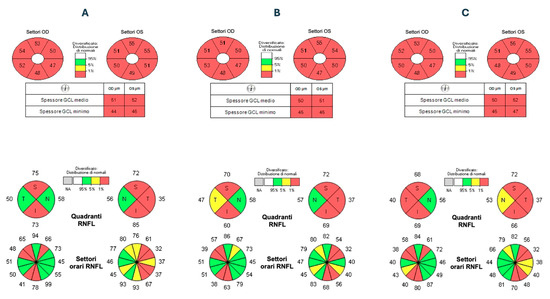
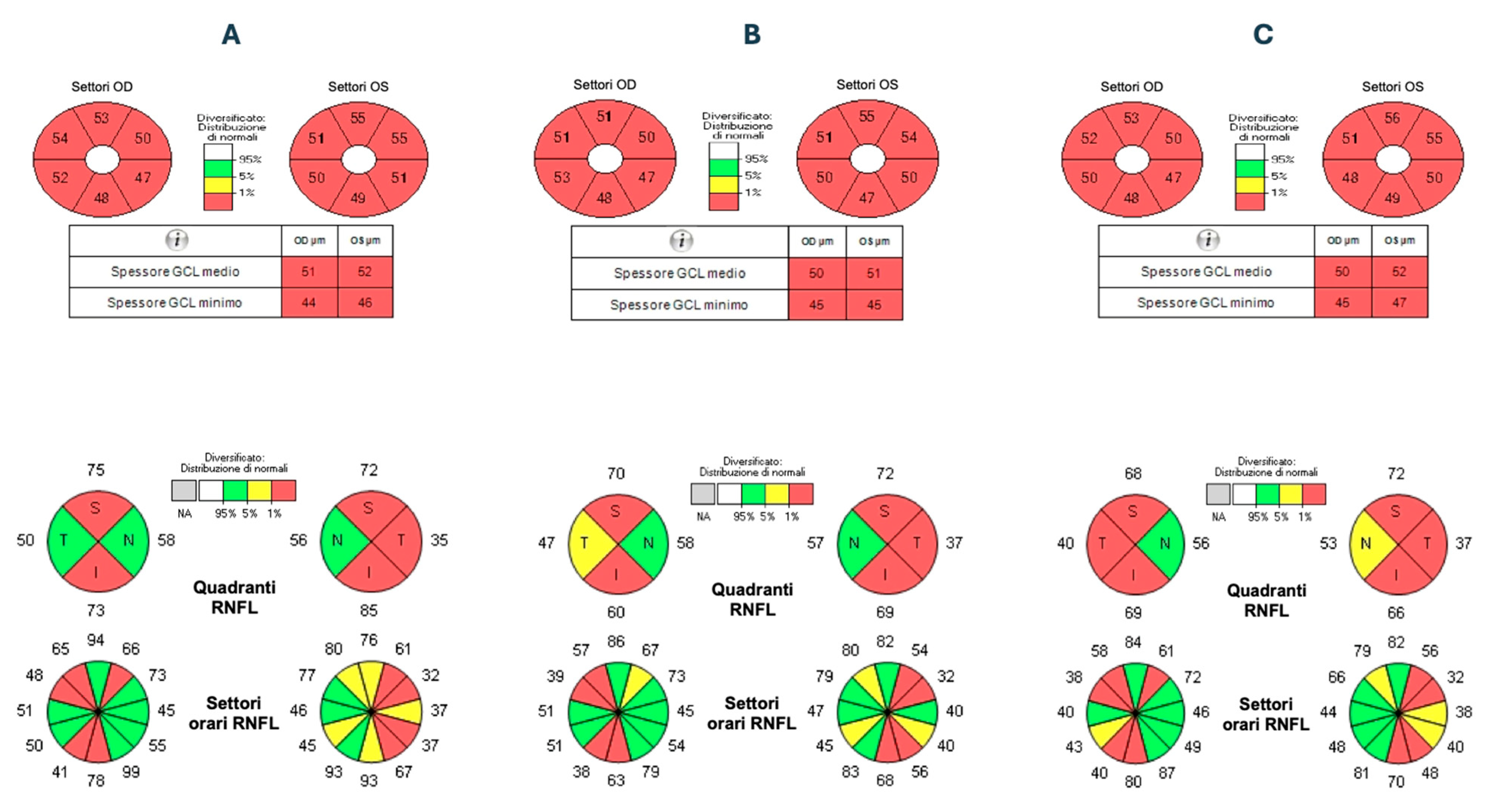
In June 2022, routine examination revealed preserved visual acuity of 20/25 bilaterally with normal intraocular pressure. However, OCT revealed mild reduction in RNFL thickness and retinal ganglion cell loss bilaterally despite the maintained visual function. (Figure 1A). To further characterize these findings, optical coherence tomography was performed with peripapillary retinal nerve fiber layer analysis and macular ganglion cell layer segmentation in both eyes.
Figure 1.
Optical Coherence Tomography (OCT) Analysis—Temporal Evolution of Retinal Changes. (A) June 2022 (Initial Detection): OCT analysis showing mild reduction in retinal nerve fiber layer (RNFL) thickness and ganglion cell layer (GCL) loss in both eyes. Upper panels display GCL thickness maps for right eye (OD) and left eye (OS) with color-coded thickness distribution. Lower panels show RNFL quadrant analysis and clock-hour sectoral measurements. (B) Six months Follow-up: Progressive reduction in both RNFL and GCL thickness compared to baseline measurements. The color maps demonstrate further thinning (increased red areas indicating below-normal thickness), particularly evident in the temporal sectors of both eyes. (C) July 2023 (Latest Follow-up): Marked progression of structural abnormalities with significant reduction in RNFL and GCL thickness bilaterally. The progression from green (normal) to yellow/red (abnormal) areas in the thickness maps demonstrates the chronic, progressive nature of retinal ganglion cell loss in this GVHD patient. Color coding: Green indicates normal thickness (95th percentile), yellow indicates borderline values (5th percentile), and red indicates abnormal thinning (below 1st percentile). OD = right eye; OS = left eye; GCL = ganglion cell layer; RNFL = retinal nerve fiber layer.
Given the structural changes observed on OCT in the presence of preserved visual acuity, comprehensive neuroimaging was performed to exclude alternative causes of ganglion cell loss. Brain magnetic resonance imaging (MRI) showed no signal abnormalities or pathological enhancement, with normal ventricular system and midline structures. The only findings were mucosal thickening in paranasal sinuses and a 6 mm polypoid lesion near the left sphenoid sinus. Orbital MRI demonstrated post-surgical changes from previous cataract surgery but revealed no intraorbital masses, normal extraocular muscles, and importantly, no optic nerve or chiasmal abnormalities. No pathological enhancement was observed after contrast administration.
2.4. Subsequent Clinical Course, After Six Months
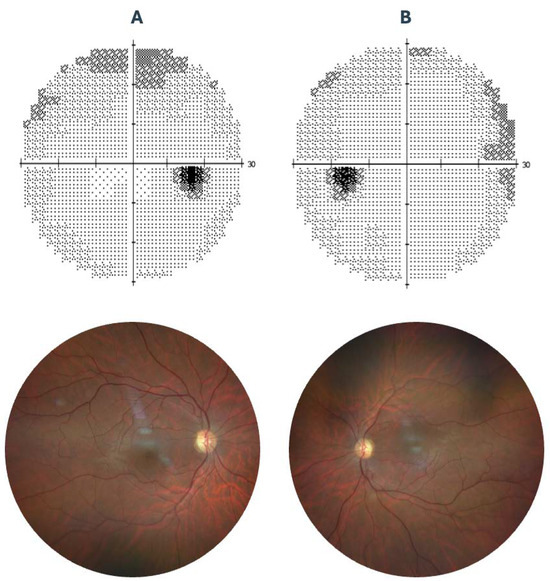
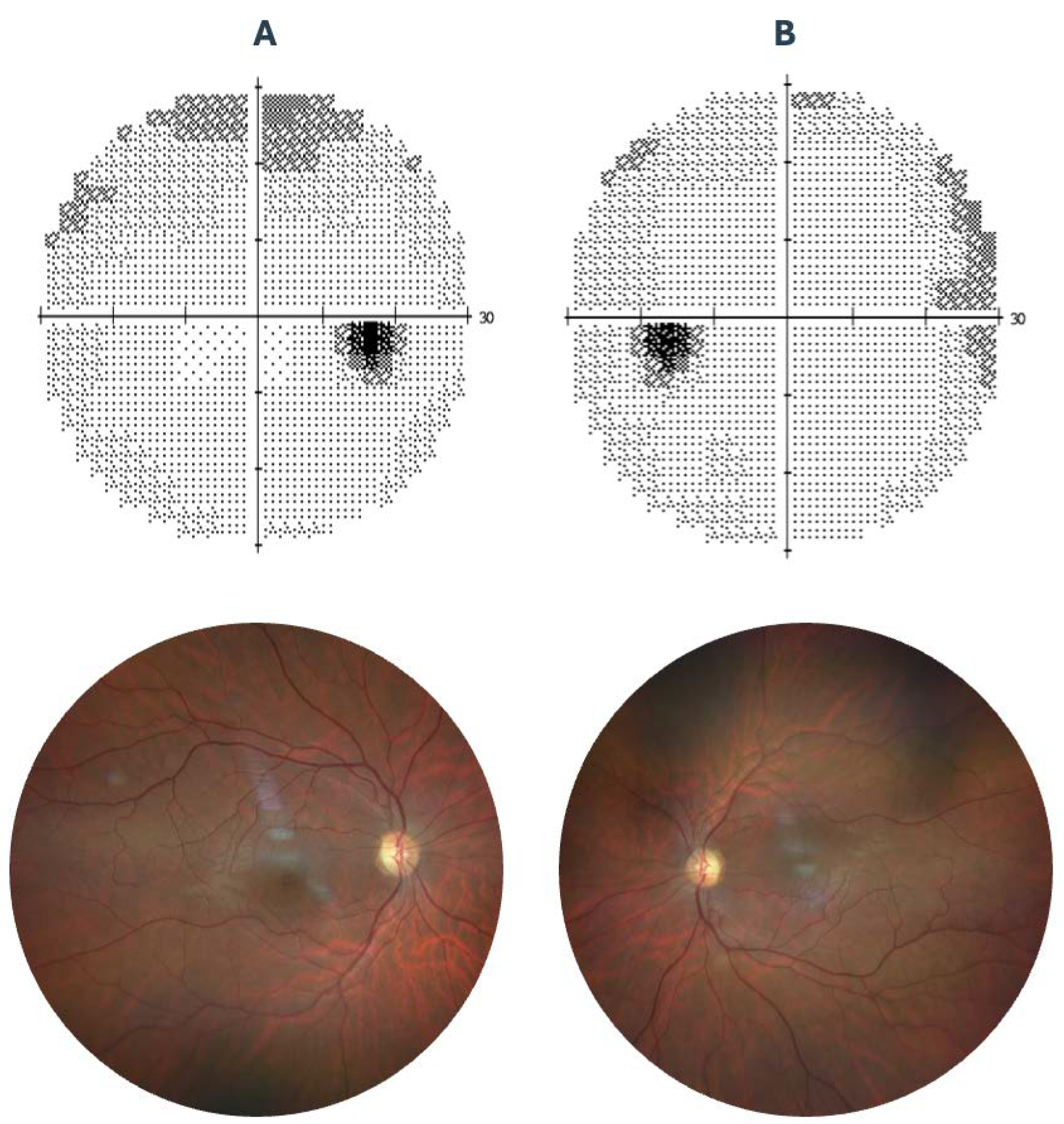
Examination reveals stable bilateral visual acuity at 20/25, with OCT confirming evident structural damage characterized by persistent RNFL and ganglion cell layer thinning (Figure 1B). Fundus examination revealed slight temporal pallor of both optic papillae with clear margins. Visual field examination remained normal, without scotomas or defects (Figure 2A,B). Automated visual field testing was performed using a standard 30-2 strategy.
Figure 2.
Visual Field Testing and Fundus Photography. (A) Right Eye (OD): Upper panel shows automated perimetry demonstrating normal visual field with physiological blind spot visible as expected dark area temporal to fixation. Lower panel displays color fundus photography revealing slight temporal pallor of the optic disc with clear disc margins. (B) Left Eye (OS): Upper panel shows corresponding normal visual field testing. Lower panel shows fundus photography with similar findings of mild temporal optic disc pallor.
Visual evoked potentials performed in February 2023 were conducted to assess functional integrity of the visual pathway despite preserved visual acuity. The examination demonstrated essentially normal findings, with both latency and amplitude within normal limits bilaterally for pattern 60’ stimulation. Pattern 15’ stimulation showed normal responses in the right eye, while the left eye exhibited a mild amplitude reduction with preserved normal latency, suggesting subtle functional impairment consistent with the structural changes observed on OCT.
2.5. One-Year Post-Initial Evaluation (July 2023)
Visual acuity remains stable at 20/25 bilaterally with normal intraocular pressure. OCT continues to demonstrate progressive structural abnormalities with marked reduction in RNFL and ganglion cell layer thickness, despite maintained functional visual performance (Figure 1C). A chronological summary of the main clinical and instrumental evaluations is presented in Table 1.
Table 1.
Chronological overview of ophthalmologic and neuro-ophthalmologic evaluations in relation to the clinical course of chronic graft-versus-host disease. Table 1 summarizes the timing of optical coherence tomography (OCT), automated visual field testing, and visual evoked potentials, highlighting progressive structural retinal changes on OCT in the presence of preserved visual acuity and visual fields and only subtle functional involvement detected by visual evoked potentials.
3. Discussion
Ocular graft-versus-host disease presents a diverse spectrum of clinical manifestations depending on whether it occurs in the acute or chronic setting. Acute ocular GVHD typically manifests within the first 100 days post-transplantation and predominantly affects the anterior segment with conjunctival hyperemia, chemosis, and pseudomembranous conjunctivitis. When posterior segment involvement occurs in acute GVHD, it presents with dramatic clinical features including severe visual loss, optic disc edema, macular swelling, retinal hemorrhages, and cotton wool spots, often accompanied by central or paracentral scotomas and abnormal electrophysiological findings.
In contrast, chronic ocular GVHD develops months to years after transplantation and is characterized by progressive dry eye disease, conjunctival fibrosis, and meibomian gland dysfunction affecting 60–90% of patients with ocular symptoms such as stinging, burning, watering, and blurred vision [1,7,8]. Traditional understanding suggested that posterior segment involvement in chronic GVHD was limited to subtle microvascular changes, occasional cotton wool spots, and mild vitreoretinal hemorrhages, typically without significant functional impact [2,9].
The pathophysiology of these two forms differs substantially. Acute GVHD Involves rapid tissue damage through activated donor T-cells that recognize host antigens, leading to immediate inflammatory responses and tissue destruction. Chronic GVHD, however, is characterized by sustained T-cell-mediated inflammatory damage that leads to progressive fibrosis through mechanisms including immune cell recruitment, production of inflammatory cytokines and chemokines, and formation of profibrotic lesions that perpetuate the inflammatory cascade [10].
Recent case reports have documented severe posterior segment involvement in acute GVHD, expanding our understanding of this complication. Lestak et al. described bilateral optic neuropathy occurring three months post-transplantation, characterized by massive optic disc edema and macular involvement with subsequent atrophy. The patient developed severe visual impairment with structural damage visible on imaging, representing an inflammatory process affecting the optic nerve and retina simultaneously [11]. More dramatically, Wang et al. published a case of acute GVHD-associated optic neuropathy in 2022, describing a 23-year-old patient who developed severe bilateral visual loss with central scotomas just one month after transplantation for acute lymphoblastic leukemia. Their patient demonstrated acute functional deterioration with profound visual impairment and electrophysiological abnormalities, representing a devastating form of GVHD-associated optic nerve involvement. Both cases shared common features of rapid onset, severe functional impairment, and inflammatory changes visible on examination and imaging [5].
Recent advances in understanding chronic GVHD have identified the critical role of inflammatory mediators in perpetuating tissue damage. Studies have documented elevated tear cytokines in chronic GVHD patients, including IL-2, IL-10, IL-17α, IFN-γ, IL-6, and TNF-α, with tear IL-10, IL-6, and TNF-α showing stronger correlations with ocular surface parameters and disease severity. These inflammatory mediators, particularly TNF-α and IL-6, are known to precipitate retinal ganglion cell damage through cytokine-mediated pathways and contribute to an excitotoxic environment that exacerbates cell death [2,12,13].
The concept of cytokine-mediated retinal ganglion cell damage aligns with emerging understanding from glaucoma research, where chronic inflammation, oxidative stress, mitochondrial dysfunction, and immune-mediated targeting represent key pathophysiological mechanisms in retinal ganglion cell degeneration [14]. Research has demonstrated that structural changes on OCT can precede functional deficits, with axonal degeneration potentially occurring before cell body death [15]. This structure-function dissociation provides important insights into disease progression and monitoring strategies.
While cytokine-mediated neurotoxicity is a plausible mechanism, other non–immune-mediated pathways should also be considered in allo-HSCT patients, including transplant-associated microvascular dysfunction. Although no clinical signs of ischemic retinopathy were observed, the absence of OCT-angiography limits the ability to fully exclude subtle vascular contributions.
Our case demonstrates a distinctly different pathophysiological pattern from the acute presentations described in the literature. In contrast to the acute functional impairment and inflammatory optic disc changes in previous reports, we observed a chronic, progressive process developing over years rather than the acute timeframe previously documented. This 41-year-old patient with established chronic GVHD following acute myeloid leukemia transplantation began showing structural retinal changes two years post-transplantation, coinciding with the chronic phase of his systemic disease rather than the acute post-transplant period.
Most remarkably, despite clear evidence of progressive retinal ganglion cell and RNFL loss on OCT, visual function remains largely preserved, creating a striking dissociation between anatomical damage and clinical symptoms.
Although standard measures of visual function, including visual acuity and automated perimetry, remained normal throughout follow-up, subtle functional alterations were detected by visual evoked potentials, suggesting that neurophysiological changes may accompany or even precede clinically detectable visual impairment.
In this setting, visual evoked potential findings provide functional support to the structural abnormalities detected on OCT, reinforcing the dissociation between progressive retinal neurodegeneration and preserved clinical visual function.
This dissociation challenges our understanding of how GVHD affects the visual system and suggests that chronic GVHD may target retinal structures through sustained, low-level inflammatory processes rather than acute immune assault.
The emergence of retinal changes two years post-transplantation, during established chronic GVHD while on maintenance immunosuppression, suggests that current therapeutic regimens may not adequately protect the posterior segment from chronic inflammatory damage.
Although this case suggests a possible association between chronic graft-versus-host disease and progressive retinal ganglion cell and retinal nerve fiber layer loss, alternative pathogenic mechanisms must be carefully considered. In patients undergoing allogeneic hematopoietic stem cell transplantation for leukemia, optic nerve and retinal damage may arise from multiple non-GVHD-related causes.
Neurotoxicity associated with cytarabine-based chemotherapy is a recognized cause of optic neuropathy. Previous reports have described encephalopathy, myelopathy, optic neuropathy, and anosmia following intravenous cytarabine administration, typically presenting as acute or subacute neurological syndromes, often accompanied by central nervous system involvement and abnormal neuroimaging findings. However, in the present case, retinal structural changes emerged several years after completion of cytarabine treatment, followed a slowly progressive course, and were not associated with encephalopathy, neurological symptoms, or magnetic resonance imaging abnormalities. While chemotherapy-related toxicity cannot be entirely excluded, the temporal profile and clinical features make this mechanism less likely [16].
In addition, retinal microvascular alterations unrelated to GVHD have been reported in some patients after allo-HSCT, including cotton wool spots, retinal hemorrhages, and ischemic changes, which are generally attributed to transplant-associated microangiopathy rather than immune-mediated ocular GVHD. In our patient, repeated funduscopic examinations did not reveal clinical signs of retinal ischemia or hemorrhage, and visual fields remained normal throughout follow-up. Nevertheless, the absence of optical coherence tomography angiography (OCT-A) represents a limitation of this report, and subtle microvascular dysfunction cannot be completely ruled out.
Retinal involvement has also been described in association with cerebral manifestations of chronic GVHD. Blecha et al. reported retinal changes in a patient with cerebral chronic GVHD, highlighting the potential for posterior segment involvement in the context of central nervous system disease [17]. In contrast, our patient showed no clinical or radiological evidence of cerebral GVHD, with normal brain magnetic resonance imaging and absence of neurological deficits, suggesting a different pathogenic mechanism.
This case suggests that current monitoring strategies may underestimate posterior segment involvement in selected patients with chronic GVHD. Current ophthalmologic surveillance focuses almost exclusively on anterior segment disease, and our patient’s normal visual acuity and visual fields would have provided false reassurance under traditional monitoring protocols while OCT revealed significant ongoing damage. This suggests that structural imaging may be more sensitive than functional testing for detecting subclinical posterior segment involvement in chronic GVHD.
A key limitation is the interpretation of longitudinal OCT changes in light of test–retest variability. Small variations in RNFL and GCL thickness (particularly in the left eye RNFL and bilateral GCL) may fall within the expected measurement fluctuation range, whereas changes observed in the right eye appear more consistent across follow-up. Additionally, posterior segment OCT imaging was not available prior to June 2022, limiting our ability to determine the onset of the neurodegenerative process. Cataract extraction may represent a potential confounder; however, postoperative fundus examination was unremarkable and the subsequent OCT pattern showed progressive thinning over time rather than an isolated post-surgical effect.
The clinical Implications extend beyond Individual patient care to broader questions about chronic GVHD pathophysiology and treatment. Recent biomarker research has identified various protein-based and cytokine markers for GVHD, but focus has primarily been on systemic manifestations [3,4,13]. Our case suggests that posterior segment OCT changes might serve as an additional biomarker for chronic GVHD severity and progression, particularly given the known correlation between tear cytokine levels and disease activity.
The preservation of visual function despite structural damage suggests we may be in a critical window where intervention might still be possible, but this window may close as ganglion cell loss progresses. Long-term follow-up of this patient, and systematic OCT screening of other chronic GVHD patients, will be essential to fully understand the natural history and optimal management of this newly recognized manifestation of chronic GVHD.
4. Conclusions
We report a rare case of progressive retinal ganglion cell and retinal nerve fiber layer thinning detected by OCT in a patient with chronic graft-versus-host disease, in the absence of overt visual dysfunction. This observation expands the spectrum of ocular GVHD manifestations and highlights the possibility of subclinical posterior segment involvement.
While a definitive causal relationship cannot be established, this case suggests that chronic GVHD-related inflammatory mechanisms may contribute to progressive retinal neurodegeneration.
Regular OCT monitoring may be valuable in chronic GVHD patients, as the pathophysiology appears to differ significantly from acute GVHD-associated optic neuropathy, potentially representing a novel biomarker for chronic disease activity and progression.
Further research is needed to determine the prevalence of subclinical posterior segment involvement in GVHD and to establish optimal monitoring protocols for early detection and potential intervention.
Author Contributions
Conceptualization: A.C.T., S.G., P.V., F.B., G.B. (Gabriele Bruno) and G.B. (Giacomo Boscia); methodology: S.G.; validation: F.B., G.A., P.C. and P.V.; formal analysis: G.B. (Gabriele Bruno), F.B. and P.V.; investigation: A.C.T., P.C. and P.V.; resources: P.C., F.B. and P.V.; data curation: G.B. (Giacomo Bruno); writing—original draft preparation: A.C.T., P.V. and F.B.; writing—review and editing: G.B. (Gabriele Bruno), P.V. and F.B.; visualization: S.G. and P.C.; supervision: F.B., P.C., P.V. and G.A. All authors have read and agreed to the published version of the manuscript.
Funding
This research received no external funding.
Institutional Review Board Statement
This study was conducted in accordance with the ethical standards of the institutional and national research committee and with the 1964 Helsinki Declaration and its later amendments between January 2021 and May 2023. Ethical review and approval were waived for this study because it is a case report.
Informed Consent Statement
Written informed consent was obtained from participant for him anonymized information to be published in this article.
Data Availability Statement
The data that support the findings of this study are not publicly available due to patient privacy and confidentiality agreements but are available from the corresponding author upon reasonable request.
Conflicts of Interest
The authors declare no conflicts of interest.
References
- Munir, S.Z.; Aylward, J. A Review of Ocular Graft-Versus-Host Disease. Optom. Vis. Sci. 2017, 94, 545–555. [Google Scholar] [CrossRef] [Scilit] [PubMed]
- Cheng, X.; Huang, R.; Huang, S.; Fan, W.; Yuan, R.; Wang, X.; Zhang, X. Recent advances in ocular graft-versus-host disease. Front. Immunol. 2023, 14, 1092108. [Google Scholar] [CrossRef] [Scilit] [PubMed]
- Jung, J.W.; Han, S.J.; Song, M.K.; Kim, T.-I.; Kim, E.K.; Min, Y.H.; Cheong, J.-W.; Seo, K.Y. Tear Cytokines as Biomarkers for Chronic Graft-versus-Host Disease. Biol. Blood Marrow Transplant. 2015, 21, 2079–2085. [Google Scholar] [CrossRef] [Scilit] [PubMed]
- Cocho, L.; Fernández, I.; Calonge, M.; Martínez, V.; González-García, M.J.; Caballero, D.; López-Corral, L.; García-Vázquez, C.; Vázquez, L.; Stern, M.E.; et al. Biomarkers in ocular chronic graft versus host disease: Tear cytokine- and chemokine-based predictive model. Investig. Ophthalmol. Vis. Sci. 2016, 57, 746–758. [Google Scholar] [CrossRef] [Scilit] [PubMed]
- Wang, B.; Jiang, F.; Wang, X. Optic neuropathy associated with GVHD after bone marrow allogeneic hematopoietic stem cell transplantation for B-Acute lymphoblastic leukemia: Case report. BMC Ophthalmol. 2022, 22, 97. [Google Scholar] [CrossRef] [Scilit] [PubMed]
- Murphy, T.; Yee, K.W.L. Cytarabine and daunorubicin for the treatment of acute myeloid leukemia. Expert. Opin. Pharmacother. 2017, 18, 1765–1780. [Google Scholar] [CrossRef] [Scilit] [PubMed]
- Zhou, L.Y.; Liu, Z.G.; Sun, Y.Q.; Li, Y.Z.; Teng, Z.Q.; Liu, C.M. Preserving blood-retinal barrier integrity: A path to retinal ganglion cell protection in glaucoma and traumatic optic neuropathy. Cell Regen. 2025, 14, 13. [Google Scholar] [CrossRef] [Scilit] [PubMed]
- Kaya, C.; Karalezli, A.; Simsek, C. Graft-versus-host disease and dry eye. Eur. Eye Res. 2022, 2, 30–34. [Google Scholar] [CrossRef] [Scilit]
- Tappeiner, C.; Heiligenhaus, A.; Halter, J.P.; Miserocchi, E.; Bandello, F.; Goldblum, D. Challenges and concepts in the diagnosis and management of ocular graft-versus-host disease. Front. Med. 2023, 10, 1133381. [Google Scholar] [CrossRef] [Scilit] [PubMed]
- Ahmed, S.S.; Wang, X.N.; Norden, J.; Pearce, K.; El-Gezawy, E.; Atarod, S.; Hromadnikova, I.; Collin, M.; Holler, E.; Dickinson, A.M. Identification and validation of biomarkers associated with acute and chronic graft versus host disease. Bone Marrow Transplant. 2015, 50, 1563–1571. [Google Scholar] [CrossRef] [Scilit] [PubMed]
- Lestak, J.; Mlcak, P.; Kuba, A.; Maresova, K.; Kyncl, M.; Tintera, J.; Fus, M. Bilateral optic neuropathy as a complication of allogeneic hematopoietic stem cell transplantation. Biomed. Pap. 2023, 167, 199–207. [Google Scholar] [CrossRef] [Scilit] [PubMed]
- Nassiri, N.; Eslani, M.; Panahi, N.; Mehravaran, S.; Ziaei, A.; Djalilian, A.R. Ocular Graft Versus Host Disease Following Allogeneic Stem Cell Transplantation: A Review of Current Knowledge and Recommendations. J. Ophthalmic. Vis. Res. 2013, 8, 351–358. [Google Scholar] [PubMed]
- Kumar, S.; Mohammadpour, H.; Cao, X. Targeting Cytokines in GVHD Therapy. J. Immunol. Res. Ther. 2017, 2, 90–99. [Google Scholar] [PubMed]
- Feng, K.M.; Tsung, T.H.; Chen, Y.H.; Lu, D.W. The Role of Retinal Ganglion Cell Structure and Function in Glaucoma. Cells 2023, 12, 2797. [Google Scholar] [CrossRef] [Scilit] [PubMed]
- Munemasa, Y.; Kitaoka, Y. Molecular mechanisms of retinal ganglion cell degeneration in glaucoma and future prospects for cell body and axonal protection. Front. Cell. Neurosci. 2012, 6, 60. [Google Scholar] [CrossRef] [Scilit] [PubMed]
- Hoffman, D.L.; Howard, J.R., Jr.; Sarma, R.; Riggs, J.E. Encephalopathy, myelopathy, optic neuropathy, and anosmia associated with intravenous cytosine arabinoside. Clin. Neuropharmacol. 1993, 16, 258–262. [Google Scholar] [CrossRef] [Scilit] [PubMed]
- Blecha, C.; Angstwurm, K.; Wolff, D.; Holler, E.; Helbig, H.; Grassinger, J.; Rennert, J.; Kleiter, I.; Huber, E.; Schmid, C.; et al. Retinal Involvement in a Patient with Cerebral Manifestation of Chronic Graft-Versus-Host-Disease. Oncol. Res. Treat. 2015, 38, 532–534. [Google Scholar] [CrossRef] [Scilit] [PubMed]

Disclaimer/Publisher’s Note: The statements, opinions and data contained in all publications are solely those of the individual author(s) and contributor(s) and not of MDPI and/or the editor(s). MDPI and/or the editor(s) disclaim responsibility for any injury to people or property resulting from any ideas, methods, instructions or products referred to in the content. |
© 2026 by the authors. Licensee MDPI, Basel, Switzerland. This article is an open access article distributed under the terms and conditions of the Creative Commons Attribution (CC BY) license.