
Article

A Retrospective Review of Dual-Focus MiSight Contact Lenses and 0.05% Atropine for Myopia Management

1
Division of Ophthalmology, Ann & Robert H. Lurie Children’s Hospital of Chicago, 225 E. Chicago Ave, Chicago, IL 60611, USA
2
Department of Ophthalmology, Northwestern University Feinberg School of Medicine, 645 N. Michigan Ave, Chicago, IL 60611, USA
*
Author to whom correspondence should be addressed.
J. Clin. Transl. Ophthalmol. 2026, 4(1), 1; https://doi.org/10.3390/jcto4010001
Submission received: 29 January 2025 / Revised: 3 September 2025 / Accepted: 17 December 2025 / Published: 19 December 2025

Abstract

Objective: The purpose of this study is to investigate the effect of low-dose atropine and dual-focus MiSight contact lenses on myopia control. Methods: This study included a retrospective review of patients (5–13 years old) started on MiSight contacts or 0.05% atropine with a ≥1-year follow-up. Outcomes included cycloplegic refraction, axial length measurement, and side effects. The right eyes were included in analyses. Results: One hundred children were treated with MiSight lenses (n = 55) or 0.05% atropine (n = 45) at an average age of 10.4 ± 2.1 years and 8.4 ± 2.5 years, respectively. At the 1-year follow-up, there was no difference from baseline in spherical equivalent or axial length in the MiSight group (p = 0.61, p = 0.98) or in the atropine group (p = 0.78, p = 0.97). Further, subgroup analysis based on age at treatment initiation (<9.5 years vs. ≥9.5 years) showed no age difference in baseline or final spherical equivalent and axial length in either the MiSight group or the atropine group. Linear regression analysis demonstrated no association between initial age and baseline spherical equivalent, baseline axial length, or the change in spherical equivalent in either the MiSight or atropine group. Conclusions: There was no significant difference in spherical equivalent or axial length after 1 year of treatment with either the MiSight contact lenses or 0.05% atropine eye drops. However, the limited sample size, the difference in age and ethnicity, and baseline refraction prevent a direct comparison between the two treatment groups.

1. Introduction

Myopia is increasing in prevalence such that half of the population is predicted to have this type of refractive error by 2050 [1,2,3,4]. The increased axial length in myopia predisposes retinal detachment, maculopathy, optic nerve abnormalities, and glaucoma [4,5]. Thus, different modalities have been explored to decrease the progression of myopia in children and adolescents, including low-dose atropine, dual-focus contact lenses, orthokeratology, and red light therapy [2,6,7,8]. The efficacy of each of these treatments has been studied at length. However, the literature lacks a comparison between modalities.
Although low-dose atropine is widely accepted as an effective form of myopia control, the optimal concentration remains a contentious topic, with efficacy, tolerability, and rebound proving to be a difficult balance. Higher concentrations of low-dose atropine cause pupil dilation and cycloplegia, which result in potentially intolerable light sensitivity or blurred vision at near. Importantly, atropine can have a rebound effect after cessation, causing myopia to progress at a faster rate, thus negating the benefit of treatment. However, a phase 3 study of East Asian children compared 0.01%, 0.025%, and 0.05% atropine and found efficacy to be concentration-dependent, with minimal rebound in the three groups [9]. Similarly, a study of low-dose atropine in European children found 0.05% to be more effective than 0.01%. Recently, two studies exploring the efficacy of 0.01% atropine in the U.S. population were published. One study showed no superiority over a placebo, while the other proved greater efficacy with 0.01% atropine compared to 0.02% atropine [10,11]. Based on this data and anecdotal evidence from the authors’ experience, 0.05% atropine was selected for this study.
In 2020, MiSight dual-focus soft contact lenses (CooperVision, Victor, NY, USA) were approved by the FDA for decreasing myopia progression in children 8–12 years of age [12]. The multi-year study suggests minimal myopic progression with no rebound effect [13,14]. Nevertheless, there is a paucity in the literature comparing the efficacy of different treatment modalities. Thus, the aim of this study was to offer some insight into the efficacy of 0.05% atropine and MiSight dual-focus contact lenses in slowing axial elongation and myopic progression in a racially and ethnically diverse US-based population.

2. Materials and Methods

A retrospective case series identified patients (5–13 years old) with a history of myopia (−6.00 to −0.50 diopters (D)) who were started on treatment with either 0.05% low-dose atropine or MiSight dual-focus contact lenses between April 2021 and August 2022 at the Ann & Robert H. Lurie Children’s Hospital of Chicago. This observational study was approved due to its retrospective nature.Approval and informed consent were waived by the Institutional Review Board of Lurie Children’s Hospital of Chicago (IRB 2021-4146, Approval Date: 26 October 2020). This study adhered to the tenets of the Declaration of Helsinki. The data collected was de-identified and HIPAA-compliant.
Patients were examined by one of two pediatric optometrists who discussed and offered both low-dose atropine and MiSight contact lenses. For each patient, the prescribed treatment was based on patient/guardian decision with provider input. Factors considered were refractive error, age, cost, and convenience. Inclusion criteria included treatment with a single modality (MiSight or 0.05% atropine), at least 1-year of follow-up without treatment change, and reported compliance by the patient and/or guardian. Children younger than 5 years old or 14 years or older at the time of treatment initiation were excluded as were patients with myopia greater than −6.00 D. Further, patients who had a prior history of myopia control treatment were excluded.
Patients treated with 0.05% low-dose atropine received the medication from a single compounding pharmacy (Mark Drugs, Roselle, IL, USA) and were instructed to administer 1 drop in each eye every night. They were directed to wear their single-vision glasses with the full cycloplegic refraction daily. Patients in the MiSight group were fit with the standard 8.7 mm base curve and 14.2 mm diameter contact lens. Patients and their parents were instructed on contact lens insertion and removal, and the contact lenses were disposed at the end of every day. Further, the patients were advised to wear the contact lenses for at least 10 hours per day, 6 days per week. Patients were encouraged to wear their full prescription glasses on the 7th day. Importantly, patients as young as 5 years old, which is lower than the FDA-approved age range for MiSight (8–12 years), were successfully fit with the lenses, and with parental assistance, they were trained to insert and remove the contact lenses.
Data obtained included self-reported gender, race, and ethnicity, as well as age at treatment initiation. Exam findings collected from baseline and the 1-year follow-up were best corrected visual acuity (BCVA) at distance and near, stereopsis, intraocular pressure, ocular alignment, and extraocular motility. For cycloplegia and dilation, patients were administered at least 1 drop of 1.0% tropicamide, 2.5% phenylephrine, and 1.0% cycloplentolate in each eye. Cycloplegic refraction was measured at least 30 min after eye drop administration by retinoscopy by one of two pediatric optometrists and was refined with the phoropter in cooperative patients. Axial length measurements were obtained using the IOLMaster 700 apparatus (Carl Zeiss Meditec AG, Jena, Germany). Patients and parents were asked about side effects or adverse events at all examinations (not only the baseline and 12-month visits), and information regarding these effects was obtained from the chart. Compliance to treatment was self-reported by patients and parents. Patients were considered compliant if they were using atropine regularly (>5 days per week) or were using MiSight lenses at least 6 days per week for a minimum of 10 h per day.
Statistical analyses including a Chi-Square test, the Mann–Whitney test, and the Wilcoxon Rank Sum test, and linear regression analysis was performed on GraphPad Prism 10 (GraphPad, La Jolla, CA, USA), SPSS 29 (IBM, Armonk, NY, USA) and R. All tests were 2-sided, with p-values < 0.05 considered statistically significant, and p-values < 0.01 were designated highly significant. There was no significant difference in baseline VA, cycloplegic refraction, or axial length between the right and left eyes of all patients. Thus, the right eye was used for analysis.

3. Results

A total of 100 patients with myopia met the inclusion criteria, with 55 patients (55%) treated with MiSight contact lenses and 45 patients (45%) treated with 0.05% atropine eye drops. At baseline, the average age of the MiSight group was 10.4 ± 2.1 years, with a median of 10.4 and an IQR of [8.9, 12.5], and the average age of the atropine group was 8.4 ± 2.5 years, with a median of 8.9 and an IQR of [6.6, 10.3] (Table 1). The gender, race, and ethnicity distributions are found in Table 1. The atropine group was significantly younger (p < 0.01) and had more Hispanic patients (p < 0.05) than the MiSight group.
Patients in the MiSight group had a baseline BCVA of 0.03 ± 0.07, a spherical equivalent of −3.42 ± 1.41 D, and an axial length of 24.82 ± 0.96 mm (Table 2). After one year on MiSight, the BCVA (0.03 ± 0.07), average spherical equivalent (−3.58 ± 1.48 D), and axial length (24.86 ± 0.98 mm) were not significantly different (p = 0.74, p = 0.61, p = 0.98). Similarly, there was no significant change in patients treated with atropine in terms of BCVA (0.07 ± 0.14 vs. 0.05 ± 0.11, p = 0.55), spherical equivalent (−3.71 ± 1.79 D vs. −3.83 ±1.92 D, p = 0.78), or axial length (24.74 ± 1.36 mm vs. 24.76 ± 1.23 mm, p = 0.97).
Each cohort was divided into two age groups for further analysis: less than 9.5 years and 9.5 years and older (Table 3). There was no significant difference in baseline myopia (measured by both spherical equivalent (p = 0.23) and axial length (p = 0.42)) or at 12 months (p = 0.42, p = 0.84) between the age groups in MiSight-treated children. In the atropine group, there was also no significant difference in baseline or final spherical equivalent (p = 0.71, p = 0.65) or baseline or final axial length (p = 0.51, p = 0.66) between the age groups. Finally, there was no significant change from baseline to the follow-up for either the MiSight or Atropine group regardless of age.
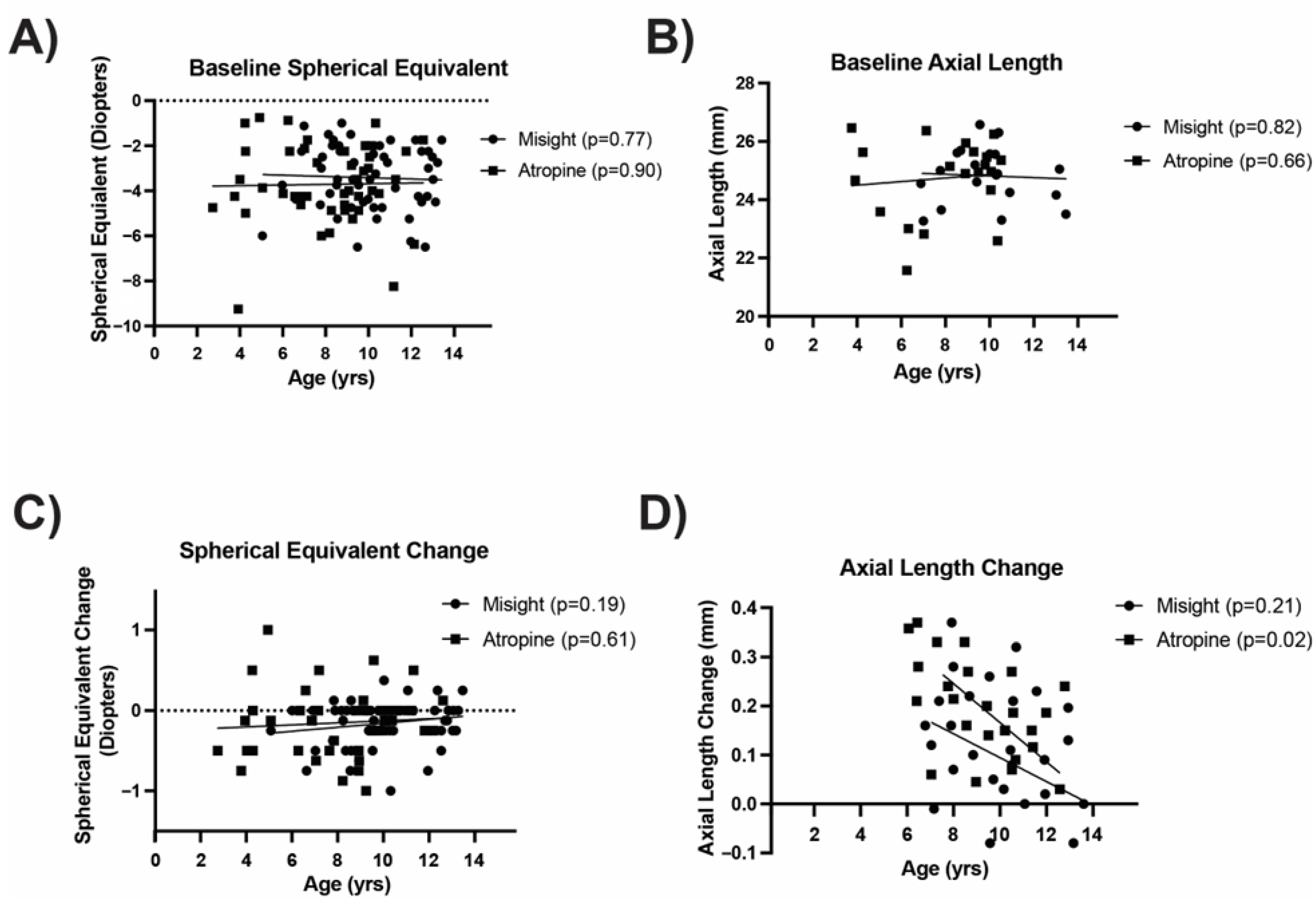
Further, age was not associated with baseline spherical equivalent (Figure 1A) or axial length (Figure 1B) in children treated with either MiSight contact lenses or 0.05% atropine. There was also no association between age and spherical equivalent change at 12 months (Figure 1C) in either treatment group. Age was associated with a change in axial length at 12 months in children treated with 0.05% atropine (p < 0.05, R2 = 0.72) but not in those prescribed MiSight contact lenses (Figure 1D).
Patients were also analyzed based on the amount of myopic spherical equivalent: ≤−3.50 D vs. >−3.50 D (Table 4). Interestingly, the MiSight-treated patients with a spherical equivalent of less than or equal to −3.50 D had significantly more astigmatism than those with less myopia (0.50 ± 0.58 D vs. 0.17 ± 0.29 D, p < 0.01). Further, the high-myopia group had significantly greater axial length at baseline (p < 0.01) and at the 1-year follow-up (p < 0.01). Similarly, the atropine group with more myopia had a significantly greater spherical equivalent and axial length at baseline (p = 0.02) and follow-up (p = 0.03). However, there was no significant change in spherical equivalent or axial length from baseline to follow-up for either the MiSight or atropine group, regardless of the level of myopia.
Adverse events were rare in both groups. In the MiSight group, two patients (4%) reported difficulty with contact lens insertion, and two additional patients (4%) complained about mild irritation and dryness. In the atropine group, three patients (7%) reported mild photophobia.

4. Discussion

Decreasing the progression of myopia has become a focus within pediatric ophthalmology and optometry over the last decade due to the rising prevalence of myopia worldwide and the anticipated increase in potentially blinding complications [1,2,3,4,7,15]. While this has led to optical and pharmacologic treatments aimed at myopia control, numerous questions remain, including patient selection and comparative efficacy.
While off-brand extended depth of focus or progressive multifocal soft contact lenses have been used for myopia control, MiSight dual-focus contact lenses were approved by the FDA for this purpose in early 2020, during the COVID-19 pandemic [12,16,17,18]. For many providers, the pandemic delayed obtaining trial sets such that these lenses were not easily prescribed until mid-2021. As such, this has limited the dissemination of additional data regarding these lenses in the United States (US), other than the original clinical trial [12]. The initial US study, which was published in 2019, showed that in 53 children, MiSight lenses decreased changes in spherical refraction and axial length by approximately three-quarters of a diopter and one-third of a millimeter compared to controls over a 3-year time period [12]. The second phase of the study fitted the original control subjects with MiSight lenses and followed the participants for an additional 3 years, reaffirming its sustained efficacy and importantly the absence of a rebound effect [13,14,19]. Similarly, the MASS study out of Spain showed that myopia progression was decreased by 39% and axial lengthening by 36% in patients using MiSight contact lenses (n = 41) compared to controls who wore single-vision distance spectacles (n = 33) over 2 years [20]. While our study did not have an untreated control group, we observed no significant change in spherical equivalent or axial length between baseline and the 1-year follow-up in the 55 children using MiSight lenses.
Similar to patients using MiSight lenses, patients treated with 0.05% atropine showed no statistical difference in spherical equivalent or axial length at baseline and at the 1-year follow-up in our cohort. We focused our study on children who were undergoing treatment with 0.05% atropine based on a number of publications, including multi-year randomized controlled clinical trials [21,22,23]. While the Atropine for the Treatment of Myopia (ATOM2) trial out of Singapore helped establish atropine as a treatment that slows myopic progression, the Low-concentration Atropine for Myopia Progression (LAMP) study out of Hong Kong honed in on the optimal atropine concentration for the Asian population [21,22,23]. Together with the LAMP study, various systematic reviews and meta-analyses have advocated for the use of 0.05% atropine as it balances myopia control efficacy with side effects such as pupil dilation and a loss of accommodation [6,24,25].
Published studies on myopia control have focused on one treatment modality and compared it to a placebo or untreated controls. Although there are a handful of meta-analyses and systematic reviews, there are limited primary studies that include both an optical modality and low-dose atropine [7,26,27]. In Huang et al.’s study, atropine eye drops were considered to be the most effective; however, this meta-analysis was published in 2016, prior to many new studies on optical modalities and low-dose atropine [26]. More recently, a systematic review by Lanca et al. found that MiSight contact lenses and Biofinity (CooperVision, Victor, NY, USA) bifocal contact lenses as well as the highly aspherical lenslets and the defocus incorporated multiple segments spectacles lenses (both of which are yet to be available in the US) may be comparable in myopia control to 0.05% atropine [7]. Although our current study is an observational case series, it suggests good efficacy of both MiSight and 0.05% atropine for controlling myopia. However, our study lacks the sample size to statistically compare the efficacy of the two modalities. A larger sample size with long-term data is required to fully understand the effectiveness of each individual treatment for different patient populations.
We divided the treatment groups based on the midpoint of the age range (9.5 years) into younger (<9.5 years) and older (≥9.5 years) subgroups. We did not find age or treatment differences in either axial length or spherical equivalent change. With experience, we have found that patient age is not necessarily a barrier to using MiSight lenses. Children as young as 5 years old can be fitted with MiSight lenses, but parent/guardian assistance and motivation are key. In fact, the only two patients whose guardians reported difficulty with handling the lenses were 7.3 and 9.6 years old at the time of contact lens fitting. Our study found MiSight to be effective in younger children; however, additional studies are needed to full evaluate its efficacy in patients under 8 years old.
The use of soft contact lenses, especially in the pediatric population, raises safety concerns regarding complications such as infiltrates and keratitis. Multiple studies including ours have shown no serious adverse events related to soft contact lenses in children [12,18,28]. The use of daily disposable soft contact lenses, as are the MiSight lenses, likely helps with decreasing the risk of infection; however, proper counseling on good hand hygiene, strict daily disposal habits, and not sleeping or swimming with the contacts should be emphasized [29]. Further, Bullimore et al. extrapolated the incidence of microbial keratitis and compared it to the risk of visual impairment from myopia complications (maculopathy, glaucoma, cataract, and retinal detachment), and they showed that the benefits of myopia control with contact lenses outweighs the potential risks of higher degrees of myopia [4]. Having multiple tools in the myopia control toolbox is valuable as each method has limitations and specific applicability for patients.
It is important to note that MiSight contact lenses are designed to correct astigmatism up to 0.75 D, limiting the use of these lenses in patients with high degrees of astigmatism. However, we successfully fitted MiSight patients with up to 2D of astigmatism. In our patient population, similar to other studies, children of Hispanic ethnicity have a higher rate and degree of astigmatism [30,31]. This may be one reason for the lower percentage of Hispanic children treated with MiSight contact lenses compared to low-dose atropine in our study. Further, it is important to understand the effect of cost on the choice of treatment and potentially patient/guardian compliance. Currently, none of the myopia control treatments are covered by medical insurance in the US. The typical cost of MiSight contact lenses ranges from USD 1200–$2500 per year. Low-dose atropine eye drops can range from USD 460–$2000 per year depending on the concentration, compounding pharmacy, and practice model. While either treatment is a financial commitment, atropine may be more attainable for many patients.
As a retrospective 1-year observational case series, there are limitations to our study. The choice of treatment was not randomized and was based on patient/guardian preference, and we did not have a control group. Further, the group sizes were relatively small, limiting the power of the study, especially considering the high number of patients included in the landmark atropine studies. In addition, there may be variations in the cycloplegic refraction metric as it was obtained by two different optometrists using retinoscopy and then refined, when possible, with the phoropter. This study also relied on reported compliance and use of treatment as well as side effects by the patient/guardian. In addition to the previously discussed differences between the groups in terms of age and ethnicity, there was a range of refractions, and MiSight lenses were only available up to −7.00 (spherical equivalent: −7.50).

5. Conclusions

In summary, we found that after 1 year of treatment with either MiSight contact lenses or 0.05% low-dose atropine eye drops, there was no significant change in either spherical equivalent or axial length from baseline levels. Further, there was no significant difference in the change in spherical equivalent or axial length over 1 year between the MiSight group and the atropine group. Longer-term case–control and age-matched studies with a greater number of patients are needed to compare the efficacy of MiSight versus 0.05% atropine.

Author Contributions

Conceptualization, N.S. and M.S.; methodology, B.L.B.; formal analysis, B.L.B. and N.S.; data curation, N.S., M.S., and H.Y.; writing—original draft preparation, N.S., M.S., and B.L.B.; writing—review and editing, N.S., M.S., H.Y., and B.L.B. All authors have read and agreed to the published version of the manuscript.

Funding

This research received no external funding.

Institutional Review Board Statement

This study was approved by the Institutional Review Board of Ann & Robert H. Lurie Children’s Hospital of Chicago (IRB 2021-4146, Approval Date: 26 October 2020). This study adhered to the tenets of the Declaration of Helsinki. The data collected was de-identified and HIPAA-compliant.

Informed Consent Statement

Due to the retrospective nature of this study, IRB approval was exempted, and informed consent was not required.

Data Availability Statement

The raw data supporting the conclusions of this article will be made available by the corresponding author upon request.

Conflicts of Interest

N.S., M.S. and H.Y: grant recipients from CooperVision for participation in the MiSight 1 Day Post Approval Study (PSA002). B.L.B; no financial disclosures relevant to the manuscript.

Abbreviations

The following abbreviations are used in this manuscript:
ANOVAAnalysis of variance
ATOM2Atropine for the Treatment of Myopia
BCVAbest corrected visual acuity
DDiopter
IQR:Interquartile range
LAMPLow-concentration Atropine for Myopia Progression

References

  1. Holden, B.A.; Fricke, T.R.; Wilson, D.A.; Jong, M.; Naidoo, K.S.; Sankaridurg, P.; Wong, T.Y.; Naduvilath, T.; Resnikoff, S. Global prevalence of myopia and high myopia and temporal trends from 2000 through 2050. Ophthalmology 2016, 123, 1036–1042. [Google Scholar] [CrossRef]
  2. Cooper, J.; Tkatchenko, A.V. A review of current concepts of the etiology and treatment of myopia. Eye Contact Lens 2018, 44, 231–247. [Google Scholar] [CrossRef] [PubMed]
  3. Grzybowski, A.; Kanclerz, P.; Tsubota, K.; Lanca, C.; Saw, S.-M. A review on the epidemiology of myopia in school children worldwide. BMC Ophthalmol. 2020, 20, 27. [Google Scholar] [CrossRef] [PubMed]
  4. Bullimore, M.A.; Ritchey, E.R.; Shah, S.; Leveziel, N.; Bourne, R.R.; Flitcroft, D.I. The risks and benefits of myopia control. Ophthalmology 2021, 128, 1561–1579. [Google Scholar] [CrossRef] [PubMed]
  5. Saw, S.; Gazzard, G.; Shih-Yen, E.C.; Chua, W. Myopia and associated pathological complications. Ophthalmic Physiol. Opt. 2005, 25, 381–391. [Google Scholar] [CrossRef]
  6. Ha, A.; Kim, S.J.; Shim, S.R.; Kim, Y.K.; Jung, J.H. Efficacy and safety of 8 atropine concentrations for myopia control in children: A network meta-analysis. Ophthalmology 2022, 129, 322–333. [Google Scholar] [CrossRef]
  7. Schmidt, D.C.; Hvid-Hansen, A.; Jacobsen, N.; Jakobsen, T.M.; Larsen, P.M.; Lindblad, K.K.; Møller, F.; Slyngborg, A.; Subhi, Y.; Kessel, L. Efficacy of interventions for myopia control in children: A systematic review with network meta-analyses. Acta Ophthalmol. 2025, 103, 939–965. [Google Scholar] [CrossRef]
  8. Youssef, M.A.; Shehata, A.R.; Adly, A.M.; Ahmed, M.R.; Abo-Bakr, H.F.; Fawzy, R.M.; Gouda, A.T. Efficacy of repeated low-level red light (rlrl) therapy on myopia outcomes in children: A systematic review and meta-analysis. BMC Ophthalmol. 2024, 24, 78. [Google Scholar] [CrossRef]
  9. Yam, J.C.; Zhang, X.J.; Zhang, Y.; Wang, Y.M.; Tang, S.M.; Li, F.F.; Kam, K.W.; Ko, S.T.; Yip, B.H.; Young, A.L.; et al. Three-year clinical trial of low-concentration atropine for myopia progression (lamp) study: Continued versus washout: Phase 3 report. Ophthalmology 2022, 129, 308–321. [Google Scholar] [CrossRef]
  10. Repka, M.X.; Weise, K.K.; Chandler, D.L.; Wu, R.; Melia, B.M.; Manny, R.E.; Kehler, L.A.F.; Jordan, C.O.; Raghuram, A.; Summers, A.I.; et al. Low-dose 0.01% atropine eye drops vs placebo for myopia control: A randomized clinical trial. JAMA Ophthalmol. 2023, 141, 756–765. [Google Scholar] [CrossRef]
  11. Zadnik, K.; Schulman, E.; Flitcroft, I.; Fogt, J.S.; Blumenfeld, L.C.; Fong, T.M.; Lang, E.; Hemmati, H.D.; Chandler, S.P. CHAMP Trial Group Investigators. Efficacy and safety of 0.01% and 0.02% atropine for the treatment of pediatric myopia progression over 3 years: A randomized clinical trial. JAMA Ophthalmol. 2023, 141, 990–999. [Google Scholar] [CrossRef] [PubMed]
  12. Chamberlain, P.; Peixoto-De-Matos, S.C.; Logan, N.S.; Ngo, C.; Jones, D.; Young, G. A 3-year randomized clinical trial of misight lenses for myopia control. Optom. Vis. Sci. 2019, 96, 556–567. [Google Scholar] [CrossRef] [PubMed]
  13. Chamberlain, P.B.; Bradley, A.; Arumugam, B.P.; Hammond, D.; McNally, J.O.; Logan, N.S.; Jones, D.B.; Ngo, C.M.; Peixoto-De-Matos, S.C.M.; Hunt, C.M.; et al. Long-term effect of dual-focus contact lenses on myopia progression in children: A 6-year multicenter clinical trial. Optom. Vis. Sci. 2022, 99, 204–212. [Google Scholar] [CrossRef] [PubMed]
  14. Chamberlain, P.; Hammond, D.S.; Arumugam, B.; Bradley, A. Six-year cumulative treatment effect and treatment efficacy of a dual focus myopia control contact lens. Ophthalmic Physiol. Opt. 2024, 44, 199–205. [Google Scholar] [CrossRef]
  15. Holden, B.; Sankaridurg, P.; Smith, E.; Aller, T.; Jong, M.; He, M. Myopia, an underrated global challenge to vision: Where the current data takes us on myopia control. Eye 2014, 28, 142–146. [Google Scholar] [CrossRef]
  16. Sankaridurg, P.; Bakaraju, R.C.; Naduvilath, T.; Chen, X.; Weng, R.; Tilia, D.; Xu, P.; Li, W.; Conrad, F.; Smith, E.L.; et al. Myopia control with novel central and peripheral plus contact lenses and extended depth of focus contact lenses: 2 year results from a randomised clinical trial. Ophthalmic Physiol. Opt. 2019, 39, 294–307. [Google Scholar] [CrossRef]
  17. Walline, J.J.; Walker, M.K.; Mutti, D.O.; Jones-Jordan, L.A.; Sinnott, L.T.; Giannoni, A.G.; Bickle, K.M.; Schulle, K.L.; Nixon, A.; Pierce, G.E.; et al. Effect of high add power, medium add power, or single-vision contact lenses on myopia progression in children: The blink randomized clinical trial. JAMA 2020, 324, 571–580. [Google Scholar] [CrossRef]
  18. Valle, A.M.G.; Blázquez, V.; Gros-Otero, J.; Infante, M.; Culebras, A.; Verdejo, A.; Sebastián, J.; García, M.; Bueno, S.; Piñero, D.P. Efficacy and safety of a soft contact lens to control myopia progression. Clin. Exp. Optom. 2021, 104, 14–21. [Google Scholar] [CrossRef]
  19. Chamberlain, P.B.; Hammond, D.S.B.; Bradley, A.; Arumugam, B.B.; Richdale, K.O.; McNally, J.O.; Hunt, C.M.; Young, G.P. Eye growth and myopia progression following cessation of myopia control therapy with a dual-focus soft contact lens. Optom. Vis. Sci. 2025, 102, 353–358. [Google Scholar] [CrossRef]
  20. Ruiz-Pomeda, A.; Pérez-Sánchez, B.; Valls, I.; Prieto-Garrido, F.L.; Gutiérrez-Ortega, R.; Villa-Collar, C. Misight assessment study spain (mass). A 2-year randomized clinical trial. Graefes Arch. Clin. Exp. Ophthalmol. 2018, 256, 1011–1021. [Google Scholar] [CrossRef]
  21. Chia, A.; Chua, W.-H.; Cheung, Y.-B.; Wong, W.-L.; Lingham, A.; Fong, A.; Tan, D. Atropine for the treatment of childhood myopia: Safety and efficacy of 0.5%, 0.1%, and 0.01% doses (atropine for the treatment of myopia 2). Ophthalmology 2012, 119, 347–354. [Google Scholar] [CrossRef]
  22. Yam, J.C.; Jiang, Y.; Tang, S.M.; Law, A.K.P.; Chan, J.J.; Wong, E.; Ko, S.T.; Young, A.L.; Tham, C.C.; Chen, L.J.; et al. Low-concentration atropine for myopia progression (lamp) study: A randomized, double-blinded, placebo-controlled trial of 0.05%, 0.025%, and 0.01% atropine eye drops in myopia control. Ophthalmology 2019, 126, 113–124. [Google Scholar] [CrossRef]
  23. Yam, J.C.; Li, F.F.; Zhang, X.; Tang, S.M.; Yip, B.H.; Kam, K.W.; Ko, S.T.; Young, A.L.; Tham, C.C.; Chen, L.J.; et al. Two-year clinical trial of the low-concentration atropine for myopia progression (lamp) study: Phase 2 report. Ophthalmology 2020, 127, 910–919. [Google Scholar] [CrossRef] [PubMed]
  24. Gong, Q.; Janowski, M.; Luo, M.; Wei, H.; Chen, B.; Yang, G.; Liu, L. Efficacy and adverse effects of atropine in childhood myopia: A meta-analysis. JAMA Ophthalmol. 2017, 135, 624–630. [Google Scholar] [CrossRef] [PubMed]
  25. Zhao, C.; Cai, C.; Ding, Q.; Dai, H. Efficacy and safety of atropine to control myopia progression: A systematic review and meta-analysis. BMC Ophthalmol. 2020, 20, 478. [Google Scholar] [CrossRef] [PubMed]
  26. Huang, J.; Wen, D.; Wang, Q.; McAlinden, C.; Flitcroft, I.; Chen, H.; Saw, S.M.; Chen, H.; Bao, F.; Zhao, Y.; et al. Efficacy comparison of 16 interventions for myopia control in children: A network meta-analysis. Ophthalmology 2016, 123, 697–708. [Google Scholar] [CrossRef]
  27. Lawrenson, J.G.; Shah, R.; Huntjens, B.; Downie, L.E.; Virgili, G.; Dhakal, R.; Verkicharla, P.K.; Li, D.; Mavi, S.; Kernohan, A.; et al. Interventions for myopia control in children: A living systematic review and network meta-analysis. Cochrane Database Syst. Rev. 2023, 2, CD014758. [Google Scholar]
  28. Woods, J.; Jones, D.; Jones, L.; Jones, S.; Hunt, C.; Chamberlain, P.; McNally, J. Ocular health of children wearing daily disposable contact lenses over a 6-year period. Contact Lens Anterior Eye 2021, 44, 101391. [Google Scholar] [CrossRef]
  29. Sauer, A.; Greth, M.; Letsch, J.; Becmeur, P.-H.; Borderie, V.; Daien, V.; Bron, A.; Creuzot-Garcher, C.; Kodjikian, L.; Burillon, C.; et al. Contact lenses and infectious keratitis: From a case-control study to a computation of the risk for wearers. Cornea 2020, 39, 769–774. [Google Scholar] [CrossRef]
  30. Fozailoff, A.; Tarczy-Hornoch, K.; Cotter, S.; Wen, G.; Lin, J.; Borchert, M.; Azen, S.; Varma, R. Prevalence of astigmatism in 6- to 72-month-old African American and hispanic children: The multi-ethnic pediatric eye disease study. Ophthalmology 2011, 118, 284–293. [Google Scholar] [CrossRef]
  31. Ying, G.-S.; Maguire, M.G.; Cyert, L.A.; Ciner, E.; Quinn, G.E.; Kulp, M.T.; Orel-Bixler, D.; Moore, B. Prevalence of vision disorders by racial and ethnic group among children participating in head start. Ophthalmology 2014, 121, 630–636. [Google Scholar] [CrossRef]
Figure 1. Linear regression analysis of association between age and spherical equivalent and axial length. Age at initiation of treatment was not associated with baseline spherical equivalent (A), baseline axial length (B), or spherical equivalent change (C) in either the MiSight or atropine group. Age was associated with axial length change (D) in the atropine group but not in the MiSight group.
Jcto 04 00001 g001
Table 1. Demographics.
MiSight, n = 55 (%)0.05% Atropine, n = 45 (%)p-Value
Age (years)10.4 ± 2.18.4 ± 2.5<0.01
Median 10.4, IQR [8.9, 12.5]Median 8.9, IQR [6.6, 10.3]
Range 5.3 to 13.9Range 2.8 to 13.1
Gender (M:F)26:29:0027:18:000.23
(47%:53%)(60%:40%)
Race 0.33
Caucasian26 (47%)17 (38%)
Black1 (1.8%)4 (9%)
Asian16 (29%)10 (22%)
Other10 (18%)13 (29%)
Multiple Races1 (1.8%)0 (0%)
Declined/Unknown1 (1.8%)1 (2%)
Ethnicity <0.05
Hispanic 7 (13%)15 (33%)
Non-Hispanic48 (87%)30 (67%)
Table 2. Exam findings.
MiSight (n = 55)
(Mean ± SD)
0.05% Atropine (n = 45)
(Mean ± SD)
Baseline BCVA0.03 ± 0.070.07 ± 0.14
Baseline Sphere (Diopters)−3.59 ± 1.50-4.18 ± 1.90
Baseline Cylinder (Diopters)0.35 ± 0.490.93 ± 1.21
Baseline Spherical Equivalent (Diopters)−3.42 ± 1.41−3.71 ± 1.79
Baseline Axial Length (mm)24.82 ± 0.9624.74 ± 1.36
1-Year BCVA0.03 ± 0.07
(p = 0.74)
0.05 ± 0.11
(p = 0.55)
1-Year Spherical Equivalent (Diopters) −3.58 ± 1.48
(p = 0.61)
−3.82 ± 1.92
(p = 0.78)
1-Year Axial Length (mm) 24.86 ± 0.98
(p = 0.98)
24.76 ± 1.23
(p = 0.97)
Table 3. Subgroups by age of patients.
MiSightAtropine 0.05%
<9.5 Years (n = 19)
(Mean ± SD)
9.5 Years and Older (n = 36)
(Mean ± SD)
p-Value<9.5 Years (n = 27)
(Mean ± SD)
9.5 Years and Older (n = 18)
(Mean ± SD)
p-Value
Age (Years)8.1 ± 1.111.6 ± 1.45<0.016.7 ± 1.910.8 ± 1.0<0.01
Baseline Sphere (Diopters)−3.25 ± 1.49−3.77 ± 1.3450.22−4.19 ± 1.94−4.17 ± 1.780.97
Baseline Cylinder (Diopters)0.30 ± 0.500.37 ± 0.480.640.78 ± 0.861.15 ± 1.550.32
Baseline Spherical Equivalent (Diopters)−3.10 ± 1.40−3.59 ± 1.390.23−3.80 ± 1.80−3.59 ± 1.800.71
Baseline Axial Length (mm)24.63 ± 0.9224.91 ± 0.930.4224.56 ± 1.5324.97 ± 0.980.51
1-Year Spherical Equivalent (Diopters) −3.34 ± 1.50
(p = 0.62)
−3.70 ± 1.43
(p = 0.74)
0.42−3.94 ± 2.01
(p = 0.79)
−3.67 ± 1.72
(p = 0.88)
0.65
1-Year Axial Length (mm)24.81 ± 0.93
(p = 0.71)
24.88 0.98
(p = 0.94)
0.8424.67 ± 1.27
(p = 0.84)
24.90 ± 1.10
(p = 0.88)
0.66
Table 4. Subgroup by baseline spherical equivalent.
MiSightAtropine
≤−3.50 D (n = 29)
(Mean ± SD)
>−3.50 D (n = 26)
(Mean ± SD)
p-Value≤−3.50 D (n = 27)
(Mean ± SD)
>−3.50 D (n = 18)
(Mean ± SD)
p-Value
Age (Years)10.2 ± 2.210.5 ± 2.10.728.1 ± 2.78.7 ± 2.60.47
Baseline Sphere (Diopters)−4.78 ± 0.94−2.26 ± 0.61<0.01−5.08 ± 1.27−2.57 ± 1.12<0.01
Baseline Cylinder (Diopters)0.50 ± 0.580.17 ± 0.290.020.82± 0.751.08 ± 1.700.49
Baseline Spherical Equivalent (Diopters)−4.53 ± 0.90−2.22 ± 0.53<0.01−4.84 ± 1.35−2.03 ± 0.73<0.01
Baseline Axial Length (mm)25.53 ± 0.7124.41 ± 0.86<0.0125.44 ± 0.9024.05 ± 1.430.02
1 Year Spherical Equivalent (Diopters) −4.72 ± 1.02
(p = 0.46)
−2.29 ± 0.57
(p = 0.64)
<0.01−4.99 ± 1.47
(p = 0.69)
−2.15 ± 1.06
(p = 0.70)
<0.01
1 Year Axial Length (mm)25.32 ± 0.89
(p = 0.64)
24.33 ± 0.80
(p = 0.81)
<0.0125.24 ± 0.88
(p = 0.60)
24.19 ± 1.38
(p = 0.82)
0.03
Disclaimer/Publisher’s Note: The statements, opinions and data contained in all publications are solely those of the individual author(s) and contributor(s) and not of MDPI and/or the editor(s). MDPI and/or the editor(s) disclaim responsibility for any injury to people or property resulting from any ideas, methods, instructions or products referred to in the content.