Heat transfer enhancement on saturated porous samples using electrostatic precipitator process in k-ε turbulent model

Abstract
1. Introduction
2. Numerical analyses
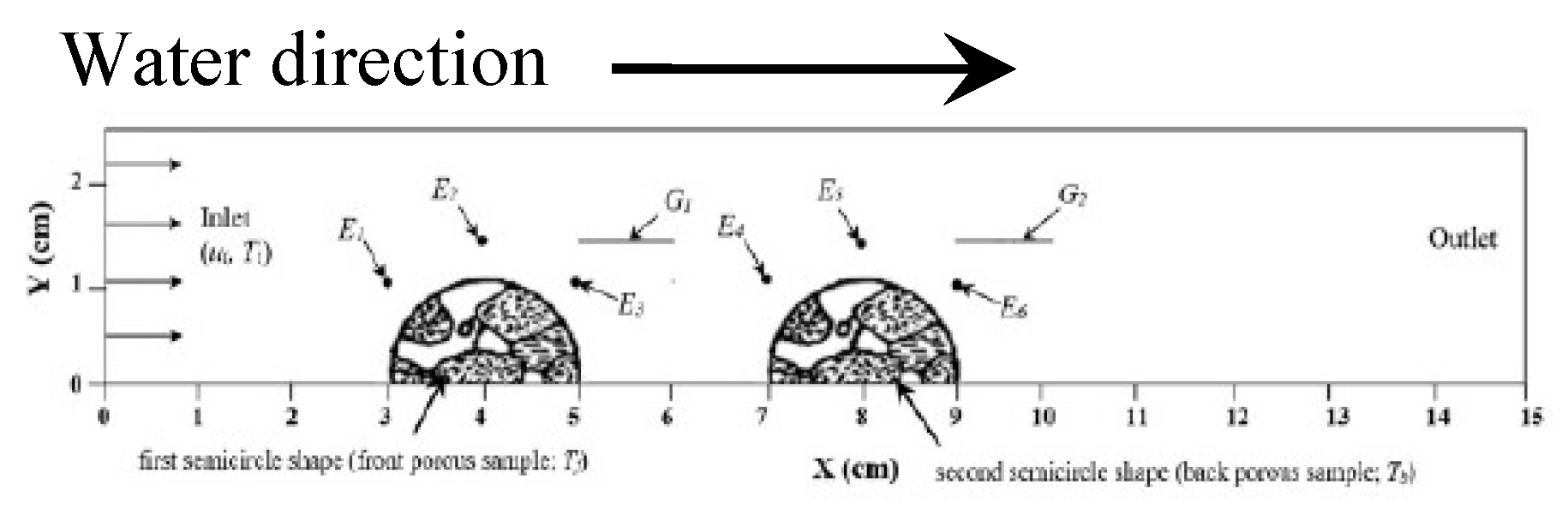
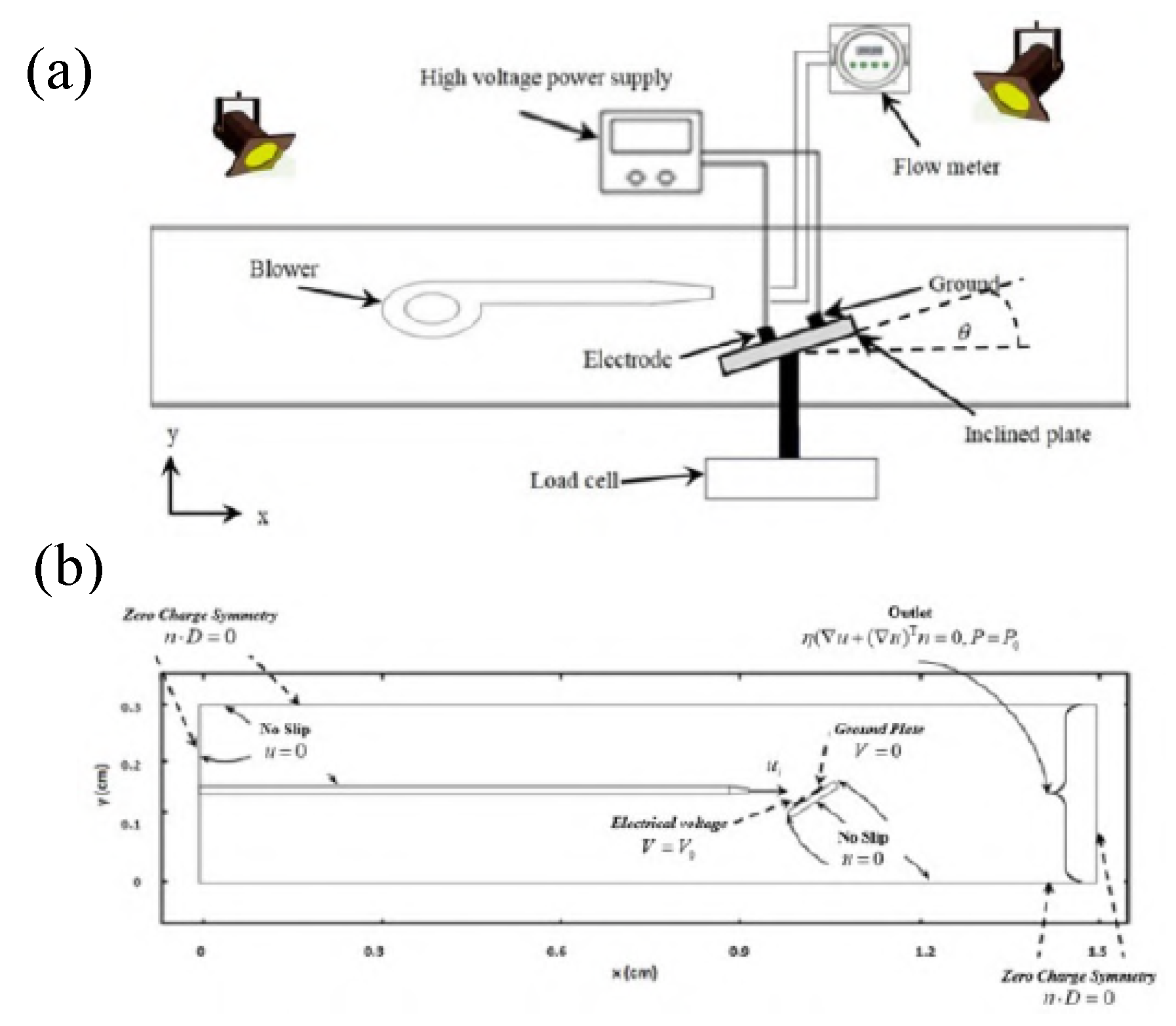
2.1. Configuration
2.2. Equations
 where u is water flow velocity, t is time, P is pressure, ρ is the density of water and μ viscosity of water. Where μtur is the viscosity of water in a turbulent flow μtur/ρ = Cμk2/ε.

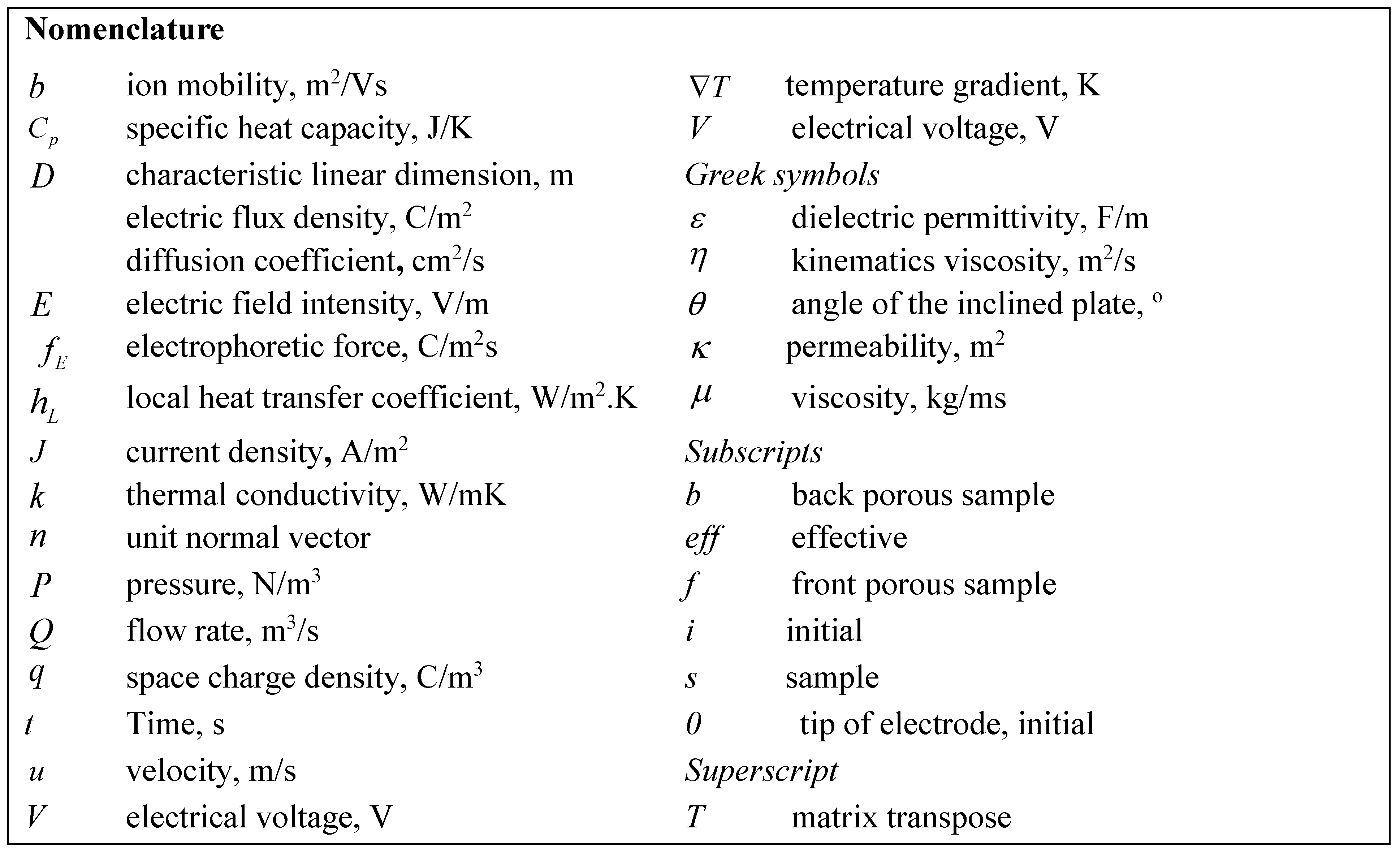
 where E is electric field and space charge density (q) is calculated by Griffiths [33]. In this idea, the electric charge is treated as a continuum of charge distributed over a region of the area. The dielectric properties are homogeneity, and the electric field line is driven from the electrode and induced to the ground. The electric field is calculated by using Maxwell’s equations (Eqs. (6), (7), (8) and (9)) shown below:
 where ε is dielectric permittivity, V is electrical voltage, J is current density, and b is ion mobility.
 where T is temperature, k thermal conductivity, and Cp the specific heat capacity. The effective thermal conductivity (keff) in a porous medium is calculated by keff = (1 − ϕ)κs + ϕκl [34] (where κ is permeability, ϕ is porosity, and subscript s and l are clay (solid, s) and water (liquid; l) phase). To investigate the local heat transfer coefficient (Lh) (Eq.(12)) within the saturated porous sample surface, the porous medium material is stuck to the bottom of the water channel, and the upper surface is exposed to hot water flow. So local convective heat transfer is defined by the thermal equilibrium equation:
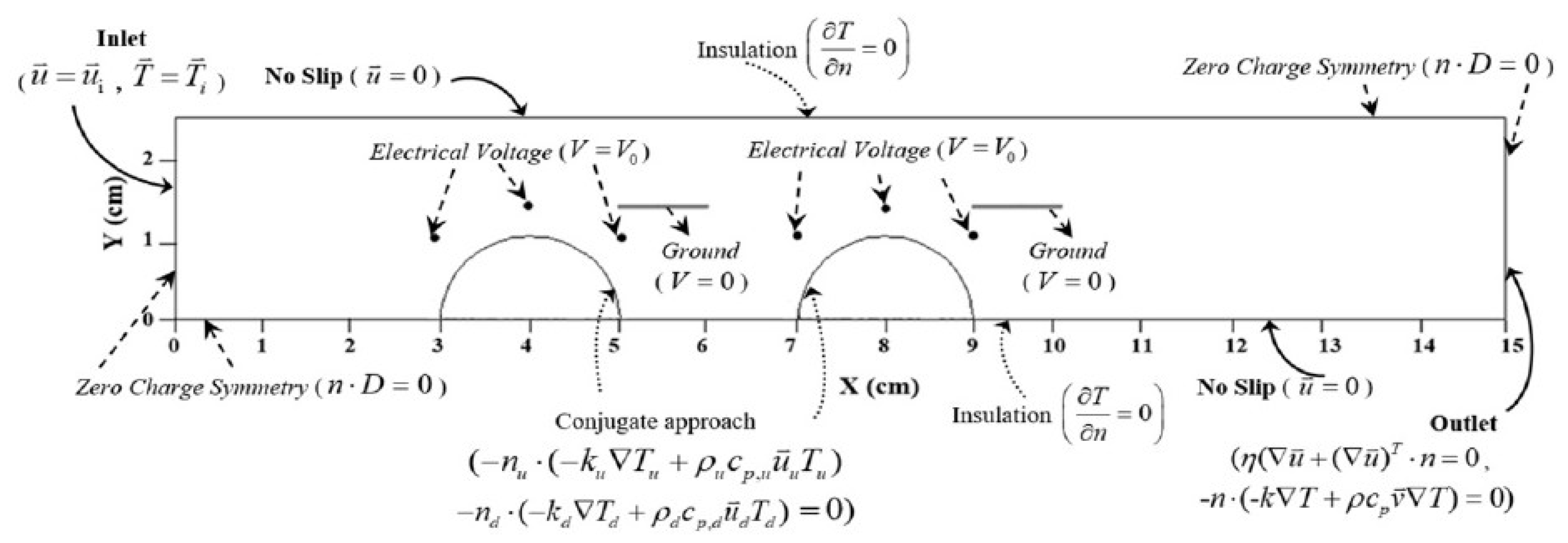
2.3. Boundary condition
 and pressure of outlet boundary condition are considered with zero viscous stress
  ). This boundary condition specifies vanishing viscous stress along with a Dirichlet condition on the pressure
  . No-slip boundary conditions are computed for the upper and lower channel flow
  . In the oblique font for solving the temperature field, the uniform initial temperature of the water channel is defined as T = Ti. The other surface is considered an insulated boundary condition (− n ⋅ (−k∇T) = 0). The interface area between the sample and water in the channel is exposed to water flow. The conjugate method can solve the interface between heat and fluid flow; the interface is solved by
 .
.
2.4. Finite element method
3. Results and discussion
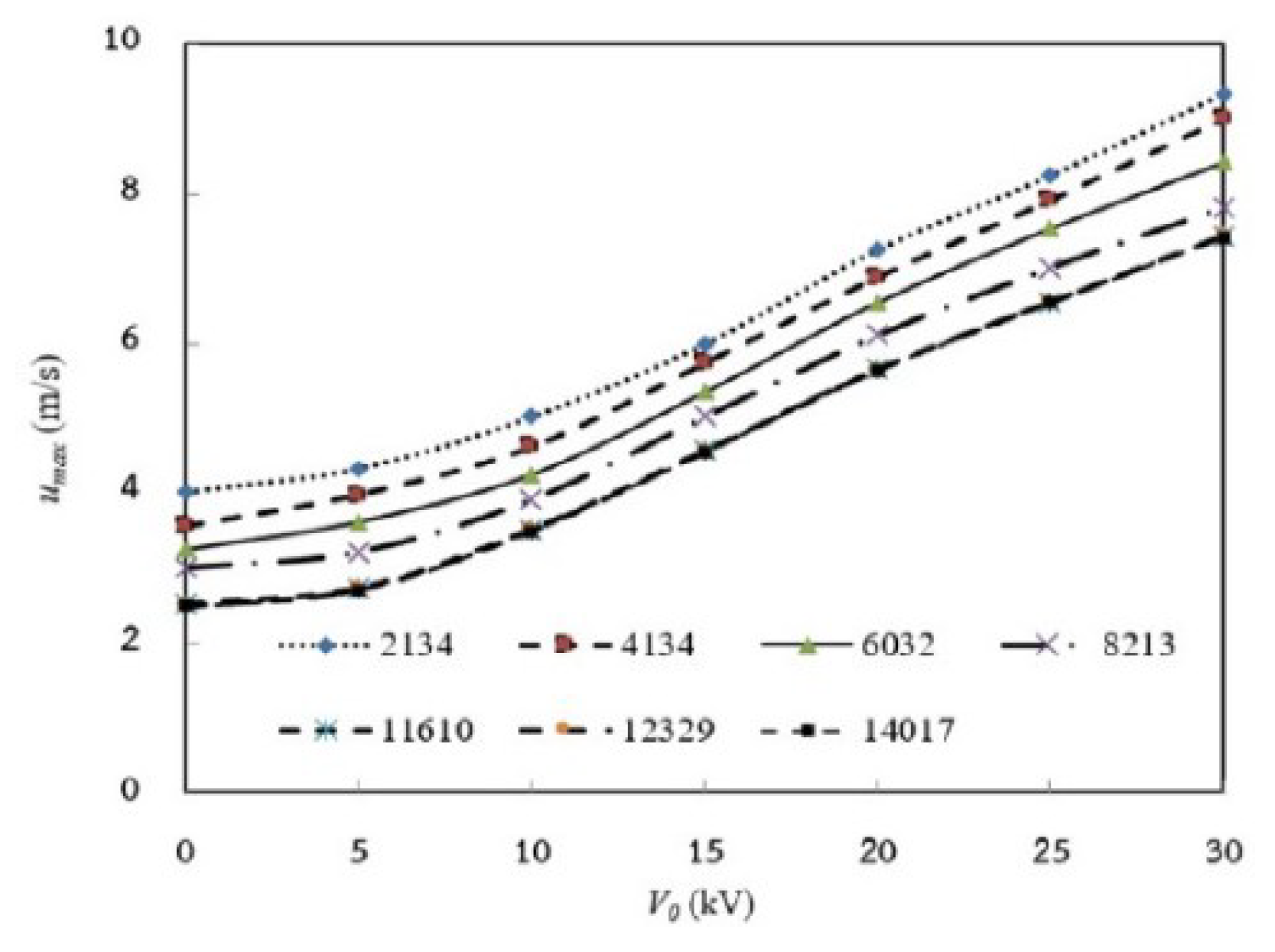
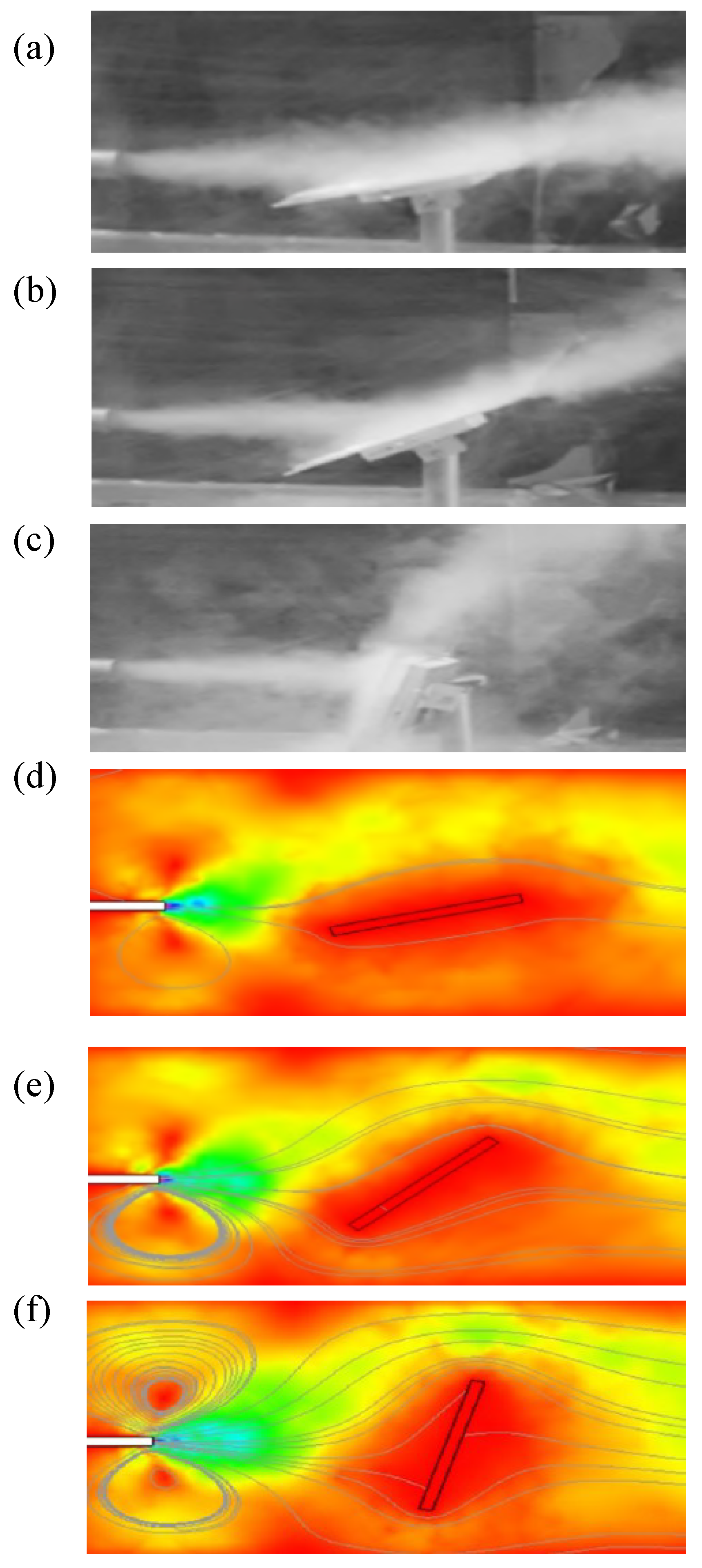
3.1. Verification of the mode
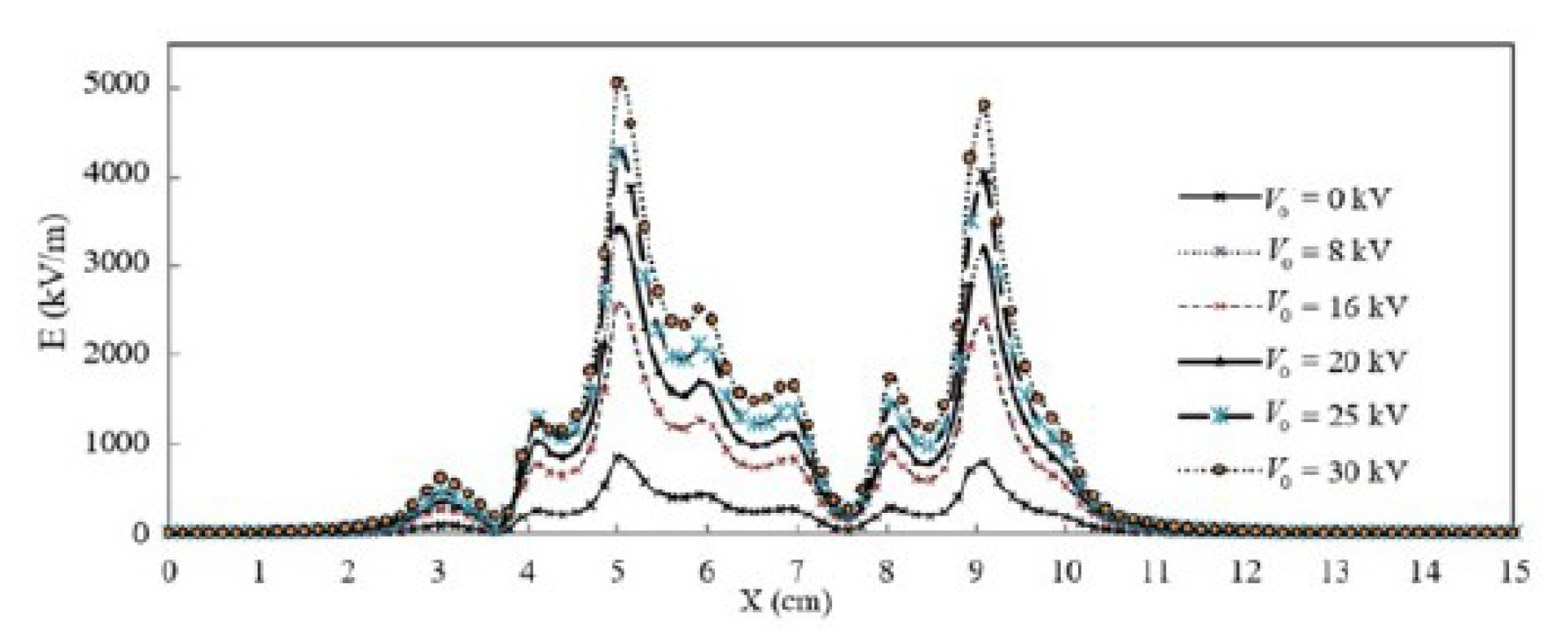
3.2. Effect of electric field distribution


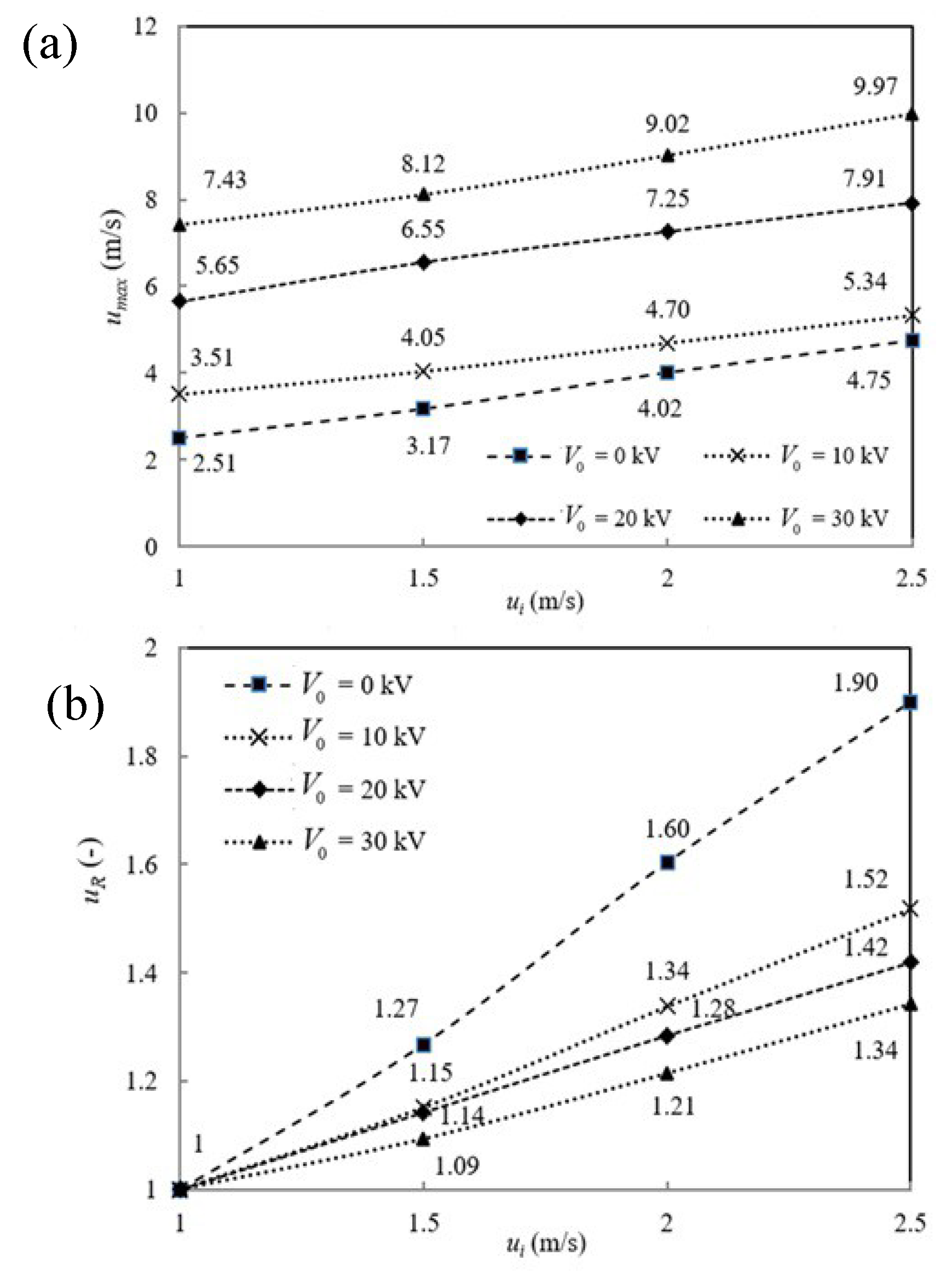
3.3. Effect of flow field distribution
3.4. Effect of pressure field distribution
3.5. Effect of vorticity field distribution
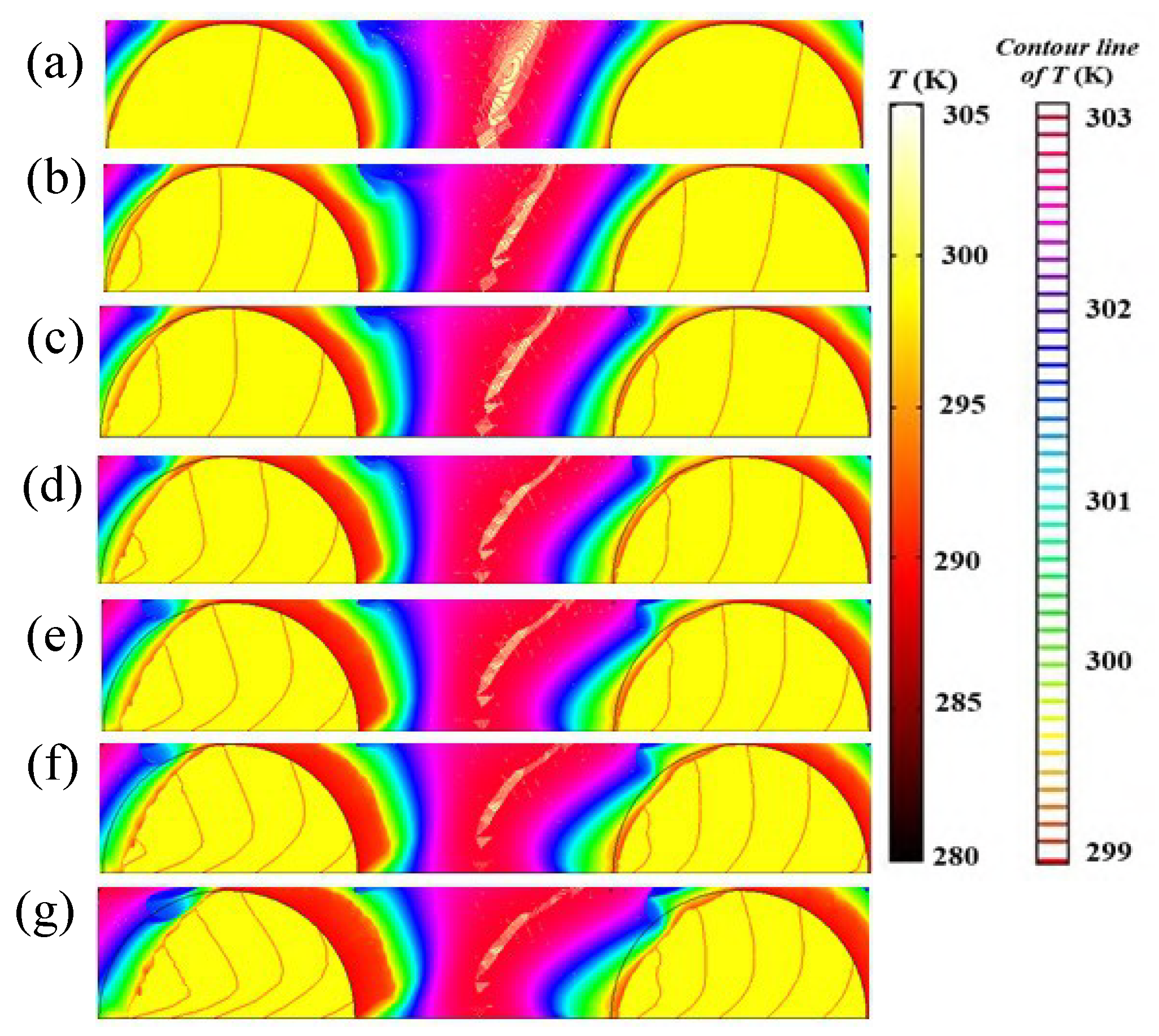
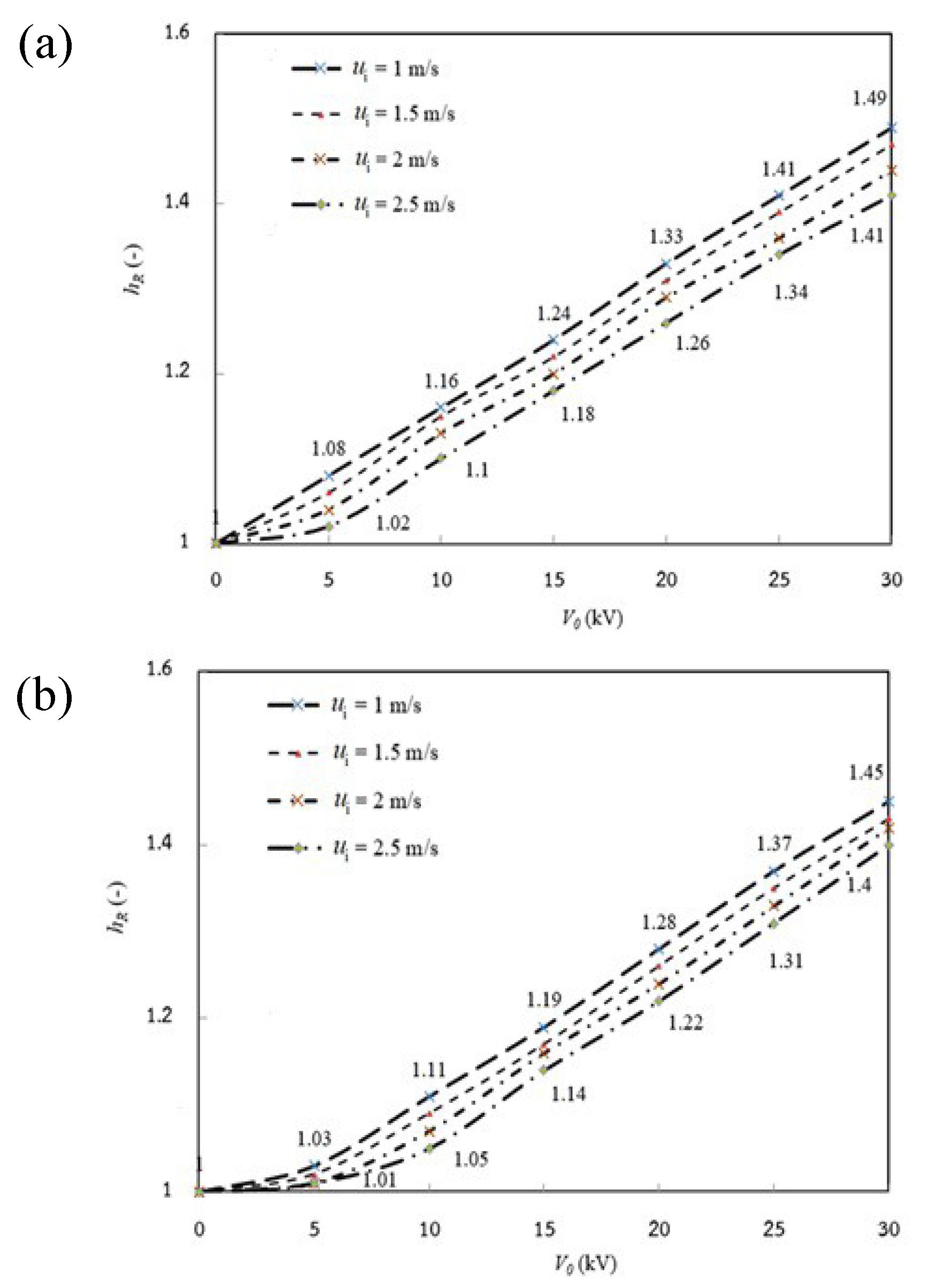
3.6. Effect of temperature field distribution
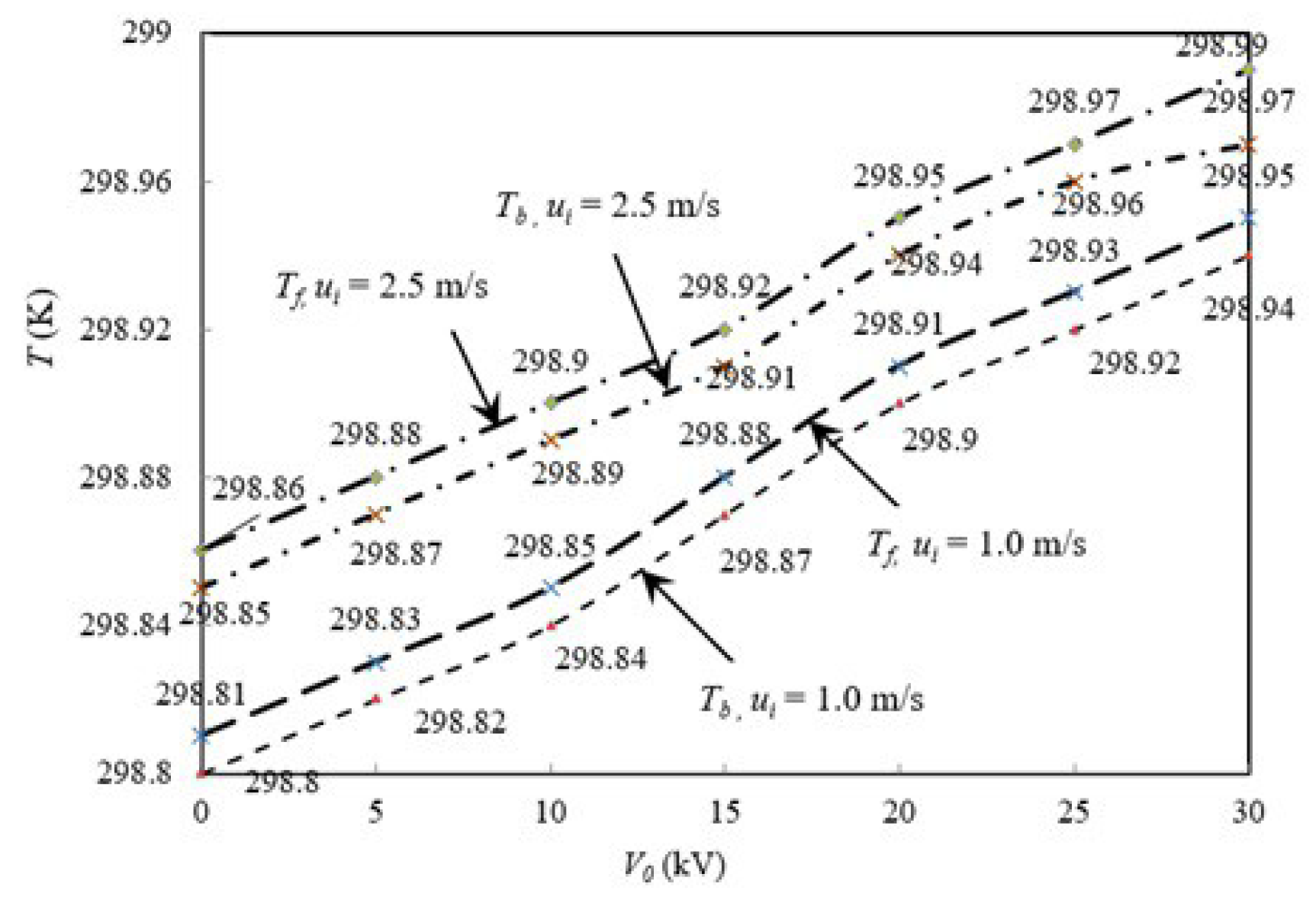
4. Heat transfer enhancement on saturated porous samples using electrostatic precipitator process
5. Conclusions
Acknowledgments
References
- Yuansong, W.; Renze, T.V.H.; Arjen, R.B.; Dock, H.E.; Yaobo, F. Minimization of excess sludge production for biological wastewater treatment. Water Research 2003, 37(18), 4453–4467. [Google Scholar] [CrossRef] [PubMed]
- Britt-Marie, W.; Bojin, P. The influence of key chemical constituents in activated sludge on surface and flocculating properties. Water Research 2003, 37(9), 2127–2139. [Google Scholar] [CrossRef]
- Yu, L. Chemically reduced excess sludge production in the activated sludge process. Chemosphere 2003, 50(1), 1–7. [Google Scholar] [CrossRef] [PubMed]
- Bing, L.; Tong, L. Biodegradation and Adsorption of Antibiotics in the Activated Sludge Process. Environmental Science and Technology 2010, 44, 3468–3473. [Google Scholar]
- Çeçen1, F.; Gül, G. Biodegradation of five pharmaceuticals: estimation by predictive models and comparison with activated sludge data. International Journal of Environmental Science and Technology 2020, 18, 327–340. [Google Scholar] [CrossRef]
- Nouri, H.; Zouzou, N.; Moreau, E.; Dascalescu, L.; Zebboudj, Y. Effect of relative humidity on current-voltage characteristics of an electrostatic precipitator. Journal of Electrostatics 2012, 70(1), 20–24. [Google Scholar] [CrossRef]
- Zhenda, Y.; Chengheng, Z.; Shaojun, L.; Yishan, G.; Chengsi, L.; Yi, W.; Daqing, H.; Xiang, G. A combined wet electrostatic precipitator for efficiently eliminating fine particle penetration. Fuel Processing Technology 2018, 180, 122–129. [Google Scholar] [CrossRef]
- Anvari, M.; Shadjou, N. Dendritic fibrous nanosilica functionalized by dithiocarbamate as a highly efficient adsorbent for the removal of malachite green from waste water based on electrostatic interaction. International Journal of Environmental Science and Technology 2021, 18, 1089–1096. [Google Scholar] [CrossRef]
- Jerzy, M.; Marek, K.; Jaroslaw, D.; Miroslaw, D.; Janusz, P.; Toshikazu, O.; Seiji, K.; Toshiyuk, K. Measurements of the velocity field of the flue gas flow in an electrostatic precipitator model using PIV method. Journal of Electrostatics 2001, 51-52, 272–277. [Google Scholar] [CrossRef]
- Lin, Z.; Kazimierz, A. Numerical simulation of the electrohydrodynamic flow in a single wire-plate electrostatic precipitator. IEEE Transactions on Industry Applications 2008, 44(3), 683–691. [Google Scholar] [CrossRef]
- Farnoosh, N.; Adamiak, K.; Castle, G.S.P. Three dimensional analysis of electrohydrodynamic flow in a spiked electrode-plate electrostatic precipitator. Journal of Electrostatics 2011, 69, 419–428. [Google Scholar] [CrossRef]
- Audrey, V.; Yves, G.; Evlyne, G.; Alain, B.; Serge, R.; Maguelone, G.; Jacques, G. Separation of particles from syngas at high-temperatures with an electrostatic precipitator. Separation and Purification Technology 2012, 92(18), 181–190. [Google Scholar] [CrossRef]
- Hao, D.; Yong, L.; TszWai, N.; Guocheng, H.; Shangchao, X.; Xin, X.; Shijian, Y.; Po, K. The simultaneous centralized control of elementalmercury emission and deep desulfurization from the flue gas using magnetic Mn–Fe spinel as a Co-benefit of the wet electrostatic precipitator. Fuel Processing Technology 2016, 142, 345–351. [Google Scholar]
- Taghayi, S.S.; Fadaki, N.; Amanifard, H.M.; Deylami; Dolati, F. Numerical analysis of the EHD driven flow with heat transfer in a smooth channel using multiple collectors. 2017, Heat and Mass Transfer (53), 2445–2460. [Google Scholar]
- Deylami, H.M. Effects of EHD on the flow and heat transfer characteristics in a rectangular corrugated channel. Heat and Mass Transfer 2019, (55), 3711–3720. [Google Scholar] [CrossRef]
- Milad, P.; Amirhosein, M.; Constantinos, S. Evaluation of a high flow rate electrostatic precipitator (ESP) as a particulate matter (PM) collector for toxicity studies. Science of The Total Environment (15) 2020, 140060. [Google Scholar]
- Jingcai, C.; Yong, D.; Zhiqiang, W.; Peng, W.; Peng, C.; Chunyuan, M. Removal of sulfuric acid aerosol in a wet electrostatic precipitator with single terylene or polypropylene collection electrodes. Journal of Aerosol Science 2011, 42(8), 44–554. [Google Scholar] [CrossRef]
- Liton, D.; Chandra, V. A wet electrostatic precipitator (WESP) for soft nanoparticle collection. Aerosol Science and Technology 2012, 46(7), 750–759. [Google Scholar] [CrossRef]
- Beelee, C.; Anthony, S.W.; Norman, C.T.; Debbie, A.N.; Britt, A.H. Collection of liquid phase particles by microfabricated electrostatic precipitator. Journal of Microelectromechanical Systems 2013, 22(5), 1010–1019. [Google Scholar] [CrossRef]
- Islam, T.; Parveen, N.; -Al-Asad, F. Hydromagnetic Natural Convection Heat Transfer of Copper-Water Nanofluid within a Right-Angled Triangular Cavity. International Journal of Thermofluid Science and Technology 2020, 7(3), No. 07030. [Google Scholar] [CrossRef]
- Yamamoto, T.; Velkoff, H.R. Electrohydro-dynamics in an electrostatic precipitator. Journal of Fluid Mechanics 1981, 108, 1–18. [Google Scholar] [CrossRef]
- Saneewong Na Ayuttaya, S. A review of electrohydrodynamics application (Based on the mechanism characteristic). Chulachomklao Royal Military Academy Journal 2017, 15, 37–59. [Google Scholar]
- Sergio, H.; Javier, J. Scaling of the velocity fluctuations in turbulent channels up to ReT = 2003. Physics of Fluids 2006, 18, 011702–4. [Google Scholar]
- Afify, A.A. MHD free convective flow and mass transfer over a stretching sheet with chemical reaction. Heat and Mass Transfer 2004, 40, 495–500. [Google Scholar]
- Wolfram, F.; Tino, W.; Holger, T.; Hans- Peter, S. Smoke surfaces: An interactive flow visualization technique inspired by real-world flow experiments. IEEE Transactions on Visualization and Computer Graphics 2008, 14(6), 1396–1403. [Google Scholar] [CrossRef]
- William, L.O.; Timothy, G.T. Verification and validation in computational fluid dynamics. Progress in Aerospace Sciences 2002, 38(3), 209–272. [Google Scholar] [CrossRef]
- Eiamsa-ard, P.; Piriyarungroj, N.; Thianpong, C.; Eiamsa-ard, S. A case study on thermal performance assessment of a heat exchanger tube equipped with regularly-spaced twisted tapes as swirl generators. Case Studies in Thermal Engineering 2014, 3, 86–102. [Google Scholar] [CrossRef]
- White, F.M. Fluid Mechanics, 8th ed; McGraw-Hill Book Company: New York, 2020. [Google Scholar]
- Saneewong Na Ayuttaya, S.; Chaktranond, C.; Rattanadecho, P. Numerical analysis of electric force influence on heat transfer in a channel flow (Theory based on saturated porous medium approach). International Journal of Heat and Mass Transfer 2013, 64, 361–374. [Google Scholar] [CrossRef]
- Saneewong Na Ayuttaya, S.; Rattanadecho, P. Influence of electrode arrangements on electro-hydrodynamics and transport phenomenon within water and porous samples connected to rectangular duct. International Journal of Thermal Sciences 2018, 130C, 367–385. [Google Scholar] [CrossRef]
- Osman, U. Estimation of the porosity of clay soils using seismic P- and S-wave velocities. Journal of Applied Geophysics 2019, 170, 103832. [Google Scholar] [CrossRef]
- Saneewong Na Ayuttaya, S.; Chaktranond, C.; Rattanadecho, P.; Kreewatcharin, T. Effect of Ground Arrangements on Swirling Flow in a Rectangular Duct Subjected to Electrohy-drodynamic Effects. Journal of Fluids Engineering-Transactions of the ASME 2012, 134, 051211–9. [Google Scholar] [CrossRef]
- Griffiths, D.J. Introduction to electrohydro-dynamics; Prentice Hall International, Inc. New Jersey, 1999; p. 54. [Google Scholar]
- Klinbun, W.; Rattanadecho, P. Numerical model of microwave driven convection in multilayer porous packed bed using a rectangular waveguide. ASME Journal of Heat Transfer 2012, 134, 0426051–10. [Google Scholar] [CrossRef]
- Ruoyu, X.; Hingjie, Z.; Jie, Y. Electric-field intrabody communication channel modeling with finite-element method. IEEE Transactions on Biomedical Engineering 2017, 58(3), 705–712. [Google Scholar] [CrossRef]
- Hadi, S.; Hamid, M.; Saeed, H.; Reza, F.M. Electrospinning of polyacrylonitrile nanofibers and simulation of electric field via finite element method. Nanomedicine Research Journal 2017, 2(2), 87–92. [Google Scholar]
- Ayuttaya, S. Saneewong Na. Numerical analysis of jet air flow impact inclined flat plate under electrohydrodynamics force in a porous medium. International Journal of Numerical Methods for Heat and Fluid Flow 2021, 31(7), 2373–2404. [Google Scholar] [CrossRef]







| References | Authors | Medium | Initial condition | Application | Methodology |
|---|---|---|---|---|---|
| [9] | Jerzy et al. | air | ui = 0.2 m/s, V0 = 24 kV | Particle precipitation process | Experiment |
| [10] | Lin and | air | Relam | Influence of the EHD | Simulation |
| Kazimierz | flow | ||||
| [11] | Farnoosh et al. | air | Retur | Influence of the EHD | Simulation |
| [12] | Audrey et al. | ashes particles | Ti = 200 – 400°C, | flow Biomass gasification | Experiment |
| into air | Pi = 2-3 MPa | ||||
| [13] | Hao et al. | wet fuel gas | V0 = 30 kV, Ti = 25°C | control the emission SO2 | Experiment |
| [14] | Taghayi et al. | biofuel into air | ui = 1.9 m/s, V0 = 10 kV, Ti =150°C, Pi = 25 Pa | Biomass gasification | Experiment |
| [15] | Deylami | SO3 into air | N/A | The removal of sulfuric | Experiment |
| acid mist from flue | |||||
| gases | |||||
| [16] | Milad et al. | PM samples into | Qi = 75 LPM, | Toxicological studies | Experiment |
| [17] | Jingcai et al. | air SO3 | V0 = 12 kV V0 = 15 - 35 kV | Control of sulfuric acid | Experiment |
| [18] | Liton and | soft nanoparticles | Qi = 50 cm3/s, | aerosol emission Industry for removal of | Experiment |
| Chandra | into liquid | V0 = 0 - 10 kV | micron-sized particles | ||
| from effluent gases. | |||||
| [19] | Beelee et al. | polydispersed liquid phase oleic | V0 = 0 - 10 kV | Airborne liquid phase particles precipitation | Experiment |
| acid particles | |||||
| [20] | Islam et al. | aerosol is | Qi = 0.53 g/min, | Device for control of | Experiment+ |
| produced by | V0 = 8.1 – 16.8 kV | particle emissions | Simulation | ||
| vaporizing | |||||
| paraffin oil |

Copyright © 2022. This article is licensed under a CC BY-NC-ND 4.0.
Share and Cite
Ayuttaya, S.S.N. Heat transfer enhancement on saturated porous samples using electrostatic precipitator process in k-ε turbulent model. Int. J. Thermofluid Sci. Technol. 2022, 9, 090403. https://doi.org/10.36963/IJTST.2022090403
Ayuttaya SSN. Heat transfer enhancement on saturated porous samples using electrostatic precipitator process in k-ε turbulent model. International Journal of Thermofluid Science and Technology. 2022; 9(4):090403. https://doi.org/10.36963/IJTST.2022090403
Chicago/Turabian StyleAyuttaya, Suwimon Saneewong Na. 2022. "Heat transfer enhancement on saturated porous samples using electrostatic precipitator process in k-ε turbulent model" International Journal of Thermofluid Science and Technology 9, no. 4: 090403. https://doi.org/10.36963/IJTST.2022090403
APA StyleAyuttaya, S. S. N. (2022). Heat transfer enhancement on saturated porous samples using electrostatic precipitator process in k-ε turbulent model. International Journal of Thermofluid Science and Technology, 9(4), 090403. https://doi.org/10.36963/IJTST.2022090403