1. Introduction
Energy demand is increasing in lockstep with population growth, industrialisation, and transportation. The unrestricted use of the earth’s finite reserves of fossil fuels has resulted in not just energy depletion on a global scale, but also a severe problem of environmental deterioration. As a result, the scientific community had to reevaluate and come up with new strategies to meet future energy demands. One of the most abundant renewable energy sources is solar energy which has the ability to hold down future rising energy demands. The SAH absorbs the sun’s rays and transfers the heat to the air blowing beneath it. There are numerous applications for hot air such as food processing, wood seasoning, space heating etc. The thermal efficiency of a SAH is poor due to the low co-efficient of heat of air, as the heat transfer between the heated absorber plate and passing air is minimal even for turbulent flow [
1].
Various researchers have utilised a variety of approaches to improve the heat transfer rate and enhance the SAH’s thermal efficiency. Various types of Fins [
2,
3,
4,
5], packed bed [
6] and intentionally roughened absorber plate [
7,
8,
9] were among the first approaches used. Artificially applying roughness over absorber surface of any SAH is the simplest, most cost-effective, and widely recognised of all the ways.
The growth of a laminar sub-layer over a typical absorber plate acts as a thermal barrier to heat transfer, resulting in poor performance from SAH.
Convective heat transfer is improved by introducing an artificial roughness element into the flow. However, because friction losses increase, more power is required to drive the blower and keep the air flowing through the duct.
Many researchers have studied the efficacy of SAHs with variety of roughness provided artificially and grouped in various ways.
Kumar et al. [
7] examined the impact of roughness factors in depth. Vyas and Shringi [
10] analyzed the efficiency of a SAH that had been artificially roughened with baffles and discovered that it was 2.23 times more efficient than a smooth one.
The performance of SAH employing tiny diameter wire as a roughness element was studied experimentally by Prasad and Saini [
11] and reported a significant increase in Nusselt number and friction factor.
V-continuous rib, V-discrete rib, 60o ribs and 45o ribs roughness elements were studied experimentally by Karwa et al. [
12]. They discovered that discrete ribs and 60o ribs outperformed continuous rib and 45o ribs respectively.
A SAH having double-pass channels with varied rib shapes roughness was tested by Rasool et al. [
13] numerically and Bootshaped ribs outperformed house-shaped and traditional square-shaped ribs. Tapas et al. [
14] evaluated numerically the performance of SAH roughened artificially by circular transverse wire rib and discovered considerable heat transfer augmentation.
The majority of the efforts done are experimental, according to the literature. As a result, a numerical analysis may be successfully carried out as an alternative to costly experimental examination in a short period of time to study different orientations and their effectiveness to enhancement of thermohydraulic efficiency of solar air heaters.
It’s a unique design to use diagonally chamfered square elements to create roughness on absorber surface of SAH. To explore the impact of roughness characteristics on SAH efficiency, a CFD based numerical analysis is presented.
2. Roughness Material and Used Method
The roughness element was made of aluminum same as that of absorber plate and pasted inside of the plate. It was square elements chamfered diagonally and arm length varied from 4 mm to 10 mm whereas height was varied from 2 to 3.5 mm.
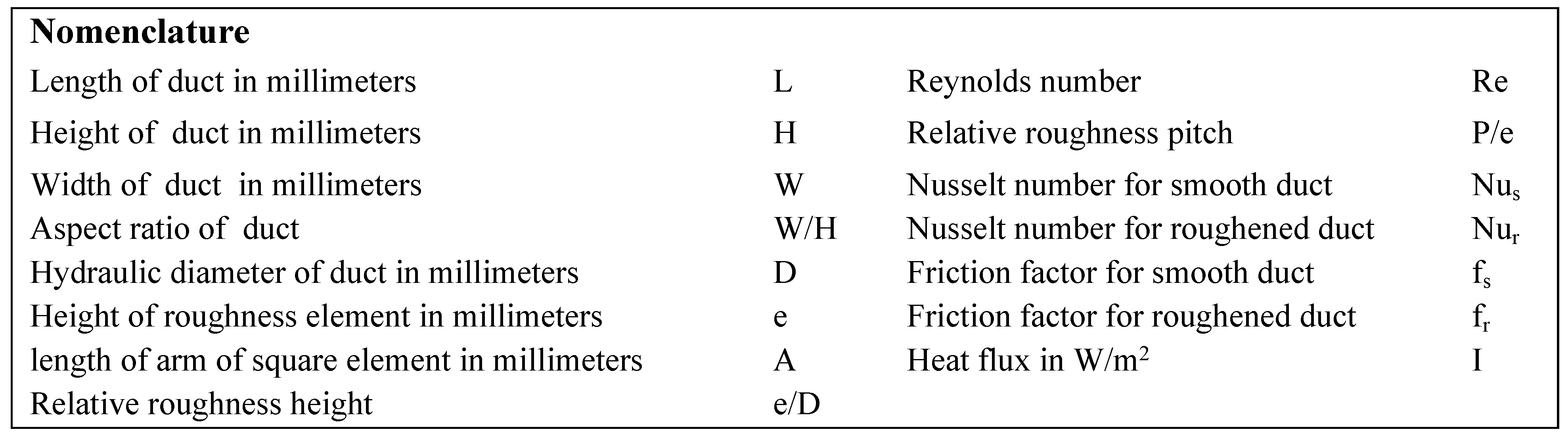
The SAH employed for investigation had a hydraulic diameter (D) of 45 mm. For all of the studies, an evenly distributed heat flux of 1000W/m2 was delivered over SAH’s absorber plate. The Reynolds number range applied in this investigation was 4250-20000 to evaluate the effect of SAH roughness on Nusselt number and friction factor.
Fig. 2 shows a schematic representation of the roughness used in this investigation. Only the absorber plate had roughness, whereas the remaining walls of the test section were kept smooth. The length (L), width (W) and height (H) of the solar air heater employed for CFD analysis were 2100mm, 200mm, and 25mm, respectively (H). Throughout the study, the aspect ratio, which is the ratio of width to height, was set to 8. The flow domain is comprises into three sections: entry, test, and exit. The entry and exit sections were made suitably large to minimize the end consequences. A three-dimensional flow domain was chosen for this study, assuming secondary flow occurred due to sloped roughness geometry in the route of air flow.
ANSYS 16.0’s ICEM CFD was used to mesh the three-dimensional flow domains explored in this work [
15]. In comparison to other regions, a finer mesh was produced in the rib region to evaluate flow dynamics and heat transmission properly.
The governing equations for the Three-Dimensional domain are presented below as:
Equation of Continuity [
15]:

where the components of fluid velocity in the x, y, and z directions are u,v, and w, respectively.
p=Pressure,
T = Temperature
T∞ = Ambient temperature.
In this study, ANSYS fluent 16.0 was utilised as computational tool for the computational analysis. This research took into account fully matured, steady state, and turbulent flow. Except for the absorber plate, all of the walls of the solar air heater duct were considered to be adiabatic. Throughout all of the testing, the air was working fluid and considered incompressible. All of the following assumptions were based on the results of prior tests conducted by the various investigators [
15].
The velocity inflow at inlet and outflow at outlet were defined as the solution domain and boundary conditions. Domain turbulence was defined using the turbulence intensity and hydraulic diameter. Steady and uniformly distributed heat flux was applied on absorber plate as boundary condition. For the pressure-velocity coupling in this computational investigation, the second order upwind numerical scheme “SIMPLE (semi-implicit technique for pressure linked equations) algorithm” was used [
15].
3. Model Selection and Validation
The selection and validation of the best suited turbulence model is a critical stage in any computational analysis because the outcome is dependent on the model used. The Dittus-Boelter empirical correlation and modified Blasius equation were compared for smooth ducts with the same cross section for Nusselt number and friction, respectively, to validate and select the best among different turbulence models i.e. Standard (STD) k-ε model, Renormalized group (RNG) k-ε model, and Realizable (RLG) k-ε model [
15]. Dittus-Boelter empirical correlation
The best suited turbulence model found and selected is Realizable (RLG) k-ε model. The questions solved in Ansys fluent are as fallows for the selected turbulence model:-
In these equations, Gk represents the generation of turbulence kinetic energy due to the mean velocity gradients, Gb is the generation of turbulence kinetic energy due to buoyancy, YM represents the contribution of the fluctuating dilatation in compressible turbulence to the overall dissipation rate. C1and C2 are constants.
σk and σε are the turbulent Prandtl numbers for k and ε respectively. Sk and Sε are user-defined source terms.
4. Discussion and Conclusions
For both the roughened and smooth absorber plates, all simulation results are provided and contrasted. The rise in thermohydraulic efficiency of SAH at various flow rates is addressed below.
4.1. Characteristics of Heat Transfer
Providing artificial roughness over absorber plate causes turbulence in the laminar sub-layer area, which aids in improving the absorber plate’s heat transfer rate. The roughness element’s shape, size, direction, and pattern have a substantial impact on turbulence intensity and Nusselt number. The impacts of roughness factors such as RRH (e/D), RRP (P/e), and ALSE (A) on heat transfer and friction factor were investigated in this study. To imitate solar energy, a continuous and uniformly distributed heat flux of 1000 W/m2 was applied on absorber plate. Range of Reynolds number used was 4250 to 20000.
4.1.1. Impact of Relative Roughness Height
For various levels of RRH (e/D) and fixed levels of RRP (P/e) of 6 and ALSE (A) of 6, Fig. 4 shows the variations in Nusselt number (Nu) as Reynolds number (Re) increases. At constant value of e/D, Nusselt number increases monotonically with increasing Reynolds number for fixed value of e/D. The reason for this is that when the Reynolds number rises, the turbulence intensity and turbulence dissipation rate rise, increasing the heat transfer rate. It’s also evident that the Nusselt number rises with respect to rise in relative roughness height. As the relative roughness height rises, the roughness splays more into core flow, enhancing turbulence and the Nusselt number.

The Nusselt number rises with increase in RRH (e/D), as shown in the Fig. above. It is also obvious that putting artificial roughness on the absorber plate increases the heat transfer rate due to flow dissociation and reattachment of the free shear layer in between two ribs, which destroys the creation of the laminar sub-layer. Fig. 5 was created using the data in Fig. 4 to study the change in Nusselt number with increasing RRH versus Reynolds number values while keeping the other parameter values constant.
It can be seen in Fig. 5, increasing the RRH (e/D) increases the Nusselt number (Nu), reaching a maximum value of Nusselt number corresponding to a RRH of 0.077. More turbulence is produced when the RRH is increased, which improves the Nusselt number. Table 3 demonstrates the changes in Nusselt number w.r.t RRH.
4.1.2. Effect of Relative roughness pitch (RRP)
Fig. 6 depicts the change in Nusselt number (Nu) when Reynolds number (Re) increases for various values of RRP (P/e) and constant values of RRH (e/D) of 0.077 and ALSE (A) of 6. The graphic shows that for a constant value of RRP, Nusselt number increases monotonically with Reynolds number. It can be seen that as the RRP (P/e) increases, Nusselt number falls. Fig. 6 shows that for each set of parameters, the highest Nusselt number is obtained at the lowest RRP.
Fig. 7 was created using the data in Fig.6 to look at how the Nusselt number changes when the RRP increases for different Reynolds numbers. Fig. 7 shows that Nusselt number reduces as RRP increases, with the maximum value of Nusselt number corresponding to RRP value of 5, which is the smallest RRP. The number of reattachment sites of the free shear layer reduces as the RRP increases, lowering the turbulence level and thus the Nusselt number. As a result, the maximum heat transmission occurs at a relative roughness pitch of 5 and decreases as the RRP increases. Table 4 illustrates the % change in Nusselt number when RRP (P/e) increases.
4.1.3. Effect of Square element size
Fig. 8 shows the changes in Nusselt number as a function of Reynolds number for various arm length sizes with constant values of RRP and RRH. For fixed square element size, it can be seen that the Nusselt number rises as the Reynolds number rises. The Nusselt number rises in tandem with the square element size. It’s also worth noting that at ALSE = 10, the Nusselt number is at its highest.
Fig. 9 was created using the data in Fig. 8 to look at how the Nusselt number changes as the ALSE (A) grows for different Reynolds numbers while keeping the other parameters constant. It is noticed that the Nusselt number increases as the ALSE (A) increases, with the highest Nusselt number corresponding to a square element size of 10. Table 4 shows the % change in Nusselt number as square element size increases (A).
4.1.4. Change in Nusselt number against Reynolds number for the whole range of trials
Fig. 10 depicts the Nusselt number’s variation with regard to Reynolds number for all sets of the studies. For the whole range of trials, the Nusselt number rises as the Reynolds number rises. The highest Nusselt number 139 is found at RRP = 5, RRH = 0.077, and ALSE = 10.
4.2. Characteristics of Friction factor
Artificial roughness improves both the rate of heat transmission and the penalty of blowing air through the duct, i.e. the friction factor. Diagonally chamfered square elements used as roughness arranged in different fashion has been investigated in preset study and found significant impact on friction factor which is discussed as follows.
4.2.1. Effect of Relative Roughness Height (RRH)
For constant values of RRP (P/e) and ALSE (A), the change in friction factor against Reynolds number for different values of RRH (e/D) is shown in Fig. 11. It can be shown that when the Reynolds number rises, the friction factor decreases.
Fig. 12 was generated from the data in Fig. 11 to demonstrate the influence of RRH on friction factor. The friction factor increases as the relative RRH increases, peaking at 0.077. Table 6 shows the percentage change in Friction factor as RRH rises.
4.2.2. Effect of Relative Roughness Pitch
Fig.13 shows the fluctuation of Friction factor (f) when Reynolds number (Re) increases for various values of RRP with a fixed value of RRH = 0.077 and ALSE = 6. The plot shows that at a certain value of RRP, Friction factor (f) falls as Reynolds number increases. Because there is less impediment on the flow route, Friction factor (f) lowers when Relative roughness pitch (P/e) increases. It can also be noticed that for all sets of relative roughness height and arm length size of square elements, the maximum in Friction factor correspond to the minimum Relative roughness pitch.

Fig. 14 was generated using the data in Fig. 13 to demonstrate the influence of relative roughness pitch on friction factor. Fig. 14 demonstrates that when the relative roughness pitch (P/e) grows, the friction factor declines, with the highest value of friction factor corresponding to P/e of 5, A of 6, and e/D of 0.077. The distance between the roughness components grows as the relative roughness pitch grows, resulting in reduced obstruction to air movement and a lower friction factor. Table 7 illustrates the % change in friction factor when P/e increases.
4.2.3. Effect of Arm lenth of square element (ALSE)
Fig.15 shows the change in friction factor (f) as a function of Reynolds number for various square element sizes with constant relative roughness pitch of 5 and relative roughness height of 0.077. The Friction factor grows as the square element size increases, as can be observed.
Fig. 16 shows that the Friction factor (f) grows as ALSE (A) increases. Table 7 shows the percentage change in Friction factor as the ALSE (A) grows.
4.2.4. Variation of Friction factor as a function of Reynolds number
For all sets of data, Fig.17 depicts the fluctuation of Friction factor (f) as a function of Reynolds number. For full sets of data, the Friction factor (f) falls as the Reynolds number rises. The friction factor also increases when the values of RRH, RRP, and ALSE increase. At RRP of 5, RRH of 0.055, and ALSE of 10, the greatest Friction factor discovered is 0.03819, which corresponds to Reynolds number of 4250.
4.3. Enhancement of Heat Transfer And Friction Factor
The Nusselt number enhancement ratio is used to compare the heat transfer enhancement of a roughened duct with chamfered square element to that of a smooth duct. The Nusselt number enhancement ratio is defined as the ratio of the roughened duct Nusselt number to the smooth duct Nusselt number [
17] at similar flow circumstances and can be explained as follows:
For various roughness geometry parameters, Fig.18 depicts the fluctuation of Enhancement ratio (Nur/Nus) as a function of Reynolds number.
The use of a chamfered square element as an artificial roughness over the absorber plate of a SAH improves the heat transfer rate while increasing the friction factor. The ratio of the friction factor achieved by the roughened absorber plate to that obtained by the smooth absorber plate [
17] at similar flow circumstances may be determined to explain the raise in friction factor.
The fluctuation of the Friction factor ratio (fr/fs) against Reynolds number is depicted in Fig. 19.
4.4. Performance Parameter
The use of artificially roughened surfaces on the absorber plate of a SAH raises the Nusselt number while also raising the friction factor. The pumping force required to blow the air through the duct increases as the friction factor rises. To get the most out of the roughened absorber plate, the Nusselt number should be as high as feasible while the friction penalty is kept as low as possible. As a result, a performance parameter is examined and defined in order to forecast the total performance of the solar air heater [
18].


Fig. 20 depicts the fluctuation of the performance parameter with respect to Reynolds number for all of the roughness geometries tested. The higher the value of the performance parameter is above unity, the better the solar air heater’s performance. It’s also worth noting that the value of the performance parameter is greater than unity for the whole range of Reynolds numbers. Furthermore, the value of the performance parameter is highest at Re of 4250 for all forms of roughness geometry. Following that, it significantly drops up to Re of 8250, after which it becomes asymptotic for higher Reynolds numbers.
Temperature distribution at different location of SAH may be seen in Fig. 21 and Fig. 22. The temperature distribution of the absorber plate is depicted in Fig. 21, where it can be observed that heat transfer reduces along the flow as the heat capacity of air falls as the difference in temperature between the absorber surface and the blowing air diminishes. It may see in the Fig. 22 that the air temperature increases along the flow.
5. Methodology for Correlation Development
The correlations for Nusselt number and friction factor are produced in this section using Microsoft Excel software to do regression analysis using the approach proposed by Saini and Saini [
20]. During the regression analysis, data was plotted on a log-log scale in order to achieve the optimum curve fitting. Data regression is discovered to deal with the first order. When two variables are equal, the relationship is the simplest. When one variable is equal to the other multiplied by a constant, the connection is the next simplest. The relationship is said to be linear in either instance. A linear connection, often known as a straight line, has a single variable with the highest power of one, and is written as:

Where m is the line’s slope and c is the line’s intercept or ordinate. By changing the value of x and y into its logarithmic value, the first order equation for a straight line can be written as:
The above equation can be expressed as follows by using antilog on both sides:
This is the most common type of first-order equation. The first order regression of the data on a plot of log x and log y yields the values of c1 and m. Equation (17) can be used to obtain the first order equation by plugging in the values of c1 and m.
It can be seen that ln (Y) and ln (Z) have a polynomial functional connection of the kind shown below (A). For first order equation for a polynomial functional relationship can be written as [
15]:
For each plot, the coefficients m1, m2, and m3 were obtained, and it was discovered that the coefficients m2 and m3 are almost identical for all plots, although m1 varied. The average values of m1, m2, and m3 were calculated, and the equation was then rearranged as follows:
Where m4 is anti ln(m1)
The Nusselt number and friction factor, as determined by the results, are completely reliant on roughness parameters and flow parameters, notably RRH (e/D), RRP (P/e), ALSE (A), and Reynolds number (Re). As a result, the following functional equation can be used to represent the Nusselt number and friction factor:

5.1. Correlation development for Nusselt number
The functional correlations between the Nusselt number and other roughness parameters as well as the Reynolds number have already been examined. Nusselt number rises as Reynolds number rises, and the power law governs the functional relationship between the two, as detailed in Section 7 on methodology. For all 184 simulation data obtained from ANSYS Fluent for all 23 artificially roughened absorber plates tested, a regression analysis was used to create statistical correlations using Microsoft Excel. As illustrated in Fig. 23, the values of ln(Nu) are shown as a function of ln(Re). The following is the best-fitting equation for Nusselt number discovered by regression analysis:

The coefficient Ao is affected by the remaining factors, such as P/e, (A/6) and e/D. Now, as shown in Fig. 24, the value of Nu/Re0.67= (Ao) against all values of P/e is displayed on a log-log scale to determine the effect of relative roughness pitch on Nusselt number. A second order polynomial is fitted through these points on a log-log scale using regression analysis, and it looks like this:
In fact, the coefficient Bo will depend on the remaining roughness parameters e/D and (A/6). Taking the parameter ALSE of (A/6) into account, the value of Nu/Re0.67(P/e)1.17*exp(-0.386(ln(P/e))2=(Bo) corresponding to all values of (A/6) is displayed on a log-log scale in Fig. 25. Now we use regression analysis to fit a second order polynomial through these locations, as follows:
In fact, the coefficient Co will be a function of the other roughness parameter e/D. Considering RRH (e/D) into account, the value of Nu/Re0.67/(P/e)1.17*exp(-0.386 (Ln(P/e))2)/ (A/6)0.33*exp(0.506(Ln(A/6))2) = Co against all values of (e/D) is shown on a log-log scale in Fig. 26. According to the regression analysis, the fittest equation for Nusselt number is as follows:
The value of Do, which offers the final form of correlation for Nusselt number, is determined via regression analysis to best fit a straight line through these points.
As illustrated in Fig. 27, the projected Nusselt number values from the developed correlation were compared to numerical values at a 95% confidence level. As can be seen, these in Fig.s are reasonable because the highest variance is less than 9%.
5.2. Correlation development for Friction Factor
The roughness geometry and flow parameters have also been discovered to have a considerable influence on the friction factor. The friction factor reduces as the Reynolds number increases, and the power law governs the functional relationship between the two, as mentioned in section 5 on methodology. For the establishment of a correlation for friction factor, a similar process was used, and the final correlation was as follows:
Fig. 28 shows a comparison of the anticipated Friction factor values from the developed correlation with numerical values at a 95% confidence level. As can be seen, these Fig.s are reasonable and have a maximum variance of less than 10%.
6. Conclusions
The thermohydraulic performance of a SAH having absorber plate roughened by chamfered square roughness elements was investigated using three-dimensional CFD simulations in this paper. The investigation’s major findings are as follows:
The Nusselt number and friction factor grows as RRH increases for the entire range of Reynolds numbers.
Nusselt number and friction factor decrease as relative RRP increases.
Nusselt number and friction factor grow as the ALSE (A) increases. The Nusselt number that corresponds to a ALSE of 6 has been shown to be the best.
In comparison to a smooth duct, the Nusselt number and friction factor both increase by 3.62 and 3.14 times, respectively.
Nusselt number and friction factor correlations have been established for the roughness geometry parameter and flow parameters.
When the numerical values of Nusselt number and friction factor predicted by the respective correlation are compared at the 95 percent confidence level, it is found that 174 out of 184 values (96 percent) of the predicted data values lie within 9% and 10% of numerically observed data values, respectively.




 where the components of fluid velocity in the x, y, and z directions are u,v, and w, respectively.


 Where m is the line’s slope and c is the line’s intercept or ordinate. By changing the value of x and y into its logarithmic value, the first order equation for a straight line can be written as: