Next Article in Journal
Modeling and simulation of suction-driven flow and heat transfer with temperature-dependent thermal conductivity in a porous channel
Previous Article in Journal
CFD Analysis to Predict Flow Behavior for Design and Operation of Tarbela Dam Reservoir for Different Environmental Conditions
 
 
International Journal of Thermofluid Science and Technology is published by MDPI from Volume 13 Issue 1 (2026). Previous articles were published by another publisher in Open Access under a CC-BY (or CC-BY-NC-ND) licence, and they are hosted by MDPI on mdpi.com as a courtesy and upon agreement with the previous journal publisher.
Article

Combined impact of variable viscosity and throughflow effects on the onset of convection in an anisotropic porous layer

by
Gangadharaiah Y H
1,*,
Nagarathnamma H
2,
S. P. Suma
3 and
Ananda K
4
1
Department of Mathematics, RV Institute of Technology and Management, Bangalore, India
2
Department of Mathematics, Dr. Ambedekar Institute of Technology, Bangalore, India
3
Department of Mathematics, Cambridge Institute of Technology, Bangalore, India
4
Department of Mathematics, New Horizon College of Engineering, Bangalore, India
*
Author to whom correspondence should be addressed.
Int. J. Thermofluid Sci. Technol. 2022, 9(3), 090303; https://doi.org/10.36963/IJTST.2022090303
Submission received: 20 October 2021 / Revised: 4 February 2022 / Accepted: 8 February 2022 / Published: 12 February 2022

Abstract

In the present article, the combined impact of vertical throughflow and temperature-reliant viscosity on the fluidsaturated anisotropic porous matrix is considered for investigation numerically by the Galerkin technique. The temperature-reliant viscosity is known to be exponential. The porous matrix is subject to continuous vertical throughflow. A parametric analysis is conducted by adjusting the following parameters: throughflow parameter, viscosity parameter, mechanical anisotropic parameter, and anisotropic thermal parameter. The findings reveal that the impacts of raising the viscosity parameter, downward throughflow parameter, and anisotropic thermal parameter delay the beginning of convection, whereas increasing mechanical anisotropic parameter and upward throughflow parameter destabilizes the porous system.

1. Introduction

Convective motion in the porous matrix was the subject of prominence study because of its significant applications. Some of these applications are, for example, assessing the performance of fiber insulations, groundwater flow prediction in aquifers, and nuclear engineering. A good review on this topic has been presented in [1,2,3,4].
Temperature-induced variations in viscosity and density can have a significant impact on the convection stability thresholds in fluid and porous media layers, as reported in depth in [5,6,7,8] and the references therein. The heat reliance of the fluid properties can modify the stream behavior in streams with heat move: specifically, its dependability attributes are grounded. The thickness shows a fairly articulated temperature variety for the greater part of the commonsense fluids since consistency is more heat-safe than thermal conductivity. Rossby [9] calculated that 20% to 25% of thermal conductivity and water viscosity values find that the kinematic viscosity parameter differs between 20% and 25% by approximately 10%, whereas just 1.5% of water thermal conductivity fluctuates. Torrance and Turcotte [10] found that that as temperature increases, liquid thickness decreases, while gases demonstrate a converse example. Many researchers have considered the effect of thickness changing temperature in convection problems in recent years(Barletta and Nield [11], Solomatov and Barr [12] and Booker [13], Shivakumara et al. [14], Suma et al. [15], Gangadharaiah [16,17], and Gangadharaiah et al. [18,19])).
The surface-driven penetrative convective motion in a composite system with exponential viscosity variance was reported by Gangadharaiah [20]. Ananda et al. [21] have investigated the penetrative convective motion with variable viscosity in a porous bed. Impact of exponential viscosity variation on Marangoni convective motion in a superposed system with a thin slab investigated by Gangadharaiah and Ananda [22]. The main objective of this study is to analyze the combined effects of exponential type viscosity variance and throughflow on the convective motion in an anisotropic porous matrix. Through normal Galerkin techniques, numerical findings are derived from the predominant equations. The outcomes of various relevant convection arrival parameters have been presented in detail.

2. Conceptual Model

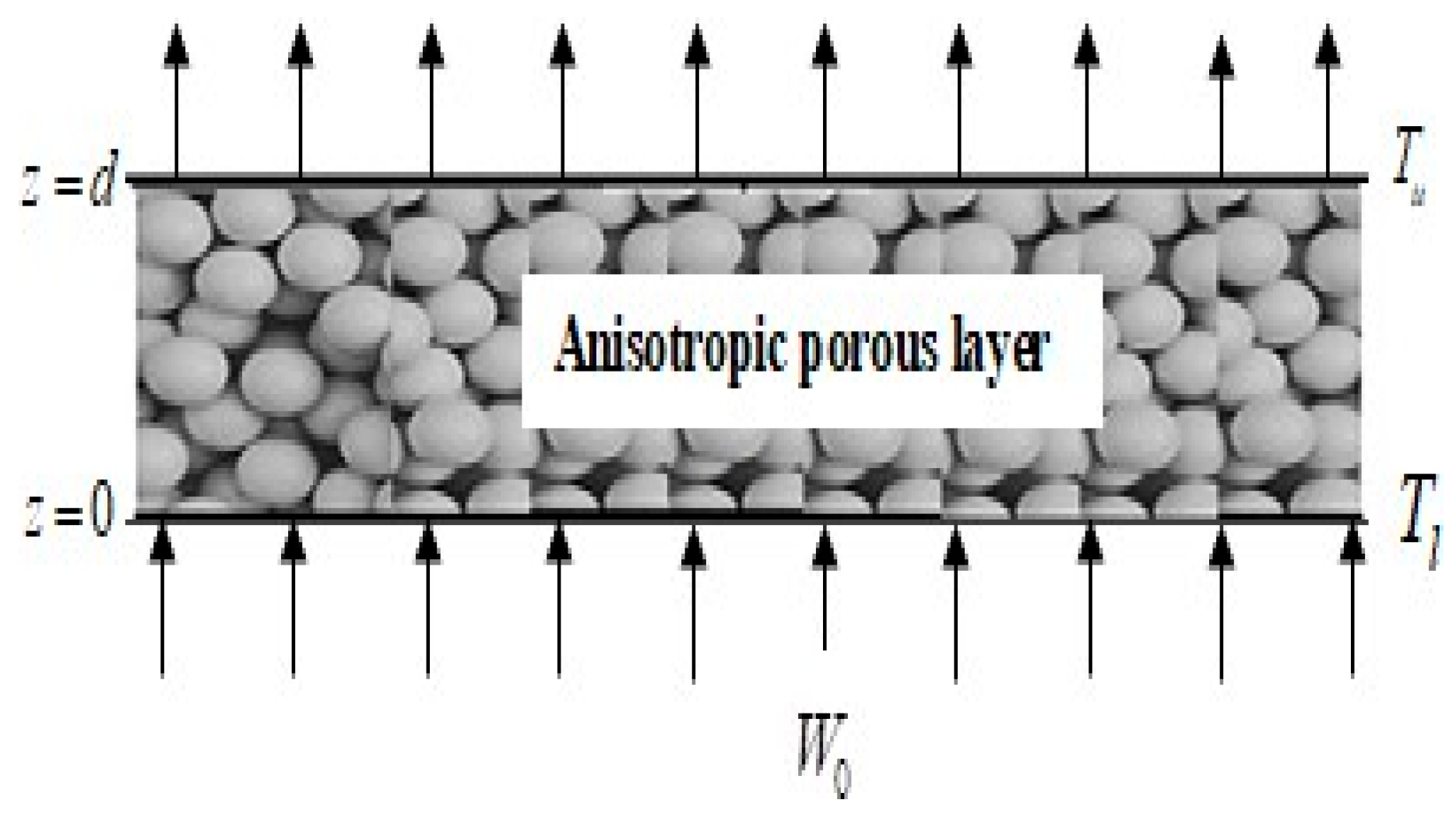
Figure 1 demonstrates the physical structure of the current study. The horizontal, isotropic porous matrix bounded between planes at z = 0 & z = d with continuous constant throughflow of vertical velocity W0 and downward gravity g (z). We presume that the viscosity depends exponentially on the temperature of the form μ= μ0 exp [− A(TT0 )].

3. Mathematical Formulation

The mathematical governing relation for the above configuration are
Ijtst 09 090303 i001
where Ijtst 09 090303 i002 is permeability tensor, Ijtst 09 090303 i003 is the velocity vector, Ijtst 09 090303 i004 is thermal diffusivity tensor, and μ(T) is variable viscosity.
The basic state is quiescent and is of the form
Ijtst 09 090303 i005
Then, the basic temperature field is:
Ijtst 09 090303 i006
On solving Equation (5), we get
Ijtst 09 090303 i007
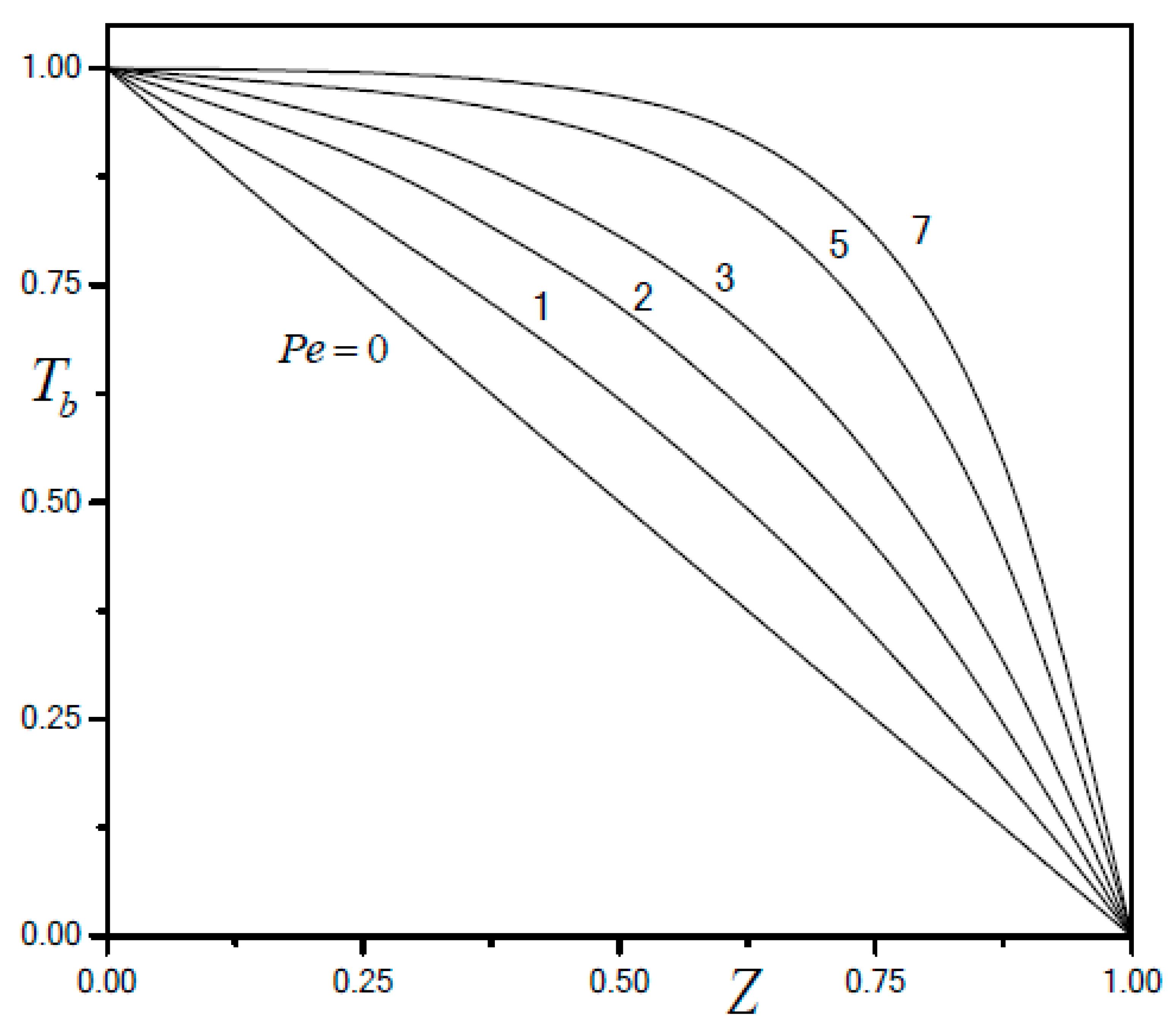
From Figure 2, it is seen modulation of throughflow the Tb (z) is to merely modifies the distribution within the porous bed. The basic state is slightly perturbed using the relation given by
Ijtst 09 090303 i008
Applying Equation (7) into Equations (1)–(3), the linear stability equations become:
Ijtst 09 090303 i009
where
Ijtst 09 090303 i010
thermal diffusivity tensor, and μ(T) is variable viscosity.
The basic state is quiescent and is of the form
We assume the solution is of the form
Ijtst 09 090303 i011
Substituting Equation (11) into Equations (8)–(9), we arrive
Ijtst 09 090303 i012
where is the R = αg0(TlTu)d3/vk is the Rayleigh number.
The boundary positions are:
Ijtst 09 090303 i013

4. Method of Solution

We now employ the Galerkin weighted residuals procedure to solve the system of Equations (12) and (13). Consequently, W&Θ are considered as
Ijtst 09 090303 i014
With trial functions
Ijtst 09 090303 i015
Using the governing parameters (Pe, B, ξ,η, a), the eigenvalue R can be obtained.

5. Results and Discussion

The effect of exponential viscosity variance with throughflow on the stability of moment of convection in an anisotropic porous bed is examined numerically. The resulting eigenvalue problem is solved using a Galerkin process. In the present analysis, the governing parameters considered are the viscosity parameter ( B), the mechanical anisotropic parameter (ξ), thermal anisotropic parameter (η), and throughflow parameter ( Pe). The consistency of the system is achieved in terms of Rc and ac by referring to different values η, ζ B and Pe.
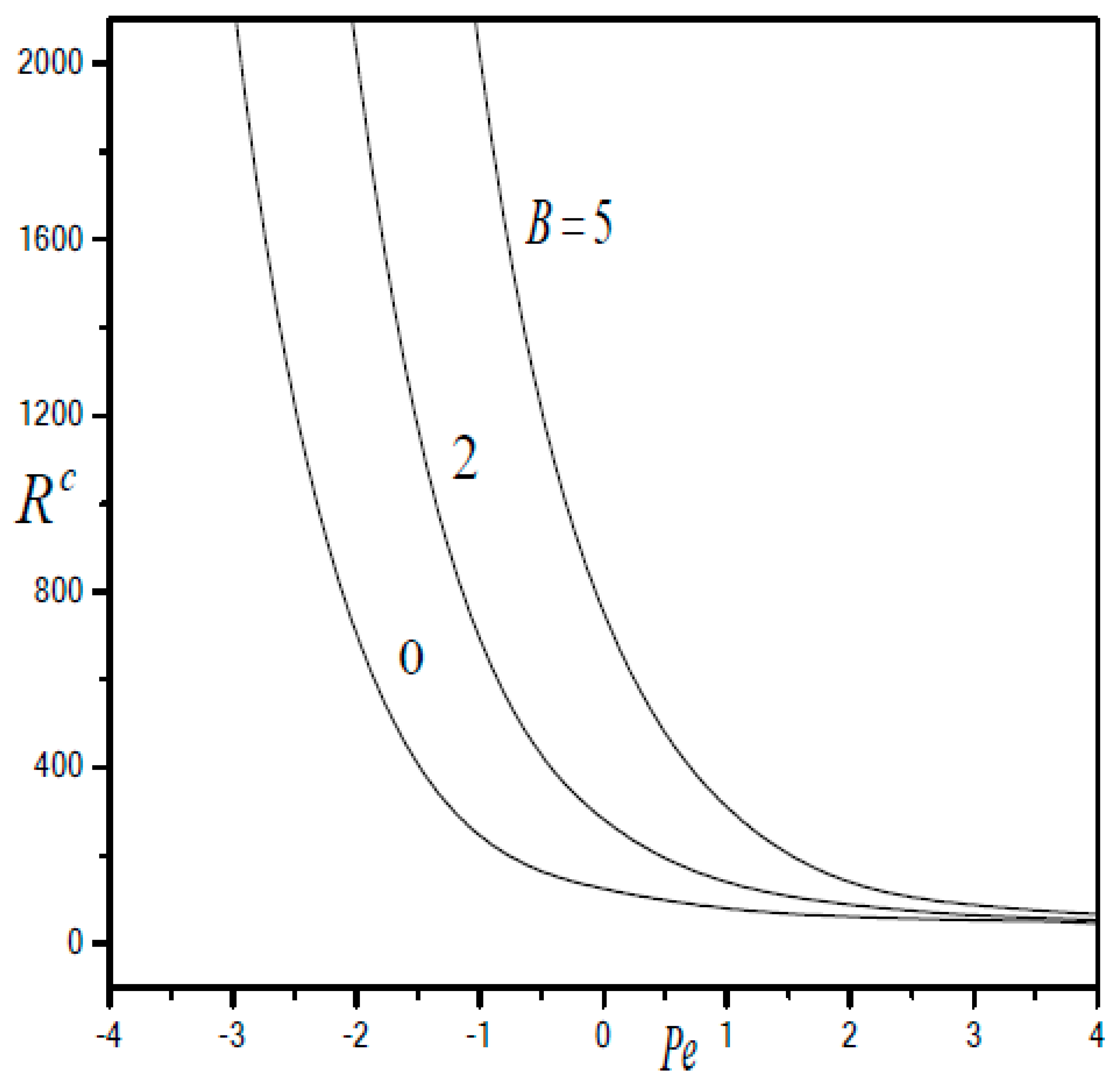
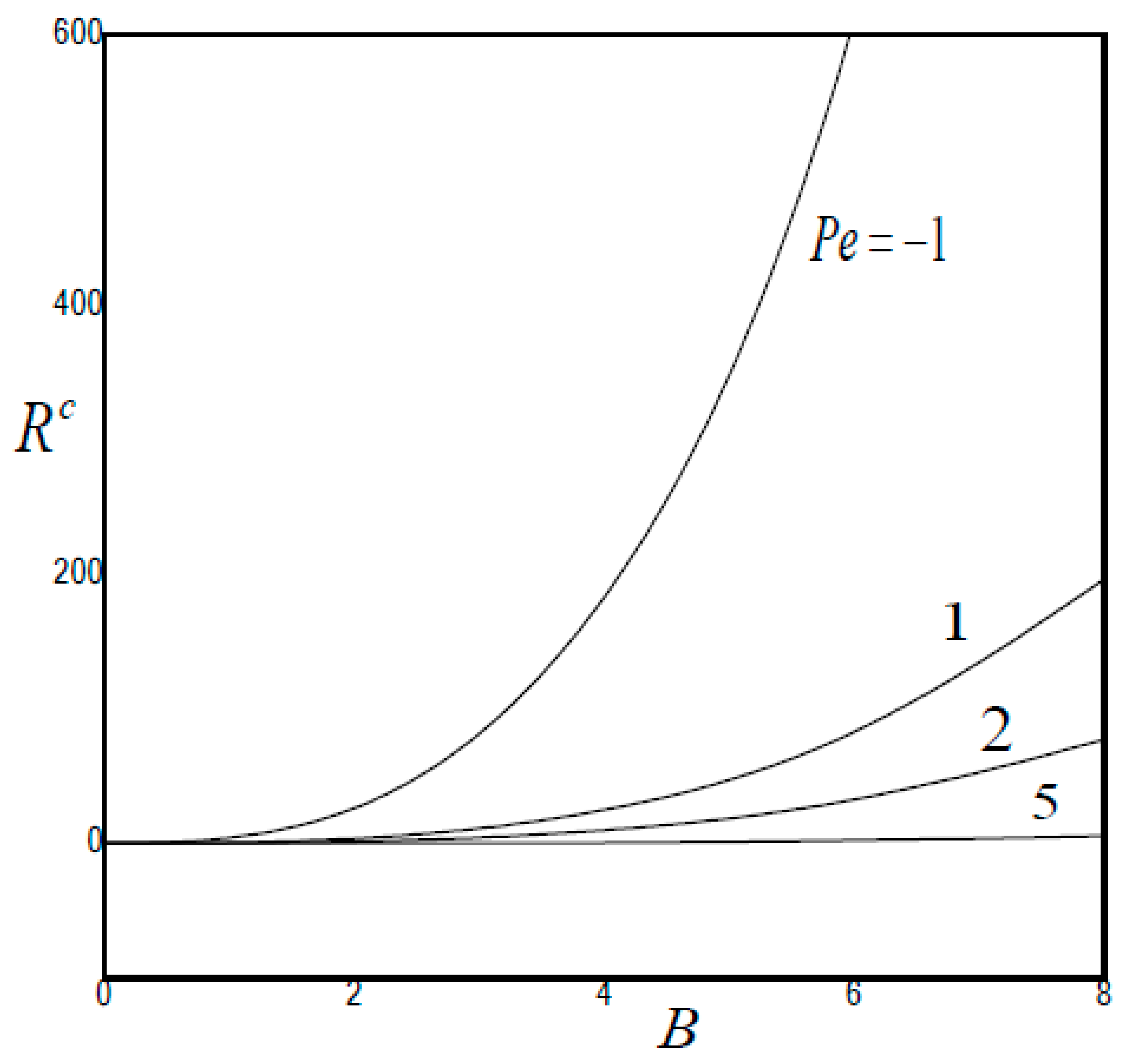
Figure 3 illustrates the impact of throughflow on the porous convection, and it is noted that the Rc increases for downward throughflow and decreases for upward throughflow. Also, it is found that Rc rises with the rise in the viscosity parameter B. Figure 4 indicate the significance of the viscosity parameter on the convective motion. It is noted that the Rc rises with the rise of viscosity term B. Further it is revealed that system gives more stable for downward throughflow.
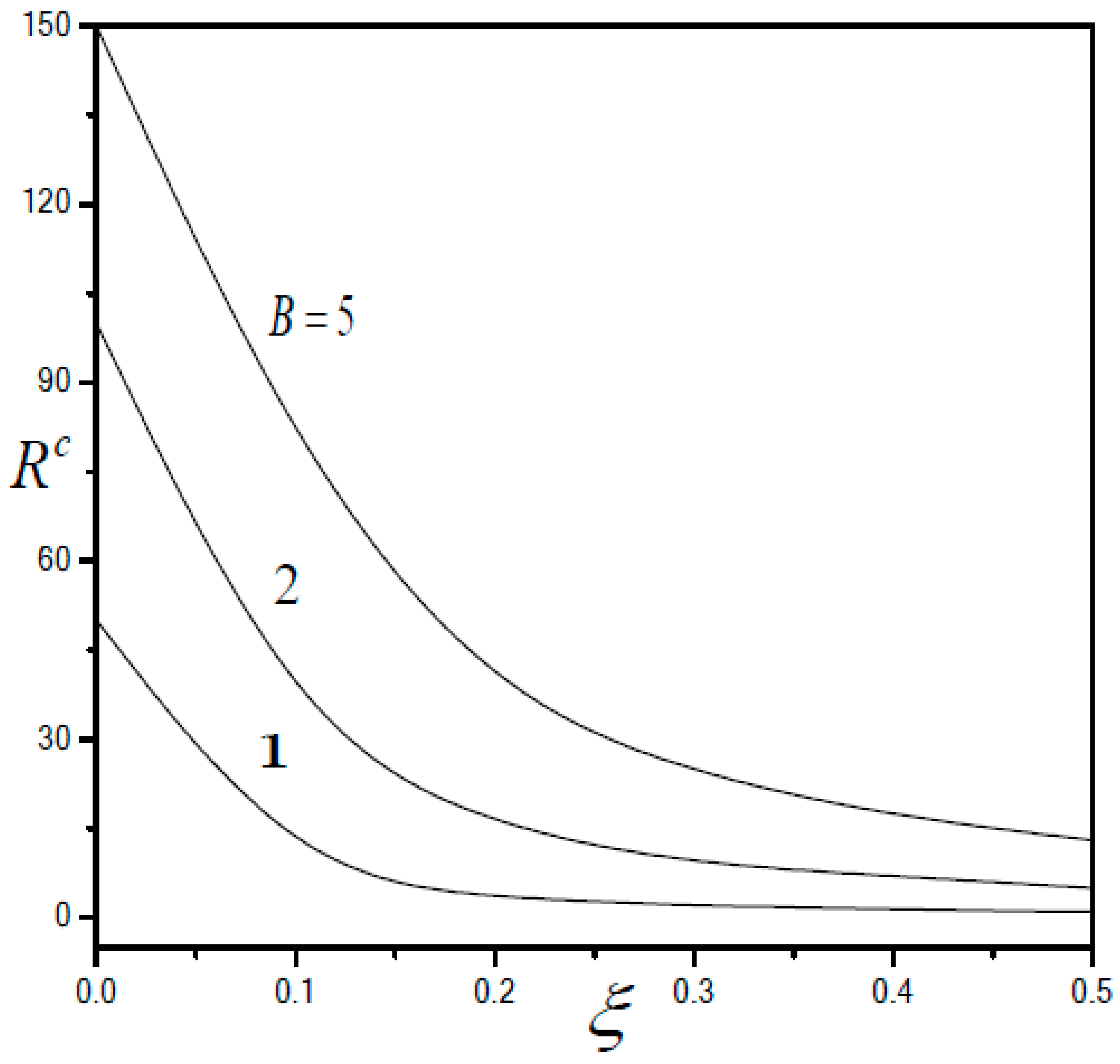
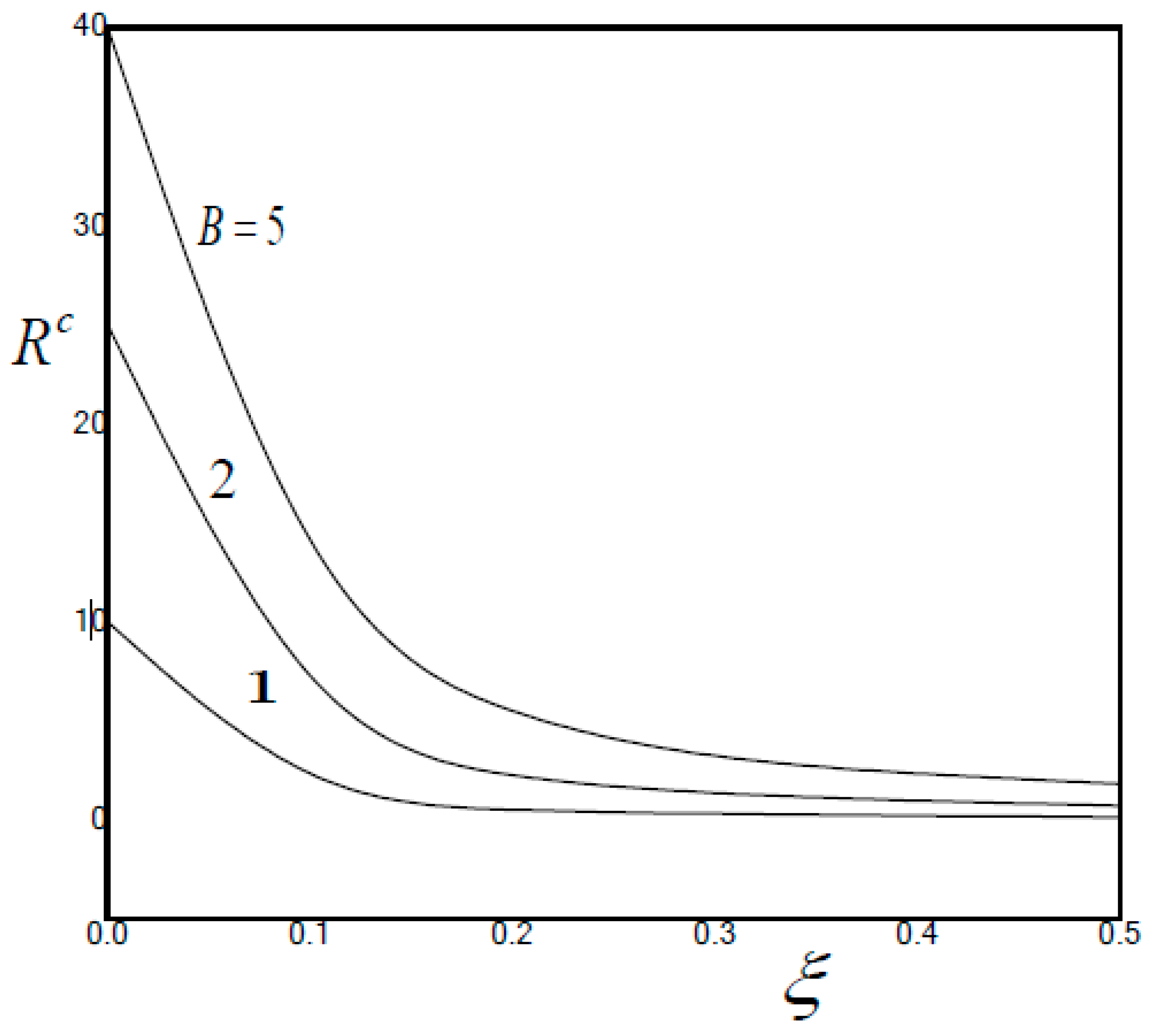
Figure 5 and Figure 6 depict the variation of Rc with ξ, for various values of viscosity parameter B with ξ=η= 0.5, for Pe = −1 and Pe = 1, respectively. The figures illustrate that as the mechanical anisotropic parameter is increased, the Rc decreases. This is as a result of the fact that rising the Kx will result in the cell’s size increasing while lower the value of Kz results in a bigger variation in temperature between the bottom and top plates as presented by Degan et al., [23]. Further, it is revealed that the system is more stable for downward throughflow.
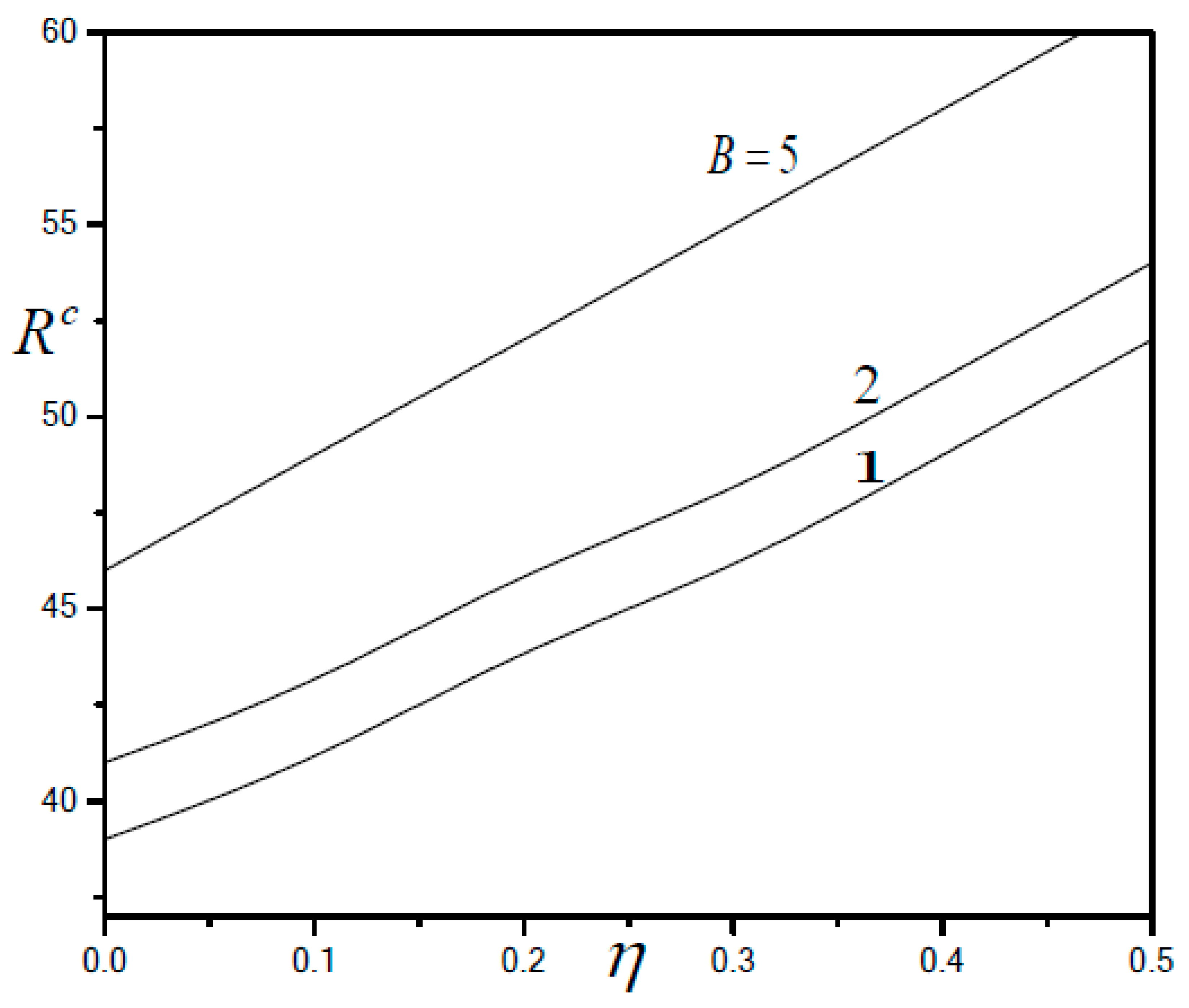
Figure 7 demonstrates the effect of η for various values of B. It should be emphasized that with rising the value of η and viscosity parameter B, the Rc also increases. Rising η causes a slowdown in κTz, as a result, the heat movement vertically through it slows.

6. Conclusions

Numerical analysis of the appearance of convective unsteadiness in an anisotropic porous matrix with throughflow and exponential viscosity variance is studied by using linear stability via the Galerkin method. The findings reveal that the impacts of raising the of the viscosity parameter, downward throughflow parameter, and anisotropic thermal parameter delay the beginning of convection and increasing mechanical anisotropic parameter and upward throughflow parameter advance the beginning of convection. Hence by increasing the values of η, B and by decreasing the values of ξ and Pe, convection in an anisotropic porous layer with adjusting throughflow can be delayed, and hence the system can be stabilized.
Ijtst 09 090303 i016

References

  1. M.A. Combarnous, S.A. Bories, Hydrothermal convection in saturated porous media. Adv. Hydrosci. 10, (1975) 231–307.
  2. P. Cheng, Heat transfer in geothermal systems. Adv. Heat Transf. 14, (1978) 1–105.
  3. D.A. Nield, The stability of convective flows in porous media. In: Kakaç, S. (ed.) Convective Heat and Mass Transfer in Porous Media, (1991) 79–122. Kluwer Academic, Dordrecht.
  4. D.A. Nield, A. Bejan, Convection in Porous Media, third ed. Springer, New York. (2006).
  5. G. McKay, Nonlinear stability analyses of problems in patterned ground formation and penetrative convection. Ph.D. Thesis, Glasgow University (1992).
  6. G.P. Merker, P. Waas, U. Grigull, Onset of convection in a horizontal water layer with maximum density effects. Int. J. Heat Mass Transf. 22, (1979) 505–515.
  7. A.C. Or, The effects of temperature-dependent viscosity and the instabilities in the convection rolls of a layer of a fluid-saturated porous medium. J. Fluid Mech. 206, (1989) 497–515.
  8. B. Straughan, Mathematical Aspects of Penetrative Convection. Longman, Harlow (1993).
  9. H.T. Rossby, A Study of Benard Convection with and Without Rotation. Journal of fluid Mechanics.36 (1969)309-335.
  10. K.E. Torrance, D.L. Turcotte, Thermal Convection with Large Viscosity Variations, Journal of Fluid Mechanics, vol.47, no. 1, (1979) 113-125.
  11. A. Barletta, D. A. Nield, Variable viscosity effects on the dissipation instability in a porous layer with horizontal throughflow, Physics of Fluids, vol.24, no. 1, (2012) 104102.
  12. V.S. Solomatov, A.C. Barr, Onset of convection in fluids with strongly temperature-dependent, power-law viscosity, Phys. Earth Planet. Int, vol.155, no. 1, (2006) 140–145.
  13. J.R. Booker, Thermal convection with strongly temperature-dependent viscosity, J. Fluid Mech, vol.76, no.1, (1976) 741-754.
  14. I.S. Shivakumara, S. P. Suma, R. Indira, and Y.H. Gangadharaiah, Effect of internal heat generation on the onset of Marangoni convection in a fluid layer overlying a layer of an anisotropic porous medium. Transp. Porous Med, 92 (2012) 727-743.
  15. S. P. Suma, Y. H. Gangadharaiah, R. Indira and I. S. Shivakumara Throughflow effects on penetrative convection in superposed fluid and porous layers. Transp. Porous Med. 95 (2012)91–110.
  16. Y.H. Gangadharaiah. the onset of Benard– Marangoni convection in composite layers with an anisotropic porous material. Journal of Applied Fluid Mechanics. 9 (2016)1551-1558.
  17. Y.H. Gangadharaiah, Double diffusive surfacedriven convection in a fluidporous system. International Journal of Thermofluid Science and Technology, 8, (2021) 080301.
  18. Gangadharaiah, Y. H, Nagarathnamma, Hanumagowda, Combined impact of vertical throughflow and gravity variance on Darcy- Brinkman convection in a porous matrix, International Journal of Thermofluid Science and Technology, 8,(2021) 080303.
  19. Gangadharaiah, Y. H, S. P. Suma, Nagarathnamma H, and T. Y. Chaya. Double- diffusive penetrative convection in a fluid overlying a porous layer. International Journal of Thermofluid Science and Technology, 9, (2022). 090103.
  20. Y.H. Gangadharaiah, Effects of internal heat generation and variable viscosity on Marangoni convection in superposed fluid and porous layers, Journal of Advanced Mathematics and Applications, 3 (2), (2014) 158-164.
  21. K Ananda, Y.H. Gangadharaiah, H Nagarathnamma, Combined impact of variable internal heat source and variable viscosity on the onset of convective motion in a porous layer, Malaya Journal of Matematik (MJM), 2020,8,3 (2020)973-976.
  22. Y.H. Gangadharaiah, K. Ananda, Influence of viscosity variation on surface driven convection in a composite layer with a boundary slab of finite thickness and finite thermal conductivity, JP Journal of Heat and Mass Transfer, Volume 19, Issue 2, (2020) 269–288.
  23. G.P. Degan, Vasseur, E. Bilgen. Convective heat transfer in a vertical anisotropic porous layer. International journal of heat and mass transfer. 38(11) (1995)1975-1987.
Figure 1. Physical configuration.
Ijtst 09 090303 g001
Figure 2. Plot of the basic state temperature distributions for different values of Pe = 5.
Ijtst 09 090303 g002
Figure 3. Rc versus Pe with ξ=η= 0.5, for different values of B.
Ijtst 09 090303 g003
Figure 4. Rc versus B with ξ=η= 0.5, for different values of Pe.
Ijtst 09 090303 g004
Figure 5. Rc versus ξ for ξ=η= 0.5, with Pe = −1 for different values of B.
Ijtst 09 090303 g005
Figure 6. Rc versus ξ for η= 0.5 & Pe = 1 for different values of B.
Ijtst 09 090303 g006
Figure 7. Rc versus η for ξ= 0.5 & Pe = 1 for different values of B.
Ijtst 09 090303 g007