Next Article in Journal
Thermal Radiation Influences on MHD Stagnation Point Stream over a Stretching Sheet with Slip Boundary Conditions
Previous Article in Journal
Perturbation analysis of thermophoresis, hall current and heat source on flow dissipative aligned convective flow about an inclined plate
 
 
International Journal of Thermofluid Science and Technology is published by MDPI from Volume 13 Issue 1 (2026). Previous articles were published by another publisher in Open Access under a CC-BY (or CC-BY-NC-ND) licence, and they are hosted by MDPI on mdpi.com as a courtesy and upon agreement with the previous journal publisher.
Article

Flow and heat transfer of Oldroyd-B nanofluid with relaxation-retardation viscous dissipation and hyperbolic boundary conditions

1
Department of Mathematics, P N. Autonomous College, Utkal University, Bhubaneswar-752057, Odisha, India
2
Department of Mathematics, Centurian University of Technology and Management, Paralakhemundi, Gajapati-761211, Odisha, India
3
Department of Physics, Radhakrishna Institute of Technology and Engineering, Bhubaneswar-752057, Odisha, India
*
Author to whom correspondence should be addressed.
Int. J. Thermofluid Sci. Technol. 2020, 7(1), 070104; https://doi.org/10.36963/IJTST.20070104
Submission received: 6 March 2020 / Revised: 17 April 2020 / Accepted: 22 April 2020 / Published: 29 April 2020

Abstract

In the present research article, modeling and computations are presented to introduce the novel concept of relaxation-retardation viscous dissipation and hyperbolic time variation boundary conditions on the magnetohydrodynamic transient flow of Oldroyd-B nanofluid past a vertical stretched plate for the first time. In the present work, firstly we implement Buongiorno’s model to illustrate Brownian motion and thermophoretic diffusion which take vital role in heat and mass transportation process. Nonlinear non-dimensional governing equations are solved by fourth order Runge-Kutta method along with shooting technique. We investigate the behavior of influential variables on the velocity, thermal and solutal fields through graphical illustrations. Our results indicate that relaxation and retardation Deborah numbers exhibit completely reverse trend in the flow field. Especially, augmented relaxation- retardation viscous dissipation invigorates the temperature gradient. The results of the current theoretical study may be instrumental for worthful practical applications.

1. Introduction

Authors pay sincere thanks to the researchers for their precious contributions through fair, honest and expeditious investigations to the important progress achieved in the accelerated research world over the past decades. Out of numerous dedicated contributions one remarkable achievement of Maxwell [1] is the development of Maxwell model.
This is a rate type model used for evaluating the viscoelastic nature of materials. Ignoring the possibility of incompressible nature of liquid is another important feature of this model. It is indeed Oldroyd [2] after Maxwell, developed a constitutive relationship for describing actual behavior of nonlinear liquids. The constitutive relations of Oldroyd-B fluid characterizes the influence of both relaxation and retardation times. The Oldroyd-B model developed by Oldroyd becomes Maxwell model without retardation time. Many noteworthy researchers manoeuvred strenuous endeavors to study the flow and heat transfer of Oldroyd-B fluid under different conditions and configurations. The outcomes of their investigations have been addressed and utilized by many others. Bhatnagar et al. [3] showed in their study how free stream velocity influences the flow of an Oldroyd-B fluid due to a stretching sheet. The effect of decay of a potential vortex in the flow of an Oldroyd-B fluid was investigated by Fetecau andFetecau [4]. The stagnation point flow of an Oldroyd-B fluid past a stretching sheet was studied intensively by Sajid et al. [5]. Zheng et al. [6] established exact solutions for MHD flow of generalized Oldroyd-B fluid due to an infinite accelerating plate. In their study, the fractional calculus approach is implemented to establish the constitutive relationship of the Oldroyd-B fluid. The solutions are developed by means of Fourier sine and Laplace transforms. Hayat et al. [7] examined three-dimensional convective flow of an Oldroyd-B fluid over a stretched surface. Their study addressed the convergence of series solutions by the homotopy analysis method (HAM). Abbasbandy et al. [8] analyzed the numerical and analytical solutions for Falkner-Skan flow of MHD Oldroyd-B fluid. The relaxation and retardation times have opposite effects on the velocity components were the results of their investigation. Interestingly, an unsteady helical flow of Oldroyd-B fluids was studied by Jamil et al. [9]. Oscillating motion of an Oldroyd-B fluid between two infinite circular cylinders was analyzed by Fetecau et al. [10]. Impact of Cattaneo-Christov heat flux in MHD flow of Oldroyd-B fluid with homogeneous-heterogeneous reactions was investigated by Hayat et al. [11]. Hayat et al. [12] applied non-Fourier heat flux theory to study on 2D stratified flow of an Oldroyd-B fluid with chemical reaction. They declared in their study that temperature distribution has opposite behavior for thermal relaxation time and variable thermal conductivity parameter. Simultaneous impacts of mixed convection and nonlinear thermal radiation in stagnation point transient flow of Oldroyd-B fluid was discussed by Hayat et al. [13]. They observed that the behavior of thermal relaxation and retardation times on velocity distribution are opposite. They also observed that temperature ratio and radiation parameters augment the temperature distribution. Zhang et al. [14] examined the flow and heat transfer of an Oldroyd-B nanofluid thin film over an unsteady stretching sheet. The influences of various relevant parameters such as unsteady parameter, volume fraction of Cu/Ag and Prandtl number on the flow field were explored in their study.
Here we pronounce that the concept of nanofluid is developed by Choi [15] where the proper dilution and suspensions of the poor heat transfer fluids such as oil, water and ethylene glycol takes place with high thermal conductivity material nanoparticles like Cu, CuO, Al2O3 ,TiO2 ,SiO2 ,ZrO2 ,ZnO . Nanofluid due to its unique and exceptional characteristic properties ensures a substantial upgradation of heat transfer of conventional (poor heat transfer) fluids. Consequently, such fluids has tremendously overwhelming the demand of heat removal in cooling applications. The most promising and inevitable diversified applications of nanofluids today include process industries, heat exchangers, cooling towers, transportation, magneto-optical devices, biomedical-therapeutic treatment and developing the best quality lubricants and oils and many others. Keeping the above astounding relevance into mind, many researchers succeeded in finding different models, phenomena and mechanisms theoretically and experimentally that would enhance the heat transfer capability of various nanofluids. Many authors have also studied the behavior of different nanofluids subject to several flow configurations and physical boundary conditions. Xuan and Li [16] studied the flow and convective heat transfer of nanofluids. Further, Buongiorno [17] introduced a two-phase model comprising the role of two slip mechanisms namely Brownian diffusion and thermophoresis which account for the thermal conductivity enhancement of nanofluids. Khan and Pop [18] analyzed the boundary-layer stretched flow of a nanofluid.
Moreover, series solutions for Oldroyd-B fluid motion induced by a deforming sheet having exponential velocity were investigated by Hayat et al. [19]. In their study, they considered the wall temperature as exponentially growing function of the horizontal distance. Shivakumara et al. [20] analyzed thermal convective instability in an Oldroyd-B nanofluid embedded in porous layer. In their analysis, the authors implemented the famous Buongiorno model and assumed zero nanoparticle flux at the boundaries. Nayak [21] examined the impact of thermal radiation and viscous dissipation on three dimensional magnetohydrodynamic flow nanofluids by shrinking surface using Homotopy analysis method (HAM). It seen that there is an increase in temperature due to an increase in thermal radiation parameter leads to lower heat transfer rate from the surface of the sheet. Also it is noticed from his study that the local Nusselt number gets reduced indicating lowering heat transfer rate from the surface with increasing Eckert number. Nayak et al. [22] explored the effects of velocity slip and non-linear thermal radiation on three dimensional magnetohydrodynamic convective flows of nanofluids through porous media. Increasing values of slip parameter slow down the axial and transverse fluid velocities and that of temperature parameter yielding greater non-linearity in heat transfer rate from the surface are important outcomes of their investigation. Nayak et al. [23] studied the effect of thermal radiation and natural convection of three dimensional magnetohydrodynamic flows of nanofluids over permeable linear stretching sheet. They declared in their study that rising the buoyancy and radiation parameter uplift the velocity and temperature profiles respectively. Ghadikolaei et al. [24] showed in his study how the porous matrix and thermal radiation influences significantly on flow and heat transfer of Fe3O4–(CH2OH)2 nanofluids. Hayat et al. [25] revealed that the heat generation parameter upgrades the fluid temperature and the related thermal boundary layer in the stretched flow of magnetohydrodynamic Oldroyd-B nanofluid. The flow of magnetized Oldroyd-B fluid over a rotating disk influenced by non- linear radiation and activation energy was analyzed by Khan et al. [15]. In their study, they developed numerical solution and conveyed that temperature ratio parameter augments the temperature distributions in the boundary layer region. Mahanthesh et al. [27] discussed the nonlinear three-dimensional stretched flow of an Oldroyd-B fluid with convective condition. Kumar et al. [28] investigated the effect of Joule heating and viscous dissipation on three- dimensional flow of Oldroyd B nanofluid with thermal radiation where they confirmed that rise in Eckert number led to the escalation of temperature fields in the entire flow domain.
Viscous dissipation finds convenience to take place in stronger gravitational fields, larger planets, heavier gases in space and geological operations. Viscous dissipation is a partial irreversible process that generates an additional heat in the flow process due to fluid friction. Nayak [29] explored the nature of dissipative flow of nanofluids under the influence of transverse magnetic field in association with thermal radiation embedded in a porous medium. It is seen in his study that an increase in Eckert number increases the fluid temperature and the associated thermal boundary layer thickness. This leads to reduction of the rate of heat transfer from the stretched surface. This reduction is further decreased due to presence of porous medium. Therefore, the presence of porous medium acts as an insulator to the surface of the sheet.
Going through the aforementioned literature survey, it is well understood that until now there is only one publication about the aspect of relaxation-retardation viscous dissipation. Only Zhang et al. [30] studied the behavior of relaxation-retardation viscous dissipation of Oldroyd-B fluid thin film. However, the impact of relaxation-retardation viscous dissipation on the flow of Oldroyd-B nanofluid past a stretched vertical plate associated with hyperbolic time varying boundary conditions has not yet studied. The aim of this study is to bridge such gap. The prime objective of our research is to model the Oldroyd-B nanofluid flow subject to relaxation-retardation viscous dissipation past a stretched vertical plate associated with hyperbolic time varying boundary conditions. Heat and mass transfer process are explored due to Buongiorno’s model featured by aspects of Brownian motion and thermophoretic diffusion. The fourth order R-K method along with shooting technique is adopted as a numerical tool to solve the resulting nonlinear governing expressions. The characteristics of velocity, thermal and solutal distributions, surface drag force, heat and mass transfer rates well displayed and discussed.

2. Formulation of the problem

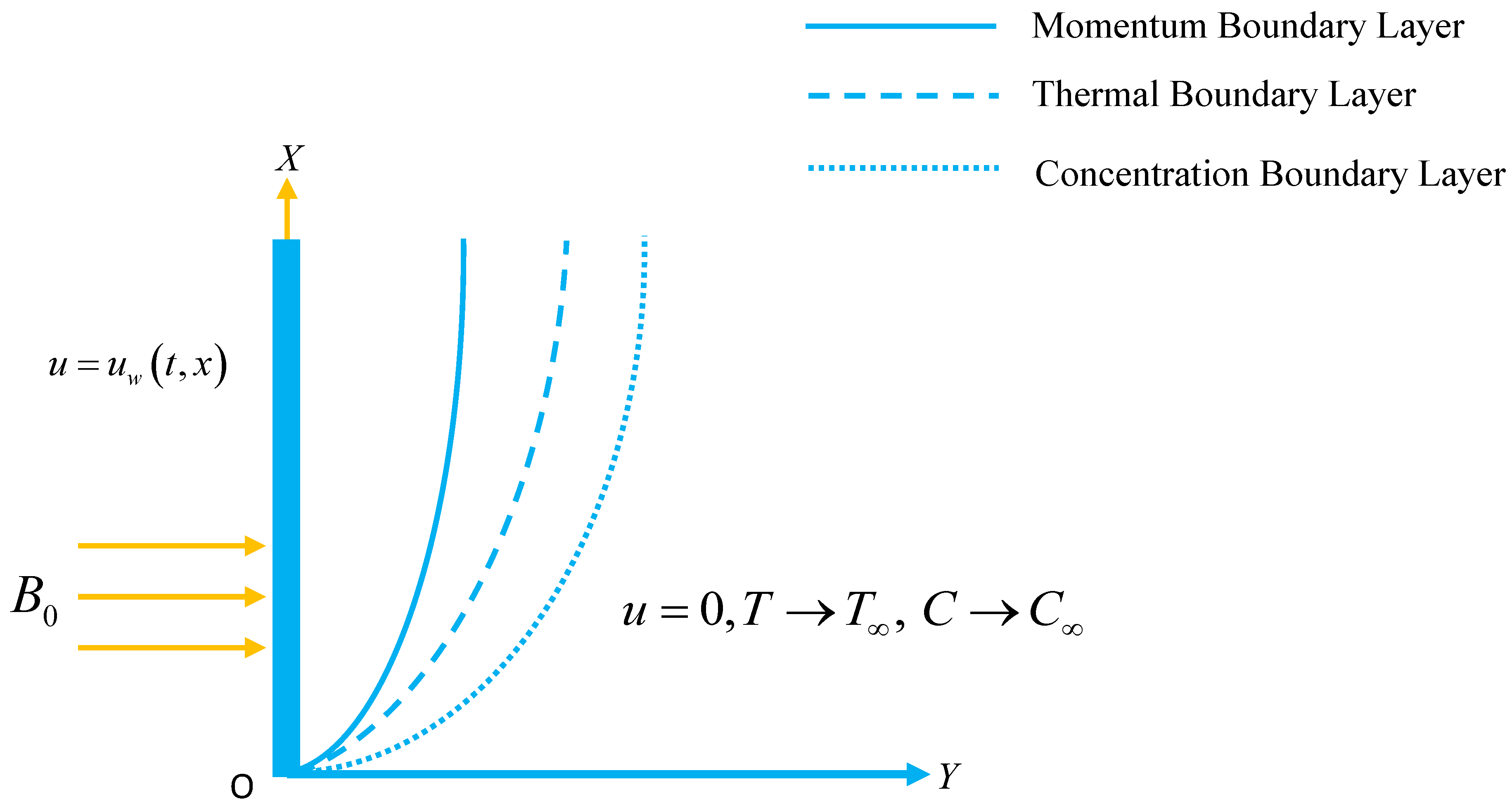
In In this problem we deal with the time-varying flow of Oldroyd B nanofluid past a stretched vertical plate. Two familiar phenomena such as thermophoretic motion and Brownian diffusion have been taken into account. Relaxation-retardation viscous dissipation is introduced. Hyperbolic time varying boundary conditions are implemented. Assume that u and v are respectively the velocity components in x- and y- directions where x-axis is along the plate and y-axis is at right angle to it as represented in Figure 1.
The underlying boundary layer equations with the very idea of Boussinesq approximation and above declared assumptions are [3], [18], [26,27,28], [30]:
Ijtst 07 070104 i001
The required hyperbolic time variation boundary conditions are:
Ijtst 07 070104 i002
Here, u and v are the fluid velocity components along x and y directions, uw(x) is the plate velocity, a > 0 is a constant.
The appropriate transformations used are
Ijtst 07 070104 i003
where Fη(η) is the differentiation with respect to η.
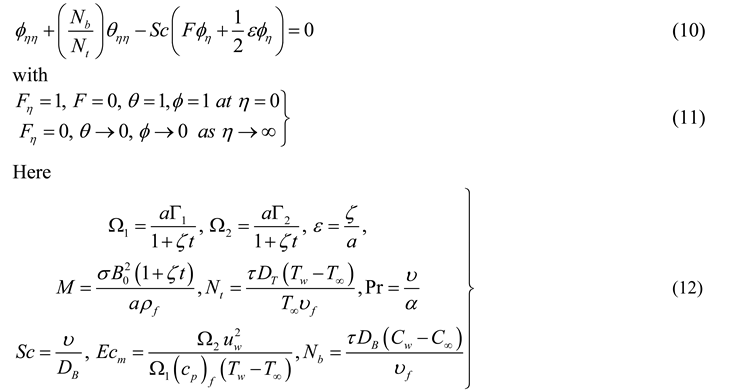
Using eqs (6) and (7), eqs (2-5) take the form
Ijtst 07 070104 i004
Ijtst 07 070104 i005
The local skin friction coefficient is written as
Ijtst 07 070104 i006
The non dimensional local skin friction coefficient is
Ijtst 07 070104 i007
The local Nusselt and Sherwood numbers are respectively
Ijtst 07 070104 i008
The non-dimensional local Nusselt and Sherwood numbers can be developed as
Ijtst 07 070104 i009

3. Solution method and validation

In the present study, the nonlinear and coupled Eqs (8), (9), and (10) with boundary conditions (11) are solved numerically using Runge-Kutta-Fehlberg method with shooting technique for different values of parameters. Table 1 conveys the comparison of present results with the previously declared results of Abel et al. [33], Megahed [34] and Waqas et al. [35] where it is visualized that there is well and good agreement between them. The good agreement is related to the visualization that augmentation of Deborah number Ω1 associated with relaxation time upsurges the skin friction significantly.

4. Results and Discussion

This section presents a bold and visionary analysis providing the physical interpretation due to the interaction of interesting assorted variables including Deborah numbers ( Ω1 and Ω2 ), Hartmann number M , Prandtl number Pr , modified Eckert number Ecm , Schmidt number Sc with flow, thermal and solutal fields. The detailed information regarding behaviors of velocity, temperature and concentration fields, viscous drag, Heat transfer rate and rate of mass transfer associated with the time-varying flow of Oldroyd-B nanofluid past a stretched vertical plate influenced by relaxation-retardation viscous dissipation have been well addressed.

4.1. Velocity distribution

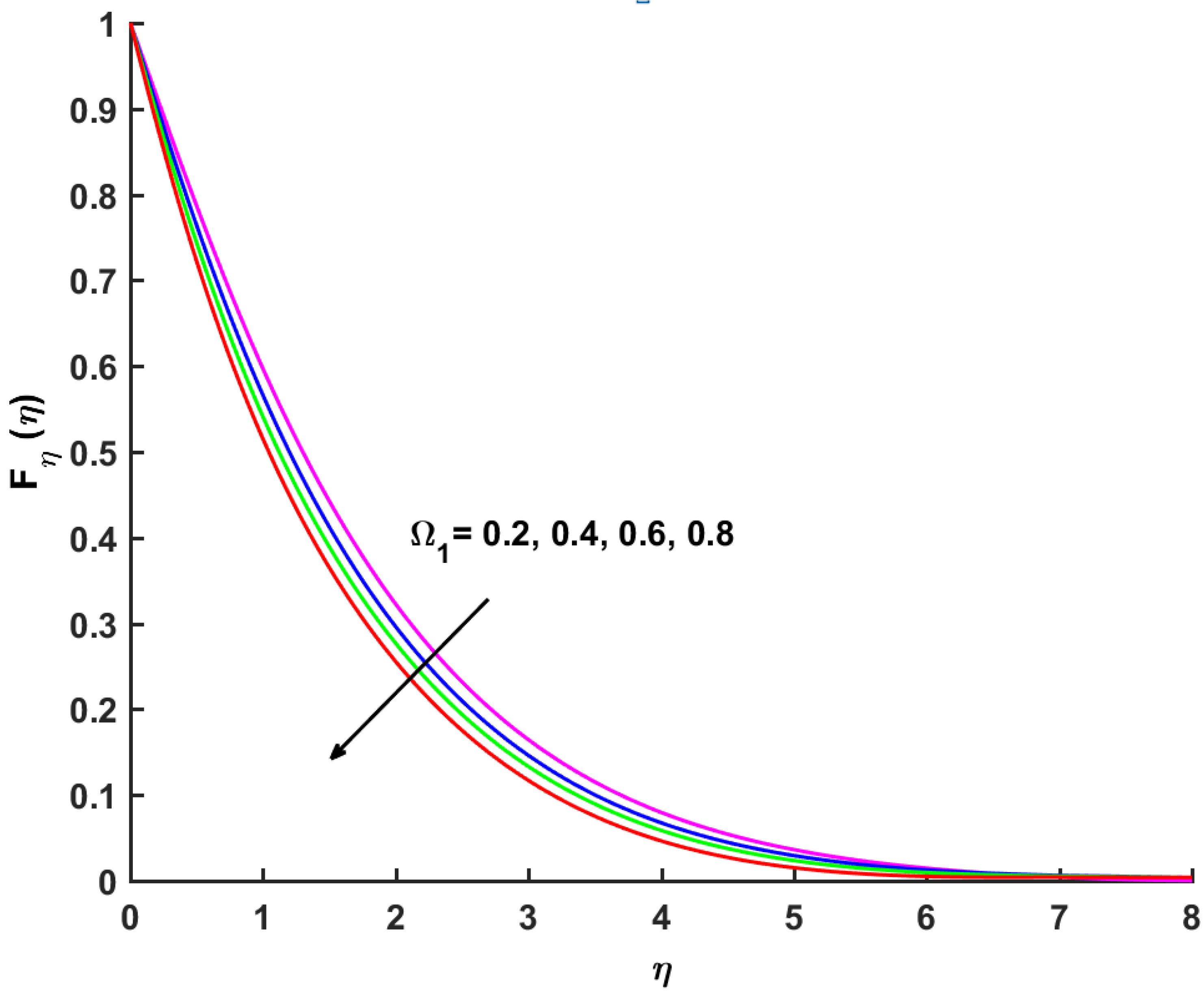
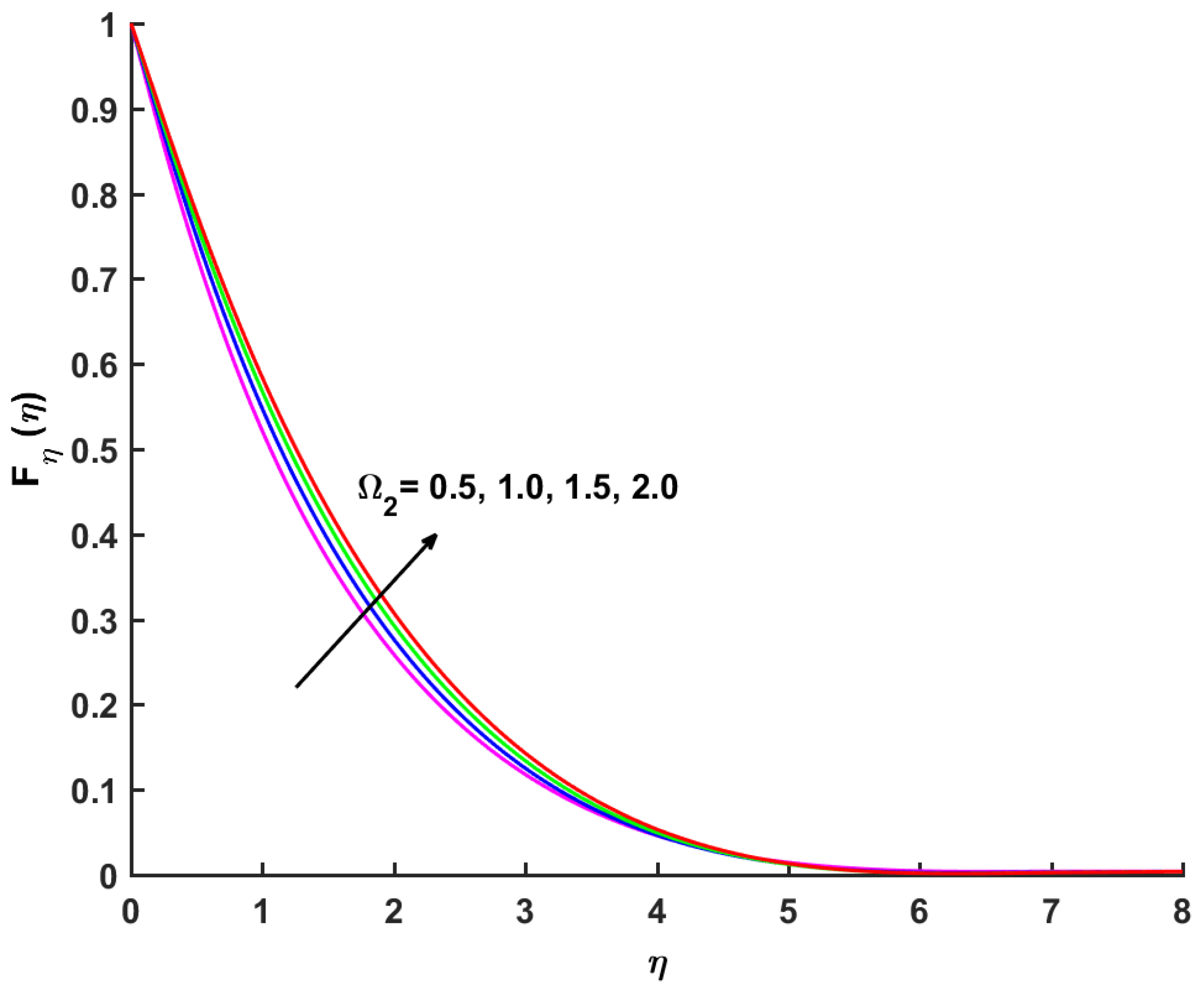
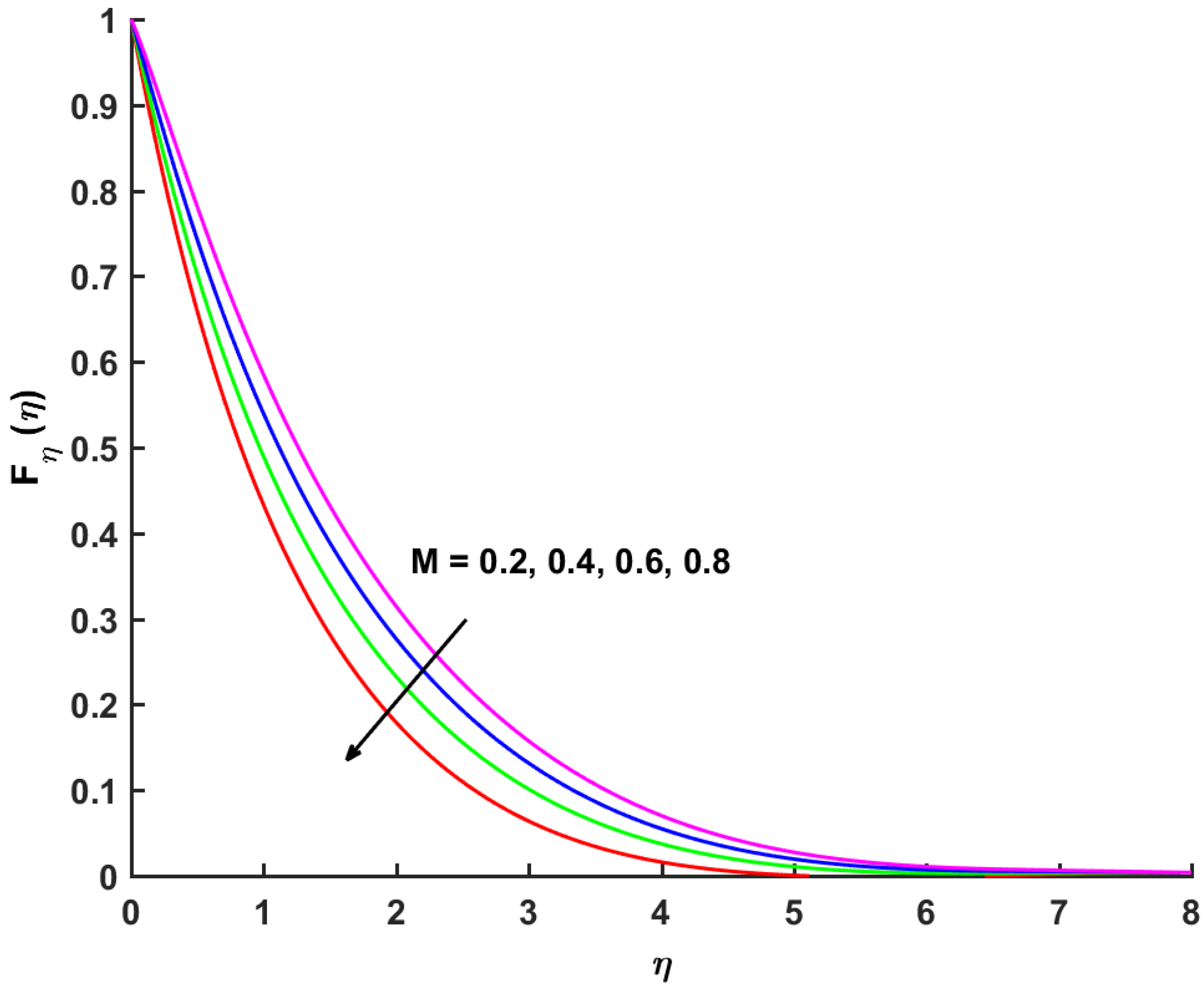
The observation of Figure 2 indicates that controlled fluid motion is accomplished due to enhancement of Deborah number Ω1 associated with relaxation time. However, the adverse nature of fluid motion in response to Deborah number Ω2 associated with retardation time is visible in Figure 3. From Figure 2 and Figure 3 it is inferred that behavior of Deborah number Ω2 is quite opposite to that of Ω1 . In fact, for higher relaxation time the Oldroyd nanofluid boosts up thereby responsible for the decline of the motion of the Oldroyd nanofluid. On the other hand, Ω2 corresponds to retardation time Г2 . Physically, an augmentation in retardation time upsurges the flow. It is well agreed with the observation in Mustafa et al. [31]. Figure 4 has rightly stated that increase in Hartmann number M contributes decelerated motion and the related shrinking velocity boundary layer. Please bear in mind that the flow over the plate is restrained by Lorentz force which is generated due to the interaction between applied magnetic field and the conducting fluid.

4.2. Temperature distribution

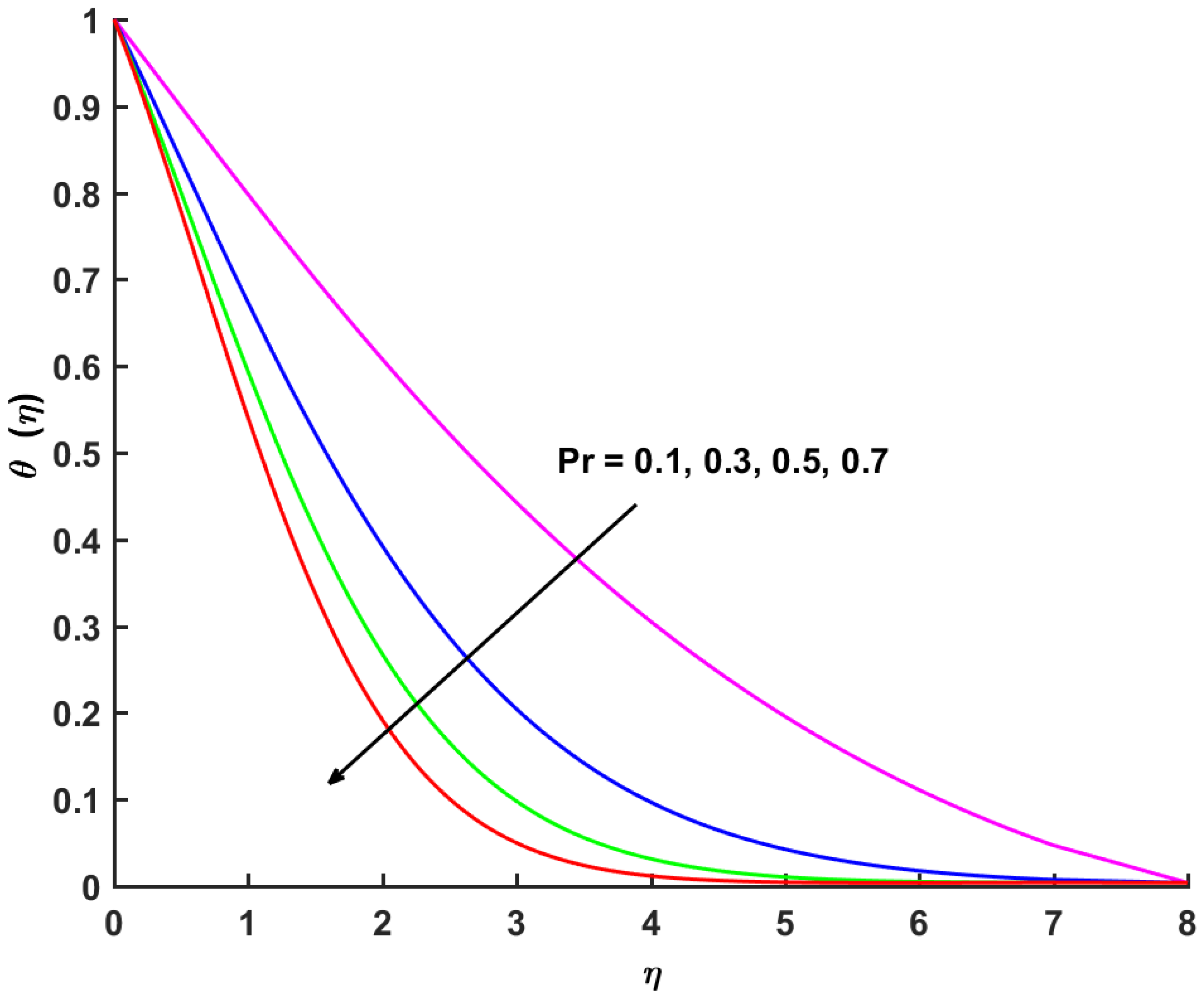
The outcomes of the present analysis reveal many interesting aspects of the heat transfer in a flow of Oldroyd-B nanofluid under the impact of various pertinent thermal parameters. We start with Figure 5 describes that fluid with high Prandtl number accounts for abatement of fluid temperature θ(η) and upgradation of heat transfer from the plate. The basic point is that Prandtl number has a reverse association with thermal diffusivity. So it is not surprised that for high Prandtl fluid (having larger value of Pr ) momentum diffusivity dominates over thermal diffusivity which responds to decaying of temperature. This is an excellent agreement with Hayat et al. [32].
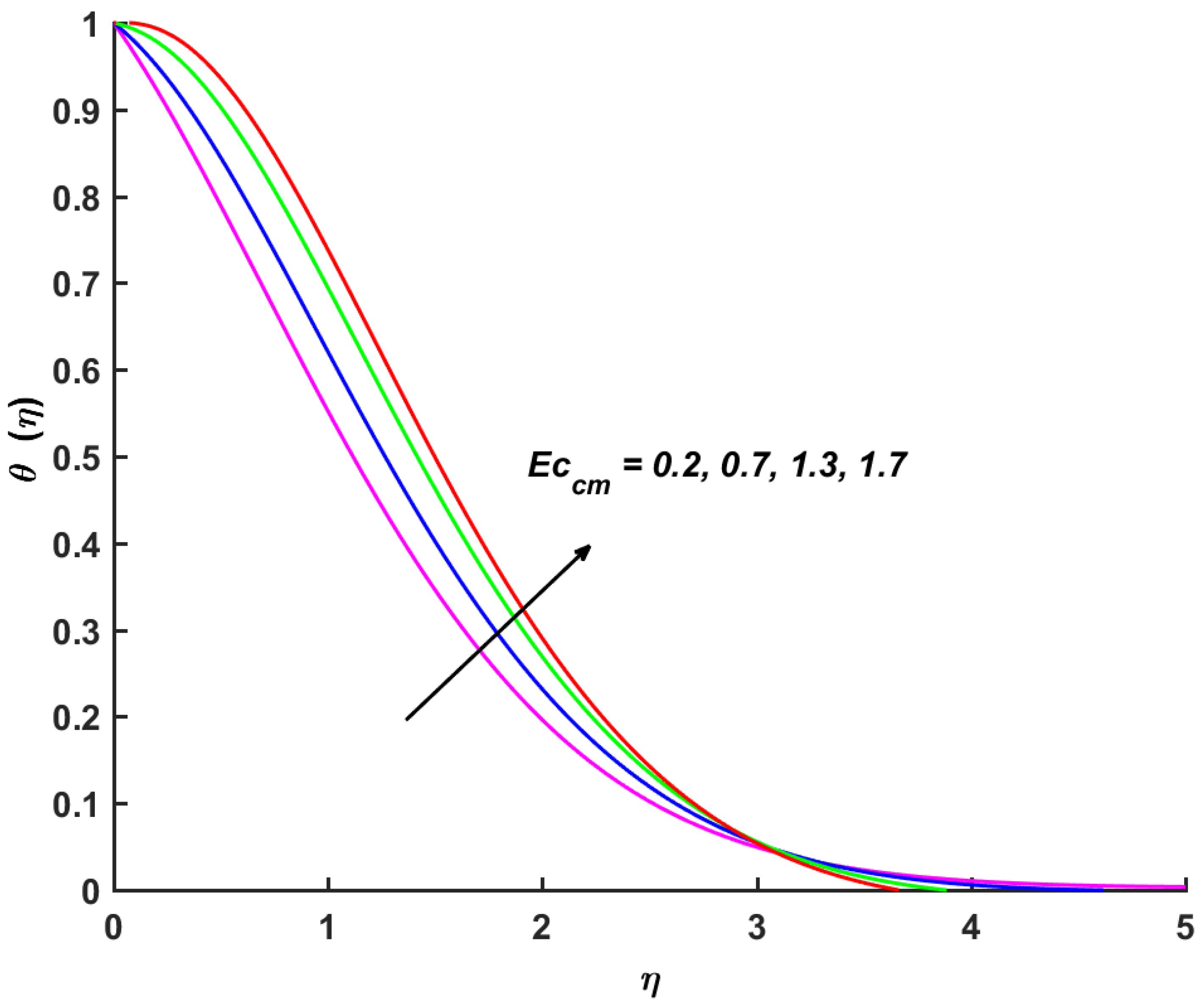
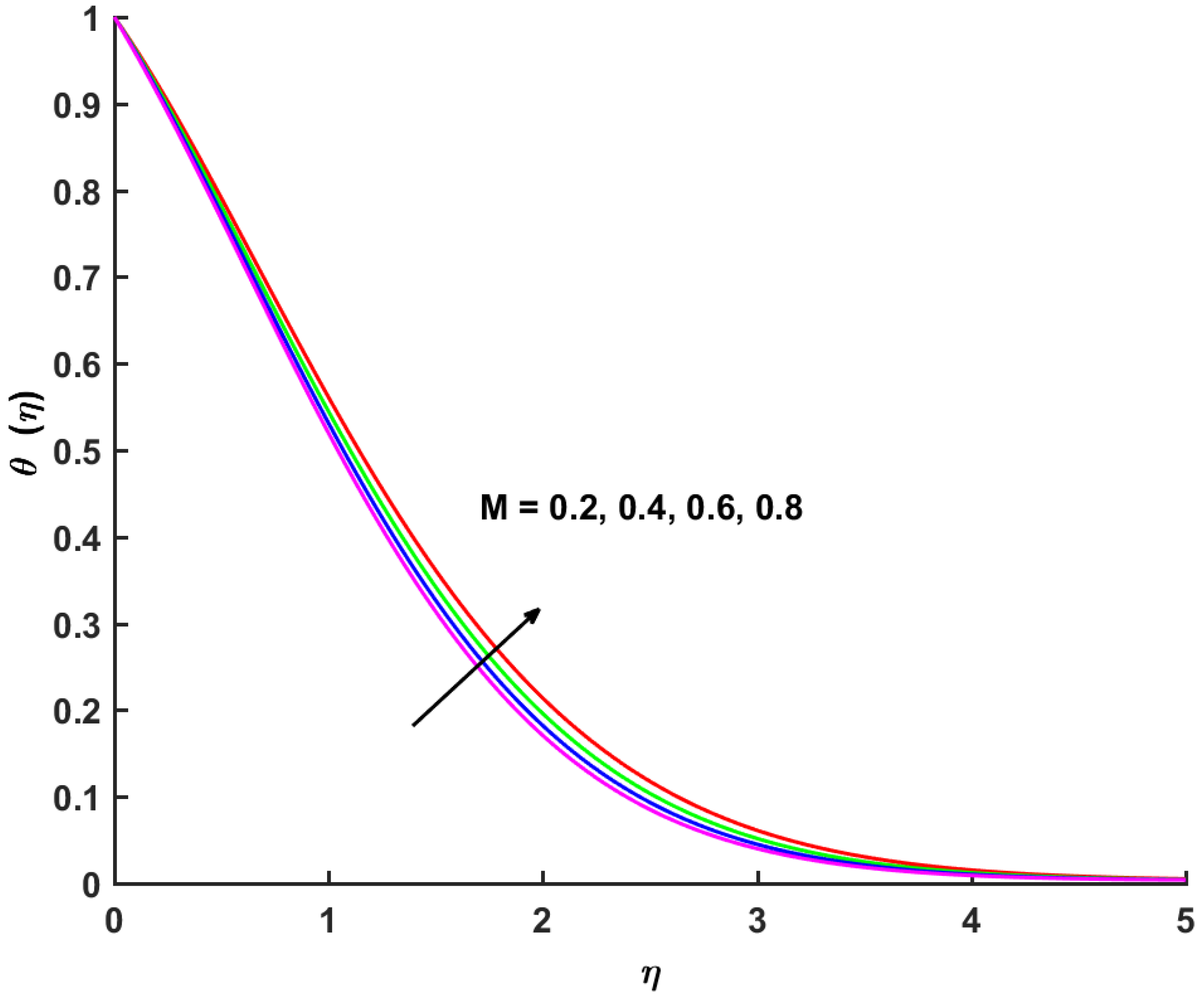
Fluid temperature θ(η) and the related layer thickness eventually develop the ascending trend in response to rising modified Eckert number Ecm (portrayed in Figure 6). In fact, increasing Ecm contributes stronger viscous dissipation associated with the converted internal energy, which in turn boosts the temperature. Further, increase in Hartmann number M (visualized in Figure 7) causes establishment and development of escalated non-dimensional fluid temperature θ(η) and the related thermal - layer thickness. In fact, greater Lorentz force due to larger M produces restrained fluid flow which in turn builds up more heat in the boundary layer.

4.3. Concentration distribution

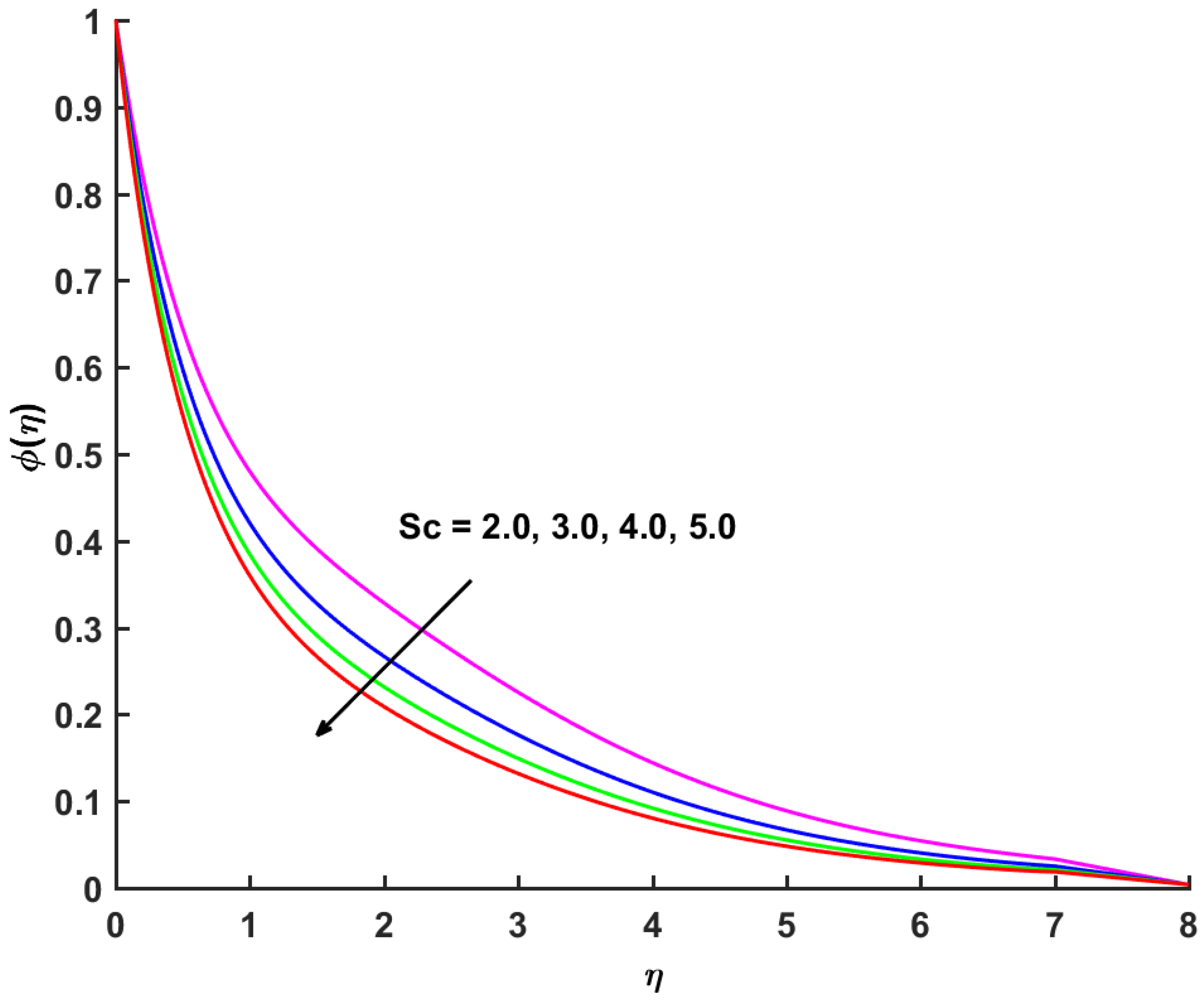
Figure 8 envisages that nanoparticles concentration ϕ(η) and the associated layer thickness undermine due to increasing Schmidt number Sc . Higher Sc indicating lower molecular diffusivity contributes lesser nanoparticles concentration in the related boundary layer. At certain Sc (for instance, Sc = 5 ), ϕ(η) is maximum in the flow zone contiguous to the solid boundary and then ϕ(η) gradually diminishes as we proceed towards the ambient fluid.

4.4. Local skin friction, Nusselt number and Sherwood number

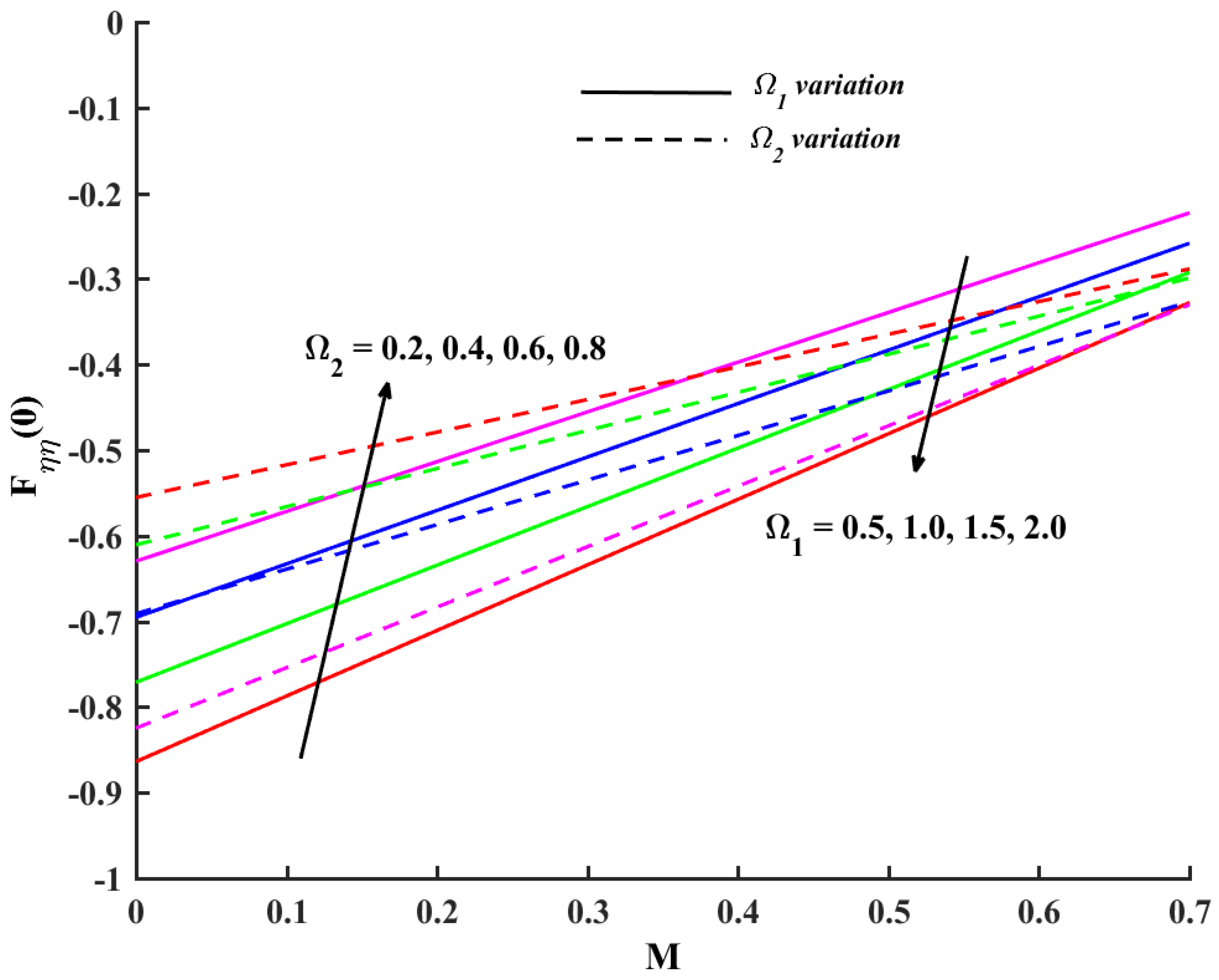
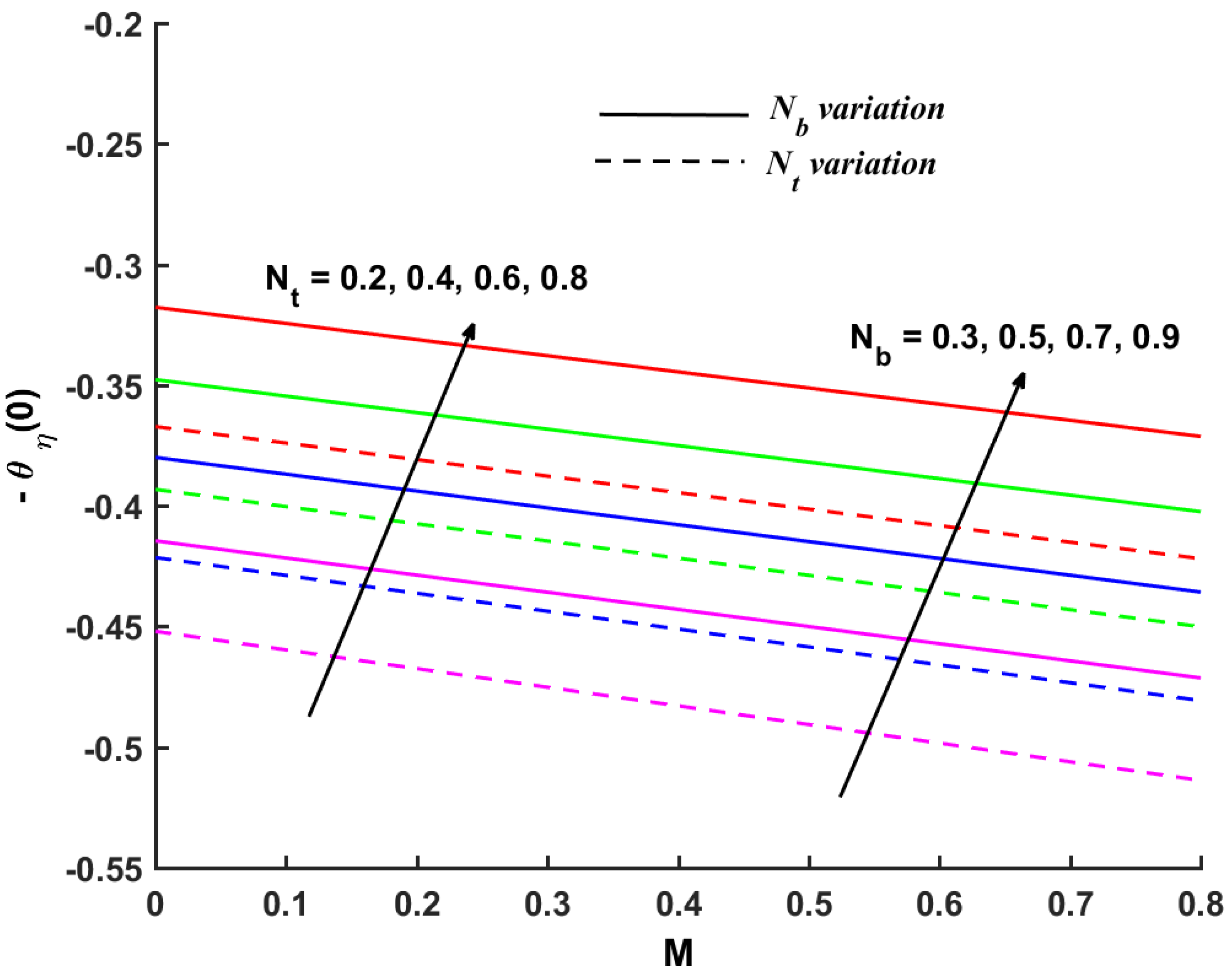
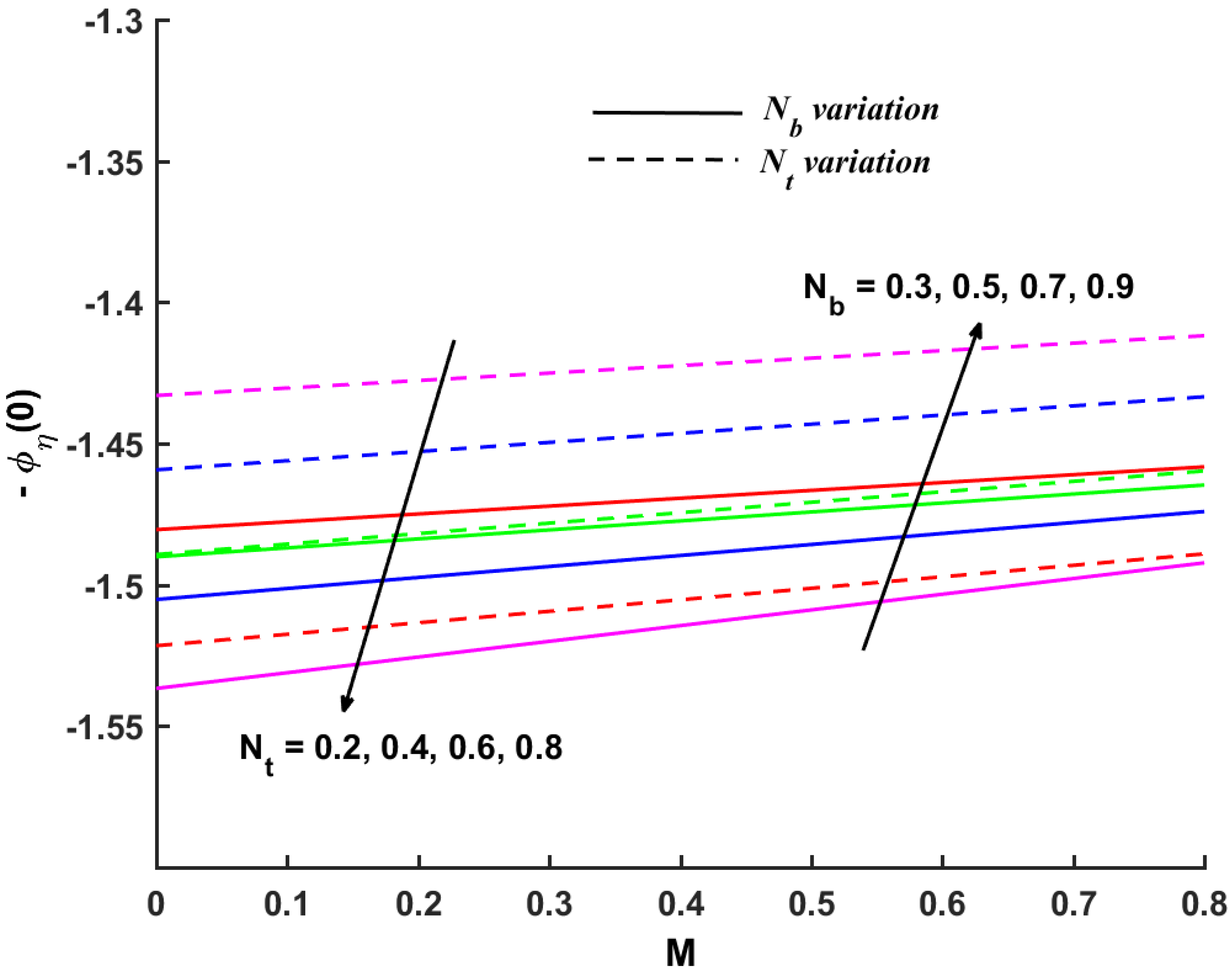
Figure 9 reveals the surface drag force Fηη(0) behavior or the skin friction characteristics in response to Deborah numbers Ω1 and Ω2 for different Hartmann number M . In this case Ω1 and Ω2 influence the wall shear stress in diagonally opposite manner. In this case, surface drag force slows down with increase in Ω1 while it escalates with rising Ω2 (opposite behavior is noticed). The skin friction is a decreasing function of Ω1 while it is an increasing function of Ω2 . Here we must note that these two Deborah numbers exhibit exactly opposite nature of fluid velocity. This is well observed in Mustafa et al. [31]. Figure 10 narrates how the Nusselt number varies in response to thermophoretic parameter Nt and Brownian motion parameter Nb against different values of Hartmann number M . A reduction in the absolute value of Nusselt number is accomplished due to elevating both Nt and Nb . This implicates that heat transfer rate gets diminution due to the influence of Brownian motion and thermophoresis mechanism. However, descending trend is more eye-catching due to the influence of Brownian motion. In fact, rise in thermophoresis parameter Nt improves the temperature profiles and the related layer thickness. As indicated in different literature, larger thermophoresis parameter indicates stronger thermophoretic force. Stronger thermophoretic force drags enormous nanoparticles through greater diffusion from the hot plate towards the ambient thereby increases the fluid temperature within the domain. An increase in Nb corresponds to the effective random motion of fluid particles generating more heat within the flow. Therefore temperature increases. Figure 11 delineates how the Sherwood number gets affected from the impact of Nt and Nb against different M . As a first step, by increasing Nt leads to a diminishing trend of mass transfer rate while that of Nb yields a reverse trend. This is because one can observe from diversified literature that increase in thermophoretic parameter Nt witnesses an up gradation of nanoparticles concentration while augmented Brownian motion parameter Nb shows a reverse trend. This is due to the fact that rising of Nt indicating strong thermophoretic force leading to larger diffusion of nanoparticles from the hot plate to the ambient fluid and as a result improves nanoparticles concentration profiles. On the other hand, the Brownian force due to Brownian motion makes the particles to move in opposite direction of the concentration gradient and makes the nanofluid more homogenous. Such force leads to low concentration gradient and more uniform nanoparticle concentration distribution. It is interesting to note that thermophoretic force strength due to Nt = 0.6 and Brownian force strength due to Nb = 0.7 contribute almost same mass transportation in the associated boundary layer.

5. Conclusion

There have been reports regarding the flow and heat transfer of Oldroyd-B nanofluid in view of relaxation-retardation viscous dissipation over a vertical stretched plate. This convenient research grows our insights into innumerable significant practical applications, for example production of plastic sheets and extrusion of polymer in polymer industry.
Enhancement of Deborah numbers Ω1 and Ω2 associated with relaxation time accounts for diminishing trend of fluid motion while that of Ω2 (Deborah number associated with retardation number) exhibit adverse behavior. More Hartmann number M indicating more Lorentz force yields diminutive fluid flow and escalates the fluid temperature. Deborah numbers Ω1 and Ω2 influence the wall shear stress in diagonally opposite manner for different Hartmann number M . Increasing thermophoretic force causes a diminution of mass transfer rate while a reverse situation is noticed for that of Brownian motion. Smaller thermophoretic force (small Nt ) and less Brownian motion subject to considerably high Prandtl fluids lead to the enhancement of heat transfer rate from the vertical stretched plate.
At last, it has been suggested that the present model can be adopted for entropy optimized three dimensional rotating flow problems, which will be a focus in our future work.
Ijtst 07 070104 i010

References

  1. Maxwell, J.C. On the dynamical theory of gases. Philos. Trans. R. Soc. 1867, 157, 49–88. [Google Scholar] [CrossRef]
  2. Oldroyd, J.G. On the formulation of rheological equations of state. Proc. R. Soc. Lond. Ser. A 1950, 200, 523–541. [Google Scholar] [CrossRef]
  3. Bhatnagar, R. K.; Gupta, G.; Rajagopal, K. R. Flow of an Oldroyd-B fluid due to a stretching sheet in the presence of a free stream velocity. Int. J. Non-Linear Mech. 1995, 30, 391–405. [Google Scholar] [CrossRef]
  4. Fetecau, C.; Fetecau, C. Decay of a potential vortex in an Oldroyd-B fluid. Int. J. Eng. Sci. 2005, 43, 340–351. [Google Scholar] [CrossRef]
  5. Sajid, M.; Abbas, Z.; Javed, T.; Ali, N. Boundary layer flow of an Oldroyd-B fluid in the region of a stagnation point over a stretching sheet. Canad. J. Phys. 2010, 88, 635 − 640. [Google Scholar] [CrossRef]
  6. Zheng, L.; Liu, Y.; Zhang, X. Exact solutions for MHD flow of generalized Oldroyd-B fluid due to an infinite accelerating plate. Math. Comput. Model 2011, 54, 780–788. 16. [Google Scholar] [CrossRef]
  7. Hayat, T.; Shehzad, S.A.; Alsaedi, A.; Alhuthali, M.S. Three-dimensional flow of an Oldroyd-B fluid over a surface with convective boundary conditions. Appl. Math. Mech. 2013, 34, 489–500. [Google Scholar] [CrossRef]
  8. Abbasbandy, S.; Hayat, T.; Alsaedi, A.; Rashidi, M. M. Numerical and analytical solutions for Falkner-Skan flow of MHD Oldroyd-B fluid. Int. J. Numer. Meth. Heat & Fluid Flow 2014, 24, 390–401. [Google Scholar]
  9. Jamil, M.; Fetecau, C.; Imran, M. Unsteady helical flows of Oldroyd-B fluids. Commun. Nonlinear Sci. Numer. Simul. 2011, 16, 1378–1386. [Google Scholar] [CrossRef]
  10. Fetecau, C.; Akhtar, W.; Imran, M.A.; Vieru, D. On the oscillating motion of an Oldroyd-B fluid between two infinite circular cylinders. Comput. Math.Appl 2010, 59, 2836–2845. [Google Scholar] [CrossRef]
  11. Hayat, T.; Imtiaz, M.; Alsaedi, A.; Almezal, S. On Cattaneo-Christov heat flux in MHD flow of Oldroyd-B fluid with homogeneous-heterogeneous reactions. J. Magnet. Magn. Mater. 2016, 401, 296–303. [Google Scholar] [CrossRef]
  12. Hayat, T.; Waqas, M.; Shehzad, A.; Alsaedi, A. On 2D stratified flow of an Oldroyd-B fluid with chemical reaction: An application of non-Fourier heat flux theory. J. Mol. Liq. 2016, 223, 566–571. [Google Scholar] [CrossRef]
  13. Hayat, T.; Qayyum, S.; Alsaedi, A.; Waqas, M. Simultaneous influences of mixed convection and nonlinear thermal radiation in stagnation point flow of Oldroyd-B fluid towards an unsteady convectively heated stretched surface. J. Mol. Liq. 2016, 224, 811–817. [Google Scholar] [CrossRef]
  14. Zhang, Y.; Zhang, M.; Bai, Y. Flow and heat transfer of an Oldroyd-B nanofluid thin film over an unsteady stretching sheet. J. Mol. Liq. 2016, 220, 665–670. [Google Scholar] [CrossRef]
  15. Choi, S.U.S. Enhancing thermal conductivity of fluids with nanoparticles. ASME Fluids Eng. Division 1995, 231, 99–105. [Google Scholar]
  16. Xuan, Y.; Li, Q. Investigation on convective heat transfer and flow features of nanofluids. J. Heat Transfer 2003, 125, 151–155. [Google Scholar] [CrossRef]
  17. Buongiorno, J. Convective Transport in Nanofluids. Journal of Heat Transfer 2006, 128, 241–250. [Google Scholar] [CrossRef]
  18. Khan, W.; Pop, I. Boundary-layer flow of a nanofluid past a stretching sheet. Int. J. Heat Mass Transf. 2010, 53, 2477–2483. [Google Scholar] [CrossRef]
  19. Hayat, T.; Imtiaz, M.; Alsaedi, A. Boundary layer flow of Oldroyd-B fluid by exponentially stretching sheet. Appl. Math. Mech. 2016, 37, 573–582. [Google Scholar] [CrossRef]
  20. Shivakumara, I.S.; Dhananjaya, M.; Ng, C. Thermal convective instability in an Oldroyd-B nanofluid saturated porous layer. Int. J. Heat Mass Transf. 2015, 84, 167–177. [Google Scholar] [CrossRef]
  21. Nayak, M K. MHD 3D flow and heat transfer analysis of nanofluid by shrinking surface inspired by thermal radiation and viscous dissipation. Int. J Mech. Sci. 2017, 124-125, 185–193. [Google Scholar] [CrossRef]
  22. Nayak, M.K.; Shaw, S.; Pandey, V.S.; Chamkha, A.J. Combined effects of slip and convective boundary condition on MHD 3Dstretched flow of nanofluid through porous media inspired by non-linear thermal radiation. Indian J Phys. [CrossRef]
  23. Nayak, M.K.; Akbar, N.S.; Pandey, V.S.; Khan, Z.H.; Tripathi, D. 3D free convective MHD flow of nanofluid over permeable linear stretching sheet with thermal radiation. Powder Technol. 2017, 315, 205–215. [Google Scholar] [CrossRef]
  24. Ghadikolaei, S.S.; Hosseinzadeh, K.; Ganji, D.D.; Hatami, M. Fe3O4–(CH2OH)2 nanofluid analysis in a porous medium under MHD radiative boundary layer and dusty fluid. J. Mol. Liq. 2018, 258, 172–185. [Google Scholar] [CrossRef]
  25. Hayat, T.; Muhammad, T.; Shehzad, S.A.; Alsaedi, A. An analytical solution for magnetohydrodynamic Oldroyd-B nanofluid flow induced by a stretching sheet with heat generation/absorption. Int. J. Ther. Sci. 2017, 111, 274–288. [Google Scholar] [CrossRef]
  26. Khan, M.; Hafeez, A.; Ahmed, J. Impacts of non-linear radiation and activation energy on the axisymmetric rotating flow of Oldroyd-B fluid. Phys. A: Stat. Mech.Appl 2020, 124085. [Google Scholar] [CrossRef]
  27. Mahanthesh, B.; Gireesha, B.J.; Shehzad, S.A.; Abbasi, F.M.; Gorla, R.S.R. Nonlinear three- dimensional stretched flow of an Oldroyd-B fluid with convective condition, thermal radiation, and mixed convection. Appl. Math. Mech. Eng. Edi 2017, 38, 969–98. [Google Scholar] [CrossRef]
  28. Kumar, K.G.; Ramesh, G.K.; Gireesha, B.J.; Gorla, R.S.R. Characteristics of Joule heating and viscous dissipation on three-dimensional flow of Oldroyd B nanofluid with thermal radiation. Alex. Eng. J. 2018, 57, 2139–2149. [Google Scholar] [CrossRef]
  29. Nayak, M.K. Chemical reaction effect on MHD viscoelastic fluid over a stretching sheet through porous medium. Meccanica 2016, 51, 1699–1711. [Google Scholar] [CrossRef]
  30. Zhang, Y.; Yuan, B.; Bai, Y.; Cao, Y.; Shen, Y. Unsteady Cattaneo-Christov double diffusion of Oldroyd-B fluid thin film with relaxation-retardation viscous dissipation and relaxation chemical reaction. Powder Technol. [CrossRef]
  31. Mustafa, M.; Hayat, T.; Alsaedi, A. Rotating flow of Oldroyd-B fluid over stretchable surface with Cattaneo-Christov heat flux: analytic solutions. Int J of Num Meth Heat Fluid Flow. [CrossRef]
  32. Hayat, T.; Qayyum, S.; Shehzad, S. A.; Alsaedi, A. Magnetohydrodynamic three-dimensional nonlinear convection flow of Oldroyd-B nanoliquid with heat generation/absorption. [CrossRef]
  33. Abel, M. S.; Tawade, J. V.; Nandeppanavar, M. M. MHD flow and heat transfer for the upper- convected Maxwell fluid over a stretching sheet. Meccanica 2012, 47, 385–93. [Google Scholar]
  34. Megahed, A.M. Variable fluid properties and variable heat flux effects on the flow and heat transfer in a non-Newtonian Maxwell fluid over an unsteady stretching sheet with slip velocity. Chin Phys B 2013, 22, 701–711. [Google Scholar] [CrossRef]
  35. Waqas, M.; Ijaz Khan, M.; Hayat, T.; Alsaedi, A. Stratified flow of an Oldroyd-Bnanoliquid with heat generation. Results in Physics 2017, 7, 2489–2496. [Google Scholar] [CrossRef]
Figure 1. Flow geometry and the associated coordinate system of the problem.
Ijtst 07 070104 g001
Figure 2. Influence of Deborah number for relaxation time Ω1 on velocity Fη(η).
Ijtst 07 070104 g002
Figure 3. Influence of Deborah number for retardation time Ω2 on velocity Fη(η).
Ijtst 07 070104 g003
Figure 4. Influence of Hartmann number M on Fη(η).
Ijtst 07 070104 g004
Figure 5. Influence of Prandtl number Pr on temperature θ(η).
Ijtst 07 070104 g005
Figure 6. Inflence of modified Eckert number Ecm on θ(η).
Ijtst 07 070104 g006
Figure 7. Influence of Hartmann number M on θ(η).
Ijtst 07 070104 g007
Figure 8. Influence of Scmidt number Sc on ϕ(η).
Ijtst 07 070104 g008
Figure 9. Influence of Ω1 and Ω2 on skin friction against M.
Ijtst 07 070104 g009
Figure 10. Influence of Nt and Nb on Nusselt number against M.
Ijtst 07 070104 g010
Figure 11. Influence of Nt and Nb on Sherwood number against M.
Ijtst 07 070104 g011
Table 1. Comparison of Fηη(0) for different values of Ω1 for Ω2 = ϵ = Z = δ = 0.
Ω1Abel et al. [33]Megahed [34]Waqas [35]Present Work
0.01.0000000.9999781.0000001.00000000
0.21.0519481.0519451.0518891.05188988
0.41.1018501.1018481.1019031.10185163
0.61.1501631.1501601.1501371.15016093
0.81.1966921.1966901.1967111.19669083
1.21.2852571.2852531.2853631.28525740
1.61.3686411.3686411.3687581.36878678
2.01.4476171.4476161.4476511.44761469