Next Article in Journal
Mass Transfer Effects on MHD Flow through Porous Medium past an Exponentially Accelerated Inclined Plate with Variable Temperature and Thermal Radiation
Previous Article in Journal
The Effects of Thermocapillarity on the Thin Film Flow of MHD UCM Fluid over an Unsteady Elastic Surface with Convective Boundary Conditions
 
 
International Journal of Thermofluid Science and Technology is published by MDPI from Volume 13 Issue 1 (2026). Previous articles were published by another publisher in Open Access under a CC-BY (or CC-BY-NC-ND) licence, and they are hosted by MDPI on mdpi.com as a courtesy and upon agreement with the previous journal publisher.
Article

Influence of non-uniform heat source/sink and variable viscosity on mixed convection flow of third grade nanofluid over an inclined stretched Riga plate

1
Department of Physics, IHSE, Siksha “O” Anusandhan Deemed to be University, Bhubaneswar-751003, Odisha, India
2
Department of Mathematics, Sri Ramakrishna Mission Vidyalaya College of Arts and Science, Coimbatore - 641020, India
*
Author to whom correspondence should be addressed.
Int. J. Thermofluid Sci. Technol. 2019, 6(4), 060401; https://doi.org/10.36963/IJTST.19060401
Submission received: 10 May 2019 / Revised: 8 August 2019 / Accepted: 1 October 2019 / Published: 20 November 2019

Abstract

The present study focuses on the impact of non-uniform heat source/sink and temperature dependent viscosity modeled by Reynolds on Cattaneo-Christov heat flow of third grade nanofluid subject to an inclined stretched Riga plate. Fourth order R-K and shooting methods have been implemented to obtain the numerical solution of the transformed boundary layer equations. The achievability of the present study is that the material constants associated with third grade fluid augment the fluid motion and boils down the fluid temperature leading to ascending velocity boundary layer and descending thermal boundary layer. And viscosity parameter enhances the heat transfer rate from the plate. Furthermore, augmented space and temperature dependent heat source upsurges the fluid temperature and the related thermal boundary layer thickness.

1. Introduction

It was the time when the World was looking forward to greater research contributions from across the Globe; Choi et al. [1] played an important role in discovering experimentally the concept of nanofluids. Nanofluids are the novel type fluids that contain nanoparticles, such as metals, oxides, carbides, and nitrides, with sizes less than 100 nm have higher thermal conductivity compared to that of the conventional base fluid, such as water, engine oil, and ethylene. Such extraordinary characteristics of nanofluids (fluids with more heat transfer capability) make them potentially useful to serve as better coolant in nuclear reactor, micro manufacturing, refrigeration, automotives, heat exchangers, aircrafts and space applications and other high energy devices, antibacterial treatment, wound treatment, asthma treatment, targeted drug release/drug delivery [2,3,4,5,6,7,8,9,10,11,12,13,14,15,16,17,18,19,20,21,22].
Looking at the Riga-plate arrangement it produces a Lorentz force of exponentially decaying nature which induces the flow over the plate. Pantokratoras and Magyari [23] were the pioneers to study electro-magnetohydrodynamic flow over a horizontal Riga plate. Later, Ahmad et al. [24] studied the flow of nanofluid past a Riga plate considering the influence of nanoparticles size on skin friction. Hakeem et al. [25] investigated the impact of exponentially variable viscosity and permeability on Blasius flow of Carreu nanofluid over an electromagnetic plate.
In fact, third grade fluid imparts features such as normal stresses and shear thinning/shear thickening phenomena. Examples of such fluids are molten plastics, slurry flows, highly viscous silicon oils and dilute polymer solutions and many more. Hayat et al. [26] explored in their investigation that velocity field disparages with enhancing of melting parameter and reducing wall thickness parameter. The deviations of flow variables for third-grade fluid are significant compared to the Newtonian fluid flow (Ready et al. [27]).
The interesting aspect of CCHF model is that thermal relaxation was added to Fourier’s law by Cattaneo [28]. The Cattaneo’s model was further improved by Christov [29] after which this model is known as CCHF model. Augmentation in thermal relaxation time contributes to low temperature (Imtiaz et al. [30]). Hayat and Nadeem [31] declared in their study that the heat source/sink that exerts strong influence on HTR associated with the TBL. Heat source/sink alters the HTR and thereby changes the structure of TBL. The fluid temperature and wall shear stress increase due to increase in heat source/sink parameter in stagnation point flow past stretching sheet (Sharma et al. [32]).
In brief, the present study is clearly meant for exploring the effects of non-uniform heat source/sink and temperature dependent variable viscosity on the flow of third grade nanofluid flow over an inclined Riga plate. Further, CCHF model is invoked to obtain the behavior of relaxation time. An appropriate numerical solution of the developed similarity transferred coupled non-linear differential equations has been devised by using fourth order R-K method through shooting technique. The influence of various significant emerging parameters concerned presented through appropriate graphs and discussion.

2. Formulation of the problem

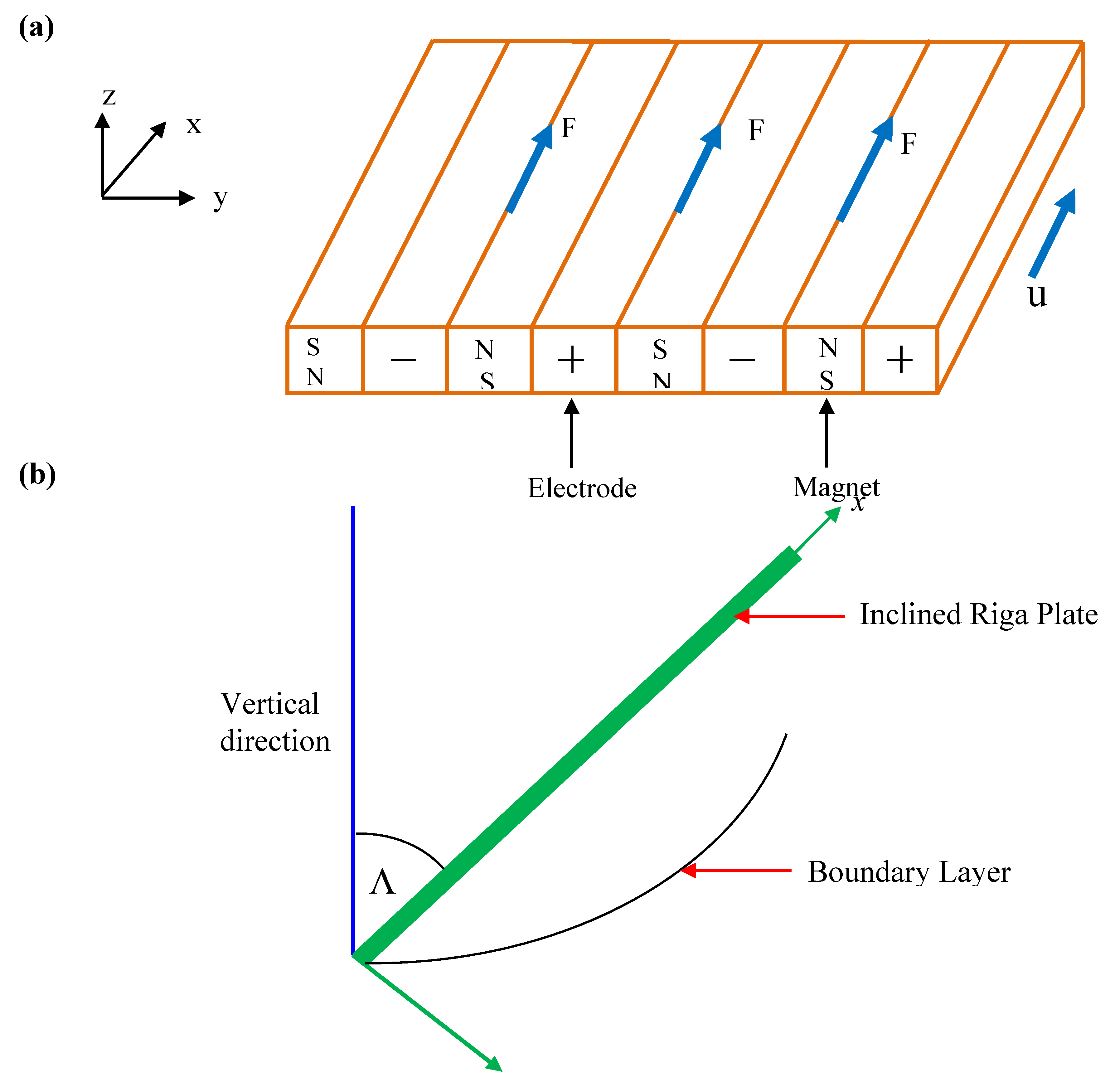
In the current study, we consider the steady incompressible flow of third grade nanofluid over an inclined stretched Riga-plate. A Cartesian coordinate system is chosen such that x-axis is along the plate and y-axis is normal to it (Figure 1). The plate is stretched by equal and opposite forces with velocity Uw (x) = ax . Electromagnetic field of the Riga-plate induces an exponentially descending Lorentz force parallel to the plate surface.
The equations of continuity, momentum and energy governing the flow of third grade nanofluid in the presence of non-uniform heat source/sink are [8,14,26,31]:
Ijtst 06 060401 i001
Figure 1. Flow configuration and coordinate system.
Ijtst 06 060401 g001
Ijtst 06 060401 i002
According to CCHF theory, we reveal [13]:
Ijtst 06 060401 i003
where λ is the relaxation time of heat flux/thermal relaxation of the fluid, V is the velocity vector and q is the heat flux. It is the time taken for the shear stress in a viscoelastic material to reduce 1/e of its initial value.
Setting λ = 0 in eq (5), classical Fourier’s law can be obtained. Considering the flow as steady Ijtst 06 060401 i017 and incompressible (∇.V = 0), eq (5) takes the form
q + λ (V.∇qq.∇V) = −kT
The energy equation then becomes
Ijtst 06 060401 i004
According to Grinberg [33], the force density averaged over the span wise coordinate z takes the form
Ijtst 06 060401 i005
Hence, Ijtst 06 060401 i018 is the Grinberg term of the momentum equation (2) which does not depend upon the flow velocity.
The requisite boundary conditions are:
Ijtst 06 060401 i006
The non-uniform heat sourc/sink is expressed as
Ijtst 06 060401 i007
Where Q0 and Q1 are the coefficients of space and temperature dependent heat source/sink respectively. The case Q0 > 0 and Q1 > 0 contributing internal heat generation while Q0 < 0 and Q1 < 0 contribute internal heat absorption.
The suitable transformations employed for the purpose are:
Ijtst 06 060401 i008
Where U = Uw +U∞ is the composite velocity. The incompressibility condition is satisfied. According to Reynolds model, the expression for temperature dependent viscosity is
Ijtst 06 060401 i009
which can be expressed as
μf(θ) = μ0 [1− () + o (m2 )]
With the help of eqs (9), (10) and (12) and neglecting higher order terms in eq. (12) and using the resulting expression, eqs (2), (4), (7) and (8) take the form:
Ijtst 06 060401 i010
Ijtst 06 060401 i011
The local skin friction coefficient
Ijtst 06 060401 i012
Where Ijtst 06 060401 i019 denotes the wall shear stress.
The non-dimensional local skin friction coefficient
Ijtst 06 060401 i013
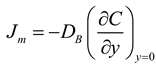
with Ijtst 06 060401 i020 denotes the wall mass flux.
The non-dimensional local Sherwood number
Ijtst 06 060401 i014

3. Numerical Methodology

The system of equations (13) – (15) together with the equation (16) are solved by using 4th order RK method along with shooting technique. A relevant short logic diagram depicting the algorithm of the solution is mentioned below.
Ijtst 06 060401 i015

4. Results and Discussion

The present study primarily focuses on the effect of non-uniform heat source/sink and variable viscosity on mixed convection CCHF of TGNF over an inclined stretched Riga plate. An appropriate numerical solution of the transformed governing equations is obtained. The values of the parameters considered for the present simulation are: Ω1 = Ω2 = Ω3 = 0.1, λc = λT = 0.3, ϒ = 0.1 , Λ = 45°, m = 0.5, δ = 0.2, Γ= 0.1, ε = 0.6 Pr = 1, Nb = Nt = 0.5, Q0 = Q1 = 0.1 and Le = 0.5 . The present analysis imparts well exploration regarding the effects of different pertinent parameters on velocity, temperature, concentration, skin friction and Sherwood number profiles through suitable graphical representation and pretty discussion.
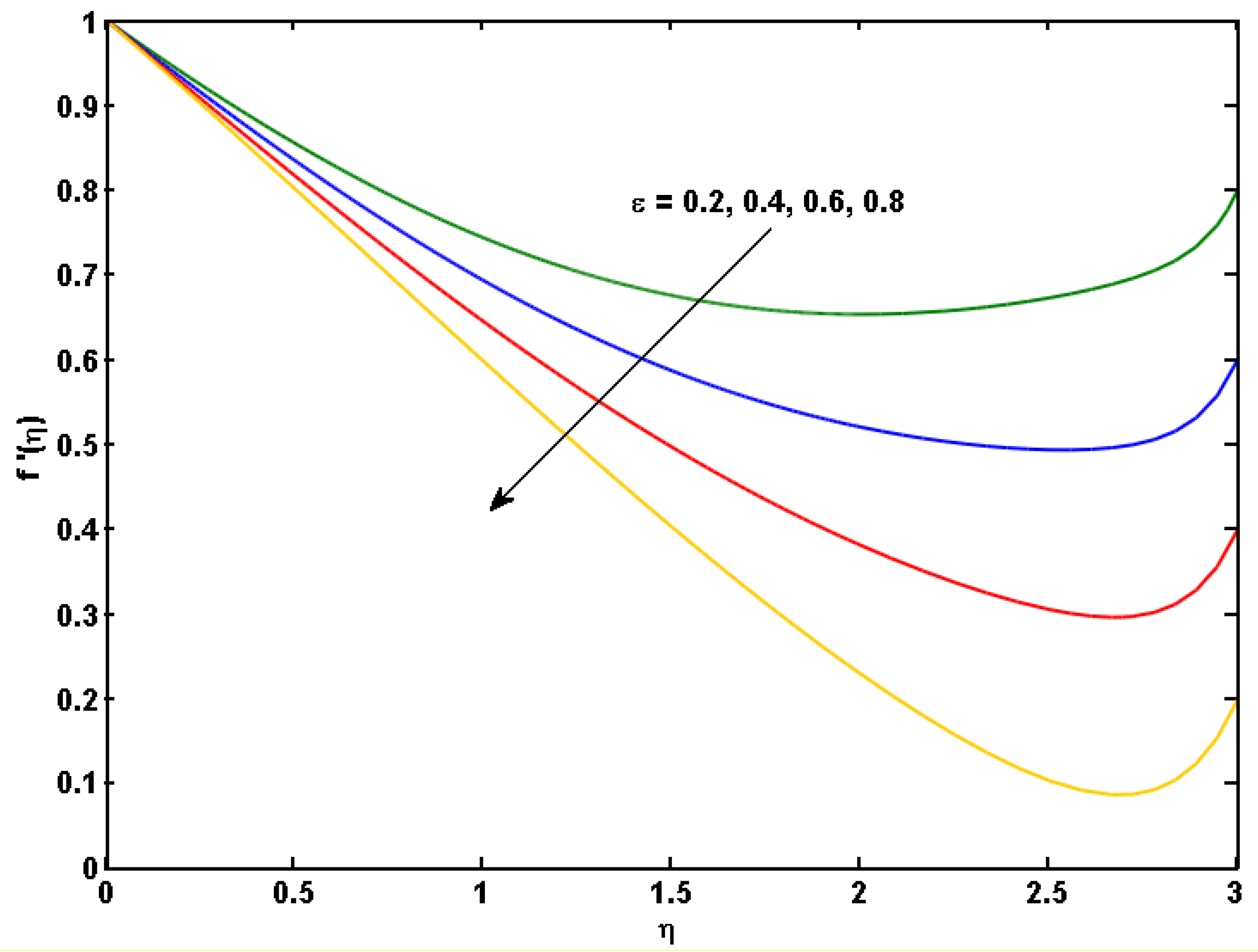
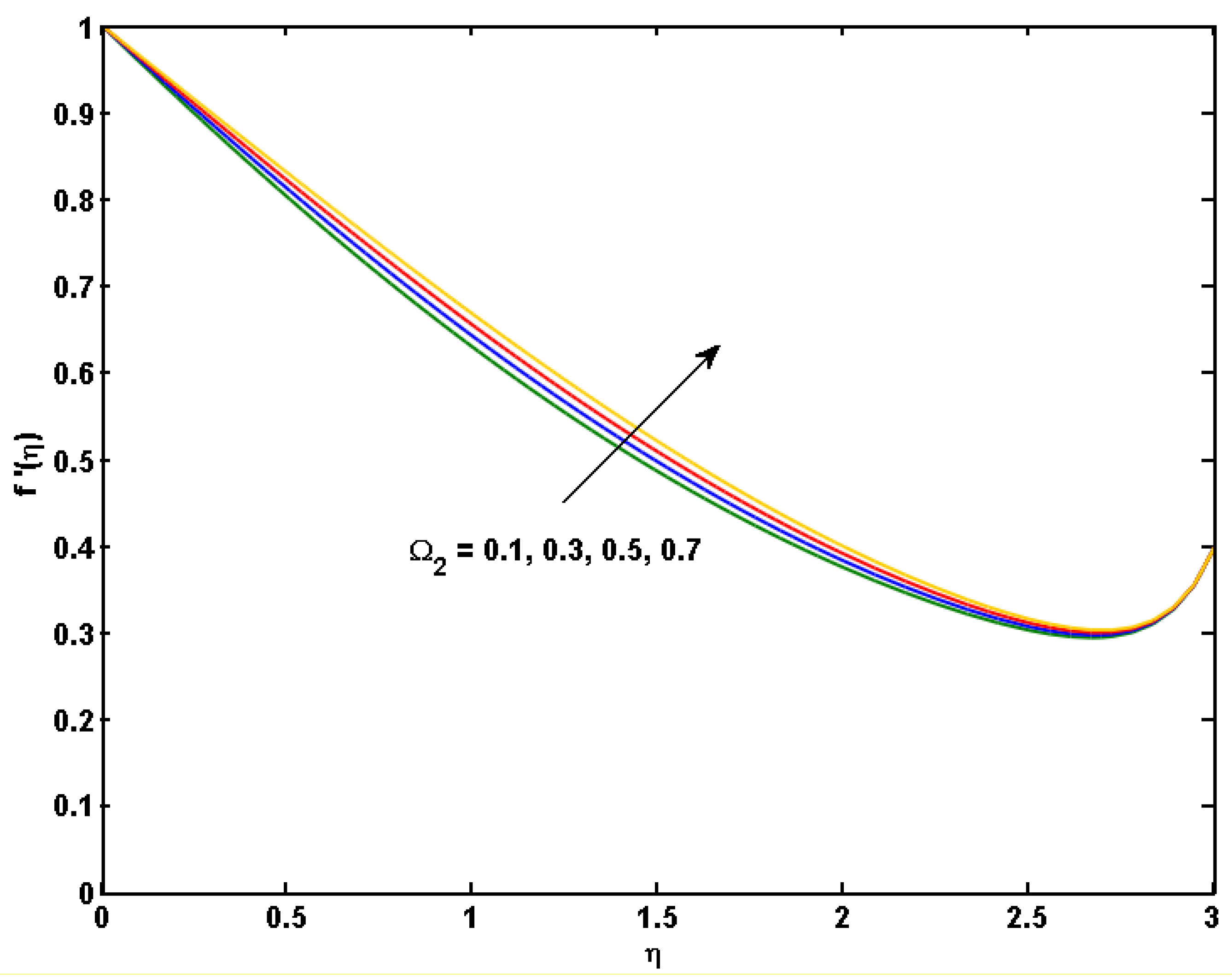
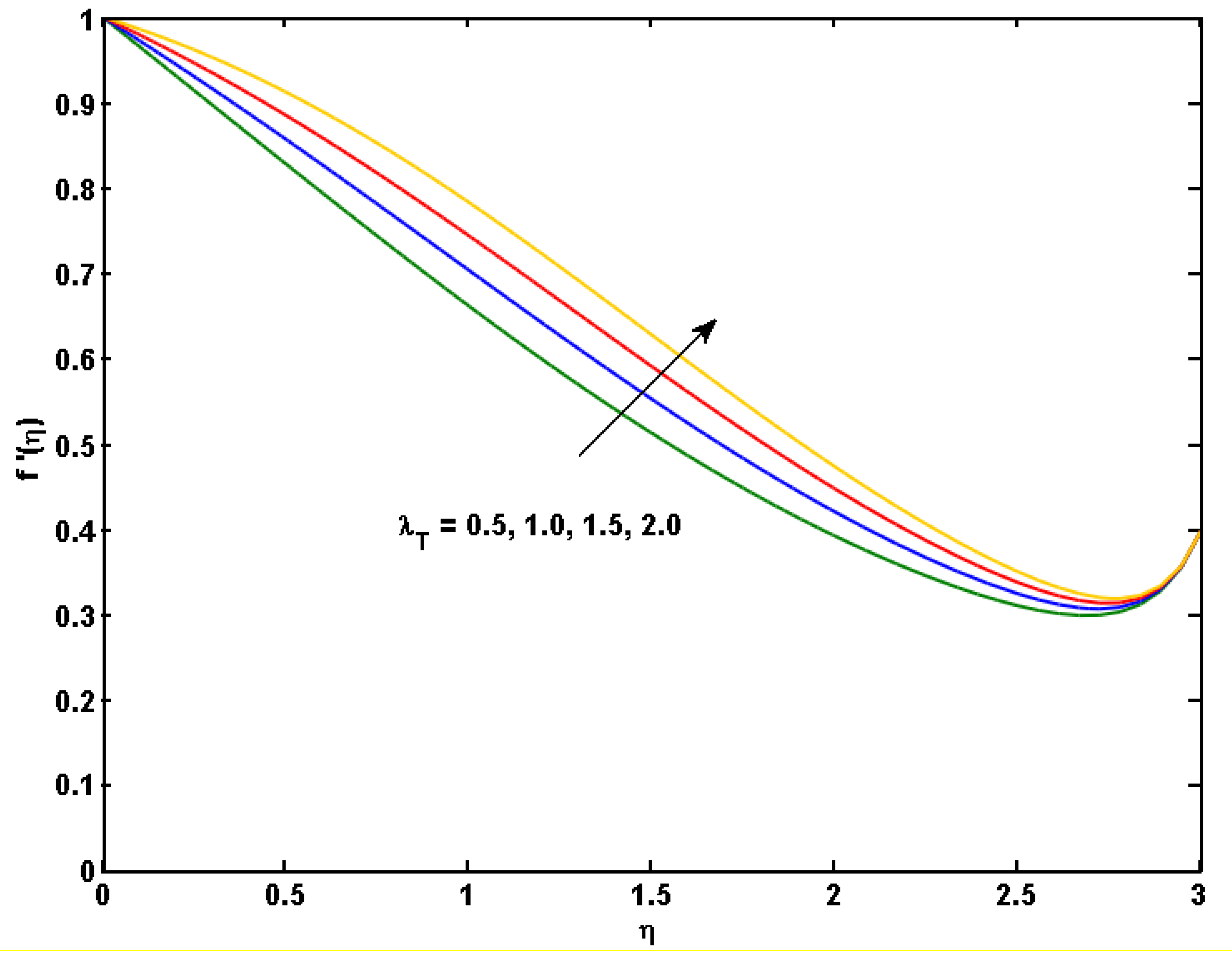
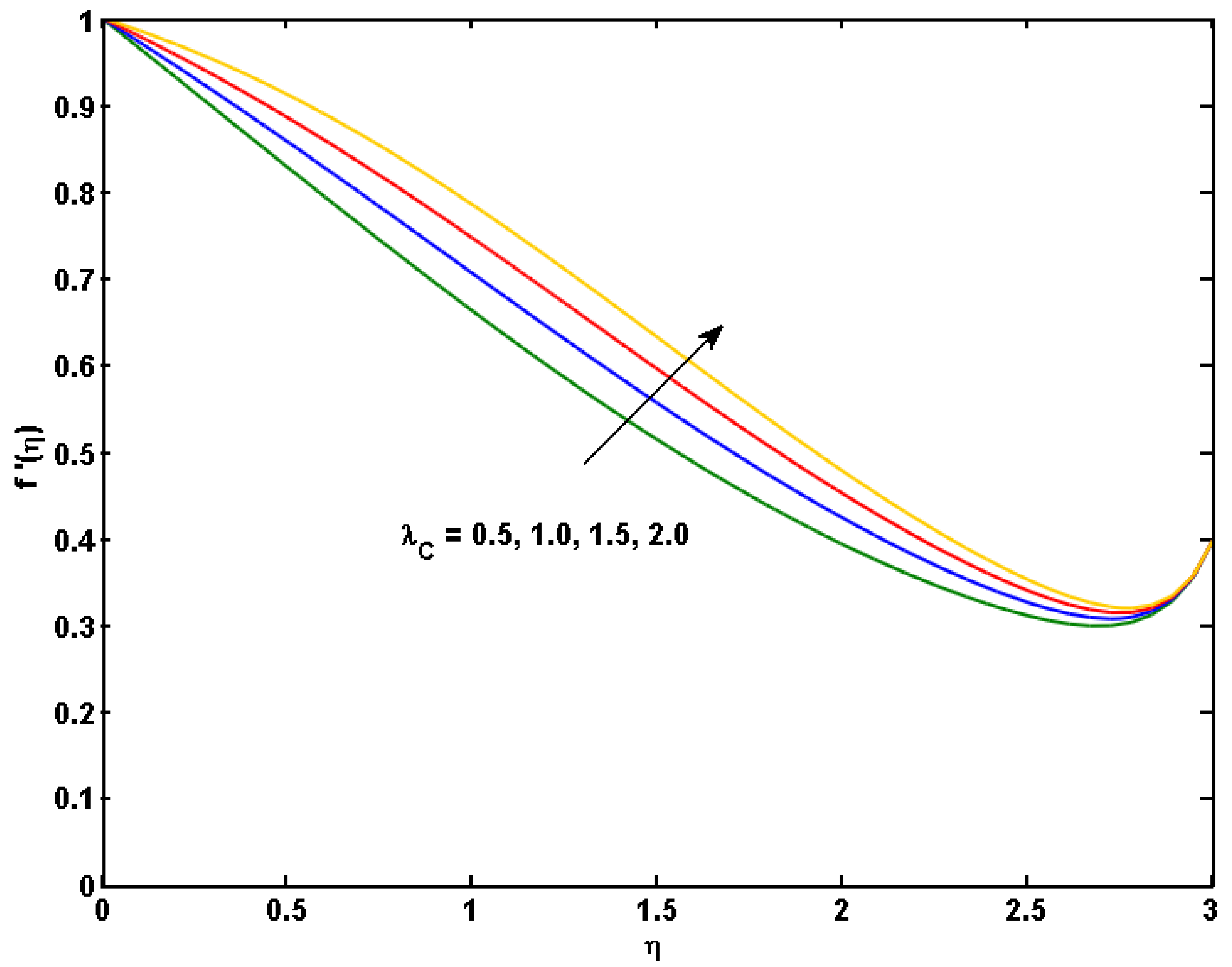
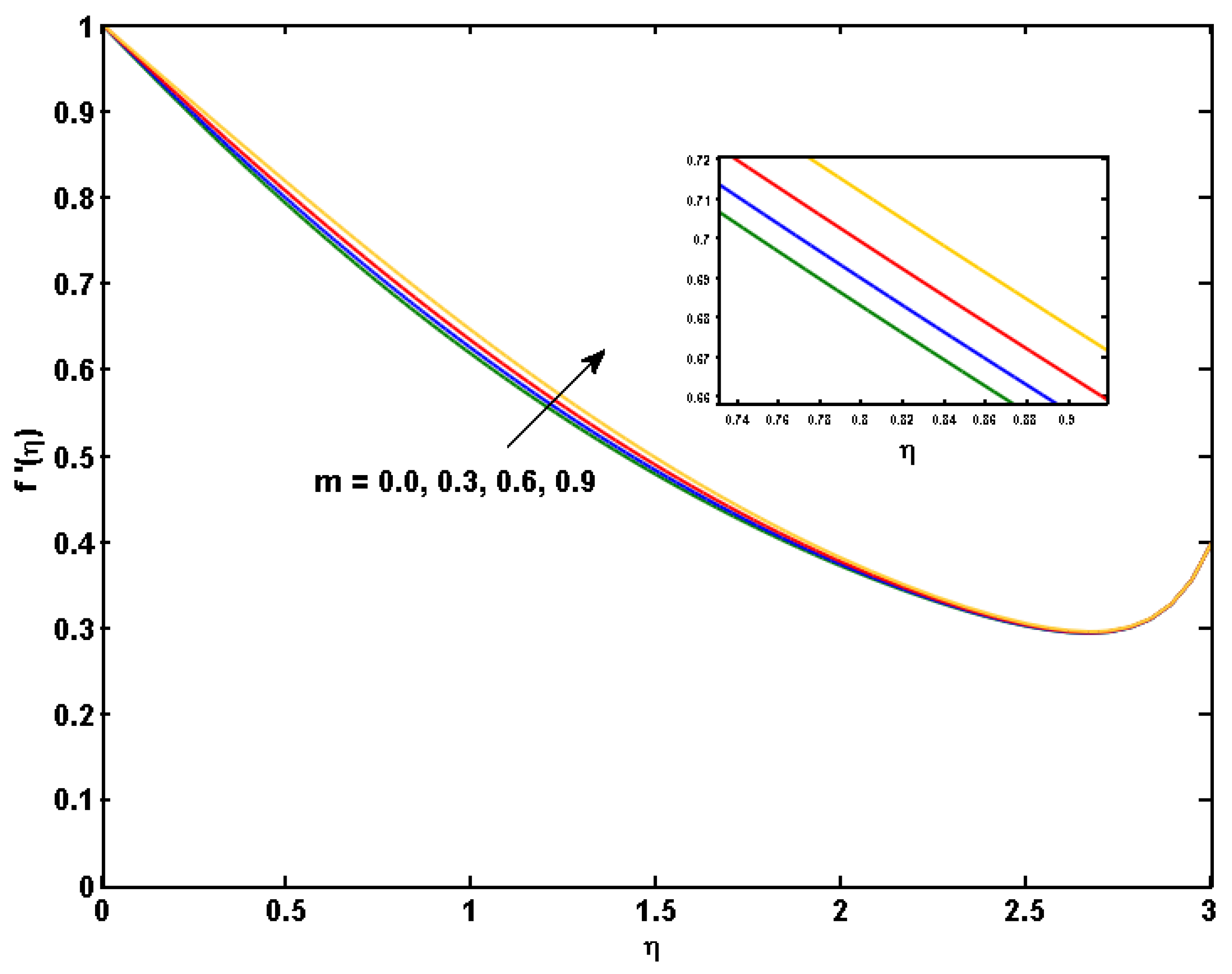
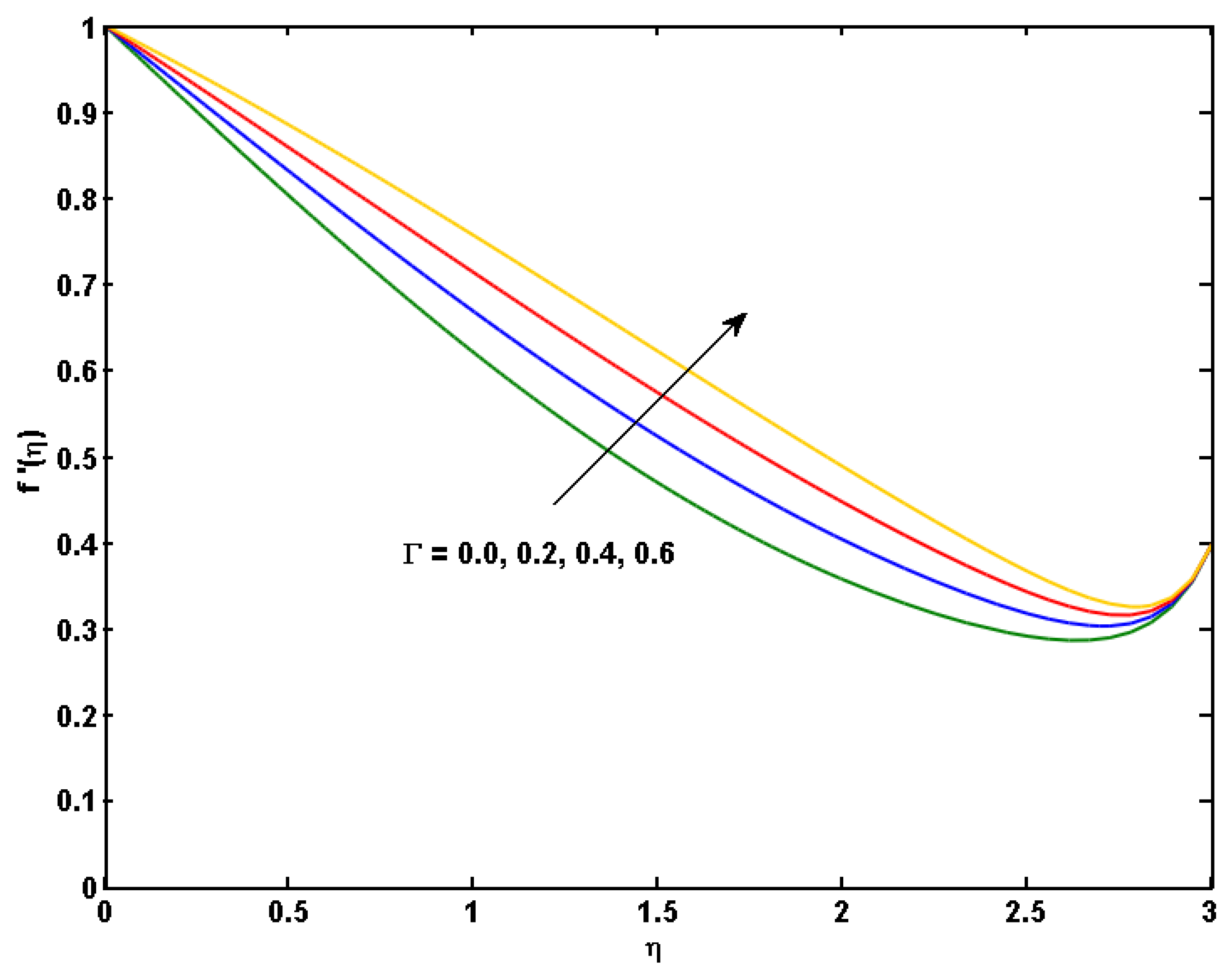
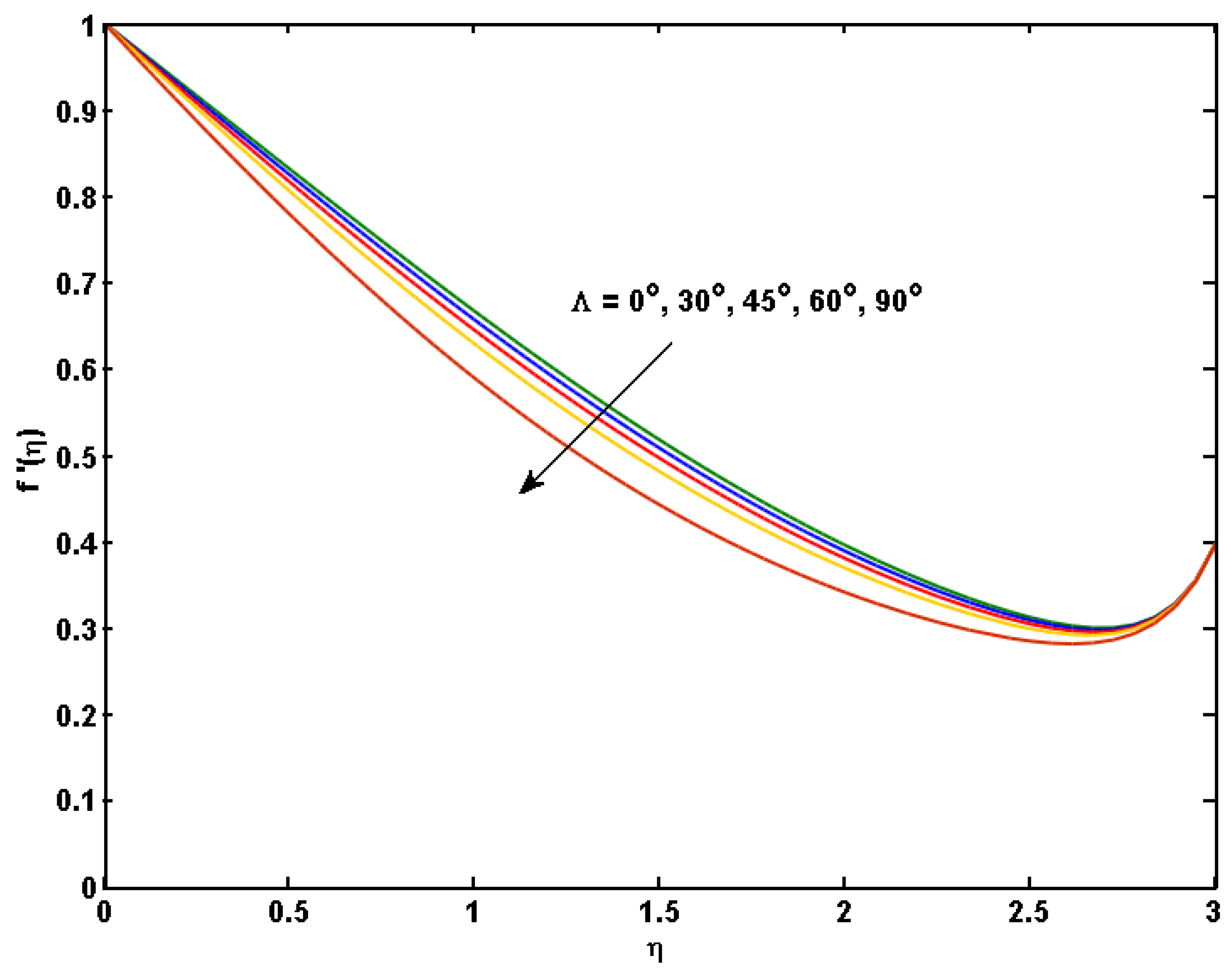
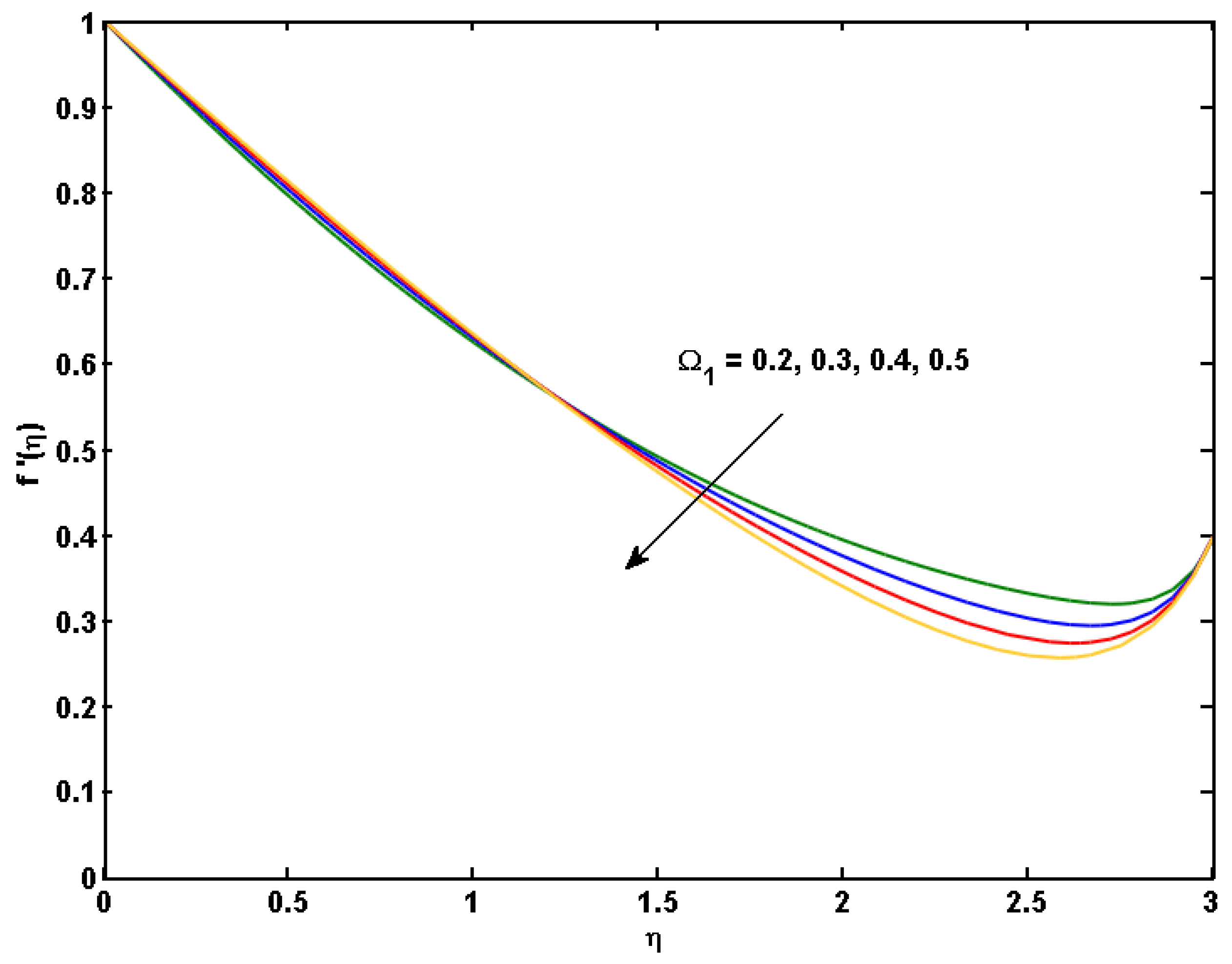
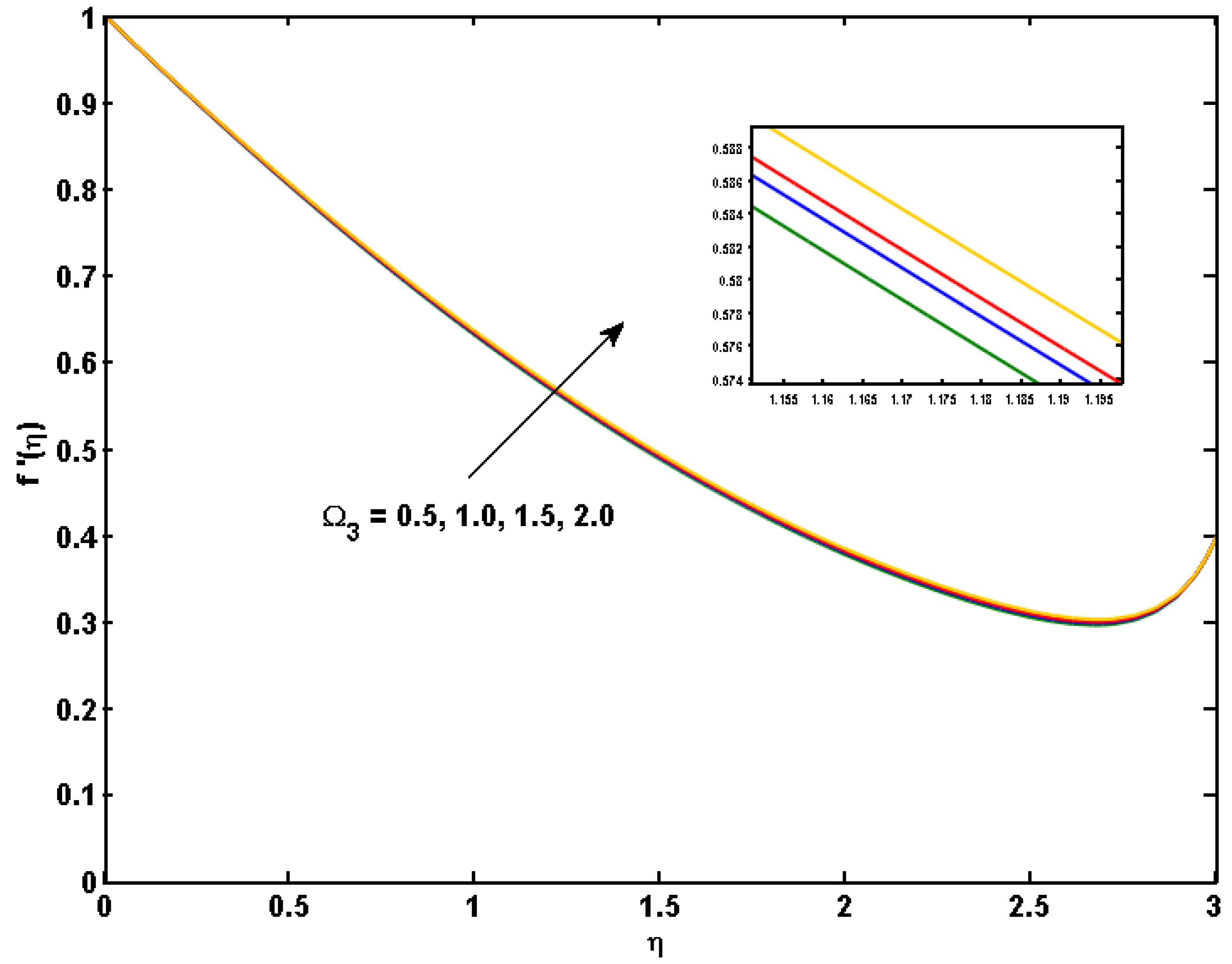
Figure 2 and Figure 3 bring to the focus the behavior of λT and λC on fluid velocity. It is noticed that an accelerated fluid motion takes place due to enhancement in λT and λC which in turn establishes thicker MBLs in the respective flow domains. Figure 4 reveals that an augmented m contributes to the accelerated fluid motion giving rise to the same environment that due to the presence of thermal and solutal buoyancies. The fundamental reason behind this ascending trend is that viscous force dominates over the inertial force. Increasing values of Γ yields the rising flow contributing to high wall velocity gradient (Figure 5). For the more and more the angle of inclination of the plate, VBL thickness gets reduced (Figure 6). As ε rises, the flow diverges from the plate towards the ambient fluid with gradually more descending trend (Figure 7). Figure 8, Figure 9 and Figure 10 portray the influence of Ω1, Ω2 and Ω3 on velocity profiles respectively. Fluid velocity gets diminution near the plate within the range (0 ≤ η ≤ 0.5) and it shows a reverse trend followed by a transition at η = 1.5 under the impact of increasing Ω1 . Indeed, material parameters are inverse relation to viscosity. That is why increase in Ω2 and Ω3 belittles the fluid viscosity thereby favors the fluid motion.
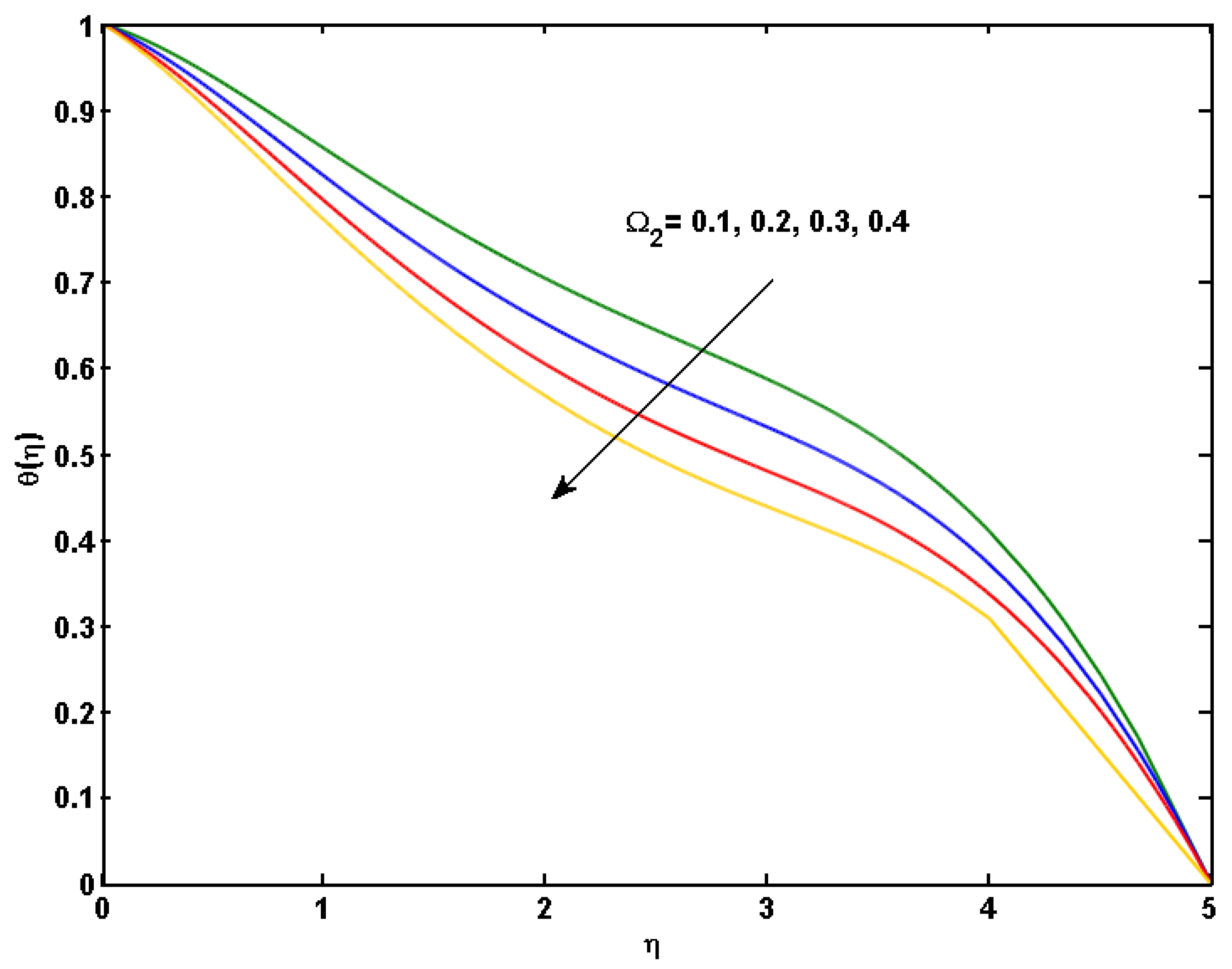
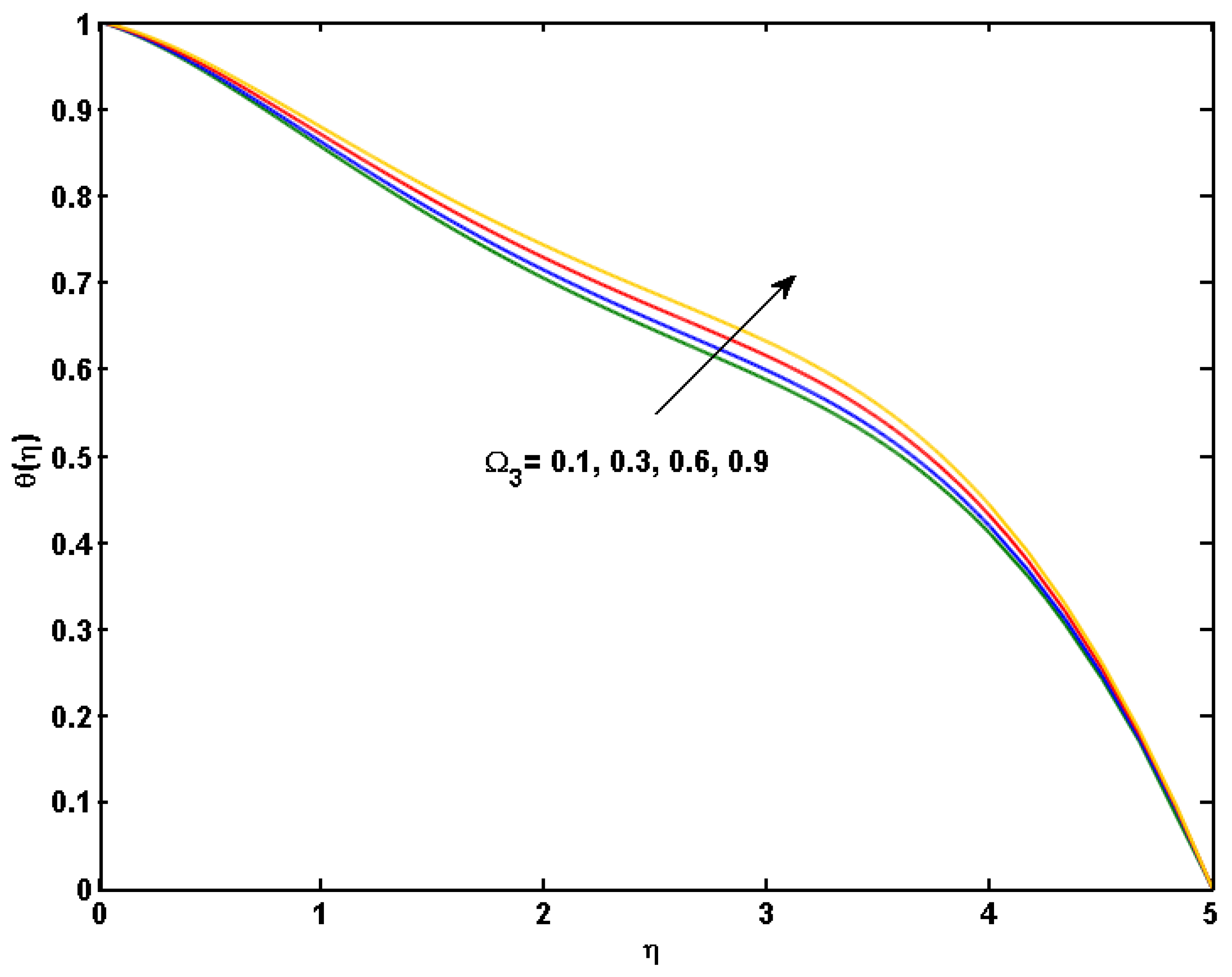
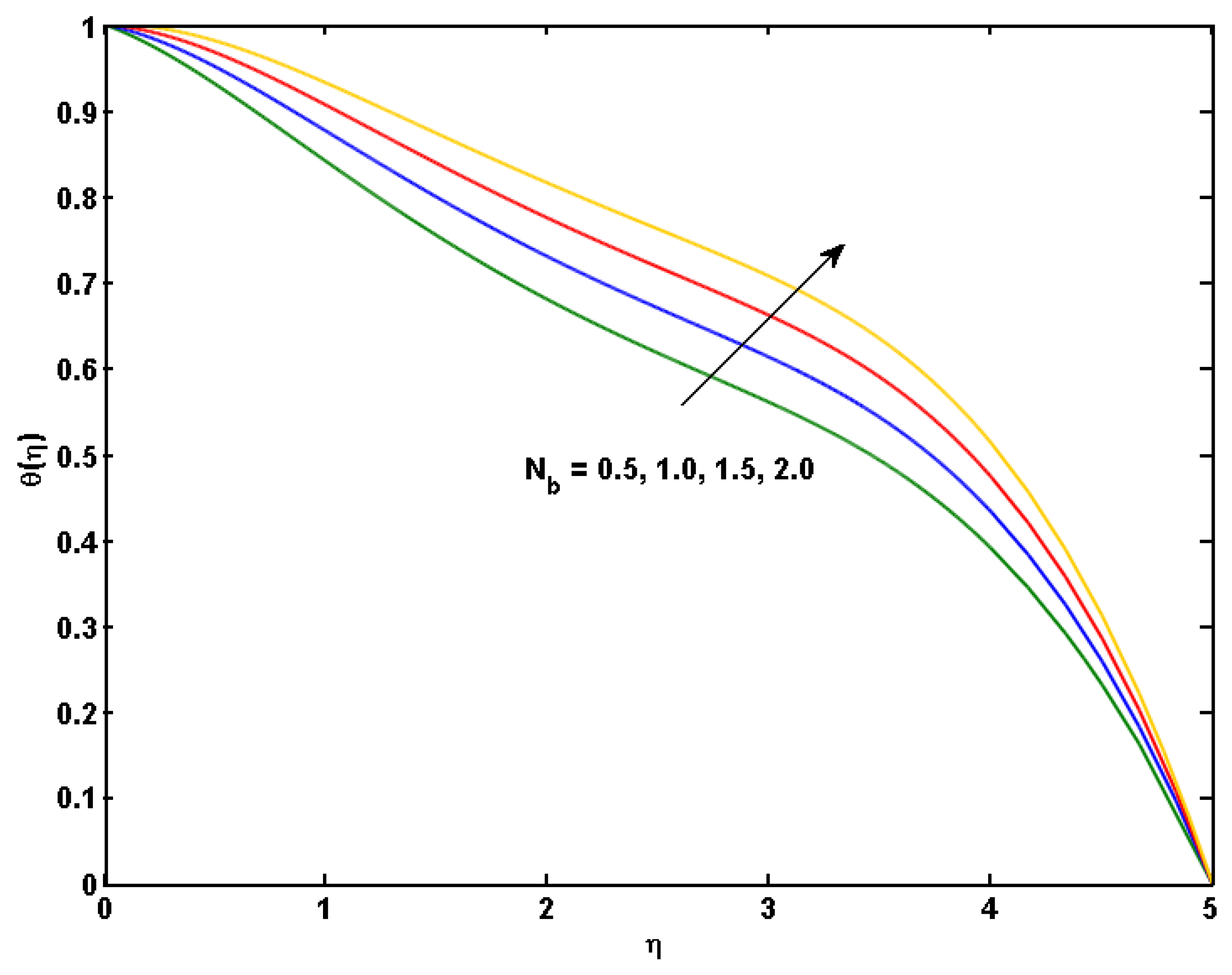
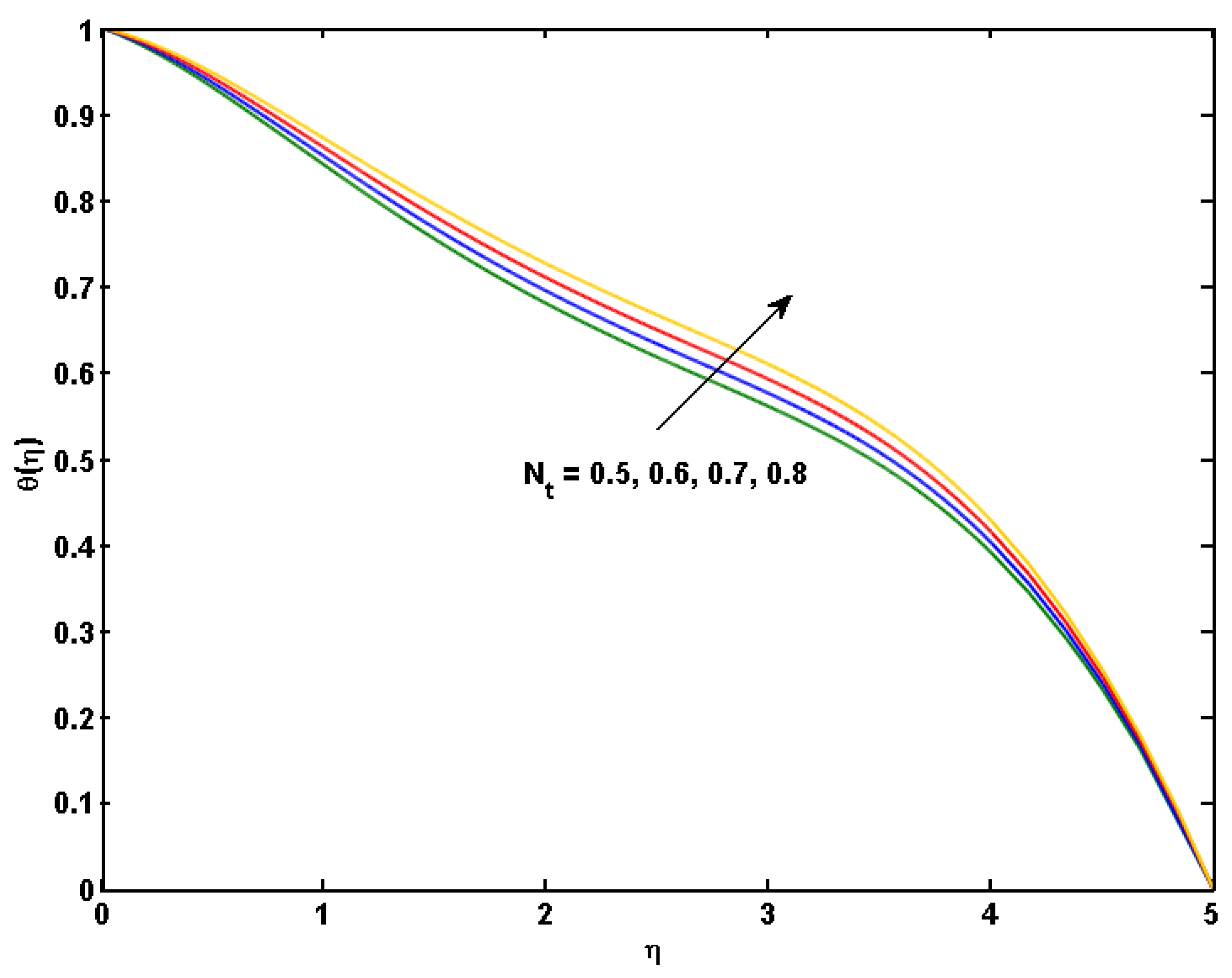
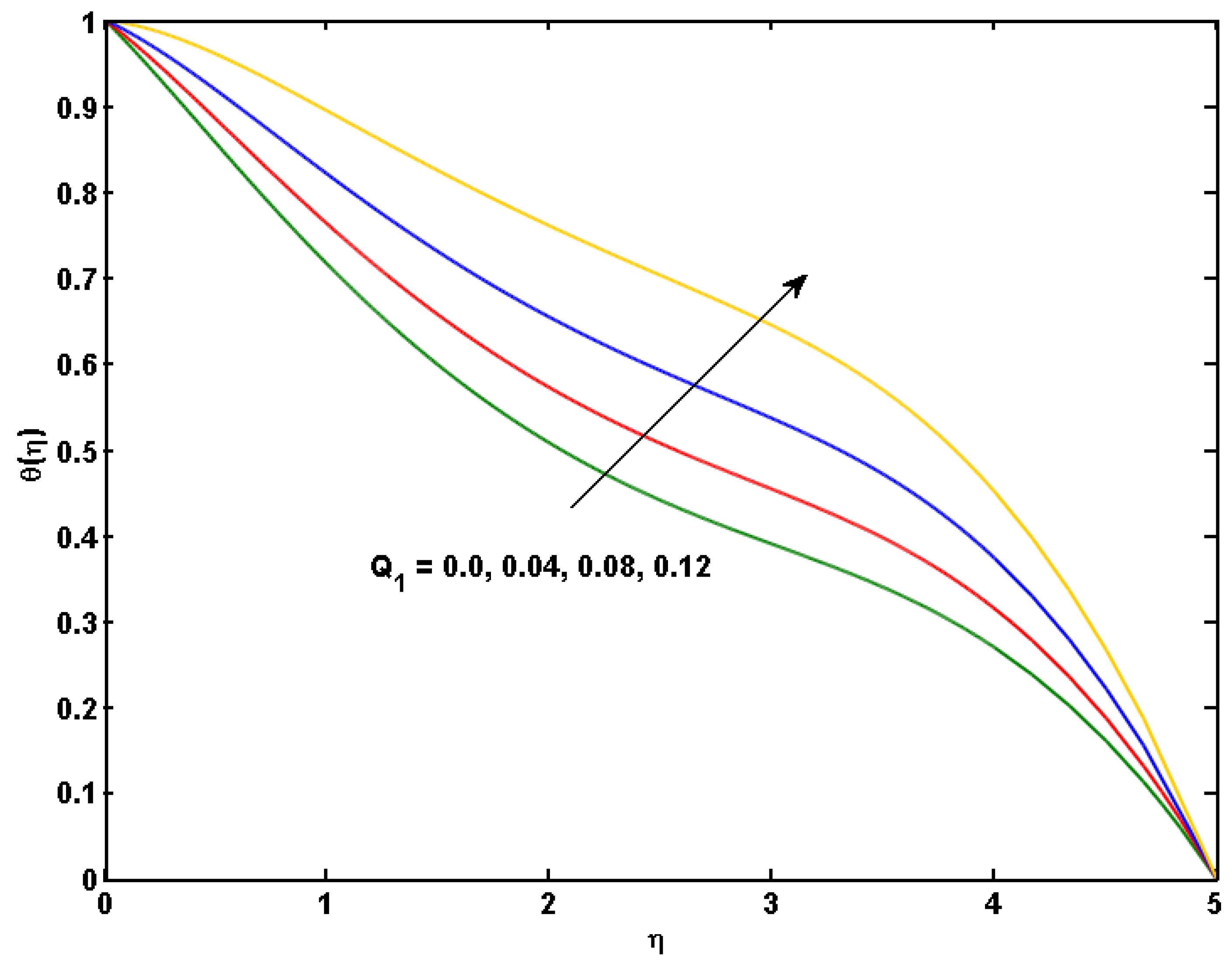
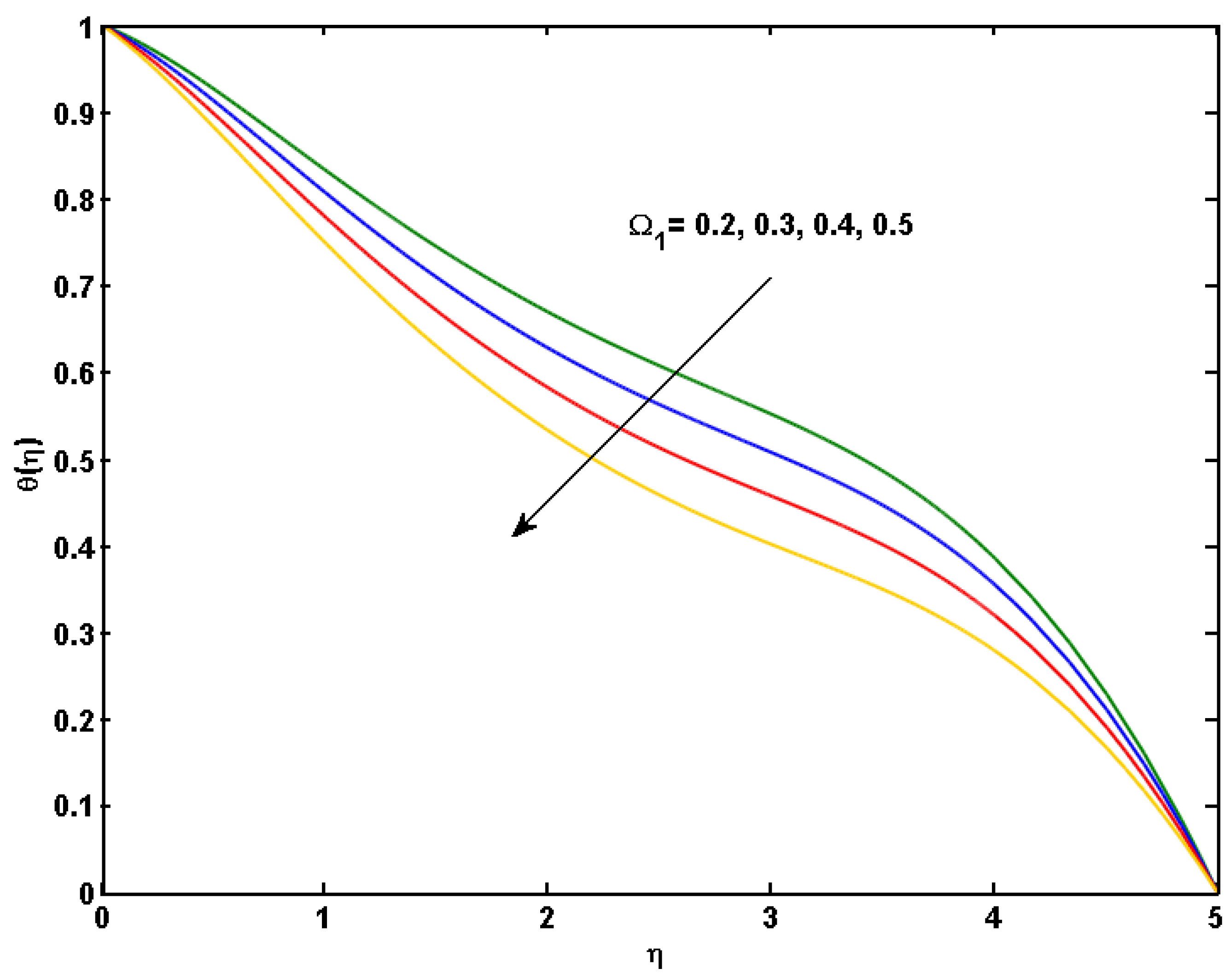
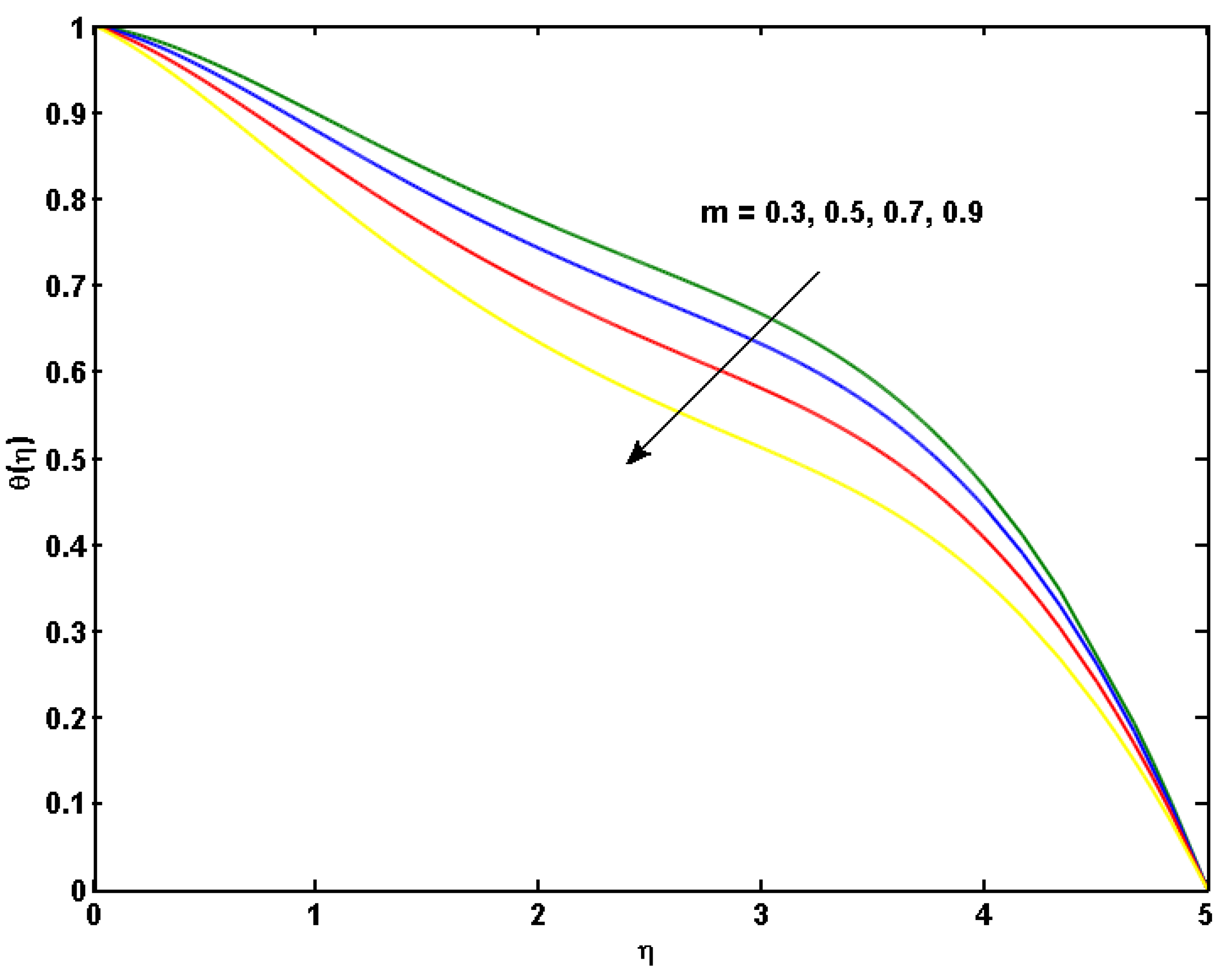
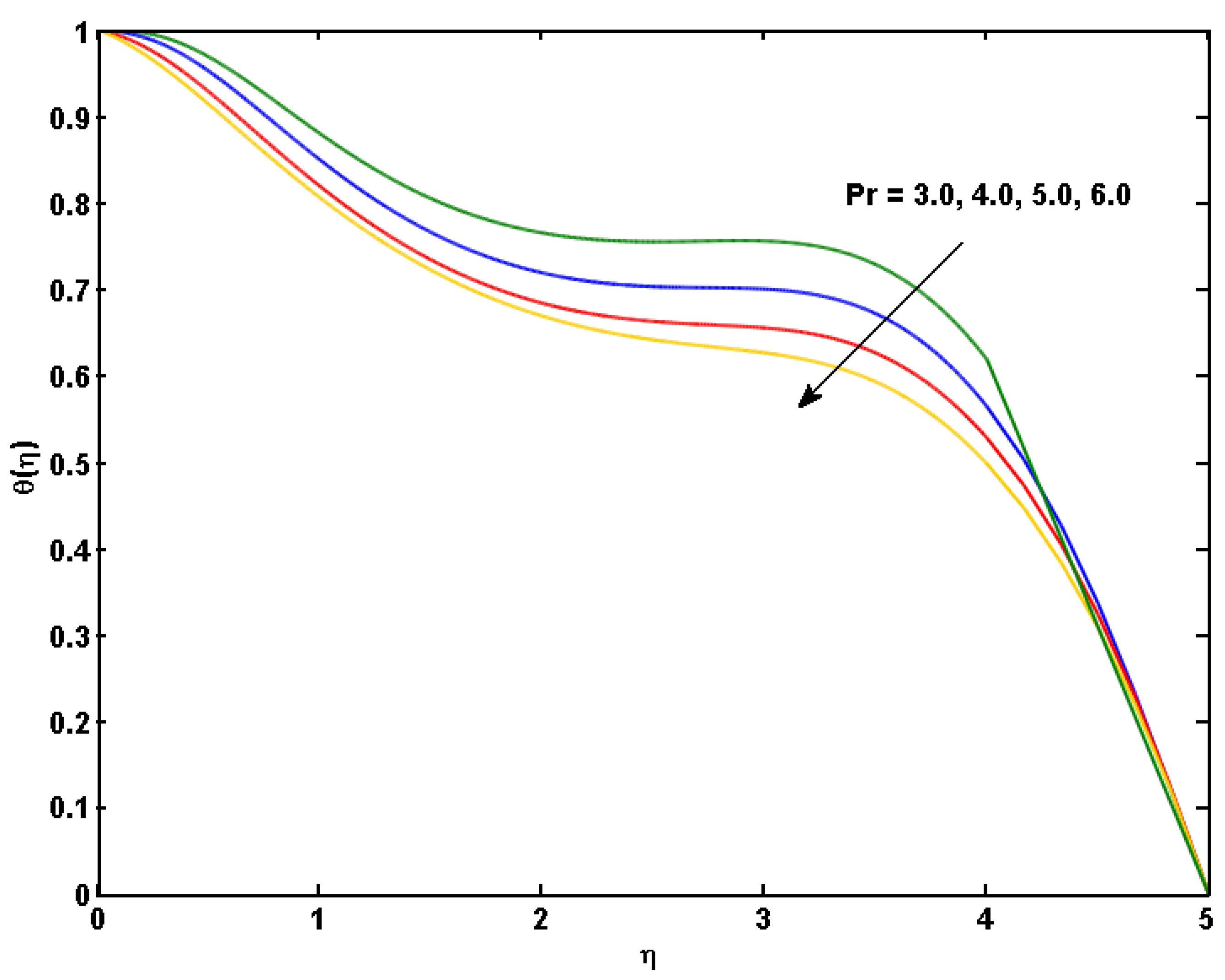
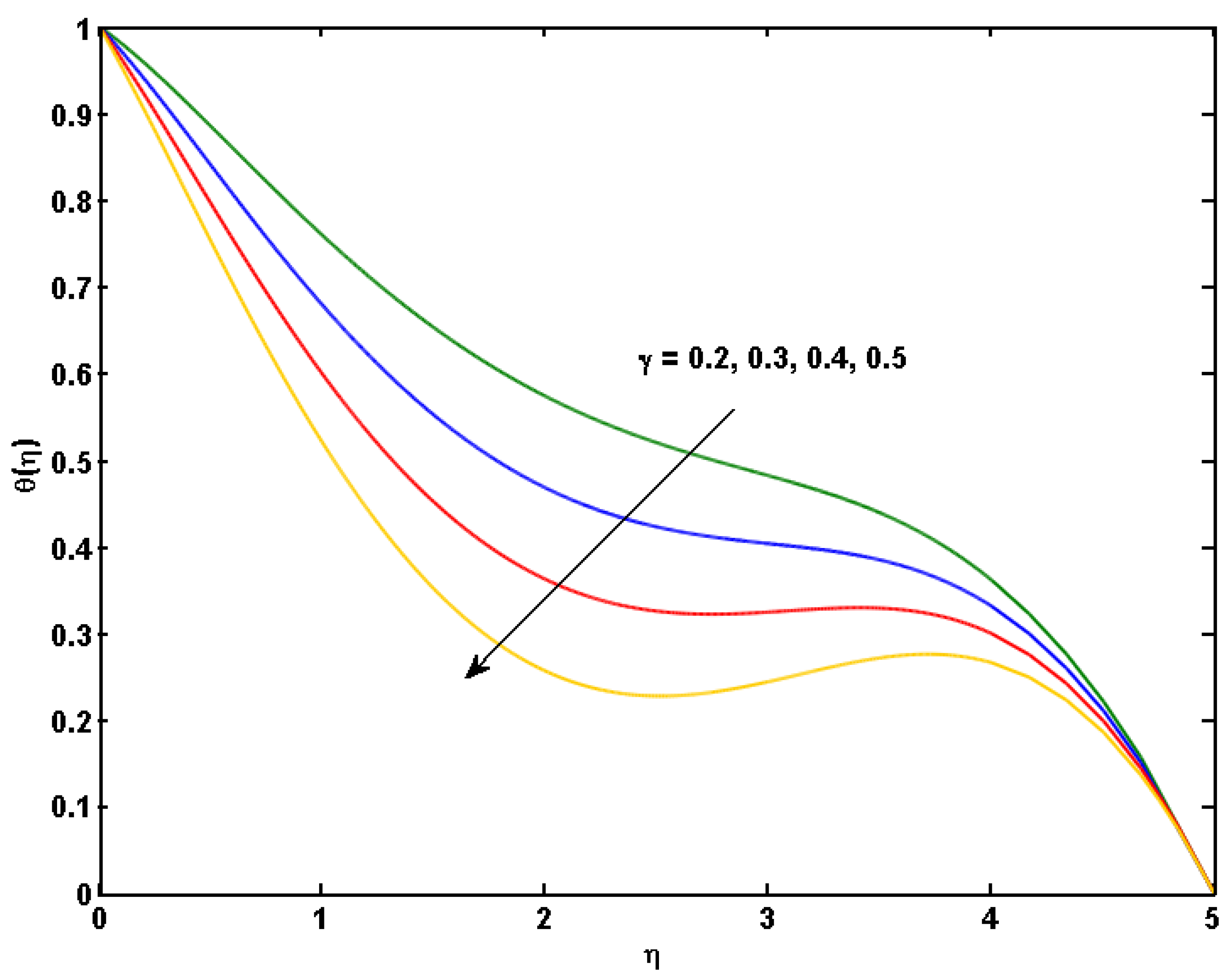
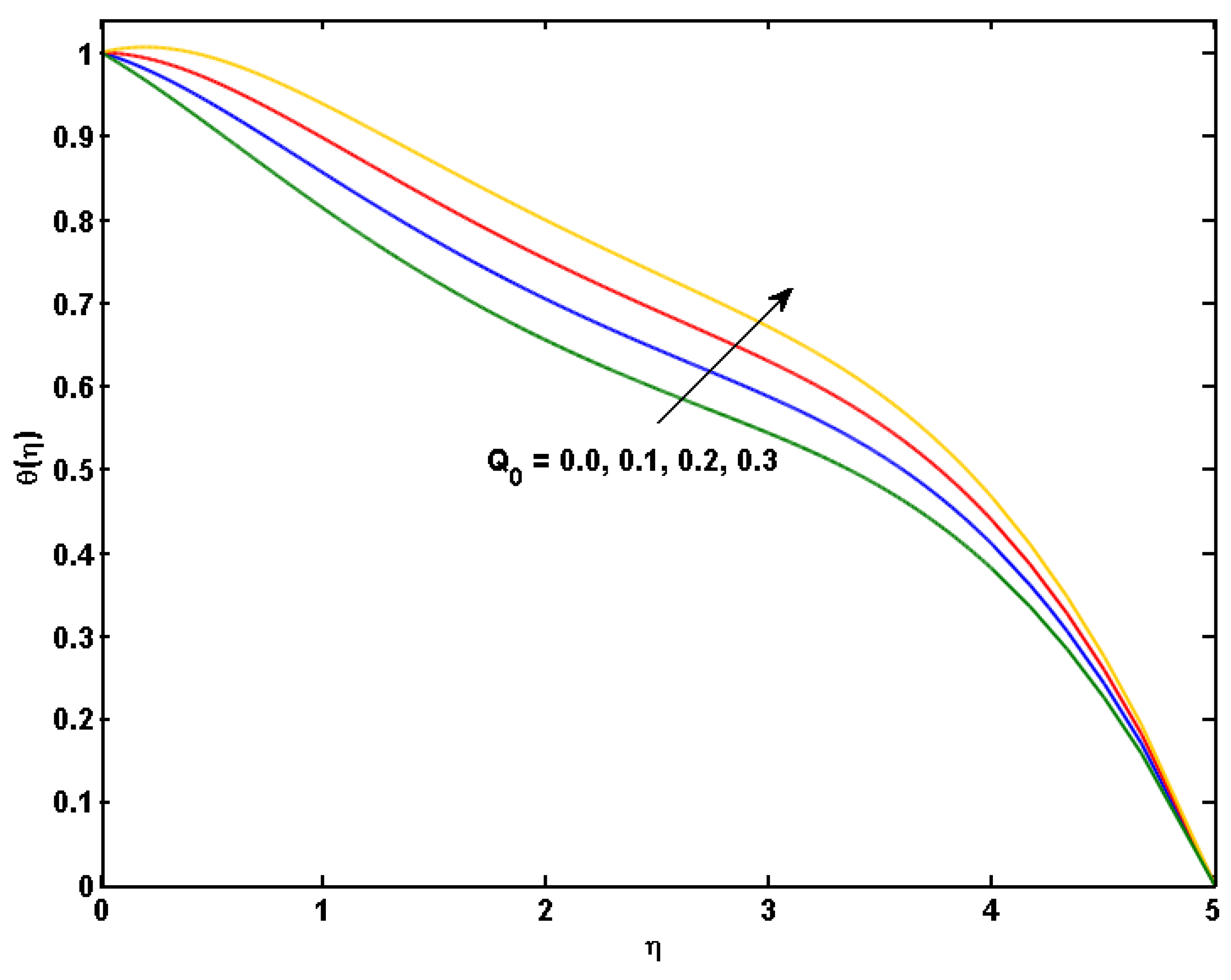
It is obvious from Figure 11, Figure 12 and Figure 13 that increase in Ω1 and Ω2 undermine the fluid temperature θ(η) while that of Ω3 upsurges it. A unique feature of these θ(η) profiles is the appearance of non-linearity which is due to the presence of non-linear terms in governing energy equation. Figure 14 demonstrates the non-linear decaying nature of the θ(η) profiles due to increase in m leading to shrinking of TBL in the entire flow regime. A non-linear θ(η) profile due to distinguished behavior of Pr is visualized in Figure 15. It is noticed here that increasing Pr makes the θ(η) less (due to low thermal diffusivity compared to viscosity) which in turn reduces TBL thickness. However, high Prandtl fluid (Pr = 6) exhibits slow response to such diminishing trend. Further, symmetrical diminishing trend of non-linear θ(η) profiles due to increase in ϒ is envisioned in Figure 16. This is because of low temperature profile under the influence of CCHF model. Figure 17 and Figure 18 offer the non-linear, however, increasing behavior of non-dimensional θ(η) due to enhancement in Nb and Nt respectively. The rationally behind this is that higher Brownian diffusion and thermophoresis force contribute to stronger fluid temperature. Behavior of non-dimensional θ(η) due to the influence of non-uniform heat source/sink (Q0 and Q1) is reflected from Figure 19 and Figure 20 respectively. In other words, increase in Q0 and Q1 upsurge the θ(η) in non-linear fashion throughout the growing TBL associated with enhanced wall temperature gradient.
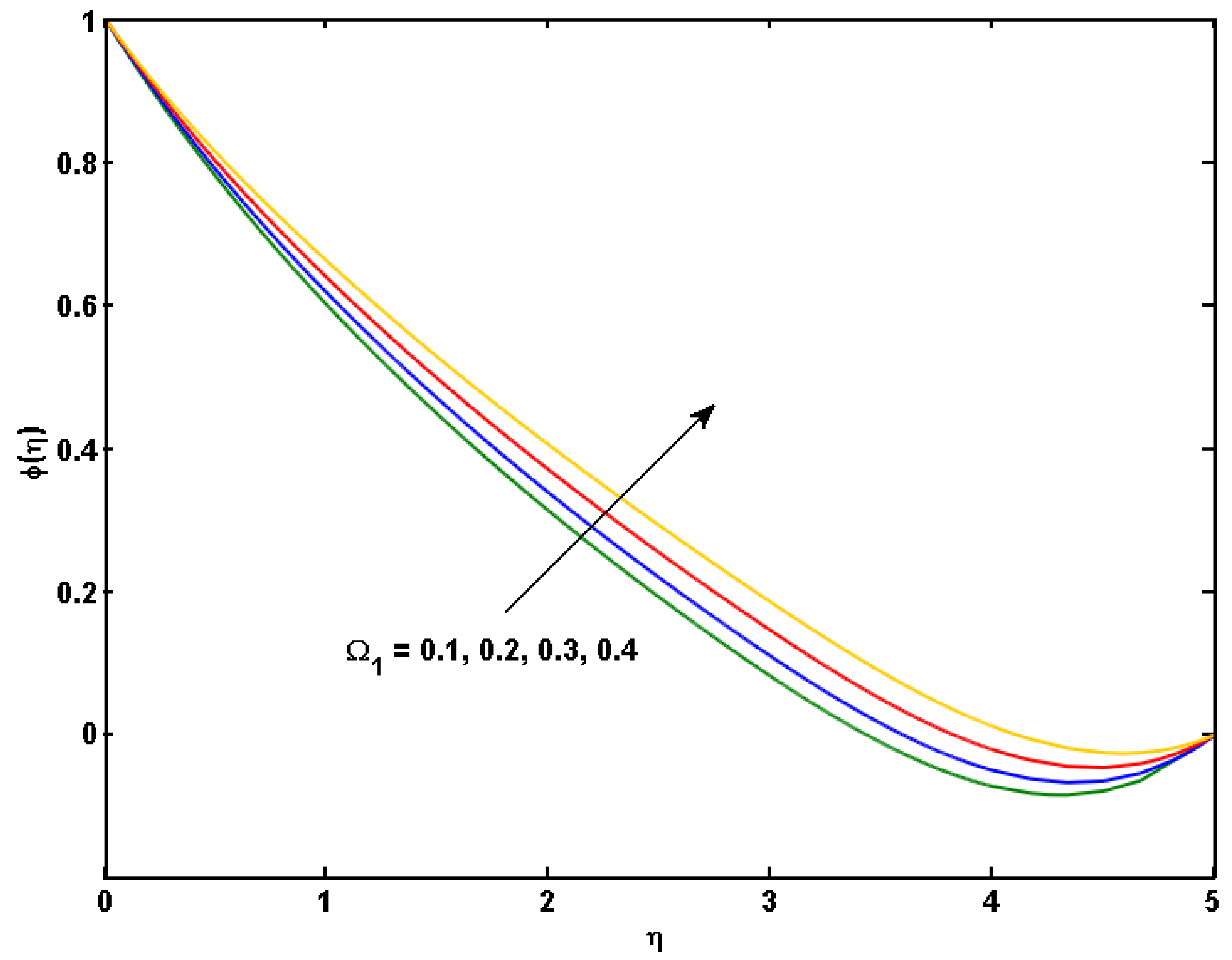
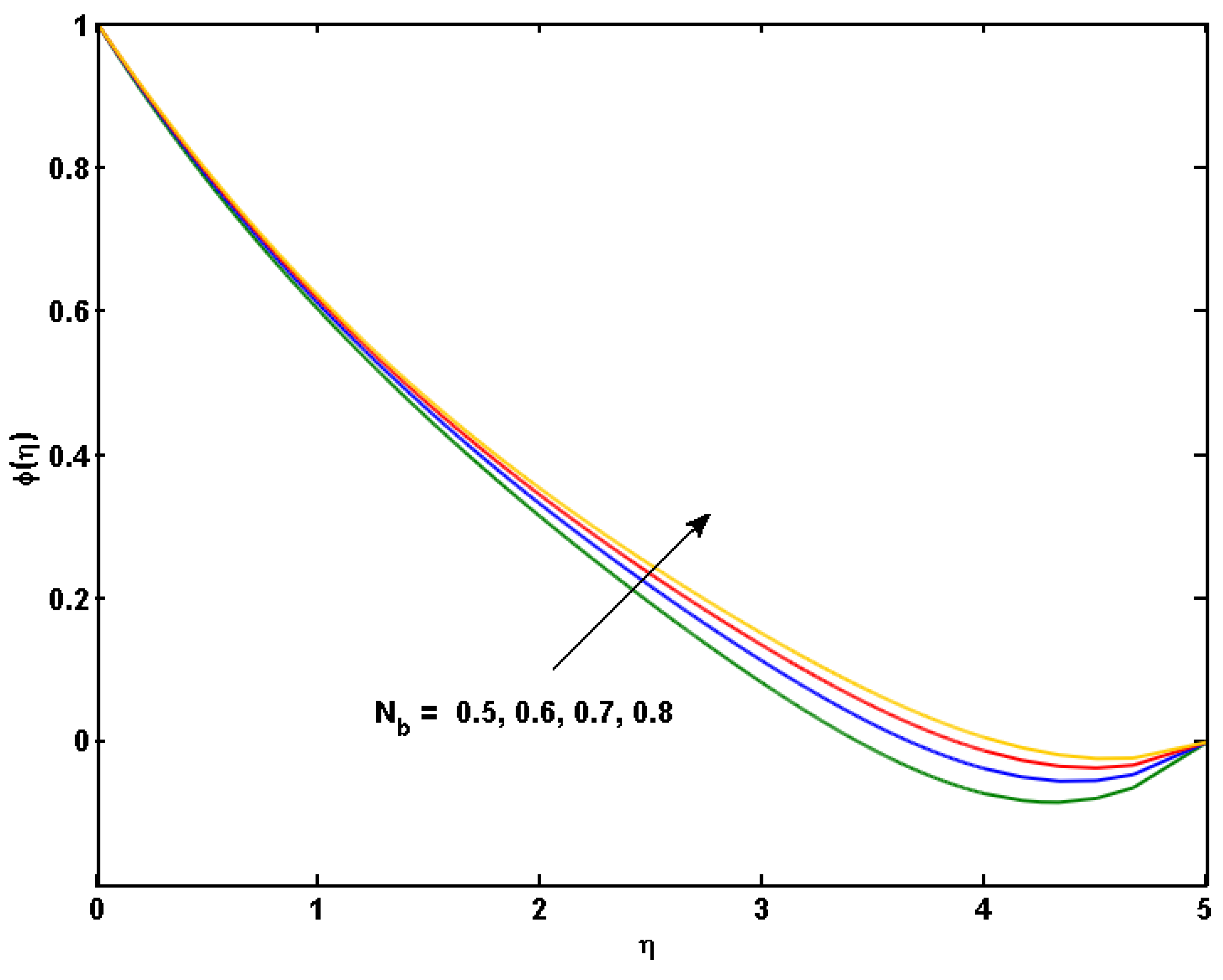
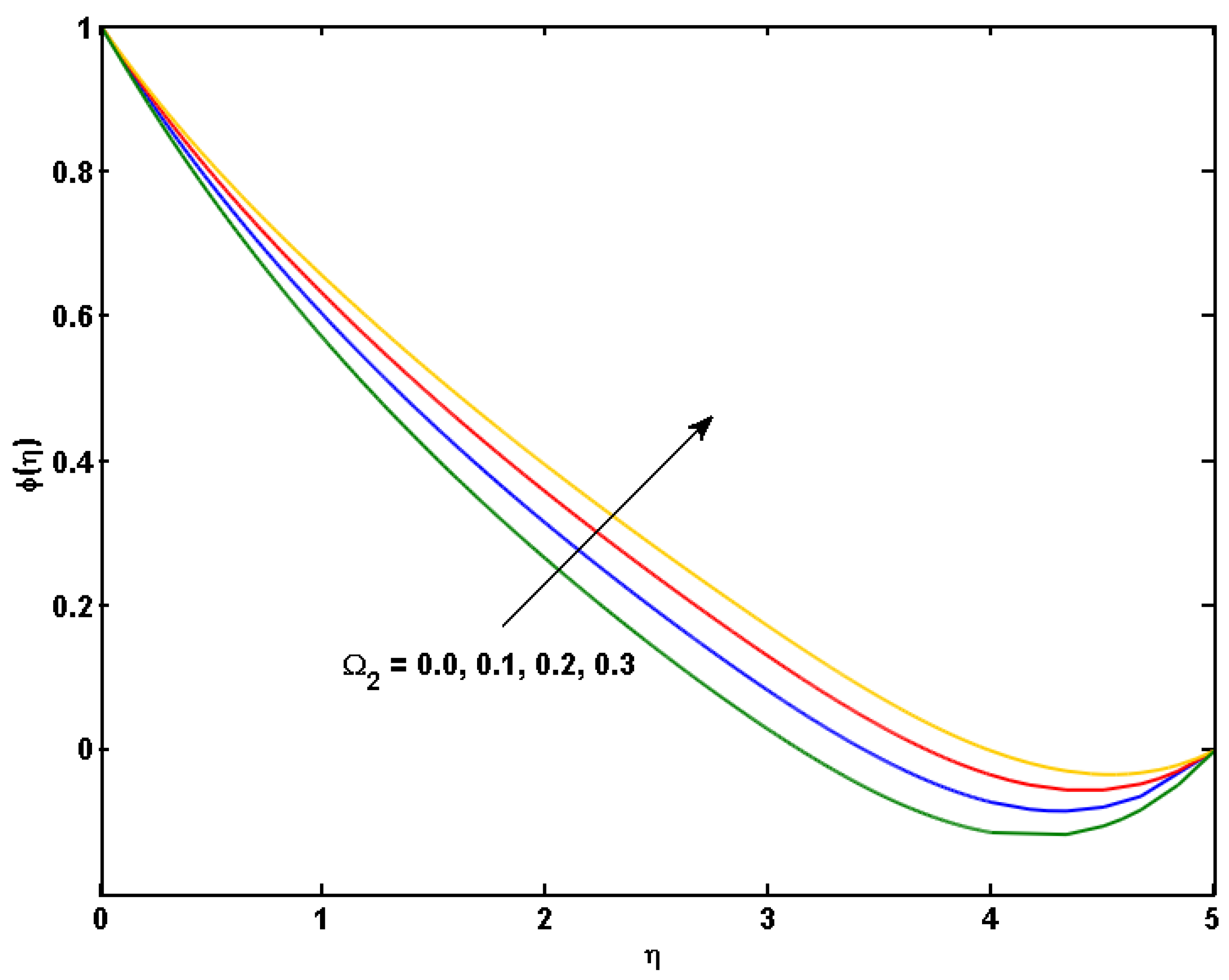
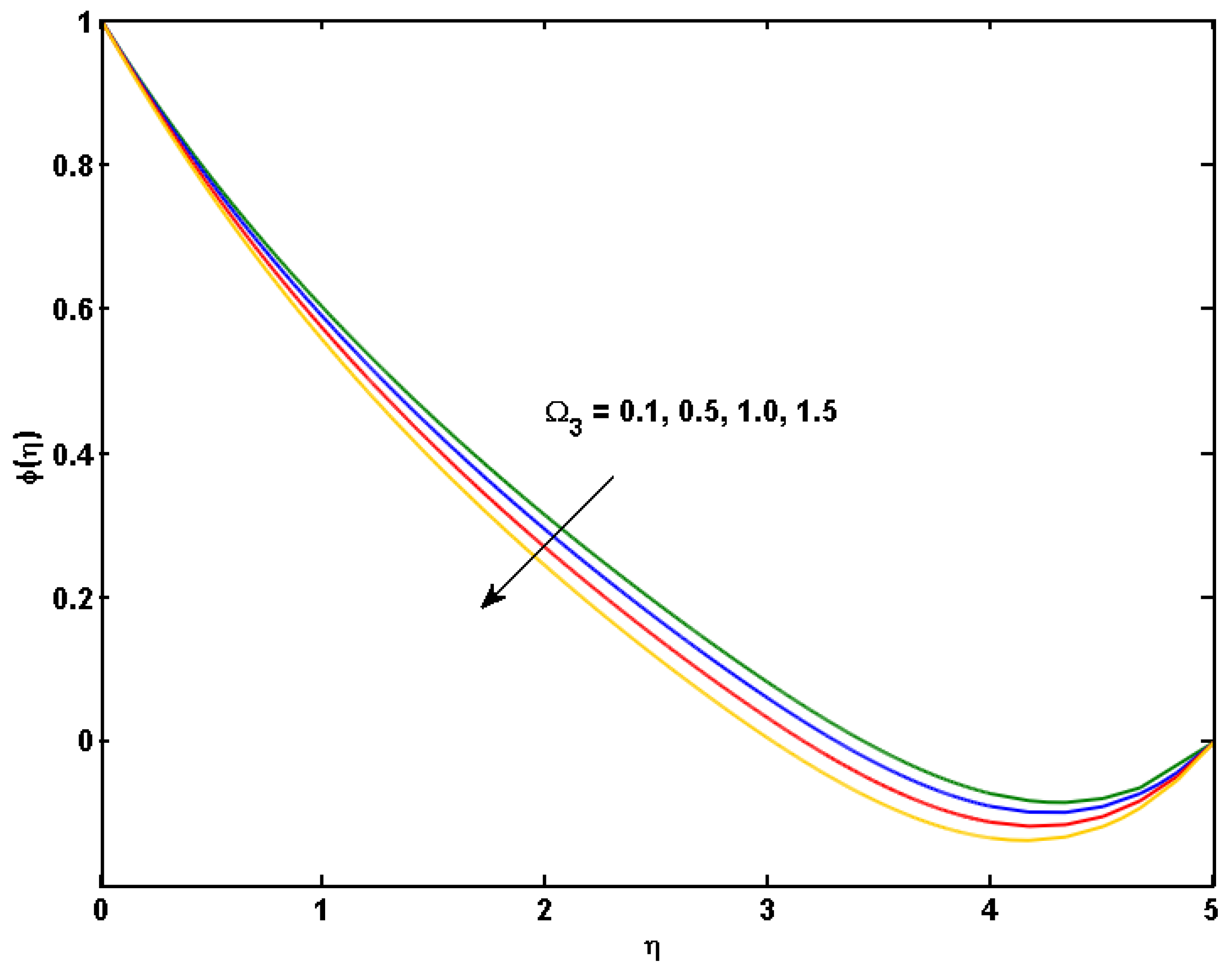
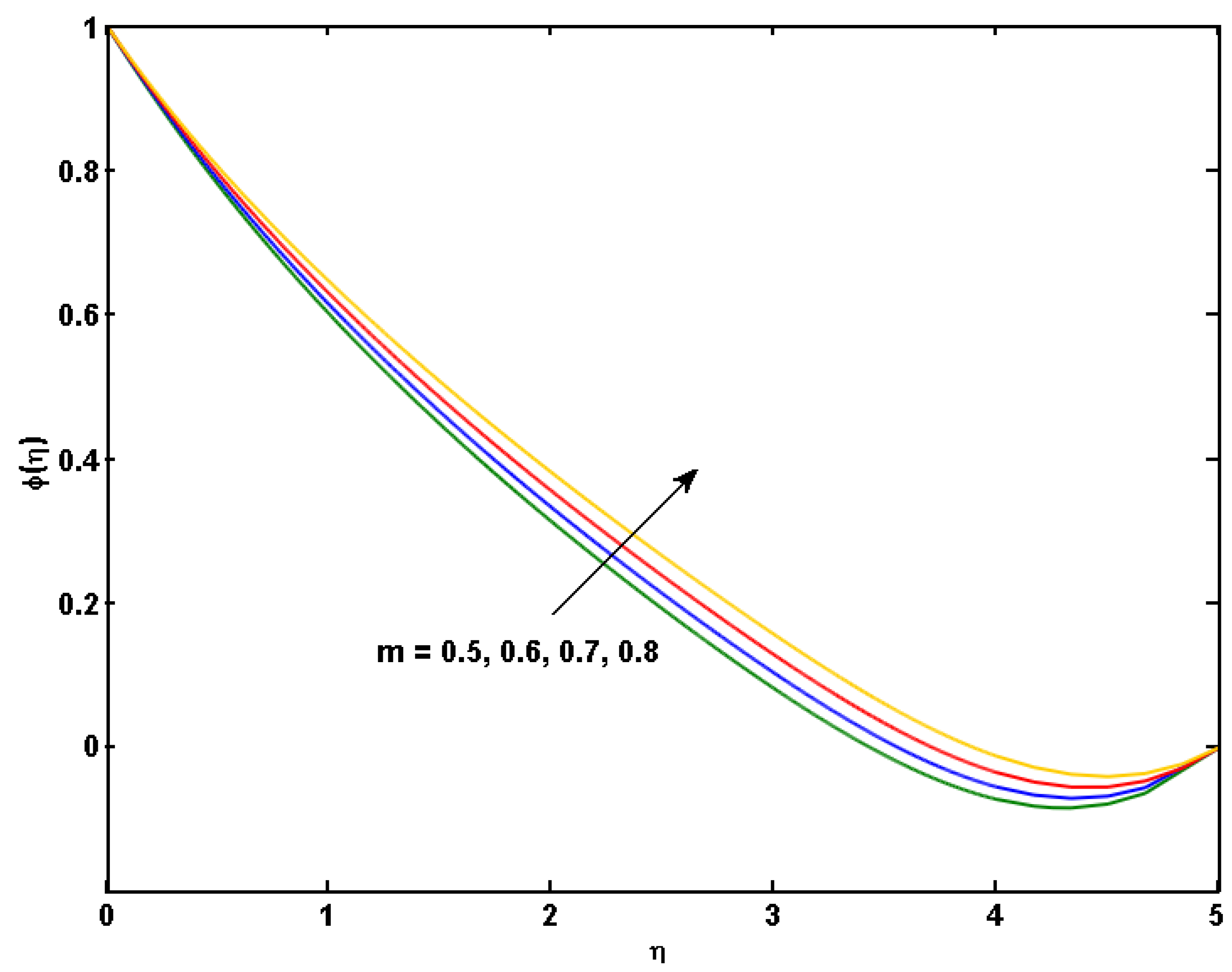
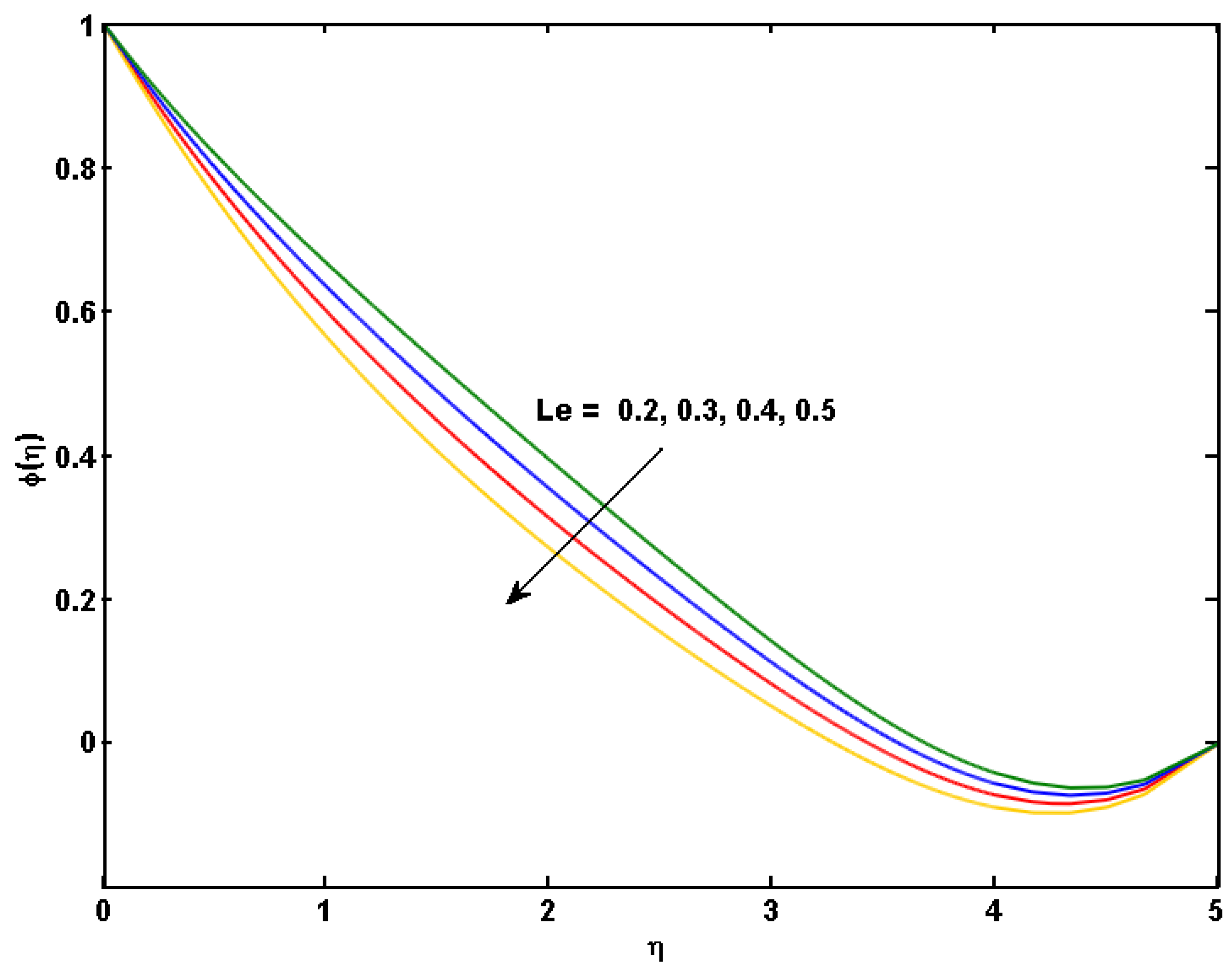
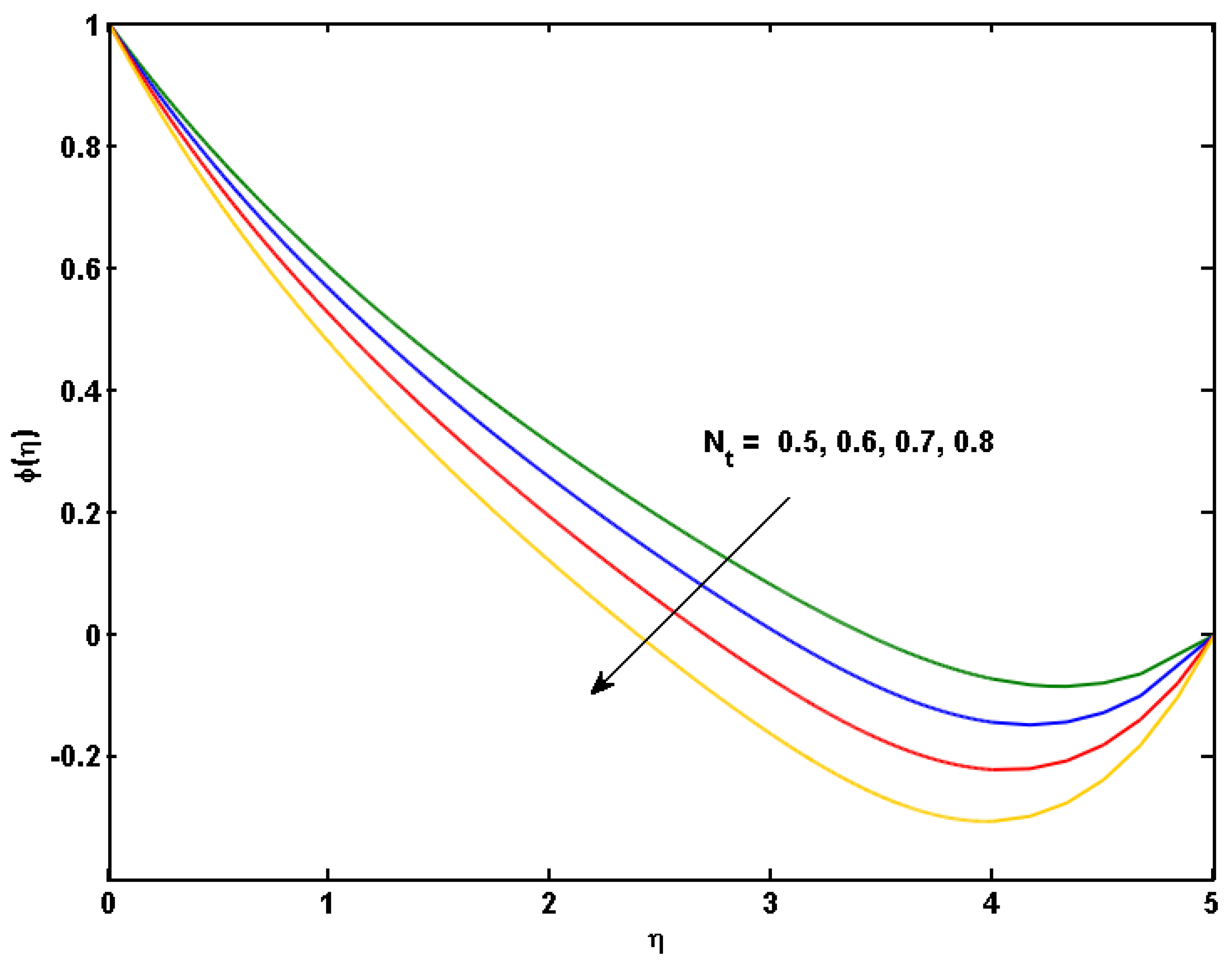
Figure 21, Figure 22 and Figure 23 illustrate that hiked Ω1 and Ω2 upsurge the fluid concentration ϕ (η) while that of Ω3 undermine it. Further, Figure 24 indicates an increasing non-linear behavior of ϕ (η) due to rise in m generating ascending CBL. Figure 25 displays that increase in Le belittles the ϕ (η) developing descending CBL. This is only due to lower mass diffusivity. Fluid concentration ϕ (η) profiles enhance in response to rise in Nb and Nt , however, enhancement is more in case of Nt (Figure 26 and Figure 27). This is due to the effective motion of nanoparticles from the plate to the fluid.
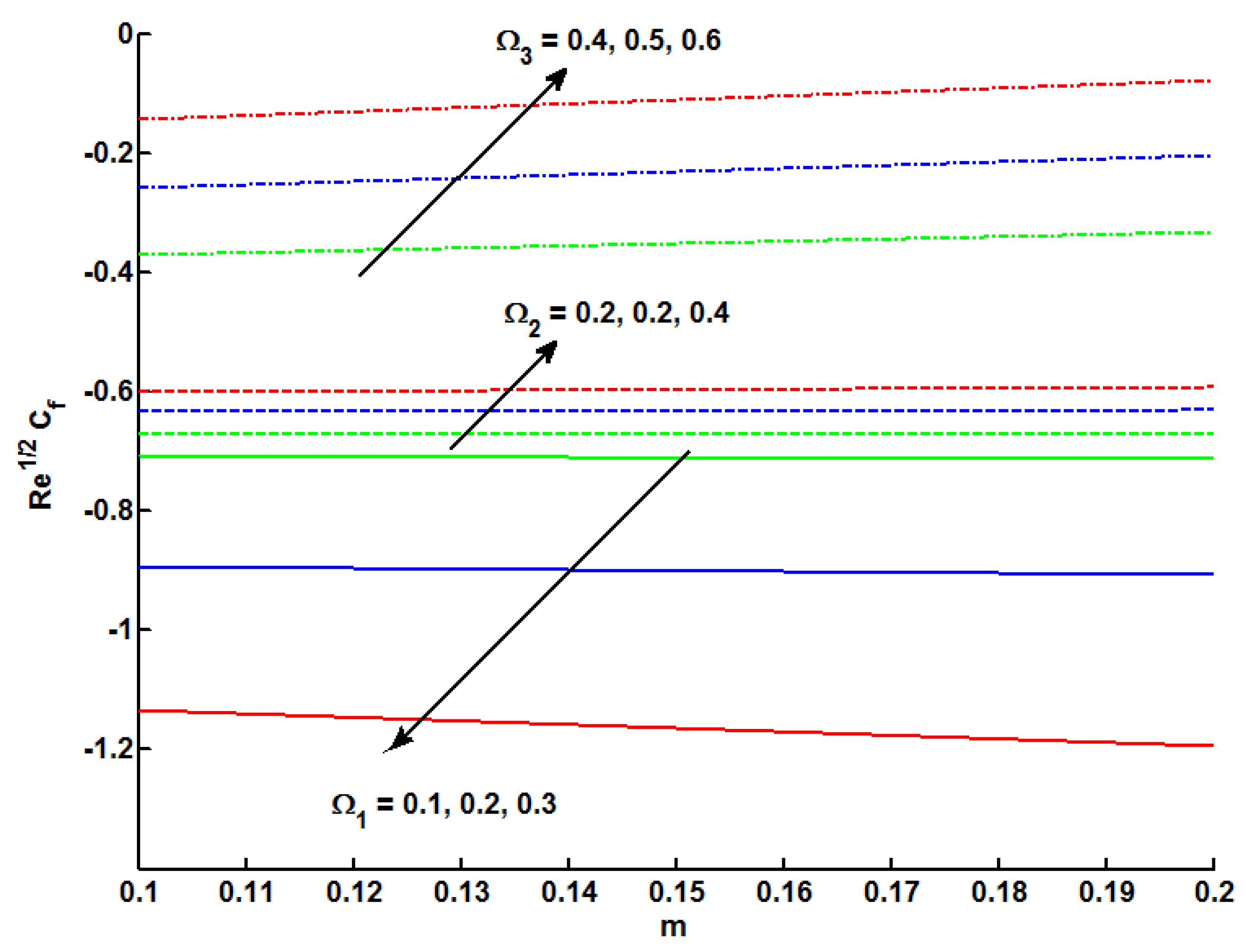
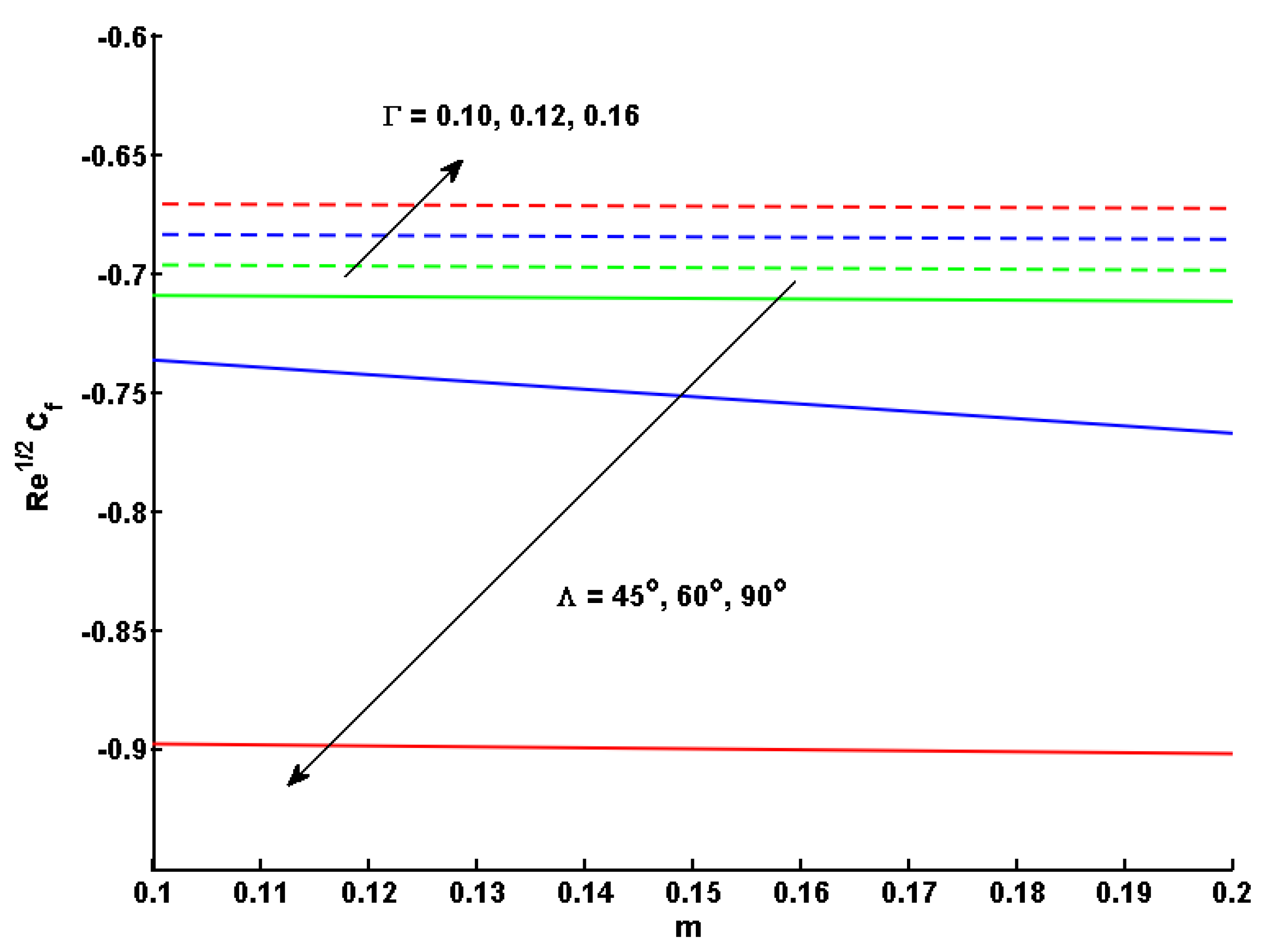
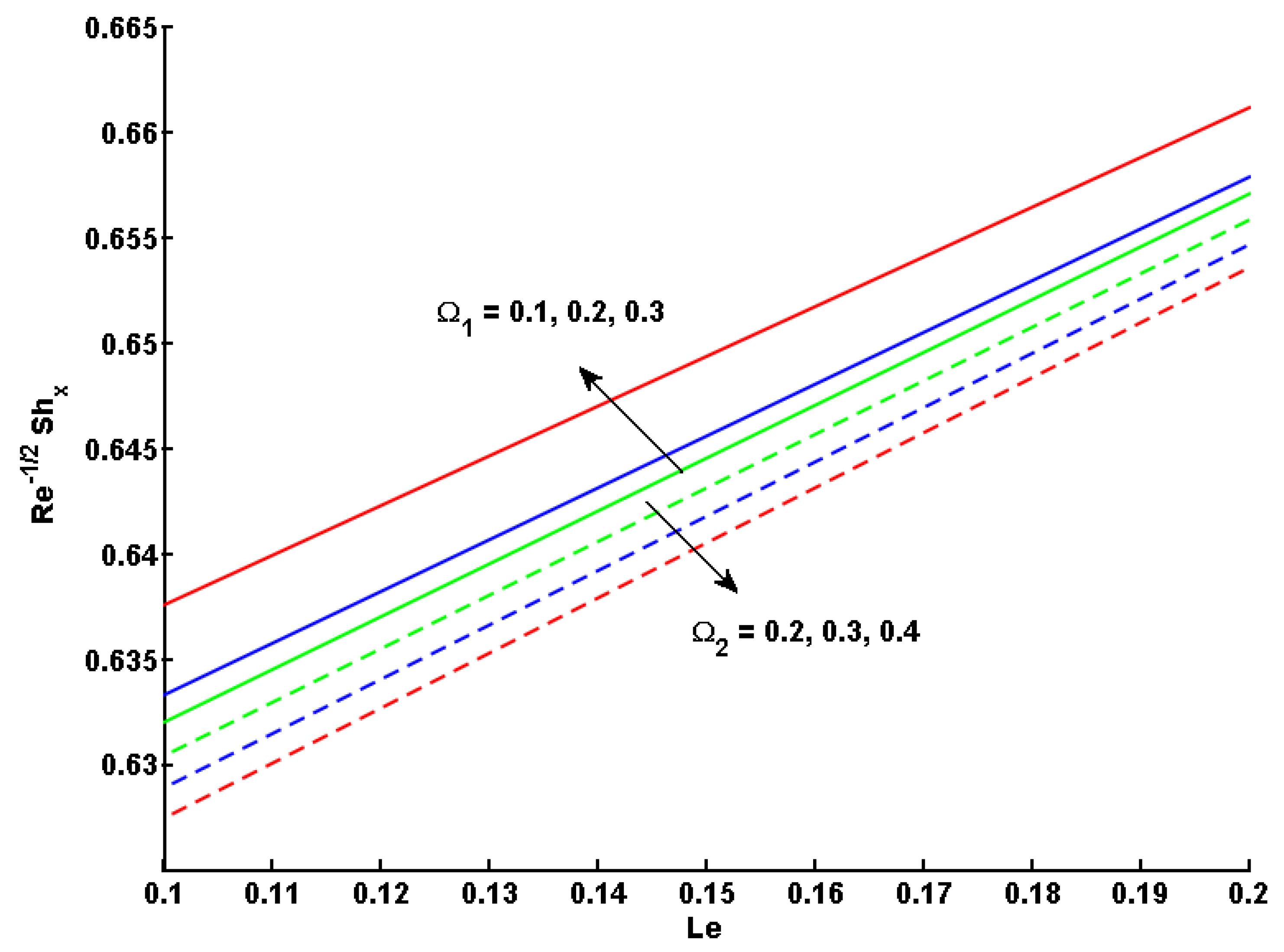
Variation of skin friction coefficient Ijtst 06 060401 i021 against m for different Ω1, Ω1 and Ω3 is shown in Figure 28. It is conveyed from this figure that Ijtst 06 060401 i022 gets augmented due to increase in Ω1 and Ω2 while the wall shear stress shows diminution due to enhancement in Ω3 . Meanwhile, Figure 29 provides the variation of the wall shear stress against m for different Γ and Λ . What is found here is that increase in Γ enhances the wall shear stress. As far as the behavior of Sherwood number Ijtst 06 060401 i023 is concerned, influence of Ω and Ω on it are diametrically opposite (Figure 30).
Augmented Ω1 enhances the mass transfer rate from the plate while that of Ω2 significantly reduces the same. Ascending trend of mass flux is prominent for comparatively higher Ω11 = 0.3).
Figure 2. f ′(η)Vs λT.
Ijtst 06 060401 g002
Figure 3. f ′(η)Vs λc.
Ijtst 06 060401 g003
Figure 4. f ′(η)Vs m.
Ijtst 06 060401 g004
Figure 5. f ′(η)Vs Γ.
Ijtst 06 060401 g005
Figure 6. f ′(η)Vs Λ..
Ijtst 06 060401 g006
Figure 7. f ′(η)Vs ε.
Ijtst 06 060401 g007
Figure 8. f ′(η)Vs Ω1.
Ijtst 06 060401 g008
Figure 9. f ′(η)Vs Ω2.
Ijtst 06 060401 g009
Figure 10. f ′(η)Vs Ω3.
Ijtst 06 060401 g010
Figure 11. θ(η)Vs Ω1.
Ijtst 06 060401 g011
Figure 12. θ(η)Vs Q2.
Ijtst 06 060401 g012
Figure 13. (η)Vs Q3.
Ijtst 06 060401 g013
Figure 14. θ(η)Vs m.
Ijtst 06 060401 g014
Figure 15. (η)Vs Pr.
Ijtst 06 060401 g015
Figure 16. θ(η)Vs ϒ.
Ijtst 06 060401 g016
Figure 17. θ(η)Vs Nb.
Ijtst 06 060401 g017
Figure 18. θ(η)Vs Nt.
Ijtst 06 060401 g018
Figure 19. θ(η)Vs Q0.
Ijtst 06 060401 g019
Figure 20. θ(η)Vs Q1.
Ijtst 06 060401 g020
Figure 21. ϕ (η)Vs Q1.
Ijtst 06 060401 g021
Figure 22. ϕ (η)Vs Ω2.
Ijtst 06 060401 g022
Figure 23. (η)Vs Ω3.
Ijtst 06 060401 g023
Figure 24. (η)Vs m.
Figure 24. (η)Vs m.
Ijtst 06 060401 g024
Figure 25. ϕ (η)Vs Le.
Ijtst 06 060401 g025
Figure 26. ϕ (η)Vs Nb.
Ijtst 06 060401 g026
Figure 27. ϕ (η)Vs Nt.
Ijtst 06 060401 g027
Figure 28. Effects of Ω1, Ω2 and Ω3 on Re 2 Cf against m.
Ijtst 06 060401 g028
Figure 29. Effect of Λ and Γ on Re 2 Cf against m.
Ijtst 06 060401 g029
Figure 30. Effects of Ω1 and Ω2 on the Sherwood number against Le.
Ijtst 06 060401 g030

5. Outcomes at a glance

The present study deals with the influence of non-uniform heat source/sink and temperature dependent viscosity on Cattaneo-Christov heat flow of third grade nanofluid past an inclined stretched Riga plate. The present investigation comes out with some important outcomes.
In the current analysis, accelerated fluid motion and thicker momentum boundary layers are due to increment in λT , λC , m , Γ. It has identified that increase in Ω1 ascends the fluid motion while that of Ω2 and Ω3 exhibits reverse effect. It acknowledges that augmented Ω1 and Ω2 accounts for shrinkage of thermal boundary layer while that of Ω3 establishes ascending thermal boundary layer. There are reports that enhanced Nb and Nt upsurges the fluid temperature while hike in Le belittles the fluid concentration leading to a descending concentration boundary layer. Further, increment in Q0 and Q1 contributes to increment in wall temperature gradient and yields an augmented wall shear stress. Finally, rise in Ω1, Ω2 and m has caused to upsurge the concentration while that of Ω3 boils down it.
Ijtst 06 060401 i016

References

  1. Choi, S.U.S. Enhancing thermal conductivity of fluids with nanoparticles. ASME Fluids Eng. Division 1995, 231, 99–105. [Google Scholar]
  2. Leal, L.G. Advanced Transport Phenomena: Fluid Mechanics and Convective Transport Processes; Cambridge University Press: New York, 2007. [Google Scholar]
  3. Khan, W. A..; Makinde, O. D; Khan, Z. H. Non-aligned MHD stagnation point flow of variable viscosity nanofluids past a stretching sheet with radiative heat. Int. J. Heat Mass Transf. 2016, 96, 525–534. [Google Scholar] [CrossRef]
  4. Khan, M. I.; Hayat, T.; Khan, M. I.; Alsaed, A. Activation energy impact in nonlinear radiative stagnation point flow of cross nanofluid. Int Comm. Heat Mass Transf 2018, 91, 216–224. [Google Scholar] [CrossRef]
  5. Khan, M. I.; Hayat, T.; Alsaed, A. Numerical investigation for entropy generation in hydromagnetic flow of fluid with variable properties and slip. Phys Fluid 2018, 30, 023601. [Google Scholar] [CrossRef]
  6. Khan, M. I.; Waqas, M.; Hayat, T.; Alsaed, A. Magneto-hydrodynamical numerical simulation of heat transfer in MHD stagnation point flow of Cross fluid model towards a stretched surface. Phys Chem Liq 2018, 56, 584–595. [Google Scholar] [CrossRef]
  7. Sheikholeslami, M.; Rokni, H. B. CVFEM for effect of Lorentz forces on nanofluid flow in a porous complex shaped enclosure by means of non-equilibrium mode. J. Mol. Liq. 2018, 254, 446–462. [Google Scholar] [CrossRef]
  8. Sheikholeslami, M.; Shehzad, S. A. Simulation of water based nanofluid convective flow inside a porous enclosure via non-equilibrium model. Int. J. Heat Mass Transf. 2018, 120, 1200–1212. [Google Scholar] [CrossRef]
  9. Sheikholeslami, M.; Seyednezhad, M. Simulation of nanofluid flow and natural convection in a porous media under the influence of electric field using CVFEM. Int. J. Heat Mass Transf. 2018, 120, 772–781. [Google Scholar] [CrossRef]
  10. Nayak, M. K.; Akbar, N. S.; Pandey, V. S.; Khan, Z. H.; Tripathi, D. 3D free convective MHD flow of nanofluid over permeable linear stretching sheet with thermal radiation. Powder Technol. 2017, 315, 205–215. [Google Scholar] [CrossRef]
  11. Nayak, M. K. MHD 3D flow and heat transfer analysis of nanofluid by shrinking surface inspired by thermal radiation and viscous dissipation. Int. J. Mech. Sci. 2017, 124, 185–193. [Google Scholar] [CrossRef]
  12. Nayak, M. K.; Akbar, N. S.; Pandey, V. S.; Khan, Z. H.; Tripathi, D. MHD 3D free convective flow of nanofluid over an exponentially stretching sheet with chemical reaction. Adv. Powder Technol. 2017, 28(9), 2159–2166. [Google Scholar] [CrossRef]
  13. Nayak, M. K.; Shaw, S.; Pandey, V. S.; Chamkha, A. J. Combined effects of slip and convective boundary condition on MHD 3D stretched flow of nanofluid through porous media inspired by non-linear thermal radiation. Indian J Phys. 2018, 92(8), 1017–1028. [Google Scholar] [CrossRef]
  14. Dogonchi, A.S.; Waqas, M.; Ganji, D.D. Shape effects of Copper-Oxide (CuO) nanoparticles to determine the heat transfer filled in a partially heated rhombus enclosure: CVFEM approach. Int. Comm. Heat Mass Transf. 2019, 107, 14–23. [Google Scholar] [CrossRef]
  15. Dogonchi, A.S.; Waqas, M.; Seyyedi, S.M.; Hashemi-Tilehnoee, M.; Ganji, D.D. CVFEM analysis for Fe3O4-H2O nanofluid in an annulus subject to thermal radiation. Int. J. Heat Mass Transf. 2019, 132, 473–483. [Google Scholar] [CrossRef]
  16. Dogonchi, A.S.; Chamkha, Ali J.; Hashemi-Tilehnoee, M.; Seyyedi, S.M.; Ganji, D.D. Effects of homogeneous-heterogeneous reactions and thermal radiation on magneto-hydrodynamic Cu-water nanofluid flow over an expanding flat plate with non-uniform heat source. J. of Central South University 2019, 26(5), 1161–1171. [Google Scholar] [CrossRef]
  17. Seyyedi, S.M.; Sahebi, N.; Dogonchi, A.S.; Hashemi-Tilehnoee, M. Numerical and experimental analysis of a rectangular single-phase natural circulation loop with asymmetric heater position. Int. J. Heat Mass Transf 2019, 130, 1343–1357. [Google Scholar] [CrossRef]
  18. Dogonchi, A.S.; Ganji, D.D. Effects of Cattaneo-Christov heat flux on buoyancy MHD nanofluid flow and heat transfer over a stretching sheet in the presence of Joule heating and thermal radiation impacts. Indian J. Phys. 2018, 92, 757–766. [Google Scholar] [CrossRef]
  19. Mabood, F.; Nayak, M. K.; Chamkha, A. J. Heat transfer on cross flow of micropolar fluids over a thin needle moving in a parallel stream influenced by binary chemical reaction and Arrhenius activation energy. European Physical J. Plus 2019, 134, 427. [Google Scholar] [CrossRef]
  20. Nayak, M. K.; Mehmood, R.; Makinde, O.D.; Mahian, O.; Chamkha, Ali J. Magnetohydrodynamic flow and heat transfer impact on ZnO-SAE50 nanolubricant flow due to an inclined rotating disk.
  21. J. Central South University 2019, 26, 1146–1160. [CrossRef]
  22. Nayak, M. K.; Shaw, Sachin; Chamkha, Ali J. MHD free convective stretched flow of a radiative nanofluid insprired by variable magnetic field. Arabian J. Sci. Engi. 2019, 44(2), 1269–1282. [Google Scholar] [CrossRef]
  23. Nayak, M. K.; Oyelakin, I. S.; Mondal, S.; Sen, S.S. Impact of the Cattaneo-Christov thermal and.
  24. solutal diffusion models on the stagnation point slip flow of Walters’ B nanofluid past an electromagnetic sheet. Heat Transf. Asian Res. 2019, 48(2), 713–726. [CrossRef]
  25. Pantokratoras, E. Magyari, MHD free-convection boundary-layer flow from a Riga-plate. J.
  26. Eng. Math. 2009; 64, pp. 303–315.
  27. Ahmad; Asghar, S.; Afzal, S. Flow of nanofluid past a Riga plate. J.Magn. Magn. Mat. 2016, 402, 44–48. [Google Scholar] [CrossRef]
  28. Abdul Hakeem, A.K.; Nayak, M. K.; Makinde, O. D. Effect of exponentially variable viscosity and permeability on Blasius flow of Carreu nanofluid over an electromagnetic plate through a porous medium. J. Appl. Computational Mech. 2019, 5(2), 390–401. [Google Scholar]
  29. Hayat, T.; Kiran, A.; Imtiaz, M.; Alsaedi, A.; Ayub, M. Melting heat transfer in the MHD flow of a third-grade fluid over a variable-thickness surface. Eur. Phys. J. Plus. 2017, 132, 265. [Google Scholar] [CrossRef]
  30. Reddy, G. J.; Hiremath, A.; Kumar, M. Computational modeling of unsteady third-grade fluid flow over a vertical cylinder: A study of heat transfer visualization. Results in Phys. 2018, 8, 671–682. [Google Scholar] [CrossRef]
  31. Cattaneo, C.; Sulla, C. D. C. Atti Sem. Mat. Fis. Univ. Modena.. 1948, 3, 83–101.
  32. Christov, C. I. On frame indifferent formulation of the Maxwell-Cattaneo model of finite-speed heat conduction. Mech Res Commun. 2009, 36(4), 481–6. [Google Scholar] [CrossRef]
  33. Imtiaz, M.; Alsaedi, A.; Shafiq, A.; Hayat, T. Impact of chemical reaction on third grade fluid flow with Cattaneo-Christov heat flux. J.of Mol. Liq. 2017, 229, 501–507. [Google Scholar] [CrossRef]
  34. Hayat, T.; Nadeem, S. Flow of 3D Eyring-Powell fluid by utilizing Cattaneo-Christov heat flux model and chemical processes over an exponentially stretching surface. Results in Phys., 2018; 8, pp. 397–403. [Google Scholar]
  35. Sharma, P. R.; Sinha, S.; Yadav, R. S.; Filippov, A. N. MHD mixed convective stagnation point flow along a vertical stretching sheet with heat source/sink. Int. J. of Heat and Mass Transf. 2018, 117, 780–786. [Google Scholar] [CrossRef]
  36. Grinberg, E. On determination of properties of some potential fields. Appl Magnetohydrodyn. Rep Phys Inst Riga 1961, 12, 147–154. [Google Scholar]