Next Article in Journal
The Effects of Thermocapillarity on the Thin Film Flow of MHD UCM Fluid over an Unsteady Elastic Surface with Convective Boundary Conditions
Previous Article in Journal
Impacts of time varying wall temperature and concentration on MHD free convective flow of a rotating fluid due to moving free-stream with hall and ion-slip currents
 
 
International Journal of Thermofluid Science and Technology is published by MDPI from Volume 13 Issue 1 (2026). Previous articles were published by another publisher in Open Access under a CC-BY (or CC-BY-NC-ND) licence, and they are hosted by MDPI on mdpi.com as a courtesy and upon agreement with the previous journal publisher.
Article

Mixed convective peristaltic flow of an Oldroyd 4-Constant fluid in a planner channel

Department of Mathematics, University of Azad Jammu & Kashmir, Muzaffarabad 13100, Pakistan
*
Author to whom correspondence should be addressed.
Int. J. Thermofluid Sci. Technol. 2019, 6(3), 060302; https://doi.org/10.36963/IJTST.19060302
Submission received: 6 June 2019 / Revised: 28 August 2019 / Accepted: 10 October 2019 / Published: 15 November 2019

Abstract

Mixed convective peristaltic flow of an Oldroyd 4-constant fluid in a two dimensional channel with flexible walls was studied in this article. The arising complicated nonlinear equations are reduced into solvable form using small Reynolds number and long wavelength assumption. The resulting equations are solved numerically by shooting method and implicit finite difference scheme. The results are compared for both velocity and temperature profiles and also compared with available literature. The impacts of involved parameter on non-dimensional velocity, temperature, pressure gradient, pressure rise per wave length and trapping are presented graphically. By the influence of buoyancy forces the symmetry of the velocity profile is disturbed about the central line of the channel and also the size of the trapped bolus increases in the left half of the channel. Also the decrease in the pressure drop per wavelength is observed for the increasing values of thermal Grashof number.

1. Introduction

The word peristalsis originally evolved from new Latin and is derived from the Greek word “peristallein” meaning “to wrap around” which is combination of two words peri-, “around” and stallein-, “to place”. Thus peristalsis is the type of motion due to contraction and relaxation of the boundary of the container in radially symmetrical direction. From the above description, it is evident that such type of motion occurs not only in industry but also have huge usage by nature as in many physiological processes the flow of fluids are blessed due to this mechanism. An instrument called peristaltic pump is used to pump the fluid without direct contact with it. This particular advantage of peristaltic pump made it useful in many medical instruments also. Physiologically contraction and relaxation mechanism involves in excretory system, menstrual cycle, chyme movement in digestive system, blood circulation in the capillaries and in many more bio fluids flow. Owing to its wide applications, for the last two decades, many researchers devoted their time to investigate about peristalsis. The mechanism by which the peristaltic motion occurs was studied by Latham [1] firstly in relation to mechanical pumping. Under negligible inertia and streamline curvature effects peristaltic flow for the Newtonian fluid case is studied by Shapiro et.al [2]. The mechanism of peristalsis in planner channel was studied by Fung and Yih [3] for arbitrary Reynolds and wave numbers. Raju and Devanathan [4] theoretically analyzed the peristaltic motion of power- law fluid in a tube. They developed the solution for stream function as a power-series in terms of amplitude of the wave. Peristaltic pumping of second order fluid in planner channel and axisymmetric tubes was analyzed by Siddiqui et al. [5] and Siddiqui and Schwarz [6], respectively. Usha and Rao [7] researched on the impact of peripheral layer in peristaltic flow of power-law fluid. Hayat et al. [8] studied the interaction of peristalsis with rheology by utilizing the constitutive equations of Johnson- Segalman and Oldroyd-B fluids. Mekheimer and Elmaboud [9] investigated the peristaltic motion using couple stress fluid. Hayat et al. [10] studied the peristaltic motion of a Burger’s fluid in a planar channel. Peristaltic Creeping Flow of Power Law physiological fluids through a non uniform Channel with slip Effect has been discussed by Chaube et al. [11]. More recently Ali et al. [12] investigated the peristaltic motion in planner channel for an Ellis fluid. Peristaltic flow of a conducting Williamson viscoelastic fluid has been explored by Bég and Rashidi [13]. Tripathi and Beg [14] studied peristaltic propulsion of Burger’s fluid through a non-uniform porous medium using homotopy perturbation method and variational iteration method. In another study, Tripathi and Beg [15] carried out an analytical study of transient magneto-peristaltic flow of couple stress biofluids.
Due to the temperature gradient between the contacting and relaxing walls of the fluid container and moving fluids inside, the phenomena of heat transfer takes place. More work on peristalsis has been done considering the heat transfer because in many industrial and biological applications transfer of heat happens with motion of the concerned fluid. In physiological processes such as heat conduction in tissues, in the processes of hemodialysis and oxygenation, heat convection due to the blood flow from the pores of the tissues and radiation between surface and its environment, heat transfer involves. Therefore, in literature many studies are available which describes the heat transfer with peristalsis. Flow with heat transfer for a viscous fluid in annulus has been examined by Vajravelu et al. [16] to show that peristaltic wave effects are evident on heat transfer. Tripathi [17] discussed a mathematical model for swallowing of food bolus through the esophagus under the influence of heat transfer. Tripathi and Beg [18] presented the unsteady physiological magneto-fluid flow and heat transfer through a finite length channel by peristaltic pumping. Sobh [19] studied the slip effects on peristaltic transport of a magneto-Newtonian fluid through a porous medium with heat transfer. Hayat et al. [20] studied the effect of heat transfer on the peristaltic flow of an electrically conducting fluid in a porous space.
The term convection refers to collective movement of groups or aggregates of molecules within fluids. Convection can be categorized as natural convection and forced convection. In urination the phenomena of natural convection involves, while, in many industrial and biological processes forced convection plays important role in heat transfer. The combination of both types of convection is termed as mixed convection. In fluids due to variation of gravitational body force associated with non-uniformity of density within the system, the flow field is significantly modified from that which would prevail under conditions of uniform density. In view of the above discussion to best of our information there is not any attempt available which investigate the mixed convective flow of Oldroyd 4-constant fluid in a planner channel due to peristalsis.
In this paper, we investigate mixed convection on the peristaltic flow of an Oldroyd 4-constant fluid in a planner channel. The organization of the paper is as follow. The problem is formulated in section 1. The effects of pertinent parameters on various characteristic of peristaltic motion are discussed in detail in section 2. Graphical and numerical results are compared in section 3 and some main findings are presented in section 4.

2. Formulation of the problem

Let us consider the flow of an incompressible Oldroyd 4-constant fluid in a symmetric channel of width 2a1. The temperature T at the left and right walls are T0 and T1 respectively. The shape of the wave propagated on the walls of channel is
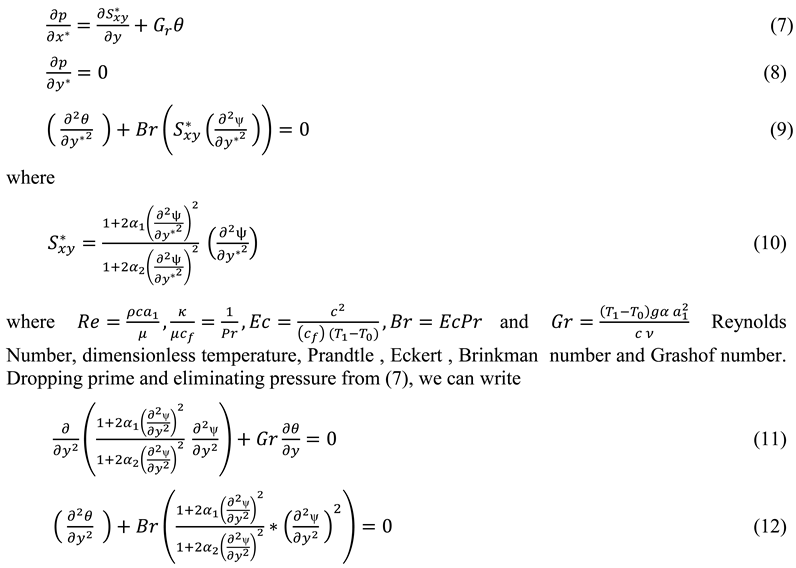
Ijtst 06 060302 i001
where b1 is the wave amplitude, λ is the wavelength and t̅ is the time. The law of conservation of mass and momentum, and energy are
Ijtst 06 060302 i002
where the extra stress tensor for Oldroyd 4-constant fluid can be expressed as
Ijtst 06 060302 i003
in which μ is the dynamic viscosity, λ1 and λ3 are the relaxation times parameter, λ2 is the retardation time parameter. Here U, V, p , μ, g, k, T and axial velocity, transverse velocity, pressure, fluid viscosity, gravitational acceleration. Introducing the variables
Ijtst 06 060302 i004
The governing equations in wave frame after using δ ≪ 1 and low Reynolds approximation
Ijtst 06 060302 i005
The dimensionless boundary conditions in the wave frame are given by
Ijtst 06 060302 i006
Dimensionless pressure rise is given by
Ijtst 06 060302 i007
Θ is Dimensionless mean flow in laboratory frame where F is in wave frame can be related as,
Θ = F + 2,
The heat flux at upper wall of the channel is
Ijtst 06 060302 i008

3. Results and discussions
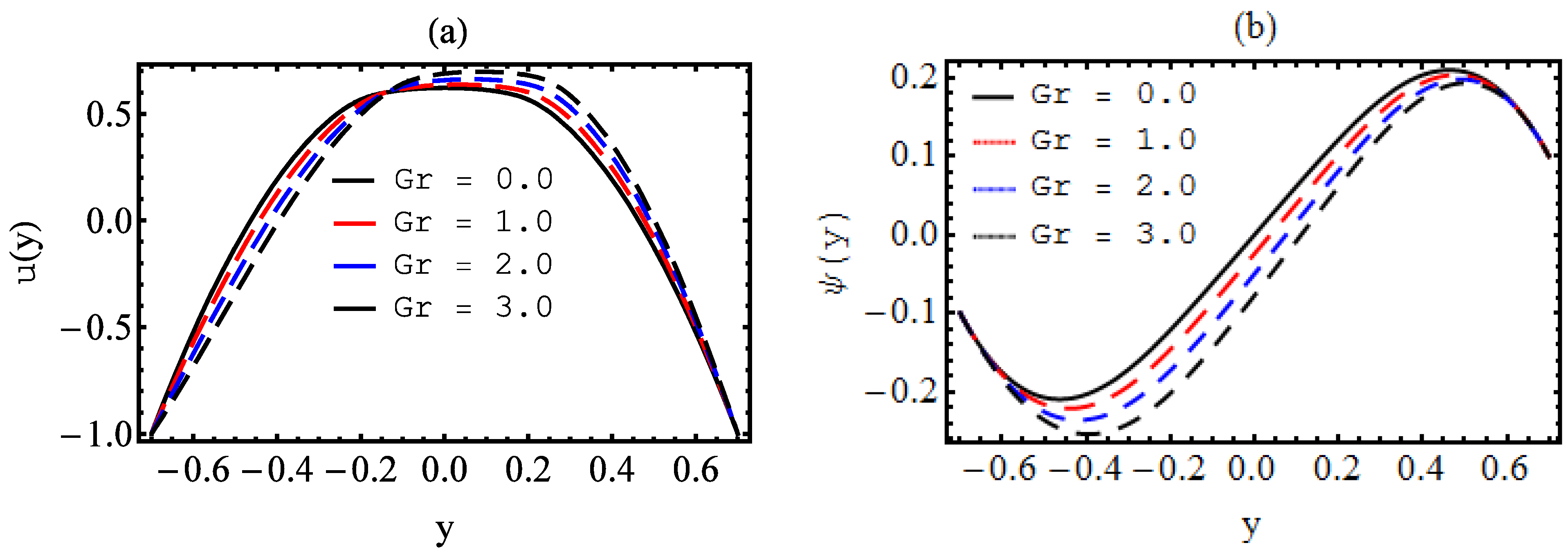
In this section we examine the effects of thermal Grashof number (Gr), for flow characteristics of inquired peristaltic motions. The effects of Gr on velocity profile are represented in Fig. 2(a), the symmetry of the curves is disturbed as we increase the thermal Grashof number. For Gr = 0 no gravity effects and for Gr = 1 both gravity and viscous effects are examined. As we increase the values of Gr the gravity effects are increasing. The effects of thermal Grashof number on stream function ψ are presented in Fig 2(b). It is obvious fact that as we increase the thermal Grashof number the stream function shows a valuable decrease.
Figure 2. Effects of Gr on (a) Velocity profile and (b) stream function when φ = 0.3, F = −0.2, α1 = 0.5, α2 = 2.0, Br = 2.5.
Ijtst 06 060302 g001
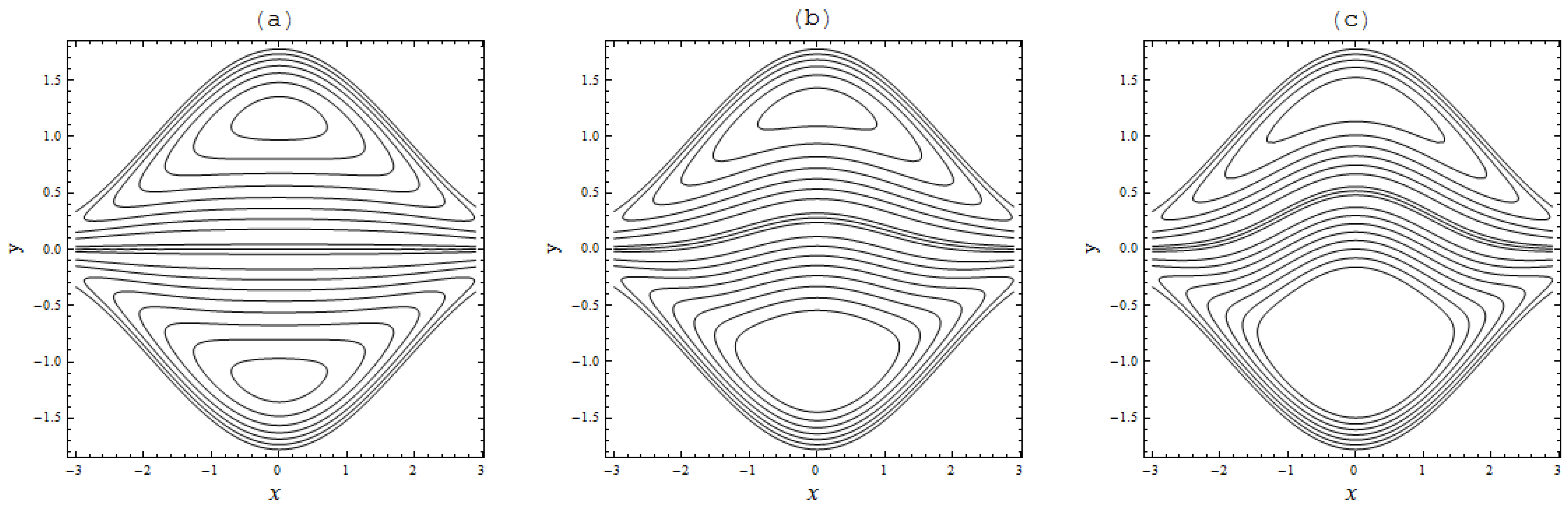
Figure 3. Stream lines for (a) Gr = 0.0, (b) Gr = 0.5, (c) Gr = 1.0 when φ = 0.8, F = −0.2, α1 = 0.5, α2 = 1.5, Br = 1.0.
Ijtst 06 060302 g002
The effect of thermal Grashof number is represented in Fig. 3. Fig. 3(a) is for Gr = 0 which show that viscous forces are dominant and symmetry is the due to the no influence of gravity force. As we increase the gravity effects the symmetry of the stream lines is disturbed and the disturbance in the flow is transferred to the upper half of the channel.
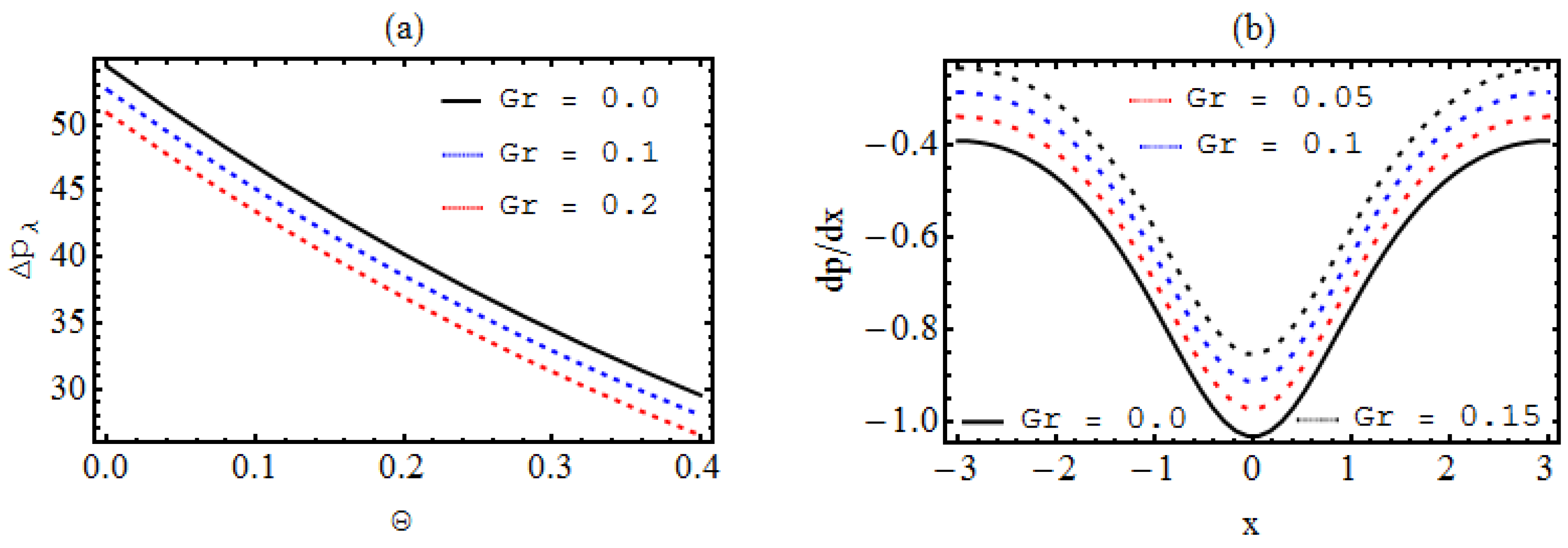
Figure 4. Effects of Gr on pressure rise per wavelength Δpλ versus flow rate Θ (a) and longitudinal pressure gradient dp / dx for Θ = 0.8 When φ = 0.3, α1 = 0.5, α2 = 2.0, Br = 1.0.
Ijtst 06 060302 g003
Fig. 4 elucidated the effects of thermal Grashof number on the pressure rise per wavelength Δpλ and on pressure gradient dp / dx . As we increase the Gr the pressure difference shows a notable decrease. This means that huge buoyancy effects results in the decrease of the pumping efficiency. Axial pressure gradient shows an enormous increase for the increasing values of the Gr and these effects are dominant at the inlet and outlet of the channel. Furthermore axial pressure gradient dp / dx reaches its maximum value in magnitude at the center of the channel.
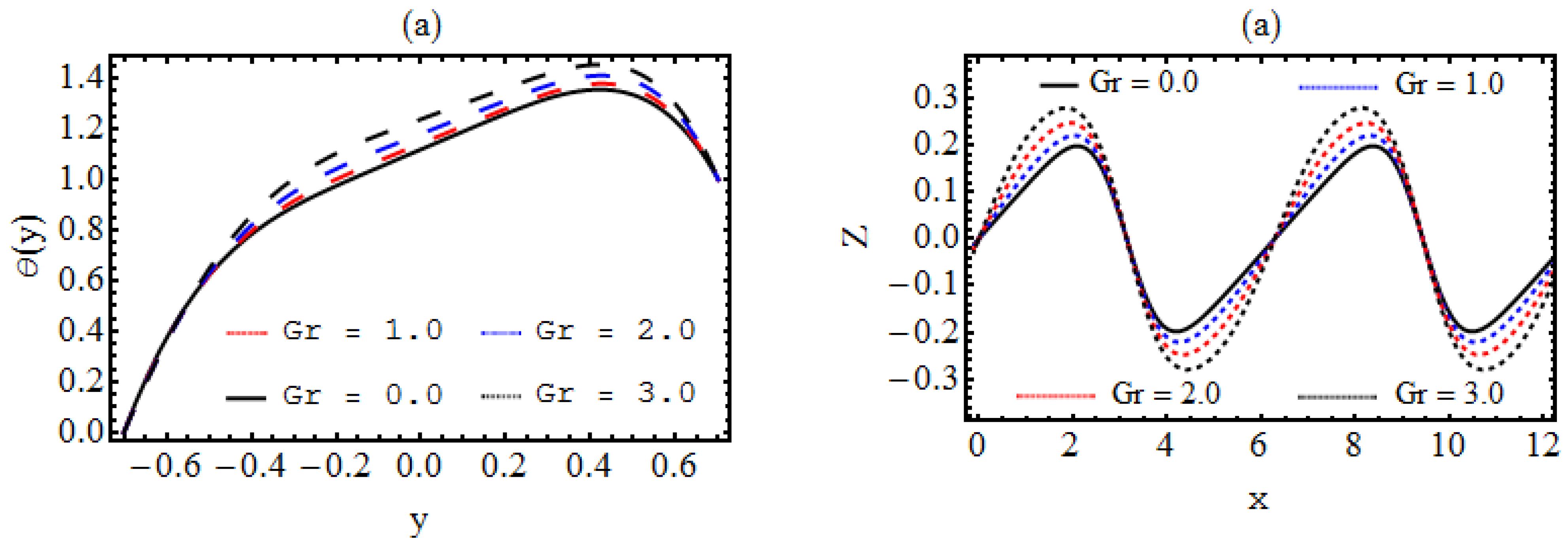
Figure 5. Effects of Gr on temperature profile θ (a) heat transfer coefficient Z (b) When φ = 0.3, α1 = 0.5, α2 = 2.0, Br = 1.0,x = π.
Ijtst 06 060302 g004
Effects of Grashof number on the internal temperature and the heat flux (heat transfer coefficient) at the walls of the channel are given in Fig. 5. Due to the increase in the Gr the effects of the gravity forces increases than the viscous forces. This results in the increase in the
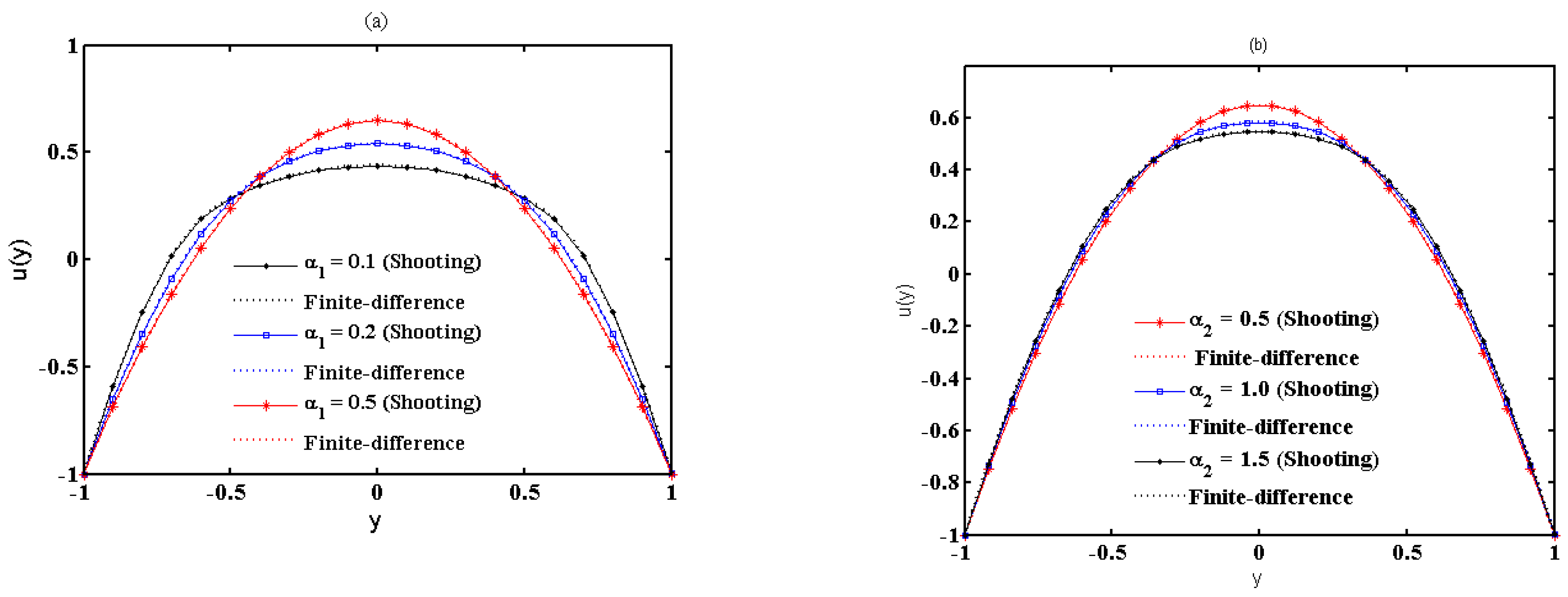
Figure 6. Comparison of velocity profile for different values of α1 when α2 = 0.5 (a) for different values of α2 when α1 = 0.5 (b) other parameters are Br = 0.5, Gr = 0.0, x = π/2.
Ijtst 06 060302 g005
temperature of the fluid and the amplitude of the heat transfer coefficient Z at the upper wall of the channel also increases.

4. Comparison

The boundary value problem is solved numerically using implicit finite difference method along iterative method with a code is executed in Fortran and graphical and tabulated results for both the solutions are presented in this subsection.
In order to make a comparison of the velocity profile Fig. 6 is plotted and it is observed that for both shooting and finite difference methods results are strongly agree with each other and these results shows a good agreement with Ali et al.[21]. Also when α1 = α2 the results for viscous fluid are obtained.
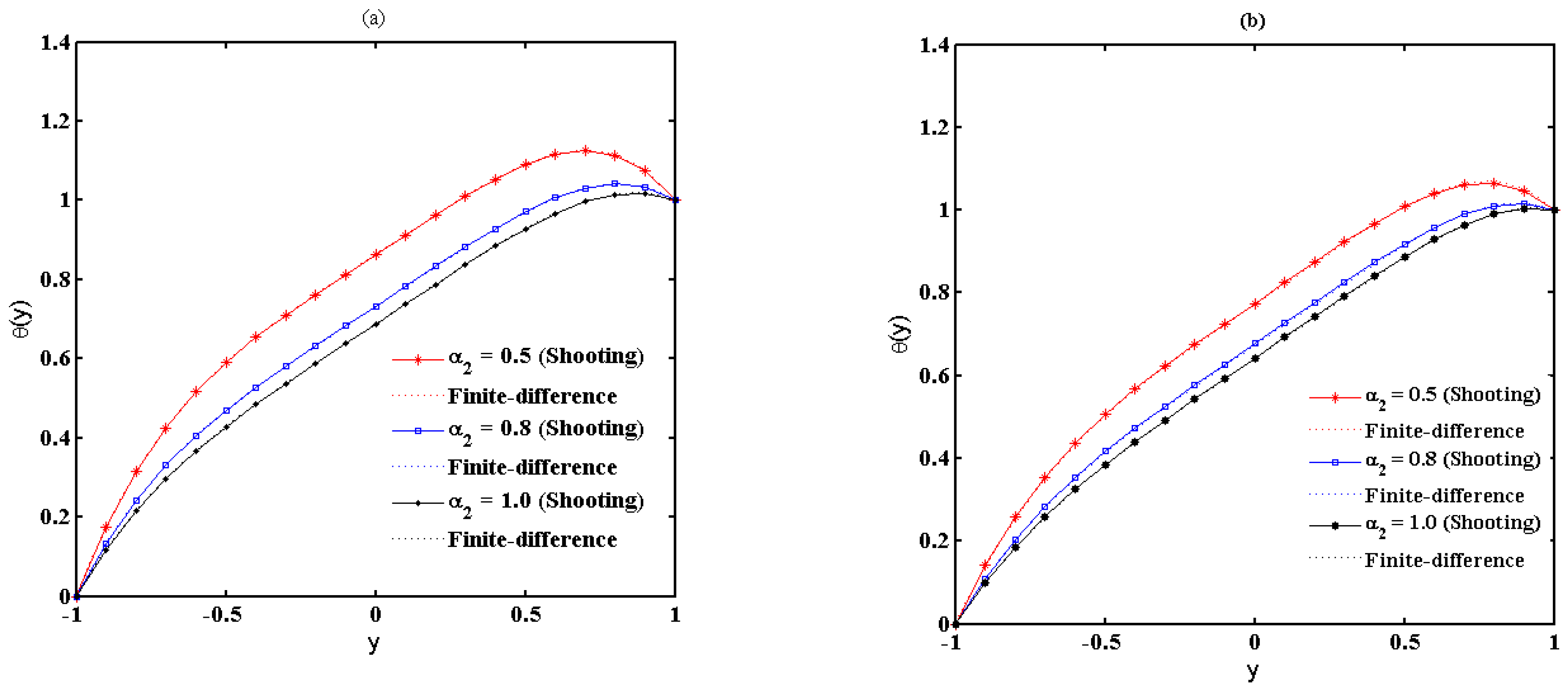
Figure 7. Comparison of temperature profile for different values of α2 when Gr = 0 (a) for different values of α2 when Gr = 1.0 (b) where α1 = 0.5 and x = π/2.
Ijtst 06 060302 g006
In Fig.7(a) temperature profile is plotted when the buoyancy forces are zero and results for both the techniques strongly coincide with each other for the increasing values of non-Newtonian fluid parameter α2. Also under the influence of buoyancy forces the temperature profiles show good agreement.
Table 01. Comparison of axial velocity u(y) for different parameters.
GrBrα1α2η = 0 η = ℎ/4η = ℎ/2
ShootingFDMShootingFDMShootingFDM
01.00.50.50.6500000.65050.5468750.54600.237500.2369
0.4 0.6271510.62720.5376550.53780.2455630.2452
0.3 0.5938510.59320.5208730.52060.2579030.2578
0.1 0.5 0.6508680.65010.5494550.54900.240570.2400
1.5 0.6513040.65070.5458560.54810.2342740.2362
1.0 0.80.6057670.60530.5328170.53240.2585740.2584
0.3 1.00.5842640.58390.5238210.52420.2680030.2681
0.2 0.50.6501730.68080.2406140.24420.5489530.5501
0.31.0 10.5866250.58600.5310050.53080.2792120.2790
Table 02. Comparison of temperature profile θ(y) for different parameters.
GrBrα1α2η = 0η = ℎ/4η = ℎ/2
ShootingFDMShootingFDMShootingFDM
01.00.50.51.40751.40741.528961.52861.600781.6007
0.4 1.241331.24121.363781.36361.448091.4479
0.3 1.073241.007321.196591.19631.293371.2932
0.1 0.5 1.409671.40921.531011.52911.603111.6028
1.5 1.866131.86111.735921.73501.529811.5291
1.0 0.81.084881.08631.207991.20781.303591.3033
0.3 1.00.6410020.64090.8840970.88350.765880.7650
0.2 0.50.681590.68080.920320.92330.8058610.8052
0.31.0 1.58901.58851.709751.70941.770941.7675
From Table 01 and Table 02 both the velocity and temperature profiles for different involved parameters is similar for both the methods.

5. Concluding remarks

Mixed convective peristaltic transport of an Oldroyd 4-constant fluid in a planner channel were investigated in this article. The main finding of the present communication are
  • The velocity profile decreases in the left half of the channel whereas in the right half of the channel the effects are quite opposite with increase in thermal Grashof number.
  • In the presence of gravity and viscous forces the stream function shows decreasing behaviors.
  • By increasing thermal Grashof number the size of trapping bolus increased.
  • The pressure rise per wavelength decreases while the pressure gradient increases by increasing thermal Grashof number.
  • With out buoyancy forces the velocity profile show a good agreement with the available results.

References

  1. Latham, T.W. Fluid motion in peristaltic pump. M. S.Thesis, MIT Cambridge MA, 1966. [Google Scholar]
  2. Shapiro, A.H.; Jaffrin, M.Y.; Weinberg, S.L. Peristaltic pumping with long wave length at low Reynolds number. Journal of Fluid Mechanics 1969, 37799, 799–825. [Google Scholar] [CrossRef]
  3. Fung, Y.C.; Yih, C.S.; Mech, P. T.T.A.J.A. 1968, 33, 669–675.
  4. Raju, K.K.; Devanathan, R. Peristaltic motion of a non-Newtonian fluid: Part II, viscoelastic fluids. Rheologica Acta 1974, 13, 944–948. [Google Scholar] [CrossRef]
  5. Siddiqui, A.M.; Schwarz, W.H. Peristaltic pumping of a third order fluid in a planner channel. Rheologica Acta 1993, 32, 47–56. [Google Scholar] [CrossRef]
  6. Siddiqui, A.M.; Schwarz, W.H. Peristaltic flow of a second order fluid in tubes. Journal of Non Newtonian fluid Mechanics 1994, 53, 257–284. [Google Scholar] [CrossRef]
  7. Usha, S.; Rao, A.R. Peristaltic transport of two-layered power-law fluids. Journal of Biomechanical Engineering 1997, 119, 483. [Google Scholar] [CrossRef] [PubMed]
  8. Hayat, T.; Wang, Y.; Siddiqui, A.M.; Hutter, K. Peristaltic motion of a Johnson–Segalman fluid in a planer channel. Mathematical Problems in Engineering 2003, 1, 1–23. [Google Scholar] [CrossRef]
  9. Mekheimer, K.S.; Abd, Y. Elmaboud. Peristaltic flow of a couple stress fluid in a annulus: Application of a endoscope. Physica A 2008, 387, 2403–2415. [Google Scholar] [CrossRef]
  10. Hayat, T.; Ali, N.; Asghar, S. Peristaltic motion of a Burger’s fluid in aplanar channel. Appl. Math. and Comput. 2007, 186, 309–329. [Google Scholar]
  11. Chaube, M.K.; Tripathi, D.; Bég, O.A.; Sharma, S.; Pandey, V.S. Peristaltic Creeping Flow of Power Law Physiological Fluids through a Nonuniform Channel with Slip Effect. Applied Bionics and Biomechanics 2015. [Google Scholar] [CrossRef] [PubMed]
  12. Ali, N.; Abbasi, A.; Ahmad, I. Channel flow of Ellis fluid due to peristalsis. AIP Advances 2015, 5, 097214. [Google Scholar] [CrossRef]
  13. Bég, O.A.; Rashidi, M.M. Multi-Step DTM simulation of magneto-peristaltic flow of a conducting Williamson viscoelastic fluid. International Journal of Applied Mathematics and Mechanics 2013, 9, 22–40. [Google Scholar]
  14. Tripathi, D.; Bég, O.A. Peristaltic propulsion of generalized Burger’s fluids through a non- uniform porous medium: A study of chyme dynamics through the diseased intestine. Mathematical Bioscience 2014, 248, 67–77. [Google Scholar] [CrossRef] [PubMed]
  15. Tripathi, D.; Bég, O.A. Transient magneto-peristaltic flow of couple stress biofluids: A magneto- hydro-dynamical study on digestive transport phenomena. Mathematical Biosciences 2013, 246, 72–83. [Google Scholar] [CrossRef] [PubMed]
  16. Vajravelu, K.; Sreenadh, S.; Rajanikanth, K.; Lee, C. Peristaltic transport of a Williamson fluid in asymmetric channels with permeable walls. Nonlinear Analysis Real World Applications 2012, 13, 2804–2822. [Google Scholar] [CrossRef]
  17. Tripathi, D. A mathematical model for swallowing of food bolus through the oesophagus under the influence of heat transfer. International Journal of Thermal Sciences 2012, 51, 91–101. [Google Scholar] [CrossRef]
  18. Tripathi, D.; Beg, O.A. A study of unsteady physiological magneto-fluid flow and heat transfer through a finite length channel by peristaltic pumping. Proc. Inst. Mech. Eng. Part H. J. Eng. Med., 2012. [Google Scholar] [CrossRef]
  19. Sobh, A.M. Heat transfer in a slip flow of peristaltic transport of a magneto-Newtonian fluid through a porous medium. International Journal of Biomathematics 2009, 2, 299–309. [Google Scholar] [CrossRef]
  20. Hayat, T.; Qureshi, M.U.; Hussain, Q. Effect of heat transfer on the peristaltic flow of an electrically conducting fluid in a porous space. Applied Mathematical Modelling 2008, 33, 1862–1873. [Google Scholar] [CrossRef]
  21. Ali; Wang; Hayat; Oberlack, M. Long wavelength approximation to peristaltic motion of an Oldroyd 4-constant fluid in a planar channel. Biorheology 2008, 45, 611–628. [Google Scholar] [CrossRef] [PubMed]