1. Introduction
The combination of heat conduction and thermal radiation mechanisms is normally encountered in semitransparent materials as cited in the textbooks by Howell et al. (2011) and Modest (2013). Practical engineering applications of semitransparent solids, such as industrial furnaces, glass manufacturing, fiber and foam insulations, high performance windows, solar collectors have been reported in publications by Viskanta and Anderson (1975) and Campo et al. (1986,1987).
Several theoretical and numerical studies exist for the prediction of the total heat transfer by simultaneous conduction and radiation in gray materials; that is materials with extinction coefficient independent of wavelength. As noted by Mishra et al. (2006), theoretical models for the quantification of radiation heat transfer have been recognized as computationally intensive and time consuming. These features are attributed to the difficulty and high processing cost involving the radiation mechanism, which are due to the integro-differential nature of the governing energy equations (Howell et al. (2011) and Modest (2013). However, reasonable efforts have been directed in the past to reduce the processing time by developing new models and enhancing the computational procedures of the existing models. Representative publications on these efforts are those by Mishra et al. (2004), Anteby et al. (2000), Ratzell III and Howell (1982). A pioneering theoretical formulation for radiation heat transfer in a planar slab was developed by Viskanta and Grosh (1962a). These authors generated a rigorous solution for the case of one-dimensional gray medium by way of a complex procedure that transforms the integro-differential energy equation into a nonlinear integral energy equation. The nonlinear integral equation was solved by an iterative procedure. The authors also extended their formulation to investigate the effects of boundary emissivities on radiation heat transfer in a gray medium (Viskanta and Grosh, 1962b). More recently, the discrete transfer method (Shah, 1979) and the collapsed dimension method (Mishra, 1997) have been implemented to address the same problem. Afterwards, a comparative study between the two methods was carried out in Talukdar and Mishra (2002). The emerging results are in very good agreement with those published by Viskanta and Grosh (1962a,b). However, an inevitable drawback was that the number of iterations required for sub-problems dominated by radiation is very large. According to Talukdar and Mishra (2002), for sub-problems dictated by conduction-radiation parameters N smaller or equal to 0.01 an under relaxation technique is mandatory to attain satisfactory convergence.
For a particular case of transparent materials, Dai and Fang (2014) used the thermal response factor method developed by Mitalas (1968) to estimate the heat transmission in bodies. In fact, the peculiarity of this work is that the absorbed solar radiation was treated as an internal source term in the descriptive energy equation.
The objective of the present work revolves around the application of a new finite strip method for the heat transfer analysis by simultaneous heat conduction and thermal radiation in an absorbing and emitting gray material forming a planar slab. Further, convection heat transfer is ignored. The method in question consists of an iterative tangent nonlinear formulation in which the gray medium is discretized into a finite number of strips. Inside each finite strip, the temperature variation is approximated using quadratic expansions in local coordinates whose coefficients are the primary unknowns in the problem. The resulting discrete equations correspond to a collection of balance energy equations and compatibility conditions of temperature and heat flux between successive strips. Unquestionably, the main features inherent to the finite strip method are simplicity and quick convergence. For verification, the finite strip method is applied to a planar slab problem with different combinations of thermal and optical properties. Numerical results in terms of temperature fields as well as conductive, radiative and total heat fluxes are presented in graphical and tabulated forms. Besides, the relative importance of each heat transfer mode is elucidated. A detailed comparison of the numerical results with others obtained by well established theoretical models demonstrates a good balance between accuracy and the number of iterations needed for convergence.
2. Steady Conservation Equation of Energy
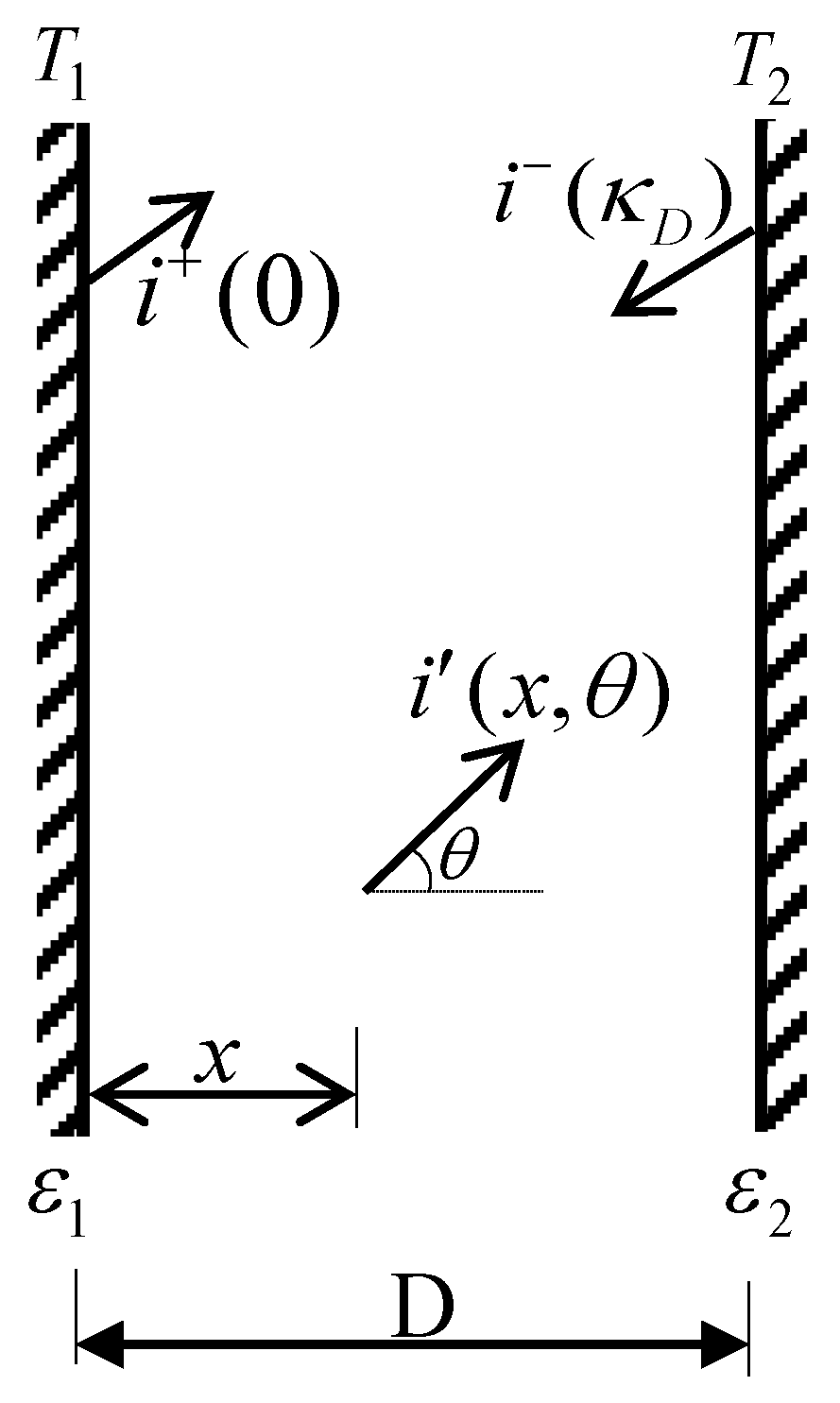
A planar slab of thickness
D made from a homogeneous, isotropic material is sketched in
Figure 1. The material filling the planar slab is assumed to be gray, absorbing, emitting and nonscattering. For simplicity, the material properties are considered independent of temperature. The bounding parallel surfaces 1 and 2 in the planar slab are idealized as opaque and diffuse and are maintained at temperatures
T1 and
T2 . It is envisioned that heat transfer in the planar slab occurs by simultaneous heat conduction and thermal radiation.
In addition, to avoid convection heat transfer, the planar slab is situated in a perfect vacuum. The one dimensional geometry is a good approximation for the energy transport in many physical situations, such as insulation, atmospheres and furnaces. Besides, the one dimensional geometry is also a building block for the preliminary analysis of more involved geometries dealing with two and three dimensions.
Under steady-state conditions, the total heat flux
qt through the planar slab is constant.
Thereby, the total heat flux
qt is quantified by the additive relation
where
qc(
x) is the conductive heat flux and
qr(
x)is the radiative heat flux occurring at the point with coordinate
x as illustrated in
Figure 1. The conductive heat flux
qc(
x) is obtained from Fourier’s law (Arpaci, 1966):
where
βc is the thermal conductivity. Upon introducing the optical coordinate
κ =
Kx, where
K is the material extinction coefficient, the radiative heat flux
qr(
x) as given by Howell et al. (2011) and Modest (2013) is:
In this equation,
i+(0) and
i−(
κD) represent the forward and backward total intensities at the bounding surfaces 1 and 2, respectively,
κDis the optical thickness and
η is the refractive index of the gray material. Furthermore, μ = cos
Θ, wherein
Θ is the angle between the radiation direction and the x-axis as indicated in
Figure 1. The blackbody total intensity
ib′ depends on the temperature
T with the formula (Howell et al., 2011 and Modest, 2013).
where the Stefan-Boltzmann constant σ = 5.67 × 10
−8 W/(m
2K
4). The quantities E
2( ) and E
3( ) in
Eq. (3) emerge from the exponential integral function (Abramowitz and Stegun, 1965):
for
n = 2 and
n = 3.
The total intensities
i+(0)and
i−(
κD) at the two bounding surfaces 1 and 2 can be evaluated by the pair of expressions
and
where
ε1 and
ε2 denote the respective surface emissivity of bounding surfaces 1 and 2.
Within the platform of simultaneous conduction-radiation heat transfer, the governing conservation equation of energy is taken from Howell et al. (2011) and Modest (2013):
Using Eqs. (2) and (3), allows us to write Eq. (7) in the form of a nonlinear integro-differential equation
which is subject to the prescribed temperature boundary conditions
From a fundamental framework, the pair of Eqs. (8) and (9) constitutes a nonlinear and nonlocal problem. On one hand, the nonlinear part presents difficulties because the blackbody total intensity ib′ depends on the temperature field T (x), which is not known a priori. On the other hand, the non-local part implies that the total heat flux qt at a point x depends on both the temperature T (x) and the temperature gradient dT/dx.
3. Numerical Computational Procedure: The New Finite Strip Method
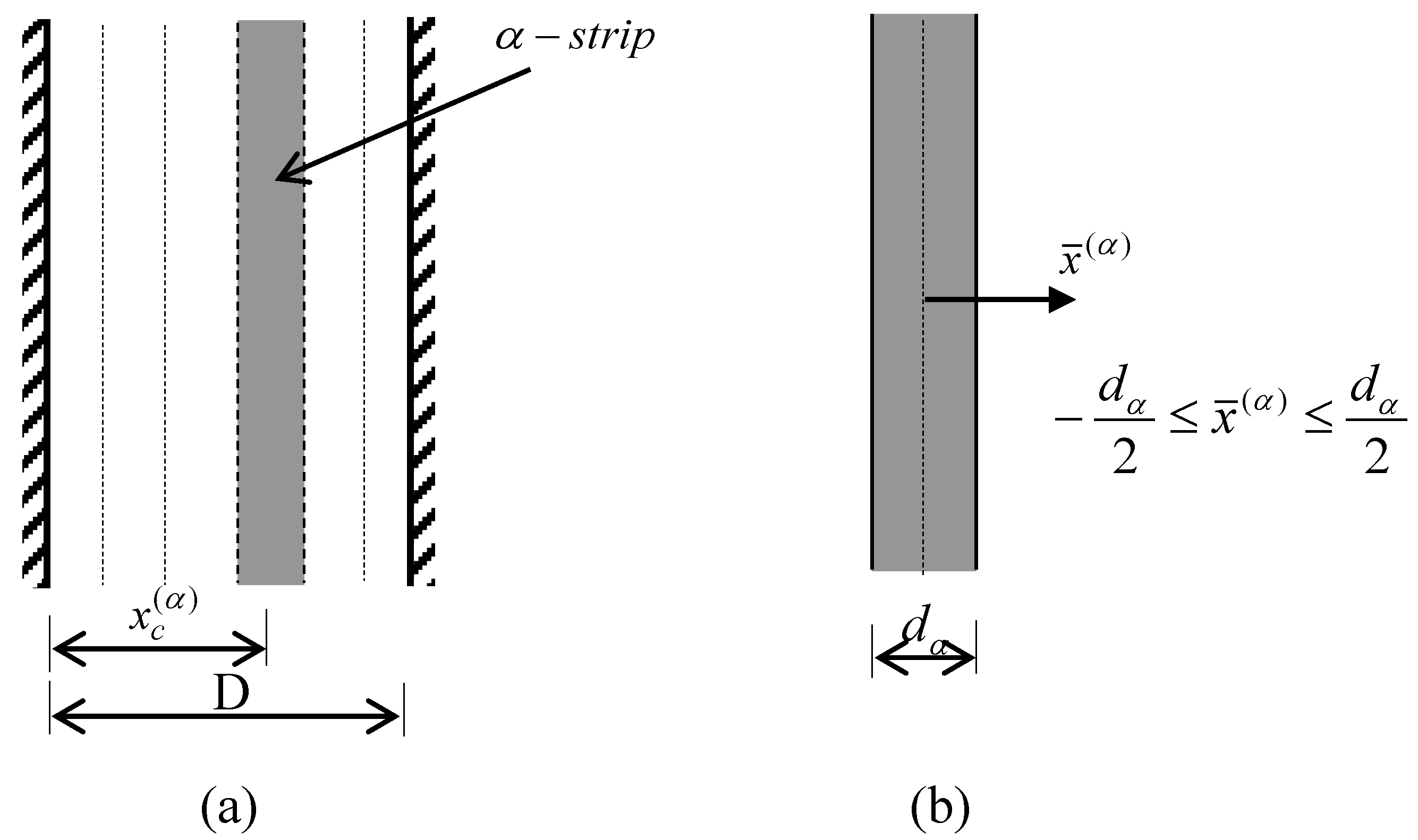
Owing that the central objective in the study is to produce manageable discrete equations, the planar slab is divided into a finite number of
L strips, each with variable thickness
dα (1 ≤
α ≤
L) as shown in
Figure 2. Accordingly, a local coordinate
is assigned at the mid-plane of each strip, so that

The temperature
T (x) at each strip is approximated by means of a quadratic expansion in the corresponding local coordinate
. Correspondingly, for a typical
α–strip, the temperature is given by the equation
where
To(α) ,
T1(α) and
T2(α) are the unknown temperature coefficients. It can be shown that: a)
To(α) represents the mean temperature in the
α–strip and b)
βcT1(α) is the conduction heat flux at the mid-plane of the
α–strip. Using this approximate temperature field, the energy equation (8) specialized at the mid-plane
= 0 of the
α–strip can be channeled through the following expression
where
κc(α) is the optical coordinate at the mid-plane of the strip. The partial derivatives of
Ψα with respect to the unknown temperature coefficients
To(γ),
T1(γ) and
T2(γ) associated with the
γ−strip are represented by the following system of integro-partial differential equations
where
δαγ stands for the Kronecker delta function.
Under the premises that the finite strips are thin, the blackbody total intensities
ib′ along with their derivatives in Eqs. (12)-(14) can be approximately evaluated in terms of the mean temperature
To in each strip. By way of this simplification, the exponential integral functions
En over the optical coordinate can be evaluated explicitly. The integrals can be treated with different quadrature schemes, such as Gaussian, Lobatto, Chebyshev, and Newton-Cotes (Press et al., 1986). The integrals in question are of the form
where
wj are the weight coefficients corresponding to the
n discrete points
μj. The differences between the various quadrature schemes lie in the values of
wj and
μj. Consider
f(
μ) to be a polynomial of degree
m, having
m +1 coefficients. For Gaussian quadrature, which contains the
2n weights and points to be arbitrary, the maximum value of
m for which the summation is exact is
m = 2n – 1. In this work, the precise four-point Gaussian quadrature scheme (Press et al., 1986) was implemented.
Actually, the present model generates a system of L energy equations, wherein each equation is connected to a particular finite strip. It is important to add that the energy equations depend on the unknown temperature coefficients. As expected, additional equations have to be written to comply with the compatibility conditions of temperature and heat flux at the interfaces of adjacent finite strips. In equation form, these compatibility conditions are equivalent to:
a) The temperature compatibility at the interface between two adjacent strips is
b) The conduction heat flux compatibility at the interface between two adjacent strips is
Besides, the temperature boundary conditions at the bounding surfaces are
Overall, a nonlinear system of algebraic equations consisting of 3
L equations and 3
L unknown temperature coefficients is formed by Eqs. (11), (16), (17) and (18). In general, the nonlinear system of algebraic equations can be written compactly as follows
where is the vector of temperature coefficients
An iterative solution procedure is implemented to solve the above system of algebraic
equations. Applying the Taylor’s series expansion of
Ψi to the vector
corresponding to a
certain iteration
m, a linearization technique leads to the equation
After neglecting higher order terms. In this equation,

represents the Jacobian matrix
of the function
Ψi and
δ indicates the incremental vector of temperature coefficients defined
by
Next, combining Eqs. (21) and (22), the unknown temperature coefficients
Tm+1 are obtained iteratively using the equation
Here, the iterative process begins by guessing an initial temperature field in the gray material occupying the planar slab, which is associated with the limiting condition of heat conduction.
Convergence of the nonlinear system of algebraic equations in Eq. (19) is achieved when the Euclidean norm of the n-th increment of temperature normalized by the temperature is less than a pre-set tolerance. Then, the convergence criterion is given by the ratio
where ‖ ‖represents the Euclidian norm and ∣
Tmax∣ signifies the absolute value of the larger
temperature between
T1 and
T2. The pre-set tolerance is usually set at 10
−3. Excellent
convergence patterns are obtained employing a relatively small number of iterations (normally,
from two to six) in the algorithm.
4. Validation of the New Finite Strip Method
The conduction-radiation parameter is defined by N = βcK/4σTref3, where βc is the thermal conductivity, K is the extinction coefficient and Tref is a reference temperature. In this work, Tref has been taken as the largest temperature at the bounding surfaces, i.e., either T1 or T2. For high values of the conduction-radiation parameter N, heat conduction is the dominant mechanism, whereas for small values of N, thermal radiation is the dominant mechanism.
For gray materials, the accuracy of the algorithm has to be demonstrated by comparing the computed results provided by the new finite strip method in terms of temperature and heat fluxes with comparable published results that are available in the heat transfer literature.
For the computational domain, uniform meshes with 100, 150 and 200 finite strips are constructed. The number of iterations required for convergence usually varied between
n = 2 and 6, being the maximum value (
n = 6) associated with the limiting case of pure radiation
N = 0. An adequate tolerance with an error equal to 0.001 is imposed. As it can be seen in
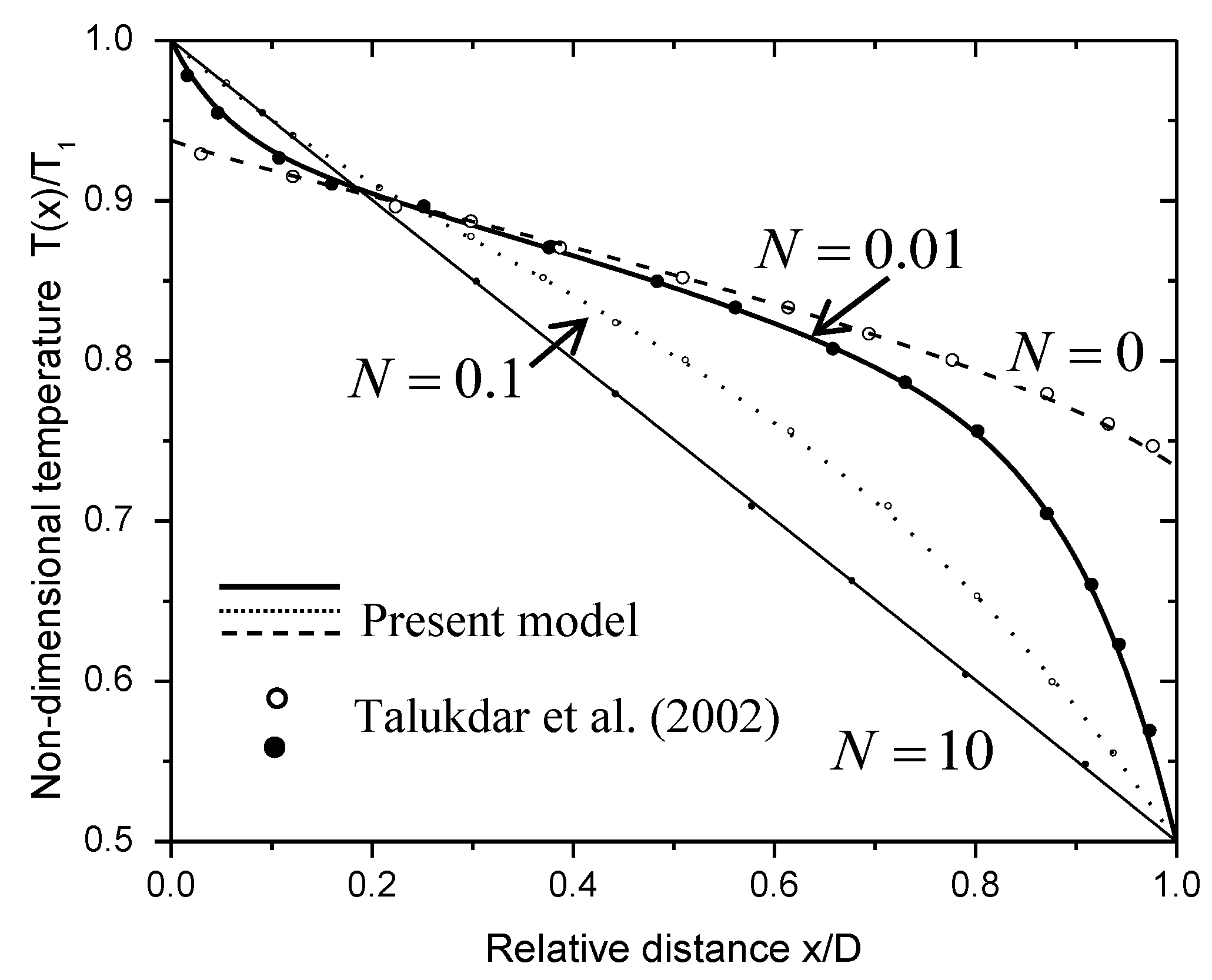
Figure 3, the non-dimensional temperature distributions are in excellent agreement with those published by Talukdar and Mishra (2002). It should be added that in the paper by these authors, the number of iterations required for gray materials having various conduction-radiation parameters
N = 0.1, 0.01, 0.001 and 0.0001 amounts to 80, 120, 600 and 650, respectively. For those particular cases connected to very small conduction-radiation parameter, such as
N ≤ 0.01. under relaxation was necessary.
5. Presentation and Discussion of the Numerical Results
Figure 3 displays the non-dimensional temperature distributions
Θ =
T/T1 varying with the relative distance
x/D for the case of a gray material owing an optical thickness
κD =1, temperature ratio
T2/T1 = 0.5 coupled with four conduction-radiation parameter
N = 0, 0.01, 0.1 and 10 together with a high surface emissivity
ε =1.0. With the exception of a high
N = 10, the three non-dimensional temperature distributions exhibit a characteristic
S-shape. For limiting pure radiation with
N = 0 and weak radiation with
N = 0.01 the two non-dimensional temperature distributions coincided with those obtained by Talukdar and Mishra (2002). For limiting pure radiation with
N = 0, the non-dimensional temperature
Θ at
x/D = 1 attains a relatively high value of
0.75. This behavior demonstrates a non-dimensional temperature jump from 0.5 to 0.75. For weak radiation with
N = 0.01 the non-dimensional temperature
Θ at
x/D = 1 attains the value of
Θ = 0.50, that is the non-dimensional temperature of the right bounding surface. For limiting pure conduction with a high
N = 10, the non-dimensional temperature distribution shows the negative sloped straight line ending with
Θ = 0.5 at
x/D = 1.
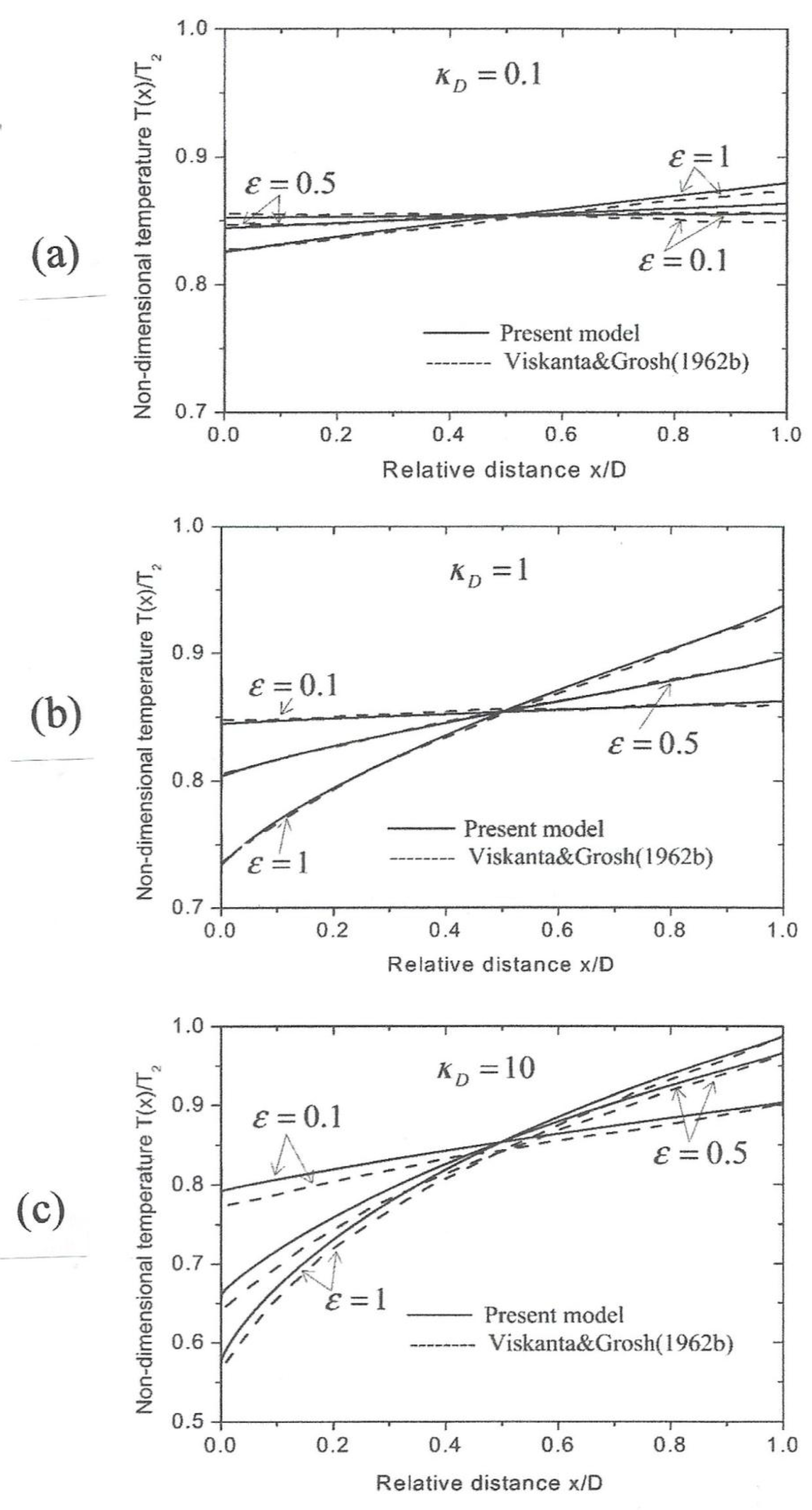
For the limiting case of pure radiation with
N = 0, the non-dimensional temperature distributions in gray materials with temperature ratio
T1/T2 = 0.5, different surface emissivity and optical thickness, are plotted in Figure. 4. Notice that a different temperature ratio
T2/T1 = 0.5 was used in
Figure 3. To assess the goodness of the new strip model in describing the heat transfer phenomena for pure radiation with
N = 0, the respective non-dimensionless temperature distributions are compared with those reported in the seminal work by Viskanta and Grosh (1962b). It is observable that for all optical thicknesses
κD the results are of excellent quality. Specifically, the largest difference of about 2.6% corresponds to a high optical thickness
κD =10.
In
Figure 4(a) for a small optical thickness
KD = 0.1 and surface emissivities
ε = 0.1, 0.5 and 1, the non-dimensional temperatures in the gray material remain almost constant from the left to the right bounding surfaces.
In
Figure 4(b) for a moderate optical thickness
KD = 1, the non-dimensional temperature curve remains constant for a surface emissivities
ε = 0.1, and switches to monotonic sloped for higher surface emissivities of
ε = 0.5 and 1. The curve slopes increase gradually with increments in the surface emissivity ε.
In
Figure 4(c) for a large optical thickness
KD = 10, the non-dimensional temperature curves exhibit a parabolic behavior, which is accentuated with increments in the surface emissivity going from ε = 0.1 to 1.
The non-dimensional heat flux is conveniently defined by the relation
ζ =
q/(
σTref4), where
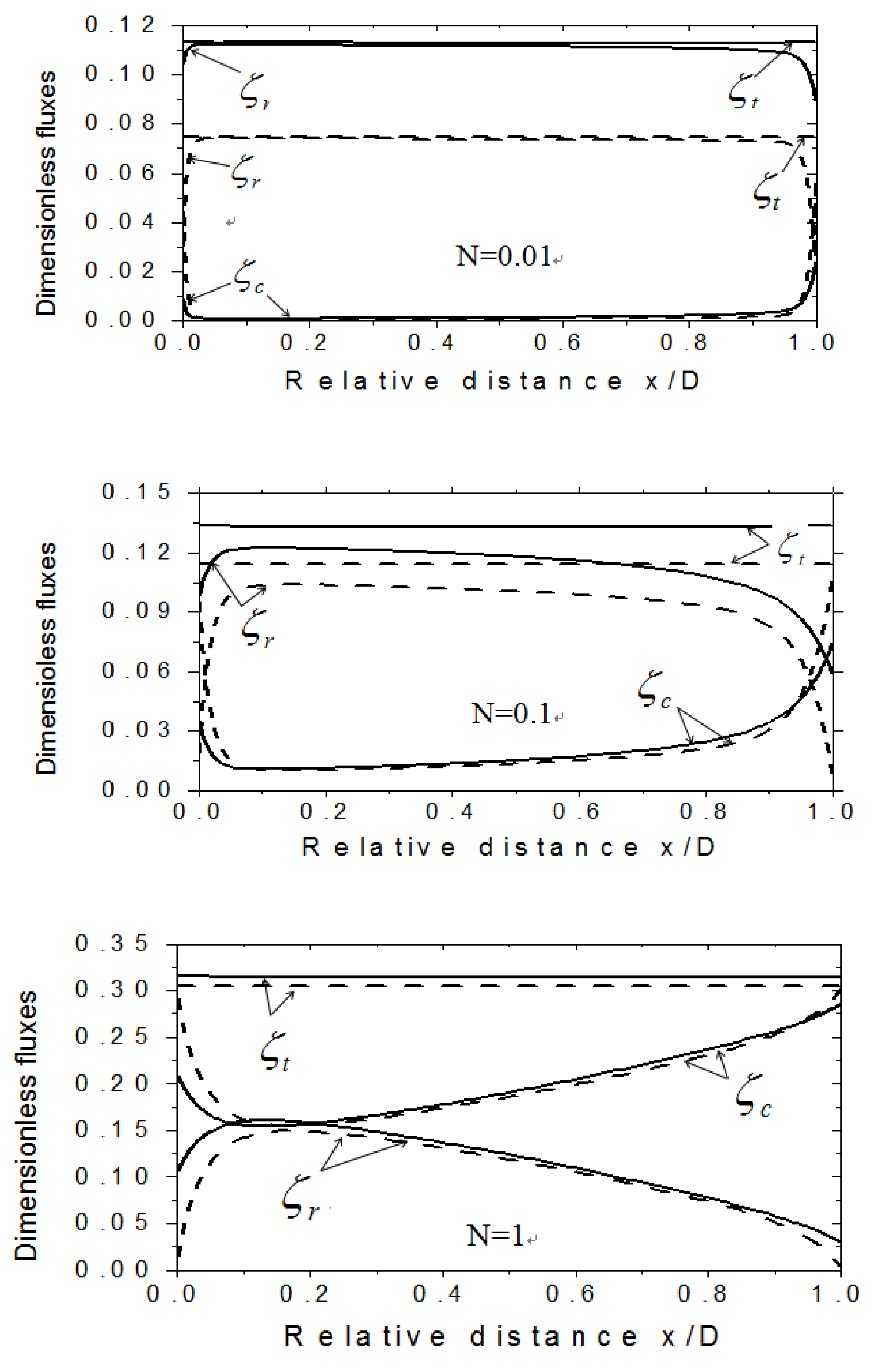
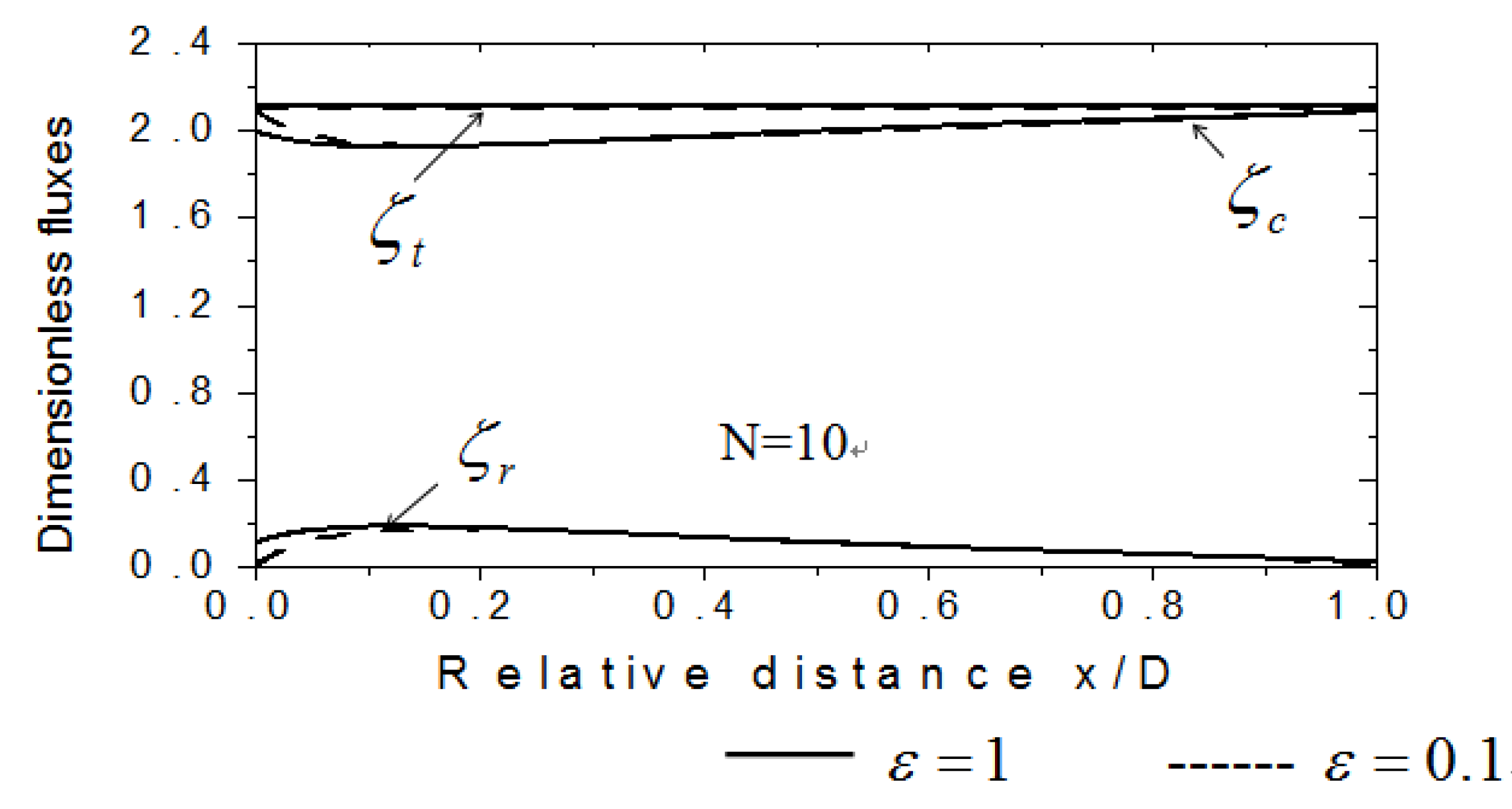
q denotes heat flux. Non-dimensional heat fluxes computed by the present model for gray materials characterized with optical thickness
κD =10, temperature ratio
T2/T1 = 0.5 and different values of the conduction-radiation parameter
N are portrayed in Figure. 5. Here again, the surface emissivity takes two extreme values
ε =1.0 and
ε = 0.1. In
Figure 5, the conductive, radiative and total non-dimensional fluxes are represented by
ζc,
ζr and
ζt, respectively. A variety of straight lines, concave lines and convex lines are observed in the figure. For the extreme case dealing with pure radiation (
N = 0), the maximum number of iterations needed for convergence was 5. On the contrary, for dominant conduction (
N = 10), only 2 iterations were needed to achieve satisfactory convergence. Again, to maintain uniformity, a tolerance of 0.001 was pre-set in advance.
The numerically-obtained non-dimensional total fluxes ζ
t are listed in Tables 1 and 2. It is observable that the numbers compared favorably with those reported in the seminal publication by Viskanta and Grosh (1962b).








 represents the Jacobian matrix
of the function Ψi and δ indicates the incremental vector of temperature coefficients defined
by
represents the Jacobian matrix
of the function Ψi and δ indicates the incremental vector of temperature coefficients defined
by