Energetic performance investigation of ejector air conditioning cycles using the environment friendly gas R161 (Fluoroethane) as substitute to the phase-out R22 (Chlorodifluoromethane)

Abstract
1. Introduction
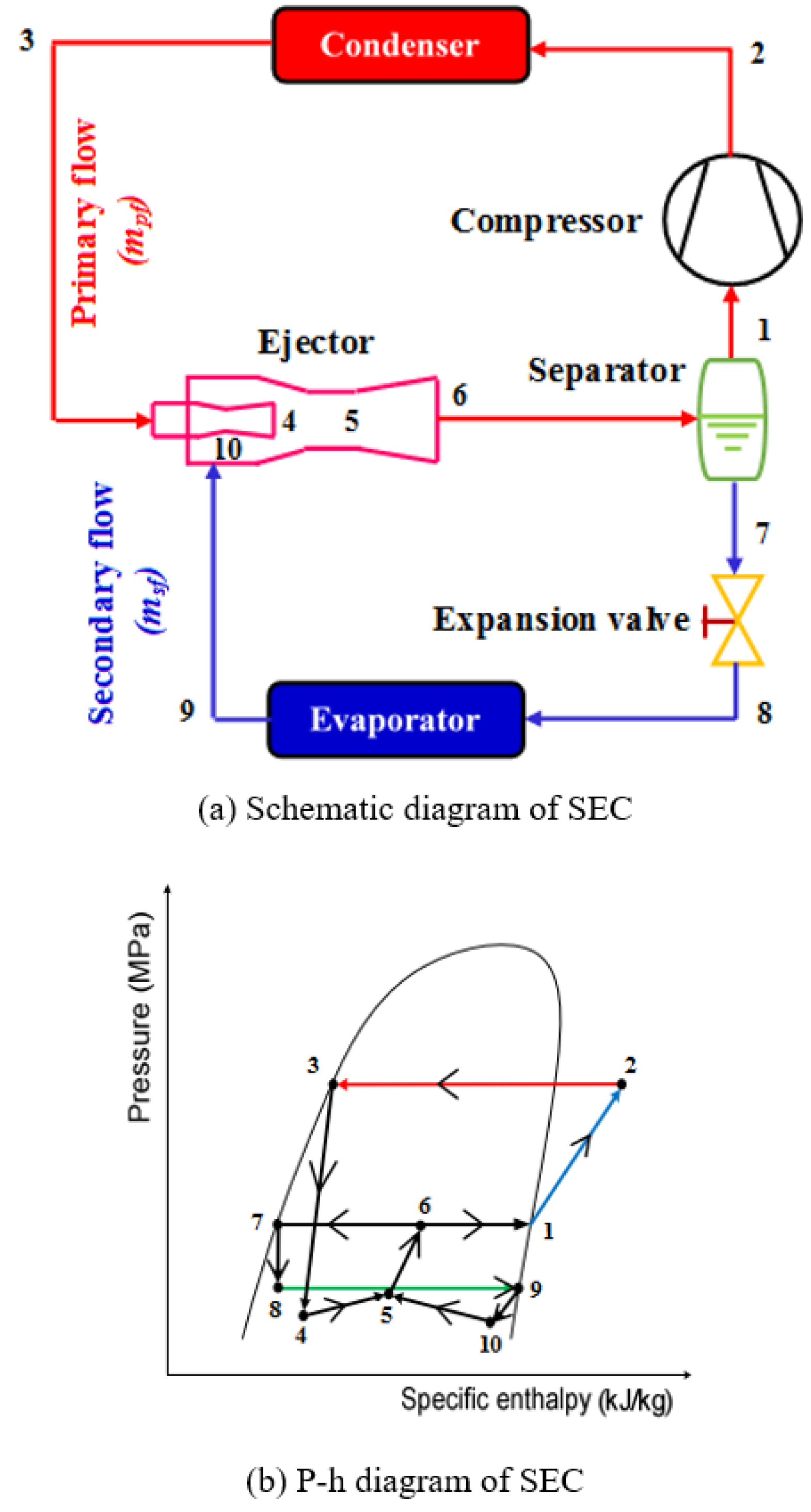
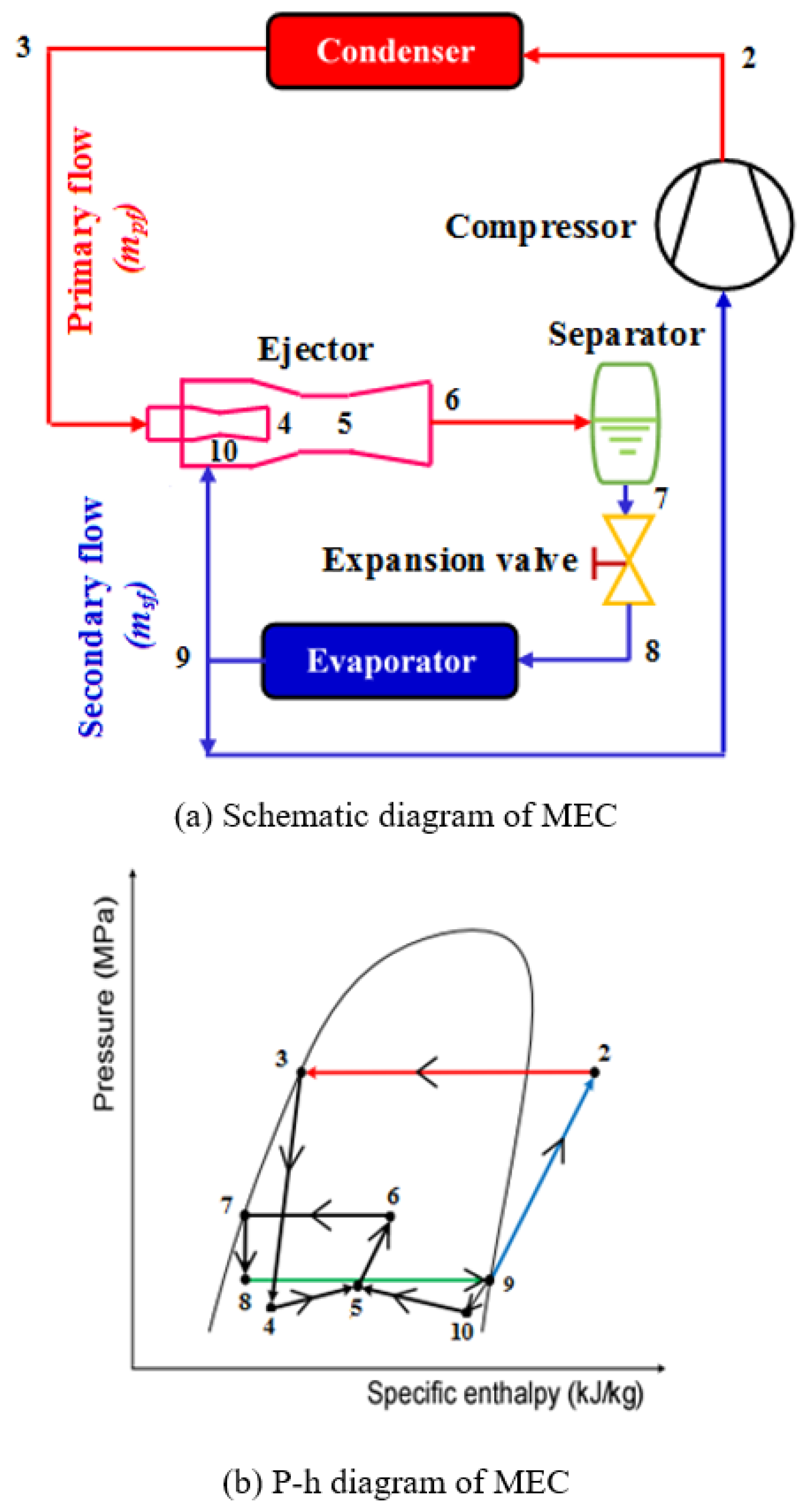
2. Description of Cycles (SEC and MEC)
2.1. Standard ejector cycle (SEC)
2.2. Modified ejector cycle (MEC)
3. Thermodynamic Analysis of Studied Ejector Air Conditioning Cycles (SEC and MEC)
3.1. Thermodynamic assumptions
- One-dimensional homogeneous equilibrium flow in the ejector expansion is considered;
- The inner wall of the ejector expansion is adiabatic;
- The ejector components have constant values of efficiencies;
- The mixing pressure in the mixing chamber of ejector is constant;
- Isenthalpic process in the expansion valve (h8 = h7);
- The compression process in the compressor is irreversible and has a given isentropic efficiency;
- Kinetic and potential energy variations are neglected in the ejector air conditioning cycles;
- Heat losses in the cycles are neglected;
- Refrigerant pressure drop in the condenser, evaporator, separator and the connection tubes are neglected;
- Saturation conditions apply at exit of the evaporator and condenser of ejector air conditioning cycles;
- Saturation condition for both liquid and vapor at the separator exit.
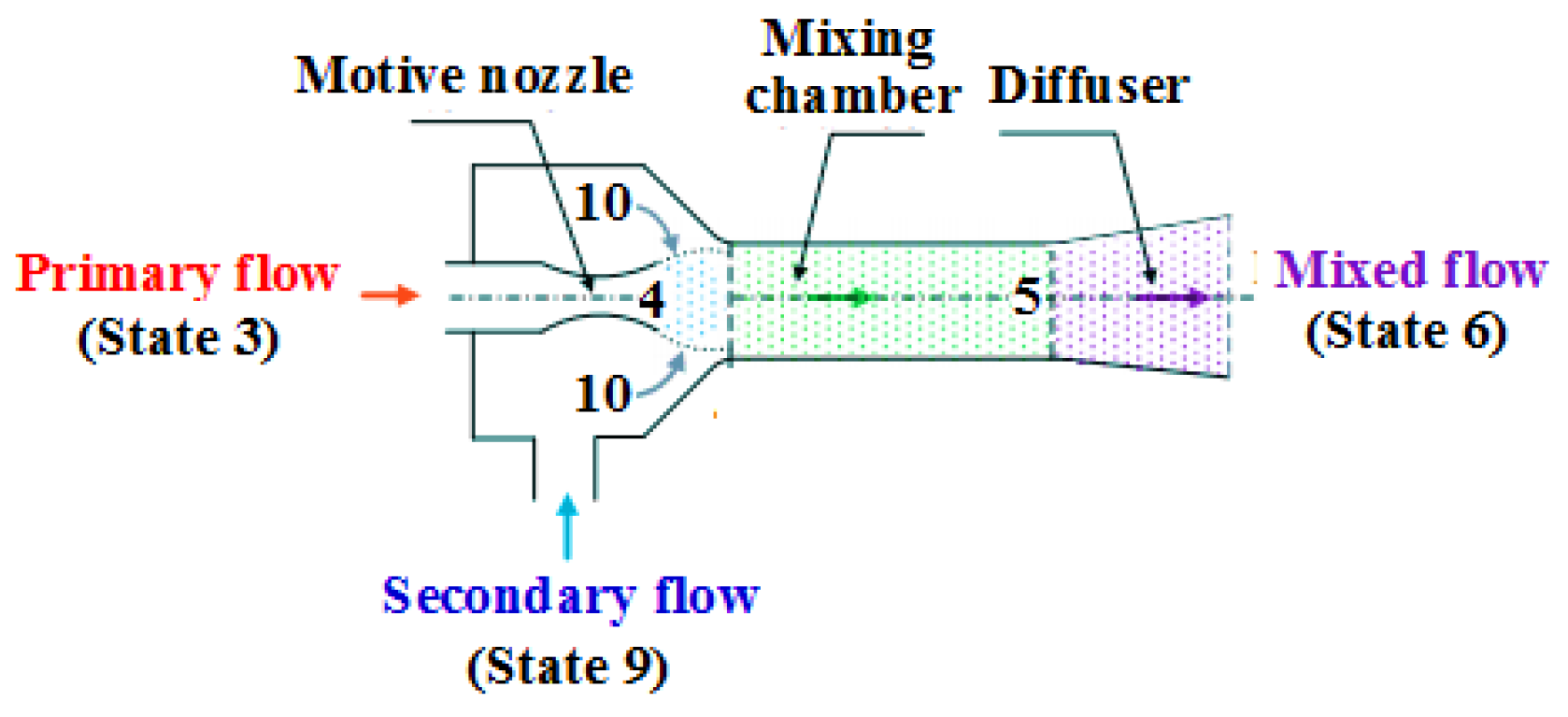
3.2. Mathematical models of ejector expansion technology
- If the motive nozzle exit placed inside the suction chamber, the mixing of the primary and the entrained fluids occurs inside the suction chamber with a constant pressure, and the ejector is classified as “a constantpressure mixing ejector”;
- If the motive nozzle exit placed inside the constant-area section, the mixing of the primary and the secondary fluids occurs inside the constant-area section and the ejector is classified as “a constant-area mixing ejector”.
3.2.1. Model of primary flow through nozzle
3.2.2. Model of secondary flow
3.2.3. Model of mixing process
3.2.4. Model of mixed flow through the diffuser
3.3. Systems coefficient of performance
3.3.1. Model of the evaporator
3.3.2. Model of the compressor
3.3.3. Model of the condenser:
3.3.4. COP of SEC and MEC
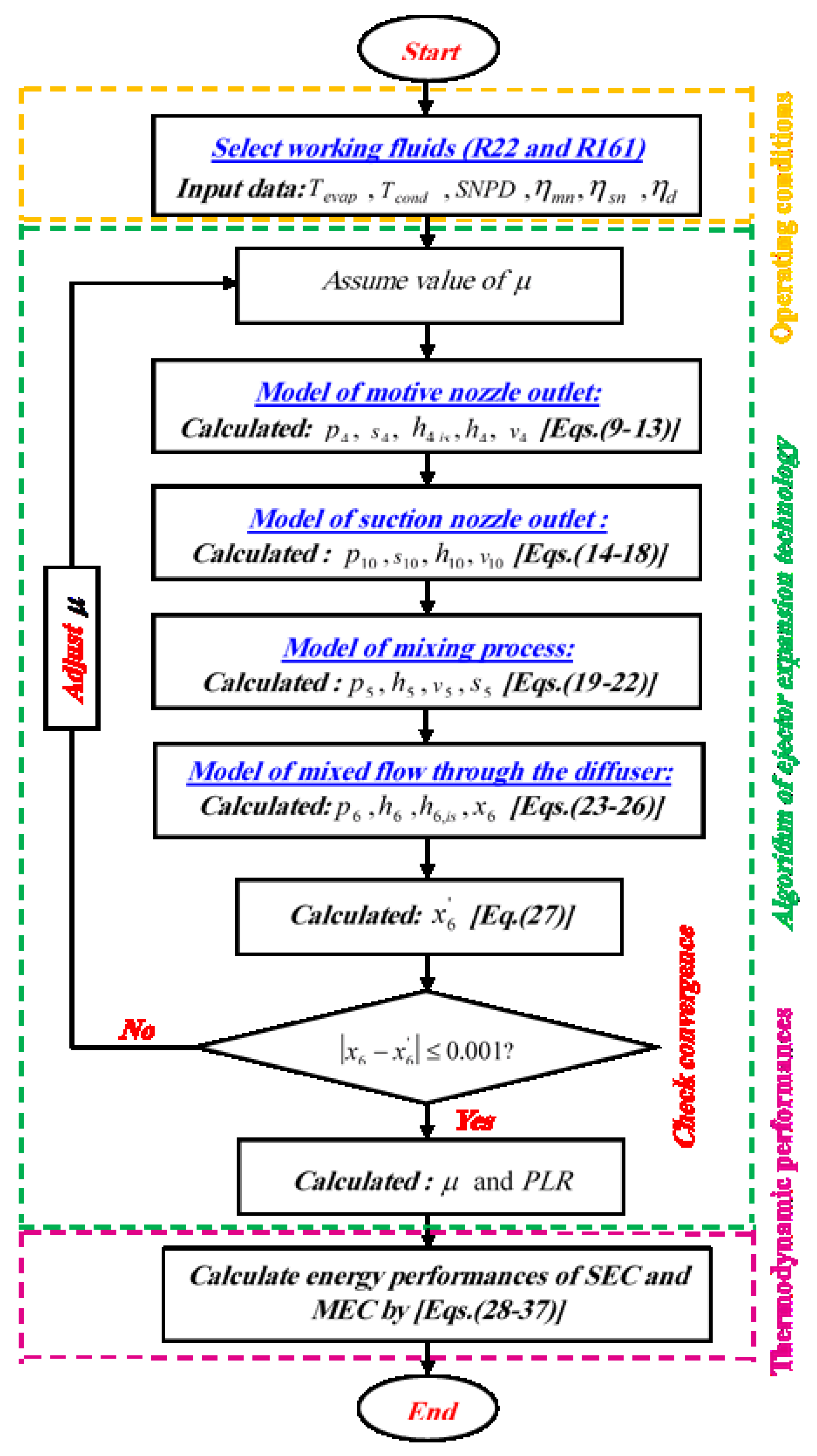
3.4. Simulation process
4. Simulation Results and Discussion
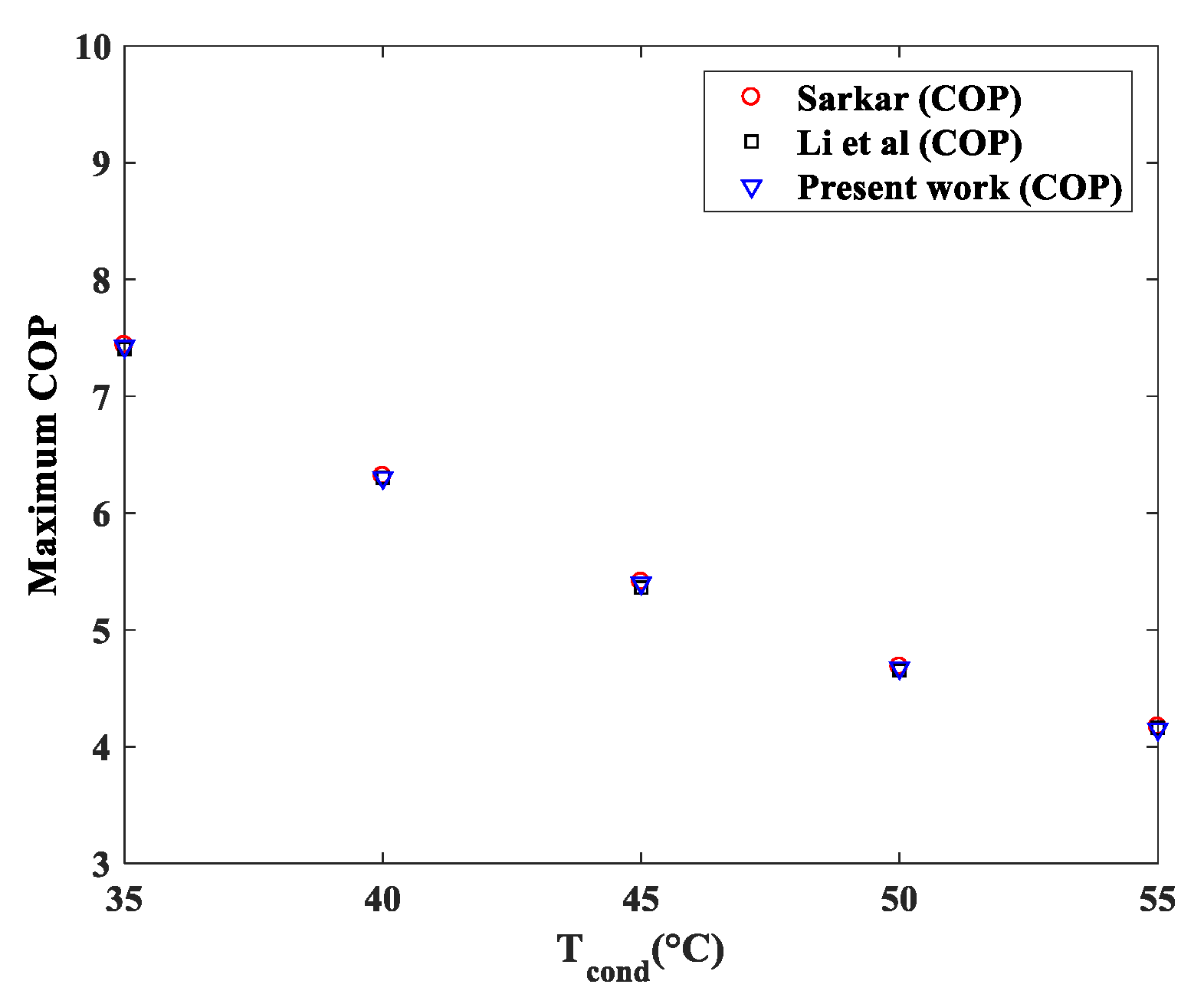
4.1. Validation of the computer simulation model
4.2. Influence of operating conditions on performances of SEC and MEC
4.2.1. Effect of the evaporator outlet temperature on performances of SEC and MEC
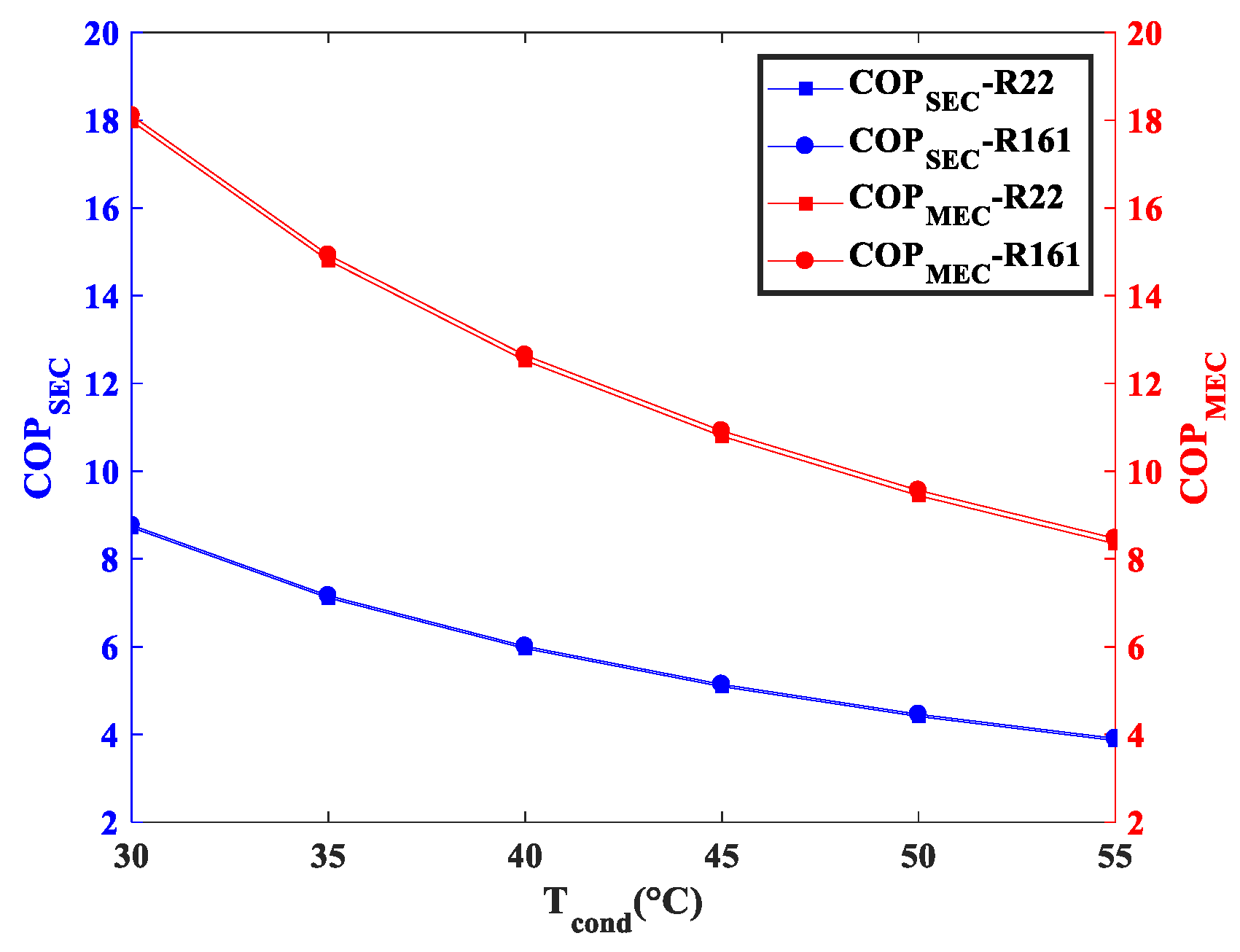
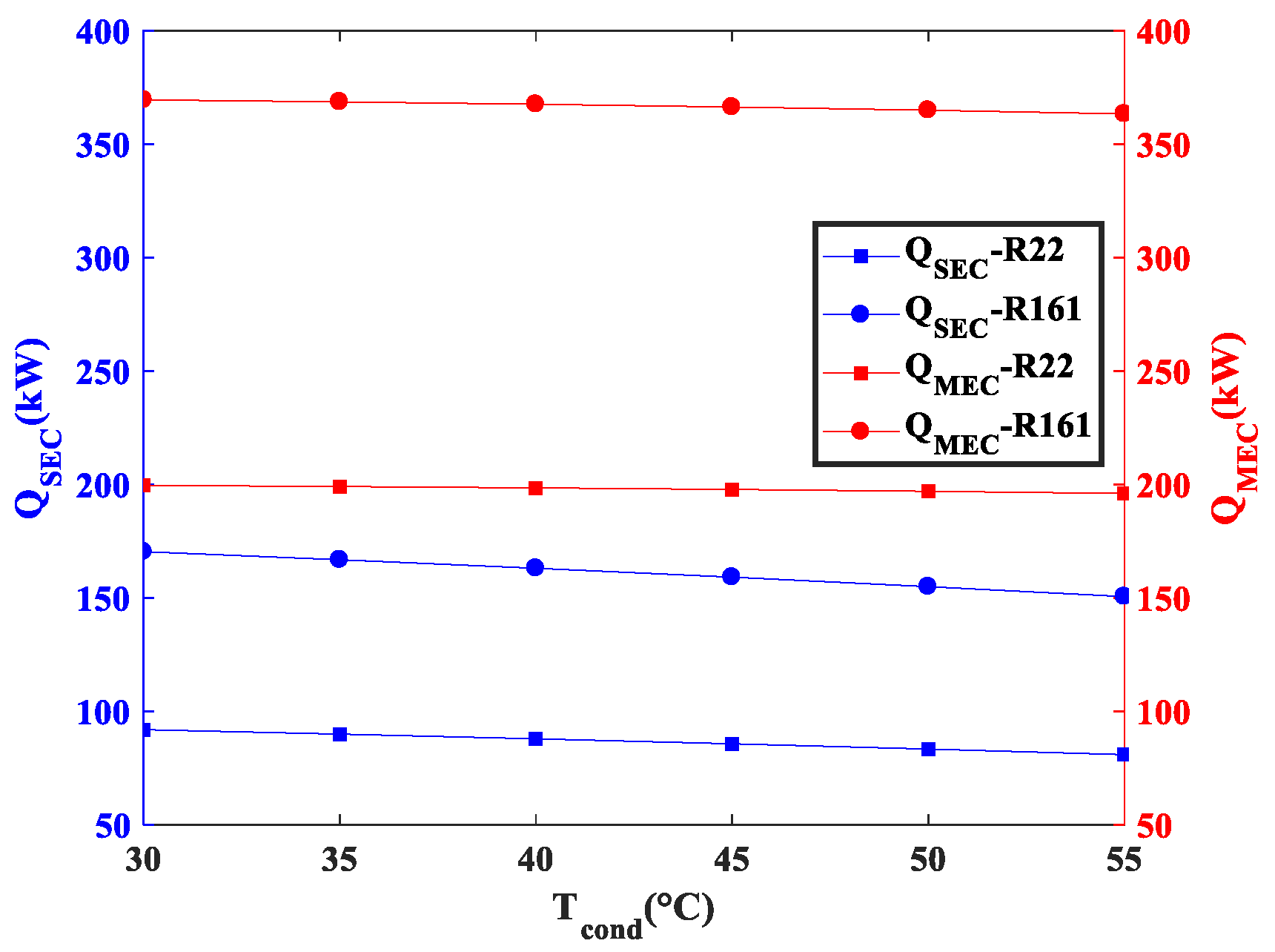
4.2.2. Effect of the condenser outlet temperature on performances of SEC and MEC
5. Conclusion
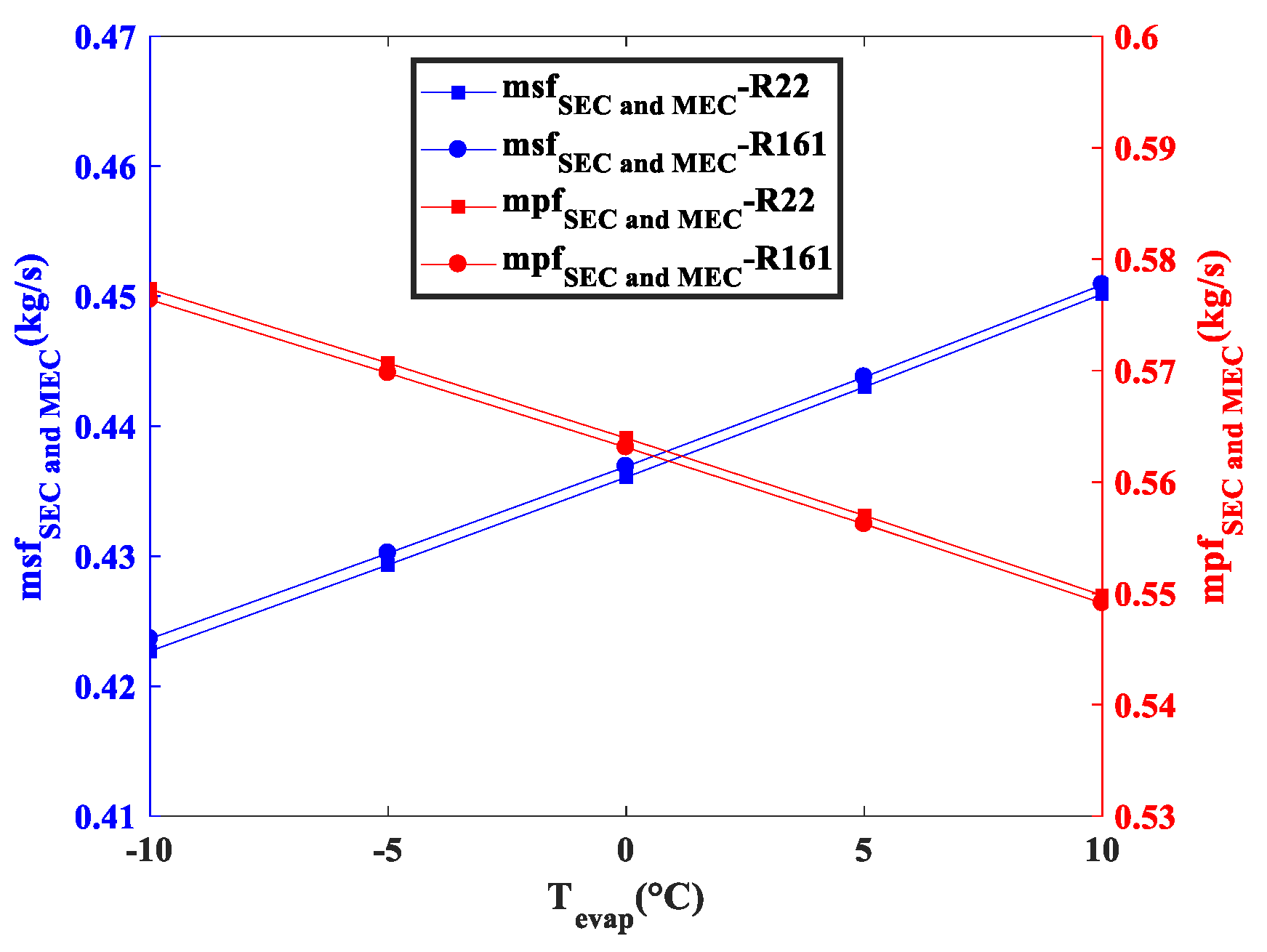
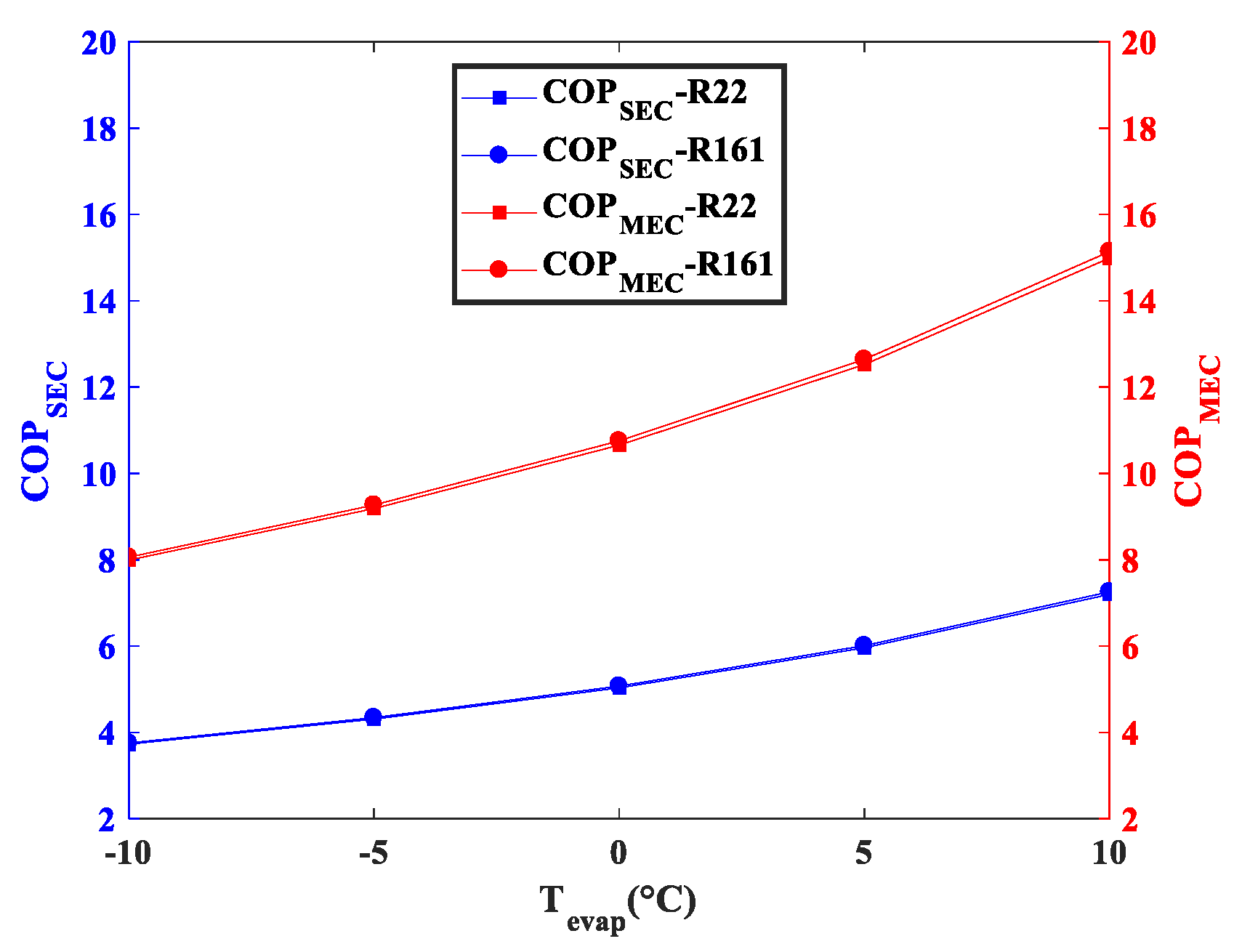
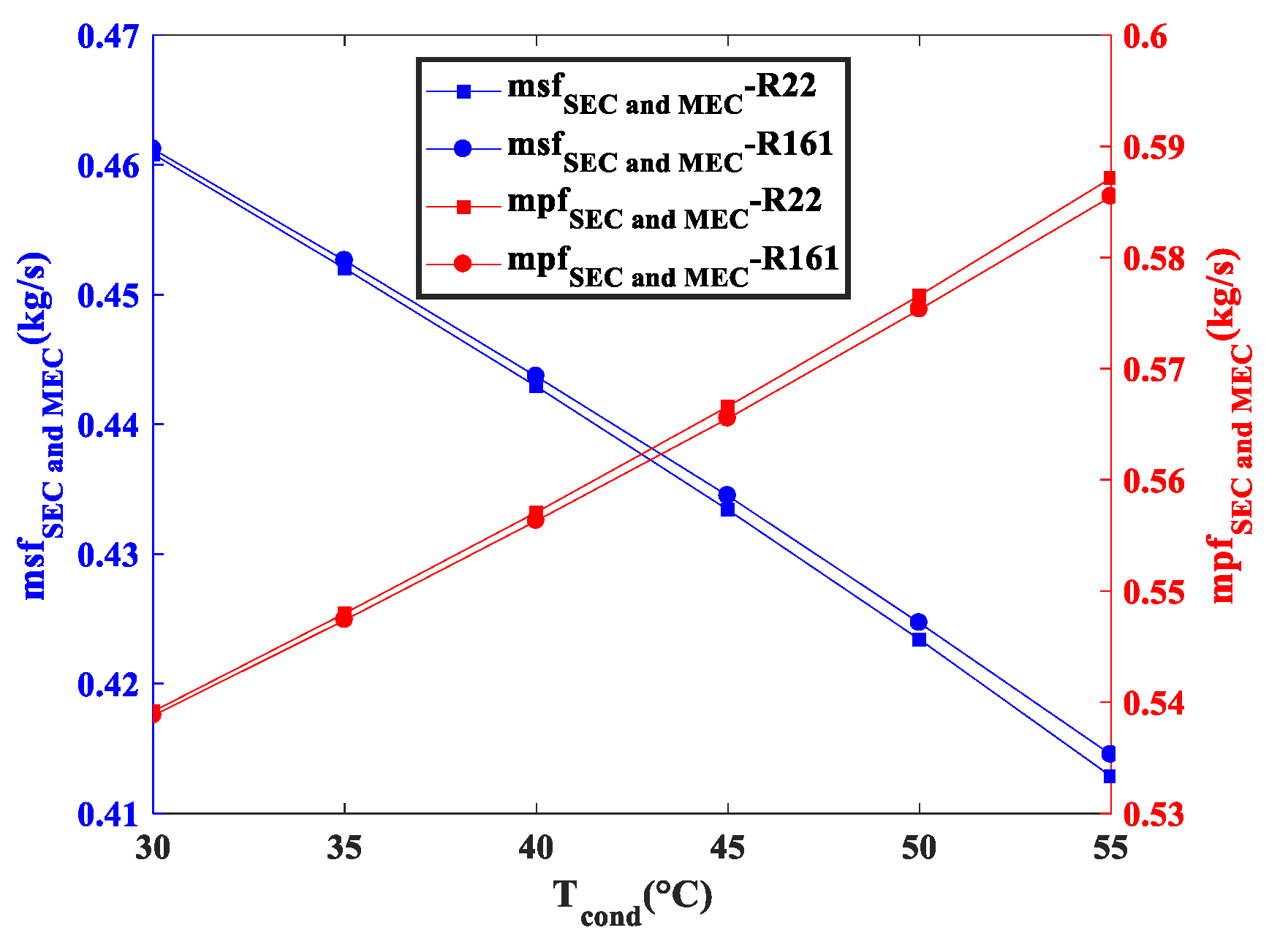
- For both investigated working fluids (R161 and R22), the primary mass flow rate increases and the secondary mass flow rate decreases with the increase of the condenser temperature (Tcond), however, the primary mass flow rate decreases and the secondary mass flow rate increases with the increasing evaporation temperature (Tevap);
- At the same operating temperatures (Tcond and Tevap), the secondary mass flow rate of the working fluid R161 is higher than that of R22 in the SEC and MEC, however, the primary mass flow rate of the working fluid R161 is lower than that of R22 in the SEC and MEC;
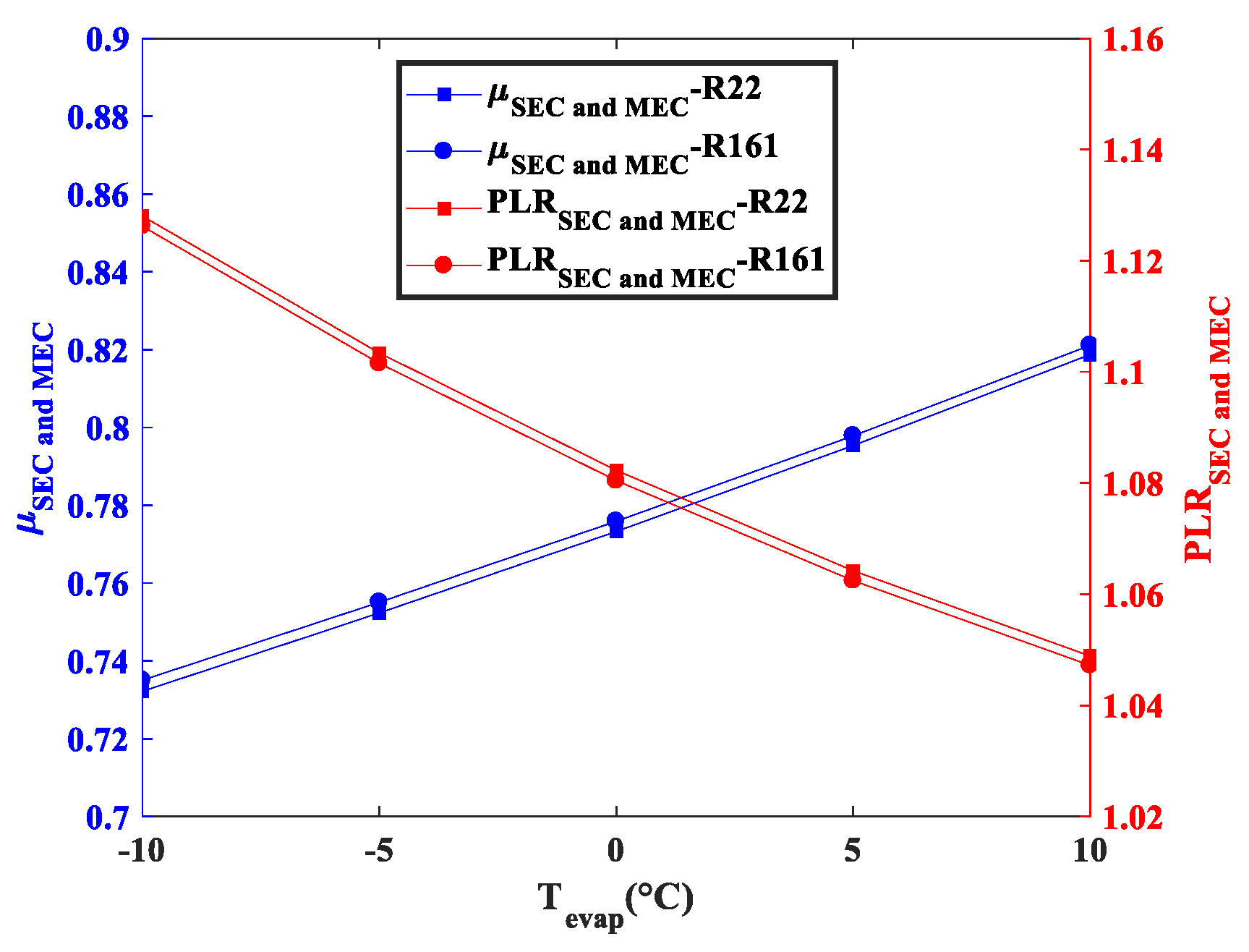
- The primary and the secondary mass flow rates of the investigated working fluids (R161 and R22) have a significant effect on the thermodynamic performances (COP, μ, and PLR) in the SEC and MEC, especially for the μ;
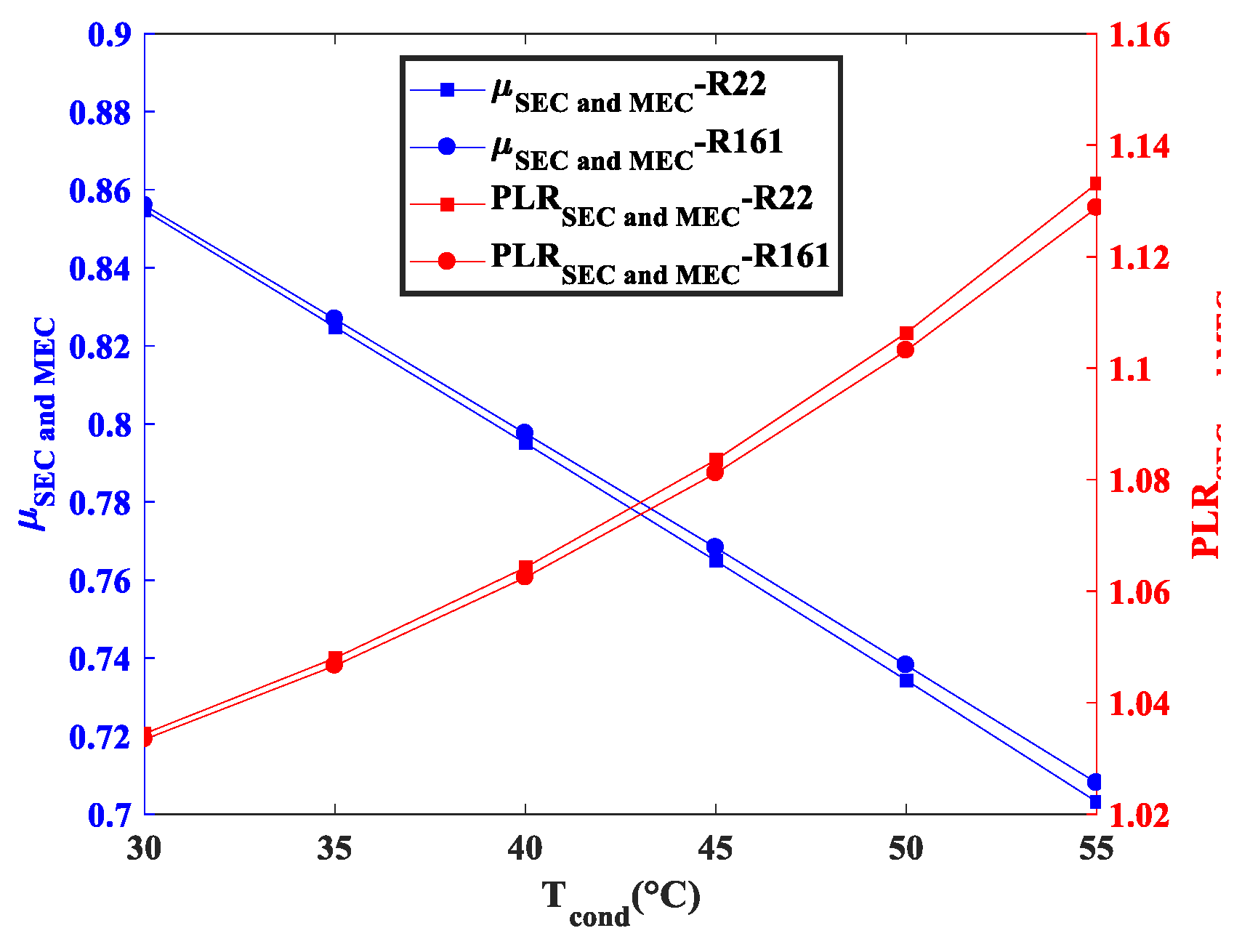
- At the same operating temperatures, the eco-friendly R161 refrigerant offers similar values of coefficient of performance (COP), entrainment ratio (μ), and pressure lift ratio (PLR) compared to those of R22 in both cycles (SEC and MEC);
- The PLR of the investigated working fluids (R161 and R22) in the SEC and MEC increases with the condenser temperature (Tcond) and decreases with the increasing of the increasing evaporation temperature (Tevap);
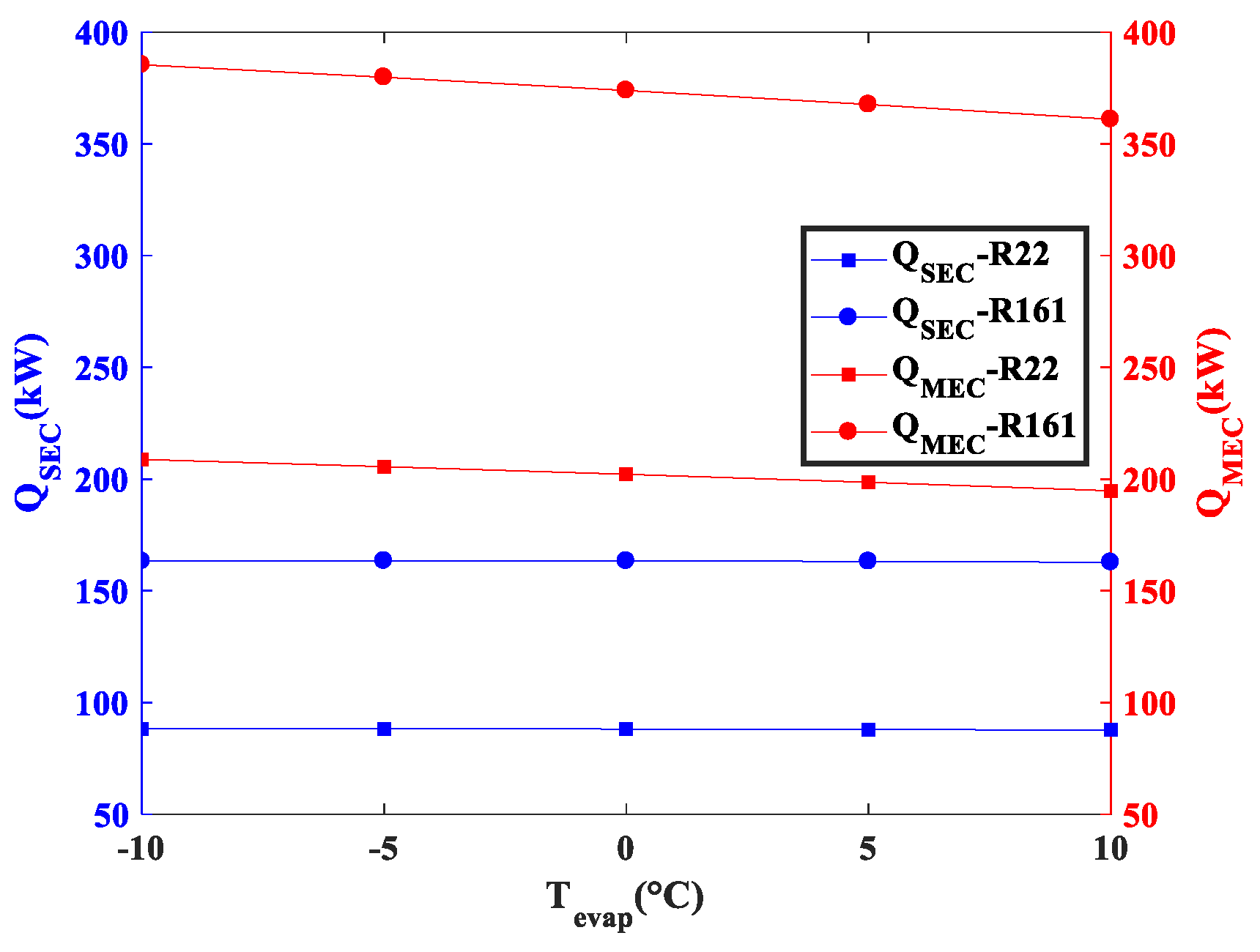
- Under the same operating temperatures, R161 showed a higher cooling effect than R22 in the SEC and MEC, since; R161 has a higher latent heat of vaporization compared to R22. The high normal boiling point has an effect on the latent heat of vaporization whereas the high normal boiling point makes a greater latent heat of vaporization and as a result, the refrigerating effect increases. In another, the R161 has a critical temperature much higher than that of R22, which makes a greater heat transfer;
- The MEC showed a higher cooling effect than the SEC because all refrigerants flows through the evaporator of the MEC, which makes a greater heat transfer;
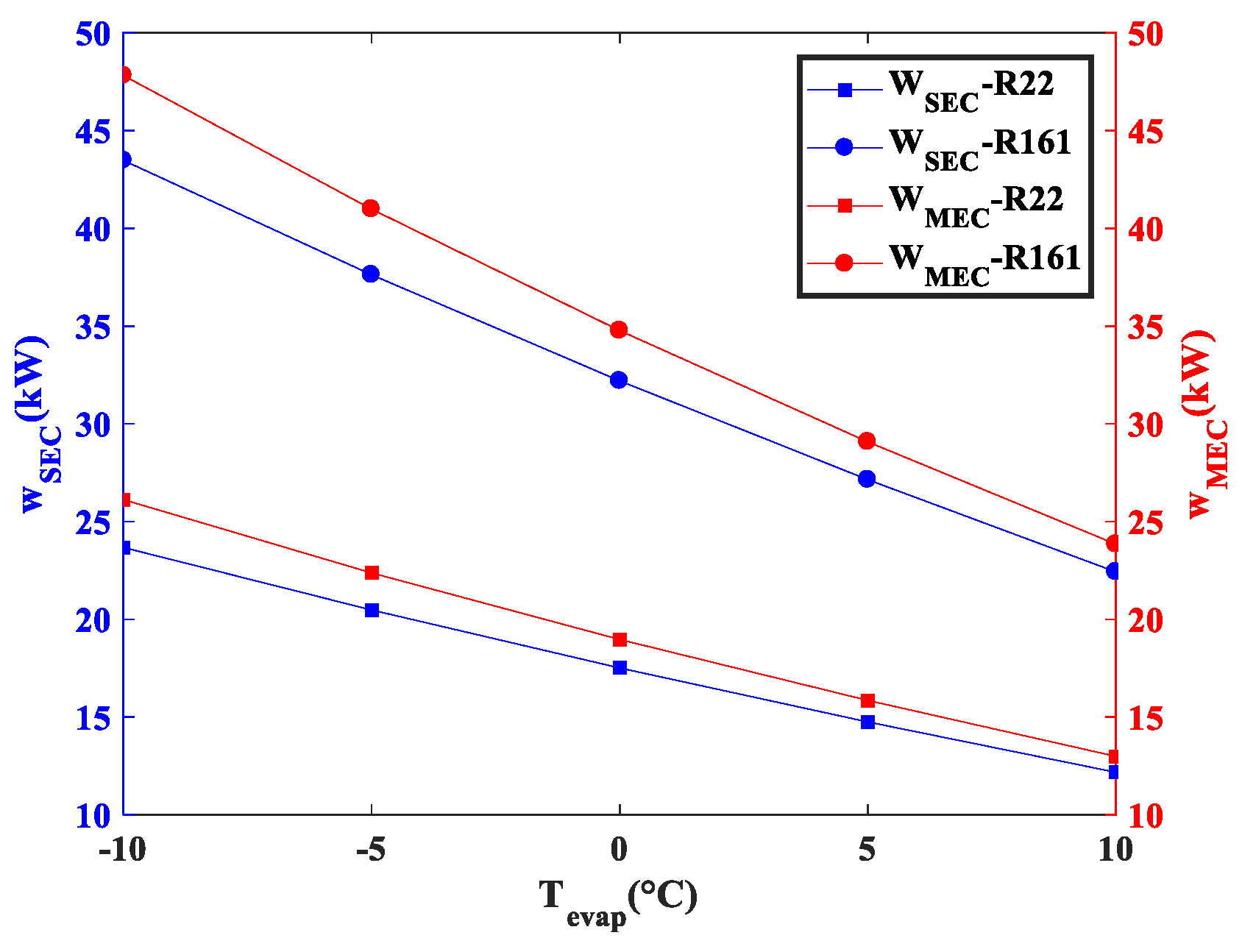
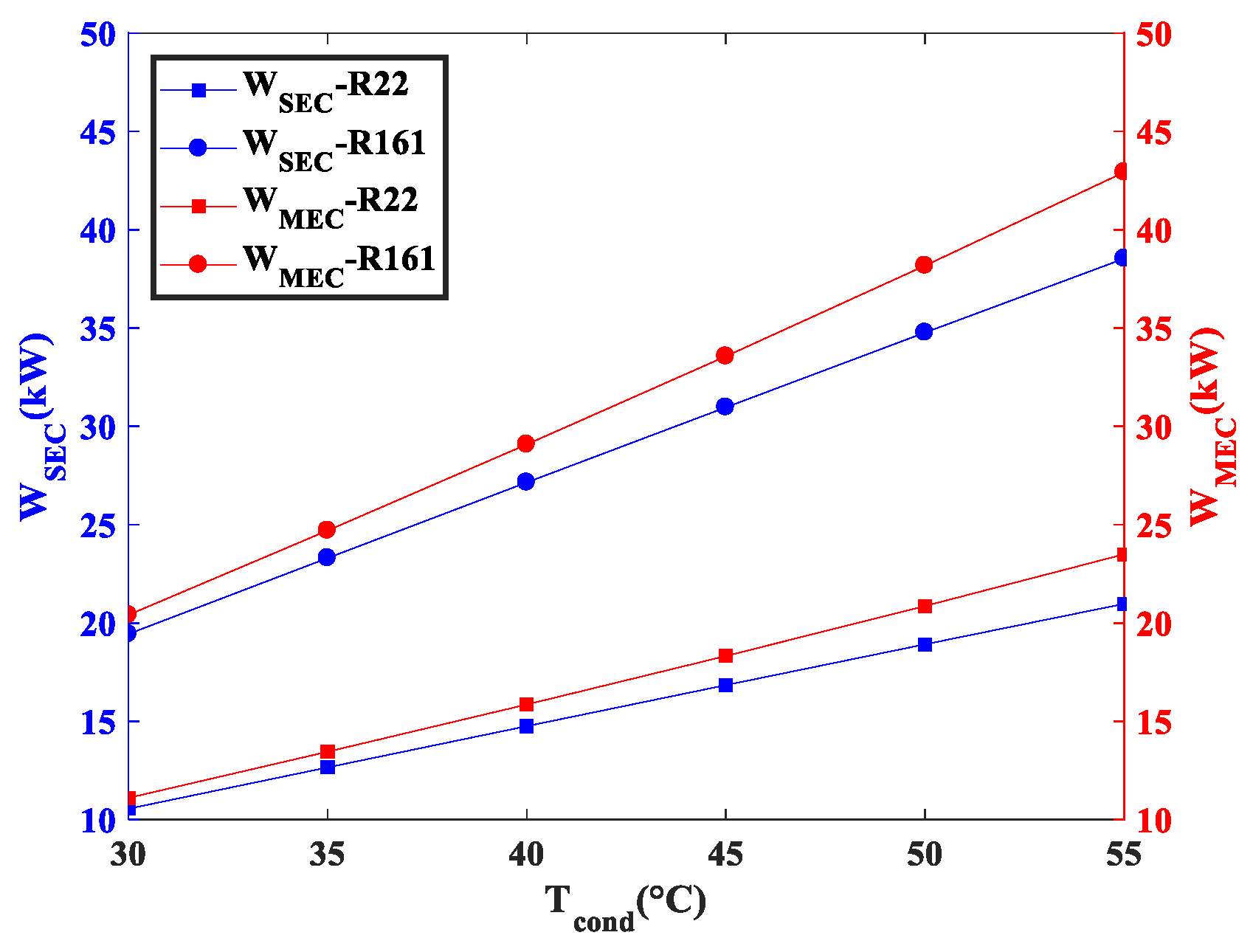
- The phase-out R22 offers lower power consumption than that of the eco-friendly R161 in the SEC and MEC;
- The COP and μ of the investigated working fluids (R161 and R22) in the SEC and MEC increases with the increasing evaporation temperature (Tevap) and decreases with the increasing of the condenser temperature (Tcond);
- The COP of the MEC operating with R161 and R22 shows an improvement above that of the SEC under the same operating temperatures (Tevap and Tcond).

References
- Liu, D.; Zhao, F.; Tang, G. Active low-grade energy recovery potential for building energy conservation. Renewable and Sustainable Energy Reviews 2010, 14(9), 2736–2747. [Google Scholar] [CrossRef]
- Calm, J.M. The next generation of refrigerants -historical review, considerations, and Outlook. International Journal of Refrigeration 2008, 31, 1123–1133. [Google Scholar] [CrossRef]
- Heath, EA. Amendment to the Montreal protocol on substances that deplete the ozone layer (Kigali amendment). International Legal Materials 2017, 56, 193–205. [Google Scholar] [CrossRef]
- Powell, RL. CFC Phase out; have we met the challenge. Journal of Fluorine Chemistry 2002, 114(2), 237–250. [Google Scholar] [CrossRef]
- Tsai, WT. Environmental risks of newgeneration fluorocarbons in replacement of potent greenhouse gases. Int. J. Glob. Warm 2013, 5, 84–95. [Google Scholar] [CrossRef]
- Sicard, A.J.; Sicard, A.J. Fluorocarbon Refrigerants and their Syntheses: Past to Present. Journal of Chemical & Engineering Data 2020, 120, 9164–9303. [Google Scholar]
- Park, C.; Lee, H.; Hwang, Y.; Radermacher, R. Recent advances in vapor compression cycle technologies. International Journal of Refrigeration 2015, 60, 118–134. [Google Scholar] [CrossRef]
- Elbel, S.; Lawrence, N. Review of recent developments in advanced ejector technology. International Journal of Refrigeration 2016, 62, 1–18. [Google Scholar] [CrossRef]
- Sarkar, J. Recent developments in ejector refrigeration technologies. Renewable and Sustainable Energy Reviews 2012, 16, 6647–6659. [Google Scholar] [CrossRef]
- Chen, X.; Omer, S.; Worall, M.; Riffat, S. Recent developments in ejector refrigeration technologies. Renewable and Sustainable Energy Reviews 2013, 19, 629–651. [Google Scholar] [CrossRef]
- Besagni, G.; Mereu, R.; Inzoli, F. Ejector refrigeration: A comprehensive review. Renewable and Sustainable Energy Reviews 2016, 53, 373–407. [Google Scholar] [CrossRef]
- Kornhauser, A.A. The Use Of An Ejector as Refrigerant Expander. International Refrigeration and Air Conditioning 1990, 82, 10–19. [Google Scholar]
- Nehdi, E.; Kairouani, L.; Bouzaina, M. Performance analysis of the vapour compression cycle using ejector as an expander. International Journal of energy research 2007, 31, 364–375. [Google Scholar] [CrossRef]
- Disawas, S.; Wongwises, S. Experimental investigation on the performance of the refrigeration cycle using a two-phase ejector as an expansion device. International Journal of Refrigeration 2004, 27, 587–594. [Google Scholar] [CrossRef]
- Sag, N.B.; Ersoy, H.K.; Hepbasli, A.; Halkaci, H.S. Energetic and exergetic comparison of basic and ejector expander refrigeration systems operating under the same external conditions and cooling capacities. Energy Conversion and Management 2015, 90, 184–194. [Google Scholar] [CrossRef]
- Sarkar, J. Performance characteristics of natural-refrigerants- based ejector expansion refrigeration cycles. Proc. Inst. Mech. Eng. Part A J. Power Energy 2009, 223, 543–550. [Google Scholar] [CrossRef]
- Sarkar, J. Geometric parameter optimization of ejector-expansion refrigeration cycle with natural refrigerants. International Journal of energy research 2010, 34, 84–94. [Google Scholar] [CrossRef]
- Sumeru, K.; Nasution, H.; Ani, F.N. Numerical study of ejector as an expansion device in splittype air conditioner. Applied Mechanics and Materials 2013, 388, 101–105. [Google Scholar] [CrossRef]
- Sumeru, K.; Sulaimon, S.; Nasution, H.; Ani, FN. Numerical and experimental study of an ejector as an expansion device in split-type air conditioner for energy savings. Energy Build 2014, 79, 98–105. [Google Scholar] [CrossRef]
- Zhao, L.; Yang, X.; Deng, S.; Li, H.; Yu, Z. Performance analysis of the ejector-expansion refrigeration cycle using zeotropic mixtures. International Journal of Refrigeration 2015, 57, 197–207. [Google Scholar] [CrossRef]
- Hu, J.; Shi, J.; Liang, Y.; Yang, Z.; Chen, J. Numerical and experimental investigation on nozzle parameters for R410A ejector air conditioning system. International Journal of Refrigeration 2013, 40, 338–46. [Google Scholar] [CrossRef]
- Zhang, Z.; Tong, L.; Chang, L.; Chen, Y.; Wang, X. Energetic and Exergetic Analysis of an Ejector-Expansion Refrigeration Cycle Using the Working Fluid R32. Entropy 2015, 17, 4744–4761. [Google Scholar] [CrossRef]
- Lawrence, N.; Elbel, S. Experimental investigation of a two-phase ejector cycle suitable for use with low-pressure refrigerants R134a and R1234yf. International Journal of Refrigeration 2013, 38, 310–322. [Google Scholar] [CrossRef]
- Pottker, G.; Hrnjak, P. Ejector in R410A vapor compression systems with experimental quantification of two major mechanisms of performance improvement: Work recovery and liquid feeding. International Journal of Refrigeration 2015, 50, 184–192. [Google Scholar] [CrossRef]
- Ma, Z.; Liu, X.; Wang, H.; Li, H.; Wang, X. OffDesign Analysis of Hydrocarbon-based Ejector-Expansion Refrigeration Cycle. Energy Procedia 2017, 105, 4685–4690. [Google Scholar] [CrossRef]
- Li, H.; Cao, F.; Bu, X.; Wang, L.; Wang, X. Performance characteristics of R1234yf ejector-expansion refrigeration cycle. Applied Energy 2014, 121, 96–103. [Google Scholar] [CrossRef]
- Deng, J.Q.; Jiang, P.X.; Lu, T.; Lu, W. Particular characteristics of transcritical CO2 refrigeration cycle with an ejector. Applied Thermal Engineering 2007, 27, 381–388. [Google Scholar] [CrossRef]
- Yu, JL.; Song, X.; Ma, M. Theoretical study on a novel R32 refrigeration cycle with a two-stage suction ejector. International Journal of Refrigeration 2013, 36, 166–172. [Google Scholar] [CrossRef]
- Maalem, Y.; Fedali, S.; Madani, H.; Tamene, Y. Performance analysis of ternary azeotropic mixtures in different vapor compression refrigeration cycles. International Journal of Refrigeration 2020, 119, 139–151. [Google Scholar] [CrossRef]
- Yadav, AK; Neeraj. Performance Analysis of Refrigerants R1234yf, R1234ze and R134a in Ejector-Based Refrigeration Cycle. International Journal of Air-Conditioning and Refrigeration 2018, 26(03), 1850026–7. [Google Scholar] [CrossRef]
- Yan, G.; Bai, T.; Yu, J. Thermodynamic analysis on a modified ejector expansion refrigeration cycle with zeotropic mixture (R290/R600a) for freezers. Energy 2016, 95, 144–154. [Google Scholar] [CrossRef]
- Liu, F.; Groll, EA.; Li, D. Modeling study of an ejector expansion residential CO2 air conditioning system. Energy Build 2012, 53, 127–136. [Google Scholar] [CrossRef]
- Liu, F.; Li, Y.; Groll, EA. Performance enhancement of CO2 air conditioner with a controllable ejector. International Journal of Refrigeration 2012, 35, 1604–1616. [Google Scholar] [CrossRef]
- Idan Al-Chlaihawi, K.; Kadhim, H.; Yousif, A. A Comparative Performance Study of an EjectorExpansion Refrigeration Cycle Using R134a and its Alternatives: Application of Automobile Air Conditioning. International Journal of AirConditioning and Refrigeration 2021, 29(04), 2150035. [Google Scholar] [CrossRef]
- Idan Al-Chlaihawia, K.; Al- Rubaye, A.; Kadhim, H. Performance investigation of an ejector expansion refrigeration system working on different alternative refrigerants to R134a. Australian Journal of Mechanical Engineering 2023, 21(5), 1806–1817. [Google Scholar] [CrossRef]
- Gao, Y.; He, G.; Cai, D.; Fan, M. Performance evaluation of a modified R290 dual-evaporator refrigeration cycle using two-phase ejector as expansion device. 2020, Energy (212), 118614. [Google Scholar] [CrossRef]
- Maalem, Y.; Tamene, Y.; Madani, H. Performances Investigation of the Eco-friendly Refrigerant R13I1 used as Working Fluid in the Ejector-Expansion Refrigeration Cycle. International Journal of Thermodynamics 2023, 26(3), 025–035. [Google Scholar] [CrossRef]
- Aghazadeh Dokandari, D.; Mahmoudi, S.M.S.; Bidi, M.; Khoshkhoo, R. Haghighi; Rosen, M. First and Second Law Analyses of Transcritical N2O Refrigeration Cycle Using an Ejector. Sustainability 2018, 10, 1177. [Google Scholar] [CrossRef]
- Bai, Y.Tao; Yu, J. Study on the ejectorexpansion refrigeration system for lowtemperature freezer application: Experimental and exergetic assessments. International Journal of Refrigeration 2023, 151, 152–160. [Google Scholar]
- Hacipasaoglu, S.; Tekin Ozturk, I. Energy and exergy analysis in the ejector expansion refrigeration cycle under optimum conditions. International Advanced Researches and Engineering Journal 2023, 07(01), 023–034. [Google Scholar] [CrossRef]
- Aktemur, C.; Tekin Öztürk, İ. Thermodynamic performance enhancement of booster assisted ejector expansion refrigeration systems with R1270/CuO nano-refrigerant. Energy Conversion and Management 2022, 253, 115191. [Google Scholar] [CrossRef]
- McLinden, M.O.; Huber, M.L. (R) Evolution of Refrigerants. Journal of Chemical & Engineering Data 2020, 65, 4176–4193. [Google Scholar] [CrossRef] [PubMed]
- Sicard, A.J. Sicard, Fluorocarbon Refrigerants and their Syntheses: Past to Present. Journal of Chemical & Engineering Data 2020, 120, 9164–9303. [Google Scholar]
- Xiaozhen, H.; Tao, Y.; Xianyang, M.; Jiangtao, W. Isothermal Vapor Liquid Equilibrium Measurements for Difluoromethane (R32)+Fluoroethane (R161)+Trans-1,3,3,3- tetrafluoropropene (R1234ze(E)) Ternary Mixtures. International Journal of Refrigeration 2017, 79, 49–56. [Google Scholar]
- Xianyang, M.; Xiaozhen, H.; Tao, Y.; Jiangtao, W. Vapor liquid equilibria for binary mixtures of difluoromethane (R32)+fluoroethane (R161) and fluoroethane (R161)+trans-1,3,3,3tetrafluoropropene (R1234ze(E)). J. Chem. Thermodynamics 2018, 118, 43–50. [Google Scholar]
- Nelson, W.M.; Hassanalizadeh, R.; Ramjugernath, D. Phase equilibrium and critical point data for ethylene and chlorodifluoromethane binary mixtures using a new “static-analytic” apparatus. Fluid Phase Equilibria 2017, 451, 106–113. [Google Scholar] [CrossRef]
- Mehemmai, M.; Grine, H.; Madani, H.; Bougriou, B. Performance analysis of ejector refrigeration cycle with zeotropic mixtures. International Journal of Thermofluid Science and Technology 2023, 10(4), 100404. [Google Scholar] [CrossRef]
- Abdou, A.; Madani, H.; Hasseine, A. Study of the performances of an ejector refrigeration cycle using CO2- based mixtures in subcritical and transcritical mode. International Journal of Thermofluid Science and Technology 2023, 10(3), 100304. [Google Scholar] [CrossRef]
- Brunin, O.; Feidt, M.; Hivet, B. Comparison of the working domains of some compression heat pumps and a compression-absorption heat pump. International Journal of Refrigeration 1997, 20, 308–31. [Google Scholar] [CrossRef]







 |
Copyright © 2022. This article is licensed under a CC BY-NC-ND 4.0.
Share and Cite
Maalem, Y.; Madani, H. Energetic performance investigation of ejector air conditioning cycles using the environment friendly gas R161 (Fluoroethane) as substitute to the phase-out R22 (Chlorodifluoromethane). Int. J. Thermofluid Sci. Technol. 2024, 11, 110201. https://doi.org/10.36963/IJTST.2024110201
Maalem Y, Madani H. Energetic performance investigation of ejector air conditioning cycles using the environment friendly gas R161 (Fluoroethane) as substitute to the phase-out R22 (Chlorodifluoromethane). International Journal of Thermofluid Science and Technology. 2024; 11(2):110201. https://doi.org/10.36963/IJTST.2024110201
Chicago/Turabian StyleMaalem, Youcef, and Hakim Madani. 2024. "Energetic performance investigation of ejector air conditioning cycles using the environment friendly gas R161 (Fluoroethane) as substitute to the phase-out R22 (Chlorodifluoromethane)" International Journal of Thermofluid Science and Technology 11, no. 2: 110201. https://doi.org/10.36963/IJTST.2024110201
APA StyleMaalem, Y., & Madani, H. (2024). Energetic performance investigation of ejector air conditioning cycles using the environment friendly gas R161 (Fluoroethane) as substitute to the phase-out R22 (Chlorodifluoromethane). International Journal of Thermofluid Science and Technology, 11(2), 110201. https://doi.org/10.36963/IJTST.2024110201