Next Article in Journal
Understanding Alzheimer’s Disease Through Neurodevelopment: Insights from Human Cerebral Organoids
Previous Article in Journal
Xenograft-Derived Human Breast Cancer Organoids Can Form Chimeras with Host Mouse Mammary Epithelial Cells Which Promote Tumor Cell Proliferation
 
 
Due to scheduled maintenance work on our servers, there may be short service disruptions on this website between 11:00 and 12:00 CEST on March 28th.
Article

A Spheroid-Based In Vitro Model to Generate the Zonal Organisation of the Tendon-to-Bone Enthesis

by
Vinothini Prabhakaran
1,2,* and
Jennifer Z. Paxton
1,2
1
Anatomy@Edinburgh, Department of Anatomy, Edinburgh Medical School, College of Medicine and Veterinary Medicine, University of Edinburgh, Edinburgh EH8 9AG, UK
2
Centre for Discovery Brain Sciences, College of Medicine and Veterinary Medicine, University of Edinburgh, Edinburgh EH8 9XD, UK
*
Author to whom correspondence should be addressed.
Organoids 2026, 5(1), 7; https://doi.org/10.3390/organoids5010007
Submission received: 15 December 2025 / Revised: 6 January 2026 / Accepted: 4 February 2026 / Published: 10 February 2026

Abstract

The tendon-to-bone enthesis is a multiphasic structure with four structurally continuous and compositionally distinct regions: tendon, uncalcified fibrocartilage, calcified fibrocartilage and bone. Our study aimed to develop 3D scaffold-free in vitro spheroids and macro-tissues of the enthesis for applications as experimental tools to understand the development and repair of enthesis injury. This study hypothesises that integrating tendon and bone cell spheroids with bone marrow mesenchymal stem cell spheroids will facilitate the production of a fibrocartilaginous interface. 3D Spheroids: The biphasic (tendon–bone) and triphasic co-culture (tendon–stem cell–bone) of spheroids in growth media and chondrogenic media were investigated to establish fusion kinetics, and the cellular and ECM components produced via histology and immunohistochemistry. Complete fusion between spheroids occurred within 6-to-8 days in biphasic co-culture, and 15-to-20 days in triphasic co-culture. Compared to biphasic, the triphasic co-culture in chondrogenic media showed a continuous interface connecting the tendon and bone regions. The presence of collagen I, sulphated proteoglycans and collagen type II in the interface region of triphasic co-culture indicates fibrochondrogenic differentiation. 3D macro-tissues: The modular tissue engineering strategy was used in this study to produce enthesis macro-tissues using spheroids as building blocks. Spheroids were bio-assembled in the triphasic manner (12 tendon spheroids, 12 stem cell spheroids and 8 bone spheroids) in the custom-designed and 3D-printed temporary supports (Formlabs Clear Resin®) using a customised spheroid bio-assembly system. The fusion of spheroids occurred by day 8 after bio-assembly, and they were removed from temporary supports and cultured in scaffold-free conditions. Although the bio-assembly methodology was successful in producing fused scaffold-free macro-tissues, the histological analysis revealed the presence of an extensive necrotic core due to the large-sized constructs. To conclude, the findings support the hypothesis that a triphasic co-culture has the potential to produce a structurally continuous fibrocartilaginous interface but requires further optimisation to produce macro-tissues with anatomical morphologies and reduced necrotic cores.

1. Introduction

Tendon/ligament disorders are common and often result from abnormal mechanical loading associated with trauma, overuse, or degenerative conditions [1]. Among musculoskeletal diseases reported worldwide, 30% were accounted as tendon/ligament injuries [2]. The recovery rate, after injury in the interface region between tendon/ligament and bone, is very slow due to a hypocellularity, relative avascularity and the anatomically complex structure known as the enthesis [3].
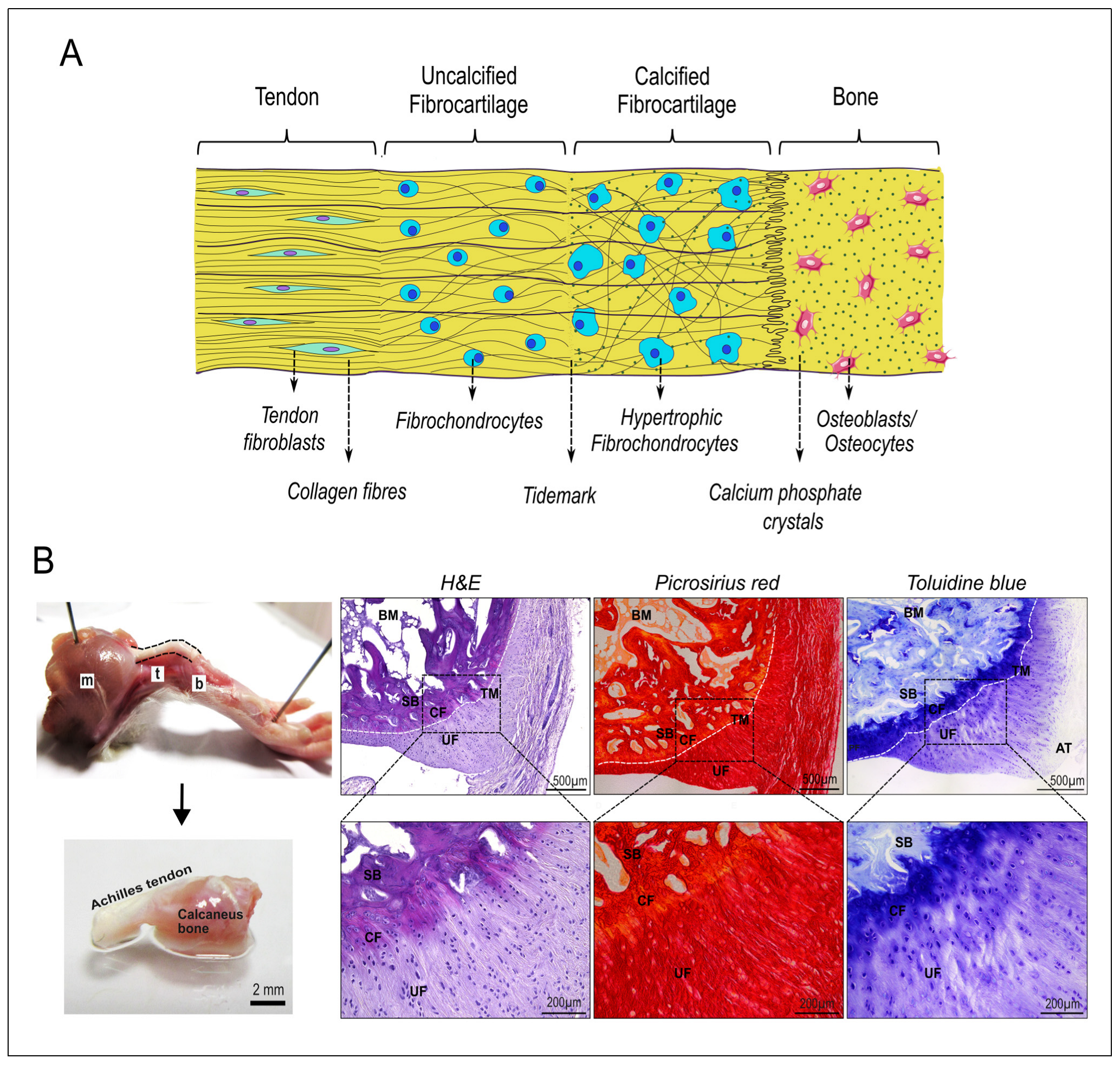
The enthesis is a multiphasic interface with structurally continuous and compositionally distinct zones: tendon, uncalcified fibrocartilage (UF), calcified fibrocartilage (CF), and bone (Figure 1A), as depicted in rat Achilles enthesis stained sections (Figure 1B). Cellular composition includes tenocytes, fibro-chondrocytes, hypertrophic fibro-chondrocytes and osteoblasts/osteocytes, respectively (Figure 1A,B). Primary extracellular matrix (ECM) components include the following: (1) tendon: collagen type I fibres; (2) UF: collagen type I and II, sulphated proteoglycans; (3) calcified fibrocartilage: collagen type I, II, and X, sulphated proteoglycans and calcium minerals; (4) bone: collagen type I and calcium mineral contents [4,5]. This region spans a 300–800 μm width [6] and functions to dissipate stress and provides mechanical strength at the tendon-bone interface to withstand compression [4,7]. After injury, the healing process occurring after surgical reattachment of tendon to bone often results in mechanically weak fibrovascular scar tissue rather than a graded fibrocartilaginous interface, leading to re-injury [3,8]. Regeneration of the native enthesis through traditional therapeutic strategies has been challenging [9], leading to the introduction and exploration of interface tissue engineering.
Interface tissue engineering is an integrative approach aimed at regenerating native entheses by developing functional tissue-engineered constructs to connect soft and hard tissues, i.e., tendon and bone [10]. Heterotypic in vitro interactions between osteoblasts and fibroblasts have been reported to induce phenotypic changes or transdifferentiation into a fibrocartilaginous interface [11]. Wang et al. [12] established a 2D triculture model by culturing bone marrow stromal cells between osteoblasts and fibroblasts, showing fibrocartilage markers at the interface. Moreover, studies have investigated 3D scaffold-based triculture models using stratified poly(D,L-lactic-co-glycolic acid) (PLGA) scaffolds [13], hybrid silk scaffolds [14], multiphasic poly(ε-caprolactone)/tricalcium phosphate (PCL/TCP) porous scaffolds [15], all of which demonstrated the presence of fibrocartilage markers at the interface. Based on these findings, we aim to develop functional tissue-engineered constructs with high physiological relevance as an in vitro model.
Scaffold-free spheroid-based constructs exhibit biomimetic properties owing to their inherent self-organising property and enhanced cell–cell and cell–ECM interactions. To date, no studies have fabricated a spheroid-based osteotendinous interface (enthesis) model despite its strong potential as a biomimetic in vitro model. Therefore, our study investigated the development of a 3D scaffold-free in vitro model of the enthesis using a spheroid-based approach. Two related strategies were investigated: (1) biphasic and triphasic co-cultures of spheroids, and (2) the bio-assembly of spheroids for macro-tissue development. The research hypothesis was that bone marrow mesenchymal stem cell (BMSC) spheroids would differentiate to fibrocartilage at the interface between bone and tendon spheroids. The fusion kinetics, cellular and ECM components of the co-cultures were examined to confirm fibrochondrogenesis at the interface. The expected outcome of this study was to investigate the spheroid-based modelling of the zonal enthesis structure that would hold significance in future research on the mechanisms of enthesis injury and repair, and help to guide a successful regenerative approach.

2. Materials and Methods

2.1. Cells

Differentiated rat osteoblasts (dRObs), rat bone marrow mesenchymal stem cells (BMSCs) and rat tendon fibroblasts (RTFs) previously isolated, expanded and cryopreserved by the research group were used in this study. In brief, rat osteoblasts procured from Cell Applications, Inc. (San Diego, CA, USA) were cultured at full confluence for 14 days for 4 to 5 passages, resulting in a population of differentiated rat osteoblasts (dRObs). Tendon fibroblasts were isolated by collagenase digestion from the Achilles tendons of adult female Sprague–Dawley rats, and BMSCs were isolated by direct plastic adherence from bilateral femurs and tibias of 14 to 16-week-old female Sprague–Dawley rats.

2.2. Growth Media

The growth media was prepared using Dulbecco’s modified Eagle’s media (DMEM; product #41966052, GibcoTM, Fisher Scientific, Paisley, UK) supplemented with 10% fetal bovine serum (FBS; Product #FB-1001, Biosera, Nuaillé, France) and 1% antibiotic–antimycotic solution (ABAM; Product #A5955, Sigma-Aldrich, St. Louis, MO, USA).

2.3. Mineralisation Media (MM)

Mineralisation media was prepared by supplementing growth media with 10 nM Dexamethasone (product #D4902, Sigma-Aldrich, St. Louis, MO, USA), 10 mM β-glycerophosphate disodium salt (product #G9422, Sigma-Aldrich, St. Louis, MO, USA), 10 ng/mL recombinant human bone morphogenetic protein BMP-4 (Product #AF-120-05ET, Peprotech®, Westlake Village, CA, USA), freshly added 50 µg/mL L-ascorbic acid 2-phosphate sesquimagnesium salt hydrate (Product #A8960, Sigma-Aldrich, St. Louis, MO, USA) and filter-sterilised (0.22 µm pore size).

2.4. Chondrogenic Media (ChM)

Chondrogenic media was prepared by supplementing DMEM with 1% ABAM, 100 nM dexamethasone (Product #D4902, Sigma-Aldrich, St. Louis, MO, USA), 1× of ITS + 1 Liquid Media Supplement (100×) (Product #I2521, Sigma-Aldrich, St. Louis, MO, USA), 40 µg/mL L-proline (product #P5607, Sigma-Aldrich, St. Louis, MO, USA), 10 ng/mL Recombinant Human Transforming growth factor TGF-β3 (Product #100-36E-10UG, Peprotech®, Rocky Hill, NJ, USA), freshly added 50 µg/mL ascorbic acid and filter sterilised (0.22 µm pore size).

2.5. Biphasic and Triphasic Co-Culture

dROb spheroids were produced by seeding 1 × 10⁵ cells in 96-well cell-repellent plates cultured in mineralisation media (MM) for 15 days. BMSC spheroids were produced by seeding 2 × 10⁵ cells in 96-well cell repellent plates cultured in growth media for 2 days. Similarly, RTF spheroids were produced by seeding 2 × 10⁵ cells in growth media for 3–4 days. These generated spheroids were co-cultured in 96-well cell-repellent plates in “Biphasic” (dRObs-RTF) and “triphasic” (dRObs-BMSC-RTF) manner. The co-cultures in growth media (control) and chondrogenic media (ChM) were investigated (N = 3) for up to 20 days.

2.5.1. Spheroid Fusion Kinetics

The fusion of individual spheroids were observed on different days i.e., day 2, 4, 6, 8, 10, 15, and 20, and the microscopic images were analysed for fusion kinetics by measuring the total length, contact length and interspheroid angles using ImageJ/Fiji 1.54 (National Institutes of Health, Bethesda, MD, USA).
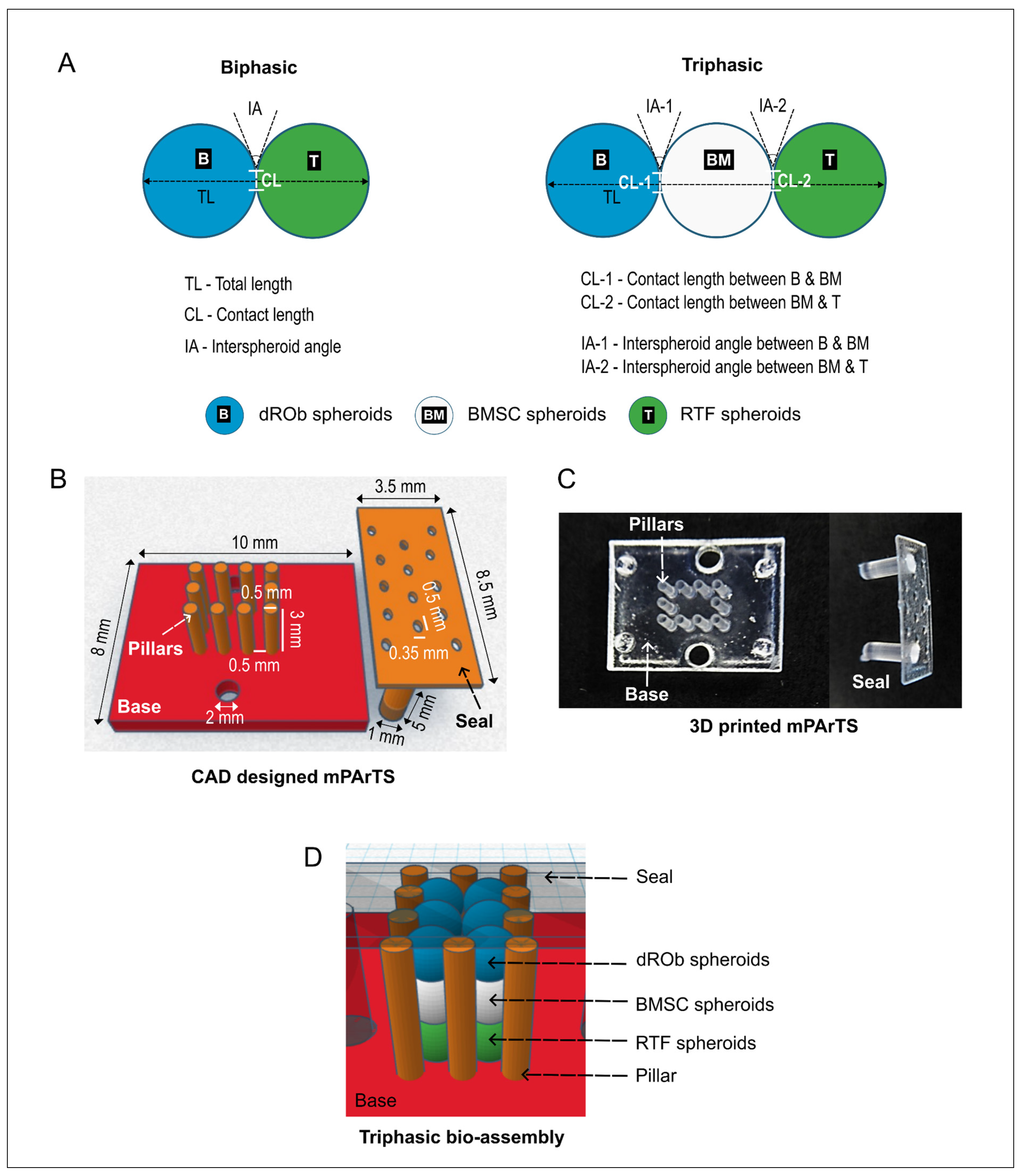
dROb spheroids are depicted as ‘B’, BMSC spheroids as ‘BM’ and RTF spheroids as ‘T’ for clearer description (Figure 2A). Using ImageJ/Fiji, the total length was measured by the line drawn end-to-end from ‘B’ to ‘T’ spheroids; the contact length was measured by the line drawn in the contact regions between spheroids; the inter-spheroid angles were measured at the junctional regions of spheroids using the angle tool (Figure 2A).

2.5.2. Histological Analysis

The fused spheroids on day 4 and day 20 were fixed with 4% paraformaldehyde for 1–2 h (N = 3), embedded in 2% agarose blocks, wax processed, and sectioned at 10 µm thickness for histology staining and 5 µm thickness for immunohistochemistry.
Harris Haematoxylin and Eosin Staining (H&E)
H&E staining was performed using a standard protocol. In brief, the sections were dewaxed with xylene and hydrated with alcohol series (100%, 90%, 70% alcohol and then water). The sections were incubated in haematoxylin for 3 min, dipped in acid alcohol, STWS (Scott’s tap water substitute) for 3 min, 1% eosin for 2 min and potassium alum for 2 min. The sections were rinsed with tap water between each incubation step. Then, the sections were dehydrated with alcohol series (70%, 90%, 95%, 100% alcohol), cleared with xylene and mounted with DPX.
Toluidine Blue Staining (TB)
TB staining was performed by dewaxing with xylene, hydration with alcohol series, staining with 1% toluidine blue stain for 1.5 to 2 min, rinsing with deionised water, followed by dehydration (with alcohol series), clearing (with xylene) and mounting steps (DPX).
Picrosirius Red Staining (PSR)
PSR staining was performed by dewaxing, hydrating, haematoxylin for 20 min, running water for 10 min, 0.1% picrosirius red stain for 1 h, two changes in acidified water (0.5% acetic acid), physical removal of excess water, dehydrating (dipping twice in absolute alcohol), clearing and mounting.
Immunohistochemistry (IHC)
Rabbit-specific horseradish peroxidase/3,3′ diaminobenzidine (HRP/DAB) detection IHC kit (Product #ab64261, Abcam, Cambridge, UK) was used to detect collagen type II. After dewaxing and hydrating, antigen retrieval was performed using 0.01M sodium citrate buffer (pH 6.0) (Product #C8532, Sigma-Aldrich) at sub-boiling temperature for 20 min, followed by hydrogen peroxide for 10 min at room temperature (RT) and 10% bovine serum albumin (BSA, Product #A4503, Sigma-Aldrich) for 15 min at RT. Then, 1:100 collagen type II polyclonal antibody (Product #PA5-99159, Invitrogen, Rockford, IL, USA) in 10% BSA was added and incubated overnight at 4 °C. At room temperature, the sections were incubated with biotinylated goat anti-rabbit IgG (H + L) for 15 min, streptavidin peroxidase for 15 min, DAB chromogen+substrate for 5 min (Collagen II). Washing with phosphate-buffered saline (PBS) and 0.1% phosphate-buffered saline with Tween 20 (PBST) was performed between each step. Haematoxylin counterstaining was performed for 30 s, followed by washing with deionised water, STWS (bluing) for 1 min, dehydration by alcohol series, clearing with xylene and mounting with DPX.
Alizarin Red Staining
Alizarin red staining was performed by dewaxing, hydrating, incubating with alizarin red solution (Product #2003999, EMD Millipore, Billerica, MA, USA) for 5–15 min, followed by blotting with filter paper, dehydrating with acetone (20 s), acetone–xylene mix (1:1) (20 s), clearing with xylene and mounting with DPX.
Brightfield (all staining) and polarised (picrosirius red staining) microscopic images were captured using the Leica THUNDER microscope (Leica Microsystems CMS GmbH, Wetzlar, Germany).

2.6. Three-Dimensional Printing of Temporary Supports

The modified pillar array temporary supports (mPArTS) were computer-aided design (CAD) modelled (Figure 2B) and 3D-printed using Formlabs Form3+ stereolithography (SLA) printer with ‘Formlabs-Clear-resin®’ (Product #RS-F2-GPCL-04). The 3D prints (Figure 2C) were post-processed by washing with isopropyl alcohol for 30 min, curing with Formlabs FormCure for 15 min and extracted using a Soxhlet extraction unit with isopropyl alcohol for 16 h. The post-processed resin materials were confirmed to be non-cytotoxic, as used previously [16].

2.7. Bio-Assembly of Spheroids

Using the customised spheroid bio-assembly system [16], twelve BMSC (‘BM’: bone marrow region) spheroids were assembled between eight dROb (‘B’: bone region) and twelve RTF (‘T’: tendon region) spheroids by a layer-by-layer approach (triphasic bio-assembly as depicted in Figure 2D) and cultured in chondrogenic media (ChM) at 37 °C and 5% CO2 to create the 3D enthesis macro-tissue model. Fusion between spheroids was examined on different days (day 2, 4, 6, 8) by removing the temporary supports (mPArTS) and observing under the Leica DMi1 microscope (Leica Microsystems CMS GmbH, Wetzlar, Germany).

2.8. Scaffold-Free Culture of Fused Macro-Tissues

After removal from the modified pillar array temporary supports (mPArTS), the fused constructs were cultured within 24-well cell-repellent plates, with exchange of chondrogenic media every day, to observe merging and reorganisation in scaffold-free conditions. The projected areas of fused constructs were measured by ImageJ/Fiji. Histological analysis (H&E, toluidine blue and picrosirius red staining) was performed on days 2, 4, and 8 after removal (dAR2, dAR4 and dAR8).

3. Results

3.1. Biphasic and Triphasic Co-Culture

3.1.1. Fusion Kinetics

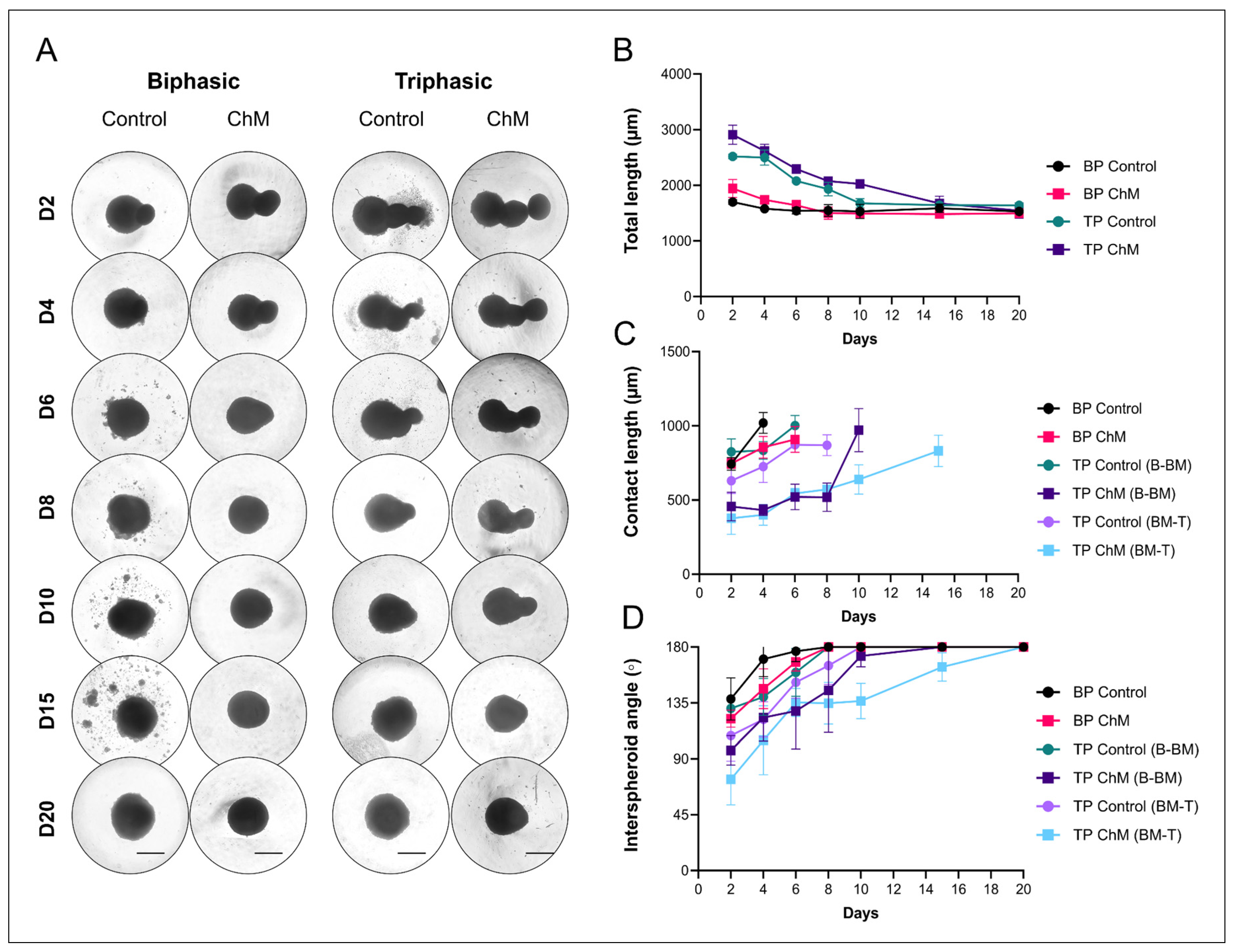
In both biphasic and triphasic co-cultures, the spheroids fused within 2 days in growth media (control) and chondrogenic media (ChM) (Figure 3A). dROb spheroids are described as ‘B’, BMSC spheroids as ‘BM’ and RTF spheroids as ‘T’. The fused spheroids merged over time, forming single units, which were spherical in shape in all groups except the triphasic ChM group that appeared pear-shaped with bulbous ‘B’ ends and tapered ‘T’ ends. Increased dead cell clumps were observed in the control group (growth media) in contrast to ChM.
The total lengths of fused spheroids were higher in ChM than in the control (Figure 3B), in both biphasic and triphasic groups. Despite these differences, the total length gradually reduced over time, which upon complete fusion reached an approximately similar size of 1.5–1.6 mm. In all groups, the contact length between spheroids increased over time (Figure 3C), and the interspheroid angles increased to 180° over time (Figure 3D). Complete fusion was indicated by the non-measurable contact length, i.e., no distinct boundary between spheroids, as well as an interspheroid angle of 180°. In the biphasic group, the day of complete fusion was deduced as day 6 (Control) and day 8 (ChM) (Figure 3C,D). In the triphasic group, ‘B’ and ‘BM’ spheroids completely fused within day 8 (control) and day 10 (ChM); whereas, ‘BM’ and ‘T’ spheroids completely fused by day 15 (control) and day 20 (ChM) (Figure 3C,D). Any spheroid (BM or T) in contact with ‘B’ spheroids exhibited a higher fusion rate than between ‘BM’ and ‘T’ spheroids. Furthermore, spheroids in control media fused earlier than in ChM.

3.1.2. Histology of Biphasic and Triphasic Co-Culture

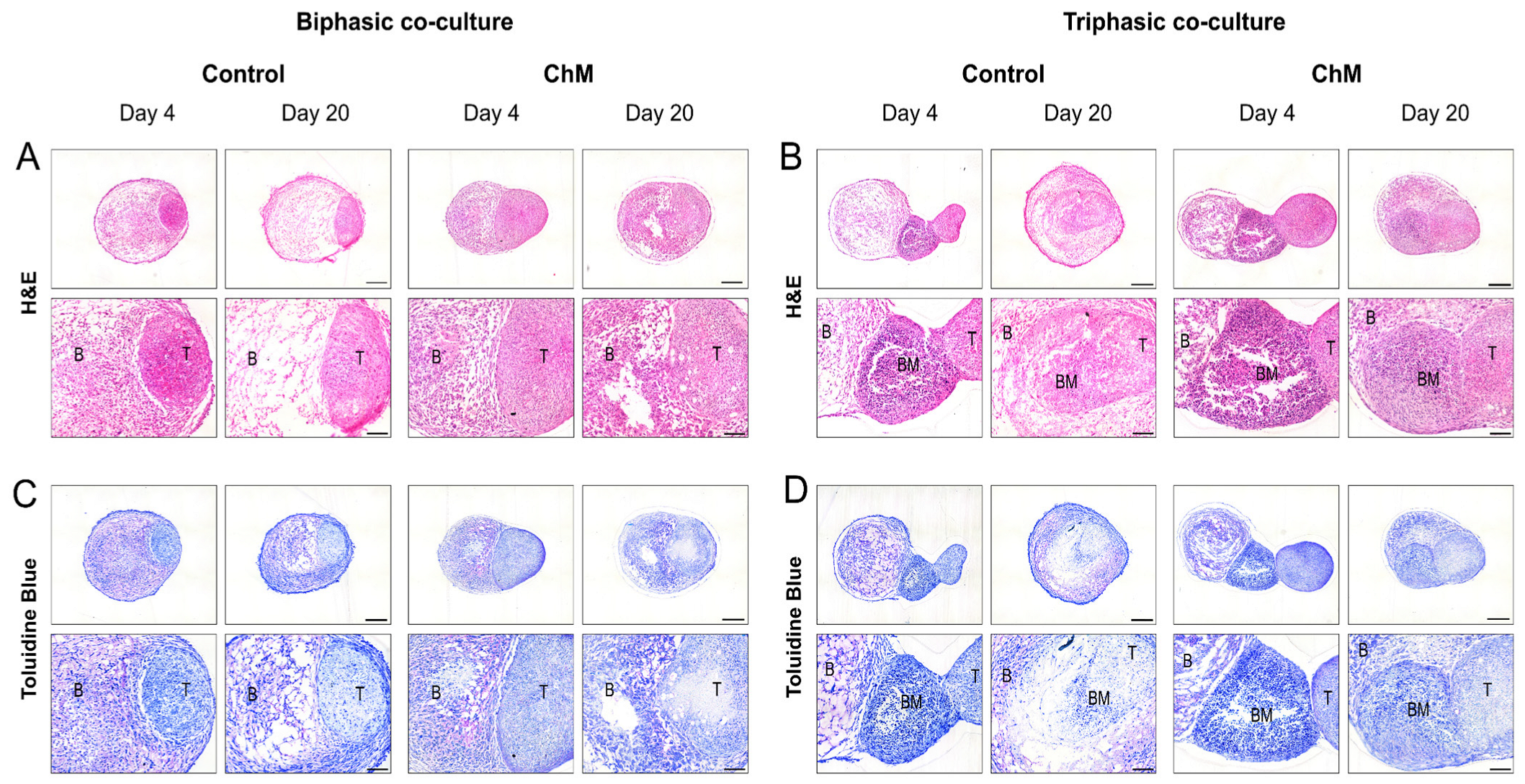
H&E staining showed that the cell distribution in the control group became sparse over time in both biphasic (Figure 4A) and triphasic co-cultures (Figure 4B), while a compact cellular arrangement was observed in the ChM group (Figure 4A,B). In the biphasic co-culture, clear distinctions were observed at the interface between ‘B’ and ‘T’ spheroids (Figure 4A). In triphasic co-culture, the ‘BM’ spheroids fused with adjacent ‘B’ & ‘T’ spheroids on either side, showing continuous B-BM-T regions (Figure 4B).
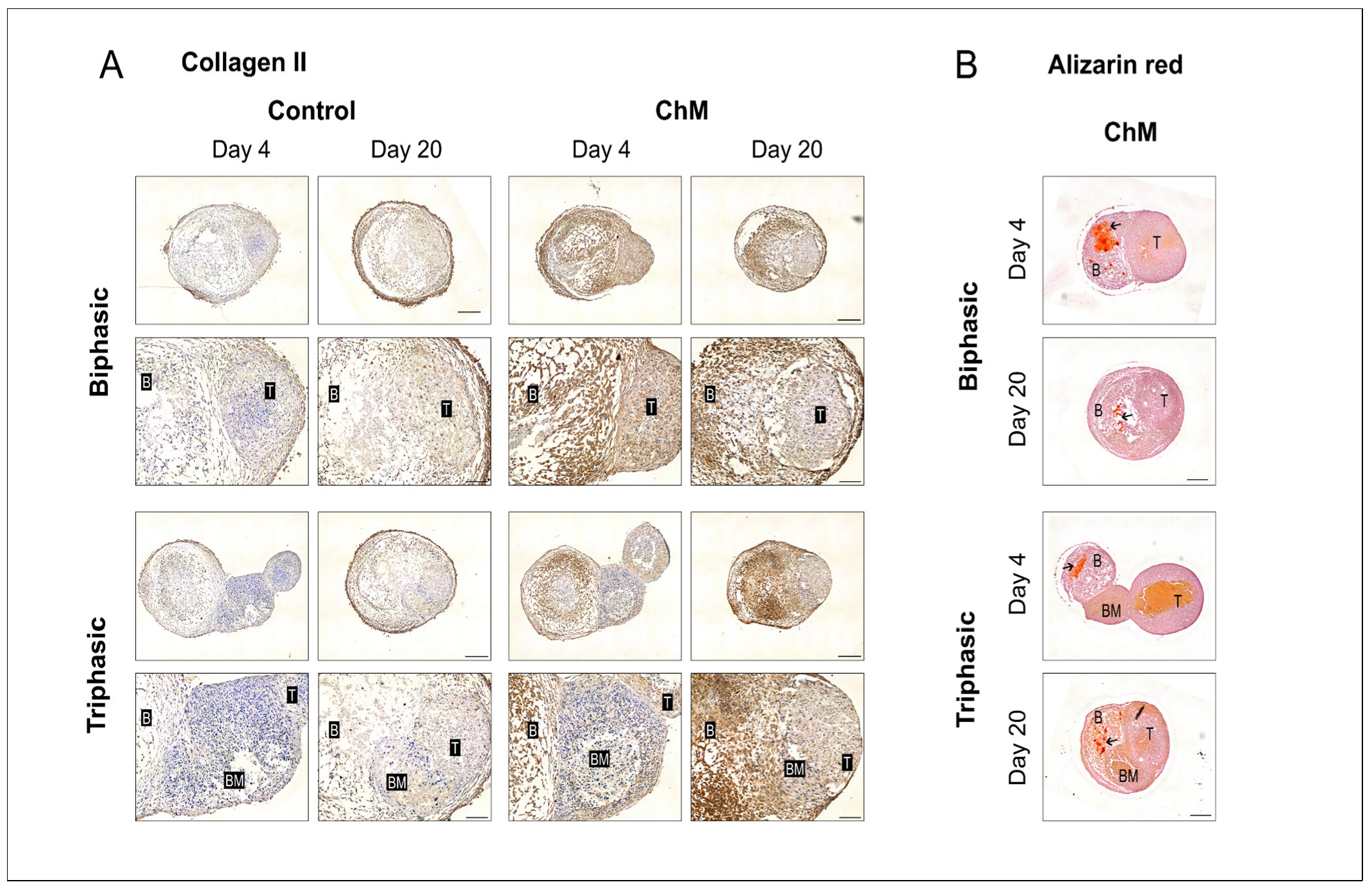
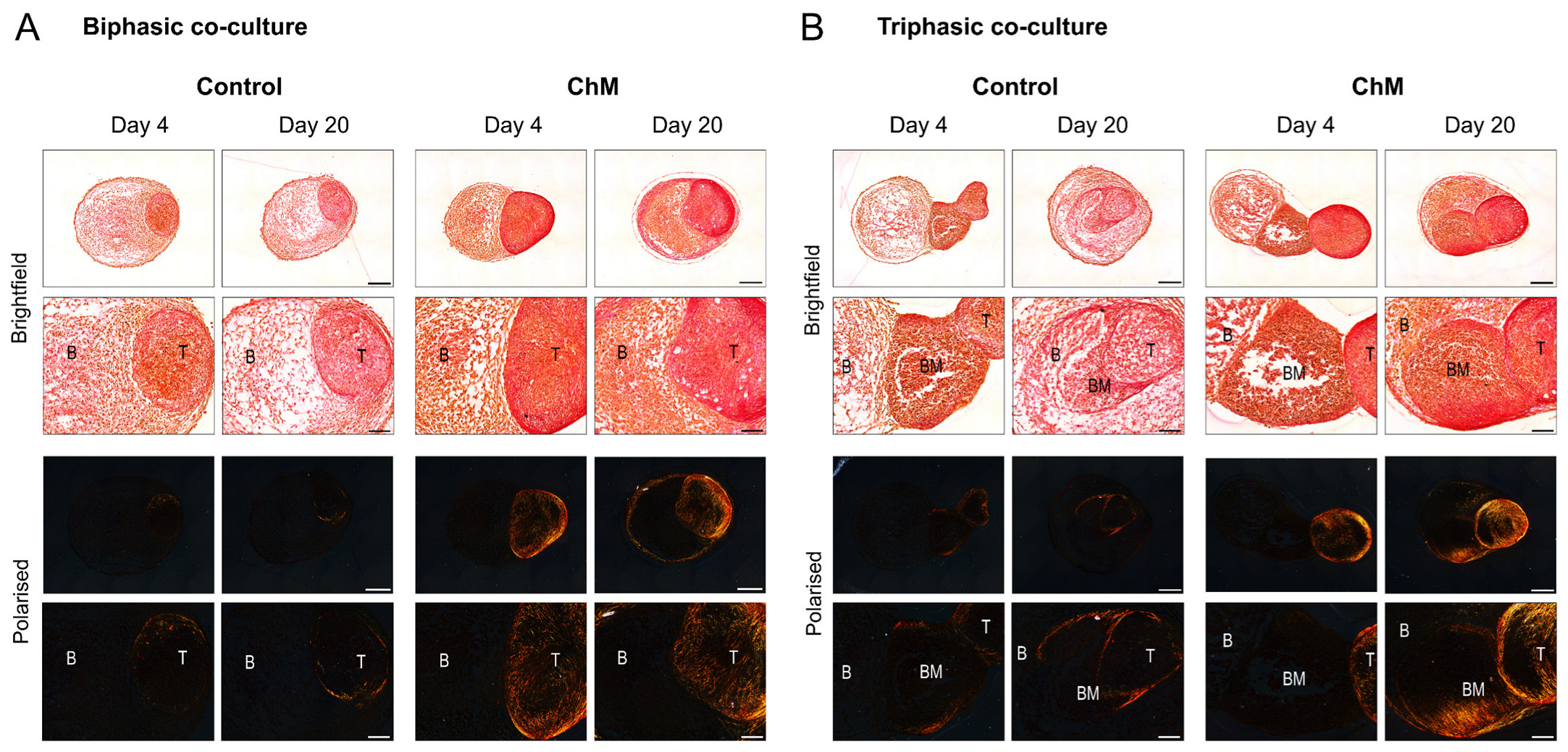
In toluidine blue-stained sections, purple metachromasia was observed in the ‘B’ region of all groups, and ‘BM’ and ‘T’ regions in ChM groups (Figure 4C,D). These results indicate that chondrogenic media had stimulated the BMSC and RTF cells to synthesise sulphated proteoglycans. In picrosirius red stained sections, collagen fibres increased over time in ChM compared to control (Figure 5A,B) in both biphasic and triphasic co-cultures. In the early stages of the ChM group, the collagen fibres were predominantly observed in the ‘T’ region, with a gradual increase in the ‘B’ and ‘BM’ regions over time. In both biphasic and triphasic co-cultures, brown-coloured DAB staining indicating collagen type II was observed in the ChM group compared to the control group (Figure 6A). Alizarin red staining showed calcium deposits in the ‘B’ spheroids of both biphasic and triphasic co-cultures in ChM (Figure 6B), which reduced over time due to the lack of mineralisation media.

3.2. Three-Dimensional Enthesis Macro-Tissue Development

3.2.1. Bio-Assembly and Fusion of Spheroids

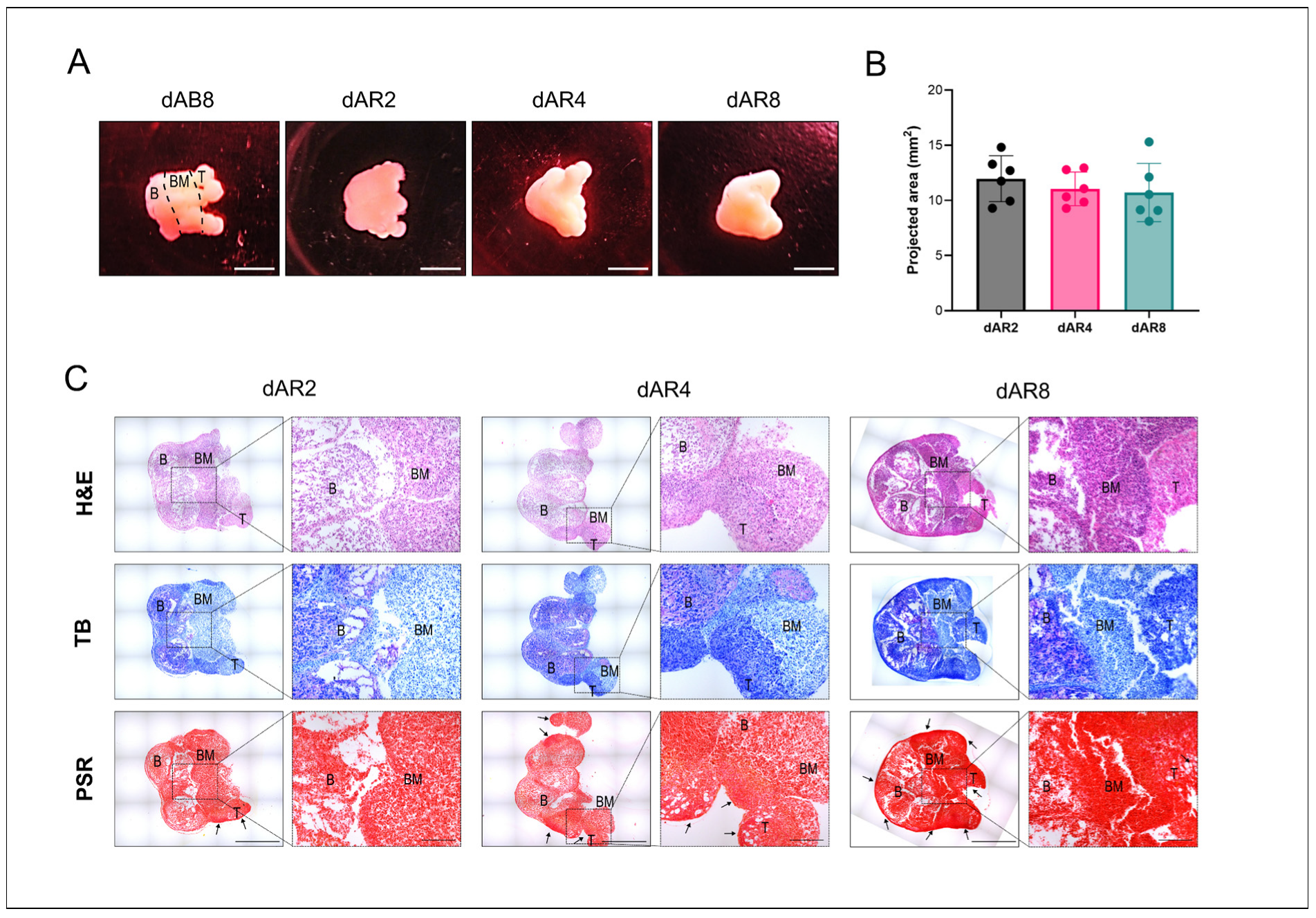
Fusion of spheroids bio-assembled in mPArTS was observed on day 8 after bio-assembly (dAB8) (Figure 7A). The fused constructs removed on dAB8 were cultured in scaffold-free conditions in ChM and were termed as B-BM-T macro-tissues. The B-BM-T macro-tissue constructs exhibited progressive fusion over time from dAR2 to dAR8; dAR: day after removal (Figure 7A). The macro-tissues showed a slight reduction in size over time, with the projected area of 11.96 ± 2.08 mm2 on dAR2 to 10.71 ± 2.64 mm2 on dAR8 (Figure 7B). Over this period, 61% of the macro-tissues remained intact, while 39% of them deformed, rendering it challenging to track the spheroid types.

3.2.2. Histology of Scaffold-Free B-BM-T Macro-Tissues

In the scaffold-free B-BM-T macro-tissues, H&E staining consistently showed necrotic cores predominantly in the ‘BM’ regions on all days (Figure 7C). Toluidine blue staining revealed strong purple metachromasia (sulphated proteoglycans) in the ‘B’ region, weaker in the ‘T’ region and none in the ‘BM’ region. Picrosirius red staining showed collagen fibres in the ‘B’ and ‘T’ region, and no collagen fibres were observed in the ‘BM’ region (Figure 7C). These findings indicate that limited media availability in the core regions of large constructs (>10 mm2 area) caused necrosis in ‘BM’ regions and therefore the lack of extracellular matrices.

4. Discussion

Surgical reconstruction strategies for tendon injury mainly rely on the integration of tendon grafts with the host bone, which often fails due to the mechanically weak interface formed during the healing process [3,8]. Therefore, the regeneration of native enthesis zonal structure is the long-term goal for treating tendon injury. The primary objective of this study is to establish a 3D biomimetic in vitro model of enthesis to enable downstream studies on enthesis injury, repair and regeneration. This study also aimed to develop macro-tissues with the potential to serve as enthesis grafts for regeneration.

4.1. Three-Dimensional Scaffold-Free Model of the Enthesis

To develop a 3D scaffold-free model of the enthesis, spheroids of each cell type (dROb, BMSC and RTF) were co-cultured in both biphasic and triphasic manner. The biphasic co-culture was examined based on the rationale that interactions between osteogenic and tenogenic cells initiate fibrocartilaginous interface formation [11], while the triphasic co-culture was investigated based on the rationale that BMSC cells differentiate into fibrocartilaginous interface when co-cultured between osteogenic and tenogenic cells [14,15]. These studies suggest that physical contact with paracrine cell interactions by co-culturing different cell types drives towards differentiation/transdifferentiation [12]. The chondrogenic medium used in this study was adapted from Cao et al. [15], where it promoted BMSC chondrogenic differentiation in the scaffold-based tendon–BMSC–bone co-culture.
In both biphasic and triphasic co-cultures, the spheroids completely fused earlier in control groups than in chondrogenic media groups. This is attributed to sparse cell distribution and lower ECM content in the control group, as observed through histological analysis (Figure 4 and Figure 5), allowing faster fusion between spheroids. Comparable findings were reported by Kosheleva et al. [17], showing that dense cellular packing slows the spheroid fusion, while loose cell packing promotes the fusion rate. Chondrogenic media maintained the compact cellular organisation and increased ECM content in both biphasic and triphasic co-cultures. This indicates that physical contact with paracrine interactions alone does not induce BMSC differentiation into fibrocartilage, highlighting the importance of chondrogenic medium in this process.
In chondrogenic media, complete fusion was earlier in the biphasic co-culture (8 days) compared to the triphasic co-culture (20 days) due to the slower fusion between BMSC and RTF spheroids. It has been reported that chondrogenic spheroid doublets (homotypic) completely fused within 72 h by De Moor et al. [18] and took 7 days by Parfenov et al. [19]. However, no studies reported fusion kinetics of biphasic or triphasic heterotypic spheroid co-cultures.
Compared to the biphasic co-culture, the triphasic co-culture in chondrogenic media exhibited a continuous BMSC interface connecting the tendon and bone regions, better representing the structural anatomy of the enthesis. Compositionally, the BMSC region in triphasic co-culture showed the presence of sulphated proteoglycans, collagen type I fibres and some collagen type II, indicating fibrochondrogenic differentiation (Figure 4, Figure 5 and Figure 6). Chondrogenic media also influenced tendon and bone regions, promoting fibrocartilaginous ECM and reducing calcium deposits by dRObs over time. These were consistent with other studies reporting that tendon-derived cells showed chondrogenic differentiation potential when cultured in chondrogenic media [20,21], as well as periosteum-derived cells showed collagen type II mRNA expression under the influence of TGFβ3 [22]. The scaffold-based osteoblast–BMSC–fibroblast co-culture in chondrogenic media was studied by Cao et al. [15], which showed collagen type II expression in the BMSC phase and close regions of the osteoblast phase. However, osteoblast and fibroblast phases were not specifically assessed for the effects of chondrogenic media.
The findings from biphasic and triphasic co-culture in this study support the research hypothesis that triphasic co-cultures with the BMSC phase between dROb and RTF phases can form a structurally continuous fibrocartilaginous interface and also underscore the importance of selective cell differentiation in different phases through media optimisation.

4.2. Three-Dimensional Enthesis Macro-Tissues

To engineer 3D enthesis macro-tissues (B-BM-T), the customised spheroid bio-assembly system and 3D printed mPArTS (modified pillar array temporary supports) were used. Mineralised dROb spheroids (15-day-old) were larger in size which continued to increase gradually over time [16], whereas BMSC (2-day-old) and RTF spheroids (3–4 day-old) continued to decrease in size. Therefore, a reduced number of dROb spheroids (eight) were used during triphasic bioassembly in mPArTS relative to BMSC and RTF spheroids (twelve) to maintain comparable volume across three phases of B-BM-T macrotissues.
In scaffold-free conditions after removal from mPArTS, the B-BM-T macro-tissues reached the size of approximately 10 mm2 area (~3.5 mm diameter) by dAR8 (day 8 after removal). In comparison, previous studies produced larger multiphasic constructs of around 8 mm × 8mm × 2.5 mm [15] and 2 × 4 cm [14], but they were scaffold-based constructs. Ayan et al. [23] fabricated scaffold-free osteochondral constructs of 1–1.5 mm. Our current study produced comparatively larger scaffold-free constructs. The extensive necrotic core in the BMSC region makes the B-BM-T macro-tissues ineffective in fibrocartilaginous interface formation. However, the methodology of multiphasic bio-assembly in our study serves as a pioneering approach for future 3D enthesis macro-tissue development by vascularising and mitigating necrotic cores.
In comparison to existing scaffold-based triphasic models, our scaffold-free triphasic method is advantageous in different aspects. The multiphasic scaffolds fabricated by Spalazzi et al. [13] consisted of three distinct phases such as Phase A: polyglactin 10:90 knitted mesh sheets, Phase B: poly(D,L-lactic-co-glycolic acid) (PLGA) microspheres and Phase C: composite microspheres with PLGA and 45S5 bioactive glass. Triculturing bovine fibroblasts–chondrocytes–osteoblasts in their respective phases formed a fibrocartilage-like interface. However, the distribution of cell types and matrices was not phase-specific because of high porosity and cell migration between phases. This limits continuous cellular gradient formation required to mimic the native enthesis. The scaffold-free triphasic model developed in our study eliminates this limitation due to close aggregation between cells, thereby preventing migration between phases. In addition, the fabrication process and reproducibility of these multiphasic scaffolds are complex. The same is true for hybrid silk [14] and PCL/TCP [15] scaffolds developed for triphasic cultures.
Hybrid silk scaffolds fabricated from raw silk fibers were used to co-culture rabbit fibroblasts–BMSC–osteoblasts for ligament-bone interface regeneration [14]. A multiphasic poly(ε-caprolactone) (PCL)–PCL/tricalcium phosphate (TCP) porous scaffold was designed to co-culture mouse fibroblasts–BMSC–osteoblasts encapsulated in gelatin methacrylate (GelMA) [15] for tendon-to-bone interface engineering. In both studies, cells were not in close contact with each other, as seen in native tissues, which is critical for cell-cell interactions. In contrast, our scaffold-free triphasic model demonstrates close cell-cell contact and compact organisation. In summary, our scaffold-free approach is time efficient and highly biomimetic, avoiding complex scaffold fabrication and clinical challenges related to biocompatibility, degradation, immunogenicity and toxicity from biomaterials.
Overall, this study has validated that the scaffold-free spheroid-based triphasic constructs produce a fibrocartilaginous interface. Further improvements by optimising methods for overall structural morphology, selective cell differentiation and necrotic core mitigation allow evaluation of cellular and extracellular matrix gradients. Mineralised and non-mineralised fibrocartilage phases can be introduced and investigated by optimising the media to selectively differentiate each phase. In addition, applying mechanical loads to these constructs would mimic the physiological conditions of native enthesis. These inform future studies in developing controlled bio-mimetic platforms to investigate complex cellular and molecular events which support the design of therapeutic strategies for enthesis regeneration. Through these systematic advancements, the ultimate goal of treating entheses injuries can be accomplished.


5. Conclusions

In conclusion, this study highlights the potential of scaffold-free co-cultures to drive the development of a 3D in vitro enthesis model. Among the strategies investigated, the triphasic co-culture marked a significant step towards biomimetic tissue development by replicating some of the key structures of native enthesis. These advancements in bottom-up tissue engineering offer valuable insights into developing a clinically relevant approach for tendon-to-bone interface repair and regeneration.

Author Contributions

V.P.: Conceptualisation, Data curation, Formal analysis, Funding acquisition, Investigation, Methodology, Validation, Visualisation, Writing—original draft, Writing—review and editing. J.Z.P.: Conceptualisation, Funding acquisition, Methodology, Project administration, Resources, Supervision, Writing—review and editing. All authors have read and agreed to the published version of the manuscript.

Funding

This research work was supported by Tenovus Scotland (grant no. E22-05BG). VP’s PhD was funded by Principal’s career development scholarship and Edinburgh Global Research Scholarship, University of Edinburgh.

Institutional Review Board Statement

Not applicable.

Informed Consent Statement

Not applicable.

Data Availability Statement

The original contributions presented in this study are included in the article. Further inquiries can be directed to the corresponding author.

Acknowledgments

We acknowledge the use of the IMPACT imaging facility, University of Edinburgh.

Conflicts of Interest

The authors declare no conflicts of interest. The funders had no role in the design of the study; in the collection, analyses, or interpretation of data; in the writing of the manuscript; or in the decision to publish the results.

References

  1. Gracey, E.; Burssens, A.; Cambré, I.; Schett, G.; Lories, R.; McInnes, I.B.; Asahara, H.; Elewaut, D. Tendon and ligament mechanical loading in the pathogenesis of inflammatory arthritis. Nat. Rev. Rheumatol. 2020, 16, 193. [Google Scholar] [CrossRef]
  2. Lei, T.; Zhang, T.; Ju, W.; Chen, X.; Heng, B.C.; Shen, W.; Yin, Z. Biomimetic strategies for tendon/ligament-to-bone interface regeneration. Bioact. Mater. 2021, 6, 2491–2510. [Google Scholar] [CrossRef]
  3. Nichols, A.E.C.; Best, K.T.; Loiselle, A.E. The Cellular Basis of Fibrotic Tendon Healing: Challenges and Opportunities. Transl. Res. J. Lab. Clin. Med. 2019, 209, 156. [Google Scholar] [CrossRef]
  4. Apostolakos, J.; Durant, T.J.; Dwyer, C.R.; Russell, R.P.; Weinreb, J.H.; Alaee, F.; Beitzel, K.; McCarthy, M.B.; Cote, M.P.; Mazzocca, A.D. The enthesis: A review of the tendon-to-bone insertion. Muscles Ligaments Tendons J. 2014, 4, 333–342. [Google Scholar] [CrossRef]
  5. Gögele, C.; Hahn, J.; Schulze-Tanzil, G. Anatomical tissue engineering of the anterior cruciate ligament entheses. Int. J. Mol. Sci. 2023, 24, 9745. [Google Scholar] [CrossRef] [PubMed]
  6. Wang, I.-N.E.; Mitroo, S.; Chen, F.H.; Lu, H.H.; Doty, S.B. Age-dependent changes in matrix composition and organization at the ligament-to-bone insertion. J. Orthop. Res. Off. Publ. Orthop. Res. Soc. 2006, 24, 1745–1755. [Google Scholar] [CrossRef]
  7. Paxton, J.; Baar, K.; Grover, L. Current Progress in Enthesis Repair: Strategies for Interfacial Tissue Engineering. Orthop. Muscular Syst. 2013, S1:003. [Google Scholar] [CrossRef]
  8. Lu, H.H.; Thomopoulos, S. Functional Attachment of Soft Tissues to Bone: Development, Healing, and Tissue Engineering. Annu. Rev. Biomed. Eng. 2013, 15, 201–226. [Google Scholar] [CrossRef]
  9. Patel, S.; Caldwell, J.; Doty, S.B.; Levine, W.N.; Rodeo, S.; Soslowsky, L.J.; Thomopoulos, S.; Lu, H.H. Integrating soft and hard tissues via interface tissue engineering. J. Orthop. Res. 2018, 36, 1069–1077. [Google Scholar] [CrossRef]
  10. Lu, H.H.; Jiang, J. Interface tissue engineering and the formulation of multiple-tissue systems. Adv. Biochem. Eng. Biotechnol. 2006, 102, 91–111. [Google Scholar] [PubMed]
  11. Wang, I.-N.E.; Shan, J.; Choi, R.; Oh, S.; Kepler, C.K.; Chen, F.H.; Lu, H.H. Role of osteoblast–fibroblast interactions in the formation of the ligament-to-bone interface. J. Orthop. Res. 2007, 25, 1609–1620. [Google Scholar] [CrossRef] [PubMed]
  12. Wang, I.-N.E.; Bogdanowicz, D.R.; Mitroo, S.; Shan, J.; Kala, S.; Lu, H.H. Cellular interactions regulate stem cell differentiation in tri-culture. Connect. Tissue Res. 2016, 57, 476–487. [Google Scholar] [CrossRef] [PubMed]
  13. Spalazzi, J.P.; Dagher, E.; Doty, S.B.; Guo, X.E.; Rodeo, S.A.; Lu, H.H. In vivo evaluation of a multiphased scaffold designed for orthopaedic interface tissue engineering and soft tissue-to-bone integration. J. Biomed. Mater. Res. Part A 2008, 86A, 1–12. [Google Scholar] [CrossRef]
  14. He, P.; Ng, K.S.; Toh, S.L.; Goh, J.C.H. In Vitro Ligament–Bone Interface Regeneration Using a Trilineage Coculture System on a Hybrid Silk Scaffold. Biomacromolecules 2012, 13, 2692–2703. [Google Scholar] [CrossRef] [PubMed]
  15. Cao, Y.; Yang, S.; Zhao, D.; Li, Y.; Cheong, S.S.; Han, D.; Li, Q. Three-dimensional printed multiphasic scaffolds with stratified cell-laden gelatin methacrylate hydrogels for biomimetic tendon-to-bone interface engineering. J. Orthop. Transl. 2020, 23, 89–100. [Google Scholar] [CrossRef]
  16. Prabhakaran, V.; Melchels, F.P.W.; Murray, L.M.; Paxton, J.Z. Engineering three-dimensional bone macro-tissues by guided fusion of cell spheroids. Front. Endocrinol. 2023, 14, 1308604. [Google Scholar] [CrossRef]
  17. Kosheleva, N.V.; Efremov, Y.M.; Shavkuta, B.S.; Zurina, I.M.; Zhang, D.; Zhang, Y.; Minaev, N.V.; Gorkun, A.A.; Wei, S.; Shpichka, A.I.; et al. Cell spheroid fusion: Beyond liquid drops model. Sci. Rep. 2020, 10, 12614. [Google Scholar] [CrossRef]
  18. De Moor, L.; Fernandez, S.; Vercruysse, C.; Tytgat, L.; Asadian, M.; De Geyter, N.; Van Vlierberghe, S.; Dubruel, P.; Declercq, H. Hybrid Bioprinting of Chondrogenically Induced Human Mesenchymal Stem Cell Spheroids. Front. Bioeng. Biotechnol. 2020, 8, 526351. [Google Scholar] [CrossRef]
  19. Parfenov, V.A.; Koudan, E.V.; Bulanova, E.A.; Karalkin, P.A.; DAS Pereira, F.; Norkin, N.E.; Knyazeva, A.D.; Gryadunova, A.A.; Petrov, O.F.; Vasiliev, M.M.; et al. Scaffold-free, label-free and nozzle-free biofabrication technology using magnetic levitational assembly. Biofabrication 2018, 10, 034104. [Google Scholar] [CrossRef]
  20. de Mos, M.; Koevoet, W.J.; Jahr, H.; Verstegen, M.M.; Heijboer, M.P.; Kops, N.; van Leeuwen, J.P.; Weinans, H.; Verhaar, J.A.; van Osch, G.J. Intrinsic differentiation potential of adolescent human tendon tissue: An in-vitro cell differentiation study. BMC Musculoskelet. Disord. 2007, 8, 16. [Google Scholar] [CrossRef]
  21. Qin, S.; Wang, W.; Liu, Z.; Hua, X.; Fu, S.; Dong, F.; Li, A.; Liu, Z.; Wang, P.; Dai, L.; et al. Fibrochondrogenic differentiation potential of tendon-derived stem/progenitor cells from human patellar tendon. J. Orthop. Transl. 2020, 22, 101–108. [Google Scholar] [CrossRef] [PubMed]
  22. Izumi, T.; Scully, S.P.; Heydemann, A.; Bolander, M.E. Transforming growth factor β1 stimulates type II collagen expression in cultured periosteum-derived cells. J. Bone Miner. Res. 1992, 7, 115–121. [Google Scholar] [CrossRef] [PubMed]
  23. Ayan, B.; Wu, Y.; Karuppagounder, V.; Kamal, F.; Ozbolat, I.T. Aspiration-assisted bioprinting of the osteochondral interface. Sci. Rep. 2020, 10, 13148. [Google Scholar] [CrossRef] [PubMed]
Figure 1. (A) Diagrammatic representation of tendon-to-bone enthesis; (B) rat Achilles enthesis stained by H&E, Picrosirius red and Toluidine blue showing cellular and extracellular matrix components of four distinct zones: tendon, uncalcified fibrocartilage, calcified fibrocartilage and bone. Abbr. m: muscle; t: tendon, b: bone; BM: bone marrow of calcaneal bone, SB: subchondral bone, CF: calcified fibrocartilage, UF: uncalcified fibrocartilage, TM: tidemark, AT: Achilles tendon. Figures were independently created and recorded by the authors.
Organoids 05 00007 g001
Figure 2. (A) Spheroid fusion kinetics measurements: diagrammatic illustration of measuring total length (TL), contact length (CL) and interspheroid angle (IA) in biphasic and triphasic co-culture of dROb (B: bone region), BMSC (BM: BMSC region) and RTF (T: tendon region) spheroids. Abbr. dROb: differentiated rat osteoblasts, BMSC: rat bone marrow mesenchymal stem cells, RTF: rat tendon fibroblasts. (B) CAD design with dimensions of modified pillar array temporary supports (mPArTS). (C) Three-dimensional-printed mPArTS and seal with ‘Formlabs-Clear-resin’. (D) Triphasic bio-assembly of dROb, BMSC, and RTF spheroids in mPArTS.
Organoids 05 00007 g002
Figure 3. (A) Microscopic images of biphasic and triphasic co-culture in growth media (control) and chondrogenic media (ChM) on different days from day 2 to day 20. scale bar: 1 mm. (B) Total length, (C) Contact length and (D) Interspheroid angles from day 2 to day 20. Error bars: standard deviations. Abbr. BP: biphasic; TP: triphasic; Control: growth media; ChM: chondrogenic media; ‘B’—bone region with differentiated rat osteoblast (dROb) spheroids, ‘BM’—BMSC region with rat bone marrow mesenchymal stem cell (BMSC) spheroids, ‘T’—tendon region with rat tendon fibroblast (RTF) spheroids.
Organoids 05 00007 g003
Figure 4. Microscopic images of H&E-stained sections of (A) biphasic and (B) triphasic constructs and toluidine blue stained sections of (C) biphasic and (D) triphasic constructs cultured in growth media (control) and chondrogenic media (ChM) on day 4 and day 20). Scale bars: whole constructs—500 µm, magnified interface regions—200 µm. ‘B’ denotes bone region with dROb spheroids; ‘BM’ denotes interface region with BMSC spheroids, ‘T’ denotes tendon region with RTF spheroids. H&E staining shows blue nuclei and pink cytoplasm; Toluidine blue staining shows blue nuclei and purple metachromatic sulphated proteoglycans.
Organoids 05 00007 g004
Figure 5. Microscopic images of picrosirius red stained sections of (A) biphasic and (B) triphasic constructs cultured in growth media (control) and chondrogenic media (ChM) on day 4 and day 20). Scale bars: whole constructs—500 µm, magnified interface regions—200 µm. ‘B’ denotes bone region with dROb spheroids; ‘BM’ denotes interface region with BMSC spheroids, ‘T’ denotes tendon region with RTF spheroids. Brightfield images show red collagen fibres and brownish black nuclei; Polarised images show reddish yellow collagen fibres.
Organoids 05 00007 g005
Figure 6. Microscopic images of (A) collagen II immunohistochemistry showing blue nuclei with dark brown collagen type II, and (B) Alizarin red stained sections of biphasic and triphasic constructs on day 4 and day 20 (black arrows indicate red calcium deposits). Scale bars: whole constructs—500 µm, magnified interface regions—200 µm. ‘B’ denotes bone region with dROb spheroids; ‘BM’ denotes interface region with BMSC spheroids, ‘T’ denotes tendon region with RTF spheroids.
Organoids 05 00007 g006
Figure 7. Scaffold-free culture of B-BM-T macro-tissue constructs. (A) Macroscopic images of fused constructs on day 8 after bio-assembly (dAB8); day 2, 4 and 8 after removal (dAR2,4,8) in chondrogenic media. Scale bar: 2 mm. (B) Bar chart representing projected areas (mm2) on dAR2, 4 & 8 (N = 3, n = 2). Error bars: standard deviation; N = experimental replicates; n = technical replicates. (C) Microscopic images of H&E, toluidine blue (TB) and picrosirius red (PSR) stained sections of B-BM-T macrotissues. Scale bar: 1 mm, high magnification images: 200 µm. Labels: ‘B’ indicates bone region with dROb spheroids; ‘BM’ indicates interface region with BMSC spheroids; ‘T’ indicates tendon region with RTF spheroids. H&E staining shows blue nuclei and pink cytoplasm; TB staining shows blue nuclei and purple metachromatic sulphated proteoglycans; PSR staining shows red collagen fibres (black arrows) and brownish black nuclei.
Organoids 05 00007 g007
Disclaimer/Publisher’s Note: The statements, opinions and data contained in all publications are solely those of the individual author(s) and contributor(s) and not of MDPI and/or the editor(s). MDPI and/or the editor(s) disclaim responsibility for any injury to people or property resulting from any ideas, methods, instructions or products referred to in the content.