Article

A Fully Annotated Hepatoblastoma Tumoroid Biobank Details Treatment-Induced Evolution and Clonal Dynamics in Paediatric Cancer Patients


by
Gijs J. F. van Son
1,†,
Femke C. A. S. Ringnalda
1,†,
Markus J. van Roosmalen
1,2,
Thomas A. Kluiver
1,
Quinty Hansen
1,
Evelien Duiker
3,4,
Marius C. van den Heuvel
3,4,
Vincent E. de Meijer
5,
Ruben H. de Kleine
5,
Ronald R. de Krijger
1,6,
József Zsiros
1,
Weng Chuan Peng
1,
Ruben van Boxtel
1,2,
Marc van de Wetering
1,
Karin Sanders
1,*,‡ and
Hans Clevers
1,2,7,8,9,*,‡
1
Princess Máxima Center for Pediatric Oncology, 3584 CS Utrecht, The Netherlands
2
Oncode Institute, 3584 CB Utrecht, The Netherlands
3
Department of Pathology, University Medical Center Groningen, 9713 GZ Groningen, The Netherlands
4
Medical Biology, University of Groningen, 9712 CP Groningen, The Netherlands
5
Section of Hepatobiliary Surgery and Liver Transplantation, Department of Surgery, University Medical Center Groningen, 9713 GZ Groningen, The Netherlands
6
Department of Pathology, University Medical Center Utrecht, Heidelberglaan 100, 3584 CX Utrecht, The Netherlands
7
Hubrecht Institute, 3584 CT Utrecht, The Netherlands
8
Royal Netherlands Academy of Arts and Sciences, 1011 JV Amsterdam, The Netherlands
9
Department of Medical Sciences, University Medical Center, 3584 CT Utrecht, The Netherlands
*
Authors to whom correspondence should be addressed.
These authors contributed equally to this work.
These authors also contributed equally to this work.
Organoids 2026, 5(1), 4; https://doi.org/10.3390/organoids5010004
Submission received: 1 October 2025 / Revised: 10 December 2025 / Accepted: 6 January 2026 / Published: 18 January 2026

Abstract

Hepatoblastoma (HB) is a paediatric liver malignancy arising from hepatic precursor cells, with >90% of cases harbouring a mutation in exon 3 of CTNNB1. We present a fully genetically characterised HB tumour organoid (tumoroid) biobank, which allows for in vitro studies of disease progression and clonal dynamics in vitro. We established a biobank of 14 tumoroid lines from 9 different patients. Tumours and tumoroids were characterised by whole genome sequencing (WGS) and histology, revealing strong concordance in cell morphology and β-catenin staining. In tumour—tumoroid pairs, identical pathogenic CTNNB1 variants were found, alongside shared copy number alterations (CNAs) and mutations. Variant allele frequency (VAF) was consistently higher in tumoroids, indicating increased tumour purity in vitro. In addition to CTNNB1, we frequently observed ARID1A alterations (single-nucleotide variants [SNVs] or CNAs in 56% of patients), and MYC gains as described previously. In paired pre- and post-treatment samples, we observed a clear increase in mutational load, attributed to a chemotherapy signature. Notably, from one patient, we analysed 4 tumour samples (3 post-treatment) with 4 matching tumoroid lines, all carrying a novel BCL6 mutation and loss of ARID1A. Mutational profiles varied across samples from different locations, suggesting intratumoral heterogeneity and clonal selection during tumoroid derivation. Taken together, this biobank allows detailed analysis of HB tumour biology, including treatment-induced progression and clonal dynamics across temporally and spatially distinct samples.

1. Introduction

Hepatoblastoma (HB) is the most common paediatric liver malignancy, originating/arising from hepatoblasts during early human development. The median age at diagnosis is 1.5 years, with most cases occurring before the age of 3 [1,2,3]. Known risk factors include Beckwith-Wiedemann syndrome, familial adenomatous polyposis coli, and a very low birth weight, although the latter remains poorly understood [4,5]. Current treatment protocols use a combination of cisplatin-containing chemotherapy and surgical resection, achieving a 5-year event-free survival of 88% for low-risk patients and a 76% 3-year event-free survival for high-risk patients [6,7,8]. Risk stratification is primarily based on histological features. Despite improved outcomes, no targeted therapy exists for patients who respond poorly to chemotherapy, implicating the need for more research into HB biology and treatment resistance.
HBs are primarily driven by mutations in components of the WNT signalling pathway, most commonly in exon 3 of CTNNB1, leading to constitutive beta-Catenin activation. Rare cases have been described that carry inactivating mutations in APC [1]. High-risk patients are genetically characterised by additional mutations in NFE2L2 or TERT, and MYC amplification or overexpression [9,10,11]. While all HBs are characterised by mutations in the WNT pathway, three different subtypes can be identified histologically: foetal, embryonal and small cell. The foetal subtype is characterised by differentiated epithelial characteristics. The embryonal subtype resembles the developing liver at 6–8 weeks of gestation, and the small cell subtype is composed of undifferentiated cells with a small diameter. These three different subtypes can also co-occur in the same tumour and can be distinguished by RNA (transcriptomic) profiles [12]. Recent multi-omics studies (whole genome sequencing [WGS], single-cell RNA sequencing, open chromatin sequencing, and spatial transcriptomics) have revealed the existence of multiple subtypes within the same genetic clones in a single tumour and suggest extensive signalling between embryonal and foetal subtypes, implicating a role for FGF19 as mediator in the embryonal subtype [13,14]. These data suggest that the different subtypes might respond differently to chemotherapy, underscoring the need for preclinical models that represent this heterogeneity.
Current research relies heavily on two popular HB-derived cell lines: HepG2 and HUH6 [15,16,17]. While these models have some advantages in ease of use and costs, they fail to recapitulate the tumour’s cellular heterogeneity. Mouse models, generated by targeting Ctnnb1 in developing livers, develop tumours that only resemble the foetal subtype [18]. Additional genetic alterations in c-Myc or Nfe2l2 have increased the resemblance to HB, yet this was accompanied by higher tumour penetrance and lower mouse survival past 10 weeks [19]. Alternatively, tumour-derived organoids (tumoroids) or patient-derived xenograft (PDX) models offer more faithful, human models of HB [20,21,22,23,24]. Over the last few years, more and more paediatric tumoroid models have been established. There are now tumoroid models available for a wide variety of tumours, including small cell sarcomas, ovarian tumours, Wilms tumour, and rhabdoid tumours [25,26,27]. Recent studies have shown that HB tumoroids preserve both subtype-specific features and intertumoral heterogeneity [28]. These models are suited for mechanistic studies and high-throughput drug screening. Previous large-scale drug screening studies rely heavily on PDX models, which are very time-consuming to establish compared to the establishment of tumoroid lines [29]. Here, we present a fully genetically characterised HB tumoroid biobank comprising 14 tumoroid lines from 9 different patients, including tumoroid lines that were established from the same patient at different timepoints during disease progression. This unique resource enables detailed studies of tumour progression, clonal dynamics, and therapy response.

2. Materials and Methods

2.1. Ethics Statement Tumour Tissue

Tumour samples were obtained from patients as part of the biobank initiative of the Princess Máxima Center for pediatric oncology, Utrecht, The Netherlands. The biobank initiative was approved by the medical ethics committee of the Erasmus Medical Center in Rotterdam, The Netherlands, under reference number MEC-2016–739 (25 November 2016), and the biobank and data access committee of the Princess Máxima Center approved the use of tumour tissue for this project (PMCLAB2020-090). All patients and/or their legal representatives signed written informed consent to have tumour samples taken for biobank usage.

2.2. Patient Material Processing

Patient material obtained via fine needle aspiration biopsies (FNAB) or surgical resection was collected in Advanced Dulbecco’s Modified Eagle’s Medium with Nutrient Mixture Ham’s F-12 (Adv-DF) (#12634, Invitrogen, Waltham, MA, USA), supplemented with 1% pen/strep (#15140-122, Invitrogen, Waltham, MA, USA), 1% Glutamax (#35050-038, Invitrogen, Waltham, MA, USA) and 1% Hepes (#15630-056, Invitrogen, Waltham, MA, USA) (hereafter referred to as Adv-DF+++). Healthy, tumour-adjacent tissue and tumour tissue were divided into smaller pieces for diagnostic purposes and used for WGS and immunohistochemistry. The remaining tissue was then further processed. Using scalpels, tumour or healthy tissue was minced into 1–3 mm3 pieces. Samples were then subdivided into three parts: one part was used for tumoroid or organoid establishment, one for downstream histopathological analysis, and one part for cryopreservation. The part used for tumoroid establishment was mechanically dissociated by repetitive pipetting with a P1000 pipette (Gilson, Middleton, WI, USA). After washing with ice-cold Adv-DF+++ medium, the cells were taken into culture.

2.3. Generation of Long-Term Tumoroid Cultures

Minced tissues were washed with ice-cold Adv-DF+++ medium, and the remaining cells or small aggregates were mixed with reduced growth factor basement membrane extract (BME; R&D, Minneapolis, MN, USA) and plated in 20–30 µL droplets. After BME had solidified, liver tumoroid medium was added. Tumoroids were cultured in the following medium: Adv-DF+++ medium, supplemented with 2% B27 without vitamin A (Gibco, Waltham, MA, USA), 1% N2 (Gibco), 1.25 mM N-Acetylcysteine (Sigma-Aldrich, Saint Louis, MO, USA), 10 nM gastrin (Sigma-Aldrich, Saint Louis, MO, USA), 50 ng/mL EGF (Peprotech, Waltham, MA, USA), 10% RSPO1 conditioned media (produced in-house), 100 ng/mL FGF10 (Peprotech), 25 ng/mL HGF (Peprotech, Waltham, MA, USA), 10 mM Nicotinamide (Sigma-Aldrich, Saint Louis, MO, USA), 5 µM A83.01 (Tocris, Dublin, Ireland), 10 µM forskolin (Tocris, Dublin, Ireland). For the establishment of the healthy liver organoids, the medium was additionally supplemented with 10% Noggin-conditioned media (produced in-house) and 0.5 nM next-generation WNT surrogate (IpA, Utrecht, Netherlands). Noggin was only added in the first passage. Rock inhibitor (Y27632, 10 µM) (Sigma-Aldrich, Saint Louis, MO, USA) was added when passaging the culture.

2.4. Histology and Immunohistochemistry

Tumour tissues were fixed in 4% paraformaldehyde (PFA), dehydrated, and subsequently embedded in paraffin. Tumoroids were washed in cold Adv-DF+++ medium and fixed for 1 h at room temperature in 4% PFA. Fixed tumoroids were sequentially dehydrated through a gradient of alcohol series and butanol, and then paraffinized. Subsequently, 4 µm thick sections were cut and used for H&E and immunohistochemical staining using standard protocols. The following primary antibody was used: anti-CTNNB1 (BD Transduction Laboratories, #610154, San Jose, CA, USA). Images were acquired with a Leica DMi8 microscope (Nussloch, Germany).

2.5. Immunofluorescence Imaging

Tumoroids and organoids were processed for a 4 µm FFPE section as described above. Sections were deparaffinized and rehydrated by immersing the slides in 3 changes of xylene, followed by a series of decreasing concentrations of ethanol and rinsing in distilled water. Heat-induced antigen retrieval was performed by placing the slides in citrate buffer (pH 6.0) and boiling for 20 min using an autoclave. Sections were permeabilized in 0.3% Triton X-100 in PBS for 15 min. Next, slides were blocked in 3% normal donkey serum (Jackson ImmunoResearch, West Grove, PA, USA) in 0.1% PBS-Tween (PBS-T) for 2 h at room temperature (RT). Tumor tissue and tumoroid sections were incubated with anti-CTNNB1 diluted in blocking buffer overnight at 4 °C. The next day, the slides were washed 3 times with PBS. Secondary antibodies were diluted in PBST and applied for 1 h at RT. The secondary antibody was raised in donkey and conjugated to Alexa Fluor 488 dye (Thermo Fisher, Waltham, MA, USA). Sections were washed with PBS and counterstained with DAPI (Sigma-Aldrich) at 5 µg/mL for 5 min at RT. Specimen slides were mounted in ProLong Gold Antifade (Invitrogen, Waltham, MA, USA) and covered with a #1.5 coverslip. Images were acquired with a 20× dry objective on a Leica SP8 (Nussloch, Germany). Acquired images were adjusted for brightness and pseudo-colour using FIJI software (v.1.54p).

2.6. WGS

Tumoroid samples were cultured for a minimum of 5 passages before genomic DNA was extracted using QIAGEN blood and tissue DNA kit (QIAGEN, Hilden, Germany). Tumour and blood samples were used directly. DNA library preparation was performed using the KAPA HyperPlus kit (Roche, Basel, Switzerland) according to the manufacturer’s instructions. Tumours (60–90× coverage), whole blood (30× coverage), and tumoroids (30× coverage) were sequenced on a NovaSeq 6000 (Illumina, San Diego, CA, USA). Reads were mapped against the human reference genome (GRCh38) with the Burrows-Wheeler Aligner (v0.7.5a) mapping software with settings ‘bwa mem -c 100 -M’. Duplicate reads were marked with Sambamba (v0.6.8). Variants were annotated using the Genome Analysis Toolkit (GATK) (v3.8-1-0). A detailed description of the complete data analysis pipeline is available at: https://github.com/UMCUGenetics/IAP (accessed on 5 January 2026). Postprocessing of variants was performed using the SMuRF pipeline with default settings. A detailed overview of the postprocessing pipeline can be found at https://github.com/ToolsVanBox/SMuRF (accessed on 5 January 2026). Briefly, variants on all autosomal and sex chromosomes were used in this analysis. Variants were filtered on mapping quality > 40, base coverage of at least 10, and a blacklist was used to filter out known false positives, which can be found at https://doi.org/10.6084/m9.figshare.30590312.v1 (accessed on 5 January 2026). Variants were also filtered to a matched normal sample. Furthermore, variants with a mean allele frequency of above 0.01 in the general population were filtered out unless these variants had a COSMIC identifier. VCF files from postprocessing were converted to MAF files using a personalised script available at https://github.com/Hubrecht-Clevers/Convert_maf (accessed on 5 January 2026). Variants were further analysed in Rstudio with R (v4.4.0), maftools (v2.19), ggplot2 (v3.5.1), data.table (v1.15.4), RColorBrewer (v1.1-3), NMF (v0.27), viridis (v0.6.5), gggenes (v0.5.1), Seurat (v5.0.3), ggrepel (v0.9.5) and readxl (v1.4.3). The full script is available at https://github.com/PMC-Clevers/Hepatoblastoma_tumoroid_biobank (accessed on 5 January 2026). Briefly, variants were divided into coding silent mutations such as synonymous variants, intron variants, and in-frame deletions or insertions, and damaging mutations, such as nonsynonymous variants, frameshifts, and gene fusions. Visualisation of mutations was further processed in R using maftools (v2.19.0). The detailed script is available at https://github.com/PMC-Clevers/Hepatoblastoma_tumoroid_biobank (accessed on 5 January 2026).

2.7. Mutational Signature Analysis

All single-nucleotide variants, both non-synonymous and synonymous, were loaded into R. A trinucleotide matrix was constructed using the UCSC h38 genome. Mutational signatures were extracted using the extractSignatures function from Maftools. Signatures were compared with known SBS signatures from the COSMIC database. Cosine distance was computed, and the best match for each signature was annotated to the extracted signatures. Ggplot2 was used for further visualisation of the mutational signatures. Alternatively, mutational signatures were analysed using the mutationalsignatures R software (https://github.com/ToolsVanBox/MutationalPatterns (accessed on 5 January 2026)) [30]. This resulted in a similar outcome. Both scripts are available at https://github.com/PMC-Clevers/Hepatoblastoma_tumoroid_biobank (accessed on 5 January 2026).

2.8. Subclone Analysis

A full description of the pipeline and variables is available at https://github.com/GJFvanSon/small_cell_sarcomas/tree/main/Subclones (accessed on 5 January 2026). Briefly, allele-specific copy number profiles were constructed using CNV-facets (v0.5.14) using standard settings [31]. Doing so, for all variants (synonymous and non-synonymous), the minor and major copy number was computed. Next, subclones were identified using pyclone-vi [32]. Pyclone fit function was run with the following settings ‘-c 40 -d beta-binomial -r 100′, followed by the write-results-file function. Visualisation of subclones over the different samples was performed in R using the ggalluvial (v0.12.5) and supraHex (v1.46.0) packages. The full script is available at https://github.com/PMC-Clevers/Hepatoblastoma_tumoroid_biobank (accessed on 5 January 2026).

3. Results

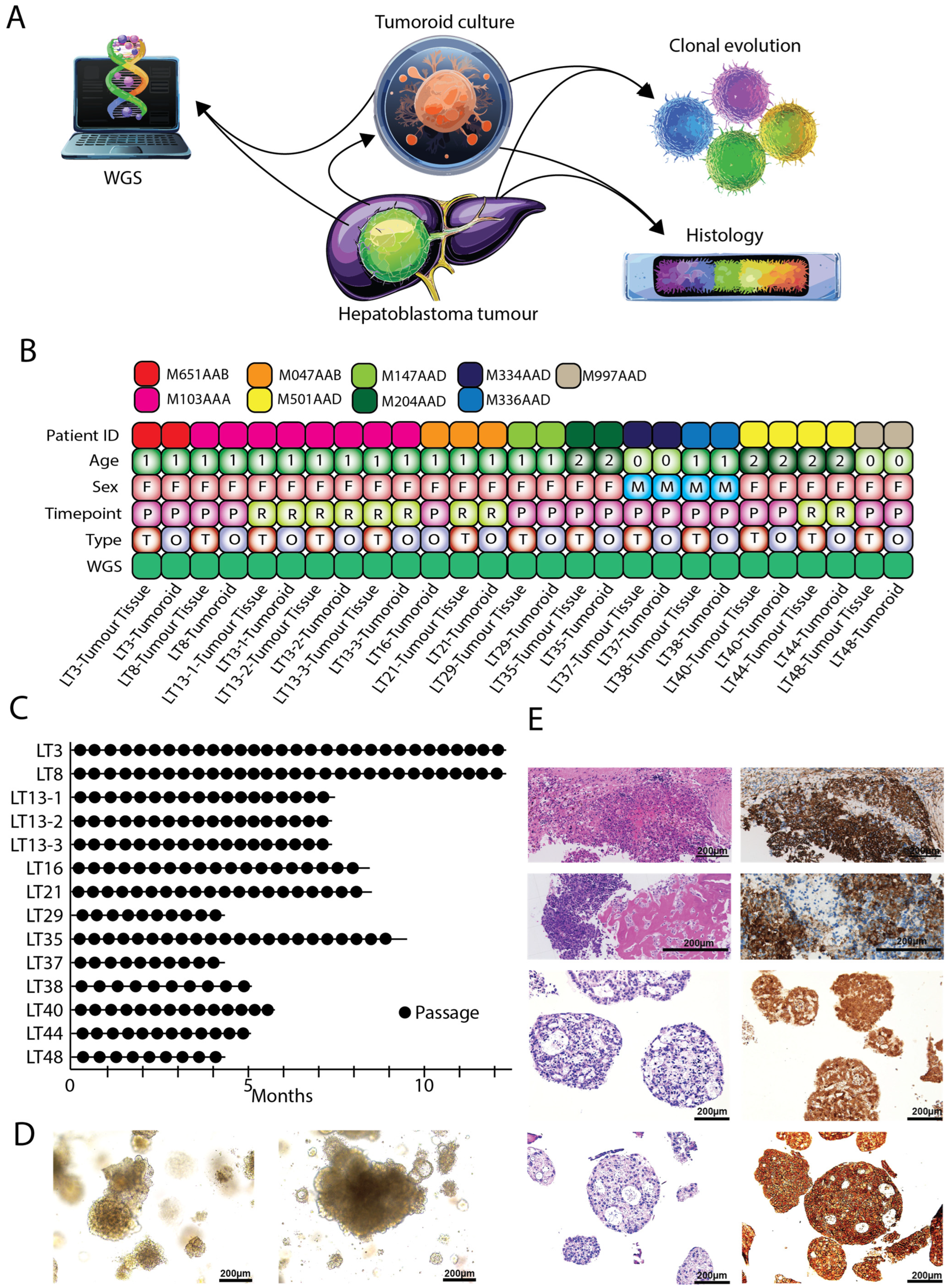
In this study, we established a living HB tumoroid biobank to study tumour evolution and genetics during disease progression. HB tumoroids were derived from FNAB or tumour resections. Tumours and matched tumoroids were characterised by WGS to confirm tumour origin and assess clonal dynamics (Figure 1A). In addition, histochemistry was performed to compare tumour and tumoroid architecture.
We established 14 HB tumoroid lines from 9 different patients (Figure 1B). Our cohort comprised 7 female and 2 male patients, ranging in age from 6 months to 2 years. Clinical metadata of all samples can be found in Supplementary Table S1. From one patient (M103AAA), 4 independent tumoroid lines were established, one from a diagnostic FNAB and three from spatially distinct lesions of the resected liver. These models provided a unique opportunity to study clonal evolution and disease progression within the same patient.
All tumoroid lines were expanded for at least 9 passages, with early lines maintained for over a year (up to 30 passages), demonstrating long-term expansion potential (Figure 1C). HB tumoroids consistently formed self-organising epithelial structures (Figure 1D). Histological comparison between tumour tissue and tumoroid cultures revealed concordance in cell morphology and β-catenin staining (Figure 1E). The hallmark heterogeneity in cell morphology and large nucleus-to-cytoplasm ratio were preserved. In tumour tissue, strong β-catenin staining was observed in a patchy pattern, a characteristic of hepatoblastoma. HB tumoroids displayed uniform β-catenin staining, indicating high tumour purity and faithful representation of the original tumour tissue. Tumoroids were also stained for β-catenin at a later passage (22) to confirm they retain tumour characteristics (Supplementary Figure S1A).
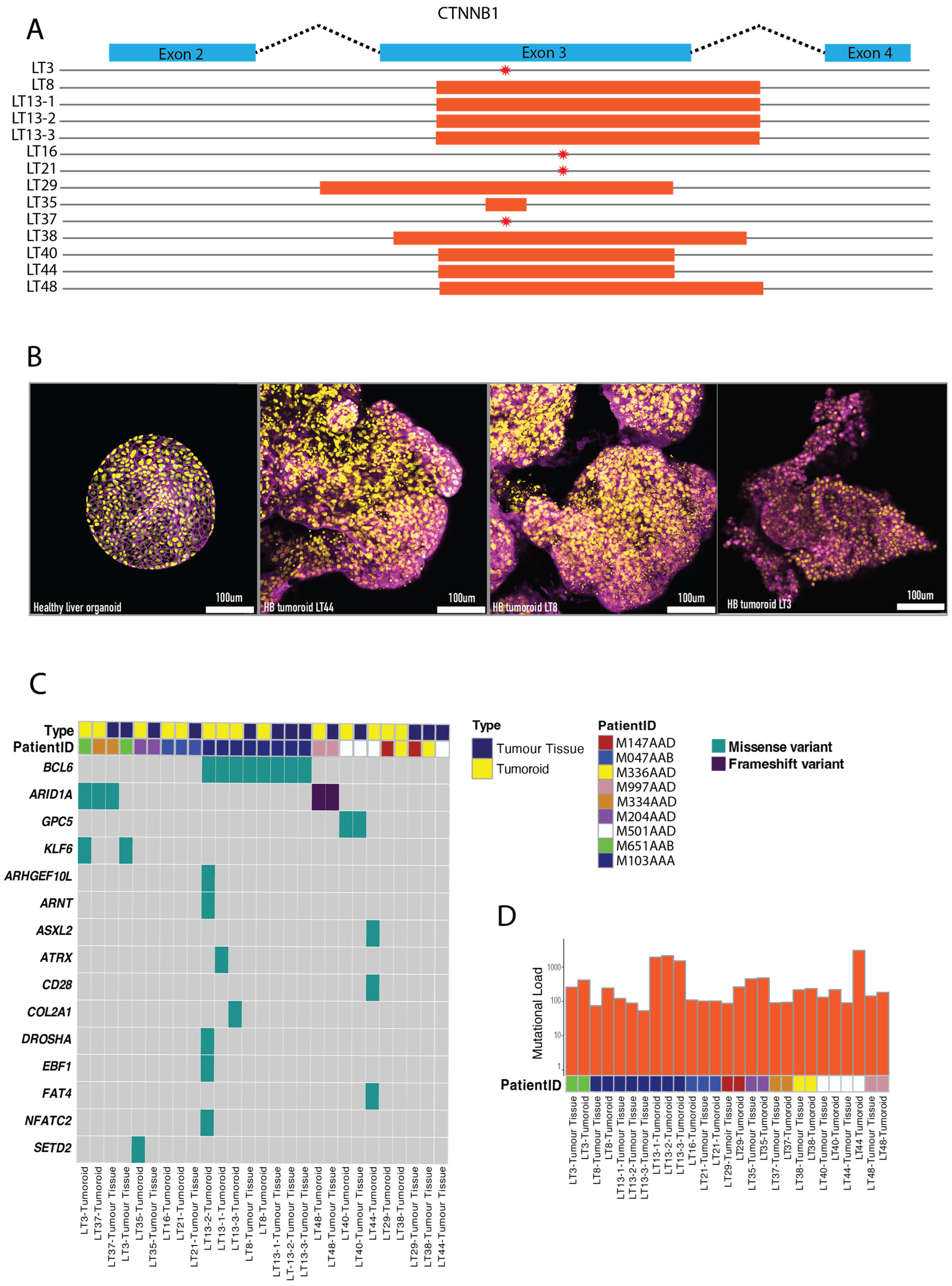
HB tumours and tumoroids were characterised by WGS. Firstly, tumour identity was confirmed by the presence of a pathogenic mutation in exon 3 of CTNNB1. These CTNNB1 mutations included single-nucleotide variants (SNV) in three patients, and deletions of (a part of) exon 3 in six patients (Figure 2A). To assess β-catenin localisation, we compared HB tumoroids with healthy liver organoids, derived from non-tumour surrounding liver tissue (Figure 2B and Figure S1B). The healthy liver organoids showed a clear membrane staining for β-catenin, while HB tumoroids displayed diffuse cytoplasmic staining with occasional nuclear signal, similar to HB tumour tissue as shown by Kluiver et al. [28] and as reported previously in other CTNNB1-mutated tumour types [33].
In addition to variants in CTNNB1, ARID1A was the only recurrently mutated oncogene in our cohort (Figure 2C). Consistent with the low mutational burden observed in paediatric tumours, most pre-treatment samples contained fewer than 100 somatic mutations. However, post-treatment samples showed an increase to approximately 1000 somatic mutations, consistent with treatment with platinum drugs (Figure 2D).
A recent study investigating 163 HB samples found recurrent mutations in only 5 genes (CTNNB1, ARID1A, APC, TERT, ITPR2), with TERT mutations mainly observed in patients who were 8–12 years old [11]. Our cohort showed recurrent mutations in ARID1A and CTNNB1. In addition to ARID1A and CTNNB1, we identified a novel variant in BCL6, a known CTNNB1 repressor and indicated in various types of cancer [34,35]. Recently, a mutation in a similar domain of BCL6 was reported in an HB case where no CTNNB1 mutation was found [36]. Notably, all four tumour samples from patient M103AAA, as well as their four matching tumoroid samples, carried the same BCL6 mutation (R550C). The BCL6 mutation has a similar VAF as the CTNNB1 mutation, suggesting an early clonal event that may have contributed to the progression of this disease. This mutation has not been previously described in HB and has a general population occurrence of less than 0.0001%. We therefore attempted to predict the structural effect of this mutation using Alphafold and Alphamissense [37]. With these algorithms, one may predict regions that are detrimental to protein function when mutated. The most vulnerable regions in BCL6 are the C and N-terminus and a small region around amino acid 370 (Supplementary Figure S2A). For the variant found in patient M103AAA, R550C, the algorithm yields a score of 0.7 (where >0.54 is indicated as likely pathogenic). We also looked at the pathogenicity of this variant using a FATHMM-score [38]. This variant scored 3.19 on a scale ranging from −16.1 to 10.6, where a score below −1.5 is considered pathogenic. Further research is needed to assess the effect and relevance of this mutation in HB. The availability of matched tumour-tumoroid models with this rare BCL6 variant offers a unique model to investigate the role of this variant in HB pathogenesis.
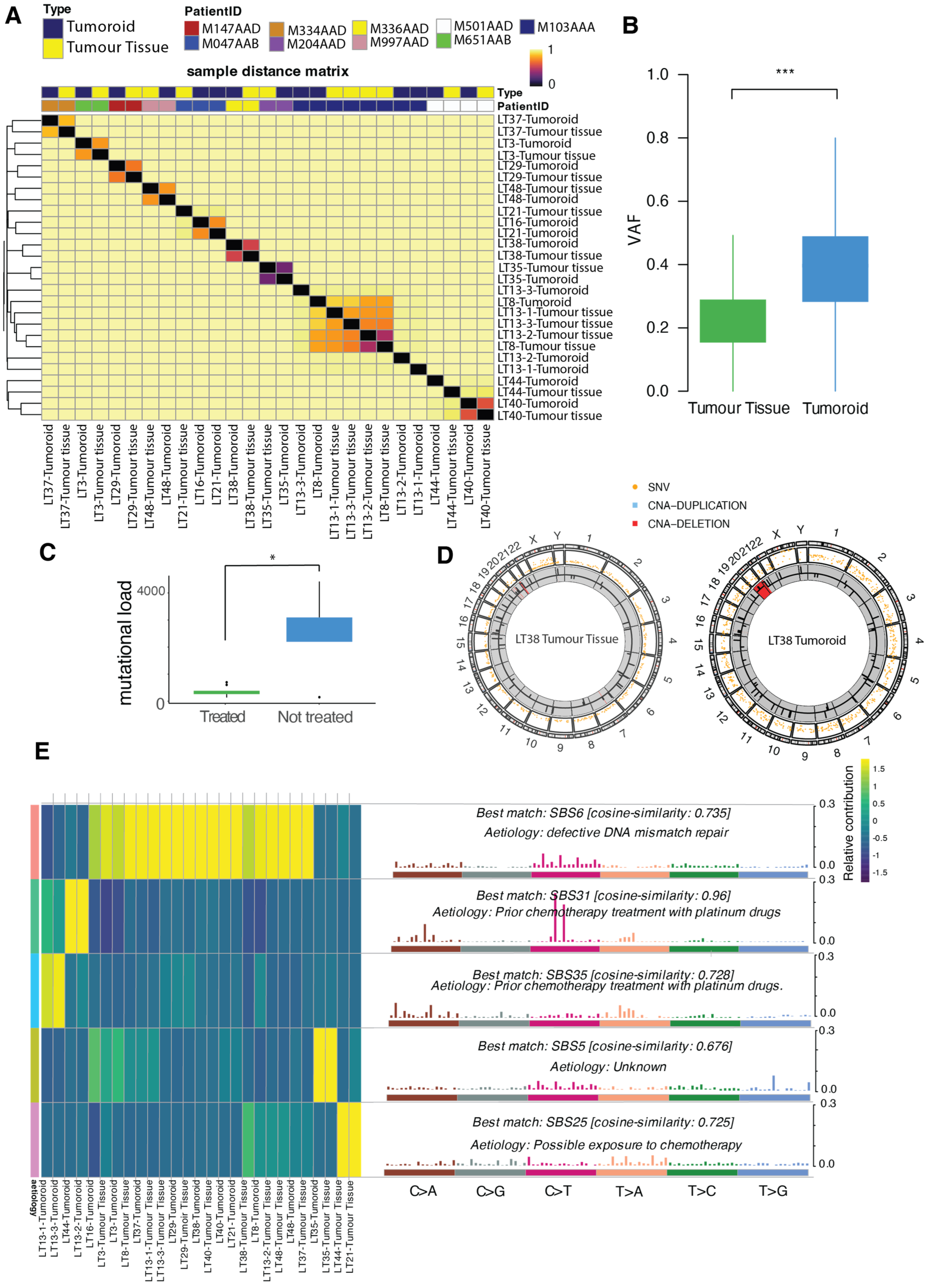
To confirm patient-specific origin and conservation of genetic heterogeneity, we compared SNVs between tumours and their corresponding tumoroid lines. We transformed the mutations in all samples into a mutation matrix based on the base that was changed. We used this matrix to calculate Jaccard’s distance between the samples. A decrease in Jaccard’s distance means the exact same base is mutated. We observed a lower Jaccard’s distance between tumour and tumoroid pairs, and hierarchical clustering of samples by Jaccard’s distance showed a distinct cluster for every patient, confirming successful derivation of patient-specific models. We observed a stronger overlap between tumours and matched tumoroids in pre-treatment compared to post-treatment samples (LT13 and LT44) (Figure 3A).
When comparing the number of somatic mutations and their VAF between tumoroids and tumours, we consistently observed that both were consistently higher in the tumoroids (Figure 3B). This likely reflects lower tumour purity in tumour samples where tumour DNA is diluted by surrounding normal and stromal tissue. For example, comparison of the LT38 tumour and matched tumoroid revealed more mutations, indicated by the increased number of dots in the outer ring of the circos plot (Figure 3D). This figure also shows the difference in VAF between a biopsy sample and a pure tumoroid culture, which ranges from 0 to 1 in radial distance. Copy number alterations (CNAs) were also more clearly detectable in tumoroids. We made an estimation of the tumour percentage in each sample based on the VAF of the CTNNB1 driver mutation. This shows higher percentages in tumoroid compared to tumour tissue samples (Supplementary Table S1). A lower percentage of tumour would result in a lower CNA and a lower resolution when looking at subclonal CNAs.
We consistently observed an increased mutational load in post-treatment tumoroids compared to pre-treatment tumoroids (Figure 3C). We do not always observe this effect in tumour tissue samples. The lower resolution attributed to a lower tumour percentage could be a cause for this discrepancy (Supplementary Table S1). To further investigate this, a mutational signature analysis was performed to identify the underlying mutational processes (Figure 3E). The majority of HBs showed an SBS6 signature, indicating an imbalance in DNA mismatch repair, associated with microsatellite instability. In our HB samples, we found no mutations in DNA mismatch repair machinery-related genes, but we did find an increase in CNAs. In post-treatment samples, we observed a higher contribution of chemotherapy-associated signatures, indicated by signatures SBS25, 31, and 35 [39]. All patients received platinum-based therapies, which accounts for the higher mutational load in the tumour, as has been previously described [40]. LT35 showed an SBS5 signature, a clocklike signature previously associated with a gain of MYC [41]. These signatures are more pronounced in tumoroid samples than in tumour samples. This is likely caused by the mutational burden and tumour percentage being higher in post-treatment tumoroid samples. Taken together, our tumoroid models recapitulate the genetic landscape of their parental tumours and provide a robust platform to study therapy-induced mutagenesis.
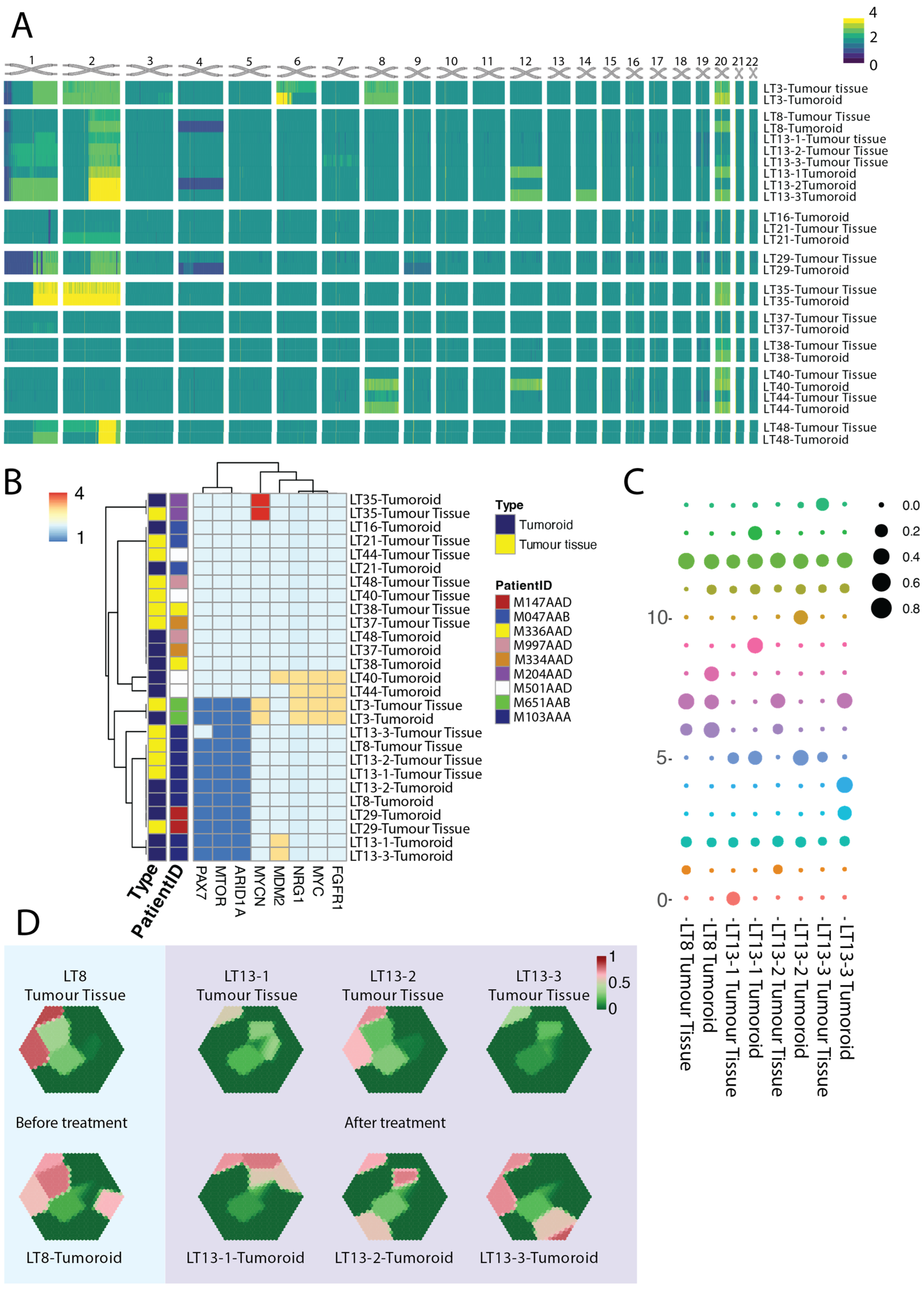
HBs frequently exhibit aneuploid genomes with recurrent chromosomal alterations, which are well-reflected in our dataset (Figure 4A). Consistent with previous studies, we observed gains in chromosomes 1q and 2q and recurrent losses in 1p and chromosome 4 (Figure 4A). A frequent gain of chromosome 20 (Figure 4A) was also observed. CNA profiles of tumour and matched tumoroids were highly similar. However, we see an increase in copy number in tumoroid samples compared to tumour tissue samples in most cases. This is another clear indication that the tumoroid consists purely of tumour, where the tumour tissue contains varying amounts of actual tumour cells. For example, in LT3, we observed an increase in the copy number of chromosomes 8 and 20 in the tumoroid when compared to the matched tumour sample. This suggested that the tumoroid line consists of a purer tumour cell population than the tumour sample. In other samples, like LT40 and 44, this difference is even more pronounced. HBs are known to carry CNAs in various genes, such as MYC, ARID1A, MDM2, and PAX7. These CNAs were mostly maintained in the matching tumoroid samples (Figure 4B). However, we see differences in tumour-tumoroid samples in some cases. For instance, looking at LT40 and 44, we see a difference in copynumber of several genes. Same hold true for the gain of MDM2 in some samples of LT13. When comparing the number of samples with a variation, be it SNV or CNA, the percentage of ARID1A-mutated samples was remarkably high (56%, 5/9 patients). This highlighted the important, yet unknown, role of this gene in the disease [42,43].
Next, we addressed clonal dynamics within these tumours (Figure 4C,D). Using Pyclone, we grouped mutations with similar VAF and allele-specific copy number into clonal clusters. We noticed that different clusters of mutations were present in our HB dataset. Cluster prevalence is indicated per sample (Figure 4C). We observed shared clusters of mutations, likely representing an early set of mutations including drivers such as CTNNB1, and clusters that are sample-specific, indicating clonal outgrowth of the tumour. Interestingly, we observed that the most abundant clone in tumour tissue samples does not necessarily give rise to the most abundant clone in tumoroid samples. For instance, we noted a great resemblance in the clonal makeup of tumour tissue samples LT8 and LT13-2, while their matched tumoroid samples did not retain the same clonal structure. This suggested that tumoroid derivation may favour the outgrowth of specific subclones, possibly caused by regional sampling differences. Figure 4D shows in greater detail the clonal makeup of each sample. It shows a heatmap where every dot in the hexagon stands for a group of mutations with similar VAF in the dataset. Dots in the upper left corner represent homozygous events that are shared amongst all tumour and tumoroid samples. Results show a prevalence of nearly 1 in all tumoroid samples, where we see a lower prevalence in some tumour samples. The higher tumour purity in tumoroid samples allows for a better detection of mutations with a lower VAF and thus the detection of more subclonal mutations, which are shown in the heatmap. For another pre- and post-treatment sample set (LT40 and LT44), we investigated the genomic distance between mutations in the treated sample versus the untreated sample (Supplementary Figure S2B). The genomic distance can be used as an indication of genomic instability. Treated samples harboured more mutations and a lower general distance, as expected (105 bases in treated samples versus 106 bases in untreated samples). Moreover, we observed an increase in hypermutated regions with a low inter-event distance. Further research is needed to determine the cause of these hypermutated regions and their impact on HB progression.

4. Discussion

In this study, we feature a fully genetically characterised HB tumoroid biobank, allowing for detailed analysis of HB tumour biology, including treatment-induced evolution and clonal dynamics across temporally and spatially distinct samples. Over the past few years, the emergence of tumoroid cultures in paediatric oncology research has greatly increased the number of model systems available for these rare tumour types. However, the use of these models is often restricted to studying cellular heterogeneity and drug response correlation studies [20,24,26,44]. Here, we focused on the genomic heterogeneity found in HB tumours using tumoroids. Recently, Roehrig et al. highlighted the clonal diversity in HB tumours in patient samples by using a multi-omics approach combining single-cell RNA sequencing with WGS [13]. The availability of tumoroid models, which retain clonal diversity as presented here, could lead to a better understanding of the disease.
In this study, we found CTNNB1 mutations in all HB samples. We did not observe any mutations in NFE2L2, while this is also a known driver with an incidence of around 10% in HB patients [45]. The same applied to TERT promoter region mutations. We did, however, observe a novel BCL6 mutation in one of our patients. BCL6 is a known cancer driver and contributor in many paediatric cancers [34]. While we explored the consequences of this mutation using in silico predictions, functional studies are required to validate the effect of this mutation.
We observe a bigger overlap between tumour and tumoroid pairs before treatment when compared to after treatment. This may have several explanations. First, pre-treatment samples were obtained from FNABs, in which the tissue sample is very small, and the regions used for sequencing and organoid derivation are closer together, whereas resection samples are larger and more heterogeneous. Second, a greater variance between different samples obtained from the same patient may reflect clonal evolution of the tumour, with distinct subclones giving rise to genetically divergent tumoroids. Third, the amount of tumour in treated samples is lower, and therefore the resolution at which we can identify mutations in the tumour samples is also lower.
We observed differences in mutations between tumoroid and tumour samples. While Jaccard’s distance showed a close correlation between tumour samples and tumoroids, some clonal differences could be observed. This could be caused by spatial differences in sampling of the tumour. It is also possible that we select for a specific clone using our culture regime. Another option is that there is ongoing clonal selection in vitro. Because we find differences in pre-and post-treated samples, as well as in samples with a spatial distance, we conclude that clonal variation is already present in the tumour. This has also been described previously in HB [13].

5. Conclusions

In conclusion, we established a fully genetically characterised biobank of 14 tumoroid lines from 9 different patients showing a high degree of similarities between tumour and tumoroid pairs. VAF was consistently higher in tumoroids, indicating increased tumour purity in vitro. In addition to CTNNB1, we frequently observed ARID1A and MYC gains as described previously. In paired pre- and post-treatment samples, we observed a clear increase in mutational load, attributed to a chemotherapy signature. Taken together, this biobank allows detailed analysis of HB tumour biology, including treatment-induced evolution and clonal dynamics across temporally and spatially distinct samples.

Supplementary Materials

The following supporting information can be downloaded at: https://www.mdpi.com/article/10.3390/organoids5010004/s1, Figure S1: (A). CTNNB1 stain on early (P11) and late (P22) passage tumoroid line (LT8) (B). Single-channel fluorescence microscopy image of β-catenin (magenta) and DAPI (yellow) staining of healthy liver organoids and hepatoblastoma tumoroids; Figure S2: (A). Alphafold missense and FATHMM score of a variant in BCL6. (B). scatterplot showing inter event distance before and after treatment in tumoroids; Table S1: Sample metadata.

Author Contributions

Conceptualization, G.J.F.v.S., F.C.A.S.R., K.S., M.v.d.W., W.C.P. and H.C.; methodology, G.J.F.v.S., F.C.A.S.R., J.Z., R.H.d.K., V.E.d.M., T.A.K. and Q.H.; software, G.J.F.v.S., M.J.v.R. and R.v.B.; formal analysis, G.J.F.v.S., E.D., M.C.v.d.H. and R.R.d.K.; investigation, G.J.F.v.S. and F.C.A.S.R.; resources, F.C.A.S.R., T.A.K., E.D., M.C.v.d.H., V.E.d.M., R.H.d.K., R.R.d.K., J.Z. and W.C.P.; data curation, G.J.F.v.S.; writing—original draft preparation, G.J.F.v.S. and F.C.A.S.R.; writing—review and editing, M.v.d.W., K.S. and H.C.; visualization, G.J.F.v.S.; supervision, K.S., M.v.d.W. and H.C.; project administration, K.S.; funding acquisition, M.v.d.W., K.S. and H.C. All authors have read and agreed to the published version of the manuscript.

Funding

Research reported in this publication was supported by the Children Cancer Free Foundation (KiKa), by Oncode Institute and by Oncode Accelerator, a Dutch National Growth Fund Project under grant number NGFOP2201.

Institutional Review Board Statement

The study was conducted in accordance with the Declaration of Helsinki, and approved by the Ethics Committee NedMec of the Erasmus medical center in Rotterdam (protocol code MEC-2016-739, 25 November 2016).

Informed Consent Statement

Written informed consent was obtained from parents or legal guardians of all patients.

Data Availability Statement

The genomic data are deposited in the EGA study database under accession number EGAS00001008251. WGS data is available under accession number EGAD00001015671. The dataset mentioned above is available under restricted access due to patient privacy and regulatory requirements. Access to the sequencing data is managed by the Biobank and Data Access Committee (BDAC) of the Princess Máxima Center. Request can be made via the EGA portal. All code used to generate figures can be accessed on https://github.com/PMC-Clevers/Hepatoblastoma_tumoroid_biobank (accessed on 5 January 2026).

Acknowledgments

We thank all children and their families for participating in our research, as well as the clinical teams involved in approaching patients for consent and collecting tissue. During the preparation of this manuscript/study, the authors used Adobe Firefly (https://www.adobe.com (accessed on 5 January 2026)) for the purposes of creating a descriptive image of the study in Figure 1A. The authors have reviewed and edited the output and take full responsibility for the content of this publication.

Conflicts of Interest

H.C. is an inventor on patents held by the Royal Netherlands Academy of Arts and Sciences that cover organoid technology. He is now head of pharma Research and Early Development (pRED) at Roche, Basel, Switzerland. H.C.’s full disclosure is given at https://uu.nl/staff/JCClevers/ (accessed 5 January 2026). All other authors declare that they have no competing interests.

Abbreviations

The following abbreviations are used in this manuscript:
HBHepatoblastoma
WGSWhole genome sequencing
CNACopy number alteration
VAFVariant allele frequency
SNVSingle-nucleotide variant
FNABFine needle aspiration biopsies
PFAParaformaldehyde
RTRoom temperature
GATKGenome Analysis Toolkit

References

  1. Pihlajoki, M.; Eloranta, K.; Nousiainen, R.; Väyrynen, V.; Soini, T.; Kyrönlahti, A.; Parkkila, S.; Kanerva, J.; Wilson, D.B.; Pakarinen, M.P.; et al. Biology of childhood hepatoblastoma and the search for novel treatments. Adv. Biol. Regul. 2024, 91, 100997. [Google Scholar] [CrossRef]
  2. Czauderna, P.; Lopez-Terrada, D.; Hiyama, E.; Häberle, B.; Malogolowkin, M.H.; Meyers, R.L. Hepatoblastoma state of the art: Pathology, genetics, risk stratification, and chemotherapy. Curr. Opin. Pediatr. 2014, 26, 19–28. [Google Scholar] [CrossRef] [PubMed]
  3. Pateva, I.B.; Egler, R.A.; Stearns, D.S. Hepatoblastoma in an 11-year-old: Case report and a review of the literature. Medicine 2017, 96, e5858. [Google Scholar] [CrossRef] [PubMed]
  4. Wu, P.V.; Rangaswami, A. Current Approaches in Hepatoblastoma—New Biological Insights to Inform Therapy. Curr. Oncol. Rep. 2022, 24, 1209–1218. [Google Scholar] [CrossRef] [PubMed]
  5. Zhu, L.R.; Zheng, W.; Gao, Q.; Chen, T.; Pan, Z.B.; Cui, W.; Cai, M.; Fang, H. Epigenetics and genetics of hepatoblastoma: Linkage and treatment. Front. Genet. 2022, 13, 1070971. [Google Scholar] [CrossRef]
  6. Watanabe, K. Current chemotherapeutic approaches for hepatoblastoma. Int. J. Clin. Oncol. 2013, 18, 955–961. [Google Scholar] [CrossRef]
  7. Haeberle, B.; von Schweinitz, D. Treatment of hepatoblastoma in the German cooperative pediatric liver tumor studies. Front. Biosci. Elite 2012, 4, 493–498. [Google Scholar] [CrossRef]
  8. Zsiros, J.; Brugieres, L.; Brock, P.; Roebuck, D.; Maibach, R.; Zimmermann, A.; Childs, M.; Pariente, D.; Laithier, V.; Otte, J.-B.; et al. Dose-dense cisplatin-based chemotherapy and surgery for children with high-risk hepatoblastoma (SIOPEL-4): A prospective, single-arm, feasibility study. Lancet Oncol. 2013, 14, 834–842. [Google Scholar] [CrossRef]
  9. Cairo, S.; Armengol, C.; De Reyniès, A.; Wei, Y.; Thomas, E.; Renard, C.-A.; Goga, A.; Balakrishnan, A.; Semeraro, M.; Gresh, L.; et al. Hepatic Stem-like Phenotype and Interplay of Wnt/β-Catenin and Myc Signaling in Aggressive Childhood Liver Cancer. Cancer Cell 2008, 14, 471–484. [Google Scholar] [CrossRef]
  10. Cairo, S.; Armengol, C.; Maibach, R.; Häberle, B.; Becker, K.; Carrillo-Reixach, J.; Guettier, C.; Vokuhl, C.; Schmid, I.; Buendia, M.-A.; et al. A combined clinical and biological risk classification improves prediction of outcome in hepatoblastoma patients. Eur. J. Cancer 2020, 141, 30–39. [Google Scholar] [CrossRef]
  11. Nagae, G.; Yamamoto, S.; Fujita, M.; Fujita, T.; Nonaka, A.; Umeda, T.; Fukuda, S.; Tatsuno, K.; Maejima, K.; Hayashi, A.; et al. Genetic and epigenetic basis of hepatoblastoma diversity. Nat. Commun. 2021, 12, 5423. [Google Scholar] [CrossRef]
  12. Jeong, S.U.; Kang, H.J. Recent updates on the classification of hepatoblastoma according to the International Pediatric Liver Tumors Consensus. J. Liver Cancer 2022, 22, 23–29. [Google Scholar] [CrossRef] [PubMed]
  13. Roehrig, A.; Hirsch, T.Z.; Pire, A.; Morcrette, G.; Gupta, B.; Marcaillou, C.; Imbeaud, S.; Chardot, C.; Gonzales, E.; Jacquemin, E.; et al. Single-cell multiomics reveals the interplay of clonal evolution and cellular plasticity in hepatoblastoma. Nat. Commun. 2024, 15, 3031. [Google Scholar] [CrossRef] [PubMed]
  14. Wu, P.V.; Fish, M.; Hazard, F.K.; Zhu, C.; Vennam, S.; Walton, H.; Wagh, D.; Coller, J.; Przybyl, J.; Morri, M.; et al. A developmental biliary lineage program cooperates with Wnt activation to promote cell proliferation in hepatoblastoma. Nat. Commun. 2024, 15, 10007. [Google Scholar] [CrossRef] [PubMed]
  15. Di Masi, A.; Viganotti, M.; Antoccia, A.; Magrelli, A.; Salvatore, M.; Azzalin, G.; Tosto, F.; Lorenzetti, S.; Maranghi, F.; Mantovani, A.; et al. Characterization of HuH6, Hep3B, HepG2 and HLE liver cancer cell lines by WNT/β—Catenin pathway, microRNA expression and protein expression profile. Cell. Mol. Biol. 2010, 56, 1299–1317. [Google Scholar]
  16. Irie, T.; Yoshii, D.; Komohara, Y.; Fujiwara, Y.; Kadohisa, M.; Honda, M.; Suzu, S.; Matsuura, T.; Kohashi, K.; Oda, Y.; et al. IL-34 in hepatoblastoma cells potentially promote tumor progression via autocrine and paracrine mechanisms. Cancer Med. 2022, 11, 1441–1453. [Google Scholar] [CrossRef]
  17. Lee-Theilen, M.; Fadini, D.D.; Hadhoud, J.R.; van Dongen, F.; Kroll, G.; Rolle, U.; Fiegel, H.C. Hepatoblastoma Cancer Stem Cells Express PD-L1, Reveal Plasticity and Can Emerge upon Chemotherapy. Cancers 2022, 14, 5825. [Google Scholar] [CrossRef]
  18. Loesch, R.; Caruso, S.; Paradis, V.; Godard, C.; Gougelet, A.; Renault, G.; Picard, S.; Tanaka, I.; Renoux-Martin, Y.; Perret, C.; et al. Deleting the β-catenin degradation domain in mouse hepatocytes drives hepatocellular carcinoma or hepatoblastoma-like tumor growth. J. Hepatol. 2022, 77, 424–435. [Google Scholar] [CrossRef]
  19. Whitlock, R.S.; Yang, T.; Vasudevan, S.A.; Woodfield, S.E. Animal Modeling of Pediatric Liver Cancer. Cancers 2020, 12, 273. [Google Scholar] [CrossRef]
  20. Saltsman, J.A.; Hammond, W.J.; Narayan, N.J.C.; Requena, D.; Gehart, H.; Lalazar, G.; LaQuaglia, M.P.; Clevers, H.; Simon, S. A Human Organoid Model of Aggressive Hepatoblastoma for Disease Modeling and Drug Testing. Cancers 2020, 12, 2668. [Google Scholar] [CrossRef]
  21. Ringnalda, F.C.A.S.; van Son, G.J.F.; Verweij, L.H.G.; Kim, S.-Y.; Amo-Addae, V.; Flucke, U.E.; Hiemcke–Jiwa, L.S.; Langenberg, K.P.S.; Bramer, J.A.M.; Heimans, L.; et al. Small round cell sarcoma tumoroid biobank reveals CIC::DUX4 sarcoma vulnerability to MCL-1 inhibition. Nat. Commun. 2025, 16, 7689. [Google Scholar] [CrossRef] [PubMed]
  22. Espinoza, A.F.; Patel, R.H.; Patel, K.R.; Badachhape, A.A.; Whitlock, R.; Srivastava, R.K.; Govindu, S.R.; Duong, A.; Kona, A.; Kureti, P.; et al. A novel treatment strategy utilizing panobinostat for high-risk and treatment-refractory hepatoblastoma. J. Hepatol. 2024, 80, 610–621. [Google Scholar] [CrossRef] [PubMed]
  23. Bissig-Choisat, B.; Kettlun-Leyton, C.; Legras, X.D.; Zorman, B.; Barzi, M.; Chen, L.L.; Amin, M.D.; Huang, Y.H.; Pautler, R.G.; Hampton, O.A.; et al. Novel patient-derived xenograft and cell line models for therapeutic testing of pediatric liver cancer. J. Hepatol. 2016, 65, 325–333. [Google Scholar] [CrossRef] [PubMed]
  24. Kim, S.-Y.; de Weert, T.A.E.; Vermeulen, M.; Ringnalda, F.; Kester, L.; Zsiros, J.; Eising, S.; Molenaar, J.J.; Sanders, K.; van de Wetering, M.; et al. Organoid drug profiling identifies methotrexate as a therapy for SCCOHT, a rare pediatric cancer. Sci. Adv. 2025, 11, eadq1724. [Google Scholar] [CrossRef]
  25. Meister, M.T.; Groot Koerkamp, M.J.A.; de Souza, T.; Breunis, W.B.; Frazer-Mendelewska, E.; Brok, M.; DeMartino, J.; Manders, F.; Calandrini, C.; Kerstens, H.H.D.; et al. Mesenchymal tumor organoid models recapitulate rhabdomyosarcoma subtypes. EMBO Mol. Med. 2022, 14, e16001. [Google Scholar] [CrossRef]
  26. Calandrini, C.; Schutgens, F.; Oka, R.; Margaritis, T.; Candelli, T.; Mathijsen, L.; Ammerlaan, C.; van Ineveld, R.L.; Derakhshan, S.; de Haan, S.; et al. An organoid biobank for childhood kidney cancers that captures disease and tissue heterogeneity. Nat. Commun. 2020, 11, 1310. [Google Scholar] [CrossRef]
  27. Paassen, I.; Williams, J.; Arceo, C.R.; Ringnalda, F.; Mercer, K.S.; Buhl, J.L.; Moreno, N.; Federico, A.; Franke, N.E.; Kranendonk, M.; et al. Atypical teratoid/rhabdoid tumoroids reveal subgroup-specific drug vulnerabilities. Oncogene 2023, 42, 1661–1671. [Google Scholar] [CrossRef]
  28. Kluiver, T.A.; Lu, Y.; Schubert, S.A.; Kraaier, L.J.; Ringnalda, F.; Lijnzaad, P.; DeMartino, J.; Megchelenbrink, W.L.; Amo-Addae, V.; Eising, S.; et al. Divergent WNT signaling and drug sensitivity profiles within hepatoblastoma tumors and organoids. Nat. Commun. 2024, 15, 8576. [Google Scholar] [CrossRef]
  29. Yoshida, G. Applications of patient-derived tumor xenograft models and tumor organoids. J. Hematol. Oncol. 2020, 13, 4. [Google Scholar] [CrossRef]
  30. Manders, F.; Brandsma, A.M.; de Kanter, J.; Verheul, M.; Oka, R.; van Roosmalen, M.J.; van der Roest, B.; van Hoeck, A.; Cuppen, E.; van Boxtel, R. MutationalPatterns: The one stop shop for the analysis of mutational processes. BMC Genom. 2022, 23, 134. [Google Scholar] [CrossRef]
  31. Shen, R.; Seshan, V.E. FACETS: Allele-specific copy number and clonal heterogeneity analysis tool for high-throughput DNA sequencing. Nucleic Acids Res. 2016, 44, e131. [Google Scholar] [CrossRef] [PubMed]
  32. Gillis, S.; Roth, A. PyClone-VI: Scalable inference of clonal population structures using whole genome data. BMC Bioinform. 2020, 21, 571. [Google Scholar] [CrossRef] [PubMed]
  33. Kim, G.; Kurnit, K.C.; Djordjevic, B.; Singh, C.; Munsell, M.F.; Wang, W.L.; Lazar, A.J.; Zhang, W.; Broaddus, R. Nuclear β-catenin localization and mutation of the CTNNB1 gene: A context-dependent association. Mod. Pathol. 2018, 31, 1553–1559. [Google Scholar] [CrossRef] [PubMed]
  34. McLachlan, T.; Matthews, W.C.; Jackson, E.R.; Staudt, D.E.; Douglas, A.M.; Findlay, I.J.; Persson, M.L.; Duchatel, R.J.; Mannan, A.; Germon, Z.P.; et al. B-cell Lymphoma 6 (BCL6): From Master Regulator of Humoral Immunity to Oncogenic Driver in Pediatric Cancers. Mol. Cancer Res. 2022, 20, 1711–1723. [Google Scholar] [CrossRef]
  35. Guo, S.; Deng, J.; Wang, P.; Kou, F.; Wu, Z.; Zhang, N.; Zhao, Z.; Nie, Y.; Yang, L. The malignancy suppression and ferroptosis facilitation of BCL6 in gastric cancer mediated by FZD7 repression are strengthened by RNF180/RhoC pathway. Cell Biosci. 2023, 13, 73. [Google Scholar] [CrossRef]
  36. Hu, H.; Zhang, W.; Zhi, T.; Li, J.; Wen, Y.; Li, F.; Mei, Y.; Huang, D. Genotypic Characteristics of Hepatoblastoma as Detected by Next Generation Sequencing and Their Correlation with Clinical Efficacy. Front. Oncol. 2021, 11, 628531. [Google Scholar] [CrossRef]
  37. Cheng, J.; Novati, G.; Pan, J.; Bycroft, C.; Žemgulytė, A.; Applebaum, T.; Pritzel, A.; Wong, L.H.; Zielinski, M.; Sargeant, T.; et al. Accurate proteome-wide missense variant effect prediction with AlphaMissense. Science 2023, 381, eadg7492. [Google Scholar] [CrossRef]
  38. Shihab, H.A.; Gough, J.; Mort, M.; Cooper, D.N.; Day, I.N.; Gaunt, T.R. Ranking non-synonymous single nucleotide polymorphisms based on disease concepts. Hum. Genom. 2014, 8, 11. [Google Scholar] [CrossRef]
  39. Pich, O.; Muiños, F.; Lolkema, M.P.; Steeghs, N.; Gonzalez-Perez, A.; Lopez-Bigas, N. The mutational footprints of cancer therapies. Nat. Genet. 2019, 51, 1732–1740. [Google Scholar] [CrossRef]
  40. Hirsch, T.Z.; Pilet, J.; Morcrette, G.; Roehrig, A.; Monteiro, B.J.E.; Molina, L.; Bayard, Q.; Trépo, E.; Meunier, L.; Caruso, S.; et al. Integrated Genomic Analysis Identifies Driver Genes and Cisplatin-Resistant Progenitor Phenotype in Pediatric Liver Cancer. Cancer Discov. 2021, 11, 2524–2543. [Google Scholar] [CrossRef]
  41. Jakobsdottir, G.M.; Dentro, S.C.; Bristow, R.G.; Wedge, D.C. AmplificationTimeR: An R package for timing sequential amplification events. Bioinformatics 2024, 40, btae281. [Google Scholar] [CrossRef]
  42. Wang, L.; Deng, C.-H.; Luo, Q.; Su, X.-B.; Shang, X.-Y.; Song, S.-J.; Cheng, S.; Qu, Y.-L.; Zou, X.; Shi, Y.; et al. Inhibition of Arid1a increases stem/progenitor cell-like properties of liver cancer. Cancer Lett. 2022, 546, 215869. [Google Scholar] [CrossRef]
  43. Sun, X.; Wang, S.C.; Wei, Y.; Luo, X.; Jia, Y.; Li, L.; Gopal, P.; Zhu, M.; Nassour, I.; Chuang, J.-C.; et al. Arid1a Has Context-Dependent Oncogenic and Tumor Suppressor Functions in Liver Cancer. Cancer Cell 2017, 32, 574–589.e576. [Google Scholar] [CrossRef]
  44. Kluiver, T.A.; Lu, Y.; Schubert, S.A.; Kraaier, L.J.; Ringnalda, F.; Lijnzaad, P.; DeMartino, J.; Megchelenbrink, W.L.; Amo-Addae, V.; Eising, S.; et al. Multi-dimensional profiling of hepatoblastomas and patient-derived tumor organoids uncovers tumor subpopulations with divergent WNT activation profiles and identifies pan-hepatoblastoma drug sensitivities. bioRxiv 2023. [Google Scholar] [CrossRef]
  45. Eichenmüller, M.; Trippel, F.; Kreuder, M.; Beck, A.; Schwarzmayr, T.; Häberle, B.; Cairo, S.; Leuschner, I.; von Schweinitz, D.; Strom, T.M.; et al. The genomic landscape of hepatoblastoma and their progenies with HCC-like features. J. Hepatol. 2014, 61, 1312–1320. [Google Scholar] [CrossRef]
Figure 1. (A) schematic overview of biobanking process. (B). Sample overview with patient identifier and metadata (age, sex, and time of procurement). P indicates primary sample usually at time of diagnosis, R indicates samples from resection or recurrence. Tumour samples are marked T, and tumoroid samples are marked O. Sex is shown by M(ale) or F(emale), and age in years. WGS data is shown in green. (C). Graph showing the time in culture and number of passages for each tumoroid line. (D). Representative brightfield images of hepatoblastoma tumoroid cultures. (E). H&E stain (left) and β-catenin stain (right) of tumour tissue (top panels) and tumoroid lines (bottom panels).
Organoids 05 00004 g001
Figure 2. (A). An overview of variants found in CTNNB1 per sample. An asterisk * indicates a single-nucleotide variant (SNV) and a red bar indicates a deletion of exon 3. (B). Fluorescence microscopy image of β-catenin (magenta) and DAPI (yellow) staining of healthy liver organoids and hepatoblastoma tumoroids. (C). Mutation plot, showing all coding SNVs in oncogenes. Color-coding distinguishes tumour and tumoroid samples and links samples from the same patient. Samples were ordered by mutations in similar genes. (D). Somatic mutational load per sample derived from WGS data.
Organoids 05 00004 g002
Figure 3. (A). Sample distance matrix using Jaccard’s distance using a binary matrix for the presence of a mutation. Samples were clustered using hierarchical clustering. (B). Variant allele frequencies (VAF) for tumour tissue and tumoroid samples with a p-value calculated using a students’ t-test (p < 0.001 (***)). (C). Mutational load of pre- and post-treatment samples with a p-value calculated using Student’s t-test (p < 0.05 (*)). (D). Circos plot showing a matched tumour tissue and tumoroid sample (LT38). The outer ring shows SNVs against a radial VAF-scale (0–1). The inner ring shows chromosomal copy numbers (red for a gain [>2] and blue for a loss [<2]). (E). A heatmap showing the relative contribution of different mutational signatures identified in this dataset using Maftools. Samples were ordered using hierarchical clustering.
Organoids 05 00004 g003
Figure 4. (A). Copy numbers per chromosomal region of 10KB with gains shown in yellow and losses in blue. (B). Gene copy numbers of oncogenes known to be frequently altered in HB. Color-coding distinguishes tumour tissue and tumoroids and links samples from the same patient. Samples were ordered using hierarchical clustering. (C). Dotplot of cellular prevalence per cluster of mutations per sample. (D). Heatmap of mutation clusters, with each spot representing a cluster. Colour intensity indicates cellular prevalence.
Organoids 05 00004 g004
Disclaimer/Publisher’s Note: The statements, opinions and data contained in all publications are solely those of the individual author(s) and contributor(s) and not of MDPI and/or the editor(s). MDPI and/or the editor(s) disclaim responsibility for any injury to people or property resulting from any ideas, methods, instructions or products referred to in the content.