Article

Evaluating a Growth Model to Predict Amino Acid Requirements for Commercial Turkey Toms with and Without Feed Additives †

1
Prestage Department of Poultry Science, North Carolina State University, Raleigh, NC 27695, USA
2
College of Agriculture and Life Sciences (CALS), North Carolina State University, Raleigh, NC 27695, USA
3
Department of Animal Science, Iowa State University, Ames, IA 50011, USA
*
Author to whom correspondence should be addressed.
The research in this manuscript is part of Brendan O. Heinichen’s dissertation.
Poultry 2026, 5(3), 34; https://doi.org/10.3390/poultry5030034
Submission received: 10 February 2026 / Revised: 2 April 2026 / Accepted: 16 April 2026 / Published: 28 April 2026

Abstract

Estimating dietary requirements is resource-intensive and often excludes common commercial practices, such as the use of feed additives (FA). The objective of this study was to evaluate whether a factorial–mechanistic growth model-derived feeding program would improve performance and economic efficiency compared to the 1994 NRC recommendations for commercial turkey toms. This applied study used 5248 Nicholas Select toms (day 0 to 140) in a 2 × 2 factorial design comparing two nutrition programs (growth MODEL versus 1994 NRC recommendations) with or without feed additives (FA). Hatch-mate toms were placed across two research farms, with eight replicate pens per treatment at each farm. Growth and efficiency measurements were collected throughout the trial, and carcass yield was measured at 140 days. Data were analyzed using mixed linear models with nutritional model, FA, phase, location, and all interactions as fixed effects. The main effect of the nutritional model was different for body weight, feed intake, feed conversion ratio, and lysine to gain (p < 0.030), with the MODEL program demonstrating favorable outcomes except for body weight through the first 42 days, which was the only variable impacted by FA (p = 0.014). Nutritional program by FA interactions affected breast meat yield, feed conversion ratio, and lysine conversion, with FA improving outcomes for toms fed the MODEL feeding program but not the NRC feeding program. These findings support the use of factorial growth models over traditional NRC feeding programs.

1. Introduction

Growth performance remains the primary determinant of nutrient requirements, and as genetic selection continues to increase growth rate and feed efficiency, nutrient specifications must be updated to match the biological demands of modern strains. Modern turkey production has seen substantial genetic improvements that have increased performance and efficiency, yet lacked changes to nutritional recommendations. Modern commercial turkey strains have been reported to reach market weights nearly twice as fast as their predecessors from the 1960s, while consuming less feed per unit of gain [1]. Current nutritional recommendations for the industry are based on the National Research Council’s (NRC) Nutrient Requirements of Poultry [2], and likely do not reflect the actual requirements of contemporary commercial turkey strains, as the data were published in the 1990s. Updates to these guidelines are currently underway; however, these updates are very limited due to a lack of research [3]. This limitation requires a novel approach, as traditional methods are too labor-intensive, expensive, and cannot keep pace with the changing growth characteristics for modern commercial turkey strains.
While the NRC (1994) recommendations provide a reputable base for diet formulation, this guide lacks data on the complexity of commercial production diets [4]. In commercial settings, environments are not highly controlled, and diets often include a combination of feed additives that alter nutrient requirements and nutrient availability [5,6,7]. Additionally, the impacts of feed additives are often tested against a control diet devoid of all other feed additives, thereby limiting their translation into commercial use. Consequently, when establishing nutritional recommendations, it is imperative to account for common combinations of feed additives on performance.
Given recent advancements in computational power and data analysis techniques, and the availability of larger data sets, factorial–mechanistic modeling presents a powerful tool for simulating nutrient requirements under dynamic production conditions. Several nonlinear growth functions have been applied to poultry growth modeling, each differing in mathematical flexibility and biological interpretation. The Gompertz equation [8] assumes a fixed inflection point at approximately 37% of mature weight, making it widely used but potentially restrictive for species with asymmetric growth patterns. The Richards equation [9] introduces an additional shape parameter that allows the inflection point to vary, providing greater flexibility to fit species- or strain-specific growth trajectories. The Lopez generalized Michaelis–Menten equation [10] offers a sigmoidal alternative with different asymptotic behavior. The selection among these functions is typically based on goodness-of-fit criteria applied to observed growth data. Consequently, nutritional modeling could be used to quickly adapt to genetic changes. With these advances, nutrient requirement models could enable the inclusion of genetic background, environmental factors, feed additives, and management practices (e.g., phase feeding) [11,12]. These models not only fill knowledge gaps by accounting for these factors, but also provide more accurate predictions for future growth and allow rapid iteration without the complexity of live animal trials.
This study was designed to determine if a factorial–mechanistic model could be developed and if it would perform as well or better than the NRC (1994) recommended feeding program. This applied investigation was set under commercial production conditions and was not developed to establish recommendations for nutrients. Briefly, in this study, a growth model-derived feeding program (hereafter referred to as the MODEL) was developed using a spreadsheet-based growth and nutrient requirement framework that links user-defined growth trajectories with factorial calculations of ME and digestible lysine requirements. Predicted body weight and body weight gain outputs from a selected growth function were used to estimate daily energy and lysine requirements, which were then translated into phase-feeding nutrient specifications. These calculated requirement profiles were used to formulate the MODEL diets for comparison with NRC-based feeding programs with and without the complexity of feed additives included in the diet. We hypothesized that this MODEL would result in more efficient growth performance characteristics of commercial turkeys under commercial industry conditions than a feeding program based on the NRC (1994) [2] recommendations. To test this hypothesis, the same hatch-mate toms were used in a 2 × 2 factorial treatment design consisting of two feeding programs (MODEL and NRC) and two additive inclusion levels (with and without) conducted across two research facilities.

2. Materials and Methods

2.1. Ethical Considerations

All animal handling and management procedures were carried out in accordance with approved protocols by the Institutional Animal Care and Use Committee (IACUC #24-105, approved 11 July 2024).

2.2. MODEL Design

MODEL overview: An Excel spreadsheet-based model (MODEL) was developed to estimate daily amino acid requirements for heavy tom turkeys using growth curve fitting with factorial–mechanistic nutrient partitioning. This MODEL included determining the best growth curve for body weight prediction, followed by estimating amino acid utilization based on body weight at a given age, and finally predicting energy requirements based on expected feed intake.
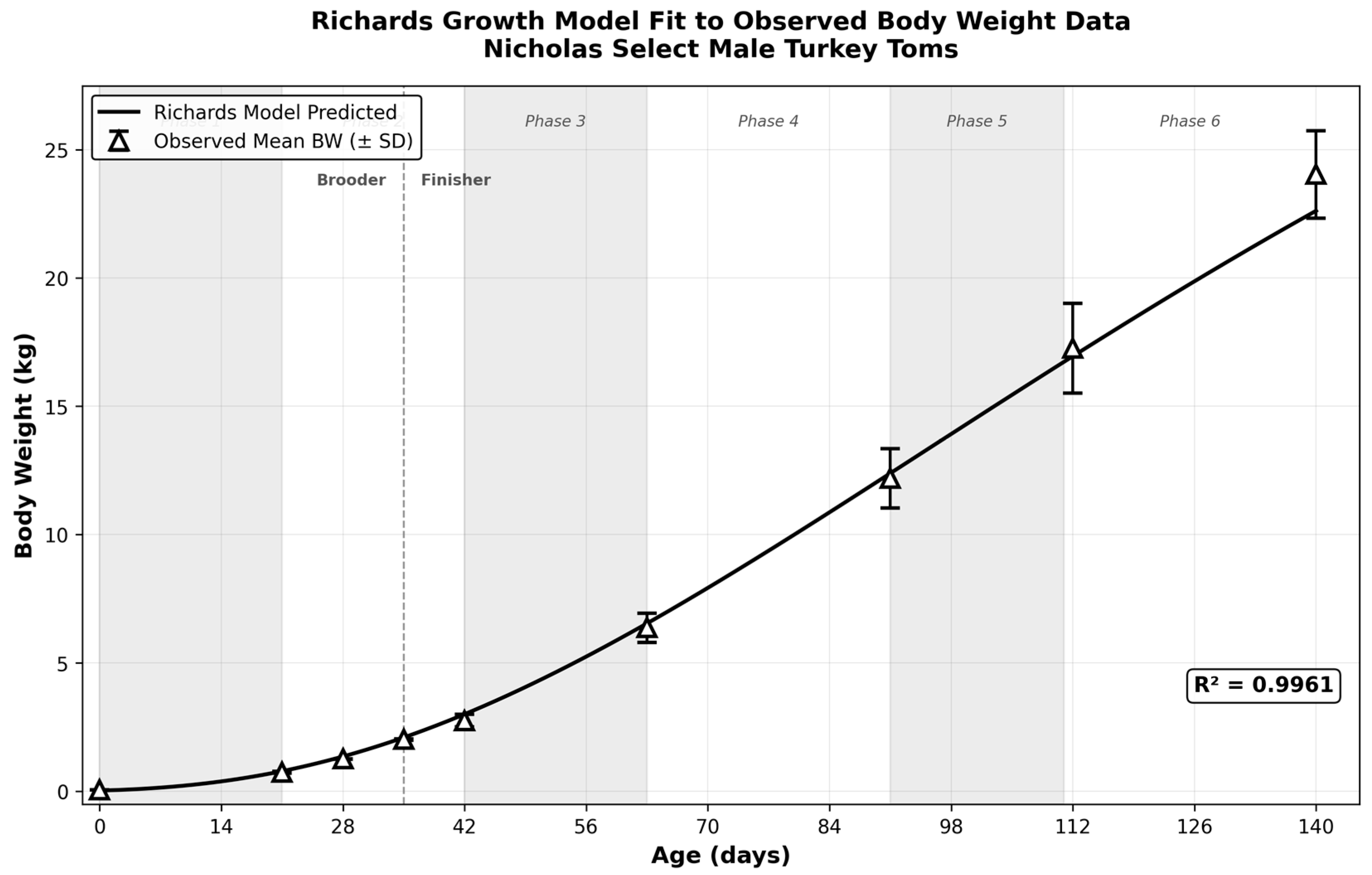
First, to identify the best underlying growth function for the MODEL, a comparative analysis was conducted using the Gompertz [8], Richards [9], and Lopez [10] equations to predict tom body weights. Predicted weights were then compared against average body weights from the Aviagen guidelines [13]. The model with the best fit modern commercial standards was identified as that with the lowest Akaike (AIC), corrected Akaike (AICC), and Bayesian (BIC) information criteria, using SAS software (SAS OnDemand for Academics, SAS 9.4, Build 9.04.01M8P02222023; SAS Institute Inc., Cary, NC, USA) [14]. Of these candidates, the Richards equation exhibited superior fit and was therefore used as the underlying growth equation for the MODEL (Table 1). The fitted Richards growth curve demonstrated excellent agreement with observed mean body weight data across all measurement points (R2 = 0.9961; Figure 1). The fitted Richards equation parameters for male turkeys were initial weight (Wi) = 0.018 kg, mature weight (Wm) = 44 kg, shape parameter (n) = −0.305, and growth rate constant (c) = 0.011.
Second, to predict nutritional requirements of the MODEL diets, body weights for each phase were estimated using the Richards equation [9]. To meet lysine requirements for growth at each phase, lysine requirements were calculated by summing maintenance and growth requirement components (Table 2). A polynomial function was used to predict age-specific protein deposition. Lysine deposition per day was estimated using the coefficients of Gous et al. [15], which describe daily protein deposition for body protein that accounts for body weight gain (BWG) and feather protein that accounts for feather development. The daily amounts of body protein and feather protein were multiplied by their respective lysine contents (7.5% for body protein and 1.8% for feather protein) to calculate total lysine deposition per day. The MODEL then regressed lysine deposition on BWG and fit a polynomial model to obtain coefficients for estimating the daily lysine requirement for growth. The lysine requirement for maintenance was calculated as 73.78 mg per kg metabolic body weight (BW0.75), a constant value derived from Brown and Firman [16], which does not vary by growth phase. The total daily lysine requirement was obtained by summing the requirements for maintenance and growth and dividing this value by daily feed intake to derive the dietary lysine requirement. Nutrient specifications for each feeding phase were determined by calculating the arithmetic mean of the predicted daily nutrient requirements across all days within the phase, using daily body weight predictions from the Richards growth curve and the factorial requirement equation.
Third, the maintenance energy requirement was calculated using metabolic body weight (BW0.75) with linear adjustments for body size as described by Rivera-Torres et al. [12]. Growth energy requirement was partitioned into components for protein, lipid, and feather deposition using coefficients from Gous et al. [15]. Feed intake was estimated based on total energy demand divided by the dietary ME content (Table 2). The Excel spreadsheet containing the MODEL is available in the Supplementary Material.

2.3. Dietary Treatments

Diets were formulated to meet nutrient requirement estimates from either the MODEL (Table 2) or the NRC [2] recommendations (Table 3), with or without a blend of commercial feed additives. The feed additive blend was a proprietary combination of commercially available feed additive technologies targeting multiple physiological functions. The blend included products designed to support gut health and intestinal integrity, enhance nutrient digestibility, promote beneficial gut microbiota, improve cellular energy status, and maintain osmotic balance. These functional categories represent established strategies in modern poultry nutrition that have been individually demonstrated to support growth performance and feed efficiency in turkey production [17]. These feed additives were not given nutritional credits in the ingredient formulation matrix but were added on top of the formulation of the diets. Due to commercial confidentiality agreements, specific product identities and exact inclusion levels cannot be disclosed. However, the additive blend and application rates were identical across all relevant treatments and locations, ensuring internal validity of treatment comparisons.
Dietary treatments were arranged in a 2 × 2 factorial design as follows: (1) MODEL formulated diets without feed additives (MODEL + no additives); (2) MODEL formulated diets with the inclusion of commercial feed additives at recommended dosages (MODEL + additives); (3) diets formulated to meet the 1994 NRC guidelines without feed additives (NRC + no additives); and (4) diets formulated to meet the 1994 NRC guidelines with the inclusion of commercial feed additives at recommended dosages (NRC + additives). Diets were formulated using Concept5 linear least-cost formulation software (Creative Formulation Concepts Tech Services, Inc., Staples, Framingham, MN, USA) using the following approaches. As this was an applied study evaluating diets under commercial conditions, diets were formulated based on industry-standard practices (MODEL) or guidelines established in the NRC [2]. For the MODEL diets, nutrient requirements were expressed on a standardized ileal digestible (SID) basis, with constraints placed on SID amino acids (lysine, TSAA, threonine, tryptophan, arginine), calcium, sodium, available phosphorus, and ME (Table 4). For the NRC diets, nutrient requirements were expressed on a total basis as recommended by NRC [2]. Therefore, total amino acid levels were used as constraints in the linear program; corresponding SID values, which were calculated by the software and are presented in Table 3, allow direct comparison between programs. For the MODEL diets, the other amino acids were determined using the ideal protein ratios as described by Firman & Boling [18]. The NRC diets used a single starter diet from day 0 to 42, whereas the MODEL diets included separate pre-starter and starter phases during this period. Consequently, diets for phases 1 and 2 for the NRC had identical nutrient specifications. In this manuscript, ‘phase’ refers to the feeding period defined by age, while ‘diet’ refers to the specific nutrient formulation fed during that phase. All diets were manufactured by the same commercial integrator, at the same feed mill, and feed was manufactured and delivered on the same days for each farm. The pre-starter and starter diets were manufactured as pellet crumbles; all other diets were manufactured as whole 3.5 mm pellets. All experimental diets were analyzed for nutrient composition, and the mean deviation between analyzed and formulated values was less than 5%. Therefore, formulated nutrient values were used for all calculations and interpretation of results (Table 4 and Table 5).

2.4. Lysine Utilization Efficiency

Phase lysine intake per unit gain (mg/g) to assess lysine utilization efficiency was calculated by multiplying phase feed intake per bird by analyzed dietary lysine concentration, then dividing by the corresponding body weight gain per bird during that phase (g). Total lysine intake per unit of gain (mg/g) was calculated by summing the total lysine consumed per bird (feed intake per bird multiplied by analyzed dietary lysine content for each phase, converted to mg) across all experimental phases, and then dividing by total cumulative body weight gained per bird (g).

2.5. Animals and Housing

Hatch-mates (purchased from a commercial hatchery, Valley of the Moon, Osceola, Iowa) were allocated across two independent research farms (Farm A and Farm B) to ensure consistency in genetic potential, starting weights, hen age, and health status. Uniform distribution of poults across pens was achieved by weighing and dividing poults evenly upon placement. Average initial body weight at placement (day of hatch) was 58.3 ± 3.8 g (CV = 6.5%) across all pens. Feeding phases were the same for both farms and were days 0–21, 22–42, 43–63, 64–91, 92–111, and 112+. Body weights and feed orts were collected weekly at both farms in the brood house, except for Farm B at week 2, when the poults had begun treatment for an infection and weights were not collected. Final body weight was taken on day 139, not day 140, due to transportation to the plant. Upon transfer to the finisher barn and with each feed phase change, toms and feed orts were weighed. Adjusted feed conversion ratio (FCR) was calculated based on feed intake and body weight gain, plus mortality weight. Mortality was recorded daily by pen. Brooder mortality (days 0–42) and final livability (day 140) were calculated and analyzed separately. Phase-specific FCR was calculated for each feeding phase, and cumulative FCR represented the running total from placement through each successive phase.

2.5.1. Farm A

A total of 3072 Nicholas Select male turkeys were housed. Ninety-six poults were placed in each of 32 pens (3.35 m × 2.4 m; starting density of 0.084 m2/poult). Pens were randomly assigned to one of the four treatment groups, with eight replicate pens per treatment. Birds were raised in a single brood barn for the first five weeks, then transferred to a single finisher barn. Pen assignments and replicate structure remained the same throughout the study. The finisher pens measured 6.4 m × 4.9 m (31.2 m2/pen), providing a target stocking density of 0.375 m2/bird at market weight (assuming 87% livability). Heating was provided by radiant heaters above each brooder pen with temperature management per industry guidelines. Ventilation was achieved in the brooder barn with four 61 cm and four 122 cm exhaust fans, and in the finisher barn, a combination of natural ventilation and three 122 cm exhaust fans was used to maintain adequate air quality. Feed was delivered by a Feed Logic automated feeding system (Feed Logic, Wahpeton, ND, USA).

2.5.2. Farm B

A total of 2176 Nicholas Select male turkeys were housed. Sixty-eight poults were placed in each of 32 pens (2.4 m × 2.4 m; starting density of 0.084 m2/poult). Pens were randomly assigned to one of the four treatment groups, with eight replicate pens per treatment. Birds were brooded in one barn divided into two rooms (16 pens per room). After five weeks, birds were transferred to a finisher barn with two rooms. In the finisher barn, each original pen was split into two (e.g., Pen 1 became Pens 1a and 1b), with one group assigned to each of the two rooms. The overall replicate structure remained the same. The finisher pens measured 3.35 m × 3.35 m (11.24 m2/pen), providing a stocking density of 0.375 m2/bird at market weight (assuming 87% livability). Heating was provided by forced air heaters with temperature management per industry guidelines. Ventilation was provided by chimney ventilation. Feed was provided by hand feeding in the brooder barn and by the Zaxe 450-00080 feed weighing system (Zaxe Technologies, Sainte-Julie, QC, Canada) in the finisher barn.

2.6. Breast Yield Data

Feed was withdrawn 12 h prior to processing. On day 139, all birds were weighed by pen on-farm to obtain the final pen-level body weight used in statistical analyses; weighing on day 140 was not feasible due to loading and transport logistics. On day 140, toms were loaded by farm and treatment onto transport trailers and taken to the commercial processing plant, where the trailer was weighed, and a total bird count on the processing line was used to calculate overall livability and final body weight. Birds from both farms were processed within one hour of arrival at the plant. On the processing line, every tenth bird (a total of 30 carcasses per treatment group per farm) was selected for detailed yield analysis. Each selected carcass had weights taken for the whole, pre-chill carcass and boneless skinless breast lobes. Breast yield percentage was calculated as (boneless skinless breast lobe weight/whole pre-chill carcass weight) × 100. Carcass weight and breast yield percentage data are reported in the results.

2.7. Statistical Analysis

All analyses were conducted with SAS OnDemand for Academics [14]. Data were analyzed separately for the brooder period (days 0–35, Phases 1–2) and finisher period (days 36–140, Phases 3–6) to account for differences in housing and pen structure between periods. For the brooder period analysis, data were analyzed using a linear mixed model with nutritional model, feed additive, and their interaction as fixed effects. The room nested within the location was included as a fixed effect, as Farm B had 2 rooms, whereas Farm A had a single room. Pen was the experimental unit. For the finisher period analysis (BW, feed intake by phase, FCR, lysine conversion), data were analyzed using a linear mixed model. Fixed effects included nutritional model, feed additive, phase, and all interactions. The room nested within the location was included as a fixed effect, as Farm B had 2 rooms, whereas Farm A had a single room, and phase was modeled as a repeated measure with an unstructured covariance structure. Pen was the experimental unit. For mortality, livability, carcass weight, total feed cost per unit of gain, total lysine conversion, and breast yield percentage, data were analyzed using a linear mixed model with nutritional model, feed additive, and their interaction as fixed effects, with room nested within location as a fixed effect as Farm B had 2 rooms whereas Farm A brooded in a single room. Post hoc pairwise comparisons were made using Tukey–Kramer adjustments for variables with significant interactions and Sidak adjustments for main effects comparisons (alpha = 0.05). Residuals were checked graphically (residuals vs. fitted, Q-Q plots), and assumptions of normality and homogeneity were met. Feed phases (1–6) refer to dietary formulation periods based on nutrient specifications and were consistent across both facilities (Phase 1: d0–21, Phase 2: d22–42, Phase 3: d43–63, Phase 4: d64–91, Phase 5: d92–111, Phase 6: d112+). Brooder and finisher periods refer to housing location: birds were housed at the brooder facility from d0–35 and the finisher facility from d36–140. Phase 2 feed was provided at both facilities; accordingly, Phase 2 data from the brooder facility (d22–35) were included in the brooder period analysis, while Phase 2 data from the finisher facility (d36–42) were included in the finisher period analysis.

3. Results

3.1. Brooder Period (Days 0–35)

During the brooder period, body weight, feed intake, FCR, and lysine per unit gain were all affected by the nutritional model (p ≤ 0.001; Table 6). Toms fed NRC diets were 7% heavier (2.00 vs. 1.87 kg; p < 0.001), consumed 10% more feed (2.85 vs. 2.58 kg; p < 0.001), but had 3% poorer FCR (1.46 vs. 1.42; p = 0.001) and 6% higher lysine intake per unit gain (17.09 vs. 16.13 mg/g; p < 0.001) compared to toms fed MODEL diets. A significant nutritional program by feed additive interaction was observed for all brooder variables (p ≤ 0.031; Table 6), indicating that the response to feed additives differed between nutritional programs during the early growth phase. Location significantly affected all brooder period variables (p < 0.001), with Farm A exhibiting lower body weights, feed intake, FCR, and lysine per unit gain compared to Farm B. The direction of nutritional model effects was consistent across both research facilities.

3.2. Mortality and Livability

Brooder mortality (days 0–42) was not significantly affected by nutritional program (p = 0.266), feed additive (p = 0.967), or their interaction (p = 0.101; Table 7). Numerically, toms fed MODEL diets had lower mortality compared to NRC-fed toms. Final livability (day 140) was not significantly affected by nutritional program (p = 0.365) or feed additive (p = 0.102), though the nutritional program by feed additive interaction approached but did not reach significance (p = 0.051; Table 7). Overall livability averaged 87%, with 87.43% for MODEL-fed toms and 86.50% for NRC-fed toms.

3.3. Individual Body Weight

Body weight differed by nutritional program (p = 0.023), phase (p < 0.001), and the interaction of the nutritional program and phase (p < 0.001; Table 8). During the finisher period (phases 2–6, days 36 through 140) toms fed the MODEL diets weighed more than those fed the NRC diets. As expected, body weight increased with age, driving the significant effect of phase. The nutritional program by phase interaction reflected differing growth rate trajectories: toms fed the NRC diets were heavier leaving the brooder and through day 91, after which MODEL-fed diets had a similar body weight through the end of the production cycle (Table 9). Body weights of toms also differed among research facility locations, with Farm B having heavier toms than Farm A (p < 0.001). The fixed effect of feed additives, and their tested interactions, including nutrition by additive by phase, were not significant (p > 0.150; Table 8).

3.4. Feed Consumption per Tom

Feed consumption of toms differed by nutritional model (p < 0.001), phase (p < 0.001), and nutritional model by phase interaction (p < 0.001; Table 8 and Table 9). Toms fed the MODEL diets consumed 3.66 kg (approximately 6%) less feed per bird than toms fed the NRC diets over the whole period. As feed phases differed in length, feed issued varied by phase, but the differences between the NRC and MODEL feeding programs increased with each consecutive phase (Table 9). While the inclusion of feed additives alone did not alter feed consumption per tom (p = 0.890; Table 8), the feed additive by phase interaction was significant (p = 0.046; Table 8). The nutritional program by feed additive interaction, however, was not significant (p = 0.074, Table 8). The 3-way interaction between nutritional program, feed additive, and phase for feed consumption was not significant (p = 0.860; Table 8). Research facility location also had a differing effect on feed consumption per tom (p < 0.001), with Farm A exhibiting lower feed consumption per tom than Farm B.

3.5. Cumulative Feed Conversion Ratio

Cumulative FCR was altered by nutritional program (p < 0.001), phase (p < 0.001), nutritional program by phase interaction (p < 0.001; Table 8 and Table 9), and nutritional program by feed additive interaction (p = 0.010; Table 8). Throughout the whole production cycle, toms fed the MODEL diets were more efficient overall, compared to toms fed the NRC diets. As expected, FCR changed throughout each phase, and the differences between the NRC and MODEL feeding programs became greater as birds aged, with MODEL-fed toms showing progressively better efficiency as compared to the NRC-fed birds (p < 0.001; Table 9). Additionally, a nutrition program by additive interaction was observed for cumulative FCR, where birds fed the MODEL diets without additives were less efficient (p = 0.010) than those fed the MODEL diets with additives, but no difference was observed within NRC diets (Table 10). The effects of additive (p = 0.334), additive by phase (p = 0.114), and the three-way interaction (p = 0.818) were not significant. Research facility location also affected FCR (p < 0.001), with Farm A exhibiting lower FCR values than Farm B.

3.6. Lysine Intake per Unit Gain

Lysine intake per unit of gain per tom was altered by nutritional model (p < 0.001), phase (p < 0.001), and the nutritional model by phase interaction (p < 0.001; Table 8 and Table 10). Throughout the whole production cycle, toms fed the MODEL diets consumed 5.8 mg less lysine per gram of gain than those fed NRC diets (p < 0.001). Within phases, a sharp decline was observed from phase 2 to phase 3 (Table 9), and it remained lower through phase 6. The nutritional model by phase effects were significant during Phases 2–5 (days 36 through 112), indicating that toms fed the MODEL diets consumed significantly less lysine per unit of gain (p ≤ 0.05); however, significance diminished in Phase 6 (day 140; Table 8). The main effect of the feed additive was not significant (p = 0.345), and the nutritional model by feed additive (p = 0.259), phase by additive (p = 0.172), and nutritional model by phase by feed additive (p = 0.784) interactions were not significant. Research facility location significantly affected lysine intake per unit of gain (p < 0.001), with toms at Farm B consuming more lysine per unit of gain than those at Farm A.

3.7. Total Feed Cost per Unit of Gain

Total feed costs were calculated by using the actual feed costs per phase, provided by the feed manufacturer. Total feed cost per unit of gain was altered by nutritional program (p < 0.001; Table 11), feed additive (p < 0.001; Table 11), and the nutritional program by feed additive interaction (p = 0.029; Table 11). Toms fed the MODEL diets had a reduced feed cost per unit of gain as compared with those fed the NRC diets, with the NRC diets increasing cost by approximately $0.05/kg of gain. Additionally, the inclusion of feed additives in the diet increased the feed cost per unit of gain, with the addition of the feed additives increasing the cost by approximately $0.04/kg of gain. A significant nutritional program by feed additive interaction demonstrated that feed costs per unit of gain were lower for the NRC diets without feed additives as compared to the NRC diets with feed additives (p < 0.001), but no difference in cost per unit of gain was observed for toms fed the MODEL diets with or without the feed additives (p = 0.538; Table 10). The effect of research facility location was not significant (p = 0.085).

3.8. Carcass Weight and Breast Yield Percentage

Whole pre-chill carcass weight was significantly affected by nutritional program (p < 0.001), feed additive (p = 0.021), and the nutritional program by feed additive interaction (p < 0.001; Table 11). Toms fed MODEL diets had heavier carcasses (19.11 kg) than toms fed NRC diets (18.45 kg). Within the significant interaction, toms fed MODEL diets without additives had the heaviest carcasses (19.95 kg), while those fed MODEL diets with additives (18.27 kg), NRC with additives (18.93 kg), and NRC without additives (17.97 kg) were lighter. Breast yield percentage was not significantly altered by the feed additive at α = 0.05 (p = 0.058; Table 11) and was altered by the feed additive by nutritional program interaction (p = 0.017; Table 11). Toms fed diets containing feed additives had numerically lower breast yield than those not fed feed additives (29.62% compared to 30.01%, respectively). Within this interaction, toms fed the MODEL diets without feed additives had a higher breast yield percentage than toms fed the MODEL diets with feed additives (p = 0.015). Toms fed the NRC diets had similar breast yield percentage with or without feed additives in the diet, and they were not different from toms fed the MODEL diets (p ≥ 0.299). Breast yield percentages were similar across nutritional models and location (p > 0.128; Table 11).

4. Discussion

The present study evaluated the performance of a factorial–mechanistic, growth-model-derived feeding program against the longstanding NRC [2] recommendations for heavy tom turkeys, while simultaneously testing a feed additive blend at two separate research facility locations. The overall objective of this applied study was to determine whether the MODEL-estimated nutrient specifications for diets fed to modern commercial turkeys improved performance and economic efficiencies relative to those fed diets formulated according to the NRC [2] recommendations.

4.1. Nutrient Density, Feed Intake, and Feed Efficiency

The MODEL formulated diets supplied approximately 4% more digestible lysine and approximately 115 kcal/kg more ME than the NRC diets on an overall basis and were comparably closer to breeder nutritional guidelines [19]. For comparison, the Aviagen Nicholas Select feeding guidelines [19] recommend digestible lysine concentrations of 1.73% (Phase 1), 1.55% (Phase 2), 1.36% (Phase 3), 1.20% (Phase 4), 1.05% (Phase 5), 0.93% (Phase 6), and 0.81% (Phase 7), with corresponding ME values of 2933; 3053; 3148; 3219; 3291; 3363; and 3434 kcal/kg. The MODEL’s predicted digestible lysine levels were generally lower than the Aviagen guidelines during early phases and converged during later phases, while the MODEL’s ME specifications were higher. This pattern reflects the MODEL’s emphasis on energy density to regulate feed intake and optimize Lys:ME ratios rather than maximizing absolute lysine concentration. The NRC specifications fell substantially below both the MODEL and Aviagen guidelines in later phases, consistent with its outdated basis.
Therefore, it is expected that MODEL-fed toms compensated for the higher dietary energy density by reducing feed intake, achieving an approximate 0.5 unit improvement in FCR, a finding consistent with Lehmann et al. [20]. These data confirm that elevating energy density while matching lysine requirements to support protein accretion leads to more efficient feed utilization. Notably, with only two research facilities that differed substantially in feeding system, ventilation, and pen management, facility-by-treatment interactions could not be meaningfully tested; however, the direction and significance of treatment effects were consistent across both locations, supporting the generalizability of these findings. Cumulative lysine conversion was improved by approximately 4 mg/g of gain with MODEL diets (Table 11). This aligns with factorial predictions and demonstrates that toms deposited protein more efficiently when dietary lysine supply aligns with the period of lean growth potential [21]. Adequate dietary lysine levels relative to energy density have been investigated for decades, but recommendations have varied significantly due to changes in genetic potential, management practices, and performance expectations.
During the brooder period (days 0–35), toms fed the NRC diets achieved higher body weights than the MODEL-fed toms, despite having poorer FCR and higher lysine intake per unit gain. The MODEL diets provided lysine to ME ratios of 5.8 g/Mcal ME (Table 2, phase 1) and 4.6 g/Mcal ME (Table 2, phase 2), as compared to 5.3 g/Mcal ME for the NRC starter diet (Table 3). Published recommendations for young turkeys suggest lysine to ME ratios in the range of 4.0–4.6 g/Mcal ME for optimal early growth [16,19,20].
The higher energy density of the MODEL Phase 1 diet (3000 kcal/kg ME vs. 2800 kcal/kg for the NRC starter) likely triggered earlier satiety and reduced voluntary feed intake, consistent with energy-driven intake regulation [22]. Consequently, despite adequate Lys:ME ratios, MODEL-fed toms consumed approximately 10% less feed during the brooder period, reducing total daily lysine intake in absolute terms. NRC-fed toms achieved higher body weights through elevated total nutrient consumption, albeit less efficiently. This trade-off (lower early body weight in exchange for improved feed efficiency) proved advantageous during later production phases when MODEL-fed toms achieved equivalent final body weights while consuming substantially less total feed.
During the grower period (phases 3–4, days 43–91), the MODEL diets provided Lys:ME ratios of 3.8 and 3.3 g/Mcal (Table 2), which fell below published recommendations for this growth stage. The NRC [2] recommends 4.33 g/Mcal for 8–12-week-old toms, while industry guidelines suggest 3.6–4.3 g/Mcal for this period [19]. Empirical studies have reported lysine to energy requirements of 4.0 g/Mcal [23], 4.5 g/Mcal [24], and 3.2–3.8 g/Mcal depending on environmental temperature [25]. More recent work by Jankowski et al. [26] observed optimal performance at 4.3 g/Mcal during weeks 9–12. Consistent with these recommendations, the MODEL-fed toms remained lighter than NRC-fed toms through phase 4 (Table 9), when MODEL Lys:ME (3.3 g/Mcal) was below most published values. This pattern reversed during the finishing phases when MODEL Lys:ME ratios (3.1 and 2.9 g/Mcal) aligned with published recommendations of 2.1–3.1 g/Mcal [22,25], and MODEL-fed toms achieved equivalent or heavier final body weights. These findings suggest the MODEL may have underestimated lysine requirements during the 6–13-week transitional growth period.
Later in the production cycle, when breast muscle accretion is expected to be elevated, this study found that lysine and energy levels in the MODEL diets supported improved feed efficiency and lysine conversion as compared with the NRC diets (Table 11). During the 16–20-week period of production, when the rate of breast muscle accretion is greatest in the tom [27], published lysine and energy level ratio recommendations are reduced to 2.11 to 3.14 g/Mcal [22,25]. However, a later study in 1996 [20] observed optimal growth and feed efficiency at a dietary total lysine level of approximately 1.20% of the diet, equivalent to 4.0 g/Mcal ME. For the 16 to 20-week period, the highest lysine level tested by Lehmann et al. (0.96% of diet or 3.0 g/Mcal ME) failed to maximize weight gain, suggesting that the requirement during the finishing phase exceeds 3.0 g/Mcal ME [20]. The nutritional MODEL simulation predicted accurate lysine and energy requirements in the context of this study, as observed by the final body weight meeting the predicted weight target.

4.2. Feed Additive Interactions with Diet Specification

A significant nutritional program by feed additive interaction was observed for FCR, feed cost, lysine conversion, and breast yield. Feed additives did not significantly alter feed cost within the MODEL diets ($0.78 vs. $0.76/kg gain; p > 0.05), but increased feed cost when paired with NRC diets ($0.85 vs. $0.79/kg gain; p < 0.05; Table 10). This differential response between nutritional models drove the significant interaction effect (p = 0.029). These findings are biologically plausible because many of the technologies used (e.g., carbohydrase enzymes, yeast-derived metabolites, essential oil phytobiotics) enhance nutrient digestibility and intestinal absorptive capacity in chickens [6,28,29]. In this study, the NRC [2] reference diets contained substantially lower ME than modern commercial formulations, which likely stimulated increased feed intake. As a result, toms consumed greater total quantities of amino acids, including lysine, per unit of gain. This compensatory increase in lysine intake minimized the likelihood that lysine supply was limiting growth performance. Consequently, even if the feed additive improved lysine bioavailability, the birds likely already received sufficient digestible lysine through elevated intake, leaving limited opportunity for detectable improvements in performance.
In the present study, feed consumption was primarily affected by the nutritional program (p < 0.001), with MODEL-fed toms consistently eating less than NRC-fed toms across all phases. This reduction became more pronounced as birds aged, consistent with energy-driven intake regulation [27]. Feed additives had no meaningful effect on feed intake, and the nutritional program by feed additive interaction was biologically negligible. These findings suggest that feed additive programs designed for conventional (NRC-type) diets may not perform identically when paired with MODEL-optimized diets that have different nutrient densities. This interaction warrants further investigation to determine whether additive programs should be adjusted when transitioning to model-based feeding programs.

4.3. Carcass Response and Commercial Relevance

Despite lower cumulative feed intake, the MODEL-fed toms achieved heavier carcass weights and maintained breast yield percentage in comparison to the NRC diet-fed toms, except when feed additives were included. However, the inclusion of feed additives was associated with a small reduction in breast yield. Functional feed additives may stimulate enteric development and immune activity, which can increase metabolic demand for amino acids such as threonine to support mucin production and immunoglobulin synthesis [30]. We hypothesize that when total amino acid supply is not proportionally increased, a greater share may be allocated toward intestinal maintenance rather than muscle accretion. This shift would leave less available to support breast muscle protein synthesis, consistent with earlier reports that breast yield is highly sensitive to lysine supply and efficiency [25,31]. Under such conditions, the modest reductions in yield observed in the present study likely reflect altered amino acid partitioning rather than impaired digestive function. Additionally, the sampling methodology may have contributed to variability in breast yield estimates. Carcasses were selected every tenth bird on the processing line, which does not guarantee that sampled birds were representative of pen-level averages for body weight or composition. A more targeted approach, such as identifying and marking birds closest to the pen mean body weight prior to transport, would better ensure that yield measurements reflect true treatment effects rather than random variation introduced by convenience sampling at the plant.
Given that breast meat carries a premium in North American markets, the modest yield penalty (~0.5%) associated with feed additive use must be weighed against the 4-point FCR advantage and the 3% reduction in feed cost/kg gain realized with the MODEL feeding program [32,33]. Processors targeting further processed products rather than whole muscle cut up may prioritize efficiency over a marginal shift in breast proportion. The benefits of this finding will ultimately depend on the marketing strategy of the processor and the characteristics of their primary consumer base.


5. Limitations

Several limitations of this study warrant consideration. As an applied field trial conducted under commercial conditions, intermediate metabolic indicators (serum amino acid concentrations, intestinal enzyme activity, tissue protein deposition rates) were not measured; future controlled-environment studies should include these to provide direct validation of MODEL nutrient utilization predictions. The economic analysis used actual manufacturer-provided feed costs, which limits reproducibility across different market conditions; sensitivity analysis incorporating commodity price volatility would strengthen practical utility. Individual ingredient and additive costs were provided under commercial confidentiality and cannot be disclosed; consequently, the economic comparisons reported here reflect relative treatment differences rather than reproducible absolute costs. The MODEL’s ideal protein ratios were derived from Firman and Boling [18], which remains one of the few peer-reviewed sources for turkey-specific ratios but may not fully reflect modern genetic potential. Finally, the proprietary nature of the feed additive blend limits mechanistic interpretation of N × A interactions. Future investigations should include metabolic sampling, additional genetic lines, and economic modeling under variable market conditions.

6. Conclusions

The MODEL accurately predicted nutrient requirements for a single commercial line of modern heavy toms during the final market phases of production, and consistently improved cumulative FCR while decreasing feed cost per kg of gain. However, the inclusion of a blend of commercial feed additives for gut health and performance enhancement did not produce similar effects. Breast meat yield was maximized when feed additives were excluded from MODEL diets; no equivalent effect of additive inclusion was observed within the NRC diets. Lysine utilization efficiency was significantly enhanced by MODEL diets across growth phases, carrying pronounced economic implications for dietary formulation. This study therefore demonstrates that factorial-mechanistic modeling can be effectively used to predict the nutritional needs of modern heavy toms and support improved performance and economic efficiency.

Supplementary Materials

The following supporting information can be downloaded at: https://www.mdpi.com/article/10.3390/poultry5030034/s1, Table S1: TURKEY GROWTH AND NUTRIENT REQUIREMENT MODEL.

Author Contributions

Conceptualization, B.O.H. and P.R.F.; methodology, B.O.H.; software, B.O.H.; validation, B.O.H., P.R.F., and D.A.K.; formal statistical analysis, B.O.H. and J.C.; investigation, B.O.H., D.A.K., and P.C.F.; resources, P.R.F. and D.A.K.; data curation, B.O.H.; writing, original draft preparation, B.O.H.; writing, review and editing, B.O.H., D.A.K., and P.R.F.; visualization, B.O.H.; supervision, P.R.F. and D.A.K.; project administration, P.R.F. and D.A.K.; funding acquisition, P.R.F. and D.A.K. All authors have read and agreed to the published version of the manuscript.

Funding

This research was supported by the National Animal Nutrition Program (http://animalnutrition.org; accessed on 1 April 2026), which is a National Research Support Project (NRSP-9) that started in 2010 and is supported by the Experiment Station Committee on Organization and Policy, the State Agricultural Experiment Stations, and Hatch Funds provided by the National Institute of Food and Agriculture, U.S. Department of Agriculture; student author tuition funded by the Google Tides Foundation grant entitled “Charting the future of poultry science through data analytics, modeling, and AI”, Grant Number TF2306-114478. The APC was funded by the North Carolina Agricultural Foundation, Inc., Raleigh, NC 27606.

Institutional Review Board Statement

The animal study protocol was approved by the Institutional Animal Care and Use Committee (protocol code IACUC #24-105, approved on 11 July 2024).

Informed Consent Statement

Not Applicable.

Data Availability Statement

The original contributions presented in this study are included in the article. Further inquiries can be directed to the corresponding author.

Acknowledgments

The authors acknowledge the technical assistance provided by farm staff at both research facilities and the generosity of the commercial integrator who participated in these efforts.

Conflicts of Interest

The authors declare no conflicts of interest.

Abbreviations

The following abbreviations are used in this manuscript:
AICAkaike information criteria
AICCCorrected Akaike information criteria
BICBayesian information criteria
BWBody weight
BWGBody weight gain
FCRFeed conversion ratio
FIFeed intake
IACUCInstitutional Animal Care and Use Committee
MEMetabolizable energy
MODELGrowth model-derived feed program
NRCNational Research Council
SEMStandard error of the mean
SIDStandardized ileal digestibility

References

  1. Havenstein, G.B.; Ferket, P.R.; Grimes, J.L.; Qureshi, M.A.; Nestor, K.E. Comparison of the Performance of 1966- Versus 2003-Type Turkeys When Fed Representative 1966 and 2003 Turkey Diets: Growth Rate, Livability, and Feed Conversion. Poult. Sci. 2007, 86, 232–240. [Google Scholar] [CrossRef]
  2. National Research Council. Nutrient Requirements of Poultry, 9th Revised ed.; The National Academies Press: Washington, DC, USA, 1994. [Google Scholar]
  3. Klasing, K.C.; Dozier, W.A.; Mateos, G.G.; Persia, M.E.; Walzem, R.L.; Sakomura, N.; Reis, M.; Viana, G.; Riveros, R.; Elkin, R.G.; et al. Informal Nutrition Symposium: Overview of the Nutrient Requirements of Poultry, 10th Revised Edition. J. Appl. Poult. Res. 2025, 34, 100616. [Google Scholar] [CrossRef]
  4. Tien, D.S.; Hockey, M.; So, D.; Stanford, J.; Clarke, E.D.; Collins, C.E.; Staudacher, H.M. Recommendations for Designing, Conducting, and Reporting Feeding Trials in Nutrition Research. Adv. Nutr. 2024, 15, 100283. [Google Scholar] [CrossRef]
  5. Attia, Y.; El-kelawy, M.; Al-Harthi, M.; El-Shafey, A. Impact of Multienzymes Dose Supplemented Continuously or Intermittently in Drinking Water on Growth Performance, Nutrient Digestibility, and Blood Constituents of Broiler Chickens. Animals 2020, 10, 375. [Google Scholar] [CrossRef]
  6. Cowieson, A.J.; Adeola, O. Carbohydrases, Protease, and Phytase Have an Additive Beneficial Effect in Nutritionally Marginal Diets for Broiler Chicks. Poult. Sci. 2005, 84, 1860–1867. [Google Scholar] [CrossRef]
  7. Dong, B.; Liu, S.; Wang, C.; Cao, Y. Effects of Xylanase Supplementation to Wheat-Based Diets on Growth Performance, Nutrient Digestibility and Gut Microbes in Weanling Pigs. Asian-Australas. J. Anim. Sci. 2018, 31, 1491–1499. [Google Scholar] [CrossRef]
  8. Laird, A.K.; Tyler, S.A.; Barton, A.D. Dynamics of Normal Growth. Growth 1965, 29, 233–248. [Google Scholar]
  9. Richards, F.J. A Flexible Growth Function for Empirical Use. J. Exp. Bot. 1959, 10, 290–301. [Google Scholar] [CrossRef]
  10. López, S.; France, J.; Gerrits, W.J.J.; Dhanoa, M.S.; Humphries, D.J.; Dijkstra, J. A Generalized Michaelis-Menten Equation for the Analysis of Growth. J. Anim. Sci. 2000, 78, 1816–1828. [Google Scholar] [CrossRef]
  11. Rivera-Torres, V.; Noblet, J.; Dubois, S.; van Milgen, J. Energy Partitioning in Male Growing Turkeys. Poult. Sci. 2010, 89, 530–538. [Google Scholar] [CrossRef]
  12. Rivera-Torres, V.; Noblet, J.; Dubois, S.; Van Milgen, J. Dynamics of Energy Utilization in Male and Female Turkeys during Growth. Animal 2011, 5, 202–210. [Google Scholar] [CrossRef]
  13. Aviagen Turkeys. Performance Objectives: Aviagen Turkeys. Available online: https://aviagenturkeys.us/documents/ (accessed on 23 February 2024).
  14. SAS Institute Inc. SAS OnDemand for Academics, SAS 9.4, Release 9.04.01M8P02222023; SAS Institute Inc.: Cary, NC, USA.
  15. Gous, R.M.; Fisher, C.; Tůmová, E.; Machander, V.; Chodová, D.; Vlčková, J.; Uhlířová, L.; Ketta, M. The Growth of Turkeys 1. Growth of the Body and Feathers and the Chemical Composition of Growth. Br. Poult. Sci. 2019, 60, 539–547. [Google Scholar] [CrossRef]
  16. Brown, J.; Firman, J.D. Digestible Lysine Requirements for Maintenance in the Starting Turkey. Int. J. Poult. Sci. 2006, 5, 740–743. [Google Scholar] [CrossRef]
  17. Perera, W.N.U.; Ravindran, V. Role of Feed Additives in Poultry Nutrition: Historical, Current and Future Perspectives. Anim. Feed Sci. Technol. 2025, 326, 116371. [Google Scholar] [CrossRef]
  18. Firman, J.D.; Boling, S.D. Lysine: Ideal Protein in Turkeys. Poult. Sci. 1998, 77, 105–110. [Google Scholar] [CrossRef]
  19. Aviagen Turkeys. Feeding Guidelines for Nicholas & BUT Heavy Lines; Aviagen Turkeys: Chester, UK, 2015; Available online: https://www.scribd.com/document/327344956/NU06-Feeding-Guidelines-for-Nicholas-but-Heavy-Lines-En (accessed on 9 February 2026).
  20. Lehmann, D.; Pack, M.; Jeroch, H. Responses of Growing and Finishing Turkey Toms to Dietary Lysine. Poult. Sci. 1996, 75, 711–718. [Google Scholar] [CrossRef]
  21. de Paula Dorigam, J.C.; Appelt, M.D.; Maiorka, A.; Muramatsu, K.; Sens, R.F.; Rocha, C.; Dahlke, F. Evaluation of the Digestible Lysine Requirements in Female Turkeys from 0 to 68 Days of Age. Anim. Feed Sci. Technol. 2016, 221, 137–146. [Google Scholar] [CrossRef]
  22. Jensen, L.S.; Manning, B.; Falen, L.; McGinnis, J. Lysine Needs of Rapidly Growing Turkeys from 12–22 Weeks of Age1. Poult. Sci. 1976, 55, 1394–1400. [Google Scholar] [CrossRef]
  23. Tuttle, W.L.; Balloun, S.L. Lysine Requirements of Starting and Growing Turkeys. Poult. Sci. 1974, 53, 1698–1704. [Google Scholar] [CrossRef]
  24. Potter, L.M.; Shelton, J.R.; McCarthy, J.P. Lysine and Protein Requirements of Growing Turkeys. Poult. Sci. 1981, 60, 2678–2686. [Google Scholar] [CrossRef]
  25. Noll, S.L.; Waibel, P.E. Lysine Requirements of Growing Turkeys in Various Temperature Environments. Poult. Sci. 1989, 68, 781–794. [Google Scholar] [CrossRef]
  26. Jankowski, J.; Mikulski, D.; Mikulska, M.; Ognik, K.; Całyniuk, Z.; Mróz, E.; Zduńczyk, Z. The Effect of Different Dietary Ratios of Arginine, Methionine, and Lysine on the Performance, Carcass Traits, and Immune Status of Turkeys. Poult. Sci. 2020, 99, 1028–1037. [Google Scholar] [CrossRef]
  27. Ferket, P. Factors That Affect Feed Intake of Meat Birds: A Review. Int. J. Poult. Sci. 2006, 5, 905–911. [Google Scholar] [CrossRef]
  28. Ahiwe, E.U.; Abdallh, M.E.; Chang’a, E.P.; Omede, A.A.; Al-Qahtani, M.; Gausi, H.; Graham, H.; Iji, P.A. Influence of Dietary Supplementation of Autolyzed Whole Yeast and Yeast Cell Wall Products on Broiler Chickens. Asian-Australas. J. Anim. Sci. 2020, 33, 579–587. [Google Scholar] [CrossRef]
  29. Al-Garadi, M.A.; Alhotan, R.A.; Hussein, E.O.; Qaid, M.M.; Suliman, G.M.; Al-Badwi, M.A.; Fazea, E.H.; Olarinre, I.O. Effects of a Natural Phytogenic Feed Additive on Broiler Performance, Carcass Traits, and Gut Health under Diets with Optimal and Reduced Energy and Amino Acid Density. Poult. Sci. 2025, 104, 105014. [Google Scholar] [CrossRef]
  30. Mao, X.; Zeng, X.; Qiao, S.; Wu, G.; Li, D. Specific Roles of Threonine in Intestinal Mucosal Integrity and Barrier Function. Front. Biosci. (Elite Ed.) 2011, 3, 1192–1200. [Google Scholar] [CrossRef]
  31. Nixey, C.; Agr, M. The Lysine Response of the Turkey. Ph.D. Thesis, University of Nottingham, Nottingham, UK, 1991. [Google Scholar]
  32. Davis, C.G.; Harvey, D.; Zahniser, S.; Gale, F.; Liefert, W. Assessing the Growth of U.S. Broiler and Poultry Meat Exports; United States Department of Agriculture: Washington, DC, USA, 1997.
  33. Case, L.A.; Miller, S.P.; Wood, B.J. Factors Affecting Breast Meat Yield in Turkeys. World Poult. Sci. J. 2010, 66, 189–202. [Google Scholar] [CrossRef]
Figure 1. Richards growth model predicted body weight (solid line) and observed mean body weight (±SD; triangles) of Nicholas Select toms from day 0 to 140. R2 = 0.9961.
Poultry 05 00034 g001
Table 1. Fit statistics using growth curve models generated by simulation 1.
Gompertz 3Richards 3Lopez 3
−2 Log Likelihood−20.9−96.9−92.9
AIC 2−12.9−86.9−82.9
AICC 2−10.6−83.2−79.1
BIC 2−8.6−81.5−77.4
1 Growth curves fitted using SAS software [14] nonlinear regression procedures. 2 Abbreviations: AIC, Akaike information criteria; AICC, corrected Akaike information criteria; BIC, Bayesian information criteria. 3 Growth function equations: Gompertz [8], Richards [9], Lopez [10].
Table 2. Formulated levels of ME, crude protein, and standardized ileal digestible (SID) amino acids for the MODEL diets.
NutrientUnitDiet 1 1Diet 2 2Diet 3 3Diet 4 4Diet 5 5Diet 6 6
Metabolizable EnergyKcal/kg300030853200332534003450
Lys:ME 7g/Mcal5.834.573.813.333.092.90
Crude Protein%26.0024.4421.2419.4918.5617.55
Arginine%1.841.481.291.151.101.05
Isoleucine%1.210.820.720.650.630.60
Lysine%1.751.411.231.091.051.00
Methionine%0.520.560.480.420.400.38
Methionine + cystine%1.030.830.730.640.620.59
Threonine%0.980.780.680.600.580.55
Tryptophan%0.260.230.200.170.170.16
Valine%1.170.940.830.770.730.70
Crude Protein%26.0024.4421.2419.4918.5617.55
1 Phase 1, days 0–21. 2 Phase 2, days 22–42. 3 Phase 3, days 43–63. 4 Phase 4, days 64–91. 5 Phase 5, days 92–111. 6 Phase 6, days 112+. 7 Lysine-to-metabolizable energy ratio calculated as (digestible lysine, % × 10)/(ME, Mcal/kg).
Table 3. Formulated levels of ME, crude protein, and SID amino acids for the basal NRC 1 diets [2].
Nutrient UnitDiet 1 2Diet 2 3Diet 3 4Diet 4 5Diet 5 6
Metabolizable EnergyKcal/kg28002900300031003200
Lys:ME 7g/Mcal5.244.804.032.972.29
Crude Protein%28.0026.0022.0019.0016.50
Arginine%1.741.591.311.120.96
Isoleucine%1.000.940.790.680.59
Lysine%1.471.391.210.920.74
Methionine%0.640.570.470.350.28
Methionine + cystine%0.950.870.730.590.49
Threonine%0.860.830.700.660.53
Tryptophan%0.290.270.220.190.16
Valine%1.101.040.880.770.68
1 Nutrient specifications based on NRC [2] recommendations. 2 Phases 1 and 2, days 0–42. 3 Phase 3, days 43–63. 4 Phase 4, days 64–91. 5 Phase 5, days 92–111. 6 Phase 6, days 112+. 7 Lysine to metabolizable energy ratio calculated as (digestible lysine, % × 10)/(ME, Mcal/kg).
Table 4. Ingredient formulation of the basal diets formulated according to the model (MODEL).
IngredientsDiet 1 1Diet 2 2Diet 3 3Diet 4 4Diet 5 5Diet 6 6
------------------------------(% of Diet)--------------------------------
Corn33.8443.4058.2561.8662.6464.40
Soybean Meal40.8729.5326.1121.8321.1119.99
Wheat Red Dog10.0010.0010.000.000.000.00
Meat & Bone Meal5.0010.008.138.447.125.94
Calcium Carbonate1.510.750.870.590.610.60
Mono-Cal Phosphate 211.310.200.340.000.000.01
Salt0.330.250.310.360.380.42
Fat AV Blend 75.144.374.385.566.757.35
Liquid Lysine 55%0.850.540.480.400.410.41
Methionine0.440.300.240.190.180.16
L-Threonine 98%0.150.060.040.020.020.03
L-Arginine 98.5%0.170.010.040.000.020.04
Vitamin Premix 80.100.100.100.100.100.09
Trace Mineral Premix 90.130.130.130.130.130.13
Nutrient Composition
Energy, kcal/kg, calculated300030853200332534003450
Crude Protein, calculated27.1424.4421.2419.5918.5617.55
Crude Fiber, calculated 3.012.782.081.981.931.89
Calcium, calculated1.451.351.251.101.000.90
Phosphorus, available, calculated0.750.700.620.560.490.45
Phosphorus, total, calculated0.890.830.720.640.580.52
Total Lysine, calculated1.871.531.321.191.131.08
Total Lysine, analyzed1.781.521.371.281.171.09
1 Phase 1, days 0–21. 2 Phase 2, days 22–42. 3 Phase 3, days 43–63. 4 Phase 4, days 64–91. 5 Phase 5, days 92–111. 6 Phase 6, days 112+. 7 Added post-pelleting. 8 Vitamin premix containing guaranteed minimum values of 12,494 IU/kg vitamin A, 5247 IU/kg vitamin D3, 100,352 IU/kg vitamin E (50%), 31.06 mg/kg vitamin B12, 251 mg/kg biotin, 4498 mg/kg vitamin K, 4000 mg/kg thiamine (B1), 13,995 mg/kg riboflavin (B2), 5998 mg/kg pyridoxine (B6), 12,700 mg/kg pantothenic acid (B5), 84,960 mg/kg niacin (B3), 4000 mg/kg folic acid (B9), respectively. 9 Mineral premix containing guaranteed minimum values of 8.0% calcium, 12.0% manganese, 12.00% zinc, 7.0% iron, 1.0% copper, 2400 ppm iodine, and 240 ppm selenium, respectively.
Table 5. Basal diet ingredient formulation for the basal National Research Council diets (NRC).
IngredientsDiet 1 1Diet 2 2Diet 3 3Diet 4 4Diet 5 5Diet 6 6
------------------------------(% of Diet)--------------------------------
Corn38.7538.7552.1162.3068.8373.79
Soybean Meal43.0843.0840.0030.8324.7720.44
Wheat Red Dog10.0010.0010.000.000.000.00
Meat & Bone Meal5.005.005.314.693.912.66
Calcium Carbonate1.131.130.730.630.580.62
Mono-Cal Phosphate 210.560.560.200.010.020.01
Salt0.320.320.270.200.220.24
Fat AV Blend 70.210.210.020.050.651.53
Liquid Lysine 55%0.210.210.260.340.110.00
Methionine0.310.310.270.200.100.05
L-Threonine 98%0.000.000.030.030.080.01
Vitamin Premix 80.100.100.100.100.100.09
Trace Mineral Premix 90.130.130.130.130.130.13
Nutrient Composition
Energy, kcal/kg, calculated280028002900300031003200
Crude Protein, calculated28.0028.0026.0022.0019.0016.50
Crude Fiber, calculated3.183.182.462.252.111.99
Calcium, calculated1.201.201.000.850.750.65
Phosphorus, available, calculated0.600.600.500.420.380.32
Phosphorus, total, calculated0.750.750.630.530.470.39
Total Lysine, calculated1.601.601.501.301.000.80
Total Lysine, analyzed1.561.561.521.381.090.87
1,2 Phases 1 and 2, days 0–21 and 22–42. 3 Phase 3, days 43–63. 4 Phase 4, days 64–91. 5 Phase 5, days 92–111. 6 Phase 6, days 112+. 7 Added post-pelleting. 8 Vitamin premix containing guaranteed minimum values of 12,494 IU/kg vitamin A, 5247 IU/kg vitamin D3, 100,352 IU/kg vitamin E (50%), 31.06 mg/kg vitamin B12, 251 mg/kg biotin, 4498 mg/kg vitamin K, 4000 mg/kg thiamine (B1), 13,995 mg/kg riboflavin (B2), 5998 mg/kg pyridoxine (B6), 12,700 mg/kg pantothenic acid (B5), 84,960 mg/kg niacin (B3), 4000 mg/kg folic acid (B9), respectively. 9 Mineral premix containing guaranteed minimum values of 8.0% calcium, 12.0% manganese, 12.00% zinc, 7.0% iron, 1.0% copper, 2400 ppm iodine, and 240 ppm selenium, respectively.
Table 6. p-values and LS means from the mixed linear model for brooder period variables (days 0–35).
LS Meansp-Values
VariableModelNRCSEMNutritionAdditiveLocationN × A
BW (kg)1.872.000.01<0.0010.014<0.001<0.001
FI (kg)2.582.850.02<0.0010.233<0.001<0.001
FCR1.421.460.010.0010.595<0.0010.031
Lys/gain (mg/g)16.1317.090.12<0.0010.943<0.0010.004
Abbreviations: BW, body weight; FI, feed intake; FCR, feed conversion ratio; Lys/gain (mg/g), lysine required per unit of gain; N × A, nutrition by additive interaction; SEM, standard error of the mean. p-values adjusted using the Tukey–Kramer method for interaction comparisons and the Sidak method for main effects.
Table 7. Mortality and livability by treatment.
LS Means (%)p-Values
ModelNRCSEMNutritionAdditiveN × A
Mortality 15.747.140.880.2660.9670.101
Livability 287.4386.500.720.3650.1020.051
Abbreviations: SEM, standard error of the mean. N × A, nutrition by additive interaction. p-values adjusted using the Tukey–Kramer method for interaction comparisons and the Sidak method for main effects. 1 Mortality for brooder period days 0–35. 2 Final livability at flock termination.
Table 8. p-values from the mixed linear model for endpoint variables for the finisher phase.
NutritionAdditivePhaseLocationN × AN × PA × PN × A × P
BW0.0230.345<0.001<0.0010.363<0.0010.1510.553
FI<0.0010.890<0.001<0.0010.074<0.0010.0460.860
FCR<0.0010.334<0.001<0.0010.010<0.0010.1140.818
Lys/gain<0.0010.345<0.001<0.0010.259<0.0010.1720.784
Abbreviations: BW, body weight; FI, feed intake/consumption; FCR, cumulative feed conversion ratio; Lys/gain, lysine required per unit of gain by phase; N × A, nutrition by additive interaction; N × P nutrition by phase interaction; A × P, additive by phase interaction; N × A × P, nutrition by additive by phase interaction. p-values adjusted using the Sidak method for main effects.
Table 9. Finisher period performance by nutritional model and phase: LS means, SEM, and p-values.
Age (Days)|PhaseMODELNRCSEMp-ValueMODELNRCSEMp-Value
BW, kg FI, kg/bird
36–42|22.592.790.017<0.00013.754.380.037<0.0001
43–63|35.996.620.048<0.00015.367.050.066<0.0001
64–91|411.7412.500.1350.000112.2515.050.179<0.0001
92–111|516.9617.440.2310.146512.2914.970.258<0.0001
112–140|624.0523.910.2280.661117.5621.220.274<0.0001
N × PF = 22.01F = 49.49
FCR Lys/gain, mg/g
36–42|21.601.720.014<0.000159.671.74.310.0508
43–63|31.621.820.013<0.000119.926.30.33<0.0001
64–91|41.892.190.015<0.000123.931.90.36<0.0001
92–111|52.072.430.018<0.000125.927.90.510.0057
112–140|62.232.710.020<0.000126.326.90.670.5180
N × PF = 39.85F = 43.79
Abbreviations: BW, body weight; FI, feed intake; FCR, cumulative feed conversion ratio; Lys/gain, lysine required per unit of gain; N × P, nutrition by phase interaction; F, F-statistic; SEM, standard error of the mean; MODEL, model-derived feeding program; NRC, National Research Council feeding program. p-values adjusted using the Tukey–Kramer method for interaction comparisons.
Table 10. Nutritional model by feed additive interaction means for finisher period endpoints.
VariableMODEL + AddMODEL − AddNRC + AddNRC − AddSEMp-Value (N × A)
FCR2.18 a2.26 a2.70 b2.70 b0.030.010
Feed Cost ($/kg gain)0.78 ab0.76 a0.85 c0.79 b0.010.029
Lys/gain (mg/g)23.61 a24.82 a28.14 b28.10 b0.330.055
Breast Yield (%)29.36 a30.39 b29.87 ab29.75 ab0.240.017
abc Means within a row with different superscripts differ (p < 0.05). Tukey–Kramer adjustment applied for pairwise comparisons. Abbreviations: FCR, feed conversion ratio; Lys/gain, lysine required per unit of gain; N × A, nutrition by additive interaction; SEM, standard error of the mean; Add, with feed additives.
Table 11. List of p-values from the mixed linear model for each variable tested.
NutritionAdditiveLocationN × A
Total Feed Cost per Unit of Gain<0.001<0.0010.0850.029
Total Lysine Conversion<0.0010.0790.0460.055
Carcass Weight (kg)<0.0010.0210.090<0.001
Breast Meat Yield (%)0.8000.0580.1280.017
Abbreviation: N × A, nutrition by additive interaction. p-values adjusted using the Tukey–Kramer method for interaction comparisons and the Sidak method for main effects.
Disclaimer/Publisher’s Note: The statements, opinions and data contained in all publications are solely those of the individual author(s) and contributor(s) and not of MDPI and/or the editor(s). MDPI and/or the editor(s) disclaim responsibility for any injury to people or property resulting from any ideas, methods, instructions or products referred to in the content.