Manual Catching and Transportation of Poultry with a Focus on Chickens and European Practices


Abstract
1. Introduction
- -
- “No one may cause pain, suffering, or harm to an animal without reasonable cause.” ([6] §1).
- -
- “No person shall transport animals or cause animals to be transported in a way likely to cause injury or undue suffering to them.” ([7] Article 3).
- -
- “The personnel handling animals are trained or competent as appropriate for this purpose and carry out their tasks without using violence or any method likely to cause unnecessary fear, injury or suffering;” ([7] Article 3 (e)).
- -
- “It shall be prohibited to: […] b) apply pressure to any particularly sensitive part of the body in such a way as to cause them unnecessary pain or suffering; […] d) lift or drag the animals by head, ears, horns, legs, tail or fleece, or handle them in such a way as to cause them unnecessary pain or suffering;” ([7] Annex I Chapter III No. 1.8 b & d).
- -
- “[…] However, the prohibition on lifting animals by their legs shall not apply to poultry, rabbits and hares;” ([8] Annex III No. 1.8 c).
2. Literature Search and Study Selection
3. The Evaluation of Animal Welfare in Poultry
- -
- Fear: an unpleasant negative situation induced by the perception of a (potential) danger that could threaten the integrity of the animal [34],
- -
- Frustration: a negative emotional evaluation of the situation as consequence of being unable to satisfy a need. This is often triggered by a hindrance to the exercise of natural behaviors.
4. Comparative Anatomical–Physiological Features to Be Considered for the Individual Animal
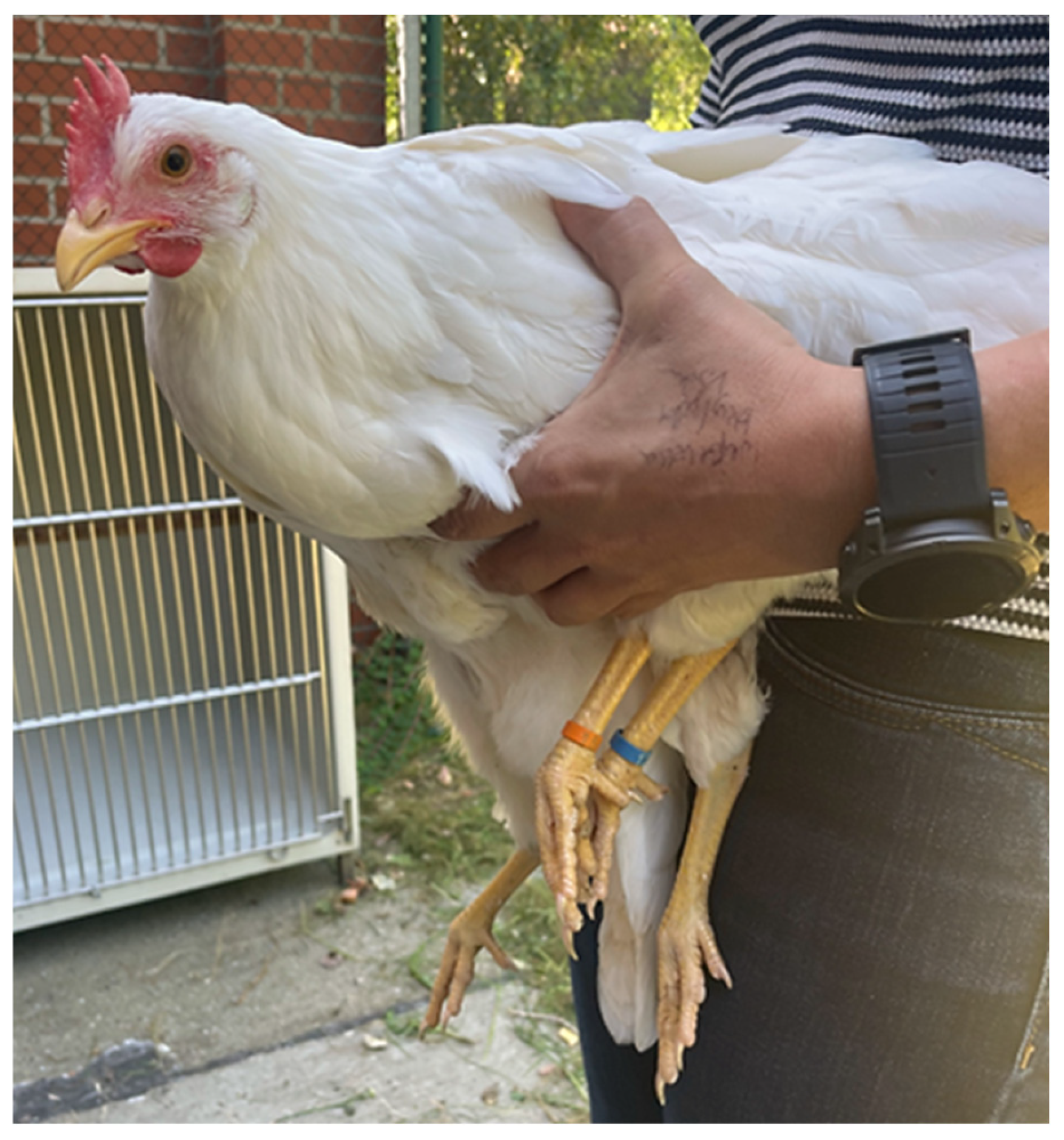
4.1. Carrying Chickens in an Upright Position Is Commonly Performed When Handling Small Numbers of Individual Birds
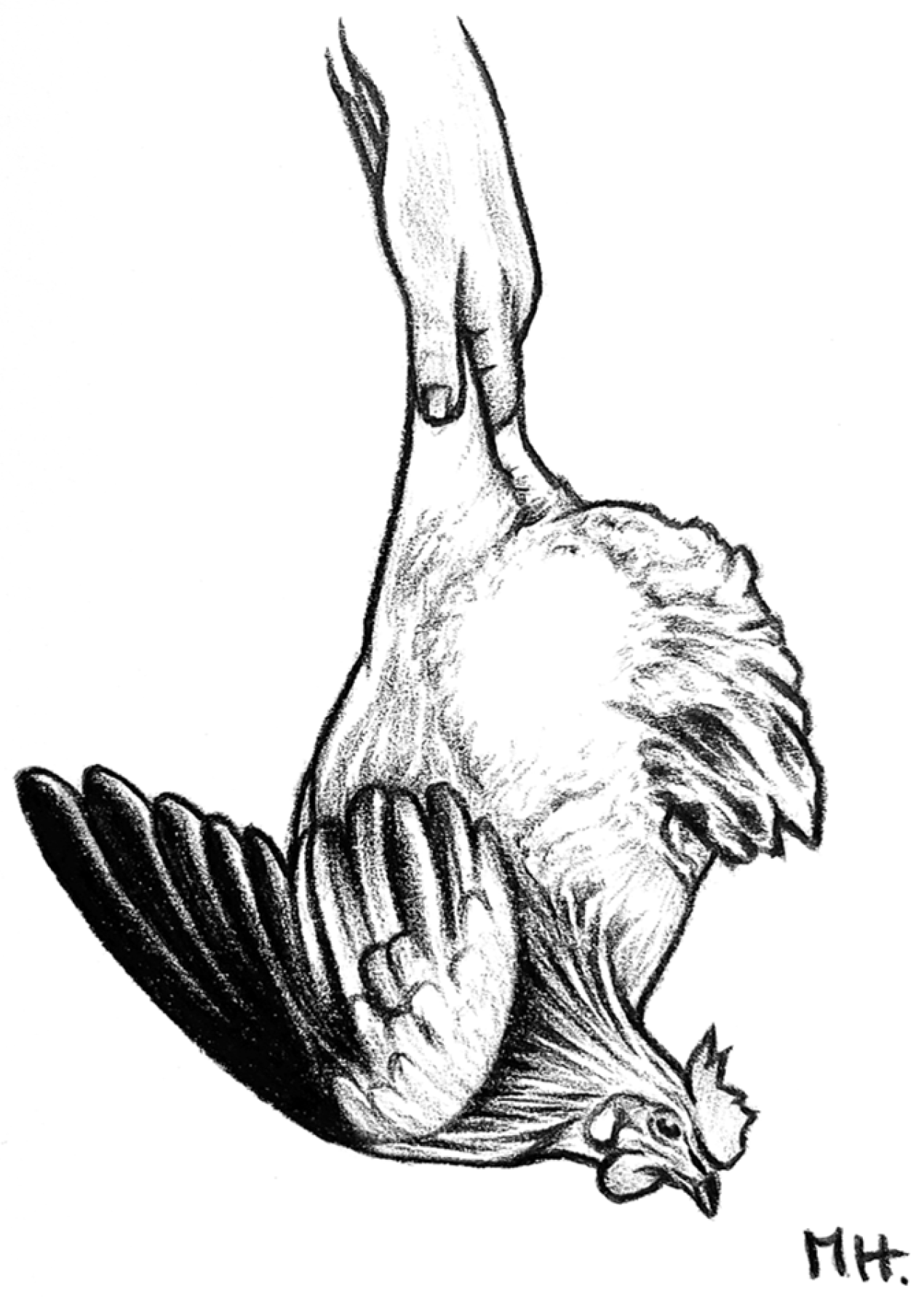
4.2. The Conditions and Duration of the Upright and Inverse Capture Methods and Carrying Position in Birds
5. The Influence of Catching and Carrying Poultry by One and Two Legs, as Well as Holding and Transporting Poultry in an Upright and Overhead Position
6. The Consequences of the Upright and Inverted Catching and Carrying Method for the Flock, the Employees, and the Business
6.1. Consequences for the Flock
6.2. Consequences for Employees
6.3. Consequences for Operations
7. Conclusions
Author Contributions
Funding
Institutional Review Board Statement
Informed Consent Statement
Data Availability Statement
Acknowledgments
Conflicts of Interest
Abbreviations
| EU | European Union |
| EFSA | European Food Safety Authority |
| ABM | animal-based measure |
| e.g., | exempli gratia (for example) |
| DOA | Death on Arrival |
References
- Kettlewell, P.J.; Turner, M.J.B. A review of broiler chicken catching and transport systems. J. Agric. Eng. Res. 1985, 31, 93–114. [Google Scholar] [CrossRef]
- De Lima, V.A.; Ceballos, M.C.; Gregory, N.G.; Da Costa, M.J.P. Effect of different catching practices during manual upright handling on broiler welfare and behavior. Poult. Sci. 2019, 98, 4282–4289. [Google Scholar] [CrossRef] [PubMed]
- Delanglez, F.; Watteyn, A.; Ampe, B.; Segers, V.; Garmyn, A.; Delezie, E.; Sleeckx, N.; Kempen, I.; Demaître, N.; Van Meirhaeghe, H.; et al. Comparing methods for catching and crating broiler chicken flocks: A trade-off between animal welfare, ergonomics and economics. Poult. Sci. 2025, 104, 104704. [Google Scholar] [CrossRef]
- Lee, C.C.; Adom, A.H.; Markom, M.A.; Tan, E.S.M.M. Automated chicken weighing system using wireless sensor network for poultry farmers. In Proceedings of the 1st International Conference on Mechanical Electronic and Biosystem Engineering (MEBSE 2018), Bogor, Indonesia, 15–16 December 2018; IOP Conference Series: Materials Science and Engineering; IOP Publishing: Bristol, UK, 2019; Volume 557, p. 012017. [Google Scholar]
- Kheiralla, A.F.; Yousif, H.; Hassan, H.G.; Khiery, H.A.; Ghanim, M. Design and development of a low cost semi-automated poultry vaccination machine. In Proceedings of the 2016 Conference of Basic Sciences and Engineering Studies (SGCAC), Khartoum, Sudan, 20–23 February 2016; IEEE: New York, NY, USA, 2016; pp. 187–191. [Google Scholar]
- Tierschutzgesetz. Animal Welfare Act as Amended on 18 May 2006 (BGB1. I S. 1206, 1313), Last Amended by Art. 2, Paragraph 20, of the Act of 20 December 2022 (BGB1. I S. 2752). 2006. Available online: https://www.gesetze-im-internet.de/tierschg/BJNR012770972.html (accessed on 21 October 2025). (In German)
- Council Regulation (EC) No 1/2005 (2004). On the Protection of Animals During Transport and Related Operations and Amending Directives 64/432/EEC and 93/119/EC and Regulation (EC) No 1255/97. OJ L 3, 5.1.2005, 1–44. Available online: https://eur-lex.europa.eu/eli/reg/2005/1/oj/eng (accessed on 21 October 2025).
- Council Regulation (EC) No 1099/2009 (2009). On the Protection of Animals at the Time of Killing. OJ L 303, 18.11.2009, 1–30. Available online: https://eur-lex.europa.eu/eli/reg/2009/1099/oj/eng (accessed on 21 October 2025).
- Proposal for a Regulation of the European Parliament and of the Council on the Protection of Animals During Transport and Related Operations, Amending Council Regulation (EC) No 1255/97 and Repealing Council Regulation (EC) No 1/2005. Available online: https://eur-lex.europa.eu/resource.html?uri=cellar:57d664d4-94df-11ee-b164-01aa75ed71a1.0001.02/DOC_1&format=PDF (accessed on 22 October 2025).
- Annexes to the Proposal for a Regulation of the European Parliament and of the Council on the Protection of Animals During Transport and Related Operations, Amending Council Regulation (EC) No 1255/97 and Repealing Council Regulation (EC) No 1/2005. Available online: https://eur-lex.europa.eu/resource.html?uri=cellar:57d664d4-94df-11ee-b164-01aa75ed71a1.0001.02/DOC_2&format=PDF (accessed on 22 October 2025).
- Werner, A.; Blaeske, A.; Rauch, E.; Erhard, M.; Unterholzner, J.; Schmidt, P.; Gotthart, M.; Louton, H. Behavior of broilers and impacts occurring to them during mechanical loading under field conditions. Poult. Sci. 2023, 102, 102688. [Google Scholar] [CrossRef]
- Mellor, D.J.; Reid, C.S.W. Concepts of animal well-being and predicting the impact of procedures on experimental animals. Improv. Well-Being Anim. Res. Environ. 1994, 3–18. [Google Scholar]
- Council, F.A.W. Farm Animal Welfare in Great Britain: Past, Present and Future; FAWC: London, UK, 2009; Available online: https://www.wellbeingintlstudiesrepository.org/cgi/viewcontent.cgi?article=1020&context=aw_welfare_gen (accessed on 21 October 2025).
- Webster, A.J. Farm animal welfare: The five freedoms and the free market. Vet. J. 2001, 161, 229–237. [Google Scholar]
- Mellor, D.J.; Beausoleil, N.J. Extending the ‘Five Domains’ model for animal welfare assessment to incorporate positive welfare states. Anim. Welf. 2015, 24, 241–253. [Google Scholar] [CrossRef]
- Webster, J. Animal welfare: Freedoms, dominions and “a life worth living”. Animals 2016, 6, 35. [Google Scholar] [CrossRef]
- Gormally, B.M.; Romero, L.M. What are you actually measuring? A review of techniques that integrate the stress response on distinct time-scales. Funct. Ecol. 2020, 34, 2030–2044. [Google Scholar] [CrossRef]
- Grandin, T. Assessment of stress during handling and transport. J. Anim. Sci. 1997, 75, 249–257. [Google Scholar] [CrossRef] [PubMed]
- Graml, C.; Waiblinger, S.; Niebuhr, K. Validation of tests for on-farm assessment of the hen–human relationship in non-cage systems. Appl. Anim. Behav. Sci. 2008, 111, 301–310. [Google Scholar] [CrossRef]
- Schlegel, L.; Kleine, A.S.; Doherr, M.G.; Fischer-Tenhagen, C. How to see stress in chickens: On the way to a Stressed Chicken Scale. Poult. Sci. 2024, 103, 103875. [Google Scholar] [CrossRef]
- Scott, G.B.; Moran, P. Behavioural responses of laying hens to carriage on horizontal and inclined conveyors. Anim. Welf. 1992, 1, 269–277. [Google Scholar] [CrossRef]
- Herborn, K.A.; Graves, J.L.; Jerem, P.; Evans, N.P.; Nager, R.; McCafferty, D.J.; McKeegan, D.E. Skin temperature reveals the intensity of acute stress. Physiol. Behav. 2015, 152, 225–230. [Google Scholar] [CrossRef]
- Mitchell, M.A.; Kettlewell, P.J.; Maxwell, M.H. Indicators of physiological stress in broiler chickens during road transportation. Anim. Welf. 1992, 1, 91–103. [Google Scholar] [CrossRef]
- Smidt, D. Advantages and Problems of Using Integrated Systems of Indicators as Compared to Single Traits. In Indicators Relevant to Farm Animal Welfare; Smidt, D., Ed.; Current Topics in Veterinary Medicine and Animal Science; Springer: Dordrecht, The Netherlands, 1983; Volume 23, pp. 201–207. [Google Scholar]
- Simonsen, H.B. Assessment of animal welfare by a holistic approach: Behaviour health and measured opinion. Acta Agric. Scand. 1996, 27, 91–96. [Google Scholar]
- Broom, D.M.; Knight, P.G.; Stansfield, S.C. Hen behaviour and hypothalamic-pituitary-adrenal responses to handling and transport. Appl. Anim. Behav. Sci. 1986, 16, 98. [Google Scholar] [CrossRef]
- Cransberg, P.H.; Hemsworth, P.H.; Coleman, G.J. Human factors affecting the behaviour and productivity of commercial broiler chickens. Br. Poult. Sci. 2000, 41, 272–279. [Google Scholar] [CrossRef]
- Fraisse, F.; Cockrem, J.F. Corticosterone and fear behaviour in white and brown caged laying hens. Br. Poult. Sci. 2006, 47, 110–119. [Google Scholar] [CrossRef]
- Hassan, F.A.; Lashin, A.I. Influence of handling processes for broilers on mortality and carcass quality at slaughterhouse. Misr J. Agric. Eng. 2017, 34, 1923–1948. [Google Scholar] [CrossRef]
- Duncan, I.J.H. Reactions of Poultry to Human Beings. Social Stress in Domestic Animals, 1st ed.; Kluwer Academic Publishers: Dordrecht, The Netherlands, 1990; pp. 121–131. [Google Scholar]
- McMillan, F.D. What Is Distress? A Complex Answer to a Simple Question. In Mental Health and Well-Being in Animals, 2nd ed.; CABI Publishing: Oxfordshire, UK, 2020; Volume 11, pp. 140–155. [Google Scholar]
- EFSA Panel on Animal Health and Welfare (AHAW); Nielsen, S.S.; Alvarez, J.; Bicout, D.J.; Calistri, P.; Canali, E.; Drewe, J.A.; Garin-Bastuji, B.; Gonzales Rojas, J.L.; Gortázar Schmidt, C.; et al. Methodological guidance for the development of animal welfare mandates in the context of the Farm to Fork Strategy. EFSA J. 2022, 20, e07403. [Google Scholar] [CrossRef] [PubMed]
- Cockram, M.S.; Dulal, K.J. Injury and mortality in broilers during handling and transport to slaughter. Can. J. Anim. Sci. 2018, 98, 416–432. [Google Scholar] [CrossRef]
- Boissy, A. Fear and fearfulness in animals. Q. Rev. Biol. 1995, 70, 165–191. [Google Scholar] [CrossRef]
- Nicol, C.J.; Scott, G.B. Pre-slaughter handling and transport of broiler chickens. Appl. Anim. Behav. Sci. 1990, 28, 57–73. [Google Scholar] [CrossRef]
- Terlouw, E.M.C.; Arnould, C.; Aupérin, B.; Berri, C.; Le Bihan-Duval, E.; Deiss, V.; Lefèvre, F.; Lensink, B.J.; Mounier, L. Pre-slaughter conditions, animal stress and welfare: Current status and possible future research. Animal 2008, 2, 1501–1517. [Google Scholar] [CrossRef]
- Bayliss, P.A.; Hinton, M.H. Transportation of broilers with special reference to mortality rates. Appl. Anim. Behav. Sci. 1990, 28, 93–118. [Google Scholar] [CrossRef]
- Krautwald-Junghanns, M.-E.; Ahlers, C.; Fries, R. Expert opinion—Transport of chickens (Gallus gallus f. dom.) for slaughter, taking into account animal welfare/anatomical-physiological and meat hygiene aspects—A literature review. TiRuP 2021, 2021, 211–254. (In German) [Google Scholar] [CrossRef]
- Kannan, G.; Mench, J.A. Influence of different handling methods and crating periods on plasma corticosterone concentrations in broilers. Br. Poult. Sci. 1996, 37, 21–31. [Google Scholar] [CrossRef]
- Herr, L. Examinations of Laying Hens at the Slaughterhouse and Their Significance for Animal Health and Welfare in Laying Operations. Doctoral Dissertation, LMU München, Munich, Germany, 2016. (In German) [Google Scholar]
- Mitchell, M.A.; Kettlewell, P.J. Welfare of poultry during transport—A review. Poult. Welf. Symp. Cervia 2009, 90–100. [Google Scholar]
- Nijdam, E.; Delezie, E.; Lambooij, E.; Nabuurs, M.J.; Decuypere, E.; Stegeman, J.A. Feed withdrawal of broilers before transport changes plasma hormone and metabolite concentrations. Poult. Sci. 2005, 84, 1146–1152. [Google Scholar] [CrossRef] [PubMed]
- Zhang, L.; Yue, H.Y.; Zhang, H.J.; Xu, L.; Wu, S.G.; Yan, H.J.; Gong, Y.S.; Qi, G.H. Transport stress in broilers: I. Blood metabolism, glycolytic potential, and meat quality. Poult. Sci. 2009, 88, 2033–2041. [Google Scholar] [CrossRef] [PubMed]
- Beuving, G.; Vonder, G.M.A. Effect of stressing factors on corticosterone levels in the plasma of laying hens. Gen. Comp. Endocrinol. 1978, 35, 153–159. [Google Scholar] [CrossRef]
- Knowles, T.G.; Broom, D.M. Effect of catching method on the concentration of plasma corticosterone in end-of-lay battery hens. Vet. Rec. 1993, 133, 527–528. [Google Scholar] [CrossRef]
- Freeman, B.M.; Manning, A.C.C.; Flack, I.H. Adrenal cortical activity in the domestic fowl, Gallus domesticus, following withdrawal of water or food. Comp. Biochem. Physiol. 1983, 74, 639–641. [Google Scholar] [CrossRef]
- Saleh, S.Y.; Jaksch, W. The effect of stress factors on blood leucocytic count, glucose and corticoids in chickens. Zentralblatt Für Veterinärmedizin 1977, 24, 220–228. [Google Scholar] [CrossRef]
- Di Martino, G.; Capello, K.; Russo, E.; Mazzucato, M.; Mulatti, P.; Ferrè, N.; Garbo, A.; Brichese, M.; Marangon, S.; Bonfanti, L. Factors associated with pre-slaughter mortality in turkeys and end of lay hens. Animal 2017, 11, 2295–2300. [Google Scholar] [CrossRef]
- Bessei, V.W.; Gschwindt, B.; Scholtyssek, S. Stress tests on laying hens—The influence of relocation on performance and certain physiological characteristics. Eur. Poult. Sci. 1979, 43, 144–149. (In German) [Google Scholar] [CrossRef]
- Voslarova, E.; Chloupek, P.; Vosmerova, P.; Chloupek, J.; Bedanova, I.; Vecerek, V. Time course changes in selected biochemical indices of broilers in response to pre-transport handling. Poult. Sci. 2011, 90, 2144–2152. [Google Scholar] [CrossRef]
- Sprafke, H. Investigation of Two Transport Options with Regard to Animal Welfare in Organically Raised Pullets. Doctoral Dissertation, LMU München, Munich, Germany, 2019. (In German) [Google Scholar]
- Warriss, P.D.; Kestin, S.C.; Brown, S.N.; Knowles, T.G.; Wilkins, L.J.; Edwards, J.E.; Austin, S.D.; Nicol, C.J. The depletion of glycogen stores and indices of dehydration in transported broilers. Br. Vet. J. 1993, 149, 391–398. [Google Scholar] [CrossRef] [PubMed]
- EFSA Panel on Animal Health and Welfare (AHAW); Nielsen, S.S.; Alvarez, J.; Bicout, D.J.; Calistri, P.; Canali, E.; Drewe, J.A.; Garin-Bastuji, B.; Gonzales Rojas, J.L.; Gortázar Schmidt, C.; et al. Welfare of domestic birds and rabbits transported in containers. EFSA J. 2022, 20, e07441. [Google Scholar] [CrossRef] [PubMed]
- EFSA Panel on Animal Health and Welfare (AHAW); Nielsen, S.S.; Alvarez, J.; Bicout, D.J.; Calistri, P.; Depner, K.; Drewe, J.A.; Garin-Bastuji, B.; Gonzales Rojas, J.L.; Gortázar Schmidt, C.; et al. Scientific Opinion on the killing for purposes other than slaughter: Poultry. EFSA J. 2019, 17, e05850. [Google Scholar] [PubMed]
- Duncker, H.R. Vertebrate lungs: Structure, topography and mechanics: A comparative perspective of the progressive integration of respiratory system, locomotor apparatus and ontogenetic development. Respir. Physiol. Neurobiol. 2004, 144, 111–124. [Google Scholar] [CrossRef]
- Duncker, H.R. Structure of avian lungs. Respir. Physiol. 1972, 14, 44–63. [Google Scholar] [CrossRef]
- Jones, J.H.; Effmann, E.L.; Schmidt-Nielsen, K. Lung volume changes during respiration in ducks. Respir. Physiol. 1985, 59, 15–25. [Google Scholar] [CrossRef]
- James, A.E., Jr.; Hutchins, G.; Bush, R.M.; Natarajan, T.K.; Burns, B. How birds breathe: Correlation of radiographic with anatomical and pathological studies. J. Am. Vet. Radiol. Soc. 1976, 17, 77–86. [Google Scholar] [CrossRef]
- Nickel, E.; Nickel, R.; Schummer, A.; Seiferle, E. Textbook of Domestic Animal Anatomy, Anatomy of Birds, 3rd ed.; Enke Ferdinand Publishing: Stuttgart, Germany, 2004. (In German) [Google Scholar]
- Lasiewski, R.C. Respiratory function in birds. Avian Biol. 1972, 2, 287–342. [Google Scholar]
- Schmidt-Nielsen, K. How birds breathe. Sci. Am. 1971, 225, 72–79. [Google Scholar] [CrossRef]
- Duncker, H.R. The Lung Air Sac System of Birds: A Contribution to the Functional Anatomy of the Respiratory Apparatus; Springer Science Business Media: Berlin/Heidelberg, Germany, 2013; Volume 45. [Google Scholar]
- Duncker, H.R. Structure of the avian respiratory tract. Respir. Physiol. 1974, 22, 1–19. [Google Scholar] [CrossRef]
- Petnehazy, O.; Csoka, A.; Fajtai, D.; Echols, S.; Donko, T. CT-based 3D reconstruction and basic anatomical analysis of the 3D anatomy of the air sac system in domestic birds. Anat. Histol. Embryol. 2024, 53, e13022. [Google Scholar] [CrossRef]
- Powell, F.L. Respiration. In Sturkie’s Avian Physiology, 5th ed.; Whittow, G.C., Ed.; Academic Press: New York, NY, USA, 2015; Volume 10, pp. 233–264. [Google Scholar]
- König, H.E.; Liebich, H.-G.; Korbel, R.T. Anatomy of Birds, 2nd ed.; Schattauer Publishing: Stuttgart, Germany, 2009; Volume 89, p. 301. (In German) [Google Scholar]
- Akers, M.; Denbow, M. Anatomy and Physiology of Domestic Animals, 1st ed.; Wiley-Blackwell: Hoboken, NJ, USA, 2008; Volume 14, pp. 379–398. [Google Scholar]
- Reece, W.O. Functional Anatomy and Physiology of Domestic Animals, 5th ed.; Wiley-Blackwell: Hoboken, NJ, USA, 2009; Volume 10, pp. 289–297. [Google Scholar]
- Animal Welfare Committee. Opinion on the Welfare Implications of Different Methods and Systems for the Catching, Carrying, Collecting and Loading of Poultry. Animal Welfare Committee, Department for Environment, Food and Rural Affairs, the Schottish Government and the Welsh Government. 2023. Available online: https://assets.publishing.service.gov.uk/media/65ce3cdf0f4eb1001aa9811a/AWC_Opinion_on_poultry_catching__carrying__collecting_and_loading_submitted_version__27.3.23.pdf (accessed on 8 December 2025).
- Wessel, J.; Rauch, E.; Hartmannsgruber, S.; Erhard, M.; Schmidt, P.; Schade, B.; Louton, H. A comparison of two manual catching methods of broiler considering injuries and behavior. Poult. Sci. 2022, 101, 102127. [Google Scholar] [CrossRef]
- Calder, W.A. Respiratory and heart rates of birds at rest. Condor 1968, 70, 358–365. [Google Scholar] [CrossRef]
- King, A.S.; Payne, D.C. Normal breathing and the effects of posture in Gallus domesticus. J. Physiol. 1964, 174, 340. [Google Scholar] [CrossRef] [PubMed]
- Bouverot, P. Control of breathing in birds compared with mammals. Physiol. Rev. 1978, 58, 604–655. [Google Scholar] [CrossRef] [PubMed]
- Fedde, M.R.; Burger, R.E.; Kitchell, R.L. Electromyographic studies of the effects of bilateral, cervical vagotomy on the action of the respiratory muscles of the domestic cock. Poult. Sci. 1964, 43, 1119–1125. [Google Scholar] [CrossRef]
- Mulcahy, D.M. Free-Living Waterfowl and Shorebirds. Zoo Animal and Wildlife Immobilization and Anesthesia, 2nd ed.; John Wiley Sons, Inc.: Hoboken, NJ, USA, 2014; Volume 29, pp. 481–505. [Google Scholar]
- Hawkins, M.G.; Malka, S.; Pascoe, P.J.; Solano, A.M.; Kass, P.H.; Ohmura, H.; Jones, J.H. Evaluation of the effects of dorsal versus lateral recumbency on the cardiopulmonary system during anesthesia with isoflurane in red-tailed hawks (Buteo jamaicensis). Am. J. Vet. Res. 2013, 74, 136–143. [Google Scholar] [CrossRef]
- Malka, S.; Hawkins, M.G.; Jones, J.H.; Pascoe, P.J.; Kass, P.H.; Wisner, E.R. Effect of body position on respiratory system volumes in anesthetized red-tailed hawks (Buteo jamaicensis) as measured via computed tomography. Am. J. Vet. Res. 2009, 70, 1155–1160. [Google Scholar] [CrossRef]
- Ludders, J.W. RESPIRATORY Physiology of Birds: Considerations for Anesthetic Management. In Seminars in Avian and Exotic Pet Medicine; WB Saunders: Philadelphia, PA, USA, 1998; Volume 7, pp. 3–9. [Google Scholar]
- Zehnder, A.M.; Hawkins, M.G.; Pascoe, P.J. Avian Anatomy and Physiology. Zoo Animal and Wildlife Immobilization and Anesthesia, 2nd ed.; John Wiley Sons, Inc.: Hoboken, NJ, USA, 2014; Volume 23, pp. 389–398. [Google Scholar]
- Hawkins, M.G.; Zehnder, A.M.; Pascoe, P.J. Cagebirds. Zoo Animal and Wildlife Immobilization and Anesthesia, 2nd ed.; John Wiley Sons, Inc.: Hoboken, NJ, USA, 2014; Volume 24, pp. 399–433. [Google Scholar]
- Heard, D. Galliformes and Columbiformes. Zoo Animal and Wildlife Immobilization and Anesthesia, 2nd ed.; John Wiley Sons, Inc.: Hoboken, NJ, USA, 2014; Volume 28, pp. 473–480. [Google Scholar]
- Lierz, M.; Korbel, R. Anesthesia and analgesia in birds. J. Exot. Pet Med. 2012, 21, 44–58. [Google Scholar] [CrossRef]
- Butler, P.J. Respiratory and cardiovascular control during diving in birds and mammals. J. Exp. Biol. 1982, 100, 195221. [Google Scholar] [CrossRef]
- Butler, P.J.; Jones, D.R. Onset of and recovery from diving bradycardia in ducks. J. Physiol. 1968, 196, 255. [Google Scholar] [CrossRef] [PubMed]
- Aviagen Turkeys Management Guidelines for Commercial Turkeys. Aviagen Turkeys Limited. 2022. Available online: https://www.aviagenturkeys.com/uploads/2022/03/17/CL23_V3_Management%20Guidelines%20for%20Growing%20Commercial%20Turkeys_EN.pdf (accessed on 9 December 2025).
- Barbut, S. Developments in turkey meat harvesting technologies. World’s Poult. Sci. J. 2015, 71, 59–70. [Google Scholar] [CrossRef]
- Chen, W.S. Duck Slaughter Processing and Meat Quality Measurements. In Duck Production and Management Strategies, 1st ed.; Springer Nature: Singapore, 2022; pp. 403–442. [Google Scholar]
- Knierim, U.; Gieseke, D.; Michaelis, S.; Keppler, C.; Spindler, B.; Rauch, E.; Petermann, S.; Andersson, R.; Schultheiß, U.; Zapf, R. Animal welfare indicators: Practical guidelines Poultry: Recommendations for production sectors involving pullets, laying hens, broilers, and turkeys. Kuratorium für Technik und Bauwesen in der Landwirtschaft eV (KTBL). 2020. Available online: https://www.ktbl.de/fileadmin/user_upload/Allgemeines/Download/Tierwohl/Leitfaden2020_Jung_Legehennen.pdf (accessed on 22 October 2025). (In German)
- Prescott, N.B.; Berry, P.S.; Haslam, S.; Tinker, D.B. Catching and crating turkeys: Effects on carcass damage, heart rate, and other welfare parameters. J. Appl. Poult. Res. 2000, 9, 424–432. [Google Scholar] [CrossRef]
- DLG-Committee; Grashorn, M.; Brehme, G. DLG-Information Sheet 436: Duck Fattening. DLG e. V.; Edition 3. 2018. Available online: https://www.dlg.org/mediacenter/dlg-merkblaetter/dlg-merkblatt-436-entenmast (accessed on 21 October 2025). (In German)
- Europaratsempfehlung. ‘Recommendation concerning Muscovy ducks (Cairina moschata) and hybrids of Muscovy ducks and Peking ducks (Anas platyrhynchos)’. Standing Committee of the European Convention for the Protection of Animals kept for Farming Purposes (T-AP). 2013. Available online: https://www.bmleh.de/SharedDocs/Downloads/DE/_Tiere/Tierschutz/Gutachten-Leitlinien/eu-haltung-moschusenten.pdf?__blob=publicationFile&v=2 (accessed on 22 October 2025). (In German)
- Niedersächsischen Ministeriums für Ernährung, Landwirtschaft, Verbraucherschutz und Landesentwicklung. Agreement between the Lower Saxony Ministry of Food, Agriculture, Consumer Protection, and Regional Development (ML) and the Lower Saxony Poultry Industry on the Further Development of Minimum Requirements for the Keeping of Muscovy Ducks. Lower Saxony Ministry of Food, Agriculture, Consumer Protection, and Regional Development. 2013. Available online: https://www.ml.niedersachsen.de/download/72727/Moschusentenvereinbarung.pdf (accessed on 2 January 2025). (In German)
- Niedersächsischen Ministeriums für Ernährung, Landwirtschaft, Verbraucherschutz und Landesentwicklung. Agreement Between the Lower Saxony Ministry of Food, Agriculture, Consumer Protection, and Regional Development (ML) and the Lower Saxony Poultry Industry on the Further Development of Minimum Requirements for the Rearing of Peking Ducks for Fattening. Lower Saxony Ministry of Food, Agriculture, Consumer Protection, and Regional Development. 2015. Available online: https://studylibde.com/doc/6616910/pekingentenv-endg---nieders%C3%A4chsische-gefl%C3%BCgelwirtschaft (accessed on 22 October 2025). (In German)
- Niedersächsischen Ministeriums für Ernährung, Landwirtschaft, Verbraucherschutz und Landesentwicklung. Agreement Between the Lower Saxony Ministry of Food, Agriculture, Consumer Protection, and Regional Development (ML) and the Lower Saxony Poultry Industry on the Further Development of Minimum Requirements for the Rearing and Fattening of Geese. Lower Saxony Ministry of Food, Agriculture, Consumer Protection, and Regional Development. 2020. Available online: https://www.ml.niedersachsen.de/download/154663/Gaensevereinbarung.pdf (accessed on 2 January 2025). (In German)
- Anderson, R.S.; Edney, A.T.B. Practical Animal Handling, 1st ed.; Pergamon Press Plc.: Oxford, UK, 1991; pp. 1–198. [Google Scholar]
- DLG-Committee; Spindler, B.; Sieverding, E.; Wolf-Reuter, M.; Grashorn, M.; Kellpler, C.; Garrelfs, I. DLG-Information Sheet 477: Handling Sick and Injured Commercial Poultry. DLG e. V.; Edition 1. 2022. Available online: https://www.dlg.org/fileadmin/downloads/Merkblaetter/dlg-merkblatt_477.pdf (accessed on 21 October 2025). (In German)
- Dutra, F.M.; Garcia, R.G.; Binotto, E.; Burbarelli, M.F.D.C. What do we know about the impacts of poultry catching? World’s Poult. Sci. J. 2021, 77, 983–999. [Google Scholar] [CrossRef]
- Delanglez, F.; Watteyn, A.; Ampe, B.; Garmyn, A.; Delezie, E.; Antonissen, G.; Sleeckx, N.; Kempen, I.; Demaître, N.; Van Meirhaeghe, H.; et al. Survey of Flemish poultry farmers on how birds fit for transport to the slaughterhouse are selected, caught, and crated and their opinions regarding the pre-transport process. Animals 2024, 14, 3241. [Google Scholar] [CrossRef]
- Rechtbank Rotterdam. ROT 22/2933, 22/2935, 22/2936. Rechtbank Rotterdam, 24-11-2022, ECLI:NL:RBROT:2022:10109, ROT 22/2933 22/2935 22/2936|HSE. 2022. Available online: https://hse.sdu.nl/content/ECLI_NL_RBROT_2022_10109 (accessed on 9 December 2025). (In Dutch)
- Gerpe, C.; Stratmann, A.; Bruckmaier, R.; Toscano, M.J. Examining the catching, carrying, and crating process during depopulation of end-of-lay hens. J. Appl. Poult. Res. 2021, 30, 100115. [Google Scholar] [CrossRef]
- Gerrits, A.R.; de Koning, K.; Mighels, A. Catching Broilers. Poultry 1985, 1, 20–23. [Google Scholar]
- Parry, R.T. Technological Developments in Pre-Slaughter Handling and Processing, 1st ed.; Processing of Poultry; Springer: Boston, MA, USA, 1995; Volume 3, pp. 65–101. [Google Scholar]
- Wolff, I.; Klein, S.; Rauch, E.; Erhard, M.; Mönch, J.; Härtle, S.; Schmidt, P.; Louton, H. Harvesting-induced stress in broilers: Comparison of a manual and a mechanical harvesting method under field conditions. Appl. Anim. Behav. Sci. 2019, 221, 104877. [Google Scholar] [CrossRef]
- Mönch, J.; Rauch, E.; Hartmannsgruber, S.; Erhard, M.; Wolff, I.; Schmidt, P.; Schug, A.R.; Louton, H. The welfare impacts of mechanical and manual broiler catching and of circumstances at loading under field conditions. Poult. Sci. 2020, 99, 5233–5251. [Google Scholar] [CrossRef]
- Zulkifli, I.; Norma, M.T.C.; Chong, C.H.; Loh, T.C. Heterophil to lymphocyte ratio and tonic immobility reactions to preslaughter handling in broiler chickens treated with ascorbic acid. Poult. Sci. 2000, 79, 402–406. [Google Scholar] [CrossRef]
- Langkabel, N.; Baumann, M.P.; Feiler, A.; Sanguankiat, A.; Fries, R. Influence of two catching methods on the occurrence of lesions in broilers. Poult. Sci. 2015, 94, 1735–1741. [Google Scholar] [CrossRef]
- Kittelsen, K.E.; Granquist, E.G.; Aunsmo, A.L.; Moe, R.O.; Tolo, E. An evaluation of two different broiler catching methods. Animals 2018, 8, 141. [Google Scholar] [CrossRef] [PubMed]
- Broom, D.M. Effects of handling and transport on laying hens. World’s Poult. Sci. J. 1990, 46, 48–50. [Google Scholar] [CrossRef]
- Delanglez, F.; Watteyn, A.; Ampe, B.; Segers, V.; Garmyn, A.; Delezie, E.; Sleeckx, N.; Kempen, I.; Demaitre, N.; Van Meirhaeghe, H.; et al. Upright versus inverted catching and crating end-of-lay hens: A trade-off between animal welfare, ergonomic and financial concerns. Poult. Sci. 2024, 103, 104118. [Google Scholar] [CrossRef] [PubMed]
- Gregory, N.G.; Wilkins, L.J. Broken bones in domestic fowl: Handling and processing damage in end-of-lay battery hens. Br. Poult. Sci. 1989, 30, 555–562. [Google Scholar] [CrossRef]
- Knowles, T.G. Handling and transport of spent hens. World’s Poult. Sci. J. 1994, 50, 60–61. [Google Scholar] [CrossRef]
- Fleming, R.H.; Whitehead, C.C.; Alvey, D.; Gregory, N.G.; Wilkins, L.J. Bone structure and breaking strength in laying hens housed in different husbandry systems. Br. Poult. Sci. 1994, 35, 651–662. [Google Scholar] [CrossRef]
- Bishop, S.C.; Fleming, R.H.; McCormack, H.A.; Flock, D.K.; Whitehead, C.C. Inheritance of bone characteristics affecting osteoporosis in laying hens. Br. Poult. Sci. 2000, 41, 33–40. [Google Scholar] [CrossRef]
- Dunn, I.C.; Fleming, R.H.; McCormack, H.A.; Morrice, D.; Burt, D.W.; Preisinger, R.; Whitehead, C.C. A QTL for osteoporosis detected in an F2 population derived from White Leghorn chicken lines divergently selected for bone index. Anim. Genet. 2007, 38, 45–49. [Google Scholar] [CrossRef]
- Whitehead, C.C. Bone breakage and osteoporosis in laying hens: Causes and solutions. Proc. Aust. Poult. Sci. Symp. 2002, 14, 61–68. [Google Scholar]
- Zhao, S.C.; Teng, X.Q.; Xu, D.L.; Chi, X.; Ge, M.; Xu, S.W. Influences of low level of dietary calcium on bone characters in laying hens. Poult. Sci. 2020, 99, 7084–7091. [Google Scholar] [CrossRef] [PubMed]
- Wei, H.D.; Chen, Y.J.; Zeng, X.Y.; Bi, Y.J.; Wang, Y.N.; Zhao, S.; Li, J.H.; Li, X.; Zhang, R.X.; Bao, J. Keel-bone fractures are associated with bone quality differences in laying hens. Anim. Welf. 2021, 30, 71–80. [Google Scholar] [CrossRef]
- Stratmann, A.; Fröhlich, E.K.F.; Gebhardt-Henrich, S.G.; Harlander-Matauschek, A.; Würbel, H.; Toscano, M.J. Genetic selection to increase bone strength affects prevalence of keel bone damage and egg parameters in commercially housed laying hens. Poult. Sci. 2016, 95, 975–984. [Google Scholar] [CrossRef] [PubMed]
- Gregory, N.G.; Wilkins, L.J. Skeletal Damage and Bone Defects During Catching and Processing. In Bone Biology and Skeletal Disorders in Poultry; Series 23; Carfax Publishing Co.: Abingdon, UK, 1992; Volume 28, pp. 313–328. [Google Scholar]
- Kittelsen, K.E.; Granquist, E.G.; Vasdal, G.; Tolo, E.; Moe, R.O. Effects of catching and transportation versus pre-slaughter handling at the abattoir on the prevalence of wing fractures in broilers. Anim. Welf. 2015, 24, 387–389. [Google Scholar] [CrossRef]
- Duncan, I.J.H. The assessment of welfare during the handling and transport of broilers. In Proceedings of the 3rd European Symposium on Poultry Welfare, Tours, France, 11–14 June 1989; World’s Poultry Science Association: Beekbergen, The Netherlands, 1989; pp. 93–107. [Google Scholar]
- Duncan, I.J.H.; Slee, G.S.; Kettlewell, P.; Berry, P.; Carlisle, A.J. Comparison of the stressfulness of harvesting broiler chickens by machine and by hand. Br. Poult. Sci. 1986, 27, 109–114. [Google Scholar] [CrossRef]
- Barnett, J.L.; Hemsworth, P.H. Fear of humans by laying hens in different tiers of a battery: Behavioural and physiological responses. Br. Poult. Sci. 1989, 30, 497–504. [Google Scholar] [CrossRef]
- Hansen, I.; Braastad, B.O.; Storbråten, J.; Tofastrud, M. Differences in fearfulness indicated by tonic immobility between laying hens in aviaries and in cages. Anim. Welf. 1993, 2, 105–112. [Google Scholar] [CrossRef]
- Kannan, G.; Mench, J.A. Prior handling does not significantly reduce the stress response to pre-slaughter handling in broiler chickens. Appl. Anim. Behav. Sci. 1997, 51, 87–99. [Google Scholar] [CrossRef]
- Tinker, D.B.; Berry, P.S.; Rycroft, J.A.; Sparks, N.H. Handling and Catching of Hens During Depopulation. Welfare of the Laying Hen, Papers from the 27th Poultry Science Symposium; World’s Poultry Science Association, CABI Publishing: Wallingford, UK, 2004; Volume 27, pp. 345–360. [Google Scholar]
- Zulkifli, I.; Gilbert, J.; Liew, P.K.; Ginsos, J. The effects of regular visual contact with human beings on fear, stress, antibody and growth responses in broiler chickens. Appl. Anim. Behav. Sci. 2002, 79, 103–112. [Google Scholar] [CrossRef]
- Jones, R.B. The nature of handling immediately prior to test affects tonic immobility fear reactions in laying hens and broilers. Appl. Anim. Behav. Sci. 1992, 34, 247–254. [Google Scholar] [CrossRef]
- Huneau-Salaün, A.; Stärk, K.D.C.; Mateus, A.; Lupo, C.; Lindberg, A.; Le Bouquin-Leneveu, S. Contribution of meat inspection to the surveillance of poultry health and welfare in the European Union. Epidemiol. Infect. 2015, 143, 2459–2472. [Google Scholar] [CrossRef]
- Vecerek, V.; Grbalova, S.; Voslarova, E.; Janackova, B.; Malena, M. Effects of travel distance and the season of the year on death rates of broilers transported to poultry processing plants. Poult. Sci. 2006, 85, 1881–1884. [Google Scholar] [CrossRef] [PubMed]
- Nielsen, B.L.; Dybkjær, L.; Herskin, M.S. Road transport of farm animals: Effects of journey duration on animal welfare. Animal 2011, 5, 415–427. [Google Scholar] [CrossRef] [PubMed]
- Weeks, C.A. Poultry Handling and Transport. Livestock Handling and Transport, 4th ed.; CABI Publishing: Wallingford, UK, 2014; Volume 20, pp. 378–398. [Google Scholar]
- Chauvin, C.; Hillion, S.; Balaine, L.; Michel, V.; Peraste, J.; Petetin, I.; Lupo, C.; Le Bouquin, S. Factors associated with mortality of broilers during transport to slaughterhouse. Animal 2011, 5, 287–293. [Google Scholar] [CrossRef] [PubMed]
- Fahd, A.M.M.; Saleem, A.S.K.; Ibrahim, M.Y.; Fattah, A.F.A.; Donia, G.R. Impact of transportation stress on growth performance, behaviour and welfare of Turkey pullets. Adv. Anim. Vet. Sci. 2024, 12, 353–360. [Google Scholar] [CrossRef]
- Cockram, M.S.; Dulal, K.J.; Mohamed, R.A.; Revie, C.W. Risk factors for bruising and mortality of broilers during manual handling, module loading, transport, and lairage. Can. J. Anim. Sci. 2018, 99, 50–65. [Google Scholar] [CrossRef]
- Petracci, M.; Bianchi, M.; Cavani, C.; Gaspari, P.; Lavazza, A. Preslaughter mortality in broiler chickens, turkeys, and spent hens under commercial slaughtering. Poult. Sci. 2006, 85, 1660–1664. [Google Scholar] [CrossRef]
- Redantz, A.; Lühken, S.; Heil, N.; Toppel, K.; Nyanzi, C.; Kernberger-Fischer, I.; Kauselmann, K.; Andersson, R.; Schrader, L.; Koch, M.; et al. Poultry: Model report on national animal welfare monitoring. Konsortium des Projektes Nationales Tierwohl-Monitoring (NaTiMon). 2023. Available online: https://d-nb.info/1295135167/34 (accessed on 31 December 2024). (In German)
- Benincasa, N.C.; Sakamoto, K.S.; da Silva, I.J.O.; Lobos, C.M.V. Animal welfare: Impacts of pre-slaughter operations on the current poultry industry. J. Anim. Behav. Biometeorol. 2020, 8, 104–110. [Google Scholar] [CrossRef]
- Knowles, T.G.; Wilkins, L.J. The problem of broken bones during the handling of laying hens–A review. Poult. Sci. 1998, 77, 1798–1802. [Google Scholar] [CrossRef]
- Majewski, E.; Potori, N.; Sulewski, P.; Wąs, A.; Mórawska, M.; Gębska, M.; Malak-Rawlikowska, A.; Grontkowska, A.; Szili, V.; Erdős, A. End of the Cage Age? A Study on the Impacts of the Transition from Cages on the EU Laying Hen Sector. Agriculture 2024, 14, 111. [Google Scholar] [CrossRef]
- Mitchell, M.A.; Kettlewell, P.J. Physiological stress and welfare of broiler chickens in transit: Solutions not problems! Poult. Sci. 1998, 77, 1803–1814. [Google Scholar] [CrossRef] [PubMed]
- Nijdam, E.; Arens, P.; Lambooij, E.; Decuypere, E.; Stegeman, J.A. Factors influencing bruises and mortality of broilers during catching, transport, and lairage. Poult. Sci. 2004, 83, 1610–1615. [Google Scholar] [CrossRef] [PubMed]
- Kettlewell, P.J.; Mitchell, M.A. Catching, handling and loading of poultry for road transportation. World’s Poult. Sci. J. 1994, 50, 54–56. [Google Scholar] [CrossRef]
- Delezie, E.; Verbeke, W.; De Tavernier, J.; Decuypere, E. Consumers’ preferences toward techniques for improving manual catching of poultry. Poult. Sci. 2006, 85, 2019–2027. [Google Scholar] [CrossRef]
- Cockram, M.S.; Dulal, K.J.; Stryhn, H.; Revie, C.W. Rearing and handling injuries in broiler chickens and risk factors for wing injuries during loading. Can. J. Anim. Sci. 2020, 100, 402–410. [Google Scholar] [CrossRef]
- Mitchell, M.; Kettlewell, P. Transport of Chicks, Pullets and Spent Hens. In Proceedings of the Welfare of the Laying Hen, Papers from the 27th Poultry Science Symposium of the World’s Poultry Science Association, Bristol, UK, July 2003; CABI Publishing: Wallingford, UK, 2004; Volume 27, pp. 361–374. [Google Scholar]
- Lalonde, S.; Beaulac, K.; Crowe, T.G.; Schwean-Lardner, K. The effects of simulated transportation conditions on the core body and extremity temperature, blood physiology, and behavior of white-strain layer pullets. Poult. Sci. 2021, 100, 697–706. [Google Scholar] [CrossRef]
- Metheringham, J. Poultry in transit—A cause for concern? Br. Vet. J. 1996, 152, 247–250. [Google Scholar] [CrossRef]
- Millman, C.; Christley, R.; Rigby, D.; Dennis, D.; O’Brien, S.J.; Williams, N. “Catch 22”: Biosecurity awareness, interpretation and practice amongst poultry catchers. Prev. Vet. Med. 2017, 141, 22–32. [Google Scholar] [CrossRef]
- Gerpe, C.; Toscano, M.J. Solutions to improve the catching, handling, and crating as part of the depopulation process of end of lay hens. J. Appl. Poult. Res. 2023, 32, 100358. [Google Scholar] [CrossRef]
- Pilecco, M.; Almeida Paz, I.C.L.; Tabaldi, L.A.; Nääs, I.A.; Garcia, R.G.; Caldara, F.R.; Francisco, N.S. Training of catching teams and reduction of back scratches in broilers. Braz. J. Poult. Sci. 2013, 15, 283–286. [Google Scholar] [CrossRef]
- Taylor, M.H.; Helbacka, N.V.L. Field studies of bruised poultry. Poult. Sci. 1968, 47, 1166–1169. [Google Scholar] [CrossRef]
- Duncan, I.J. The domestic fowl. In The UFAW Handbook on the Care and Management of Laboratory and Other Research Animals, 9th ed.; John Wiley Sons Ltd.: Hoboken, NJ, USA, 2024; Volume 40, pp. 739–761. [Google Scholar]





| Parameter | Individual-Based | Flock-Based |
|---|---|---|
| Behavior | Restlessness, vocalizations, feather pecking, escape attempts, frequency of feces passage, chicken stress scale, tonic immobility test, novel object test, avoidance distance test, avoidance distance touch test, approach test | Smothering events, sound volume & vocalizations, movement flow |
| Physiology | Body temperature (cloacal & comb temperature), respiratory rate, beak breathing, heart rate/pulse | |
| Biology | Hematocrit, creatine kinase, fat metabolism products, adrenal gland weight, antibody formation/immunological parameters, hormones (e.g., corticosteroids, prostaglandins, adrenocorticotropic hormone (ACTH)-stimulation test) | Hormones (particularly corticosteroids) |
| Health | Physical integrity of the living animal or carcass (condition of feathers, skin, body structure, organs, tissues including bruises, fractures, epiphyseal separations), necropsy findings | Flock treatment rate, mortality rate, rate of death on arrivals (DOA) |
| Performance | Body weight (change), ovary activity upon necropsy | Feed intake, body weight change, laying rate |
| Reference | Type of Bird | Body Weight/Age | Catching Method | Sample Size (Flocks/Birds) | Welfare Indicators | Main Findings |
|---|---|---|---|---|---|---|
| Delanglez et al. (2024) [109] | Laying hens | 94 weeks | One-legged (inverted) and upright | 7 flocks: ~3000 hens per method and flock | Behavior, noise, wing flapping, catcher–bird-interaction, DOA, injuries | Upright method took almost twice as long; 1.8 times more expensive; lower prevalence of wing flapping and wing bruises |
| Gerpe et al. (2021) [100] | Laying hens | 72–85 weeks | Upright method (for baseline assessment); various catching methods combined with inverted carrying | 15 flocks, 603 hens in total | Active and passive collisions, injuries (bone and muscle) | 8.1% of the hens showed severe injuries (fractures, muscle damage, increased corticosterone) due to collisions when carried out by non-professional catchers |
| Delanglez et al. (2025) [3] | Broilers | ~42 days | Inverted, mechanical and upright | 15 flocks, 5000 broilers per method and flock | Behavior, noise, wing flapping, catcher–bird-interaction, DOA, catch damage | Upright method required 0.63 additional person-hours per 1000 broilers, 1.5 times more expensive, less wing flapping, better catcher–bird interaction |
| Kannan et al. (1996) [39] | Broilers (male) | 42–49 days | Inverted and upright | Research facility with 280 broilers | Plasma corticosteroid concentrations | Upright handling led to significantly lower corticosteroid concentrations; crating stress can mask the prior handling stress |
| Kittelsen et al. (2018) [107] | Broilers | 1.3–1.5 kg 33–44 days | Two-legged (inverted, up to 3 per hand) and upright (2 per catch) | 2 flocks (different strains): 3951 broilers | Fractures, DOA, stocking density | Catching by two legs took significantly longer, broilers were more restless, showed more wing fractures; less consistent crating density |
| Langkabel et al. (2015) [106] | Broilers | 1.9–2.5 kg 35–42 days | One-legged (inverted) and two-legged (inverted) | Farm 1: 38,500 broilers Farm 2: 29,500 broilers | Lesions (hemorrhages, wing fractures), wing flapping | Catching by two legs took longer in general; no effect on the prevalence of bruises or fractures in the carcass |
| Wessel et al. (2022) [70] | Broilers | 2.3–3.1 kg 30–40 days | One-legged (inverted) and two-legged (inverted) | 12 loadings, average of 8679 broilers per loading | Behavior, injuries | Catching by two legs took twice as long; significantly higher variability in stocking density in the transport containers (two-legged method); one-legged method led to higher chances for epiphysiolysis |
Disclaimer/Publisher’s Note: The statements, opinions and data contained in all publications are solely those of the individual author(s) and contributor(s) and not of MDPI and/or the editor(s). MDPI and/or the editor(s) disclaim responsibility for any injury to people or property resulting from any ideas, methods, instructions or products referred to in the content. |
© 2026 by the authors. Licensee MDPI, Basel, Switzerland. This article is an open access article distributed under the terms and conditions of the Creative Commons Attribution (CC BY) license.
Share and Cite
Hettmannsperger, M.A.; Ruhnke, I. Manual Catching and Transportation of Poultry with a Focus on Chickens and European Practices. Poultry 2026, 5, 30. https://doi.org/10.3390/poultry5020030
Hettmannsperger MA, Ruhnke I. Manual Catching and Transportation of Poultry with a Focus on Chickens and European Practices. Poultry. 2026; 5(2):30. https://doi.org/10.3390/poultry5020030
Chicago/Turabian StyleHettmannsperger, Maike Alena, and Isabelle Ruhnke. 2026. "Manual Catching and Transportation of Poultry with a Focus on Chickens and European Practices" Poultry 5, no. 2: 30. https://doi.org/10.3390/poultry5020030
APA StyleHettmannsperger, M. A., & Ruhnke, I. (2026). Manual Catching and Transportation of Poultry with a Focus on Chickens and European Practices. Poultry, 5(2), 30. https://doi.org/10.3390/poultry5020030