Article

Heat Stress Induces Inflammatory Response Through Inhibiting PPARα in Broiler Chickens

State Key Laboratory of Animal Nutrition, Institute of Animal Science, Chinese Academy of Agricultural Sciences, Beijing 100193, China
*
Author to whom correspondence should be addressed.
Poultry 2026, 5(1), 13; https://doi.org/10.3390/poultry5010013
Submission received: 14 October 2025 / Revised: 18 December 2025 / Accepted: 23 January 2026 / Published: 9 February 2026

Abstract

Heat stress poses a considerable challenge to the modern poultry industry by negatively impacting immune system maturation and eliciting inflammatory responses. Peroxisome proliferators-activated receptors α (PPARα), predominantly expressed in metabolically active tissues such as skeletal muscle, are essential for regulating the inflammatory process. Moreover, our recent research has found that heat stress down-regulates the transcription of PPARα in broiler chickens. To study if PPARα regulation is involved in heat-stress-induced skeletal muscle inflammatory response in broiler chickens, 180 male Arbor Acres (AA) broilers aged 22 days were randomly assigned to three experimental groups: a thermoneutral condition group at 21 °C, a heat stress group at 31 °C and a heat stress group at 31 °C supplemented with the PPARα activator fenofibrate. After 7 days of adaptive feeding, the broilers were subjected to a 14-day formal experimental phase. Results demonstrated that heat stress decreased the spleen and thymus index and increased serum and breast muscle inflammatory factor concentrations (p < 0.05). Moreover, heat-stress-induced abnormal breast muscle fiber morphology in broiler chickens. Furthermore, heat stress significantly up-regulated nuclear factor kappa-B (NF-κB) expression in boiler chickens (p < 0.05). However, activating PPARα through fenofibrate improved the growth performance (p < 0.05), enhanced immune organ indexes (p < 0.05), reduced inflammatory factor concentrations (p < 0.05), alleviated breast muscle fiber morphology damage and suppressed NF-κB expression (p < 0.05) in the breast muscle of broiler chickens. Based on our previous research, these results collectively underscore that heat stress induced inflammation and up-regulated NF-κB in the breast muscle of broiler chickens by inhibiting PPARα.

1. Introduction

Broiler chickens, characterized by a rapid growth rate, high metabolic activity and a body surface covered with feathers but lacking sweat glands, exhibit heightened susceptibility to elevated temperatures, which detrimentally impact their performance and health [1]. As global warming intensifies, heat stress has emerged as a serious impediment to the sustainable development of the poultry industry [2]. Heat stress exerts adverse effects by disrupting the development of the immune system, elevating levels of pro-inflammatory cytokines and activating inflammatory signaling pathways, collectively compromising animal health. The main immune organs in broiler chickens, which consist of the thymus, bursa of Fabricius and spleen, experience significant impairment in growth and development under heat stress conditions [3]. Elevated temperatures lead to a reduction in lymphocytes and lymphoid follicles, leading to atrophy of the bursa of Fabricius in broiler chickens [4,5]. Similarly, heat stress resulted in spleen atrophy in broiler chickens by increasing the apoptosis rate of spleen cells [6,7]. Furthermore, heat stress significantly impacts pro-inflammatory cytokines in broiler chickens, including interleukin-2 (IL-2) in lymphocytes, as well as IL-1β, IL-6, tumor necrosis factor-α (TNF-α) and IL-4 in the spleen [8,9]. Notably, the upregulation of pro-inflammatory cytokine expression is a consequence of the nuclear factor kappa-B (NF-κB) pathway, a central and classic signaling pathway in the inflammatory process [10]. The overexpression of IL-6, IL-8 and TNF-α in broiler chickens is induced by the activation of the NF-κB signaling pathway, a phenomenon linked to heat stress [11,12]. Therefore, heat stress represents a critical global issue in the broiler industry, inducing inflammatory responses that adversely affect broiler health. Notably, our recent research revealed that heat stress down-regulates the transcription of PPARα in broiler chickens [13].
Peroxisome proliferator-activated receptor α (PPARα) plays a dynamic regulatory role in various physiological and pathological processes [14,15]. Notably, PPARα serves as a critical regulator of inflammation, as evidenced by prolonged inflammatory responses observed in PPARα-knockout mice following inflammation induction [16]. Furthermore, a study has demonstrated that PPARα activation inhibits the expression of inflammatory response-related genes through negative interference with the NF-κB signaling pathway in vitro [17]. The NF-κB pathway, swiftly activated by heat stress, plays a significant role in inducing inflammation in broiler chickens [11,12]. Previous research reported that PPARα mitigates inflammatory responses by inhibiting NF-κB transcription and reducing inflammatory factor production in broiler chickens under cold stress [18]. Nonetheless, the functions of PPARα in heat-stress-induced inflammatory responses in broiler chickens remain poorly understood.
Building on the aforementioned groundwork, we hypothesized that PPAR serves as a vital target in regulating the inflammatory response in broiler chickens under heat stress. Fenofibrate, a clofibrate derivative, is a specific and highly efficient activator of PPARα [19]. To verify this hypothesis, the current research sought to explore whether PPARα regulates the inflammatory response of heat-stressed broiler chickens through a fenofibrate-activated PPARα trial. The research not only highlights the critical role of PPARα as a regulatory target in mitigating heat-stress-induced inflammation but also establishes a theoretical basis for enhancing the health of broiler chickens.

2. Materials and Methods

Adhering rigorously to global animal welfare norms, the animal trials conducted in this research were carefully evaluated and sanctioned by the Animal Care and Use Committee at the Institute of Animal Science, Chinese Academy of Agricultural Sciences. Ethical Approval No. IAS 2020-112 validates the compliance of these experimental protocols.

2.1. Birds and Housing

One-day-old male Arbor Acres chickens were purchased from a commercial hatchery (Luanping Yijia Agricultural Development Co., Ltd., Chengde, China) and reared in the artificial climate chambers (4.08 × 2.88 × 2.38 m3) of the Chinese Academy of Agricultural Sciences’ State Key Laboratory of Animal Nutrition and Feeding. Then, until 22 days old, the investigation selected 180 22-day-old male Arbor Acres (AA) chickens with similar body weights (970.2 g ± 7.96). These were randomly allotted to three treatment categories: the thermal neutral (TN) group, the heat stress (HS) group and the heat stress group with PPARα activation by means of fenofibrate (HSA) group. Every treatment had six repetitions, and each repetition included ten broilers. The temperature of the TN group was set at 21 °C, and the temperature of the HS group and the HSA group was set at 31 °C. The added amount of fenofibrate (F7960, Solaibao Biotechnology, Beijing, China) in the experimental diets was determined according to the body weight of broilers, i.e., 27 mg/kg/d from 28 to 35 days old and 25 mg/kg/d from 35 to 42 days old. All broilers were domiciled in single-layer flat cages (0.82 × 0.70 × 0.60 m3) that were placed in the artificial climate chambers (4.08 × 2.88 × 2.38 m3) of the Chinese Academy of Agricultural Sciences’ State Key Laboratory of Animal Nutrition and Feeding, whereby each chamber was stocked with three cages. As per the Arbor Acres Broiler Management Handbook [20], broilers were caged for one week to acclimate until 29 days old, then the 14-day experimental period (29 to 42 days old) began with other feeding conditions set accordingly. The temperature and humidity in the artificial climate chambers were monitored in real time to maintain the temperature in the chambers with an accuracy of ±1 °C, the humidity in the chambers with an accuracy of ±7%, the wind speed < 0.5 m/s, the ammonia concentration < 5 ppm, and the 24 h light period in the whole trial. The temperature and humidity recorder (Testo 174 H, Testo AG, Lenzkirchen, Germany) kept recording once every ten minutes.

2.2. Diets and Feeding Program

All groups were provided with a standardized basal diet with maize and soybean meal (Table 1) [21], which was developed according to the AA broiler recommendations of 2019 [22]. In this study, unrestricted access to both diets and water was granted to all broiler chickens.

2.3. Sample Collection

After being deprived of feed for 12 h, 12 broilers per group, 2 broilers in each replication, were selected on the 7th and 14th day of heat stress. These birds were chosen based on their body weight, which was closely aligned with the average body weight of the group, ensuring a representative sample. Blood specimens, which were derived from the left-wing vein, were procured with the use of vacuum blood collection tubes. Subsequently, they were centrifuged at 1000× g for 10 min at 4 °C to extract the serum, and the serum was stored at −20 °C for the analysis of inflammatory factors. Next, broilers were euthanized by CO2 inhalation, and immune organs (spleen, thymus, and bursa of Fabricius) were collected and weighed for index calculation. Upon weighing, breast muscle tissue samples were rapidly retrieved and frozen in liquid nitrogen without delay. Stored at –80 °C, these samples were intended for the investigation of inflammatory factors and NF-κB expression. Moreover, another segment of the breast muscle was conserved with 4% paraformaldehyde (Biosharp, Shanghai, China), preparing it for hematoxylin and eosin (HE) staining to conduct histomorphological studies.

2.4. Growth Performance

The record of broiler feed intake was conducted every day. At the beginning and the end of the trial, the body weight of broilers was also recorded. The average daily gain (ADG), average daily feed intake (ADFI) and feed conversion rate (FCR, FCR = ADFI ÷ ADG) were calculated.

2.5. Immune Organ Index Analysis

Spleen, thymus and bursa of Fabricius immune organ indexes (index = organ weight ÷ broiler body weight × 100) were calculated.

2.6. Inflammatory Factor Analysis

Breast muscle samples were subjected to homogenization in a glass homogenizer with 10 mL of pre-refrigerated PBS (in a 1:5 mass/volume proportion). After the centrifugal processing of the formed homogenate at 1500× g for 15 min, the supernatant was salvaged. Through the use of immunoassay kits from Nanjing Jiancheng Bioengineering Institute, the levels of IL-1β, IL-6 and TNF-α in both serum and breast muscle were subsequently assayed. Absorbance measurements at 530 nm were carried out using a Multiskan MK3 microplate reader from Thermo Fisher Scientific (Waltham, MA, USA).

2.7. Breast Muscle Histomorphology Analysis

Immobilized and preserved in 4% paraformaldehyde, breast muscle samples were embedded and encapsulated in paraffin with a KD-BMIV machine (KEDEE, Jinhua, China). Then, going through precision trimming, systematic dehydration, professional transparency treatment, meticulous waxing and precise sectioning (1–1.5 mm slice thickness) by a KD-2268 microtome (KEDEE, Jinhua, China), they finally received standardized HE staining.

2.8. Quantitative Real-Time PCR

The expression of NF-κB mRNA in breast muscle was assessed through Quantitative Real-Time PCR. Total RNA extraction from breast muscle samples by the Trizol method, RNA reverse transcription, and Quantitative Real-Time PCR was performed using reagent kits (Takara, Dalian, China). With β-actin acting as the calibrator gene for data normalization, the 2ΔΔCt methodology was utilized to ascertain the relative quantification of gene expression. This process was preceded by using the primers listed in Table 2 for performing relative RT-PCR to analyze gene expression [21].

2.9. Western Blot Analysis

To isolate and denature the entire protein content from cecal mucosa and breast muscle specimens, Radio Immunoprecipitation Assay (RIPA) lysis buffer (AWB0136c; Abiowell, Wuhan, China) and SDS loading buffer (AWB0055; Abiowell, China) were utilized. Leveraging SDS-polyacrylamide gel electrophoresis media from Quanshijin (Haidian, Beijing, China), proteomic entities with distinct molecular weights were segregated by means of electrophoretic techniques. Proteins were separated by 12% SDS-PAGE gradient gels (Quanshijin, Haidian, Beijing, China) at 80 V for 30 min, then at 120 V for 60 min and transferred to PVDF membranes (0.45 μm; Millipore, Bedford, USA) at 300 mA for 30 min. Thereafter, a polyvinylidene fluoride (PVDF) blotting film sourced from Millipore (Burlington, MA, USA) was utilized to transfer these segregated proteomic entities. The antibodies of NF-κB (AWA64866; Abiowell, China) and β-actin (AWA80002; Abiowell, China) were diluted by primary antibody diluent (AWB0200c; Abiowell, China) before use. Once the PVDF blotting membrane had been washed in a rapid-blocking solution (AWB0214b; Abiowell, China) for 10 min, it was flushed three times with 0.05% TBS + Tween (Biyuntian, Shanghai, China). Then, it was incubated in diluted primary antibodies at 4 °C for the whole night. After three more flushes with 0.05% TBS + Tween, the membrane was incubated at room temperature for 90 min with an anti-rabbit secondary antibody (AWS0002; Abiowell, China) diluted by a secondary antibody diluent (AWB0201c; Abiowell, China). Finally, the protein bands were detected by Li-COR Odyssey (Tanon-5200, Tanon Science and Technology Co., Shanghai, China) and quantified using National Institutes of Health (NIH) ImageJ 1.52n (National Institutes of Health, Bethesda, MD, USA).

2.10. Statistical Analysis

SPSS 23.0 was used for one-way ANOVA with Duncan post hoc tests and a D’Agostino–Pearson omnibus normality test on experimental data. GraphPad Prism 8.0 constructed figures. Replicates (n = 12) were experimental units; data are shown as mean ± SEM, with p < 0.05 indicating significance.

3. Results

3.1. Growth Performance

Table 3 illustrates the effects of PPARα activation on the growth performance of broiler chickens exposed to heat stress [21]. In the first seven-day phase of the study, broiler chickens in the HS group fell short of those in the TN group (p < 0.05). The HS group showed remarkably lower ADG and ADFI, and its FCR was considerably heightened (p < 0.05). Yet, upon activation of PPARα, the chickens in the HSA group effected a significant shift. Compared to the HS group, they displayed significantly augmented ADG and ADFI, along with a significantly decreased FCR, thus highlighting a clear-cut improvement (p < 0.05). During the 7–14 d of the trial, compared to the TN group, the broiler chickens in the HS group had markedly lower ADG and ADFI, and higher FCR (p < 0.05). Additionally, whereas ADG and ADFI remained unaltered for the HS and HSA groups, the HSA group saw a marked decline in FCR (p < 0.05).

3.2. Immune Organ Indexes

Table 4 expounds on the divergences in the splenic, thymic and bursal of Fabricius indices among the three experimental groups. At the 7-day time-point of the trial, in comparison with the TN group, heat stress significantly attenuated the splenic and thymic indices of broiler chickens in the HS group (p < 0.05). In a nutshell, PPARα activation substantially increased the spleen and thymus indices in the HSA group as opposed to the HS group (p < 0.05). The bursa of Fabricius index stayed constant among the three groups initially (p > 0.05). But at 14 days, the HS group had considerably lower spleen, thymus and bursa of Fabricius indices than the TN group (p < 0.05). Significantly, PPARα activation advanced the spleen and thymus indices in the HSA group compared to the HS group (p < 0.05), with no significant effect on the bursa of Fabricius index (p > 0.05).

3.3. Inflammatory Factors

The differences in IL-6, IL-1β and TNF-α concentrations in serum and breast muscle among the three groups are shown in Table 5. At the 7 d and 14 d of the trial, the HS group significantly increased the concentrations of serum IL-6, IL-1β and TNF-α in broiler chickens compared to those in the TN group (p < 0.05). Following PPARα activation, the concentrations of serum IL-6, IL-1β and TNF-α were significantly reduced compared to the HS group (p < 0.05). At the 7 d of the trial, heat stress significantly increased the breast muscle IL-6 and TNF-α concentrations compared to the TN group (p < 0.05), while PPARα activation markedly reduced heat-stress-induced elevations in breast muscle IL-6 and TNF-α (p < 0.05). However, there were no significant effects on breast muscle IL-1β (p > 0.05) concentrations among the three groups. On the 14 d of the trial, compared to the TN group, heat stress significantly increased breast muscle IL-1β and TNF-α concentrations in broiler chickens from the HS group (p < 0.05). Additionally, PPARα activation markedly reduced the breast muscle IL-1βand TNF-α concentrations compared to those in the HS group (p < 0.05). There was no effect on breast muscle IL-6 concentrations among the three treatments (p > 0.05).

3.4. Breast Muscle Histomorphology Analysis

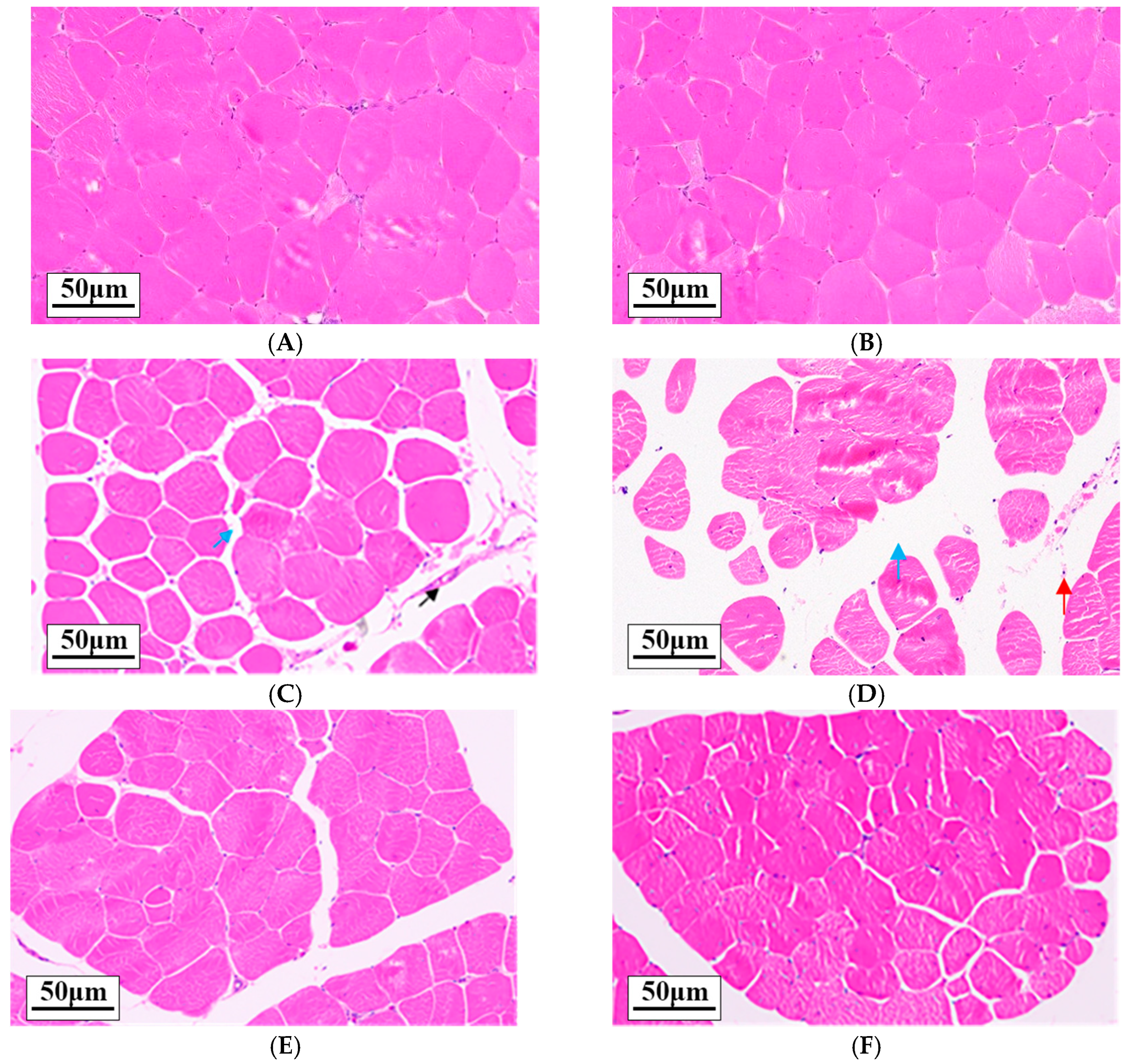
The effects of PPARα activation on breast muscle histomorphology in broiler chickens, as assessed by HE staining, are shown in Figure 1. Breast muscle tissue from the TN group had normal breast muscle morphology, characteristic of healthy muscle at both 7 d and 14 d of the trial. In contrast, mild abnormalities of breast muscle were observed in the HS group, including the intermuscular space widening (blue arrows) and a small number of inflammatory cells diffusely distributed (red arrow). Remarkably, breast muscle morphology in the HSA group showed significant improvement with no obvious fibrosis and necrotic foci.

3.5. NF-κB Expression in Breast Muscle

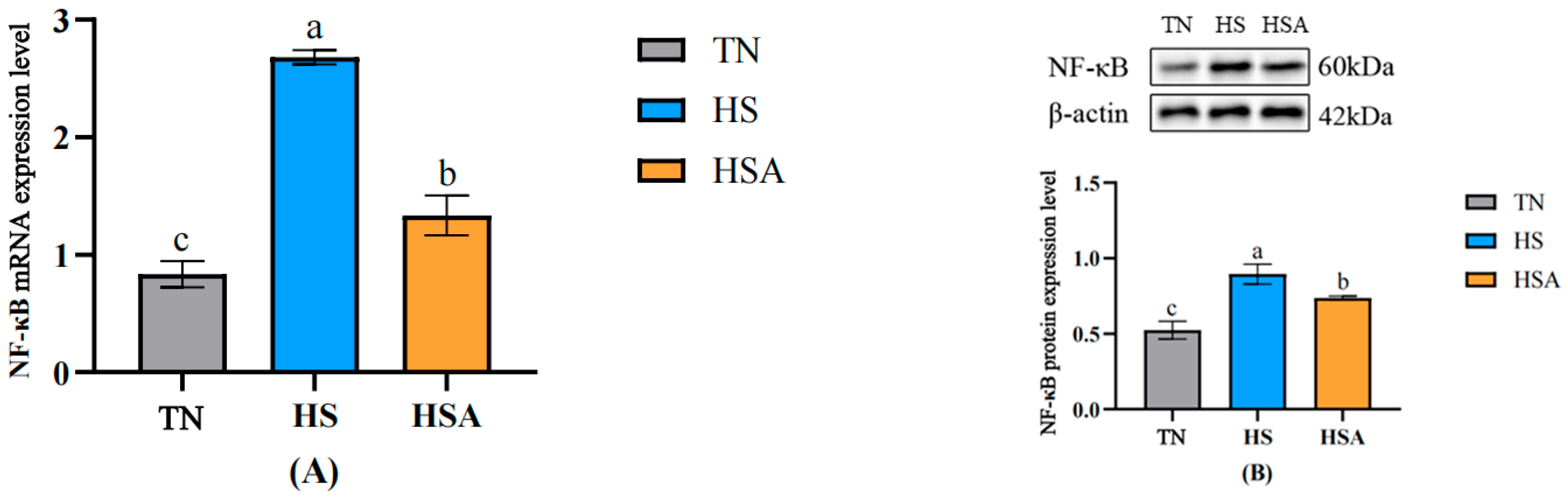
Given the indispensable regulatory role of the NF-κB signaling pathway in modulating the inflammatory responses of broiler chickens during heat stress, we gauged the NF-κB gene expression in breast muscle on the 14th day of the experiment, as depicted in Figure 2 (Figures S1 and S2). Contrary to the TN group, the HS group manifested a significant upsurge in NF-κB mRNA and protein expression (p < 0.05). However, PPARα activation significantly down-regulated the mRNA and protein expression of NF-κB compared to those in the HS group (p < 0.05).

4. Discussion

This study revealed that heat stress escalated the amounts of pro-inflammatory mediators, leading to the infiltration of inflammatory cells into the breast muscle and activation of NF-κB expression, thereby initiating an inflammatory cascade in broiler chickens. Our results clearly indicate that activating PPARα mitigated heat-stress-induced inflammatory responses in broiler chickens, as indicated by the marked reduction in pro-inflammatory factors, alleviation of breast muscle histomorphology damage and suppression of NF-κB expression.
Our previous research successfully established heat stress broiler models at 31 °C [6,21]. In the present study, heat stress reduced the ADFI and ADG while increasing the FCR in broiler chickens. The pronounced decline in growth performance of broiler chickens under heat stress, as documented in previous research, aligns with the fundamental observations of our present research [6,23,24]. Following PPARα activation, ADFI and ADG on 1–7 d of the trial, as well as the FCR throughout the whole trial period, exhibited improvements in broiler chickens under heat stress, indicating that PPARα activation enhanced the growth performance in broiler chickens.
In this study, a significant decrease was observed in the index of spleen, thymus and bursa of Fabricius in broiler chickens under heat stress at 31 °C. Particularly, the spleen, as the largest peripheral immune organ in broiler chickens, is essential for both systemic cellular and humoral immunity [25,26]. The thymus and bursa of Fabricius are crucial organs in the development of adaptive immunity, with the thymus primarily involved in T cell differentiation and maturation in cellular immunity, and the bursa of Fabricius serving as the specific immune organ for humoral immunity in poultry [27,28]. Therefore, the immune organ index, including the spleen, thymus and bursa of Fabricius, represents essential markers for assessing both cellular and humoral immunity in broiler chickens [29]. In the present study, heat stress reduced the immune organ indexes, indicating an impairment of immune functions in the immune organs of broiler chickens. This finding is supported by previous studies reporting that exposure to heat stress reduced the spleen index in broiler chickens [6,23,30]. Furthermore, our study revealed that PPARα activation enhanced the indices of spleen and thymus, indicating that PPARα activation improved the immune functions in broiler chickens during heat stress. Previous studies have shown that PPARα activation improves immune functions in the liver, a significant immune organ, in humans and mice [31]. In addition, PPARα deficiency is involved in impairing the T cell functions in mice [32,33,34]. These previous studies indirectly support our findings that PPARα activation improved the immune function of immune organs in heat-stressed broiler chickens, although further investigations are warranted to comprehensively understand this. Therefore, the results of this study indicated that heat stress caused a significant reduction in immune function by inhibiting PPARα in broiler chickens.
The findings of this investigation showed that under heat stress conditions, the levels of IL-6, IL-1β and TNF-α escalated in both the serum and breast muscle of broiler chickens. Heat-stressed broilers exhibited infiltration of inflammatory cells in the breast muscle. IL-6, IL-1β and TNF-α are essential pro-inflammatory cytokines that regulate the inflammatory response in broiler chickens through their pro-inflammatory actions [35,36]. Previous research consistently reported an elevation in pro-inflammatory cytokine concentrations in broiler chickens under heat stress, including IL-1β, IL-2, IL-4, IL-6 and TNF-α [37,38]. These studies align with our results, indicating that heat stress triggered inflammatory responses by elevating pro-inflammatory cytokine concentrations in broiler chickens. Activation of PPARα resulted in lower concentrations of IL-6, IL-1β and TNF-α in the serum and breast muscle of broiler chickens. This was accompanied by a decrease in the infiltration of inflammatory cells in the breast muscle, indicating that PPARα activation suppressed the heat-stress-induced inflammatory reactions. It has been demonstrated that PPARα activation inhibited inflammatory responses in mammals, such as Inflammatory Bowel Diseases (IBD) mice [39], porcine endometrium [40] and the injured cornea of mice [41]. Moreover, independent anti-inflammatory effects of PPARα have been confirmed using the PPARα activator fenofibrate in both in vivo mammalian models and in vitro cell studies [42,43,44]. These mammalian studies support our results that PPARα activation inhibited inflammatory responses in broiler chickens under heat stress. Consequently, heat stress aggravated inflammatory responses in broiler chickens by inhibiting PPARα.
It is notable that heat stress up-regulated the transcription and translation of NF-κB in broiler chickens in this study. Playing a pivotal role in the regulation of inflammatory and immune homeostasis, the NF-κB signaling cascade is triggered when broiler chickens are confronted with heat stress, thereby causing the emergence of inflammation [11,12]. Consistent with previous studies, our findings demonstrated that heat stress escalated NF-κB expression, thereby instigating inflammatory responses in broiler chickens. Importantly, PPARα activation inhibited the breast muscle NF-κB expression of broiler chickens in this study. Prior studies have demonstrated that NF-κB expression can be down-regulated through activating PPARα in laboratory animals in vivo [41,45,46]. However, the function of PPARα in regulating the NF-κB signaling pathway in poultry has been minimally explored. This study filled this gap by revealing that PPARα activation inhibited the expression of NF-κB to reduce inflammation in heat-stressed broiler chickens. Consequently, heat stress up-regulated NF-κB expression, promoting inflammation in broiler chicken through PPARα inhibition. It is worth noting that inflammation has been associated with reduced BW and ADG, along with an increase in FCR in broiler chickens [47,48]. Although research on the role of PPARα on growth performance is limited, the improvement of growth performance induced by PPARα activation can be attributed to activating a PPARα-alleviated inflammatory response, thereby enhancing the growth performance in broiler chickens. Additionally, this study may have a limitation in that it only provides preliminary evidence for the role of PPARα in heat-stressed broilers. Future research will aim to systematically investigate the regulatory mechanism network of the PPARα pathway in broiler chickens.
Moreover, we are aware of a limitation of this study, which is that no expression of PPARα was measured. This study is a follow-up research based on our previous research [13]. In our recent research, it has been found that heat stress down-regulated the transcription of PPARα in broiler chickens [13]. Therefore, we conducted this experiment to certify the function of PPARα in heat-stressed broilers. The conclusion of this study regarding the inhibition of PPARα by heat stress needs to be considered in conjunction with our previous research.

5. Conclusions

In conclusion, heat stress triggers the up-regulation of NF-κB and inflammation by inhibiting PPARα in broiler chickens. The present study provides initial insights into the role of PPARα in regulating inflammatory responses in broiler chickens under heat stress. Further research efforts are warranted to unravel the regulatory networks of PPARα and to develop feed additives targeting PPARα activation, aiming to improve the health and performance of broiler chickens.

Supplementary Materials

The following supporting information can be downloaded at: https://www.mdpi.com/article/10.3390/poultry5010013/s1, Figure S1: Marker band of different molecular mass; Figure S2: Effects of PPARα activation in vivo on original data of Western Blot (n = 6) The following supporting information can be downloaded at Supplementary material.

Author Contributions

Conceptualization, X.L. and M.Z.; methodology, X.L. and M.Z.; formal analysis, M.Y. and X.L.; investigation, M.Y., X.L. and X.Z.; resources, M.Y. and X.L.; data curation, M.Y. and X.L.; writing—original draft preparation, M.Y.; writing—review and editing, X.Z., J.F. and M.Z.; visualization, M.Y.; supervision, M.Z.; project administration, M.Z. All authors have read and agreed to the published version of the manuscript.

Funding

This study received funding from multiple sources, including: (1) The National Natural Science Foundation of China (Grant No. 32272933, General Program); (2) The National Key Research and Development Program of China (Project Code: 2021YFD1300404); (3) The Chinese Academy of Agricultural Sciences through its Science and Technology Innovation Initiative (Project ID: ASTIP-IAS09).

Institutional Review Board Statement

Endorsed by the Animal Care and Use Committee of the Institute of Animal Science, Chinese Academy of Agricultural Sciences (Ethical Approval No. IAS 2020-112), approved on 30 December 2020, the animal experiments performed in this study completely adhered to international animal welfare norms.

Informed Consent Statement

Not applicable.

Data Availability Statement

The original contributions presented in this study are included in the article material. Further inquiries can be directed to the corresponding author.

Acknowledgments

The successful accomplishment of this study was largely because of the technical aid and contributions of the researchers at the State Key Laboratory of Animal Nutrition and Feeding. Their know-how was extremely significant, and we fully recognize and appreciate their dedication.

Conflicts of Interest

The authors affirm the absence of any actual or potential conflicts of interest, whether financial, professional, or personal, that might have biased the research outcomes presented in this manuscript.

References

  1. Zuo, J.; Xu, M.; Abdullahi, Y.A.; Ma, L.; Zhang, Z.; Feng, D. Constant heat stress reduces skeletal muscle protein deposition in broilers. J. Sci. Food Agric. 2015, 95, 429–436. [Google Scholar] [CrossRef]
  2. Madkour, M.; Salman, F.M.; El-Wardany, I.; Abdel-Fattah, S.A.; Alagawany, M.; Hashem, N.M.; Abdelnour, S.A.; El-Kholy, M.S.; Dhama, K. Mitigating the detrimental effects of heat stress in poultry through thermal conditioning and nutritional manipulation. J. Therm. Biol. 2022, 103, 103169. [Google Scholar] [CrossRef]
  3. Sun, S.; Li, B.; Wu, M.; Deng, Y.; Li, J.; Xiong, Y.; He, S. Effect of dietary supplemental vitamin C and betaine on the growth performance, humoral immunity, immune organ index, and antioxidant status of broilers under heat stress. Trop. Anim. Health Prod. 2023, 55, 96. [Google Scholar] [CrossRef] [PubMed]
  4. Aengwanich, W. Pathological changes and the effects of ascorbic acid on lesion scores of bursa of fabricius in broilers under chronic heat stress. Res. J. Vet. Sci. 2010, 1, 62–66. [Google Scholar]
  5. Shah, M.; Zaneb, H.; Masood, S.; Khan, I.; Sikandar, A.; Ashraf, S.; Rehman, H.F.; Usman, M.M.; Khan, F.A.; Amanullah, H.; et al. Effect of zinc and probiotics supplementation on performance and immune organs morphology in heat stressed broilers. S. Afr. J. Anim. Sci. 2018, 48, 1017–1025. [Google Scholar] [CrossRef]
  6. Ma, D.D.; Liu, Q.X.; Zhang, M.H.; Feng, J.H.; Li, X.M.; Zhou, Y.; Wang, X.J. iTRAQ-based quantitative proteomics analysis of the spleen reveals innate immunity and cell death pathways associated with heat stress in broilers (Gallus gallus). J. Proteom. 2019, 196, 11–21. [Google Scholar] [CrossRef]
  7. Zhang, C.; Chen, K.K.; Zhao, X.H.; Geng, Z.Y. Protective effects of resveratrol against high ambient temperature-induced spleen dysplasia in broilers through modulating splenic redox status and apoptosis. J. Sci. Food Agric. 2018, 98, 5409–5417. [Google Scholar] [CrossRef]
  8. Emami, N.K.; Greene, E.S.; Kogut, M.H.; Dridi, S. Heat Stress and Feed Restriction Distinctly Affect Performance, Carcass and Meat Yield, Intestinal Integrity, and Inflammatory (Chemo)Cytokines in Broiler Chickens. Front. Physiol. 2021, 12, 707757. [Google Scholar] [CrossRef]
  9. Jimoh, O.A.; Daramola, O.T.; Okin-Aminu, H.O.; Ojo, O.A. HSP70, adiponectin, leptin, pro-inflammatory cytokines and metabolic hormones of heat-stressed broilers fed herbal supplements. J. Therm. Biol. 2023, 117, 103681. [Google Scholar] [CrossRef] [PubMed]
  10. Barnabei, L.; Laplantine, E.; Mbongo, W.; Rieux-Laucat, F.; Weil, R. NF-κB: At the Borders of Autoimmunity and Inflammation. Front. Immunol. 2021, 12, 716469. [Google Scholar] [CrossRef]
  11. Zhao, Y.L.; Zhuang, Y.; Shi, Y.; Xu, Z.; Zhou, C.M.; Guo, L.Y.; Liu, P.; Wu, C.; Hu, R.M.; Hu, G.L.; et al. Effects of N-acetyl-l-cysteine on heat stress-induced oxidative stress and inflammation in the hypothalamus of hens. J. Therm. Biol. 2021, 98, 102927. [Google Scholar] [CrossRef]
  12. Liu, W.C.; Ou, B.H.; Liang, Z.L.; Zhang, R.; Zhao, Z.H. Algae-derived polysaccharides supplementation ameliorates heat stress-induced impairment of bursa of Fabricius via modulating NF-κB signaling pathway in broilers. Poult. Sci. 2021, 100, 101139. [Google Scholar] [CrossRef] [PubMed]
  13. Li, X.; Zhao, X.; Yu, M.; Zhang, M.; Feng, J. Effects of Heat Stress on Breast Muscle Metabolomics and Lipid Metabolism Related Genes in Growing Broilers. Animals 2024, 14, 430. [Google Scholar] [CrossRef]
  14. Corton, J.C.; Cunningham, M.L.; Hummer, B.T.; Lau, C.; Meek, B.; Peters, J.M.; Popp, J.A.; Rhomberg, L.; Seed, J.; Klaunig, J.E. Mode of action framework analysis for receptor-mediated toxicity: The peroxisome proliferator-activated receptor alpha (PPARα) as a case study. Crit. Rev. Toxicol. 2014, 44, 1–49. [Google Scholar] [CrossRef] [PubMed]
  15. Peters, J.M.; Cheung, C.; Gonzalez, F.J. Peroxisome proliferator-activated receptor-alpha and liver cancer: Where do we stand? J. Mol. Med. 2005, 83, 774–785. [Google Scholar] [CrossRef]
  16. Hinds, T.D., Jr.; Kipp, Z.A.; Xu, M.; Yiannikouris, F.B.; Morris, A.J.; Stec, D.F.; Wahli, W.; Stec, D.E. Adipose-Specific PPARα Knockout Mice Have Increased Lipogenesis by PASK-SREBP1 Signaling and a Polarity Shift to Inflammatory Macrophages in White Adipose Tissue. Cells 2021, 11, 4. [Google Scholar] [CrossRef]
  17. Jung, Y.; Kim, J.C.; Choi, Y.; Lee, S.; Kang, K.S.; Kim, Y.K.; Kim, S.N. Eupatilin with PPARα agonistic effects inhibits TNFα-induced MMP signaling in HaCaT cells. Biochem. Biophys. Res. Commun. 2017, 493, 220–226. [Google Scholar] [CrossRef] [PubMed]
  18. Zhang, Z.W.; Bi, M.Y.; Yao, H.D.; Fu, J.; Li, S.; Xu, S.W. Effect of cold stress on expression of AMPKalpha-PPARalpha pathway and inflammation genes. Avian Dis. 2014, 58, 415–426. [Google Scholar] [CrossRef]
  19. Wang, M.S.; Han, Q.S.; Jia, Z.R.; Chen, C.S.; Qiao, C.; Liu, Q.Q.; Zhang, Y.M.; Wang, K.W.; Wang, J.; Xiao, K.; et al. PPARα agonist fenofibrate relieves acquired resistance to gefitinib in non-small cell lung cancer by promoting apoptosis via PPARα/AMPK/AKT/FoxO1 pathway. Acta Pharmacol. Sin. 2022, 43, 167–176. [Google Scholar] [CrossRef]
  20. Acres, A. Broiler Management Handbook; Aviagen: Huntsville, AL, USA, 2018. [Google Scholar]
  21. Yu, M.; Li, X.; Zhao, X.; Feng, J.; Zhang, M. Chromium picolinate alleviates heat stress-induced breast muscle glucose and lipid metabolism disorders in broiler chickens. Poult. Sci. 2025, 104, 105704. [Google Scholar] [CrossRef]
  22. Aviagen. Arbor Acres Broiler Nutrition Specifications 2019; Aviagen: Huntsville, AL, USA, 2019; pp. 3–5. [Google Scholar]
  23. Abdel-Moneim, A.E.; Shehata, A.M.; Mohamed, N.G.; Elbaz, A.M.; Ibrahim, N.S. Synergistic effect of Spirulina platensis and selenium nanoparticles on growth performance, serum metabolites, immune responses, and antioxidant capacity of heat-stressed broiler chickens. Biol. Trace Elem. Res. 2022, 200, 768–779. [Google Scholar] [CrossRef]
  24. Zhai, W.; Peebles, E.D.; Mejia, L.; Zumwalt, C.D.; Corzo, A. Effects of dietary amino acid density and metabolizable energy level on the growth and meat yield of summer-reared broilers. J. Appl. Poult. Res. 2014, 23, 501–515. [Google Scholar] [CrossRef]
  25. Zhang, Q.; Chen, B.; Yang, P.; Zhang, L.; Liu, Y.; Ullah, S.; Wu, L.; Waqas, Y.; Le, Y.; Chen, W.; et al. Identification and structural composition of the blood-spleen barrier in chickens. Vet. J. 2015, 204, 110–116. [Google Scholar] [CrossRef]
  26. Kotarev, V.I.; Mikhailov, E.V.; Khokhlova, N.A.; Chaplygina, Y.A.; Samuilenko, A.Y.; Falkova, Y.O.; Misharin, I.I. Histomorphometric indicators of chicken-broilers spleen of the cobb-500 cross within the species-specific interferon. In Proceedings of the International Scientific-Practical Conference—Agriculture and Food Security: Technology, Innovation, Markets, Human Resources (FIES 2019); EDP Sciences: Les Ulis, France, 2020. [Google Scholar]
  27. Cooper, M.D.; Raymond, D.A.; Peterson, R.D.; South, M.A.; Good, R.A. The functions of the thymus system and the bursa system in the chicken. J. Exp. Med. 1966, 123, 75–102. [Google Scholar] [CrossRef]
  28. Rose, M.E. The immune system in birds. J. R. Soc. Med. 1979, 72, 701–705. [Google Scholar] [CrossRef]
  29. Ahmat, M.; Cheng, J.; Abbas, Z.; Cheng, Q.; Fan, Z.; Ahmad, B.; Hou, M.; Osman, G.; Guo, H.; Wang, J.; et al. Effects of Bacillus amyloliquefaciens LFB112 on Growth Performance, Carcass Traits, Immune, and Serum Biochemical Response in Broiler Chickens. Antibiotics 2021, 10, 1427. [Google Scholar] [CrossRef]
  30. Abo Ghanima, M.M.; Abd El-Hack, M.E.; Othman, S.I.; Taha, A.E.; Allam, A.A.; Eid Abdel-Moneim, A.M. Impact of different rearing systems on growth, carcass traits, oxidative stress biomarkers, and humoral immunity of broilers exposed to heat stress. Poult. Sci. 2020, 99, 3070–3078. [Google Scholar] [CrossRef] [PubMed]
  31. Kersten, S.; Stienstra, R. The role and regulation of the peroxisome proliferator activated receptor alpha in human liver. Biochimie 2017, 136, 75–84. [Google Scholar] [CrossRef]
  32. Hichami, A.; Yessoufou, A.; Ghiringhelli, F.; Salvadori, F.; Moutairou, K.; Zwetyenga, N.; Khan, N.A. Peroxisome proliferator-activated receptor alpha deficiency impairs regulatory T cell functions: Possible application in the inhibition of melanoma tumor growth in mice. Biochimie 2016, 131, 1–10. [Google Scholar] [CrossRef]
  33. Hines, I.N.; Kremer, M.; Moore, S.M.; Wheeler, M.D. Impaired T cell-mediated hepatitis in peroxisome proliferator activated receptor alpha (PPARα)-deficient mice. Biol. Res. 2018, 51, 5. [Google Scholar] [CrossRef] [PubMed]
  34. Christofides, A.; Cao, C.; Wang, Q.; Tijaro-Ovalle, N.M.; Konstantinidou, E.; Shah, R.; Jani, C.; Pal, R.; Aksoylar, H.I.; Patsoukis, N.; et al. Pparα Ablation Suppresses T Cell Responses and Anti-Tumor Immunity By Compromising the Antigen-Presenting Properties of Tumor-Associated Macrophages. Blood 2021, 138, 438. [Google Scholar] [CrossRef]
  35. Rattanasrisomporn, J.; Tantikositruj, C.; Thiptara, A.; Kitpipit, W.; Wichianrat, I.; Kayan, A.; Boonkaewwan, C. Pro-inflammatory cytokine release from chicken peripheral blood mononuclear cells stimulated with lipopolysaccharide. Vet. World 2022, 15, 885–889. [Google Scholar] [CrossRef]
  36. Rodríguez, S.P.; Herrera, A.L.; Parra, J.E. Gene expression of pro-inflammatory (IL-8, IL-18, TNF-α, and IFN-γ) and anti-inflammatory (IL-10) cytokines in the duodenum of broiler chickens exposed to lipopolysaccharides from Escherichia coli and Bacillus subtilis. Vet. World 2023, 16, 564–570. [Google Scholar] [CrossRef]
  37. Han, A.Y.; Zhang, M.H.; Zuo, X.L.; Zheng, S.S.; Zhao, C.F.; Feng, J.H.; Cheng, C. Effect of acute heat stress on calcium concentration, proliferation, cell cycle, and interleukin-2 production in splenic lymphocytes from broiler chickens. Poult. Sci. 2010, 89, 2063–2070. [Google Scholar] [CrossRef] [PubMed]
  38. Xu, D.N.; Li, W.Y.; Huang, Y.M.; He, J.H.; Tian, Y.B. The Effect of Selenium and Polysaccharide of Atractylodes macrocephala Koidz. (PAMK) on Immune Response in Chicken Spleen Under Heat Stress. Biol. Trace Elem. Res. 2014, 160, 232–237. [Google Scholar] [CrossRef] [PubMed]
  39. Basso, P.J.; Sales-Campos, H.; Nardini, V.; Duarte-Silva, M.; Alves, V.B.F.; Bonfá, G.; Rodrigues, C.C.; Ghirotto, B.; Chica, J.E.L.; Nomizo, A.; et al. Peroxisome Proliferator-Activated Receptor Alpha Mediates the Beneficial Effects of Atorvastatin in Experimental Colitis. Front. Immunol. 2021, 12, 618365. [Google Scholar] [CrossRef]
  40. Kunicka, Z.; Kurzyńska, A.; Szydłowska, A.; Bogacka, I. Peroxisome proliferator-activated receptor alpha regulates the expression of the immune response mediators in the porcine endometrium during the estrous cycle and early pregnancy. Am. J. Reprod. Immunol. 2020, 83, e13211. [Google Scholar] [CrossRef]
  41. Nakano, Y.; Uchiyama, M.; Arima, T.; Nagasaka, S.; Igarashi, T.; Shimizu, A.; Takahashi, H. PPARα Agonist Suppresses Inflammation after Corneal Alkali Burn by Suppressing Proinflammatory Cytokines, MCP-1, and Nuclear Translocation of NF-κB. Molecules 2018, 24, 114. [Google Scholar] [CrossRef] [PubMed]
  42. Tzani, A.; Daskalopoulou, A.; Doulamis, I.P.; Konstantopoulos, P.; Antoranz, A.; Minia, A.; Marinos, G.; Alexopoulos, L.; Perrea, D.N. PPAR-alpha independent anti-inflammatory effects of fenofibrate in a transgenic model of atherosclerosis. Atherosclerosis 2018, 275, e117–e118. [Google Scholar] [CrossRef]
  43. Ferrari, S.M.; Ragusa, F.; Paparo, S.R.; Nasini, F.; Nardi, M.; Franceschini, S.S.; Fallahi, P.; Antonelli, A. Differential modulation of CXCL8 versus CXCL10, by cytokines, PPAR-gamma, or PPAR-alpha agonists, in primary cells from Graves’ disease and ophthalmopathy. Autoimmun. Rev. 2019, 18, 673–678. [Google Scholar] [CrossRef]
  44. Kabagambe, E.K.; Glasser, S.P.; Ordovas, J.M.; Warodomwichit, D.; Tsai, M.Y.; Hopkins, P.N.; Borecki, I.B.; Wojczynski, M.; Arnett, D.K. TCF7L2 polymorphisms and inflammatory markers before and after treatment with fenofibrate. Diabetol. Metab. Syndr. 2009, 1, 16. [Google Scholar] [CrossRef] [PubMed]
  45. Wang, M.; Luo, W.; Yu, T.; Liang, S.; Sun, J.; Zhang, Y.; Han, X.; Long, X.; Liang, G.; Li, G. Corynoline protects ang II-induced hypertensive heart failure by increasing PPARα and Inhibiting NF-κB pathway. Biomed. Pharmacother. 2022, 150, 113075. [Google Scholar] [CrossRef] [PubMed]
  46. Liu, K.; Zhao, X.; Qi, X.; Hou, D.-L.; Li, H.-B.; Gu, Y.-H.; Xu, Q.-L. Design, synthesis, and biological evaluation of a novel dual peroxisome proliferator-activated receptor alpha/delta agonist for the treatment of diabetic kidney disease through anti-inflammatory mechanisms. Eur. J. Med. Chem. 2021, 218, 113388. [Google Scholar] [CrossRef] [PubMed]
  47. Liu, L.; Sui, W.; Yang, Y.; Liu, L.; Li, Q.; Guo, A. Establishment of an Enteric Inflammation Model in Broiler Chickens by Oral Administration with Dextran Sulfate Sodium. Animals 2022, 12, 3552. [Google Scholar] [CrossRef]
  48. Téllez-Isaías, G.; Eisenreich, W.; Petrone-García, V.M.; Hernández-Velasco, X.; Castellanos-Huerta, C.-H.; Tellez, G., Jr.; Latorre, J.D.; Bottje, W.; Señas-Cuesta, R.; Coles, M.; et al. Effects of chronic stress and intestinal inflammation on commercial poultry health and performance: A review. Ger. J. Vet. Res. 2023, 3, 38–57. [Google Scholar] [CrossRef]
Figure 1. Effects of activating PPARα in vivo on breast muscle histomorphology of broilers under heat stress (×200, n = 12); (A) 28 d TN group; (B) 35 d TN group; (C) 28 d HS group; (D) 35 d HS group; (E) 28 d HSA group; (F) 35 d HSA group. Black arrow: blood vessel. Blue arrow: the intermuscular space widens. Red arrow: inflammatory cells are diffusely distributed. Abbreviation: TN: the thermal neutral group; HS: the heat stress group; HSA: the heat stress with PPARα activation group.
Poultry 05 00013 g001
Figure 2. Effects of activating PPARα in vivo on 35 d NF-κB expression of broilers under heat stress. (A) mRNA expression analysis (n = 12). (B) Western blot analysis (n = 6). Abbreviation: NF-κB: Nuclear factor kappa-B; TN: the thermal neutral group; HS: the heat stress group; HSA: the heat stress with PPARα activation group. In the same rank, values with different small letter superscripts mean significant difference (p < 0.05).
Poultry 05 00013 g002
Table 1. Composition and nutrient levels of the basal diet (as-fed basis) %.
ItemsContent
Ingredients
Corn56.51
Soybean meal35.52
Limestone1.00
Soybean oil4.50
NaCl 0.30
DL-methionine0.11
CaHPO41.78
Premix 10.28
Total100.00
Nutrient levels 2
Metabolic energy/(MJ/Kg)12.73
Crude protein20.07
Available phosphate0.40
Ca0.90
Methionine0.42
Lysine1.00
Methionine + Cyseine0.78
1 Premix provided the following per kg of the diet: VA 10,000 IU, VD3 3400 IU, VE 16 IU, VB1 2.0 mg, VK3 2.0 mg, VB2 6.4 mg, VB12 0.012 mg, VB6 2.0 mg, choline 500 mg, pantothenic acid calcium 10 mg, folic acid 1 mg, biotin 0.1 mg, nicotinic acid 26 mg, Zn (ZnSO4·7H2O) 40 mg, Mn (MnSO4·H2O) 80 mg, Fe (FeSO4·7H2O) 80 mg, I (KI) 0.35 mg, Cu (CuSO4·5H2O) 8 mg, Se (Na2SeO3) 0.15 mg. 2 Nutrient levels were calculated according to the Tables of Feed Composition and Nutritive Values in China (2021).
Table 2. The primers used in RT-PCR.
GenesPrimer Sequence (5′-3′)GeneBank Number
β-actinF: CTGTGTTCCCATCTATCGT
R: TCTTCTCTCTGTTGGCTTTG
NM_205518.2
NF-κBF: TCATCCACCGCCGCCACATT
R: GGCTGAGGAAGGCACTGAAGTC
NM_205129.1
Abbreviation: NF-κB: Nuclear factor kappa-B.
Table 3. Effects of activating PPARα in vivo on growth performance of broilers under heat stress (n = 12).
Growth PerformanceTNHSHSAp Value
28–35 d
ADFI (g)161.19 a ± 2.59128.97 c ± 3.81136.81 b ± 5.18<0.01
ADG (g)93.99 a ± 1.6368.29 c ± 1.1582.08 b ± 2.58<0.01
FCR1.71 b ± 0.041.89 a ± 0.051.65 b ± 0.02<0.01
35–42 d
ADFI (g)188.59 a ± 7.26140.58 b ± 6.18142.81 b ± 6.18<0.01
ADG (g)122.76 a ± 6.6276.45 b ± 5.6285.62 b ± 7.12<0.01
FCR1.54 c ± 0.041.85 a ± 0.161.69 b ± 0.170.01
Abbreviation: ADFI: average daily feed intake; ADG: average daily gain; FCR: feed-to-gain ratio; TN: the thermal neutral group; HS: the heat stress group; HSA: the heat stress with PPARα activation group. In the same rank, values with different small letter superscripts mean significant difference (p < 0.05).
Table 4. Effects of activating PPARα in vivo on immune organ index of broilers under heat stress (n = 12).
Growth PerformanceTNHSHSAp Value
35 d
Spleen index (%)0.14 a ± 0.020.07 c ± 0.010.10 b ± 0.02<0.01
Thymus index (%)0.46 a ± 0.110.16 c ± 0.030.26 b ± 0.02<0.01
Bursa of Fabricius index (%)0.06 ± 0.020.04 ± 0.010.06 ± 0.020.11
42 d
Spleen index (%)0.15 a ± 0.010.08 c ± 0.020.12 b ± 0.01<0.01
Thymus index (%)0.37 a ± 0.040.17 c ± 0.020.25 b ± 0.03<0.01
Bursa of Fabricius index (%)0.07 a ± 0.030.03 b ± 0.010.04 b ± 0.02<0.01
Abbreviation: TN: the thermal neutral group; HS: the heat stress group; HSA: the heat stress with PPARα activation group. In the same rank, values with different small letter superscripts mean significant difference (p < 0.05), while those with the same or no letter superscripts mean no significant difference (p > 0.05).
Table 5. Effects of activating PPARα in vivo on the inflammatory factor of broilers under heat stress (n = 12).
Inflammatory FactorTNHSHSAp Value
35 d
Serum IL-6 (pg/mL)56.39 b ± 7.4073.18 a ± 3.2762.04 b ± 4.80<0.01
Serum IL-1β (pg/mL)15.00 b ± 1.7823.37 a ± 2.8316.74 b ± 0.88<0.01
Serum TNF-α (pg/mL)54.49 b ± 7.4274.33 a ± 7.5560.28 b ± 9.140.02
Breast muscle IL-6 (pg/mg)8.79 b ± 0.4211.20 a ± 0.709.19 b ± 1.290.04
Breast muscle IL-1β (pg/mg)10.79 ± 1.5614.93 ± 0.8011.99 ± 2.240.86
Breast muscle TNF-α (pg/mg)16.17 c ± 0.9022.34 a ± 2.7218.83 b ± 1.17<0.01
42 d
Serum IL-6 (pg/mL)54.70 b ± 9.8276.85 a ± 7.4158.48 b ± 10.080.04
Serum IL-1β (pg/mL)16.08 b ± 2.0022.88 a ± 2.2016.65 b ± 1.240.86
Serum TNF-α (pg/mL)50.63 b ± 5.5171.97 a ± 7.2357.27 b ± 4.48<0.01
Breast muscle IL-6 (pg/mg)6.02 ± 0.657.76 ± 1.246.19 ± 0.560.16
Breast muscle IL-1β (pg/mg)10.77 b ± 1.6516.24 a ± 0.9112.37 b ± 2.08<0.01
Breast muscle TNF-α (pg/mg)16.22 c ± 1.9423.89 a ± 0.9520.23 b ± 1.650.01
Abbreviation: TN: the thermal neutral group; HS: the heat stress group; HSA: the heat stress with PPARα activation group. In the same rank, values with different small letter superscripts mean significant difference (p < 0.05), while those with the same or no letter superscripts mean no significant difference (p > 0.05).
Disclaimer/Publisher’s Note: The statements, opinions and data contained in all publications are solely those of the individual author(s) and contributor(s) and not of MDPI and/or the editor(s). MDPI and/or the editor(s) disclaim responsibility for any injury to people or property resulting from any ideas, methods, instructions or products referred to in the content.