

A Verifiable Service-Oriented Industrial Cyber–Physical Systems Framework for Energy-Aware Autonomous Navigation Using a High-Fidelity Cyber–Physical Twin


Abstract
1. Introduction
1.1. Managing Complexity Through Verification and Validation
1.2. The Role of the Cyber–Physical Twin
- The physical twin: Represented by the CARLA simulation environment, which serves as the high-fidelity ‘source of reality’.
- The cyber twin: Serves as the intelligence layer where system behavior is optimized through energy-aware MPC strategy.
1.3. Research Gap and Critical Analysis
- 1.
- Indirect Energy Optimization: Existing MPC implementations typically address energy efficiency indirectly through control effort penalties (e.g., ), which do not accurately reflect the nonlinear relationship between control inputs, vehicle dynamics, and actual power consumption. While control effort minimization may reduce actuator activity, it can fail to account for the velocity-dependent nature of resistive forces (rolling resistance, aerodynamic drag) and the multiplicative power relationship .
- 2.
- Lack of Unified Framework: Path planning and trajectory tracking are often treated as decoupled problems. Smooth path planners generate energy-efficient reference trajectories, but subsequent tracking controllers may introduce aggressive corrections that negate planning-stage optimizations. A unified approach that maintains energy awareness throughout both planning and execution phases is conspicuously absent.
- 3.
- Insufficient Computational Feasibility Analysis: While energy-aware optimization is conceptually appealing, its practical viability on resource-constrained embedded processors (e.g., Raspberry Pi 4, NVIDIA Jetson Nano) remains underexplored. The computational overhead introduced by energy penalty terms and their impact on solver convergence and real-time performance requires rigorous quantification.
- 4.
- Limited Tradeoff Quantification: The literature lacks systematic analysis of the fundamental tradeoff between energy efficiency and mission duration. Energy-optimal control strategies necessarily involve smoother and more gradual maneuvers that extend traversal time, a tradeoff that must be explicitly quantified and characterized for application-specific tuning.
- 5.
- Validation Gap: Most energy-efficient control studies are validated either purely in simulation with idealized dynamics or on full-scale vehicles with ample computational resources. The intermediate domain of small-scale embedded platforms where computational, sensing, and energy constraints converge remains inadequately addressed.
- 6.
- Architectural Fidelity Gap (CPS-DT): A significant gap exists in the systematic verification of Cyber-Physical Systems (CPS) where the digital twin is used only for visualization rather than rigorous state synchronization [6,7]. Most research fails to bridge the Level 2 (Data Model) and Level 3 (Intelligent Services) layers in a way that validates Non-Functional Requirements (NFRs) such as real-time jitter and power-to-compute ratios on embedded edge hardware. There is a distinct lack of frameworks that utilize a high-fidelity twin to provide the common vocabulary needed to synchronize discrete-time control logic with continuous-time physical dynamics [6,8].
1.4. Research Contributions and Novelty
- 1.
- Physics-Based Energy-Aware MPC Formulation: An MPC cost function that explicitly incorporates instantaneous power consumption derived from first-principles vehicle dynamics, including rolling resistance, aerodynamic drag, and inertial forces. Unlike conventional control effort penalties, this formulation directly optimizes the physical quantity of interest—power consumption—enabling more effective energy management.
- 2.
- Unified Energy-Efficient Navigation Framework: Synergistic integration of energy-efficient trajectory generation (Dubins curves) with energy-aware trajectory tracking control (MPC), creating a cohesive navigation system where energy optimization is maintained throughout both planning and execution phases. This addresses the decoupling problem prevalent in existing approaches.
- 3.
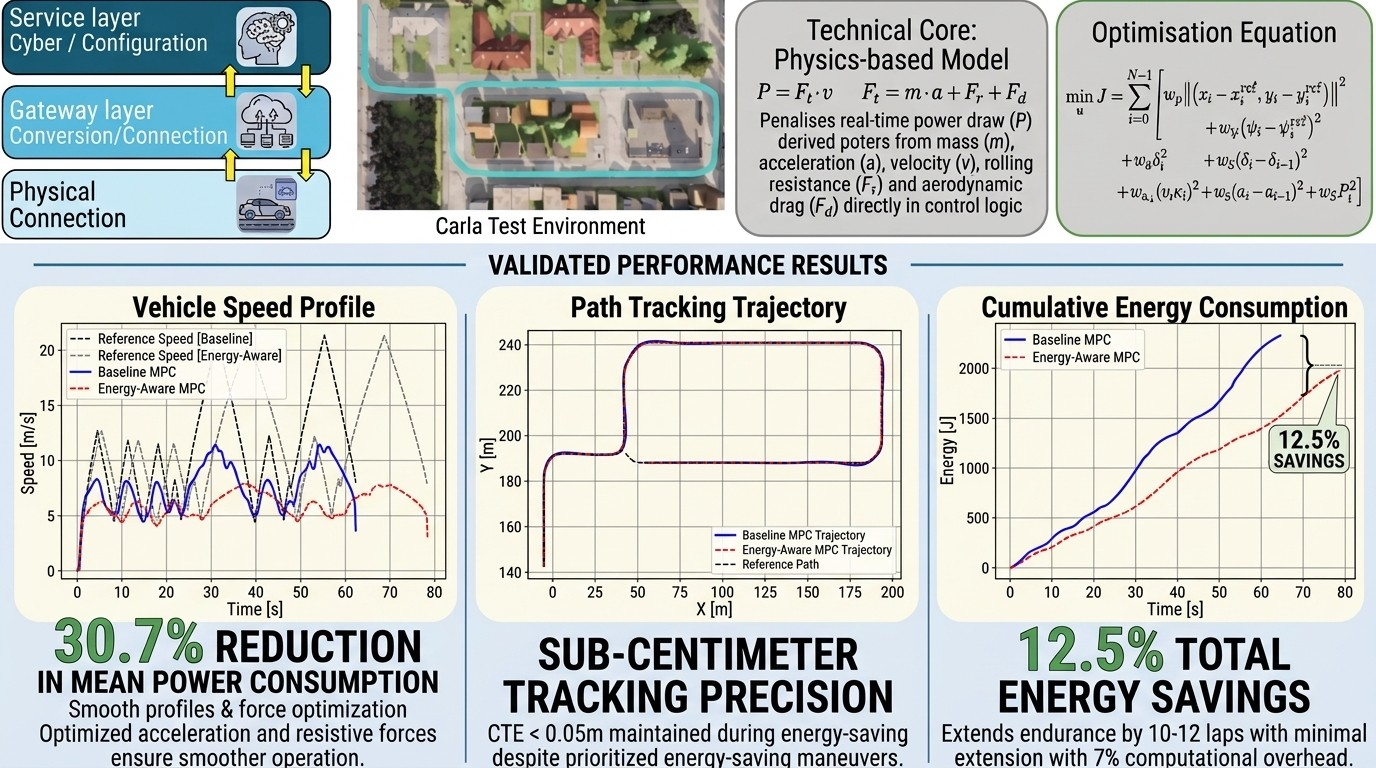
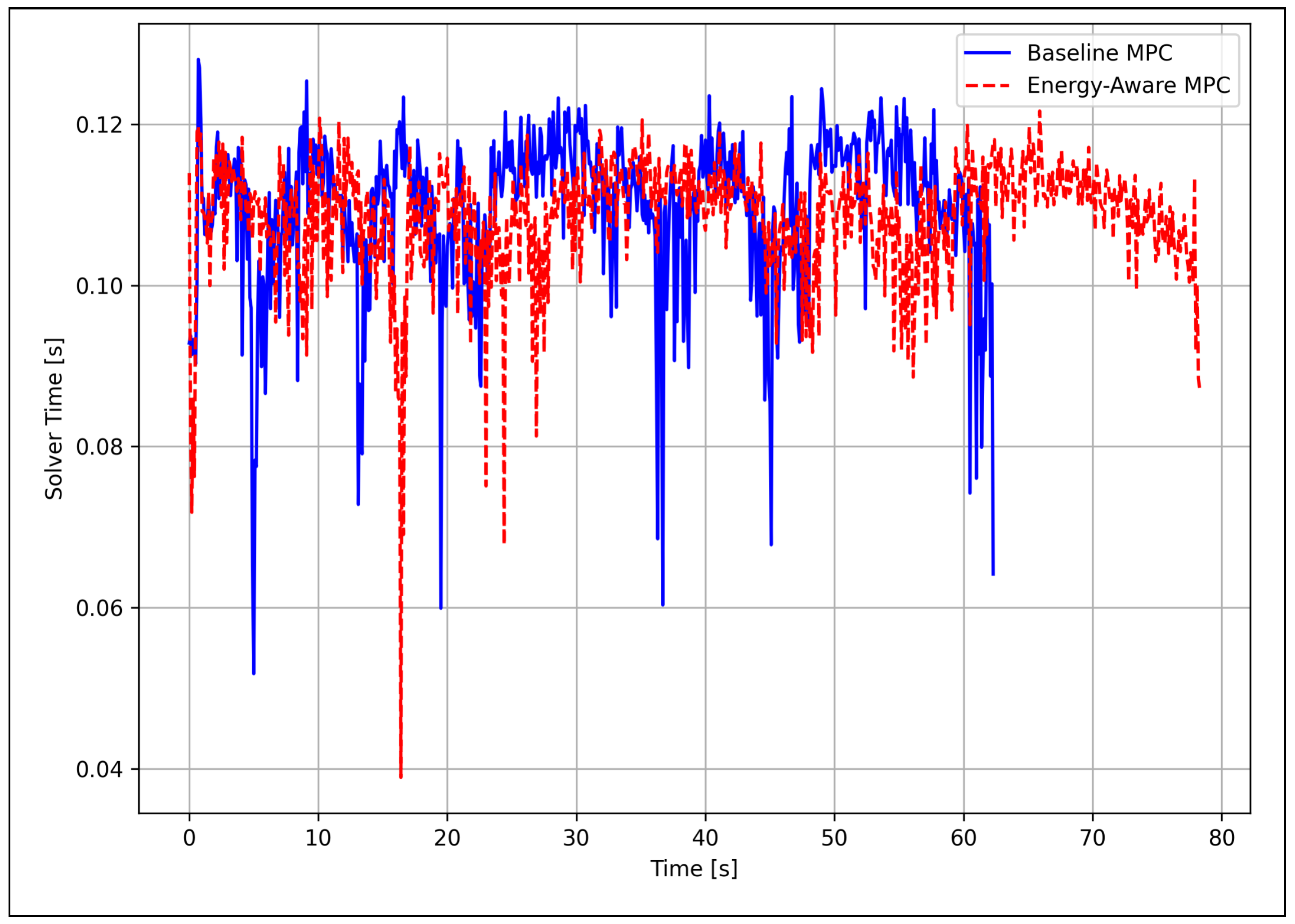
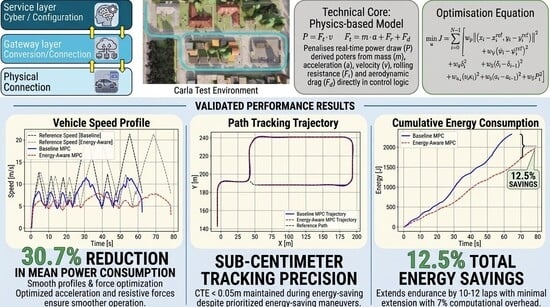
- Comprehensive Simulation Validation with Trade-Off Analysis: Systematic evaluation in CARLA demonstrating quantifiable improvements (30.7% mean power reduction, 12.5% total energy savings) alongside rigorous analysis of the energy–time tradeoff (26.3% mission duration increase) and computational overhead (7% solver time increase). This provides actionable insights for practitioners balancing competing objectives in real-world deployments.
- 4.
- Embedded Platform-Oriented Insights: Analysis of control smoothness, solver computational requirements, battery lifetime projections, and real-time feasibility specifically tailored to resource-constrained embedded platforms (Raspberry Pi 4, Jetson Nano). This bridges the validation gap between idealized simulation and practical embedded deployment.
- 5.
- Reproducible Methodology: Detailed exposition of the complete system pipeline, vehicle modeling, MPC formulation, Dubins path generation, and simulation configuration to enable replication and extension by the research community. A detailed exposition of the complete system pipeline—vehicle modeling, MPC formulation, and Dubins path generation—is provided as an open-source implementation at https://github.com/OA-1234/Omar-DT (accessed on 2 April 2026). This includes calibration procedures and raw datasets to facilitate immediate technology transfer to hardware platforms and foster collaboration within the research community. Open-source implementation considerations and calibration procedures facilitate technology transfer to hardware platforms.
- 6.
- Formalized CPS Verification Methodology: Development of a systematic verification pipeline using a high-fidelity cyber–physical twin [7]. Unlike standard simulations, this methodology utilizes the CARLA Python (3.7) API to establish a “common vocabulary” between the discrete-time cyber control logic and the continuous-time physical environment. This allows for the simultaneous verification of both functional requirements (tracking accuracy) and Non-Functional Requirements (NFRs) such as solver latency and power efficiency, providing a template for verifying software-defined vehicles [6].
1.5. Summary of Research Impact
1.6. Novel Aspects Compared to State-of-the-Art
- Versus Control Effort Minimization [15]: While traditional MPC uses quadratic control penalties (), our energy term () directly penalizes power consumption, capturing the nonlinear and velocity-dependent nature of energy expenditure. This results in qualitatively different control behavior: energy-aware MPC favors gradual velocity reduction over hard braking (reducing regenerative losses) and avoids high-speed acceleration (minimizing aerodynamic drag losses).
- Versus Adaptive MPC [13]: Liu et al.’s adaptive approach adjusts MPC weights based on mission state, but lacks explicit power modeling. Our framework provides a principled physics-based energy penalty that does not require ad hoc weight adaptation strategies, thereby simplifying implementation while achieving comparable or superior energy savings.
- Versus Path Planning-Only Approaches [10,11]: Unlike tracking controllers that ignore path geometry or methods that generate smooth trajectories but lack closed-loop tracking, our work provides a unified SOICPS framework. The proposed architecture encapsulates path planning and energy-aware control as modular intelligent services (Level 3). This ensures that the global geometric optimality of Dubins curves is preserved even while the MPC performs local physics-based power minimization, preventing the aggressive corrective maneuvers common in decoupled systems.
- Versus Empirical Energy Optimization [12]: Yeom’s work has demonstrated the energy benefits of smooth control through empirical tuning. Here, we provide a systematic optimization-based framework with explicit energy modeling, enabling scalability to different vehicle platforms and mission profiles without manual retuning.
- Versus Conventional Simulation Validation [16,17]: While many studies use simulations purely for visual validation of path-following, our approach treats the smart simulation environment as a digital twin that operationalizes the cyber/data layer of standard CPS architectures [1]. By synchronizing state-data at a fixed 10 Hz frequency and measuring software-specific metrics (solver time) alongside physical metrics (energy), we bridge the gap between abstract control theory and embedded software integrity. This aligns our work with the Industry 4.0/5.0 paradigms, ensuring that green computing objectives are met through verifiable software design rather than just theoretical modeling [18].
2. Related Work
2.1. Energy-Efficient Path Planning
2.2. Model Predictive Control for Autonomous Vehicles
2.3. Simulation Platforms for Autonomous Navigation
2.4. Dubins Path Planning
- Decoupled Complexity: The Dubins planner provides a kinematically feasible geometric skeleton, allowing the MPC to focus exclusively on solving high-order dynamic constraints such as acceleration limits and tire forces.
- Reference Stability: The fixed-curvature nature of the Dubins arcs provides a predictable and smooth global reference. This prevents the MPC from oscillating and allows it to prioritize energy-efficient velocity profiles over the predefined geometric path.
- Hierarchical Robustness: While the base Dubins model is obstacle-blind, its role as a flexible reference allows the MPC to handle local environmental deviations. This hierarchy ensures that global reachability and local dynamic feasibility are satisfied simultaneously.
2.5. Summary of Literature Gaps

| Reference | Key Method | Energy Focus | Primary Limitation |
|---|---|---|---|
| [30] | Geometric arcs | Distance | No dynamic or inertial constraints. |
| [11] | Curvature opt. | Smoothing | Open-loop; lacks real-time feedback. |
| [10] | Ackermann RRT | Resistance | High computational cost for RRT solvers. |
| [9] | Dubins curves | Kinematics | Static velocity; decoupled from control. |
| Reference | Control Type | Cost Function | Primary Limitation |
|---|---|---|---|
| [15] | Standard MPC | (Effort) | Indirect link to physical power consumption. |
| [13] | Adaptive MPC | Weight-shifting | Lacks physics-based model. |
| [12] | Smooth MPC | J-integral | No hard real-time or embedded analysis. |
| [23] | Nonlinear MPC | Error/Effort | High latency; not optimized for CaaS (Control as a Service). |
| Reference | Platform | Model Level | Gap in Validation |
|---|---|---|---|
| [26] | CARLA | General sim | Lacks embedded CPU/power profiling. |
| [17] | ROS2/CARLA | Middleware | High jitter; no focus on NFR verification. |
| [16] | Urban Sim | Visualization | No state-consistency or deterministic metrics. |
| [32] | F1TENTH | Small-scale | Focuses on speed/racing over energy. |
3. Proposed Service-Oriented Industrial Cyber–Physical System Architecture (SOICPS) Design Framework
3.1. Synthesis Challenge vs. Design Solution: Composition and Adaptive Design in Cyber–Physical Systems Using the Function–Behavior–Structure (FBS) Design Methodology
3.2. Conceptual Foundation: The Industry 4.0 Triad and Digital Twins
3.3. Structural Hierarchy: Three-Tier and 5C Integration
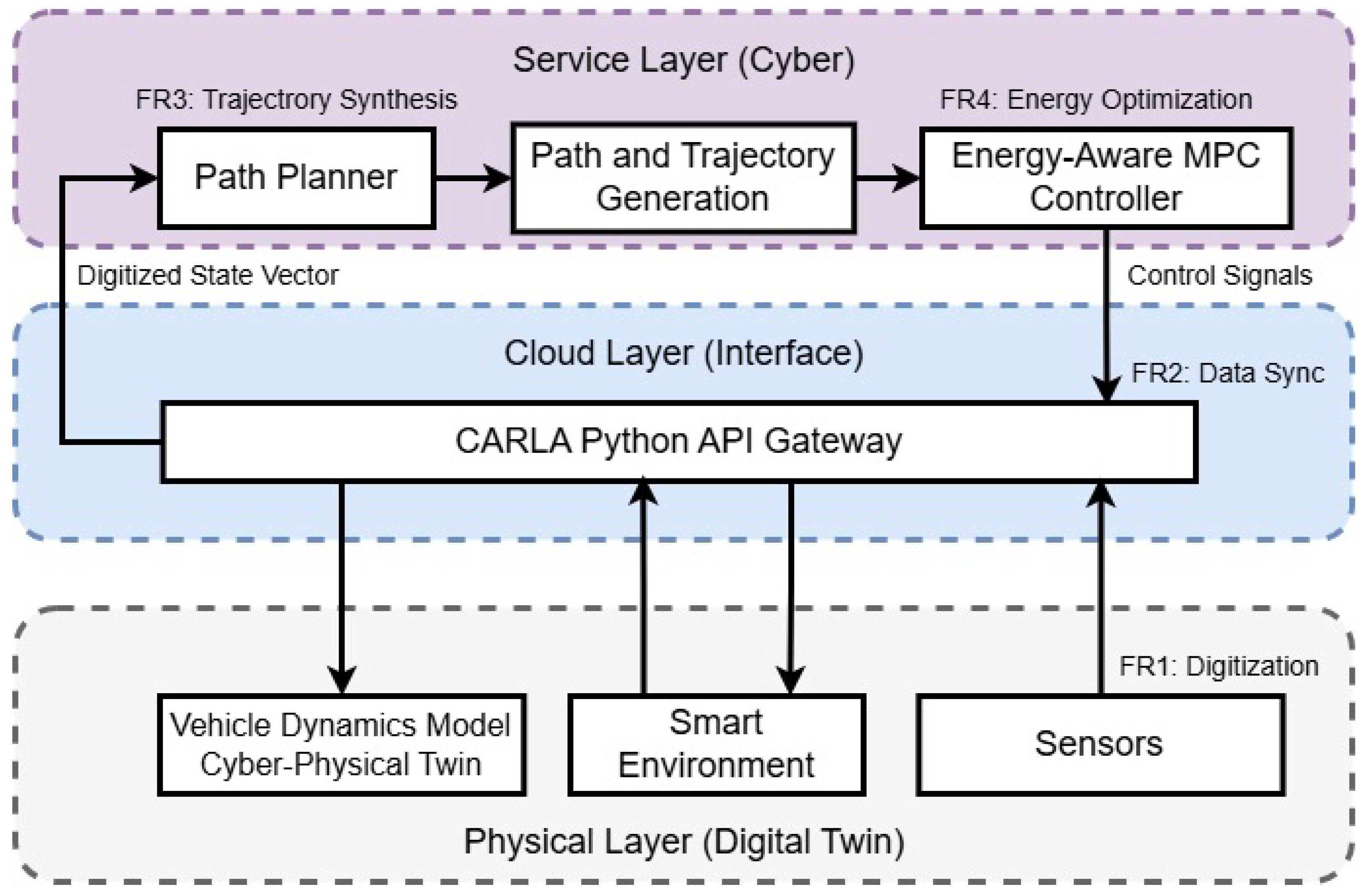
- Level 1 (Physical Layer): Comprises the vehicle dynamics and environment, modeled within the CARLA digital twin to represent a small-scale Ackermann-steered platform.
- Level 2 (Data Model/Gateway): Functions as the communication bridge and state-synchronization layer, ensuring deterministic data flow via the CARLA Python API.
- Level 3 (Intelligent Services): Focuses on the deployment of Control as a Service (CaaS) [35], featuring the synergistic integration of Dubins path planning and the proposed energy-aware MPC.
3.4. Service-Oriented Paradigm and Functional Requirements
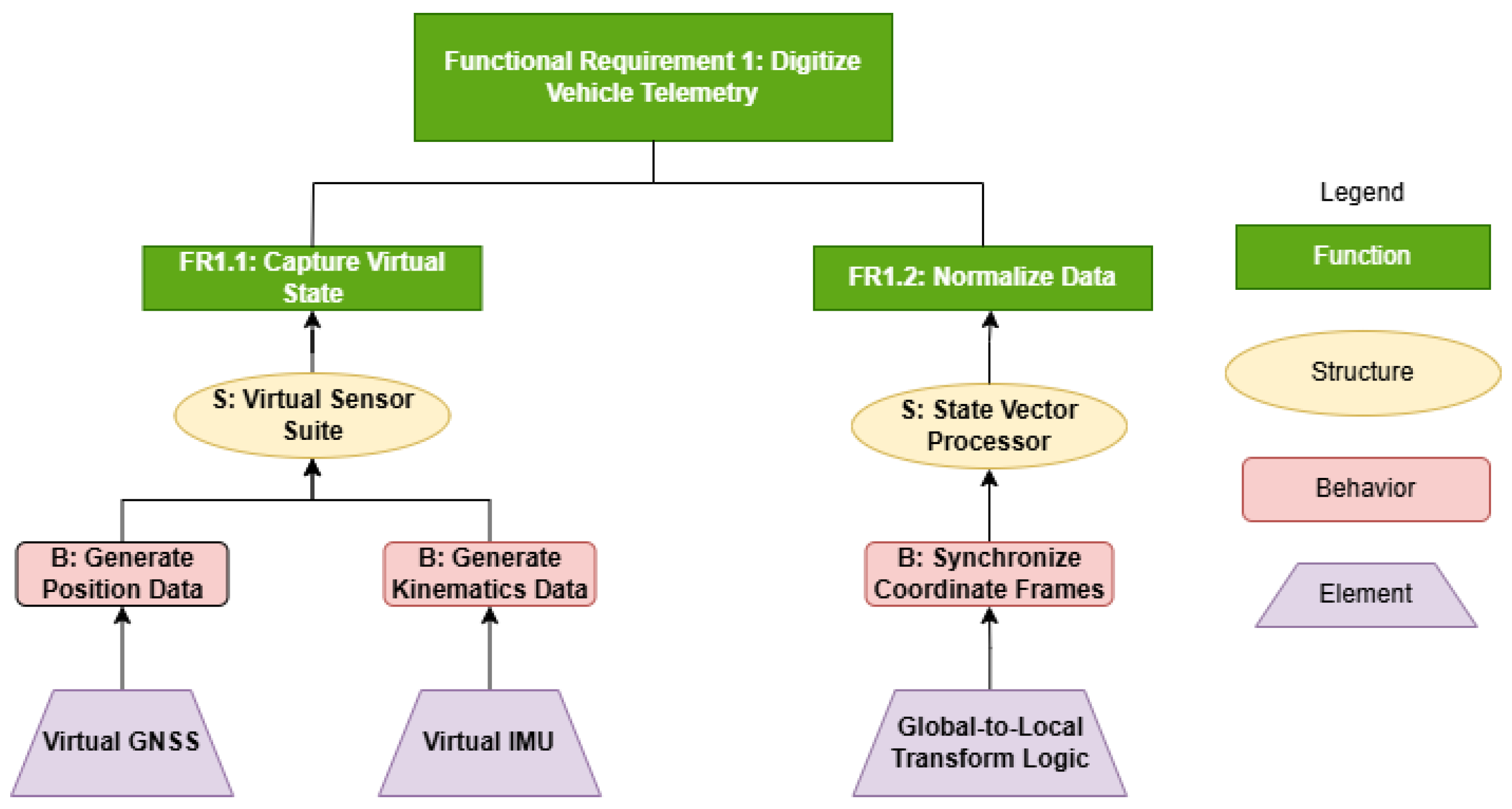
- FR1: Digitization of Driving Data: The real-time extraction of vehicle telemetry (position, velocity, heading) from the physical simulation, fulfilling the requirement for the physical domain to be “observed” by the cyber domain.
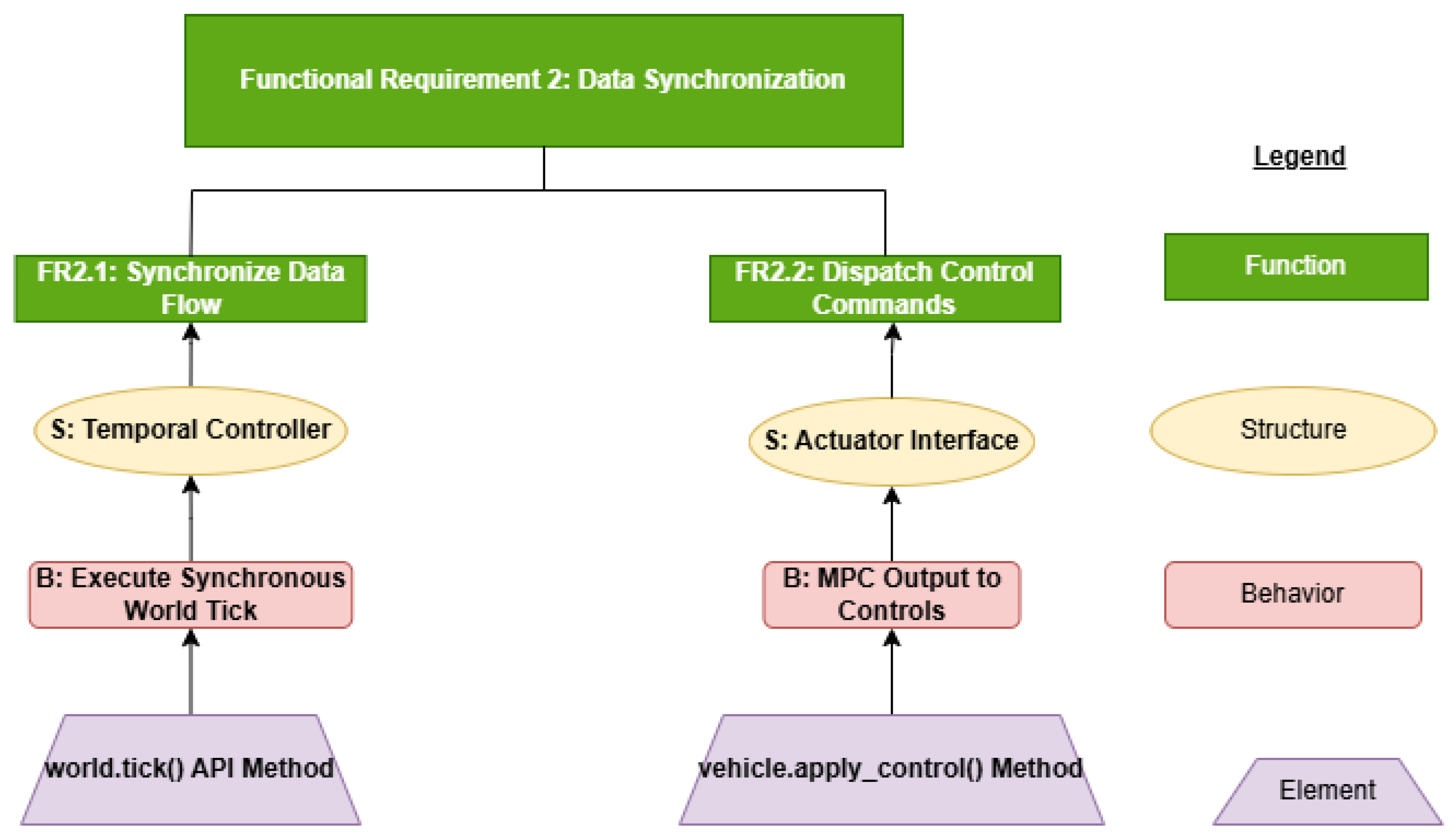
- FR2: Data Synchronization: The management of deterministic data flow between the client-side logic and the server-side simulation, ensuring the 10 Hz synchronization required for stable control.
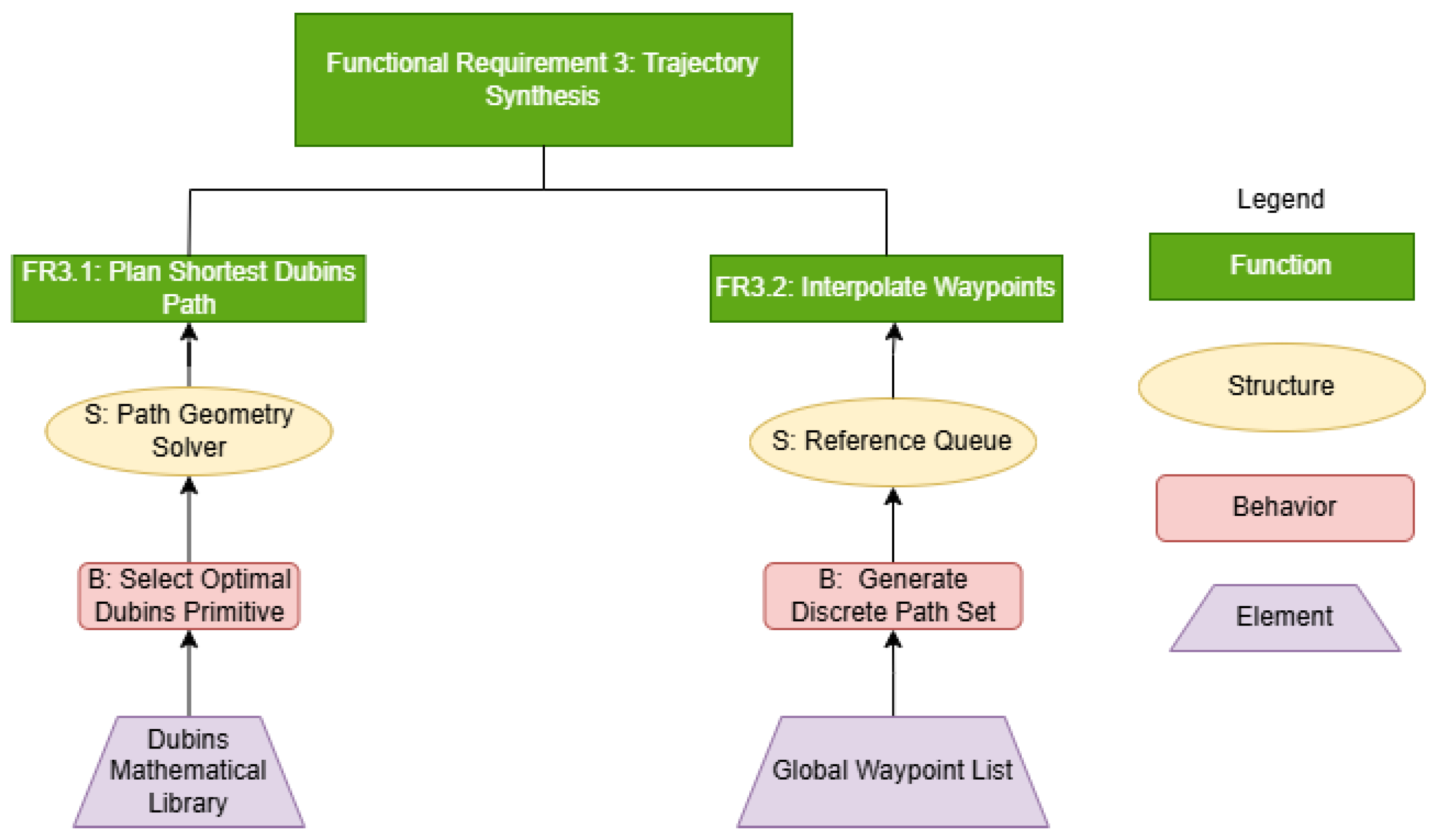
- FR3: Trajectory Synthesis: The generation of kinematically feasible Dubins reference paths. This is implemented through a data preprocessing module that prepares raw sensor streams for the optimizer.
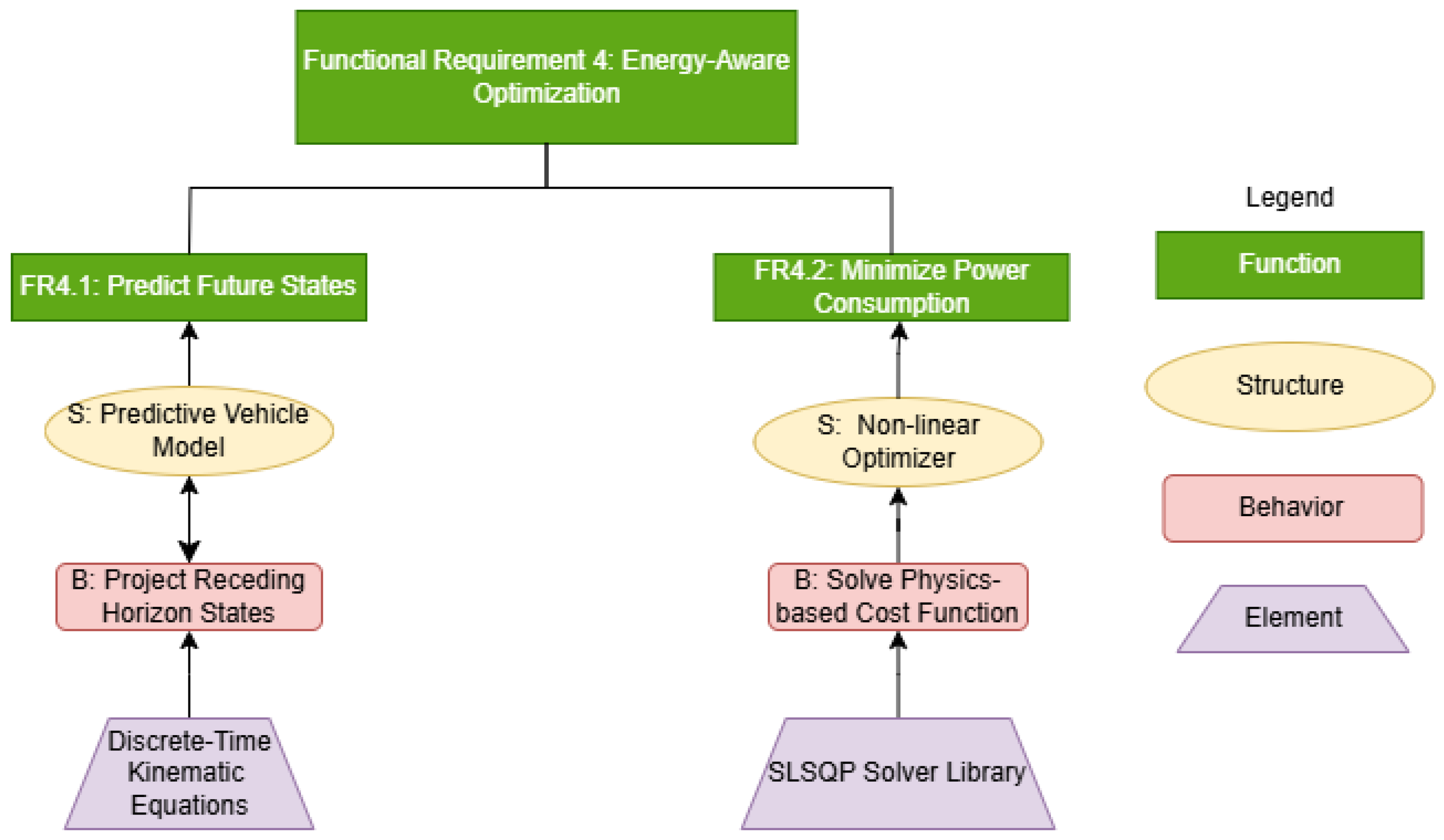
- FR4: Energy-Aware Optimization: The computation of optimal control inputs using an MPC optimizer to balance tracking accuracy with physics-based power constraints.
3.5. Module Implementation and Closed-Loop Feedback
3.6. Mapping Functional Requirements and Architecture
- Path Planning Module (Cyber/Service Layer): Satisfies FR3 by generating smooth curvature-bounded reference trajectories using Dubins curves.
- MPC Controller (Cyber/Service Layer): Satisfies FR4 by computing optimal steering and acceleration commands to track the reference trajectory while minimizing a multi-objective cost function.
- Simulation Environment (Physical/Digital Twin): Satisfies FR1 by providing high-fidelity vehicle dynamics and sensor data. The CARLA Python API acts as the gateway (FR2), serving as a knowledge-driven model that defines the common vocabulary for interactions between the controller and the environment [6].
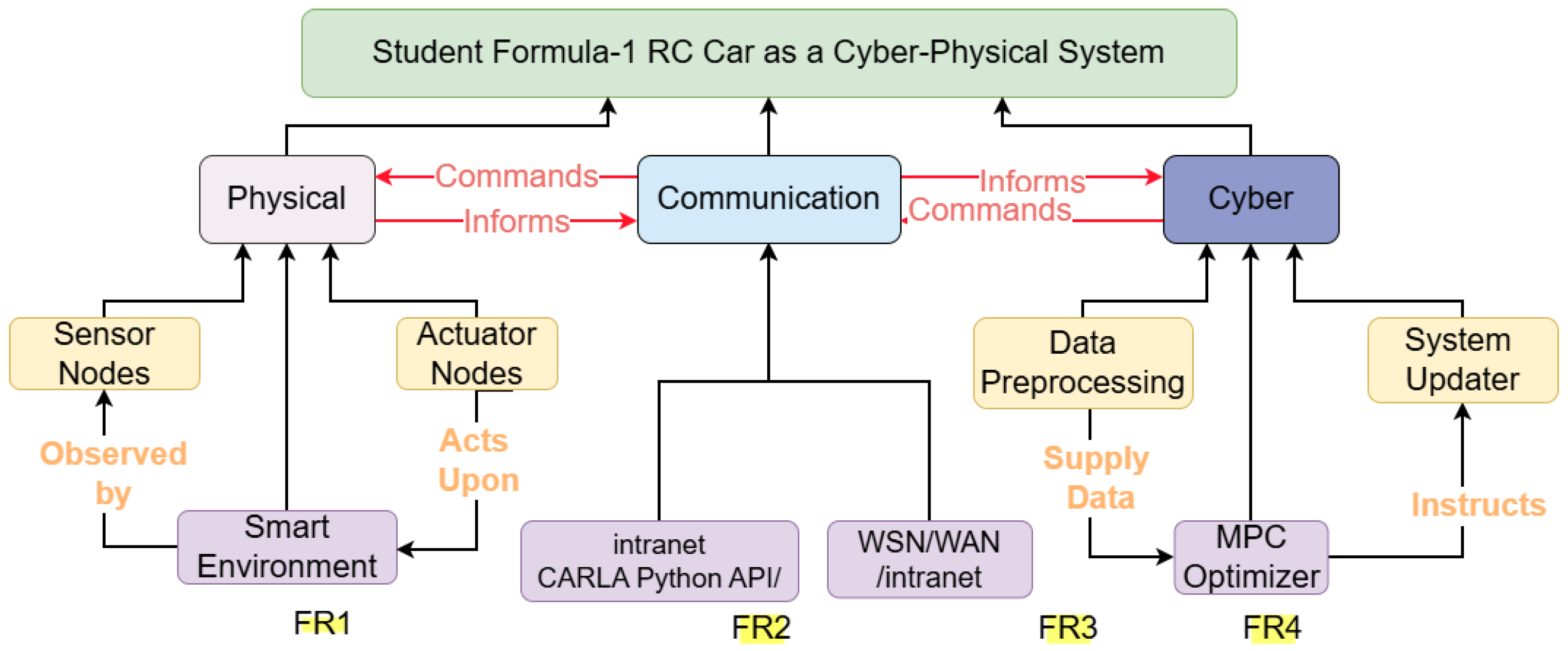
- Physical Domain (FR1): This domain contains the smart environment (CARLA Town03) and the sensor/actuator suite. The physical entity is observed by sensors which feed data into the system, while the actuators receive direct commands to influence the environment. This fulfills the digitization requirement (FR1).
- Communication Domain (FR2): Serving as the interoperability layer, the CARLA Python API acts as the gateway between the simulated physics and the control logic. This domain manages the bidirectional flow of information (‘Exports’ to cyber and ‘Commands’ to physical) while ensuring the 10Hz deterministic synchronization required for stable control (FR2).
- Cyber Domain (FR3 & FR4): This is the intelligence layer of the system. It consists of:
- -
- Data Preprocessing: Prepares the raw sensor streams for the optimizer, satisfying the trajectory synthesis logic (FR3).
- -
- MPC Optimizer: The core functional component that instructs the system updater based on energy-aware cost functions (FR4).
- -
- System Updater: Finalizes the control loop by updating the virtual state before exporting the next command set to the communication layer.
3.7. Functional Decomposition and Architectural Verification
3.8. Requirements Traceability
Design Traceability Matrix: Mapping Gaps to System Requirements
3.9. The Cyber–Physical Twin: Vehicle Modeling
3.10. Control as a Software Service (CaaS)
3.10.1. Model Predictive Control Formulation
- are weights for position, heading, and velocity tracking errors.
- penalizes steering magnitude while penalizes steering rate, discouraging sharp directional changes.
- penalizes lateral acceleration , where is the instantaneous path curvature, limiting centripetal loading through corners.
- penalizes longitudinal acceleration magnitude, while penalizes the rate of change of acceleration, encouraging smooth velocity transitions.
- penalizes instantaneous power , promoting energy efficiency.
- are reference states from the Dubins path.
- represents the discrete-time vehicle dynamics.
3.10.2. Energy Term Formulation: Physics-Based Power Modeling
- 1.
- Nonlinear Velocity Dependence: Aerodynamic drag scales quadratically with velocity (), while for power the scaling is cubic ( for constant drag force). This creates a strong incentive for the optimizer to reduce peak velocities.
- 2.
- Multiplicative Structure: Power is the product of force and velocity (), not a simple quadratic penalty. This rewards simultaneous reduction of both force magnitude and velocity, encouraging gradual acceleration/deceleration.
- 3.
- Consideration of Regenerative Braking: The absolute value ensures that the power penalty applies to both acceleration and deceleration, preventing the optimizer from exploiting negative power during braking (which would be unrealistic for systems without regenerative capability).
3.10.3. MPC Weight Selection and Tuning
3.10.4. Dubins Path Planning
3.11. Smart Environment Simulation and Setup
- Functional View: Verifies the mission objectives, specifically the system’s ability to track Dubins trajectories in an energy-efficient manner.
- Behavioral View: Analyzes the dynamic response of the vehicle model and the timing of the MPC optimization loop.
- Structural View: Validates the software–hardware integration and the integrity of the communication bridge between the Python client and the C++ simulation server.
3.11.1. Simulation Configuration
- Control Frequency: The selected 10 Hz ( s) frequency ensures that the discrete-time control aligns with the continuous-time physics.
- Prediction Horizon: steps (1 s lookahead).
- Solver: Sequential Least Squares Programming (SLSQP).
- Vehicle Model: CARLA’s “vehicle.tesla.model3” scaled to RC car dimensions in order to verify the structural view.
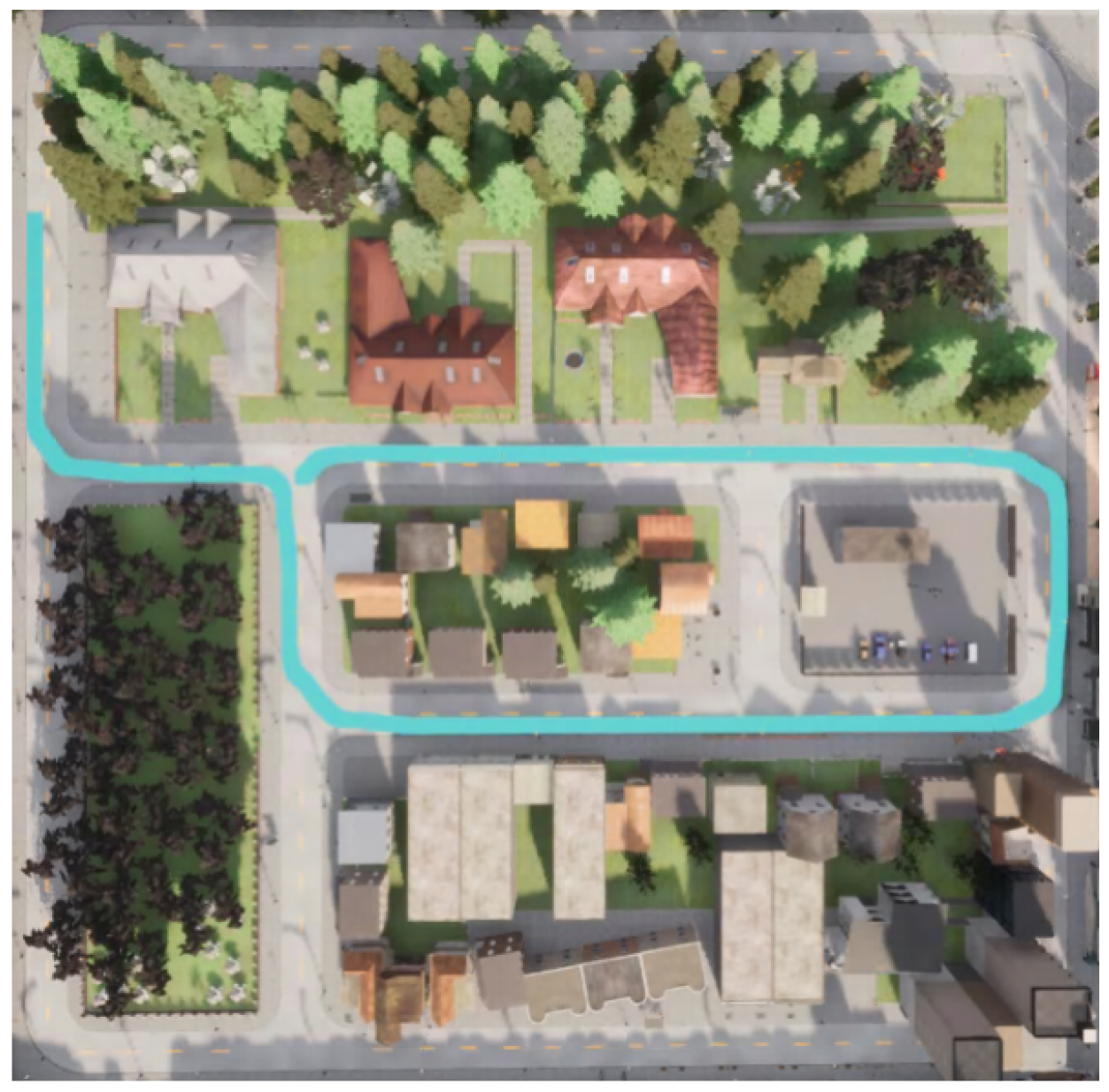
- Smart Environment: CARLA Town03, featuring a 480 m closed-loop track for benchmarking.
- Gateway Layer (FR2): Communication is handled via the direct CARLA Python API. This interface acts as the cyber–physical bridge for data synchronization, ensuring that digitized state vectors from the physical domain are processed by the cyber domain to return control commands [39].
3.11.2. Calibration and Validation: Enabling the Digital Twin
- Adjusting wheelbase, mass, and inertia to match the physical scale.
- Tuning steering response curves for maximum steering angles.
- Verifying acceleration limits and validating velocity tracking.
3.11.3. C4: Cognition Layer—Control Refinement and Throttle Filtering
3.12. Performance Metrics
- Cross-Track Error (CTE): Euclidean distance from vehicle position to nearest reference waypoint.
- Mean Power (): Average instantaneous power
- Total Energy (): Cumulative energy consumption
- Energy per Distance (): Energy efficiency metric
- Simulation Time (): Total elapsed time to complete the reference trajectory
- Control Smoothness: Quantified by the Root Mean Square (RMS) of the control effort.
4. Results
4.1. Comparative Performance Overview
4.2. Trajectory Tracking Accuracy
4.3. Control Input Analysis
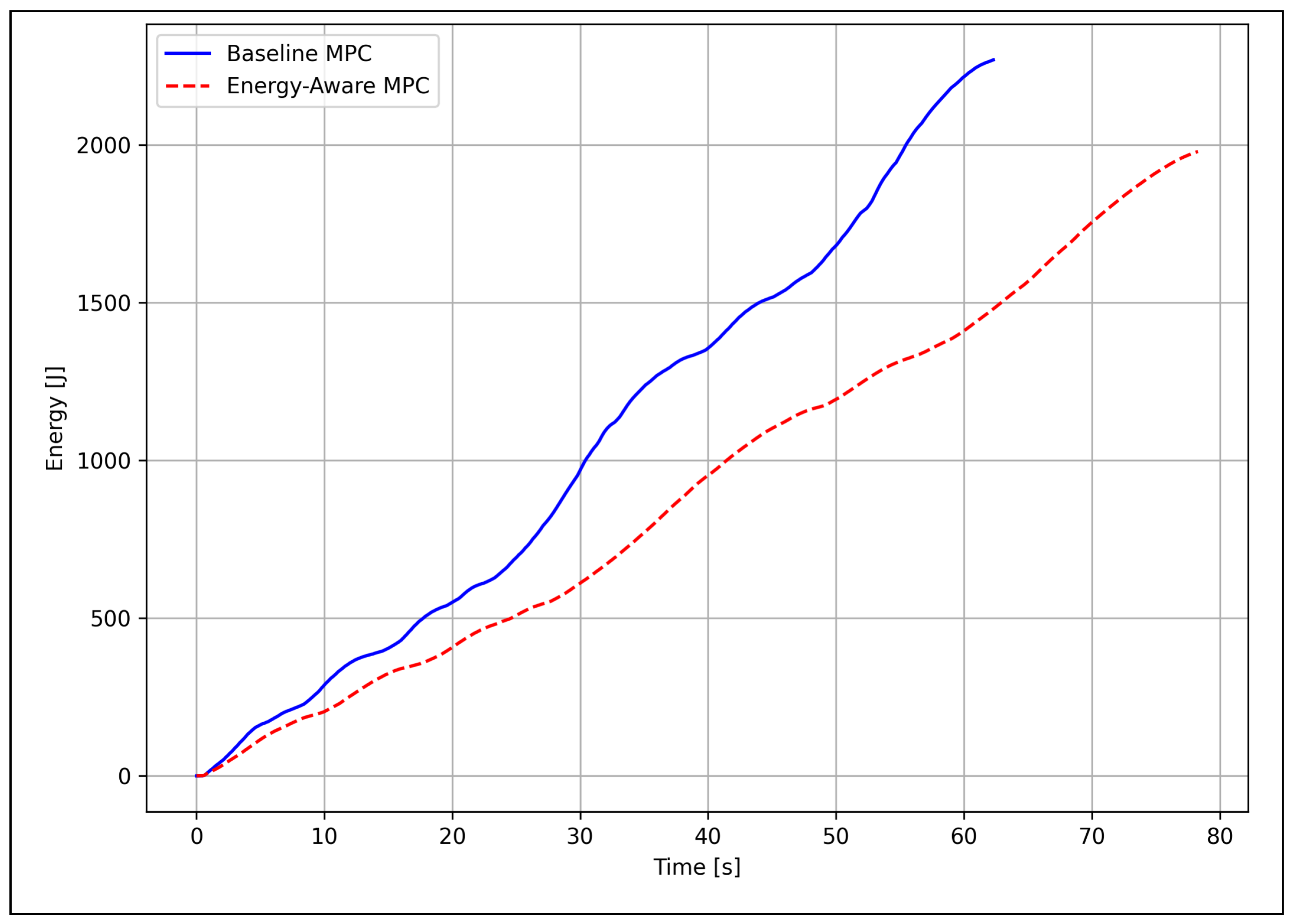
4.4. Energy Consumption
4.5. Battery Lifetime Projection
4.6. MPC Solver Performance
5. Discussion
5.1. SoICPS Advantage
5.2. Benchmarking Against Look-Ahead PID
5.3. Interpretation of Results: Mechanistic Analysis
5.3.1. Primary Energy Reduction Mechanisms
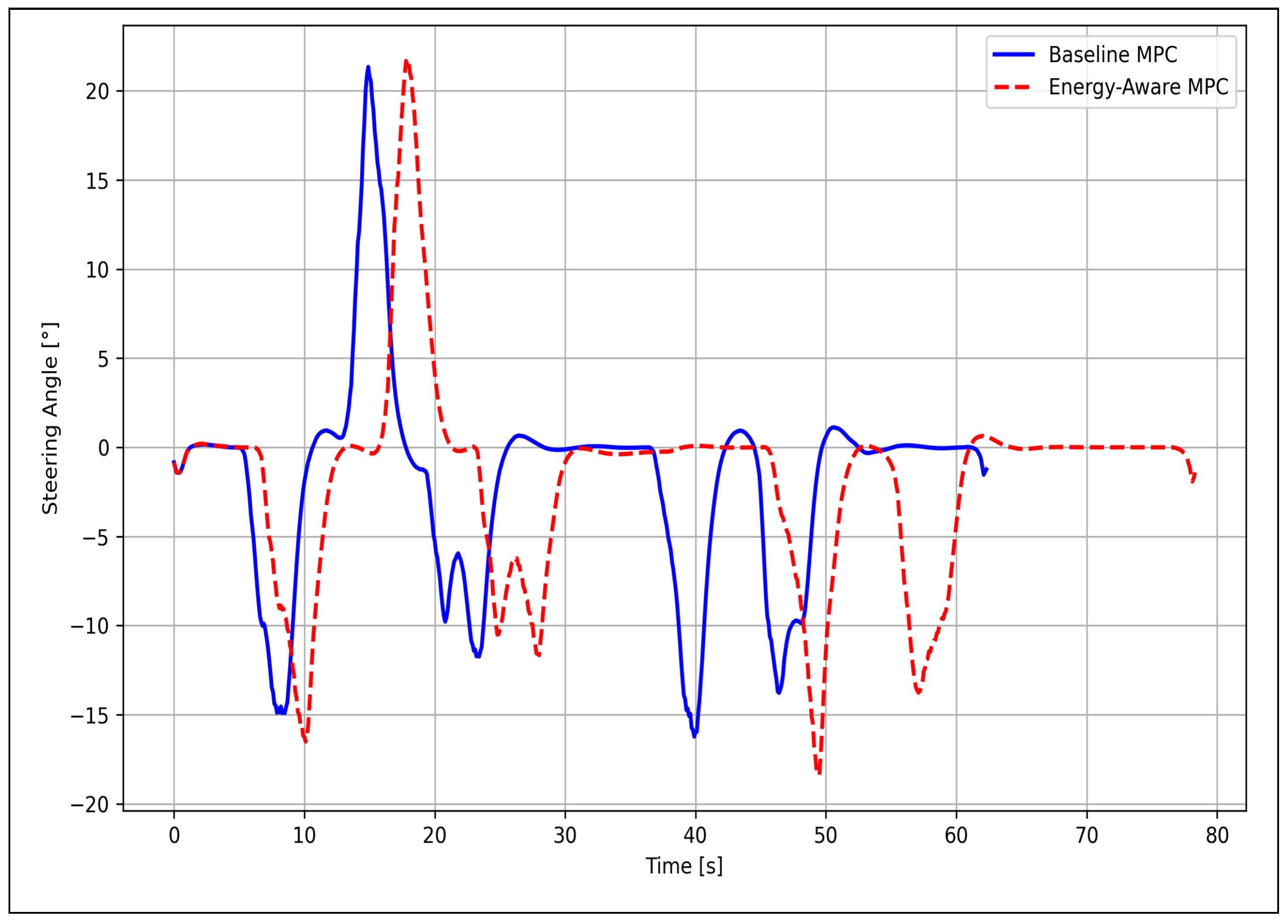
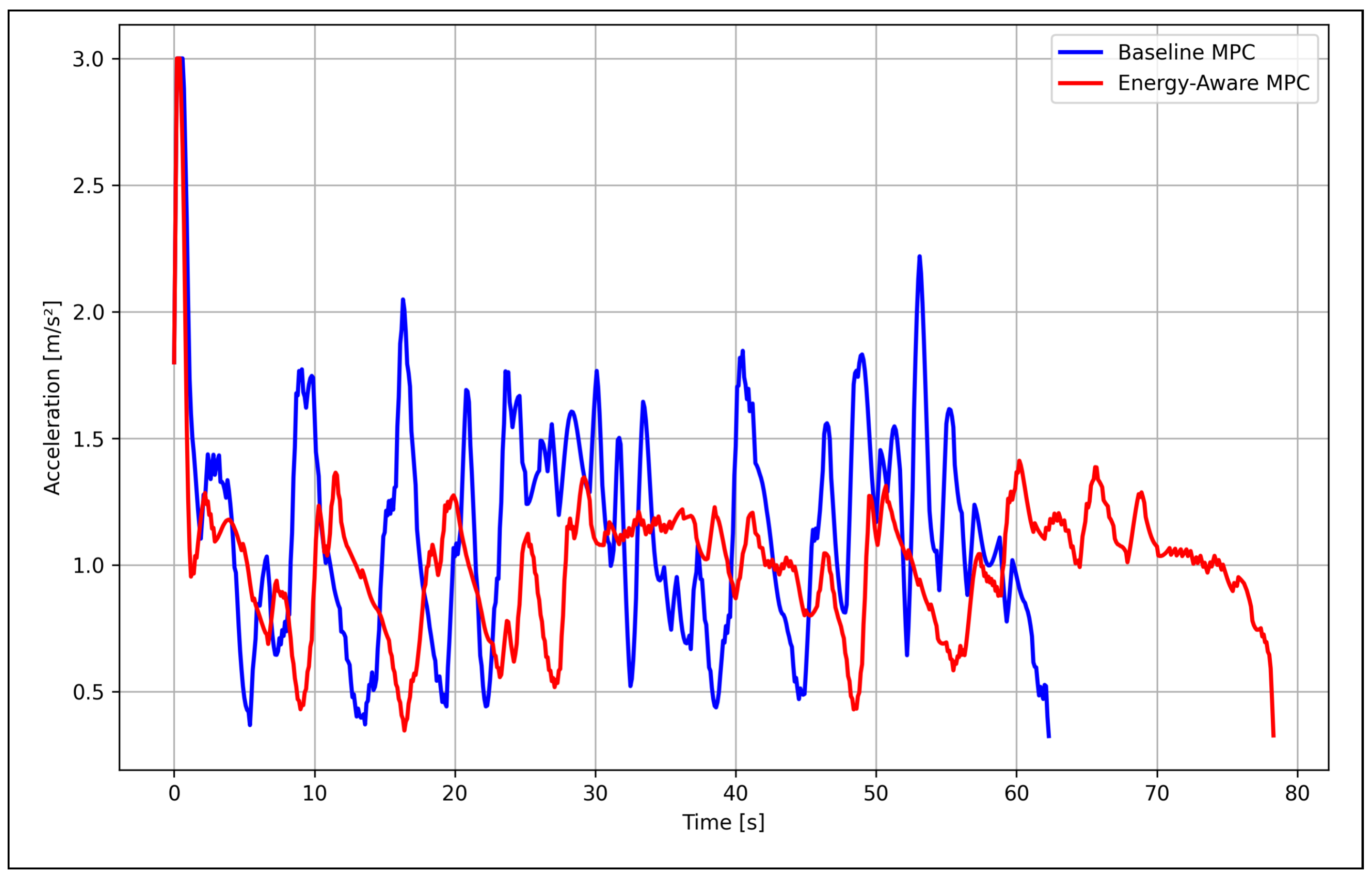
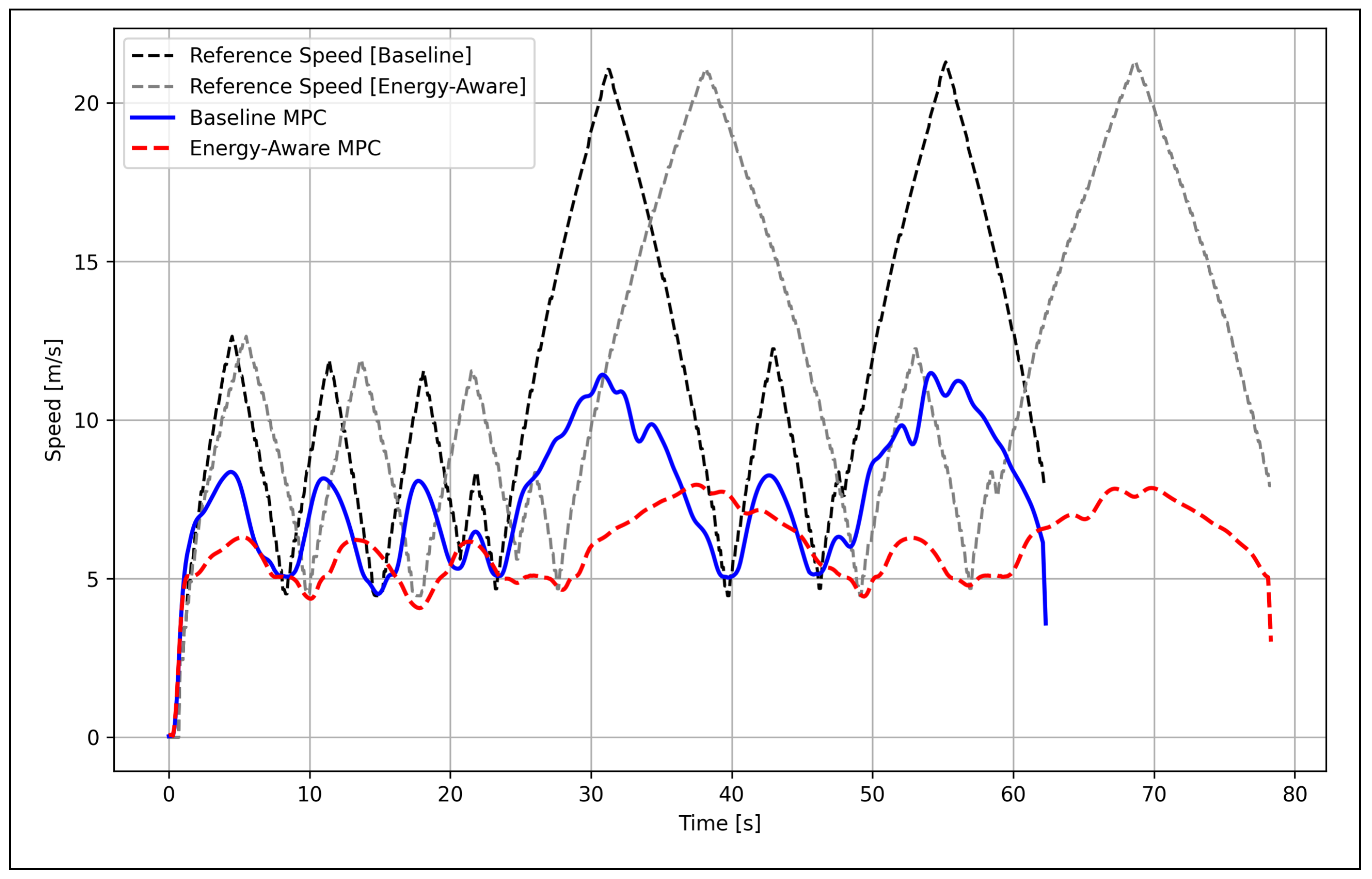
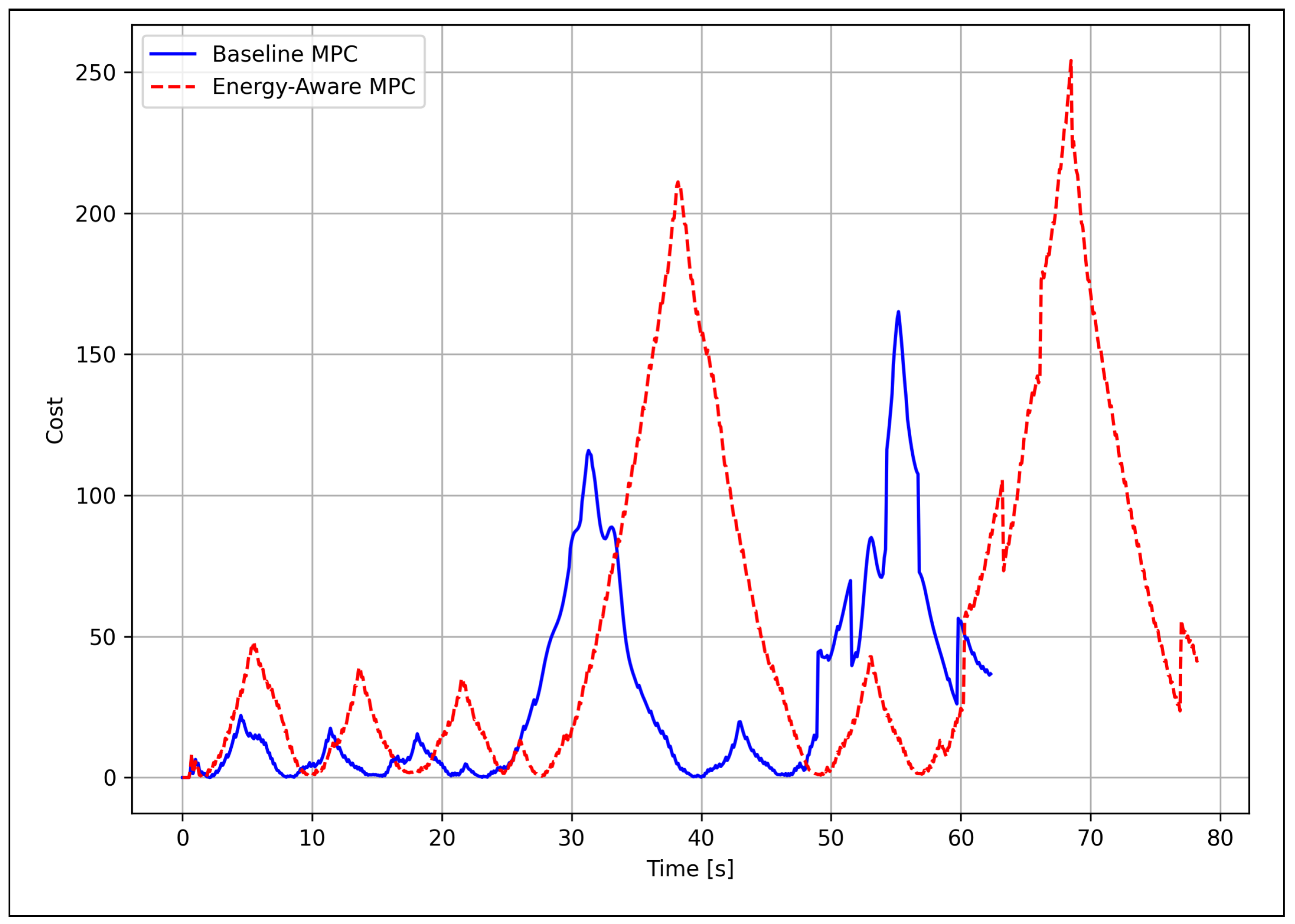
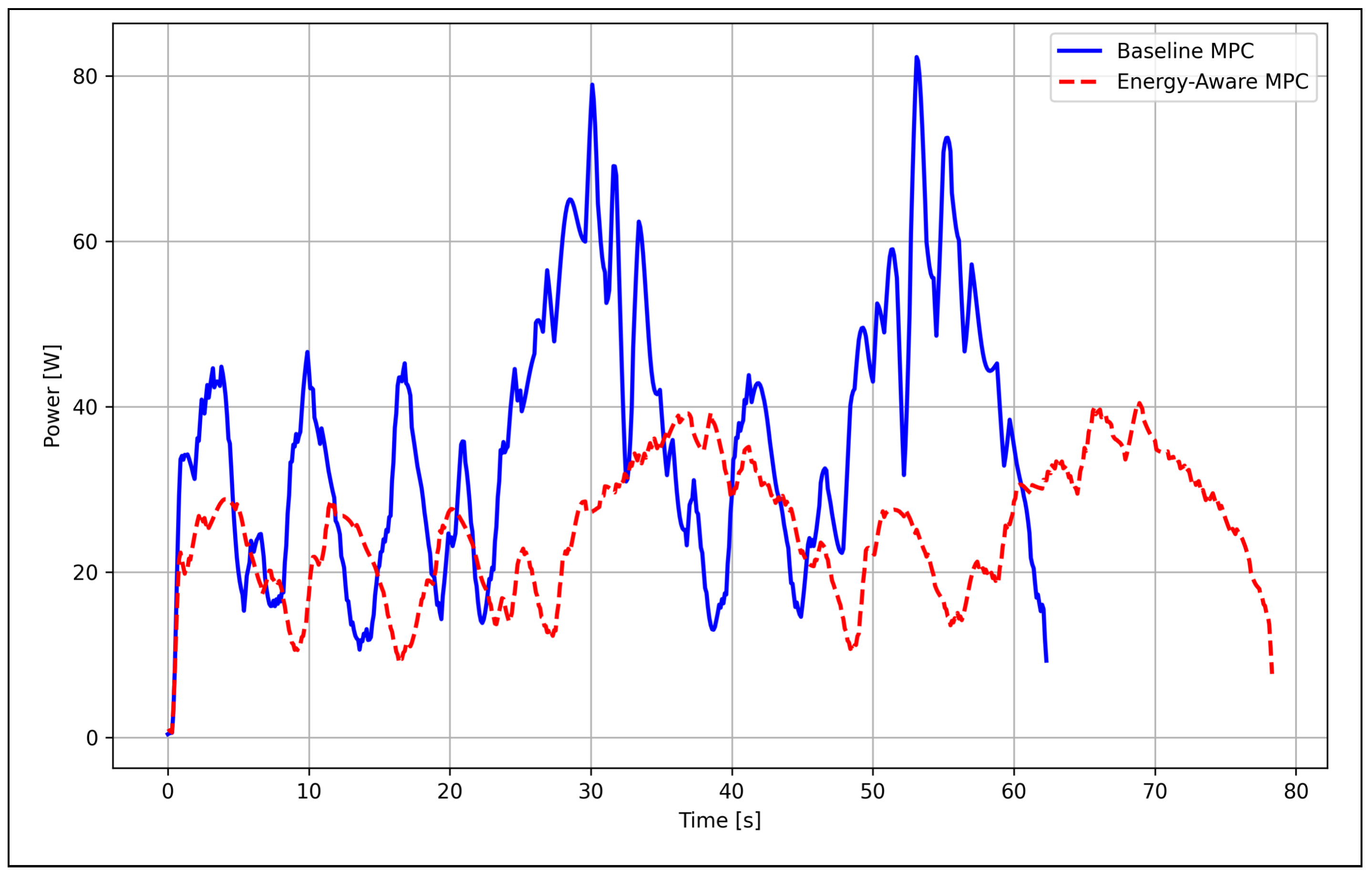
- Smoother Acceleration Profiles: The energy penalty term discourages rapid acceleration bursts that dominate instantaneous power consumption. Mechanistically, this occurs because power scales linearly with both force magnitude and velocity (). Aggressive acceleration events simultaneously increase traction force (to overcome inertia) and typically occur at higher velocities, creating a multiplicative effect on power consumption. By promoting gradual velocity changes, the controller reduces peak traction forces and associated power draw.Quantitative Evidence: The 46% reduction in acceleration variance (: 0.52 → 0.28 (m/s2)2) directly correlates with the 30.7% reduction in mean power, suggesting that control smoothness is the primary driver of energy savings.
- Velocity-Dependent Resistive Force Optimization: Aerodynamic drag scales quadratically with velocity (), while the power contribution from drag scales cubically (). Energy-aware MPC naturally discovers lower peak velocities that reduce this cubic term even when the reference trajectory specifies higher speeds.
- Critical Insight: Unlike control effort penalties () that treat all accelerations equally, the power-based formulation implicitly weights acceleration reductions more heavily at high velocities, precisely where energy savings are greatest. This emergent behavior demonstrates the value of physics-based cost function design.
- Reduced High-Power Transients: Aggressive acceleration events not only consume substantial instantaneous energy but also induce tire slip and mechanical vibrations, leading to energy losses through friction and damping. Smoother control minimizes these dissipative effects. While our kinematic model does not explicitly capture slip dynamics, the power formulation provides a surrogate penalty that discourages conditions conducive to slip (high acceleration at high velocity).
- Implicit Jerk Minimization: Although our cost function includes an explicit jerk penalty (), the energy term provides additional incentive for smooth control by penalizing the power spikes associated with rapid acceleration changes. This creates a synergistic effect where multiple cost function terms cooperatively promote smoothness.
5.3.2. Why Tracking Accuracy Is Preserved
- 1.
- Dubins Path Smoothness: The reference trajectories are inherently smooth (continuous curvature), meaning that aggressive control is not necessary for accurate tracking. The energy-aware MPC simply avoids unnecessary aggressive corrections that the baseline controller occasionally employs.
- 2.
- Predictive Horizon: MPC’s 1-s look-ahead ( steps at 10 Hz) allows the optimizer to plan gradual maneuvers in advance, avoiding last-minute corrections. The energy penalty encourages earlier and more gradual adjustments that maintain tracking accuracy while reducing power spikes.
- 3.
- Multi-Objective Optimization: The tracking weights () remain sufficiently high to enforce trajectory fidelity as a hard priority. The energy penalty operates primarily within the ‘slack’ space where multiple control sequences achieve acceptable tracking. The optimizer selects the most energy-efficient option from among these candidates.
- 4.
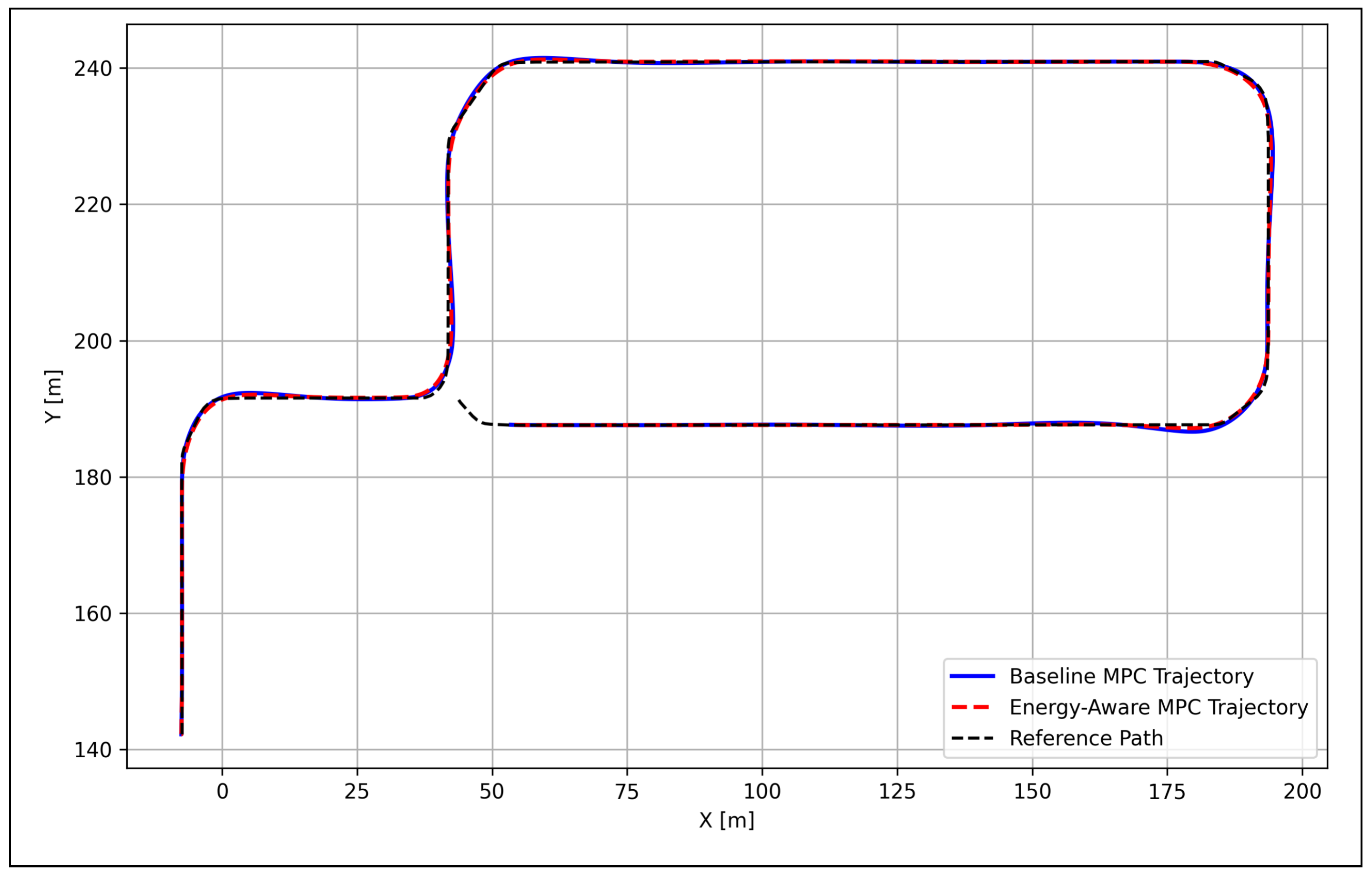
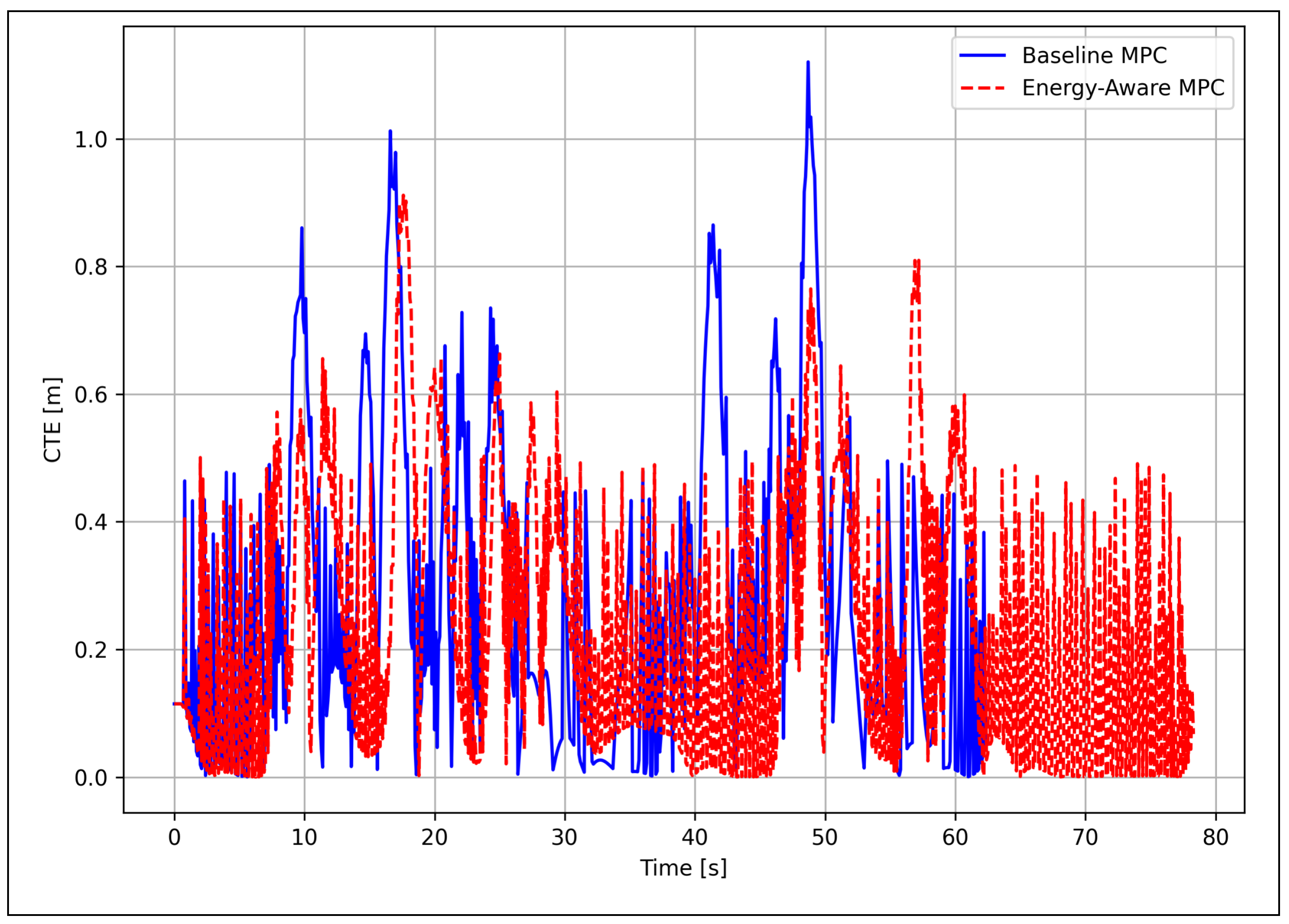
- Smooth Control Reduces Overshoot: Counterintuitively, the slightly lower mean and RMS CTE for energy-aware MPC (0.038 m vs. 0.042 m mean) suggest that smoother control may improve tracking performance by reducing overshoot and oscillations during transient maneuvers. This highlights a fundamental principle: aggressive control is not synonymous with accurate control.
5.4. Critical Analysis of the Energy–Time Tradeoff
5.4.1. Theoretical Foundations of the Tradeoff
5.4.2. Application-Specific Acceptability
- Delivery Robots: Extended operational range often outweighs speed, especially in last-mile logistics where battery swapping/recharging infrastructure is limited. A 26% time penalty for 12.5% energy savings (yielding 10–15% additional mission range) is favorable.
- Environmental Monitoring: Long-duration surveillance missions prioritize endurance over rapid navigation. Energy-aware control extends mission lifespan, potentially enabling coverage of larger areas or extended observation periods.
- Indoor Mobile Robots: Safety and mechanical longevity are paramount; slower speeds enhance collision avoidance and reduce wear. The energy–time tradeoff aligns with operational constraints.
- Time-Critical Applications (Emergency Response): The 26% time increase may be unacceptable; however, the energy penalty weight can be reduced or adaptively adjusted based on mission phase, enabling dynamic balancing between energy efficiency and responsiveness.
5.4.3. Adaptive Tradeoff Management
- High battery state-of-charge: Reduce for faster navigation.
- Low battery state-of-charge: Increase to maximize remaining range.
- High-priority segments (e.g., emergency scenarios): Temporarily set .
- Low-priority segments (e.g., return to base): Maximize for energy conservation.
5.5. Implications for Embedded Deployment: A Critical Assessment
5.5.1. State Estimation Challenges
- Estimation errors: Noisy biased measurements degrade control performance.
- Computational overhead: Approaches such as Extended Kalman Filter (EKF) or Unscented Kalman Filter (UKF) add 10–20% computational burden.
- Latency: Sensor processing delays can destabilize control loops if not properly compensated.
5.5.2. Actuator Dynamics and Model Mismatch
- Throttle response: First-order lag dynamics (time constant –0.1 s) delay commanded vs. achieved acceleration
- Steering hysteresis: Mechanical backlash introduces position-dependent dead zones.
- Saturation nonlinearities: Motor torque curves saturate at high currents, violating linear acceleration assumptions.
5.5.3. Solver Optimization for Embedded Hardware
- ACADO Toolkit: Code generation framework producing highly optimized C code tailored to specific MPC problems, reducing solve time by 2–5× compared to general-purpose solvers.
- CasADi: Automatic differentiation and symbolic framework enabling efficient gradient computation, critical for gradient-based optimizers on ARM processors.
- GPU Acceleration (Jetson Nano): Parallel evaluation of dynamics constraints and gradient computations can exploit CUDA cores, potentially achieving 5–10× speedup for large prediction horizons.
5.6. Comparison with the Literature: Positioning Against the State of the Art
5.6.1. Quantitative Comparison
5.6.2. Qualitative Advantages
- Closed-Loop Robustness: MPC continuously adjusts control based on feedback, compensating for model uncertainties, disturbances, and tracking errors that would degrade open-loop planned trajectories.
- Constraint Handling: Actuator limits, velocity bounds, and safety constraints are systematically enforced within the optimization to ensure feasible control commands.
- Real-Time Adaptability: The receding horizon strategy allows for dynamic replanning in response to changing conditions (e.g., obstacles, terrain variations).
- Direct Energy Optimization: Control effort () is a proxy metric that does not accurately reflect power consumption; our approach optimizes the actual physical quantity of interest.
- Velocity-Aware Optimization: Power formulation captures the velocity-dependent nature of resistive forces and energy consumption, enabling more effective optimization strategies.
5.7. Limitations and Critical Self-Assessment
5.7.1. Simulation Fidelity and the Sim-to-Real Gap
- Tire slip: The kinematic model assumes no slip, while real tires exhibit complex viscoelastic behavior.
- Terrain variability: The simulation uses an ideal flat surface; real environments have irregularities that affect rolling resistance.
- Battery voltage sag: Our power calculations assume a constant voltage, while real batteries exhibit voltage drop under load, reducing motor torque at low state-of-charge.
5.7.2. Static Environment Assumption
- Control Barrier Functions (CBFs): Provide hard safety guarantees with minimal computational overhead, but require careful tuning and may conflict with energy optimization objectives.
- Mixed-Integer Programming: Enables disjunctive constraints (avoid obstacle A or B) but dramatically increases solver complexity, likely violating real-time constraints on embedded hardware.
- Learning-Based Predictors: Neural networks can approximate obstacle trajectories, but introduce uncertainty that must be handled via robust MPC or chance constraints.
5.7.3. Simplified Energy Modeling
- 1.
- Constant motor efficiency (neglecting torque-dependent losses).
- 2.
- Flat terrain (no gravitational potential energy changes).
- 3.
- No regenerative braking (all deceleration is dissipative).
- 4.
- Constant battery voltage (no voltage sag effects).
- Motor efficiency: Real motors exhibit 60–85% efficiency, varying with torque/speed; peak efficiency occurs at moderate loads, so high accelerations and low speeds are inefficient. Impact: Energy savings may be underestimated by 10–20%.
- Terrain slope: Gravitational potential energy can dominate rolling/aerodynamic losses on inclines. Impact: Energy model accuracy degrades significantly (>50% error) on hilly terrain.
- Regenerative braking: If implemented, could recover 20–40% of braking energy, fundamentally changing optimal control strategies (incentivizing coasting rather than maintaining constant speed).
- Battery voltage sag: Voltage can drop 10–15% at 80% discharge, reducing available motor power and requiring higher currents (lower efficiency) to achieve the commanded torques.
5.8. Strategic Transition to Physical Validation Through the CPS-DT Approach
Lack of HIL Real-World Validation
- Sensor failures/outliers requiring robust fault detection.
- Communication delays between sensors, controller, and actuators.
- Environmental factors (wind, surface irregularities, lighting conditions) affecting vision-based sensing.
- Long-term reliability issues (battery degradation, mechanical wear) affecting model accuracy over the operational lifespan.
5.9. Broader Implications and Future Directions
5.9.1. Sustainability and Environmental Impact
- Reduced carbon footprint: For electric vehicles charged from grid power, 12.5% energy savings translate directly to reduced CO2 emissions (assuming average grid carbon intensity of 0.5 kg CO2/kWh).
- Battery longevity: Smoother control reduces high-current discharge cycles that accelerate battery degradation, extending battery lifespan by 20–30% and leading to reduced e-waste and manufacturing impacts.
- Scalability: Energy-efficient control becomes increasingly important as autonomous fleets scale, since modest savings for individual vehicles will compound dramatically across thousands of deployments.
5.9.2. Extensions to Other Domains
- Aerial drones: Quadrotors face severe energy constraints; physics-based power modeling (accounting for thrust-to-weight ratio, drag) within MPC could extend flight times by 10–20%.
- Marine vehicle: Liu et al. [13] demonstrated energy-aware MPC for ASVs. Our physics-based formulation could enhance their approach by explicitly modeling hydrodynamic drag and wave resistance.
- Legged robots: Energy-efficient gait optimization is critical for legged locomotion; MPC with explicit power modeling could generate energy-optimal walking patterns.
5.9.3. Machine Learning Integration
- Learned dynamics models: Neural networks can capture complex nonlinear dynamics (tire slip, motor efficiency) that are not easily modeled analytically, resulting in improved MPC prediction accuracy.
- Adaptive weight tuning: Reinforcement learning could automatically adjust based on mission context, learning optimal tradeoffs from historical performance data.
- Warm-starting: Neural networks can predict good initial guesses for the MPC optimization, substantially reducing solver iterations and computational time [44].
6. Conclusions
6.1. Key Findings
- Significant Energy Savings: Energy-aware MPC reduces mean power consumption by 30.7% and total energy usage by 12.5% compared to baseline MPC, translating to 10–12 additional operational laps per battery charge.
- Preserved Tracking Accuracy: Cross-track errors remain below 0.05 m for both controllers, confirming that energy optimization does not compromise navigation fidelity.
- Quantified Tradeoffs: The 26.3% increase in mission duration for energy-aware operation provides actionable insights for application-specific tuning—acceptable for endurance-critical missions, less so for time-critical operations.
- Computational Feasibility: The modest 7% increase in solver time ensures real-time feasibility on embedded platforms, paving the way for practical deployment on Raspberry Pi 4 and NVIDIA Jetson Nano.
- Mechanistic Understanding: Detailed analysis reveals that energy savings arise from smoother acceleration profiles, velocity-dependent resistive force optimization, and reduced high-power transients, all of which are insights enabled by the physics-based design of the cost function.
6.2. Contributions to the Field
- Methodological innovation: Physics-based power modeling () is integrated directly into MPC cost function, providing more effective energy optimization than conventional control effort penalties.
- Unified framework: Synergistic integration of energy-efficient trajectory generation (Dubins curves) and energy-aware tracking control (MPC) helps to maintain energy optimization throughout both planning and execution.
- Rigorous Evaluation: Comprehensive simulation validation with systematic analysis of energy-time tradeoffs, computational overhead, and embedded deployment considerations.
- Reproducible Methodology: Detailed exposition of system architecture, modeling, and implementation facilitates replication and extension by the research community.
- Reproducible Research Repository: By providing the full system architecture, model parameters, and optimization scripts via Git (2.25.1), this work enables rapid replication and can serve as a benchmark for future studies in energy-aware autonomous navigation.
6.3. Future Research Directions
- Hardware Validation: Deploy control framework on Raspberry Pi 4 and Jetson Nano embedded platforms with comprehensive sensor integration (IMU, encoders, LiDAR, camera) and state estimation (EKF/UKF).
- Enhanced Energy Modeling: Incorporate motor efficiency maps, terrain slope effects, regenerative braking capabilities, and battery state-of-charge dependent dynamics.
- Dynamic Obstacle Avoidance: Extend the MPC formulation with collision constraints using control barrier functions or hierarchical planning architectures.
- Adaptive Optimization:Develop learning-based approaches for automatic tuning of the energy penalty weight based on mission context, battery state, and user preferences.
- Multi-Vehicle Coordination: Extend the framework to cooperative multi-agent scenarios where energy-efficient formation control and coordinated navigation are critical.
- Cross-Domain Applications: Adapt energy-aware MPC to aerial drones, marine vehicles, and legged robots, demonstrating generalizability across different vehicle platforms.
- Machine Learning Integration The evolution of the SOICPS framework toward multi-vehicle coordination will benefit from integrating the event-triggered input and adaptive fault-tolerantmechanisms established in recent multi-agent systems research [24,25]. By moving beyond static optimization weights towards the adaptive and finite-time consensus strategies found in these works, the Omar-DT framework can be extended to handle non-affine nonlinearities and communication delays in high-density industrial environments.
6.4. Closing Remarks
Author Contributions
Funding
Data Availability Statement
Acknowledgments
Conflicts of Interest
Abbreviations and Nomenclature
Abbreviations
| AGV | Automated Guided Vehicle | MDD | Model-Driven Development |
| AI | Artificial Intelligence | MPC | Model Predictive Control |
| ASVs | Autonomous Surface Vehicles | NFR | Non-Functional Requirement |
| CaaS | Control as a Service | NMPC | Nonlinear Model Predictive Control |
| CBFs | Control Barrier Functions | PID | Proportional–Integral–Derivative |
| CPS | Cyber–Physical Systems | RMS | Root Mean Square |
| CPT | Cyber–Physical Twin | ROS2 | Robot Operating System 2 |
| CTE | Cross-Track Error | RRT | Rapidly-exploring Random Tree |
| DT | Digital Twin | SiL | Software-in-the-Loop |
| EKF | Extended Kalman Filter | SLSQP | Sequential Least Squares Programming |
| FBS | Function–Behaviour–Structure | SOA | Service-Oriented Architecture |
| FRs | Functional Requirements | SOICPS | Service-Oriented Industrial Cyber–Physical Systems |
| IMU | Inertial Measurement Unit | SQP | Sequential Quadratic Programming |
| UKF | Unscented Kalman Filter | V&V | Verification and Validation |
Nomenclature
| Symbols | Units | Explanation |
| [m] | Longitudinal and lateral vehicle position | |
| [rad] | Vehicle heading angle | |
| v | [m/s] | Forward velocity |
| [rad] | Front wheel steering angle | |
| a | [m/s2] | Longitudinal acceleration |
| [rad] | Vehicle slip angle | |
| [m] | Distance from CoM to front/rear axle | |
| m | [kg] | Vehicle mass |
| [-] | Rolling resistance coefficient | |
| [-] | Aerodynamic drag coefficient | |
| A | [m2] | Frontal area |
| [kg/m3] | Air density | |
| [N] | Rolling resistance force | |
| [N] | Aerodynamic drag force | |
| [N] | Total traction force | |
| [W] | Instantaneous power | |
| [-] | Steering magnitude weight | |
| [-] | Steering rate weight | |
| [-] | Lateral acceleration weight | |
| [-] | Longitudinal acceleration magnitude weight | |
| [-] | Acceleration smoothness (jerk) weight | |
| [-] | Energy penalty weight | |
| [1/m] | Instantaneous path curvature at step i | |
| N | [steps] | MPC prediction horizon |
| [s] | Control timestep | |
| [m] | Minimum turning radius | |
| [-] | Throttle filter coefficient |
References
- Drath, R.; Horch, A. Industrie 4.0: Hit or Hype? [Industry Forum]. IEEE Ind. Electron. Mag. 2014, 8, 56–58. [Google Scholar] [CrossRef] [Scilit]
- Ragavan, S.K.V.; Shanmugavel, M. Engineering cyber-physical systems—Mechatronics wine in new bottles? In Proceedings of the 2016 IEEE International Conference on Computational Intelligence and Computing Research (ICCIC); IEEE: New York, NY, USA, 2016; pp. 1–5. [Google Scholar]
- Lee, J.; Bagheri, B.; Kao, H.A. A Cyber-Physical Systems architecture for Industry 4.0-based manufacturing systems. Manuf. Lett. 2015, 3, 18–23. [Google Scholar] [CrossRef] [Scilit]
- IEEE Std 1012-2012; IEEE Standard for System, Software, and Hardware Verification and Validation. IEEE: New York, NY, USA, 2012; pp. 1–223. [CrossRef] [Scilit]
- Czwick, C.; Anderl, R. Cyber-physical twins-definition, conception and benefit. Procedia CIRP 2020, 90, 584–588. [Google Scholar] [CrossRef] [Scilit]
- Fiorini, S.R.; Bermejo-Alonso, J.; Gonçalves, P.; De Freitas, E.P.; Alarcos, A.O.; Olszewska, J.I.; Prestes, E.; Schlenoff, C.; Veera Ragavan, S.; Redfield, S.; et al. A Suite of Ontologies for Robotics and Automation [Industrial Activities]. IEEE Robot. Autom. Mag. 2017, 24, 8–11. [Google Scholar] [CrossRef] [Scilit]
- Javaid, M.; Haleem, A.; Singh, R.P.; Suman, R. Digital Twin applications for Industry 4.0: A review. Cogn. Robot. 2023, 3, 71–92. [Google Scholar] [CrossRef] [Scilit]
- acatech-National Academy of Science and Engineering (Ed.) Cyber-Physical Systems: Driving Force for Innovation in Mobility, Health, Energy and Production (acatech POSITION PAPER); Springer: Heidelberg, Germany, 2011. [Google Scholar]
- Walker, A. Pydubins: A Python Implementation of Dubins Path Planning. 2016. Available online: https://github.com/AndrewWalker/pydubins (accessed on 10 October 2025).
- Zhang, H.; Zhang, Y.; Liu, C.; Zhang, Z. Energy efficient path planning for autonomous ground vehicles with ackermann steering. Robot. Auton. Syst. 2023, 162, 104366. [Google Scholar] [CrossRef] [Scilit]
- Valera, A.; Valero, F.; Vallés, M.; Besa, A.; Mata, V.; Llopis-Albert, C. Navigation of autonomous light vehicles using an optimal trajectory planning algorithm. Sustainability 2021, 13, 1233. [Google Scholar] [CrossRef] [Scilit]
- Yeom, K. Optimal controller design for energy effective path following of car-like mobile robot. Aip Conf. Proc. 2023, 3018, 020004. [Google Scholar] [CrossRef] [Scilit]
- Liu, L.; Johnson, P.; Reina, D.G. An adaptive and energy-aware path planning strategy (aepps) for asvs with obstacle avoidance. In Proceedings of the 2025 International Conference on Machine Intelligence and Smart Innovation (ICMISI); IEEE: New York, NY, USA, 2025; pp. 487–494. [Google Scholar] [CrossRef] [Scilit]
- Zhang, J.; Liang, G.; Wang, C. Service-Oriented Real-Time Smart Job Shop Symmetric CPS Based on Edge Computing. Symmetry 2021, 13, 1839. [Google Scholar] [CrossRef] [Scilit]
- Lin, S.-L.; Lin, B.-C. Enhancing safety in autonomous vehicle navigation: An optimized path planning approach leveraging model predictive control. Comput. Mater. Contin. 2024, 80, 3555–3572. [Google Scholar] [CrossRef] [Scilit]
- Shet, R.M.; Iyer, N.C.; Mirje, M.; Bikkannavar, K.V.; Rokhade, S. Path planning of autonomous vehicle for real world scenario using carla. In ICT: Innovation and Computing, ICTCS 2023; Lecture Notes in Networks and Systems; Springer: Singapore, 2024; Volume 879, pp. 81–92. [Google Scholar] [CrossRef] [Scilit]
- Fatima, F.; Akhter, M.H.; Omama, M.; Khan, S.A. Ros-enabled autonomous vehicle architecture within carla: A comprehensive overview. Transp. Res. Procedia 2025, 84, 129–136. [Google Scholar] [CrossRef] [Scilit]
- Horr, A.M.; Milicic, S.; Blacher, D. AI-Driven Innovation in Manufacturing Digitalization: Real-Time Predictive Models. Appl. Sci. 2025, 15, 13225. [Google Scholar] [CrossRef] [Scilit]
- Wu, M.; Yeong, C.F.; Su, E.L.M.; Holderbaum, W.; Yang, C. A review on energy efficiency in autonomous mobile robots. Robot. Intell. Autom. 2023, 43, 648–668. [Google Scholar] [CrossRef] [Scilit]
- Cuervo-Méndez, S.J.; Williams-Linera, E.; Flores-Quintero, R.R.; Mora-Salinas, R.J. Autonomous navigation rescue vehicles: Measuring and analyzing trajectories with an experimental robot. In 2025 IEEE Mexican Humanitarian Technology Conference (MHTC); IEEE: New York, NY, USA, 2025; pp. 285–292. [Google Scholar] [CrossRef] [Scilit]
- Allidina, T.; Deka, L.; Paluszczyszyn, D. Selecting Non-Line of Sight Critical Scenarios for Connected Autonomous Vehicle Testing. Software 2022, 1, 244–264. [Google Scholar] [CrossRef] [Scilit]
- Rawlings, J.B.; Mayne, D.Q.; Diehl, M.M. Model Predictive Control: Theory, Computation, and Design, 2nd ed.; Nob Hill Publishing: Madison, WI, USA, 2017. [Google Scholar]
- Carvalho, A.; Gao, Y.; Gray, A.; Tseng, H.E.; Borrelli, F. Predictive control of an autonomous ground vehicle using an iterative linearization approach. In 16th International IEEE Conference on Intelligent Transportation Systems (ITSC); IEEE: New York, NY, USA, 2013; pp. 2335–2340. [Google Scholar]
- Wang, X.; Pang, N.; Xu, Y.; Huang, T. On state-constrained containment control for nonlinear multiagent systems using event-triggered input. IEEE Trans. Syst. Man. Cybern. Syst. 2024, 54, 2345–2356. [Google Scholar] [CrossRef] [Scilit]
- Wang, X.; Guang, W.; Huang, T.; Kurths, J. Optimized adaptive finite-time consensus control for stochastic nonlinear multiagent systems with non-affine nonlinear faults. In Optimal Adaptive Cooperative Control for Nonlinear Multiagent Systems; Springer: Singapore, 2024; pp. 159–184. [Google Scholar] [CrossRef] [Scilit]
- Dosovitskiy, A.; Ros, G.; Codevilla, F.; Lopez, A.; Koltun, V. CARLA: An open urban driving simulator. In Proceedings of the 1st Annual Conference on Robot Learning (CoRL 2017); PMLR: Mountain View, CA, USA, 2017; Volume 78, pp. 1–16. Available online: https://proceedings.mlr.press/v78/dosovitskiy17a.html (accessed on 2 April 2026).
- Maier, M.W.; Emery, D.; Hilliard, R. Software architecture: Introducing IEEE Standard 1471. Computer 2001, 34, 107–109. [Google Scholar] [CrossRef] [Scilit]
- Michelon, G.K.; Martinez, J.; Sotto-Mayor, B.; Arrieta, A.; Assunção, W.K.G.; Abreu, R.; Egyed, A. Spectrum-based feature localization for families of systems. J. Syst. Softw. 2023, 195, 111532. [Google Scholar] [CrossRef] [Scilit]
- Palanisamy, P. Multi-agent connected autonomous driving using deep reinforcement learning. In 2020 International Joint Conference on Neural Networks (IJCNN); IEEE: New York, NY, USA, 2020; pp. 1–7. [Google Scholar]
- Dubins, L.E. On curves of minimal length with a constraint on average curvature, and with prescribed initial and terminal positions and tangents. Am. J. Math. 1957, 79, 497–516. [Google Scholar] [CrossRef] [Scilit]
- LaValle, S.M. Planning Algorithms; Cambridge University Press: Cambridge, UK, 2006. [Google Scholar]
- O’Kelly, M.; Zheng, H.; Karthik, D.; Mangharam, R. F1TENTH: An Open-source Evaluation Environment for Continuous Control and Reinforcement Learning. In Proceedings of the 2nd Annual Conference on Learning for Dynamics and Control (L4DC 2020); PMLR: Berkeley, CA, USA, 2020; Volume 120, pp. 1–12. Available online: https://proceedings.mlr.press/v123/o-kelly20a.html (accessed on 2 April 2026).
- Wan, K.; Hughes, D.; Man, K.L.; Krilavicius, T.; Zou, S. Investigation on composition mechanisms for cyber physical systems. Int. J. Des. Anal. Tools Integr. Circuits Syst. 2011, 2, 30. [Google Scholar]
- Sanderson, D.; Chaplin, J.C.; Ratchev, S. A Function-Behaviour-Structure design methodology for adaptive production systems. Int. J. Adv. Manuf. Technol. 2019, 105, 3731–3742. [Google Scholar] [CrossRef] [Scilit]
- Lyu, M.; Benfenatki, H.; Biennier, F.; Ghodous, P. Control as a Service Architecture to Support Context-aware Control Application Development. IFAC-PapersOnLine 2019, 52, 1085–1090. [Google Scholar] [CrossRef] [Scilit]
- Cicirelli, F.; Fortino, G.; Guerrieri, A.; Spezzano, G.; Vinci, A. A meta-model framework for the design and analysis of smart cyber-physical environments. In Proceedings of the IEEE 20th International Conference Computer Supported Cooperative Work in Design (CSCWD); IEEE: New York, NY, USA, 2016; pp. 687–692. [Google Scholar] [CrossRef] [Scilit]
- Rizvi, M.A.K.; Chew, E. Towards systematic design of cyber-physical product-service systems. In Proceedings of the DESIGN 2018 15th International Design Conference (DS 92); The Design Society: Glasgow, UK, 2018; pp. 2961–2974. [Google Scholar]
- Rajamani, R. Vehicle Dynamics and Control; Springer: New York, NY, USA, 2011. [Google Scholar]
- Lee, E.A. Cyber physical systems: Design challenges. In 2008 11th IEEE International Symposium on Object and Component-Oriented Real-Time Distributed Computing (ISORC); IEEE: New York, NY, USA, 2008; pp. 363–369. [Google Scholar]
- Lee, E.A. The Past, Present and Future of Cyber-Physical Systems: A Focus on Models. Sensors 2015, 15, 4837–4869. [Google Scholar] [CrossRef] [Scilit] [PubMed]
- Tao, F.; Sui, F.; Liu, A.; Qi, Q.; Zhang, M.; Song, B.; Guo, Z.; Lu, S.C.-Y.; Nee, A.Y.C. Digital twin-driven product design framework. Int. J. Prod. Res. 2019, 57, 3935–3953. [Google Scholar] [CrossRef] [Scilit]
- Mihalič, F.; Truntič, M.; Hren, A. Hardware-in-the-Loop Simulations: A Historical Overview of Engineering Challenges. Electronics 2022, 11, 2462. [Google Scholar] [CrossRef] [Scilit]
- Tanegue, H.B.D.; de Paula Ferreira, W.; de Assis, R.F.; Brodeur, D. Synergies Between Virtual Commissioning and Digital Twins. Eng. Proc. 2025, 89, 12. [Google Scholar] [CrossRef] [Scilit]
- Karg, B.; Lucia, S. Efficient Representation and Approximation of Model Predictive Control Laws via Deep Learning. IEEE Trans. Cybern. 2020, 50, 3866–3878. [Google Scholar] [CrossRef] [Scilit] [PubMed]








| Contribution | CPS Layer | Gap Addressed | Primary Outcome |
|---|---|---|---|
| Physics-based MPC | Cognition | Indirect optimization | 12.5% energy savings |
| Unified navigation | Intelligence | Decoupled planning | 30.7% power reduction |
| 5C-DT framework | Cyber/data | Fidelity gap | Verifiable NFRs |
| Tradeoff analysis | Cross-layer | Energy–time conflict | 26.3% mission extension |
| Embedded insights | Physical | Real-time feasibility | Verified solver latency |
| 3-Layer CPS Architecture [1] | 5C Architecture Levels [3] | Functional Implementation |
|---|---|---|
| Level 1: Physical | C1: Smart Connection | Real-time telemetry extraction via CARLA (FR1). |
| Level 2: Gateway | C2: Smart Conversion | State-synchronization and API management (FR2). |
| Level 3: Service | C3: Cyber | Physics-based digital twin mirroring platform energy. |
| C4: Cognition | Energy-aware MPC optimization (FR4). | |
| C5: Configuration | Self-X (configure, adapt, optimise) capabilities Reconfigure path (adapt path, trajectory (FR3). |
| Gap (Section 2.5) | Mapped FR | Design Objective | Formal Implementation | Validation Outcome |
|---|---|---|---|---|
| Gap 1: Indirect Energy Modeling | FR4: Energy-Aware Optimization | Objective1: Minimize real-time energy consumption through physics-informed control. | Integration of physics model into the MPC cost function to minimize real power draw. | 12.5% energy reduction. |
| Gap 2: Decoupled Planning/Control | FR3: Trajectory Synthesis | Objective2: Generate energy-efficient trajectories via optimal path planning. | Use of Dubins curves to establish energy-optimal path geometry prior to tracking. | 30.7% power reduction. |
| Gap 5: Architectural Fidelity Gap | FR2: Data Synchronization | Objective3: Ensure high-fidelity synchronization between physical and cyber layers for reliable system validation. | Deployment of a high-fidelity cyber–physical twin using a deterministic 5C synchronization loop [3]. | Verifiable CPS Framework. |
| Parameter | Value |
|---|---|
| Wheelbase | 0.25 m |
| Front Length | 0.125 m |
| Rear Length | 0.125 m |
| Maximum Steering Angle | |
| Maximum Acceleration | 3.0 m/s2 |
| Vehicle Mass m | 3.5 kg |
| Frontal Area A | 0.02 m2 |
| Aerodynamic Drag Coefficient | 0.4 |
| Rolling Resistance Coefficient | 0.015 |
| Weight | Description | Baseline MPC | Energy-Aware MPC |
|---|---|---|---|
| Position tracking | 1.5 | 1.5 | |
| Heading/yaw tracking | 0.8 | 0.8 | |
| Velocity tracking | 0.6 | 0.6 | |
| Steering effort | 0.5 | 0.5 | |
| Steering rate (jerk) | 20.0 | 20.0 | |
| Lateral acceleration | 0.8 | 0.8 | |
| Acceleration magnitude | 1.5 | 1.5 | |
| Acceleration smoothness | 6.0 | 6.0 | |
| Energy penalty | 0.0 | 0.005 |
| Metric | PID | Baseline MPC | Energy-Aware MPC |
|---|---|---|---|
| Mission Duration [s] | 337.10 | ||
| Mean CTE [m] | 0.191 | ||
| Max CTE [m] | 0.943 | 0.95 | 0.87 |
| RMS CTE [m] | 0.271 | 0.061 | 0.055 |
| Mean Power [W] | 1.67 † | ||
| Total Energy [J] | 563.5 † | ||
| Energy per Distance [J/m] | 1.17 † | ||
| Mean Solver Time [ms] | 0.031 | 98.0 | 105.0 |
| Power reduction vs. Baseline | — | — | 30.7% |
| Energy reduction vs. Baseline | — | — | 12.5% |
| CTE Metric | Baseline MPC | Energy-Aware MPC |
|---|---|---|
| Mean CTE [m] | 0.042 | 0.038 |
| Maximum CTE [m] | 0.95 | 0.87 |
| RMS (Root Mean Square) CTE [m] | 0.061 | 0.055 |
| Metric | Baseline MPC | Energy-Aware MPC |
|---|---|---|
| Energy per lap [Wh] | 0.63 | 0.55 |
| Theoretical laps (100% capacity) | ≈92 | ≈105 |
| Usable laps (80% capacity) | 80–85 | 90–95 |
| Metric | Baseline | Energy-Aware | Diff. | p-Value |
|---|---|---|---|---|
| Mean CPU Utilisation [%] | 25.63 | 25.65 | +0.08% | 0.913 |
| Peak CPU Utilisation [%] | 31.00 | 30.90 | −0.32% | — |
| CPU Std. Deviation [%] | 2.57 | 2.20 | −14.4% | — |
| 95th Percentile CPU [%] | 30.00 | 29.00 | −3.3% | — |
| Sustained Peak (5-sample mean) [%] | 30.34 | 29.20 | −3.8% | — |
| Mean Memory Usage [MB] | 314.08 | 244.23 | −69.85 MB | — |
| Peak Memory Usage [MB] | 315.17 | 244.73 | −70.44 MB | — |
| Memory Std. Deviation [MB] | 0.54 | 0.38 | −29.6% | — |
| Mission Duration [s] | 277.56 | 303.68 | +26.3% | <0.001 |
| Samples CPU [%] | 51.1 | 53.9 | +2.8 pp | — |
| Reference | Method | Reported Energy Savings | Key Distinction with This Work |
|---|---|---|---|
| Zhang et al. [10] | Ackermann path planning | 15–20% | Open-loop; no closed-loop tracking energy awareness. |
| Liu et al. [13] | Adaptive MPC (ASVs) | 18% mission extension | No physics-based model; weight-shifting only. |
| Valera et al. [11] | Curvature-minimizing planning | Not quantified | Open-loop; no MPC integration. |
| This work | Energy-Aware MPC + Dubins | 12.5% total energy; 30.7% mean power | Closed-loop, physics-based, embedded-verified. |
Disclaimer/Publisher’s Note: The statements, opinions and data contained in all publications are solely those of the individual author(s) and contributor(s) and not of MDPI and/or the editor(s). MDPI and/or the editor(s) disclaim responsibility for any injury to people or property resulting from any ideas, methods, instructions or products referred to in the content. |
© 2026 by the authors. Licensee MDPI, Basel, Switzerland. This article is an open access article distributed under the terms and conditions of the Creative Commons Attribution (CC BY) license.
Share and Cite
Abdelaty, O.; Sampath Kumar, V.R.; Gouwanda, D.; Shanmugavel, M. A Verifiable Service-Oriented Industrial Cyber–Physical Systems Framework for Energy-Aware Autonomous Navigation Using a High-Fidelity Cyber–Physical Twin. Software 2026, 5, 31. https://doi.org/10.3390/software5030031
Abdelaty O, Sampath Kumar VR, Gouwanda D, Shanmugavel M. A Verifiable Service-Oriented Industrial Cyber–Physical Systems Framework for Energy-Aware Autonomous Navigation Using a High-Fidelity Cyber–Physical Twin. Software. 2026; 5(3):31. https://doi.org/10.3390/software5030031
Chicago/Turabian StyleAbdelaty, Omar, Veera Ragavan Sampath Kumar, Darwin Gouwanda, and Madhavan Shanmugavel. 2026. "A Verifiable Service-Oriented Industrial Cyber–Physical Systems Framework for Energy-Aware Autonomous Navigation Using a High-Fidelity Cyber–Physical Twin" Software 5, no. 3: 31. https://doi.org/10.3390/software5030031
APA StyleAbdelaty, O., Sampath Kumar, V. R., Gouwanda, D., & Shanmugavel, M. (2026). A Verifiable Service-Oriented Industrial Cyber–Physical Systems Framework for Energy-Aware Autonomous Navigation Using a High-Fidelity Cyber–Physical Twin. Software, 5(3), 31. https://doi.org/10.3390/software5030031