


Interaction Effects of Team Attributes and System Attributes in Software Maintenance Productivity
Abstract
1. Introduction
2. Background
2.1. Software Maintenance vs. Software Development
2.2. Main Study Constructs—Lifecycle-Team Attributes
2.3. Literature on Factors Affecting Maintenance Productivity
3. Theoretical Lens and Hypotheses Development
3.1. Knowledge Creation Theory
3.2. Research Model and Hypotheses
3.2.1. Direct Effects of System Attributes
3.2.2. Direct Effects of Team Attributes
- New member learning burdens: New members must build system-specific mental models to achieve cognitive fit, expending significant effort for comprehending code organization, style, architecture, and inter-module linkages [10]. They rely on knowledge exchanges and shared team cognition to understand code interactions.
- Degraded shared team cognition: New members create gaps in shared cognition, weakening knowledge exchanges. They have weaker social ties, less shared system and task knowledge, more uncertainty about others’ skills [36], less trust in other members [66], and less common tacit knowledge [67]. Also, less team familiarity means less knowledge overlap, fewer shared experiences, and less agreement on conventions. This adds errors, gaps, and inconsistencies in explicit knowledge assets. This also makes explicit knowledge harder to locate, search, share, and reuse.
- Coordination difficulties: Instable teams lack common team knowledge crucial for communication, mutual understanding, trust, and coordination [68,69]. Members face more uncertainty about each other’s skills, spending more time on knowledge search and being less likely to voluntarily engage in socialization and tacit knowledge sharing [70]. This escalates the number of knowledge exchanges and information overload [51], slowing learning and mental model adaptation while weakening coordinative capacity [17].
3.2.3. Interaction Effects: Team Attributes and System Age
3.2.4. Interaction Effects: Team Attributes and System Volatility
4. Research Method and Setting
4.1. Sample, Data, and Descriptive Statistics
4.2. Construct Definition, Operationalization and Descriptive Statistics
4.3. Model Specification
5. Results
5.1. Regression Analysis
5.2. Robustness
- Team Instability: To account for potential effects of attrition rates, we applied a more intricate alternative measure than a simple count of maintainers that worked on a system over the three-year period. We used the share of work attributed to each maintainer and produced similar results to the ones in Table 6 (not tabulated here). The share of work attributed to a person was calculated as the average duration-share of a person working on a system for over three years, or , where Ci,k,j is an hour-charge maintainer j makes for task k on system i.
- Team Skill-Diversity: We also used an entropy-based measure of team skill-diversity that yielded similar results to the ones in Table 6 (not tabulated here). We defined the entropy-based measure of team diversity as , where Pi is the fraction of the team members holding a distinct functional title i, and T is the number of distinct functional titles in the team [72].
6. Discussion
6.1. Main Findings
6.2. Implications for Research
6.3. Implications for Practice
“Organizations unwittingly forgo opportunities to leverage team knowledge with practices that disrupt team structures, such as assigning members based on individual availability rather than prior association with other team members, or failing to control member turnover in standing teams.”
6.4. Limitations
7. Conclusions
Funding
Data Availability Statement
Conflicts of Interest
Appendix A. Relevant Prior Studies

| Operational Measure | Work Unit | Context | Finding | Dependent Variable | Study |
|---|---|---|---|---|---|
| System Age | |||||
| Application age | Task | Maint. | n.s. | Maintenance productivity | [35] |
| Age of the portfolio in months | Project | Maint. | (−) | Percentage growth in module count | [37] |
| “ | “ | (+) | Number of maintenance activities (number of corrections, adaptations, enhancements, etc.) | [37] | |
| “ | “ | (+) | Module count | [37] | |
| “ | “ | (+) | Number of corrections per module | [37] | |
| “ | “ | (+) | Number of activities per developer | [37] | |
| Age from go-live date | Period (3 years) | Maint. | n.s. | Software volatility (no. of software changes per system over a set time frame divided by SLOC) | [14] |
| Old vs. new system | Period (3 years) | Maint. | (+) | System volatility (stability index) | [15] |
| n.s. | System complexity (cyclomatics per module) | [37] | |||
| Time elapsed between start of the very first MR project on a system and start of the current MR | MR | Inc-Dev. | (−) | Team efficiency (MR completion time) | [36] |
| System Volatility | |||||
| Tot no. of enhancements performed in 3 years | Period (3 years) | Maint. | n.s. | Maintenance cost (total cost in dollars) | [13] |
| (+) | Quality (number of errors) | [13] | |||
| Cyclomatic complexity | Period (3 years) | Maint. | (−) | Software volatility (no. of software changes per system over a set time frame divided by SLOC) | [14] |
| Time span between software changes | Period (3 years) | Maint. | (−) | Software volatility (no. software changes per system over a set time frame divided by SLOC) | [14] |
| Operational Measure | Work Scope | Context | Finding | Dependent Variable | Study |
|---|---|---|---|---|---|
| Team Knowledge-Diversity | |||||
| Team General Technical Experience | |||||
| Maintainers’ individual skill level (rated by management) | Project | Maint. | (−) | Effort (tot. hours) | [56] |
| Personnel capability (subjective) aggregated for team | LC | “ | n.s. | Productivity (size/tot. hours) | [5] |
| Team capability (% members rated high by others in team) | Project | “ | (+)/n.s. | Productivity/Effort (tot. hours) | [10] |
| Technical capability of members of product team | LC | “ | (+) | Productivity (size/tot. hours) | [37] |
| Team Experience with Maintenance | |||||
| Individual/Avg. unrelated-systems experience | MR/Group of MRs | (−)/(−) | Productivity | [11] | |
| Maintained vs. developed MR | MR | “ | (−) | Team efficiency (in MR time completion) | [37] |
| Release | “ | (+) | Maintenance effort (no. of hours) | [11] | |
| MR with more than 38% repair deltas | MR | “ | (−) | Team efficiency (in MR time completion) | [37] |
| Team (Managerial) Role Experience | |||||
| Avg. no. of years in a given role in the team | Project | Dev | (+) | Team performance (software quality) | [12] |
| Team Experience with System/System Domain | |||||
| Same-system experience | MR/Group of MRs | Inc-Dev | (−)/(−) | Productivity on one MR/group MRs/release | [11] |
| Related-systems experience | MR/Group of MRs | “ | (−)/(−) | Productivity on one MR/group MRs/release | [11] |
| Unrelated-systems experience | MR/Group of MRs | “ | (−)/(−) | Productivity on one MR/group MRs/release | [11] |
| No. of past deltas completed per member | MR | “ | (+) | Team efficiency (in MR time completion) | [37] |
| Avg. no. of similar-domain projects per member | Project | Dev | (+) | Performance (reduced effort) | [34] |
| 3+ years exp. on maintained system, 3+ years maintenance exp., or other combination | “ | Maint. | n.s. | Productivity (size/effort) | [35] |
| Team Stability | |||||
| Stability (duration of stay of developers in team) | Project | ut-source | (+) | Project performance (quality and timeliness of meeting expected deliverables) | [38] |
| Team additions and attrition over time | “ | n.s. | [38] | ||
| Team Size | |||||
| No. of developers who completed deltas in an MR | MR (delta) | Inc-Dev | (−) | Team efficiency (in MR time completion) | [37] |
| No. of developers in group MR | Group of MRs | “ | (+) | Productivity (effort/no. of hours per group MR) | [11] |
| Avg. no. of developers per MR | Release | “ | (−) | Productivity (effort/no. of hours per release) | [11] |
| Avg. role exp. across individuals in team | “ | Dev | (−) | Team Perform. (schedule adherence) | [12] |
| Full-time equiv. headcount of no. of people in project | “ | “ | (−) | Quality (size/no. of code errors) | [7] |
| No. of people involved in project | “ | “ | (−) | Productivity (size/tot. effort/hours) | [86] |
| No. of persons involved in change task | MR | “ | (−) | Performance (neg. of MR completion time) | [77] |
| Number of persons involved | “ | “ | n.s. | Quality (no. of soft. failures) | [77] |
| Number of persons involved | Project | “ | (−)/n.s. | Productivity/Product Quality | [7] |
| Number of persons involved | Project | “ | (−)/(−) | Productivity/Product Quality | [86] |
| Team Familiarity | |||||
| Individual/Avg. experience working w/others | MR/Group MRs | Inc-Dev | (−)/(−) | Productivity | [11] |
| Avg. no. of times a member worked w/every other member | Dev. | “ | (+) | Team performance (software quality) | [12] |
| Avg. no. of MRs in which every pair developed code in the past | MR (delta) | “ | (+) | Team efficiency (in MR time completion) | [37] |
| Interaction between Team Attributes | |||||
| Team variety diversity × team size | Project | Dev. | (+) | Performance | [34] |
| Team variety diversity × task complexity | “ | “ | (+) | Performance | [34] |
| Team familiarity (stability) × team size | MR | Inc-Dev | (+) | Team efficiency (in MR time completion) | [37] |
| Team familiarity (stability) × geog. dispersion | “ | “ | (+) | Team efficiency (in MR time completion) | [37] |
| Task familiarity × complexity | “ | “ | (−) op. | Team efficiency (in MR time completion) | [37] |
| Task familiarity × team familiarity (stability) | “ | “ | (−) op. | Team efficiency (in MR time completion) | [37] |
| Team instability × software complexity | Period (3 years) | Maint. | (−) | Maintenance productivity | [16] |
| Team skill-diversity × software complexity | Period (3 years) | Maint. | (−) | Maintenance productivity | [16] |
Appendix B. Testing for Endogeneity of Lifecycle-Team Attributes
| Variables | Mean | Min | Max | Std. Dev. | (1) | (2) | (3) | (4) | (5) | (6) | (7) | (8) |
|---|---|---|---|---|---|---|---|---|---|---|---|---|
| (1) ProdHrs | 0.18 | 0.65 | 2.99 | 0.22 | 1.00 | |||||||
| (2) ln(TeamInstability) | 0.00 | 4.49 | 7.12 | 1.23 | −0.41 * | 1.00 | ||||||
| (3) ln(TeamDiversity) | 0.00 | 2.99 | 4.20 | 0.78 | −0.40 * | 0.92 * | 1.00 | |||||
| (4) InfoType | 4.62 | 2 | 5 | 0.80 | 0.02 | 0.26 * | 0.26 * | 1.00 | ||||
| (5) SOX_Rating | 0.13 | 0 | 2 | 0.48 | 0.02 | 0.20 * | 0.17 * | 0.06 | 1.00 | |||
| (6) APP_Developer_D | 0.93 | 0 | 1 | 0.24 | −0.02 | −0.05 | −0.10 * | 0.06 | 0.11 * | 1.00 | ||
| (7) RTO | 15.2 | 1 | 100 | 24.42 | −0.09 | −0.30 * | −0.26 * | −0.10 * | −0.11 * | 0.04 | 1.00 | |
| (8) LOB_C | 0.12 | 0 | 1 | 0.33 | −0.09 | −0.28 * | −0.24 * | −0.18 * | −0.04 | 0.04 | 0.47 * | 1.00 |
| TeamInstability | TeamDiversity | |
|---|---|---|
| InfoType | 0.194 *** | 0.205 *** |
| (4.32) | (4.50) | |
| SOX_Rating | 0.166 *** | 0.147 *** |
| (3.73) | (3.23) | |
| APP_Developer_D | −0.082 * | −0.130 *** |
| (−1.84) | (−2.87) | |
| LOB_C | −0.155 *** | −0.121 ** |
| (−3.07) | (−2.36) | |
| RTO | −0.189 *** | −0.161 *** |
| (−3.75) | (−3.16) | |
| R2 | 0.188 | 0.162 |
| adj. R2 | 0.179 | 0.152 |
| F-stat | 29.37 | 37.68 |
| Dependent Variable | Effort Productivity (ProdHrs) (n = 146) | ||||
|---|---|---|---|---|---|
| (1) | (2) | (3) | (4) | ||
| OLS | 2SLS | OLS | 2SLS | ||
| Age | −0.149 ** | 0.043 | −0.142 ** | 0.064 | |
| (−2.45) | (0.56) | (−2.46) | (0.96) | ||
| SoftVolatility | 0.063 | 0.363 | 0.022 | −0.004 | |
| (0.55) | (1.12) | (0.24) | (−0.02) | ||
| Complexity | (–) | 0.154 ** | 0.306 *** | 0.147 ** | 0.299 *** |
| (2.50) | (4.40) | (2.50) | (4.78) | ||
| TeamInstability | (–) | −0.736 *** | −1.216 *** | ||
| (−6.51) | (−3.21) | ||||
| TeamDiversity | (–) | −0.735 *** | −0.836 *** | ||
| (−7.90) | (−3.44) | ||||
| R2 | 0.486 | 0.359 | 0.536 | 0.480 | |
| adj. R2 | 0.472 | 0.341 | 0.523 | 0.465 | |
References
- Erlikh, L. Leveraging legacy system dollars for e-business. IT Prof. 2000, 2, 17–23. [Google Scholar] [CrossRef]
- Seacord, R.C.; Plakosh, D.; Lewis, G.A. Modernizing Legacy Systems: Software Technologies, Engineering Processes, and Business Practices; Addison-Wesley Professional: Boston, MA, USA, 2003. [Google Scholar]
- Dekleva, S.; Drehmer, D. Measuring software engineering evolution: A Rasch calibration. Inf. Syst. Res. 1997, 8, 95–104. [Google Scholar] [CrossRef]
- Pigoski, T.M. Practical Software Maintenance: Best Practices for Managing Your Software Investment; John Wiley & Sons, Inc.: Hoboken, NJ, USA, 1996. [Google Scholar]
- Krishnan, M.S.; Kriebel, C.H.; Kekre, S.; Mukhopadhyay, T. An Empirical Analysis of Productivity and Quality in Software Products. Manage. Sci. 2000, 46, 745–759. [Google Scholar] [CrossRef]
- Hoda, R.; Salleh, N.; Grundy, J.; Tee, H.M. Systematic literature reviews in agile software development: A tertiary study. Inf. Softw. Technol. 2017, 85, 60–70. [Google Scholar] [CrossRef]
- Ramasubbu, N.; Balan, R.K. Globally Distributed Software Development Project Performance: An Empirical Analysis. In Proceedings of the 6th Joint Meeting of the European Software Engineering Conference and the ACM SIGSOFT Symposium on the Foundations of Software Engineering, Dubrovnik, Croatia, 3–7 September 2007; pp. 125–134. [Google Scholar]
- Sull, D.; Sull, C.; Zweig, B. Toxic culture is driving the great resignation. MIT Sloan Manag. Rev. 2022, 63, 1–9. [Google Scholar]
- Dibble, R.; Gibson, C.B. Crossing team boundaries: A theoretical model of team boundary permeability and a discussion of why it matters. Hum. Relat. 2018, 71, 925–950. [Google Scholar] [CrossRef]
- Banker, R.D.; Datar, S.; Kemerer, C.F. Factors Affecting Software Maintenance Productivity: An Explanatory Study. In Proceedings of the Eighth International Conference on Information Systems; ACM: New York, NY, USA, 1987; pp. 160–175. [Google Scholar]
- Boh, W.F.; Slaughter, S.A.; Espinosa, J.A. Learning from experience in software development: A multilevel analysis. Manag. Sci. 2007, 53, 1315–1331. [Google Scholar] [CrossRef]
- Huckman, R.S.; Staats, B.R.; Upton, D.M. Team Familiarity, Role Experience, and Performance: Evidence from Indian Software Services. Manag. Sci. 2009, 55, 85–100. [Google Scholar] [CrossRef]
- Banker, R.D.; Slaughter, S.A. The moderating affects of structure on volatility and complexity in software enhancement. Inf. Syst. Res. 2000, 11, 219–240. [Google Scholar] [CrossRef]
- Zhang, X.; Windsor, J.; Pavur, R. Determinants of software volatility: A field study. J. Softw. Maint. Evol. Res. Pract. 2003, 15, 191–204. [Google Scholar] [CrossRef]
- Heales, J. Factors affecting information system volatility. In Proceedings of 20th International Conference on Information Systems, Atlanta, GA, USA, 12–15 December 1999; Association for Information Systems: Atlanta, GA, USA, 2000; pp. 70–83. [Google Scholar]
- Benaroch, M.; Lyytinen, K. How Much Does Software Complexity Matter for Maintenance Productivity? The Link Between Team Instability and Diversity. IEEE Trans. Softw. Eng. 2023, 49, 2459–2475. [Google Scholar] [CrossRef]
- Faraj, S.; Sproull, L. Coordinating expertise in software development teams. Manag. Sci. 2000, 46, 1554–1568. [Google Scholar] [CrossRef]
- Espinosa, J.A.; Nan, N.; Carmel, E. Do Gradations of Time Zone Separation Make a Difference in Performance? A First Laboratory Study. In Proceedings of the ICGSE, Munich, Germany, 27–30 August 2007; pp. 12–22. [Google Scholar]
- Banker, R.D.; Davis, G.B.; Slaughter, S.A. Software development practices, software complexity, and software maintenance performance: A field study. Manag. Sci. 1998, 44, 433–450. [Google Scholar] [CrossRef]
- Nah, F.F.; Faja, S.; Cata, T. Characteristics of ERP software maintenance: A multiple case study. J. Softw. Maint. Evol. Res. Pract. 2001, 13, 399–414. [Google Scholar] [CrossRef]
- Hansen, S.W.; Robinson, W.N.; Lyytinen, K.J. Computing Requirements: Cognitive Approaches to Distributed Requirements Engineering. In Proceedings of the 45th Hawaii International Conference on System Sciences (HICSS), Maui, HI, USA, 4–7 January 2012; pp. 5224–5233. [Google Scholar]
- Davison, J.W.; Mancl, D.M.; Opdyke, W.F. Understanding and Addressing the Essential Costs of Evolving Systems. Bell Labs Tech. J. 2000, 5, 44–54. [Google Scholar] [CrossRef]
- Fraser, S.; Beck, K.; Booch, G.; Coplien, J.; Johnson, R.; Opdyke, W. Beyond the Hype: Do Patterns and Frameworks Reduce Discovery Costs? In Proceedings of the 12th Annual Conference on Object-Oriented Programming, Systems, Languages, and Applications (OOPSLA ’97), Atlanta, GA, USA, 5–9 October 1997; pp. 342–344. [Google Scholar]
- Pfleeger, S.L. What software engineering can learn from soccer. IEEE Softw. 2002, 19, 64–65. [Google Scholar] [CrossRef]
- Espinosa, J.A.; Slaughter, S.A.; Kraut, R.E.; Herbsleb, J.D. Team knowledge and coordination in geographically distributed software development. J. Manag. Inf. Syst. 2007, 24, 135–169. [Google Scholar] [CrossRef]
- Narayanan, S.; Balasubramanian, S.; Swaminathan, J.M. A matter of balance: Specialization, task variety, and individual learning in a software maintenance environment. Manag. Sci. 2009, 55, 1861–1876. [Google Scholar] [CrossRef]
- Brooks, F.P. The mythical man-month. ACM SIGPLAN Not. 1975, 10, 193. [Google Scholar] [CrossRef]
- Britto, R.; Smite, D.; Damm, L.-O.; Börstler, J. Evaluating and strategizing the onboarding of software developers in large-scale globally distributed projects. J. Syst. Softw. 2020, 169, 110699. [Google Scholar] [CrossRef]
- Lewis, K. Knowledge and performance in knowledge-worker teams: A longitudinal study of transactive memory systems. Manag. Sci. 2004, 50, 1519–1533. [Google Scholar] [CrossRef]
- Brenner, R. Balancing resources and load: Eleven nontechnical phenomena that contribute to formation or persistence of technical debt. In Proceedings of the 2019 IEEE/ACM International Conference on Technical Debt, TechDebt 2019, Montreal, QC, Canada, 26–27 May 2019; pp. 38–47. [Google Scholar] [CrossRef]
- Paletz, S.B.F.; Schunn, C.D. Assessing group-level participation in fluid teams: Testing a new metric. Behav. Res. Methods 2011, 43, 522–536. [Google Scholar] [CrossRef]
- Edmondson, A.C. Speaking up in the operating room: How team leaders promote learning in interdisciplinary action teams. J. Manag. Stud. 2003, 40, 1419–1452. [Google Scholar] [CrossRef]
- Huckman, R.S.; Staats, B.R. Fluid tasks and fluid teams: The impact of diversity in experience and team familiarity on team performance. Manuf. Serv. Oper. Manag. 2011, 13, 310–328. [Google Scholar] [CrossRef]
- Kang, K.; Hahn, J.; De, P. Learning Effects of Domain, Technology, and Customer Knowledge in Information Systems Development: An Empirical Study. Inf. Syst. Res. 2017, 28, 797–811. [Google Scholar] [CrossRef]
- Jorgensen, M. Experience with the accuracy of software maintenance task effort prediction models. IEEE Trans. Softw. Eng. 1995, 21, 674–681. [Google Scholar] [CrossRef]
- Espinosa, J.A.; Slaughter, S.A.; Kraut, R.E.; Herbsleb, J.D. Familiarity, Complexity, and Team Performance in Geographically Distributed Software Development. Organ. Sci. 2007, 18, 613–630. [Google Scholar] [CrossRef]
- Barry, E.J.; Kemerer, C.F.; Slaughter, S.A. How software process automation affects software evolution: A longitudinal empirical analysis. J. Softw. Maint. Evol. Res. Pract. 2007, 19, 1–31. [Google Scholar] [CrossRef]
- Narayanan, S.; Balasubramanian, S.; Swaminathan, J.M. Managing Outsourced Software Projects: An Analysis of Project Performance and Customer Satisfaction. Prod. Oper. Manag. 2011, 20, 508–521. [Google Scholar] [CrossRef]
- Espinosa, J.A.; DeLone, W.; Lee, G. Global boundaries, task processes and IS project success: A field study. Inf. Technol. People 2006, 19, 345–370. [Google Scholar] [CrossRef]
- Bunderson, S.J.; Sutcliffe, K.M. Comparing Alternative Conceptualizations of Functional Diversity in Management Teams: Process and Performance Effects. Acad. Manag. J. 2002, 45, 875–893. [Google Scholar] [CrossRef]
- Jehn, K.A.; Northcraft, G.B.; Neale, M.A. Why differences make a difference: A field study of diversity, conflict, and performance in workgroups. Adm. Sci. Q. 1999, 44, 741–763. [Google Scholar] [CrossRef]
- Pelled, L.H.; Eisenhardt, K.M.; Xin, K.R. Exploring the black box: An analysis of work group diversity, conflict, and performance. Adm. Sci. Q. 1999, 44, 1–28. [Google Scholar] [CrossRef]
- Shaft, T.M.; Vessey, I. The role of cognitive fit in the relationship between software comprehension and modification. MIS Q. 2006, 30, 29–55. [Google Scholar] [CrossRef]
- Rodriguez, O.; Martinez, A.; Vizcaino, A.; Favela, J.; Piattini, M. Identifying Knowledge Management Needs in Software Maintenance Groups: A Qualitative Approach. In Proceedings of the 5th Mexican International Conference on Computer Science (ENC 2004), Colima, Mexico, 24 September 2004; IEEE Computer Society Press: Los Alamitos, CA, USA, 2004; pp. 72–79. [Google Scholar]
- Mohd, N.M.Z.; Abdullah, R.; Murad, M.A.A.; Selamat, M.H. Managing Knowledge in Collaborative Software Maintenance Environment. In Knowledge Management; Virtanen, P., Helander, N., Eds.; Books on Demand: Norderstedt, Germany, 2010. [Google Scholar]
- Nonaka, I.; von Krogh, G.; Voelpel, S. Organizational knowledge creation theory: Evolutionary paths and future advances. Organ. Stud. 2006, 27, 1179–1208. [Google Scholar] [CrossRef]
- Agresti, W. Knowledge Management. Adv. Comput. 2000, 53, 171–283. [Google Scholar]
- Liang, D.W.; Moreland, R.; Argote, L. Group versus individual training and group performance: The mediating role of transactive memory. Pers. Soc. Psychol. Bull. 1995, 21, 384–393. [Google Scholar] [CrossRef]
- Wegner, D.M. Transactive memory: A contemporary analysis of the group mind. In Theories of Group Behavior; Mullen, B., Goethals, G.R., Eds.; Springer: New York, NY, USA, 1986; pp. 185–205. [Google Scholar]
- Bedwell, W.L. Adaptive Team Performance: The Influence of Membership Fluidity on Shared Team Cognition. Front. Psychol. 2019, 10, 2266. [Google Scholar] [CrossRef]
- Ellwart, T.; Antoni, C.H. Shared and Distributed Team Cognition and Information Over-load: Evidence and Approaches for Team Adaptation. In Information and Communication Overload in the Digital Age; Marques, R.P.F., Batista, J.C.L., Eds.; IGI Global Scientific Publishing: Hershey, PA, USA, 2017. [Google Scholar]
- Cannon-Bowers, J.A.; Salas, E.; Converse, S. Shared mental models in expert team decision making. In Individual and Group Decision Making: Current Issues; Castellan, N.J., Jr., Ed.; Lawrence Erlbaum Associates, Inc.: Mahwah, NJ, USA, 1993; pp. 221–246. [Google Scholar]
- Barry, E.; Slaughter, S.A. Measuring software volatility: A multi-dimensional approach. In Proceedings of the 21st International Conference on Information Systems, Brisbane, Australia, 10–13 December 2000; Association for Information Systems: Atlanta, GA, USA, 2000; pp. 412–413. [Google Scholar]
- Jones, C. Geriatric Issues of Aging Software. CROSSTALK J. Def. Softw. Eng. 2007, 20, 4–8. Available online: https://api.semanticscholar.org/CorpusID:114226117 (accessed on 26 March 2026).
- Kemerer, C.F. Reliability of function points measurement: A field experiment. Commun. ACM 1993, 36, 85–97. [Google Scholar] [CrossRef]
- Banker, R.D.; Datar, S.M.; Kemerer, C.F.; Zweig, D. Software complexity and maintenance costs. Commun. ACM 1993, 36, 81–94. [Google Scholar] [CrossRef]
- Kemerer, C.F.; Slaughter, S.A. Determinants of Software Maintenance Profiles: An Empirical Investigation. J. Softw. Maint. Res. Pract. 1997, 9, 235–251. [Google Scholar] [CrossRef]
- Lehman, M.M. Laws of Software Evolution Revisited. In European Workshop on Software Process Technology; Springer: Heidelberg, Germany, 1996; pp. 108–124. [Google Scholar]
- Hager, J. Software cost reduction methods in practice: A post mortem analysis. J. Syst. Softw. 1991, 14, 67–77. [Google Scholar] [CrossRef]
- Butcher, G.G. Addressing Software Volatility in the System Life Cycle; Colorado Technical University: Colorado Springs, CO, USA, 1997. [Google Scholar]
- Littlewood, B.; Strigini, L. The risks of software. Sci. Am. 1992, 267, 62. [Google Scholar] [CrossRef]
- Holden, S.J.S.; Vanhuele, M. Know the name, forget the exposure: Brand familiarity versus memory of exposure context. Psychol. Mark. 1999, 16, 479–496. [Google Scholar] [CrossRef]
- Ton, Z.; Huckman, R.S. Managing the impact of employee turnover on performance: The role of process conformance. Organ. Sci. 2008, 19, 56–68. [Google Scholar] [CrossRef]
- Gaimon, C. Planning information technology-knowledge worker systems. Manag. Sci. 1997, 43, 1308–1328. [Google Scholar] [CrossRef]
- Argote, L.; Learning, O. Retaining and Transferring Knowledge; Kluwer Academic Publishers: Norwell, MA, USA, 1999. [Google Scholar]
- McCarter, M.W.; Sheremeta, R.M. You Can’t Put Old Wine in New Bottles: The Effect of Newcomers on Coordination in Groups. PLoS ONE 2013, 8, e55058. [Google Scholar] [CrossRef]
- Argote, L.; Lee, S.; Park, J. Organizational learning processes and outcomes: Major findings and future research directions. Manag. Sci. 2021, 67, 5399–5429. [Google Scholar] [CrossRef]
- Cramton, C.D. The mutual knowledge problem and its consequences for dispersed collaboration. Organ. Sci. 2001, 12, 346–371. [Google Scholar] [CrossRef]
- Aral, S.; Brynjolfsson, E.; Van Alstyne, M.W. Antecedents and Consequences of Mutual Knowledge in Teams. 2008. Available online: https://ssrn.com/abstract=1299260 (accessed on 26 March 2026).
- Hinds, P.J.; Mortensen, M. Understanding conflict in geographically distributed teams: The moderating effects of shared identity, shared context, and spontaneous communication. Organ. Sci. 2005, 16, 290–307. [Google Scholar] [CrossRef]
- Przybilla, L.; Wiesche, M.; Thatcher, J.B. Conceptualizing Fluid Team Membership and Its Effects in IT Pro-jects: A Preliminary Model. In Proceedings of the 28th European Conference on Information Systems (ECIS2020), Marrakech, Morocco, 15–17 June 2020. [Google Scholar]
- Liang, T.; Liu, C.; Lin, T.; Lin, B. Effect of team diversity on software project performance. Ind. Manag. Data Syst. 2007, 107, 636–653. [Google Scholar] [CrossRef]
- Mark, G.; Lyytinen, K.; Bergman, M. Boundary objects in design: An ecological view of design artifacts. J. Assoc. Inf. Syst. 2007, 8, 546–568. [Google Scholar] [CrossRef]
- Zhou, Y.M. Designing for complexity: Using divisions and hierarchy to manage complex tasks. Organ. Sci. 2013, 24, 339–355. [Google Scholar] [CrossRef]
- Cohen, W.M.; Levinthal, D.A. Absorptive Capacity: A New Perspective on Learning and Innovation. Adm. Sci. Q. 1990, 35, 128–152. [Google Scholar] [CrossRef]
- Boehm, B.W.; Abts, C.; Brown, A.W.; Chulani, S.; Clark, B.K.; Horowitz, E.; Steece, B. Software Cost Estimation with COCOMO II, 1st ed.; Prentice Hall PTR: Upper Saddle River, NJ, USA, 2000. [Google Scholar]
- Herbsleb, J.; Mockus, A. An empirical study of speed and communication in globally distributed software development. IEEE Trans. Softw. Eng. 2003, 29, 481–494. [Google Scholar] [CrossRef]
- Toothaker, L.E.; Aiken, L.S.; West, S.G. Multiple Regression: Testing and Interpreting Interactions; Sage: Newbury Park, CA, USA, 1991. [Google Scholar]
- Card, D.N. The Challenge of Productivity Measurement. In Proceedings of the Pacific Northwest Software Quality Conference, Portland, OR, USA, 9–11 October 2006. [Google Scholar]
- Mortensen, M.; Haas, M.R. Rethinking teams: From bounded membership to dynamic participation. Organ. Sci. 2018, 29, 341–355. [Google Scholar] [CrossRef]
- Narayanan, S.; Swaminathan, J.M.; Talluri, S. Knowledge diversity, turnover, and organizational-unit productivity: An empirical analysis in a knowledge-intensive context. Prod. Oper. Manag. 2014, 23, 1332–1351. [Google Scholar] [CrossRef]
- Kemerer, C.F. Software complexity and software maintenance: A survey of empirical research. Ann. Softw. Eng. 1995, 1, 1–22. [Google Scholar] [CrossRef]
- Bollinger, G.; Belsley, D.A.; Kuh, E.; Welsch, R.E. Regression Diagnostics: Identifying Influential Data and Sources of Collinearity; Wiley and Sons: New York, NY, USA, 1980. [Google Scholar]
- Wooldridge, J.M. Introductory Econometrics: A Modern Approach, 4th ed.; South-Western: Melbourne, Australia, 2009. [Google Scholar]
- Greene, W.H. Econometric Analysis, 5th ed.; Pearson Education: London, UK, 2005. [Google Scholar]
- Ramasubbu, N.; Kemerer, C.F.; Hong, J. Structural Complexity and Programmer Team Strategy: An Experimental Test. IEEE Trans. Softw. Eng. 2012, 38, 1054–1068. [Google Scholar] [CrossRef]
- Gefen, D.; Schneberger, S.L. The Non-Homogeneous Maintenance Periods: A Case Study of Software Modifications. In Proceedings of the Conference Software Maintenance, Monterey, CA, USA, 4–8 November 1996. [Google Scholar]
- Nizalova, O.Y.; Murtazashvili, I. Exogenous Treatment and Endogenous Factors: Vanishing of Omitted Variable Bias on the Interaction Term. J. Econ. Methods 2014, 5, 71–77. [Google Scholar] [CrossRef]
- Singh, M. Integrating Artificial Intelligence with Legacy Systems: A Systematic Analysis of Challenges and Strategic Considerations. Eur. J. Comput. Sci. Inf. Technol. 2025, 13, 38–45. [Google Scholar] [CrossRef]
- Diggs, C.; Doyle, M.; Madan, A.; Scott, S.; Escamilla, E.; Zimmer, J.; Thaker, S. Leveraging LLMs for Legacy Code Modernization: Challenges and Opportunities for LLM-Generated Documentation. Available online: https://arxiv.org/abs/2411.14971 (accessed on 26 March 2026).
- Klemmer, J.H.; Horstmann, S.A.; Patnaik, N.; Ludden, C.; Burton, C.; Powers, C.; Massacci, F.; Rahman, A.; Votipka, D.; Lipford, H.R.; et al. Using AI Assistants in Software Development: A Qualitative Study on Security Practices and Concerns: Extended Version. In Proceedings of the 2024 ACM SIGSAC Conference on Computer and Communications Security (CCS ’24), Salt Lake City, UT, USA, 14–18 October 2024; Volume 1. [Google Scholar] [CrossRef]
- Ma, W.; Liu, S.; Lin, Z.; Wang, W.; Hu, Q.; Liu, Y.; Liu, Y. LLMs: Understanding Code Syntax and Semantics for Code Analysis. arXiv 2017, arXiv:2305.12138. [Google Scholar]
- Jin, H.; Chen, H. Are LLMs Reliable Code Reviewers? Systematic Overcorrection in Requirement Conformance Judgement. arXiv 2026, arXiv:2603.00539. [Google Scholar] [CrossRef]
| Knowledge Types | Examples in Maintenance | |
|---|---|---|
| Explicit | Codified, documentable, and communicable information | Code, design docs, data models, forums |
| Tacit | Experiential, context-sensitive; includes group meta-knowledge | System structure insights; debugging tactics; knowing who has specific expertise |
| Knowledge transfer (sharing) modes | ||
| Socialization (tacit→tacit) | Sharing through interaction, observation, imitation, practice | Mentoring novices on system structure |
| Externalization (tacit→explicit) | Articulating tacit knowledge via documents or models | Re-documentation; explaining behavior via sketches and code samples |
| Combination (explicit→explicit) | Connecting existing explicit sources to create new knowledge | Synthesizing references for specific maintenance tasks |
| Internalization (explicit→tacit) | Building tacit understanding by acting on explicit knowledge | Studying data models or code comments to grasp system functioning |
| Other Knowledge Activities | ||
| Search | Recognizing knowledge needs and locating sources | Finding who last worked on a module; locating documentation |
| Integration & Coordination | Combining knowledge across maintainers; sequencing interdependent tasks | Leveraging diverse expertise; synchronizing tasks to avoid redundancy |
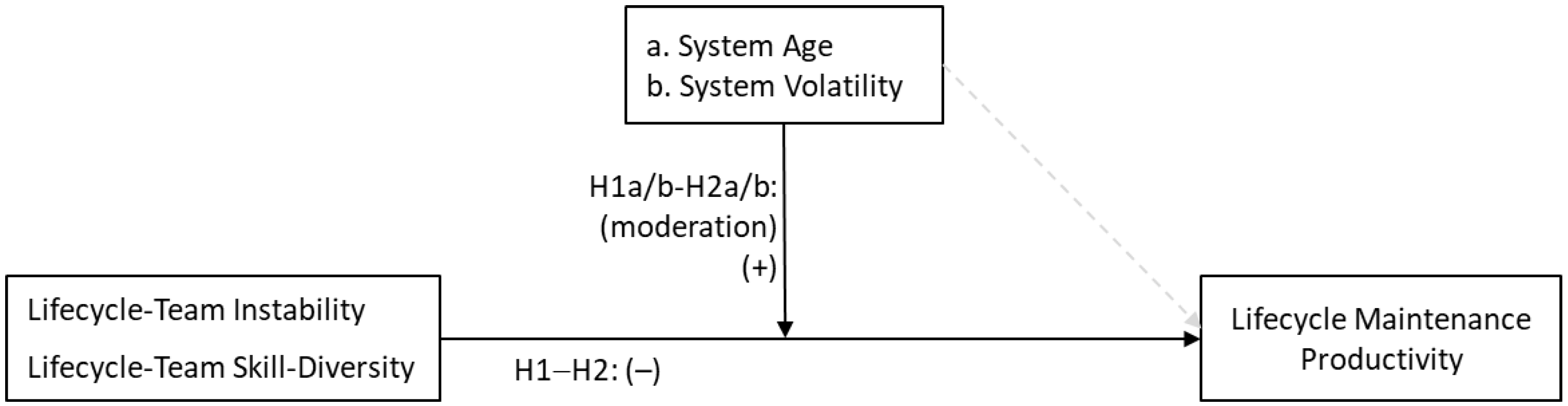
| Team Instability: H1 (−) | Team Skill-Diversity: H2 (−) | |
|---|---|---|
| Loss of tacit knowledge (−) More and less efficient knowledge search & sharing by new members (−) Difficult team coordination & knowledge integration (−) Degraded shared team cognition (−) | Improved system comprehension (+)
| |
| System age (a) | H1a ⇓ (+) | H2a ⇓ (+) |
| Lower quality explicit knowledge (−) Need more knowledge search & sharing (−)
| Age exacerbates team instability-related knowledge challenges:
| Age offsets team diversity-related knowledge challenges:
|
| System Volatility (b) | H1b ⇓ (+) | H2b ⇓ (+) |
Lower quality explicit knowledge (−)
Need less knowledge search and sharing (+)
| Volatility exacerbates team instability-related knowledge challenges:
| Volatility enhances positive team instability-related benefits:
|
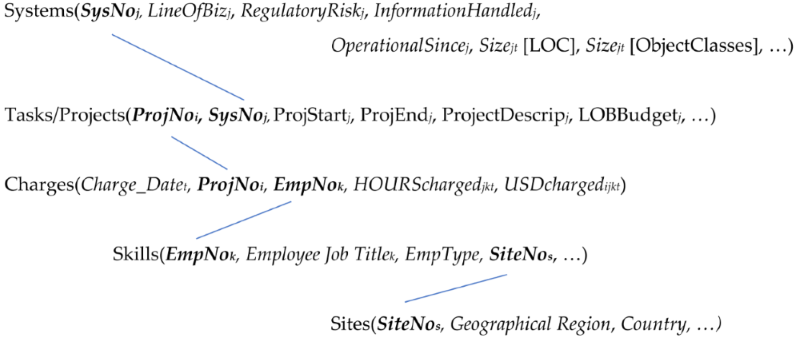
| Systems |
|
| Maintenance Tasks (Projects) |
|
| Charges |
|
| Maintainers |
|
| Sites |
|
| Variable | Measurement | Mean | Min | Max | StDev | Trans-Formed |
|---|---|---|---|---|---|---|
| Raw data items | ||||||
| Size | Number of object classes | 1132 | 6 | 17,117 | 1807 | Log * |
| Number of non-comment lines of code (LOC) | 171,297 | 511 | 4,198,640 | 317,146 | ||
| Number of Tasks | Number of maintenance tasks on a system (in 3 years) | 23.86 | 1.00 | 154.00 | 27.48 | Log |
| Total Maintenance-Effort | Sum of daily hours charged by maintainers of a system (in 3 years) | 52K | 11 | 890K | 91K | Log |
| Total Maintenance-Cost | Sum of daily dollars charged by maintainers of a system (in 3 years) | 1152K | 29 | 18,737K | 2016K | Log |
| Dependent variables | ||||||
| Effort Productivity (ProdHrs) | ln(Size) to ln(Total Maintenance-Effort) ratio | 0.65 | 0.18 | 2.99 | 0.22 | |
| Cost Productivity (ProdUSD) | ln(Size) to ln(Total Maintenance-Cost) ratio | 0.49 | 0.15 | 2.13 | 0.14 | |
| Independent Variables & Interaction Terms | ||||||
| Age (Age) | Number of years from a system’s go-live date till Dec. 2011 | 6.95 | 1.00 | 42.00 | 4.49 | Log |
| Software Volatility (SoftVolatility) | ln(Number of Tasks) to ln(Size) ratio | 0.43 | 0.00 | 1.43 | 0.21 | |
| Lifecycle-Team Instability (TeamInstability) | Count of distinct maintainers who worked on a system (in 3 years) | 164.0 | 1 | 1231.0 | 129.42 | Log & Zero-centered |
| Lifecycle-Team Skill-Diversity (TeamDiversity) | Count of distinct job titles (functional skills) of maintainers who worked on a system (in a 3-year period) | 25.16 | 1 | 67 | 14.51 | Log & Zero-centered |
| Interaction Terms (Age-TeamIns/TeamDiv) | Agey × Team Instability | 0.2 | −3.07 | 7.887 | 0.91 | |
| Age × Team Diversity | 0.22 | −0.15 | 2.705 | 0.33 | ||
| (Volatility-TeamIns/TeamDiv) | Volatility × Team Instability | 0.12 | −1.86 | 5.248 | 0.57 | |
| Volatility × Team Diversity | 0.12 | −0.17 | 1.8 | 0.22 | ||
| Control variables | ||||||
| Complexity (Complexity) | System cyclomatic complexity | 27,203 | 84 | 764,016 | 54,904 | Log & Zero-centered ** |
| Customer Info (CustInfo) | System handles sensitive customer (financial, personal) data? (binary) | 0.462 | 0.00 | 0.499 | 1.00 | |
| Line of Business (LOB) | Line of business a system serves (LOB names omitted for confidentiality) | 1-of-N | ||||
| LOB-1 (51%) | 0.512 | 0.00 | 1.00 | 0.500 | ||
| LOB-2 (28%) | 0.277 | 0.00 | 1.00 | 0.448 | ||
| LOB-3 (12%) | 0.122 | 0.00 | 1.00 | 0.328 | ||
| LOB-others (others) | 0.089 | 0.00 | 1.00 | 0.285 | ||
| Risk regulatory (Risk) | System’s regulatory risk exposure (low = 2, medium = 3, high = 4) | 3.052 | 2.00 | 4.00 | 0.771 | |
| Information Type (infoType) | Sensitivity of system data (public = 2, internal = 3, private = 4, confidential = 5) | 4.617 | 2.00 | 5.00 | 0.801 | |
| Variables | Mean | Min | Max | StdDev | (1) | (2) | (3) | (4) | (5) | (6) | (7) |
|---|---|---|---|---|---|---|---|---|---|---|---|
| (1) ProdHrs | 0.18 | 0.65 | 2.99 | 0.22 | 1.00 | ||||||
| (2) ProdUSD | 0.15 | 0.49 | 2.13 | 0.14 | 0.94 * | 1.00 | |||||
| (3) ln(Age) | 0.00 | 1.76 | 3.74 | 0.63 | −0.10 * | −0.06 | 1.00 | ||||
| (4) SoftVolatility | 0.00 | 0.43 | 1.43 | 0.21 | −0.31 * | −0.17 * | 0.30 * | 1.00 | |||
| (5) ln(Complexity) | 4.43 | 9.16 | 13.55 | 1.56 | −0.41 * | −0.57 * | 0.18 * | 0.38 * | 1.00 | ||
| (6) ln(TeamInstability) | 0.00 | 4.49 | 7.12 | 1.23 | −0.41 * | −0.25 * | 0.26 * | 0.24 * | 0.34 * | 1.00 | |
| (7) ln(TeamDiversity) | 0.00 | 2.99 | 4.20 | 0.78 | −0.40 * | −0.22 * | 0.24 * | 0.33 * | 0.33 * | 0.92 * | 1.00 |
| Dependent Variable | Exp. Sign | Effort Productivity (ProdHrs) (n = 426) | ||||
|---|---|---|---|---|---|---|
| (1) | (2) | (3) | (4) | (5) | ||
| Complexity | (−) | −0.617 *** | −0.633 *** | −0.660 *** | −0.638 *** | −0.677 *** |
| (−15.37) | (−17.04) | (−19.81) | (−17.12) | (−20.09) | ||
| Age | −0.060 | −0.056 | −0.008 | −0.056 | −0.021 | |
| (−1.54) | (−1.55) | (−0.23) | (−1.55) | (−0.65) | ||
| Volatility | −0.528 *** | −0.083 | −0.110 * | −0.188 *** | −0.254 *** | |
| (−12.75) | (−1.30) | (−1.86) | (−3.39) | (−5.05) | ||
| Team Instability | (−) | −0.539 *** | −0.408 *** | |||
| (−8.58) | (−7.10) | |||||
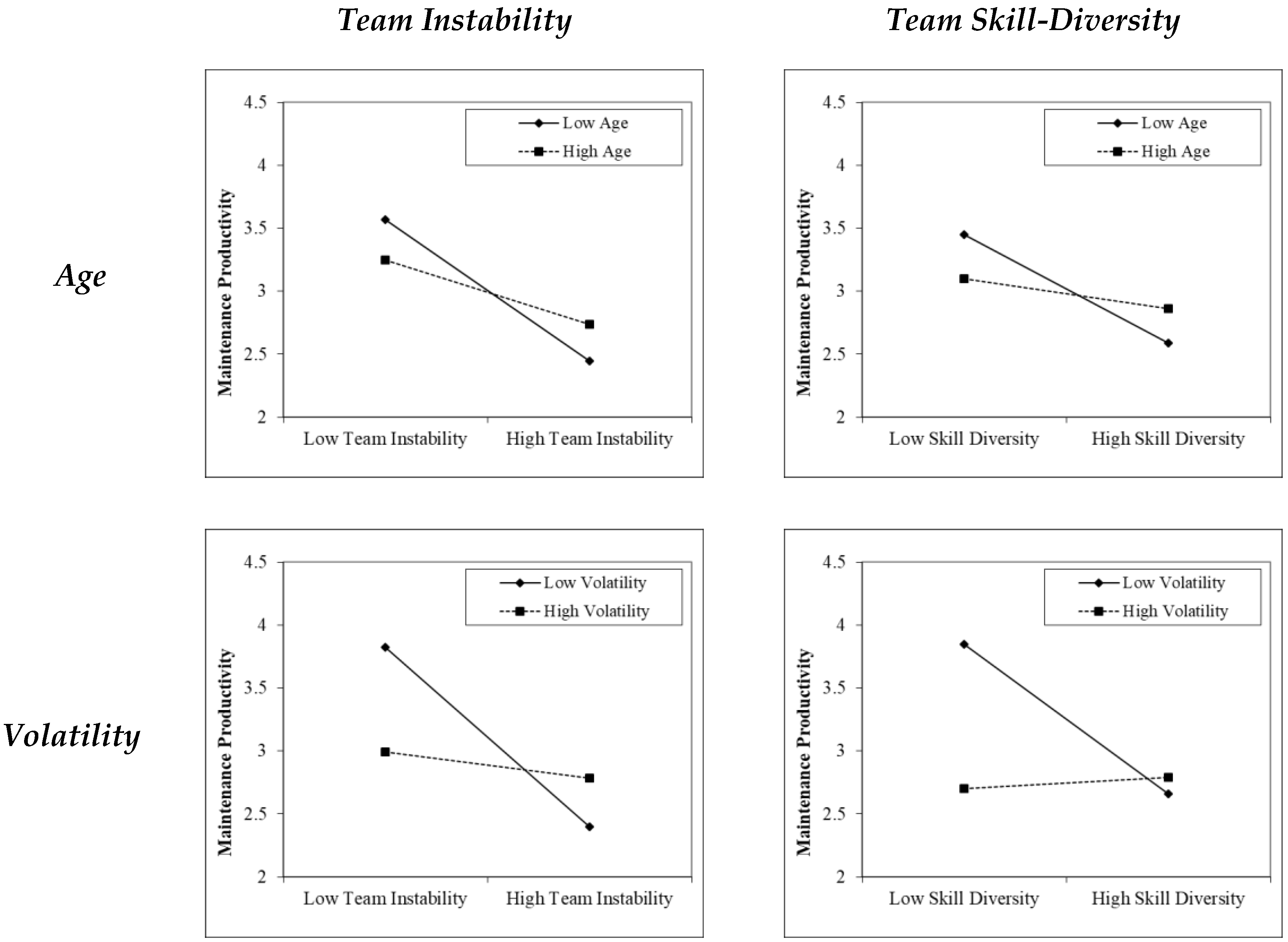
| Age × Instability | (+) | 0.153 *** | ||||
| (4.59) | ||||||
| Volatility × Instability | (+) | 0.305 *** | ||||
| (8.12) | ||||||
| Team Skill-Diversity | (−) | −0.454 *** | −0.276 *** | |||
| (−8.46) | (−5.33) | |||||
| Age × Skill-Diversity | (+) | 0.156 *** | ||||
| (4.74) | ||||||
| Volatility × Skill-Diversity | (+) | 0.319 *** | ||||
| (7.62) | ||||||
| R2 | 0.421 | 0.507 | 0.613 | 0.505 | 0.608 | |
| adj. R2 | 0.417 | 0.503 | 0.607 | 0.501 | 0.602 | |
| Percent change in productivity for a one standard deviation increase in attribute | Team Instability | Team Skill-Diversity | |
| H1 (−) | H2 (−) | ||
| −14.60% | −7.77% | ||
| System Age | −0.78% | 3.06% (2) | 3.83% |
| System Volatility | −0.38% (1) | 1.15% | 1.51% |
Dependent Variable | Exp. Sign | Effort Productivity (ProdUSD) (n = 426) | ||||
|---|---|---|---|---|---|---|
| (1) | (2) | (3) | (4) | (5) | ||
| Complexity | (−) | −0.749 *** | −0.760 *** | −0.785 *** | −0.761 *** | −0.798 *** |
| (−20.21) | (−21.61) | (−24.97) | (−21.22) | (−24.75) | ||
| Age | −0.071 ** | −0.068 ** | −0.010 | −0.068 * | −0.025 | |
| (−1.97) | (−1.99) | (−0.33) | (−1.97) | (−0.80) | ||
| Volatility | −0.438 *** | −0.099 | −0.149 *** | −0.223 *** | −0.296 *** | |
| (−11.47) | (−1.62) | (−2.67) | (−4.17) | (−6.16) | ||
| Team Instability | (−) | −0.411 *** | −0.283 *** | |||
| (−6.91) | (−5.20) | |||||
| Age × Instability | (+) | 0.204 *** | ||||
| (6.49) | ||||||
| Volatility × Instability | (+) | 0.228 *** | ||||
| (6.42) | ||||||
| Team Skill-Diversity | (−) | −0.287 *** | −0.138 *** | |||
| (−5.55) | (−2.79) | |||||
| Age × Skill-Diversity | (+) | 0.207 *** | ||||
| (6.56) | ||||||
| Volatility × Skill-Diversity | (+) | 0.234 *** | ||||
| (5.84) | ||||||
| R2 | 0.507 | 0.558 | 0.655 | 0.541 | 0.641 | |
| adj. R2 | 0.504 | 0.553 | 0.649 | 0.537 | 0.635 | |
Disclaimer/Publisher’s Note: The statements, opinions and data contained in all publications are solely those of the individual author(s) and contributor(s) and not of MDPI and/or the editor(s). MDPI and/or the editor(s) disclaim responsibility for any injury to people or property resulting from any ideas, methods, instructions or products referred to in the content. |
© 2026 by the author. Licensee MDPI, Basel, Switzerland. This article is an open access article distributed under the terms and conditions of the Creative Commons Attribution (CC BY) license.
Share and Cite
Benaroch, M. Interaction Effects of Team Attributes and System Attributes in Software Maintenance Productivity. Software 2026, 5, 13. https://doi.org/10.3390/software5020013
Benaroch M. Interaction Effects of Team Attributes and System Attributes in Software Maintenance Productivity. Software. 2026; 5(2):13. https://doi.org/10.3390/software5020013
Chicago/Turabian StyleBenaroch, Michel. 2026. "Interaction Effects of Team Attributes and System Attributes in Software Maintenance Productivity" Software 5, no. 2: 13. https://doi.org/10.3390/software5020013
APA StyleBenaroch, M. (2026). Interaction Effects of Team Attributes and System Attributes in Software Maintenance Productivity. Software, 5(2), 13. https://doi.org/10.3390/software5020013

