Article

Salinity Tolerance of Rice Genotypes: Response to Physiological Parameters and Seed Germination

by
Felipe de Campos Carmona
1,
Abdelbagi M. Ismail
2,
James Egdane
2,
Gustavo Soares Lima
1,
Ibanor Anghinoni
3,
Sidnei Deuner
4,* and
Filipe Selau Carlos
4
1
Integrar—Gestão e Inovação Agropecuária, Estrada Sinval S/N, P.O. Box 3, Capivari do Sul 95552-000, Rio Grande do Sul, Brazil
2
International Rice Research Institute, Metro Manila DAPO Box 7777, Philippines
3
Department of Soil Science, Universidade Federal do Rio Grande do Sul, Avenida Bento Gonçalves 7712, Bairro Agronomia, Porto Alegre 91540-000, Rio Grande do Sul, Brazil
4
Department of Botany, Universidade Federal de Pelotas, Avenida Eliseu Maciel, s/nº, Bairro Universitário, Capão do Leão 96160-000, Rio Grande do Sul, Brazil
*
Author to whom correspondence should be addressed.
Submission received: 11 July 2025 / Revised: 23 September 2025 / Accepted: 24 October 2025 / Published: 12 January 2026

Abstract

Soil salinity is a major abiotic stress that limits rice production, with severity varying among genotypes. It disrupts key physiological processes, particularly water uptake and membrane integrity. This study evaluated six rice genotypes to (i) determine the critical salinity threshold for seed germination and (ii) investigate the physiological mechanisms underlying genotypic variation. Seeds were exposed to saline solutions of up to 32 dS m−1 under controlled conditions, and germination was recorded at 2, 5, 10, and 14 days after stress imposition. Additional assays at 0, 12, 18, and 24 dS m−1 for 1, 3, and 5 days assessed water uptake, electrolyte leakage, and malondialdehyde (MDA) accumulation. The critical threshold for germination was consistent across genotypes (26.01–28.53 dS m−1), except for Nona Bokra, which was more sensitive (20.5 dS m−1). Salinity reduced seed water uptake and promoted membrane degradation, as evidenced by increased electrolyte leakage and MDA accumulation, with severity proportional to stress duration.

1. Introduction

In arid and semi-arid regions, soil salinity is one of the main environmental constraints to seed germination [1,2]. Coastal soils are also highly susceptible to salinization due to periodic seawater intrusion [3]. The response of rice (Oryza sativa L.) to salinity during germination has become increasingly relevant, particularly in Southeast Asia [1]. Labor shortages are driving producers away from transplanting toward line and broadcast sowing, both of which are carried out in dry soil rather than under flooded conditions [4]. Under saline conditions, this practice exacerbates germination failure due to reduced soil moisture [1]. Understanding the salinity tolerance of different rice genotypes during germination is, therefore, critical to sustaining crop establishment in salt-affected regions [5].
Information on genetic variation in salinity tolerance during germination remains limited [5]. Such knowledge is essential for selecting suitable sowing systems in which seeds are placed directly into the soil. Reports on the critical salinity threshold for rice germination are inconsistent [1]. Some studies suggest that salinity delays germination without substantially reducing final percentages [6], while others indicate that rice can tolerate electrical conductivity levels up to 16.3 dS m−1 [7]. Conversely, certain cultivars have been reported to fail at levels as low as 11 dS m−1, highlighting the wide genetic variation in rice responses to salinity stress [8].
Water absorption initiates the metabolic processes that break seed dormancy and trigger germination. These processes involve enzymatic activation and mobilization of nutritional reserves, both of which are negatively affected by excess NaCl in the soil [1]. In media with reduced osmotic potential, germination failure may result either from impaired water uptake or from the toxic effects of excess salts [9]. For example, Atriplex seeds germinating at –1.0 MPa exhibited greater delays in NaCl-based media compared with iso-osmotic PEG solutions, indicating that both osmotic and ionic factors influence germination [10,11].
Membrane stability is a sensitive indicator of NaCl damage. At high concentrations, Na+ can displace Ca2+ from the plasma membrane, reducing its integrity and causing electrolyte leakage, particularly of K+ [1]. This leakage is often associated with lipid peroxidation, where the oxidation of unsaturated fatty acids generates reactive oxygen species (ROS) that destabilize membranes [12]. Malondialdehyde (MDA), a byproduct of polyunsaturated fatty acid degradation, is widely used as a marker of lipid peroxidation [13]. Elevated MDA levels in salt-stressed plants confirm increased membrane permeability [14,15].
Taken together, seed water uptake, electrolyte leakage, and MDA accumulation are key physiological indicators of salt stress during germination. Therefore, this study aimed to (i) determine the critical salinity threshold for germination in rice genotypes and (ii) relate seed physiological responses to genotypic variation under saline stress.

2. Materials and Methods

2.1. Experimental Design

This study was conducted at the Crop and Environmental Sciences Division of the International Rice Research Institute (IRRI), Los Baños, Philippines. Six rice varieties with contrasting origins and salinity responses were selected: BR47 (India, tolerant), CSR36 (Bangladesh, tolerant), IR72046 (Philippines, tolerant), FL478 (Philippines, tolerant), Nona Bokra (Japan, tolerant), and IR29 (Philippines, susceptible). Two experiments were performed in parallel: (i) determination of the critical salinity threshold for germination and (ii) evaluation of water uptake, malondialdehyde (MDA) accumulation, and membrane stability under salinity.

2.2. Critical Salinity Level

For each cultivar, 10 seeds were placed in Petri dishes containing three layers of paper towels moistened with saline solutions prepared by dissolving NaCl in distilled water. Salinity treatments were 0 (control), 4, 8, 12, 16, 18, 20, 22, 24, 26, 28, 30, and 32 dS m−1. Each treatment was replicated three times. Fifteen milliliters of solution was added per dish, and controls received distilled water only. Plates were sealed with porous tape to minimize evaporation while allowing gas exchange and incubated at 28 °C.

2.3. Seed Germination

Seed germination was recorded daily from the second to the tenth day, and a final evaluation was recorded after 14 days, according to the methodology described by the international rules for seed testing [16], with seeds with emerged coleoptiles being considered germinated. Regression analyses were used to estimate the critical salinity threshold at 2, 5, 10, and 14 days. The threshold was defined as the salinity level causing >30% reduction in germination [17]. Inflection points in germination response curves were estimated using segmented polynomial regression, which partitions nonlinear regressions into linear segments. Inflection points were determined by minimizing the residual mean square error (RMSE) of the fitted regressions.

2.4. Water Absorption, Malondialdehyde Synthesis, and Membrane Stability

Twenty seeds of each variety were placed in Petri dishes with three layers of paper towels and divided into two groups of ten seeds. Their dry weights were recorded before treatments. Plates were moistened with 15 mL of saline solutions (0, 12, 18, and 24 dS m−1), sealed, and incubated at 28 °C. Seeds were sampled after 1, 3, and 5 days, with three replicates per treatment. Water absorption was calculated according to Equation (1).
W u = m d m w / m d
where Wu = water uptake (mL g−1 seed), md = dry weight (g), and mw = wet weight after soaking (g).
The same seeds were then used to quantify lipid peroxidation, estimated by MDA content using the thiobarbituric acid (TBA) method [18].
Electrolyte leakage was measured using the second group of seeds. After thorough washing, seeds were placed in test tubes containing 20 mL of deionized water. Tubes were sealed and incubated at 32 °C for 12 and 24 h. Electrical conductivity (EC) of the solution was measured, and electrolyte leakage (EL) was expressed as shown in Equations (2) and (3).
E L 12 = E C 12 / m d
E L 24 = E C 24 E C 12 / m d
where EL12 and EL24 = electrolyte leakage after 12 and 24 h (mS m−1 g−1), EC12 and EC24 = electrical conductivity (mS m−1), and md = dry weight of seeds (g).
Values of water uptake, MDA content, and electrolyte leakage were expressed as means ± standard errors. Correlations between germination percentages (2, 5, 10, and 14 days at 0, 12, 18, and 24 dS m−1) and physiological parameters (water uptake, EL12, EL24, and MDA) were analyzed using Pearson’s correlation.

2.5. Statistical Analyses

Data normality was assessed using the Shapiro–Wilk test. Analysis of variance (ANOVA, p < 0.05) was conducted, and cultivar responses to salinity were modeled with sigmoidal regressions. Pearson’s correlations were used to examine associations among germination, water uptake, electrolyte leakage, and MDA content. Analyses were performed using SAS software (version 9.4).

3. Results

3.1. Seed Germination and Critical Salinity Level

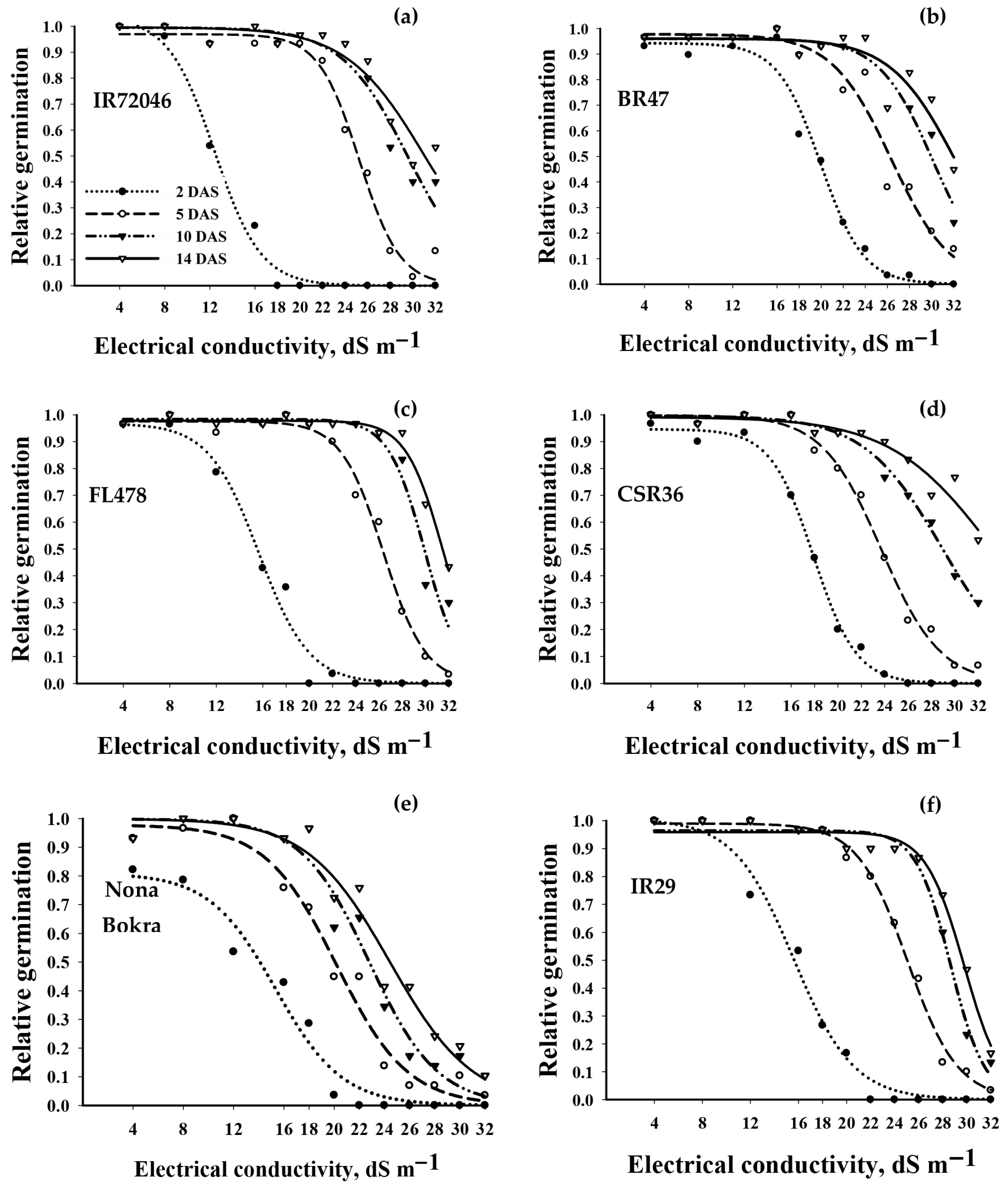
Seed germination of all genotypes declined with increasing salinity (Figure 1), and sigmoidal regression models provided highly significant fits in all cases (Table 1). Relative germination was lowest at 2 days after soaking (DAS), when the effect of salinity was strongest.
At 2 DAS, the salinity level at which germination began to decline varied among cultivars. BR47 was the least sensitive, maintaining germination at salinity levels more than three times higher than those tolerated by Nona Bokra, the most sensitive genotype (Table 1). By 5 DAS, germination increased substantially in all cultivars relative to 2 DAS, irrespective of salinity level (Figure 1).
The salinity threshold for germination also varied with cultivar and duration of exposure. BR47 consistently exhibited the highest inflection points at 2, 10, and 14 DAS, while Nona Bokra showed the lowest performance across all time points (Table 1). Overall, very high salinity levels were required to substantially inhibit germination.
At 10 DAS, the estimated critical salinity threshold was similar among most cultivars, ranging between 26 and 28 dS m−1 (Table 1). The only exception was Nona Bokra, with a threshold of ~20 dS m−1, significantly lower than the other genotypes, including IR29. Interestingly, although IR29 is widely used as a susceptible check for salinity tolerance during the vegetative stage [19], it performed better than Nona Bokra during germination. These results suggest that tolerance to salinity at germination does not necessarily correspond to tolerance at later growth stages.

3.2. Water Absorption

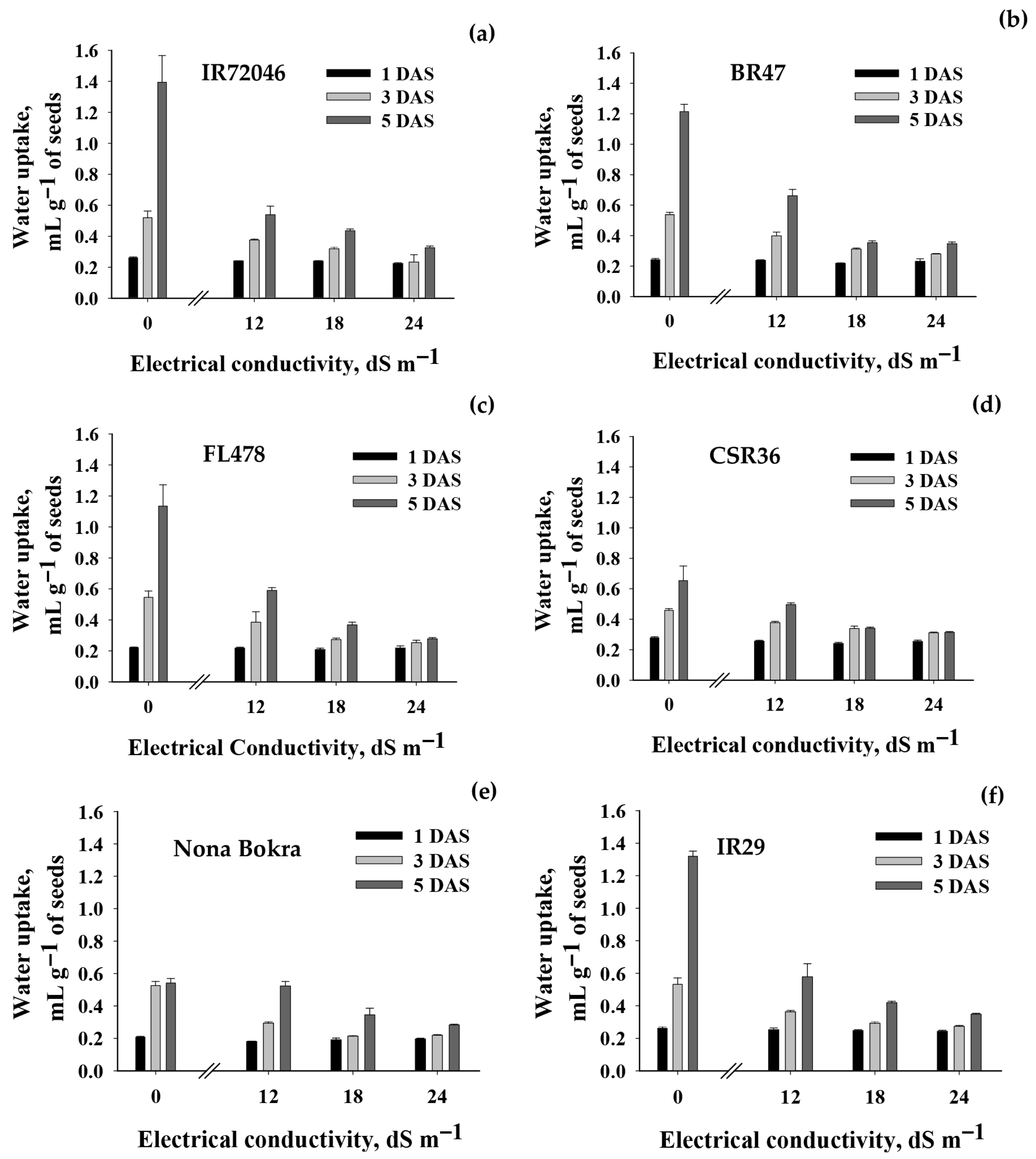
Water uptake by seeds increased with soaking time and decreased with salinity level (Figure 2). At 1 DAS, no significant differences in water absorption were observed among genotypes, regardless of medium conductivity. The largest differences emerged under control conditions, where water absorption at 5 DAS was consistently higher than at 1 and 3 DAS for all genotypes except Nona Bokra, which showed no difference between 3 and 5 DAS (Figure 2e). At 12 dS m−1, significant differences were detected across all soaking times, with uptake following the same pattern (5 DAS > 3 DAS > 1 DAS). At higher salinity levels (18 and 24 dS m−1), soaking time had little effect on absorption, except for FL478 and CSR36, which showed no difference between 3 and 5 DAS (Figure 2a,d).
Comparisons between the control and 24 dS m−1 treatments revealed substantial reductions in water uptake across genotypes. IR72046 exhibited the greatest reduction (64%), followed by FL478 and IR29 (~60% each) (Figure 2a,c,f). In contrast, CSR36 showed the smallest reduction (37%), followed by Nona Bokra (45%). However, in absolute terms, Nona Bokra had the lowest water absorption under 24 dS m−1 across all genotypes.

3.3. Electrolyte Loss

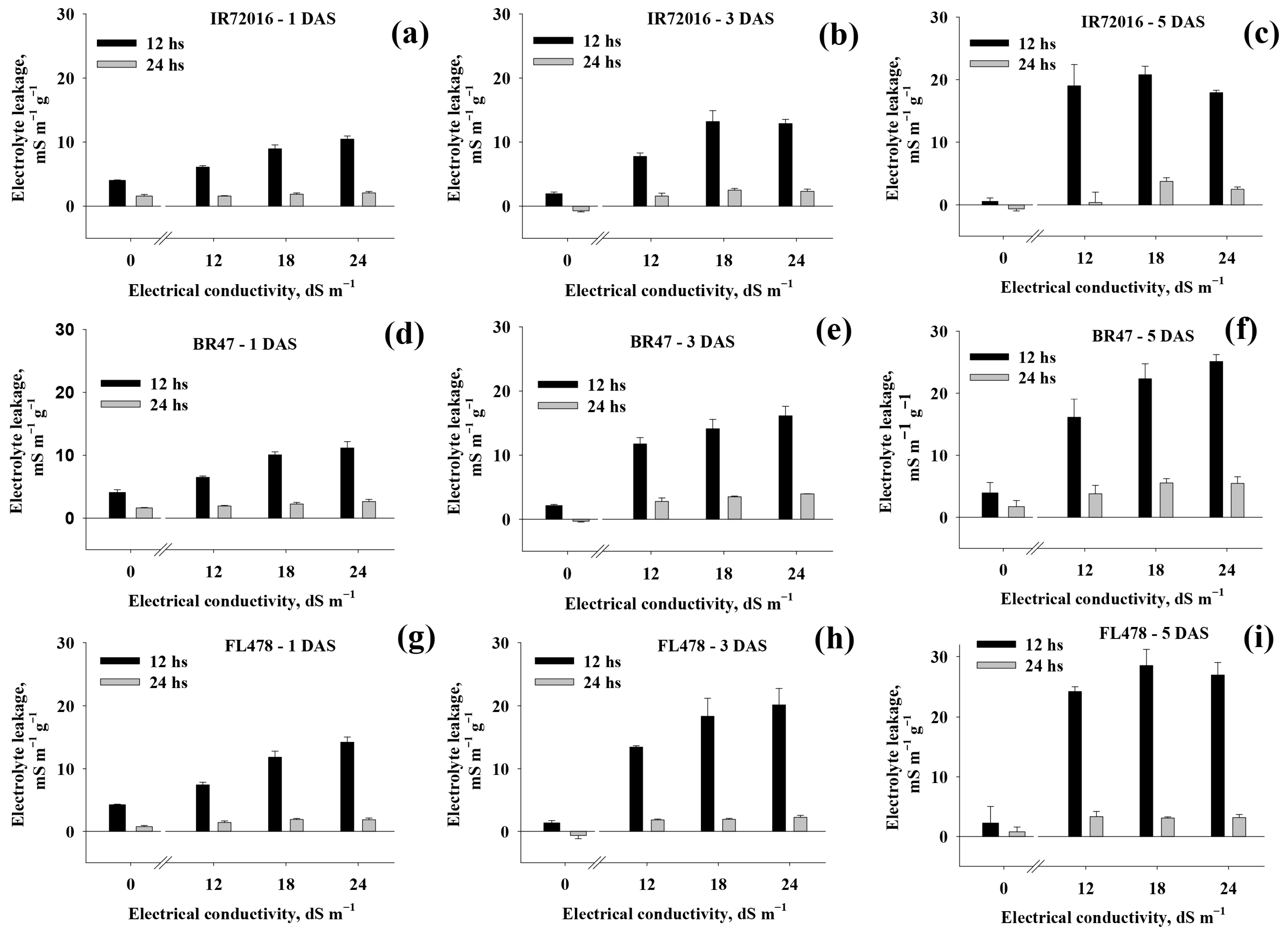
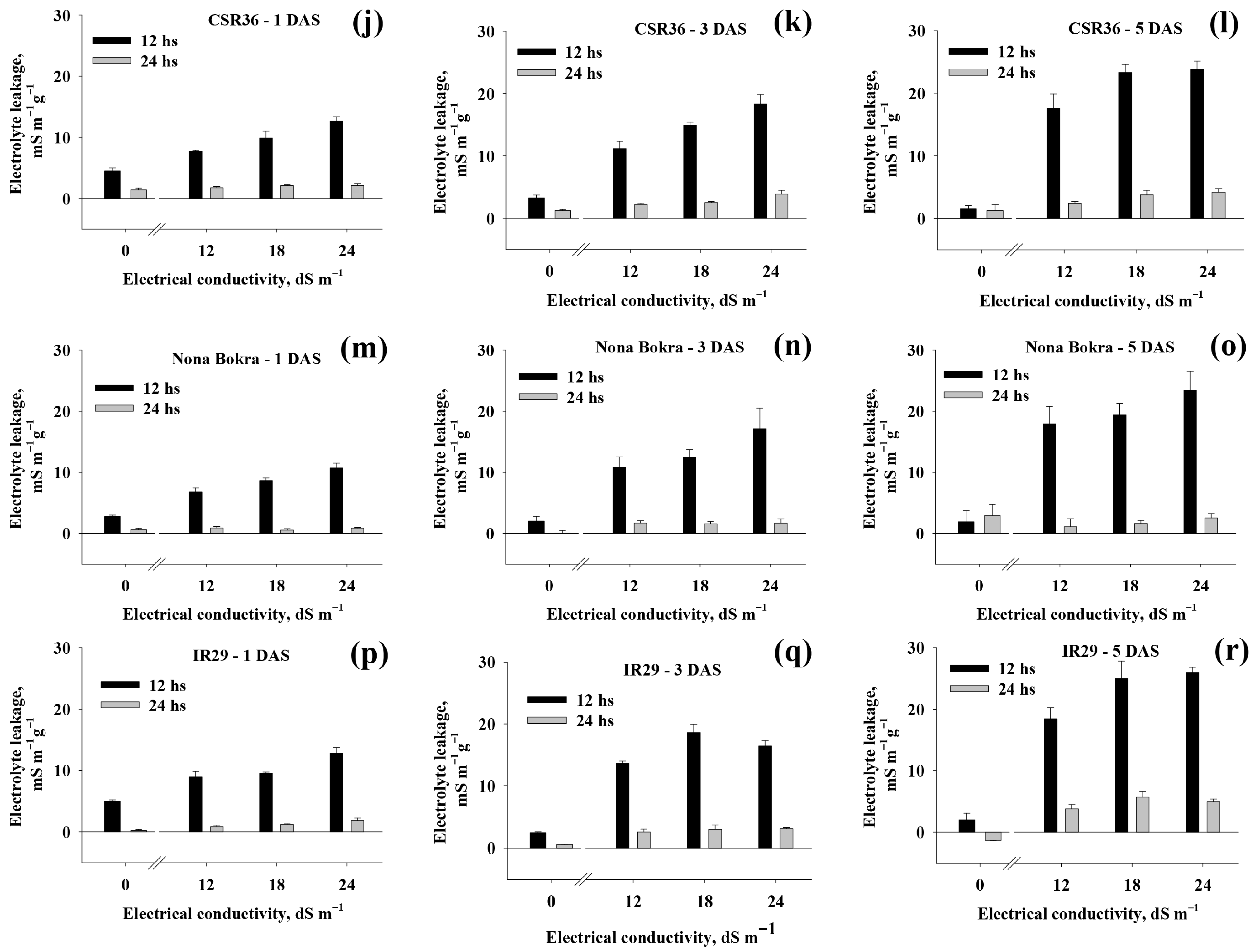
Membrane damage was assessed indirectly by measuring solute leakage from seeds. Electrolyte leakage generally increased with salinity and soaking time, showing an inverse trend to water uptake (Figure 3). At 1 DAS, differences between treatments were relatively uniform. By 3 DAS, some cultivars, such as IR72046 (Figure 3b) and IR29 (Figure 3q), exhibited higher electrolyte loss at 18 dS m−1 than at higher salinity levels. A similar pattern was observed at 5 DAS for IR72046 (Figure 3c) and FL478 (Figure 3i). Except in the control treatment, electrolyte loss measured after 12 h in the water bath was consistently higher than at 24 h, consistent with previous observations [20].
Nona Bokra displayed similar electrolyte loss patterns to the other cultivars (Figure 3m–o), but values were generally lower than those observed in FL478 (Figure 3g–i) and IR29 (Figure 3p–r). This suggests that the high sensitivity of Nona Bokra to salinity (Figure 1, Table 1) is not directly related to membrane stability under salt stress.

3.4. Malondialdehyde Accumulation

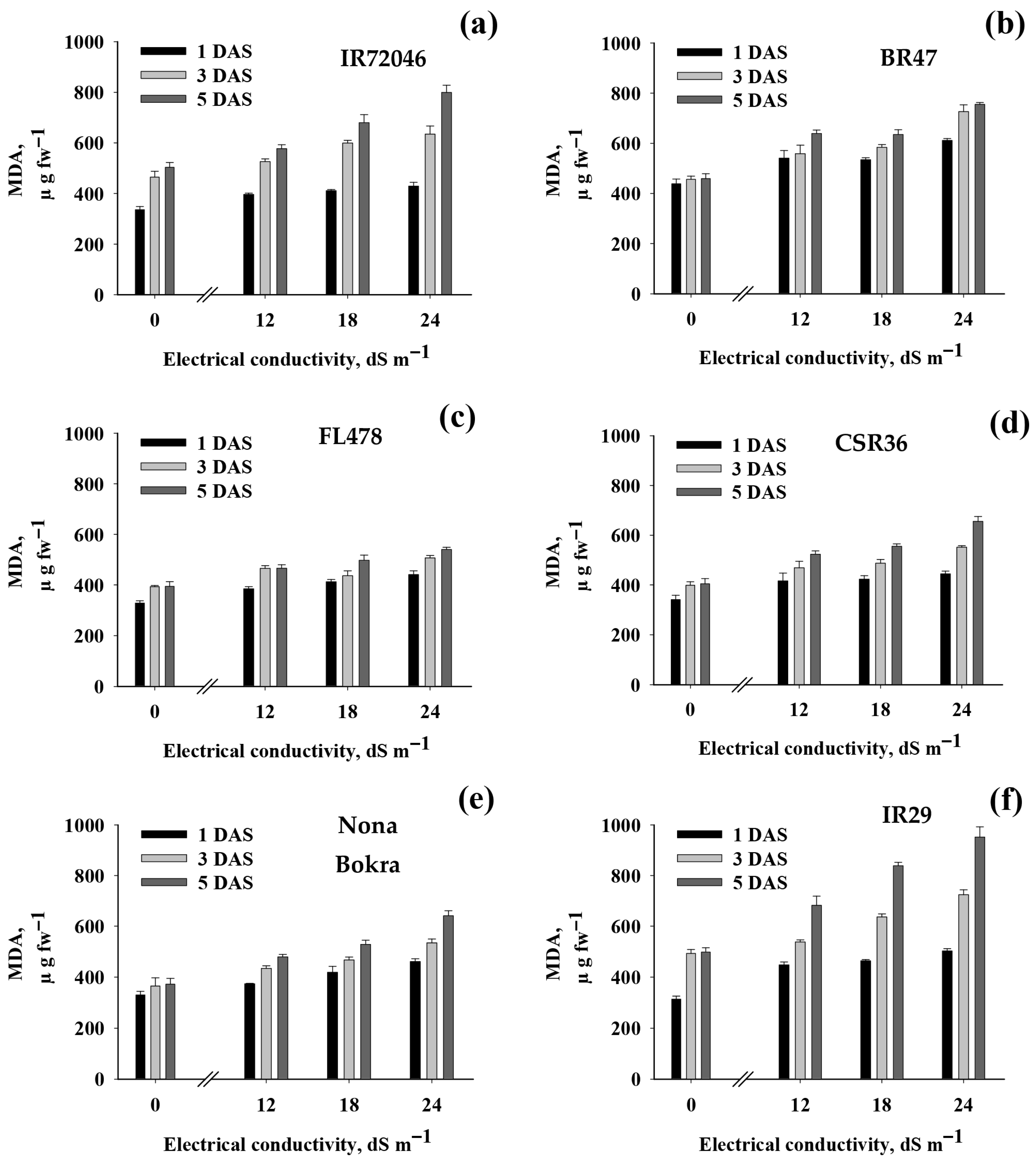
MDA accumulation, an indicator of lipid peroxidation, was influenced by both salinity level and soaking time (Figure 4). Response patterns differed among cultivars, with IR72046 (Figure 4a) and, particularly, IR29 (Figure 4f) showing the largest differences among treatments. Significant MDA accumulation was observed even in control conditions at certain soaking intervals in all cultivars except BR47 (Figure 4b). From 12 dS m−1 onward, MDA levels at 5 DAS were consistently higher than at 1 DAS, indicating that prolonged exposure exacerbates oxidative damage.

4. Discussion

4.1. Seed Germination and Critical Salinity Level

Rice seeds that are fully hydrated and non-dormant typically germinate after a temperature-dependent period. Reduced water potential in the medium can delay or prevent germination depending on the severity of the reduction [21]. In this study, germination was delayed at intermediate salinity levels for all cultivars (Figure 1). However, Nona Bokra exhibited markedly lower germination at the highest salinity levels (Figure 1e). Under optimal conditions, rice typically germinates within 2 days [22], a pattern confirmed in this study, as all cultivars displayed >80% germination at the lowest salinity level (Figure 1).
The 10-day stress period was sufficient to determine the critical salinity threshold, as germination percentages at 10 DAS were comparable to those at 14 DAS. At the field level, where seeds encounter multiple stressors, such similarity is expected to be even more pronounced.
Salinity tolerance is complex and varies among genotypes and developmental stages, posing challenges for breeding programs [23,24]. Despite being a glycophyte, the critical salinity thresholds observed in this study (Table 1) were comparable to those of moderately salt-tolerant halophytes such as Hordeum jubatum [25], reflecting the low soil water potential required for rice germination [26].
Our findings align with previous studies reporting high germination percentages (>70%) at salinities around 24 dS m−1 [26,27]. However, other studies observed complete inhibition at lower levels (12–20 dS m−1), underscoring the substantial genetic variation in rice response to salinity during germination [8,28]. Correlations between physiological traits and germination suggest that different mechanisms contribute to salinity tolerance. For instance, in CSR36, electrolyte loss after 12 h at 1 DAS was strongly correlated with germination across all periods, whereas in IR72046, correlations were significant but weaker at 3 DAS (Table 2).

4.2. Water Absorption

Seed water uptake occurs in two phases: initial apoplastic movement, independent of the osmotic potential of the medium, followed by entry across cell membranes driven by the osmotic gradient between the seed and its environment [29]. Similar water absorption values at 1 DAS across salinity levels (Figure 2) likely reflect apoplastic uptake. Reduced absorption at higher salinity represents the osmotic limitation imposed by NaCl.
Nona Bokra exhibited the strongest interactions, with water uptake at 5 DAS correlating with germination and electrolyte loss at 1 and 3 DAS. However, MDA synthesis appeared to be the primary factor limiting germination in this variety, showing strong correlations across all soaking times. Similarly, MDA accumulation was the best predictor of reduced germination in IR29, especially at 3 and 5 DAS (Table 2).

4.3. Electrolyte Loss

NaCl rapidly enters cells, reducing cytoplasmic osmotic potential and facilitating water uptake, an adaptive mechanism under moderate salinity [10]. At high concentrations, however, Na+ can displace Ca2+ in plasma membranes, increasing permeability and promoting K+ leakage [30]. All genotypes showed increased electrolyte loss with salinity (Figure 3), yet germination was only impaired at very high salinity (Table 1). This indicates that rice seeds possess effective mechanisms to maintain germination despite partial membrane destabilization.

4.4. Malondialdehyde Synthesis

MDA accumulation increases with salinity due to lipid peroxidation induced by reactive oxygen species, leading to membrane damage, disrupted ionic fluxes, and reduced selectivity for nutrient exchange. While some salinity-tolerant rice varieties, such as Pokkali, may maintain low MDA levels in leaves under stress [31], all five tolerant varieties in this study showed increased MDA synthesis in seeds with rising salinity (Figure 4a–e).
Among the genotypes, IR29, which is susceptible during the vegetative stage, exhibited the highest absolute MDA accumulation (Figure 4f). This suggests that oxidative damage during germination may differ from stress responses at later growth stages, contributing to inter-genotypic variation in salinity tolerance at the seed stage.

5. Conclusions

The critical salinity threshold for germination in irrigated rice varieties IR72046, BR47, FL478, CSR36, and IR29, after 10 days of soaking in saline medium, ranged from 26.01 to 28.53 dS m−1. In contrast, the Nona Bokra variety exhibited a lower threshold of 20.5 dS m−1.
Salinity and exposure time reduced seed water absorption and increased membrane damage, as indicated by higher electrolyte leakage and malondialdehyde (MDA) accumulation under prolonged stress.
Declines in germination rates were linked to different physiological mechanisms across varieties. Electrolyte leakage after 12 h at 1 and 3 DAS was the best indicator of stress in CSR36 and IR72046, respectively, whereas lipid peroxidation was the primary factor limiting germination in Nona Bokra and IR29.
The results of this study contribute to the selection of materials for genetic improvement programs and the recommendation of cultivars for cultivation areas with a history of salinity or subject to high salinity conditions in the growing environment.

Author Contributions

Conceptualization, F.d.C.C. and A.M.I.; methodology, F.d.C.C., A.M.I. and J.E.; software, F.d.C.C.; validation, F.d.C.C., A.M.I., J.E., G.S.L., I.A. and F.S.C.; formal analysis, F.d.C.C. and I.A.; investigation J.E. and G.S.L.; resources, F.d.C.C., S.D. and F.S.C.; data curation, F.d.C.C. and F.S.C.; writing—original draft preparation, F.d.C.C., G.S.L. and F.S.C.; writing—review and editing, F.d.C.C., S.D. and F.S.C.; visualization, S.D. and F.S.C.; supervision, F.d.C.C.; project administration, F.d.C.C.; funding acquisition, F.d.C.C. All authors have read and agreed to the published version of the manuscript.

Funding

This study was partially financed by Coordination for the Improvement of Higher Education Personnel (CAPES-Brazil; Financing code 001) and by Brazilian National Council for Scientific and Technological Development (CNPq-Brazil; Grant numbers 430264 2018–6).

Data Availability Statement

The original contributions presented in this study are included in the article. Further inquiries can be directed to the corresponding author.

Conflicts of Interest

The authors declare that they have no known competing financial interests or personal relationships that could have appeared to influence the work reported in this paper.

References

  1. Arif, Y.; Singh, P.; Siddiqui, H.; Bajguz, A.; Hayat, S. Salinity induced physiological and biochemical changes in plants: An omic approach towards salt stress tolerance. Plant Physiol. Biochem. 2020, 156, 64–77. [Google Scholar] [CrossRef]
  2. Chele, K.H.; Tinte, M.M.; Piater, L.A.; Dubery, I.A.; Tugizimana, F. Soil Salinity, a Serious Environmental Issue and Plant Responses: A Metabolomics Perspective. Metabolites 2021, 11, 724. [Google Scholar] [CrossRef] [PubMed]
  3. Thiam, S.; Villamor, G.B.; Faye, L.C.; Sène, J.H.B.; Diwediga, B.; Kyei-Baffour, N. Monitoring land use and soil salinity changes in coastal landscape: A case study from Senegal. Environ. Monit. Assess. 2021, 10, 259. [Google Scholar] [CrossRef] [PubMed]
  4. Carlos, F.S.; Schaffer, N.; Marcolin, E.; Fernandes, R.S.; Mariot, R.; Mazzurana, M.; Roesch, L.F.W.; Levandoski, B.; Camargo, F.A.d.O. A long-term no-tillage system can increase enzymatic activity and maintain bacterial richness in paddy fields. Land Degrad. Dev. 2021, 32, 2257–2268. [Google Scholar] [CrossRef]
  5. Shankar, R.; Bhattacharjee, A.; Jain, M. Transcriptome analysis in different rice cultivars provides novel insights into desiccation and salinity stress responses. Sci. Rep. 2016, 6, 23719. [Google Scholar] [CrossRef] [PubMed]
  6. Akbar, M.; Yabuno, T. Breeding for saline resistant varieties of rice. I-Comparative performance of some rice varieties to salinity during early development stages. Jpn. J. Breed. 1974, 24, 176–181. [Google Scholar]
  7. Khan, M.S.A.; Hamid, A.; Karim, M.A. Effect of sodium chloride on germination and seedling characters of different types of rice (Oryza sativa L.). J. Agron. Crop Sci. 1997, 179, 163–169. [Google Scholar]
  8. Jagadev, P.N.; Jena, D. Effect of saline irrigation water on germination and seedling growth of rice genotypes. Orissa J. Agric. Res. 1993, 6, 87–90. [Google Scholar]
  9. Kaymakanova, M. Effect of Salinity on Germination and Seed Physiology in Bean (Phaseolus vulgaris L.). Biotechnol. Biotechnol. Equip. 2009, 23, 326–329. [Google Scholar] [CrossRef]
  10. Katembe, W.J.; Ungar, I.A.; Mitchell, J.P. Effect of Salinity on Germination and Seedling Growth of two Atriplex species (Chenopodiaceae). Ann. Bot. 1998, 82, 167–175. [Google Scholar] [CrossRef]
  11. Bueno, M.; Lendínez, M.L.; Aparicio, C.; Cordovilla, M.P. Germination and growth of Atriplex prostrata and Plantago coronopus: Two strategies to survive in saline habitats. Flora 2017, 227, 56–63. [Google Scholar] [CrossRef]
  12. Marschner, H. Mineral Nutrition of Higher Plants, 2nd ed.; Academic Press: London, UK, 1995; 650p. [Google Scholar]
  13. Mittler, R. Oxidative stress, antioxidants and stress tolerance. Trends Plant Sci. 2002, 7, 405–410. [Google Scholar] [CrossRef] [PubMed]
  14. Fadzilla, N.M.; Finch, R.P.; Burdon, R.H. Salinity, oxidative stress and antioxidant responses in shoot cultures of rice. Exp. Bot. 1997, 48, 325–331. [Google Scholar] [CrossRef]
  15. Lutts, S.; Kinet, J.M.; Bouharmont, J. NaCl-induced senescence in leaves of rice (Oryza sativa L.) cultivars differing in salinity resistance. Ann. Bot. 1996, 78, 389–398. [Google Scholar] [CrossRef]
  16. ISTA. International rules for seed testing. Seed Sci. Technol. 1993, 21, 160–186. [Google Scholar]
  17. Zhou, G.; Ma, B.L.; Li, J.; Feng, C.; Lu, J.; Qin, P. Determining salinity threshold level for castor bean emergence and stand stablishment. Crop Sci. 2010, 50, 2030–2036. [Google Scholar] [CrossRef]
  18. Cakmak, I.; Horst, W.J. Effects of Aluminium on Lipid Peroxidation, Superoxide Dismutase, Catalase, and Peroxidase Activities in Root Tips of Soybean (Glycine Max). Physiol. Plant. 1991, 83, 463–468. [Google Scholar] [CrossRef]
  19. Gregorio, G.B.; Senadhira, D.; Mendoza, R.D. Screening Rice for Salinity Tolerance; IRRI Discussion Series Paper, 22; Science Publishing Group: Los Baños, Philippines, 1997; 29p. [Google Scholar]
  20. Ismail, A.M.; Hall, A.E.; Close, T.J. Chilling tolerance during emergence of cowpea associated with a dehydrin and slow electrolyte leakage. Crop Sci. 1997, 37, 1270–1277. [Google Scholar] [CrossRef]
  21. Nawaz, M.A.; Fukai, S.; Prakash, S.; Bhandari, B. Effect of soaking medium on the physicochemical properties of parboiled glutinous rice of selected laotian cultivars. Int. J. Food Prop. 2018, 21, 1896–1910. [Google Scholar] [CrossRef]
  22. Yoshida, S. Fundamentals of Rice Crop Science; The International Rice Research Institute: Los Baños, Philippines, 1981; 269p. [Google Scholar]
  23. Zeng, L.; Poss, J.A.; Wilson, C.; Draz, A.S.E.; Gregorio, G.B.; Grieve, C.M. Evaluation of salt tolerance in rice genotypes by physiological characters. Euphytica 2003, 129, 281–292. [Google Scholar] [CrossRef]
  24. Maas, E.V.; Hoffman, G.J. Crop salt tolerance—Current assessment. J. Irrig. Drain. Div. 1977, 103, 115–134. [Google Scholar] [CrossRef]
  25. Ungar, I.A. Ecophysiology of Vascular Halophytes, 1st ed.; CRC Press: Boca Raton, FL, USA, 1991; 218p. [Google Scholar]
  26. Shonjani, S. Salt Sensitivity of Rice, Maize, Sugar Beet, and Cotton During Germination and Early Vegetative Growth. Ph.D. Thesis, University of Giessen, Gießen, Germany, 2002; 164p. [Google Scholar]
  27. Djanaguiraman, M.; Ramadass, R.; Devi, D.D. Effect of salt stress on germination and seedling growth in rice genotypes. Madras Agric. J. 2003, 90, 50–53. [Google Scholar] [CrossRef]
  28. Hakim, A.; Juraimi, S.; Begum, M.; Hanafi, M.M.; Ismail, M.R.; Selamat, A. Effect of salt stress on germination and early seedling growth of rice (Oryza sativa L.). Afr. J. Biotech. 2010, 9, 1911–1918. [Google Scholar]
  29. Bewley, J.D.; Black, M. Seeds: Physiology of Development and Germination, 2nd ed.; Plenum Press: New York, NY, USA, 1994; 447p. [Google Scholar]
  30. Hao, S.; Wang, Y.; Yan, Y.; Liu, Y.; Wang, J.; Chen, S. A Review on Plant Responses to Salt Stress and Their Mechanisms of Salt Resistance. Horticulturae 2021, 7, 132. [Google Scholar] [CrossRef]
  31. Dionisio-Sese, M.L.; Tobita, S. Antioxidant responses of rice seedlings to salinity stress. Plant Sci. 1998, 135, 1–9. [Google Scholar] [CrossRef]
Figure 1. Relative germination of rice varieties IR72046 (a), BR47 (b), FL478 (c), CSR36 (d), Nona Bokra (e), and IR29 (f), submitted to salinity levels for 2, 5, 10, and 14 days. DAS: days after soaking. IRRI, Los Baños, Philippines.
Seeds 05 00005 g001
Figure 2. Effect of salinity on water uptake in rice genotypes IR72046 (a), BR47 (b), FL478 (c), CSR36 (d), Nona Bokra (e) and IR29 (f) after one, three and five days of soaking. Bars indicate standard error.
Seeds 05 00005 g002
Figure 3. Electrolyte leakage in rice genotypes IR72046 (ac), BR47 (df), FL478 (gi), CSR36 (jl), Nona Bokra (mo) and IR29 (pr) as a function of salinity level and soaking time. Bars indicate standard error.
Seeds 05 00005 g003aSeeds 05 00005 g003b
Figure 4. Effect of salinity on malondialdehyde synthesis in rice genotypes IR72046 (a), BR47 (b), FL478 (c), CSR36 (d), Nona Bokra (e) and IR29 (f) after one, three and five days of soaking. Bars indicate standard error.
Seeds 05 00005 g004
Table 1. Equations and regression coefficients of the sigmoidal response curves of rice varieties exposed to salinity levels for different soaking intervals.
IntervalEquationR2Inflection
Point (dS m−1)
Critical
Level (dS m−1)
IR72046
2 DASŷ = 1.036/(1 + e(−(x − 12.42)/−2.057))0.99 ***7.3910.91
5 DASŷ = 0.969/(1 + e(−(x − 25.25)/−1.804))0.98 ***20.9723.52
10 DASŷ = 0.995/(1 + e(−(x − 29.56)/−2.934))0.94 ***24.2127.02
14 DASŷ = 0.996/(1 + e(−(x − 31.07)/−3.471))0.90 ***25.1128.08
BR47
2 DASŷ = 0.943/(1 + e(−(x − 19.95)/−1.946))0.98 ***15.1317.89
5 DASŷ = 0.978/(1 + e(−(x − 26.35)/−2.692))0.96 ***18.9623.86
10 DASŷ = 0.960/(1 + e(−(x − 30.15)/−2.463))0.93 ***26.7927.71
14 DASŷ = 0.961/(1 + e(−(x − 32.20)/−2.956))0.84 **27.6329.28
FL478
2 DASŷ = 0.968/(1 + e(−(x − 15.67)/−2.150))0.98 ***9.7913.60
5 DASŷ = 0.976/(1 + e(−(x − 26.37)/−1.815))0.99 ***20.4224.68
10 DASŷ = 0.984/(1 + e(−(x − 29.94)/−1.565))0.96 ***25.4328.53
14 DASŷ = 0.978/(1 + e(−(x − 31.53)/−1.605))0.98 ***27.3330.04
CSR36
2 DASŷ = 0.946/(1 + e(−(x − 17.91)/−1.823))0.99 ***12.7116.00
5 DASŷ = 0.998/(1 + e(−(x − 23.71)/−2.521))0.99 ***16.6621.55
10 DASŷ = 0.996/(1 + e(−(x − 28.99)/−3.370))0.99 ***20.3526.08
14 DASŷ = 0.992/(1 + e(−(x − 33.33)/−4.378))0.93 ***21.1629.50
Nona Bokra
2 DASŷ = 0.810/(1 + e(−(x − 15.36)/−2.643))0.97 ***5.0410.47
5 DASŷ = 0.978/(1 + e(−(x − 20.21)/−2.823))0.98 ***13.2317.60
10 DASŷ = 0.998/(1 + e(−(x − 22.81)/−2.699))0.96 ***14.8720.50
14 DASŷ = 0.999/(1 + e(−(x − 24.44)/−3.288))0.97 ***23.7521.64
IR29
2 DASŷ = 1.006/(1 + e(−(x − 15.62)/−2.492))0.99 ***7.8513.55
5 DASŷ = 0.990/(1 + e(−(x − 25.10)/−2.090))0.99 ***17.8823.25
10 DASŷ = 0.964/(1 + e(−(x − 28.67)/−1.434))0.98 ***24.7427.27
14 DASŷ = 0.959/(1 + e(−(x − 29.79)/−1.605))0.98 ***25.2228.19
** Indicates significant difference at 0.0001 < p < 0.001 and *** indicates significant difference at p < 0.0001.
Table 2. Pearson’s correlation coefficients between the germination of different rice varieties exposed to salinity levels of 0, 12, 18, and 24 dS m−1 for 2, 5, 10, and 14 days and the water absorption, loss of electrolytes (after 12 and 24 h water bath), and malondialdehyde (MDA) synthesis exposed to the same salinity levels for one, three, and five days.
GerminationWater UptakeElectrolyte LeakageMDA Synthesis
12 h24 h
1 DAS3 DAS5 DAS1 DAS3 DAS5 DAS1 DAS3 DAS5 DAS1 DAS3 DAS5 DAS
IR72046
2 DAS0.71 **0.85 **0.86 **−0.91 **−0.91 **−0.78 **−0.74 **−0.90 **−0.77 **−0.86 **−0.88 **−0.84 **
5 DAS0.80 **0.65 *0.50−0.73 **−0.60 *−0.20−0.54−0.40−0.25−0.57−0.59 *−0.77 **
10 DAS0.450.320.33−0.37−0.58 *−0.17−0.19−0.31−0.11−0.21−0.30−0.20
14 DAS0.450.320.33−0.37−0.58 *−0.17−0.19−0.31−0.11−0.21−0.30−0.20
BR47
2 DAS0.400.78 **0.73 *−0.87 **−0.67 *−0.68 *−0.70 *−0.68 *−0.48−0.75 **−0.85 **−0.76 **
5 DAS0.66 *0.510.51−0.61 *−0.43−0.45−0.29−0.42−0.42−0.52−0.58 *−0.55
10 DAS0.520.310.41−0.38−0.24−0.250.05−0.24−0.34−0.30−0.13−0.26
14 DAS0.520.310.41−0.38−0.24−0.250.05−0.24−0.34−0.30−0.13−0.26
FL478
2 DAS0.160.81 **0.85 **−0.93 **−0.82 **−0.68 *−0.71 **−0.70 *−0.44−0.92 **−0.64 *−0.88 **
5 DAS−0.080.530.52−0.62 *−0.49−0.34−0.31−0.46−0.23−0.65 *−0.78 **−0.61 *
10 DAS−0.67 *0.290.17−0.19−0.21−0.12−0.02−0.11−0.07−0.41−0.14−0.15
14 DAS−0.67 *0.290.17−0.19−0.21−0.12−0.02−0.11−0.07−0.41−0.14−0.15
CSR36
2 DAS0.490.79 **0.76 **−0.91 **−0.83 **−0.73 **−0.49−0.79 **−0.67 *−0.57−0.82 **−0.82 **
5 DAS0.320.60 *0.58 *−0.84 **−0.73 **−0.51−0.51−0.67 *−0.54−0.49−0.71 **−0.68 *
10 DAS0.360.440.44−0.71 **−0.54−0.33−0.45−0.26−0.26−0.32−0.51−0.44
14 DAS0.220.360.43−0.73 **−0.43−0.35−0.14−0.25−0.35−0.47−0.41−0.46
Nona Bokra
2 DAS0.320.88 **0.80 **−0.96 **−0.82 **−0.89 **−0.19−0.540.19−0.87 **−0.87 **−0.92 **
5 DAS 0.000.60 *0.83 **−0.80 **−0.68 *−0.66 *−0.15−0.28−0.10−0.79 **−0.80 **−0.88 **
10 DAS−0.020.420.69 *−0.71 **−0.65 *−0.44−0.35−0.22−0.03−0.66 *−0.73 **−0.79 **
14 DAS−0.030.430.70 *−0.72 **−0.65 *−0.46−0.35−0.22−0.04−0.68 *−0.73 **−0.80 **
IR29
2 DAS0.550.86 **0.86 **−0.83 **−0.80 **−0.84 **−0.83 **−0.65 *−0.78 **−0.82 **−0.94 **−0.96 **
5 DAS0.410.540.51−0.77 **−0.37−0.53−0.65 *−0.39−0.41−0.59 *−0.81 **−0.69 *
10 DAS0.090.450.41−0.41−0.26−0.44−0.16−0.20−0.40−0.51−0.70 *−0.58 *
14 DAS0.090.450.41−0.41−0.26−0.44−0.16−0.20−0.40−0.51−0.70 *−0.58 *
* Indicates significant difference at 0.0001 < p < 0.001 and ** indicates significant difference at p < 0.0001.
Disclaimer/Publisher’s Note: The statements, opinions and data contained in all publications are solely those of the individual author(s) and contributor(s) and not of MDPI and/or the editor(s). MDPI and/or the editor(s) disclaim responsibility for any injury to people or property resulting from any ideas, methods, instructions or products referred to in the content.