Article

Risk Factors for High-Risk Human Papillomavirus Infections Among Female Students Identified Through Self-Sampling in Benin City, Edo State


by
Ewean Chukwuma Omoruyi
1,2,3,
Adeola Fowotade
1,4,*,
Adekunle Akinola Fowotade
5,
Pius Omoruyi Omosigho
2 and
Dennis Edokpaigbe Agbonlahor
2
1
Biorepository Clinical Virology Laboratory, College of Medicine, University of Ibadan, P.O. Box 22133 Ibadan, Oyo State, Nigeria
2
Department of Medical Laboratory Sciences, Edo State University, P.O. Box 312102 Iyamho, Edo State, Nigeria
3
Department of Medical Laboratory Sciences, Faculty of Allied Health Sciences, Federal University of Health Sciences, P.O. Box 234001 Ila-Orangun, Osun State, Nigeria
4
Department of Medical Microbiology and Parasitology, College of Medicine, University of Ibadan, P.O. Box 22133 Ibadan, Oyo State, Nigeria
5
Department of Pathology, University of Ilorin Teaching Hospital, P.O. Box 240003 Ilorin, Kwara State, Nigeria
*
Author to whom correspondence should be addressed.
Venereology 2026, 5(3), 17; https://doi.org/10.3390/venereology5030017
Submission received: 23 December 2025 / Revised: 25 June 2026 / Accepted: 30 June 2026 / Published: 10 July 2026

Abstract

Background: High-risk human papillomavirus (HPV) is a leading cause of cervical cancer, particularly in settings with high-risk sexual behaviours and limited preventive care. HPV prevalence peaks in adolescence and early adulthood due to early sexual initiation, multiple partners, inconsistent condom use, anal intercourse, and oral–genital contact. To assess the prevalence and associated risk factors for high-risk HPV infections among female students in Benin City, Nigeria. A faith-based college in Benin City, Nigeria. Methods: A cross-sectional study was conducted among 133 female nursing students. Self-collected genital swabs were analysed using real-time fluorescence quantitative PCR to detect 14 high-risk HPV types. Participants completed a structured questionnaire on sexual behaviour, contraceptive use, and HPV knowledge. Results: The overall high-risk HPV prevalence was 45/133 (33.8%), with 39 (29.3%) presenting multiple infections. HPV66, 58, and 56 were the most common types detected. Significant associations were observed with oral contraceptive use (OR = 3.2, 95% CI = 1.01–9.97) and abnormal vaginal discharge (p = 0.028). Conclusions: The predominance of HPV66, HPV58, and HPV56 highlights the increasing importance of non-vaccine HPV genotypes and shows the need for targeted screening and vaccination. Associations with abnormal vaginal discharge and oral contraceptive use emphasize the importance of sexual health education and routine gynaecological care among young women. This study underscores the need for targeted HPV screening, vaccination, and sexual health education to reduce cervical cancer risk among young women in Nigeria.

1. Introduction

HPV is the most common sexually transmitted infection (STI) worldwide, affecting both men and women [1]. While most infections are transient and cleared by the immune system, persistent infections with high-risk HPV types are strongly associated with cervical cancer and other anogenital malignancies.
HPV 16 and 18 have been known to account for approximately 70% of cervical cancer globally; however, emerging evidence suggests increasing regional variability in genotype distribution, particularly in sub-Saharan Africa [2]. This variability may help explain observed differences in disease burden across regions. Sub-Saharan Africa bears a disproportionately high burden, accounting for over 20% of global cervical cancer cases. In Nigeria, HPV prevalence among women of reproductive age ranges between 10% and 25%, contributing significantly to the country’s cervical cancer morbidity and mortality [3,4]. Although HPV DNA testing has been recommended by the WHO as the preferred method for cervical cancer screening, Nigeria’s Cervical Cancer control program primarily advocates for the more accessible “screen-and-treat” approach using visual inspection with acetic acid (VIA) to suit local resource constraints.
In sub-Saharan Africa, the burden of HPV-related diseases is exacerbated by limited healthcare infrastructure, high HIV prevalence, and socio-cultural factors that influence sexual health behaviours [5]. Benin City, a commercial hub in southern Nigeria, has been identified as a hotspot for HPV assessment, and inconsistent access to healthcare services [6]. These factors contribute to the heightened risk of HPV infection among young women, particularly those in higher education institutions, where awareness and vaccination coverage may be suboptimal.
Nigeria’s national HPV vaccination program remains underdeveloped, with low uptake rates due to financial constraints, vaccine hesitancy, and lack of awareness [7]. In October 2023, Nigeria launched the largest single-round HPV vaccination campaign in Africa, integrating the single-dose vaccine into its routine immunization program and targeting 7.7 million girls aged 9 to 14; by mid-2024, over 12 million girls had been vaccinated [8].
In Edo State, the campaign began on 27 May 2024, with strong advocacy led by the First Lady and support from health partners, focusing on community education and stakeholder engagement to promote vaccine uptake and dispel myths [8]. The vaccination campaign was focused on younger adolescents, whereas this study was focused on young adult females aged 18–25 years. Previous studies from Benin City reveal low HPV awareness and vaccine uptake across multiple groups: only 5.7% seroprevalence was found among females, with multiple sexual partners as a major risk factor. Similarly, about 97% of secondary school girls and a majority of parents lacked adequate knowledge on HPV vaccination, and even among medical students with positive attitudes, actual vaccination rates remained below 4% [9,10,11].
Young adult female nursing students are an ideal population for an HPV study due to their potential role as future healthcare providers and educators, yet they often exhibit gaps in knowledge and low vaccine uptake despite their increased exposure to health information.
This study aims to identify the risk factors associated with HPV infection among young female students in Benin, Nigeria, and propose targeted health promotion strategies to mitigate the burden of HPV-associated diseases.

2. Methodology

2.1. Study Design

This cross-sectional study was conducted among 133 female nursing students in Benin City, Edo State. Self-collected vaginal swab samples were used for HPV detection, enhancing methodological transparency and comparability with other studies. The self-collected genital swabs were screened for 14 high-risk HPV types using real-time fluorescence quantitative PCR, while participants completed structured questionnaires assessing sexual behavior, contraceptive use, and HPV knowledge; data were analyzed using descriptive statistics, chi-square tests, and logistic regression to identify factors associated with HPV infection.

2.2. Setting

The study was conducted between November and December 2024 at a faith-based school, which has a total female (only) student population of over 390. For this study, only female nursing students were included as the study population, consistent with the focus on high-risk HPV infections among females.

2.3. Study Population

The study included 133 female students aged 18 to 24 years, who provided informed consent, were willing to self-collect genital samples for HPV testing, and participated voluntarily, ensuring ethical compliance. Participants were not restricted to only sexually active individuals; sexual exposure status was determined through self-reported history of penetrative intercourse using a structured questionnaire. Direct eligibility questions were initially asked, while the structured questionnaire was administered after enrolment for detailed characterization of sexual behaviors, but not for eligibility determination. Those reporting no sexual activity were included in descriptive analyses but excluded from behavioural risk modelling where relevant.

2.4. Sample Size and Selection Criteria

2.4.1. Sample Size Determination and Sampling Method:

The sample size was determined using the single population proportion formula:
N = Z 2P Q/d2,
where N is the required sample size, Z is the standard normal deviate at 95% confidence level (1.96), p is the estimated prevalence of high-risk HPV (25% based on previous studies in similar populations) [12], and d is the margin of error set at 5% (0.05). This yielded a minimum required sample of approximately 113 participants. Given the relatively small study population (~390 students), a finite population correction (FPC) was applied. After adjusting for a 15% non-response rate, the final minimum sample size was 130. A total of 133 participants were recruited. This sample size was considered sufficient to estimate HPV prevalence with acceptable precision and to detect moderate associations, while the multivariate analysis was conservatively specified to avoid overfitting.
A purposive sampling method was used, targeting sexually active female nursing students aged 18 to 24 years who were present and willing to participate during the study period.

2.4.2. Sample Collection and Storage

Participants received training on proper self-collection of genital swabs using sterile collection kits. After collection, the samples were temporarily stored in a −80 °C freezer at the University of Benin Teaching Hospital (UBTH). They were then transported under a maintained cold chain to the Clinical Virology Laboratory, College of Medicine, University of Ibadan, for analysis.

2.5. HPV Genotyping

DNA was extracted using the Qiagen Spin Column DNA Extraction Kit, (QIAGEN, Hilden, Germany) following the manufacturer’s instructions. The extracted nucleic acid was stored at −80 °C until further analysis. HPV DNA was detected using a real-time fluorescence qPCR detection kit ((Guangzhou Viuick Biotechnology Co., Ltd., Guangzhou, China) on a Bio-Rad CFX96 Real-Time System. The assay targets 14 high-risk HPV types (HPV-16, -18, -31, -33, -35, -39, -45, -51, -52, -56, -58, -59, -66 and -68) and two lrHPV (HPV-6 and 11), detected simultaneously using four different probe master mixes across four detection channels. The kits contain seven components: HPV Positive Control, HPV Negative Control, Re-dissolved Diluent, and HPV Ready Master Mix 1 to 4. Briefly, after homogenizing the master mix, 20 µL of it was added to each PCR tube along with 5 µL of the positive control or DNA extract for samples. The amplification was initiated by adding 5 µL of the extracted eluent to the PCR reaction tubes, excluding the positive and negative control tubes. The Bio-Rad CFX96 Real-Time System (Bio-Rad Laboratories, Hercules, CA, USA) was used for amplification and detection, following the kit’s recommended DNA amplification program.

2.6. Data Collection

Each participant completed a structured questionnaire assessing demographic characteristics, sexual behavior, and awareness of HPV. Questions included age at first sexual intercourse, number of sexual partners, history of sexually transmitted infections, and knowledge of HPV vaccination. Age categories were defined to reflect differences in sexual behaviour, biological susceptibility, and HPV acquisition dynamics between late adolescence (18–20 years) and early adulthood (21–24 years), consistent with WHO classifications and epidemiological evidence indicating variation in HPV exposure and persistence across these age groups. Side occupation, which is a secondary-income-generating activity aside from formal education, was included as a proxy indicator of socioeconomic exposure, as students engaged in part-time work may experience increased financial independence, broader social networks, and altered time-use patterns, all of which have been associated with a higher likelihood of sexual activity and potential STI exposure.

2.7. Statistical Analysis

Data were analyzed using descriptive statistics, followed by bivariate and multivariate analyses. Chi-square tests were used when expected cell counts were ≥5, while Fisher’s exact test was applied when expected counts were <5. Variables with p < 0.20 in bivariate analysis were included in the multivariate logistic regression model. The regression model was re-run with a reduced number of predictors, and sparse categories were merged or excluded to improve model stability and reduce excessively large odds ratios and wide confidence intervals, resulting in more stable estimates. Firth’s logistic regression was applied to reduce bias. Significance was set at p < 0.05.

2.8. Definition of Multiple Infection

Multiple HPV infection was defined as the detection of two or more distinct high-risk HPV genotypes in a single-participant sample during PCR analysis. Only high-risk HPV types included in the assay panel were considered in this classification.

2.9. Ethical Consideration

Ethical approval for the study was sought and obtained from the Edo State Ministry of Health Ethics Committee (Approval No: HA/737/24/C/04003215), ensuring compliance with ethical research standards. Additionally, written permission was granted by the Provost of the institution to facilitate the study. Informed consent was obtained from all participants before enrollment, ensuring their voluntary participation and adherence to ethical guidelines for human subject research. Participant data confidentiality was ensured through anonymized data collection, secure storage, and restricted access, in compliance with ethical guidelines.

3. Results

3.1. Participant Characteristics

All participants were female students (n = 133), with the majority aged 18–20 years (41.4%). Most were unmarried (86.5%), had no side occupation (78.2%), and were from monogamous family settings (85.7%). A large proportion resided within Edo State (82.7%). Detailed sociodemographic characteristics are presented in Table 1.

3.2. Prevalence and Genotype Distribution of HPV

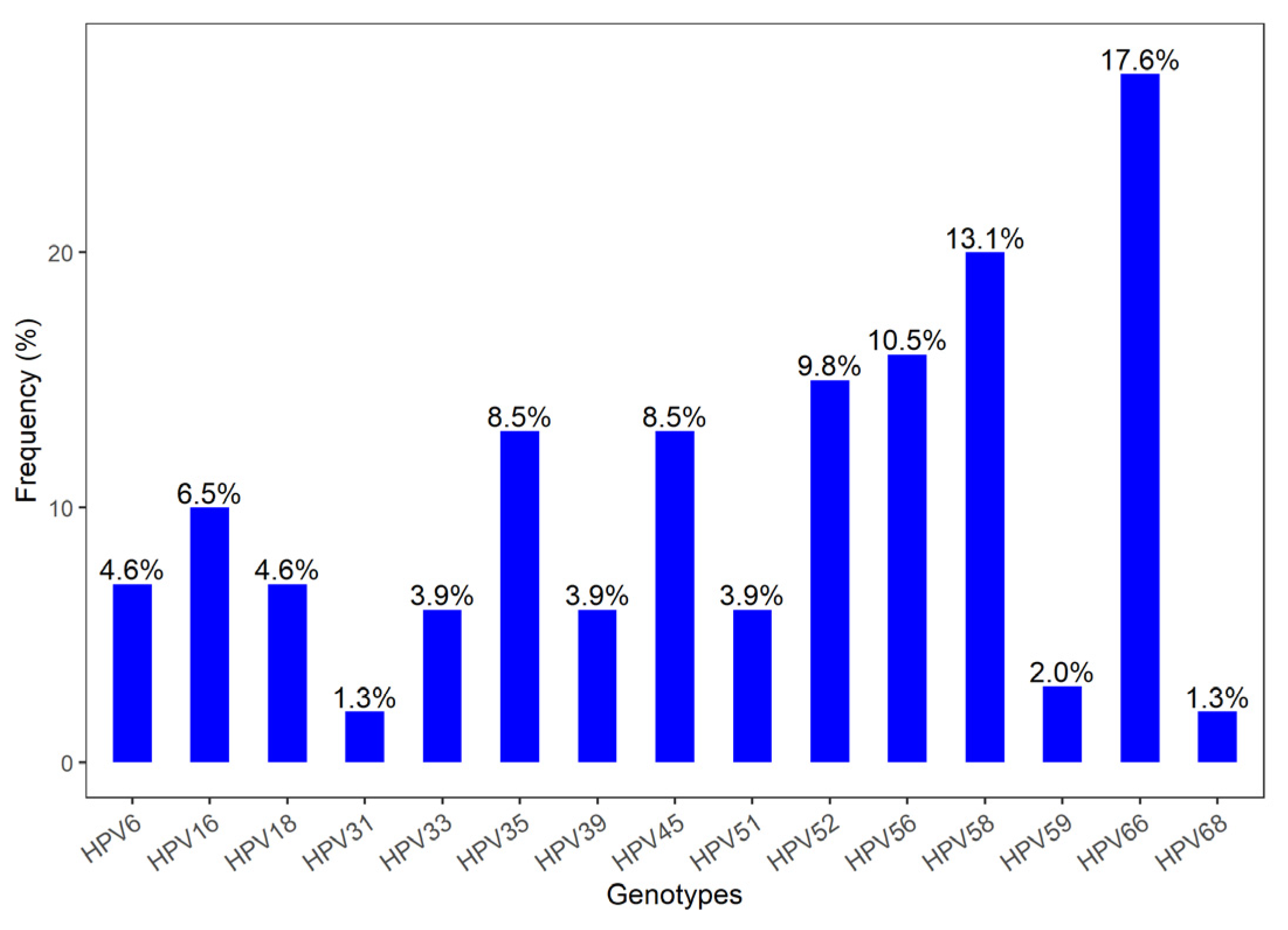
The overall prevalence of high-risk HPV infection was 33.8% (45/133). Among participants, 29.3% (39/133) had multiple high-risk HPV infections, while 4.5% (6/133) had a single high-risk infection. Low-risk HPV types were detected in 5.3% (7/133) of participants. The most frequently detected high-risk genotypes were HPV66 (17.6%), HPV58 (13.1%), HPV56 (10.5%), and HPV52 (9.8%), while HPV31 and HPV68 were the least prevalent. The distribution of HPV genotypes is illustrated in Figure 1.

3.3. Bivariate Analysis of Factors Associated with HPV Infection

Bivariate analysis identified several factors significantly associated with HPV infection. Sociodemographic variables such as family type (p = 0.017) and side occupation (p = 0.032) were significantly associated with HPV positivity. Among medical history variables, abnormal vaginal discharge (p = 0.028) and oral contraceptive use (p < 0.001) also showed significant associations with HPV infection (Table 2).
For sexual and behavioural factors, the analysis was restricted to participants with a history of sexual exposure (n = 69), excluding those with no sexual experience (n = 64). Within this restricted population, none of the sexual behaviour variables demonstrated a statistically significant association with HPV infection (all p > 0.05) (Table 3).

3.4. Multivariate Logistic Regression Analysis

Variables with p < 0.20 in bivariate analysis were included in the multivariate logistic regression model to identify independent predictors of HPV infection. To improve model stability, sparse categories were merged or excluded, and Firth’s penalized likelihood method was applied. The results of multivariate logistic regression analysis are presented in Table 4.
In the adjusted model, having a side occupation remained significantly associated with HPV infection. Participants with no side occupation had higher odds of HPV infection compared to artisans (AOR = 17.99; 95% CI: 1.21–267.6), while those engaged in trading had substantially higher odds (AOR = 59.80; 95% CI: 3.10–1154.40).
Oral contraceptive use was also independently associated with HPV infection, with users having over three times higher odds compared to non-users (AOR = 3.17; 95% CI: 1.01–9.97).

4. Discussion

This study reveals a high prevalence of high-risk HPV infections among young female students in Benin City, predominantly HPV66, HPV58, HPV56, and HPV52, in contrast to the global focus on HPV16 and HPV18 [13]. The prevalence of these genotypes is epidemiologically significant, as HPV58 and HPV56 have been linked to cervical intraepithelial neoplasia and invasive cervical cancer in several populations, including sub-Saharan Africa. Despite HPV66 being categorized as a probable high-risk genotype and excluded from current nonavalent vaccines, its significant incidence in this study indicates potential gaps in vaccine coverage. These findings show the importance of continuous molecular surveillance and the need for region-specific prevention strategies aligned with local genotype distribution patterns. These findings are consistent with reports from Ghana, where vaccine-preventable HPV genotypes were found to be widely distributed among women presenting for cervical screening, underscoring the continued relevance of HPV vaccination and genotype surveillance in West African populations [14].
The high HPV prevalence observed in this study is comparable to findings from a similar study in Ibadan, which also reported elevated infection rates among women aged 15–29 years [15]. Reports from other settings show variability in HPV prevalence; for instance, a large-scale study in South Africa documented an overall prevalence of 45.2% among sexually active women [16], while higher prevalence has been reported among HIV-positive and sexually active cohorts reported a higher HPV prevalence in Kenya [17]. These studies are presented for contextual reference, as differences in study populations, methodologies, and underlying risk factors limit direct comparability.
In contrast, studies from high-income countries have reported lower HPV prevalence, coinciding with the implementation of widespread vaccination programs and routine cervical screening. For example, in the United States, HPV prevalence among young women declined following vaccine introduction [18]. However, these observations are context-specific and are cautiously interpreted due to differences in healthcare systems, population characteristics, and prevention strategies.
Behavioral factors such as multiple sexual partners, early sexual debut, and lack of HPV vaccination were significantly associated with HPV positivity, consistent with global epidemiological trends [2]. These findings, coupled with low vaccine coverage among participants, highlight the urgent need for improved access to HPV vaccination programs in Nigeria.
Although several African nations, including Rwanda and South Africa, have successfully implemented national HPV vaccination strategies [19] Nigeria has only recently introduced the HPV vaccine into its national immunization schedule (2023) via the National Primary Health Care Development Agency (NPHCDA) [8]. Vaccine rollout remains limited, particularly outside the primary target age group of 9–14 years. These observations reinforce the need for intensified public health education, expanded vaccination outreach, and sustained political commitment to achieve widespread vaccine uptake and long-term protection against high-risk HPV infections.
The high prevalence reported in Benin City further emphasizes the need for targeted HPV vaccination programs, increased awareness, and enhanced cervical cancer screening efforts. Evidence from a long time post-vaccination surveillance in the United States (2019–2022) demonstrates that vaccination significantly reduces infection rates among young women [20], supporting its potential effectiveness in Nigeria.
This study also demonstrates the feasibility of self-sampling and molecular testing, providing timely, locally relevant data to inform vaccine composition, early vaccination strategies, and more inclusive, context-specific HPV prevention programs.
Strengths of the study include its focus on a high-risk group during early HPV vaccine rollout and the use of molecular methods and self-sampling to enhance detection. Limitations include its cross-sectional design, relatively small sample size, and purposive sampling approach. The use of purposive sampling introduces a risk of selection bias, as participants were recruited based on predefined criteria rather than random selection. As a result, the study population may not fully reflect the diversity of the broader population of young women, potentially influencing the observed prevalence of high-risk HPV infection and associated risk factors. This limitation restricts the generalizability of the findings beyond the study setting and highlights the need for future studies using probability-based sampling techniques. Reliance on self-reported behavioural data introduces potential reporting bias. HIV status was not assessed due to ethical and logistical constraints, which may influence HPV epidemiology. Some regression estimates showed wide confidence intervals due to small cell sizes and sparse data, which may limit the precision and interpretability of certain associations. Although this was addressed by refining the regression model and applying Firth’s logistic regression, residual uncertainty may remain.

5. Conclusions

This study reveals a high burden of high-risk HPV infection among young women in Benin City, Nigeria, driven predominantly by HPV genotypes not currently included in the nonavalent HPV vaccine, particularly HPV types 66 and 56, as well as HPV types 58 and 52. The findings highlight the need for expanded molecular surveillance and locally tailored HPV prevention strategies, including targeted vaccination, screening, and sexual health education. Behavioral factors such as multiple sexual partners, early sexual debut, and lack of HPV vaccination were factors associated with HPV positivity, consistent with global trends. The feasibility of self-sampling demonstrated in this study supports broader HPV screening and surveillance, while the observed genotype distribution may inform vaccine policy, early vaccination strategies, and context-specific HPV prevention programmes in Nigeria.

Author Contributions

C.E.O. and A.F. conceptualized the study. D.E.A. and P.O.O. designed the study. C.E.O. and A.F. collected and analysed the data, while C.E.O. and A.A.F. performed the laboratory analysis. C.E.O., A.F. and A.A.F. drafted the manuscript. All authors have read and agreed to the published version of the manuscript.

Funding

This research received no specific grant from any funding agency in the public, commercial, or non-profit sectors.

Institutional Review Board Statement

The study was conducted in accordance with the Declaration of Helsinki and approved by the Edo State Ministry of Health Ethics Committee (Approval No: HA/737/24/C/04003215) on 4 March 2024.

Informed Consent Statement

Informed consent was obtained from all subjects involved in the study.

Data Availability Statement

Data and materials are available by the authors.

Acknowledgments

The authors would like to express their gratitude to the participants for their cooperation.

Conflicts of Interest

The authors declare that they have no financial or personal relationship(s) that may have inappropriately influenced them in writing this article.

References

  1. World Health Organization (WHO). Human Papillomavirus (HPV) and Cancer. World Health Organization. 2024. Available online: https://www.who.int/news-room/fact-sheets/detail/human-papilloma-virus-and-cancer (accessed on 2 April 2025).
  2. Wei, F.; Georges, D.; Man, I.; Baussano, I.; Clifford, G.M. Causal attribution of human papillomavirus genotypes to invasive cervical cancer worldwide: A systematic analysis of the global literature. Lancet 2024, 404, 435–444. [Google Scholar] [CrossRef]
  3. Bruni, L.; Albero, G.; Serrano, B.; Mena, M.; Collado, J.J.; Bosch, F.X. Human Papillomavirus and Related Diseases in the World: Summary Report. ICO/IARC Information Centre on HPV and Cancer (HPV Information Centre). 2023. Available online: https://www.hpvcentre.net/statistics/reports/XWX.pdf (accessed on 3 June 2025).
  4. Ogembo, R.K.; Gona, P.N.; Seymour, A.J.; Park, H.S.; Bain, P.A.; Maranda, L.; Ogembo, J.G. Prevalence of human papillomavirus genotypes among African women with normal cervical cytology and neoplasia: A systematic review and meta-analysis. PLoS ONE 2015, 10, e0122488. [Google Scholar] [CrossRef] [PubMed]
  5. Aleezada, Z.N.; Patel, I.; Yusuf, N. Understanding HPV-Induced Cancers and Investigating the Barriers Faced by Low- and Middle-Income Countries in Prevention and Treatment. Int. J. Mol. Sci. 2025, 26, 5581. [Google Scholar] [CrossRef] [PubMed]
  6. Isara, A.R.; Nwaogwugwu, J.C. Sexual and Reproductive Health Knowledge, Attitude and Behaviours of in-School Adolescents in Benin City, Nigeria. Afr. J. Biomed. Res. 2022, 25, 121. [Google Scholar] [CrossRef]
  7. Ezechi, O.; Akinsolu, F.; Salako, A.; Abodunrin, O.; Adewole, I.; Olagunju, M.; Okunbor, H.; Sanni-Adeniyi, R.; Zamba, E.; Njuguna, D.W.; et al. High-risk human papillomavirus infection among Nigerian women: A systematic review and meta-analysis. J. Int. Med. Res. 2023, 51, 7. [Google Scholar] [CrossRef] [PubMed]
  8. National Primary Health Care Development Agency (NPHCDA). One Dose at a Time: Mobilizing to Eliminate Cervical Cancer in Nigeria. IVAC International Vaccine Access Center. 2024. Available online: https://publichealth.jhu.edu/ivac/2024/one-dose-at-a-time-mobilizing-to-eliminate-cervical-cancer-in-nigeria (accessed on 2 June 2025).
  9. Sandra, I.O.; Olajumoke, I. Knowledge, Sociocultural Barriers, and Hesitancytohpv Vaccine Among Caregivers of Adolescents in Benin City, Nigeria, 2024. Available online: https://repository.uniben.edu/sites/default/files/2026-03/KSB.pdf (accessed on 2 April 2025).
  10. Isikhuemen, M.; Esene, V.; Kubeyinje, W. Knowledge of Human Papilloma Virus among College of Nursing students at the University of Benin Teaching Hospital, Benin City, Nigeria. Niger. Delta J. Med. Med. Res. 2026, 5, 2. [Google Scholar]
  11. Elebiyo, O.T. Knowledge, attitude, and uptake of Human Papilloma Virus (HPV) vaccine among parents of adolescents attending outpatient clinic at the University of Benin Teaching Hospital, Nigeria. Afr. J. Reprod. Health 2023, 27, 108–117. [Google Scholar] [PubMed]
  12. Charan, J.; Biswas, T. How to calculate sample size for different study designs in medical research? Indian J. Psychol. Med. 2013, 35, 121–126. [Google Scholar] [CrossRef] [PubMed]
  13. Magagi, L.H.; Lagare, A.; Bowo-Ngandji, A.; Hassane, F.; Maiga, A.Z.; Issa, M.; Ibrahim, A.; Eric, A.; Zoubeirou, A.M. Prevalence and genotype distribution of human papillomavirus (HPV) infections among West African populations: A systematic review and meta-analysis. Infect. Agent Cancer 2025, 20, 62. [Google Scholar] [CrossRef] [PubMed]
  14. Donkoh, E.T.; Asmah, R.H.; Agyemang-Yeboah, F.; Dabo, E.O.; Wiredu, E.K. Prevalence and distribution of vaccine preventable genital human papillomavirus (HPV) genotypes in Ghanaian women presenting for screening. Cancer Control 2022, 29, 10732748221094721. [Google Scholar] [CrossRef] [PubMed]
  15. Ashaka, O.S.; Omoare, A.A.; James, A.B.; Adeyemi, O.O.; Oladiji, F.; Adeniji, K.A.; Okunade, K.S.; Agbede, O.O. Prevalence and Risk Factors of Genital Human Papillomavirus Infections among Women in Lagos, Nigeria. Trop. Med. Infect. Dis. 2022, 7, 386. [Google Scholar] [CrossRef] [PubMed]
  16. Morhason-Bello, I.O.; Baisley, K.; Pavon, M.A.; Adewole, I.F.; Bakare, R.A.; de Sanjosé, S.; Francis, S.C.; Watson-Jones, D. Oral, genital and anal human papillomavirus infections among female sex workers in Ibadan, Nigeria. PLoS ONE 2022, 17, e0265269. [Google Scholar] [CrossRef] [PubMed]
  17. Qulu, W.; Mtshali, A.; Osman, F.; Ndlela, N.; Ntuli, L.; Mzobe, G.; Naicker, N.; Garrett, N.; Rompalo, A.; Mindel, A.; et al. High-risk human papillomavirus prevalence among South African women diagnosed with other STIs and BV. PLoS ONE 2023, 18, e0294698. [Google Scholar] [CrossRef] [PubMed]
  18. Kangethe, J.M.; Gichuhi, S.; Odari, E.; Pintye, J.; Mutai, K.; Abdullahi, L.; Maiyo, A.; Mureithi, M.W. Confronting the human papillomavirus–HIV intersection: Cervical cytology implications for Kenyan women living with HIV. S. Afr. J. HIV Med. 2023, 24, 1508. [Google Scholar] [CrossRef]
  19. Binagwaho, A.; Wagner, C.M.; Gatera, M.; Karema, C.; Nutt, C.T.; Ngabo, F. Achieving high coverage in Rwanda’s national human papillomavirus vaccination programme. Bull. World Health Organ. 2012, 90, 623–628. [Google Scholar] [CrossRef] [PubMed]
  20. Rosenblum, H.G.; Lewis, R.M.; Gargano, J.W.; Querec, T.D.; Unger, E.R.; Markowitz, L.E. Human papillomavirus vaccine impact and effectiveness through 12 years after vaccine introduction in the United States, 2003 to 2018. Ann. Intern. Med. 2022, 175, 918–926. [Google Scholar] [CrossRef] [PubMed]
Figure 1. Distribution of HPV genotypes among participants.
Venereology 05 00017 g001
Table 1. Sociodemographic characteristics of participants and HPV infection.
CharacteristicsHPV InfectionTotalp-Value
PositiveNegative
Sex
Female45 (33.8)88 (66.2)133 (100)-
Age group (years)
18–2015 (27.3)40 (72.7)55 (41.4)
21–2318 (42.9)24 (57.1)42 (31.6)0.274
>2412 (33.3)24 (66.7)36 (27.1)
Religion
Christianity32 (33.7)63 (66.3)95 (71.4)
Islam11 (31.4)24 (68.6)35 (26.3)0.513
African Tradition2 (66.7)1 (33.3)3 (2.3)
Education
First year 2 (33.3)4 (66.7)6 (4.5)
Second year19 (31.1)42 (68.9)61 (45.9)
Third year19 (38.0)31 (62.0)50 (37.6)0.909
Fourth5 (31.3)11 (68.8)16 (12.0)
Occupation
No side occupation34 (32.7)70 (67.3)104 (78.2)
Artisan1 (9.1)10 (90.9)11 (8.3)0.032 *
Trading10 (55.6)8 (44.4)18 (13.5)
Marital Status
Single43 (37.4)72 (62.6)115 (86.5)
Married2 (13.3)13 (86.7)15 (11.3)0.099
Divorced03 (100.0)3 (2.3)
Family type
Monogamous34 (29.8)80 (70.2)114 (85.7)0.017 *
Polygamous11 (57.9)8 (42.1)19 (14.3)
Residence
Outside Edo state11 (47.8)12 (52.2)23 (17.3)0.119
Inside Edo State34 (30.9)76 (69.1)110 (82.7)
Fisher’s exact test applied when expected counts < 5; * p < 0.05 (statistically significant).
Table 2. Medical History of Participants and HPV Infection.
CharacteristicsHPV StatusTotalp-Value
PositiveNegative
HPV vaccination
Yes4 (30.8)9 (69.2)13 (9.8)1.00
No41 (34.2)79 (65.8)120 (90.2)
Prior screening for HPV
Yes5 (50.0)5 (50.0)10 (7.5)0.305
No40 (32.5)83 (67.5)123 (92.5)
Previous STI
Yes6 (54.5)5 (45.5)11 (8.3)0.182
No39 (32.0)83 (68.0)122 (91.7)
Previous genital warts
Yes4 (50.0)4 (50.0)8 (6.0)0.442
No41 (32.8)84 (67.2)125 (94.0)
Experienced bleeding PV
Yes4 (20.0)16 (80.0)20 (15.0)0.156
No41 (36.3)72 (63.7)113 (85.0)
Abnormal vaginal discharge
Yes22 (45.8)26 (54.2)48 (36.1)0.028 *
No23 (27.1)62 (72.9)85 (63.9)
Oral Contraceptive use
Yes24 (57.1)18 (42.9)42 (31.6)<0.001 *
No21 (23.1)70 (76.9)91 (68.4)
Fisher’s exact test applied when expected counts < 5; * p < 0.05 (statistically significant). STI = sexually transmitted infections; PV = Per Vagina.
Table 3. Sexual and behavioural characteristics associated with HPV infection among sexually exposed participants (n = 69).
CharacteristicsHPV InfectionTotalp-Value
Positive n (%)Negative n (%)
Sexual History
Skin-to-skin sex
Yes29 (49.2)30 (50.8)59 (85.51)<0.301
No3 (30.0)7 (70.0)10 (14.49)
Sexually active for a long time
Yes21 (48.8)22 (51.2)43 (62.32)0.598
No11 (42.3)15 (57.7)26 (37.68)
Regular condom use
Yes16 (45.7)19 (54.3)35 (50.72)0.904
No16 (47.1)18 (52.9)34 (49.28)
Partner condom use
Yes17 (50.0)17 (50.0)34 (49.28)0.536
No15 (42.9)20 (57.1)35 (50.72)
Mutually monogamous
Yes20 (50.0)20 (50.0)40 (57.97)0.472
No12 (41.4)17 (58.6)29 (42.03)
Sex with same sex
Yes6 (50)6 (50)12 (17.39)1.000
No26 (45.6)31 (54.4)57 (82.61)
Exposure to genital fluids
Yes15 (45.5)18 (54.5)33 (47.83)0.981
No16 (45.7)19 (54.3)35 (50.72)
Age at first vaginal sex (years)
<180 (0)3 (100.0)3 (4.35)
18–2015 (62.5)9 (37.5)24 (34.78)0.118
21–237 (43.8)9 (56.2)16 (23.19)
≥242 (28.6)5 (71.4)7 (10.15)
Age at first oral sex (years)
<180 (0)1 (100.0)1 (1.45)0.247
18–209 (60.0)6 (40.0)15 (21.74)
21–232 (28.6)5 (71.4)7 (10.15)
≥243 (50.0)3 (50.0)6 (8.70)
Number of oral sex partners
115 (45.5)18 (54.5)33 (47.83)0.421
2–43 (60.0)2 (40.0)5 (7.25)
5–100 (0.0)1 (100.0)1 (1.45)
Number of vaginal sex partners
126 (46.4)30 (53.6)56 (81.16)
2–43 (50.0)3 (50.0)6 (8.70)0.873
>52 (50.0)2 (50.0)4 (5.80)
Number of current sex partners
None2 (25.0)6 (75.0)8 (11.59)0.312
126 (48.1)28 (51.9)54 (78.26)
>13 (50.0)3 (50.0)6 (8.70)
Number of lifetime sex partners
120 (43.5)26 (56.5)46 (66.67)0.478
>19 (52.9)8 (47.1)17 (24.64)
Fisher’s exact test was applied where expected cell counts were <5. Analysis restricted to participants with a history of sexual exposure (n = 69). Participants reporting no sexual experience (n = 64) were excluded.
Table 4. Multivariate Logistic Regression of Risk Factors for HPV Infection.
CharacteristicsAdjusted Odds Ratio95% CI
Occupation *
Artisan1
None17.991.210–267.6
Trading59.803.097–1154.40
Family type
Monogamous1
Polygamous3.7020.970–14.122
Abnormal changes in vagina
No1
Yes1.9510.730–5.214
Contraception drug use *
No1
Yes3.1731.01–9.969
Sexual exposure
Vaginal sex0.3730.043–3.222
Oral sex0.1650.003–10.063
Both oral and vaginal sex0.6120.043–8.730
Skin to skin sex
No1
Yes1.3270.252–6.987
Sexually active with long relation
No1
Yes1.4750.396–5.494
Age at first vaginal sex
18–201
21–230.8760.105–7.324
240.3150.024–4.208
Number of current sex partners
None1.0560.218–5.111
One6.8250.205–227.422
More than one4.4830.089–224.88
Number of life sex partner
01
10.5580.016–19.885
>11.2820.031–52.209
CI = Confidence Interval; Reference category = 1.00. * Statistically significant predictor in the multivariate logistic regression model (p < 0.05). Analysis restricted to sexually active participants.
Disclaimer/Publisher’s Note: The statements, opinions and data contained in all publications are solely those of the individual author(s) and contributor(s) and not of MDPI and/or the editor(s). MDPI and/or the editor(s) disclaim responsibility for any injury to people or property resulting from any ideas, methods, instructions or products referred to in the content.