


Abstract
Background: The surveillance of antimicrobial-resistant (AMR) gonorrhea in the United States is conducted under the Gonococcal Isolate Surveillance Project (GISP). Its protocol involves the collection of urethral isolates from the symptomatic men diagnosed with urethral gonorrhea at designated surveillance sites and the estimation of the percentage of cases resistant to current and former gonorrhea antibiotics. A switch to a new antibiotic is typically made when this percentage for a current first-line drug reaches 5%. However, the cost-effectiveness of this surveillance strategy has never been assessed. Methods: We utilized our previously developed agent-based model of gonorrhea transmission among the US men who have sex with men (MSM) population and estimated the total number of gonorrhea cases, total number of discounted quality-adjusted life years (QALYs) and total discounted costs over 25 years under the current surveillance strategy and under a scenario with no surveillance. Results: The maintenance of the current surveillance strategy is projected to avert 104,108 (95% uncertainty interval: 9163, 213,238) gonorrhea cases, gain 192.9 (95% uncertainty interval: 6, 458.3) QALYs and save $38.6 million (95% uncertainty interval: $1 million, $68.2 million) in the simulated cohort of 10,000 US MSM over a 25-year period (2023–2048) when compared to a scenario with no surveillance. Conclusions: The current US surveillance strategy for AMR gonorrhea is cost-saving. However, the low-bound estimate indicates limited savings of $1 million, which is relatively modest at a national scale.
1. Introduction
The rise of antimicrobial-resistant (AMR) gonorrhea is an emerging public health concern. Neisseria gonorrhoeae has developed resistance over the years to most classes of antibiotics used for its treatment and continues to develop resistance to the so-called last-line cephalosporins [1]. According to the World Health Organization (WHO), resistance to ceftriaxone, the antibiotic that belongs to this group and is one of the primary antibiotics used to treat N. gonorrhoeae, rose sharply from 0.8% to 5% between 2022 and 2024, and resistant strains were detected in more countries [2]. This threatens our ability to treat this infection as well as other infections that are cured with the same antibiotics.
Untreated gonorrhea can have a number of negative health consequences, such as infertility, disseminated gonococcal infection (DGI), ectopic pregnancy, etc. [3]. In addition to the negative impact on health, some of these complications involve high financial costs for both individuals and health systems. A number of studies have investigated the impact of different interventions on the spread of gonorrhea, such as an increase in repeat testing in patients treated for gonorrhea [4], expedited partner therapy [5], point-of-care tests [6], different screening strategies [7,8,9], the use of dual antimicrobial therapy [10] and the impact of gonorrhea vaccination [11].
The aim of this project is to evaluate the cost-effectiveness of the current US surveillance strategy for AMR gonorrhea. The monitoring has been conducted under the Gonococcal Isolate Surveillance Project (GISP), a sentinel surveillance system formed in 1986 [12]. The GISP protocol involves the monthly collection of urethral isolates from up to the first 25 symptomatic men diagnosed with urethral gonorrhea at participating surveillance sites. These samples are tested to estimate the percentage of cases resistant to the current and former gonorrhea antibiotics [13]. The reach of 5% for a current first-line drug normally triggers a transition to a different antibiotic (in accordance with the WHO guidelines [14]). Even though this surveillance strategy has been in place for 40 years, its cost-effectiveness has never been evaluated.
We leveraged our agent-based model of gonorrhea transmission among the US men who have sex with men (MSM) population and estimated the total number of averted gonorrhea cases, incremental quality-adjusted life years (QALYs) and incremental costs under the current surveillance strategy in comparison to a scenario with no surveillance. In the absence of surveillance, the percentage of cases resistant to the current first-line antibiotic is not estimated. Therefore, it will continue to be used after the 5% threshold is reached.
The investigation period is 25 years (2023–2048). The discounted QALYs and costs per incident gonococcal infection were also estimated. Further, the contribution of different types of gonococcal infection and of the sequelae to the overall disease burden was studied. Finally, we determined the main drivers of uncertainty in the analysis.
2. Materials and Methods
2.1. Simulation Model
An agent-based model of gonorrhea transmission among the US MSM is described in detail in [15]. It was developed using the Java-based simulation modelling tool AnyLogic (version 8.8.1 University). The population of the model is 10,000 US MSM of a sexually active age, which remains constant. The natural history of gonorrhea is captured in the Susceptible–Infectious–Susceptible (SIS) framework. The disease can occur at rectal, pharyngeal and urethral sites, presenting as single-site or double-site infections. Sexual practices included in the model are oral sex, anal sex, kissing, rimming and docking. The specific transmission routes modelled are: rectum to pharynx, rectum to urethra, pharynx to rectum, pharynx to pharynx, pharynx to urethra, urethra to rectum, urethra to pharynx and urethra to urethra. The agents mix randomly, and all the contacts are one-time events. We opted not to include the main partnership formation due to its fairly low prevalence among the US MSM population [16]. We assumed asymptomatic presentation for rectal and pharyngeal infections (where the symptoms are rare [17]) and allowed both symptomatic and asymptomatic presentations for urethral infections. The gonococcal strain exhibits either susceptibility or resistance to ceftriaxone, the current first-line therapeutic agent [18].
The recovery pathway for symptomatic individuals involves seeking the first-line treatment at the healthcare facilities where they receive a single intramuscular dose of ceftriaxone 500 mg and take the urine nucleic acid amplification test (NAAT) for gonorrhea. If it fails because the strain was resistant or the pathogen developed resistance during the treatment, the individuals seek the second-line treatment. They are prescribed gentamicin 240 mg intramuscular in a single dose and azithromycin 2 g orally in a single dose [18]. This is followed by recovery at all the infected sites.
The therapeutic procedures were not modelled as explicit events. Instead, the act of an agent undergoing treatment results in a transition between model states. For example, receiving the first-line treatment causes an agent to move from ‘first-line treatment’ state to another one (e.g., “susceptible”, “second-line treatment”, etc.). The model counts the number of agents who receive the first-line treatment and the number of agents who receive the second-line treatment, which are then used for the calculation of the total costs.
The recovery pathways for asymptomatic individuals include either natural recovery or routine screening conducted at the healthcare facilities. The screening is conducted at three anatomical sites using urine, rectal or pharyngeal NAATs. The infection detection is followed by the first-line treatment (single intramuscular dose of ceftriaxone 500 mg). If the treatment fails, the asymptomatic individuals remain infectious.
The model was calibrated using the Bayesian calibration approach, which allowed us to select the trajectories that best fit the real-world data. The calibration targets were the prevalence of gonorrhea at three anatomical sites among the US MSM, the prevalence of ceftriaxone-resistant gonorrhea at three anatomical sites among the US MSM and the annual rate of reported gonorrhea cases per 100,000 US MSM. The calibration period was 2004–2019, which was determined by the data that we used for calibration. For this work, we used the version of our model that includes 100 selected trajectories (in contrast to the version described in [15] that includes 70 trajectories).
2.2. Current Surveillance Strategy for Antimicrobial-Resistant Gonorrhea
The isolates are collected monthly from up to the first 25 men with symptomatic gonococcal urethritis seeking care at the participating sexually transmitted disease clinics. The procedure involves the collection of urethral swabs from the patients. These isolates are then shipped to the regional laboratories within the Antibiotic Resistance Laboratory Network (ARLN), where they are stored in the freezers. Clinical and demographic data are also collected from the patients and submitted to the Centers for Disease Control and Prevention (CDC) electronically. At the laboratories, the agar dilution method is used to test whether the isolates are susceptible to the key antibiotics currently or previously used for the treatment of gonorrhea (ceftriaxone, azithromycin, ciprofloxacin, etc.) [13]. The results are submitted electronically to the CDC, where they are compiled and analyzed, and the percentages of cases resistant to these antibiotics are estimated. These results are published annually.
2.3. Cost-Effectiveness Analysis
We adopted a healthcare sector perspective for our analysis and followed the Consolidated Health Economic Evaluation Reporting Standards (CHEERS) [19]. QALYs were used as a measure of the disease burden on the population’s health, as they allow for the inclusion of morbidity and the impact of sequelae due to gonorrhea, and for comparison of the efficiency of health interventions for different conditions using the same units.
It was assumed that people experience reduced quality of life due to urethritis during symptomatic urethral gonorrhea and while experiencing sequelae caused by untreated asymptomatic gonorrhea. The reduction in quality of life was quantified using the utilities of each health state. Utilities are preference-based values scaled from 0 (representing death) to 1 (representing perfect health). We considered DGI and epididymitis as possible sequelae and distinguished between inpatient and outpatient treatments of these sequelae. The probability of developing a sequela was assumed to be the same for all the anatomical sites.
The state-specific utilities, probabilities and durations, as well as the associated uncertainty intervals, were obtained from [20] and are presented in Table 1. The uncertainty intervals represent the 95% uncertainty intervals (the 2.5th and 97.5th percentiles of the posterior distribution). The probability of epididymitis in case of untreated gonococcal infection obtained from [20] was based on pooled estimates from longitudinal studies on the sequelae among men with chlamydia, as no data for gonorrhea is available.
Table 1.
Utilities, probabilities and durations used in the analysis.
In order to simulate the target outputs, the utilities and probabilities were assigned by the beta distribution, while the durations were assigned by the gamma distribution. Then, for each distribution, we applied the optimization procedure that found the parameters that minimize the sum of the squared differences between the reported and achieved means and the 95% uncertainty intervals. This was implemented in R (version 4.3.3).
The simulations were run for 25 years (2023–2048). This simulation window was chosen as it is reasonable to expect that N. gonorrhoeae would develop resistance to ceftriaxone during that time (it started to be used as the first-line treatment for the US MSM in 2004 [21]). During the simulations, the utilities, probabilities and durations were sampled from the relevant distributions.
The total costs were calculated as the sum of the costs due to diagnosis and treatment of gonorrhea, the costs of treatment of the sequelae and the cost of surveillance of AMR gonorrhea. All the costs are listed in Table 2. The costs obtained from the literature were adjusted to 2023 USD based on the Personal Health Care (PHC) price indices [22].
Table 2.
Costs used in the analysis.
The costs were assigned by the gamma distribution, and their parameters were also found by applying the optimization procedure. As only the mean was available for the cost of gentamicin, we calculated its 95% uncertainty interval, having assumed that the coefficient of variation is 5%. We found no data on the cost of the susceptibility testing at ASTN laboratories, the cost of transportation of the isolates from the surveillance sites to ASTN laboratories and all other related operational costs. Therefore, we defined the sum of all these costs per isolate as the “cost of antimicrobial susceptibility testing (AST) per isolate” and assumed its value. The coefficient of variation was assumed to be 25%.
The cost of diagnosis and treatment of a case of symptomatic, ceftriaxone-susceptible gonorrhea includes: the cost of testing for gonorrhea at one site, the cost of treatment for urethritis and the cost of a first-line antibiotic for gonorrhea. The cost of treatment for urethritis includes the cost of a short clinic visit (in consistence with the previous studies [20,24]). The cost of ceftriaxone 500 mg, the current first-line antibiotic, was assumed to cost twice as much as the 250 mg dose.
Ceftriaxone will be replaced at some point—the possible candidates are zoliflodacin and gepotidacin [25]. We assumed that by the time of the replacement, the generic options of these drugs would already be available, as the level of resistance to ceftriaxone is still low. These options are often 80–85% cheaper than branded medicines [26]. Therefore, we assumed that the cost of the replacement antibiotic would equal the cost of the current first-line generic (ceftriaxone). However, this is not certainly known, and different scenarios are possible. Therefore, we explored a higher cost of the replacement antibiotic in the sensitivity analysis.
In the case of a ceftriaxone-resistant strain, the cost of the second test for gonorrhea, the cost of treatment for urethritis the second time, and the cost of the second-line antibiotics (gentamicin 240 mg and azithromycin 2 g) are added to the cost of the diagnosis and treatment of symptomatic, ceftriaxone-susceptible gonorrhea.
The cost of diagnosis and treatment of a case of asymptomatic gonorrhea consists of the cost of testing for gonorrhea at three anatomical sites, the cost of a first-line antibiotic for gonorrhea and the cost of a short clinic visit. Since there is no published cost of rectal or pharyngeal tests for gonorrhea, we assumed that their cost would equal the cost of urine NAAT for gonorrhea.
The cost of treatment of a sequela (DGI or epididymitis) arising from a case of untreated asymptomatic gonorrhea was calculated as the probability of a sequela given untreated gonorrhea multiplied by the weighted average of the inpatient and outpatient costs.
Finally, the cost of surveillance of AMR gonorrhea per year was calculated as the product of the number of the tested isolates per year and the cost of AST per isolate. The recent estimate of the US MSM population is 4,230,000 [27]. The number of isolates used in GISP is normally around 5000–6000 isolates per year [28]. Since 2013, the percentage of isolates that come from the US MSM constitutes around one-third of all the isolates [29]. Therefore, an average of 1833 isolates from the US MSM are submitted to GISP annually. This comprises 0.04% of the entire US MSM population. We assumed that it would remain on this level during the simulation period. The population of our model is 10,000 US MSM. Therefore, the number of isolates from the US MSM submitted to GISP in our model was adjusted accordingly.
The total QALYs and costs were discounted to 2023 at 3% annually [30]. Subsequently, the total discounted QALYs and costs were decomposed into their component parts.
We also estimated the total number of gonorrhea cases (both symptomatic and asymptomatic), as well as the discounted QALYs and costs per incident gonococcal infection.
The analysis was conducted in MS Excel and Python (version 3.11.5).
2.4. Sensitivity Analysis
In order to identify the key drivers of uncertainty, we performed one-way sensitivity analysis on the following parameters: the utilities, durations, probabilities, the cost of the replacement antibiotic and the cost of the AST per isolate. For most of the parameters, this was done by running the simulations using the lowest and the highest values from the associated uncertainty intervals while keeping the other parameters fixed. For the cost of the replacement antibiotic, rather than using the highest value from the associated uncertainty interval, we used a value equal to ten times the base cost of ceftriaxone.
3. Results
3.1. Results of the Cost-Effectiveness Analysis
The results of the cost-effectiveness analysis are shown in Table 3.
Table 3.
Results of the cost-effectiveness analysis. The mean and 95% uncertainty interval are reported. The simulations were run in the cohort of 10,000 US men who have sex with men for 25 years (2023–2048).
The maintenance of the current surveillance strategy would result in 35,742 (95% uncertainty interval: 19,574, 65,455) gonorrhea cases, 56.7 (95% uncertainty interval: 19.3, 122.6) QALYs and $14 million (95% uncertainty interval: $6.5 million, $24.7 million) spent in the simulated cohort of 10,000 US MSM over a 25-year period (2023–2048). Meanwhile, if no surveillance is in place, this would lead to 138,694 (95% uncertainty interval: 30,486, 276,422) gonorrhea cases, 249.7 (95% uncertainty interval: 40.8, 544.2) QALYs and $54.4 million ($11.9 million, $85.9 million) spent over the same period of time.
The current surveillance strategy is cost-saving compared to a scenario with no surveillance, as the health gains are higher and the costs are lower.
Under the current strategy, the discounted QALYs per incident gonococcal infection are 0.0017 (95% uncertainty interval: 0.0008, 0.003), while the discounted costs per incident gonococcal infection are $419.4 (95% uncertainty interval: $276.9, $542.8).
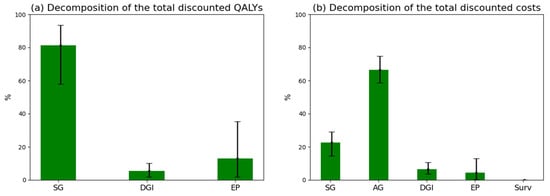
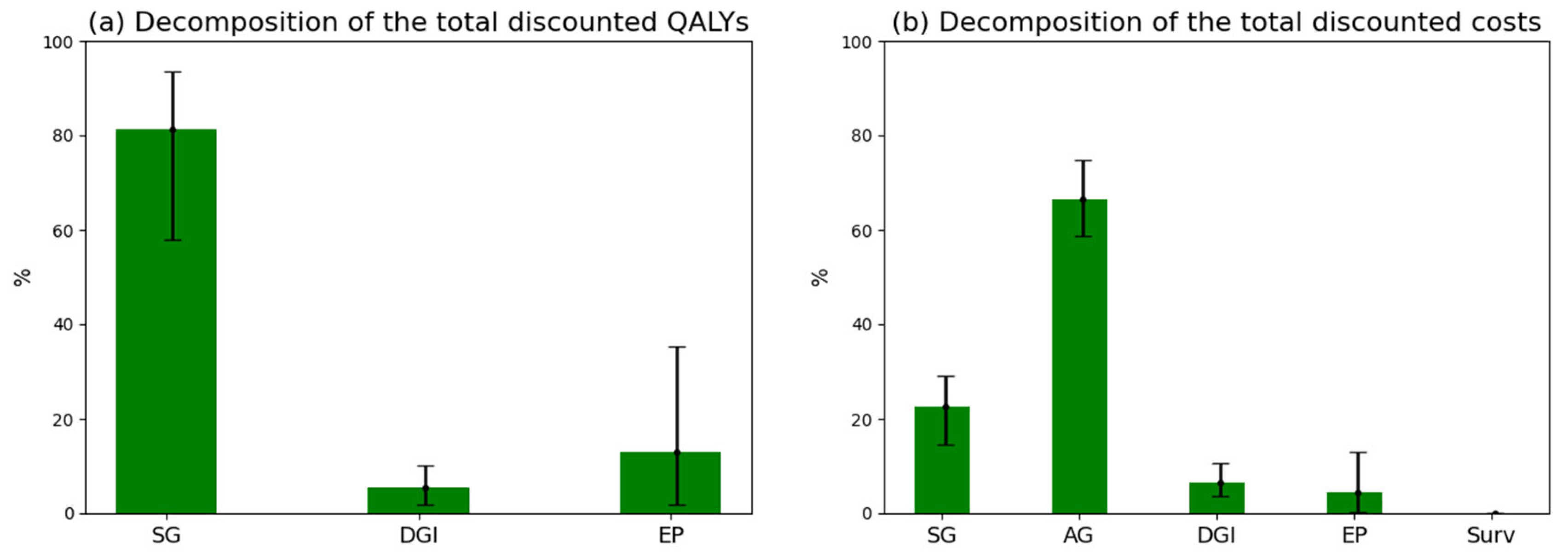
The decomposition of the total discounted QALYs and costs under the current surveillance strategy is shown in Figure 1.
Figure 1.
Decomposition of the total discounted QALYs and costs under the current surveillance strategy. The simulations were run in the cohort of 10,000 US men who have sex with men for 25 years (2023–2048). The means are identified as histograms, and the 95% uncertainty intervals are identified as error bars. Abbreviations: QALYs, quality-adjusted life years; SG, symptomatic gonorrhea; AG, asymptomatic gonorrhea; DGI, disseminated gonococcal infection; EP, epididymitis; Surv, surveillance of antimicrobial-resistant gonorrhea.
The composition of the total discounted QALYs is 81.4% (95% uncertainty interval: 57.8%, 93.6%) due to symptomatic gonorrhea, 5.4% (95% uncertainty interval: 1.9%, 10.2%) due to DGI and 13.1% (95% uncertainty interval: 1.7%, 35.3%) due to epididymitis.
The contributors to the total discounted costs are the diagnosis and treatment of symptomatic gonorrhea (22.6% (95% uncertainty interval: 14.6%, 29%)), diagnosis and treatment of asymptomatic gonorrhea (66.4% (95% uncertainty interval: 58.6%, 74.9%)), treatment of DGI (6.4% (95% uncertainty interval: 3.7%, 10.6%)), treatment of epididymitis (4.4% (95% uncertainty interval: 0.3%, 12.9%)) and surveillance of AMR gonorrhea (0.06% (95% uncertainty interval: 0.03%, 0.12%)).
3.2. Results of the Sensitivity Analysis
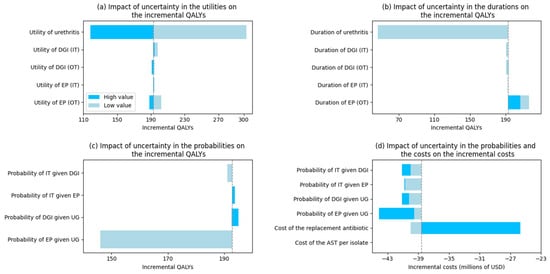
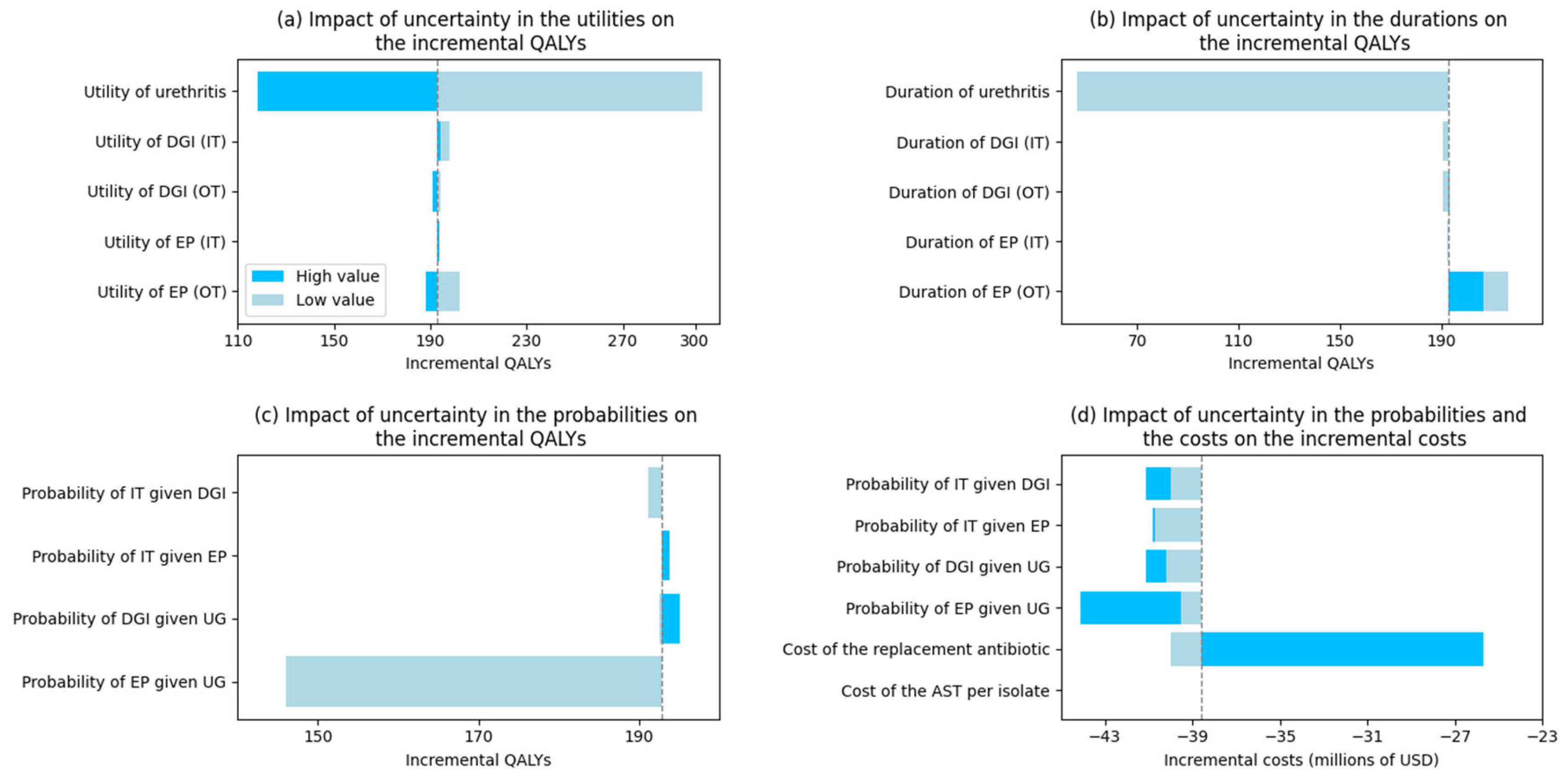
The results of the one-way sensitivity analysis are presented in Figure 2.
Figure 2.
Results of the one-way sensitivity analysis. In case the result obtained using a low value is equal to the result obtained using a high value, only the low-value result is shown. Abbreviations: QALYs, quality-adjusted life years; DGI, disseminated gonococcal infection; EP, epididymitis; IT, inpatient treatment; OT, outpatient treatment; UG, untreated gonorrhea; AST, antimicrobial susceptibility testing.
The incremental QALYs are robust to the variations in the duration of epididymitis (inpatient treatment) and the utility of epididymitis (inpatient treatment), so these results are difficult to spot on the plot. The same is true for the cost of the AST per isolate, to which the incremental costs are robust.
The current surveillance strategy is cost-saving compared to no surveillance in all the one-way sensitivity analyses. The main determinants of the incremental QALYs are the utility of urethritis, the duration of urethritis and the probability of epididymitis given untreated gonorrhea. Since the last parameter was estimated for the probability of epididymitis given untreated chlamydia and was used only because no such data is available for gonorrhea, it is not surprising that this is one of the main drivers of uncertainty in the analysis. Meanwhile, urethritis experienced during symptomatic gonorrhea is the main source of the QALYs overall, so the parameters related to this condition have a big effect. The incremental costs are most sensitive to the cost of the replacement antibiotic, which is also an expected result given the high uncertainty associated with this parameter.
4. Discussion
This paper addresses a decades-long evidence gap by conducting the first cost-effectiveness analysis of the surveillance strategy for AMR gonorrhea in the United States. The strategy is based on the use of GISP estimates for informing the national gonorrhea treatment guidelines. The projections for the total number of gonorrhea cases, discounted QALYs and discounted costs over a 25-year period for the current situation and for a scenario with no surveillance have been obtained. Our results indicate that the current surveillance strategy yields health gains while reducing the costs. However, it should be noted that the lowest projected savings ($1 million) constitute a limited gain given the national scope of the program. The discounted QALYs and costs per incident gonococcal infection under the current strategy were also estimated.
We found that the main contributor to the total discounted costs is the diagnosis and treatment of asymptomatic gonorrhea. Meanwhile, symptomatic gonorrhea accounts for the largest proportion of the total discounted QALYs. This is followed by epididymitis, which is responsible for 13% of them on average. DGI impacts more in terms of the costs than in terms of the QALYs. This complication is rare but, unlike epididymitis, has a nearly 30% probability of inpatient treatment, which results in high costs. These results once again highlight the importance of routine screening for gonorrhea among vulnerable populations such as MSM. As for surveillance of AMR gonorrhea, its contribution to the total discounted costs is very low.
Since this study was conducted using an agent-based model, which is inherently stochastic, and there is a strong dominance of the current surveillance strategy over no surveillance (it is cost-saving), there was no decision uncertainty to resolve with a probabilistic sensitivity analysis. Instead, as a sensitivity analysis, we conducted a one-way sensitivity analysis to determine the main drivers of uncertainty. They are the utility of urethritis, the duration of urethritis, the probability of epididymitis given untreated gonorrhea and the cost of the replacement antibiotic.
The obtained results should be viewed in the context of some limitations. In particular, full adherence to the gonorrhea treatment guidelines was assumed. In reality, according to a recent study [31], around 20% of the male patients have not received the recommended first-line antibiotic therapy. Similarly to many other models of gonorrhea transmission, our model’s population consists exclusively of the MSM who are disproportionally affected by this disease and have disproportionally high rates of asymptomatic infections. For the entire US population, the specific results will be different. However, the main conclusion is expected to hold. Finally, if data on the probability of epididymitis given untreated gonococcal infection become available in the future, it will improve the accuracy of this analysis.
5. Conclusions
The current US surveillance strategy for AMR gonorrhea is cost-saving compared to a scenario with no surveillance. However, the low-bound estimate shows limited savings of $1 million, a relatively modest amount on a national scale.
Funding
This research received no external funding.
Institutional Review Board Statement
Not applicable.
Informed Consent Statement
Not applicable.
Data Availability Statement
Data is contained within the article.
Conflicts of Interest
The author declares no conflicts of interest.
Abbreviations
The following abbreviations are used in this manuscript:
| AMR | Antimicrobial-resistant |
| DGI | Disseminated gonococcal infection |
| GISP | Gonococcal Isolate Surveillance Project |
| MSM | Men who have sex with men |
| QALY | Quality-adjusted life year |
| WHO | World Health Organization |
| PHC | Personal health care |
| SG | Symptomatic gonorrhea |
| AG | Asymptomatic gonorrhea |
| EP | Epididymitis |
| IT | Inpatient treatment |
| OT | Outpatient treatment |
| UG | Untreated gonorrhea |
| AST | Antimicrobial susceptibility testing |
| NAAT | Nucleic acid amplification test |
| ARLN | Antibiotic Resistance Laboratory Network |
| CDC | Centers for Disease Control and Prevention |
References
- Alirol, E.; Wi, T.E.; Bala, M.; Bazzo, M.L.; Chen, X.-S.; Deal, C.; Dillon, J.-A.R.; Kularatne, R.; Heim, J.; van Huijsduijnen, R.H.; et al. Multidrug-resistant gonorrhea: A research and development roadmap to discover new medicines. PLoS Med. 2017, 14, e1002366. [Google Scholar] [CrossRef] [Scilit] [PubMed]
- More Countries Report Rising Levels of Drug-Resistant Gonorrhoea, Warns WHO. World Health Organization. Available online: https://www.who.int/news/item/19-11-2025-more-countries-report-rising-levels-of-drug-resistant-gonorrhoea--warns-who (accessed on 25 January 2026).
- Workowski, K. Chlamydia and gonorrhea. Ann. Intern. Med. 2013, 158, ITC2-1. [Google Scholar] [CrossRef] [Scilit] [PubMed]
- Gift, T.L.; Malotte, C.K.; Ledsky, R.; Hogben, M.; Middlestadt, S.; VanDevanter, N.L.; Lawrence, J.S.S.; The GCAP Study Group. A cost-effectiveness analysis of interventions to increase repeat testing in patients treated for gonorrhea or chlamydia at public sexually transmitted disease clinics. Sex. Transm. Dis. 2005, 32, 542–549. [Google Scholar] [CrossRef] [Scilit] [PubMed]
- Gift, T.L.; Kissinger, P.; Mohammed, H.; Leichliter, J.S.; Hogben, M.; Golden, M.R. The cost and cost-effectiveness of expedited partner therapy compared with standard partner referral for the treatment of chlamydia or gonorrhea. Sex. Transm. Dis. 2011, 38, 1067–1073. [Google Scholar] [CrossRef] [Scilit]
- Huntington, S.E.; Burns, R.M.; Harding-Esch, E.; Harvey, M.J.; Hill-Tout, R.; Fuller, S.S.; Adams, E.J.; Sadiq, S.T. Modelling-based evaluation of the costs, benefits and cost-effectiveness of multipathogen point-of-care tests for sexually transmitted infections in symptomatic genitourinary medicine clinic attendees. BMJ Open 2018, 8, e020394. [Google Scholar] [CrossRef] [Scilit]
- Aledort, J.E.; Hook, E.W., III; Weinstein, M.C.; Goldie, S.J. The cost effectiveness of gonorrhea screening in urban emergency departments. Sex. Transm. Dis. 2005, 32, 425–436. [Google Scholar] [CrossRef] [Scilit]
- Bernstein, K.T.; Mehta, S.D.; Rompalo, A.M.; Erbelding, E.J. Cost-effectiveness of screening strategies for gonorrhea among females in private sector care. Obstet. Gynecol. 2006, 107, 813–821. [Google Scholar] [CrossRef] [Scilit]
- Kraut-Becher, J.R.; Gift, T.L.; Haddix, A.C.; Irwin, K.L.; Greifinger, R.B. Cost-effectiveness of universal screening for chlamydia and gonorrhea in US jails. J. Urban Health 2004, 81, 453–471. [Google Scholar] [CrossRef] [Scilit]
- Xiridou, M.; Lugnér, A.; De Vries, H.J.; Van Bergen, J.E.; Götz, H.M.; Van Benthem, B.H.; Wallinga, J.; Van Der Sande, M.A. Cost-effectiveness of dual antimicrobial therapy for gonococcal infections among men who have sex with men in The Netherlands. Sex. Transm. Dis. 2016, 43, 542–548. [Google Scholar] [CrossRef] [Scilit]
- Whittles, L.K.; Didelot, X.; White, P.J. Public health impact and cost-effectiveness of gonorrhoea vaccination: An integrated transmission-dynamic health-economic modelling analysis. Lancet Infect. Dis. 2022, 22, 1030–1041. [Google Scholar] [CrossRef] [Scilit]
- Bolan, G.A.; Sparling, P.F.; Wasserheit, J.N. The emerging threat of untreatable gonococcal infection. N. Engl. J. Med. 2012, 366, 485–487. [Google Scholar] [CrossRef] [Scilit]
- Pham, C.; Raphael, B.; Cyr, S.S.; Torrone, E. Gonococcal Isolate Surveillance Project (GISP) and Enhanced GISP (eGISP); CDC Stacks Public Health Publications: Atlanta, GA, USA, 2020. Available online: https://stacks.cdc.gov/view/cdc/108436 (accessed on 18 February 2023).
- World Health Organization. Global Action Plan to Control the Spread and Impact of Antimicrobial Resistance in Neisseria gonorrhoeae; World Health Organization: Geneva, Switzerland, 2012; Available online: https://www.who.int/publications/i/item/9789241503501 (accessed on 2 April 2023).
- Prakhova, S. Evaluating Performance of the US Surveillance Systems for Monitoring Antimicrobial-Resistant Gonorrhea: An Agent-Based Modelling Study. Preprints 2024. [Google Scholar] [CrossRef]
- Weiss, K.M.; Goodreau, S.M.; Morris, M.; Prasad, P.; Ramaraju, R.; Sanchez, T.; Jenness, S.M. Egocentric sexual networks of men who have sex with men in the United States: Results from the ARTnet study. Epidemics 2020, 30, 100386. [Google Scholar] [CrossRef] [Scilit] [PubMed]
- Fairley, C.K.; Hocking, J.S.; Zhang, L.; Chow, E.P. Frequent transmission of gonorrhea in men who have sex with men. Emerg. Infect. Dis. 2017, 23, 102–104. [Google Scholar] [CrossRef] [Scilit] [PubMed]
- Workowski, K.A.; Bachmann, L.H.; Chan, P.A.; Johnston, C.M.; Muzny, C.A.; Park, I.; Reno, H.; Zenilman, J.M.; Bolan, G.A. Sexually transmitted infections treatment guidelines, 2021. MMWR. Recomm. Rep. 2021, 70, 1–187. [Google Scholar] [CrossRef] [Scilit]
- Husereau, D.; Drummond, M.; Augustovski, F.; de Bekker-Grob, E.; Briggs, A.H.; Carswell, C.; Caulley, L.; Chaiyakunapruk, N.; Greenberg, D.; Loder, E.; et al. Consolidated Health Economic Evaluation Reporting Standards 2022 (CHEERS 2022) statement: Updated reporting guidance for health economic evaluations. MDM Policy Pract. 2022, 7, 23814683211061097. [Google Scholar] [CrossRef] [Scilit]
- Li, Y.; Rönn, M.M.; Tuite, A.R.; Chesson, H.W.; Gift, T.L.; Trikalinos, T.A.; Testa, C.; Bellerose, M.; Hsu, K.; Berruti, A.A.; et al. Estimated costs and quality-adjusted life-years lost due to N. gonorrhoeae infections acquired in 2015 in the United States: A modelling study of overall burden and disparities by age, race/ethnicity, and other factors. Lancet Reg. Health—Am 2022, 16. [Google Scholar] [CrossRef] [Scilit]
- Del Rio, C.; Hall, G.; Hook, E., III; Holmes, K.; Whittington, W.; Judson, F.; Yee, E.; Harvey, A.; Kramer, K.; Trees, D.; et al. Update to CDC’s sexually transmitted diseases treatment guidelines, 2006: Fluoroquinolones no longer recommended for treatment of gonococcal infections. JAMA J. Am. Med. Assoc. 2007, 297, 2466. [Google Scholar]
- Using Appropriate Price Indices for Analyses of Health Care Expenditures or Income Across Multiple Years. Agency for Healthcare Research and Quality. Available online: https://meps.ahrq.gov//about_meps/Price_Index.shtml (accessed on 1 December 2025).
- Gentamicin Prices, Coupons, Copay Cards & Patient Assistance. Drugs.com. Available online: https://www.drugs.com/price-guide/gentamicin (accessed on 3 December 2025).
- Mehta, S.D.; Bishai, D.; Howell, M.R.; Rothman, R.E.; Quinn, T.C.; Zenilman, J.M. Cost-effectiveness of five strategies for gonorrhea and chlamydia control among female and male emergency department patients. Sex. Transm. Dis. 2002, 29, 83–91. [Google Scholar] [CrossRef] [Scilit]
- Franco, S.; Hammerschlag, M.R. Alternative drugs for the treatment of gonococcal infections: Old and new. Expert Rev. Anti-Infect. Ther. 2024, 22, 753–759. [Google Scholar] [CrossRef] [Scilit]
- Waning, B.; Diedrichsen, E.; Moon, S. A lifeline to treatment: The role of Indian generic manufacturers in supplying antiretroviral medicines to developing countries. J. Int. AIDS Soc. 2010, 13, 35. [Google Scholar] [CrossRef] [Scilit]
- Bennett, B.W.; DuBose, S.; Huang, Y.-L.A.; Johnson, C.H.; Hoover, K.W.; Wiener, J.; Purcell, D.W.; Sullivan, P.S. population percentage and population size of men who have sex with men in the United States, 2017–2021: Meta-analysis of 5 population-based surveys. JMIR Public Health Surveill. 2024, 10, e56643. [Google Scholar] [CrossRef] [Scilit]
- Kersh, E.N.; Pham, C.D.; Papp, J.R.; Myers, R.; Steece, R.; Kubin, G.; Gautom, R.; Nash, E.E.; Sharpe, S.; Gernert, K.M.; et al. Expanding US Laboratory capacity for Neisseria gonorrhoeae antimicrobial susceptibility testing and whole-genome sequencing through the CDC’s antibiotic resistance laboratory network. J. Clin. Microbiol. 2020, 58, e01461-19. [Google Scholar] [CrossRef] [Scilit]
- Haskin, S.; Harvey, A.; Frankson, R.; Berman, L.; Kreisel, K.; Shouse, L. Sexually Transmitted Disease Surveillance 2022: Gonococcal Isolate Surveillance Project National Profile; Department of Health and Human Services: Atlanta, GA, USA, 2024. Available online: https://www.cdc.gov/sti-statistics/media/pdfs/2024/07/2022-GISP-Profiles_National_CLEARED_CLEAN.pdf (accessed on 15 July 2024).
- Lopez, A.D.; Murray, C.C. The global burden of disease, 1990–2020. Nat. Med. 1998, 4, 1241–1243. [Google Scholar] [CrossRef] [Scilit]
- Sittig, K.R.; Collin, S.M.; Rosa, R. Factors associated with non-guideline-adherent treatment for gonorrhea and chlamydia among outpatient prescriptions in the Unites States. Int. J. STD AIDS 2022, 33, 694–700. [Google Scholar] [CrossRef] [Scilit]

Disclaimer/Publisher’s Note: The statements, opinions and data contained in all publications are solely those of the individual author(s) and contributor(s) and not of MDPI and/or the editor(s). MDPI and/or the editor(s) disclaim responsibility for any injury to people or property resulting from any ideas, methods, instructions or products referred to in the content. |
© 2026 by the author. Licensee MDPI, Basel, Switzerland. This article is an open access article distributed under the terms and conditions of the Creative Commons Attribution (CC BY) license.