Skip to Content
VenereologyVenereology
  • Article
  • Open Access

20 January 2026

Digital Dating and the Syphilis Surge in Japan: Unraveling the Link Between Technology and STI Trends


and
Division of Natural and Applied Science, Duke Kunshan University, No. 8 Duke Avenue, Kunshan 215316, China
*
Author to whom correspondence should be addressed.

Abstract

Background/Objectives: This study investigates the potential association between the sharp increase in syphilis cases in Japan and the growing popularity of dating apps, with a specific focus on the dynamics during the COVID-19 pandemic. Syphilis, a sexually transmitted infection (STIs) caused by Treponema pallidum, presents a significant global public health challenge despite being curable with antibiotics. In Japan, the incidence of syphilis has risen dramatically since 2013, surpassing 10,000 reported cases annually by 2022. Methods: To examine this trend, we analyzed the quarterly reported syphilis cases alongside active user data from three major dating apps (App1, App2, and App3) and conducted a stratified linear correlation analysis by gender and age group. Results: The results reveal that syphilis cases showed accelerated growth starting in the first quarter of 2021, and App 3 demonstrated the strongest positive correlation with new syphilis cases. The association was particularly significant among males aged 20–29 (R2 = 0.70, p = 0.0007) and 30–39 (R2 = 0.82, p < 0.0001). Conclusions: These findings suggest that the widespread use of dating apps may contribute to the rise in sexually transmitted infections, including syphilis, by facilitating extensive new sexual contacts. Notably, this trend became increasingly evident during the COVID-19 pandemic. Future STI prevention strategies should consider integrating dating apps as a potential medium for public health interventions. Additionally, strengthening sexual health services is essential to ensure that responses to global crises do not inadvertently undermine STI prevention and control efforts.
Keywords:
syphilis; Japan; dating apps

1. Introduction

Syphilis is a sexually transmitted infection (STI) caused by the bacterium Treponema pallidum. The disease progresses through distinct stages, including primary, secondary, latent, and tertiary. Each distinct stage presents with unique clinical symptoms [1]. If left untreated, syphilis can lead to severe complications, including cardiovascular, neurological, and systemic damage in its later stages, significantly contributing to increased morbidity and mortality [2]. Additionally, syphilis can be transmitted from mother to child during pregnancy, resulting in congenital syphilis. This condition can lead to miscarriage, stillbirth, or severe health problems in newborns [3]. Despite being treatable and curable with antibiotics like penicillin, syphilis remains a pressing public health issue worldwide.
Over the last decade, the global epidemiology of syphilis has undergone notable changes. A steady rise in syphilis cases since 2010, reversing a previous decline observed in earlier years [4]. In 2016 alone, the WHO estimated that there were 6.3 million new cases of syphilis globally, underscoring the persistent burden of the disease, particularly in low- and middle-income countries where limited healthcare access and lack of routine STI screening present significant challenges [5]. However, the rise in syphilis cases is not confined to resource-limited regions. Higher-income countries such as the United States, the United Kingdom, and Japan have also reported substantial increases over the past decade, especially among high-risk groups [6].
Japan’s syphilis trends mirror the global resurgence. Historically, syphilis cases in Japan were at an all-time low in the early 2000s. However, beginning in 2013, reports of syphilis have surged dramatically, reaching record levels in recent years [7]. Data from Japan’s National Institute of Infectious Diseases (NIID) revealed that, in 2013, there were only about 1000 reported cases of syphilis. By 2022, however, this number had risen to over 10,000 annually, a tenfold increase within less than a decade [8]. This sharp upward trend is not limited to men who have sex with men (MSM); it has also been observed among heterosexual individuals [9]. The increasing prevalence in this demographic raises concerns about congenital syphilis, aligning Japan’s situation with global patterns.
The resurgence of syphilis over the past decade can be attributed to several contributing factors [10]. Increased casual and unprotected sexual activity, often facilitated by the rise in dating apps, has played a significant role, alongside a phenomenon known as risk compensation, where improved HIV treatments have reduced the perceived fear of HIV, potentially leading to riskier sexual behaviors. Additionally, limited awareness or access to STI prevention measures has further driven infection rates [11]. The COVID-19 pandemic likely exacerbated these trends, as disruptions to healthcare services, including reduced STI testing and scaled-back public health outreach, created additional challenges. However, research on these contributing factors, particularly the role of dating apps, sexual behavior changes, and the pandemic’s influence, remains limited and requires further study.
Combatting syphilis remains a priority for global public health. Key strategies include improving access to STI screening, particularly for high-risk populations, promoting safer sexual practices, and expanding public health campaigns to reduce stigma and encourage timely treatment [12]. However, the rising syphilis rates over the last decade underscore the need for renewed, tailored efforts to address the root causes of the disease’s resurgence and tackle the unique challenges presented by different populations and regions.
This study aims to investigate the potential link between the increasing use of dating apps and the rise in syphilis cases in Japan, with a particular focus on the COVID-19 pandemic period. The surge in popularity of these apps during the pandemic may have facilitated greater opportunities for risky sexual behaviors, potentially contributing to the escalation of syphilis cases. By analyzing the behavioral changes associated with dating app usage and their role in promoting risky practices, this research aims to shed light on the factors driving the resurgence of syphilis. Furthermore, the findings of this study will contribute to a broader understanding of how technology intersects with social behavior and public health, providing critical insights to address similar challenges in Japan and beyond.

2. Materials and Methods

2.1. Data Source

This study utilized publicly available data on syphilis incidence, titled Notification Trends Among Syphilis Cases in Japan, published by the Japan Institute for Health Security (Tokyo, Japan). The dataset included the number of new syphilis cases categorized by gender and age, spanning from the second quarter of 2017 (2017 Q2) to the fourth quarter of 2024 (2024 Q4). Under Japanese law, notification of syphilis cases to relevant authorities is mandatory, ensuring the reliability and accuracy of the data [13,14,15,16,17,18,19,20].
Given the significant increase in syphilis cases in Japan observed since 2021, a comparison of the top ten dating apps in Japan was conducted to identify the most widely used platform. Data on the monthly active users of these apps from January 2021 to December 2021 were obtained from App Ape (Fuller, Inc., Niigata, Japan) (https://dashboard.appa.pe/home, accessed on 13 January 2025), a market analytics platform known for providing accurate app usage data. Based on this analysis, the three most popular dating apps in Japan were selected for further study. To obtain a comprehensive understanding of dating app usage patterns, data on active users of the selected dating apps, including demographic information such as gender and age, were analyzed monthly. The study relied on active user data per quarter rather than metrics such as the total number of users or new user registrations, as active user data provides a more accurate reflection of user engagement with the apps.
Due to variations in the categorization of age groups and the interval for data collection across the two datasets, this study will standardize the age groups by redefining them and integrate monthly data into quarterly data to establish a consistent framework for comparison in subsequent analyses. Furthermore, all data utilized in this research were anonymized and aggregated, ensuring that no personal identifiable information was collected, accessed, or analyzed.

2.2. Statistical Analysis

The objective of this study is to investigate the correlation between the number of newly reported syphilis cases and the usage of dating apps. To enable meaningful comparisons across different demographic groups, data from both sources were stratified by gender and age. First, descriptive analyses were conducted to visualize quarterly trends, with graphs illustrating the distribution of syphilis cases across various age and gender groups. As the raw data included only group-level data for males and females, the data for the gender chart was derived by combining the data from these two groups. To facilitate clear comparisons of overall trends in patient numbers across genders, the x- and y-axis of the graphs were used. Next, a linear correlation was conducted to assess the strength of the association between the number of syphilis cases and the use of dating apps. Not only was there a connection between the two in the overall gender and age of each app compared, but specific age groups and genders were also considered in this study. However, data for age groups 0–19 and 60+ were incomplete across the three apps. Therefore, only the age groups 20–29, 30–39, 40–49, and 50–59 were included in the subgroups’ analysis. Finally, linear regression analyses were performed to quantify the relationships between the variables. Regression results included the slope, p-values, and R2 values to assess the strength and significance of the correlations. To assess the robustness of the primary findings and address potential concerns regarding the assumptions of linear regression, a sensitivity analysis was conducted following the primary analysis. Specifically, to test whether the identified associations were dependent on the linearity assumption or influenced by outliers, all statistically significant relationships derived from the simple linear regression models were re-evaluated using Spearman’s rank-order correlation (ρ), a non-parametric measure of monotonic association. For all statistical analyses, GraphPad Prism 10 software (Version 10.4.0 (527), GraphPad Software, Boston, MA, USA) was used for data processing and visualization. Statistical significance was defined as an R2 greater than 0.5 and a p-value less than 0.05.

3. Results

3.1. Monthly Ranking Dynamics of Dating Applications

Table 1 presents the monthly ranking dynamics of the top 10 dating applications in Japan from January to December 2021, based on monthly active user data sourced from the platform “App Ape”. Throughout the observation period, App1 consistently maintained the highest ranking (1st place), followed by App2 (average ranking: 2.25) and App3 (average ranking: 2.75). The rankings of the remaining applications (App4–App10) showed moderate fluctuations, with average rankings ranging from 4.25 to 8.92.
Table 1. Monthly Ranking Dynamics of Key Dating Applications (January to December 2021).

3.2. Trend of New Syphilis Cases

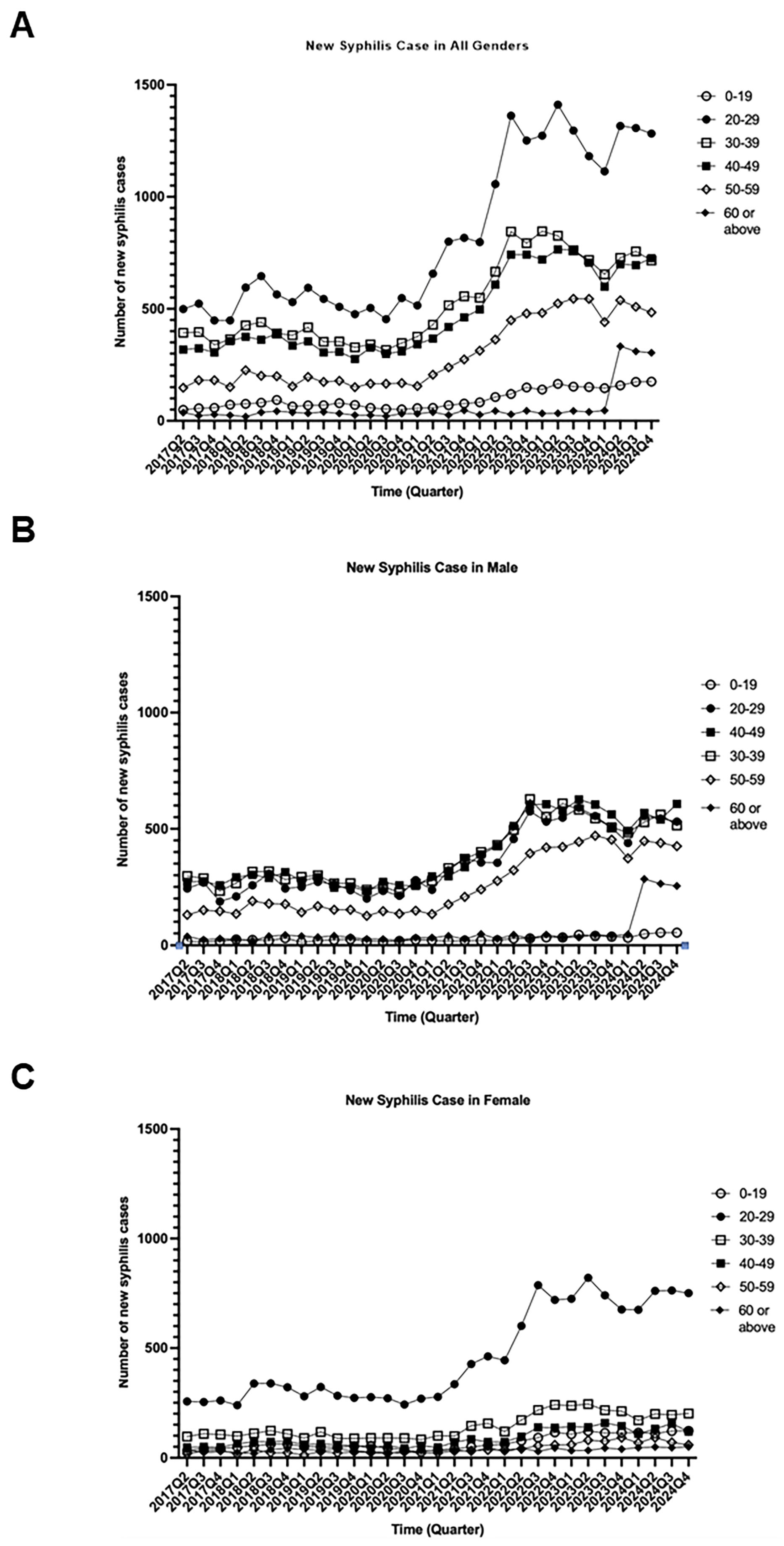
According to the quarterly trend of new syphilis cases from 2017 Q2 to 2024 Q4 (Figure 1), the overall number of new syphilis cases showed a significant upward trend during this period, especially accelerating from 2021 Q1. Since then, the growth rate of syphilis cases has remained at a high level until it peaked in 2023 Q1. It is worth noticing that there are significant differences in the incidence trends and the main affected groups among different age groups. In terms of gender differences, the number of male cases was higher than that of female cases. However, there is little age difference among the new male cases, which means the high incidence age groups of male cases are more dispersed. The new cases in females are mainly in the 20–29 age group. The number of cases in this group has risen sharply since 2021 Q3 and reached the highest level among all age groups of females in 2023 Q3.
Figure 1. Quarterly number of new syphilis cases by sex and age group, 2017Q2–2024Q4. This figure set includes three line graphs illustrating the temporal trends in newly reported syphilis cases among (A) all genders, (B) males, and (C) females. Data are arranged by calendar quarter from the second quarter of 2017 (2017Q2) to the fourth quarter of 2024 (2024Q4). The y-axis represents the number of newly diagnosed syphilis cases, and the x-axis represents time in quarters. Each panel stratifies cases into six age groups: 0–19 years, 20–29 years, 30–39 years, 40–49 years, 50–59 years, and ≥60 years. Age groups are represented using distinct markers: open circle (0–19), closed circle (20–29), open square (30–39), filled square (40–49), open diamond (50–59), and filled diamond (≥60).

3.3. Association Between Dating App Usage and Syphilis Incidence

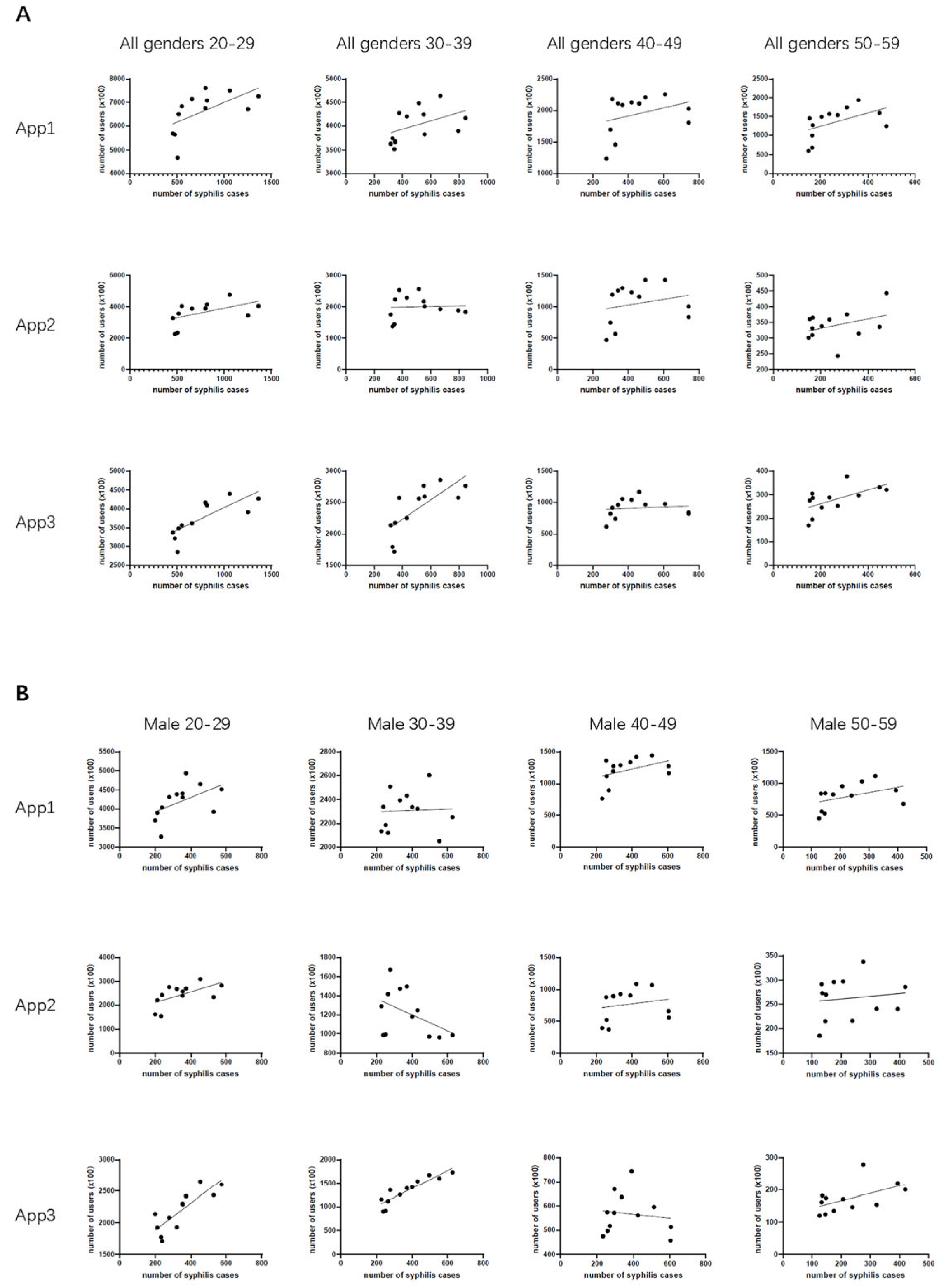
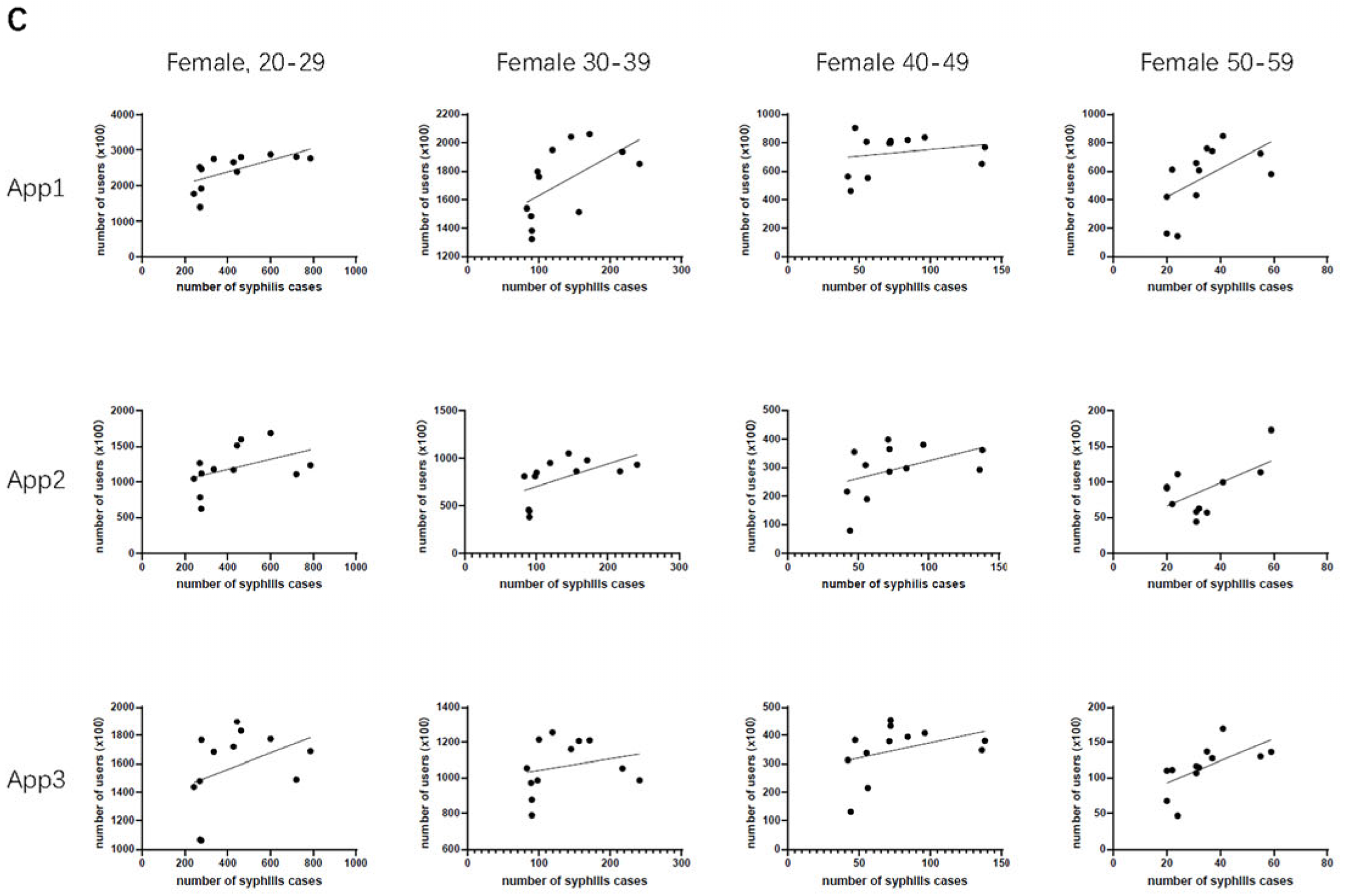
Linear regression analyses were conducted to examine the relationship between the active user counts of three leading dating applications (App1, App2, and App3) and newly reported syphilis cases in Japan, stratified by overall and specific gender and age group (20–29, 30–39, 40–49, 50–59 years). The results are summarized in Table 2 and Figure 2.
Table 2. Linear regression result between Japan’s syphilis cases and dating app active users (App1, App2, and App3). Correlation analysis of study variables was tested using parametric (Simple linear regression) and non-parametric (Spearman’s ρ) methods.
Figure 2. Correlation between the number of newly diagnosed syphilis cases and the number of active users of App1–App3 by gender and age stratification from 2020Q1 to 2022Q4, among (A) all genders, (B) males, and (C) females. This figure illustrates the relationship between newly diagnosed syphilis cases and the number of active users of the top three dating apps in Japan (App1–App3), stratified by gender and age group, from the first quarter of 2020 (Q1 2020) to the fourth quarter of 2022 (Q4 2022). The horizontal axis represents the number of newly reported syphilis cases, while the vertical axis shows the number of active dating-app users, expressed in units of “×100.” Each scatter point corresponds to the observed values for a specific quarter within the study period. The black solid line represents the simple linear regression fitted to the raw data and is included to visually illustrate the linear trend between the two variables.
Initially, from an overall perspective, the result indicates a strong statistical association between new syphilis cases and dating apps’ active users, regardless of age or gender (R2 = 0.50, p value = 0.0001). Among different age groups, the groups aged 20–29 (R2 = 0.60, p value = 0.003) and 30–39 (R2 = 0.56, p value = 0.006) both show strong correlation. Then, just focus on the gender variables, compared with the all-aged female group, the all-aged male group presents a strong and significant correlation (R2 = 0.79, p value = 0.0001). Further subgroup analysis revealed that strong correlations were primarily concentrated particularly in male groups aged 20–29 (R2 = 0.70, p value = 0.0007) and 30–39 (R2 = 0.82, p value < 0.0001) (Table 2 and Figure 2).
When examining the top three dating apps, App3 stands out with a clear and specific statistical correlation to syphilis cases, while App1 and App2 present less defined or consistent relationships. In App1, a moderate positive correlation was only observed in younger groups, like the female group aged 20–29 (R2 = 0.41, p value = 0.02), the female group aged 30–39 (R2 = 0.33, p value = 0.05), and all gender groups aged 20–29 (R2 = 0.35, p value = 0.04). The correlation is even weaker in App2. In App2, only the male group aged 20–29 (R2 = 0.36, p value = 0.04) showed a moderately positive correlation. In App3, there were a few groups, like the all-aged male group (R2 = 0.79, p value = 0.0001) male group aged 20–29 (R2 = 0.70, p value = 0.0007), and the male group aged 30–39 (R2 = 0.82, p value < 0.0001), that have very strong and highly stable positive correlations. Also, there were some groups, such as all gender groups aged 20–29 (R2 = 0.59, p value = 0.0036), and all gender groups aged 30–39 (R2 = 0.55, p value = 0.01), that have moderate positive correlations (Table 2 and Figure 2). Overall, App3 exhibited a pronounced and specific association pattern with syphilis cases, particularly among young and middle-aged males. In contrast, the associations observed for App1 and App2 were less distinct or consistent across demographic groups. To confirm the robustness of the primary linear regression findings, a sensitivity analysis was conducted. All associations were re-examined using Spearman’s rank-order correlation, a non-parametric measure (Table 2). A high degree of concordance between the results of the parametric (simple linear regression) and non-parametric (Spearman) analyses was interpreted as evidence for a stable and reliable association, irrespective of the specific statistical model.

4. Discussion

The observed rise in STI cases in Japan and the proliferation of dating applications may not represent a direct causal relationship, but they appear to have a strong association with each other. It is critical to frame this relationship not as a unidirectional causation but rather as dating apps acting as a powerful societal catalyst in interpersonal communication. These platforms have been suggested to be associated with the dynamics of human connection by providing unprecedented efficiency and scale in partner seeking [21]. Where previous social interactions were often constrained by geography and social circles, dating apps offer immediate, on-demand access to a vast pool of potential partners [22]. This technological shift may increase the potential number of sexual encounters an individual can have, thereby inherently expanding the network through which STIs can propagate.
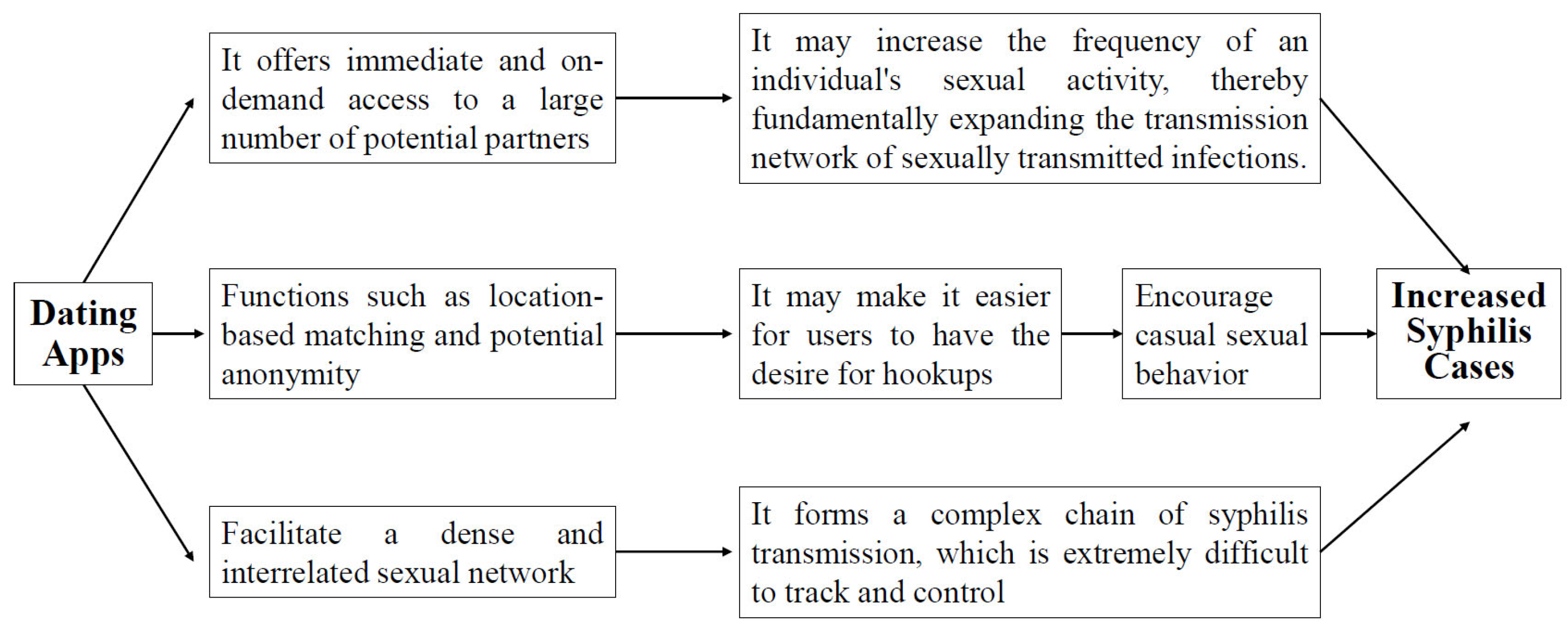
The specific functionalities of these applications further amplify risk. Features such as location-based matching and the potential for anonymity may make users more likely to desire hookups, which may encourage casual sexual behaviors, including the inconsistent use of condoms [23]. Unlike a contained outbreak in a small community, an infection introduced into these digital networks can spread rapidly and widely through multiple concurrent or sequential partners, creating complex transmission chains that are exceedingly difficult for public health authorities to trace and contain [24]. This environment is particularly conducive to the spread of asymptomatic or subclinical infections. To better explain the underlying mechanism by which dating apps affect the increased syphilis cases, a mechanistic interpretation was provided in this case (Figure 3).
Figure 3. Proposed mechanisms linking dating app usage to the rise in syphilis cases. The figure highlights several potential mechanisms through which dating apps may contribute to syphilis transmission, such as increased access to partners, the lower perception of risk due to anonymity, and the creation of dense, highly interconnected sexual networks. While these factors may shed light on short-term transmission patterns, the exact significance of each mechanism and the long-term behavior of the system remain unclear. To address this, future research should combine behavioral data with dynamic transmission models to explore these pathways, evaluate their relative impacts, and enhance understanding of syphilis transmission dynamics in the context of dating app usage.
This rapid technological change has revealed a critical gap in Japan’s public health infrastructure between the ease of finding partners and the lack of comprehensive sexual health education and preparedness. Japan’s formal sexual education has historically been criticized for its inadequacy, often focusing on biological reproduction rather than practical aspects of sexual health, risk reduction, and communication skills [25]. Consequently, while younger generations are adept at using dating technology, they may lack the knowledge, confidence, or agency to insist on safe sex practices or disclose STI status. This is compounded by a persistent cultural stigma surrounding STIs, which contributes to low testing rates and a reluctance to seek treatment, allowing infections to spread undetected [26].
However, it might be an oversimplification to place the burden of explanation solely on dating apps. The observed rise in STI cases during the COVID-19 pandemic, despite lockdown measures and social distancing guidelines, highlights a complex interplay of behavioral, healthcare, and societal factors. While lockdowns aimed to restrict physical interactions, the extent of adherence varied, with some individuals continuing to meet for in-person social or sexual encounters. A surge in dating app usage during the pandemic, driven by the emotional toll of prolonged isolation, loneliness, and the desire for connection, may have led some to seek intimacy, sometimes resulting in riskier sexual behaviors or casual partnerships [27,28]. Additionally, the pandemic might have disrupted access to STI testing and related healthcare services, as public health priorities shifted toward managing COVID-19 cases [29]. This likely delayed diagnoses and treatment for STIs, allowing undiagnosed infections to spread further. Public health messaging during this time also heavily focused on COVID-19, potentially leading to a gap in sexual health education and awareness, which may have influenced risky behaviors such as reduced condom use or neglecting routine testing. Furthermore, while testing and reporting of STIs were likely underreported during strict lockdowns, a rebound in sexual activity following the relaxation of restrictions may have also contributed to a delayed surge in reported cases [30]. These findings underscore the need to maintain accessible sexual health services and robust public health campaigns even during global health crises to address long-term implications on public health.
Gender-based analysis further mentioned that the association between dating app usage and syphilis cases is substantially stronger among males than females, and the strongest correlations were concentrated in male subgroups aged 20–29 and 30–39. These findings suggest that young adult males may be a key population driving the observed overall correlation between dating app activity and syphilis incidence.
During pandemic lockdowns, App3 probably became a convenient platform for users to quickly connect with multiple partners, resulting in higher partner volumes within a tightly interconnected network. The structural efficiency of the app, rather than the app itself, fostered an ideal environment for rapid STI transmission, allowing a single infection to spread quickly through the connected user base. Our results are also influenced by surveillance bias. Users of modern dating apps like App3 may be more health-conscious and proactive, which could be associated with higher testing rates and greater case detection. Additionally, standard public health practices, such as partner notification, may be more likely to be identified App3 as a recurring point of connection, further amplifying the perceived association in the data. Consequently, the observed correlation is not a straightforward causal relationship but rather a complex interaction of actual infection dynamics within app-mediated networks and the overrepresentation of cases due to enhanced detection in these same networks.
This observation also offers an important insight into public health strategies, suggesting a potential shift from broad demographic “risk groups” toward addressing specific, high connectivity “risk networks” (Figure 3). The implication is that dating apps should not be seen as adversaries but as potential allies in public health efforts. Although causal inferences cannot be drawn from the present findings, our findings advocate for modernizing sexual health strategies by targeting prevention efforts “upstream,” directly within the digital environments where these connections are formed [31]. Collaboration between public health agencies and dating app developers could enable the integration of discreet preventive measures, such as prompts for status disclosure, in-app testing resources, and anonymous exposure notifications. By leveraging these digital platforms not merely as transmission sites but also as tools for prevention and network-level health promotion, we can enhance sexual health interventions and improve outcomes on a broader scale. Additionally, from the perspective of time, it is essential to move beyond short-term association and consider the long-term or asymptotic result of dating app-mediated sexual transmission systems, which is also one of the concerns of the decision makers of public health. A symmetry-based approach, which characterizes the asymptotic states of complex interaction systems, can be adopted to model the long-term equilibrium dynamics of STI transmission with the influence of using dating apps [32].
The observed correlation between dating app usage and reported STI cases during the COVID-19 pandemic is intriguing; however, several limitations must be acknowledged when interpreting these findings. First, the data itself may have deviations. The presence of a variable incubation period and the potential for asymptomatic presentation in early-stage syphilis led to an unavoidable lag and potential underreporting in surveillance data [33], resulting in statistical errors or omissions regarding the true prevalence. Also, because mainstream dating apps (for example, App1, App2, and App3) focus on heterosexual relationships, the incidence of syphilis among homosexuals may be systematically overlooked or underrepresented. Recent national surveillance and epidemiological studies indicate a pronounced shift, with heterosexual contact now reported as a primary transmission route for a majority of new syphilis cases among adults in Japan’s ongoing epidemic [34,35]. This context renders the investigation of heterosexual partner-seeking platforms particularly important. Our finding that widespread use of dating apps associates with the surge of syphilis cases in Japan aligns with the hypothesis that these digital tools may be acting as structural catalysts within this specific epidemiological landscape. While our data cannot specify the sexuality of app users, the independent epidemiological evidence for substantial heterosexual transmission strengthens the plausibility that apps facilitating heterosexual connections are relevant contributing environmental factors. In addition, a key issue arises from the fact that the two datasets originate from different sources. Such discrepancies in data origin raise questions about the comparability and reliability of the relationship. Temporal misalignments may exist between the reporting periods of the datasets, as dating app usage might represent ongoing activity trends. In contrast, STI case data could be subject to delays in testing and reporting. Last but not least, the granularity of the data might differ significantly, with dating app trends reflecting general app activity (e.g., downloads, sign-ups, or usage rates) rather than specific behaviors such as in-person encounters, which are more directly linked to STI transmission. This makes it challenging to draw definitive connections between these two datasets.
Biases in the datasets further complicate the interpretation of findings. Reporting of STI cases, particularly during the COVID-19 pandemic, may not have been consistent. Strained healthcare systems reduced access to STI screening services, and an increased focus on managing the pandemic could have resulted in underreporting cases during this period [36]. Conversely, public health efforts to promote STI awareness and testing may have led to better-case detection among specific populations, particularly users of dating apps [37], which could inflate the association between the two variables. Moreover, the dating app dataset may lack reliability or precision, as metrics such as download rates or user activity do not necessarily reflect in-person behaviors or risky sexual practices. In this case, causal interpretations about the relationship between dating app use and risky sexual behaviors may not be made [38].
It is also important to consider the impact of the pandemic itself as a confounding factor. Social distancing measures, movement restrictions, and the general uncertainty of the pandemic likely affected both dating behaviors and sexual activity, which in turn could influence STI rates. For example, while dating app usage may have increased as people sought virtual companionship during lockdowns, actual physical interactions may have declined due to restrictions. Conversely, as restrictions eased, a rapid increase in physical encounters may have contributed disproportionately to a spike in STI cases independent of dating app usage trends. Such factors highlight the difficulty in disentangling the specific role of dating app behavior in driving STI cases during this unique period.
While a statistical correlation may exist, it is crucial to avoid conflating correlation with causation. An increase in dating app usage during the pandemic does not inherently lead to a higher prevalence of STIs. A wide variety of factors, including social distancing measures, condom use [39,40], could all contribute to the observed trends. Without more comprehensive data that explicitly links individual self-reported dating app usage to health outcomes, the relationship remains tentative at best. Consequently, the findings should be interpreted with caution, and further investigations utilizing more robust and integrated datasets are necessary to validate the hypothesized connection.
The dramatic resurgence of syphilis in Japan must be contextualized within the nation’s broader STI landscape, where it acts not as an isolated epidemic but as a highly visible indicator of systemic public health challenges. In this study, we noticed that this surge is strongly associated with the proliferation of dating applications, which function as a significant catalyst by enabling rapid, anonymous, and geographically fluid sexual networks that facilitate the efficient transmission of the infection. However, this same technological ecosystem may amplify the spread of other prevalent STIs, including chlamydia [41] and gonorrhea [42]. We postulate the synergy between digital platforms that accelerate partner connection, and pre-existing vulnerabilities such as inadequate sexual education, pervasive stigma, and low testing rates, which collectively fuel the transmission of a wide spectrum of infections [43,44,45].
In the future management of STIs, it is crucial to ensure that sexual health services remain continuous during global crises to prevent disruptions that could negatively impact the control of other diseases. Digital platforms, particularly dating apps, should be recognized as valuable tools for public health interventions. By integrating regulatory measures and fostering partnerships with these platforms, public health systems can leverage mobile technologies for targeted, efficient prevention, education, and surveillance of STIs. This cross-border collaboration is essential for curbing syphilis, improving overall STI prevention outcomes, and addressing the rising incidence of infections worldwide. Using Japan as a case study, this research highlights innovative strategies and measures that can be applied globally. Future public health efforts should focus on combining technological tools with sexual health education and outreach to build a robust, adaptive response to the evolving landscape of STI prevention and control.

5. Conclusions

This study provides quantitative evidence supporting a significant association between the rapid increase in syphilis cases in Japan and the use of dating apps, particularly among males aged 20–39. The findings suggest that digital platforms, by expanding opportunities for new sexual contacts, may contribute to the heightened risk of sexually transmitted infections, without implying a direct causal relationship. This association was especially pronounced during the COVID-19 pandemic, wherein strict isolation measures may have prompted greater engagement in high-risk behaviors. At the same time, disruptions to public health services, such as STI testing and outreach, may have facilitated the unchecked spread of infections. Furthermore, systemic challenges, including insufficient sexual health education and cultural stigmatization, likely compounded the increase in infection rates.

Author Contributions

Conceptualization, Y.J. and Y.-W.K.; methodology, Y.J. and Y.-W.K.; formal analysis, Y.J. and Y.-W.K.; data curation, Y.J.; writing—original draft preparation, Y.J. and Y.-W.K.; writing—review and editing, Y.J. and Y.-W.K.; visualization, Y.J. and Y.-W.K.; supervision, Y.-W.K.; funding acquisition, Y.-W.K. All authors have read and agreed to the published version of the manuscript.

Funding

This research was supported in part by the Startup Fund from the Division of Natural and Applied Sciences, Duke Kunshan University (00AKUG0130). Y.-W.K. acknowledges funding from Duke Kunshan University.

Institutional Review Board Statement

This study does not require Institutional Review Board (IRB) approval, as all data utilized in the research were obtained from publicly accessible databases in the public domain. No identifiable private or sensitive information was used, ensuring compliance with ethical and legal standards for research involving publicly available data.

Data Availability Statement

No new data were created in this article.

Acknowledgments

We thank the Writing and Language Studio at Duke Kunshan University for assistance in the review preparation process.

Conflicts of Interest

The authors declare no conflicts of interest.

Abbreviations

The following abbreviations are used in this manuscript:
STISexually transmitted infection
HIVHuman immunodeficiency virus
AppApplication

References

  1. Chaudhry, S.; Akinlusi, I.; Shi, T.; Cervantes, J. Secondary Syphilis: Pathophysiology, Clinical Manifestations, and Diagnostic Testing. Venereology 2023, 2, 65–75. [Google Scholar] [CrossRef]
  2. Ying, Z.; Li, X.; Yin, N.; Gao, C. Long-term health effects of syphilis in cardiovascular diseases and neurological diseases: A systematic review and meta-analysis. Medicine 2026, 105, e46480. [Google Scholar] [CrossRef] [PubMed]
  3. Stamm, L.V. Syphilis: Re-emergence of an old foe. Microb. Cell 2016, 3, 363–370. Available online: https://pmc.ncbi.nlm.nih.gov/articles/PMC5354565/ (accessed on 23 November 2025). [CrossRef] [PubMed]
  4. Espinoza, J.L.; Trung, L.Q. Resurgent Syphilis Across the Globe: A Public Health Perspective on Bridging Surveillance and Strategy. Pathogens 2025, 14, 1148. [Google Scholar] [CrossRef]
  5. Yu, W.; You, X.; Luo, W. Global, regional, and national burden of syphilis, 1990–2021 and predictions by Bayesian age-period-cohort analysis: A systematic analysis for the global burden of disease study 2021. Front. Med. 2024, 11, 1448841. Available online: https://pmc.ncbi.nlm.nih.gov/articles/PMC11357943/ (accessed on 23 November 2025). [CrossRef]
  6. Rosset, F.; Celoria, V.; Delmonte, S.; Mastorino, L.; Sciamarrelli, N.; Boskovic, S.; Ribero, S.; Quaglino, P. The Epidemiology of Syphilis Worldwide in the Last Decade. J. Clin. Med. 2025, 14, 5308. [Google Scholar] [CrossRef]
  7. Japan Institute for Health Security. Syphilis 2008–2014. IASR 2015, 36, 17–19. Available online: https://id-info.jihs.go.jp/niid/en/iasr/5413-tpc420.html (accessed on 23 November 2025).
  8. Japan Institute for Health Security. Guide to Treating Congenital Syphilis 2023. IASR 2023, 44, 197–198. Available online: https://id-info.jihs.go.jp/surveillance/iasr/44/526/article/090/index.html (accessed on 23 November 2025).
  9. Komori, A.; Mori, H.; Xie, W.; Valenti, S.; Naito, T. Rapid resurgence of syphilis in Japan after the COVID-19 pandemic: A descriptive study. PLoS ONE 2024, 19, e0298288. Available online: https://journals.plos.org/plosone/article?id=10.1371/journal.pone.0298288 (accessed on 23 November 2025). [CrossRef]
  10. Naito, T.; Mari, H.; Fujibayashi, K.; Fukushima, S.; Yuda, M.; Fukui, N.; Suzuki, M.; Goto-Hirano, K.; Kuwatsaru, R. The resurgence of syphilis over the past decade can be attributed to several contributing factors. J. Infect. Chemother. 2022, 28, 1494–1500. Available online: https://www.jiac-j.com/article/S1341-321X(22)00212-4/fulltext (accessed on 24 November 2025). [CrossRef]
  11. Rahman, T.; Kong, F.Y.S.; Williams, R.; Davis, K.; Whitby, J.; Eades, F.; Graham, S.; Joshy, G.; Eades, S. Increasing awareness of sexually transmitted infections (STI) testing and addressing stigma may improve STI testing in Aboriginal and Torres Strait Islander youth: Evidence from the Next Generation Youth Wellbeing Study. Aust. N. Z. J. Public Health 2024, 48, 100203. Available online: https://www.sciencedirect.com/science/article/pii/S1326020024000797 (accessed on 23 November 2025). [CrossRef]
  12. Ong, J.J.; Unemo, M.; Molina, J.M.; Miranda, A.E.; Seib, K.L.; de Mello, M.B.; Doherty, M.; Johnson, C.C.; Delany-Moretlwe, S.; Fairley, C. Beyond behavioural change: Prioritising structural solutions to control bacterial sexually transmitted infections. eClinicalMedicine 2025, 83, 103198. [Google Scholar] [CrossRef] [PubMed]
  13. Suzuki, Y.; Kosaka, M.; Yamamoto, K.; Hamaki, T.; Kusumi, E.; Takahashi, K.; Tanimoto, T. Association between Syphilis Incidence and Dating App Use in Japan. JMA J. 2020, 3, 109–117. Available online: https://www.jmaj.jp/detail.php?id=10.31662/jmaj.2019-0033 (accessed on 23 November 2025). [CrossRef] [PubMed]
  14. National Institute of Infectious Diseases. Summary of Syphilis Notification in Japan (as of 4 July 2018). Available online: https://id-info.jihs.go.jp/surveillance/idwr/article/syphilis/010/syphilis2018q2.pdf (accessed on 23 November 2025).
  15. National Institute of Infectious Diseases. Summary of Syphilis Notification in Japan (as of 2 Oct 2019). Available online: https://id-info.jihs.go.jp/surveillance/idwr/article/syphilis/010/syphilis2019q3.pdf (accessed on 23 November 2025).
  16. National Institute of Infectious Diseases. Summary of Syphilis Notification in Japan (as of 8 January 2021). Available online: https://id-info.jihs.go.jp/surveillance/idwr/article/syphilis/010/syphilis2020q4.pdf (accessed on 23 November 2025).
  17. National Institute of Infectious Diseases. Summary of Syphilis Notification in Japan (as of 7 January 2022). Available online: https://id-info.jihs.go.jp/surveillance/idwr/article/syphilis/010/syphilis2021q4.pdf (accessed on 23 November 2025).
  18. National Institute of Infectious Diseases. Summary of Syphilis Notification in Japan (as of 6 July 2022). Available online: https://id-info.jihs.go.jp/surveillance/idwr/article/syphilis/010/syphilis2022q2.pdf (accessed on 23 November 2025).
  19. National Institute of Infectious Diseases. Summary of Syphilis Notification in Japan (as of 4 October 2023). Available online: https://id-info.jihs.go.jp/surveillance/idwr/article/syphilis/010/syphilis2023q3.pdf (accessed on 23 November 2025).
  20. National Institute of Infectious Diseases. Summary of Syphilis Notification in Japan (as of 7 January 2025). Available online: https://id-info.jihs.go.jp/surveillance/idwr/article/syphilis/010/syphilis2024q4.pdf (accessed on 23 November 2025).
  21. Castro, Á.; Barrada, J.R. Dating Apps and Their Sociodemographic and Psychosocial Correlates: A Systematic Review. Int. J. Environ. Res. Public Health 2020, 17, 6500. [Google Scholar] [CrossRef] [PubMed]
  22. Bandinelli, C.; Gandini, A. Dating Apps: The Uncertainty of Marketised Love. Cult. Sociology. Cult. Sociol. 2022, 16, 423–441. Available online: https://journals.sagepub.com/doi/full/10.1177/17499755211051559 (accessed on 24 November 2025). [CrossRef]
  23. Reeves, J.M.; Griner, S.B.; Johnson, K.C.; Jones, E.C., Jr.; Shangani, S. Exploring relationships between dating app use and sexual activity among young adult college students. Front. Reprod. Health 2024, 6, 1453423. Available online: https://pmc.ncbi.nlm.nih.gov/articles/PMC11604616/ (accessed on 24 November 2025). [CrossRef]
  24. Lazebnik, T. Mathematical model of dating apps’ influence on sexually transmitted diseases spread. Soc. Netw. Anal. Min. 2024, 14, 187. Available online: https://link.springer.com/article/10.1007/s13278-024-01351-5 (accessed on 23 November 2025). [CrossRef]
  25. Fu, H. The bumpy road to socialise nature: Sex education in Japan. Cult. Health Sex. 2011, 13, 903–915. Available online: https://www.tandfonline.com/doi/abs/10.1080/13691058.2011.587894 (accessed on 24 November 2025). [CrossRef]
  26. Malta, M.; Bastos, F.I.; Strathdee, S.A.; Cunnigham, S.D.; Pilotto, J.H.; Kerrigan, D. Knowledge, perceived stigma, and care-seeking experiences for sexually transmitted infections: A qualitative study from the perspective of public clinic attendees in Rio de Janeiro, Brazil. BMC Public Health 2007, 7, 18. [Google Scholar] [CrossRef]
  27. Chirom, O.B. Effects of Modern Dating Applications on Healthy Offline Intimate Relationships during the COVID-19 Pandemic: A Review of the Tinder Dating Application. Adv. J. Commun. 2021, 9, 12–38. [Google Scholar]
  28. Gibson, A.F. Exploring the impact of COVID-19 on mobile dating: Critical avenues for research. Soc. Pers. Psychol. Compass 2021, 15, e12643. [Google Scholar] [CrossRef]
  29. Kanda, N.; Hashimoto, H.; Imai, T.; Yoshimoto, H.; Goda, K.; Mitsutake, N.; Hatakeyama, S. Indirect impact of the COVID-19 pandemic on the incidence of non–COVID-19 infectious diseases: A region-wide, patient-based database study in Japan. Public Health 2023, 241, 20–24. Available online: https://www.sciencedirect.com/science/article/pii/S0033350622003018 (accessed on 24 November 2025). [CrossRef] [PubMed]
  30. Schwartz, N.; Hunter, S.; Forbes, S.M.; Gesink, D.; Hobin, E.; Anderson, L.N.; Rebellato, S.; Pabayo, R.; Smith, B.T. The COVID-19 pandemic’s impact on sexually transmitted infections and the modifying role of public health funding: An interrupted time series study. J. Public Health 2025, 47, 395–403. [Google Scholar] [CrossRef] [PubMed]
  31. Garcia-Lglesias, J.; Heaphy, B.; Mowlabocus, S.; Yodovich, N.; Nagington, M.; Patton, K.; Atherton, S.; Ford, A. Dating apps as health allies? Examining the opportunities and challenges of dating apps as partners in public health. Med. Humanit. 2024, 50, 594–597. Available online: https://mh.bmj.com/content/50/3/594 (accessed on 23 November 2025). [CrossRef] [PubMed]
  32. Lazebnik, T.; Bunimovich-Mendrazitsky, S.; Shaikhet, L. Novel Method to Analytically Obtain the Asymptotic Stable Equilibria States of Extended SIR-Type Epidemiological Models. Symmetry 2021, 13, 1120. Available online: https://www.mdpi.com/2073-8994/13/7/1120#FD31-symmetry-13-01120 (accessed on 23 November 2025). [CrossRef]
  33. Singh, A.E.; Romanowski, B. Syphilis: Review with Emphasis on Clinical, Epidemiologic, and Some Biologic Features. Clin. Microbiol. Rev. 1999, 12, 187–209. Available online: https://journals.asm.org/doi/10.1128/cmr.12.2.187 (accessed on 23 November 2025). [CrossRef]
  34. Ukai, T.; Kakimoto, K.; Kawahata, T.; Miyama, T.; Iritani, N.; Motomura, K. Resurgence of syphilis in 2022 amongst heterosexual men and women in Osaka, Japan. Clin. Microbiol. Infect. 2023, 29, 396–397. [Google Scholar] [CrossRef]
  35. Yamagishi, Y.; Minami, M.; Nakamura, N.; Onoe, Y.; Kobori, Y.; Itoda, I.; Mikamo, H. Identification of key risk factors for syphilis among high-risk populations in urban areas of Japan. J. Infect. Chemother. 2025, 31, 102863. [Google Scholar] [CrossRef]
  36. Liu, M.; Zhou, J.; Lan, Y.; Zhang, H.; Wu, M.; Zhang, X.; Leng, L.; Mi, X.; Li, J. A Neglected Narrative in the COVID-19 Pandemic: Epidemiological and Clinical Impacts of the COVID-19 Outbreak on Syphilis. Clin. Cosmet. Investig. Dermatol 2023, 16, 2485–2496. [Google Scholar] [CrossRef]
  37. Friedman, A.L.; Kachur, R.E.; Noar, S.M.; McFarlane, M. Health Communication and Social Marketing Campaigns for Sexually Transmitted Disease Prevention and ControlWhat Is the Evidence of their Effectiveness? Sex Transm. Dis. 2016, 43, S83–S101. Available online: https://journals.lww.com/stdjournal/fulltext/2016/02001/health_communication_and_social_marketing.11.aspx (accessed on 24 November 2025). [CrossRef]
  38. Sawyer, A.N.; Smith, E.R.; Benotsch, E.G. Dating Application Use and Sexual Risk Behavior Among Young Adults. Sex. Res. Soc. Policy 2018, 15, 183–191. Available online: https://link.springer.com/article/10.1007/s13178-017-0297-6 (accessed on 23 November 2025). [CrossRef]
  39. Yan, X.; Wang, X.; Zhang, X.; Wang, L.; Zhang, B.; Jia, Z. The Epidemic of Sexually Transmitted Diseases Under the Influence of COVID-19 in China. Front. Public Health 2021, 9, 737817. Available online: https://www.frontiersin.org/journals/public-health/articles/10.3389/fpubh.2021.737817/full (accessed on 24 November 2025). [CrossRef] [PubMed]
  40. Foss, A.M.; Hossaim, M.; Vickerman, P.T.; Watts, C.H. A systematic review of published evidence on intervention impact on condom use in sub-Saharan Africa and Asia. Sex. Transm. Infect. 2007, 83, 510–516. Available online: https://sti.bmj.com/content/83/7/510.short (accessed on 23 November 2025). [CrossRef] [PubMed]
  41. Gravningen, K.; Aicken, C.R.; Schirmer, H.; Mercer, C.H. Meeting sexual partners online: Associated sexual behaviour and prevalent chlamydia infection among adolescents in Norway: A cross-sectional study. Sex. Transm. Infect. 2016, 92, 97–103. [Google Scholar] [CrossRef]
  42. Beymer, M.R.; Weiss, R.E.; Bolan, R.K.; Rudy, E.T.; Bourque, L.B.; Rodriguez, J.P.; Morisky, D.E. Sex on demand: Geosocial networking phone apps and risk of sexually transmitted infections among a cross-sectional sample of men who have sex with men in Los Angeles County. Sex. Transm. Infect. 2014, 90, 567–572. [Google Scholar] [CrossRef]
  43. Noguchi, T.; Tashiro, M.; Marui, Y.; Horikawa, S.; Zablotska-Manos, I. Initiation and delivery of comprehensive sexuality education in Japanese schools. Sex Educ. 2025, 25, 647–665. [Google Scholar] [CrossRef]
  44. Kaneda, Y. Beyond coronavirus: Addressing the escalation of sexually transmitted infections in Japan. New Microbes New Infect. 2023, 9, 101174. Available online: https://pmc.ncbi.nlm.nih.gov/articles/PMC10493501/ (accessed on 23 November 2025). [CrossRef]
  45. Taniguchi, T.; Yamagishi, K.; Yahaba, M.; Yoshikawa, H.; Igari, H. Missed opportunities: HIV testing deficits among syphilis-tested patients in Japan. J. Infect. Chemother. 2025, 31, 102816. Available online: https://www.sciencedirect.com/science/article/pii/S1341321X25002132 (accessed on 23 November 2025). [CrossRef]
Disclaimer/Publisher’s Note: The statements, opinions and data contained in all publications are solely those of the individual author(s) and contributor(s) and not of MDPI and/or the editor(s). MDPI and/or the editor(s) disclaim responsibility for any injury to people or property resulting from any ideas, methods, instructions or products referred to in the content.

Article Metrics

Citations

Article Access Statistics

Multiple requests from the same IP address are counted as one view.