Article

Diagnostic Utility of Human Papilloma Virus Testing in Comparison with Pap Cytology and Histopathology in Unvaccinated Women with Cervical High-Grade Dysplasia and Carcinoma in Botswana


by
Patricia Setsile Rantshabeng
1,2,*,
Nametso Dire
3,
Andrew Khulekani Ndlovu
1 and
Ishmael Kasvosve
1
1
Department of Medical Laboratory Sciences, School of Allied Health Sciences, University of Botswana, Gaborone, Botswana
2
Department of Pathology, Faculty of Medicine, University of Botswana, Gaborone, Botswana
3
Department of Statistics, Faculty of Social Sciences, University of Botswana, Gaborone, Botswana
*
Author to whom correspondence should be addressed.
Venereology 2025, 4(4), 15; https://doi.org/10.3390/venereology4040015
Submission received: 15 June 2025 / Revised: 10 November 2025 / Accepted: 12 November 2025 / Published: 17 November 2025

Abstract

Background/Objective: High-risk human papillomavirus (hrHPV) is an established causative agent for the malignant transformation of cervical cells that can be detected using the Papanicolaou (Pap) smear test. A call by the World Health Organization (WHO) for global collective efforts towards eliminating cervical cancer has endorsed hrHPV DNA testing as an alternative screening test. The objective of this study was to determine the diagnostic utility of hrHPV DNA testing in detecting high-grade cervical intraepithelial lesions (HSILs) in unvaccinated women with abnormal Pap smears and histopathologically confirmed CIN3 and carcinoma. Methods: This study included 111 cervical tissues with a histopathological confirmation of the cervical intraepithelial neoplasia grade (CIN3) and malignancy. Tissues were sectioned, dewaxed, and digested, and DNA was extracted and tested for hrHPV using the Abbott RealTime HR HPV assay. Pap smear results associated with the tissue samples were extracted from corresponding clinical records, and data was analyzed using R-statistical software. Results: Extracted Pap smear records for the 111 cervical tissue samples indicated that 89 (80.2%) had a high-grade intraepithelial lesion (Pap-HSIL), 20 (18%) had squamous cell carcinoma (Pap-SCC), and two (1.8%) had Pap-adenocarcinoma. A total of 68/89 (76.4%) of Pap-HSIL, 15/20 (75%) of Pap-SCC, and ½ (50%) of Pap-adenocarcinoma cases had detectable hrHPV DNA. Conclusions: This study’s findings demonstrate that the Pap smear is still a valuable screening test especially for detecting both hrHPV-dependent and -independent cervical dysplasia in unvaccinated populations. While considerations are made to improve cervical cancer screening, including the introduction of hrHPV DNA testing in national cervical cancer screening programs, there is a need for the careful interpretation of molecular testing results for clinical intervention. This is especially important for hrHPV-independent cervical dysplasia screening, since this can have dire implications for clinically asymptomatic women.

1. Introduction

Cervical cancer is the fourth most common malignancy in women globally [1], underscoring the need for continued efforts towards effective control, including organized screening and development of novel screening tests for early diagnosis. The high-risk human papillomavirus (hrHPV), in the presence of other co-factors [2], is well established as a causative agent for the malignant transformation of cervical cells [3,4], making cervical cancer one of the few cancers that can be prevented with prophylactic vaccines. For decades, the Papanicolaou (Pap) smear test, developed by a Greek scientist Gorge Papanicolaou [5], has been the gold standard for the screening and early detection of cervical dysplasia, which is normally followed by a histopathological confirmation of the excised lesion [6,7]. The main advantages of the Pap smear test include its high specificity and the early detection of cervical lesions, in addition to grading their severity to inform appropriate clinical interventions, when robust screening is implemented, while its disadvantages include the need for high-level infrastructure and repetition and its medium sensitivity [8,9]. The integration of the human papillomavirus DNA into that of the host, an essential step for the malignant transformation of cells [10], can be detected using molecular methods, making it an ideal biomarker for cervical carcinogenesis. However, the HPV DNA test detects the presence/absence of the carcinogenic agent (HPV) in a patient sample [8,11], and its main advantage has been reported to be its high sensitivity and that it requires medium-level infrastructure, while its major disadvantage is that it has a low to medium specificity [8,12,13] and lacks cervical lesion grading in comparison to the Pap smear, which is critical for clinical intervention. Despite efforts to increase coverage, reports indicate that Pap smear-based screening programs have not been effective in reducing the burden of cervical cancer cases in low- and middle-income countries (LMICs) when compared to high-income countries (HICs) [14].
Significant regional variations noted in the burden of cervical cancer between LMICs and HICs have also been attributed to low HPV vaccination coverage and challenges with the successful implementation of organized screening programs [15,16]. The 2020 WHO global strategy report has called for global collective efforts towards eliminating cervical cancer, adopting a triple intervention strategy (90-70-90) with intents to have “90% of girls vaccinated against human papillomavirus (HPV), 70% of women screened with high precisions tests at 35 and 45 years of age, 90% of women who are identified with cervical cancer should receive treatment and care,” by 2030 [17]. The relationship between hrHPV infection and cervical cancer development has led to proposals on the use of hrHPV DNA testing as an alternative to the Pap smear, citing that it is more sensitive and reliable for primary cervical cancer screening [8,17,18,19]. Although a decline in the number of cervical cancer cases has been observed in most high-income countries (HICs) due to successful Pap smear-based programs [20,21,22,23], more effort is needed to achieve similar results in low- and middle-income countries (LMICs), with screening currently reported to be as low as 4% in some areas [24]. Studies attribute these low screening percentages to the use of low-performance tests, citing the Pap smear, in comparison to HPV DNA testing [25]. A study by Bruni et al. [24] reported the Pap smear as the primary screening method in 78% (109/139) of countries that had cervical screening programs. Furthermore, 35% (48/139) of those countries recommended HPV DNA-based tests for primary screening programs. In addition, the high cost of hrHPV DNA-based testing has also been reported as a barrier to the implementation of national hrHPV screening strategies in most LMICs [26], which are also reporting low HPV vaccination rates [27].
Therefore, the conclusion that HPV DNA testing is more sensitive for detecting and reducing cervical cancer incidences [26,28,29] mainly emanates from developed countries with more organized screening programs [30,31] and high vaccination rates, where the accuracy of Pap smear test screening is expected to be compromised as hrHPV-related dysplasia rates are drastically reduced in vaccinated women [32]. Knowledge gaps exist in the published literature, with limited data from LMICs to provide guidance for evidence-based decision making by policy makers to accelerate the transition from Pap smear-based to hrHPV DNA screening programs [33,34,35]. In Botswana, cervical cancer ranks first as the most common malignancy in women and accounted for 33% of all new cancer cases and 19.8% of all cancer-related deaths in 2022 [36]. The HPV vaccination program targeting schoolgirls aged 9 to 13 years in Botswana began in 2015, with the quadrivalent HPV vaccine (HPV 6/11/16/18) [37], and it is reported to be reaching an almost 100% coverage of the targeted population [38]. The vaccination drive is expected to lower the hrHPV-associated cervical cancer incidence as this population becomes eligible for cervical cancer screening [39,40]. To date, cervical cancer screening in Botswana has been largely Pap smear-based, with hrHPV DNA testing available at a smaller scale and mostly in private health facilities.
The prevalence of hrHPV in Botswana has been reported to range between 8 and 95% in women with histopathologically confirmed cervical high-grade dysplasia [41,42,43,44]. The high-grade squamous intraepithelial lesion (HSIL), which is regarded as an immediate precursor for cervical cancer [3], is also used as a threshold for the surgical treatment of cervical dysplasia, with the ultimate goal of cervical cancer screening being to detect and identify women eligible for treatment before these precancerous cervical lesions become malignant [45]. Therefore, the objective of this study was to determine the diagnostic utility of hrHPV DNA testing for the detection of high-grade cervical intraepithelial lesions (HSILs) in unvaccinated women with abnormal Pap smears and histopathologically confirmed CIN3 and carcinoma.

2. Materials and Methods

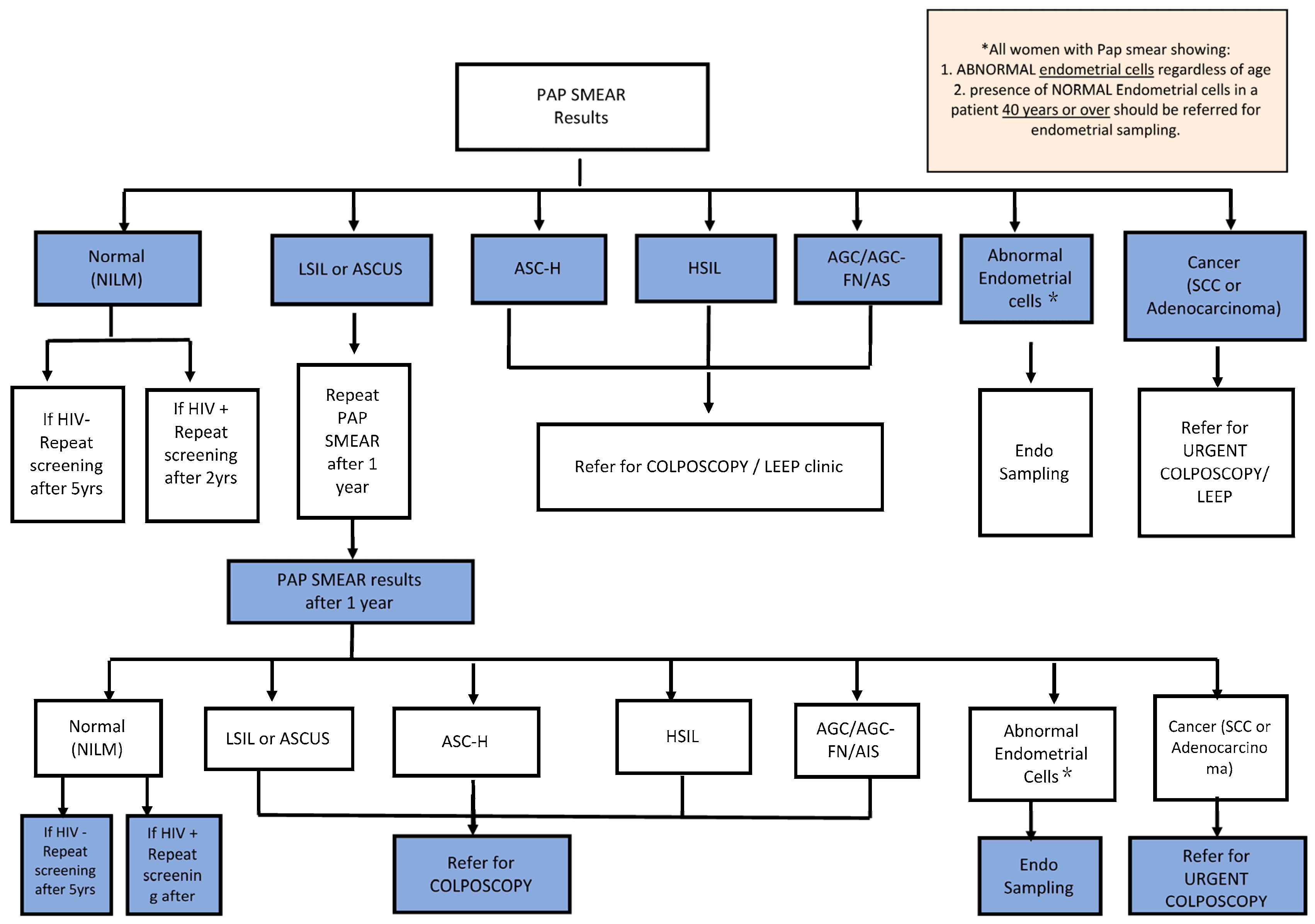
This retrospective cross-sectional study included one hundred and eleven (111) residual and archived formalin-fixed paraffin-embedded (FFPE) cervical biopsies diagnosed with a high-grade dysplasia (CIN3) and carcinoma (squamous cell and adenocarcinoma) at the National Health Laboratory (NHL). The NHL is the largest of the two public health facilities offering Anatomical Pathology services in Botswana. These biopsies were collected between 2002 and 2013 during routine patient management (see screening guidelines in Figure A1) and are now archived as residual samples as per the laws of Botswana, post-diagnosis. This study was approved by the University of Botswana institutional review board (UB-IRB) and a research permit, issued by the human Health Research and Development Committee, Ministry of Health (Protocol REF# PPME 13/18/1 US V (232) dated 11 February 2013). A waiver of consent was also obtained from the UB-IRB, consistent with ISO 15189 [BOS ISO 15189:2003(E)] [46]. Study samples were selected based on physical availability; tissue adequacy for laboratory investigations; and completeness of clinical data from medical records, including availability of Pap smear test results (diagnosed ≤ 6 months prior to biopsy collection). There was no Pap smear testing in this study. To ensure confidentiality, de-identified medical data associated with the samples was extracted from the participants’ records.

2.1. Laboratory Investigations

Tissues were cooled on a cold plate at −20 °C, and a 20 µm thick section was trimmed off each block to remove the dirty surface. Thereafter, tissues were sectioned at 4 µm and stained with hematoxylin and eosin before being analyzed by a consultant anatomical pathologist to confirm diagnosis. For hrHPV DNA testing, five (5) serial tissue sections of 10 µm thickness were sectioned and transferred to well-labeled 15 mL tubes for dewaxing using xylene (3× washes, each lasting for 1 min) and rehydration in degraded alcohol solutions (100%, 90%, and 80% for 1 min each) and incubation in phosphate-buffered saline (1 h). The microtome blade and stage were cleaned with xylene followed by absolute alcohol and DNAse solution to prevent cross-contamination between each tissue block. Tissues were digested in lysis buffer and proteinase K overnight (12–16 h) at 56 °C. Following digestion, DNA was extracted and amplified using the Abbott mSample Preparation System DNA kit on the Abbott m2000sp instrument, following the manufacturer’s instructions. The Abbott m2000sp instrument uses magnetic particle technology to isolate DNA, which minimizes damage, ensuring extraction of high-quality DNA for genomic studies. Isolated DNA was tested for the presence of hrHPV using the Abbott RealTime HR HPV assay [43], as per the manufacturer’s instructions. The Abbott RealTime HR HPV assay is a WHO-approved quantitative in vitro test used with the m2000 Abbott instrument for detecting DNA [47]. The Abbott RealTime HR HPV assay uses GP5+/6+ primers targeting the conserved L1 region of the 14 hrHPV genotypes. The assay, however, partially genotypes HPV 16 and 18 only, pooling the remaining 12 HPV types (31, 33, 35, 39, 45, 51, 52, 56, 58, 59, 66, and 68) and reporting them as Other HR HPV [47]. Abbott RealTime HR HPV has been reported to have a sensitivity of 98.5% and specificity of 89.7%, and it can be used safely in cervical cancer screening programs [48]. This assay also uses human genomic DNA (β-globin) as an internal control (IC) to validate the sample for analysis. Results are only considered valid if the IC is positive in the sample. Samples with a negative IC are to be repeated and considered invalid if a negative result persists. All samples in this study passed the IC stage and were included in the analysis.

2.2. Statistical Analysis

Data collected was analyzed with R-statistical software version 4.3.1, (R Foundation for Statistical Computing, Auckland, New Zealand). Fisher’s Exact tests were conducted for association, and statistical significance was determined by a p-value of ≤0.05.

3. Results

One hundred and eleven archived and residual cervical tissue samples from unvaccinated women aged 21 years and above (Median, 39 years) who were histologically diagnosed with high-grade dysplasia (CIN3) or carcinoma (adenocarcinoma or squamous cell carcinoma) were included in this study (Table 1 and Table 2).
Table 3 presents the distribution of study subjects according to hrHPV DNA testing and Pap smear results across different age groups. Overall, hrHPV was detected in 84 out of 111 (76%) women with abnormal Pap smears and was undetected in 27/111 (24%) cases. Six subjects had undocumented age information and therefore were not included in this analysis. In the 20–30 year age group, there were 10 cases of Pap-HSIL among those with hrHPV DNA detection, accounting for 9.5% of the total cases in this age group. Similarly, there was only one case of HSIL, representing 0.9% of the total among those without hrHPV DNA detection. Across the 31–40 year and 41–50 year age groups, higher detection rates for hrHPV DNA in both HSIL and SCC were observed. A Fisher’s exact p-value = 0.606 indicated no association between the age group and hrHPV DNA detection in all age groups. However, the p-value for the association between the age group and Pap smear result was less than 0.001, indicating a statistically significant association between the age group and Pap smear results.
Table 4 presents the distribution of hrHPV genotypes in the study participants. Among the study participants, 84/111 (75.7%) had detectable hrHPV DNA, with the majority having multiple hrHPV genotypes. Specifically, 28/111 (25.2%) had HPV 16, in which 20/28 were detected in HSIL, and 8/28 were detected in SCC. Among those with detectable hrHPV DNA, single and multiple genotypes, including 16 only, 16 and 18, 16 and Other, 16, 18 and Other, 18 only, 18 and Other, and Other hrHPV categories, were observed with varying frequencies. Notably, 43/84 (38.7%) cases exhibited Other hrHPV types. In contrast, 27/111 (24.3%) participants did not have detectable hrHPV DNA, all of whom had a negative test result. Overall, Fisher’s exact test yielded a p-value of 0.687, suggesting that there is no statistically significant association between the hrHPV genotype and the Pap smear results in the sampled population.

4. Discussion

This study sought to evaluate the diagnostic utility of hrHPV DNA testing for the detection of high-grade and carcinoma lesions in unvaccinated women in comparison to the Pap smear and histopathology as the gold standard (Table 1 and Table 2). The Pap smear has been previously reported as a more diagnostically superior cervical cancer screening test compared to hrHPV DNA testing because it provides more useful information regarding the degree of dysplasia, in addition to detecting hrHPV-independent cervical and related glandular lesions [49,50]. In its continued efforts to combat hrHPV-associated cervical cancer, the World Health Organization has advised the partial genotyping of HPV 16 and 18 in cervical cancer screening [25] regardless of Pap smear results [8]. In this study, conventional Pap smear test results for the study participants, which were extracted from medical records, indicated that 89/111 (80.2%) had high-grade squamous cell intraepithelial lesions (Pap-HSIL), 20/111 (18%) had squamous cell carcinoma (Pap-SCC), and 2/111 (1.8%) had adenocarcinoma (Pap-adenocarcinoma). Participants’ histopathology results were as follows: adenocarcinoma in 2/111(1.8%), CIN2/3 in 82/111(73.9%), CIS in 15/111(13.5%), and 12/111(10.8%) had SCC.
A study by Pileggi et al. [13] reported that the Pap smear test had a more superior diagnostic accuracy than hrHPV DNA testing alone for the detection of CIN2/3+; their study’s findings indicate that hrHPV DNA testing detected more cervical lesions than the Pap smear in women younger than 30 years. In our study, participants aged 31 to 40 years had a higher hrHPV DNA detection rate for HSILs (35.2%) than other age groups (Table 3). Another study by Feng et al. [51], who were investigating the distribution of hrHPV in HSILs, reported an overall 91.8% prevalence rate of hrHPV in HSILs, which is higher than that reported in our study (61.9%). Their study also reported a 14.7% hrHPV prevalence in 30–39-year-olds, which was much lower than that reported in our study (35.2%). Despite this, there was no statistically significant association between age groups and hrHPV DNA detection (p-value = 0.606) in our study. In contrast, a statistically significant association was observed between the age group and Pap smear test result (p-value < 0.001), suggesting that age may play a significant role in determining the outcome of a Pap smear test in comparison to the hrHPV DNA testing.
A negative hrHPV DNA test has been advocated for when hrHPV DNA screening is used as a stand-alone test [45], providing an assurance of increased screening intervals for women, especially in developed countries with more organized screening and wider vaccination coverage. A study by Stuebs et al. [52] reported that the Pap smear’s accuracy is comparable to hrHPV DNA testing and that a positive (hrHPV) screening test increased the risk of HSIL/CIN3 detection by 5-fold; the authors also reported that this finding necessitates the correct diagnosis of HSILs because hrHPV DNA testing is a molecular test and is therefore less specific than the Pap smear test in detecting cervical intraepithelial neoplasia [52]. The HPV 16 and 18 prevalence in our study was 40% in Pap-HSILs and 45% in Pap-SCC, which is lower than the 50–90% reported by other studies [53,54,55]. Another study by Rebolj et al. [56] reported that the low specificity of hrHPV DNA testing necessitates a triage with Pap smears to curb excessive colposcopy referrals. While the risk of overtreatment exists for hrHPV DNA-positive cases in the absence of Pap smear testing, the conclusion that a negative hrHPV DNA test result provides assurance for increasing screening intervals for women will have similar detrimental effects for women with hrHPV-independent or clinically asymptomatic HSILs. The asymptomatic nature of hrHPV-independent tumors in their early stages has been reported to be attributable for their late-stage diagnosis [57]. In this study, hrHPV DNA was detected in 77% (65/84) of HSIL cases detected through the Pap smear test (Table 4), despite all cases having a histopathological confirmation of a HSIL and carcinoma.
Studies have reported on HPV-independent precancerous lesions with varying results [57]. In addition, the fifth WHO edition guide on female genital tract tumors does recognize the existence of HPV-independent cancers as a separate entity [58]. A study in Japan reported about 13.3% of women with hrHPV-negative Pap-LSIL having a histopathological confirmation of CIN2/3 [59]. However, this prevalence of hrHPV-negative CIN2/3 was lower than that reported in our study, which stood at 24%. Garcia et al. [60] also reported that 22.7% of the women in their study with a histopathologically confirmed HSIL had a negative hrHPV test result. This finding is similar to that of our study, with 24% of the participants with HSILs having a negative test result for hrHPV DNA. Although significantly lower than our study’s findings, Carozzi et al. [61] also reported that 4.7% of histopathologically confirmed CIN3 in their study was hrHPV-negative.
The 2017 Cancer Genome Atlas [62] also reported that about 15% of cervical squamous cell carcinoma (SCC) is hrHPV DNA-negative, confirming that malignant progression does not necessarily need continuous hrHPV replication. Despite evidence on the existence of hrHPV-independent cervical cancers reported by studies, the general suggestion is that this finding could be due to very low and undetectable hrHPV viral loads or that these cancers are not hrHPV infection-related [53,63,64]. Although our study did not assess the hrHPV viral load levels for our cohort, the findings further validate the above reports on the existence of hrHPV-independent cancers. In this study, 27.3% (6/22) of the study subjects with a carcinoma diagnosis had a negative test result for hrHPV DNA. This observation takes into account that clinical examinations may still detect cervical carcinoma lesions; however, they may not detect asymptomatic HSILs, which may progress to carcinoma if left undiagnosed. Studies that have analyzed Pap smear and hrHPV DNA co-testing report that this approach yields a higher specificity and sensitivity for the detection of HSILs than one stand-alone test [65,66,67] and that a co-testing approach also reduces the costs and morbidity associated with the potential overtreatment from multiple colposcopy referrals when hrHPV DNA is used as a stand-alone test [65]. However, the co-testing approach adds more costs for LMICs that are already struggling with implementing Pap smear-based programs. Overall, the ability of a cervical cancer screening test to detect precancerous lesions remains important, and for developing appropriate guidelines, there is a need to make considerations for hrHPV-negative lesions.
This study had limitations. We sampled from a single site and used a small sample size of available tissues that had a histological confirmation of CIN3 and cervical carcinoma. We also used available Pap smear results extracted from corresponding patient medical records. This convenience sampling technique may have potentially introduced a sampling bias. We also acknowledge that while the Abbott hrHPV assay is reported to be highly sensitive and WHO-approved for hrHPV screening in cervical cancer programs, it uses the GP5+/6+ primers that target the conserved L1 region of the high-risk HPVs, which may have limited detection where HPV DNA was integrated in the lesions. This has been reported by studies that found that the L1 gene is mostly lost during HPV integration, a key step in carcinogenesis, when compared to the E6/E7 genes that remain stable even after integration. This therefore makes E6/E7-based primers more superior to L1-based primers for HPV detection, especially for progressive infections [68]. The lack of hrHPV detection in FFPE-derived DNA, despite having detectable human β-globin (internal control), has also been attributed to the degradation due to fixation and the length of storage [69,70], especially in adenocarcinoma lesions [71]; therefore, it is also plausible that this may have affected our study findings. However, our study had only two (2) adenocarcinoma cases; therefore, a larger and representative sample of adenocarcinoma lesions is needed to substantiate this. This study also did not evaluate the diagnostic accuracy of Pap smear and hrHPV DNA co-testing. Despite these limitations, the preliminary findings of this study provide insights into the performance of both the Pap smear and hrHPV DNA testing as screening tests. Future studies should consider a multi-site and larger sampling approach, broadening investigations of the Pap smear test against hrHPV DNA testing in the detection of cervical dysplasia, including a co-testing evaluation, in addition to enrolling vaccinated women who are expected to start screening at the age of 25 years by the year 2027.

5. Conclusions

This study’s findings demonstrate that the Pap smear is still a valuable screening test, especially for detecting both hrHPV-dependent and -independent cervical dysplasia in unvaccinated populations. While considerations are made to improve cervical cancer screening, including the introduction of hrHPV DNA testing in national cervical cancer screening programs, there is a need for the careful interpretation of molecular testing results for clinical interventions. This is especially important for hrHPV-independent cervical dysplasia screening, since this can have dire implications for clinically asymptomatic women.

Author Contributions

Conceptualization: P.S.R., A.K.N. and I.K.; methodology: P.S.R., A.K.N. and I.K.; validation, P.S.R., A.K.N. and I.K.; formal analysis, P.S.R., A.K.N., N.D. and I.K.; investigation, P.S.R., A.K.N. and I.K.; resources, P.S.R., A.K.N., N.D. and I.K.; data curation, P.S.R., A.K.N., N.D. and I.K.; writing—original draft preparation, P.S.R., A.K.N., N.D. and I.K.; writing—review and editing, P.S.R., A.K.N., N.D. and I.K.; visualization, P.S.R., N.D., A.K.N. and I.K.; supervision, A.K.N. and I.K.; project administration, I.K.; funding acquisition, P.S.R. and I.K.; All authors have read and agreed to the published version of the manuscript.

Funding

This research received no external funding.

Institutional Review Board Statement

This study was conducted in accordance with the Declaration of Helsinki and was approved by the University of Botswana Institutional Review Board, and a research permit was issued by the human Health Research and Development Committee, Ministry of Health (Protocol REF# PPME 13/18/1 US V (232) dated 11 February 2013) for studies involving humans/human samples.

Informed Consent Statement

Patient consent was waived by the IRB due to the fact that this study used residual and archived material. These samples were collected from patients for routine patient diagnosis and are now archived as per the health laws of Botswana. The process of obtaining consent from the patients was not feasible since the patients may not be reachable, and this would have delayed the study process. Data from these samples and associated medical data were uniquely identified and de-linked to protect the patient information during the study, but their identification was not altered, and they will be sent back to their original storage location after the study.

Data Availability Statement

All the data pertaining to this study has been provided in this manuscript.

Acknowledgments

We acknowledge the assistance we received from Abbott Company in South Africa for supporting this study with hrHPV testing kits. We also wish to acknowledge the support of the department of Pathology and the School of Allied Health Professions, University of Botswana, the Botswana Harvard Health Partnership Research Laboratory, and the National Health Laboratory Anatomic Pathology division.

Conflicts of Interest

The authors declare no conflicts of interest.

Abbreviations

The following abbreviations are used in this manuscript:
HPVhuman papillomavirus
Hrhigh-risk
DNAdeoxyribonucleic acid
LMIClow- and middle-income countries
HIChigh-income countries
HSILhigh-grade squamous intraepithelial lesion
CINcervical intraepithelial lesion
SCCsquamous cell carcinoma
FFPEformalin-fixed paraffin-embedded
CIconfidence interval

Appendix A

Figure A1. Pap smear results algorithm in Botswana. Key; NILM: Normal for Intraepithelial Lesion or Malignancy, LSIL: Low grade Squamous Lesion, ASCUS: Atypical Squamous Cells of Undetermined Significance, ASC-H: Atypical Squamous Cells- cannot exclude High-grade squamous intraepithelial lesion, HSIL: High grade Squamous Intraepithelial Lesion, AGC: Atypical Glandular Cells, AGC-FN: Atypical Glandular Cells-Favor Neoplastic, AGC-AIS: Atypical Glandular Cells-Adenocarcinoma In Situ. * represents abnormal endometrial cells; 1 and 2 indicate instances where action needs to be taken when * is detected.
Venereology 04 00015 g0a1

References

  1. Bray, F.; Laversanne, M.; Sung, H.; Ferlay, J.; Siegel, R.L.; Soerjomataram, I.; Jemal, A. Global cancer statistics 2022: GLOBOCAN estimates of incidence and mortality worldwide for 36 cancers in 185 countries. CA Cancer J. Clin. 2024, 74, 229–263. [Google Scholar] [CrossRef]
  2. Bosch, F.X.; Lorincz, A.; Munoz, N.; Meijer, C.J.L.M.; Shah, K.V. The causal relation between human papillomavirus and cervical cancer. J. Clin. Pathol. 2002, 55, 244–265. [Google Scholar] [CrossRef]
  3. Schiffman, M.; Castle, P.E.; Jeronimo, J.; Rodriguez, A.C.; Wacholder, S. Human papillomavirus and cervical cancer. Lancet 2007, 370, 890–907. [Google Scholar] [CrossRef]
  4. zur Hausen, H. Papillomaviruses and cancer: From basic studies to clinical application. Nat. Rev. Cancer 2002, 2, 342–350. [Google Scholar] [CrossRef] [PubMed]
  5. Tan, S.Y.; Tatsumura, Y. George Papanicolaou (1883–1962): Discoverer of the Pap smear. Singap. Med. J. 2015, 56, 586–587. [Google Scholar] [CrossRef] [PubMed]
  6. Karimi-Zarchi, M.; Peighmbari, F.; Karimi, N.; Rohi, M.; Chiti, Z. A Comparison of 3 Ways of Conventional Pap Smear, Liquid-Based Cytology and Colposcopy vs Cervical Biopsy for Early Diagnosis of Premalignant Lesions or Cervical Cancer in Women with Abnormal Conventional Pap Test. Int. J. Biomed. Sci. 2013, 9, 205–210. [Google Scholar] [CrossRef] [PubMed]
  7. Nkwabong, E.; Badjan, I.L.B.; Sando, Z. Pap smear accuracy for the diagnosis of cervical precancerous lesions. Trop. Doct. 2019, 49, 34–39. [Google Scholar] [CrossRef]
  8. World Health Organisation. The WHO Guideline for Screening and Treatment of Cervical Pre-Cancer Lesions for Cervical Cancer Prevention, 2nd ed.; World Health Organisation Publications: Geneva, Switzerland, 2021. [Google Scholar]
  9. Bal, M.S.; Goyal, R.; Suri, A.K.; Mohi, M.K. Detection of abnormal cervical cytology in Papanicolaou smears. J. Cytol. 2012, 29, 45–47. [Google Scholar] [CrossRef]
  10. Pirami, L.; Giachè, V.; Becciolini, A. Analysis of HPV16, 18, 31, and 35 DNA in pre-invasive and invasive lesions of the uterine cervix. J. Clin. Pathol. 1997, 50, 600–604. [Google Scholar] [CrossRef]
  11. Arbyn, M.; Simon, M.; Peeters, E.; Xu, L.; Meijer, C.J.; Berkhof, J.; Cuschieri, K.; Bonde, J.; Vanlencak, A.O.; Zhao, F.-H.; et al. 2020 list of human papillomavirus assays suitable for primary cervical cancer screening. Clin. Microbiol. Infect. 2021, 27, 1083–1095. [Google Scholar] [CrossRef]
  12. Castle, P.E. The potential utility of HPV genotyping in screening and clinical management. J. Natl. Compr. Canc. Netw. 2008, 6, 83–95. [Google Scholar] [CrossRef]
  13. Pileggi, C.; Flotta, D.; Bianco, A.; Nobile, C.G.; Pavia, M.; Mehrotra, R.; Mkhize--Kwitshana, Z.; Kibiki, G.; Bates, D.O. Is HPV DNA testing specificity comparable to that of cytological testing in primary cervical cancer screening? Results of a meta-analysis of randomized controlled trials. Int. J. Cancer 2014, 135, 166–177. [Google Scholar] [CrossRef]
  14. Hull, R.; Mbele, M.; Makhafola, T.; Hicks, C.; Wang, S.M.; Reis, R.M. Cervical cancer in low and middle-income countries. Oncol. Lett. 2020, 20, 2058–2074. [Google Scholar] [CrossRef] [PubMed]
  15. Siegel, R.L.; Miller, K.D.; Wagle, N.S.; Jemal, A. Cancer statistics 2023. CA Cancer J. Clin. 2023, 73, 17–48. [Google Scholar] [CrossRef] [PubMed]
  16. Caputo, A.; Macrì, L.; Gibilisco, F.; Vatrano, S.; Taranto, C.; Occhipinti, E.; Santamaria, F.; Arcoria, A.; Scillieri, R.; Fraggetta, F. Validation of full-remote reporting for cervicovaginal cytology: The Caltagirone-Acireale distributed lab. J. Am. Soc. Cytopathol. 2023, 12, 378–385. [Google Scholar] [CrossRef]
  17. World Health Organisation. Global Strategy Towards the Elimination of Cervical Cancer as a Public Health Problem [WHO Cervical Cancer Elimination Initiative]; World Health Organisation Publications: Geneva, Switzerland, 2020. [Google Scholar]
  18. Cuzick, J.; Clavel, C.; Petry, K.; Meij er, C.J.; Hoyer, H.; Ratnam, S.; Szarewski, A.; Birembaut, P.; Kulasingam, S.; Sasieni, P.; et al. Overview of the European and North American studies on HPV testing in primary cervical cancer screening. Int. J. Cancer 2006, 119, 1095–1101. [Google Scholar] [CrossRef]
  19. Koliopoulos, G.; Arbyn, M.; Martin-Hirsch, P.P.; Kyrgiou, M.; Prendiville, W.J.; Paraskevaidis, E. Cytology versus HPV testing for cervical cancer screening in the general population. Cochrane Database Syst. Rev. 2017, 8, Cd008587. [Google Scholar] [CrossRef]
  20. Bray, F.; Carstensen, B.; Møller, H.; Zappa, M.; Žakelj, M.P.; Lawrence, G.; Hakama, M.; Weiderpass, E. Incidence Trends of Adenocarcinoma of the Cervix in 13 European Countries. Cancer Epidemiol. Biomark. Prev. 2005, 14, 2191–2199. [Google Scholar] [CrossRef]
  21. Bray, F.; Loos, A.H.; McCarron, P.; Weiderpass, E.; Arbyn, M.; Møller, H.; Hakama, M.; Parkin, D.M. Trends in cervical squamous cell carcinoma incidence in 13 European countries: Changing risk and the effects of screening. Cancer Epidemiol Biomark. Prev. 2005, 14, 677–686. [Google Scholar] [CrossRef]
  22. Utada, M.; Chernyavskiy, P.; Lee, W.J.; Franceschi, S.; Sauvaget, C.; de Gonzalez, A.B.; Withrow, D.R. Increasing risk of uterine cervical cancer among young Japanese women: Comparison of incidence trends in Japan, South Korea and Japanese-Americans between 1985 and 2012. Int. J. Cancer 2019, 144, 2144–2152. [Google Scholar] [CrossRef]
  23. Singh, D.; Vignat, J.; Lorenzoni, V.; Eslahi, M.; Ginsburg, O.; Lauby-Secretan, B.; Arbyn, M.; Basu, P.; Bray, F.; Vaccarella, S. Global estimates of incidence and mortality of cervical cancer in 2020: A baseline analysis of the WHO Global Cervical Cancer Elimination Initiative. Lancet Glob. Health 2023, 11, e197–e206. [Google Scholar] [CrossRef] [PubMed]
  24. Bruni, L.; Serrano, B.; Roura, E.; Alemany, L.; Cowan, M.; Herrero, R.; Poljak, M.; Murillo, R.; Broutet, N.; Riley, L.M.; et al. Cervical cancer screening programmes and age-specific coverage estimates for 202 countries and territories worldwide: A review and synthetic analysis. Lancet Glob. Health 2022, 10, e1115–e1127. [Google Scholar] [CrossRef] [PubMed]
  25. Kundrod, K.A.; Jeronimo, J.; Vetter, B.; Maza, M.; Murenzi, G.; Phoolcharoen, N.; Castle, P.E. Toward 70% cervical cancer screening coverage: Technical challenges and opportunities to increase access to human papillomavirus (HPV) testing. PLoS Glob. Public Health 2023, 3, e0001982. [Google Scholar] [CrossRef] [PubMed]
  26. Ronco, G.; Dillner, J.; Elfström, K.M.; Tunesi, S.; Snijders, P.J.F.; Arbyn, M.; Kitchener, H.; Segnan, N.; Gilham, C.; Giorgi-Rossi, P.; et al. Efficacy of HPV-based screening for prevention of invasive cervical cancer: Follow-up of four European randomised controlled trials. Lancet 2014, 383, 524–532. [Google Scholar] [CrossRef]
  27. Duncan, J.; Harris, M.; Skyers, N.; Bailey, A.; Figueroa, J.P. A Call for Low-and Middle-Income Countries to Commit to the Elimination of Cervical Cancer. Lancet Reg. Health Am 2021, 2. [Google Scholar] [CrossRef]
  28. Rijkaart, D.C.; Berkhof, J.; Rozendaal, L.; van Kemenade, F.J.; Bulkmans, N.W.; Heideman, D.A.; Kenter, G.G.; Cuzick, J.; Snijders, P.J.; Meijer, C.J. Human papillomavirus testing for the detection of high-grade cervical intraepithelial neoplasia and cancer: Final results of the POBASCAM randomised controlled trial. Lancet Oncol. 2012, 13, 78–88. [Google Scholar] [CrossRef]
  29. Kitchener, H.C.; Castle, P.E.; Cox, J.T. Achievements and limitations of cervical cytology screening. Vaccine 2006, 24, S63–S70. [Google Scholar] [CrossRef]
  30. Bhatla, N.; Singhal, S. Primary HPV screening for cervical cancer. Best Pr. Res. Clin. Obs. Gynaecol. 2020, 65, 98–108. [Google Scholar] [CrossRef]
  31. Liang, L.A.; Einzmann, T.; Franzen, A.; Schwarzer, K.; Schauberger, G.; Schriefer, D.; Radde, K.; Zeissig, S.R.; Ikenberg, H.; Meijer, C.J.; et al. Cervical Cancer Screening: Comparison of Conventional Pap Smear Test, Liquid-Based Cytology, and Human Papillomavirus Testing as Stand-alone or Cotesting Strategies. Cancer Epidemiol. Biomark. Prev. 2021, 30, 474–484. [Google Scholar] [CrossRef]
  32. Drolet, M.; Bénard, É.; Pérez, N.; Brisson, M.; Ali, H.; Boily, M.C.; Yu, B.N. Population-level impact and herd effects following the introduction of human papillomavirus vaccination programmes: Updated systematic review and meta-analysis. Lancet 2019, 394, 497–509. [Google Scholar] [CrossRef]
  33. Maver, P.J.; Poljak, M. Primary HPV-based cervical cancer screening in Europe: Implementation status, challenges, and future plans. Clin. Microbiol. Infect. 2020, 26, 579–583. [Google Scholar] [CrossRef]
  34. Fontham, E.T.H.; Wolf, A.M.D.; Church, T.R.; Etzioni, R.; Flowers, C.R.; Herzig, A.; Guerra, C.E.; Oeffinger, K.C.; Shih, Y.T.; Walter, L.C.; et al. Cervical cancer screening for individuals at average risk: 2020 guideline update from the American Cancer Society. CA Cancer J. Clin. 2020, 70, 321–346. [Google Scholar] [CrossRef]
  35. Pimple, S.A.; Mishra, G.A. Optimizing high risk HPV-based primary screening for cervical cancer in low- and middle-income countries: Opportunities and challenges. Minerva Ginecol. 2019, 71, 365–371. [Google Scholar] [CrossRef]
  36. Ferlay, J.E.M.; Lam, F.; Laversanne, M.; Colombet, M.; Mery, L.; Piñeros, M.; Znaor, A.; Soerjomataram, I.; Bray, F. Global Cancer Observatory: Cancer Today; International Agency for Research on Cancer: Lyon, France, 2024. [Google Scholar]
  37. Raesima, M.M.; Forhan, S.E.; Voetsch, A.C.; Hewitt, S.; Hariri, S.; Wang, S.A.; Pelletier, A.R.; Letebele, M.; Pheto, T.; Ramogola-Masire, D.; et al. Human Papillomavirus Vaccination Coverage Among School Girls in a Demonstration Project—Botswana, 2013. Morb. Mortal. Wkly. Rep. 2015, 64, 1147–1149. [Google Scholar] [CrossRef]
  38. Health, M.O. Child and Adolescent Immunisation report (2023). Botsw. Gov. Rep. 2023. [Google Scholar]
  39. El-Zein, M.; Richardson, L.; Franco, E.L. Cervical cancer screening of HPV vaccinated populations: Cytology, molecular testing, both or none. J. Clin. Virol. 2016, 76 (Suppl. S1), S62–S68. [Google Scholar] [CrossRef] [PubMed]
  40. Baldur-Felskov, B.; Dehlendorff, C.; Munk, C.; Kjaer, S.K. Early impact of human papillomavirus vaccination on cervical neoplasia--nationwide follow-up of young Danish women. J. Natl. Cancer Inst. 2014, 106, djt460. [Google Scholar] [CrossRef] [PubMed]
  41. MacLeod, I.J.; O’Donnell, B.; Moyo, S.; Lockman, S.; Shapiro, R.L.; Kayembe, M.; van Widenfelt, E.; Makhema, J.; Essex, M.; Wester, C. Prevalence of human papillomavirus genotypes and associated cervical squamous intraepithelial lesions in HIV-infected women in Botswana. J. Med. Virol. 2011, 83, 1689–1695. [Google Scholar] [CrossRef]
  42. Ramogola-Masire, D.; McGrath, C.M.; Barnhart, K.T.; Friedman, H.M.; Zetola, N.M. Subtype distribution of human papillomavirus in HIV-infected women with cervical intraepithelial neoplasia stages 2 and 3 in Botswana. Int. J. Gynecol. Pathol. 2011, 30, 591–596. [Google Scholar] [CrossRef][Green Version]
  43. Rantshabeng, P.; Kasvosve, I.; Ndlovu, A.; Gaseitsiwe, S.; Moyo, S. Prevalence of high-risk human papilloma virus in women with high-grade squamous cell intraepithelial lesions in Botswana using Abbott RealTime HPV assay. PLoS ONE 2019, 14, e0211260. [Google Scholar] [CrossRef]
  44. Luckett, R.; Ramogola--Masire, D.; Gompers, A.; Moraka, N.; Moyo, S.; Sedabadi, L.; Tawe, L.; Kashamba, T.; Gaborone, K.; Mathoma, A.; et al. Triage of HPV positivity in a high HIV prevalence setting: A prospective cohort study comparing visual triage methods and HPV genotype restriction in Botswana. Int. J. Gynecol. Obstet. 2024, 165, 507–518. [Google Scholar] [CrossRef]
  45. Wentzensen, N.; CMA. Cervical Cancer Screening—Past, Present, and Future. Cancer Epidemiol. Biomark. Prev. 2021, 30, 432–434. [Google Scholar] [CrossRef] [PubMed]
  46. Medical laboratories-Particular requirements for quality and competence; Botswana Bureau of Standards (BOBS): Gaborone, Botswana, 2003.
  47. Carozzi, F.M.; Burroni, E.; Bisanzi, S.; Puliti, D.; Confortini, M.; Rossi, P.G.; Sani, C.; Scalisi, A.; Chini, F. Comparison of clinical performance of Abbott RealTime High Risk HPV test with that of hybrid capture 2 assay in a screening setting. J. Clin. Microbiol. 2011, 49, 1446–1451. [Google Scholar] [CrossRef] [PubMed]
  48. Poljak, M.; Oštrbenk, A.; Seme, K.; Šterbenc, A.; Jančar, N.; Bokal, E.V. Three-year longitudinal data on the clinical performance of the Abbott RealTime High Risk HPV test in a cervical cancer screening setting. J. Clin. Virol. 2016, 76 (Suppl. S1), S29–S39. [Google Scholar] [CrossRef]
  49. Kang, M.; Ha, S.Y.; Cho, H.Y.; Chung, D.H.; Kim, N.R.; An, J.; Lee, S.; Seok, J.Y.; Jeong, J. Comparison of papanicolaou smear and human papillomavirus (HPV) test as cervical screening tools: Can we rely on HPV test alone as a screening method? An 11-year retrospective experience at a single institution. J. Pathol. Transl. Med. 2020, 54, 112–118. [Google Scholar] [CrossRef] [PubMed]
  50. Nasser, H.; AlAyyaf, M.; Atallah, A.; Aminulislam, M.; Rizwan, L.; Aodah, A.; Alkahtani, Y.; Alshammari, H.; Alsayed, A.; Szpunar, S. Eleven-year review of data on Pap smears in Saudi Arabia: We need more focus on glandular abnormalities! Ann Saudi. Med. 2017, 37, 265–271. [Google Scholar] [CrossRef][Green Version]
  51. Feng, F.X.; Birdsong, G.G.; Wei, J.; Dababneh, M.N.; Reid, M.D.; Hoskins, M.; Wang, Q. Retrospective analysis of HPV infection: Cotesting and HPV genotyping in cervical cancer screening within a large academic health care system. Cancer Cytopathol. 2025, 133, e22916. [Google Scholar] [CrossRef]
  52. Stuebs, F.A.; Koch, M.C.; Dietl, A.K.; Adler, W.; Geppert, C.; Hartmann, A.; Knöll, A.; Beckmann, M.W.; Mehlhorn, G.; Schulmeyer, C.E.; et al. Cytology and High-Risk Human Papillomavirus Test for Cervical Cancer Screening Assessment. Diagnostics 2022, 12, 1748. [Google Scholar] [CrossRef]
  53. de Sanjose, S.; Quint, W.G.; Alemany, L.; Geraets, D.T.; Klaustermeier, J.E.; Lloveras, B.; Tous, S.; Felix, A.; Bravo, L.E.; Shin, H.-R.; et al. Human papillomavirus genotype attribution in invasive cervical cancer: A retrospective cross-sectional worldwide study. Lancet Oncol. 2010, 11, 1048–1056. [Google Scholar] [CrossRef]
  54. Wang, X.; Zeng, Y.; Huang, X.; Zhang, Y. Prevalence and Genotype Distribution of Human Papillomavirus in Invasive Cervical Cancer, Cervical Intraepithelial Neoplasia, and Asymptomatic Women in Southeast China. Biomed Res. Int. 2018, 2018, 2897937. [Google Scholar] [CrossRef]
  55. Siegler, E.; Shiner, M.; Segev, Y.; Mackuli, L.; Lahat, N.; Lavie, O. Prevalence and Genotype Distribution of HPV Types in Women at Risk for Cervical Neoplasia in Israel. Isr. Med. Assoc. J. 2017, 19, 635–639. [Google Scholar] [PubMed]
  56. Rebolj, M.; NS; Lynge, E. Restriction of human papillomavirus DNA testing in primary cervical screening to women above age 30: Systematic review. Eur. J. Cancer Prev. 2012, 21, 73–81. [Google Scholar] [PubMed]
  57. Giannella, L.; Grelloni, C.; Natalini, L.; Sartini, G.; Bordini, M.; Carpini, G.D.; Di Giuseppe, J.; Dugo, E.; Piva, F.; Ciavattini, A. Molecular Features of HPV-Independent Cervical Cancers. Pathogens 2025, 14, 668. [Google Scholar] [CrossRef] [PubMed]
  58. Nicolás, I.; Marimon, L.; Barnadas, E.; Saco, A.; Rodríguez-Carunchio, L.; Fusté, P.; Martí, C.; Rodriguez-Trujillo, A.; Torne, A.; del Pino, M.; et al. HPV-negative tumors of the uterine cervix. Mod. Pathol. 2019, 32, 1189–1196. [Google Scholar] [CrossRef]
  59. Hideshima, M.; Hashiguchi, M.; Honda, A.; Umezaki, Y.; Okuma, R.; Hikari, T.; Fukuda, A.; Okugawa, K.; Yokoyama, M. Are HPV-negative lesions concerned for the introduction of primary HPV testing for cervical cancer screening in Japan? J. Obstet. Gynaecol. Res. 2023, 49, 2860–2867. [Google Scholar] [CrossRef]
  60. García, F.R.; Norenhag, J.; Edfeldt, G.; Cheng, L.; Hugerth, L.W.; Pennhag, A.A.L.; Schuppe-Koistinen, I.; Engstrand, L.; Olovsson, M.; Du, J. Prevalence of the human papillomavirus (HPV) types among cervical dysplasia women attending a gynaecological clinic in Sweden. BJC Rep. 2023, 1, 11. [Google Scholar] [CrossRef]
  61. Carozzi, F.M.; Tornesello, M.L.; Burroni, E.; Loquercio, G.; Carillo, G.; Angeloni, C.; Scalisi, A.; Macis, R.; Chini, F.; Buonaguro, F.M.; et al. Prevalence of Human Papillomavirus Types in High-Grade Cervical Intraepithelial Neoplasia and Cancer in Italy. Cancer Epidemiol. Biomark. Prev. 2010, 19, 2389–2400. [Google Scholar] [CrossRef]
  62. Cancer Genome Atlas Research Network. Integrated genomic and molecular characterization of cervical cancer. Nature 2017, 543, 378–384. [Google Scholar] [CrossRef]
  63. Sherman, M.E.; Lorincz, A.T.; Scott, D.R.; Wacholder, S.; Castle, P.E.; Glass, A.G.; Mielzynska-Lohnas, I.; Rush, B.B.; Schiffman, M. Baseline cytology, human papillomavirus testing, and risk for cervical neoplasia: A 10-year cohort analysis. J. Natl. Cancer Inst. 2003, 95, 46–52. [Google Scholar] [CrossRef]
  64. Hodgson, A.; Park, K.J.; Djordjevic, B.; Howitt, B.E.; Nucci, M.R.; Oliva, E.; Stolnicu, S.; Xu, B.; Soslow, R.; Parra-Herran, C. International Endocervical Adenocarcinoma Criteria and Classification: Validation and Interobserver Reproducibility. Am. J. Surg. Pathol. 2019, 43, 75–83. [Google Scholar] [CrossRef]
  65. Patanwala, I.Y.; Bauer, H.M.; Miyamoto, J.; Park, I.U.; Huchko, M.J.; Smith-McCune, K.K. A systematic review of randomized trials assessing human papillomavirus testing in cervical cancer screening. Am. J. Obs. Gynecol. 2013, 208, 343–353. [Google Scholar] [CrossRef] [PubMed]
  66. Kitchener, H.C.; Almonte, M.; Thomson, C.; Wheeler, P.; Sargent, A.; Stoykova, B.; Gilham, C.; Baysson, H.; Roberts, C.; Dowie, R.; et al. HPV testing in combination with liquid-based cytology in primary cervical screening (ARTISTIC): A randomised controlled trial. Lancet Oncol. 2009, 10, 672–682. [Google Scholar] [CrossRef]
  67. Luyten, A.; Buttmann--Schweiger, N.; Luyten, K.; Mauritz, C.; Reinecke--Lüthge, A.; Pietralla, M.; Meijer, C.J.L.M.; Petry, K.U. Early detection of CIN3 and cervical cancer during long-term follow-up using HPV/Pap smear co-testing and risk-adapted follow-up in a locally organised screening programme. Int. J. Cancer 2014, 135, 1408–1416. [Google Scholar] [CrossRef]
  68. Tjalma, W.A.; Depuydt, C.E. Cervical cancer screening: Which HPV test should be used--L1 or E6/E7? Eur. J. Obs. Gynecol. Reprod. Biol. 2013, 170, 45–46. [Google Scholar] [CrossRef]
  69. Greer, C.E.; Peterson, S.L.; Kiviat, N.B.; Manos, M.M. PCR amplification from paraffin-embedded tissues. Effects of fixative and fixation time. Am. J. Clin. Pathol. 1991, 95, 117–124. [Google Scholar] [CrossRef]
  70. Greer, C.E.; Wheeler, C.M.; Manos, M.M. Sample preparation and PCR amplification from paraffin-embedded tissues. PCR Methods Appl. 1994, 3, S113–S122. [Google Scholar] [CrossRef]
  71. Vaughan, L.M.; Malinowski, D.P. Comments on: Limitations of HPV DNA Testing in Screening of Cervical Adenocarcinomas. Rev. Bras. Ginecol. Obs. 2019, 41, 357–359. [Google Scholar] [CrossRef] [PubMed]

Table 1. Distribution of study participants by Pap smear diagnosis.
Pap Smear DiagnosisTotal, n (%)
Adenocarcinoma2 (1.8)
HSIL (CIN2/3)89 (80.2)
SCC20 (18.0)
Total111 (100.0)
Key: High grade squamous intraepithelial lesion (HSIL), Cervical intraepithelial neoplasia grades 2 and 3 (CIN 2/3), Squamous cell carcinoma (SCC).
Table 2. Distribution of study participants by histopathology diagnosis.
Histopathology DiagnosisTotal, n (%)
Adenocarcinoma2 (1.8)
CIN2/382 (73.9)
CIS15 (13.5)
SCC12 (10.8)
Total111
Key: Cervical intraepithelial neoplasia grades 2 and 3 (CIN 2/3), carcinoma in situ (CIS), squamous cell carcinoma (SCC).
Table 3. Distribution of study participants’ hrHPV DNA testing and Pap smear diagnosis results stratified by age.
hrHPV DNA Detected, n = 80hrHPV DNA Not Detected, n = 25
Age Group (Years)Adenocarcinoma,
n (%)
HSIL
n (%)
SCC
n (%)
Adenocarcinoma
n (%)
HSIL
n (%)
SCC
n (%)
Total
n (%)
20–30010 (9.5)001 (0.9)011 (10.5)
31–40037 (35.2)3 (2.9)010 (9.5)1 (0.9)51 (48.6)
41–50012 (11.4)9 (8.6)08 (7.6)2 (1.9)31 (29.5)
>501 (0.9)6 (5.7)2 (1.9)1 (0.9)02 (1.9)12 (11.4)
Total1 (0.9)65 (61.9)14 (13.3)1 (0.9)19 (18.1)5 (4.8)105 (100)
Fisher’s exact test: hrHPV testing results stratified by age group, p-value = 0.606. Fisher’s exact test: Pap cytology diagnosis stratification by age group, p-value < 0.001. Key: High-grade squamous intraepithelial lesion (HSIL), high-risk human papilloma virus (hrHPV), and squamous cell carcinoma (SCC).
Table 4. Distribution of study participants according to detected hrHPV genotypes and Pap smear results.
hrHPV Detectionn (%)hrHPV Typesn (%)Pap Smear Diagnosisn (%)
Detected84 (75.7)16 only28 (25.2)HSIL20 (18)
SCC8 (7.2)
16 and 181 (0.9)HSIL1 (0.9)
16 and Other hrHPV type6 (5.4)HSIL6 (5.4)
16, 18 and Other hrHPV type2 (1.8)HSIL1 (0.9)
SCC1 (0.9)
18 only2 (1.8)HSIL2 (1.8)
18 and Other hrHPV type2 (1.8)HSIL2 (1.8)
Other hrHPV type43 (38.7)Adenocarcinoma1 (0.9)
HSIL36 (32.4)
SCC6 (5.4)
Not detected27 (24.3)Negative27 (24.3)Adenocarcinoma1 (0.9)
HSIL21 (19)
SCC5 (4.5)
Total111 (100%) 111 (100%) 111 (100%)
Fisher’s exact test: p-value = 0.687. Key: High-grade squamous intraepithelial lesion (HSIL), high-risk human papilloma virus (hrHPV), and squamous cell carcinoma (SCC).
Disclaimer/Publisher’s Note: The statements, opinions and data contained in all publications are solely those of the individual author(s) and contributor(s) and not of MDPI and/or the editor(s). MDPI and/or the editor(s) disclaim responsibility for any injury to people or property resulting from any ideas, methods, instructions or products referred to in the content.