
Review

Unravelling the Biological Interplay Between Genital HPV Infection and Cervicovaginal Microbiota in Sub-Saharan Africa: Implications for Cervical (Pre)cancer Prevention

by
Harris Onywera
1,2,3,4,*,
Zizipho Z. A. Mbulawa
5,6,7,
Adrian Brink
1,2,
Anna-Lise Williamson
1,8 and
Lamech M. Mwapagha
9,*
1
Institute of Infectious Disease and Molecular Medicine, University of Cape Town, Cape Town 7925, South Africa
2
Division of Medical Microbiology, Department of Pathology, Faculty of Health Sciences, University of Cape Town, Cape Town 7925, South Africa
3
Research, Innovations, and Academics Unit, Tunacare Services Health Providers Limited, Nairobi 00100, Kenya
4
Centre for Research in Infectious Diseases, College of Graduate Studies and Research, Mount Kenya University, P.O. Box 342, Thika 01000, Kenya
5
SAMRC/UCT Gynaecological Cancer Research Centre, University of Cape Town, Cape Town 7925, South Africa
6
National Health Laboratory Service, Nelson Mandela Academic Hospital, Mthatha 5100, South Africa
7
Department of Laboratory Medicine and Pathology, Walter Sisulu University, Mthatha 5100, South Africa
8
Division of Medical Virology, Department of Pathology, Faculty of Health Sciences, University of Cape Town, Cape Town 7925, South Africa
9
Department of Biology, Chemistry and Physics, Faculty of Health, Natural Resources and Applied Sciences, Namibia University of Science and Technology, 13 Jackson Kaujeua Street, Windhoek Private Bag 13388, Namibia
*
Authors to whom correspondence should be addressed.
Venereology 2024, 3(4), 211-231; https://doi.org/10.3390/venereology3040017

Submission received: 25 June 2024 / Revised: 29 October 2024 / Accepted: 1 November 2024 / Published: 14 November 2024
(This article belongs to the Special Issue Exclusive Papers of the Editorial Board Members of Venereology)

Abstract

Cervical cancer is more common in Sub-Saharan Africa (SSA) compared to developed countries, with persistent genital high-risk HPV (HR-HPV) infection identified as the cause. However, other factors contributing to this gap remain unclear. This review explores the potential role of cervicovaginal microbiota (CVM) in genital HPV infection and cervical cancer development among women in SSA. Many women of African descent, including those from SSA, lack lactobacilli dominance in their CVM, which is considered a biomarker of cervicovaginal health. Published literature has associated Lactobacillus-dominated CVM with a lower risk of HPV infection and cervical cancer. The converse is true for women with high diversity non-Lactobacillus-dominated CVM and bacterial vaginosis, the most common form of vaginal disorder. However, findings on the relationship between specific bacterial abundance and cervical disease severity are inconsistent and inconclusive due to differences in study design, study population, sampling, and potential confounders. Thus, there is a need to form consensus to advance research on CVM and HPV-associated cervical disease. Despite the exact mechanisms by which CVM influence HR-HPV persistence and cervical carcinogenesis being unknown, the backbone of the mechanisms appears to be mediated in part by the following: cervicovaginal dysbiosis, elevated vaginal pH, high ratio of L-to-D-lactic acid, cohesive biofilm formation, chronic inflammation, and immune dysregulation. Consequently, these promote cellular proliferation, genetic instability, and evasion of immune surveillance. This review calls for larger, prospective studies to unravel causal links, identify protective features, and integrate CVM interventions into HPV and cervical cancer prevention strategies in SSA.
Keywords: HPV; cervicovaginal microbiota (CVM); cervical (pre)cancer; cervical disease; Sub-Saharan Africa (SSA) HPV; cervicovaginal microbiota (CVM); cervical (pre)cancer; cervical disease; Sub-Saharan Africa (SSA)
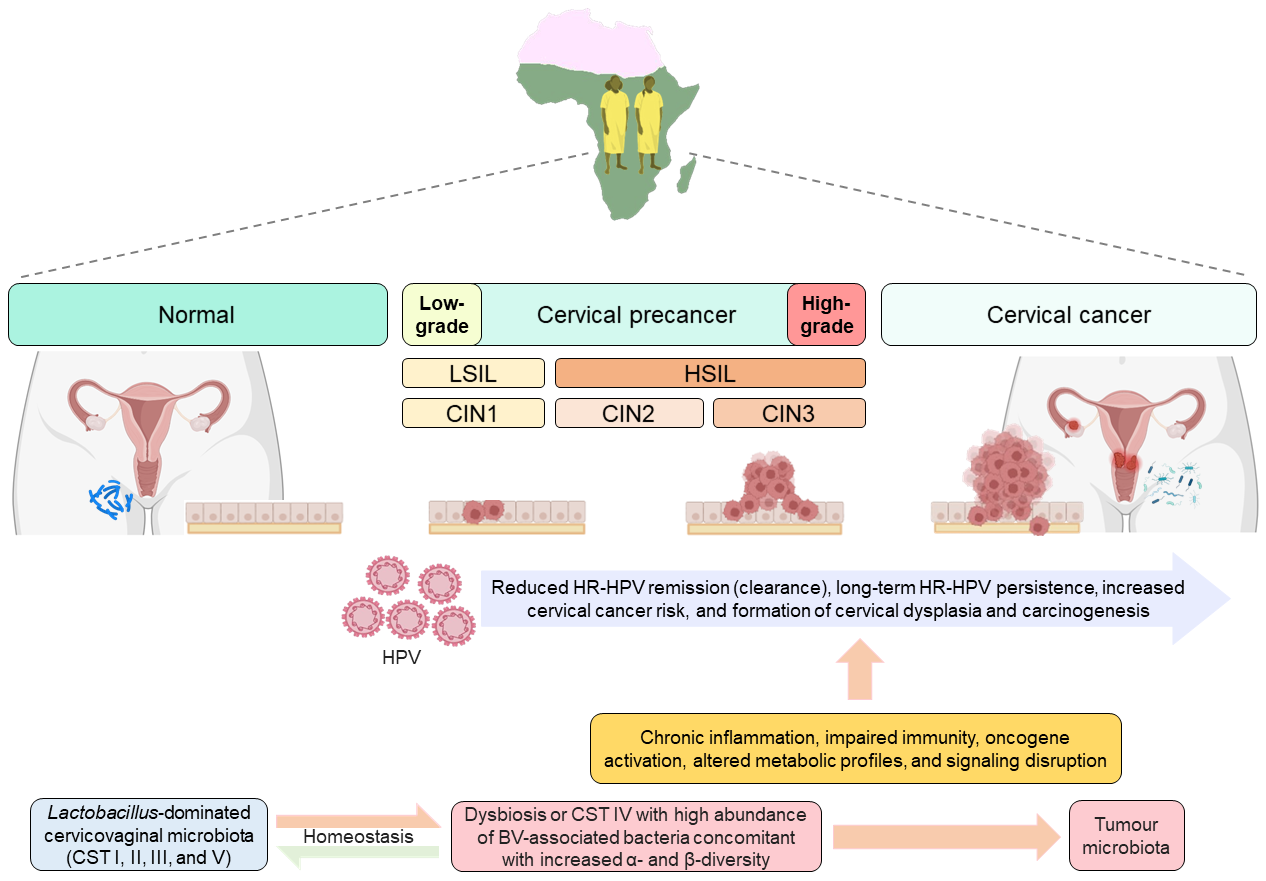
Graphical Abstract