Article

The Experimental Determination of Parameters for the Modeling of the Stamping Process of AA6005C Aluminum Alloy


by
Luiza Emília Vila Nova Mazzoni
1,
Fernanda Mariano Pereira
1,2,*,
Estefani Alves da Silva Calabria
1,
Luca de Paulo Ferreira
3,
Alfredo Rocha de Faria
1,
Tamires de Souza Nossa
3 and
Kahl Dick Zilnyk
1
1
Center for Manufacturing Competence (CCM), Technological Institute of Aeronautics—ITA, São José dos Campos 12228-900, SP, Brazil
2
Department of Materials Engineering (DEMA), State University of Ponta Grossa (UEPG), Ponta Grossa 84030-900, PR, Brazil
3
Laboratory of Materials (LabMat), Federal Institute of Education, Science and Technology of São Paulo (IFSP), Itapetininga 18202-000, SP, Brazil
*
Author to whom correspondence should be addressed.
Submission received: 25 October 2025 / Revised: 11 January 2026 / Accepted: 13 February 2026 / Published: 15 February 2026

Abstract

This study provides the first complete and experimentally validated Yoshida–Uemori (Y–U) parameter set for AA6005C aluminum alloy, enabling accurate constitutive modeling for stamping simulations. A comprehensive set of mechanical tests was conducted, comprising uniaxial tensile tests along 0°, 45°, and 90° to the rolling direction, hydraulic bulge tests, Nakajima tests for the forming limit curve (FLC), and cyclic tension-compression experiments. Results showed moderate planar anisotropy with R-values of 0.49–0.90, equi-biaxial yield stress around 105 MPa, and plane-strain FLC0 ≈ 0.25, typical for 6xxx-series alloys. The cyclic tests highlighted a strong Bauschinger effect and transient softening, which allowed precise calibration of the Yoshida-Uemori (Y-U) model. The resulting material parameters were validated using a U-bending case study, in which the predicted springback angle differed by only 2°, confirming the transferability of the calibrated model to forming conditions not used during parameter identification. The dataset generated in this work provides a robust foundation for finite element simulations of the AA6005C stamping processes and constitutes a practical reference for industrial implementation.

1. Introduction

Aluminum alloys have become increasingly important in lightweight structural applications due to their favorable balance of strength, ductility, corrosion resistance, and processing cost. In the automotive sector, 6xxx-series alloys are widely employed for exterior panels and structural components because the Mg–Si precipitation system enables good formability in the soft state and increased strength after paint-bake or age-hardening treatments. Among these alloys, AA6005C has gained attention as a promising candidate for stamped components requiring dimensional precision and high surface quality. However, the accurate numerical simulation of forming and springback depends critically on experimentally determined material parameters that capture both anisotropic yielding and reverse-loading behavior [1,2,3].
Accurate prediction of springback in finite element simulations requires constitutive models capable of reproducing transient phenomena that occur during load reversal, such as the Bauschinger effect, permanent softening, and directional variations in hardening. Classical isotropic or simple kinematic hardening laws are insufficient in this regard. More sophisticated models—particularly two-surface formulations such as the Yoshida–Uemori model—have been shown to reproduce these effects with practical computational cost. Because the predictive performance of such models depends strongly on the quality of the experimental data used for calibration, a complete and validated dataset for AA6005C is essential for industrial implementation [4,5,6].
Previous studies on 6xxx automotive sheets, such as AA6016 and AA6022, report yield strengths typically between 50 and 120 MPa and total elongations of 20–30%, with average normal anisotropy R ≈ 0.6–0.8 and plane-strain forming limits FLC0 in the range 0.20–0.30 [2]. These values serve as reference benchmarks for assessing the performance of AA6005C in the present work.
The Yoshida–Uemori (Y–U) model is a two-surface plasticity model that combines isotropic and kinematic hardening to accurately capture the Bauschinger effect, permanent softening, and work-hardening stagnation observed during cyclic loading and unloading. Unlike classical isotropic or simple kinematic models, the Y–U formulation describes the evolution of a yield surface that moves kinematically within a bounding surface governed by combined hardening. This enables the model to reproduce early re-yielding upon load reversal, transient stress offset, and the characteristic “plateau” in reverse stress–strain curves—phenomena critical to springback accuracy [7,8,9]. The model incorporates evolution equations for both the yield surface and the bounding surface, along with material parameters ( Y , B , C , R s a t , b , m , and optionally h) that can be identified from cyclic tension–compression tests [7,8,9,10]. Because the Y-U model captures these complex behaviors with a manageable parameter set, it has been implemented in major commercial FE codes (LS-DYNA, Ansys Lagrange, Canonsburg, PA, USA; PamStamp, ESI Group, Paris, France; AutoForm, AutoForm Engineering GmbH, Zurich, Switzerland) and is increasingly used in the automotive industry to reduce trial-and-error iterations in tool design [8,9,10,11]. Recent extensions of the model incorporate anisotropic hardening evolution, further enhancing predictive capability for aluminum alloys [9,10,12].
This work therefore provides, for the first time, a complete experimental parameter set for AA6005C aluminum sheet, including Yoshida–Uemori hardening parameters identified from cyclic tension–compression tests, which can be directly implemented in commercial FE software such as InspireForm (Altair HyperWorks 2024, Altair Engineering Inc., Troy, MI, USA) for stamping simulations. The test program comprises uniaxial tensile experiments at 0°, 45°, and 90°, hydraulic bulge tests, the Nakajima test to determine the FLC, and cyclic tension–compression tests, resulting in a unified dataset for characterizing anisotropy, biaxial flow, and reverse-loading response. The U-bending test is employed as an independent validation method to evaluate the accuracy of the dataset in predicting material behavior during forming processes within a commercial FE software [4,6].

2. Materials and Methods

2.1. Material and Sample Preparation

The material investigated was the aluminum alloy AA6005C-O, supplied by Novelis Aluminum Co. (Atlanta, GA, USA), in the form of a cold-rolled sheet with a nominal thickness of 0.91 mm. Blanks and test specimens were produced by waterjet cutting using OMAX waterjet system (OMAX Corporation, Kent, WA, USA). The sheets were produced by the supplier through a conventional hot-rolling plus cold-rolling route for automotive body applications and delivered as a coil with a final gauge of 0.91 mm in the O temper. The detailed rolling schedule (including the initial thickness and reduction per pass) is proprietary and was not disclosed; therefore, anisotropy is characterized here based on the measured Lankford coefficients and forming limit behavior rather than on processing parameters. The chemical composition is summarized in Table 1, highlighting Si, Mg, and Fe as the principal alloying elements.
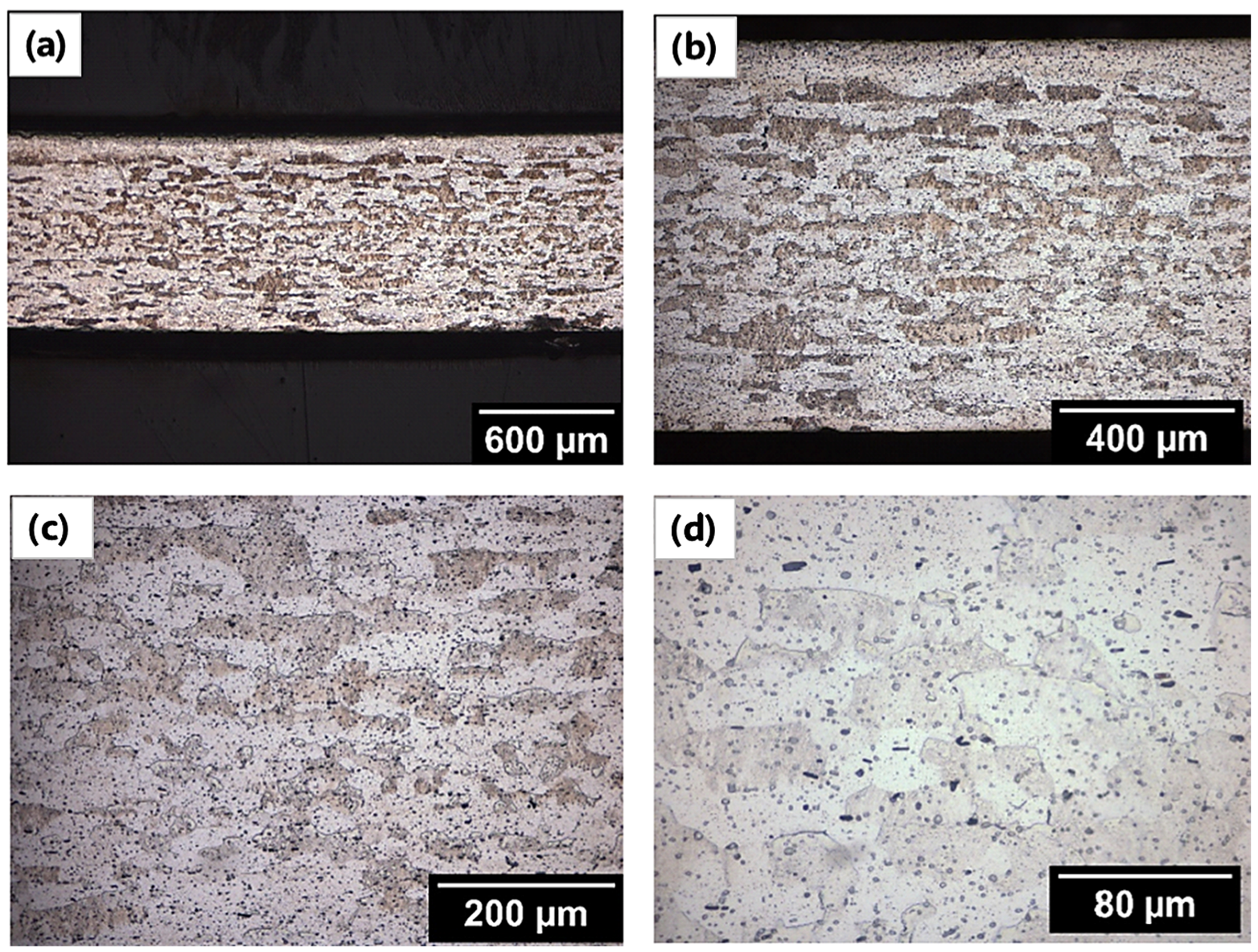
In addition to the mechanical characterization, the microstructure of the as-received AA6005C-O sheet was examined by optical metallography. Rectangular coupons were sectioned from the mid-thickness in the rolling–transverse (RD–TD) plane and mounted in conductive resin. The samples were successively ground with SiC abrasive papers up to 2000 grit and polished with a 1 µm diamond suspension to obtain a mirror-like surface. To reveal the grain structure and second-phase particles, the specimens were etched with Keller’s reagent (2.5 mL HNO3, 1.5 mL HCl, 1 mL HF, and 95 mL distilled water) for a few seconds and then rinsed in water and ethanol. Optical micrographs were acquired at magnifications between 50× and 500× using a light microscope in bright-field mode.
The AA6005C sheets were supplied by the industrial partner in the fully annealed O temper. Although the W temper is more frequently used in automotive production lines, the present characterization of the O condition is scientifically relevant, useful for process modeling, and provides a consistent baseline for comparison with other 6xxx automotive alloys.

2.2. Tensile Testing

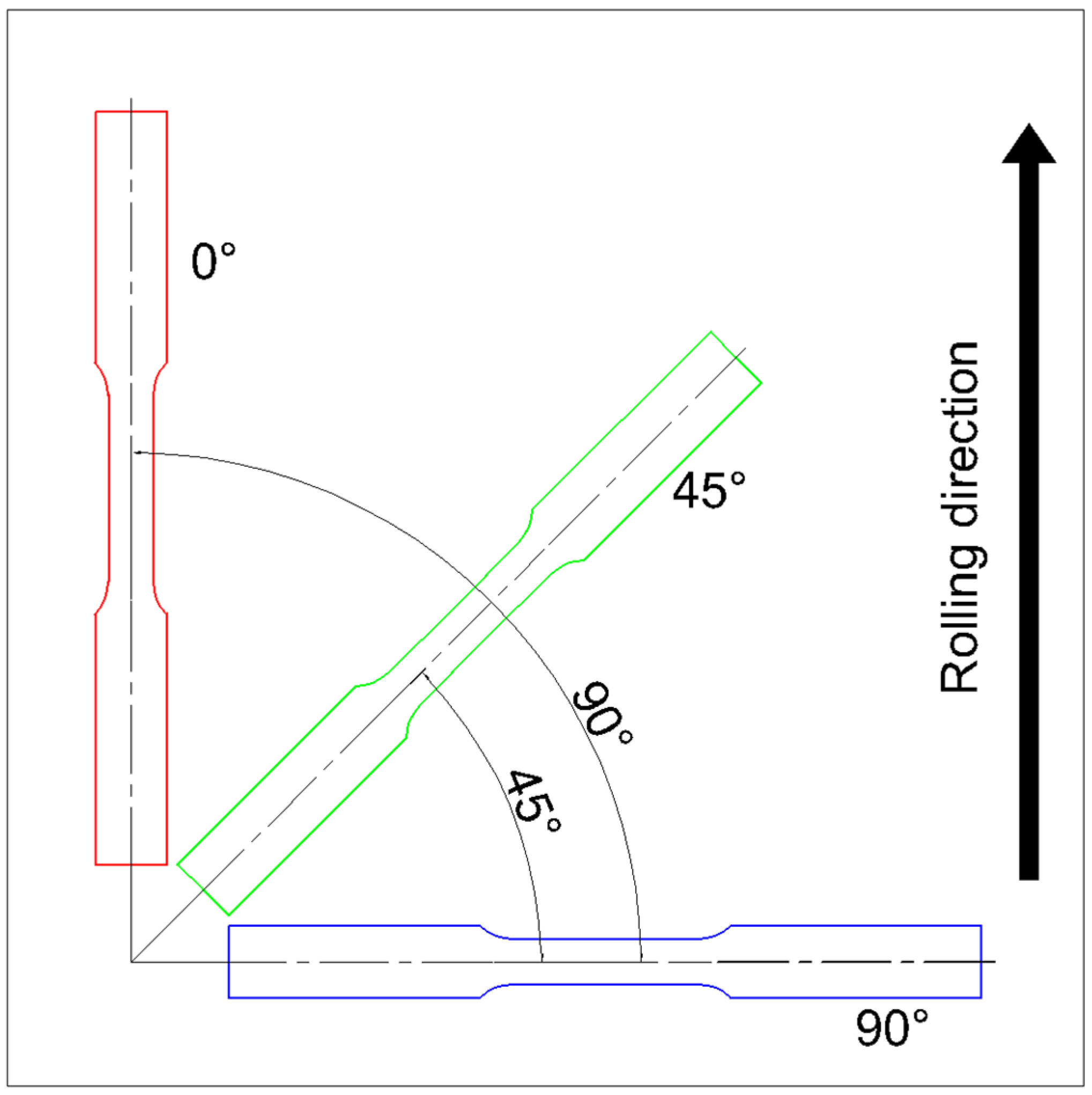
Uniaxial tensile tests were performed at 0°, 45°, and 90° with respect to the rolling direction (Figure 1) using a 100 kN universal test frame (MTS Systems Corporation, Eden Prairie, MN, USA). The specimens were flat dog-bone samples with an overall length of approximately 172 mm (6.75 inches) and a gauge length of 50 mm, prepared according to the ASTM E8 standard [13]. Three samples were prepared for each rolling direction.
A random black-on-white speckle pattern was applied to the specimen surface to serve as an optical reference for strain gradient measurements using Digital Image Correlation (DIC) techniques. During testing, the specimen was clamped in the mechanical grips while a pair of cameras positioned behind the test frame captured the full-field deformation evolution. The DIC and MTS control systems were synchronized through independent computers.
The tests were conducted under displacement control at a crosshead speed of 1.27 mm/min. The true stress–strain data obtained were analyzed to determine the yield strength (σy), ultimate tensile strength (UTS), uniform and total elongation, strain-hardening exponent (n), strength coefficient (K), and Lankford anisotropy coefficients (R–values) for the 0°, 45°, and 90° directions.

2.3. Hydraulic Bulge Testing

The hydraulic bulge test was conducted to characterize the biaxial flow behavior of AA6005C under near equi-biaxial tension and to obtain the corresponding true stress–strain curve for anisotropic plasticity calibration. Circular blanks with a diameter of 165 mm were cut from the as-received sheet by waterjet cutting.
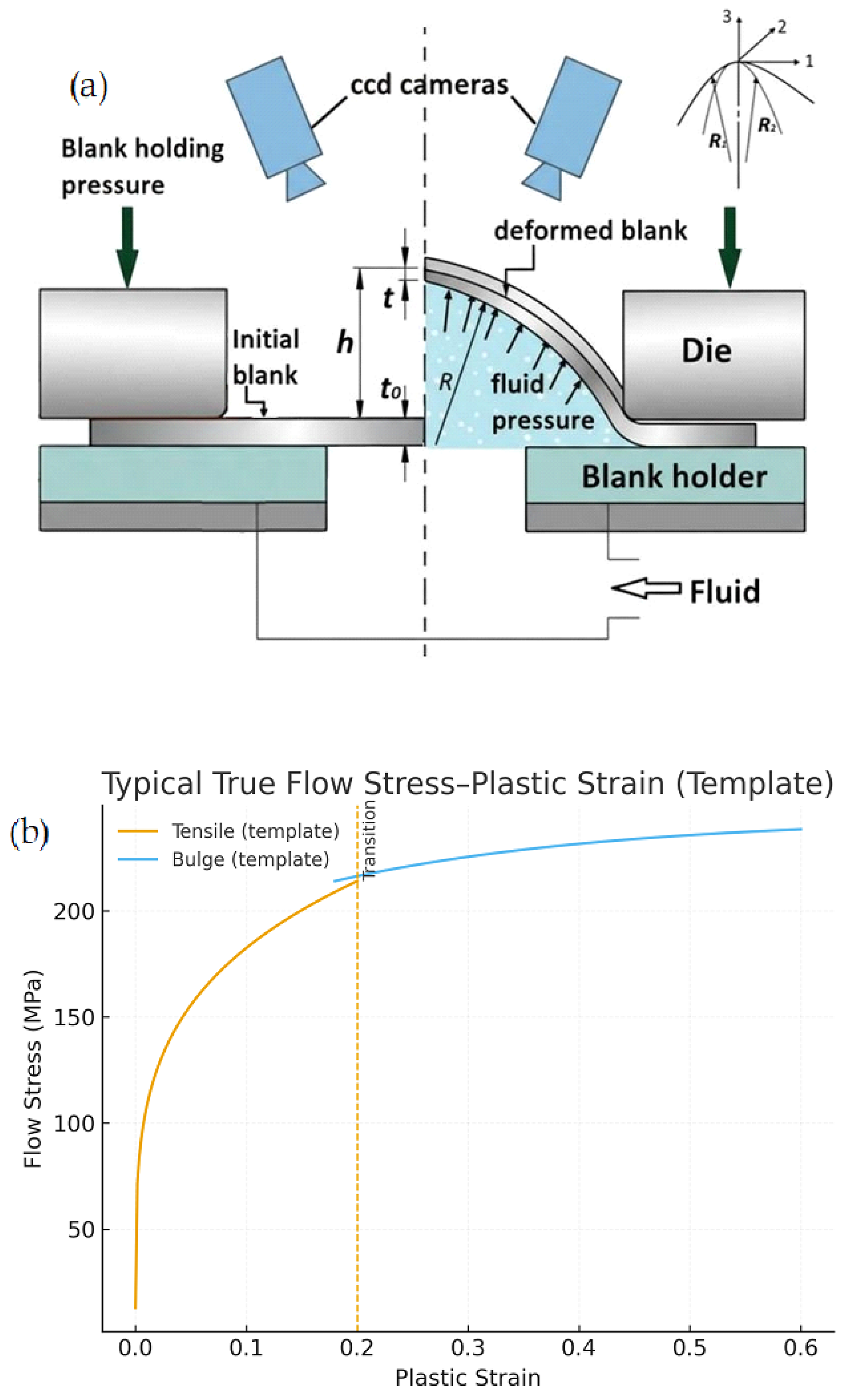
Testing was performed on a Universal Sheet Metal Testing Machine (Model 145-60, Erichsen GmbH, Hemer, Germany) using hydraulic oil as the pressure medium. The blank was clamped with a blank holder force of 250 kN to suppress flange draw in. The punch advanced at 1.0 mm/s until specimen fracture. Machine transducers recorded pressure and displacement, and a two-camera DIC system continuously measured full-field strains on the dome surface, with emphasis on the pole region. The hydraulic bulge setup and a representative equi-biaxial stress–strain curve are shown in Figure 2a,b.
Data reduction followed standard bulge relations. The true biaxial membrane stress at the pole was computed from the measured pressure p , dome radius R , and current thickness t using
σβpR/2t
for equi-biaxial loading. Major and minor true strains ( ε 1 and ε 2 ) were obtained from DIC, and the thickness strain was derived from plastic incompressibility as ε t   =   ( ε 1 + ε 2 ) . These quantities were used to construct the equi-biaxial true stress–true strain curve and to compare biaxial flow with the uniaxial response [14]. The main test parameters are summarized in Table 2.
Thickness at the pole was obtained directly from DIC major-strain and minor-strain fields using the plastic incompressibility relation t = t 0 e x p ( ε 1 ε 2 ) . This estimation was validated against post-fracture thickness measurements, with discrepancies below 3%. To ensure accuracy during cyclic compression, the friction of the anti-buckling fixture was quantified through a dead-load calibration, resulting in a correction factor of 1.8–2.3 MPa depending on load level.

2.4. Forming Limit Curve (FLC) Determination (Nakajima Test)

The formability of AA6005C was quantified by constructing a forming limit curve (FLC) in accordance with ISO 12004-2:2021 using the Nakajima methodology [15]. Blanks were waterjet cut into seven specimen geometries to span strain paths from uniaxial tension to equi-biaxial stretching [14,15]. Tests were performed on a Universal Sheet Metal Testing Machine (Erichsen GmbH, Hemer, Germany) equipped with a 101.6 mm (4 inches) hemispherical punch. Each specimen was clamped with a 400 kN blank holder force; PTFE sheets and grease were used as lubricants to minimize friction. The punch advanced at a constant speed of 1.5 mm/s until the sample fracture.
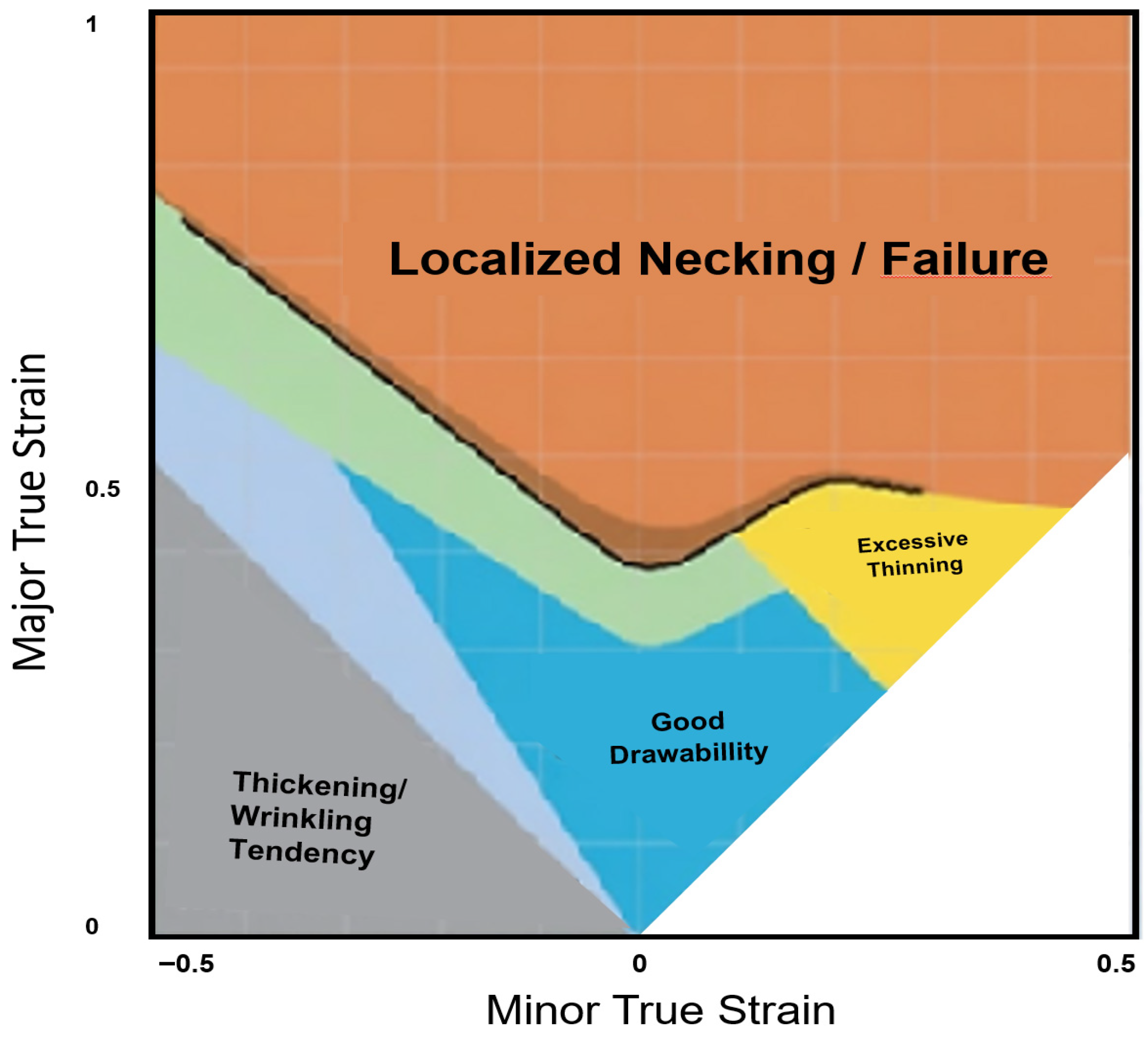
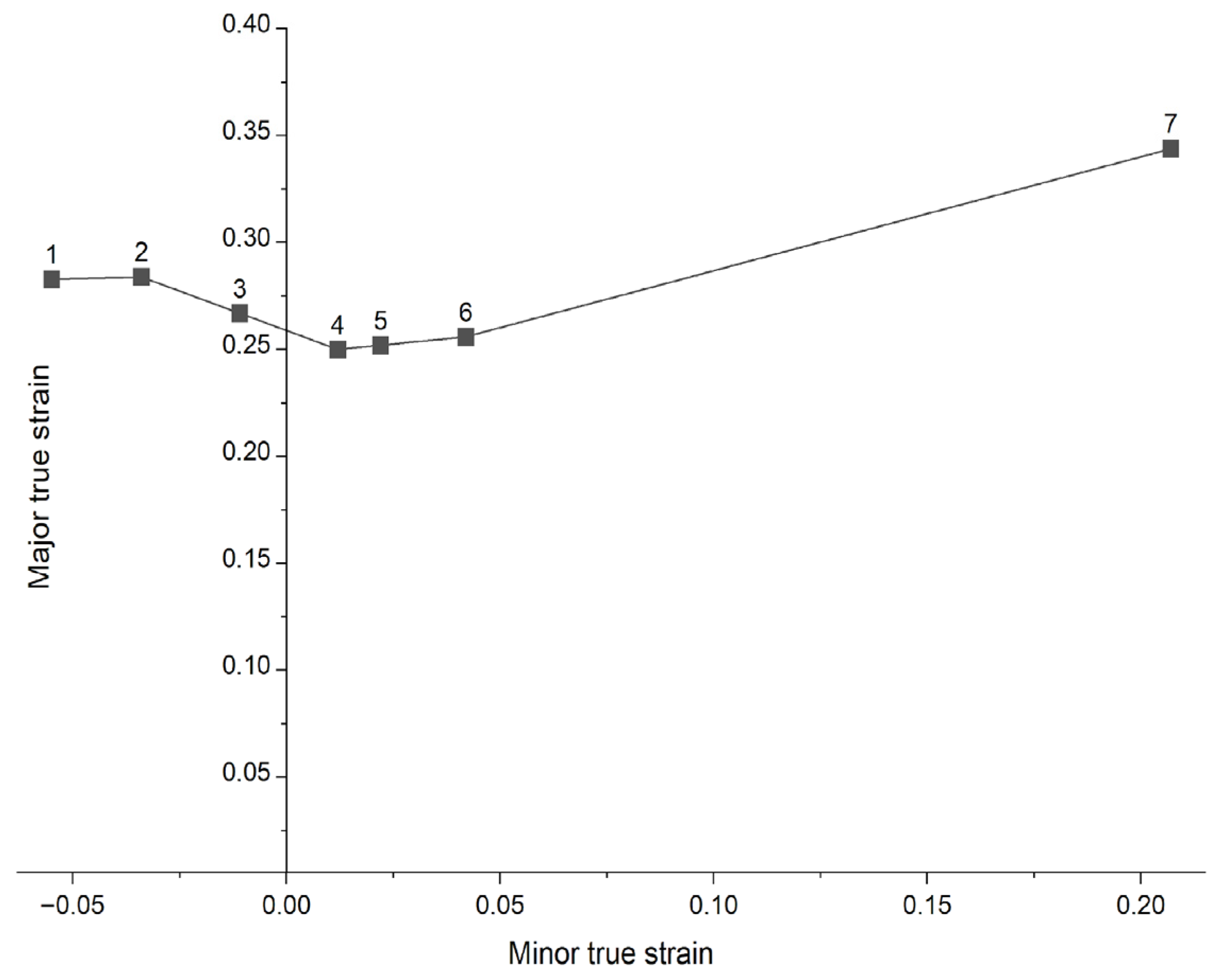
A DIC system recorded full-field strains throughout the test. The evolution of the major (ε1) and minor (ε2) in-plane strains was tracked over time, and the onset of localized necking—which defines the limit strain point for a given path—was identified with a time-dependent, user-independent procedure based on the Linear Best-Fit (LBF) algorithm. This approach determines the instant of plastic instability objectively from the temporal behavior of the strain rate field, improving repeatability relative to operator-driven criteria. The seven limit points obtained across the tested strain paths were finally plotted in the (ε1, ε2) space to form the complete FLC for AA6005C [14,15,16,17,18]. A schematic forming limit diagram is presented in Figure 3, showing the area of good formability (blue) and some of the main non-conformances, such as wrinkling (gray), excessive thinning or risk of necking (yellow), and fracture by localized necking above the limit curve (orange).

2.5. Cyclic Tension–Compression Testing

Cyclic tension–compression tests were carried out to capture the Bauschinger effect and the transient/permanent softening phenomena required to calibrate the Yoshida–Uemori (Y–U) combined hardening mode. Flat tensile-type specimens with a 25 mm gauge length were waterjet cut along 0°, 45°, and 90° to the rolling direction, with five replicates per direction (15 specimens in total).
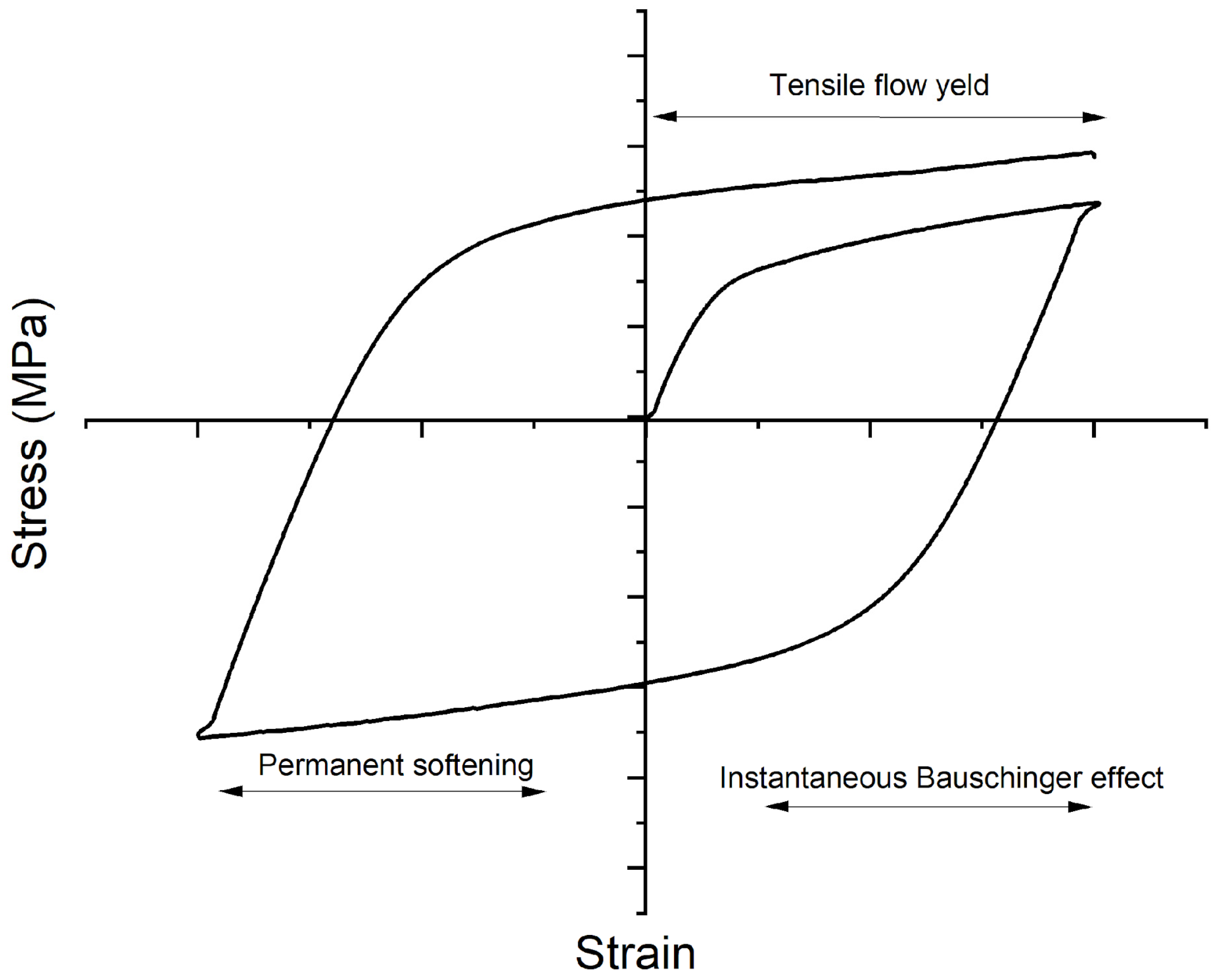
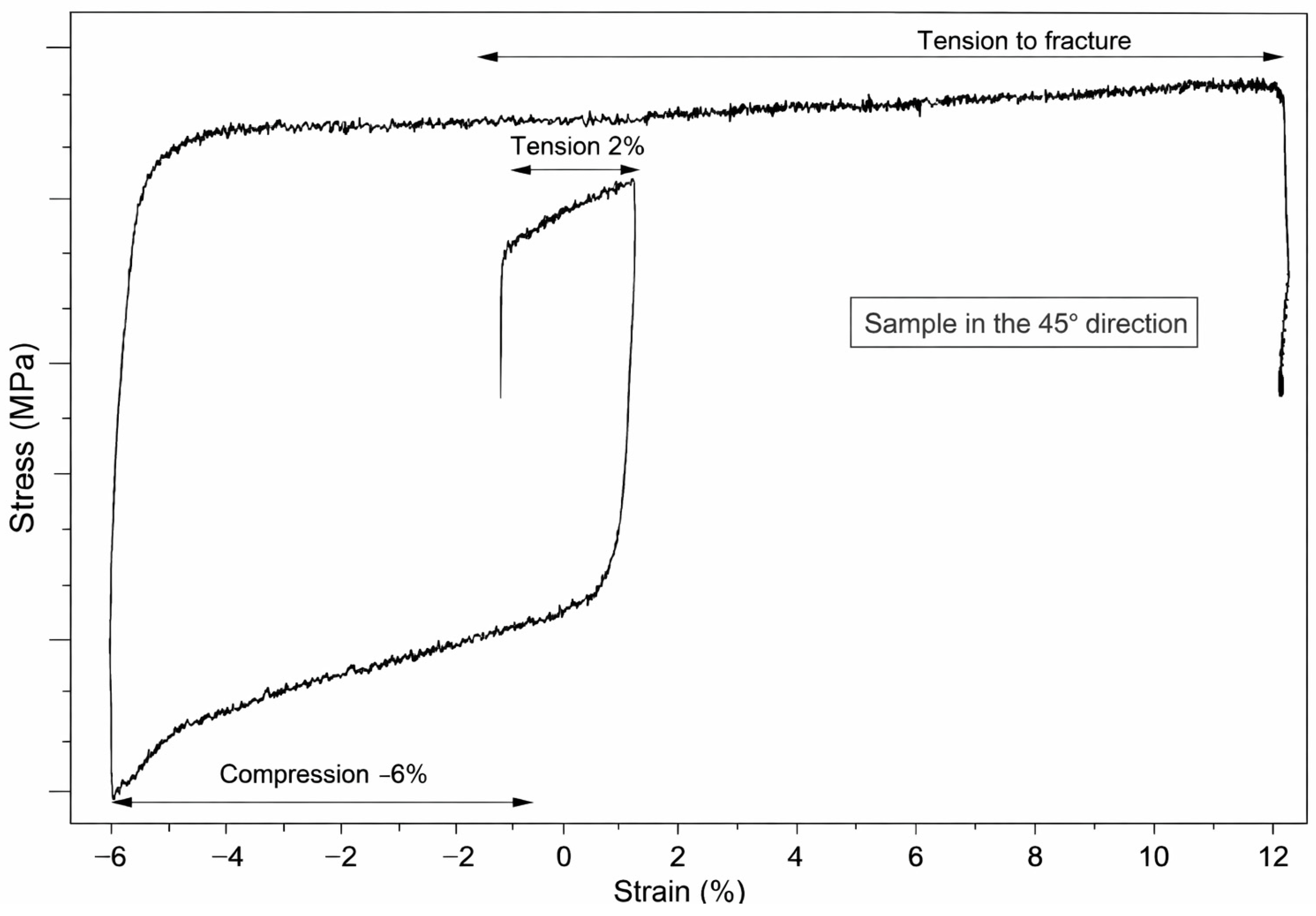
Experiments were performed on a 450 kN servo-hydraulic test frame (Instron, Norwood, MA, USA) equipped with a spring-guided anti-buckling fixture. Specimens were mounted to prevent out-of-plane buckling, and all sliding interfaces were lubricated. Axial force was recorded by the machine load cell, and a clip-on extensometer measured axial strain within the gauge. The loading segments are schematized in Figure 4; a representative loop is shown in Figure 5.
Each test followed three displacement-controlled segments:
(i)
tension up to ~0.02 engineering strain.
(ii)
load reversal to compression up to ~0.06 engineering strain.
(iii)
a final tension segment to fracture.
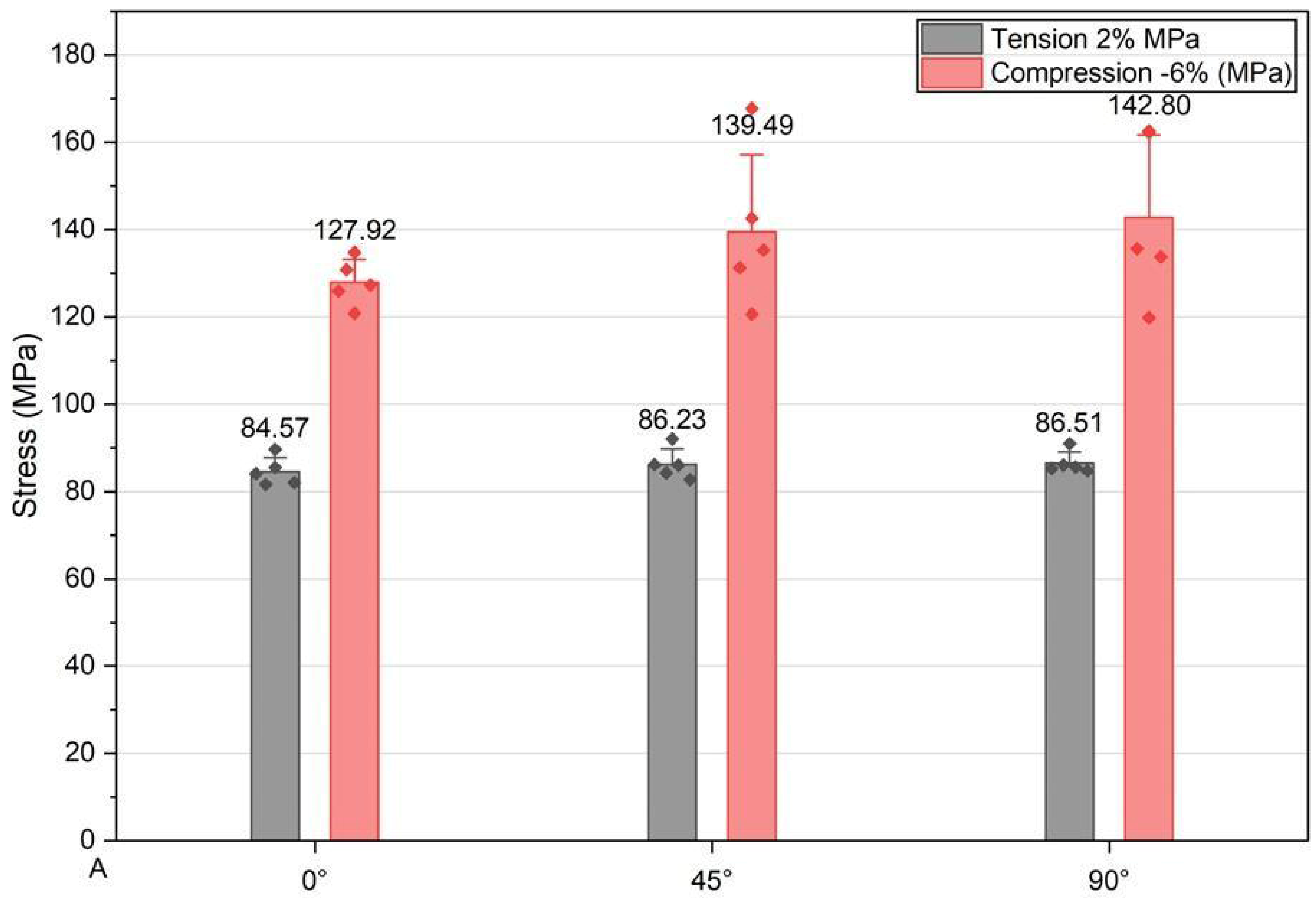
Post-processing converted signals to true stress–strain. The residual friction of the fixture in compression was compensated for using the monotonic tensile response as a reference. From each hysteresis loop, we extracted tension stress at 2%, compression stress at 6%, and fracture stress and strain; together with the full loop, these data were used to identify the Y-U model parameters [8,9,10,14].
The Yoshida–Uemori model is formulated as a two-surface plasticity frameworkIn this framework, a 0 represents the saturation value of the internal backstress, defining the maximum kinematic hardening level under cyclic loading, while h is a dimensionless coefficient associated with the non-isotropic hardening component that modulates the intensity of transient softening and the saturated stress under reverse loading [4,5,11].
The Yoshida–Uemori model employs two coupled surfaces—a yield surface that translates in stress space and a bounding surface that expands or contracts according to the accumulated plastic strain. This structure enables the model to reproduce the early re-yielding typically observed after load reversal, as well as the stagnation of work hardening during reverse loading. The evolution equations introduce independent kinematic and isotropic contributions, allowing the model to capture both transient softening and long-range internal stress effects. Because these mechanisms govern the magnitude of springback, especially in aluminum alloys with pronounced Bauschinger response, the Y–U formulation has become a reference approach in industrial forming simulations.
f = 3 2 s α : s α Y 2 = 0
where
  • s = deviatoric stress,
  • α = backstress (center of the yield surface),
  • Y = initial size of the yield surface (constant).
Bounding surface (combined isotropic–kinematic hardening):
F   =   3 2 s β : s β ( B + R ) 2   =   0
where
  • β = center of the bounding surface,
  • B = initial size of the bounding surface,
  • R = isotropic hardening component.
Evolution Equations
Kinematic hardening of the yield surface:
d α   =   2 3 C d p C α a   d p
with:
α   =   α β
a = 2 3 ( B + R Y )
C = material parameter.
Isotropic hardening of bounding surface:
d R   =   m R s a t R d p
where
  • R s a t = saturation value of R ,
  • m = rate parameter.
Kinematic hardening of bounding surface:
d β   =   2 3 m b d p
where
  • b = material parameter.
The model parameters ( Y , B , C , R s a t , b , m ) are identified by fitting the experimental cyclic stress–strain curves using an optimization procedure. The parameter a 0 represents the saturation value of the internal backstress in the Yoshida–Uemori model. It is treated as an independent kinematic hardening constant, directly identified from the cyclic tension–compression curves, rather than being computed from other parameters such as Y , C 1 , or C 2 .
The Y-U model parameters were identified through an optimization procedure that minimizes the difference between the experimental and predicted stress values across the entire cyclic loading path. The goodness-of-fit was quantified using the coefficient of determination (R2), which measures the proportion of variance in the experimental stress data explained by the model.

2.6. U-Bending Validation Test

A specimen with dimensions of 30 mm × 400 mm was prepared with its longitudinal axis aligned along the rolling direction. A lubricant was applied to the punch and die interfaces, and the U-bending tests were conducted using a hydraulic press (Hidraumak, Novo Hamburgo, Brazil). The deformed samples were subsequently digitized with Hexagon’s H3DS scanner (Hexagon AB, Stockholm, Sweden), and the profile angles were directly measured to evaluate springback.
The numerical modeling of the test was carried out in InspireForm (version 2024). The tooling was represented as a rigid body, while the AA6005C-O blank was modeled as a deformable body discretized with quadrilateral shell elements.

3. Results and Discussion

3.1. Uniaxial Tensile Behavior

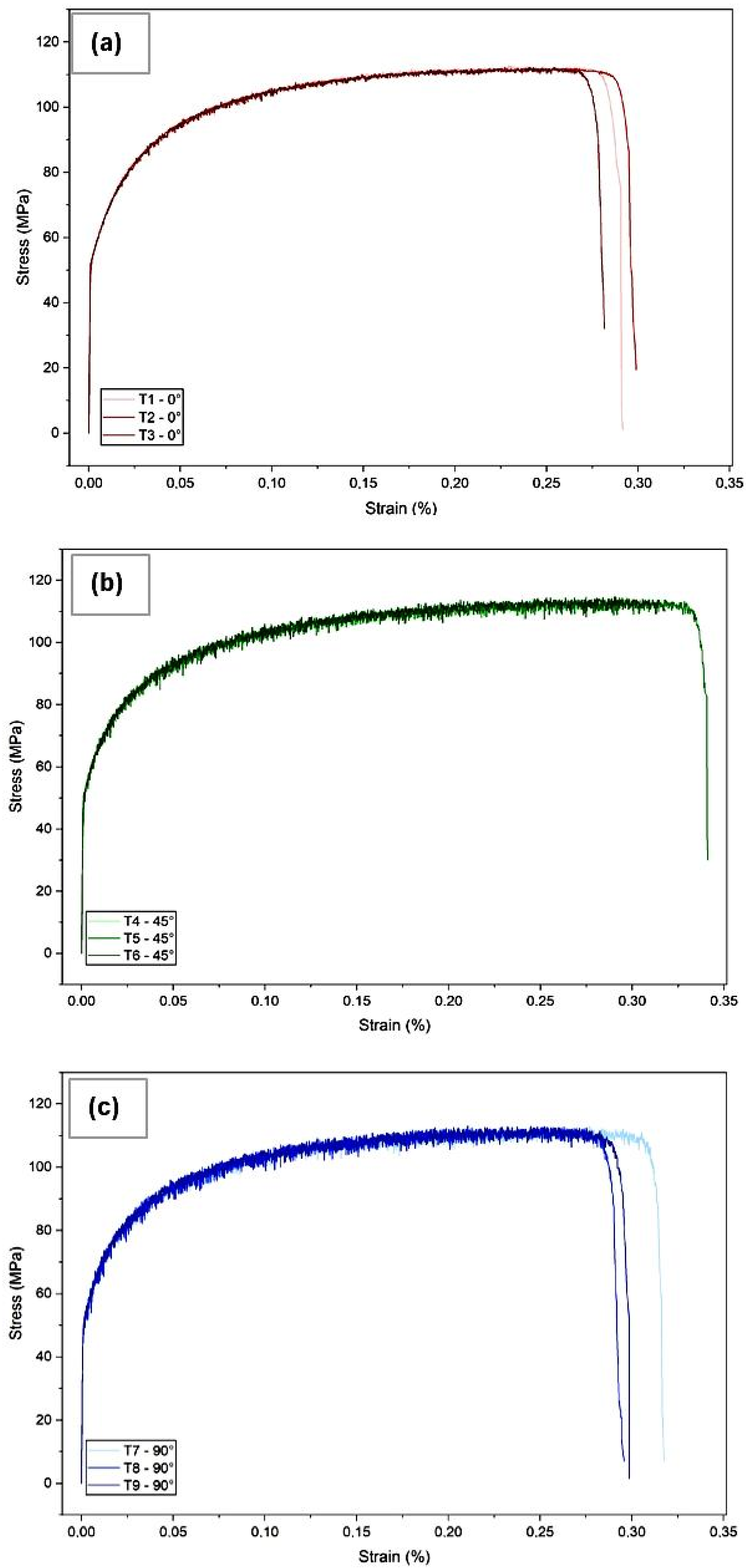
AA6005C exhibited a consistent yield strength of 55–56 MPa and an ultimate tensile strength of approximately 113 MPa. It should be noted that the tests were carried out with the material in the O temper (fully annealed, soft state), which is not commonly used for this alloy (the W, solution heat-treated, naturally aged, temper is more usual). The uniform elongation ranged from 29% to 34%, indicating good ductility. The R-values revealed moderate planar anisotropy (R0 = 0.65, R45 = 0.49, R90 = 0.89), comparable to other 6xxx-series alloys (e.g., AA6016, AA6022) [17,19]. The average strain-hardening exponent “n” is approximately 0.23. The average values for each orientation are summarized in Table 3.
The alloy showed moderate plastic anisotropy, with Lankford coefficients varying from 0.49 at 45° to 0.90 at 90°, and an average normal anisotropy of R = 0.63. An R < 1 indicates a stronger tendency toward thickness reduction rather than in-plane deformation, a key consideration in deep-drawing design to avoid excessive stretching and premature failure. The orientation-dependent engineering stress–strain curves are shown in Figure 6a–c. The directional variation in R-values justifies the use of an advanced anisotropic yield criterion to accurately capture material flow and predict features like earing [2,7]. On the other hand, the hydraulic bulge tests (Section 2.3 and Section 3.2) indicated a nearly isotropic behavior under biaxial stretching, suggesting that anisotropy is less pronounced under stretch-dominated conditions—an advantage for large outer panels such as roofs and hoods [14,20].
Figure 7 provides additional insight into the as-received microstructure of AA6005C-O. At the optical scale, the sheet exhibits a predominantly recrystallized matrix with grains that are nearly equiaxed in the RD–TD plane and only weak morphological elongation, together with a sparse population of coarse intermetallic particles. This morphology is consistent with the moderate planar anisotropy quantified by the R-values (R0 = 0.65, R45 = 0.49, R90 = 0.89) and with the almost isotropic response under equi-biaxial stretching observed in the hydraulic bulge test. In recrystallized 6xxx-series automotive alloys, such behavior is often linked to crystallographic texture effects (e.g., the presence of cube-type components) superimposed on a recrystallized grain structure, which can promote orientation-dependent plastic flow while preserving good overall formability under biaxial loading [1,19,20,21]
The measured yield strength (55–56 MPa), ultimate tensile strength (113 MPa), and total elongation (30–34%) reflect the fully annealed O temper of the present AA6005C sheet, resulting in lower strength but higher ductility than the 6xxx alloys in the T4 temper (e.g., 6016-T4 and 6116-T4) reported in the literature. Nevertheless, the average normal anisotropy R ≈ 0.63 and the plane-strain forming limit FLC0 ≈ 0.25 lie within the typical ranges documented for automotive 6xxx-series sheets in stamping conditions, confirming that the investigated AA6005C-O batch is representative of commercial forming-grade material.

3.2. Biaxial Behavior from Hydraulic Bulge Testing

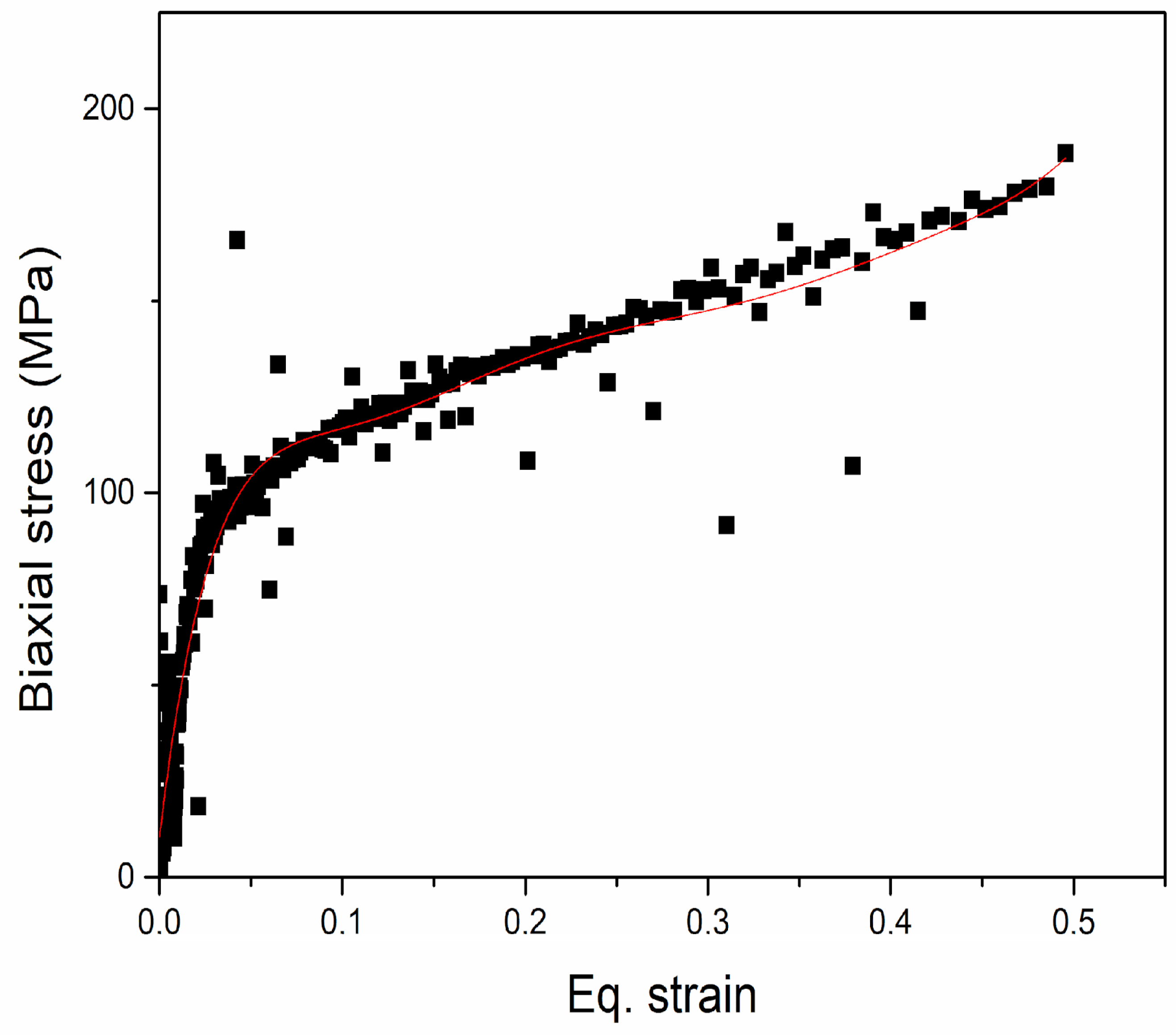
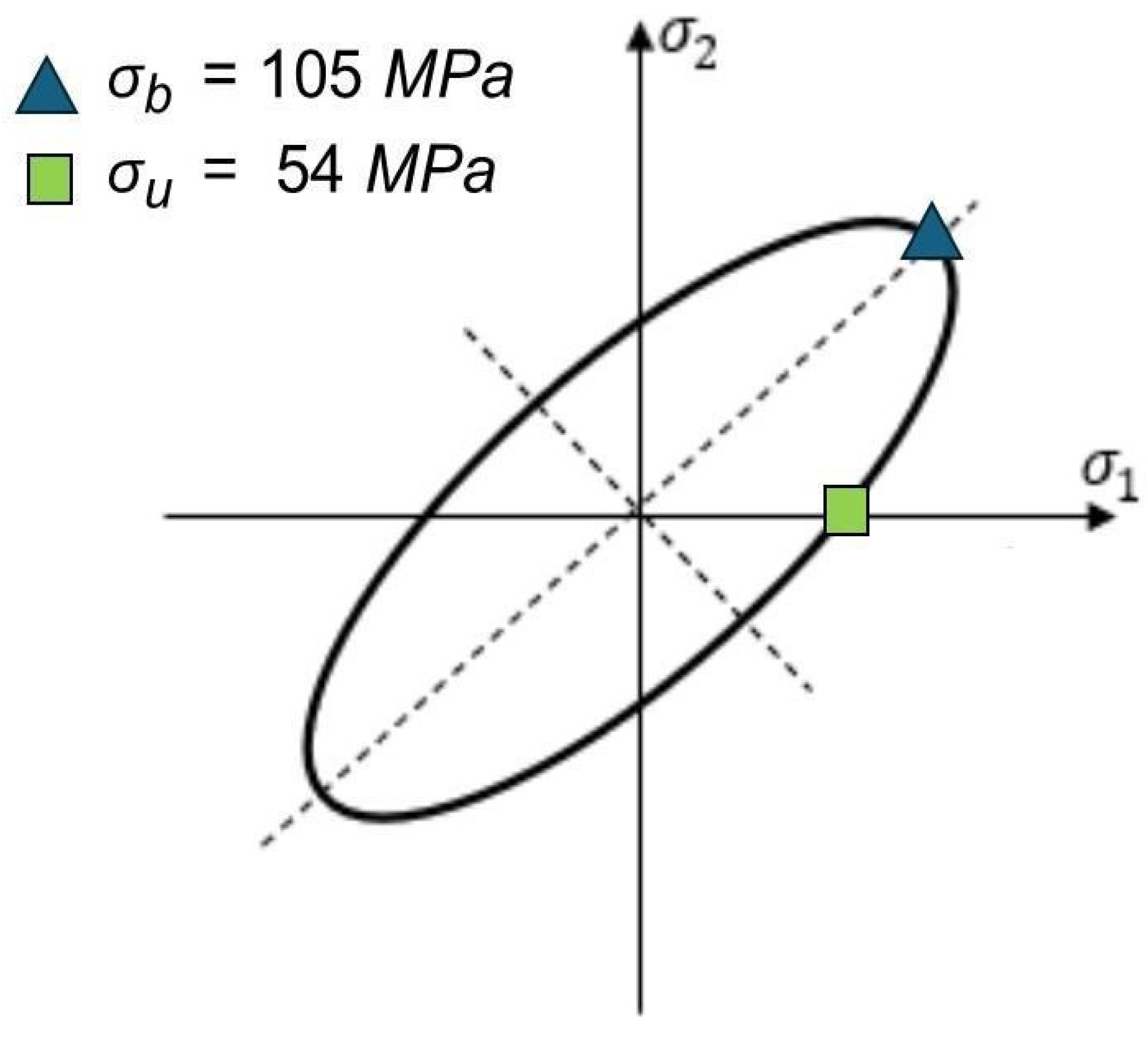
The hydraulic bulge test revealed a biaxial yield stress of 105 MPa, a value notably higher than the 54 MPa observed in the uniaxial tensile test. The experimental equi-biaxial curve is presented in Figure 8. This difference arises from the shape of the material’s yield surface, as an equi-biaxial stress state requires higher stress components to initiate plastic flow. In addition, the biaxial test achieved a total elongation exceeding 50% (key biaxial parameters are listed in Table 4), compared with 30–35% in the uniaxial test, since the biaxial stress state suppresses localized necking and promotes more uniform deformation [22,23,24].
The stress ratio (TD/RD) of approximately 1.12 during the test confirmed an almost isotropic behavior under stretching, which is advantageous for forming large panels. The combination of uniaxial and biaxial yield points is therefore essential for the accurate calibration of the anisotropic yield criterion, ensuring the reliability of the constitutive model [7]. A representative yield surface illustrating the uniaxial and biaxial points is shown in Figure 9.
The apparent contrast between the directional behavior observed in uniaxial testing and the near-isotropic response measured in the hydraulic bulge test is commonly reported for recrystallized 6xxx-series sheets [14,21]. In such materials, crystallographic texture can promote moderate planar anisotropy in uniaxial tension, reflected in the measured R-values, while the response under equi-biaxial stretching remains closer to isotropic, leading to biaxial anisotropy coefficients near unity. This behavior is characteristic of texture-driven rather than morphology-driven anisotropy, and the consistency between the uniaxial and biaxial results reinforces the validity of the adopted anisotropic yield description [21].

3.3. Nakajima Test—Forming Limit Curve (FLC) Determination

The forming limit diagram (FLD) provided quantitative insight into the safe process window for stamping this alloy. The plane-strain forming limit (FLC0) of approximately 0.25 is consistent with values reported for other 6xxx-series alloys in similar temper conditions (T4/O) [18]. This value serves as a critical parameter for simulation engineers, defining the maximum stretch the sheet can withstand in critical regions—such as over die or punch radii—before the onset of localized necking. The experimental determination of this limit, together with a robust data-analysis method such as LBF, provides high confidence in applying this failure criterion within simulations. The experimental data distribution across strain paths is shown in Figure 10.
The forming limit curve obtained experimentally is consistent with previously reported forming limit data for 6xxx-series aluminum alloys derived from Nakajima testing, without the need for additional empirical fitting. This reinforces the validity of using experimental stress–strain data from tensile tests as input for characterizing formability limits in aluminum alloys. The onset of localized necking was identified using the Linear Best-Fit (LBF) method, with a 5-frame window and 2nd-derivative filtering consistent with ISO 12004-2:2021 [14]. The resulting plane-strain limit of approximately ε1 ≈ 0.25 is within the expected range for 6xxx aluminum alloys and confirms the internal consistency between the measured stress–strain curves and the forming limit behavior.

3.4. Cyclic Plasticity and Yoshida–Uemori Model Calibration

All variables used in the Yoshida–Uemori formulation are defined upon first appearance: σ denotes the Cauchy stress, s the deviatoric stress, α the backstress tensor, R the isotropic hardening variable, and b, B, C, m the material constants governing kinematic and isotropic evolution. All parameters presented in the tables follow SI units.
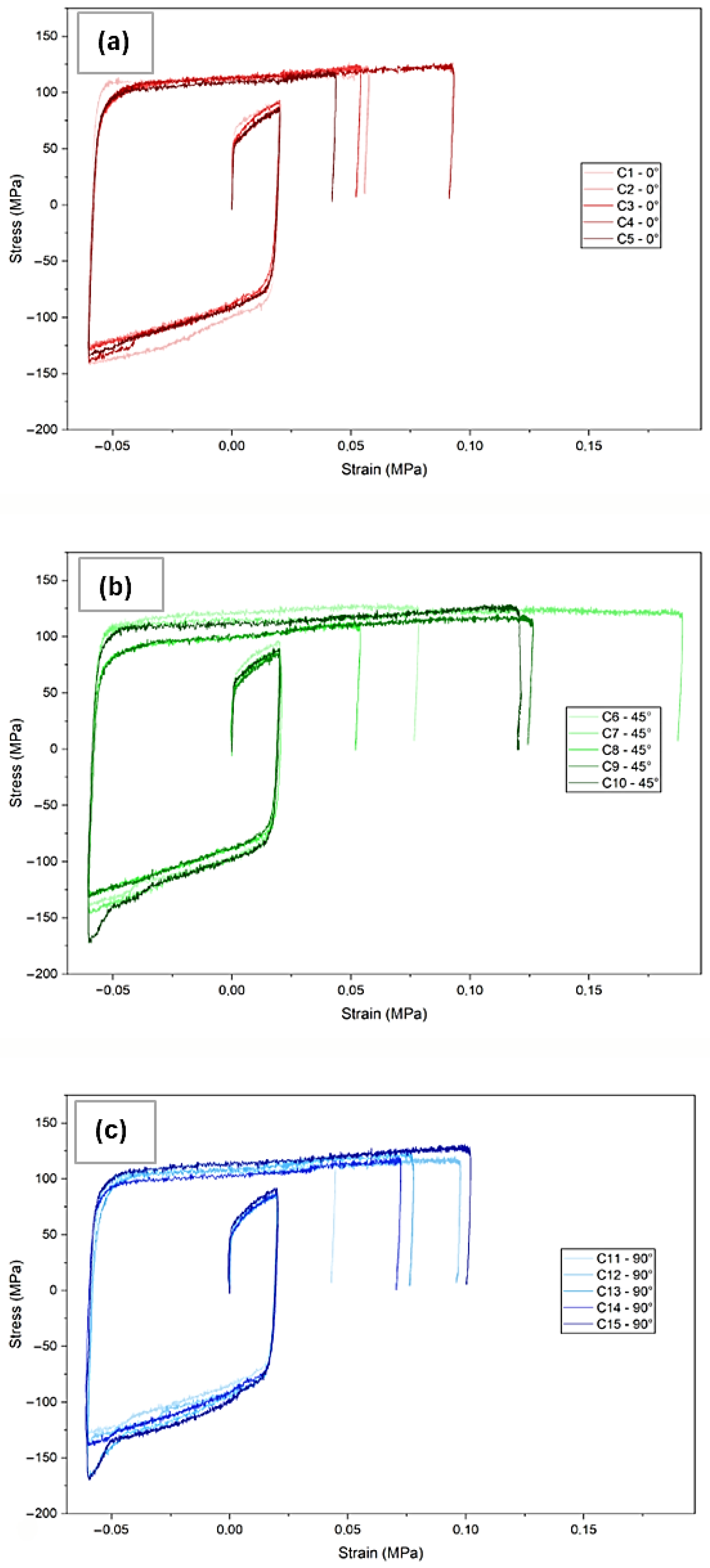
The cyclic tension–compression tests revealed a pronounced Bauschinger effect, accompanied by transient softening and work-hardening stagnation—mechanisms that cannot be captured by isotropic hardening laws and that play a key role in springback prediction. To accurately represent these behaviors, the Yoshida–Uemori (Y–U) model was calibrated using the full set of cyclic stress–strain loops obtained for the three orientations (0°, 45°, and 90°). The model corresponds to the original two-surface formulation proposed by Yoshida and Uemori (2002), where the yield surface translates kinematically and the bounding surface expands isotropically. No anisotropic hardening extensions were used. The identified parameters are listed in Table 5.
A negative value of R s a t was obtained, which is physically consistent within the Y–U framework and required to reproduce the reduction in reverse yield stress associated with transient softening. This sign convention follows the original model and is essential for describing the lower stress level observed during reverse loading relative to monotonic deformation at the same plastic strain.
The adequacy of the calibrated parameters was assessed by qualitative comparison between the model predictions and the experimental hysteresis loops. Representative loops for 0°, 45°, and 90° are shown in Figure 11. The five repeated tests performed for each orientation are presented individually, allowing the natural dispersion of the cyclic response to be visualized directly. The calibrated model successfully reproduces characteristic features of the material behavior, including curvature during strain reversal, the transient softening region, and the re-yielding plateau.
Parameter identification was performed using the cyclic tension–compression data in conjunction with monotonic tensile curves, anisotropy coefficients, and the biaxial yield stress. The resulting parameter set (Table 5) provides a physically consistent and robust description of the cyclic response over the strain range relevant to forming simulations. Representative loops for the three orientations are displayed in Figure 11, and the corresponding extracted stress–strain metrics are summarized in Figure 12.
In particular, the calibrated values of a 0 and h control, respectively, the saturation level of the internal backstress and the non-isotropic contribution to transient softening, ensuring that the Y–U model reproduces both the amplitude and the shape of the reverse-loading response observed in the cyclic tests.

3.5. U-Bending Test and Numerical Validation

The obtained parameters were validated through a U-bending case study. The Barlat89 yield function, combined with Yoshida’s hardening criterion, was adopted to describe the material behavior. The numerical simulation outcomes were subsequently compared against experimental results from an actual forming process.
For the anisotropic plasticity model, the Barlat89 yield criterion was selected because it has been extensively validated for 6xxx-series aluminum alloys and offers a robust balance between predictive accuracy and numerical stability in industrial FE solvers. The model parameters were identified by simultaneously fitting the uniaxial yield stresses, the measured R-values, and the biaxial yield point obtained from the hydraulic bulge test. This multi-objective calibration ensures that the resulting yield locus adequately represents the material response across tension- and stretching-dominated loading paths. The corresponding yield surface is shown in Figure 9, illustrating the consistency between the experimental data and the calibrated anisotropic model [7].
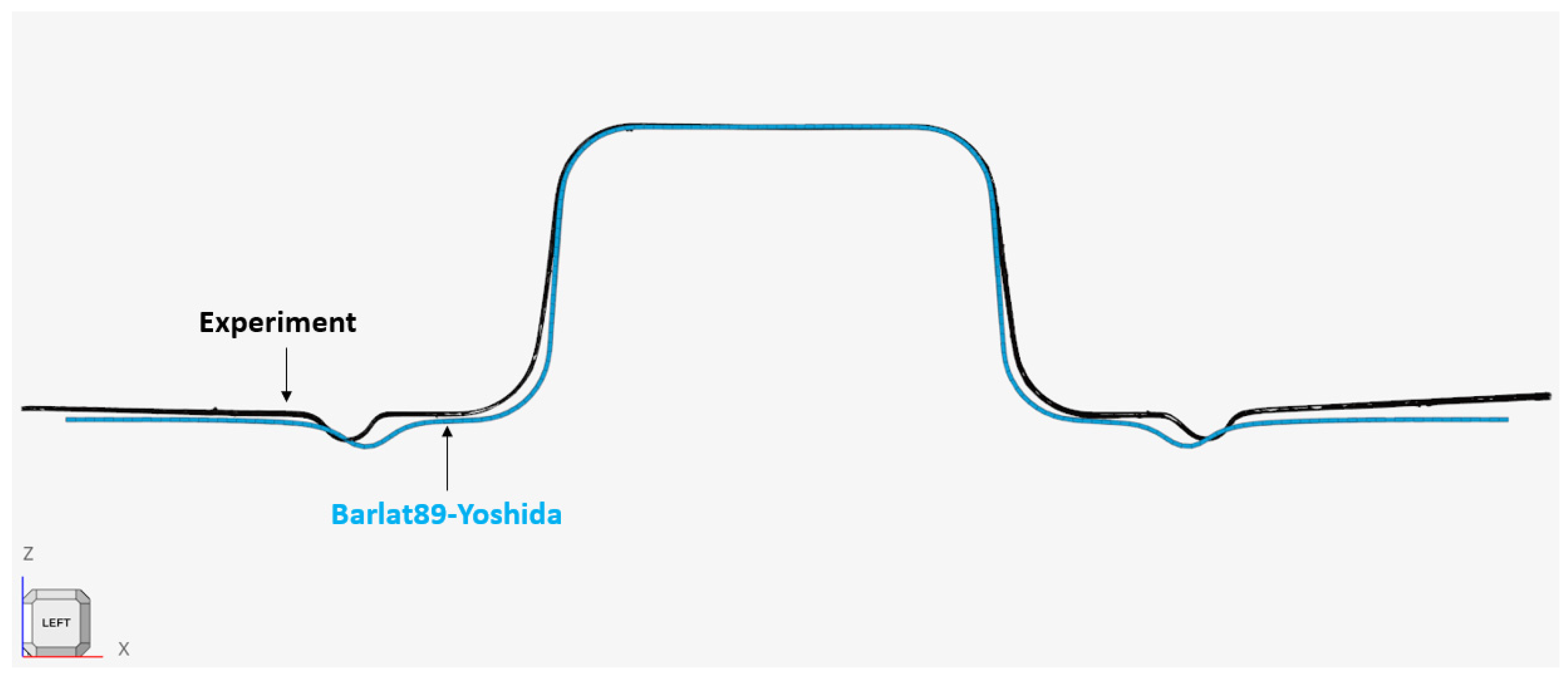
Figure 13 shows that the Barlat89-Yoshida constitutive model aligns closely with the experimental results. The predicted upper opening angle at the punch radius deviates by only 2° from the measured values, indicating satisfactory accuracy in regions governed by simple bending, where springback is the dominant factor influencing the response. Furthermore, the model provides a good representation of the material behavior in the drawbead region. Nevertheless, refinement of the mathematical formulation remains necessary to more accurately capture the hardening characteristics of elements subjected to reverse loading.
To quantify predictive accuracy, the opening angle measured experimentally after unloading was compared with the simulated value obtained using the calibrated Barlat89 + Y–U model. The numerical prediction differed by 2.0°, corresponding to a relative deviation of 5.8%, which is within the typical acceptance envelope for aluminum-sheet springback simulations [25]. This agreement confirms that the identified hardening parameters and anisotropy description are transferable to forming scenarios different from those used for calibration, thereby substantiating the claim that the present dataset is validated and directly applicable to springback-relevant FE modeling [7,10,12].
In summary, this study consolidates a comprehensive and high-fidelity dataset for the AA6005C alloy. The combination of anisotropy parameters, a robust experimental FLC, and crucially, the calibrated parameters for the Yoshida–Uemori hardening model, provides a validated foundation for simulation engineering. The application of this material model in finite element software will enable the automotive industry to design stamping tools and processes with greater predictability, thereby reducing the number of trial iterations and ensuring the dimensional accuracy of components formed with this promising aluminum alloy [12].

4. Conclusions

Experimental characterization revealed that the AA6005C alloy exhibits mechanical properties favorable for stamping applications, with moderate anisotropy. Under equi-biaxial stretching, the material showed a near-isotropic response, with a yield stress of approximately 105 MPa. The alloy’s formability was quantified by the forming limit diagram, which indicated a plane-strain limit (FLC0) of around 0.25, consistent with values reported for other 6xxx-series alloys. Although this study focused on AA6005C in the O-temper condition, which is less commonly used than solution-treated conditions (e.g., W/T4) in industrial forming, the results provide a representative reference for understanding its mechanical response and for calibrating constitutive models under controlled conditions. The combination of optical microstructural observations and mechanical testing indicates that AA6005C-O exhibits a predominantly recrystallized grain morphology at the sheet scale (RD–TD plane), with relatively equiaxed grains. Taken together, this work provides a comprehensive and validated dataset that serves as a robust basis for finite element modeling and reliable simulation of industrial stamping processes for AA6005C panels. The identified material parameters can be implemented in commercial FE codes to improve springback prediction and reduce tool development time in automotive applications.
Although the present work focuses exclusively on cold-stamping conditions, it provides a validated baseline for future investigations into temperature-assisted forming routes. Such processes have been reported to modify frictional and hardening behavior in 6xxx alloys; however, these effects are beyond the scope of the current characterization and are therefore mentioned only as potential directions for subsequent study.

Author Contributions

Conceptualization, K.D.Z., L.E.V.N.M. and F.M.P.; Methodology, L.E.V.N.M. and F.M.P.; Formal Analysis, L.E.V.N.M., F.M.P., A.R.d.F. and K.D.Z.; Investigation, E.A.d.S.C., L.d.P.F. and T.d.S.N.; Resources, K.D.Z. and A.R.d.F.; Data Curation, L.E.V.N.M., F.M.P. and L.d.P.F.; Writing—Original Draft Preparation, F.M.P. and L.E.V.N.M.; Writing—Review and Editing, F.M.P., L.E.V.N.M., A.R.d.F., T.d.S.N. and K.D.Z.; Supervision, K.D.Z.; Project Administration, K.D.Z.; Funding Acquisition, K.D.Z. All authors have read and agreed to the published version of the manuscript.

Funding

This research was funded by the Rota 2030 Project—DESCAAL (Demonstrator of Class-A Surface Stamping in Aluminum) through FUNDEP (27194.02.02/2021.01-00).

Data Availability Statement

The original contributions presented in this study are included in the article. Further inquiries can be directed to the corresponding author.

Acknowledgments

The authors gratefully acknowledge Novelis Co. for supplying the aluminum sheets.

Conflicts of Interest

The authors declare no conflicts of interest. The funders had no role in the design of the study; in the collection, analyses, or interpretation of data; in the writing of the manuscript; or in the decision to publish the results.

References

  1. Totten, G.E.; MacKenzie, D.S. (Eds.) Handbook of Aluminum Alloy Production and Materials; CRC Press: Boca Raton, FL, USA, 2024. [Google Scholar]
  2. Yanaga, D.; Kuwabara, T.; Korkolis, Y.P. Material modeling of 6000 series aluminum alloy sheets with different density cube textures and effect on FEA. Int. J. Solids Struct. 2012, 49, 3488–3495. [Google Scholar] [CrossRef]
  3. Mazzoni, L.E.V.N. Influence of Material Modeling on Simulation Accuracy for Cold Stamped Aluminum Alloy. Master’s Thesis, Instituto Tecnológico de Aeronáutica (ITA), São José dos Campos, Brazil, 2024. [Google Scholar]
  4. Yoshida, F.; Uemori, T. A model of large-strain cyclic plasticity describing the Bauschinger effect and work hardening stagnation. Int. J. Plast. 2002, 18, 661–686. [Google Scholar] [CrossRef]
  5. Yoshida, F.; Uemori, T.; Fujiwara, K. Elastic–plastic behavior of steel sheets under in-plane cyclic tension–compression at large strain. Int. J. Plast. 2002, 18, 633–659. [Google Scholar] [CrossRef]
  6. Du, B.; Guo, Y.; Wang, J.; Ren, H. High strain rate Bauschinger response of 6061-T6 aluminum alloy. Int. J. Plast. 2025, 192, 104422. [Google Scholar] [CrossRef]
  7. Barlat, F.; Brem, J.; Yoon, J.W.; Chung, K.; Dick, R.E.; Lege, D.J.; Pourboghrat, F.; Choi, S.H.; Chu, E. Plane stress yield function for aluminum alloy sheets—Part I: Theory. Int. J. Plast. 2003, 19, 1297–1319. [Google Scholar] [CrossRef]
  8. Lemoine, X.; Durrenberger, L.; Clet, T.; Richard, F. Identification Protocol of Yoshida–Uemori Hardening Model. IOP Conf. Ser. Mater. Sci. Eng. 2022, 1238, 012001. [Google Scholar] [CrossRef]
  9. Banerjee, D.K.; Luecke, W.E.; Iadicola, M.A.; Rust, E. Evaluation of methods for determining the Yoshida–Uemori combined isotropic–kinematic model parameters. Mater. Today Commun. 2022, 33, 104270. [Google Scholar] [CrossRef]
  10. Toros, S. Parameters Determination of Yoshida–Uemori Model Through Optimization Process of Cyclic Tension–Compression Test and V-Bending Springback. Lat. Am. J. Solids Struct. 2016, 13, 1893–1911. [Google Scholar] [CrossRef]
  11. Yoshida, F.; Uemori, T. A model of large-strain cyclic plasticity and its application to springback simulation. Int. J. Mech. Sci. 2003, 45, 1687–1702. [Google Scholar] [CrossRef]
  12. Yoshida, F.; Hamasaki, H.; Uemori, T. Modeling of anisotropic hardening of sheet metals including description of the Bauschinger effect. Int. J. Plast. 2015, 75, 170–188. [Google Scholar] [CrossRef]
  13. ASTM E8/E8M-24; Standard Test Methods for Tension Testing of Metallic Materials. ASTM International: West Conshohocken, PA, USA, 2024.
  14. EWI—Engineering & Welding Institute. Final Report No. 22644CSQ—Experimental Characterization of AA6005C for Cold Stamping; EWI: Columbus, OH, USA, 2023. [Google Scholar]
  15. ISO 12004-2:2021; Metallic Materials—Determination of Forming-Limit Curves for Sheet and Strip—Part 2: Determination of Forming-Limit Curves in the Laboratory. ISO: Geneva, Switzerland, 2021.
  16. Volk, W.; Hora, P. New algorithm for a robust user-independent evaluation of beginning instability for the experimental FLC determination. Int. J. Mater. Form. 2011, 4, 339–346. [Google Scholar] [CrossRef]
  17. Zhang, F.; He, K.; Li, Z.; Huang, B. Strain-Rate Effect on Anisotropic Deformation of High-Strength Aluminum Alloy Sheet. Metals 2022, 12, 1430. [Google Scholar] [CrossRef]
  18. Sun, L.; Cai, Z.; He, D.; Li, L. Aluminum Alloy Sheet–Forming Limit Curve Prediction Based on Original Measured Stress–Strain Data. Metals 2019, 9, 1129. [Google Scholar] [CrossRef]
  19. Mrówka-Nowotnik, G.; Sieniawski, J. Influence of Heat Treatment on the Microstructure and Mechanical Properties of 6005 and 6082 Aluminium Alloys. J. Mater. Process. Technol. 2005, 162–163, 367–372. [Google Scholar] [CrossRef]
  20. Kuwabara, T.; Barlat, F. Deformation Behavior of Aluminum Alloys under Various Stress States: Material Modeling and Testing. Mater. Trans. 2024, 65, 1193–1217. [Google Scholar] [CrossRef]
  21. Zhang, Q.; Xu, X.; Wang, Y. Effect of Mg/Si Ratio on the Bendability and Anisotropic Bend Behavior of Extruded 6000-Series Al Alloy. Materials 2023, 16, 3599. [Google Scholar] [CrossRef] [PubMed]
  22. Iizuka, Y.; Kuwabara, T.; Hayamizu, H. Prediction Method of Hole Expansion Limit for 6000 Series Aluminum Alloy Sheet. J. Jpn. Inst. Light Met. 2022, 72, 702–707. [Google Scholar] [CrossRef]
  23. Harant, M.; Verleysen, P.; Forejt, M.; Kolomy, S. The Effects of Strain Rate and Anisotropy on the Formability and Mechanical Behaviour of Aluminium Alloy 2024-T3. Metals 2024, 14, 98. [Google Scholar] [CrossRef]
  24. Wang, K.; Liu, Z.; Zhang, C.; Lu, J. Experimental validation of non-associated flow rule and hydraulic bulge forming. Int. J. Solids Struct. 2025, 311, 113218. [Google Scholar] [CrossRef]
  25. Dou, S.; Wang, X.; Xia, J.; Wilson, L. Analysis of Sheet Metal Forming (Warm Stamping): Variable Friction Coefficient on 6111 Aluminum Alloy. Metals 2020, 10, 1189. [Google Scholar] [CrossRef]
Figure 1. Geometry and dimensions of the tensile specimen.
Alloys 05 00004 g001
Figure 2. (a) Hydraulic bulge test setup; (b) representative equi-biaxial true stress–strain curve.
Alloys 05 00004 g002
Figure 3. Schematic forming limit diagram (FLD) for AA6005C, showing good formability zone (blue), wrinkling (gray), necking risk (yellow), and fracture by localized necking (orange). Adapted from Ref. [18].
Alloys 05 00004 g003
Figure 4. Displacement-controlled loading protocol used in the cyclic tension–compression tests. The procedure consists of three sequential segments: (i) monotonic tensile loading up to the prescribed strain level, (ii) unloading to the target compressive strain, and (iii) reloading in tension. This protocol ensures proper identification of transient softening, reverse yielding, and permanent softening, which are essential for Yoshida–Uemori model calibration.
Alloys 05 00004 g004
Figure 5. Representative engineering stress–strain loop obtained from cyclic testing of AA6005C-O. The early re-yielding after load reversal, the transient softening region, and the stagnation of work hardening in compression are clearly visible and illustrate the magnitude of the Bauschinger effect characteristic of the alloy.
Alloys 05 00004 g005
Figure 6. Engineering stress–strain curves for AA6005C at (a) 0°, (b) 45°, and (c) 90° relative to rolling direction.
Alloys 05 00004 g006
Figure 7. Optical microstructure of the AA6005C-O sheet in the as-received condition observed in the rolling–transverse (RD–TD) plane after etching with Keller’s reagent. Original magnifications of (a) 50×, (b) 100×, (c) 200×, and (d) 500×.
Alloys 05 00004 g007
Figure 8. Biaxial stress–strain experimental curve for AA6005C-O.
Alloys 05 00004 g008
Figure 9. Representative yield surface for AA6005C-O (uniaxial vs. equi-biaxial points).
Alloys 05 00004 g009
Figure 10. Experimental FLD data distribution for AA6005C-O.
Alloys 05 00004 g010
Figure 11. Cyclic tension–compression stress–strain loops at (a) 0°, (b) 45°, and (c) 90°.
Alloys 05 00004 g011
Figure 12. Stress and strain metrics extracted from cyclic tests at 0°, 45°, and 90°.
Alloys 05 00004 g012
Figure 13. U-bending experiment dimensional comparison against Barlat89-Yoshida numerical simulation.
Alloys 05 00004 g013
Table 1. Chemical composition of AA6005C (wt.%).
ElementSiMgMn + CrMnFeCuCrZnOthers (Total)TiOther (Each)Al
Present (wt. %)0.50–0.900.40–0.700.12–0.500.00–0.500.00–0.350.00–0.300.00–0.300.00–0.200.00–0.150.00–0.100.00–0.05Balance
Chemical composition of AA6005C-O (data from supplier Novelis Aluminum).
Table 2. Test parameters used in the hydraulic bulge test.
ParameterValue
Pressure mediumOil
Ram speed~1.0 mm/s
Blank holder force250 kN
Blank diameter165 mm
DICTwo cameras, full-field
Table 3. Average mechanical properties of AA6005C-O at 0°, 45° and 90° to the rolling direction (mean ± SD).
Orientation (°)Young’s Modulus [GPa]Yield Strength [MPa]UTS [MPa]A [%]n R
67.67 ± 7.7756.00 ± 0.00112.33 ± 0.5829.10 ± 0.850.23 ± 0.000.65 ± 0.01
45°68.67 ± 7.5754.33 ± 0.58114.33 ± 0.5834.20 ± 0.260.23 ± 0.000.49 ± 0.02
90°69.00 ± 1.0054.33 ± 1.53113.00 ± 0.0030.47 ± 1.250.22 ± 0.010.89 ± 0.01
Table 4. Biaxial parameters for AA6005C-O obtained from hydraulic bulge testing.
ParameterSymbolValueUnit
Bulge flow stress σ b 105MPa
Biaxial anisotropy coefficient r b 1.120
Table 5. AA 6005C-O Yoshida–Uemori function parameters.
ParameterValue
Y55.20 MPa
a020.56
B35.64 MPa
C84.36
b110.80
m5.92
Rsat−20.18 MPa
h0.5
Parameters without MPa designation are dimensionless material constants.
Disclaimer/Publisher’s Note: The statements, opinions and data contained in all publications are solely those of the individual author(s) and contributor(s) and not of MDPI and/or the editor(s). MDPI and/or the editor(s) disclaim responsibility for any injury to people or property resulting from any ideas, methods, instructions or products referred to in the content.