


Effects of Auto-Stirring on Powder Dispensing Rate Consistency in Hopper-Based Binder Jetting 3D Printing with Cohesive Powder


Highlights
- A custom auto-stirring attachment was designed and integrated into a hopper-based binder jetting 3D printer to actively agitate cohesive powder during dispensing.
- With auto-stirring enabled, short-term and long-term dispensing rate variability were each reduced by approximately 33% compared to the standard hopper, with statistically significant improvements confirmed by post hoc testing.
- Combining mechanical agitation with ultrasonic vibration offers a practical route to consistent powder dispensing for highly cohesive feedstocks that resist flow under vibration alone.
- These findings support broader adoption of cohesive and non-traditional powders in hopper-based binder jetting, where dispensing consistency is a prerequisite for reliable part quality.
Abstract
1. Introduction
1.1. Powder Dispensing in Binder Jetting 3D Printing
1.2. Reported Approaches for Achieving Consistent Powder Dispensing Rate with Hopper-Based Dispensing Systems and Issues That Arise with Cohesive Powders
1.3. Gaps in Hopper-Based Powder Dispensing Rate Research
1.4. Objectives of This Study
2. Materials and Methods
2.1. ExOne Innovent+ Binder Jetting 3D Printer and Its Ultrasonic Hopper Dispensing System
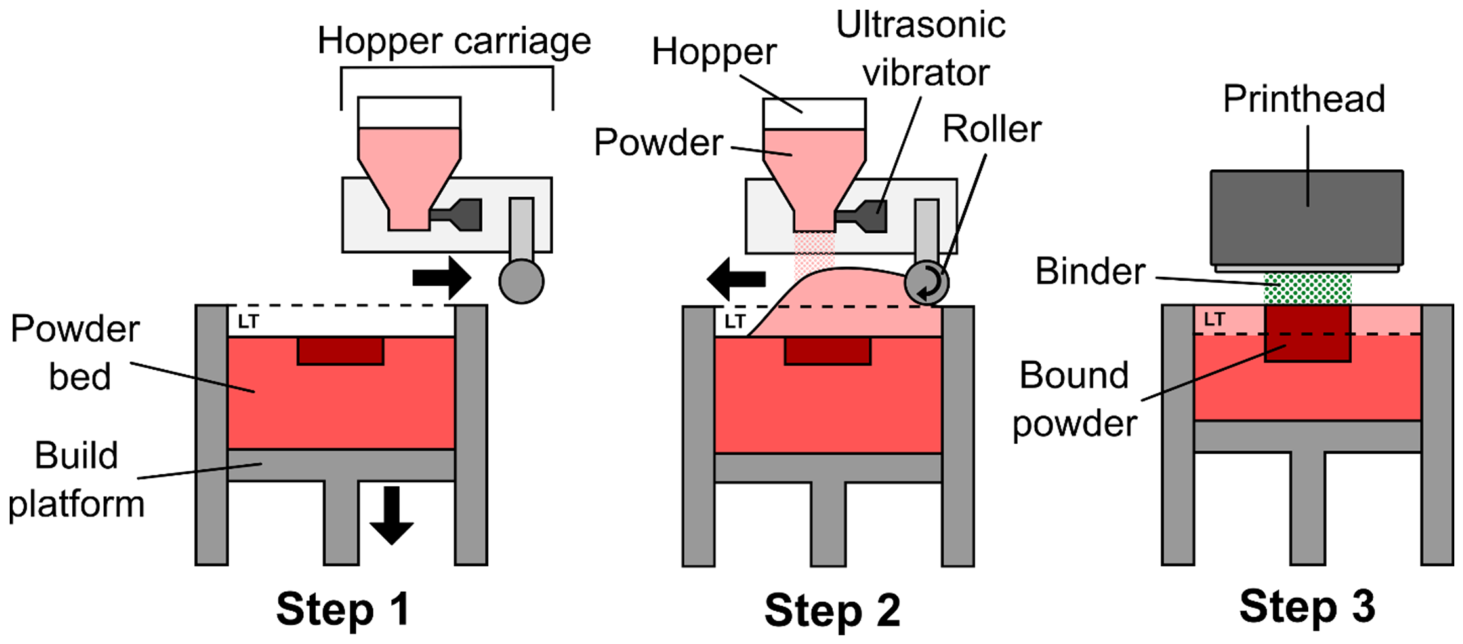
- Step 1: The build platform lowers by the desired layer thickness (LT), creating space for a new powder layer. The hopper carriage traverses from left to right across the powder bed.
- Step 2: The hopper carriage moves from right to left. An ultrasonic vibrator attached to the hopper is activated to facilitate feedstock powder flow from the hopper onto the powder bed. The hopper dispenses more powder than needed for a single layer, while a roller spreads the powder bed, resulting in a new powder layer with the thickness of LT.
- Step 3: A printhead, independent from the hopper carriage, deposits liquid binder onto selected regions of the powder bed based on the digital model geometry. The binder bonds the powder particles within those regions and penetrates below, adhering the new layer of powder to the previously bound layers.
2.2. Auto-Stirring Device for Hopper-Based Powder Dispensing Systems
2.2.1. Design and Fabrication of Auto-Stir Hopper Body
2.2.2. Design and Fabrication of Motor Housings and Screw Auger
2.2.3. Integration of Hopper Assembly and Control System
2.3. Feedstock Powder
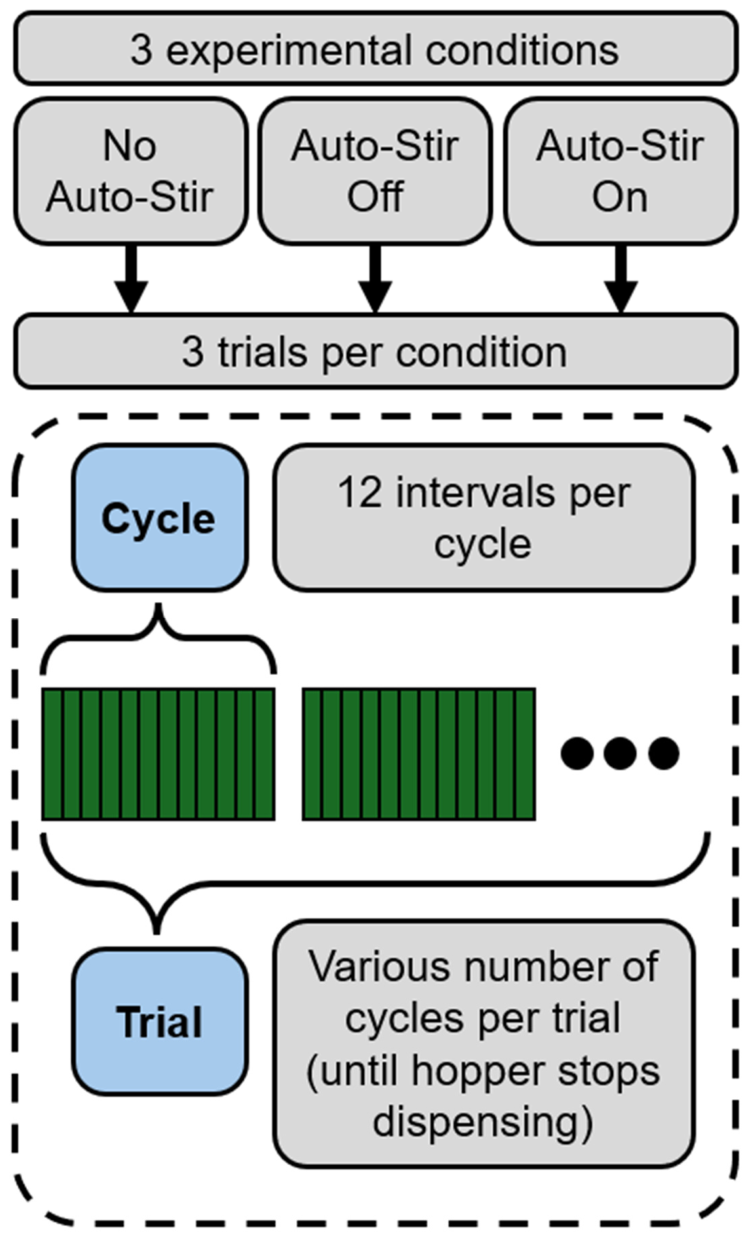
2.4. Experimental Conditions
- Condition 1, “No Auto-Stir”: The ExOne Innovent+ OEM hopper was employed. This hopper did not involve stirring of the powder.
- Condition 2, “Auto-Stir Off”: The custom-built hopper was employed. The screw augers remained inactive.
- Condition 3, “Auto-Stir On”: The custom-built hopper was employed. The screw augers were active.
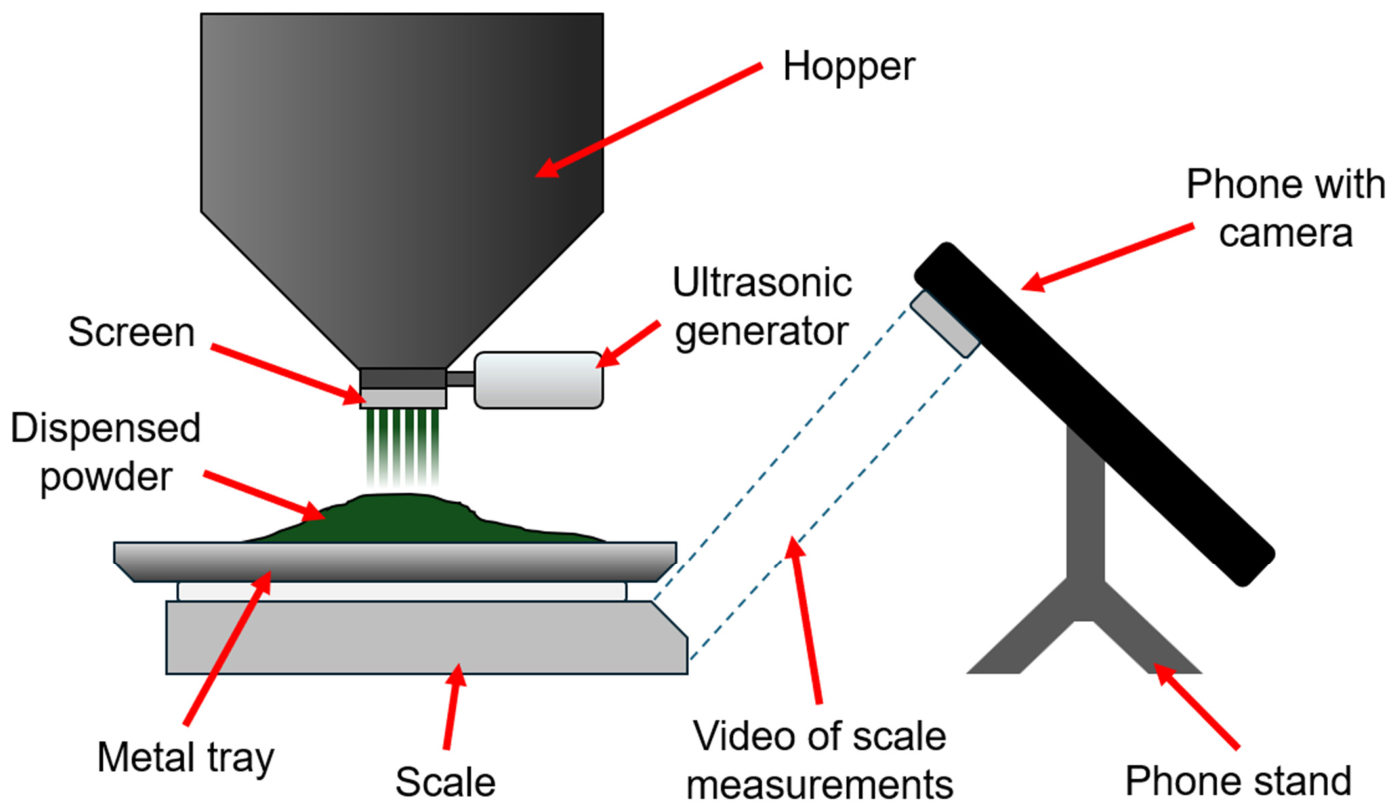
2.5. Measurement Setup for Dispensing Rate
2.6. Measurement of Dispensing Rate Consistency
3. Results
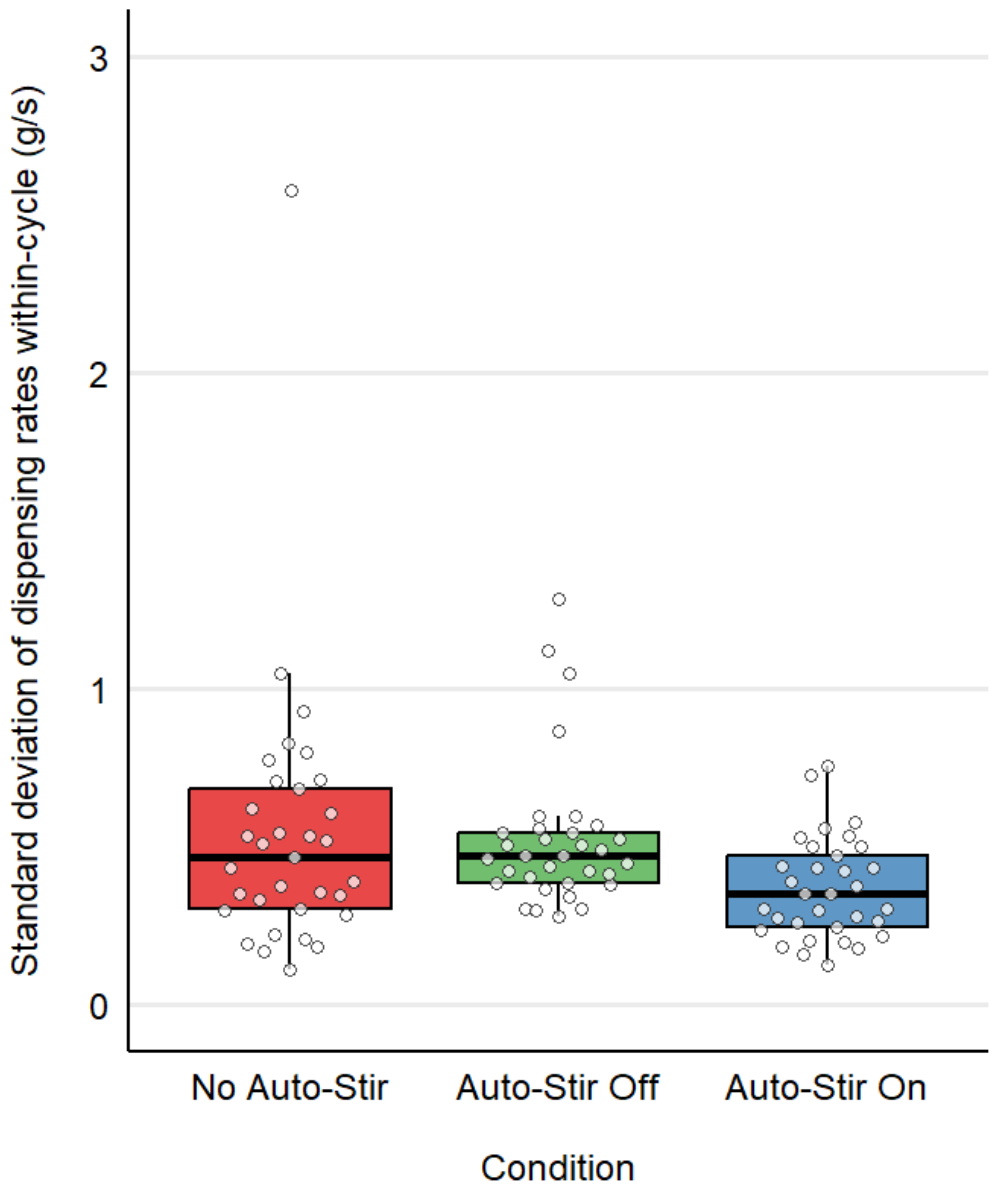
3.1. Within-Cycle Dispensing Rate Consistency
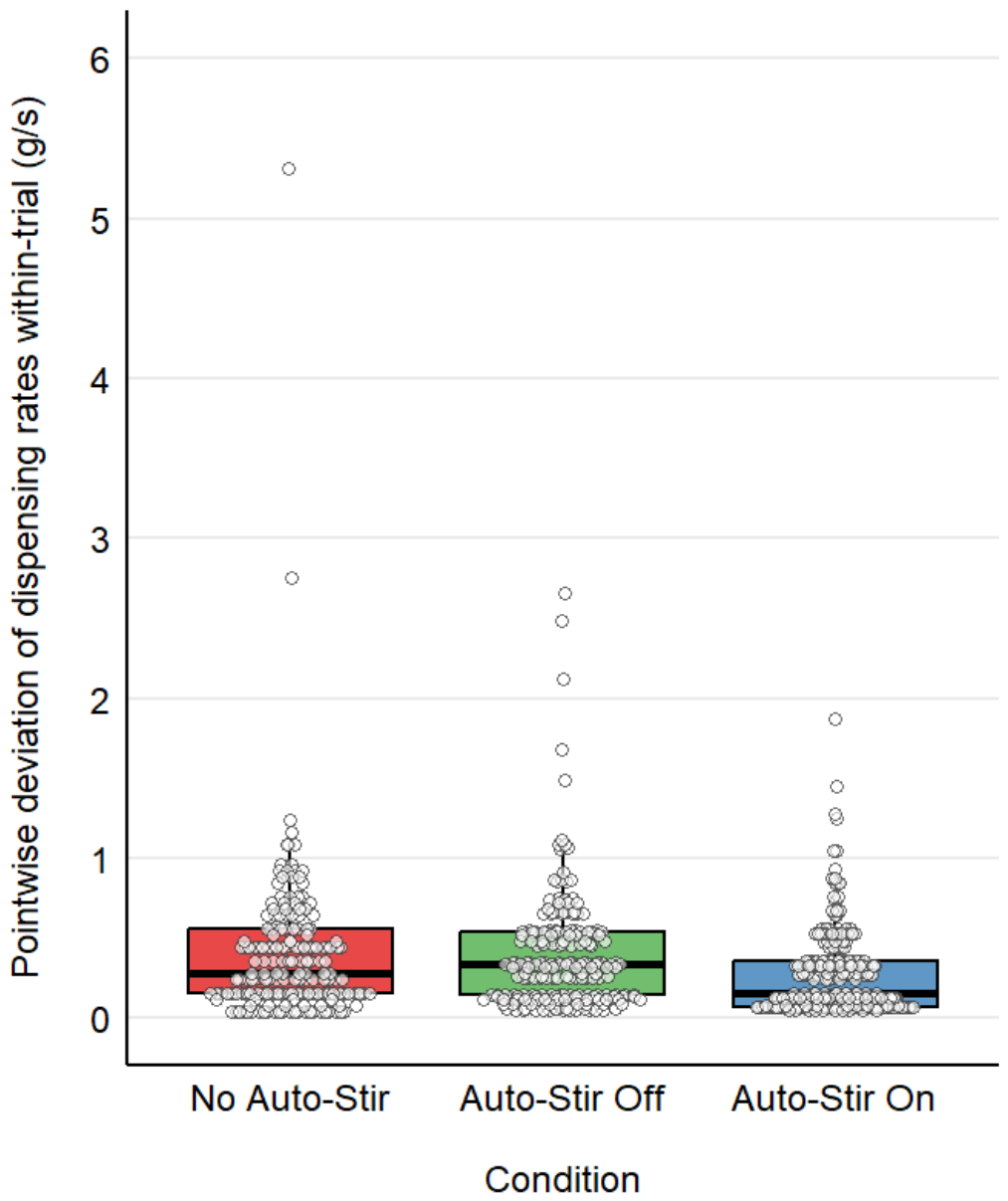
3.2. Within-Trial Dispensing Rate Consistency
4. Discussion
4.1. Mechanistic Interpretation of Dispensing Rate Consistency Improvement
4.2. Limitations of the Study
4.3. Practical Engineering Implications and Future Work
5. Conclusions
- The auto-stir hopper with active mechanical agitation (“Auto-Stir On”), in addition to ultrasonic vibration, reduced within-cycle standard deviation of dispensing rate by about one-third relative to the OEM hopper (“No Auto-Stir”), indicating more consistent dispensing rates short-term.
- Analysis of within-trial pointwise deviations showed a reduction in long-term dispensing rate variability under the “Auto-Stir On” condition, indicating more consistent dispensing rates long-term.
- A Tukey post hoc test revealed that the “Auto-Stir On” condition significantly improved dispensing rate consistency compared with the “No Auto-Stir” condition at the 0.05 significance level both short-term (p = 0.046) and long-term (p = 0.001). The “Auto-Stir Off” condition showed no significant difference from “No Auto-Stir” (p > 0.95) in both within-cycle and within-trial cases, isolating mechanical agitation as the key factor driving the enhancement of dispensing rate consistency.
- These findings were derived from experiments using a cohesive organic powder (algae with a repose angle of 56°) and may not be directly applicable to free-flowing metal or ceramic feedstocks without additional experimental validation.
Author Contributions
Funding
Data Availability Statement
Conflicts of Interest
References
- Dev Singh, D.; Mahender, T.; Raji Reddy, A. Powder Bed Fusion Process: A Brief Review. Mater. Today Proc. 2021, 46, 350–355. [Google Scholar] [CrossRef] [Scilit]
- Ziaee, M.; Crane, N.B. Binder Jetting: A Review of Process, Materials, and Methods. Addit. Manuf. 2019, 28, 781–801. [Google Scholar] [CrossRef] [Scilit]
- Abd-Elaziem, W.; Elkatatny, S.; Abd-Elaziem, A.-E.; Khedr, M.; Abd El-baky, M.A.; Hassan, M.A.; Abu-Okail, M.; Mohammed, M.; Järvenpää, A.; Allam, T.; et al. On the Current Research Progress of Metallic Materials Fabricated by Laser Powder Bed Fusion Process: A Review. J. Mater. Res. Technol. 2022, 20, 681–707. [Google Scholar] [CrossRef] [Scilit]
- Davoodi, F.; Varmaziar, S.; Atapour, M.; Iuliano, L.; Saboori, A. In Vitro Corrosion and Bio-Tribocorrosion Performance of Electron Beam Powder Bed Fusion Ti6Al4V Specimens with Lapping and Superfinishing Treatments. Prog. Addit. Manuf. 2025, 10, 9117–9132. [Google Scholar] [CrossRef] [Scilit]
- Dejene, N.D.; Lemu, H.G. Current Status and Challenges of Powder Bed Fusion-Based Metal Additive Manufacturing: Literature Review. Metals 2023, 13, 424. [Google Scholar] [CrossRef] [Scilit]
- Gaikwad, M.U.; Gaikwad, P.U.; Ambhore, N.; Sharma, A.; Bhosale, S.S. Powder Bed Additive Manufacturing Using Machine Learning Algorithms for Multidisciplinary Applications: A Review and Outlook. Recent Pat. Mech. Eng. 2025, 18, 12–25. [Google Scholar] [CrossRef] [Scilit]
- Katz-Demyanetz, A.; Popov, V.V.; Kovalevsky, A.; Safranchik, D.; Koptyug, A. Powder-Bed Additive Manufacturing for Aerospace Application: Techniques, Metallic and Metal/Ceramic Composite Materials and Trends. Manuf. Rev. 2019, 6, 5. [Google Scholar] [CrossRef] [Scilit]
- Salehi, H.; Cummins, J.; Gallino, E.; Garg, V.; Deng, T.; Hassanpour, A.; Bradley, M. Optimising Spread-Layer Quality in Powder Additive Manufacturing: Assessing Packing Fraction and Segregation Tendency. Processes 2023, 11, 2276. [Google Scholar] [CrossRef] [Scilit]
- Moghadasi, M.; Du, W.; Li, M.; Pei, Z.; Ma, C. Ceramic Binder Jetting Additive Manufacturing: Effects of Particle Size on Feedstock Powder and Final Part Properties. Ceram. Int. 2020, 46, 16966–16972. [Google Scholar] [CrossRef] [Scilit]
- Wang, L.; Wu, H.; Yin, Z.; Jiang, C.; Pan, Y.; He, L.; Nie, G.; Deng, X.; Wu, S. Additive Manufacturing of High-Performance SiO2-Al2O3-K2O (Na2O) Ceramic Components via Binder Jetting Technology. Ceram. Int. 2025, 51, 529–540. [Google Scholar] [CrossRef] [Scilit]
- Miao, G.; Du, W.; Pei, Z.; Ma, C. A Literature Review on Powder Spreading in Additive Manufacturing. Addit. Manuf. 2022, 58, 103029. [Google Scholar] [CrossRef] [Scilit]
- Wei, X.; Moghadasi, M.; Du, W.; Ma, C.; Pei, Z. Experimental Investigation on Ultrasonic Hopper Dispensing System in Powder Bed Additive Manufacturing. J. Manuf. Process. 2021, 71, 106–112. [Google Scholar] [CrossRef] [Scilit]
- Li, Z.; Li, H.; Yin, J.; Li, Y.; Nie, Z.; Li, X.; You, D.; Guan, K.; Duan, W.; Cao, L.; et al. A Review of Spatter in Laser Powder Bed Fusion Additive Manufacturing: In Situ Detection, Generation, Effects, and Countermeasures. Micromachines 2022, 13, 1366. [Google Scholar] [CrossRef] [Scilit]
- Meier, C.; Fuchs, S.L.; Much, N.; Nitzler, J.; Penny, R.W.; Praegla, P.M.; Proell, S.D.; Sun, Y.; Weissbach, R.; Schreter, M.; et al. Physics-Based Modeling and Predictive Simulation of Powder Bed Fusion Additive Manufacturing Across Length Scales. GAMM-Mitteilungen 2021, 44, e202100014. [Google Scholar] [CrossRef] [Scilit]
- Lampitella, V.; Trofa, M.; Astarita, A.; D’Avino, G. Discrete Element Method Analysis of the Spreading Mechanism and Its Influence on Powder Bed Characteristics in Additive Manufacturing. Micromachines 2021, 12, 392. [Google Scholar] [CrossRef] [Scilit] [PubMed]
- Chen, Y.; Wang, Y.; Huang, L.; Su, B.; Yang, Y. Investigating the Microscopic Mechanism of Ultrasonic-Vibration-Assisted-Pressing of WC-Co Powder by Simulation. Materials 2023, 16, 5199. [Google Scholar] [CrossRef] [Scilit]
- Sinclair, C.W.; Edinger, R.; Sparling, W.; Molavi-Kakhki, A.; Labrecque, C. Vibratory Powder Feeding for Powder Bed Additive Manufacturing Using Water and Gas Atomized Metal Powders. Materials 2021, 14, 3548. [Google Scholar] [CrossRef] [Scilit]
- Kollmann, T.H.; Tomas, J. Effect of Applied Vibration on Silo Hopper Design. Part. Sci. Technol. 2002, 20, 15–31. [Google Scholar] [CrossRef] [Scilit]
- Shah, D.S.; Moravkar, K.K.; Jha, D.K.; Lonkar, V.; Amin, P.D.; Chalikwar, S.S. A Concise Summary of Powder Processing Methodologies for Flow Enhancement. Heliyon 2023, 9, e16498. [Google Scholar] [CrossRef] [Scilit]
- Jallo, L.J.; Ghoroi, C.; Gurumurthy, L.; Patel, U.; Davé, R.N. Improvement of Flow and Bulk Density of Pharmaceutical Powders Using Surface Modification. Int. J. Pharm. 2012, 423, 213–225. [Google Scholar] [CrossRef] [Scilit]
- Kunnath, K.T.; Tripathi, S.; Kim, S.S.; Chen, L.; Zheng, K.; Davé, R.N. Selection of Silica Type and Amount for Flowability Enhancements via Dry Coating: Contact Mechanics Based Predictive Approach. Pharm. Res. 2023, 40, 2917–2933. [Google Scholar] [CrossRef] [Scilit]
- Chattoraj, S.; Shi, L.; Sun, C.C. Profoundly Improving Flow Properties of a Cohesive Cellulose Powder by Surface Coating with Nano-silica through Comilling. J. Pharm. Sci. 2011, 100, 4943–4952. [Google Scholar] [CrossRef] [Scilit]
- Lu, G.; Zhao, J.; Zhou, Y.; Fu, Y.; Lu, S.; Zhang, H. Study on Flowability Enhancement and Performance Testing of Ultrafine Dry Powder Fire Extinguishing Agents Based on Application Requirements. Fire 2024, 7, 146. [Google Scholar] [CrossRef] [Scilit]
- Janzen, K.; Kallies, K.J.; Waalkes, L.; Imgrund, P.; Emmelmann, C. Influence of Different Powder Conditioning Strategies on Metal Binder Jetting with Ti-6Al-4V. Materials 2024, 17, 750. [Google Scholar] [CrossRef] [Scilit]
- Rescaglio, A.; De Smet, F.; Aerts, L.; Lumay, G. Tribo-Electrification of Pharmaceutical Powder Blends. Part. Sci. Technol. 2019, 37, 1024–1031. [Google Scholar] [CrossRef] [Scilit]
- Gao, G.; Zhang, X.; Xu, M.; Han, Y.; Ao, J.; Cai, Y.; Wang, J. Structural Optimized Design of a Powder Mixer for Multi-Material Directed Energy Deposition Based on CFD-DPM. Coatings 2023, 13, 773. [Google Scholar] [CrossRef] [Scilit]
- Badgujar, C.M.; Wu, H.; Flippo, D.; Brokesh, E. Design, Fabrication, and Experimental Investigation of Screw Auger Type Feed Mechanism for a Robotic Wheat Drill. J. ASABE 2022, 65, 1333–1342. [Google Scholar] [CrossRef] [Scilit]
- Bai, P.; Yang, S.; Yan, Y.; Wang, D.; Ma, Y. Advances in Powder-Filled Mold Processes: A Comprehensive Review and Outlook. Materials 2024, 17, 5476. [Google Scholar] [CrossRef] [Scilit] [PubMed]
- Nicolai, R.; Ollerich, J.; Kelley, J. Screw Auger Power and Throughput Analysis. In Proceedings of the 2004 ASAE Annual Meeting, Ottawa, ON, Canada, 1–4 August 2004. [Google Scholar]
- Ghosh, B.N. Conveyance of Wet Parchment Coffee Beans by an Auger. J. Agric. Eng. Res. 1967, 12, 274–280. [Google Scholar] [CrossRef] [Scilit]
- Williams, D.F.; Lofgren, C.S.; Plumley, J.K.; Hicks, D.M. Auger-Applicator for Applying Small Amounts of Granular Pesticides. J. Econ. Entomol. 1983, 76, 395–397. [Google Scholar] [CrossRef] [Scilit]
- Dunst, P.; Bornmann, P.; Hemsel, T.; Sextro, W. Vibration-Assisted Handling of Dry Fine Powders. Actuators 2018, 7, 18. [Google Scholar] [CrossRef] [Scilit]
- Lopes Neto, J.P.; do Nascimento, J.W.B.; Silva, R.C.; da Costa, C.A. Powder Flow Criteria for Design of Vertical Silo Walls. Eng. Agríc. 2013, 33, 453–462. [Google Scholar] [CrossRef] [Scilit]
- Schulze, D. Powders and Bulk Solids: Behavior, Characterization, Storage and Flow; Springer International Publishing: Cham, Switzerland, 2021. [Google Scholar]
- Mehos, G.; Morgan, D. Hopper Design Principles. Chem. Eng. 2016, 123, 58. [Google Scholar]
- Cleary, P.W.; Sawley, M.L. DEM Modelling of Industrial Granular Flows: 3D Case Studies and the Effect of Particle Shape on Hopper Discharge. Appl. Math. Model. 2002, 26, 89–111. [Google Scholar] [CrossRef] [Scilit]
- McGlinchey, D. (Ed.) Bulk Solids Handling, 1st ed.; John Wiley & Sons, Ltd.: Hoboken, NJ, USA, 2008. [Google Scholar]
- Das, S.; Santosa, J. Design of a Micro-Hopper Array for Multi-Material Powder Deposition. In Proceedings of the International Solid Freeform Fabrication Symposium, Austin, TX, USA, 6–8 August 2001; pp. 155–162. [Google Scholar] [CrossRef]
- Wang, H.; Zhang, T.; Zhao, M.; Chen, R.; Wu, L. Micro-Dosing of Fine Cohesive Powders Actuated by Pulse Inertia Force. Micromachines 2018, 9, 73. [Google Scholar] [CrossRef] [Scilit] [PubMed]
- Jansen, D.; Hanemann, T.; Radek, M.; Rota, A.; Schröpfer, J.; Heilmaier, M. Development of Actual Powder Layer Height Depending on Nominal Layer Thicknesses and Selection of Laser Parameters. J. Mater. Process. Technol. 2021, 298, 117305. [Google Scholar] [CrossRef] [Scilit]
- Oropeza, D.; Roberts, R.; Hart, A.J. A Modular Testbed for Mechanized Spreading of Powder Layers for Additive Manufacturing. Rev. Sci. Instrum. 2021, 92, 015114. [Google Scholar] [CrossRef] [Scilit]
- Zhou, W.; Chen, P.; Min, M.; Ma, X.; Wang, J.; Griffith, R.; Hussain, F.; Peng, P.; Xie, Q.; Li, Y.; et al. Environment-Enhancing Algal Biofuel Production Using Wastewaters. Renew. Sustain. Energy Rev. 2014, 36, 256–269. [Google Scholar] [CrossRef] [Scilit]
- Khan, F.; Shakil Arman, M.; Sanders, J.; Meraj Pasha, M.; Mazedur Rahman, A.; Pei, Z.; Dong, T. Binder Jetting 3D Printing Utilizing Waste Algae Powder: A Feasibility Study. Intell. Sustain. Manuf. 2024, 1, 10016. [Google Scholar] [CrossRef] [Scilit]
- Zegzulka, J.; Gelnar, D.; Jezerska, L.; Prokes, R.; Rozbroj, J. Characterization and Flowability Methods for Metal Powders. Sci. Rep. 2020, 10, 21004. [Google Scholar] [CrossRef] [Scilit]
- Reddy, R.S.; Ramachandra, C.T.; Hiregoudar, S.; Nidoni, U.; Ram, J.; Kammar, M. Influence of Processing Conditions on Functional and Reconstitution Properties of Milk Powder Made from Osmanabadi Goat Milk by Spray Drying. Small Rumin. Res. 2014, 119, 130–137. [Google Scholar] [CrossRef] [Scilit]
- Oropeza, D.; Penny, R.W.; Gilbert, D.; Hart, A.J. Mechanized Spreading of Ceramic Powder Layers for Additive Manufacturing Characterized by Transmission X-Ray Imaging: Influence of Powder Feedstock and Spreading Parameters on Powder Layer Density. Powder Technol. 2022, 398, 117053. [Google Scholar] [CrossRef] [Scilit]
- Oh, J.-W.; Park, J.; Nahm, S.; Choi, H. SiC-Si Composite Part Fabrication via SiC Powder Binder Jetting Additive Manufacturing and Molten-Si Infiltration. Int. J. Refract. Met. Hard Mater. 2021, 101, 105686. [Google Scholar] [CrossRef] [Scilit]
- Sonia, P.; Jain, J.K.; Saxena, K.K. Influence of Ultrasonic Vibration Assistance in Manufacturing Processes: A Review. Mater. Manuf. Process. 2021, 36, 1451–1475. [Google Scholar] [CrossRef] [Scilit]
- Li, M.; Miao, G.; Du, W.; Pei, Z.; Ma, C. Difference between Powder Bed Density and Green Density for a Free-Flowing Powder in Binder Jetting Additive Manufacturing. J. Manuf. Process. 2022, 84, 448–456. [Google Scholar] [CrossRef] [Scilit]
- Hilton, J.E.; Cleary, P.W. Granular Flow during Hopper Discharge. Phys. Rev. E 2011, 84, 011307. [Google Scholar] [CrossRef] [Scilit]
- Park, H.W.; Kim, S.T.; Choung, M.G.; Han, W.-Y.; Yoon, W.B. Analysis of Grinding Kinetics and Flow Behavior of Adzuki Bean (Phaseolus angularis) Flour for Hopper Design. J. Food Process Eng. 2016, 39, 366–376. [Google Scholar] [CrossRef] [Scilit]
- Hidaka, J.; Kano, J.; Shimosaka, A. Flow Mechanism of Granular Materials Discharging from Bin-Hopper System. KONA Powder Part. J. 1995, 13, 205–213. [Google Scholar] [CrossRef] [Scilit]
- Timoleanov, K.; Savenkov, D.; Gorgadze, L. Features of Designing Feeding Hoppers of Loose Materials of Low Productivity in Agriculture. MATEC Web Conf. 2018, 224, 05020. [Google Scholar] [CrossRef] [Scilit]
- Jakubowska, E.; Ciepluch, N. Blend Segregation in Tablets Manufacturing and Its Effect on Drug Content Uniformity—A Review. Pharmaceutics 2021, 13, 1909. [Google Scholar] [CrossRef] [Scilit]
- Mann, M.; Davies, R.; Lawrence, C.; Ghita, O. Prototype Design for Grading Structures in Powder Bed Fusion Processes. 3D Print. Addit. Manuf. 2023, 10, 1320–1335. [Google Scholar] [CrossRef] [Scilit]
- Mellin, P.; Zavalis, T.; Tingö, L.; Brodin, H.; Wendel, J.; Berg, S.; Riabov, D.; Strondl, A.; Nyborg, L. Moisture Content Analysis of Metal Powders Using Oven Desorption Followed by Karl Fischer Titration. Met. Powder Rep. 2020, 75, 34–39. [Google Scholar] [CrossRef] [Scilit]
- Ileleji, K.E.; Garcia, A.A.; Kingsly, A.R.P.; Clementson, C.L. Comparison of Standard Moisture Loss-on-Drying Methods for the Determination of Moisture Content of Corn Distillers Dried Grains with Solubles. J. AOAC Int. 2010, 93, 191–196. [Google Scholar] [CrossRef] [Scilit]



| Repose Angle | Hausner Ratio | Flowability Classification |
|---|---|---|
| 20° < α < 30° | 1.00–1.11 | Very free flowing |
| 30° < α < 38° | 1.12–1.18 | Free flowing |
| 38° < α < 45° | 1.19–1.25 | Fair flow |
| 45° < α < 55° | 1.26–1.34 | Cohesive |
| 55° < α < 70° | 1.35–1.45 | Very cohesive |
| Property | Value |
|---|---|
| Particle size distribution (µm) | D10 = 65, D50 = 100, D90 = 190 |
| Apparent density (g/cm3) | 0.45 |
| Repose angle (°) | 56 |
| Flowability classification | Very cohesive |
| Material | Property | Value | Reference |
|---|---|---|---|
| 316 L Stainless Steel | Particle size distribution (µm) | D10 = 26.7 D50 = 42.6 D90 = 64.0 | [44] |
| Repose angle (Mean ± Std) (°) | 34.2 ± 2 | ||
| Flowability classification | Free flowing | ||
| Aluminum | Particle size distribution (µm) | D10 = 29.4 D50 = 79.1 D90 = 187.3 | [44] |
| Repose angle (Mean ± Std) (°) | 36.8 ± 1.5 | ||
| Flowability classification | Free flowing | ||
| Titanium | Particle size distribution (µm) | D10 = 80.7 D50 = 295.1 D90 = 452.1 | [44] |
| Repose angle (Mean ± Std) (°) | 44.9 ± 1.6 | ||
| Flowability classification | Fair flow | ||
| Alumina (spherical) | Particle size distribution (µm) | D10 = 10.1 D50 = 21.6 D90 = 39.0 | [46] |
| Repose angle (Mean ± Std) (°) | 50.3 ± 0.6 | ||
| Flowability classification | Cohesive | ||
| Alumina (irregular) | Particle size distribution (µm) | D10 = 13.4 D50 = 23.8 D90 = 41.9 | [46] |
| Repose angle (Mean ± Std) (°) | 43.6 ± 1.8 | ||
| Flowability classification | Fair flow | ||
| Silicon Carbide | Particle size distribution (µm) | D10 = 42.2 D50 = 63.7 D90 = 93.2 | [47] |
| Repose angle (Mean ± Std) (°) | Not available | ||
| Hausner ratio | 1.134 | ||
| Flowability classification | Free flowing |
| Condition | Mean (g/s) | Standard Deviation (g/s) |
|---|---|---|
| No Auto-Stir | 0.542 | 0.435 |
| Auto-Stir Off | 0.521 | 0.233 |
| Auto-Stir On | 0.364 | 0.159 |
| Configuration Comparison | p-Value |
|---|---|
| No Auto-Stir vs. Auto-Stir Off | 0.958 |
| Auto-Stir Off vs. Auto-Stir On | 0.088 |
| No Auto-Stir vs. Auto-Stir On | 0.046 |
| Condition | Mean (g/s) | Standard Deviation (g/s) |
|---|---|---|
| No Auto-Stir | 0.405 | 0.500 |
| Auto-Stir Off | 0.399 | 0.380 |
| Auto-Stir On | 0.274 | 0.255 |
| Configuration Comparison | p-Value |
|---|---|
| No Auto-Stir vs. Auto-Stir Off | 0.984 |
| Auto-Stir Off vs. Auto-Stir On | 0.002 |
| No Auto-Stir vs. Auto-Stir On | 0.001 |
Disclaimer/Publisher’s Note: The statements, opinions and data contained in all publications are solely those of the individual author(s) and contributor(s) and not of MDPI and/or the editor(s). MDPI and/or the editor(s) disclaim responsibility for any injury to people or property resulting from any ideas, methods, instructions or products referred to in the content. |
© 2026 by the authors. Licensee MDPI, Basel, Switzerland. This article is an open access article distributed under the terms and conditions of the Creative Commons Attribution (CC BY) license.
Share and Cite
Sanders, J.; Kazi, S.; Pei, Z.; Kao, Y.-T.; Dubovick, K. Effects of Auto-Stirring on Powder Dispensing Rate Consistency in Hopper-Based Binder Jetting 3D Printing with Cohesive Powder. Powders 2026, 5, 21. https://doi.org/10.3390/powders5020021
Sanders J, Kazi S, Pei Z, Kao Y-T, Dubovick K. Effects of Auto-Stirring on Powder Dispensing Rate Consistency in Hopper-Based Binder Jetting 3D Printing with Cohesive Powder. Powders. 2026; 5(2):21. https://doi.org/10.3390/powders5020021
Chicago/Turabian StyleSanders, Jackson, Siddhartha Kazi, Zhijian Pei, Yi-Tang Kao, and Kenneth Dubovick. 2026. "Effects of Auto-Stirring on Powder Dispensing Rate Consistency in Hopper-Based Binder Jetting 3D Printing with Cohesive Powder" Powders 5, no. 2: 21. https://doi.org/10.3390/powders5020021
APA StyleSanders, J., Kazi, S., Pei, Z., Kao, Y.-T., & Dubovick, K. (2026). Effects of Auto-Stirring on Powder Dispensing Rate Consistency in Hopper-Based Binder Jetting 3D Printing with Cohesive Powder. Powders, 5(2), 21. https://doi.org/10.3390/powders5020021