Article

Mineralogical Influence of the Partial Replacement of Palm Oil Fuel Ash on the Mechanical Performance of Alkali-Activated Mortars


by
José Eduardo Aguilar-Joo
1,2,*,
Berenice Arroyo-Serena
2,
Diana Paola Rodríguez-Serralde
1,
Marx Dostoievski Hernández-García
1,
Francisco Miguel López-Vázquez
1,
Abraham Izquierdo-Tapia
1 and
Janer Ramírez-Lizcano
1
1
Unidad Profesional Interdisciplinaria en Ingeniería Palenque (UPIIP), Instituto Politécnico Nacional, Carretera Federal 199, Tramo Catazajá-Rancho Nuevo KM 24.5 Pakal-Na, Palenque 29960, Chiapas, Mexico
2
Instituto de Investigación e Innovación en Energías Renovables (IIIER), Universidad de Ciencias y Artes de Chiapas, Ciudad Universitaria, Libramiento Norte Poniente 1150, Tuxtla Gutiérrez 29039, Chiapas, Mexico
*
Author to whom correspondence should be addressed.
Powders 2026, 5(2), 19; https://doi.org/10.3390/powders5020019
Submission received: 4 April 2026 / Revised: 8 May 2026 / Accepted: 27 May 2026 / Published: 1 June 2026

Abstract

This research investigates the relationship between mineralogical composition and compressive strength in alkali-activated cement–sand mortars incorporating palm oil fuel ash (POFA) as a partial replacement of Portland cement. POFA was introduced at 5 wt.% and 10 wt.% of the binder, and activation was achieved using a NaOH–Na2SiO3 solution (3:1 mass ratio). Compressive strength and bulk density were evaluated at 7 and 28 days, while phase evolution was analyzed by X-ray diffraction (XRD) coupled with Rietveld refinement. The results demonstrate that POFA incorporation significantly modified the CaO–SiO2–Al2O3 balance of the system, promoting the consumption of portlandite and the formation of Na- and K-rich aluminosilicate phases such as albite and muscovite. The control mixture exhibited the highest compressive strength values, whereas increasing POFA content reduced both strength and density due to calcium dilution, lower gel compactness, and increased porosity. Nevertheless, all mixtures exhibited progressive strength development over time, indicating continued hydration and geopolymerization reactions associated with the formation of hybrid C–(N,K)–A–S–H gels. These findings demonstrate that POFA can effectively participate in alkali-activated hybrid binders when applied at controlled replacement levels, highlighting its potential as a sustainable supplementary material for lower-carbon cementitious systems.

1. Introduction

The construction sector is currently facing a critical challenge: substantially reducing the environmental impact associated with Portland cement production while maintaining or enhancing the mechanical and durability performance of cement-based materials. Ordinary Portland cement (OPC) manufacturing accounts for approximately 7–8% of global anthropogenic CO2 emissions, in addition to significant energy consumption and the extensive use of non-renewable raw materials [1,2]. In this context, the partial replacement of OPC with supplementary cementitious materials (SCMs), as well as the development of alternative binder systems, has become a key strategy for advancing sustainable construction and reducing the carbon footprint of infrastructure materials [3].
Among the various SCMs investigated, agro-industrial by-products have gained increasing attention due to their wide availability and potential for valorization. In particular, palm oil fuel ash (POFA), a solid residue generated during the combustion of biomass for energy production, has emerged as a promising candidate. The palm oil industry produces substantial quantities of biomass waste, and the disposal of POFA in landfills represents a significant environmental concern in producing regions. Its incorporation into cementitious systems offers a dual benefit: mitigating waste disposal issues while reducing clinker consumption and associated emissions in concrete production [4,5,6].
From a chemical and mineralogical perspective, POFA is typically characterized by a high silica content, often exceeding 50 wt.%, along with smaller fractions of alumina and iron oxides. These oxides enable POFA to exhibit pozzolanic behavior, reacting with calcium hydroxide released during cement hydration to form secondary calcium silicate hydrate (C–S–H) gels. The formation of these reaction products contributes to pore refinement, microstructural densification, and improvements in long-term mechanical strength and durability. Furthermore, the reactivity of POFA is closely linked to its amorphous phase content, particle size distribution, and degree of crystallinity, which are strongly influenced by processing conditions [7].
Despite its potential, the performance of POFA in cementitious systems is highly dependent on its physicochemical characteristics. This raw material commonly exhibits relatively coarse particles, irregular morphology, and elevated loss on ignition due to the presence of unburned carbon. These features may negatively affect workability, increase water demand, and delay early-age strength development [8]. Consequently, several studies have emphasized the importance of post-processing techniques, such as controlled calcination and mechanical grinding, to enhance its pozzolanic activity and overall performance [9].
Previous experimental investigations have demonstrated the effectiveness of processed POFA in improving the mechanical properties of cementitious composites. Hamada et al. [10] evaluated the incorporation of nanoparticle-sized POFA (NPOFA) as a partial cement replacement (0–30%) in lightweight concrete. Their results indicated that the inclusion of approximately 5.33% NPOFA led to flexural and indirect tensile strengths of 8.53 MPa and 5.38 MPa, respectively, highlighting the beneficial effect of particle size refinement on mechanical performance. Similarly, Zeyad et al. [11] investigated ultrafine POFA (U-POFA) in high-strength green concrete under various steam-curing regimes. The authors reported improved workability and long-term strength gains ranging from 5.4% to 10%. In addition, steam curing was found to effectively compensate for reduced early-age strength, with a 193% increase in one-day compressive strength observed at 80 °C for 16 h in mixtures containing 60% U-POFA.
Beyond its role as a conventional SCM in OPC-based systems, POFA has also been explored as a precursor material in alkali-activated and geopolymer binders. In these systems, POFA can participate either as a primary aluminosilicate source or as part of blended formulations with materials such as ground granulated blast furnace slag or fly ash. These alternative binders have demonstrated enhanced mechanical performance and improved durability under aggressive conditions. Abdulmatin et al. [12] reported that alkali-activated mortars incorporating ground POFA, slag, and calcium carbide residue achieved a maximum compressive strength of 23.6 MPa at 90 days under optimized ternary compositions. In addition, Salami et al. [13] observed that POFA-based alkali-activated composites reinforced with polyvinyl alcohol fibers exhibited complex thermal behavior, including strength reductions at elevated temperatures (300 °C and 900 °C) and an atypical strength increase at 600 °C. Furthermore, Algaifi et al. [14] highlighted that the incorporation of POFA in alkali-activated systems can significantly enhance durability performance while contributing to the development of low-carbon binder technologies.
Despite the increasing number of studies on POFA-based materials, a significant research gap persists: the fundamental relationship between the inherent mineralogical characteristics of POFA and the mechanical performance of hybrid alkali-activated cementitious systems remains insufficiently understood. In particular, limited research has focused on the role of POFA mineralogy in cement–sand mortars activated under alkaline conditions, where complex interactions between hydration and geopolymeric reactions may occur. A comprehensive understanding of these interactions is essential for optimizing binder formulations, improving performance predictability, and ensuring the reliable application of such materials in engineering practice.
Therefore, the present research aims to investigate the influence of POFA mineralogy on the mechanical performance of alkali-activated cement–sand mortars incorporating partial POFA replacement. By correlating mineralogical composition, processing conditions, and mechanical performance, this research seeks to contribute to the development of sustainable, high-performance cementitious materials within a circular economy framework.

2. Materials and Methods

2.1. Raw Materials

Ordinary Portland cement (OPC) was used as the primary binder. A CPC 30 cement manufactured by CEMEX, Monterrey, Mexico (equivalent to ASTM Type I) was used conforming to Mexican standard NMX-C-414-ONNCCE-2017 [15], and whose mineralogical and chemical composition is consistent with typical clinker-based systems reported in the literature [16].
Palm oil fuel ash (POFA) was employed as a partial cement replacement. Before incorporation into the mortar mixtures, the ash was oven-dried at 105 °C for 24 h to remove moisture and subsequently ground to improve its fineness and reactivity [7,17]. Particle size distribution analysis of the processed POFA revealed a median particle size (D50) of 138 µm, confirming a moderate refinement relative to the untreated ash. This fineness level is consistent with the range reported by Liew et al. [18] and is substantially lower than the coarser particle sizes documented by Hasan et al. [19].
Natural river sand (RS) complying with Mexican standard NMX-C-329-ONNCCE-2016 for fine aggregates was used as the inert phase in the mortar mixtures [20]. The particle size distribution of the sand was within the limits specified for standard mortar production with a fineness modulus of 2.41 [21].
The chemical composition of OPC, POFA and RS are presented in Table 1. In particular, the chemical suitability of POFA as a supplementary cementitious material was assessed in accordance with ASTM C618-19 [22]. The combined content of SiO2, Al2O3, and Fe2O3 indicates that the ash possesses adequate aluminosilicate potential for participation in secondary pozzolanic.
Alkali activation was achieved using a combination of sodium hydroxide (NaOH) and sodium silicate (Na2SiO3). A 6 M NaOH solution was prepared by dissolving analytical-grade pellets in distilled water and allowing the solution to equilibrate for 24 h prior to use. The activator solution consisted of a Na2SiO3/NaOH mass ratio of 3:1, which has been widely reported as an optimal range for enhancing dissolution of aluminosilicate species and promoting gel formation in alkali-activated systems [23,24,25]. The combined alkaline solution was gradually incorporated into the dry mixture to ensure homogeneous dispersion and to facilitate the activation of both OPC hydration products and POFA-derived reactive phases.

2.2. Mix Proportions and Specimen Preparation

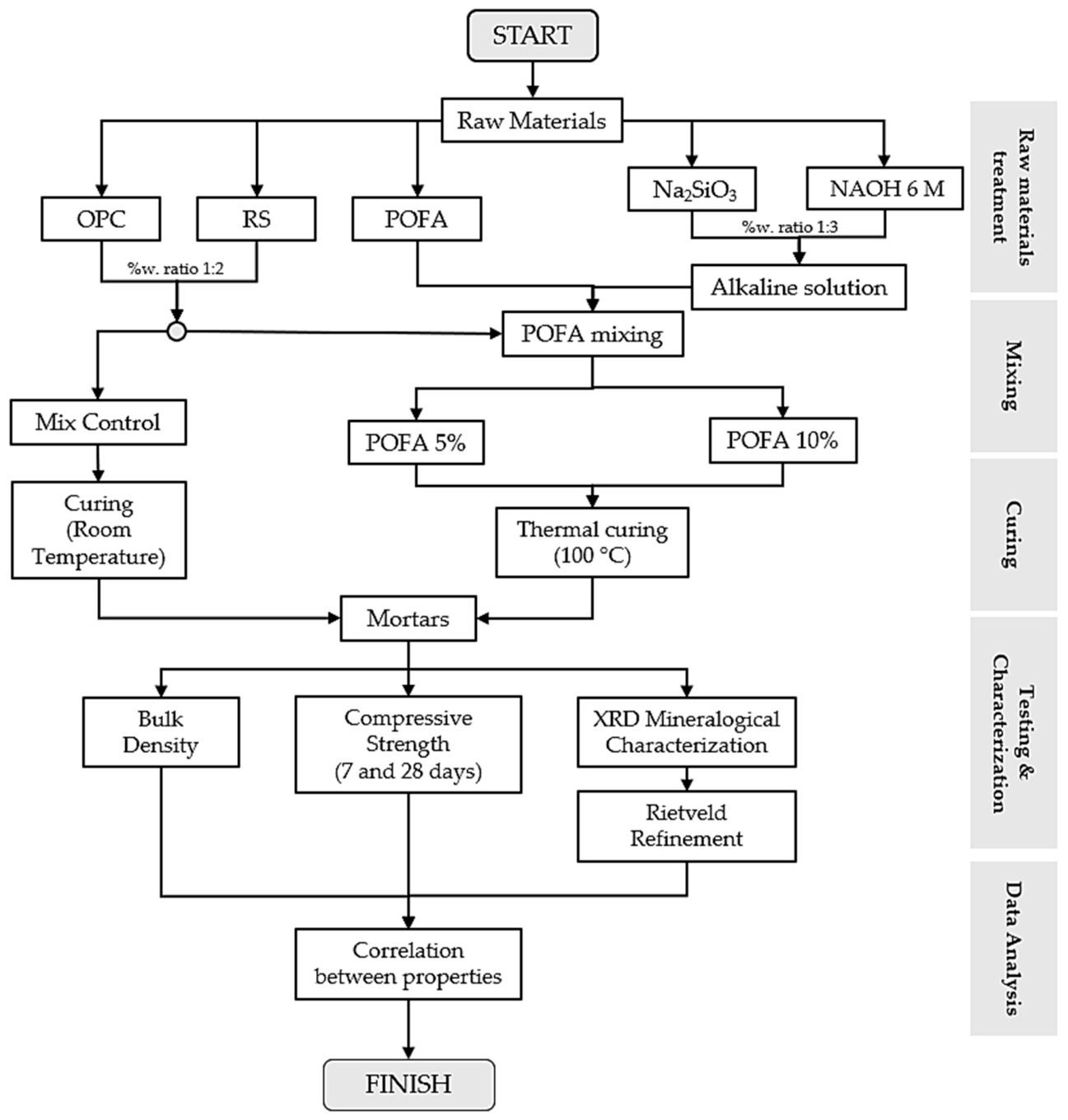
The schematic flow diagram of experimental research is presented in Figure 1.
Cement–sand mortars were prepared with partial replacement of OPC by POFA at levels of 5 wt.% and 10 wt.% relative to the total binder content. A control mixture (OPC and RS) was also produced for comparison purposes. The binder-to-sand ratio was maintained constant, and the liquid-to-binder ratio was adjusted to achieve adequate workability while ensuring proper activation conditions. The alkaline solution acted as both activator and mixing liquid. Table 2 shows the detailed mix proportions and curing conditions of the mortar formulations.
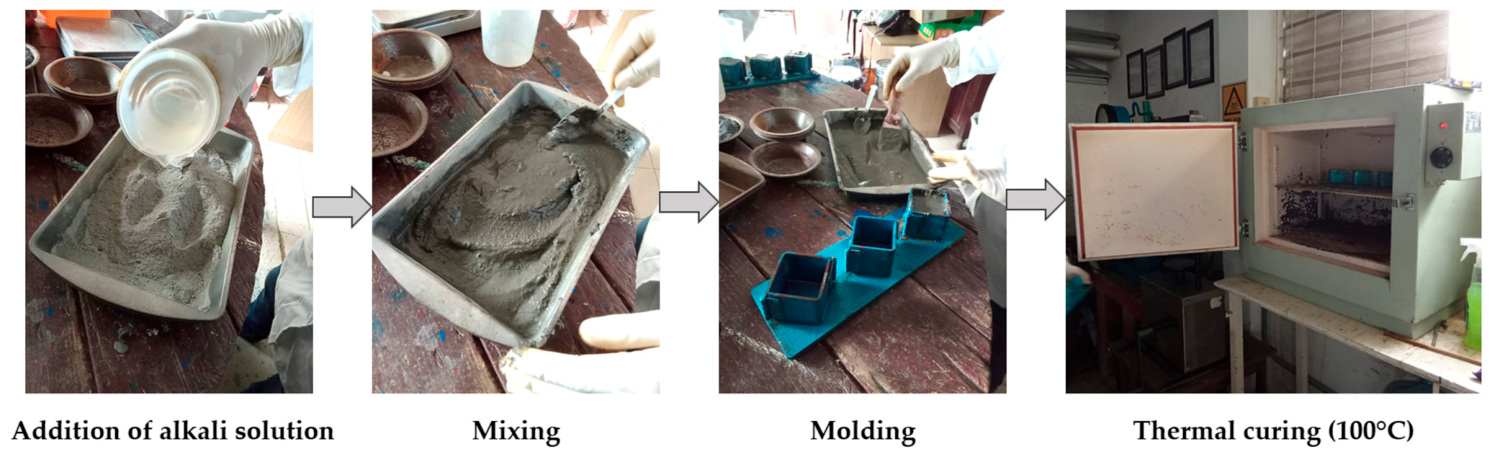
All mixtures were prepared using a mechanical mixer following standardized procedures. The dry components (OPC, POFA, and RS) were first homogenized, after which the alkaline solution was gradually added under continuous mixing. The resulting fresh mortar was then cast into 5 × 5 × 5 cm3 cubic molds, conforming to the Mexican industrial standard NMX-C-486-ONNCCE-2014 [26] for cement mortars, ensuring reproducibility and comparability with conventional systems. After casting, specimens were covered to prevent moisture loss and demolded after 24 h. Subsequently, thermal curing was performed at 100 °C in an oven, which enhances the development of reaction products and improves mechanical properties [27,28,29]. The preparation stages for the mortars are illustrated in Figure 2.

2.3. Physical and Mechanical Characterization

Compressive strength tests were performed at 7 and 28 days of curing ages in accordance with Mexican standard NMX-C-486-ONNCCE-2014 [26] for cement mortars. The tests were conducted using an ELVEC E660-5 electrohydraulic universal testing machine, applying load at a constant rate until failure. The reported values correspond to the average of multiple specimens to ensure statistical reliability.
In addition, bulk density of the mortar specimens was determined prior to compression testing. Each specimen was measured geometrically to obtain its volume and weighed using an electronic balance with a maximum capacity of 2200 g and a precision of 0.01 g. The density was calculated based on the measured mass-to-volume ratio, providing complementary information on the compactness and internal structure of the material.
Compressive strength is widely recognized as a key performance indicator for alkali-activated and blended cement systems, as it reflects the extent of chemical reactions and the development of the microstructure [11,13,14]. The combined evaluation of compressive strength and apparent density enables a more comprehensive understanding of the relationship between mechanical performance and material densification.

2.4. Mineralogical Characterization

Mineralogical characterization of the raw materials and hardened mortars was carried out by X-ray diffraction (XRD). The analyses were performed using a Rigaku Ultima IV X-ray diffractometer (Rigaku Corporation, Tokyo, Japan) equipped with CuKα radiation (λ = 1.54184 Å), operating at 40 kV and 44 mA (1.76 kW), and fitted with a silicon strip detector (D/teX Ultra) in Bragg–Brentano θ–θ geometry over a 2θ range of 15–70°, in order to identify the crystalline phases present.
Quantitative phase analysis was conducted using the Rietveld refinement method implemented in the MAUD (Materials Analysis Using Diffraction) software version 2.99993, which allows for the precise determination of phase proportions and provides information on the evolution of crystalline and amorphous components [29,30]. This approach is widely recognized as a reliable tool for the characterization of cementitious and alkali-activated materials [31].
The mineralogical results were used to identify the formation of hydration and reaction products, such as calcium silicate hydrates and other aluminosilicate phases, and to evaluate the contribution of POFA-derived phases to the overall system [12,13].

3. Results

3.1. Mineralogical Identification of Raw Materials by XRD

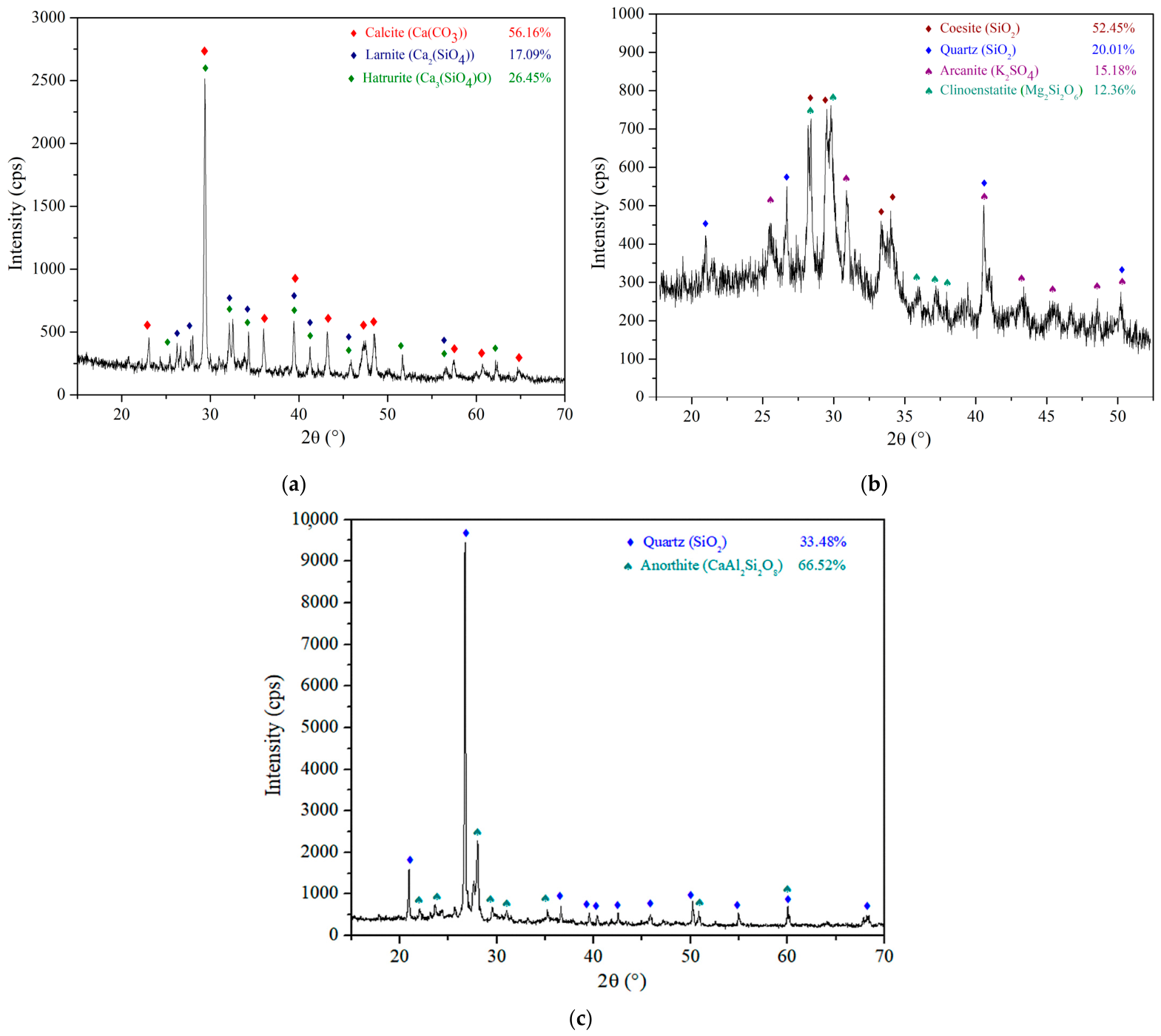
X-ray diffraction (XRD) analysis was collected to determine the mineralogical composition of the dry raw materials. The resulting diffraction patterns and the quantitative mineralogical percentages of each sample are presented in Figure 3.
Based on the analysis of each sample, the predominant mineral formation of OPC (Figure 3a) are calcite (CaCO3) (JCPDS card No.00-005-0586) with 56.16%, followed by hatrurite (Alite, Ca3(SiO4)O) (JCPDS card No.01-073-0599) with 26.45% and larnite (Belite, Ca2SiO4) (JCPDS card No.01-070-0388) with 17.09%. These last two components are consistent with the standard clinker composition reported in the literature [32].
In POFA (Figure 3b), coesite (SiO2) (JCPDS card No.01-075-4410), low quartz (SiO2) (JCPDS card No.00-033-1161), arcanite (K2SO4) (JCPDS card No.00-005-0613) and clinoenstatite (Mg2Si2O6) (JCPDS card No.00-035-0610) were identified as minerals in their most representative diffraction peaks, with 52.45%, 20.01%, 15.18%, 12.36%, respectively. Furthermore, the background elevation observed in the diffractogram indicates the presence of an amorphous silica phase, which can be attributed to the thermal treatment of the biomass [5,33].
Finally, anorthite (CaAl2Si2O8) (JCPDS card No.00-041-1481) was found in RS (Figure 3c) (JCPDS card No.01-089-1304) with 66.52%, followed by quartz (SiO2) (JCPDS card No.01-079-6237) with 33.48%.
These results support the properties of each raw material and were carefully compared with recent studies.

3.2. Physical and Mechanical Characterization

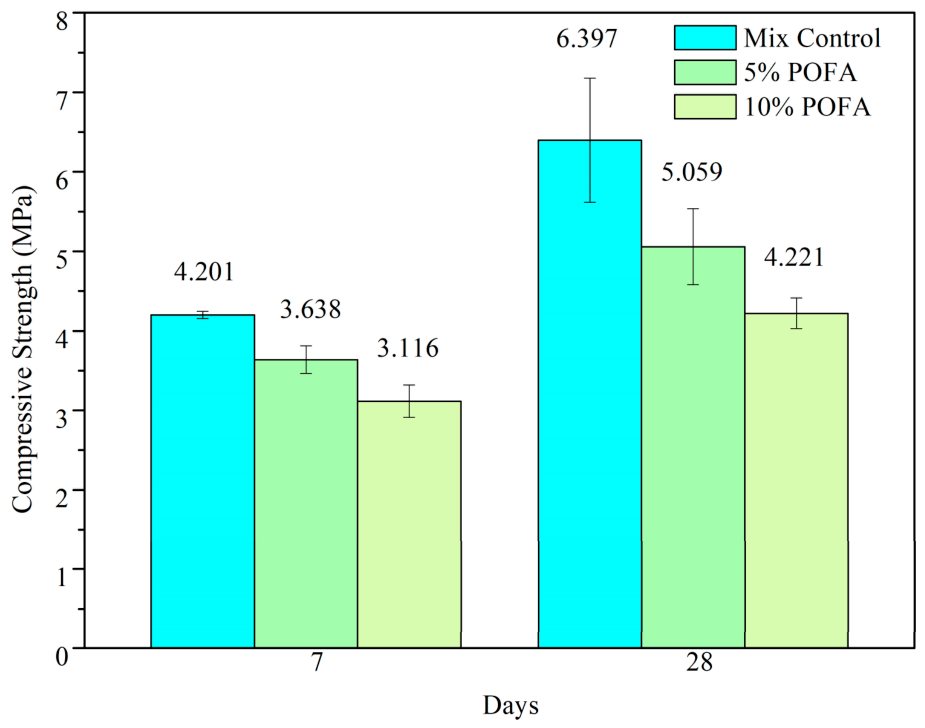
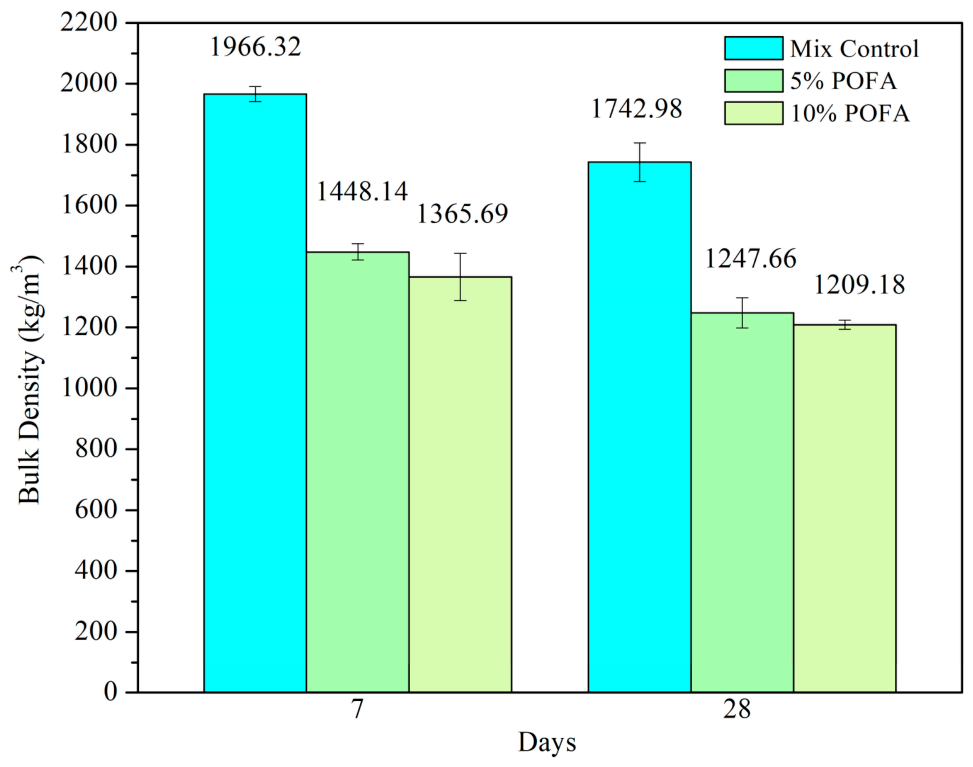
The compressive strength and bulk density results of the mortar specimens prepared according to the mixture proportions described in Section 2.2 are presented in Figure 4 and Figure 5, respectively, including error bars corresponding to a 95% confidence interval. First, the results obtained indicate that most of the mortar formulations developed compressive strength values comparable to those required for Type III structural mortars (f’j ≥ 4 MPa), according to the specifications established by the Mexican standard NMX-C-486-ONNCCE-2014 [26].
At 7 days, the control mixture exhibited a compressive strength of 4.201 MPa, while the mixtures incorporating 5 wt.% and 10 wt.% POFA showed a reduction of 13.40% and 25.83%, respectively. A similar trend was observed at 28 days, where the control mixture reached 6.397 MPa, whereas the 5 wt.% and 10 wt.% POFA mixtures achieved reductions of up to 20.92% and 34%, respectively.
This trend indicates that increasing POFA content leads to a reduction in compressive strength, although the continued strength gain over time suggests the presence of ongoing hydration and alkali-activation reactions. In parallel, bulk density results show that the control mixture presented the highest values (1966.32 kg/m3 at 7 days and 1742.98 kg/m3 at 28 days), while POFA incorporation progressively reduced density, reaching 1209.18 kg/m3 for the 10 wt.% mixture at 28 days.
This reduction can be primarily attributed to the dilution effect associated with partial replacement of OPC, which reduces the availability of clinker phases responsible for early hydration. It should be noted that this is compensated for by improved particle packing or enhanced reactivity [34]. Similar trends have been reported by Daud et al. [35] and Elbasir et al. [36], who demonstrated that although POFA contributes to strength development in alkali-activated mortars, its effectiveness is highly dependent on particle fineness and precursor reactivity, with untreated or coarser ashes leading to reduced early-age strength. Furthermore, as a supplementary cementitious material, POFA frequently lowers initial compressive strength because its pozzolanic contribution is generally delayed relative to the rapid hydration of Portland cement clinker [37]. In agreement with these findings, Hasan et al. [19] also reported that increasing POFA replacement levels led to progressive compressive strength reductions.
Despite the initial reduction, the increase in compressive strength from 7 to 28 days indicates the progressive formation of binding gels such as C–(A)–S–H and N–A–S–H. This delayed strength development is consistent with the slower dissolution kinetics of silica-rich precursors in alkaline environments. Therefore, thermal curing is fundamental in this system, as it provides the necessary thermal energy to enable the progressive consolidation of the mortar matrix at later ages. Salami et al. [13] observed that POFA-based alkali-activated mortars exhibit gradual strength evolution due to ongoing geopolymerization and microstructural refinement. Additionally, research on POFA–slag systems have shown that calcium availability plays a crucial role in accelerating gel formation and improving mechanical performance, highlighting the importance of precursor synergy in hybrid binders [38].

3.3. Mineralogical Analysis of Mortar Samples

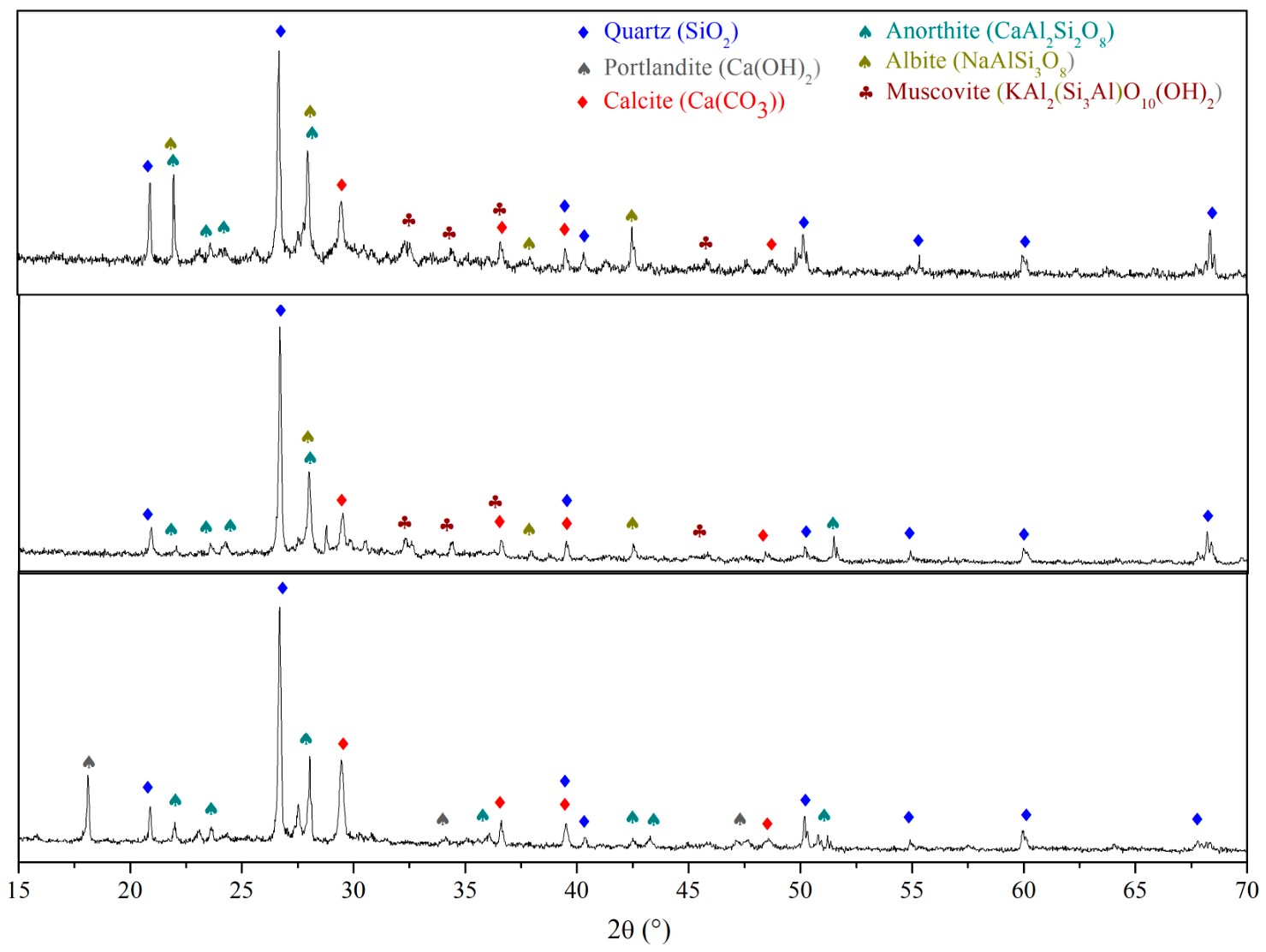
The mineralogical composition of the alkali-activated mortar samples at 28 days of curing was evaluated through X-ray diffraction (XRD) patterns (Figure 6), complemented by quantitative phase analysis using Rietveld refinement (Table 3). To ensure the reliability of the refinement procedure, statistical quality indicators including Rwp, Rb, Rexp, GOF, and χ2 were incorporated, following established quantitative phase analysis practices for cementitious and alkali-activated materials.
Additionally, since no internal crystalline standard was employed, the amorphous phase contribution was comparatively estimated through peak deconvolution and integrated area analysis of crystalline reflections and diffuse halo regions within the diffractograms, thereby providing a semi-quantitative assessment of the crystalline-to-amorphous balance among the evaluated mortar formulations.
The diffractograms revealed a complex mineral assemblage composed of residual crystalline phases inherited from the precursors, newly formed crystalline products, and a significant amorphous fraction associated with geopolymeric gel formation.
The XRD patterns show that all mortars contain crystalline quartz (SiO2) and calcium aluminosilicates (anorthite; CaAl2Si2O8) as major phases [39,40].
In the Mix control, substantial portlandite (Ca(OH)2) and calcite (CaCO3) peaks are present, which are typical hydration products of ordinary Portland cement (OPC) [37,41]. Upon alkali activation with 5–10% POFA replacement, portlandite peaks almost disappear, while the calcite content decreases significantly. This performance indicates the consumption of Ca2+ ions and their incorporation into newly formed calcium–aluminosilicate hydrate (C–A–S–H) phases.
Concomitantly, sodium-rich feldspars emerge albite (NaAlSi3O8) appears at 17–22 wt.% (absent in the control mix), and a minor muscovite (K-aluminosilicate) fraction is detected only in the activated samples. Furthermore, the persistence of quartz and feldspar peaks is expected, as quartz is largely inert and feldspars tend to dissolve slowly under alkaline conditions [42,43]. In contrast, the formation of albite and muscovite indicates the incorporation of Na+ and K+ from the activator into stable crystalline phases [44].
These trends—namely, the depletion of Ca(OH)2 and the formation of Na- and Ca-rich aluminosilicate phases—are consistent with previous studies on alkali-activated binders. For example, Komaei and Molaei [45] reported that the stabilization of volcanic ash with slag leads to the formation of crystalline albite and anorthite, alongside residual quartz and calcite. Likewise, Harmaji and Jafari [46] identified albite as a typical product of N–A–S–H gel condensation, while Rahimpour and Esmaeili [47] observed albite, anorthite, muscovite, and quartz in fully recycled geopolymer concrete.
Overall, the incorporation of POFA results in a more aluminosilicate-rich mineral assemblage. The high anorthite content, together with the formation of albite and muscovite, suggests the development of a hybrid C–(N, K)–A–S–H gel coexisting with crystalline Na/K feldspar phases. This reflects the dual alkaline activation of OPC and POFA. Such Ca–Na/K aluminosilicate phases have been associated with improved long-term stability and mechanical performance in alkali-activated mortars [44,47], indicating that the observed mineralogy plays a critical role in the overall performance of the material.

4. Discussion

The mineralogical analysis reveals significant changes in crystalline phases as POFA replaces a fraction of the alkaline binder, which correlate with the observed mechanical and density data. In the Mix control, the mortar contains large proportions of quartz and calcite alongside anorthite and portlandite. POFA addition dilutes carbonate phases and transforms the calcium-rich hydration products into new feldspathic phases that directly affect binder gel formation and density.
In this research, the control mortar (highest quartz and calcite content) exhibits the highest early strength. Replacing 5% and 10% of the binder with POFA caused strength losses, reflecting a dilution of reactive Ca(OH)2 and silica in the mix. The near disappearance of portlandite indicates that available Ca(OH)2 was consumed to form calcium aluminosilicate gels rather than remaining as free lime. As reported by Elbasir et al. [36], the CaO/SiO2 and SiO2/Al2O3 ratios govern the formation of C–S–H, C–(A)–S–H, and N–A–S–H gels, which control mechanical performance. In this research, increasing POFA reduces the Ca/Si ratio while promoting Na/Al incorporation, as evidenced by the formation of albite. Although the 5% POFA mixture exhibits a high anorthite content that may contribute as a secondary binding phase, this effect is insufficient to compensate for the reduced calcium availability, in agreement with Faridmehr et al. [48]. Additionally, the higher quartz content observed in the 10% POFA mixture correlates with the lowest compressive strength, indicating that residual silica and other crystalline constituents act predominantly as inert fillers rather than direct contributors to strength development, as demonstrated by Liew et al. [18] and Hassan et al. [19]. This distinction is essential because although XRD identifies crystalline phases, mechanical strength is more strongly related to the continuity of amorphous gels generated during alkali activation.
Bulk density results follow a similar trend, decreasing significantly with increasing POFA content. The lower density of the POFA mixtures reflects reduced gel formation and increased porosity, consistent with the findings of Mashri et al. [49], who linked higher density and strength to enhanced C–S–H formation and lower pore volume. From a mineralogical perspective, the incorporation of this raw material promotes the formation of sodium- and potassium-rich aluminosilicate phases such as albite and muscovite, indicating a shift toward a more sodium-dominated binding system [36]. While these phases contribute to the development of (N, K)–A–S–H gels, their binding capacity appears lower than that of calcium-rich C–(A)–S–H gels. This is particularly evident in the 10% POFA mixture, where increased albite and muscovite contents coexist with higher residual quartz and lower anorthite, resulting in reduced mechanical performance.
These findings are consistent with previous studies reporting that high POFA contents lead to inferior mechanical properties due to insufficient CaO availability. Faridmehr et al. [48] highlighted that replacing Ca-rich precursors with POFA weakens the calcium silicate network, while similar substitution effects have been observed in systems where slag or other calcium sources are partially replaced. As a result, the binder shifts from a calcium-stabilized system toward a sodium-dominated aluminosilicate network, which typically exhibits lower early-age strength.
On the other hand, the role of activator chemistry must be considered when interpreting these results. The NaOH/Na2SiO3 solution (3:1 by weight) was essential in promoting precursor dissolution and gel formation. NaOH provides the high-pH environment necessary to dissolve aluminosilicate species from POFA and other precursors, while Na2SiO3 supplies additional soluble silica that enhances geopolymerization kinetics and increases gel volume. For example, Sasui et al. [50] reported that the incorporation of soluble silicates greatly enhanced precursor reactivity and increased compressive strength. In this respect, the elevated soluble silica content promoted C–(A)–S–H gel formation around POFA and cementitious particles, offsetting the loss in strength associated with binder dilution.
The results confirm that POFA incorporation significantly alters the CaO–SiO2–Al2O3 balance, which governs gel formation and microstructural development. While small additions of POFA (5%) promote the formation of new aluminosilicate phases, higher replacement levels (10%) lead to a reduction in C–(A)–S–H gel content, increased porosity, and lower mechanical performance. These findings suggest that POFA can effectively participate in alkali activation; however, its content must be carefully optimized to maintain sufficient calcium availability [49]. Excessive POFA replacement results in a weaker, less dense matrix unless additional calcium sources are incorporated to compensate for the reduced CaO content.

5. Conclusions

This research evaluated the influence of POFA mineralogy on the mechanical performance of alkali-activated cement–sand mortars with 5 wt.% and 10 wt.% OPC replacement. The results show that POFA incorporation significantly alters the mineralogical composition, promoting the formation of Na- and K-rich aluminosilicate phases (e.g., albite and muscovite) using an alkaline NaOH/Na2SiO3 solution (3:1 mass ratio), while reducing portlandite and calcite contents. This reflects a shift from a calcium-dominated system toward a hybrid aluminosilicate binding matrix.
From a mechanical perspective, POFA replacement led to a reduction in compressive strength at both curing ages. The control mix exhibited the highest strength (4.201 MPa at 7 days and 6.397 MPa at 28 days), while 5 wt.% and 10 wt.% POFA caused decreases of up to 20.92% and 34%, respectively. This reduction is attributed to reduced calcium availability, dilution effects, and a negative correlation between high crystallinity and early-age strength. Despite this reduction, all mixtures showed strength gain over time, indicating ongoing hydration and the progressive geopolymerization of amorphous binding gels (N–A–S–H and C–(N,K)–A–S–H) fostered by the highly alkaline environment. Furthermore, most developed formulations achieved compressive strength values consistent with Type III structural mortar requirements (f’j ≥ 4 MPa) according to NMX-C-486-ONNCCE-2014, thereby confirming their technical feasibility within structural mortar classification despite not being optimized as high-strength systems.
Bulk density also decreased as POFA content increased, suggesting greater porosity and reduced matrix compactness. Among the evaluated mixtures, the 5 wt.% POFA formulation provided the most favorable balance between mineralogical transformation and mechanical performance, whereas 10 wt.% POFA resulted in more pronounced deterioration in both physical and mechanical properties.
Despite these contributions, several limitations of the present study should be acknowledged and prioritized in future investigations. These include: (i) expanding POFA substitution gradients to identify critical replacement thresholds, (ii) comparing ambient and thermal curing regimes to distinguish intrinsic POFA reactivity from curing effects, (iii) extending long-term mechanical, durability, and reaction kinetics assessments, (iv) incorporating complementary morphological and thermogravimetric techniques to validate gel development mechanisms, (v) evaluating POFA physicochemical parameters such as loss on ignition (LOI) and fineness to better understand reactivity, and (vi) conducting comprehensive sustainability assessments incorporating embodied energy, transportation, and carbon reduction metrics.
Nevertheless, this research demonstrates that POFA possesses considerable potential as a supplementary mineral resource in alkali-activated mortar systems, particularly when applied at controlled replacement levels and under optimized activation conditions. Its greatest future value may lie in supporting the regional development of lower-carbon construction materials derived from agro-industrial by-products, thereby contributing to reduced environmental burdens while promoting circular material use in developing regions.

Author Contributions

Conceptualization, J.E.A.-J. and M.D.H.-G.; methodology, J.E.A.-J., M.D.H.-G. and A.I.-T.; software, B.A.-S.; validation, J.E.A.-J. and B.A.-S.; formal analysis, J.E.A.-J.; investigation, D.P.R.-S., F.M.L.-V. and J.R.-L.; resources, J.E.A.-J.; data curation, A.I.-T.; writing—original draft preparation, J.E.A.-J.; writing—review and editing, J.E.A.-J., M.D.H.-G. and D.P.R.-S.; visualization, F.M.L.-V. and J.R.-L.; supervision, D.P.R.-S.; funding acquisition, J.E.A.-J. and B.A.-S. All authors have read and agreed to the published version of the manuscript.

Funding

This research received no external funding.

Informed Consent Statement

Not applicable.

Data Availability Statement

The original contributions presented in this study are included in the article. Further inquiries can be directed to the corresponding author.

Acknowledgments

The authors would like to acknowledge that this research was realized by students of the Unidad Profesional Interdisciplinaria en Ingeniería Palenque (UPIIP) under the supervision of José Eduardo Aguilar-Joo. The authors also express their sincere gratitude to the Instituto de Investigación e Innovación en Energías Renovables (IIIER), especially to Berenice Arroyo-Serena, for her valuable support and collaboration during the development of this work. Special thanks are extended to Jorge Alberto Muñoz León and his construction company for generously providing the facilities and space required for the preparation and production of the mortar specimens.

Conflicts of Interest

The authors declare no conflicts of interest.

Abbreviations

The following abbreviations are used in this manuscript:
POFAPalm oil fuel ash
OPCOrdinary Portland Cement
RSRiver sand
wtWeight
SCMSupplementary cementitious material

References

  1. Scrivener, K.L.; John, V.M.; Gartner, E.M. Eco-efficient cements: Potential economically viable solutions for a low-CO2 cement-based materials industry. Cem. Concr. Res. 2018, 114, 2–26. [Google Scholar] [CrossRef] [Scilit]
  2. Andrew, R.M. Global CO2 emissions from cement production. Earth Syst. Sci. Data 2018, 10, 195–217. [Google Scholar] [CrossRef] [Scilit]
  3. Provis, J.L. Alkali-Activated Materials. Cem. Concr. Res. 2018, 114, 40–48. [Google Scholar] [CrossRef] [Scilit]
  4. Abu Aisheh, Y.I. Palm oil fuel ash as a sustainable supplementary cementitious material for concrete: A state-of-the-art review. Case Stud. Constr. Mater. 2022, 18, e01770. [Google Scholar] [CrossRef] [Scilit]
  5. Mohd Sufian, A.N.; Rahman, M.R.; Mohamad Said, K.A.; Bakri, M.K.B. A Critical Review of Various Types of Palm Oil Fuel Ash (POFA) Utilization in Enhancing Concrete and Mortar Properties. J. Build. Pathol. Rehabil. 2025, 10, 124. [Google Scholar] [CrossRef] [Scilit]
  6. Abdulhaleem, K.N.; Hamada, H.M.; Majdi, A.; Yousif, S.T. Influence of Palm Oil Fuel Ash as Agricultural Waste on the Environment and Strength of Geopolymer Concrete. Res. Eng. Struct. Mater. 2025, 11, 647–662. [Google Scholar] [CrossRef] [Scilit]
  7. Hong, W.C.; Mohammed, B.S.; Abdulkadir, I.; Liew, M.S. Modeling and Optimizing the Effect of Palm Oil Fuel Ash on the Properties of Engineered Cementitious Composite. Buildings 2023, 13, 628. [Google Scholar] [CrossRef] [Scilit]
  8. Hamada, H.M.; Thomas, B.S.; Yahaya, F.M.; Muthusamy, K.; Yang, J.; Abdalla, J.A.; Hawileh, R.A. Sustainable Use of Palm Oil Fuel Ash as a Supplementary Cementitious Material: A Comprehensive Review. J. Build. Eng. 2021, 40, 102286. [Google Scholar] [CrossRef] [Scilit]
  9. Torres-Ortega, R.; Luna-Velasco, M.; Arrieta-Baldovino, J. Characterization of the Pozzolanic Potential of Oil Palm Kernel Shell Ash Obtained through Optimization of Physicochemical Processes. Materials 2025, 18, 1248. [Google Scholar] [CrossRef] [Scilit]
  10. Hamada, H.M.; Al-Attar, A.A.; Tayeh, B.; Yahaya, F.B.M. Optimizing the concrete strength of lightweight concrete containing nano palm oil fuel ash and palm oil clinker using response surface method. Case Stud. Constr. Mater. 2022, 16, e01061. [Google Scholar] [CrossRef] [Scilit]
  11. Zeyad, A.M.; Johari, M.A.M.; Alharbi, Y.R.; Abadel, A.A.; Amran, Y.H.M.; Tayeh, B.A.; Abutaleb, A. Influence of steam curing regimes on the properties of ultrafine POFA-based high-strength green concrete. J. Build. Eng. 2021, 38, 102204. [Google Scholar] [CrossRef] [Scilit]
  12. Abdulmatin, A.; Sa, N.; Dueramae, S.; Haruehansapong, S. Strength and Acid Resistance of Mortar with Different Binders from Palm Oil Fuel Ash, Slag, and Calcium Carbide Residue. Civ. Eng. J. 2024, 10, 1340–1355. [Google Scholar] [CrossRef] [Scilit]
  13. Salami, B.A.; Maslehuddin, M.; Johari, M.A.M.; Mohamed, H.D.; Ahmad, Z.A. Effect of alkaline activator ratio on the compressive strength response of POFA-EACC mortar subjected to elevated temperature. Mater. High Temp. 2021, 38, 166–176. [Google Scholar] [CrossRef] [Scilit]
  14. Algaifi, H.A.; Huseien, G.F.; Syamsir, A.; Qaid, A.; Baharom, S.; Mhaya, A.M. Optimizing durability and performance in high-volume fly ash-based alkali-activated mortar with palm oil fuel ash and slag: A response surface methodology approach. Dev. Built Environ. 2024, 18, 100427. [Google Scholar] [CrossRef] [Scilit]
  15. NMX-C-414-ONNCCE-2017; Cementantes. Hidráulicos–Especificaciones y Métodos de Ensayo. Organismo Nacional de Normalización y Certificación de la Construcción y Edificación, S.C., ONNCCE: Ciudad de México, Mexico, 2017.
  16. Goergens, J.; Manninger, T.; Goetz-Neunhoeffer, F. In-situ XRD study of the temperature-dependent early hydration of calcium aluminate cement in a mix with calcite. Cem. Concr. Res. 2020, 136, 106160. [Google Scholar] [CrossRef] [Scilit]
  17. Isa, M.N.; Awang, H. Characteristics of palm oil fuel ash geopolymer mortar activated with wood ash lye cured at ambient temperature. J. Build. Eng. 2023, 66, 105851. [Google Scholar] [CrossRef] [Scilit]
  18. Liew, Y.X.; Saad, S.A.; Anand, N.; Tee, K.F.; Chin, S.C. Evaluating the impact of reducing POFA’s particle fineness on its pozzolanic reactivity and mortar strength. J. Mater. Sci. Mater. Eng. 2024, 19, 23. [Google Scholar] [CrossRef] [Scilit]
  19. Hasan, N.M.S.; Sobuz, M.H.R.; Shaurdho, N.M.N.; Meraz, M.M.; Datta, S.D.; Aditto, F.S.; Kabbo, M.K.I.; Miah, M.J. Eco-friendly concrete incorporating palm oil fuel ash: Fresh and mechanical properties with machine learning prediction, and sustainability assessment. Heliyon 2023, 9, e22296. [Google Scholar] [CrossRef] [Scilit] [PubMed]
  20. NMX-C-329-ONNCCE-2016; Cementantes. Hidráulicos–Determinación de la Granulometría de la Arena de Sílice Utilizada en la Preparación de los Morteros de Cementantes Hidráulicos. Organismo Nacional de Normalización y Certificación de la Construcción y Edificación, S.C., ONNCCE: Ciudad de México, Mexico, 2016.
  21. Claisse, P.A. Aggregates for concrete and mortar. In Civil Engineering Materials; Elsevier: Amsterdam, The Netherlands, 2015; pp. 177–188. [Google Scholar] [CrossRef] [Scilit]
  22. ASTM, C618-19; Standard Specification for Coal Fly Ash and Raw or Calcined Natural Pozzolan for Use in Concrete. Annual Book of ASTM Standards. ASTM: West Conshohocken, PA, USA, 2003.
  23. Liu, Y.; Hou, Z.; Feng, Z. Investigating the performance of Alkali-Activated cementitious materials under temperature cycling. Int. J. Heat Technol. 2024, 42, 490–500. [Google Scholar] [CrossRef] [Scilit]
  24. Su, P.; Zhao, P.; Wang, H.; Zhou, K.; Guo, Y.; Liu, S.; Lu, H.; Chen, H.; Zhang, L.; He, Z.; et al. Preparation and application of alkali-activated cementitious materials in solidification/stabilization of chromite ore processing residue. RSC Adv. 2024, 14, 19912–19921. [Google Scholar] [CrossRef] [Scilit]
  25. Aiken, T.A.; Gu, L.; Kwasny, J.; Huseien, G.F.; McPolin, D.; Sha, W. Acid resistance of alkali-activated binders: A review of performance, mechanisms of deterioration and testing procedures. Constr. Build. Mater. 2022, 342, 128057. [Google Scholar] [CrossRef] [Scilit]
  26. NMX-C-486-ONNCCE–2014; Mampostería–Morteros Para Uso Estructural–Especificaciones y Métodos de Ensayo. Organismo Nacional de Normalización y Certificación de la Construcción y Edificación, S.C., ONNCCE: Ciudad de México, Mexico, 2014.
  27. Athira, V.; Charitha, V.; Athira, G.; Bahurudeen, A. Agro-waste ash based alkali-activated binder: Cleaner production of zero cement concrete for construction. J. Clean. Prod. 2020, 286, 125429. [Google Scholar] [CrossRef] [Scilit]
  28. Gao, X.; Yao, X.; Yang, T.; Zhou, S.; Wei, H.; Zhang, Z. Calcium carbide residue as auxiliary activator for one-part sodium carbonate-activated slag cements: Compressive strength, phase assemblage and environmental benefits. Constr. Build. Mater. 2021, 308, 125015. [Google Scholar] [CrossRef] [Scilit]
  29. Ali, A.; Chiang, Y.W.; Santos, R.M. X-ray Diffraction Techniques for Mineral Characterization: A Review for Engineers of the Fundamentals, Applications, and Research Directions. Minerals 2022, 12, 205. [Google Scholar] [CrossRef] [Scilit]
  30. Zhang, L.; Zhou, J.; He, X.; Chen, C. XRD-Rietveld method for evaluating the leaching characteristics of hardened cement paste in flowing water. Adv. Civ. Eng. 2020, 2020, 6715271. [Google Scholar] [CrossRef] [Scilit]
  31. Gao, F.; Ji, Y.; Zhang, L.; Zhang, Z.; Xue, Q. High temperature resistance of a phase change cementitious material at elevated temperatures. Constr. Build. Mater. 2021, 292, 123456. [Google Scholar] [CrossRef] [Scilit]
  32. Chen, J.; Xie, B.; Lu, Z.; He, S.; Ma, S. Early Hydration Characteristics and Kinetics Model of Ordinary Portland Cement-Calcium Sulfoaluminate Cement Composites. Materials 2025, 18, 2559. [Google Scholar] [CrossRef] [Scilit] [PubMed]
  33. Tang, W.L.; Lee, H.-S.; Vimonsatit, V.; Htut, T.; Singh, J.K.; Wan Hassan, W.N.F.; Ismail, M.A.; Seikh, A.H.; Alharthi, N. Optimization of Micro and Nano Palm Oil Fuel Ash to Determine the Carbonation Resistance of the Concrete in Accelerated Condition. Materials 2019, 12, 130. [Google Scholar] [CrossRef] [Scilit]
  34. Sumesh, M.; Alengaram, U.J.; Jumaat, M.Z.; Mo, K.H.; Singh, R.; Nayaka, R.R.; Srinivas, K. Chemo-physico-mechanical characteristics of high-strength alkali-activated mortar containing non-traditional supplementary cementitious materials. J. Build. Eng. 2021, 44, 103368. [Google Scholar] [CrossRef] [Scilit]
  35. Daud, F.A.A.; Ismail, I.; Ahmadi, R.; Samat, N.A.S.B.A. Characterization of Alkali-Activated palm oil fuel ash pastes as a function of calcination temperatures of raw precursor. Mater. Perform. Charact. 2020, 9, 36–49. [Google Scholar] [CrossRef] [Scilit]
  36. Elbasir, O.M.M.; Johari, M.A.M.; Ahmad, Z.A.; Mashaan, N.S.; Milad, A. The Compressive Strength and Microstructure of Alkali-Activated Mortars Utilizing By-Product-Based Binary-Blended Precursors. Appl. Mech. 2023, 4, 885–898. [Google Scholar] [CrossRef] [Scilit]
  37. Amran, M.; Lee, Y.H.; Fediuk, R.; Murali, G.; Mosaberpanah, M.A.; Ozbakkaloglu, T.; Lee, Y.Y.; Vatin, N.; Klyuev, S.; Karelia, M. Palm Oil Fuel Ash-Based Eco-Friendly Concrete Composite: A Critical Review of the Long-Term Properties. Materials 2021, 14, 7074. [Google Scholar] [CrossRef] [Scilit]
  38. Salih, M.A.; Farzadnia, N.; Demirboga, R.; Ali, A.A.A. Effect of elevated temperatures on mechanical and microstructural properties of alkali-activated mortar made up of POFA and GGBS. Constr. Build. Mater. 2022, 328, 127041. [Google Scholar] [CrossRef] [Scilit]
  39. Burduhos Nergis, D.D.; Abdullah, M.M.A.B.; Sandu, A.V.; Vizureanu, P. XRD and TG-DTA Study of New Alkali Activated Materials Based on Fly Ash with Sand and Glass Powder. Materials 2020, 13, 343. [Google Scholar] [CrossRef] [Scilit]
  40. Huseien, G.F.; Mhaya, A.M. A Comparative Study of Utilizing Waste Palm Oil Fuel Ash and Tile Ceramics to Enhance Slag–Fly Ash Geopolymer Property-Based Composite. J. Compos. Sci. 2026, 10, 33. [Google Scholar] [CrossRef] [Scilit]
  41. Nikolić, N.M.; Ivanović, M.; Nenadović, S.; Potočnik, J.; Dolenec, S.; Bučevac, D.; Kandić, A.; Kljajević, L. Alkali-Activated Materials from Diverse Solid Precursors: Structural, Mechanical and Radiological Properties. Gels 2026, 12, 200. [Google Scholar] [CrossRef] [Scilit] [PubMed]
  42. D’Elia, A.; Pinto, D.; Eramo, G.; Laviano, R.; Palomo, A.; Fernández-Jiménez, A. Effect of Alkali Concentration on the Activation of Carbonate-High Illite Clay. Appl. Sci. 2020, 10, 2203. [Google Scholar] [CrossRef] [Scilit]
  43. Coppola, B.; Tulliani, J.-M.; Antonaci, P.; Palmero, P. Role of Natural Stone Wastes and Minerals in the Alkali Activation Process: A Review. Materials 2020, 13, 2284. [Google Scholar] [CrossRef] [Scilit]
  44. Yan, W.; Cheng, H.; Zhang, M.; Qin, Y.; Cao, J.; Cao, X. Alkali-Activated Slag–Fly Ash–Desert Sand Mortar for Building Applications: Flowability, Mechanical Properties, Sulfate Resistance, and Microstructural Analysis. Buildings 2025, 15, 2069. [Google Scholar] [CrossRef] [Scilit]
  45. Komaei, A.; Molaei, M.A. Effect of partial replacement of volcanic ash with slag on the performance of sustainable alkali-activated materials for lead-contaminated soil remediation. Sci. Rep. 2026, 16, 6380. [Google Scholar] [CrossRef] [Scilit]
  46. Harmaji, A.; Jafari, R. Mitigating Strength Loss in Geopolymers in Low-Temperature Environments by Sodium Nitrite Addition. Materials 2025, 18, 3987. [Google Scholar] [CrossRef] [Scilit]
  47. Rahimpour, H.; Esmaeili, J. Characterization, mechanical strength, rheological properties and life cycle assessment of fully recycled concrete through geopolymer technology. Sci. Rep. 2025, 15, 9424. [Google Scholar] [CrossRef] [Scilit]
  48. Faridmehr, I.; Bedon, C.; Huseien, G.F.; Nikoo, M.; Baghban, M.H. Assessment of Mechanical Properties and Structural Morphology of Alkali-Activated Mortars with Industrial Waste Materials. Sustainability 2021, 13, 2062. [Google Scholar] [CrossRef] [Scilit]
  49. Mashri, M.O.M.; Johari, M.A.M.; Ahmad, Z.A.; Mijarsh, M.J.A. Influence of milling process of palm oil fuel ash on the properties of palm oil fuel ash-based alkali activated mortar. Case Stud. Constr. Mater. 2021, 16, e00857. [Google Scholar] [CrossRef] [Scilit]
  50. Sasui, S.; Kim, G.; Van Riessen, A.; Lim, C.; Eu, H.; Park, J.; Nam, J. Effects of Na2SiO3/NaOH ratio in alkali activator on the microstructure, strength and chloride ingress in fly ash and GGBS based alkali activated concrete. J. Build. Eng. 2024, 98, 111255. [Google Scholar] [CrossRef] [Scilit]
Figure 1. Schematic flow diagram of the experimental procedure.
Powders 05 00019 g001
Figure 2. Experimental procedure for the synthesis of mortars.
Powders 05 00019 g002
Figure 3. XRD patterns with quantitative phases results of (a) OPC, (b) POFA and (c) RS. Symbols denote the identified crystalline phases listed in the upper-right legend of each figure.
Powders 05 00019 g003
Figure 4. Compressive strength of alkali-activated cement–sand mortars with partial replacement of OPC by POFA (Mix control, 5 wt.%, and 10 wt.%) at 7 and 28 days of curing.
Powders 05 00019 g004
Figure 5. Bulk density of alkali-activated cement–sand mortars with partial replacement of OPC by POFA (Mix control, 5 wt.%, and 10 wt.%) at 7 and 28 days of curing.
Powders 05 00019 g005
Figure 6. XRD patterns of mortars samples. Symbols denote the identified crystalline phases listed in the upper-right legend.
Powders 05 00019 g006
Table 1. Determination of the elemental composition of OPC, POFA and RS (% Mass).
Raw MaterialSiO2Al2O3CaOMgOFe2O3K2OOthers
OPC29.743.1165.970.390.410.180.2
POFA69.938.963.154.383.798.711.08
RS63.0223.8412.770.180.1200.07
Table 2. Mix proportions and curing conditions of mortar samples.
SampleRS/OPC
Ratio
OPC
(wt.%)
POFA
(wt.%)
Na2SiO3/
NaOH
Curing
Mix Control2:110003:1Room temperature
POFA 5%2:19553:1100 °C
POFA 10%2:190103:1100 °C
Table 3. Mineralogical composition of mortars samples as determined by XRD data and Rietveld refinements.
SampleMineralogical Composition (%Mass)Amorphous Phase (%)Rwp
(%)
Rb
(%)
Rexp
(%)
GOFχ2
QuartzAnorthiteCalciteAlbitePortlanditeMuscovite
Mix control32.6937.6822.84---6.79---51.239.7177.5545.6681.7142.939
POFA 5%17.9155.376.8516.830.582.4648.549.8187.9915.5591.7663.119
POFA 10%21.6637.3013.4221.090.895.6447.079.0697.4825.5281.6412.691
Disclaimer/Publisher’s Note: The statements, opinions and data contained in all publications are solely those of the individual author(s) and contributor(s) and not of MDPI and/or the editor(s). MDPI and/or the editor(s) disclaim responsibility for any injury to people or property resulting from any ideas, methods, instructions or products referred to in the content.