
Variation in Radar Reflectivity Slopes in the Lower Troposphere at the West Coast of India During Pre-Monsoon and Monsoon Seasons Using Ground-Based C-Band Radar

Abstract
1. Introduction
2. Data and Methods
3. Results
3.1. Spatial Distribution of the Number of Ze Profiles Used in the Present Study
3.2. Characteristics of Radar Reflectivity Slopes [S-Ze]
3.3. Characteristics of Average Radar Reflectivity Slopes (S-Ze)
4. Discussion
5. Conclusions
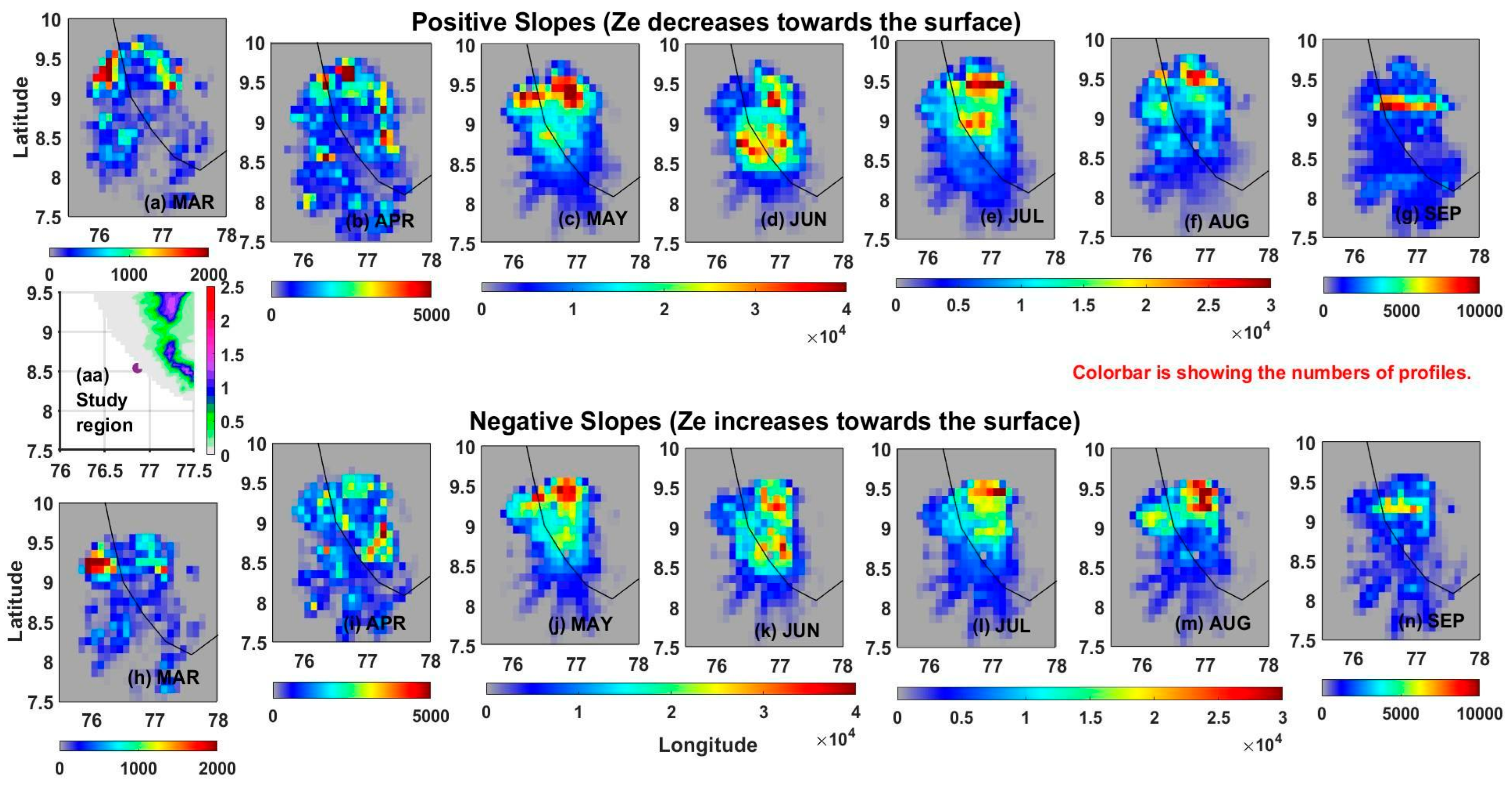
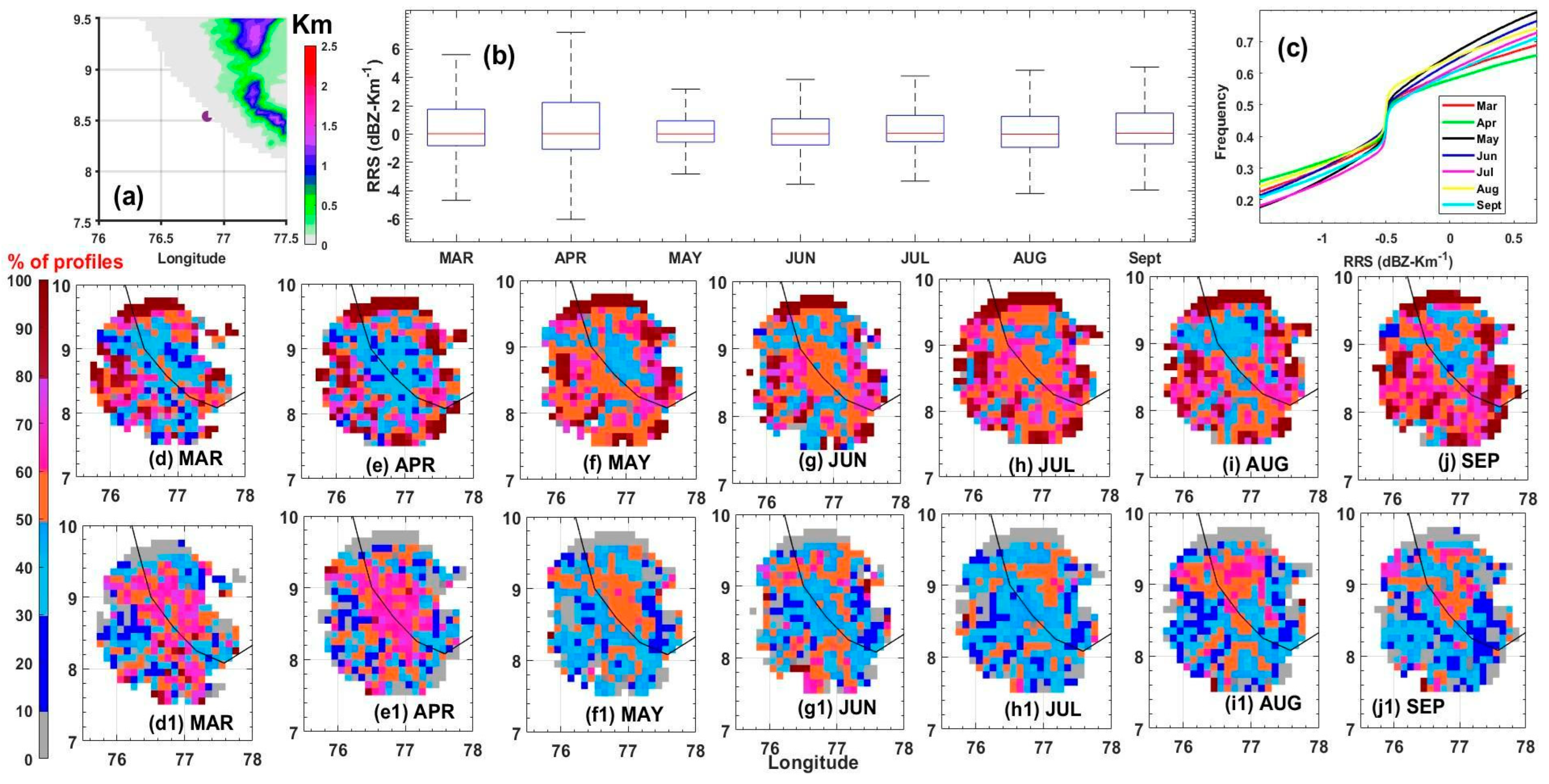
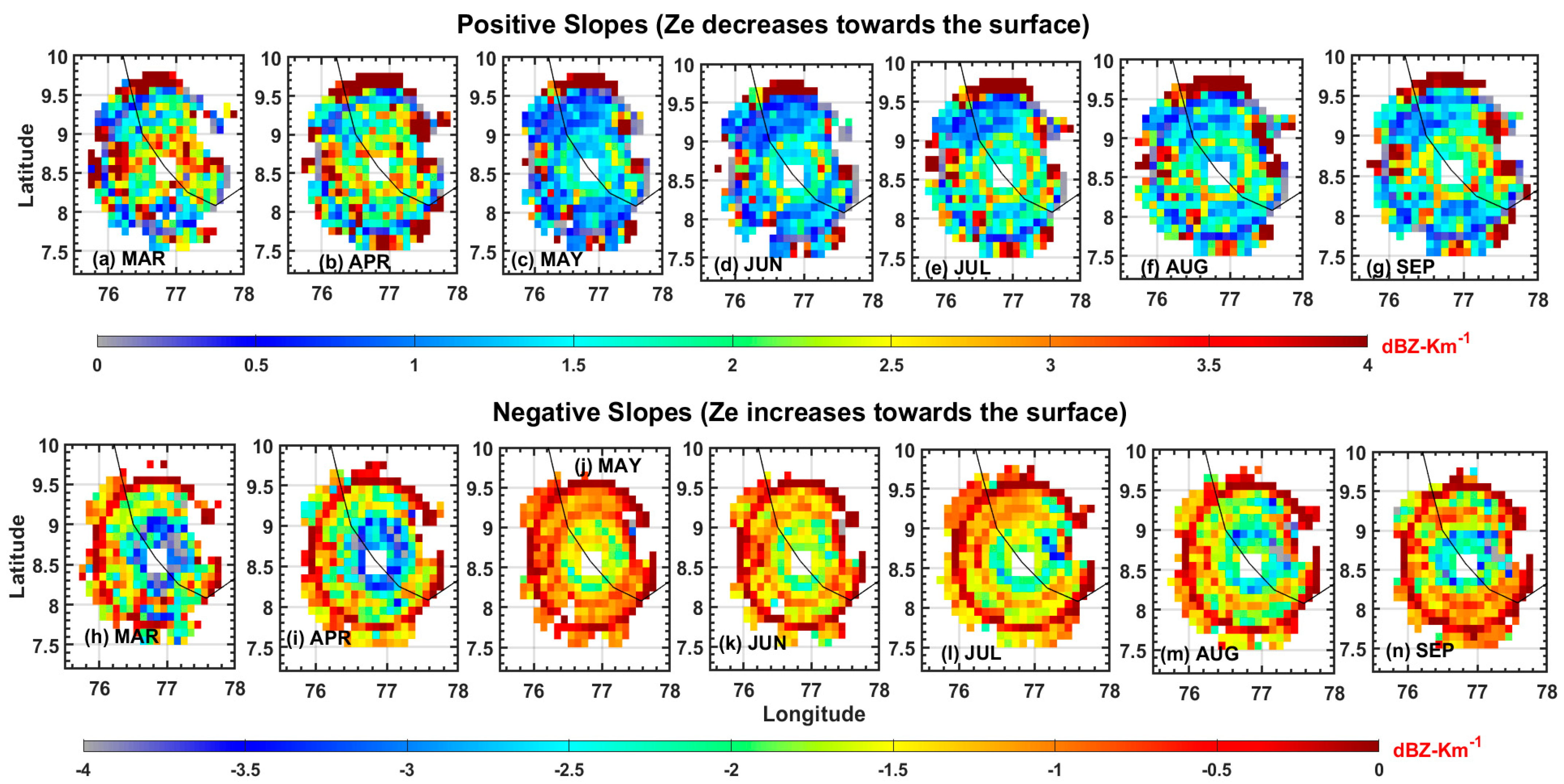
- Monthly variations in radar reflectivity slope from the pre-monsoon to monsoon months are observed in the lower troposphere. The land–ocean contrasts of the vertical profiles contributing to positive and negative radar reflectivity slopes are less compared to north–south gradients and higher in monsoon months.
- Changes in radar reflectivity slope are significant during the monsoon months compared to the pre-monsoon months near the coastal boundaries. This reflects the role of advected moisture from the Arabian Sea into land regions during the monsoon seasons.
- The average radar reflectivity slopes show the highest positive and negative magnitudes near the coast across all months. The highest magnitudes of radar reflectivity slope are observed in March and April and are associated with fewer and more vertical Ze profiles, respectively.
- The increase or decrease in hydrometeor size is less during the monsoon months (June–July–August–September) compared to pre-monsoon months. The March–April months show the largest increases or decreases in hydrometeor size in the lower troposphere.
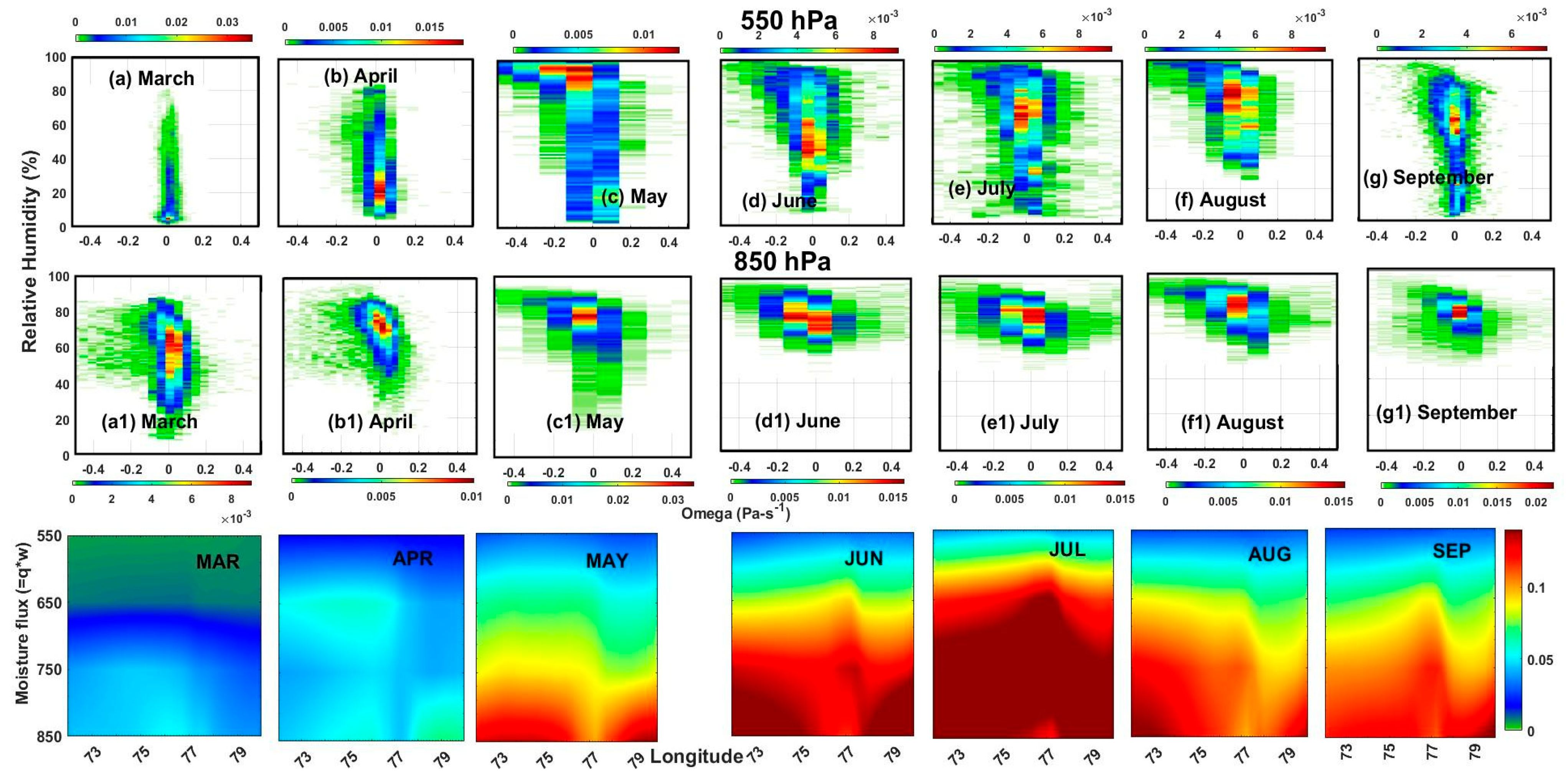
- The variations in the radar reflectivity slopes are the combined effect of the atmospheric thermodynamic (RH and moisture flux) and dynamic conditions (vertical velocity). For example, in March and April, the atmosphere is dry, and the largest decrease in hydrometeor size is observed near the coastal boundary. However, we also see significantly steeper negative radar reflectivity slopes where lower updraught and downdraught allow hydrometeors to grow.
- A strong updraught takes RH to higher altitudes, making the atmosphere drier and contributing to a positive S-Ze. Ze tends to decrease in the lower troposphere. At the same time, a weak updraught with sufficient RH provides enough time for the hydrometeors to grow and contribute to negative S-Ze, and Ze tends to increase towards the surface in the lower troposphere.
Funding
Institutional Review Board Statement
Informed Consent Statement
Data Availability Statement
Conflicts of Interest
References
- Rajeevan, M.; Kesarkar, A.; Thampi, S.B.; Rao, T.N.; Radhakrishna, B.; Rajasekhar, M. Sensitivity of WRF cloud microphysics to simulations of a severe thunderstorm event over Southeast India. Ann. Geophys. 2010, 28, 603–619. [Google Scholar] [CrossRef]
- Litta, A.J.; Mohanty, U.C.; Das, S.; Mary Idicula, S. Numerical simulation of severe local storms over East India using the WRF-NMM mesoscale model. Atmos. Res. 2012, 116, 161–184. [Google Scholar] [CrossRef]
- Mukhopadhyay, P.; Mahakur, M.; Singh, H.A.K. The interaction of large scale and mesoscale environments leading to the formation of intense thunderstorms over Kolkata, Part I: Doppler radar and satellite observations. J. Earth Syst. Sci. 2009, 118, 441–466. [Google Scholar] [CrossRef]
- Suresh, R. Forecasting and nowcasting convective weather phenomena over southern peninsular India—Part I: Thunderstorms. Indian J. Radio Space Phys. 2012, 41, 421–434. [Google Scholar]
- Srivastava, K.; Roy Bhowmik, S.K.; Sen Roy, S.; Thampi, S.B.; Reddy, Y.K. Simulation of high impact convective events over Indian region by the ARPS model with assimilation of Doppler weather radar radial velocity and reflectivity. Atmosfera 2010, 23, 53–73. [Google Scholar]
- Marshall, J.S.; Palmer, W.M. The distribution of raindrops with size. J. Meteorol. 1948, 5, 165–166. [Google Scholar] [CrossRef]
- Fabry, F.; Zawadzki, I. Long-Term Radar Observations of the Melting Layer of Precipitation and Their Interpretation. J. Atmos. Sci. 1995, 52, 838–851. [Google Scholar] [CrossRef]
- Vignal, B.; Galli, G.; Joss, J.; Germann, U. Three methods to determine profiles of reflectivity from volumetric radar data to correct precipitation estimates. J. Appl. Meteorol. Clim. 2000, 39, 1715–1726. [Google Scholar] [CrossRef]
- Bellon, A.; Lee, G.W.; Zawadzki, I. Error Statistics of VPR Corrections in Stratiform Precipitation. J. Appl. Meteorol. Clim. 2005, 44, 998–1015. [Google Scholar] [CrossRef]
- Liu, C.; Zipser, E.J. Why Does Radar Reflectivity Tend to Increase Downward Toward the Ocean Surface, but Decrease Downward Toward the Land Surface? J. Geophys. Res. Atmos. 2013, 118, 135–148. [Google Scholar] [CrossRef]
- Li, X.; Srivastava, R.C. An Analytical Solution for Raindrop Evaporation and Its Application to Radar Rainfall Measurements. J. Appl. Meteorol. Clim. 2001, 40, 1607–1616. [Google Scholar] [CrossRef]
- Adler, R.F.; Huffman, G.J.; Chang, A.; Ferraro, R.; Xie, P.-P.; Janowiak, J.; Rudolf, B.; Schneider, U.; Curtis, S.; Bolvin, D.; et al. The Version-2 Global Precipitation Climatology Project [GPCP] Monthly Precipitation Analysis [1979–Present]. J. Hydrometeor. 2003, 4, 1147–1167. [Google Scholar] [CrossRef]
- Kumjian, M.R.; Prat, O.P. The impact of raindrop collisional processes on the polarimetric radar variables. J. Atmos. Sci. 2014, 71, 3052–3067. [Google Scholar] [CrossRef]
- Huang, H.; Chen, F. Precipitation Microphysics of Tropical Cyclones Over the Western North Pacific Based on GPM DPR Observations: A Preliminary Analysis. J. Geophys. Res. Atmos. 2019, 124, 3124–3142. [Google Scholar] [CrossRef]
- Del Castillo-Velarde, C.; Kumar, S.; Valdivia-Prado, J.M.; Moya-Álvarez, A.S.; Flores-Rojas, J.L.; Villalobos-Puma, E.; Martínez-Castro, D.; Silva-Vidal, Y. Evaluation of GPM dual-frequency precipitation radar algorithms to estimate drop size distribution parameters, using ground-based measurement over the central Andes of Peru. Earth Syst. Environ. 2021, 5, 597–619. [Google Scholar] [CrossRef]
- Li, Q.; Sun, X.; Liu, X.; Li, H. Linkage Between Radar Reflectivity Slope and Raindrop Size Distribution in Precipitation with Bright Bands. Remote Sens. 2025, 17, 2393. [Google Scholar] [CrossRef]
- Fu, Y.; Lin, Y.; Liu, G.; Wang, Q. Seasonal Characteristics of Precipitation in 1998 Over East Asia as Derived from TRMM PR. Adv. Atmos. Sci. 2003, 20, 511–529. [Google Scholar]
- Liu, G.; Fu, Y. The characteristics of tropical precipitation profiles as inferred from satellite radar measurements. J. Meteorol. Soc. Jpn. 2001, 79, 131–143. [Google Scholar] [CrossRef]
- Das, S.; Shukla, A.K.; Maitra, A. Investigation of Vertical Profile of Rain Microstructure at Ahmedabad in Indian Tropical Region. Adv. Space Res. 2016, 45, 1235–1243. [Google Scholar] [CrossRef]
- Kumar, S. Investigation of radar reflectivity profiles below the freezing level over Southeast Asia using TRMM and Megha-Tropiques satellites. Remote Sens. Lett. 2024, 15, 1250–1258. [Google Scholar] [CrossRef]
- Parker, M.D.; Johnson, R.H. Organizational Modes of Midlatitude Mesoscale Convective Systems. Mon. Weather Rev. 2000, 128, 3413–3436. [Google Scholar] [CrossRef]
- Rutledge, S.A.; Houze, R.A., Jr. A Diagnostic Modelling Study of the Trailing Stratiform Region of a Midlatitude Squall Line. J. Atmos. Sci. 1987, 44, 2640–2656. [Google Scholar] [CrossRef][Green Version]
- Leary, C.A.; Houze, R.A. The Structure and Evolution of Convection in a Tropical Cloud Cluster. J. Atmos. Sci. 1979, 36, 437–457. [Google Scholar] [CrossRef]
- Kumar, S.; Bhat, G.S. Frequency of a State of Cloud Systems Over Tropical Warm Ocean. Environ. Res. Commun. 2019, 1, 061003. [Google Scholar] [CrossRef]
- Kumar, S.; Del Castillo-Velarde, C.; Rojas, J.L.F.; Moya-Álvarez, A.; Castro, D.M.; Srivastava, S.; Silva, Y. Precipitation Structure During Various Phases the Life Cycle of Precipitating Cloud Systems Using Geostationary Satellite and Space-Based Precipitation Radar Over Peru. GIScience Remote Sens. 2020, 57, 1057–1082. [Google Scholar] [CrossRef]
- Kumar, S.; Srivastava, S. Vertical characteristics of precipitating cloud systems during different phases of life cycle of cloud systems using satellite-based radar over tropical oceanic areas. J. Appl. Nat. Sci. 2022, 14, 1272–1285. [Google Scholar] [CrossRef]
- Cifelli, R.; Nesbitt, S.W.; Rutledge, S.A.; Petersen, W.A.; Yuter, S. Radar Characteristics of Precipitation Features in the EPIC and TEPPS Regions of the East Pacific. Mon. Weather. Rev. 2007, 135, 1576–1595. [Google Scholar] [CrossRef][Green Version]
- Krishnakumar, K.; Rao, G.P.; Gopakumar, C. Rainfall trends in twentieth century over Kerala, India. Atmos. Environ. 2009, 43, 1940–1944. [Google Scholar] [CrossRef]
- Gray, W.M.; Jacobson, R.W., Jr. Diurnal variation of deep cumulus convection. Mon. Weather Rev. 1977, 105, 1171–1188. [Google Scholar] [CrossRef]
- Subrahmanyam, K.V.; Kumar, K.K. C-band polarimetric doppler weather radar observations during an extreme precipitation event and associated dynamics over Peninsular India. Nat. Hazards 2022, 114, 1307–1322. [Google Scholar] [CrossRef]
- Mohanty, U.C.; Dube, S.K.; Singh, M.P. A Study of Heat and Moisture Budget in the Arabian Sea and their Role in the Onset and Maintenance of Summer Monsoon. J. Meteorol. Soc. Jpn. 1983, 61, 208–221. [Google Scholar] [CrossRef]
- Romatschke, U.; Houze, R.A., Jr. Characteristics of precipitating convective systems in the premonsoon season of South Asia. J. Hydrometeorol. 2011, 12, 157–180. [Google Scholar] [CrossRef]
- Romatschke, U.; Houze, R.A., Jr. Characteristics of precipitating convective systems in the South Asian monsoon. J. Hydrometeorol. 2011, 12, 3–26. [Google Scholar] [CrossRef]
- Jash, D.; Resmi, E.A.; Unnikrishnan, C.K.; Sumesh, R.K.; Kumar, S.; Sukumar, N. Analysis of Pre-Monsoon Convective Systems over a Tropical Coastal Region Using C-Band Polarimetric Radar, Satellite and Numerical Simulation. Atmosphere 2022, 13, 1349. [Google Scholar] [CrossRef]
- Hirose, M.; Nakamura, K. Spatial and Seasonal Variation of Rain Profiles over Asia Observed by Space Borne Precipitation Radar. J. Clim. 2002, 15, 3443–3458. [Google Scholar] [CrossRef]
- Hirose, M.; Nakamura, K. Spatiotemporal Variation of the Vertical Gradient of Rainfall Rate Observed by the TRMM Precipitation Radar. J. Clim. 2004, 17, 3378–3397. [Google Scholar] [CrossRef]
- Kumar, S. Regional and Seasonal Differences of Radar Reflectivity Slopes in Lower Troposphere in Convective and Stratiform Precipitation Using TRMM PR Data. Theor. Appl. Clim. 2024, 155, 2719–2728. [Google Scholar] [CrossRef]
- Imaoka, K.; Nakamura, K. Statistical Analysis of the Life Cycle of Isolated Tropical Cold Cloud Systems Using MTSAT-1R and TRMM Data. Mon. Weather Rev. 2012, 140, 3552–3572. [Google Scholar] [CrossRef]
- Kumar, S.; Bhat, G.S. Vertical structure of orographic precipitating clouds observed over south Asia during summer monsoon season. J. Earth Syst. Sci. 2017, 126, 114. [Google Scholar] [CrossRef]
- Panda, S.K.; Shukla, B.P.; Kumar, P. Clutter Mitigation and 3D Volumetric Gridding of TERLS DWR Reflectivity Data [V1.0], SAC Report, SAC/EPSA/AOSG/SR/19/2018. Available online: https://www.mosdac.gov.in/3d-volumetric-terls-dwrproduct (accessed on 19 May 2026).
- Kumar, K.K.; Subrahmanyam, K.V.; Kumar, C.P.; Shanmugasundari, J.; Koushik, N.; Ajith, R.P.; Girija Devi, L. C-band dual-polarisation Doppler weather radar at Thumba [8.537° N, 76.865° E]: Initial results and validation. J. Appl. Remote Sens. 2020, 14, 044509. [Google Scholar] [CrossRef]
- Mishra, S.; Shanmuga Sundari, J.; Channabasava, B.; Anandan, V.K. First indigenously developed polarimetric C-band Doppler weather radar in India and its first hand validation results. J. Electromagn. Waves Appl. 2020, 34, 825–840. [Google Scholar] [CrossRef]
- Johnson, R.H.; Aves, S.L.; Ciesielski, P.E.; Keenan, T.D. Organisation of oceanic convection during the onset of the 1998 East Asian summer monsoon. Mon. Weather Rev. 2005, 133, 131–148. [Google Scholar] [CrossRef]
- Yuter, S.E.; Houze, R.A., Jr.; Smith, E.A.; Wilheit, T.T.; Zipser, E. Physical characterisation of tropical oceanic convection observed in KWAJEX. J. Appl. Meteorol. Clim. 2005, 44, 385–415. [Google Scholar] [CrossRef]
- Zipser, E.J.; Lutz, K.R. The vertical profile of radar reflectivity of convective cells is a strong indicator of storm intensity and lightning probability? Mon. Weather Rev. 1994, 122, 1751–1759. [Google Scholar] [CrossRef]
- Szoke, E.J.; Zipser, E.J. A radar study of convective cells in mesoscale systems in GATE. Part II: Life cycles of convective cells. J. Atmos. Sci. 1986, 43, 199–218. [Google Scholar] [CrossRef]
- Pisharoty, P.R. Evaporation from the Arabian Sea and the Indian southwest monsoon. In Proceedings of the Symposium on Meteorological Results of the International Indian Ocean Expedition, Bombay, India, 22–26 July 1965; India Meteorological Department: New Delhi, India, 1965. [Google Scholar]
- Ghosh, S.K.; Pant, M.C.; Dewan, B.N. Influence of the Arabian Sea on the Indian summer monsoon. Tellus 1978, 30, 117–125. [Google Scholar] [CrossRef]
- Levine, R.C.; Turner, A.G. Dependence of Indian monsoon rainfall on moisture fluxes across the Arabian Sea and the impact of coupled model sea surface temperature biases. Clim. Dyn. 2012, 38, 2167–2190. [Google Scholar] [CrossRef]
- Murakami, T.; Nakazawa, T.; He, T. On the 40–50 day oscillation during the 1979 Northern Hemisphere summer: Part II: Heat and moisture budget. J. Meteorol. Soc. Jpn. 1984, 62, 469–484. [Google Scholar] [CrossRef]
- Clemens, S.C.; Oglesby, R.J. Interhemispheric moisture transport in the Indian Ocean summer monsoon: Data-model and model-model comparisons. Paleoceanography 1992, 7, 633–643. [Google Scholar] [CrossRef]
- Swapna, P.; Ramesh Kumar, M.R. Role of low level flow on the summer monsoon rainfall over the Indian subcontinent during two contrasting monsoon years. J. Indian Geophys. Union 2002, 6, 123–137. [Google Scholar]
- Patil, C.; Prabhakaran, T.; Ray, K.C.S.; Karipot, A. Revisiting moisture transport during the Indian summer monsoon using the moisture river concept. Pure Appl. Geophys. 2019, 176, 5107–5123. [Google Scholar] [CrossRef]
- Gimeno, L.; Drumond, A.; Nieto, R.; Trigo, R.M.; Stohl, A. On the origin of continental precipitation. Geophys. Res. Lett. 2010, 37, L13804. [Google Scholar] [CrossRef]
- Stohl, A.; James, P. ALagrangian analysis of the atmospheric branch of the global water cycle. Part I: Method description, validation, and demonstration for the August 2002 flooding in central Europe. J. Hydrometeorol. 2004, 5, 656–678. [Google Scholar] [CrossRef]
- Stohl, A.; James, P. A Lagrangian analysis of the atmospheric branch of the global water cycle. Part II: Earth’s river catchments, ocean basins, and moisture transports between them. J. Hydrometeorol. 2005, 6, 961–984. [Google Scholar] [CrossRef]
- Ordóñez, P.; Ribera, P.; Gallego, D.; Peña-Ortiz, C. Major moisture sources for western and southern India and their role on synoptic-scale rainfall events. Hydrol. Process. 2012, 26, 3886–3895. [Google Scholar] [CrossRef]
- Gadgil, S. The Indian monsoon and its variability. Annu. Rev. Earth Planet. Sci. 2003, 31, 429–467. [Google Scholar] [CrossRef]
- Mooley, D.A. Independence of Southeast-Asian summer monsoon rainfall. Bull. Am. Meteorol. Soc. 1970, 51, 298. [Google Scholar]
- Mooley, D.A. Some aspects of Indian monsoon depressions and associated rainfall. Mon. Weather Rev. 1973, 101, 271–280. [Google Scholar] [CrossRef]
- Mooley, D.A. Major climatological discontinuities in monthly activity of summer monsoon over Asia. Pure Appl. Geophys. 1974, 112, 546–552. [Google Scholar] [CrossRef]
- Mooley, D.A.; Parthasarathy, B. Fluctuations in all-India summer monsoon rainfall during 1871–1978. Clim. Change 1984, 6, 287–301. [Google Scholar] [CrossRef]
- Rao, K.G.; Goswami, B.N. Interannual variations of sea-surface temperature over the Arabian Sea and the Indian monsoon—A new perspective. Mon. Weather Rev. 1988, 116, 558–568. [Google Scholar] [CrossRef]
- Winstanl, D. Rainfall patterns and general atmospheric circulation. Nature 1973, 245, 190–194. [Google Scholar] [CrossRef]
- Kalnay, E.; Kanamitsu, M.; Kistler, R.; Collins, W.; Deaven, D.; Gandin, L.; Iredell, M.; Saha, S.; White, G.; Woollen, J.; et al. The NCEP/NCAR 40-Year Reanalysis Project. Bull. Am. Meteorol. Soc. 1996, 77, 437–471. [Google Scholar] [CrossRef]
- Uma, K.N.; Sama, B. Characteristics of monsoon convection and its interaction with the large-scale environment over the gateway of the Indian summer monsoon: Insights from radar observations and reanalysis. Clim. Dyn. 2025, 63, 379. [Google Scholar] [CrossRef]
- Subrahmanyam, K.V.; Kumar, K.K. Characterisation of deep convective cells during the Indian summer monsoon using C-band polarimetric Doppler weather radar observations over Thumba [8.5° N, 77° E]. Remote Sens. Appl. Soc. Environ. 2023, 30, 100956. [Google Scholar]
- Trenberth, K.E. Atmospheric moisture recycling: Role of advection and local evaporation. J. Clim. 1999, 12, 1368–1381. [Google Scholar] [CrossRef]
- Schumacher, C.; Houze, R.A., Jr. The TRMM Precipitation Radar’s View of Shallow, Isolated Rain. J. Appl. Meteorol. 2003, 42, 1519–1524. [Google Scholar] [CrossRef]
- Lucas, C.; Zipser, E.J.; LeMone, M.A. Vertical Velocity in Oceanic Convection off Tropical Australia. J. Atmos. Sci. 1994, 51, 3183–3193. [Google Scholar] [CrossRef]
- Houze, R.A. Orographic Effects on Precipitating Clouds. Rev. Geophys. 2012, 50, RG1001. [Google Scholar] [CrossRef]
- Kumar, S. Effect of surface wind flow, relative humidity, vertical velocity and topography on convective organisations over Western Ghats using TRMM, GPM, Megha-Tropiques satellites and ERA reanalysis data. Theor. Appl. Climatol. 2026, 157, 363. [Google Scholar] [CrossRef]
- Kumar, S. Precipitation structure and convective intensity over Southeast South Asia during active and break spells of the Indian summer monsoon using TRMM, GPM, Megha-Tropiques satellites and reanalysis data. Int. J. Climatol. 2025, 45, e8758. [Google Scholar] [CrossRef]
- Kumar, S. Differences in the convective variability during active and break spells over South Asian region using 25 years of satellite observations and reanalysis data. Theor. Appl. Climatol. 2025, 156, 415. [Google Scholar] [CrossRef]
- Kondo, Y.; Higuchi, A.; Nakamura, K. Small-scale cloud activity over the Maritime Continent and the Western Pacific as revealed by satellite data. Mon. Weather Rev. 2006, 134, 1581–1599. [Google Scholar] [CrossRef]
- Houze, R.A., Jr.; Wilton, D.C.; Smull, F.B. Monsoon convection in the Himalayan region as seen by the TRMM precipitation radar. Q. J. R. Meteorol. Soc. 2007, 133, 1389–1411. [Google Scholar] [CrossRef]
- Kumar, S. Vertical structure of precipitating shallow echoes observed from TRMM during Indian summer monsoon. Theor. Appl. Climatol. 2018, 133, 1051–1059. [Google Scholar] [CrossRef]


Disclaimer/Publisher’s Note: The statements, opinions and data contained in all publications are solely those of the individual author(s) and contributor(s) and not of MDPI and/or the editor(s). MDPI and/or the editor(s) disclaim responsibility for any injury to people or property resulting from any ideas, methods, instructions or products referred to in the content. |
© 2026 by the author. Licensee MDPI, Basel, Switzerland. This article is an open access article distributed under the terms and conditions of the Creative Commons Attribution (CC BY) license.
Share and Cite
Kumar, S. Variation in Radar Reflectivity Slopes in the Lower Troposphere at the West Coast of India During Pre-Monsoon and Monsoon Seasons Using Ground-Based C-Band Radar. Meteorology 2026, 5, 15. https://doi.org/10.3390/meteorology5020015
Kumar S. Variation in Radar Reflectivity Slopes in the Lower Troposphere at the West Coast of India During Pre-Monsoon and Monsoon Seasons Using Ground-Based C-Band Radar. Meteorology. 2026; 5(2):15. https://doi.org/10.3390/meteorology5020015
Chicago/Turabian StyleKumar, Shailendra. 2026. "Variation in Radar Reflectivity Slopes in the Lower Troposphere at the West Coast of India During Pre-Monsoon and Monsoon Seasons Using Ground-Based C-Band Radar" Meteorology 5, no. 2: 15. https://doi.org/10.3390/meteorology5020015
APA StyleKumar, S. (2026). Variation in Radar Reflectivity Slopes in the Lower Troposphere at the West Coast of India During Pre-Monsoon and Monsoon Seasons Using Ground-Based C-Band Radar. Meteorology, 5(2), 15. https://doi.org/10.3390/meteorology5020015