Article

Variation in Radar Reflectivity Slopes in the Lower Troposphere at the West Coast of India During Pre-Monsoon and Monsoon Seasons Using Ground-Based C-Band Radar

Space Physics Laboratory, Vikram Sarabhai Space Centre, Trivandrum 695022, India
Meteorology 2026, 5(2), 15; https://doi.org/10.3390/meteorology5020015
Submission received: 24 March 2026 / Revised: 20 May 2026 / Accepted: 29 May 2026 / Published: 12 June 2026

Abstract

The present study investigates the statistical distribution of radar reflectivity slopes [S-Ze] in the lower troposphere along the west coast of India using a C-band radar during the pre-monsoon and monsoon seasons in 2024. The study period spans a range of meteorological conditions, from a drier atmosphere during pre-monsoon months to a moist atmosphere during the monsoon months, with varying updraughts and downdraughts. To investigate the S-Ze, we calculated the difference in Ze between 4 km and 2 km altitudes in the lower troposphere. The S-Ze could be either positive or negative, where, in a positive [negative] S-Ze, the Ze decreases [increases] towards the surface. The monthly variations in S-Ze from the pre-monsoon to monsoon months are observed in the lower troposphere and are higher in monsoon months compared to pre-monsoon months, which are too near the coast. The land–ocean contrasts of the vertical profiles contributing to +ve and −ve S-Ze are lower compared to north–south gradients and higher in monsoon months. The average S-Ze shows the highest +ve and −ve S-Ze magnitude near the coast among all the months. The highest magnitude in S-Ze is observed in March and April and is associated with the lower and higher numbers of vertical Ze profiles. The increase or decrease in hydrometeor size is less during the monsoon months (June, July, August, and September) compared to pre-monsoon months, where the March–April months have the highest increase or decrease in the hydrometeor’s size in the lower troposphere. The variations in the S-Ze are the combined effect of the atmospheric, thermodynamic (relative humidity (RH) and moisture flux), and dynamic conditions (zonal, meridional, and vertical velocity). Strong updraughts that carry RH to higher altitudes make the lower atmosphere drier and contribute to a +ve S-Ze; Ze tends to decrease in the lower troposphere. However, a weaker updraught or a moderate downdraught with sufficient RH provides sufficient time for hydrometeors to grow and contributes to −ve S-Ze, and Ze tends to increase in the lower troposphere. For example, in March and April, the atmosphere is dry, and we observe the largest decrease in hydrometeors near the coastal boundary. However, we also see significantly higher negative radar reflectivity slopes, and weak downdraughts provide enough time for hydrometeors to grow. In June and July, there are strong updraughts (downdraughts) with high (low) RH, making the atmosphere more conducive to a decreasing tendency in Ze and contributing to a higher fraction of +ve S-Ze. The results presented here would be an extension of the study from the satellite-based observations, revealing the extension of climatology for the inclusion of stratiform precipitation.

1. Introduction

Radar is one of the most relevant and reliable instruments to monitor three-dimensional precipitation, from its genesis to its dissipation, using the radar reflectivity factor [1,2,3,4,5]. However, it does not directly measure the precipitation depth compared to a rain gauge; thus, an empirical relationship [Z is reflectivity and R is rain rate; Z = aRb] is required to estimate the surface rainfall [6], which is commonly used nowadays. In the mentioned equation, radar reflectivity is in mm6m−3, whereas the rain rate (RR) is in mm-h−1. Previously, ground-based radar was used to estimate the near-surface rainfall, using the radar reflectivity factor [7,8,9] mostly over land-dominated regions. Still, after having so much development in the radar-rainfall equations, estimating the near-surface rainfall rate [RR] is one of the most challenging tasks [9,10,11] because of the variations in raindrops’ mass led by variations in the microphysical processes such as evaporation, fragmentation, accumulation, and collision–coalescence in the lower troposphere [10,11,12,13,14,15,16]. This also changes the total rainwater arriving at the surface from several kilometers above the ground [10,17]. For example, when a low cloud base exists and raindrops descend within the clouds, the RR rises because of the aggregation of cloud droplets [18]. In this context, changes in RR are seen as either a loss or an increase in the masses of raindrops from evaporation, breakup, or collision–coalescence influenced by varying meteorological conditions [19]. The differences in raindrops are influenced by different types of precipitation [convective/stratiform], their intensity, geographical locations [land, ocean, and terrain], and meteorological conditions [19,20]. For example, vertical wind shear and vertically tilted clouds cause the difference in the precipitation near the surface and several kilometers above the surface [21,22]. The differences in the hydrometeors’ size are also affected by the various stages of the life cycles of precipitating cloud systems in the lower troposphere, as well as by the types of precipitation [e.g., convective or stratiform precipitation] [23,24,25,26]. Terrestrial and marine regions also exhibit different trends in RR below the freezing height (FZH) [27]. Therefore, grasping the vertical changes in RR and hydrometeors’ size in the lower troposphere is crucial for examining surface rainfall.
Rainfall over the Indian subcontinent is divided into three major seasons: pre-monsoon [March–April–May], monsoon [June–July–August–September], and post-monsoon [October–November–December] seasons [28]. The convective environment over the Indian subcontinent is very hot and dry during pre-monsoon conditions compared to the monsoon period, which is mostly moist [28]. Earlier studies reported that the intensification of low-level jets during the monsoon seasons and heating of the mountain slope trigger convection, which plays a key role in the formation of precipitating systems over the mountain region [29,30]. Deep convection is intermittent during the pre-monsoon period, whereas stratiform clouds occur during the monsoon period. The middle layers are observed to be dry prior to the monsoon onset month, when the intensified low-level jet consistently moistens the atmosphere and increases daily precipitation and vertically integrated water vapor [31]. The high temperature and moisture availability make Kerala and parts of Karnataka and Tamil Nadu vulnerable to thunderstorms in the evening and night hours of the pre-monsoon period. Romatschke and Houze [32,33,34] showed that precipitation during pre-monsoon months is more convective. They showed that India’s west coast consists of smaller systems that contribute to surface rainfall. The pre-monsoon season witnesses severe local thunderstorms near the foothills of the southwest coast of India [19,32,33] that have the potential to trigger landslides and flash floods. Jash et al. [34] used the C-band polarimetric Doppler weather radar data to investigate the features of pre-monsoon thunderstorms over southern peninsular India and observed that the percentages of convective and stratiform pixels were 22% and 78%, respectively.
Previously, the attenuated corrected radar reflectivity factor [Ze] observed from the Tropical Rainfall Measuring Mission [TRMM]-based precipitation radar (PR) [35,36] was used to investigate the vertical gradient in RR below 4 km altitude [taking the difference in RR at 3.5 and 2 km altitude]. They [35,36] showed different characteristics of the RR gradient across different tropical weather regimes [10,37]. Both studies [35,36] also showed monthly and regional variation in Ze and RR gradients below the FZH, which were associated with meteorological conditions and the intensity of convection. Liu and Zipser [10] used a linear regression approach to estimate the slope of Ze below 4 km altitude and showed that Ze mostly increases [decreases] towards the surface over ocean [land] [20,37]. Kumar [20] showed that convective precipitation has a higher fraction of negative slopes over the ocean, whereas land has a similar fraction of positive and negative slopes. They also showed that stratiform precipitation has a nearly equal fraction of positive and negative slopes over the ocean, whereas land has a higher fraction of positive slopes.
Liu and Zipser [10] demonstrated that vertical profiles with their echo tops exceeding the FZH exhibit both positive and negative slopes beneath 4 km. They also showed that during the monsoonal months, the majority of convective areas with echo tops exceeding 4.5 km show a reduction in maximum reflectivity in Southeast Asia, and nearly ~50% of profiles with bright band [BB] tend to increase towards the surface. Hirose and Nakamura [35] showed that variations in radar reflectivity below the FZH depend on the seasons and the progression of the monsoon across the Indian land and oceanic regimes. Continuous precipitation observations during day and night will capture the variability in the lower troposphere across all phases of cloud systems, unlike TRMM and GPM, which provide snapshots and correspond mostly to mature phases [24,38]. Ground-based radar provides continuous measurements of Ze very close to the surface for both convective and stratiform precipitation. The main aim of the present study is to investigate differences in radar reflectivity slope in the lower troposphere across different meteorological conditions. Here, we present the monthly climatology of variation in Ze (whether Ze increases or decreases towards the surface) in the lower troposphere for 2024 during the pre-monsoon to monsoon months.

2. Data and Methods

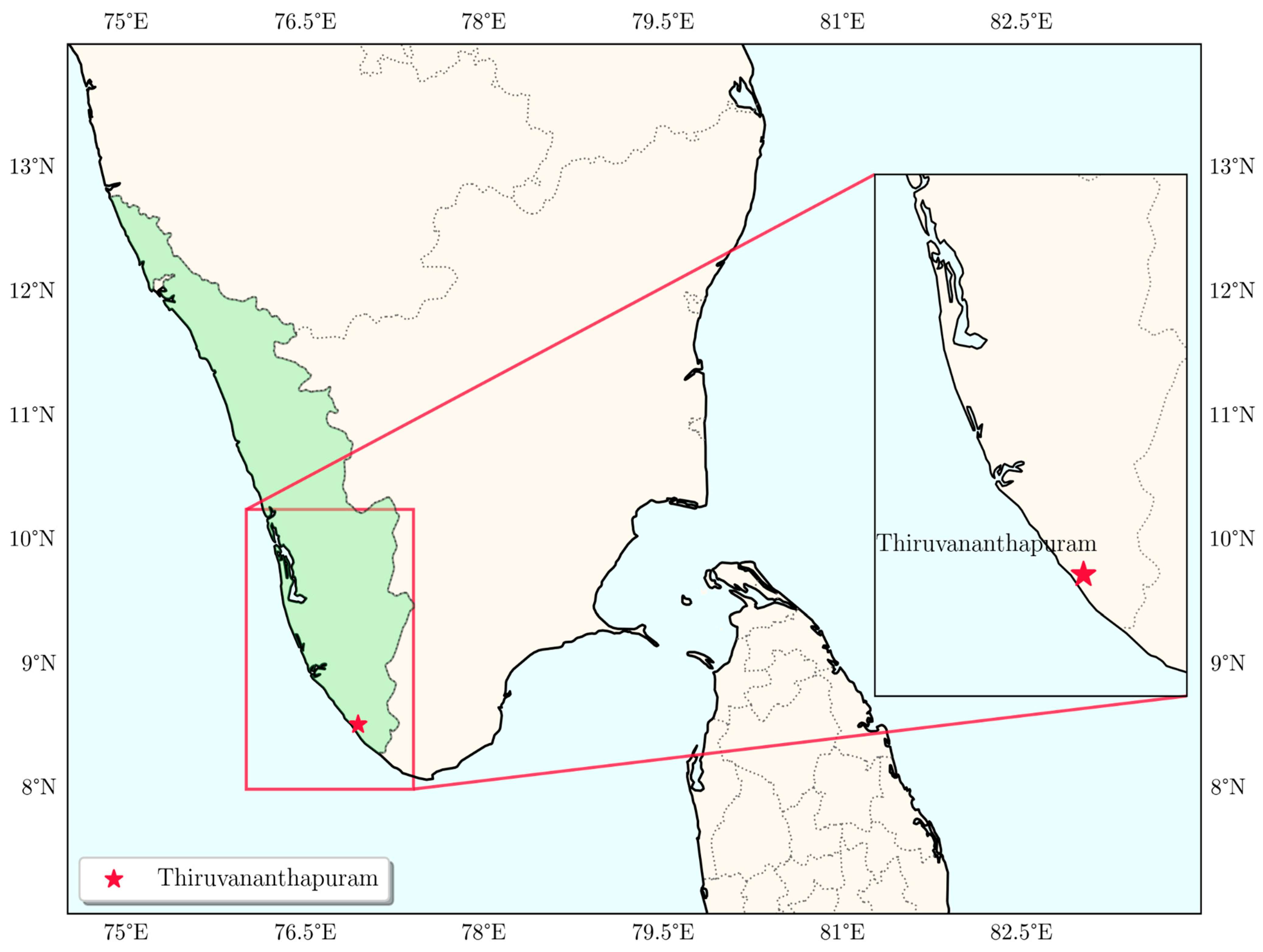
The current research utilizes the 3D volumetric gridded Ze data from the C-band polarimetric Doppler weather radar [DWR, wavelength: 5.33 cm; frequency: 5.625 GHz; antenna gain: 45 dB] installed at Thumba, Trivandrum, India. The DWR is positioned along the AS coast and bordered by the Western Ghats to the east [Figure 1]. Kerala state is popularly known as the “Gateway of the Indian Summer Monsoon” of India and receives rainfall during the pre-monsoon, southwest monsoon, and post-monsoon months [28]. The location of our radar consists of land, ocean, coastal boundaries, and topographic features [39]. Thus, the present study provides information on the Ze variations at all types of geographical features, e.g., land, topography, and oceanic areas. Here, the Ze information is adjusted for clutter by combining spatial continuity filtering with a fuzzy-logic-derived echo classification algorithm [40]. The data are organized in a [481 × 481 × 81] grid, with a horizontal resolution of 1 km × 1 km [lon-lat] and a vertical resolution of 250 m. The highest altitude considered during gridding is 20.0 km. In the present study, a total of 273 days of continuous DWR-based Ze observations from March 2024 to September 2024 are analyzed [each file is 400 MB]. Comprehensive details regarding the C-band DWR can be found in [41,42]. The C-band radar is also validated with the Global Precipitation Measurement (GPM) satellites and provides a very good correlation [0.89].
Previously, ground-based radar Ze information was used to estimate the Ze variations over the land areas [7,8,9]. Cifelli et al. [27], Johnson et al. [43], and Yuter et al. [44] showed that Ze increases near the sea surface during convective precipitation. From a land-based radar in Darwin, Australia, Zipser and Lutz [45] showed that Ze profiles decrease towards the surface for continental storms, whereas they continue to increase towards the surface for oceanic storms. However, numerous other terrestrial areas exhibit profiles where reflectivity rises as one approaches the surface. Kumar and Bhat [39] used the Ze variation in the lower troposphere to distinguish the life-cycle properties of cloud systems across different tropical oceanic areas. They also showed that in convective precipitation, Ze decreases towards the surface, whereas in less stratiform precipitation, Ze increases towards the surface. Li et al. [16] also observed Ze variations in precipitation using the C/Ka band radar below the FZH and revealed that relative humidity [RH] and strong updrafts strongly affect the increase or decrease in Ze towards lower altitudes. Using the previous methods, we also calculated the slopes in Ze [S-Ze] from the vertical profiles of Ze observed by the C-band radar, using a similar approach [35,36]. To estimate the S-Ze, we calculated the difference between the Ze at 4 km and 2 km altitudes [S-Ze = Ze4 km − Ze2 km] [35,36], and S-Ze could be either positive or negative. For example, if S-Ze is greater than zero [+ve S-Ze], it suggests that Ze decreases towards the surface, while if S-Ze is less than zero [−ve S-Ze], it implies that Ze increases towards the surface. However, a few constraints are also applied here and mentioned below. For example, only vertical profiles extending to 2 km are used here to eliminate shallow clouds. Additionally, the Ze must be greater than 2 and less than 70 dBZ at altitudes between 2 and 5 km to remove unambiguous values [34]. Here, the calculated vertical gradient or slopes (S-Ze) are influenced by the time-averaged length of raindrops held in the atmosphere [46].
It is known that advected moisture from the surrounding oceans to the Indian subcontinent is linked to rainfall activity [47,48,49,50,51,52]. For example, it is observed that the transported moisture from the AS is, on average, 40% larger than the cross-equatorial flux from the southern Indian Ocean [53]. Along with the AS, the Indian Ocean is also considered an important moisture source over South Asia [54,55,56,57]. The wind during the Indian summer monsoon season (June to September) transports the moisture from AS to the Indian subcontinent and plays a significant role in producing the surface rainfall [58,59,60,61,62,63,64]. In regard to this, to investigate the effect of the vertical velocity and humidity, we also utilized the low-level humidity [RH in %], specific humidity [q in g-kg−1], u [zonal wind velocity] and v [meridional wind velocity] components and Omega [Pa-s−1; pressure vertical velocity] data from the NCEP (National Center for Environmental Prediction) [65] throughout the study periods. The moisture is calculated by using the equation ‘q × V’, where ‘q’ is specific humidity and ‘V’ is the resultant wind obtained from the zonal and meridional velocity components.

3. Results

3.1. Spatial Distribution of the Number of Ze Profiles Used in the Present Study

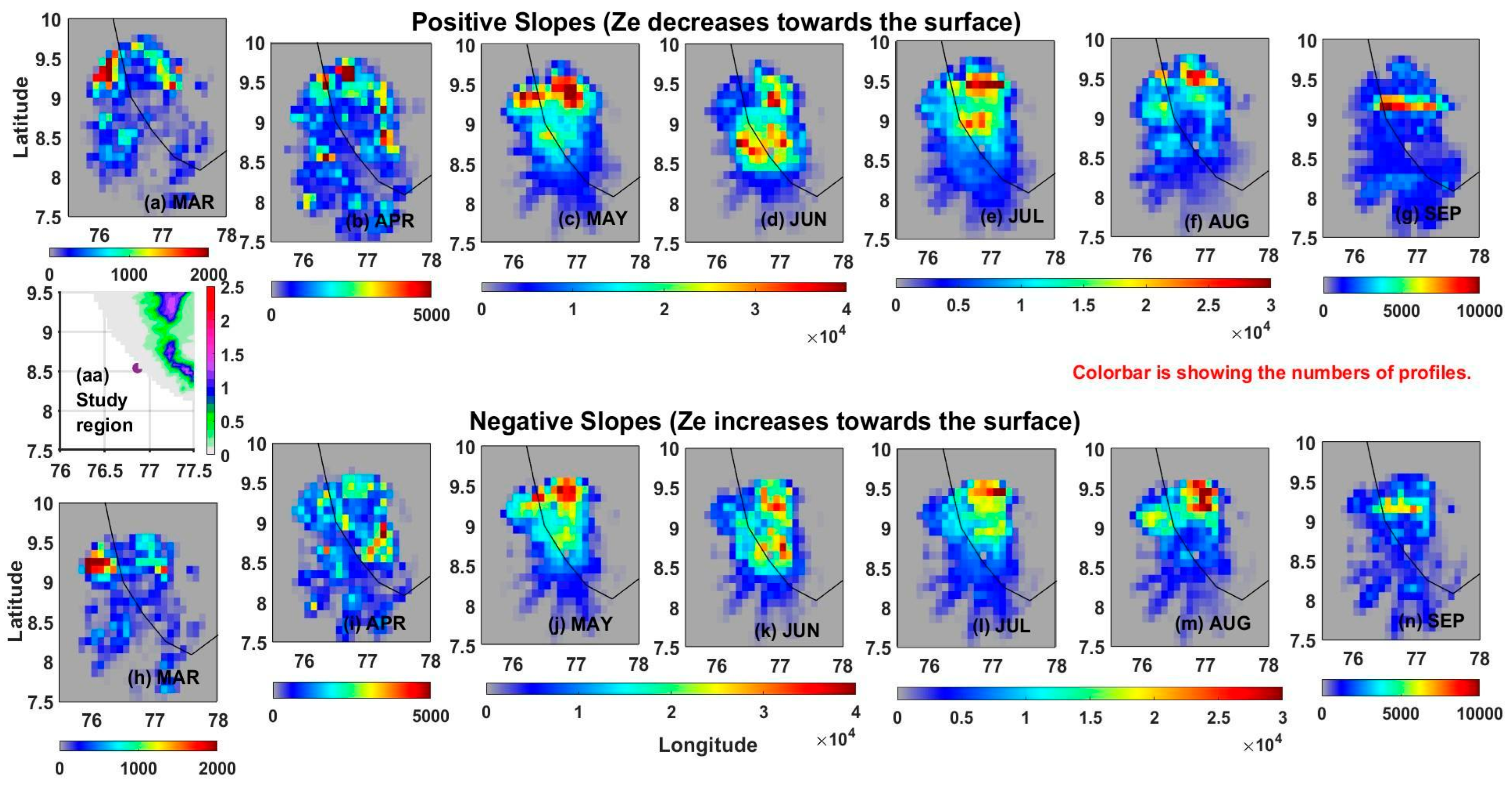
Figure 2 shows the spatial distribution of the number of vertical profiles used in the present study in each 0.1° × 0.1° grid box. It is observed that March and April have the fewest Ze profiles, followed by September. During the month of March, the land, ocean, and topographic areas at northern latitudes have a higher number of Ze profiles with +ve S-Ze [Ze decreases towards the surface], whereas the oceanic areas also have higher numbers of −ve S-Ze [Ze increases towards the surface]. At the same time, southern latitudes have fewer Ze profiles than northern latitudes in the study regions [10,20,35,36,37]. Importantly, the number of Ze profiles is very low near the coastal boundary. April shows different characteristics, with nearly twice as many Ze profiles observed compared to March. The land-dominated areas have higher numbers of −ve S-Ze near the coastal boundary compared to oceanic areas, and there is an increase in the number of Ze profiles observed at the southern latitudes. However, the As have nearly the same number of Ze profiles across both slope types. In May, the northern latitudes have a much higher number of Ze profiles with both +ve and −ve S-Ze compared to southern latitudes. Also, the number of profiles with −ve and +ve S-Ze is highest over land and topographic areas compared to oceanic areas. It is seen that pre-monsoon months have higher north–south gradients in number distributions (numbers of Ze profiles) compared to the land–ocean contrast.
June shows different features compared to the pre-monsoon months, with a higher number of Ze profiles observed at coastal boundaries and topographic regimes, in both overland and oceanic areas, as well as in the southern latitudes. Both land and oceanic areas have higher numbers of Ze profiles with both +ve and −ve S-Ze, especially near the coastal boundary. During the month, higher numbers of both +ve and −ve S-Ze are observed only over the land-dominated areas, and that, too, at the northern latitudes. Also, the coastal boundaries have a higher number of Ze profiles with +ve S-Ze, and Ze decreases towards the surface near the coastal boundary. The north–south gradient in the number distributions is higher during the monsoon withdrawal, e.g., in August and September. Again, during both months, northern latitudes and land-dominated areas have higher fractions of −ve and +ve S-Ze. Coastal boundaries have more −ve S-Ze, and it is observed that Ze increases towards the surface near the coastal boundaries.
During the monsoon season [except in June], the months have a higher number of Ze profiles over northern and topographic regimes. The tendency of the −ve S-Ze increases towards the southern latitudes from May to July. Spatially, the ocean and coastal boundaries have a higher fraction of −ve S-Ze from May to July, and Ze increases towards the surface. These monthly variations are somewhat similar to TRMM-based observations, which also showed that topographic regions [Figure 2a] consist of a higher fraction of +ve S-Ze [10,20,35,36,37]. The major differences among the pre-monsoon and monsoon months can be classified as land–ocean and northern–southern latitudes. For example, the land–ocean contrast in S-Ze is higher in pre-monsoon months, whereas the north–south differences are higher in monsoon months. The regional differences in the number of profiles with +ve and −ve S-Ze are associated with background meteorological conditions and are related to convective and stratiform precipitation types, as discussed later [10,35,36].

3.2. Characteristics of Radar Reflectivity Slopes [S-Ze]

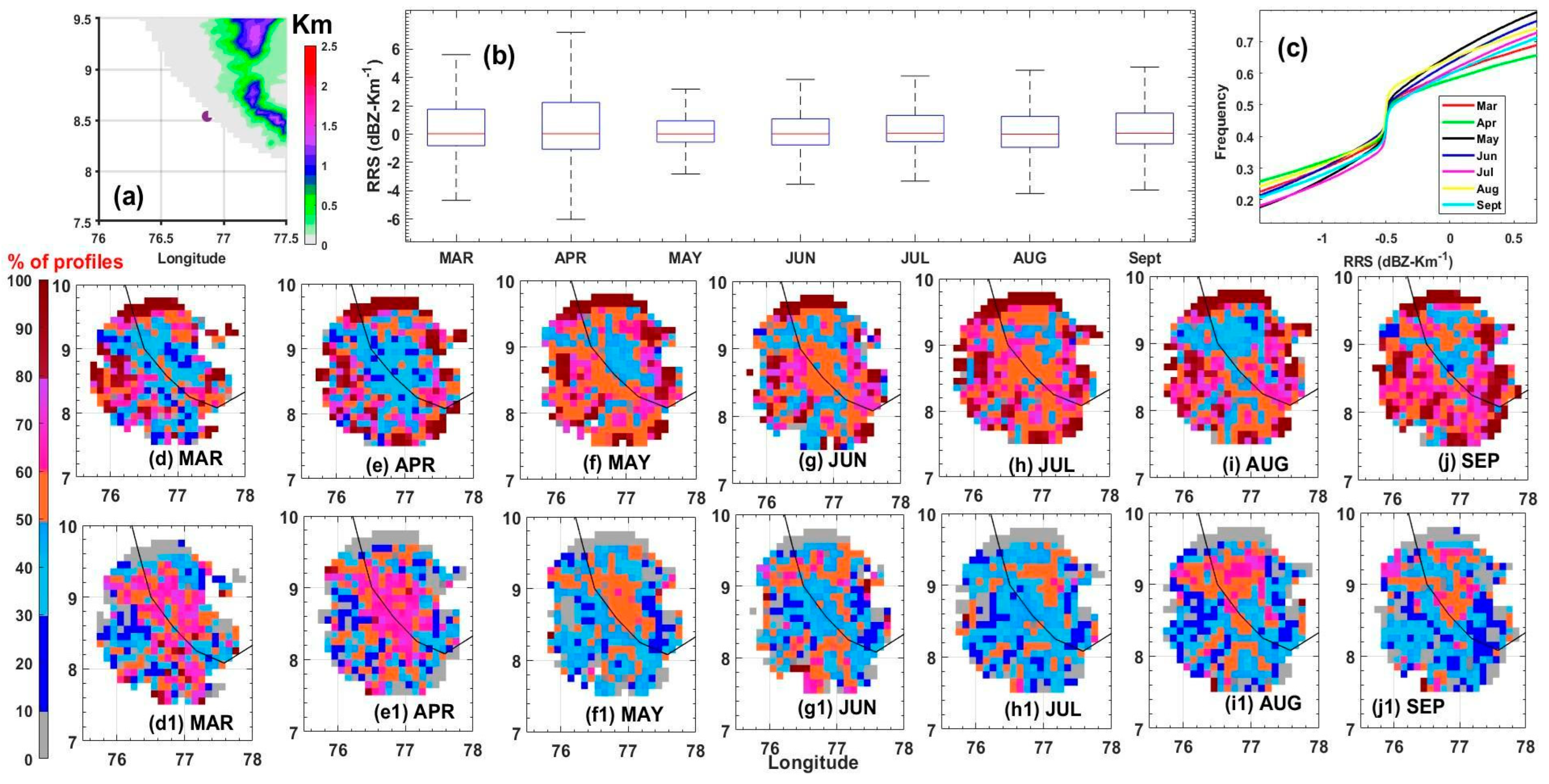
Figure 3b,c show the boxplot and frequency distribution of monthly S-Ze, and monthly variations are observed in S-Ze [10,20,35,36]. Among all the months, a higher fraction of +ve S-Ze is observed during March and April compared to other months, reflecting that Ze mostly decreases towards the surface. May and June have the smallest S-Ze range [in magnitude] compared to other months. June and July have the highest fraction of −ve S-Ze compared to other months, reflecting that Ze mostly increases towards the surface. Figure 3d–j [middle row] show the normalized [relative] spatial distribution of +ve S-Ze in each 0.1° × 0.1° grid box over the study areas, whereas Figure 3(d1–j1) [bottom row] show the normalized [relative] spatial distribution of −ve S-Ze. Normalization is based on the total number of profiles in each 0.1° × 0.1° grid box. The normalized variations show features different from those in Figure 2, and monthly variations are observed in the spatial distributions of S-Ze from the pre-monsoon to the monsoon months [35,36]. For example, the location of maxima and minima (hotspots) of +ve and −ve S-Ze changes, and the majority of the differences are observed near the coastal boundaries, which may be associated with changes in meteorological conditions, such as advected moisture [53,54,55,56,57].
In March, a nearly equal fraction of +ve and −ve S-Ze is observed over both land- and ocean-dominated areas; the hotspots are not similar to those in earlier months [20,37]. The land–ocean contrast is also observed, and oceans (land) have a higher fraction of +ve S-Ze (−ve S-Ze), and Ze decreases (increases) towards the surface, and is opposite to TRMM-based observations [20,37]. April shows a different spatial distribution compared to March. For example, at the coastal boundaries, both on land and at sea, a higher fraction of −ve S-Ze [>60%] is observed, and Ze increases towards the surface. However, many grid points have nearly similar fractions of +ve and −ve S-Ze. Importantly, the land–ocean contrast is not observable here compared to March, and the north–south gradient is not observed here. For example, the southern AS (land) has a higher (lower) fraction of +ve S-Ze (+ve S-Ze), reflecting that, over the ocean, Ze increases (decreases) towards the surface. The differences among the land, ocean, and coastal boundaries are associated with low-level RH and updraft differences [10].
During May, S-Ze shows different spatial distributions compared to earlier months and a much higher fraction of +ve S-Ze (>70%) over land areas near the coastal boundary, where Ze increases towards the surface. The oceanic areas show a higher fraction of +ve S-Ze, whereas the opposite characteristics are observed compared to satellite-based observations. Both +ve and −ve S-Ze have a strong land–ocean contrast, and land has a smaller fraction of +ve S-Ze compared to oceanic areas. This is the monsoon onset month, and a lot of moisture is being transported from the ocean towards the land, as well as updraught changes, which could be the possible reasons behind these features (Figure 4) [35,66]. June shows nearly the same spatial distributions as May had, but the percentages of +ve and −ve S-Ze are not similar. It is observed that a higher fraction of +ve S-Ze [>60%] is observed over the land, ocean, and topographic features of the study regions, and Ze increases towards the surface. Southern AS has a higher fraction of −ve S-Ze compared to northern AS, and Ze increases more rapidly in the southern AS compared to the northern AS. This could be related to changes in wind reversal and updrafts during the monsoon seasons [33]. During the July months, different S-Ze spatial distributions are observed, as in June, the month has, and most of the time, all the spatial areas have nearly similar fractions of +ve S-Ze and −ve S-Ze, both over land- and oceanic-dominated areas. The land–ocean contrast as well as the north–south gradient contrast are not observable compared to the previous months.
August has a completely different spatial distribution compared to July, and the land–ocean contrast is more visible at northern and southern latitudes over ocean and land, respectively. For example, higher grids of the southern AS have +ve S-Ze [>70%], and there are more profiles where Ze decreases towards the surface. A higher fraction of −ve S-Ze [>70%] is observed near the topographic regions and in the northern latitudes of the study areas, indicating that more profiles show increasing Ze towards the surface. The increasing Ze at lower altitudes over land and oceanic areas may be associated with higher Ze at lower altitudes, as previously observed by Subhramanyam and Kishore [67] in the deep convective cores [66,67]. The month of September shows somewhat similar geographical distributions to August, with small changes. For example, oceanic areas and southern land latitudes have the highest fraction of +ve S-Ze [>80%] compared to earlier months and reveal that in September, the Ze tends to decrease over most of the study regions. Only land adjacent to the coastal boundary has a higher fraction of −ve S-Ze, and Ze tends to increase towards the surface. Hirose and Nakamura [35] showed that S-Ze variations depend on the seasons and the progression of the monsoon over the Indian land and ocean, a pattern also observed here.

3.3. Characteristics of Average Radar Reflectivity Slopes (S-Ze)

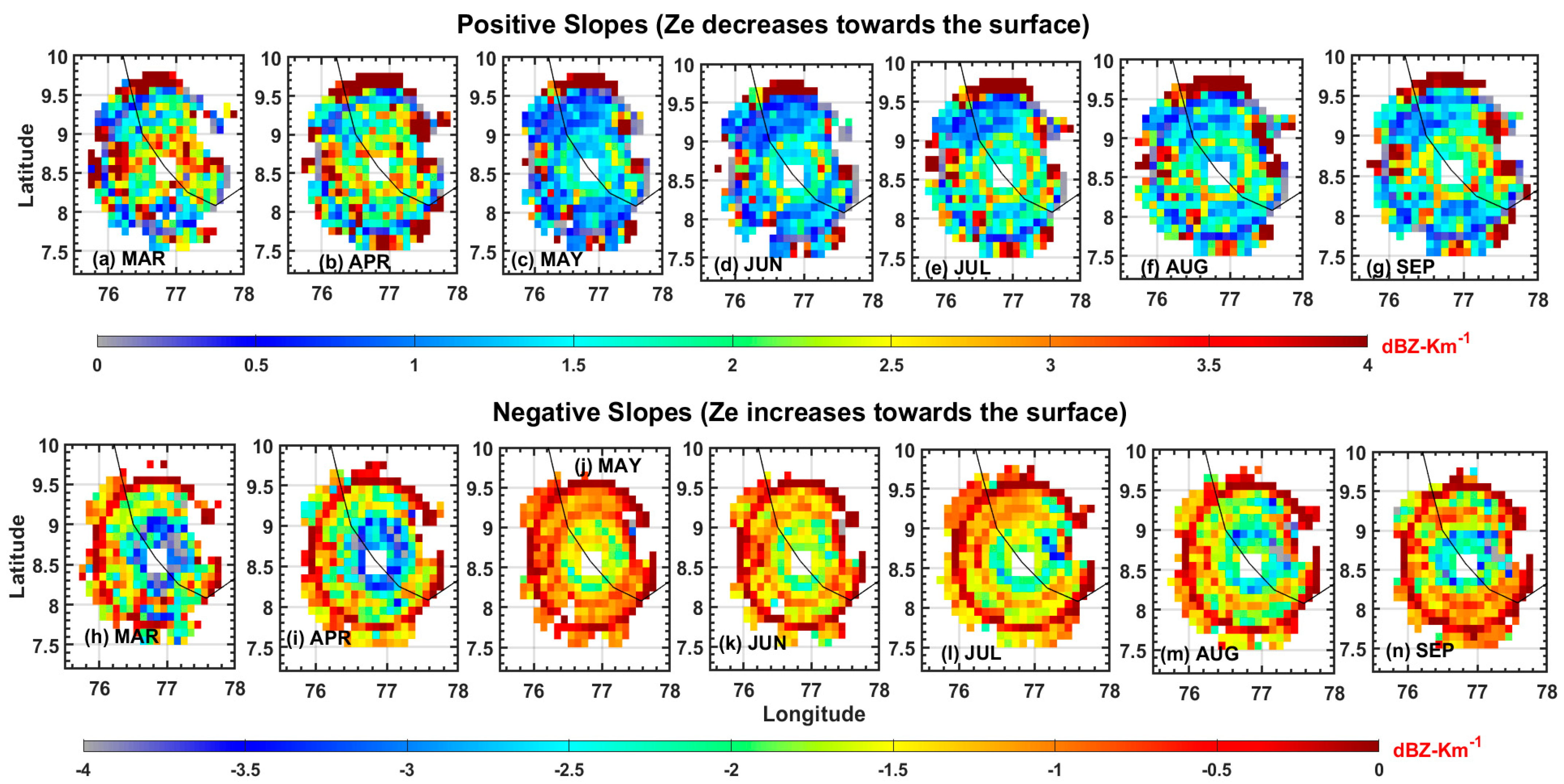
Figure 4 shows the spatial average of the S-Ze in each 0.1° × 0.1° grid box for each month. The top row [Figure 4a–g] shows the spatial average of the S-Ze > 0, whereas the bottom row shows the spatial average for S-Ze < 0 [Figure 4h–n] in each 0.1° × 0.1° grid box. March and April have the highest spatial average of +ve S-Ze [>3 dBZ km−1], indicating that the decrease in hydrometeor size is greatest in these months. However, near the coastal boundaries, a higher average −ve S-Ze [<−4 dBZ-Km−1] is observed, which shows that near the coastal boundary (both over land and ocean), the hydrometeor sizes increase irrespective of the drier atmosphere. The land–ocean differences are not higher, but irrespective of the +ve and −ve S-Ze, the differences in the hydrometeor size are the highest. During the monsoon onset month, e.g., May, there is less average +ve and −ve S-Ze magnitude [−1.5 dBZ-Km−1 < S-Ze < 1.5 dBZ-Km−1], and it shows that the increase and decrease in the hydrometeors are less compared to drier months [March and April]. Again, the higher changes (increases or decreases) in hydrometeor size are observed near the coastal boundary [>2 dBZ km−1 and <−2 dBZ km−1]. As we move away from the coastal boundary, the rate of increase or decrease in hydrometeors is lower.
June shows spatial-average trends similar to those of May, and coastal boundaries exhibit a higher rate of increase or decrease in hydrometeor size than those farther from the radar locations. July has larger spatial areas (number of grid points) with greater +ve S-Ze [i.e., more grids with S-Ze > 2 dBZ km−1] near the coastal boundary than in May and June, and a higher decrease in hydrometeor size than in June months. The spatial distribution of average −ve S-Ze shows nearly the same trends as in June, and again, the coastal boundaries show a higher increase in hydrometeor size. August shows different spatial average characteristics of +ve S-Ze, and just near the coastal boundary, the decrease in the hydrometeor size is at least <0.5 dBZ km−1 compared to earlier monsoon months. However, near the eastern edge of the topographic altitudes, the largest increase in hydrometeor size is observed, with average S-Ze < −4 dBZ km−1. The number of grid points of the spatial average of +ve S-Ze increases, and shows that the hydrometeor size reduces near the coastal boundary. The end of the monsoon month, e.g., September, has trends similar to July, and the rate of decrease in hydrometeor size is higher near the coastal boundaries, and the rate of increase in the hydrometeor size is the lowest over the southern AS. The spatial average of −ve S-Ze also shows different trends, and again, the southern AS has the least increase in hydrometeor size, whereas the northern coastal boundary shows the highest increase.
We can divide the whole study period into three time scales. For example, the S-Ze characteristics are similar in the March and April months, then in the monsoon onset months (e.g., May and June), and then in the July-to-September months. Also, across all months, observations at the edge exhibit different characteristics than those at nearby distances from the radar site, and this may be related to the very small number of observations [Figure 3].

4. Discussion

Romatschke and Houze [33] demonstrated that during the monsoon seasons, increased moisture advects from the AS towards coastal regions, which can lead to severe storms and strong orographic convection over the study areas [66]. Trenberth [68] explored the connections between the wind, atmospheric water vapor, and rainfall and found that during the monsoon onset period, precipitation is linked to transported water vapor, whereas in the late or post-monsoon season, precipitation is related to evaporated and recycled water vapor. The precipitation variations are also associated with wet and dry environments, and for that, knowledge of moisture content would be helpful. We hypothesize that these regional variations are primarily attributed to low-level RH and vertical velocity [Figure 5]. For example, the moist atmosphere and weaker updrafts at lower levels can lead to the accretion or collision of raindrops, increasing their size, especially over the ocean [69] in shallow cumulus regions. However, in a dry atmosphere (low RH), raindrops either evaporate or break into smaller raindrops [10,70], leading to a decrease in Ze towards the surface. Over land and topographic areas, higher updraught speeds and strong evaporation play a vital role in determining the Ze near the surface [24,71,72]. The coastal boundary has both moisture and arid areas, which affect Ze variation [10,35,36]. One important factor in reducing Ze could be the evaporation of smaller hydrometeors in unsaturated air. As the monsoon progresses and at the end of the monsoon months (August–September), Ze tends to increase towards the surface compared to the June–July months and may be associated with the maximum echoes observed near the surface in deep convective cores [66,67].
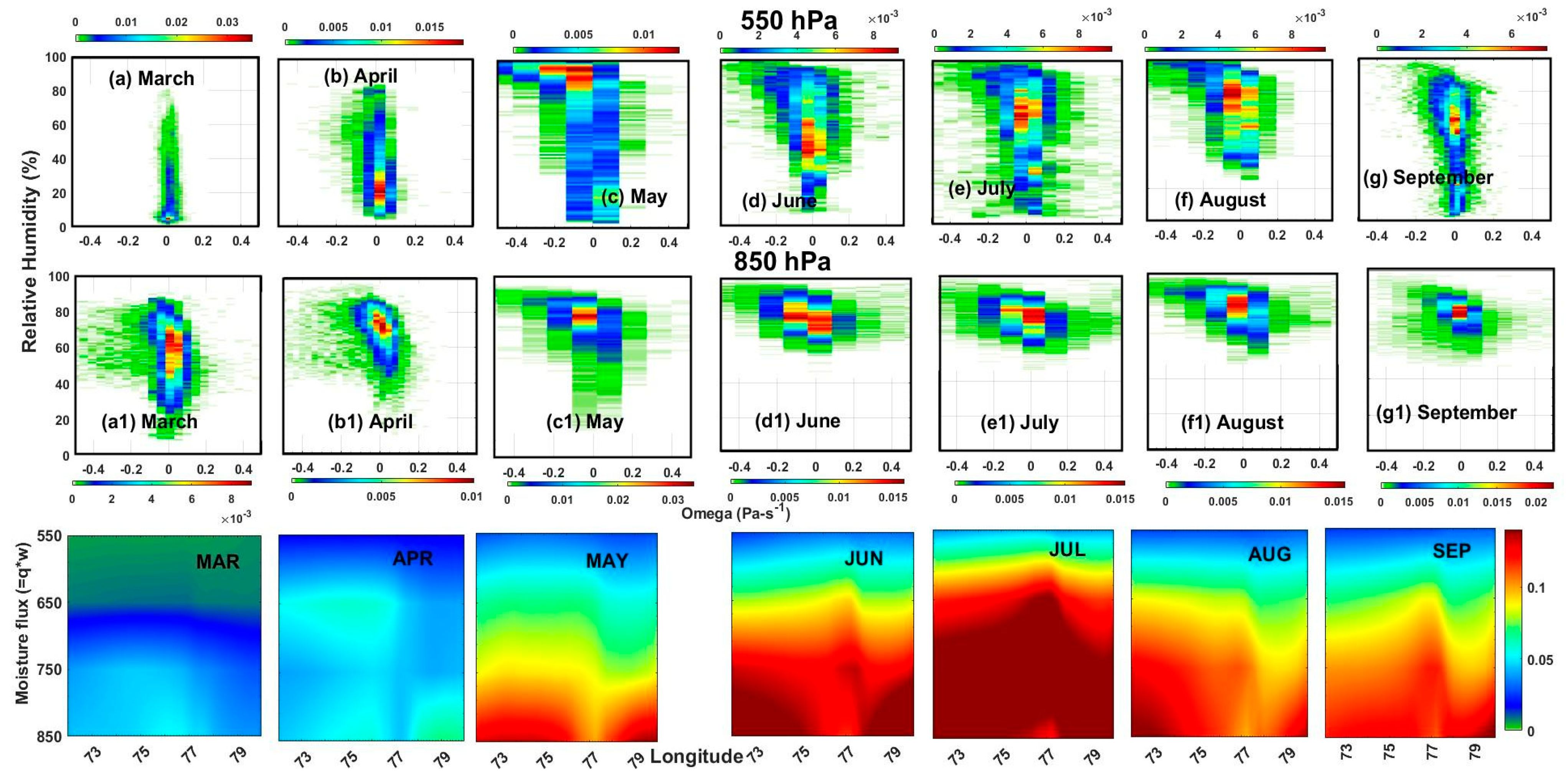
We hypothesized that Ze variation is associated with moisture content and vertical velocity [10,20,21,35,36]. Figure 5 shows the joint histogram between the vertical velocity [w] and RH at 550 hPa [upper panel] and 850 hPa [middle panel] for different months. The histogram reveals the combined effects of atmospheric dynamics and microphysics on Ze variations. The joint histogram shows similar distributions around positive ‘w’ [downdraught] and negative ‘w’ [updraught], but with different RH across months. This could be the possible reason why spatial differences are observed over land and orographic features. A strong updraught transports RH into the deeper atmosphere, making the lower atmosphere drier, which contributes to a +ve S-Ze, and Ze tends to decrease in the lower troposphere. But a weak updraught and downdraught with sufficient RH provides enough time for the hydrometeors to grow and contribute to −ve S-Ze, and Ze tends to increase in the lower troposphere [10,20,35,36,37]. March and April have weak downdraught and may provide enough time for hydrometeors to grow [contribute to −ve S-Ze], and at the same time, strong updraught can lead to higher RH in the deeper atmosphere and provide less RH [dry atmosphere] to hydrometeors, decreasing in size and contributing to +ve S-Ze. May has a strong updraught with higher RH, which contributes to +ve S-Ze and provides less RH, decreasing hydrometeors. June and July months have a strong updraught with higher RH, but at the same time they also have a strong downdraught with less RH at 850 hPa, which makes the atmosphere more pronounced so that Ze should decrease towards the surface and contribute to a higher fraction of +ve S-Ze. In August, a higher number of profiles corresponds to higher RH and updraught, and contributes to a higher fraction of +ve S-Ze. September has nearly similar updraught-downdraught and also corresponds to a nearly equal fraction of +ve and −ve S-Ze.
It is also well known that the local advected moisture plays a vital role compared to large-scale weather conditions [47,48,49,50,51,52,53,54,55,56,57,58,59,60,61,62,63,64]. The bottom panel [Figure 5] shows the role of vertical moisture buildup and its removal from pre-monsoon months to monsoon-end months. The striking feature is the moistening of the low-boundary layer and mid-troposphere that occurs before the summer monsoon onset (May to July), and then it decreases in August and September. These features are associated with changes in updraught/downdraught and in zonal and meridional winds. The pre-monsoon months [April and May] have the least zonal moisture, and thus we observe that Ze decreases towards the surface (>4 dBZ-Km−1), but with fewer Ze profiles. April has a higher probability of low-level RH than March, and thus a higher fraction of profiles show a −ve S-Ze, and Ze increases towards the surface over land-dominated areas. This could be associated with collision–coalescence processes in moist conditions, compared to March, during intense rainfall events, which increase hydrometeor size as they move downward. Both months have less updraught and downdraught, which provides enough time for hydrometeors to grow; thus, we also have the highest −ve S-Ze. However, the change in hydrometeor size is greatest in March and April; it either increases or decreases towards the surface. During the monsoon onset months [May months], zonally, a high moisture flux is observed, along with an increase in RH, both associated with updraughts and downdraughts. This reduces the probability of evaporation and breakup, and a higher updraught also provides less time for hydrometeors to grow. It reduces the magnitude of both +ve and −ve S-Ze (2 dBZ-Km−1 < S-Ze < 2 dBZ-Km−1) and the rate at which the hydrometeors’ size increases or decreases towards the surface.
Vertically, June and July have a maximum moisture flux, and the main differences are observed in the joint histogram at 850 hPa. There is a higher probability of RH (>80%) during updraught than during downdraught, and the maximum number of Ze profiles is associated with RH (70–80%). July has the highest vertical moisture flux, with a histogram nearly identical to that of June. This could be related to two effects: First, a convective outburst produces higher RH at low levels, which is important for future convection. A second possibility also exists, where the evaporation of stratiform precipitation with a lower rain rate during the hydrometeor’s downward journey contributes to low-level RH [73,74]. The higher RH at lower levels during the mentioned months increases the grid of higher −ve S-Ze, where hydrometeor sizes increase towards the surface, but their fractions are lower. After the month of July, the reduction in RH and moisture flux affects the S-Ze, and an increase in the +ve S-Ze is observed over the AS, whereas land-dominated areas have a higher fraction of −ve S-Ze. However, the rate of increase or decrease in hydrometeor size is slightly higher than in June and July in land-dominated areas. The effect of a drier atmosphere is visible, and the possibility of breakup is high, and the Ze decreases towards the surface near the coastal boundary. However, an increase is also observed in the hydrometeor in the eastern part of the observation regimes. However, under higher RH conditions, we still observe a higher fraction of +ve S-Ze, which may be related to the evaporation of smaller hydrometeors during stratiform or convective outbursts and during the monsoon seasons. As the monsoon withdraws, the September months become drier, and there is an increase in +ve S-Ze observed.
The contrasting feature in radar reflectivity slopes between the present and earlier studies [10,20,21,35,36] (based on TRMM data) is due to temporal and spatial differences in the observations. First, C-band provides continuous precipitation observations, and thus it captures Ze variations during the initial, mature, and dissipating phases, whereas TRMM/GPM-based observations most often capture only mature phases [24,38,75]. The second reason is the sensitivity [minimum detectable dBZ] of both the radar and TRMM, which is much higher [~17 dBZ] than C-band [~5 dBZ]. In that way, TRMM captures only the intense convection, whereas C-band radar also captures the less intense rainfall [66]. The present study is dominated by stratiform precipitation and thus shows a more positive S-Ze than TRMM-based observations [20,37]. Uma and Sama [66] showed that 60% of storms are congested over THUMBA during the monsoon seasons. Since the mature and dissipating phases are dominated by stratiform precipitation [greater than ~70–80%], the present study primarily examines the variation in Ze in stratiform precipitation [20,37] along with light rainfall. The highest Z are observed at ~4–5 km altitude during stratiform precipitation and may affect the results presented in the study [10,20,35,36,37,76,77].

5. Conclusions

The main conclusions from the present study are listed below:
  • Monthly variations in radar reflectivity slope from the pre-monsoon to monsoon months are observed in the lower troposphere. The land–ocean contrasts of the vertical profiles contributing to positive and negative radar reflectivity slopes are less compared to north–south gradients and higher in monsoon months.
  • Changes in radar reflectivity slope are significant during the monsoon months compared to the pre-monsoon months near the coastal boundaries. This reflects the role of advected moisture from the Arabian Sea into land regions during the monsoon seasons.
  • The average radar reflectivity slopes show the highest positive and negative magnitudes near the coast across all months. The highest magnitudes of radar reflectivity slope are observed in March and April and are associated with fewer and more vertical Ze profiles, respectively.
  • The increase or decrease in hydrometeor size is less during the monsoon months (June–July–August–September) compared to pre-monsoon months. The March–April months show the largest increases or decreases in hydrometeor size in the lower troposphere.
  • The variations in the radar reflectivity slopes are the combined effect of the atmospheric thermodynamic (RH and moisture flux) and dynamic conditions (vertical velocity). For example, in March and April, the atmosphere is dry, and the largest decrease in hydrometeor size is observed near the coastal boundary. However, we also see significantly steeper negative radar reflectivity slopes where lower updraught and downdraught allow hydrometeors to grow.
  • A strong updraught takes RH to higher altitudes, making the atmosphere drier and contributing to a positive S-Ze. Ze tends to decrease in the lower troposphere. At the same time, a weak updraught with sufficient RH provides enough time for the hydrometeors to grow and contribute to negative S-Ze, and Ze tends to increase towards the surface in the lower troposphere.
The differences in S-Ze provide a deeper understanding of precipitation microphysics from pre-monsoon to monsoon months and offer practical guidance for improving radar rainfall estimation in operational meteorology. Moreover, heavy rainfall can attenuate C-band radar signals, affecting the calculation of S-Ze. This research indicates that exploring the mechanisms behind the occurrence of S-Ze patterns in the pre-monsoon and monsoon months could enhance the understanding of monsoon variability. The slopes presented here provide the combined effect of monsoon onset wind and moisture characteristics. However, a detailed analysis, supported by additional ground-based observations, is required to understand the pre-monsoon-to-monsoon variability in the lower atmosphere. The results presented here would extend the study from satellite-based observations and reveal the extended climatology of stratiform precipitation.

Funding

There is no funding available for this research.

Institutional Review Board Statement

Not applicable.

Informed Consent Statement

Not applicable.

Data Availability Statement

The C-band radar data is available on mosdac.gov.in (accessed on 19 May 2026).

Conflicts of Interest

The author declares no conflicts of interest.

References

  1. Rajeevan, M.; Kesarkar, A.; Thampi, S.B.; Rao, T.N.; Radhakrishna, B.; Rajasekhar, M. Sensitivity of WRF cloud microphysics to simulations of a severe thunderstorm event over Southeast India. Ann. Geophys. 2010, 28, 603–619. [Google Scholar] [CrossRef]
  2. Litta, A.J.; Mohanty, U.C.; Das, S.; Mary Idicula, S. Numerical simulation of severe local storms over East India using the WRF-NMM mesoscale model. Atmos. Res. 2012, 116, 161–184. [Google Scholar] [CrossRef]
  3. Mukhopadhyay, P.; Mahakur, M.; Singh, H.A.K. The interaction of large scale and mesoscale environments leading to the formation of intense thunderstorms over Kolkata, Part I: Doppler radar and satellite observations. J. Earth Syst. Sci. 2009, 118, 441–466. [Google Scholar] [CrossRef]
  4. Suresh, R. Forecasting and nowcasting convective weather phenomena over southern peninsular India—Part I: Thunderstorms. Indian J. Radio Space Phys. 2012, 41, 421–434. [Google Scholar]
  5. Srivastava, K.; Roy Bhowmik, S.K.; Sen Roy, S.; Thampi, S.B.; Reddy, Y.K. Simulation of high impact convective events over Indian region by the ARPS model with assimilation of Doppler weather radar radial velocity and reflectivity. Atmosfera 2010, 23, 53–73. [Google Scholar]
  6. Marshall, J.S.; Palmer, W.M. The distribution of raindrops with size. J. Meteorol. 1948, 5, 165–166. [Google Scholar] [CrossRef]
  7. Fabry, F.; Zawadzki, I. Long-Term Radar Observations of the Melting Layer of Precipitation and Their Interpretation. J. Atmos. Sci. 1995, 52, 838–851. [Google Scholar] [CrossRef]
  8. Vignal, B.; Galli, G.; Joss, J.; Germann, U. Three methods to determine profiles of reflectivity from volumetric radar data to correct precipitation estimates. J. Appl. Meteorol. Clim. 2000, 39, 1715–1726. [Google Scholar] [CrossRef]
  9. Bellon, A.; Lee, G.W.; Zawadzki, I. Error Statistics of VPR Corrections in Stratiform Precipitation. J. Appl. Meteorol. Clim. 2005, 44, 998–1015. [Google Scholar] [CrossRef]
  10. Liu, C.; Zipser, E.J. Why Does Radar Reflectivity Tend to Increase Downward Toward the Ocean Surface, but Decrease Downward Toward the Land Surface? J. Geophys. Res. Atmos. 2013, 118, 135–148. [Google Scholar] [CrossRef]
  11. Li, X.; Srivastava, R.C. An Analytical Solution for Raindrop Evaporation and Its Application to Radar Rainfall Measurements. J. Appl. Meteorol. Clim. 2001, 40, 1607–1616. [Google Scholar] [CrossRef]
  12. Adler, R.F.; Huffman, G.J.; Chang, A.; Ferraro, R.; Xie, P.-P.; Janowiak, J.; Rudolf, B.; Schneider, U.; Curtis, S.; Bolvin, D.; et al. The Version-2 Global Precipitation Climatology Project [GPCP] Monthly Precipitation Analysis [1979–Present]. J. Hydrometeor. 2003, 4, 1147–1167. [Google Scholar] [CrossRef]
  13. Kumjian, M.R.; Prat, O.P. The impact of raindrop collisional processes on the polarimetric radar variables. J. Atmos. Sci. 2014, 71, 3052–3067. [Google Scholar] [CrossRef]
  14. Huang, H.; Chen, F. Precipitation Microphysics of Tropical Cyclones Over the Western North Pacific Based on GPM DPR Observations: A Preliminary Analysis. J. Geophys. Res. Atmos. 2019, 124, 3124–3142. [Google Scholar] [CrossRef]
  15. Del Castillo-Velarde, C.; Kumar, S.; Valdivia-Prado, J.M.; Moya-Álvarez, A.S.; Flores-Rojas, J.L.; Villalobos-Puma, E.; Martínez-Castro, D.; Silva-Vidal, Y. Evaluation of GPM dual-frequency precipitation radar algorithms to estimate drop size distribution parameters, using ground-based measurement over the central Andes of Peru. Earth Syst. Environ. 2021, 5, 597–619. [Google Scholar] [CrossRef]
  16. Li, Q.; Sun, X.; Liu, X.; Li, H. Linkage Between Radar Reflectivity Slope and Raindrop Size Distribution in Precipitation with Bright Bands. Remote Sens. 2025, 17, 2393. [Google Scholar] [CrossRef]
  17. Fu, Y.; Lin, Y.; Liu, G.; Wang, Q. Seasonal Characteristics of Precipitation in 1998 Over East Asia as Derived from TRMM PR. Adv. Atmos. Sci. 2003, 20, 511–529. [Google Scholar]
  18. Liu, G.; Fu, Y. The characteristics of tropical precipitation profiles as inferred from satellite radar measurements. J. Meteorol. Soc. Jpn. 2001, 79, 131–143. [Google Scholar] [CrossRef]
  19. Das, S.; Shukla, A.K.; Maitra, A. Investigation of Vertical Profile of Rain Microstructure at Ahmedabad in Indian Tropical Region. Adv. Space Res. 2016, 45, 1235–1243. [Google Scholar] [CrossRef]
  20. Kumar, S. Investigation of radar reflectivity profiles below the freezing level over Southeast Asia using TRMM and Megha-Tropiques satellites. Remote Sens. Lett. 2024, 15, 1250–1258. [Google Scholar] [CrossRef]
  21. Parker, M.D.; Johnson, R.H. Organizational Modes of Midlatitude Mesoscale Convective Systems. Mon. Weather Rev. 2000, 128, 3413–3436. [Google Scholar] [CrossRef]
  22. Rutledge, S.A.; Houze, R.A., Jr. A Diagnostic Modelling Study of the Trailing Stratiform Region of a Midlatitude Squall Line. J. Atmos. Sci. 1987, 44, 2640–2656. [Google Scholar] [CrossRef][Green Version]
  23. Leary, C.A.; Houze, R.A. The Structure and Evolution of Convection in a Tropical Cloud Cluster. J. Atmos. Sci. 1979, 36, 437–457. [Google Scholar] [CrossRef]
  24. Kumar, S.; Bhat, G.S. Frequency of a State of Cloud Systems Over Tropical Warm Ocean. Environ. Res. Commun. 2019, 1, 061003. [Google Scholar] [CrossRef]
  25. Kumar, S.; Del Castillo-Velarde, C.; Rojas, J.L.F.; Moya-Álvarez, A.; Castro, D.M.; Srivastava, S.; Silva, Y. Precipitation Structure During Various Phases the Life Cycle of Precipitating Cloud Systems Using Geostationary Satellite and Space-Based Precipitation Radar Over Peru. GIScience Remote Sens. 2020, 57, 1057–1082. [Google Scholar] [CrossRef]
  26. Kumar, S.; Srivastava, S. Vertical characteristics of precipitating cloud systems during different phases of life cycle of cloud systems using satellite-based radar over tropical oceanic areas. J. Appl. Nat. Sci. 2022, 14, 1272–1285. [Google Scholar] [CrossRef]
  27. Cifelli, R.; Nesbitt, S.W.; Rutledge, S.A.; Petersen, W.A.; Yuter, S. Radar Characteristics of Precipitation Features in the EPIC and TEPPS Regions of the East Pacific. Mon. Weather. Rev. 2007, 135, 1576–1595. [Google Scholar] [CrossRef][Green Version]
  28. Krishnakumar, K.; Rao, G.P.; Gopakumar, C. Rainfall trends in twentieth century over Kerala, India. Atmos. Environ. 2009, 43, 1940–1944. [Google Scholar] [CrossRef]
  29. Gray, W.M.; Jacobson, R.W., Jr. Diurnal variation of deep cumulus convection. Mon. Weather Rev. 1977, 105, 1171–1188. [Google Scholar] [CrossRef]
  30. Subrahmanyam, K.V.; Kumar, K.K. C-band polarimetric doppler weather radar observations during an extreme precipitation event and associated dynamics over Peninsular India. Nat. Hazards 2022, 114, 1307–1322. [Google Scholar] [CrossRef]
  31. Mohanty, U.C.; Dube, S.K.; Singh, M.P. A Study of Heat and Moisture Budget in the Arabian Sea and their Role in the Onset and Maintenance of Summer Monsoon. J. Meteorol. Soc. Jpn. 1983, 61, 208–221. [Google Scholar] [CrossRef]
  32. Romatschke, U.; Houze, R.A., Jr. Characteristics of precipitating convective systems in the premonsoon season of South Asia. J. Hydrometeorol. 2011, 12, 157–180. [Google Scholar] [CrossRef]
  33. Romatschke, U.; Houze, R.A., Jr. Characteristics of precipitating convective systems in the South Asian monsoon. J. Hydrometeorol. 2011, 12, 3–26. [Google Scholar] [CrossRef]
  34. Jash, D.; Resmi, E.A.; Unnikrishnan, C.K.; Sumesh, R.K.; Kumar, S.; Sukumar, N. Analysis of Pre-Monsoon Convective Systems over a Tropical Coastal Region Using C-Band Polarimetric Radar, Satellite and Numerical Simulation. Atmosphere 2022, 13, 1349. [Google Scholar] [CrossRef]
  35. Hirose, M.; Nakamura, K. Spatial and Seasonal Variation of Rain Profiles over Asia Observed by Space Borne Precipitation Radar. J. Clim. 2002, 15, 3443–3458. [Google Scholar] [CrossRef]
  36. Hirose, M.; Nakamura, K. Spatiotemporal Variation of the Vertical Gradient of Rainfall Rate Observed by the TRMM Precipitation Radar. J. Clim. 2004, 17, 3378–3397. [Google Scholar] [CrossRef]
  37. Kumar, S. Regional and Seasonal Differences of Radar Reflectivity Slopes in Lower Troposphere in Convective and Stratiform Precipitation Using TRMM PR Data. Theor. Appl. Clim. 2024, 155, 2719–2728. [Google Scholar] [CrossRef]
  38. Imaoka, K.; Nakamura, K. Statistical Analysis of the Life Cycle of Isolated Tropical Cold Cloud Systems Using MTSAT-1R and TRMM Data. Mon. Weather Rev. 2012, 140, 3552–3572. [Google Scholar] [CrossRef]
  39. Kumar, S.; Bhat, G.S. Vertical structure of orographic precipitating clouds observed over south Asia during summer monsoon season. J. Earth Syst. Sci. 2017, 126, 114. [Google Scholar] [CrossRef]
  40. Panda, S.K.; Shukla, B.P.; Kumar, P. Clutter Mitigation and 3D Volumetric Gridding of TERLS DWR Reflectivity Data [V1.0], SAC Report, SAC/EPSA/AOSG/SR/19/2018. Available online: https://www.mosdac.gov.in/3d-volumetric-terls-dwrproduct (accessed on 19 May 2026).
  41. Kumar, K.K.; Subrahmanyam, K.V.; Kumar, C.P.; Shanmugasundari, J.; Koushik, N.; Ajith, R.P.; Girija Devi, L. C-band dual-polarisation Doppler weather radar at Thumba [8.537° N, 76.865° E]: Initial results and validation. J. Appl. Remote Sens. 2020, 14, 044509. [Google Scholar] [CrossRef]
  42. Mishra, S.; Shanmuga Sundari, J.; Channabasava, B.; Anandan, V.K. First indigenously developed polarimetric C-band Doppler weather radar in India and its first hand validation results. J. Electromagn. Waves Appl. 2020, 34, 825–840. [Google Scholar] [CrossRef]
  43. Johnson, R.H.; Aves, S.L.; Ciesielski, P.E.; Keenan, T.D. Organisation of oceanic convection during the onset of the 1998 East Asian summer monsoon. Mon. Weather Rev. 2005, 133, 131–148. [Google Scholar] [CrossRef]
  44. Yuter, S.E.; Houze, R.A., Jr.; Smith, E.A.; Wilheit, T.T.; Zipser, E. Physical characterisation of tropical oceanic convection observed in KWAJEX. J. Appl. Meteorol. Clim. 2005, 44, 385–415. [Google Scholar] [CrossRef]
  45. Zipser, E.J.; Lutz, K.R. The vertical profile of radar reflectivity of convective cells is a strong indicator of storm intensity and lightning probability? Mon. Weather Rev. 1994, 122, 1751–1759. [Google Scholar] [CrossRef]
  46. Szoke, E.J.; Zipser, E.J. A radar study of convective cells in mesoscale systems in GATE. Part II: Life cycles of convective cells. J. Atmos. Sci. 1986, 43, 199–218. [Google Scholar] [CrossRef]
  47. Pisharoty, P.R. Evaporation from the Arabian Sea and the Indian southwest monsoon. In Proceedings of the Symposium on Meteorological Results of the International Indian Ocean Expedition, Bombay, India, 22–26 July 1965; India Meteorological Department: New Delhi, India, 1965. [Google Scholar]
  48. Ghosh, S.K.; Pant, M.C.; Dewan, B.N. Influence of the Arabian Sea on the Indian summer monsoon. Tellus 1978, 30, 117–125. [Google Scholar] [CrossRef]
  49. Levine, R.C.; Turner, A.G. Dependence of Indian monsoon rainfall on moisture fluxes across the Arabian Sea and the impact of coupled model sea surface temperature biases. Clim. Dyn. 2012, 38, 2167–2190. [Google Scholar] [CrossRef]
  50. Murakami, T.; Nakazawa, T.; He, T. On the 40–50 day oscillation during the 1979 Northern Hemisphere summer: Part II: Heat and moisture budget. J. Meteorol. Soc. Jpn. 1984, 62, 469–484. [Google Scholar] [CrossRef]
  51. Clemens, S.C.; Oglesby, R.J. Interhemispheric moisture transport in the Indian Ocean summer monsoon: Data-model and model-model comparisons. Paleoceanography 1992, 7, 633–643. [Google Scholar] [CrossRef]
  52. Swapna, P.; Ramesh Kumar, M.R. Role of low level flow on the summer monsoon rainfall over the Indian subcontinent during two contrasting monsoon years. J. Indian Geophys. Union 2002, 6, 123–137. [Google Scholar]
  53. Patil, C.; Prabhakaran, T.; Ray, K.C.S.; Karipot, A. Revisiting moisture transport during the Indian summer monsoon using the moisture river concept. Pure Appl. Geophys. 2019, 176, 5107–5123. [Google Scholar] [CrossRef]
  54. Gimeno, L.; Drumond, A.; Nieto, R.; Trigo, R.M.; Stohl, A. On the origin of continental precipitation. Geophys. Res. Lett. 2010, 37, L13804. [Google Scholar] [CrossRef]
  55. Stohl, A.; James, P. ALagrangian analysis of the atmospheric branch of the global water cycle. Part I: Method description, validation, and demonstration for the August 2002 flooding in central Europe. J. Hydrometeorol. 2004, 5, 656–678. [Google Scholar] [CrossRef]
  56. Stohl, A.; James, P. A Lagrangian analysis of the atmospheric branch of the global water cycle. Part II: Earth’s river catchments, ocean basins, and moisture transports between them. J. Hydrometeorol. 2005, 6, 961–984. [Google Scholar] [CrossRef]
  57. Ordóñez, P.; Ribera, P.; Gallego, D.; Peña-Ortiz, C. Major moisture sources for western and southern India and their role on synoptic-scale rainfall events. Hydrol. Process. 2012, 26, 3886–3895. [Google Scholar] [CrossRef]
  58. Gadgil, S. The Indian monsoon and its variability. Annu. Rev. Earth Planet. Sci. 2003, 31, 429–467. [Google Scholar] [CrossRef]
  59. Mooley, D.A. Independence of Southeast-Asian summer monsoon rainfall. Bull. Am. Meteorol. Soc. 1970, 51, 298. [Google Scholar]
  60. Mooley, D.A. Some aspects of Indian monsoon depressions and associated rainfall. Mon. Weather Rev. 1973, 101, 271–280. [Google Scholar] [CrossRef]
  61. Mooley, D.A. Major climatological discontinuities in monthly activity of summer monsoon over Asia. Pure Appl. Geophys. 1974, 112, 546–552. [Google Scholar] [CrossRef]
  62. Mooley, D.A.; Parthasarathy, B. Fluctuations in all-India summer monsoon rainfall during 1871–1978. Clim. Change 1984, 6, 287–301. [Google Scholar] [CrossRef]
  63. Rao, K.G.; Goswami, B.N. Interannual variations of sea-surface temperature over the Arabian Sea and the Indian monsoon—A new perspective. Mon. Weather Rev. 1988, 116, 558–568. [Google Scholar] [CrossRef]
  64. Winstanl, D. Rainfall patterns and general atmospheric circulation. Nature 1973, 245, 190–194. [Google Scholar] [CrossRef]
  65. Kalnay, E.; Kanamitsu, M.; Kistler, R.; Collins, W.; Deaven, D.; Gandin, L.; Iredell, M.; Saha, S.; White, G.; Woollen, J.; et al. The NCEP/NCAR 40-Year Reanalysis Project. Bull. Am. Meteorol. Soc. 1996, 77, 437–471. [Google Scholar] [CrossRef]
  66. Uma, K.N.; Sama, B. Characteristics of monsoon convection and its interaction with the large-scale environment over the gateway of the Indian summer monsoon: Insights from radar observations and reanalysis. Clim. Dyn. 2025, 63, 379. [Google Scholar] [CrossRef]
  67. Subrahmanyam, K.V.; Kumar, K.K. Characterisation of deep convective cells during the Indian summer monsoon using C-band polarimetric Doppler weather radar observations over Thumba [8.5° N, 77° E]. Remote Sens. Appl. Soc. Environ. 2023, 30, 100956. [Google Scholar]
  68. Trenberth, K.E. Atmospheric moisture recycling: Role of advection and local evaporation. J. Clim. 1999, 12, 1368–1381. [Google Scholar] [CrossRef]
  69. Schumacher, C.; Houze, R.A., Jr. The TRMM Precipitation Radar’s View of Shallow, Isolated Rain. J. Appl. Meteorol. 2003, 42, 1519–1524. [Google Scholar] [CrossRef]
  70. Lucas, C.; Zipser, E.J.; LeMone, M.A. Vertical Velocity in Oceanic Convection off Tropical Australia. J. Atmos. Sci. 1994, 51, 3183–3193. [Google Scholar] [CrossRef]
  71. Houze, R.A. Orographic Effects on Precipitating Clouds. Rev. Geophys. 2012, 50, RG1001. [Google Scholar] [CrossRef]
  72. Kumar, S. Effect of surface wind flow, relative humidity, vertical velocity and topography on convective organisations over Western Ghats using TRMM, GPM, Megha-Tropiques satellites and ERA reanalysis data. Theor. Appl. Climatol. 2026, 157, 363. [Google Scholar] [CrossRef]
  73. Kumar, S. Precipitation structure and convective intensity over Southeast South Asia during active and break spells of the Indian summer monsoon using TRMM, GPM, Megha-Tropiques satellites and reanalysis data. Int. J. Climatol. 2025, 45, e8758. [Google Scholar] [CrossRef]
  74. Kumar, S. Differences in the convective variability during active and break spells over South Asian region using 25 years of satellite observations and reanalysis data. Theor. Appl. Climatol. 2025, 156, 415. [Google Scholar] [CrossRef]
  75. Kondo, Y.; Higuchi, A.; Nakamura, K. Small-scale cloud activity over the Maritime Continent and the Western Pacific as revealed by satellite data. Mon. Weather Rev. 2006, 134, 1581–1599. [Google Scholar] [CrossRef]
  76. Houze, R.A., Jr.; Wilton, D.C.; Smull, F.B. Monsoon convection in the Himalayan region as seen by the TRMM precipitation radar. Q. J. R. Meteorol. Soc. 2007, 133, 1389–1411. [Google Scholar] [CrossRef]
  77. Kumar, S. Vertical structure of precipitating shallow echoes observed from TRMM during Indian summer monsoon. Theor. Appl. Climatol. 2018, 133, 1051–1059. [Google Scholar] [CrossRef]
Figure 1. The C-band radar is installed in Trivandrum city (red star), located in Kerala state (green color).
Meteorology 05 00015 g001
Figure 2. Top row and bottom row (an): number of C-band-based vertical profiles of radar reflectivity used in the present study for pre-monsoon and monsoon months for the year 2024. The top row (ag) corresponds to positive slopes [S-Ze; Ze decreases towards the surface], whereas the bottom row (hn) corresponds to negative slopes [S-Ze; Ze increases towards the surface] for pre-monsoon and monsoon months. The color bar indicates the number of Ze vertical profiles used in the present study. (aa) Study regions presented here to calculate the radar reflectivity slopes [S-Ze]. The violet color shows the location of the C-band radar. The color bar shows the topographic altitude of the Western Ghats included in the present study.
Meteorology 05 00015 g002
Figure 3. (a) The study regions used in the present study. The violet color shows the location of the C-band radar. The color bar shows the topographic altitude of the Western Ghats included in the present study. (b) Boxplot of the monthly radar reflectivity slopes used in the present study. (c) Cumulative frequency distribution of radar reflectivity slopes for pre-monsoon and monsoon months. (dj) Spatial distribution of positive radar reflectivity slopes [Ze decreases towards the surface] in each 0.1° × 0.1° grid box for pre-monsoon and monsoon months. (d1j1) Spatial distribution of negative radar reflectivity slopes [Ze increases towards the surface] in each 0.1° × 0.1° grid box for pre-monsoon and monsoon months. The color bar shows the fraction of Ze profiles in the present study.
Meteorology 05 00015 g003
Figure 4. (Top) row, (ag) Spatial distribution of the average of positive radar reflectivity slopes [Ze is decreasing towards the surface] in each 0.1° × 0.1° grid box for pre-monsoon and monsoon months. (Bottom) row, (hn) Spatial distribution of negative radar reflectivity slopes [Ze is increasing towards the surface] in each 0.1° × 0.1° grid box for pre-monsoon and monsoon months.
Meteorology 05 00015 g004
Figure 5. (Top row): A joint histogram between the relative humidity and vertical velocity ‘w’ < 0 [updraught] and ‘w’ > 0 [downdraught] at 550 hPa for pre-monsoon and monsoon months. The color bar shows the relative occurrences. The dotted red line separates the updraught and downdraught. (Middle row): A joint histogram between the relative humidity and vertical velocity [‘w’ < 0 [updraught] and ‘w’ > 0 [downdraught] at 850 hPa for pre-monsoon and monsoon months. The color bar shows the relative occurrences. The dotted red line separates the updraught and downdraught. (Bottom row): vertical zonal variations in transported moisture [=q × V] during pre-monsoon to monsoon months.
Meteorology 05 00015 g005
Disclaimer/Publisher’s Note: The statements, opinions and data contained in all publications are solely those of the individual author(s) and contributor(s) and not of MDPI and/or the editor(s). MDPI and/or the editor(s) disclaim responsibility for any injury to people or property resulting from any ideas, methods, instructions or products referred to in the content.