


Abstract
This study investigates whether aerodynamic interaction effects in an interlocked (negative-gap) counter-rotating dual Savonius rotor configuration can improve the efficiency of drag-based vertical-axis wind turbines in urban wind conditions. Two-dimensional Computational Fluid Dynamics (CFD) simulations were performed in ANSYS Fluent 2025 R2 using both steady and unsteady RANS approaches, including dynamic meshing to enable collision-free rotation in the interlocked overlap region. The numerical setup was first validated for a single two-bucket reference rotor against published experimental data of torque and power coefficients and subsequently applied to dual-rotor configurations with negative gap distances. The results show that the dual-rotor arrangement redistributes torque production over the azimuth angle and yields a smoother and consistently positive mean static torque coefficient, indicating improved self-starting behavior compared to the single rotor. Under transient operation, the dual-rotor configuration yields higher power coefficient values across the entire investigated tip-speed ratio range. The highest performance gain is observed at a tip-speed ratio of , where the peak power coefficient increases from (single-rotor) to (dual-rotor), corresponding to an improvement of the power coefficient of about .
1. Introduction
The global transformation towards low-carbon energy systems is accelerating due to climate change mitigation targets, geopolitical vulnerabilities, and the long-term economic risks associated with fossil fuel-based supply chains. In this context, renewable electricity generation is increasingly promoted as a key pillar of future energy systems. At the same time, the relevance of green hydrogen is growing rapidly, as it enables the conversion of renewable electricity into storable and transportable chemical energy and serves as an essential feedstock for a wide range of Power-to-X pathways. This is reflected in the rapid expansion of electrolysis capacities. According to the International Energy Agency (IEA), the planned electrolyzer capacity could exceed 520 GW by 2030 [1]. However, the environmental benefit of hydrogen strongly depends on the underlying production route; only hydrogen produced from low-carbon electricity can provide substantial reductions in lifecycle greenhouse gas emissions [1,2]. Consequently, the large-scale deployment of hydrogen technologies implies a significant increase in electricity demand from renewable energy sources, particularly for water electrolysis. From a system perspective, this creates a fundamental challenge: renewable generation capacity must be expanded rapidly while overall energy demand must be reduced to keep infrastructure requirements, costs, and resource use within feasible limits.
While large-scale wind farms and utility-scale photovoltaic systems remain essential for renewable supply expansion, they are often associated with land-use conflicts, grid reinforcement needs, and long planning procedures. At the same time, wind power already plays a substantial role in global electricity supply, accounting for around of worldwide power generation in 2023 and exceeding 2300 TWh of annual electricity generation [3,4]. In terms of installed capacity, global wind power has expanded rapidly and reached more than 1000 GW worldwide [5].
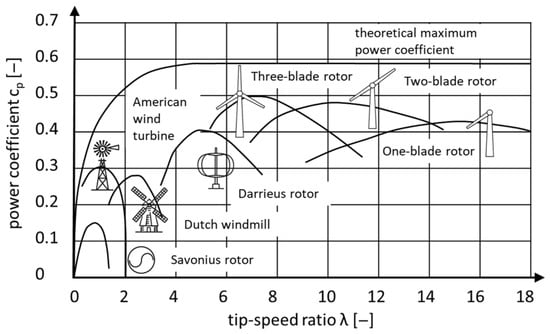
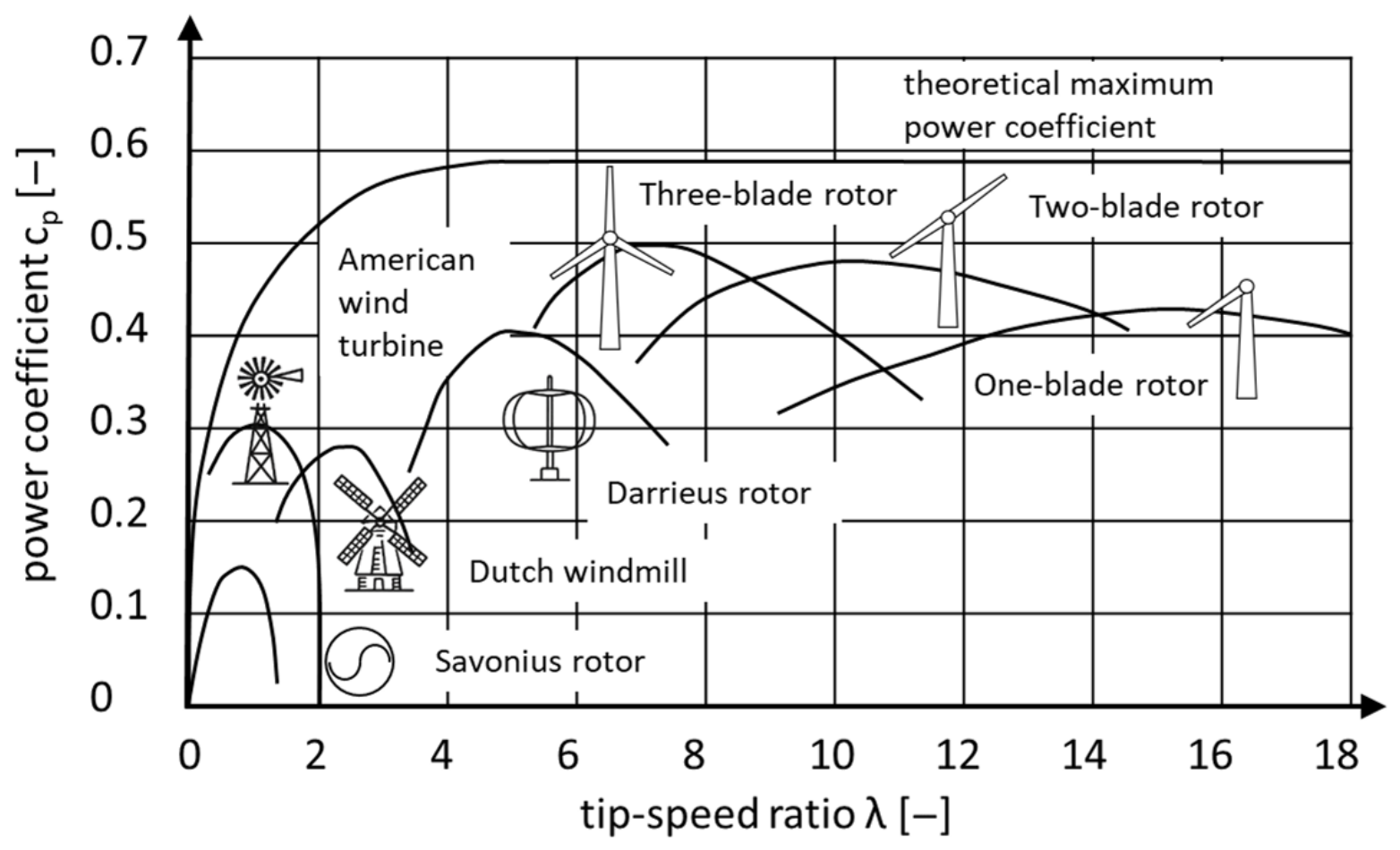
In contrast, small-scale wind energy conversion can contribute to local self-sufficiency, reduce transmission losses, and complement centralized infrastructure, especially in urban and semi-urban regions. Within this distributed context, small wind turbines have gained renewed attention for integration into building-related environments. Small wind turbines are typically classified as horizontal-axis wind turbines (HAWTs) and vertical-axis wind turbines (VAWTs), which mainly differ in rotor orientation and flow sensitivity. Compared to HAWTs, which typically offer higher efficiency but require yaw alignment and relatively steady inflow conditions, VAWTs can operate under rapidly changing wind directions (omnidirectional). In addition, VAWTs exhibit lower noise, better self-starting behavior and can operate at comparatively low wind speeds, which is advantageous under the generally reduced mean wind velocities in urban environment [6]. Among the different VAWT concepts, the Savonius rotor stands out due to its simple construction, robustness and inherent self-starting capability, making it attractive for small-scale generation applications in space-constrained installation sites [7]. Nevertheless, Savonius turbines are limited by the drag-based operating principle, resulting in comparatively low power coefficients compared to lift-driven concepts (see Figure 1). Improving the aerodynamic efficiency of Savonius turbines therefore remains an important research objective, particularly for applications where a low cut-in wind speed, robustness under strongly fluctuating wind directions, and limited installation space constitute key limiting factors.
Figure 1.
Power coefficient as a function of tip-speed ratio for different wind turbine rotor types. The black curves represent typical operating ranges and characteristic performance curves of the respective rotor concepts.
2. Review of Savonius Turbine Optimization Strategies
Originally introduced by Sigurd J. Savonius in the 1920s [8], the Savonius rotor remains an attractive concept for small-scale wind energy harvesting due to its simplicity and reliable self-starting behavior. Given its comparatively low power coefficient relative to lift-based wind turbines, the Savonius rotor has become a primary starting point for extensive design optimization efforts. The following section therefore provides a brief overview of common optimization strategies. A more comprehensive and detailed review can be found in the existing literature [9].
The performance of Savonius rotors are strongly governed by geometric parameters and by the resulting flow and pressure field inside the rotor cavity. In the literature, performance enhancement strategies can be broadly classified into three main categories: (i) rotor-internal design modifications focusing on blade/bucket geometry and rotor parameters, (ii) external flow-guidance or augmentation concepts such as deflectors, guide vanes or duct-/funnel-like concentrators, and (iii) multi-stage and multi-rotor or array configurations in which aerodynamic interaction effects between neighboring Savonius rotors are exploited to achieve synergistic performance gains.
2.1. Rotor-Internal Design Optimization Strategies
Rotor-internal optimization of Savonius turbines primarily targets the reduction of negative torque on the returning blade and the stabilisation of torque production over one revolution, particularly at low tip-speed ratios where drag-driven rotors typically operate [7,9]. Accordingly, a large share of the literature focuses on geometric rotor parameters such as bucket number, overlap ratio, blade arc angle and blade-profile modifications (e.g., slotted or vented blades), as well as three-dimensional configurations including twisted/helical concepts.
The number of buckets has a first-order influence on the balance between driving and resisting drag forces. Classical wind tunnel measurements comparing two- and three-bucket rotors indicate that adding buckets can increase blockage and drag on the returning side, thereby enhancing negative torque and reducing peak efficiency [10]. More recent studies extending this comparison to confirm that increasing bucket number does not necessarily improve peak performance, as the achievable power and torque coefficients remain strongly dependent on the negative-torque contribution [11]. Overall, two-bucket rotors are most commonly reported to yield the highest peak power coefficient, while three-bucket designs may still be selected for smoother torque output and more stable starting behavior under fluctuating inflow conditions [10].
Another key design variable is the overlap ratio , which controls the inter-bucket gap flow and the pressure equalization between the advancing and returning sides. Both experimental and numerical studies consistently show that the relationship between and performance is non-monotonic and that an optimum overlap exists [10,12,13]. The classical wind tunnel campaign by Sheldahl et al. [10] suggests improved performance for moderate overlaps, and recent analyses generally confirm optimal ranges of approximately depending on Reynolds number and blade geometry [12]. In this range, the overlap jet can mitigate adverse pressure build-up on the returning blade while maintaining sufficient differential pressure on the advancing blade to sustain positive torque.
Beyond overlap, the blade arc angle of the buckets modifies the effective projected area and the flow separation behavior along the convex blade surface. Parametric studies demonstrate that optimized arc angles can increase the torque coefficient and thus improve power extraction compared to the conventional semicircular baseline, although the optimum depends on tip-speed ratio (TSR) and operating Reynolds number [14,15]. In general, these investigations support the conclusion that controlling the wake interaction and limiting flow stagnation on the returning blade side is essential for increasing net rotor torque.
A wide range of blade-profile modifications has been proposed to enhance the pressure distribution and reduce negative torque on the returning blade [16,17,18]. Both experimental measurements and Computational Fluid Dynamics (CFD)-based parametric studies show that such modifications can increase the peak power coefficient compared to the conventional semicircular baseline, with reported improvements of the peak power coefficients typically on the order of – depending on the specific geometry and operating conditions. However, the modified geometries do not necessarily outperform the baseline design across the full TSR range.
Moreover, three-dimensional modifications such as twisted/helical blades are frequently reported as effective measures to reduce torque ripple and improve operational stability [19,20]. While such concepts do not always maximize peak efficiency, they can increase the consistency of positive torque over the azimuthal cycle and may therefore be advantageous for small-scale generation under highly unsteady omnidirectional urban inflow conditions.
2.2. External Flow-Guidance
In contrast to rotor-internal design modifications, external flow-guidance and augmentation concepts aim at improving Savonius turbine performance by deliberately shaping the upstream flow field. The dominant objective is to reduce the negative torque on the returning blade by shielding it from direct stagnation pressure while simultaneously increasing the effective mass flow rate incident on the advancing concave bucket. Typical devices include flat-plate deflectors and shields as well as guide-vane or duct-/nozzle-like concentrators [21,22,23,24]. A common finding across experimental and CFD-based studies is that the performance improvement depends strongly on the deflector positioning and geometry, as these parameters determine whether the device primarily provides beneficial flow redirection or instead introduces detrimental wake interaction with the rotor. Depending on the concept and parameterization, reported peak power coefficient improvements are typically in the range of –, while duct-, nozzle-, or diffuser-augmented configurations may even exceed performance gains of under optimized operating conditions. Related wake-management concepts were investigated by Fatahian et al. [25], who demonstrated that splitter-type deflectors can further suppress detrimental wake impingement while maintaining effective flow guidance towards the advancing bucket.
2.3. Multi-Rotor/Multi-Stage Configuration
Beyond single-rotor optimization, several studies have investigated multi-rotor Savonius configurations, since aerodynamic interactions between neighboring rotors can be exploited to increase the net extracted power density. When Savonius turbines are combined in the horizontal plane, power-enhancement interactions may occur due to modified wake dynamics: the upstream rotor can bend and redirect the main stream and thereby provide additional driving flow to the downstream rotor, while periodic coupling effects between both rotors are associated with vortex shedding and cyclic pressure fluctuations in the gap region.
Previous studies on closely arranged Savonius turbines indicate that the interaction benefit is a strong function of geometric and operational parameters, most notably gap distance, relative direction of rotation (co-rotating vs. counter-rotating) and relative phase angle between the rotors [26,27,28]. In particular, the numerical coupling study by Sun et al. [26] reported that counter-rotating rotors can yield the highest power coefficient for a relative phase angle of and gap distances in the range of approximately 0.2 D–0.4 D, whereas may drastically reduce performance due to unfavourable wake impingement and increased negative torque. In contrast, co-rotating layouts were found to exhibit improved average performance at reduced gap distances with a weaker sensitivity to the phase angle, and for oblique rotor placements, the influence of was reported to be less significant.
Complementary cluster-scale CFD investigations further confirm that beneficial interaction effects occur only for selected layout parameters: very small gaps intensify blockage and adverse interference, while moderate spacing can generate a favorable accelerated gap flow and partial mutual shielding of the returning blades [27]. Recent studies addressing twin-rotor Savonius systems confirm that the coupling behavior remains sensitive to the relative placement of the turbines and to the detailed flow development in the inter-rotor region [28]. Moreover, for advanced twin-rotor concepts incorporating additional flow-guidance devices, CFD results indicate that the combined impact of turbine spacing and deflector arrangement governs whether the interaction becomes beneficial or detrimental [29]. Overall, the literature shows that multi-rotor Savonius systems offer potential for higher power density, but their performance is non-isotropic with respect to inflow direction and requires careful optimization of spacing, rotation mode and phase to avoid losses dominated by wake interference. Consequently, the relative orientation of the coupled rotor system with respect to the prevailing wind direction represents an additional key design variable and largely determines whether rotor–rotor interactions become beneficial or detrimental. To ensure that such interaction benefits persist under real-world wind conditions, the coupled system may require an alignment mechanism (yawing) so that the rotor arrangement is oriented with respect to the prevailing wind direction, similar to conventional HAWT installations.
In addition to such horizontal clustering concepts, a second important class of multi-rotor systems in the Savonius literature are multi-stage (stacked) configurations, in which two or more Savonius stages are mounted on the same shaft with a defined angular offset. The primary motivation is to stabilize the torque output and to improve operational robustness under unsteady inflow conditions rather than solely maximizing the peak power coefficient. Classical experimental work by Kamoji et al. [30] compared single-, two- and three-stage conventional Savonius rotors and reported that staging can substantially reduce torque fluctuations while maintaining comparable overall performance depending on the selected configuration and staging concept. More recent wind tunnel measurements on a two-stage two-bladed Savonius rotor with a phase shift between stages confirm the strong influence of stage offset and overlap optimization and reported a peak power coefficient of up to at an overlap ratio of and [31]. Overall, multi-stage arrangements represent a practically relevant approach for small-scale installations where reduced torque ripple and reliable self-starting behavior are prioritized.
3. Reference Geometry
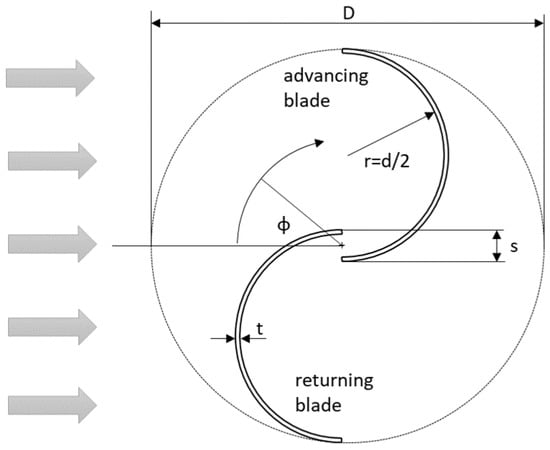
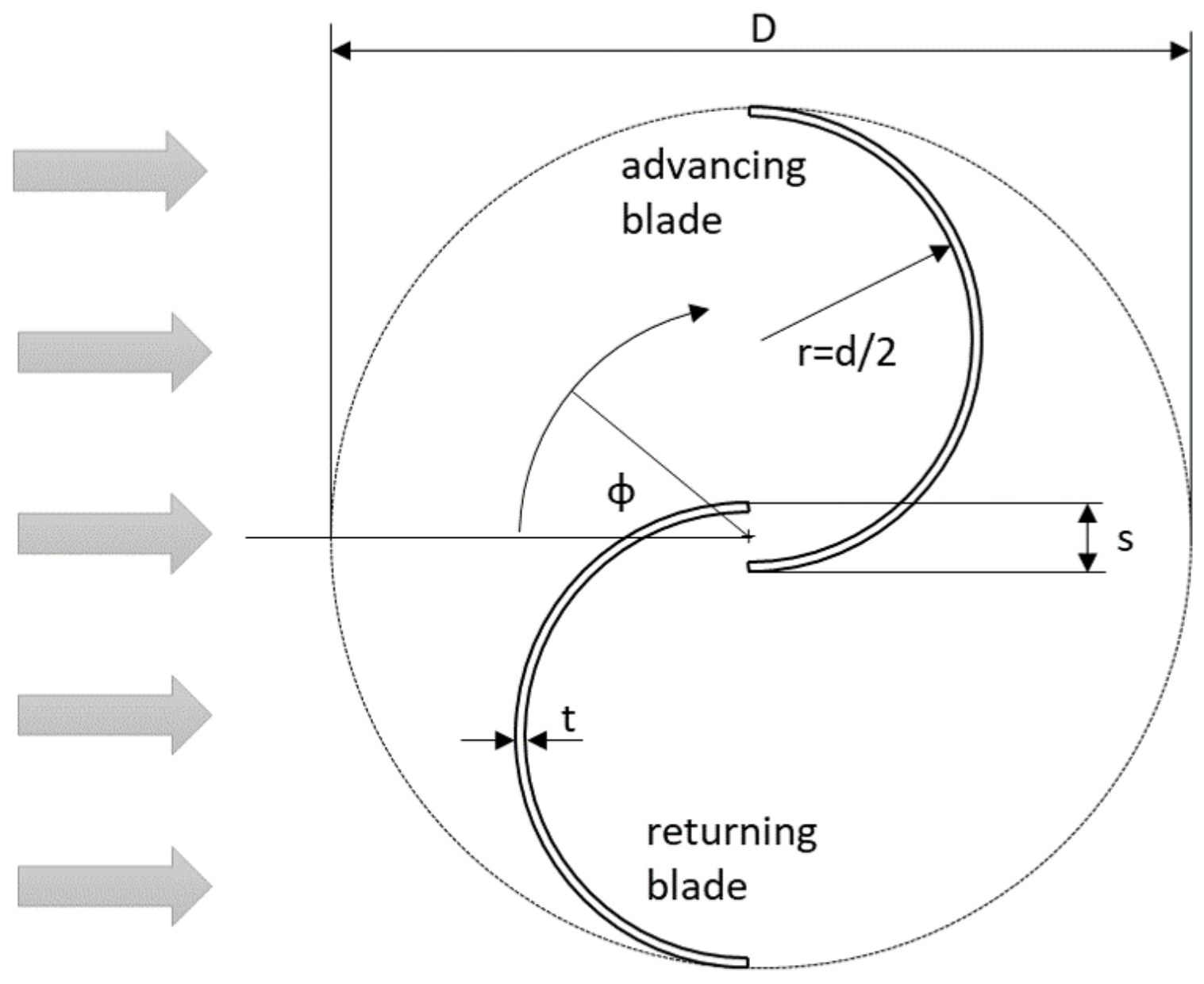
Before the optimization approach on which this contribution is based is introduced, it is reasonable to introduce the geometry and terminology of a conventional two-bucket Savonius rotor, which is widely used as a baseline reference configuration in the Savonius literature. The baseline Savonius turbine consists of two (or more) semi-cylindrical blades (buckets) arranged point-symmetrically around a central shaft. In the most common two-bladed configuration, the buckets are offset such that a central gap is formed. During operation, the rotor blades are typically distinguished as the advancing blade and the returning blade (Figure 2). The advancing blade denotes the bucket whose concave surface faces the incoming wind and therefore produces the dominant positive torque contribution due to pressure-driven drag forces. In contrast, the returning blade moves with its convex surface exposed to the incoming flow and is associated with adverse drag forces, flow separation, and potentially negative torque contributions depending on the operating conditions.
Figure 2.
Geometry of a two-bucket Savonius rotor (cross-section) showing rotor diameter D, blade radius , overlap s, blade thickness t, and azimuth angle .
The geometry is characterized by the rotor diameter D and rotor height H. The projected swept area is generally defined as
The bucket diameter is denoted by d, corresponding to the diameter of each semi-cylinder. The overlap between the two buckets is described by the overlap distance s, defined as the minimum gap between the outer edges of the buckets in the cross-sectional view. Following common conventions in the Savonius literature, the overlap ratio is defined as
Furthermore, referring to Figure 2, the bucket wall thickness is denoted by t, and the angular position of the buckets is represented by .
4. Interlocked Savonius Rotor Pair
While the previously mentioned multi-rotor studies mainly address displaced arrangements with a finite positive spacing between the rotor envelopes, the geometric design space of interacting Savonius pairs is not limited to separated configurations. In particular, an additional class of layout can be defined by allowing the projected rotor envelopes to overlap, resulting in a negative gap (). This particular interlocked Savonius rotor pair configuration constitutes the focus of the present investigation.
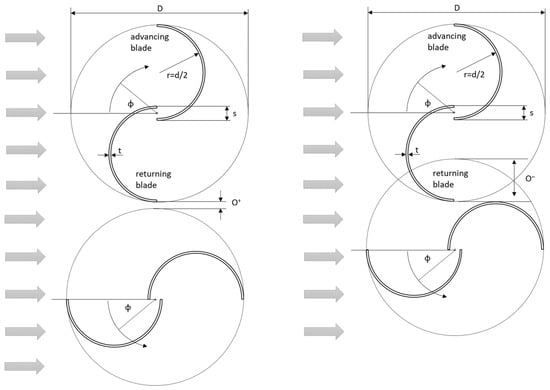
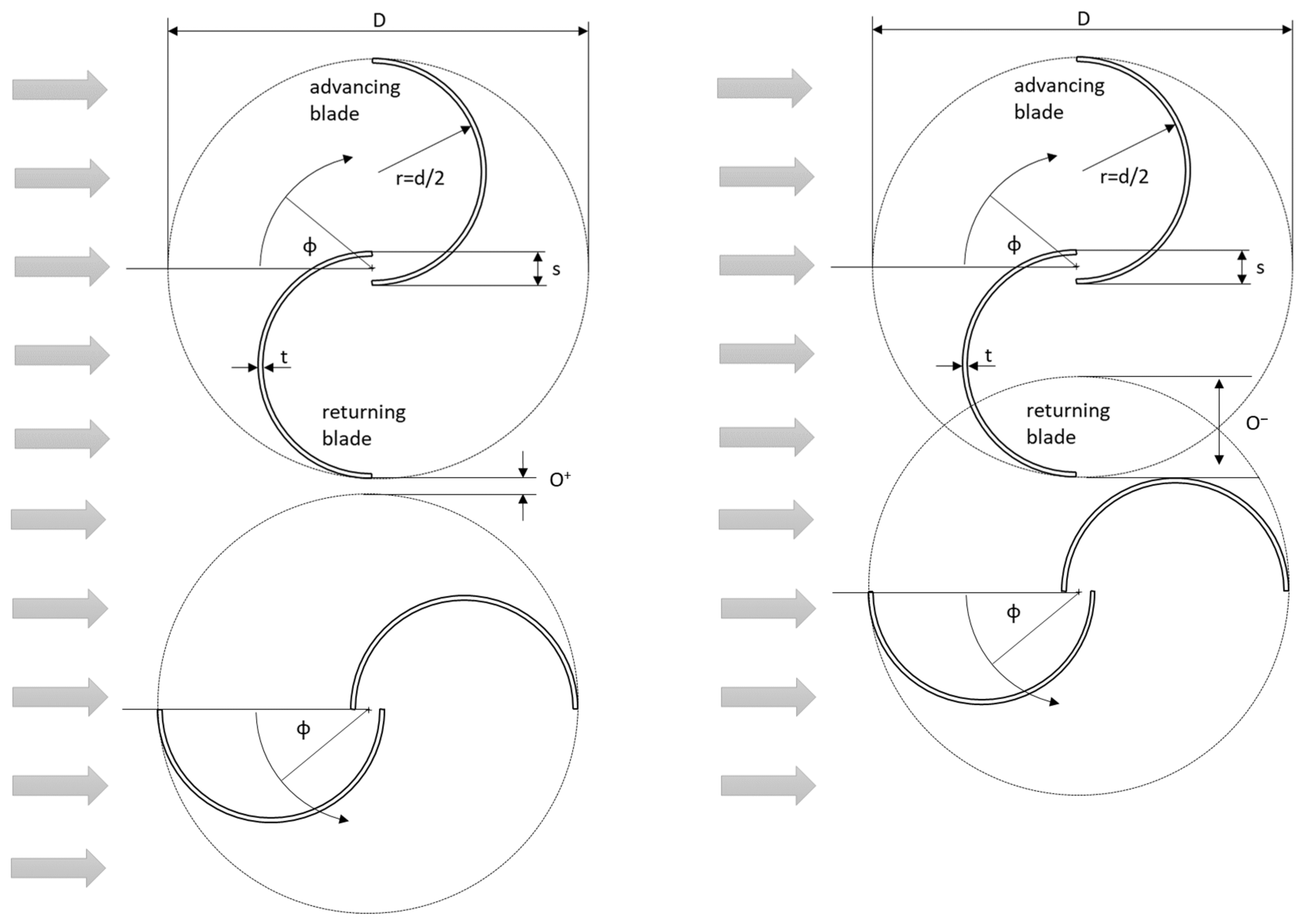
In the investigated arrangement, the two counter-rotating rotors are not merely placed in proximity but become interlocked or interleaved in the sense that their theoretical swept paths intersect in projection. The avoidance of actual blade collision is ensured by a fixed angular offset between the buckets (), such that the bucket trajectories overlap geometrically without physical interference. Figure 3 illustrates the interlocked dual-rotor configuration with a negative gap () considered in this work and contrasts it with the more commonly investigated Savonius layouts featuring a finite positive spacing between the rotor envelopes (positive gap, ). To the best of the authors’ knowledge, this interlocked negative-gap configuration has not yet been systematically investigated in the Savonius literature. Consequently, the aerodynamic interaction mechanisms in the overlap region, including potential flow acceleration, cavity pressure coupling and wake redirection, remain largely undocumented, despite the fact that such a configuration may enable stronger interaction effects than conventional positive-gap arrangements. Additionally, it should be noted that the practical realization of such an interlocked dual-rotor system is inherently more challenging than single-rotor and dual-rotor implementations with a positive gap since a fixed angular offset between the two rotors must be maintained to avoid blade collision. This typically requires an appropriate mechanical synchronization and coupling concept to ensure phase locking under aerodynamic loading.
Figure 3.
Geometry of dual Savonius rotor configurations (cross-section): dual-rotor arrangement with positive gap () (left) and interlocked counter-rotating dual-rotor configuration with negative gap () (right).
For the simulations conducted in this work, a two-bucket Savonius rotor configuration with a fixed overlap ratio was chosen. The buckets were semi-cylindrical. Relevant geometry parameters for the single-rotor configuration and the dual-rotor interlocked Savonius pair are summarized in Table 1. The considered baseline geometry, together with the applied flow conditions (Section 5.3), was selected to match the Reynolds number of the experimentally investigated Savonius rotor reported in [10].
Table 1.
Geometric parameters of the baseline Savonius rotor and interlocked dual-rotor configuration.
A negative overlap ratio of was selected to obtain a compact dual-rotor arrangement. In the chosen reference position at an angular position of , the outermost points of both rotors are approximately aligned on a common vertical line (see Figure 3). This overlap therefore provides a geometrically consistent initial layout.
5. Numerical Methodology
In order to investigate the aerodynamic interaction effects of the proposed interlocked Savonius rotor configuration, numerical simulations were performed using ANSYS Fluent (2025 R2). The flow is modeled by solving the Reynolds-averaged Navier–Stokes (RANS) equations, including steady and unsteady simulations to resolve the transient behavior typical of drag-based vertical-axis turbines. All simulations were conducted on a two-dimensional cross-sectional model of the rotor geometry, which represents a common and computationally efficient approach for the comparative assessment of Savonius rotor performance and interaction effects. The following section provides further details on the numerical setup, including the computational domain, mesh generation and discretization strategy, as well as the applied boundary conditions and solver settings.
5.1. Flow Modeling and Governing Equations
The flow is assumed Newtonian, adiabatic and incompressible, which is justified by the low Mach number regime of the investigated operating conditions. The governing equations therefore consist of the incompressible continuity and momentum equations:
where u denotes the velocity vector, p the static pressure, the fluid density and the dynamic viscosity. Turbulent transport is represented through an eddy-viscosity approach. In the present work, two common two-equation turbulence closures are considered, namely the standard k– model and the k– SST model. Both turbulence models belong to the class of two-equation eddy-viscosity closures, in which the additional transport equations provide a characteristic turbulent velocity scale and length scale to compute the turbulent viscosity . The standard k– model is widely used in industrial CFD due to its robustness and good convergence behavior, but it may show limitations in strongly separated flows and regions with adverse pressure gradients. In contrast, the k– SST model combines the near-wall accuracy of the k– formulation with the free-stream robustness of the k– model through a blending function and is therefore generally considered more reliable for bluff-body aerodynamics with pronounced separation, as encountered in Savonius rotors. For this reason, both models are considered in the present study in order to assess the sensitivity of the predicted torque and performance coefficients.
5.2. Meshing Strategy and Rotor Motion
For rotating machinery simulations, the sliding-mesh technique is commonly considered the most accurate approach, as it represents the relative motion between rotating and stationary flow domains explicitly and enables a highly efficient time-resolved prediction of rotor-wake interaction. In a conventional setup, the rotor is enclosed by a rotating mesh zone which exchanges fluxes with the surrounding stationary domain through a non-conformal sliding interface, where the flow variables are transferred by interpolation. In the present study, however, a classical sliding-mesh formulation cannot be applied for the investigated interlocked dual-rotor configuration. Due to the negative gap (), the projected rotor envelopes overlap such that two independent rotating subdomains would geometrically intersect. Consequently, the flow domain cannot be decomposed into separate non-overlapping rotating zones without artificially splitting the physically relevant overlap region.
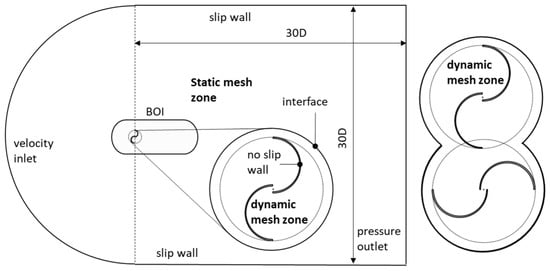
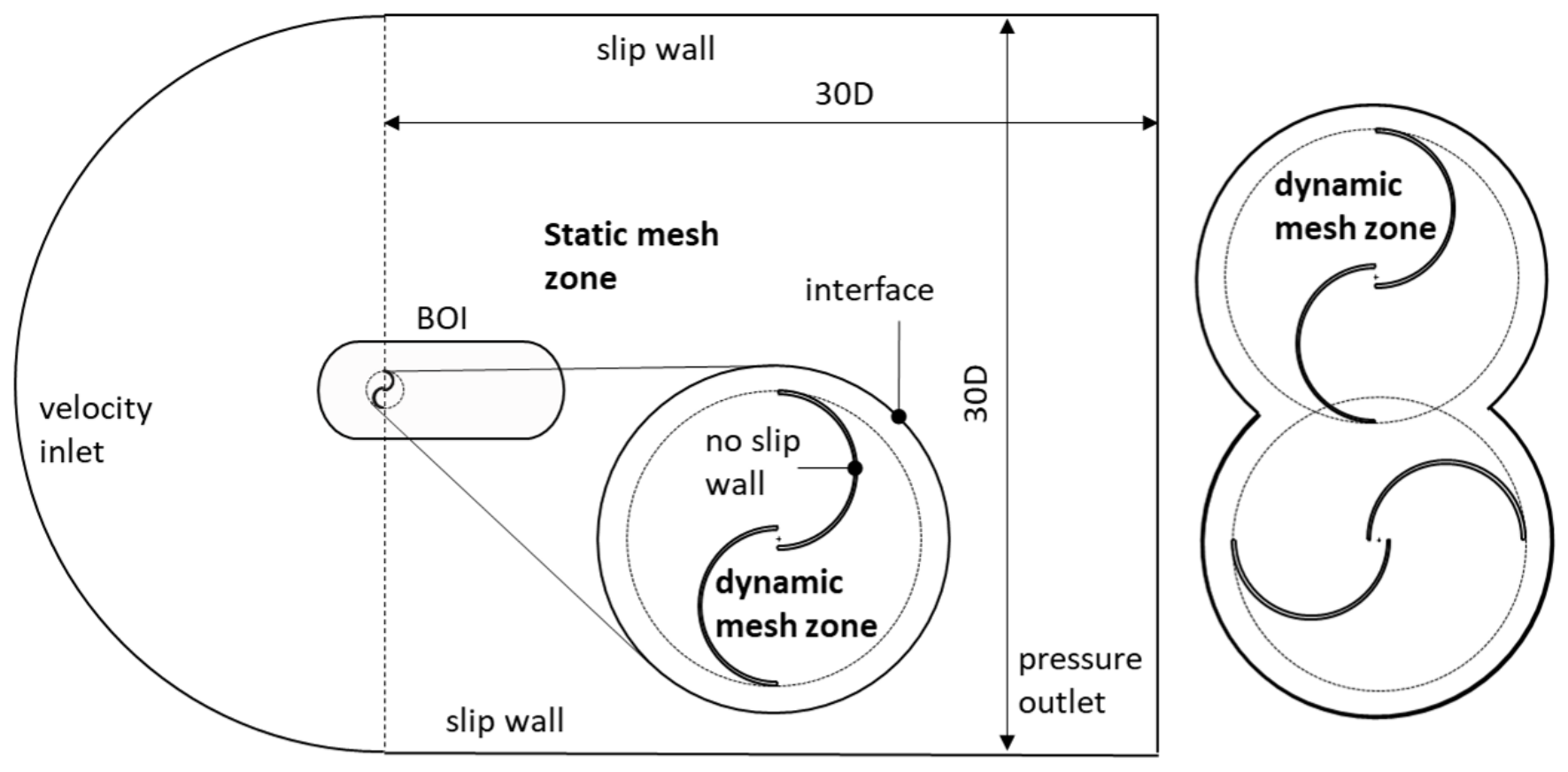
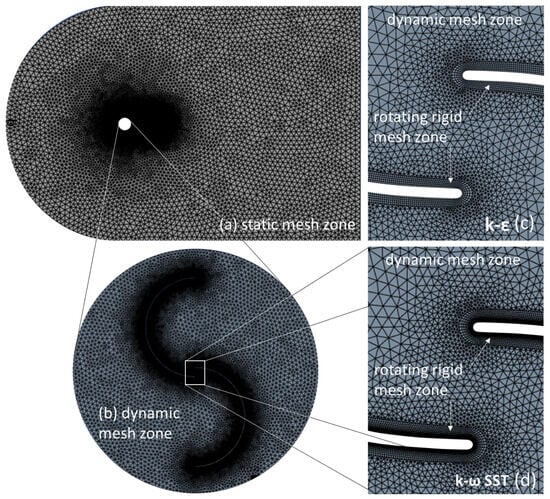
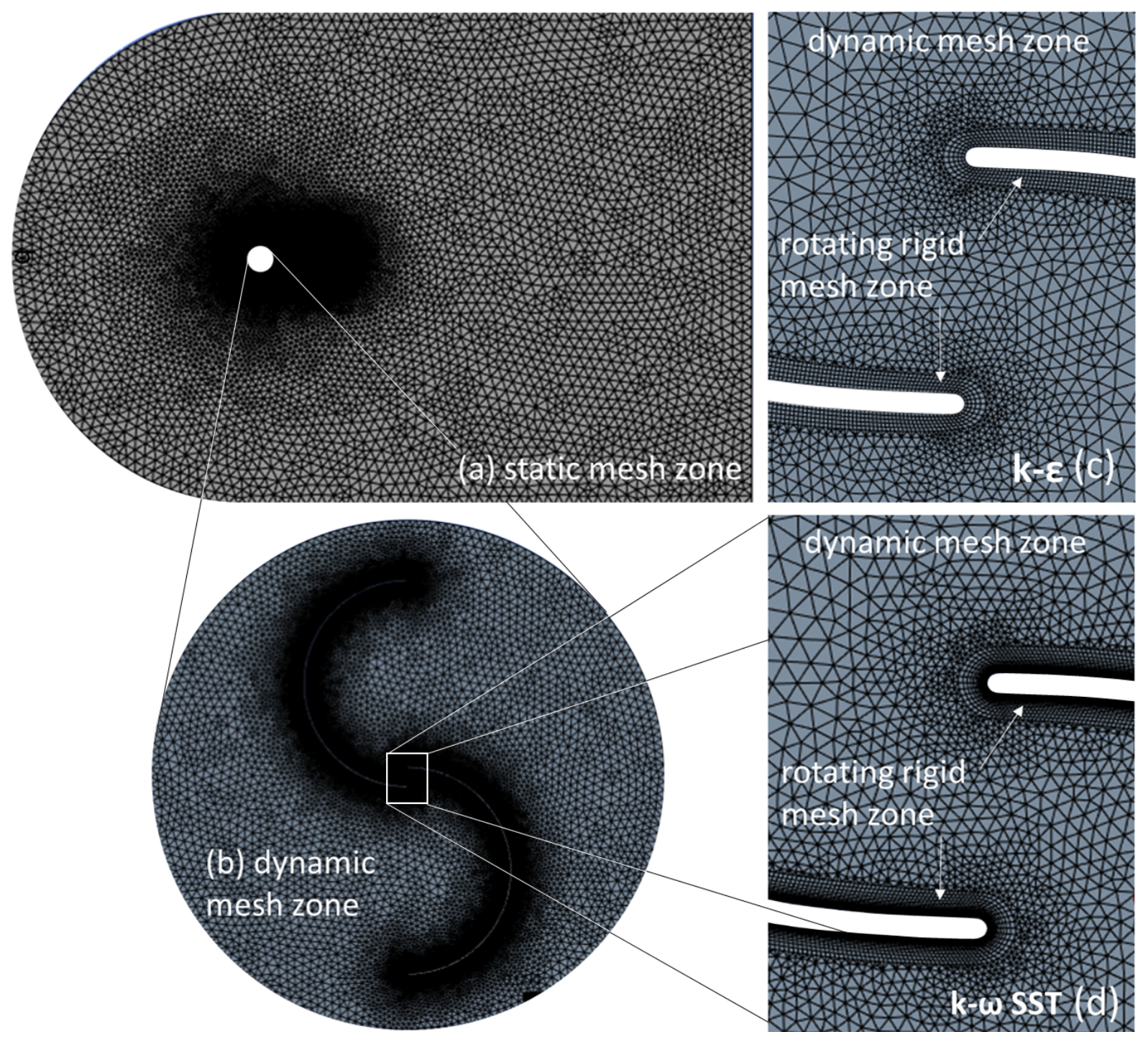
To overcome this limitation, a dynamic meshing approach is applied. A detailed overview of the computational domain and the employed mesh zones is shown in Figure 4. In total, three mesh zones were defined in order to control the mesh motion. The far-field region of the computational domain was discretized using a stationary mesh. In the vicinity of the rotors, a dynamic mesh zone was employed, while the near-wall boundary-layer cells around the rotor buckets were not allowed to deform but instead treated as a rigid body rotating together with the buckets walls. Between the inner dynamic zone and the outer stationary zone, a non-conformal interface was defined, analogous to the sliding-mesh approach, where the flow variables are transferred by interpolation across the interface.
Figure 4.
Computation domain and mesh zones for single-rotor and dual-rotor configurations.
The adopted computational domain consists of a two-dimensional far-field domain with a semi-circular upstream inlet section. The inlet is specified as a velocity inlet with uniform free-stream velocity , while the outlet is modeled as a pressure outlet at ambient reference pressure. The upper and lower boundaries are defined as slip walls to reduce confinement effects and to approximate an unbounded external flow environment. The overall domain dimensions are defined relative to the rotor diameter D, where the downstream length is set to in order to capture wake recovery, and the domain height is also chosen as to limit blockage effects. The rotor center is positioned sufficiently far from the inlet arc to ensure a stable inflow field prior to rotor interaction.
An unstructured mesh topology is used to accurately represent the curved bucket geometry and to resolve local separation phenomena. Local refinement is applied around the rotor and in the near-wake region by an additional body of influence (BOI) to ensure adequate resolution of the flow field and its interaction with the rotor. Near-wall prism layers are generated on the bucket surfaces to capture the strong flow gradients in the boundary layer and to improve wall shear stress predictions. A detailed view of the mesh topology and prism-layer resolution is provided in Figure 5. Since two turbulence closures are considered (standard k– and k– SST), different near-wall resolutions are applied. For the k– SST model, the first-cell height is chosen such that a wall-resolved treatment is ensured (). In contrast, for the standard k– model a coarser near-wall discretization is employed, resulting in first-cell values of approximately , applied in combination with the enhanced wall treatment.
Figure 5.
Mesh topology and boundary-layer resolution used for the k– and k– SST turbulence closure.
5.3. Reference Flow Conditions
In order to ensure comparability with available experimental and numerical studies on Savonius rotors, all simulations were performed at a fixed Reynolds number based on the rotor diameter D. The Reynolds number is defined as
where denotes the free-stream velocity, the air density, the dynamic viscosity, and the kinematic viscosity. The free-stream velocity was selected such that the target Reynolds number of is obtained for the chosen rotor diameter. The corresponding reference quantities and fluid properties used for the simulations and the non-dimensionalization of the results are summarized in Table 2.
Table 2.
Reference flow quantities and fluid properties used for the numerical simulations and non-dimensionalization.
The simulations were conducted using a turbulence intensity of 1% at the inlet, which is consistent with commonly applied boundary conditions in CFD studies of Savonius rotors under wind tunnel validation conditions. It should be noted that this value does not represent urban wind conditions, where turbulence intensities are significantly higher. However, the use of low-turbulence inflow was deliberately chosen to ensure consistency with the reference data and planned wind tunnel measurement.
6. Performance Coefficients and Effective Reference Area
The aerodynamic performance of the investigated Savonius rotor configurations is evaluated based on the static and dynamic torque M obtained from the CFD solution. To enable a consistent comparison between different operating conditions and rotor arrangements, the results are expressed using non-dimensional performance coefficients. The corresponding moment coefficient is defined as
where denotes the air density, the free-stream velocity, A the projected swept area, and the characteristic rotor radius. The power coefficient is then given by
with the mechanical power and the tip-speed ratio
where denotes the angular velocity of the rotor.
For a conventional single-rotor configuration, the projected reference area is defined as , where D is the rotor diameter and H the rotor height. However, for the interlocked dual-rotor configuration investigated in this work, the projected rotor envelopes overlap in the cross-sectional view when a negative gap () is applied. In this case, the total projected area is smaller than the simple sum of the two individual rotor areas, i.e., . To avoid inconsistent normalization of the performance coefficients, an effective reference area is introduced based on the union of both projected rotor envelopes. Assuming identical rotor height H for both rotors, the effective area is expressed as
where denotes the effective projected width of the dual-rotor arrangement. For two identical rotors with an envelope spacing O (positive gap or negative gap ), the effective width reads
Accordingly, in the interlocked case (), the reference area decreases due to negative overlap, i.e., . The performance coefficients reported for dual-rotor cases are therefore normalized using instead of . In addition, the characteristic length scale entering the non-dimensional moment coefficient is adapted consistently by defining an effective reference radius
7. Results: Single Rotor
This section presents the numerical results obtained in the present study. To establish confidence in the computational setup and to provide a consistent baseline for subsequent comparisons, the single-rotor configuration is first presented and the predicted aerodynamic performance is validated against available experimental data. The agreement obtained serves to verify the adopted numerical methodology, including the applied boundary conditions, dynamic mesh strategy, and modeling assumptions. Both steady and transient simulations are considered.
For validation, the wind tunnel dataset of [10] is used, which provides widely used reference performance data for two- and three-bucket Savonius rotors. The measurements were conducted in a large low-speed wind tunnel, where the rotor torque and rotational speed were recorded under controlled tunnel conditions. In total, fifteen rotor configurations were tested, including variations in the number of buckets ( and ), rotor height ( and ), overlap distance (0–), and freestream velocity ( and ), corresponding to Reynolds numbers of and . The dataset includes static torque measurements as a function of rotor azimuth angle, enabling an assessment of self-starting characteristics as well as dynamic torque measurements to access the operational torque and power output.
Based on the validated single-rotor reference, steady and transient simulations of the dual rotor configuration are performed in the next section to assess the aerodynamic interaction effects and to quantify potential performance gains or penalties. The single-rotor results thus form the foundation for the subsequent evaluation of the dual-rotor arrangements.
7.1. Grid Independence Study
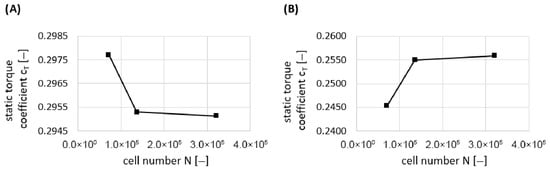
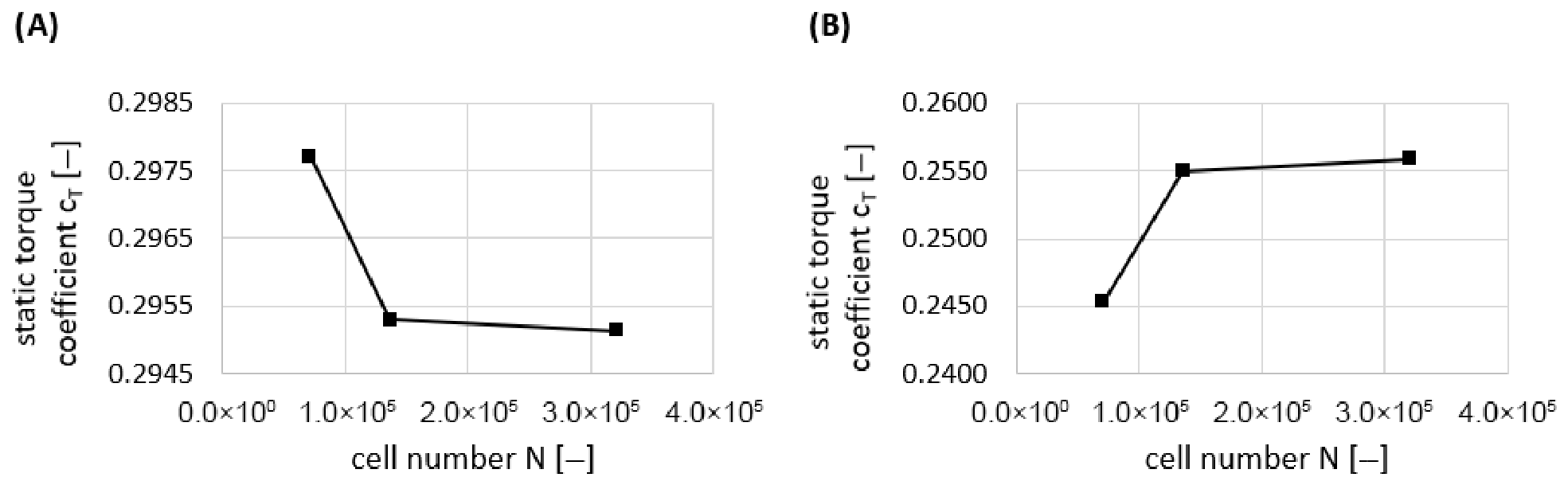
Prior to the comparison with experimental reference data, mesh independence studies were carried out for both steady (RANS) and transient simulations (URANS) to ensure that the predicted torque coefficients are not significantly affected by the spatial discretization. For the steady RANS case, the investigation was performed at a reference position at an azimuth angle of using the k– SST turbulence model, as it typically exhibits a stronger sensitivity to near-wall grid resolution.
Figure 6 presents the static torque coefficient for the steady RANS (Figure 6A) and the URANS simulation (Figure 6B). For the grid convergence assessment, three mesh resolutions (coarse, medium, and fine) were generated by systematically doubling the specified element size while keeping the overall refinement strategy unchanged. For both the steady and unsteady cases, a noticeable change in is observed between the coarsest and the intermediate grid, whereas further refinement towards the finest mesh results only in a marginal variation. The relative deviation drops to below for the steady case and below for the URANS case, indicating that the solution is sufficiently grid independent. Consequently, the finest grid was not considered necessary, and the intermediate mesh resolution was selected as a reasonable compromise between accuracy and computational cost for all subsequent single-rotor and dual-rotor simulations.
Figure 6.
Mesh convergence study for the single-rotor case (A) k– SST steady RANS at , (B) k– SST URANS.
7.2. Single Rotor: Static Torque Coefficient Validation
This subsection presents the results for the static performance of the single-rotor under varying azimuth angles and serves as a baseline for the subsequent interaction studies, in particular, to evaluate the self-starting capability. For the static assessment, the rotor is fixed at prescribed angular positions and steady-state RANS simulations are performed. Although the flow around a bluff-body rotor can remain inherently unsteady due to separation and vortex shedding even in a fixed configuration, the steady solution provides a quasi-steady approximation of the mean static aerodynamic loads.
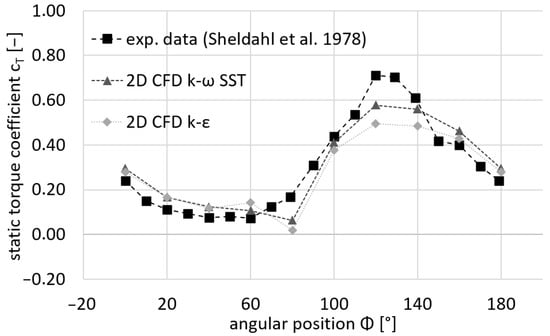
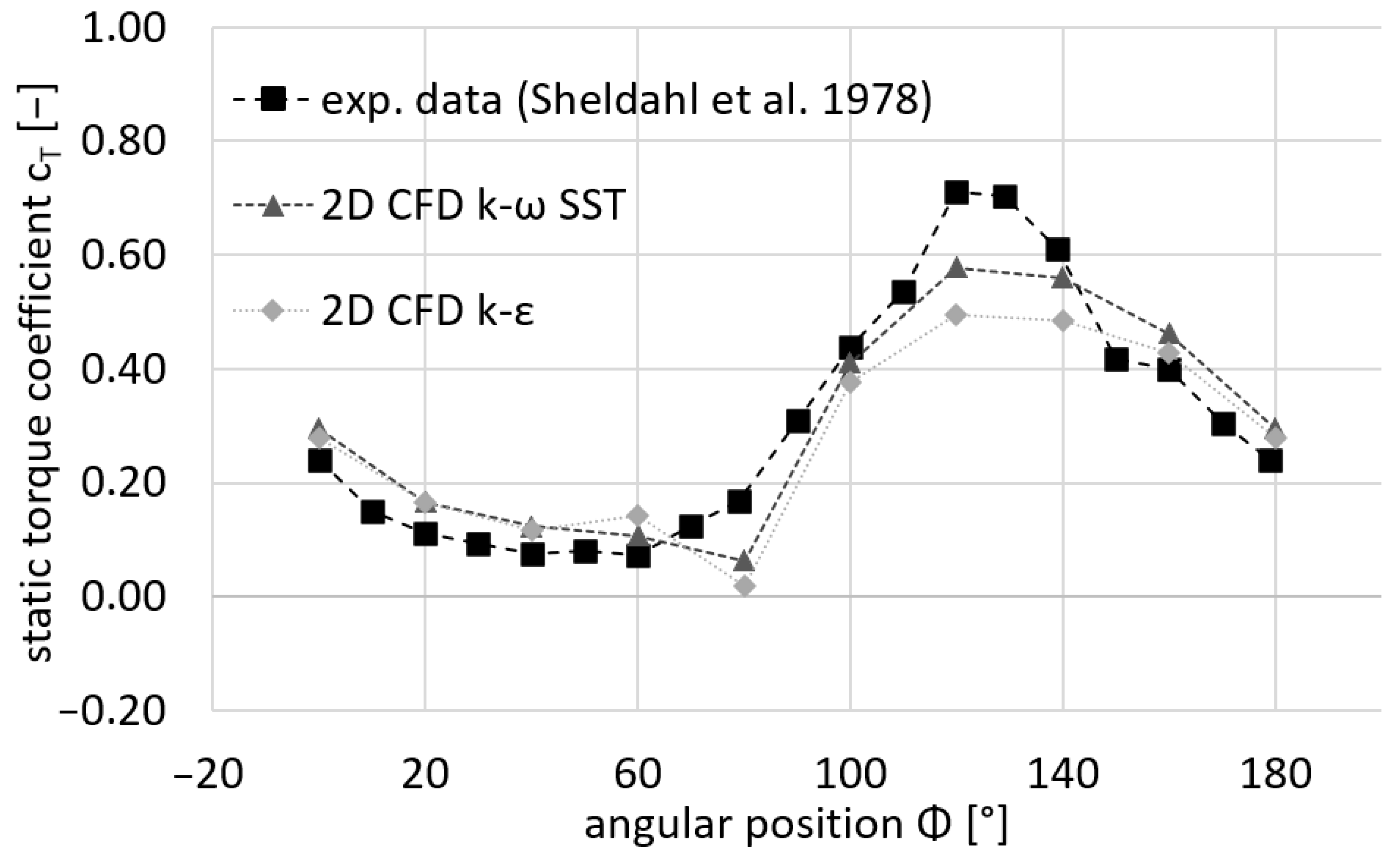
Figure 7 compares the computed static torque coefficient obtained with both turbulence models (k– and k– SST) against the experimental reference data from [10]. Overall, the simulations reproduce the characteristic trend of the experimental curve, including the low-torque plateau at intermediate azimuth angles and the pronounced increase in between approximately and . Quantitatively, both turbulence models capture the main torque-producing region but underpredict the peak values compared to the experiment. The k– SST model yields consistently higher torque levels and shows a closer agreement with the measurements, particularly in the high-torque range around –, whereas the k– model exhibits a stronger reduction of and therefore a more conservative estimate of the driving torque. The steady results confirm that the numerical setup reproduces not only the correct qualitative trend of the static torque distribution over the azimuth but also provides a reasonable quantitative agreement with the experimental reference data. In particular, the simulations capture the location and extent of the main torque-producing region and predict the correct order of magnitude of . Remaining deviations are mainly observed in the peak torque range, where both turbulence closures slightly underpredict the experimental maximum values. This discrepancy can be attributed to the limitations of a steady RANS representation in highly separated and strongly unsteady flows. Nevertheless, the results still allow a meaningful assessment of the self-starting capability, since this characteristic is mainly governed by the occurrence and extent of low or negative torque regions over the azimuthal cycle rather than by the exact prediction of peak values.
Figure 7.
Static torque coefficient as a function of azimuth angle for the single-rotor configuration (). Experimental reference data were taken from [10].
7.3. Single-Rotor: Transient URANS Setup
In the following, the transient single-rotor results are presented in terms of the power coefficient as a function of the tip-speed ratio . In contrast to the quasi-steady static torque analysis, the transient URANS simulations capture the unsteady rotor–wake interaction and thus represent the physically relevant operating condition of the rotating Savonius turbine. Based on the validation results of the static torque distribution, only the k– SST turbulence model is considered for the transient simulations, as it yielded the closest agreement with the experimental benchmark and provided robust convergence for the strongly separated flow regime.
The temporal resolution of the URANS simulations is defined based on a constant rotor azimuth increment per time step. Specifically, the time step is chosen such that each time step corresponds to azimuth increment. This time-stepping strategy, and in particular, the value chosen for , is commonly used in transient CFD simulations of rotating machinery since it provides a constant angular resolution per revolution and thus enables a consistent evaluation of azimuth-dependent flow structures as well as torque fluctuations [32,33].
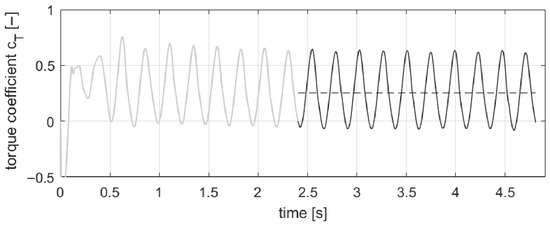
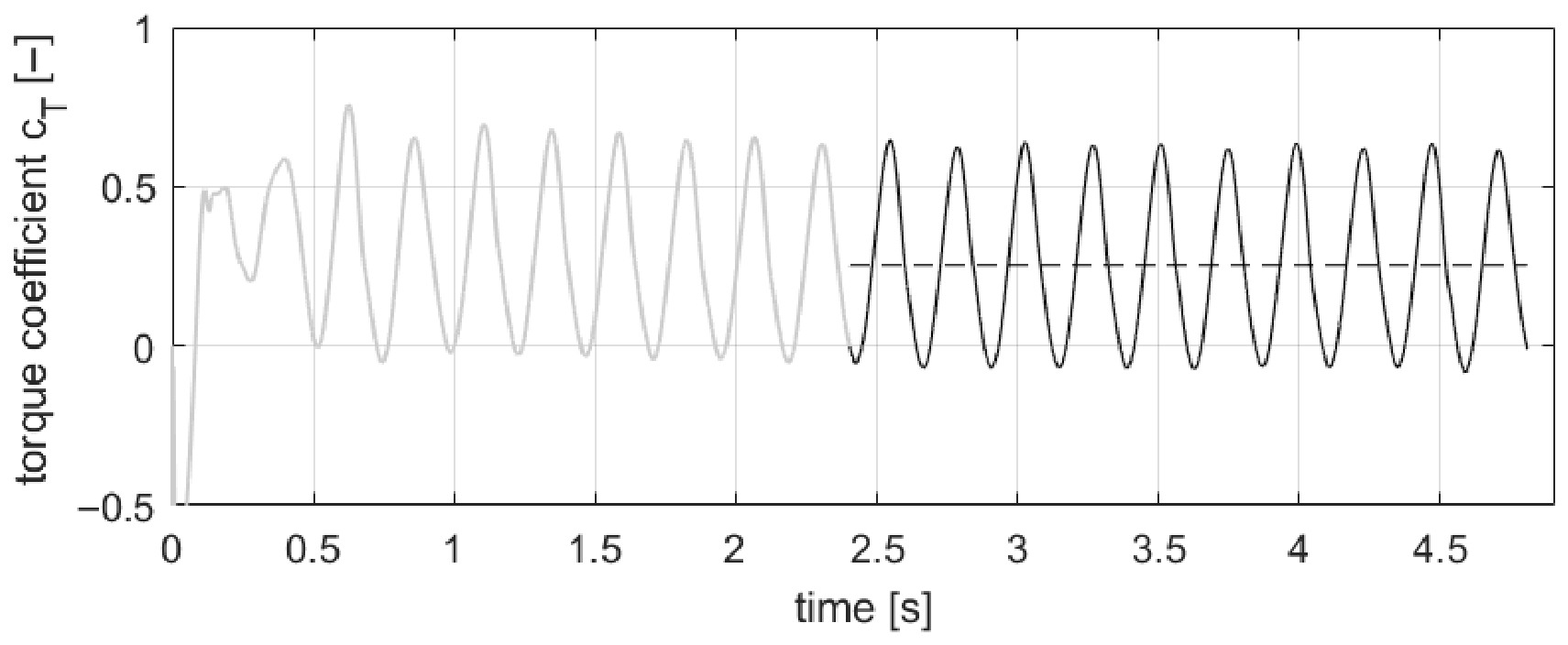
To obtain representative performance coefficients from the transient simulations, the instantaneous aerodynamic torque is monitored over multiple rotor revolutions. Since the flow field around a Savonius rotor requires several revolutions to develop a periodic wake structure and to eliminate initial transient effects, each operating point is simulated for a total of ten full rotor revolutions. As illustrated in Figure 8, the solution exhibits an initial transient phase followed by a quasi-periodic regime with nearly repeatable torque oscillations. The final reported mean coefficients are therefore obtained by phase-averaging over the last five revolutions. This procedure ensures that the reported performance values are based on statistically converged periodic operation rather than on the initial start-up transients.
Figure 8.
Torque coefficient history over the first ten rotor revolutions used for the evaluation of the power coefficient ().
7.4. Single-Rotor: Power Coefficient Validation
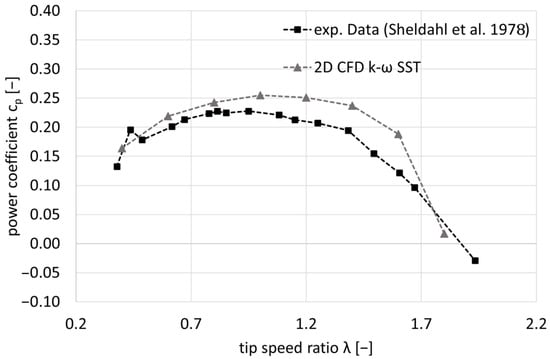
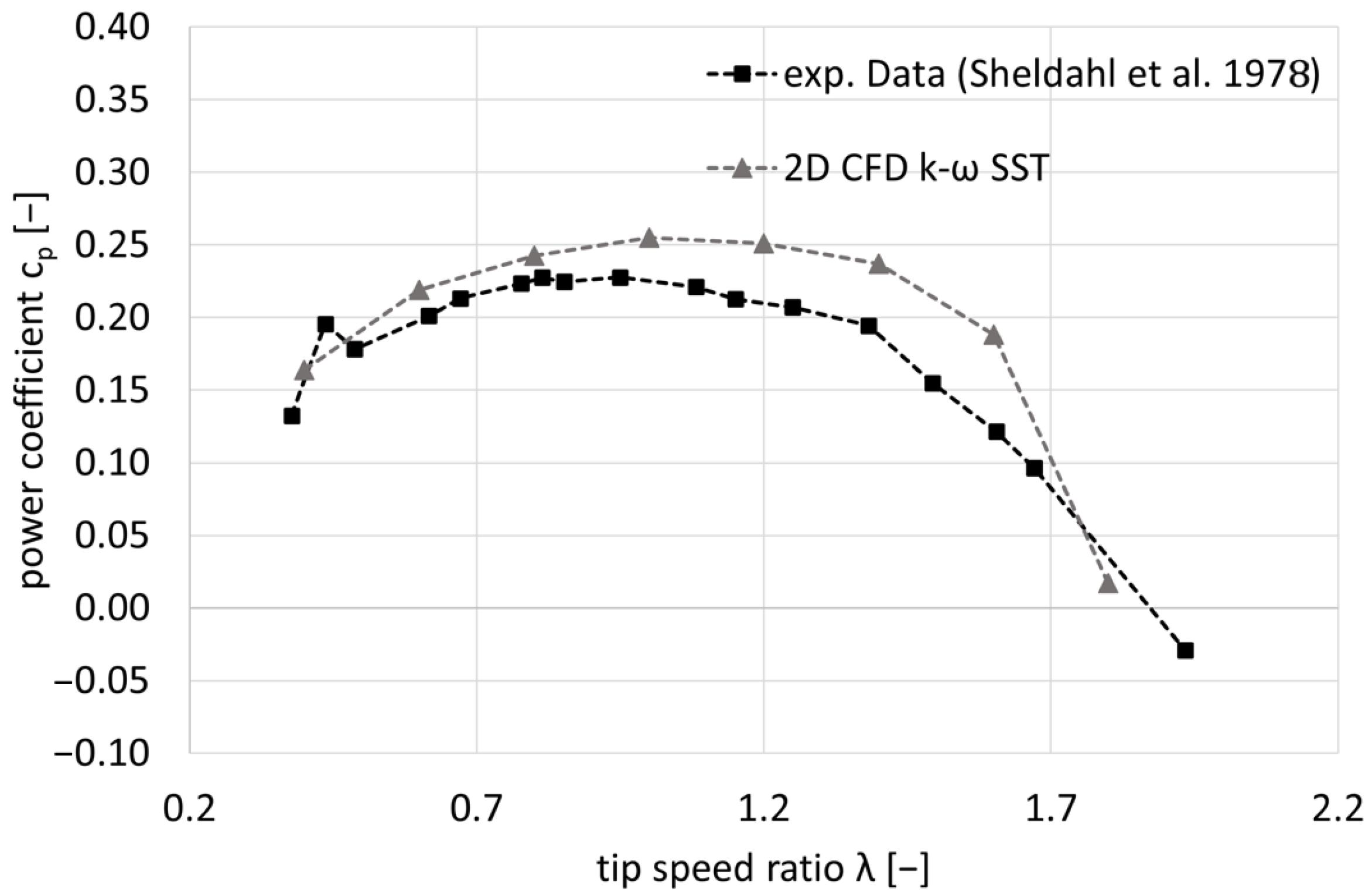
Figure 9 compares the predicted power coefficient with the experimental reference data of Sheldahl et al. [10] over the investigated tip-speed-ratio range of . Overall, the numerical results reproduce the general shape of the experimental curve. In particular, the power coefficient is predicted with good accuracy, even though at higher tip-speed ratios (), the numerical model slightly overpredicts the power coefficient compared to the measurements. This indicates that the employed URANS setup is able to capture the dominant unsteady aerodynamic mechanisms governing the cycle-averaged power production of the Savonius rotor. The quantitative deviations between CFD and experiments, particularly at elevated TSR, can mainly be attributed to three factors. First, the turbulence modeling relies on URANS and eddy-viscosity closures, i.e., time-averaged modeling assumptions, which are known to have limitations in capturing highly unsteady separated flows with strong vortex shedding, recirculation and rotor-cavity pressure fluctuations—all of which play a key role in Savonius aerodynamics. Second, the present simulations are performed in two dimensions, whereas the experimental reference corresponds to a finite-height three-dimensional rotor. Consequently, inherently 3D effects such as tip vortices, spanwise flow, and end losses cannot be represented in the 2D model and may contribute to discrepancies in the predicted performance, especially in the high-load and peak-power regime. Third, the present CFD setup assumes fully turbulent flow and does not account for laminar-to-turbulent transition effects. Depending on the local Reynolds number and pressure-gradient history along the blade surface, transitional boundary-layer behavior may affect separation characteristics and the resulting pressure distribution, thereby influencing the torque and overall performance. Nevertheless, the overall agreement in terms of both peak value and curve shape provides confidence that the modeling setup is suitable for the subsequent investigation of the interlocked dual-rotor configuration.
Figure 9.
Power coefficient as a function of the tip-speed ratio for the single Savonius rotor: comparison between experimental data and 2D URANS simulations. Experimental reference data were taken from [10].
8. Results: Dual-Rotor
The following section presents the numerical results for the interlocked dual-rotor configuration. In analogy to the single-rotor investigation, both RANS and URANS simulations are evaluated in order to characterize the operating behavior of the dual-rotor turbine. To ensure a consistent and meaningful comparison, the dual-rotor simulations are carried out using the same numerical modeling framework as established for the validated single-rotor case. In particular, the computational domain, boundary conditions, meshing strategy and turbulence modeling approach are kept consistent with the single-rotor setup. The transient simulations follow the same temporal discretization based on a constant rotor azimuth increment per time step, ensuring comparable angular resolution. The results are therefore discussed in direct comparison to the corresponding single-rotor predictions. This enables the identification of flow-mechanical effects introduced by rotor interaction and allows an assessment of how these mechanisms influence both the static torque behavior and the overall aerodynamic performance of the dual-rotor configuration.
8.1. Dual-Rotor: Steady Torque Coefficient
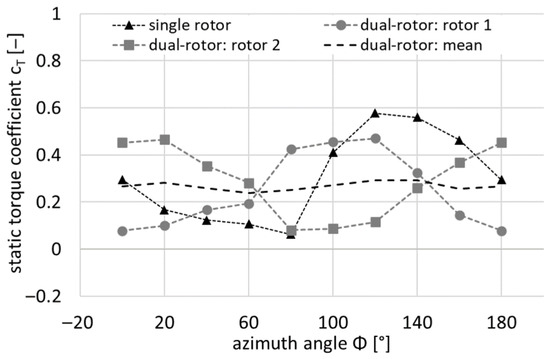
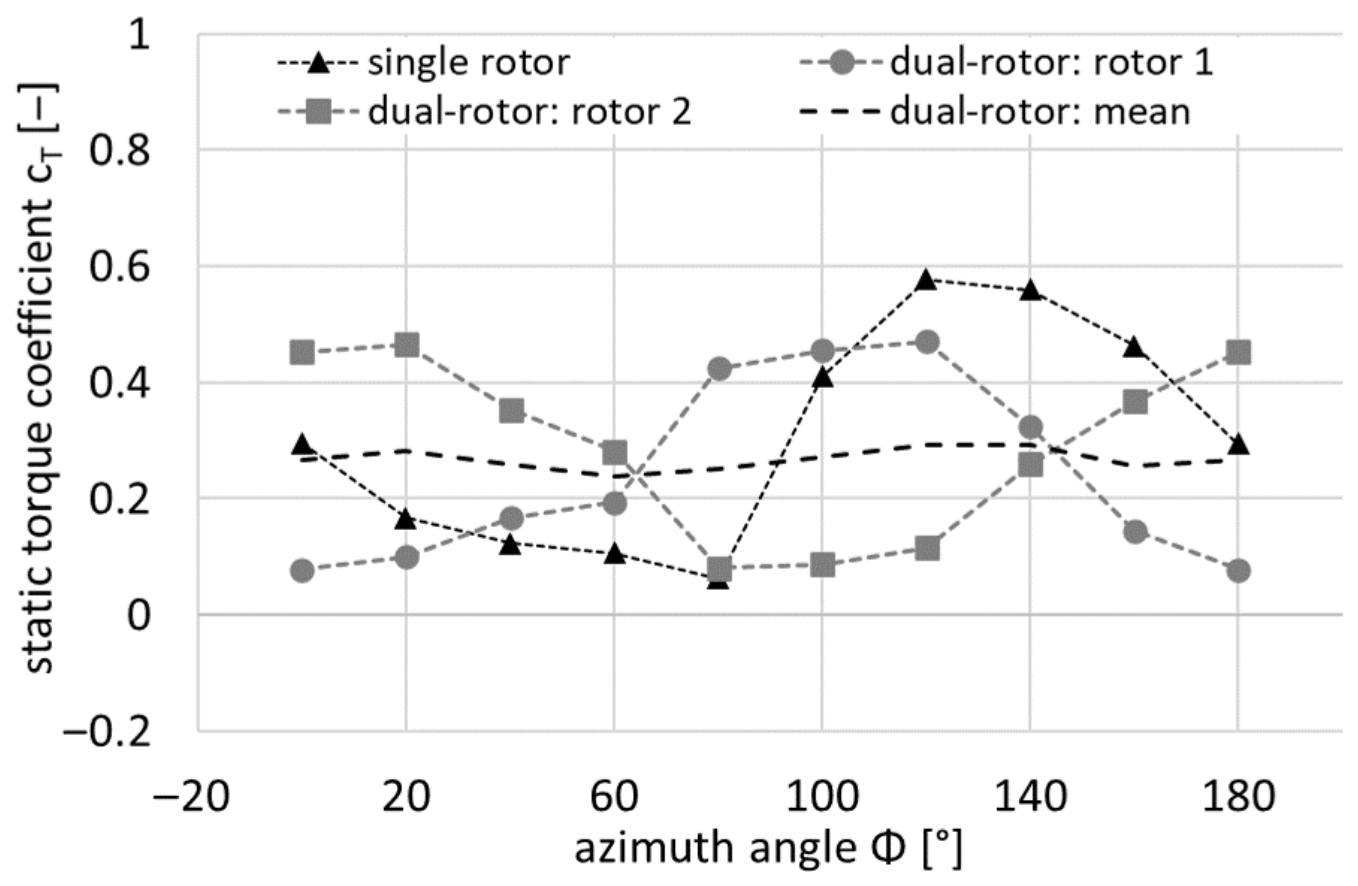
Figure 10 compares the static torque coefficient obtained from the steady CFD simulations for the single-rotor reference case and for the dual-rotor configuration. For the dual-rotor arrangement, the static torque is evaluated separately for rotor 1 and rotor 2, and additionally, the mean value of both rotors is shown in order to assess the overall starting tendency of the coupled system. In the single-rotor case, the torque distribution exhibits a pronounced azimuthal dependence with a distinct torque-producing region at intermediate angular positions. In contrast, the dual-rotor configuration leads to a clear redistribution of the torque generation over the azimuth. The torque curves of rotor 1 and rotor 2 show an approximately complementary behavior. As a consequence, the mean dual-rotor torque coefficient remains comparatively smooth and positive over the entire investigated angular range. The present results therefore suggest that the dual-rotor configuration improves the starting behavior, as at least one of the two rotors produces a sufficiently high driving torque at any given angular position, leading to a more robust net positive torque of the overall system. This effect is analogous to the principle of multi-stage Savonius turbines, where phase-shifted stages are employed to reduce torque ripple and to ensure a more continuous positive driving torque during start-up.
Figure 10.
Static torque coefficient as a function of azimuth angle for the single-rotor and dual-rotor configuration ().
8.2. Dual-Rotor: Power Coefficient and Flow Field Analysis
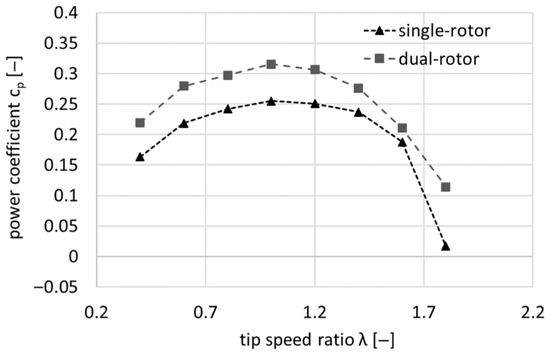
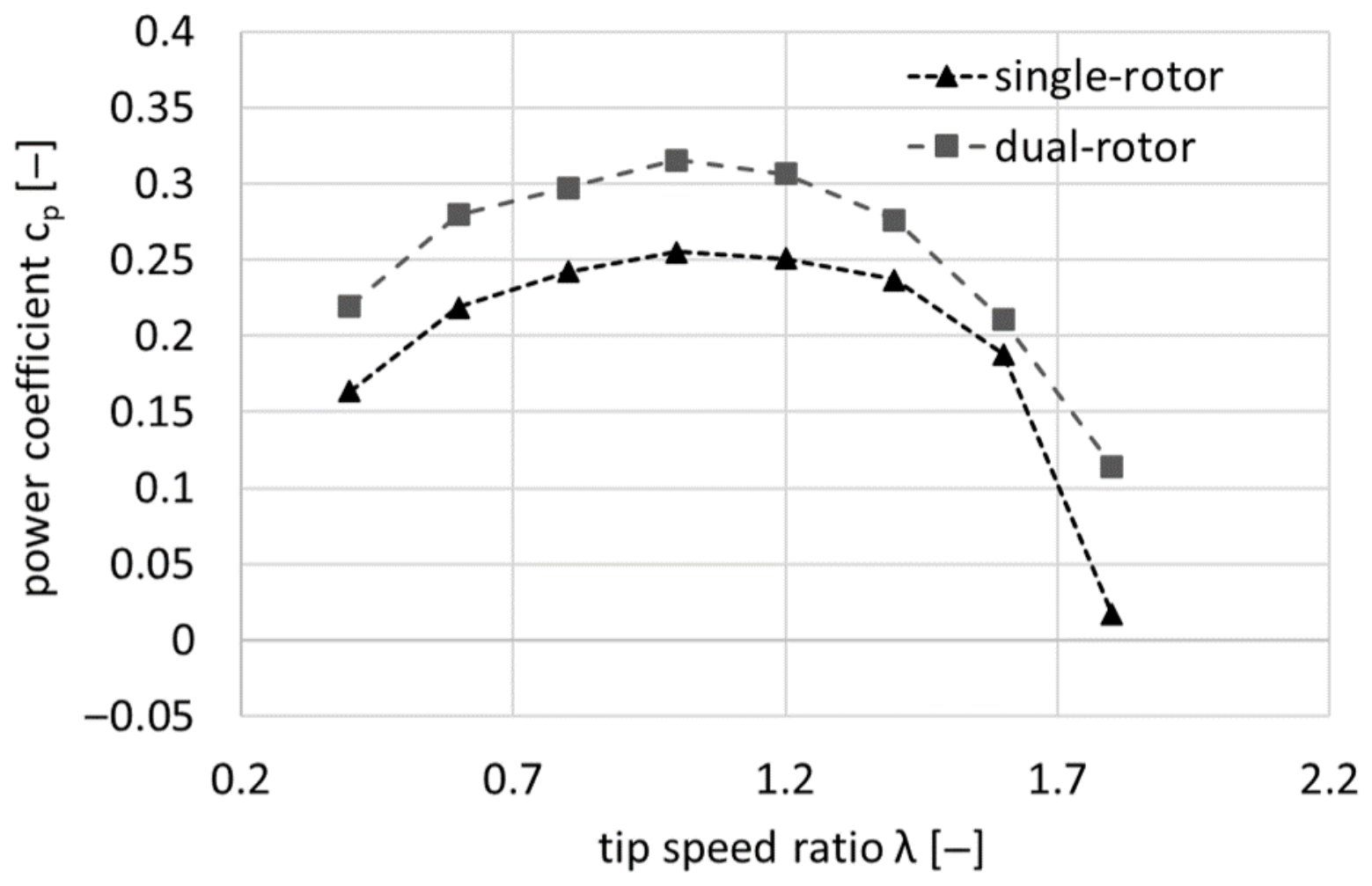
Figure 11 compares the dynamic performance of the interlocked dual-rotor configuration with the validated single-rotor reference case in terms of the power coefficient over the investigated tip-speed ratio range. The corresponding numerical data are provided in the Supplementary Materials (Table S1). In the dual-rotor setup, both rotors exhibit nearly identical characteristics. For the purpose of a consistent and meaningful comparison with the single-rotor case, the average Cp value of the two individual rotors in the dual-rotor configuration is used. This averaged value is then directly compared to the Cp value of the single-rotor reference case. Overall, the results indicate that the investigated dual-rotor configuration yields higher values for all operating points for the selected parameter combination (, ). In particular, the maximum power coefficient increases noticeably compared to the single-rotor configuration, indicating that the aerodynamic interaction of the interlocked rotors leads to a beneficial redistribution of driving and resisting torque contributions over the rotor revolution. This suggests that the interlocked arrangement stabilizes the net torque production and mitigates adverse torque phases.
Figure 11.
Comparison of the predicted power coefficient curves for the single-rotor reference case and the interlocked dual-rotor configuration.
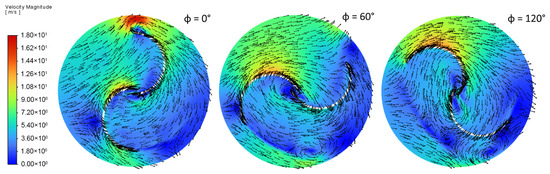
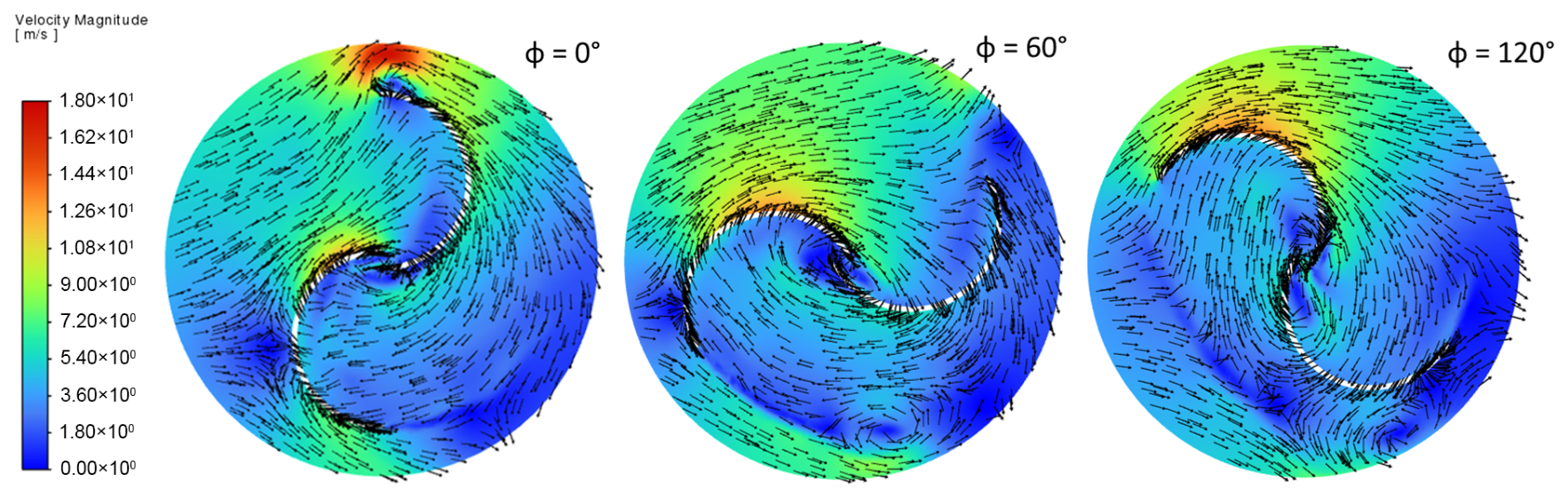
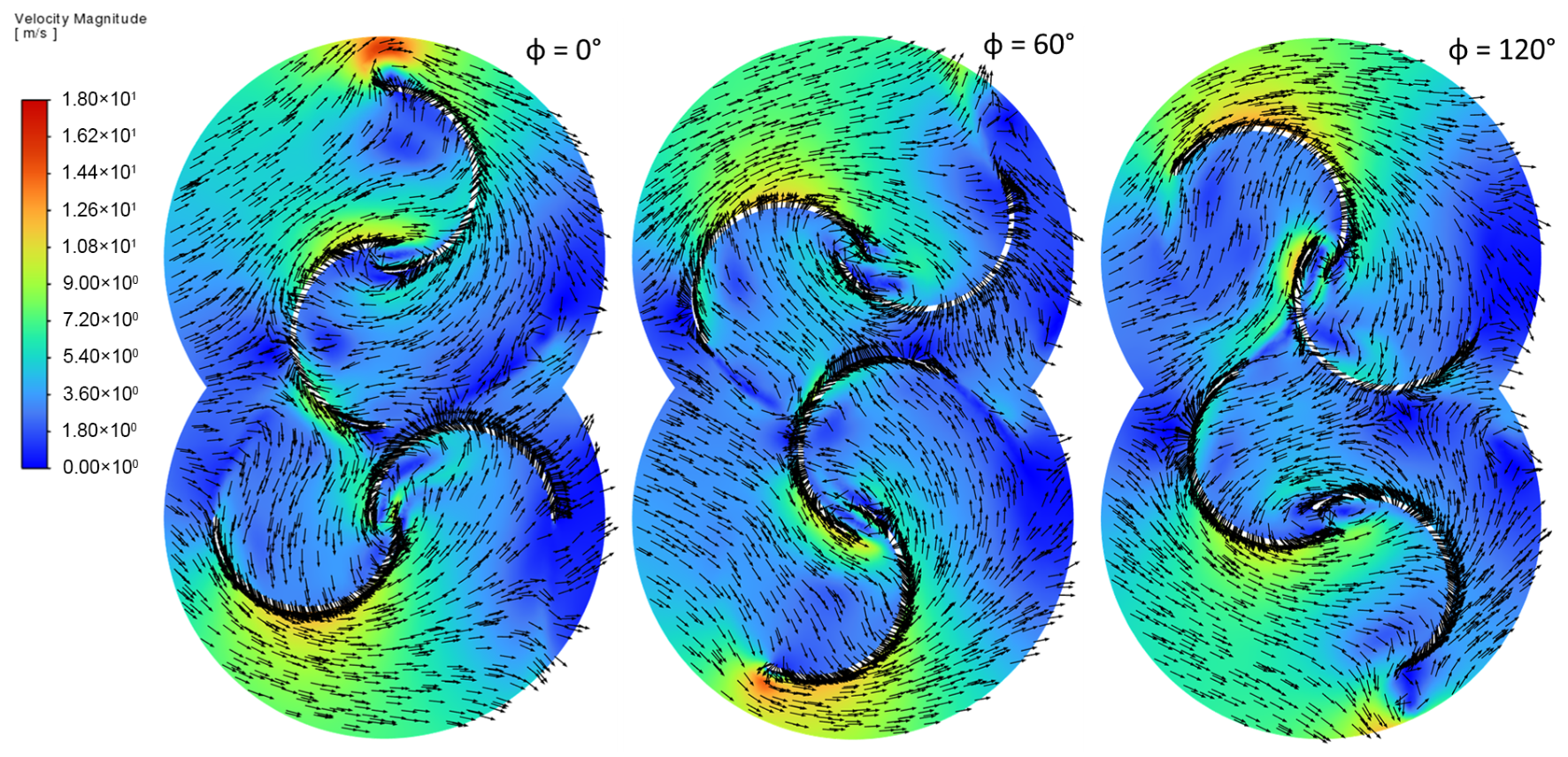
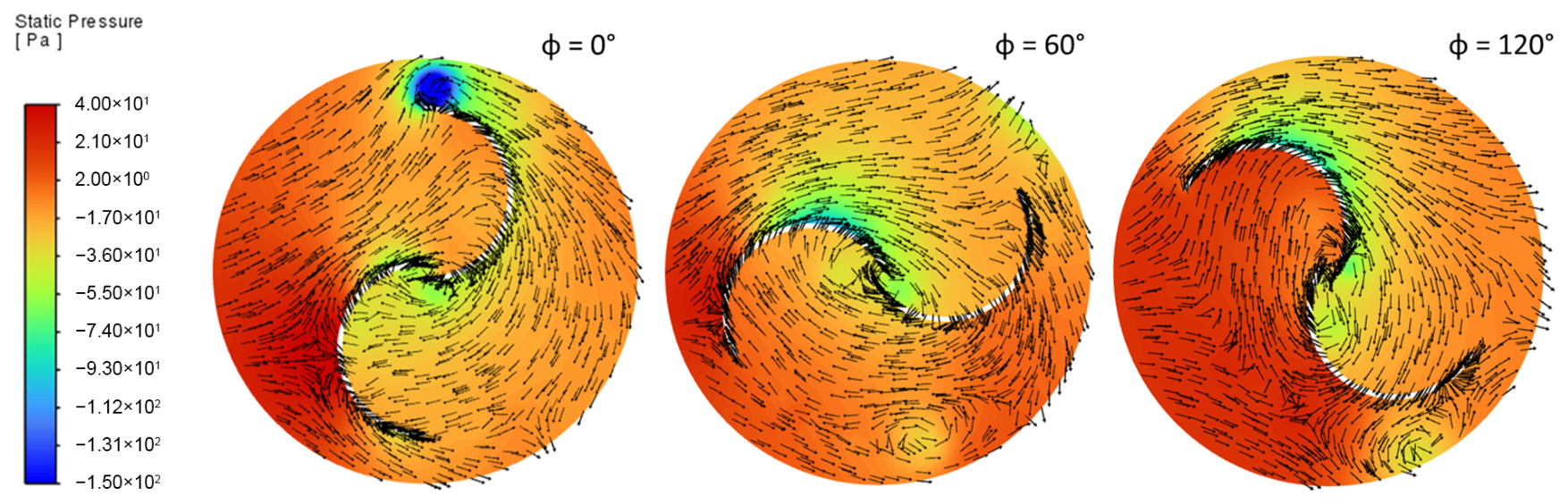
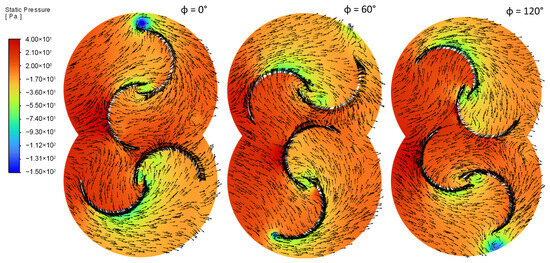
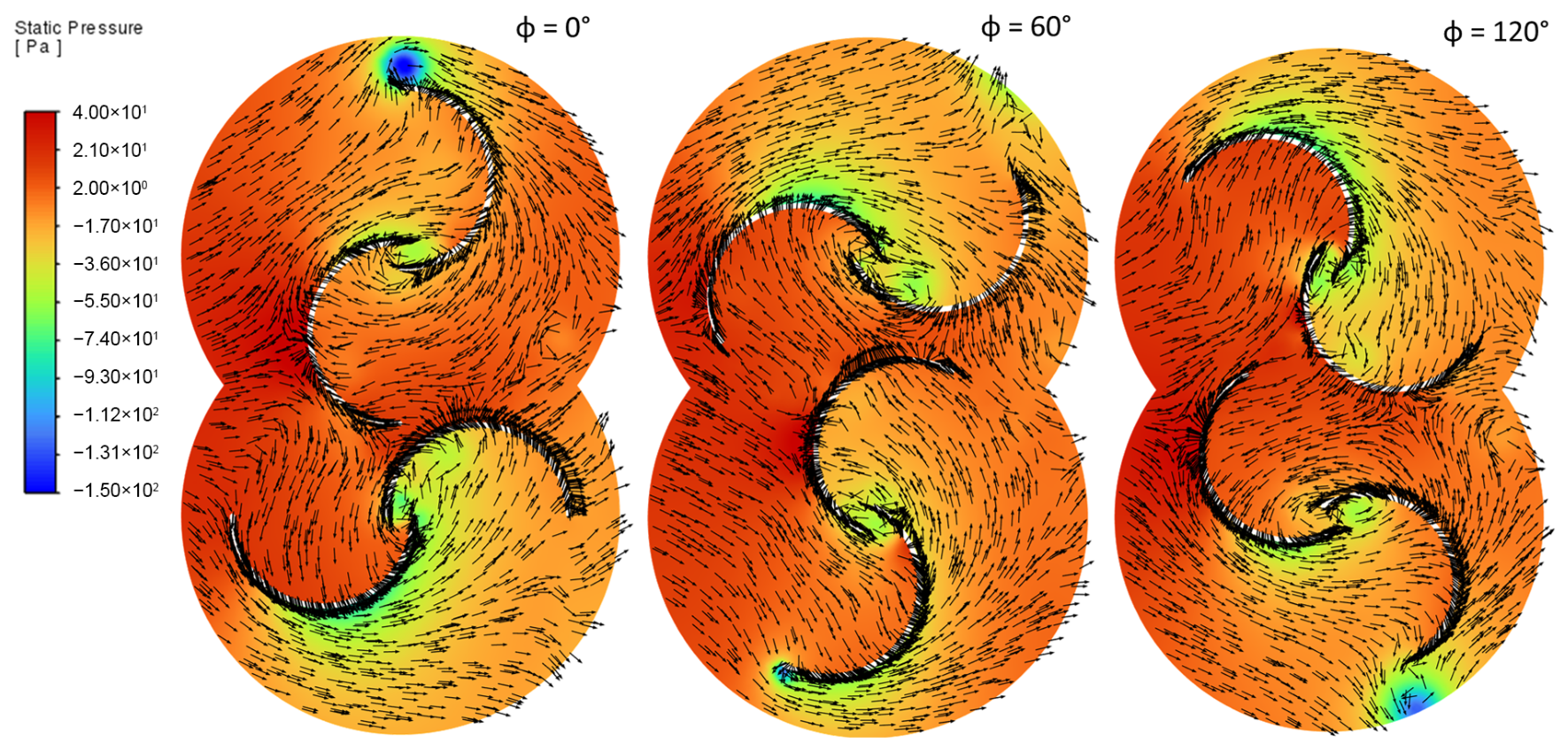
To provide a physical explanation for the improved dynamic performance of the interlocked dual-rotor configuration, phase-resolved flow fields are analyzed in terms of velocity magnitude and static pressure distributions. Figure 12, Figure 13, Figure 14 and Figure 15 compare the single-rotor reference case with the interlocked dual-rotor arrangement at representative azimuth angles of , and . For the single rotor, the pressure fields show a pronounced difference across the returning blade, which leads to a significant negative torque contribution. In contrast, the flow in the interaction region of the interlocked dual-rotor configuration is significantly affected. The analysis of the velocity and pressure fields reveals two main physical mechanisms:
Figure 12.
Phase-resolved flow fields at , and : velocity magnitude, single-rotor ().
Figure 13.
Phase-resolved flow fields at , and : velocity magnitude, dual-rotor ().
Figure 14.
Phase-resolved flow fields at , and : static pressure, single-rotor ().
Figure 15.
Phase-resolved flow fields at , and : static pressure, dual-rotor ().
(i) Redirection of the flow and shielding of the returning blade: In the overlap region, the flow is deflected by the second rotor, which partially shields the returning blade. As a result of this shielding, the stagnation pressure on the concave side of the returning blade is reduced.
(ii) Pressure increase on the convex side of the returning blade due to rotor interaction: Independently, the comparison of the pressure field on the convex side of the returning blade within the overlap region shows a distinct change. In particular, at and , a significantly higher static pressure level is observed compared to the single-rotor case. The cause of this pressure increase is that, in the dual-rotor configuration, the induced pressure fields of both rotors overlap. As a result, a higher overall pressure level is established in the interaction region, even without a significant change in the local flow velocity. In combination, these effects lead to a reduction of the pressure difference across the returning blade. Consequently, the negative torque contribution is reduced, resulting in an increased overall torque.
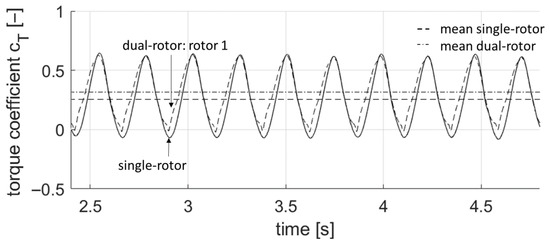
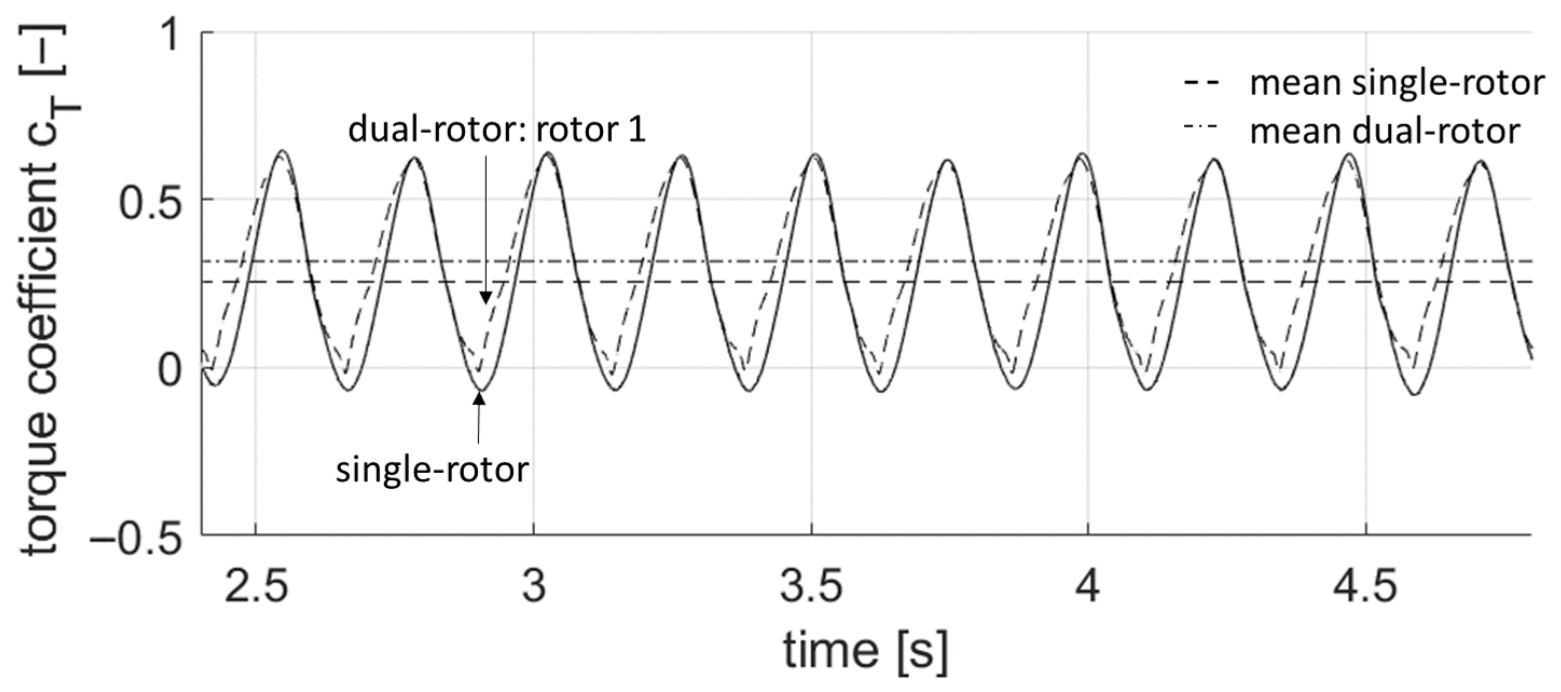
This effect is also reflected in the temporal evolution of the torque coefficient shown in Figure 16. While the single-rotor case exhibits pronounced low and adverse torque intervals, the dual-rotor configuration maintains predominantly positive torque throughout the cycle. In particular, the negative or near-zero torque phases are noticeably shifted upward, which is consistent with the flow-field analysis indicating a partial shielding of the returning blade and a more favorable pressure distribution over a wider azimuth range. Consequently, the cycle-averaged torque level increases, leading directly to a higher mean power coefficient. These results indicate that the investigated interlocked dual-rotor configuration enhances the self-starting behavior and leads to an overall increase in dynamic energy conversion performance.
Figure 16.
Time history of the torque coefficient comparing the single-rotor reference case with the interlocked dual-rotor configuration (rotor 1) ().
9. Conclusions
This study investigated the aerodynamic interaction effects of an interlocked (negative-gap) counter-rotating dual Savonius rotor configuration using two-dimensional steady and transient RANS simulations in ANSYS Fluent 2025 R2 combining rigid cell rotation with a dynamic meshing approach. The numerical framework was first validated against published experimental data for a conventional single-rotor reference geometry, including both the static torque coefficient distribution and the dynamic power coefficient over a relevant TSR range. The overall agreement obtained provides confidence in the suitability of the modeling approach for comparative performance assessment. The main contribution of the present work is the demonstration that the investigated negative-gap interlocked rotor layout can yield a performance benefit compared to a single Savonius rotor operating at identical Reynolds number and tip-speed ratio. It should be emphasized that only a single geometric configuration (, ) was investigated in this study. Further analyses with varying negative gap ratios and inter-rotor phase offsets are necessary to assess the robustness and general validity of the observed performance improvements. In the static analysis, the dual-rotor configuration redistributes the torque generation over the azimuth such that the combined mean torque remains smooth and positive over the complete revolution. This indicates an improved starting tendency and supports the hypothesis that counter-rotating interlocked Savonius pairs behave analogously to phase-shifted multi-stage systems, where torque ripple and adverse torque intervals are mitigated through geometric phase diversity. Under transient URANS conditions, the interlocked arrangement provides a consistently higher power coefficient across the investigated TSR range. The largest gain is observed close to the optimal operating point around , where the peak power coefficient increases from for the single rotor to for the dual-rotor system, corresponding to an improvement of approximately . The phase-resolved velocity and pressure fields indicate that this enhancement is not merely caused by local flow acceleration but results primarily from a favorable redistribution of pressure forces: the interaction between both rotors partially shields the returning blades and reduces resisting pressure loads while maintaining high stagnation pressure levels on the advancing concave sides over a larger fraction of the revolution.
Based on the aerodynamic findings, the results suggest that the interlocked dual-rotor concept may represent a promising design pathway for drag-based VAWTs in space-constrained environments, as it inherently combines key benefits known from multi-stage Savonius configurations with interaction mechanisms comparable to external flow-guidance devices and partial shielding. However, this study also has limitations that define the scope of the conclusions. Primarily, the mechanical feasibility of an interlocked configuration requires phase-locked operation, implying additional drivetrain complexity and friction losses that are not addressed in the present numerical investigation.
10. Outlook
The present findings indicate that interlocked (negative-gap) Savonius rotor pairs can exploit aerodynamic interaction effects to improve both torque stability and cycle-averaged power extraction. To further assess the robustness, applicability and practical feasibility of this concept, several research directions are considered.
From a numerical perspective, the next step should be a systematic parameter study of the interlocked configuration. In particular, the influence of the negative gap ratio , the inter-rotor phase offset , the overlap ratio , and potential asymmetries between both rotors (e.g., different overlap or bucket diameters) should be quantified. Such a study would clarify whether the observed performance increase represents a local optimum of the chosen configuration or persists over a broader design space. Moreover, a sensitivity analysis with respect to inflow turbulence intensity and angle-of-attack variations is required, since realistic urban wind conditions are highly turbulent and strongly directional. The latter is especially important for interlocked arrangements, as rotor–rotor interactions may change substantially when the inflow direction deviates from the design orientation.
A key limitation of the present work is the two-dimensional modeling approach. Therefore, future simulations should extend the analysis to three-dimensional URANS and, where feasible, hybrid RANS/LES methods. This will enable an assessment of finite-height effects such as end losses, tip vortices and spanwise flow, which are known to influence the absolute efficiency of Savonius turbines. In addition, transition modeling (or dedicated studies at different Reynolds numbers) should be considered to evaluate whether laminar-to-turbulent transition affects the interaction mechanism in the overlap region and the associated pressure coupling between both rotors.
Beyond CFD, experimental validation is essential to confirm the predicted interaction benefit under controlled conditions. A feasible laboratory-scale implementation can be realized using the existing wind tunnel infrastructure at Jade University. A modular test rig could be constructed consisting of two geometrically identical Savonius rotors with adjustable negative gap and phase offset. To support the interpretation of the flow physics, the experimental campaign could be complemented by flow field diagnostics such as smoke-wire techniques or particle image velocimetry (PIV), focusing on the overlap/interlock region where the interaction is expected to occur. In particular, validating the predicted shielding effect on the returning blades by pressure taps would provide a direct link between numerical modeling and physical mechanisms. Finally, for potential real-world deployment, it is recommended to evaluate the concept under outdoor conditions in the university environment. A small-scale demonstrator installed on an accessible rooftop or test site would enable assessment under realistic gusty inflow, including directional variability. This step would also allow investigations of practical aspects such as structural loads, vibration behavior, drivetrain losses due to synchronization, and maintenance requirements. Moreover, since the interlocked dual-rotor arrangement may reduce the omnidirectional behavior typically associated with Savonius turbines, it is essential to investigate suitable concepts for passive or active alignment with the prevailing wind direction (e.g., simple yaw mechanisms, weather-vane concepts, or guided mounting). In combination, these future numerical and experimental studies will allow a comprehensive evaluation of the interlocked Savonius concept and its suitability as a robust urban small-wind technology.
Supplementary Materials
The following supporting information can be downloaded at: https://www.mdpi.com/article/10.3390/wind6020023/s1, Table S1: Comparison of the predicted power coefficient curves for the single-rotor reference case and the interlocked dual-rotor configuration.
Author Contributions
K.M.H. conceived the study, developed the numerical methodology, performed the CFD simulations, conducted the validation and formal analysis, and prepared the original manuscript draft including figures and visualization. M.S. supported the numerical investigations, contributed to the validation process, and assisted in proofreading as well as manuscript revision. K.O. provided scientific supervision, contributed to the conceptual development of the study, and supported the review and editing of the manuscript. All authors have read and agreed to the published version of the manuscript.
Funding
This research was funded by Federal Ministry for Economic Affairs and Climate Action grant number 46SKD207BX. The APC was funded by the Federal Ministry for Economic Affairs and Climate Action (BMWK).
Institutional Review Board Statement
Not applicable.
Informed Consent Statement
Not applicable.
Data Availability Statement
The original contributions presented in this study are included in the article/Supplementary Materials. Further inquiries can be directed to the corresponding author(s).
Conflicts of Interest
The authors declare no conflicts of interest.
Abbreviations
The following abbreviations are used in this manuscript:
| BOI | Body of Influence |
| CFD | Computational Fluid Dynamics |
| RANS | Reynolds-Averaged Navier–Stokes |
| URANS | Unsteady Reynolds-Averaged Navier–Stokes |
| VAWT | Vertical-Axis Wind Turbine |
| HAWT | Horizontal-Axis Wind Turbine |
| TSR | Tip-Speed Ratio |
| SST | Shear Stress Transport |
| PIV | Particle Image Velocimetry |
| IEA | International Energy Agency |
| IRENA | International Renewable Energy Agency |
References
- International Energy Agency. Global Hydrogen Review 2024: Hydrogen Production; Technical Report; International Energy Agency: Paris, France, 2024. [Google Scholar]
- International Renewable Energy Agency. Green Hydrogen: A Guide to Policy Making; Technical Report; International Renewable Energy Agency (IRENA): Abu Dhabi, United Arab Emirates, 2020. [Google Scholar]
- Ember. Global Electricity Review 2024; Technical Report; Ember: London, UK, 2024. [Google Scholar]
- International Energy Agency. Wind; Technical Report; International Energy Agency: Paris, France, 2024. [Google Scholar]
- World Wind Energy Association. Global Statistics; Technical Report; World Wind Energy Association: Bonn, Germany, 2024. [Google Scholar]
- Toja-Silva, F.; Colmenar-Santos, A.; Castro-Gil, M. Urban wind energy exploitation systems: Behaviour under multidirectional flow conditions—Opportunities and challenges. Renew. Sustain. Energy Rev. 2013, 24, 364–378. [Google Scholar] [CrossRef] [Scilit]
- Akwa, J.V.; Vielmo, H.A.; Petry, A.P. A review on the performance of Savonius wind turbines. Renew. Sustain. Energy Rev. 2012, 16, 3054–3064. [Google Scholar] [CrossRef] [Scilit]
- Savonius, S.J. Wind Rotor. U.S. Patent 1697574A, 1 January 1929. [Google Scholar]
- Chitura, A.G.; Mukumba, P.; Lethole, N. Enhancing the Performance of Savonius Wind Turbines: A Review of Advances Using Multiple Parameters. Energies 2024, 17, 3708. [Google Scholar] [CrossRef] [Scilit]
- Sheldahl, R.E.; Blackwell, B.F.; Feltz, L.V. Wind tunnel performance data for two- and three-bucket Savonius rotors. J. Energy 1978, 2, 160–164. [Google Scholar] [CrossRef] [Scilit]
- Thiyagaraj, J.; Rahamathullah, I.; Anbuchezhiyan, G.; Barathiraja, R.; Ponshanmugakumar, A. Influence of blade numbers, overlap ratio and modified blades on performance characteristics of the savonius hydro-kinetic turbine. Mater. Today Proc. 2021, 46, 4047–4053. [Google Scholar] [CrossRef] [Scilit]
- Hosseini, S.E.; Salehi, F. Analyzing overlap ratio effect on performance of a modified Savonius wind turbine. Phys. Fluids 2023, 35, 125131. [Google Scholar] [CrossRef] [Scilit]
- Ebrahimpour, M.; Shafaghat, R.; Alamian, R.; Safdari Shadloo, M. Numerical Investigation of the Savonius Vertical Axis Wind Turbine and Evaluation of the Effect of the Overlap Parameter in Both Horizontal and Vertical Directions on Its Performance. Symmetry 2019, 11, 821. [Google Scholar] [CrossRef] [Scilit]
- Mao, Z.; Tian, W.L. Effect of the blade arc angle on the performance of a Savonius wind turbine. Adv. Mech. Eng. 2015, 7, 1687814015584247. [Google Scholar] [CrossRef] [Scilit]
- Abdelaziz, K.R.; Nawar, M.A.; Ramadan, A.; Attai, Y.A.; Mohamed, M.H. Performance investigation of a Savonius rotor by varying the blade arc angles. Ocean. Eng. 2022, 260, 112054. [Google Scholar] [CrossRef] [Scilit]
- Kacprzak, K.; Liskiewicz, G.; Sobczak, K. Numerical investigation of conventional and modified Savonius wind turbines. Renew. Energy 2013, 60, 578–585. [Google Scholar] [CrossRef] [Scilit]
- Elmekawy, A.; Saeed, H.; Kassab, S. Performance enhancement of Savonius wind turbine by blade shape and twisted angle modifications. Proc. Inst. Mech. Eng. Part A J. Power Energy 2021, 235, 1487–1500. [Google Scholar] [CrossRef] [Scilit]
- Alom, N.; Saha, U.K. Influence of blade profiles on Savonius rotor performance: Numerical simulation and experimental validation. Energy Convers. Manag. 2019, 186, 267–277. [Google Scholar] [CrossRef] [Scilit]
- El-Askary, W.; Saad, A.S.; AbdelSalam, A.M.; Sakr, I. Investigating the performance of a twisted modified Savonius rotor. J. Wind. Eng. Ind. Aerodyn. 2018, 182, 344–355. [Google Scholar] [CrossRef] [Scilit]
- Saad, A.S.; El-Sharkawy, I.I.; Ookawara, S.; Ahmed, M. Performance enhancement of twisted-bladed Savonius vertical axis wind turbines. Energy Convers. Manag. 2020, 209, 112673. [Google Scholar] [CrossRef] [Scilit]
- Tian, W.; Bian, J.; Yang, G.; Ni, X.; Mao, Z. Influence of a passive upstream deflector on the performance of the Savonius wind turbine. Energy Rep. 2022, 8, 7488–7499. [Google Scholar] [CrossRef] [Scilit]
- Altan, B.D.; Atılgan, M.; Özdamar, A. An experimental study on improvement of a Savonius rotor performance with curtaining. Exp. Therm. Fluid Sci. 2008, 32, 1673–1678. [Google Scholar] [CrossRef] [Scilit]
- Guo, F.; Song, B.; Mao, Z.; Tian, W. Experimental and numerical validation of the influence on Savonius turbine caused by rear deflector. Energy 2020, 196, 117132. [Google Scholar] [CrossRef] [Scilit]
- Nimvari, M.E.; Fatahian, H.; Fatahian, E. Performance improvement of a Savonius vertical axis wind turbine using a porous deflector. ENergy Convers. Manag. 2020, 220, 113062. [Google Scholar] [CrossRef] [Scilit]
- Fatahian, E.; Ismail, F.; Hafifi Hafiz Ishak, M.; Chang, W.S. The role of wake splitter deflector on performance enhancement of Savonius wind turbine. Phys. Fluids 2022, 34, 095111. [Google Scholar] [CrossRef] [Scilit]
- Sun, X.; Luo, D.; Huang, D.; Wu, G. Numerical study on coupling effects among multiple Savonius turbines. J. Renew. Sustain. Energy 2012, 4, 053107. [Google Scholar] [CrossRef] [Scilit]
- Shaheen, M.; Abdallah, S.; Khalil, A. Numerical study of two-bucket Savonius wind turbine cluster. J. Wind. Eng. Ind. Aerodyn. 2015, 137, 78–89. [Google Scholar] [CrossRef] [Scilit]
- Tata, M.; Benzaoui, A.; Oukassou, K. Aerodynamic Performance Investigations of Savonius Twin Rotors. J. Appl. Fluid Mech. 2024, 17, 442–460. [Google Scholar] [CrossRef] [Scilit]
- Han, Y.; Kim, E.; Oh, S. Numerical investigations on double Savonius vertical axis wind turbines with a deflector: Effects of turbine and deflector-related parameters. Energy Rep. 2025, 14, 4950–4962. [Google Scholar] [CrossRef] [Scilit]
- Kamoji, M.A.; Kedare, S.B.; Prabhu, S.V. Experimental Investigations on Single Stage, Two Stage and Three Stage Conventional Savonius Rotor. Int. J. Energy Res. 2008, 32, 877–895. [Google Scholar] [CrossRef] [Scilit]
- Sharma, K.K.; Gupta, R.; Biswas, A. Performance Measurement of a Two-Stage Two-Bladed Savonius Rotor. Int. J. Renew. Energy Res. 2014, 4, 115–121. [Google Scholar]
- Tian, W.; Mao, Z.; Zhang, B.; Li, Y. Shape Optimization of a Savonius Wind Rotor with Different Objective Functions. Appl. Energy 2018, 213, 148–157. [Google Scholar] [CrossRef] [Scilit]
- Michna, J.; Rogowski, K. CFD Calculations of Average Flow Parameters around the Savonius Wind Turbine Rotor. Energies 2022, 16, 281. [Google Scholar] [CrossRef] [Scilit]

Disclaimer/Publisher’s Note: The statements, opinions and data contained in all publications are solely those of the individual author(s) and contributor(s) and not of MDPI and/or the editor(s). MDPI and/or the editor(s) disclaim responsibility for any injury to people or property resulting from any ideas, methods, instructions or products referred to in the content. |
© 2026 by the authors. Licensee MDPI, Basel, Switzerland. This article is an open access article distributed under the terms and conditions of the Creative Commons Attribution (CC BY) license.