

Wind Effects of Surrounding Structures in an Urban Area on a High-Rise Building by Computational Fluid Dynamics

 , and
, and
Abstract
1. Introduction
2. Materials and Methods
2.1. Scenario 1
2.1.1. Pre-Processing, Scenario 1
- V: reference velocity (m/s);
- L: impact length (m);
- ν: fluid viscosity (m2/s).
- : wind velocity to be estimated at height Z above ground level (m);
- : reference velocity (m/s);
- : height variation;
- : height related to the reference speed (m);
- α: roughness exponent (Table 2).

| Parameter | Value |
|---|---|
| Water | 0.13 |
| Grass | 0.14–0.16 |
| Crops and shrubs | 0.20 |
| Forests | 0.25 |
| Urban area | 0.40 |
- friction velocity;
- empirical coefficient, equal to 0.09.
- friction velocity;
- : Von Karman constant, equal to 0.4;
- : height variable [m];
- : terrain roughness height, equal to 1 m.
- ϵ: turbulent energy dissipation rate [m2/s3];
- empirical coefficient, equal to 0.09;
- kinetic energy.
- friction velocity;
- : reference wind velocity [m];
- : reference height [m];
- : terrain roughness height, equal to 1 m.
2.1.2. Solution, Scenario 1
2.2. Scenario 2
2.2.1. Pre-Processing, Scenario 2
2.2.2. Solution, Scenario 2
3. Results
3.1. Results, Scenario 1
3.2. Results, Scenario 2
4. Discussion
5. Conclusions
Author Contributions
Funding
Institutional Review Board Statement
Informed Consent Statement
Data Availability Statement
Acknowledgments
Conflicts of Interest
Appendix A
Appendix A.1



Appendix A.2

Appendix A.3

References
- Piralla, M. Diseño Estructural [Structural Design], 2nd ed.; Limusa: Mexico City, Mexico, 2001. [Google Scholar]
- Díaz, R.Y.B. Mecánica de Estructuras [Structural Mechanics]; CIMN: Barcelona, Spain, 2014. [Google Scholar]
- Koks, E.E.; Haer, T. A high-resolution wind damage model for Europe. Sci. Rep. 2020, 10, 6866. [Google Scholar] [CrossRef] [Scilit]
- Ouyang, Z.; Spence, S.M.J. Performance-based wind-induced structural and envelope damage assessment of engineered buildings through nonlinear dynamic analysis. J. Wind Eng. Ind. Aerodyn. 2021, 208, 104452. [Google Scholar] [CrossRef] [Scilit]
- Tomás, A.; Morales, M. Revisión y estudio comparativo de la acción del viento sobre las estructuras empleando Eurocódigo y Código Técnico de la Edificación. Inf. constr. 2012, 64, 381–390. [Google Scholar] [CrossRef] [Scilit]
- Zhao, Y.; Li, R.; Feng, L.; Wu, Y.; Gao, N. Boundary layer wind tunnel tests of outdoor airflow field around urban buildings: A review of methods and status. Renew. Sustain. Energy Rev. 2022, 356, 04031. [Google Scholar] [CrossRef] [Scilit]
- EN 1991-1-4; Eurocode 1: Actions on Structures—Part 1–4: General Actions—Wind Actions. European Committee for Standardization: Brussels, Belgium, 2005.
- NTC (2023); Normas Técnicas Complementarias para Diseño por Viento. Secretarias de Obras y Servicios de la CDMX: Ciudad de México, México, 2023.
- ASCE 7; Minimum design loads and associated criteria for buildings and other structures. American Society of Civil Engineers: Reston, VA, USA, 2023.
- Iancovici, M.; Nica, G.B. Time-domain structural damage and loss estimates for wind loads: Road to resilience-targeted and smart buildings design. Buildings 2023, 13, 734. [Google Scholar] [CrossRef] [Scilit]
- Coca-Obdulio. Daños del viento en zonas urbanas. Arquit. Y Urban. 2008, 29, 64–67. [Google Scholar]
- Bustamante, C.; Jans, M.; Higueras, E. El comportamiento del viento en la morfología urbana y su incidencia en el uso estancial del espacio público, Punta Arenas, Chile. [Wind behavior in urban morphology and its impact on the leisure use of public space, Punta Arenas, Chile]. AUS 2017, 6, 28–33. [Google Scholar]
- Lin, C.; Ooka, R.; Takakuwa, Y.; Kikumoto, H. Wind tunnel study of Parapet effects on rooftop wind environment with implications for safe urban-air-mobility operations. Build. Environ. 2025, 284, 113509. [Google Scholar] [CrossRef] [Scilit]
- Taniike, Y. Interference mechanism for enhanced wind forces on neighboring tall buildings. J. Wind Eng. Ind. Aerodyn. 1992, 42, 1073–1083. [Google Scholar] [CrossRef] [Scilit]
- Bailey, A.; Vincent, N.D.G. Wind-pressure on buildings including effects of adjacent buildings. J. Inst. Civ. Eng. 1943, 20, 243–275. [Google Scholar] [CrossRef] [Scilit]
- Lam, K.M.; Leung, M.Y.H.; Zhao, J.G. Interference effects on wind loading of a row of closely spaced tall buildings. J. Wind Eng. Ind. Aerodyn. 2008, 96, 562–583. [Google Scholar] [CrossRef] [Scilit]
- Ishida, Y.; Yoshida, A.; Yamane, Y.; Mochida, A. Impact of a single high-rise building on the wind pressure acting on the surrounding low-rise buildings. J. Wind Eng. Ind. Aerodyn. 2024, 250, 105742. [Google Scholar] [CrossRef] [Scilit]
- Xamán, J. Dinámica De Fluidos Computacional Para Ingenieros. In Computational Fluid Dynamics for Engineers; Palibrio: Bloomington, IN, USA, 2016. [Google Scholar]
- White, F.M. Mecánica de Fluidos; Mcgraw-Hill: Madrid, Spain, 2010. [Google Scholar]
- Versteeg, H.K.; Malalasekera, W. An Introduction to Computational Fluid Dynamics: The Finite Volume Method, 2nd ed.; Pearson Education Limited: London, UK, 2007. [Google Scholar]
- Baghaei Daemei, A.; Khotbehsara, E.M.; Nobarani, E.M.; Bahrami, P. Study on wind aerodynamic and flow characteristics of triangular-shaped tall buildings and CFD simulation in order to assess drag coefficient. Ain Shams Eng. J. 2019, 10, 541–548. [Google Scholar] [CrossRef] [Scilit]
- Khalil, I.; Lakkis, I. Computational Fluid Dynamics: An Introduction to Modeling and Applications, 1st ed.; McGrawHill: New York, NY, USA, 2023; Available online: https://books.google.com.mx/books/about/Computational_Fluid_Dynamics_An_Introduc.html?id=eMCqEAAAQBAJ&redir_esc=y (accessed on 4 April 2024).
- Liu, S.; Wuxuan, P.; Zhao, X.; Zhang, H.; Cheng, X.; Long, Z.; Chen, Q. Influence of surrounding buildings on wind flow around a building predicted by CFD simulations. Build. Environ. 2018, 140, 1–10. [Google Scholar] [CrossRef] [Scilit]
- Kim, Y.C.; Yoshida, A.; Tamura, Y. Characteristics of surface wind pressures on low-rise building located among large group of surrounding buildings. Eng. Struct. 2012, 35, 18–28. [Google Scholar] [CrossRef] [Scilit]
- Cheng, Z.; Wong, J.K.; Mercan, O. Evaluating the wind loads on high-rise buildings of various plan dimensions through numerical simulations. Eng. Struct. 2025, 343, 120981, 2025. [Google Scholar] [CrossRef] [Scilit]
- Haan, F.L.; Wang, J.; Sterling, M.; Kopp, G.A. Experimentally estimating wind load coefficients for tornadoes–An alternative perspective. J. Wind Eng. Ind. Aerodyn. 2024, 251, 105811. [Google Scholar] [CrossRef] [Scilit]
- Wijesooriya, K.; Mohotti, D.; Lee, C.-K.; Mendis, P. A technical review of computational fluid dynamics (CFD) applications on wind design of tall buildings and structures: Past, present and future. J. Build. Eng. 2023, 74, 106828. [Google Scholar] [CrossRef] [Scilit]
- Idrissi, A.; El Mghari, H.; El Amraoui, R. CFD simulation advances in urban aerodynamics: Accuracy, validation, and high-rise building applications. Results Eng. 2025, 26, 105148. [Google Scholar] [CrossRef] [Scilit]
- Liu, F.; Ren, Y.; Zhang, L.; Li, X. Impact of super high-rise buildings on wind comfort and safety of pedestrian wind environment: A case study in Shanghai, China. Case Stud. Therm. Eng. 2025, 71, 106197. [Google Scholar] [CrossRef] [Scilit]
- Kikuchi, T.; Ohtake, K.; Takahashi, Y.; Watanabe, H.; Hidari, K.; Tanabe, S.; Nobe, T. Comparison of wind pressure coefficients between wind tunnel experiments and full-scale measurements using operational data from an urban high-rise building. Build. Environ. 2024, 252, 111244. [Google Scholar] [CrossRef] [Scilit]
- ANSYS, Inc. Capítulo 4: Turbulencia» [Chapter 4: Turbulence], Ansys Fluent R2 2024. Accedido: 13 de enero de 2025. Available online: https://ansyshelp.ansys.com/public/account/secured?returnurl=/Views/Secured/corp/v242/en/flu_th/flu_th_sec_turb_kw_sst.html (accessed on 13 January 2025).
- Fernández, M. Técnicas Numéricas en Ingeniería de Fluidos: Introducción a la Dinámica de Fluidos Computacional (CFD) Por el Método de Volúmenes Finitos; Reverté: Barcelona, Spain, 2012. [Google Scholar]
- Fatchurrohman, N.; Chia, S.T. Performance of hybrid nano-micro reinforced mg metal matrix composites brake calliper: Simulation approach. IOP Conf. Ser.: Mater. Sci. Eng. 2017, 257, 012060. [Google Scholar] [CrossRef] [Scilit]
- Huang, S.; Li, Q.S.; Xu, S. Numerical evaluation of wind effects on a tall steel building by CFD. J. Constr. Steel Res. 2007, 63, 612–627. [Google Scholar] [CrossRef] [Scilit]
- Guevara Díaz, J.M. Cuantificación del perfil del viento hasta 100 m de altura desde la superficie y su incidencia en la climatología eólica. Terra Nueva Etapa 2013, 29, 81–101. [Google Scholar]
- Kubilay, A.; Rubin, A.; Derome, D.; Carmeliet, J. Wind-comfort assessment in cities undergoing densification with high-rise buildings remediated by urban trees. J. Wind Eng. Ind. Aerodyn. 2024, 249, 105721. [Google Scholar] [CrossRef] [Scilit]
- Montazeri, H.; Blocken, B. CFD simulation of wind-induced pressure coefficients on buildings with and without balconies: Validation and sensitivity analysis. Build. Environ. 2013, 60, 137–149. [Google Scholar] [CrossRef] [Scilit]


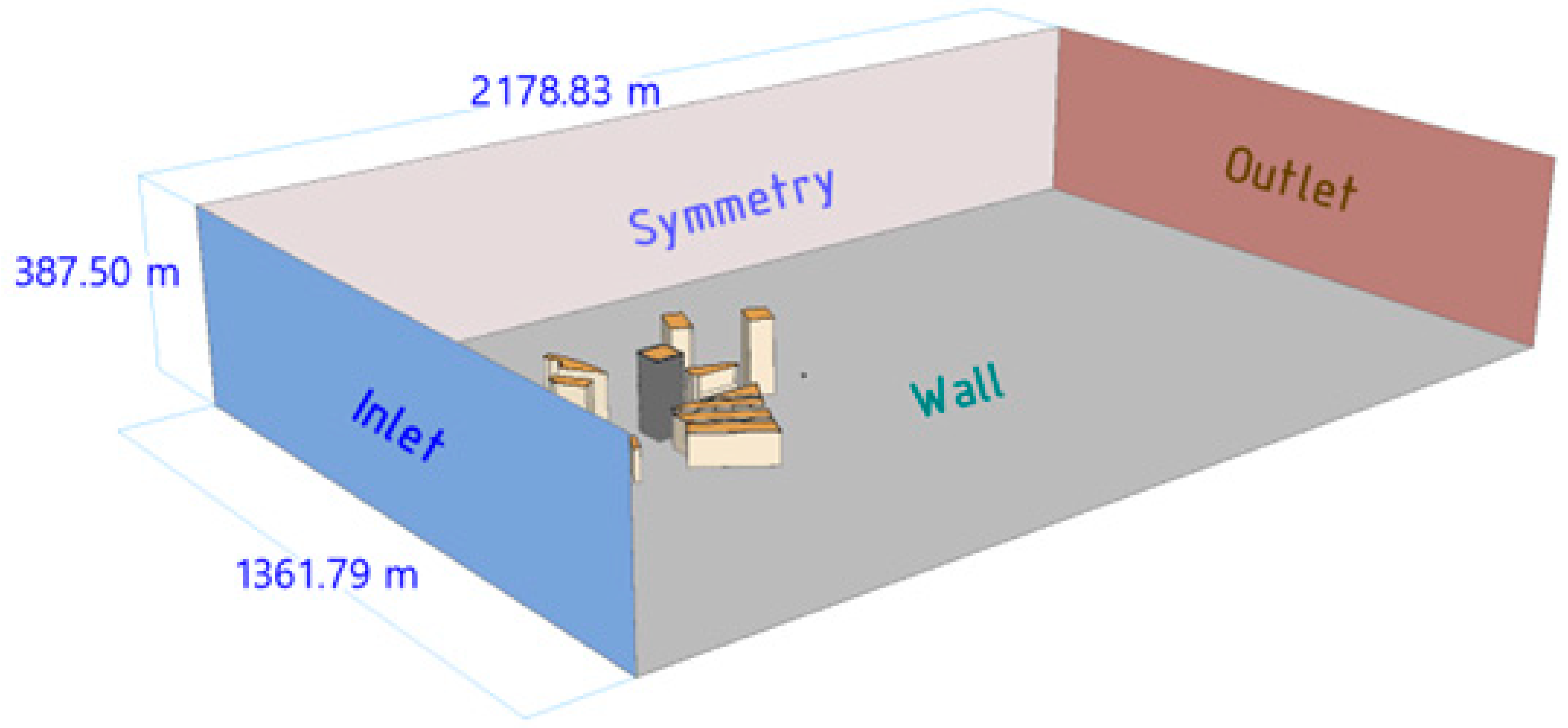


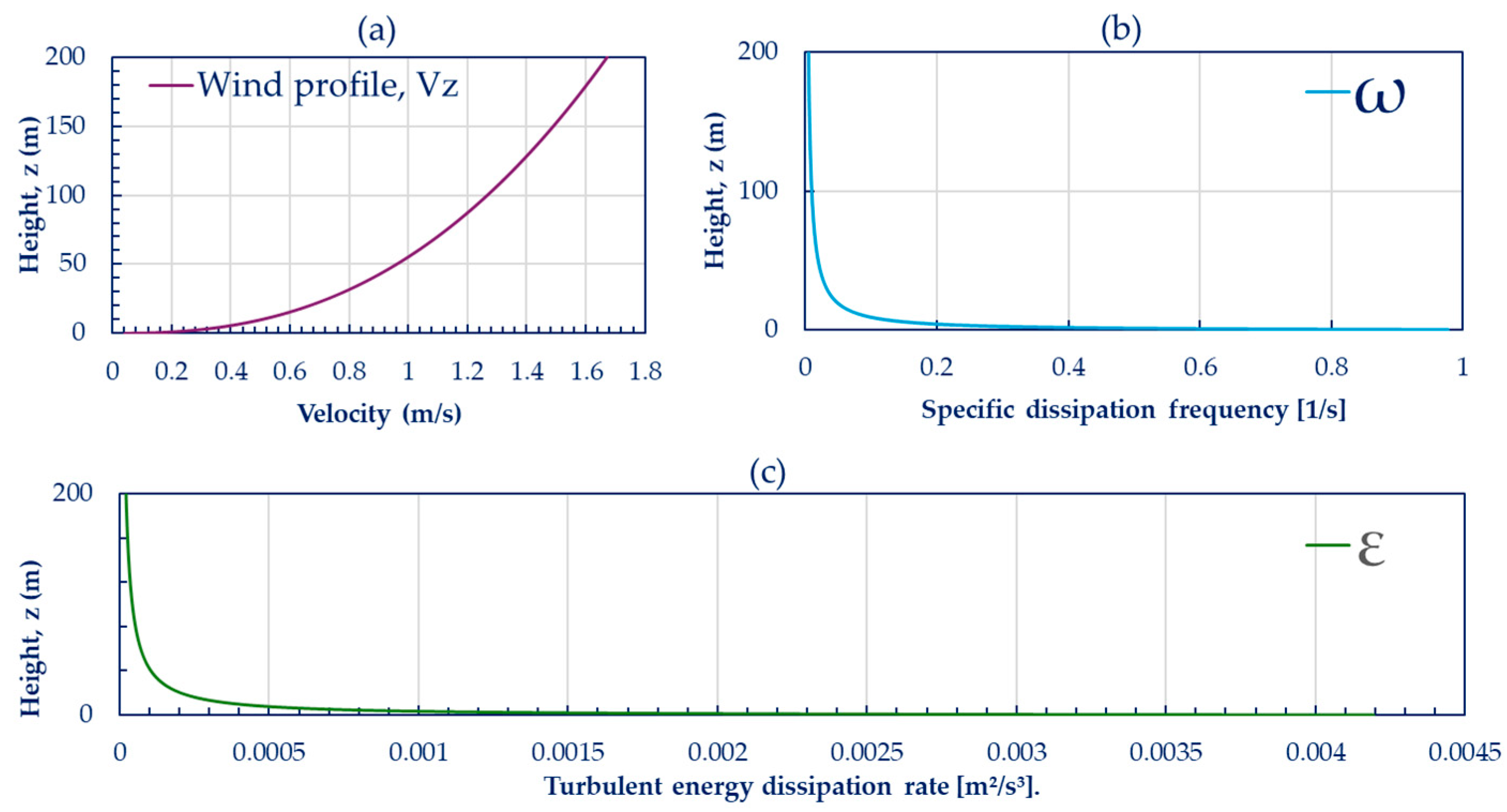


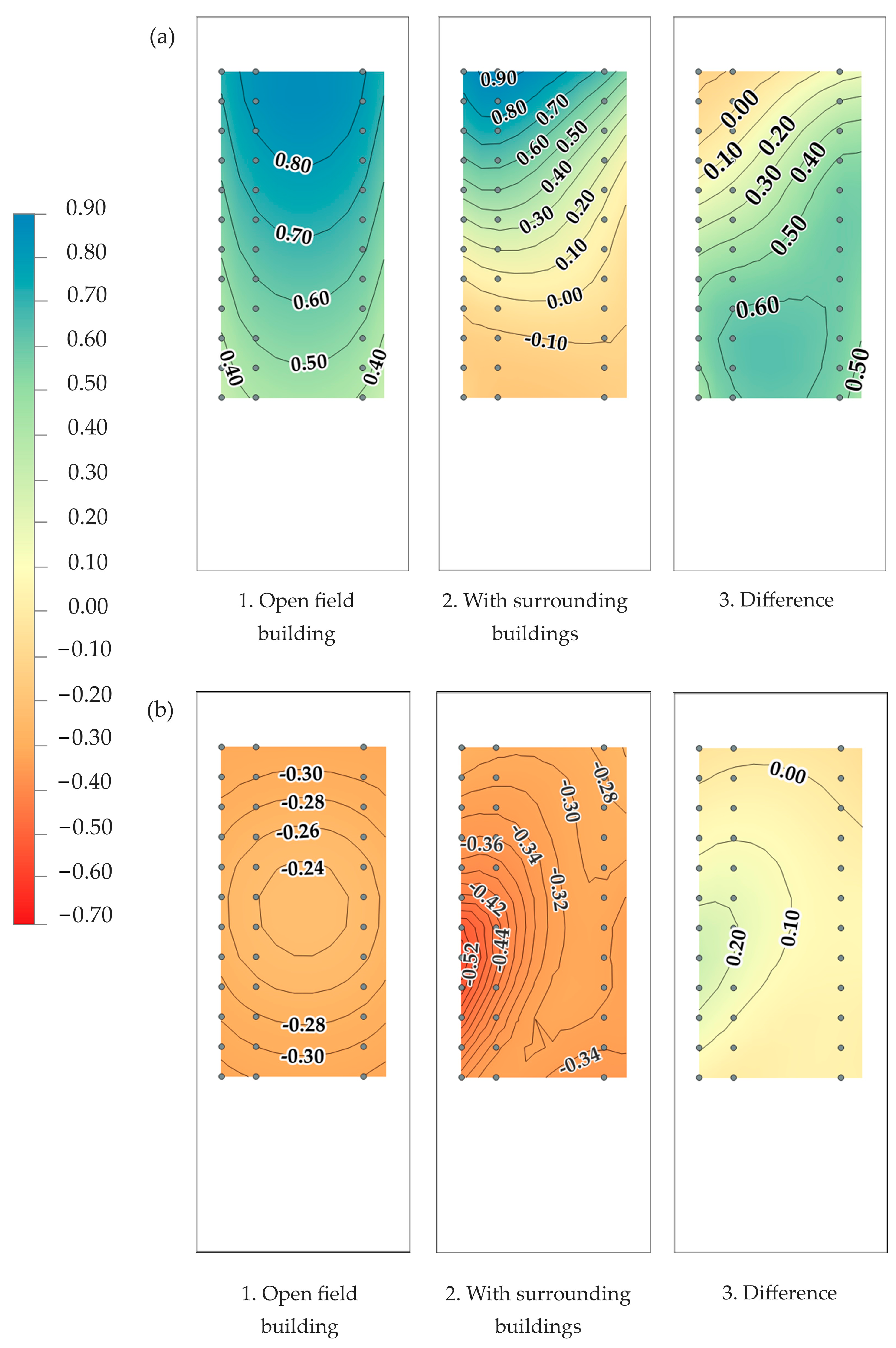
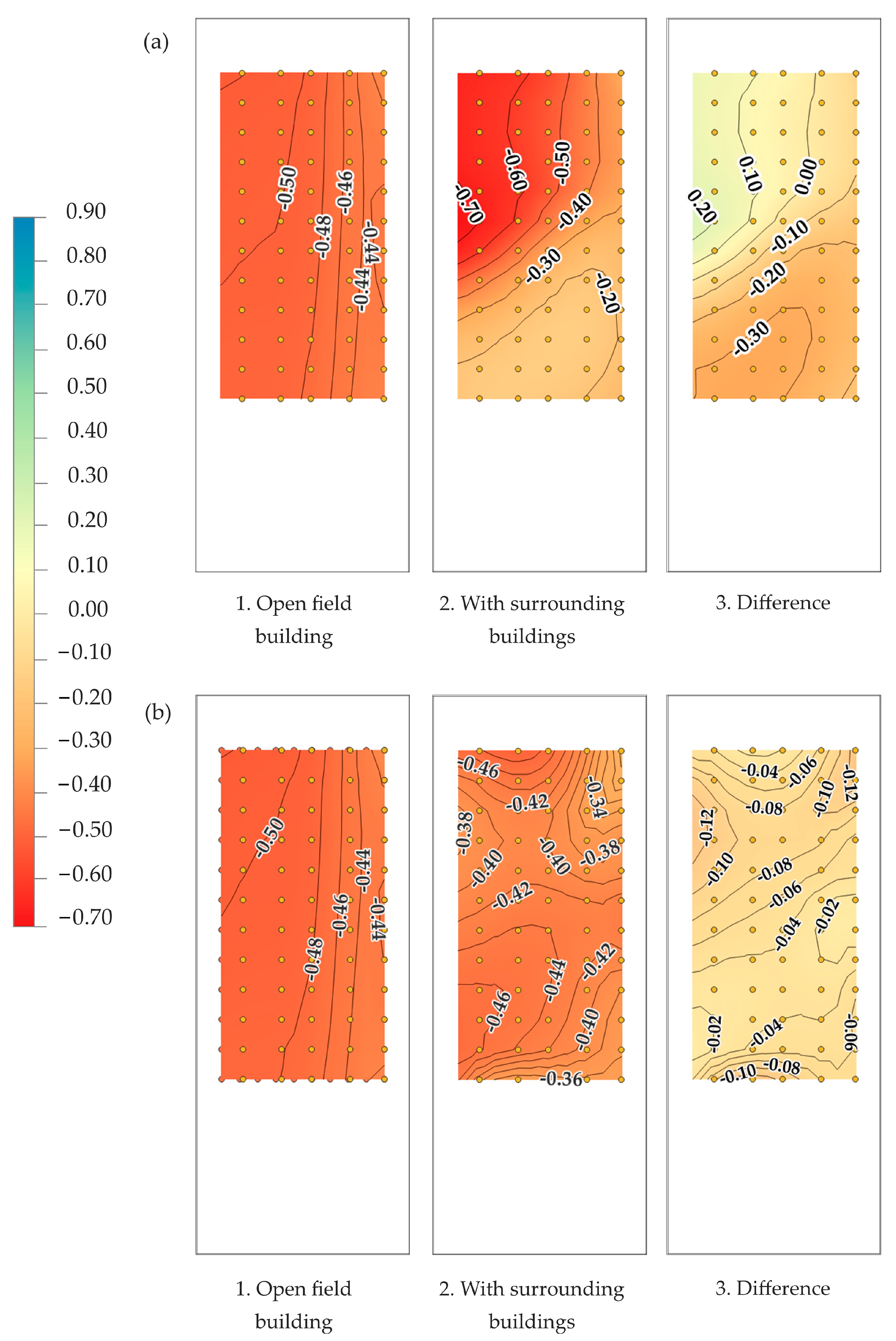

| Title | Comment | Ref |
|---|---|---|
| Evaluating the wind loads on high-rise buildings of various plan dimensions through numerical simulations. | Checked the functionality of CFD for capturing pressure coefficients for high-rise buildings via WMLES simulations, which are more precise than RANS models. | [25] |
| Experimentally estimating wind load coefficients for tornadoes—An alternative perspective. | Explained the importance of turbulence and its relationship with applied loads on a surface or structure. | [26] |
| A technical review of computational fluid dynamics (CFD) applications on wind design of tall buildings and structures: Past, present and future | Parameters such as the velocity profile, mean pressure turbulence intensity profile, turbulence model, and solution method influence the pressure for obtaining pressure coefficients on a surface. The LES model is more accurate than RANS but has higher computational costs. | [27] |
| CFD simulation advances in urban aerodynamics: Accuracy, validation, and high-rise building applications | Turbulence models such as k-ε-RNG and SST-ω-Standard were compared, including parameters like kinetic energy and the dissipation rate. To validate this research, wind tunnel studies were used. The result was that both models are reliable, but the k-ε model has a lower computational cost. | [28] |
| Parameter | Value |
|---|---|
| Inlet velocity | 1.51 m/s |
| Outlet pressure | 0 Pa |
| Wall | No-slip |
| Air density | 1.255 kg/m3 |
| Air viscosity | 1.5 × 10⁻⁵ m2/s |
| Wind velocity | (Equation (2)) |
| Kinetic energy | (Equation (3)) |
| Turbulent energy dissipation rate | (Equation (4)) |
| Specific dissipation frequency | (Equation (5)) |
| Friction velocity | (Equation (6)) |
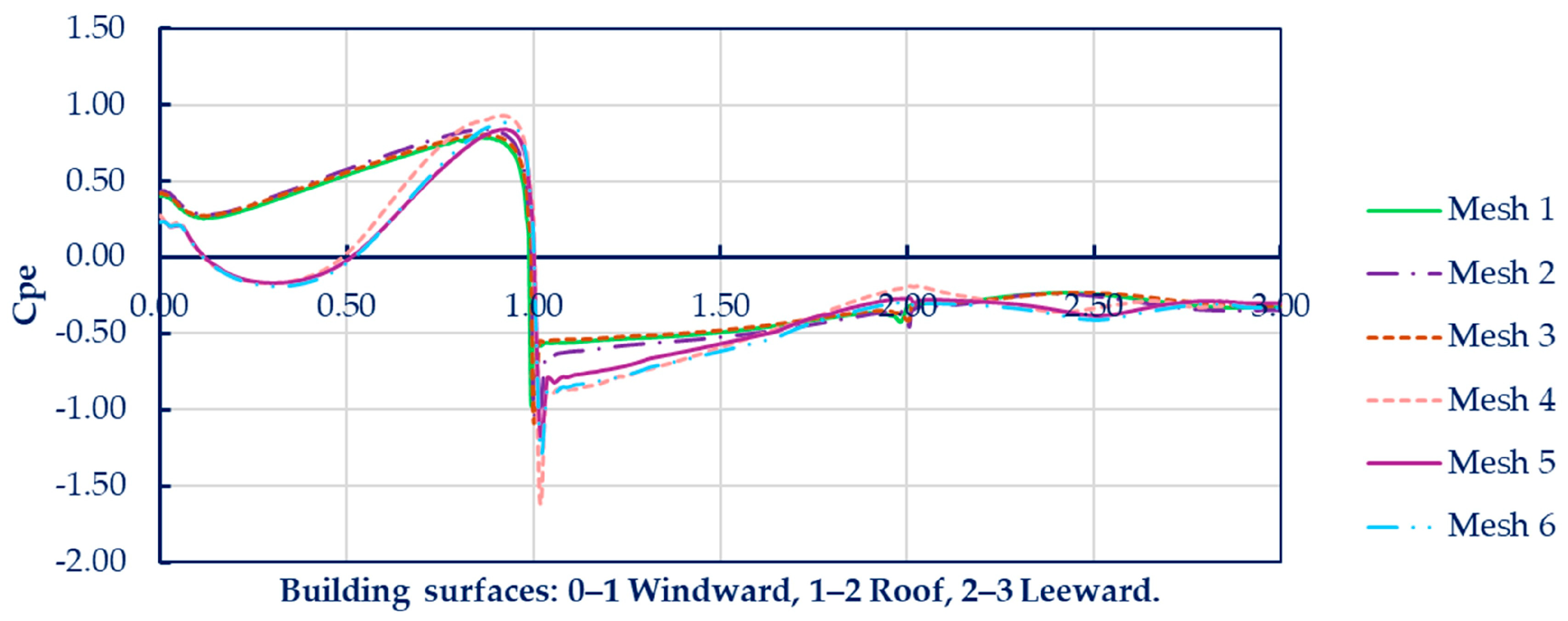
| Mesh | Total Number of Cells | Minimum Orthogonal Quality | Maximum Aspect Ratio | Maximum Skewness |
|---|---|---|---|---|
| 1 | 2,191,351 | 0.50 | 49.38 | 0.21 |
| 2 | 2,264,594 | 0.50 | 18.21 | 0.45 |
| 3 | 2,627,127 | 0.50 | 19.21 | 0.44 |
| 4 | 3,254,540 | 0.45 | 34.20 | 0.92 |
| 5 | 2,560,055 | 0.48 | 40.90 | 0.85 |
| 6 | 2,560,362 | 0.42 | 23.39 | 0.63 |
Disclaimer/Publisher’s Note: The statements, opinions and data contained in all publications are solely those of the individual author(s) and contributor(s) and not of MDPI and/or the editor(s). MDPI and/or the editor(s) disclaim responsibility for any injury to people or property resulting from any ideas, methods, instructions or products referred to in the content. |
© 2026 by the authors. Licensee MDPI, Basel, Switzerland. This article is an open access article distributed under the terms and conditions of the Creative Commons Attribution (CC BY) license.
Share and Cite
Villalobos-García, C.; Pérez-Moreno, L.F.; Arjona-Catzim, I.F.; Rico-García, E. Wind Effects of Surrounding Structures in an Urban Area on a High-Rise Building by Computational Fluid Dynamics. Wind 2026, 6, 16. https://doi.org/10.3390/wind6020016
Villalobos-García C, Pérez-Moreno LF, Arjona-Catzim IF, Rico-García E. Wind Effects of Surrounding Structures in an Urban Area on a High-Rise Building by Computational Fluid Dynamics. Wind. 2026; 6(2):16. https://doi.org/10.3390/wind6020016
Chicago/Turabian StyleVillalobos-García, Citlali, Luis Francisco Pérez-Moreno, Iván Fermín Arjona-Catzim, and Enrique Rico-García. 2026. "Wind Effects of Surrounding Structures in an Urban Area on a High-Rise Building by Computational Fluid Dynamics" Wind 6, no. 2: 16. https://doi.org/10.3390/wind6020016
APA StyleVillalobos-García, C., Pérez-Moreno, L. F., Arjona-Catzim, I. F., & Rico-García, E. (2026). Wind Effects of Surrounding Structures in an Urban Area on a High-Rise Building by Computational Fluid Dynamics. Wind, 6(2), 16. https://doi.org/10.3390/wind6020016