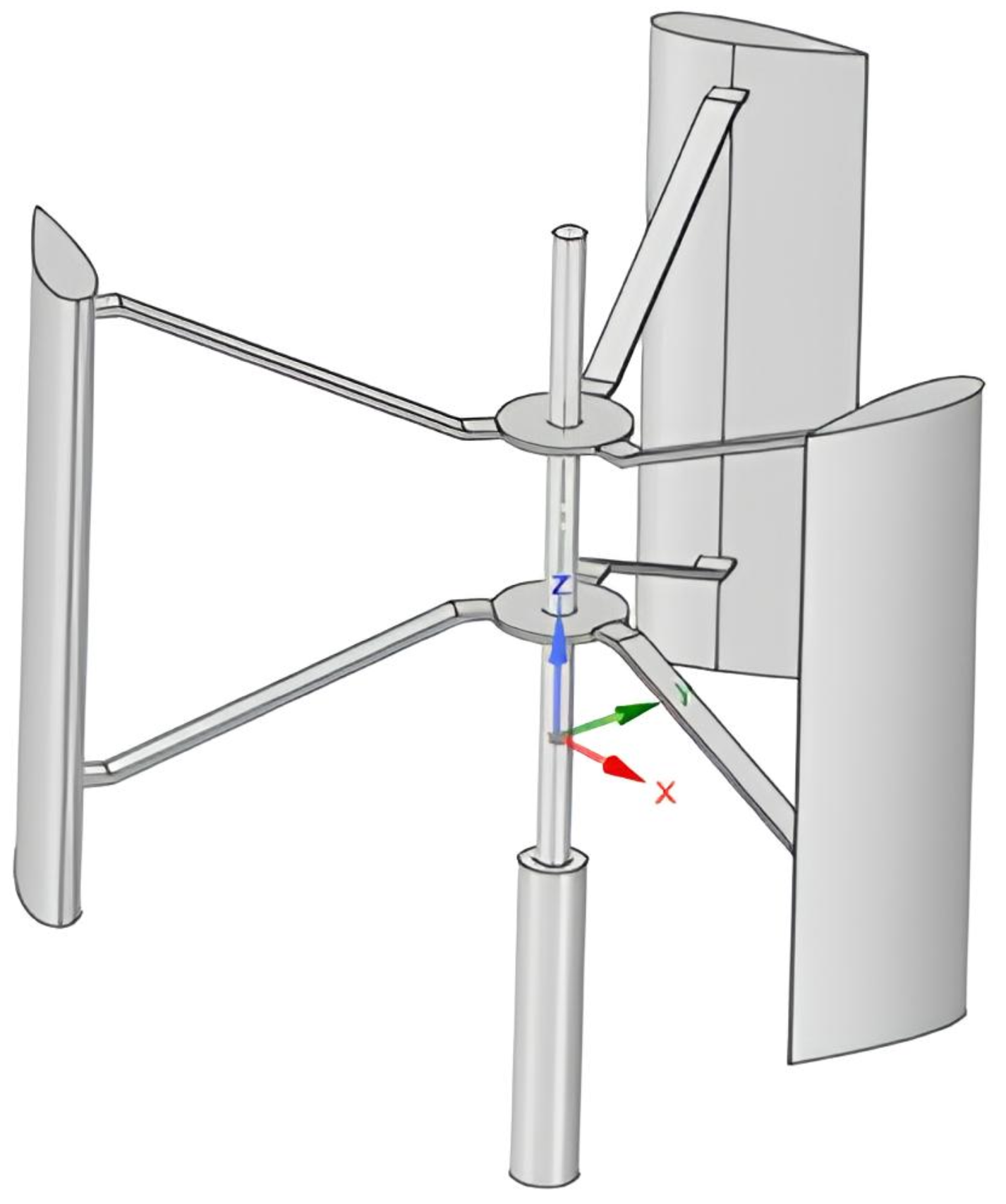
Figure 1.
Three-bladed H-Darrieus turbine model. The figure shows the turbine rotor configuration with support arms, shaft, and coordinate axes used in the simulations.
Figure 1.
Three-bladed H-Darrieus turbine model. The figure shows the turbine rotor configuration with support arms, shaft, and coordinate axes used in the simulations.
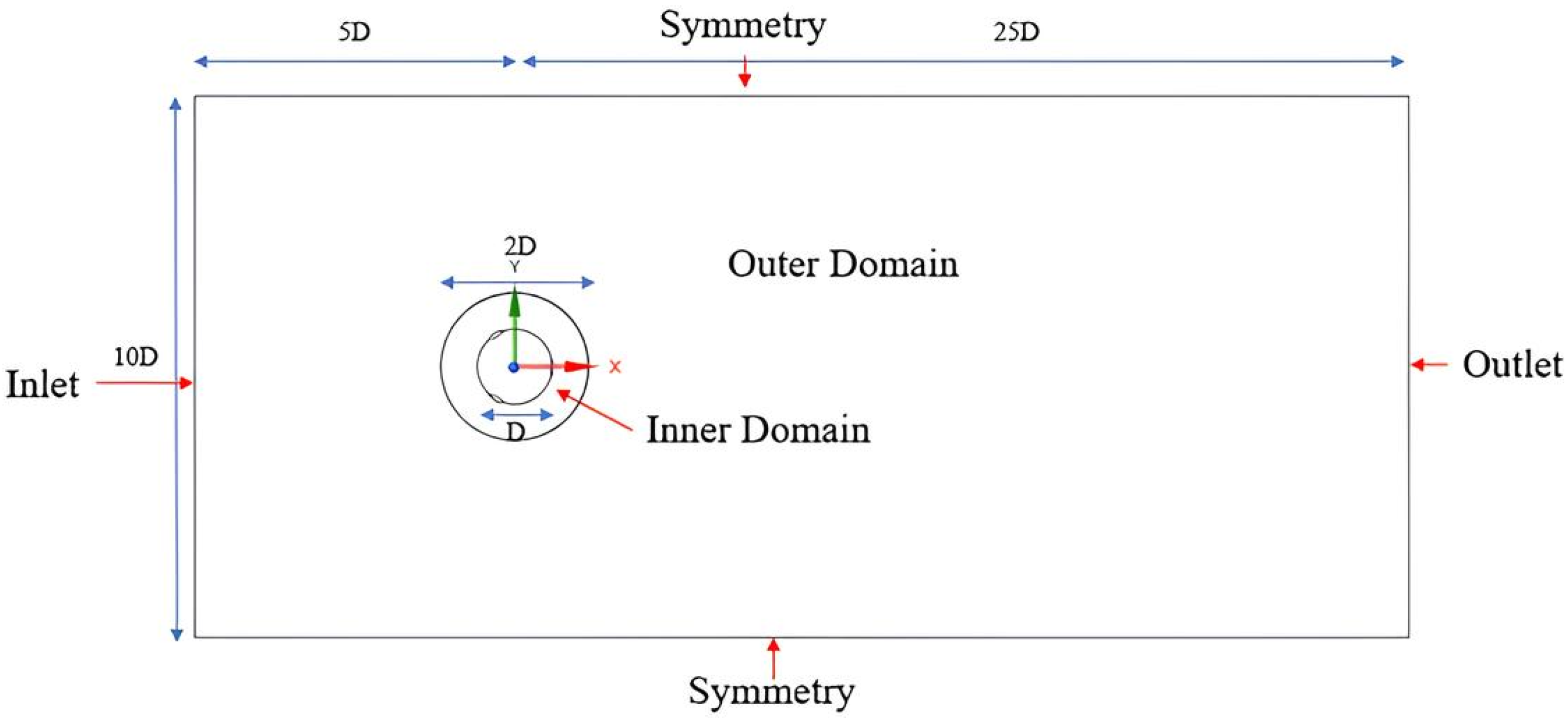
Figure 2.
Computational domain dimensions, showing inflow, outflow, symmetry, and wall boundaries [
21,
32].
Figure 2.
Computational domain dimensions, showing inflow, outflow, symmetry, and wall boundaries [
21,
32].
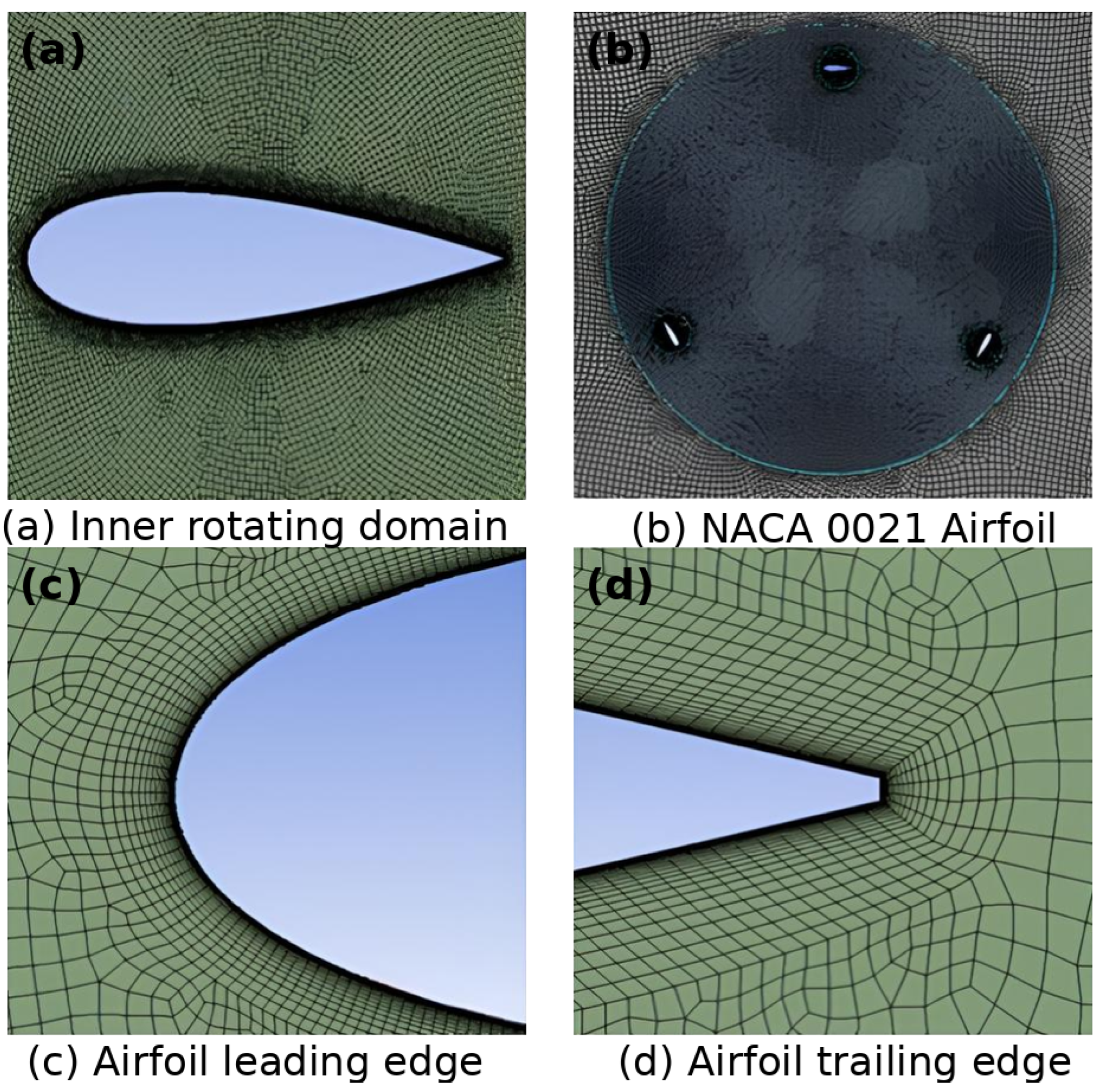
Figure 3.
Inner domain and airfoil mesh detail, showing refinement near the leading and trailing edges.
Figure 3.
Inner domain and airfoil mesh detail, showing refinement near the leading and trailing edges.
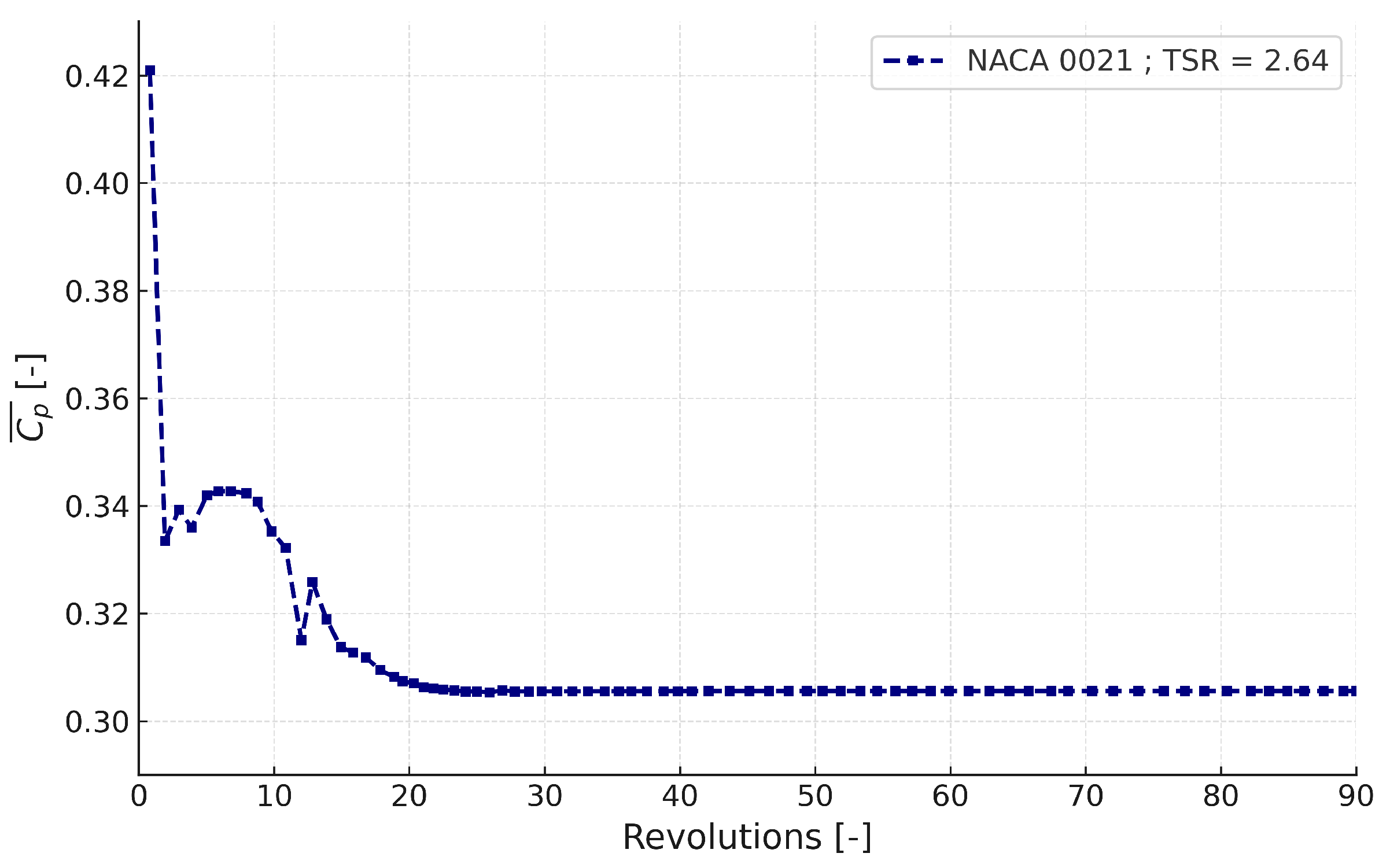
Figure 4.
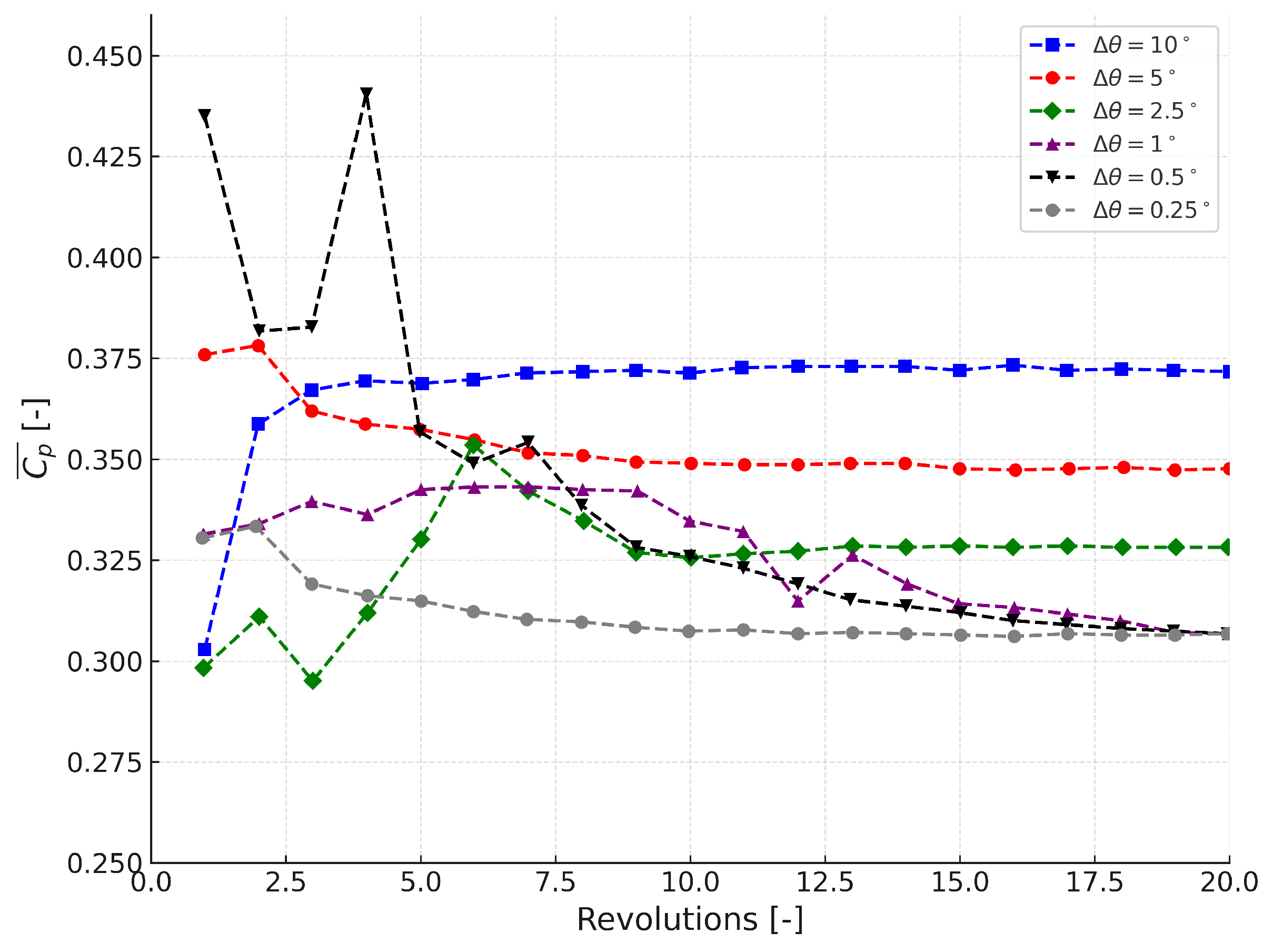
Numerical verification: average power coefficient () across revolutions for the NACA 0021 reference case at . Convergence is achieved after approximately 20 revolutions.
Figure 4.
Numerical verification: average power coefficient () across revolutions for the NACA 0021 reference case at . Convergence is achieved after approximately 20 revolutions.
Figure 5.
Numerical verification: effect of azimuthal increment () on convergence. Increments finer than show negligible additional improvement.
Figure 5.
Numerical verification: effect of azimuthal increment () on convergence. Increments finer than show negligible additional improvement.
Figure 6.
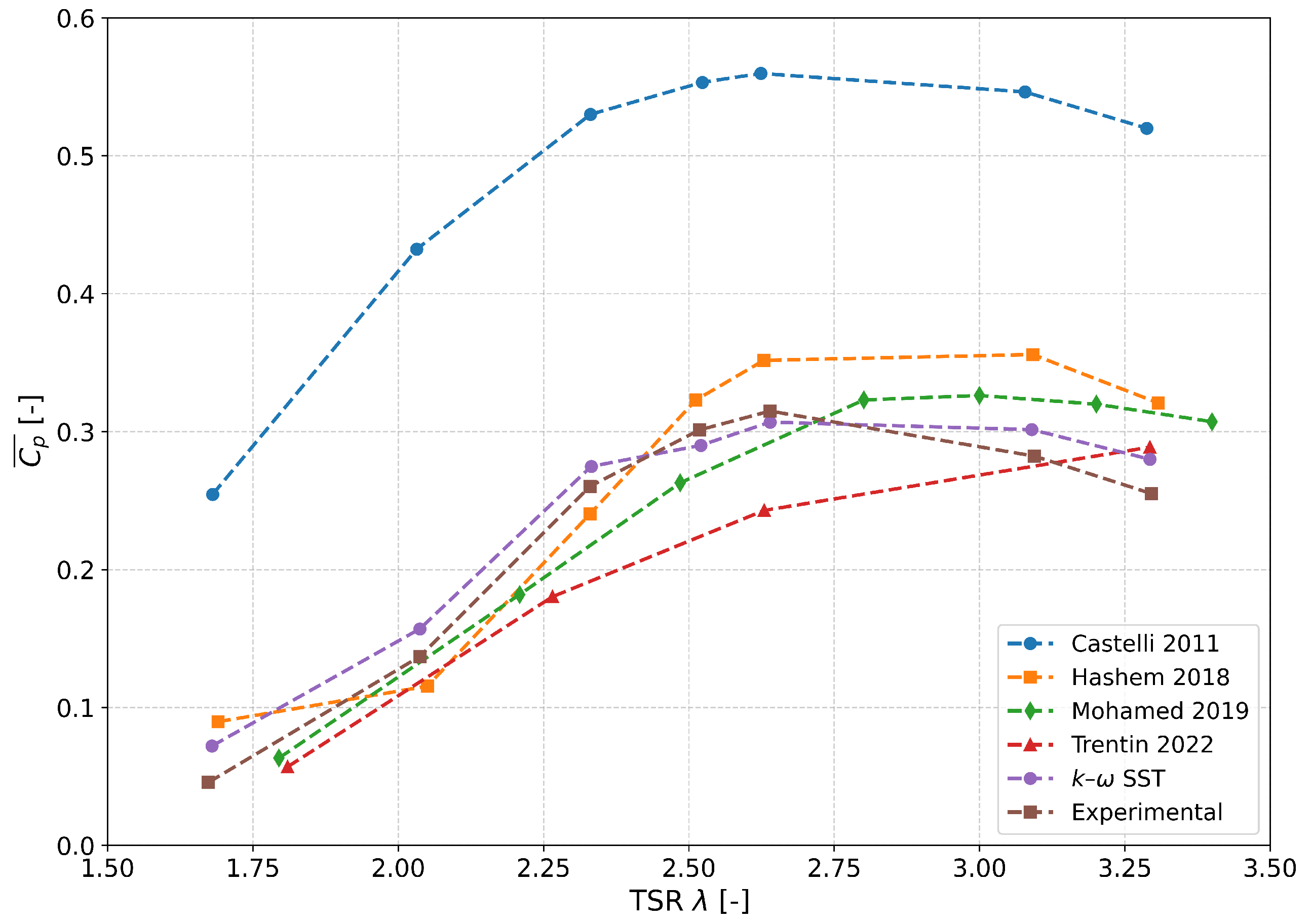
Comparison between experimental and numerical average power coefficient (
) across different tip speed ratios (
) for the NACA 0021 airfoil. Experimental data from Castelli et al. [
7], Hashem et al. [
23], Mohamed et al. [
37], Trentin et al. [
21], Menter [
27] and Balduzzi et al. [
34].
Figure 6.
Comparison between experimental and numerical average power coefficient (
) across different tip speed ratios (
) for the NACA 0021 airfoil. Experimental data from Castelli et al. [
7], Hashem et al. [
23], Mohamed et al. [
37], Trentin et al. [
21], Menter [
27] and Balduzzi et al. [
34].
Figure 7.
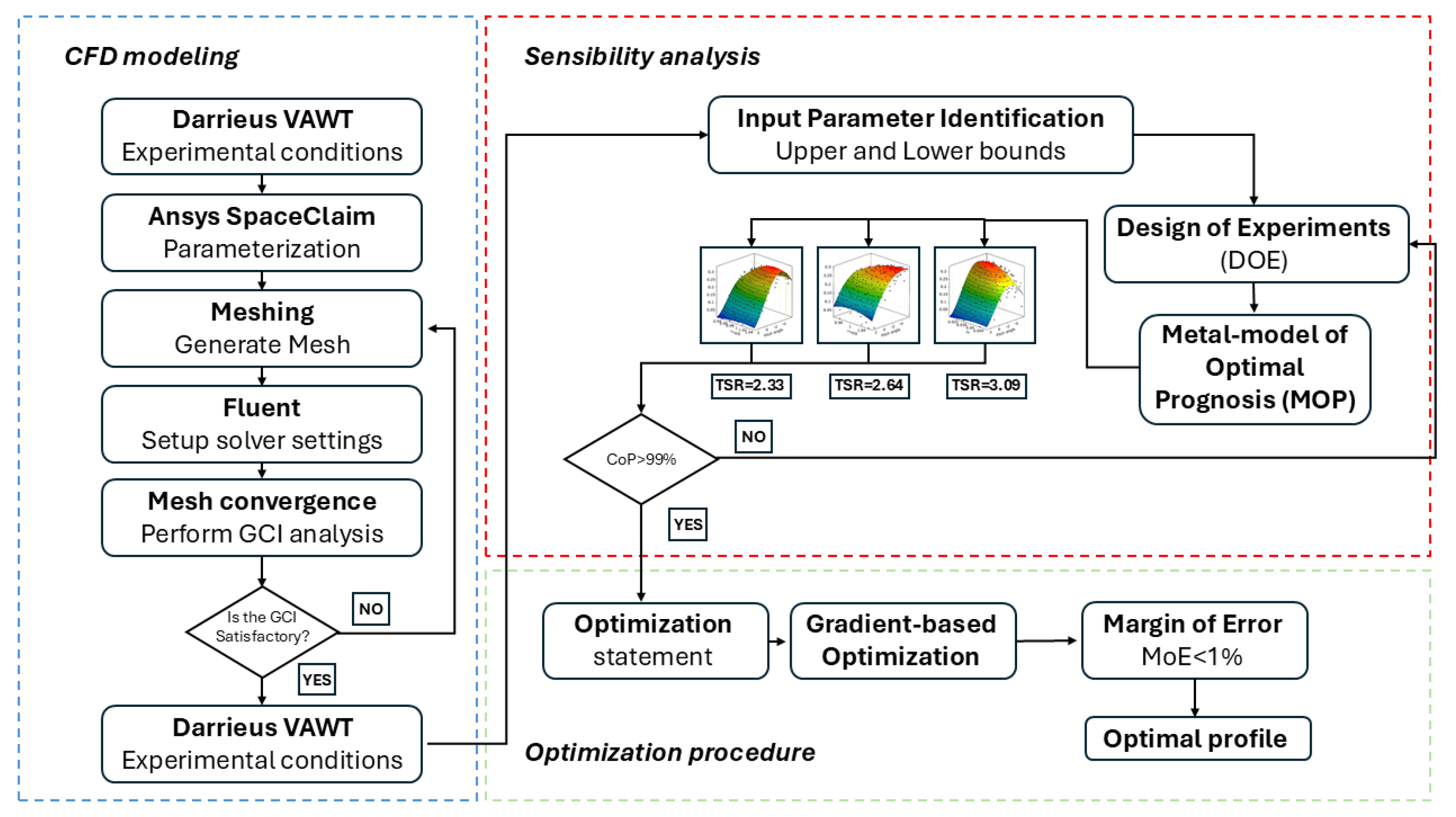
Workflow diagram showing the CFD modeling, sensitivity analysis, and optimization framework. Modified from [
21].
Figure 7.
Workflow diagram showing the CFD modeling, sensitivity analysis, and optimization framework. Modified from [
21].
Figure 8.
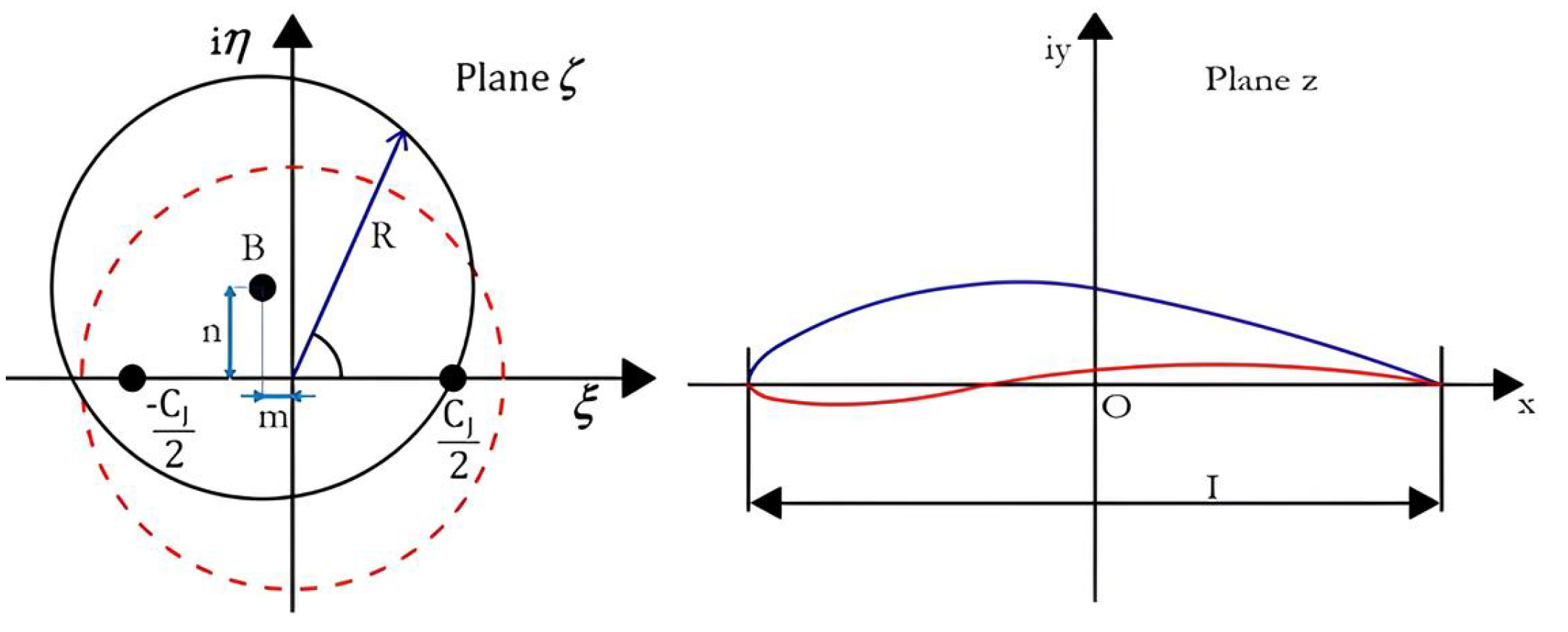
Joukowsky transformation and symmetric airfoil generation based on ellipse parameters
a,
b, and center offset
m. Adapted from [
12].
Figure 8.
Joukowsky transformation and symmetric airfoil generation based on ellipse parameters
a,
b, and center offset
m. Adapted from [
12].
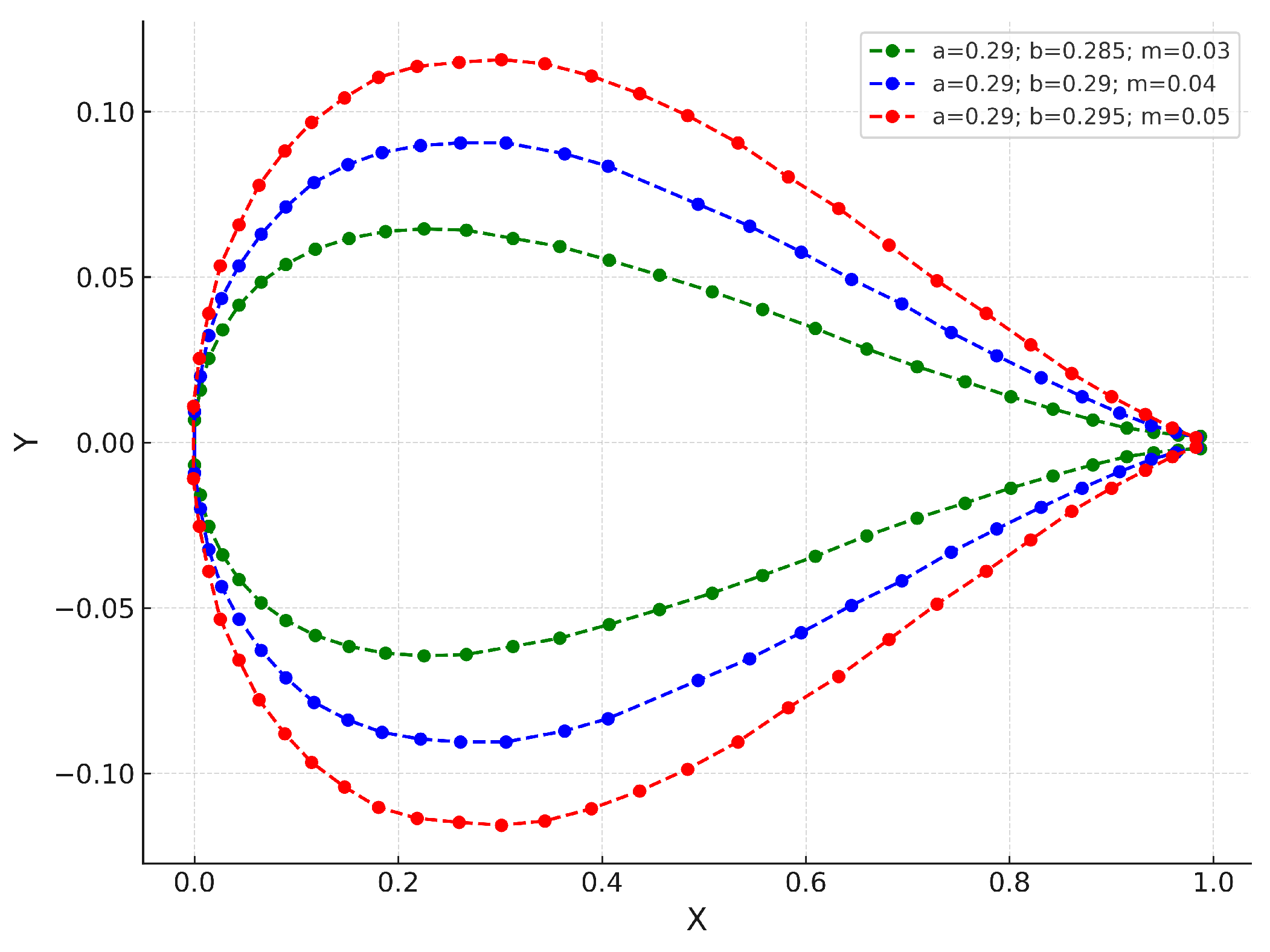
Figure 9.
Effect of varying Joukowsky parameters a, b, and m on airfoil shape. Shifting controls maximum thickness position along the chord.
Figure 9.
Effect of varying Joukowsky parameters a, b, and m on airfoil shape. Shifting controls maximum thickness position along the chord.
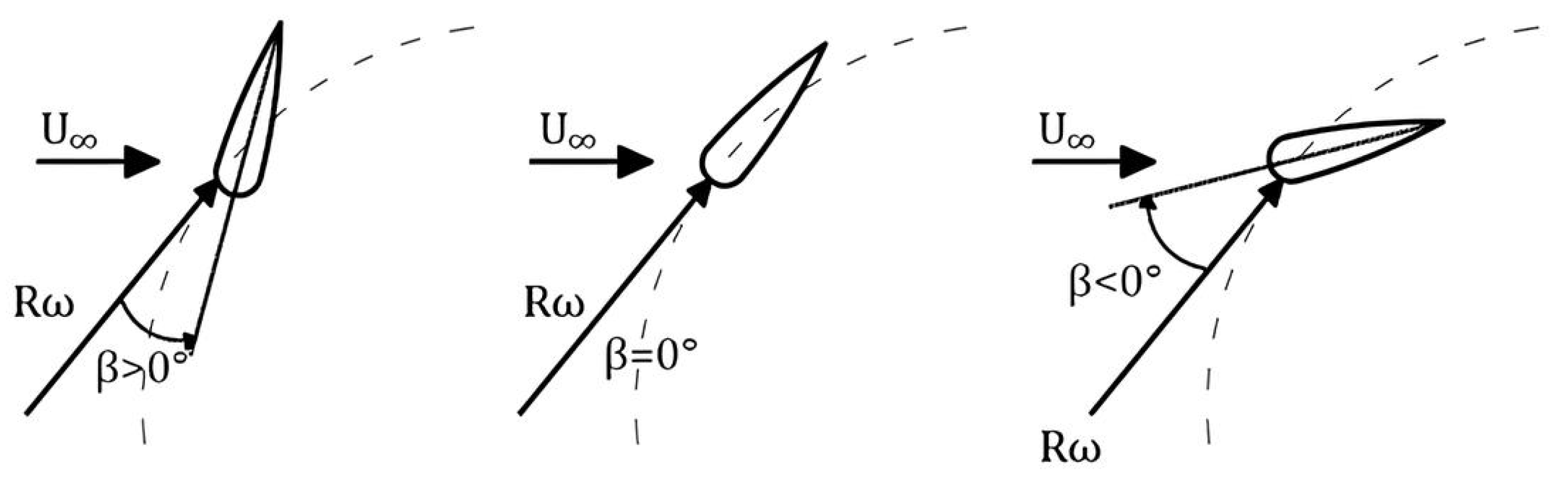
Figure 10.
Schematic representation of the blade pitch angle for a VAWT blade.
Figure 10.
Schematic representation of the blade pitch angle for a VAWT blade.
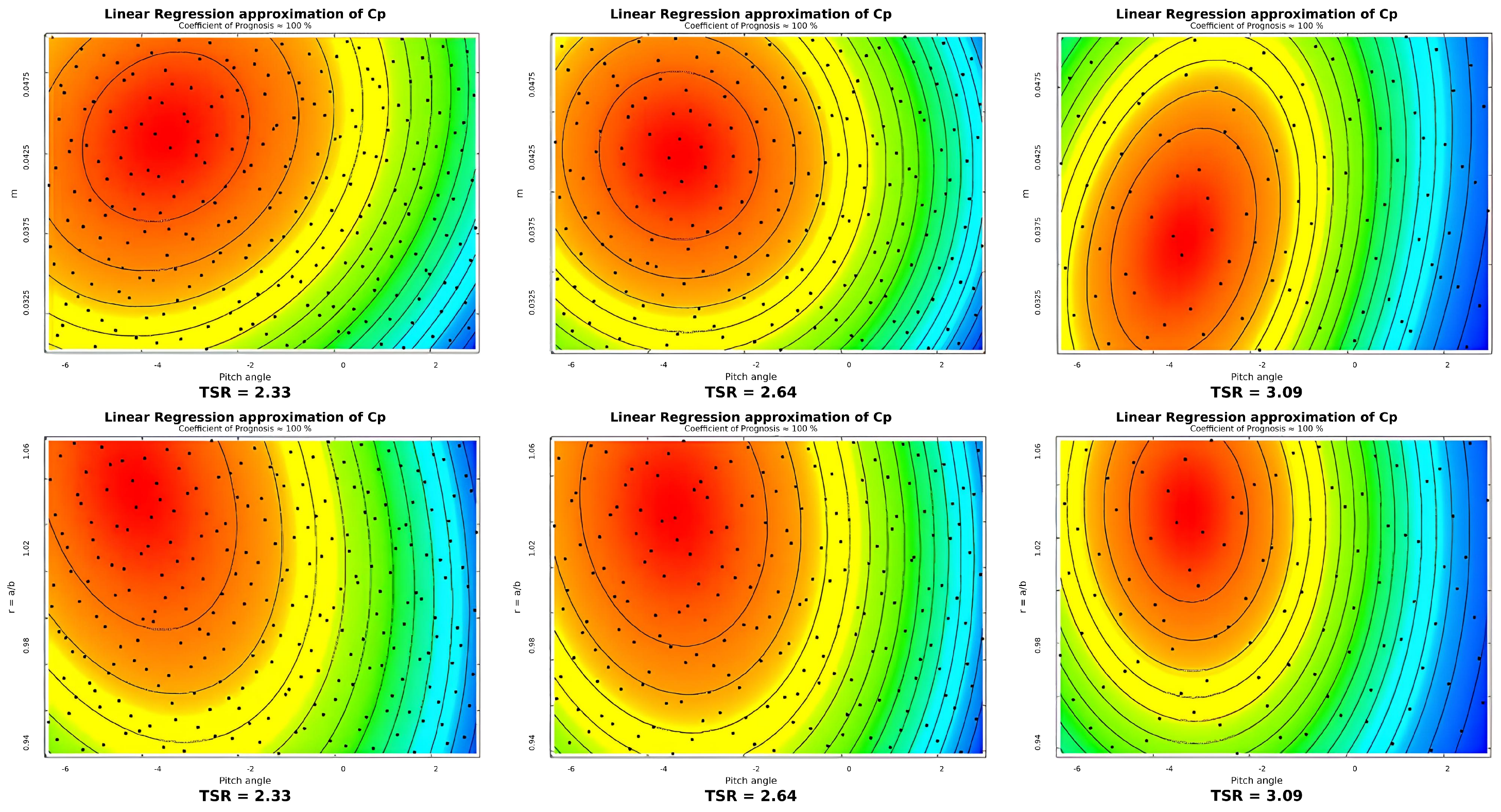
Figure 11.
Two-dimensional top-down views of surrogate response surfaces for as functions of pitch angle () and relative thickness (m) (top) and and maximum-thickness position () (bottom) at , 2.64, 3.09. Red zones represent optimal design regions, confirming as the dominant variable with m and providing secondary refinements.
Figure 11.
Two-dimensional top-down views of surrogate response surfaces for as functions of pitch angle () and relative thickness (m) (top) and and maximum-thickness position () (bottom) at , 2.64, 3.09. Red zones represent optimal design regions, confirming as the dominant variable with m and providing secondary refinements.
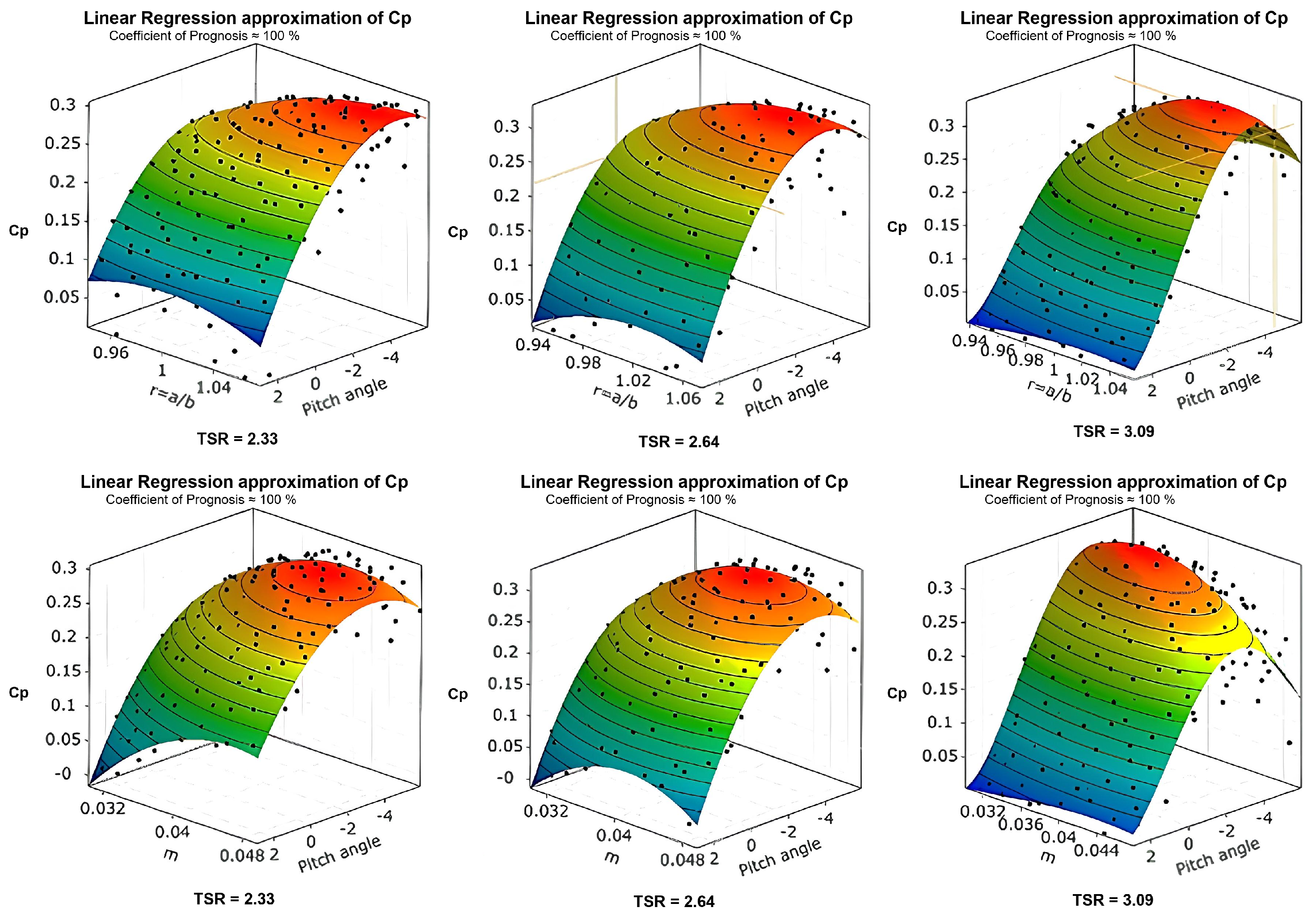
Figure 12.
Three-dimensional surrogate response surfaces corresponding to
Figure 11. The smooth quadratic trends across
,
m, and
explain the near-perfect predictive accuracy of the second-order LRM surrogate.
Figure 12.
Three-dimensional surrogate response surfaces corresponding to
Figure 11. The smooth quadratic trends across
,
m, and
explain the near-perfect predictive accuracy of the second-order LRM surrogate.
Figure 13.
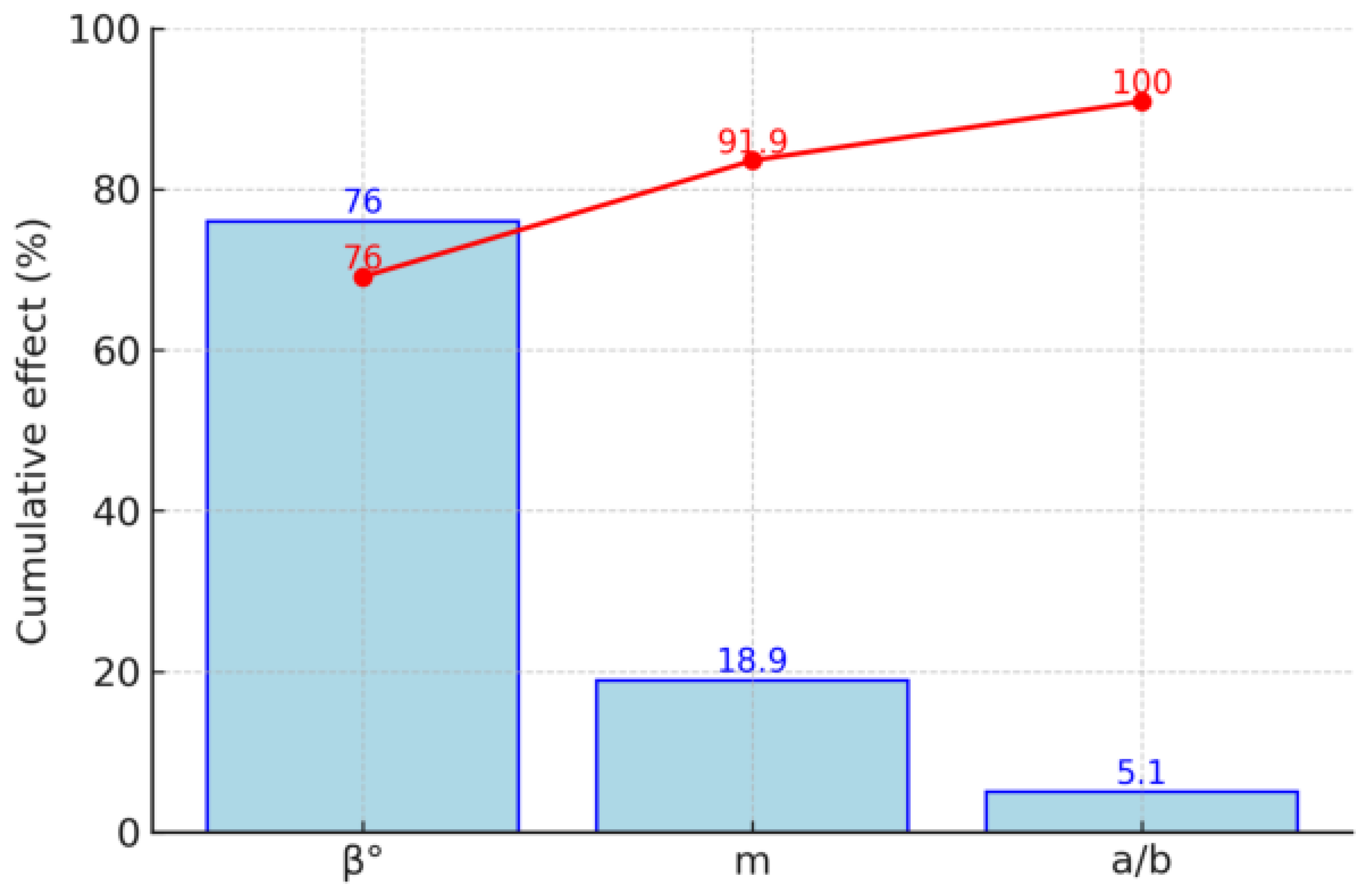
Coefficient of Importance (CoI) analysis at . Pitch angle () accounts for 76% of the variance in .
Figure 13.
Coefficient of Importance (CoI) analysis at . Pitch angle () accounts for 76% of the variance in .
Figure 14.
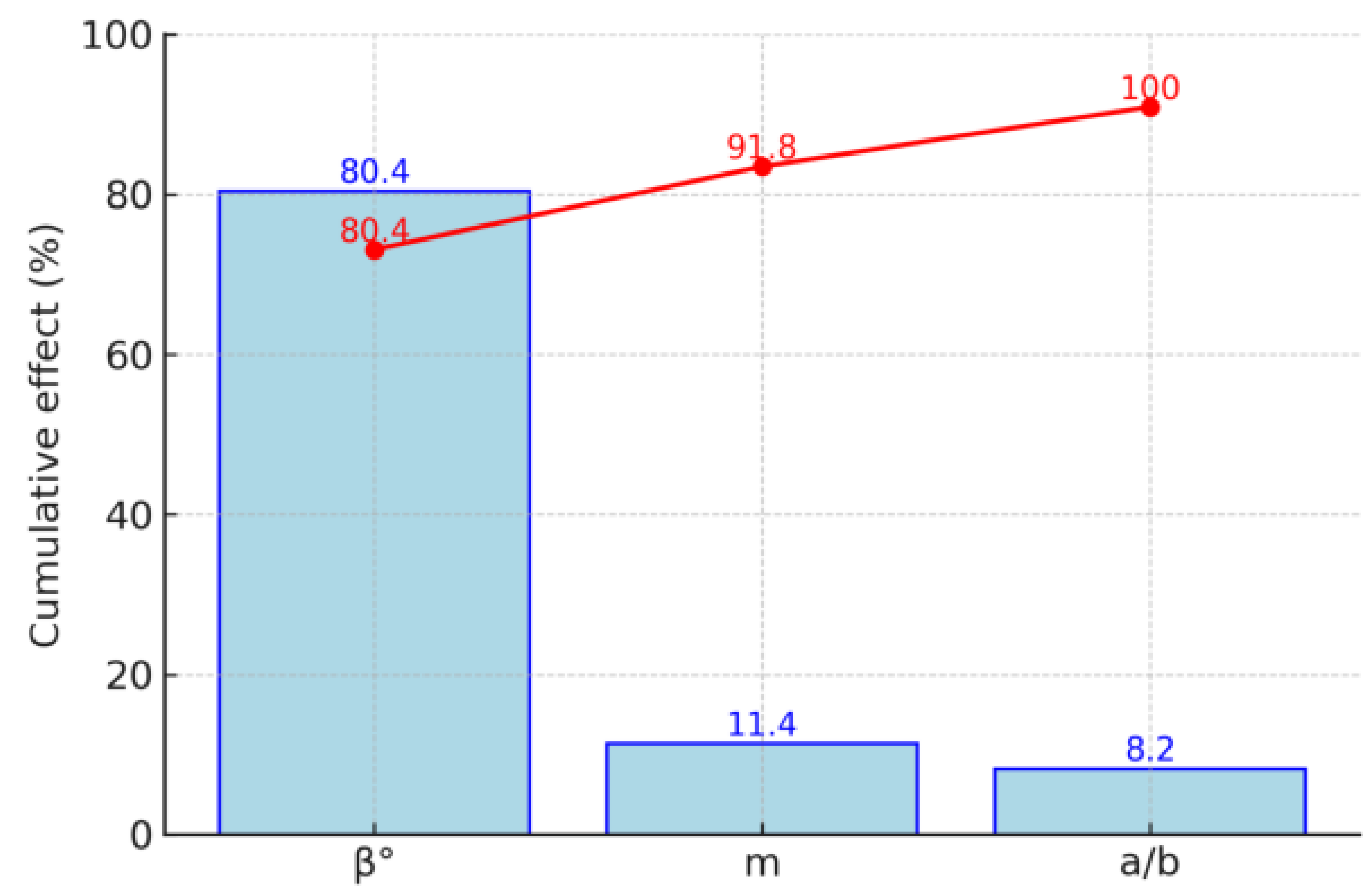
CoI analysis at . Pitch angle () contributes 80.4% of the total effect, while m and contribute 11.4% and 8.2%, respectively.
Figure 14.
CoI analysis at . Pitch angle () contributes 80.4% of the total effect, while m and contribute 11.4% and 8.2%, respectively.
Figure 15.
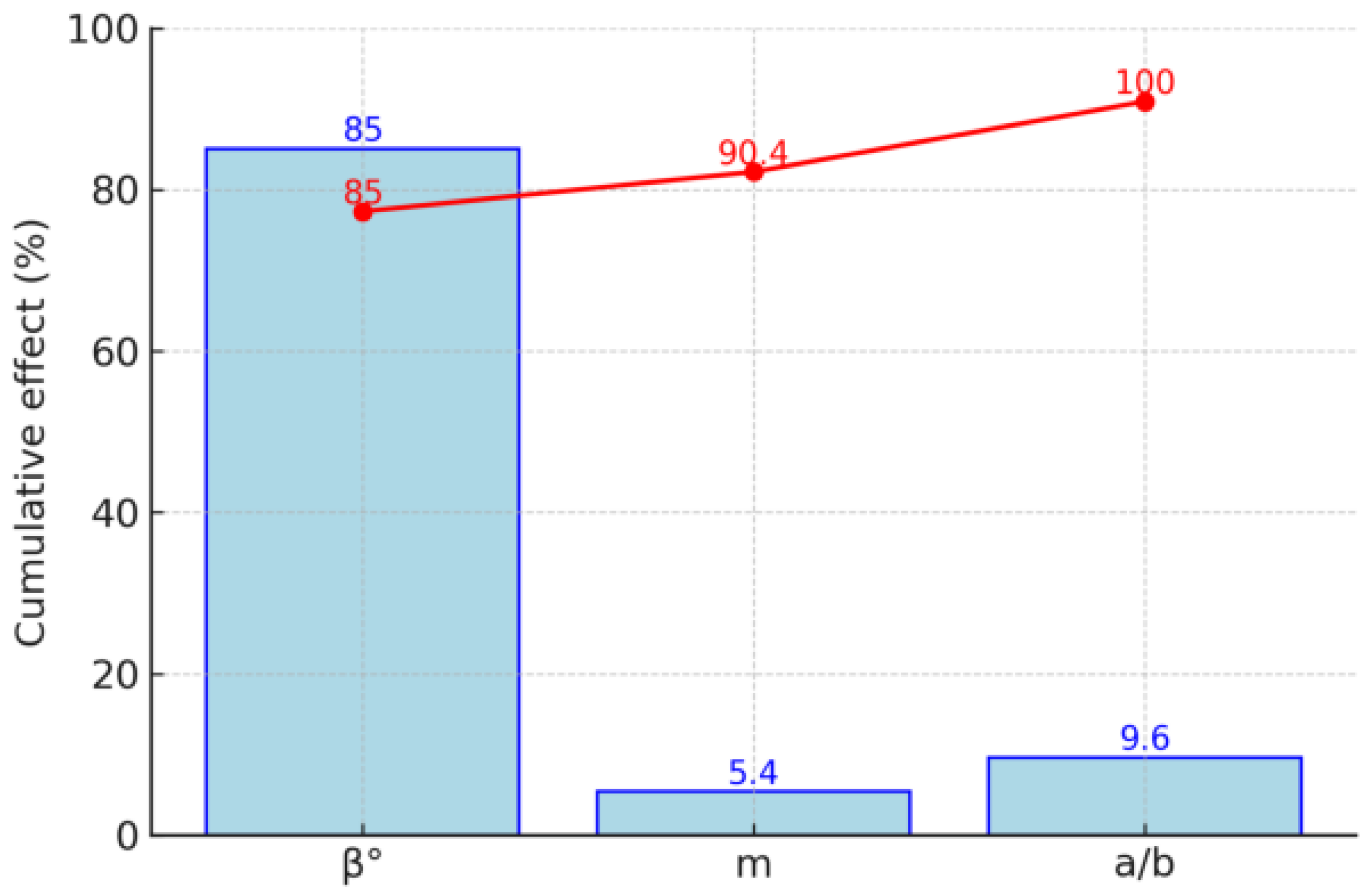
CoI analysis at . The influence of reaches 85%, highlighting its dominant role in delaying stall and improving torque production at higher TSRs.
Figure 15.
CoI analysis at . The influence of reaches 85%, highlighting its dominant role in delaying stall and improving torque production at higher TSRs.
Figure 16.
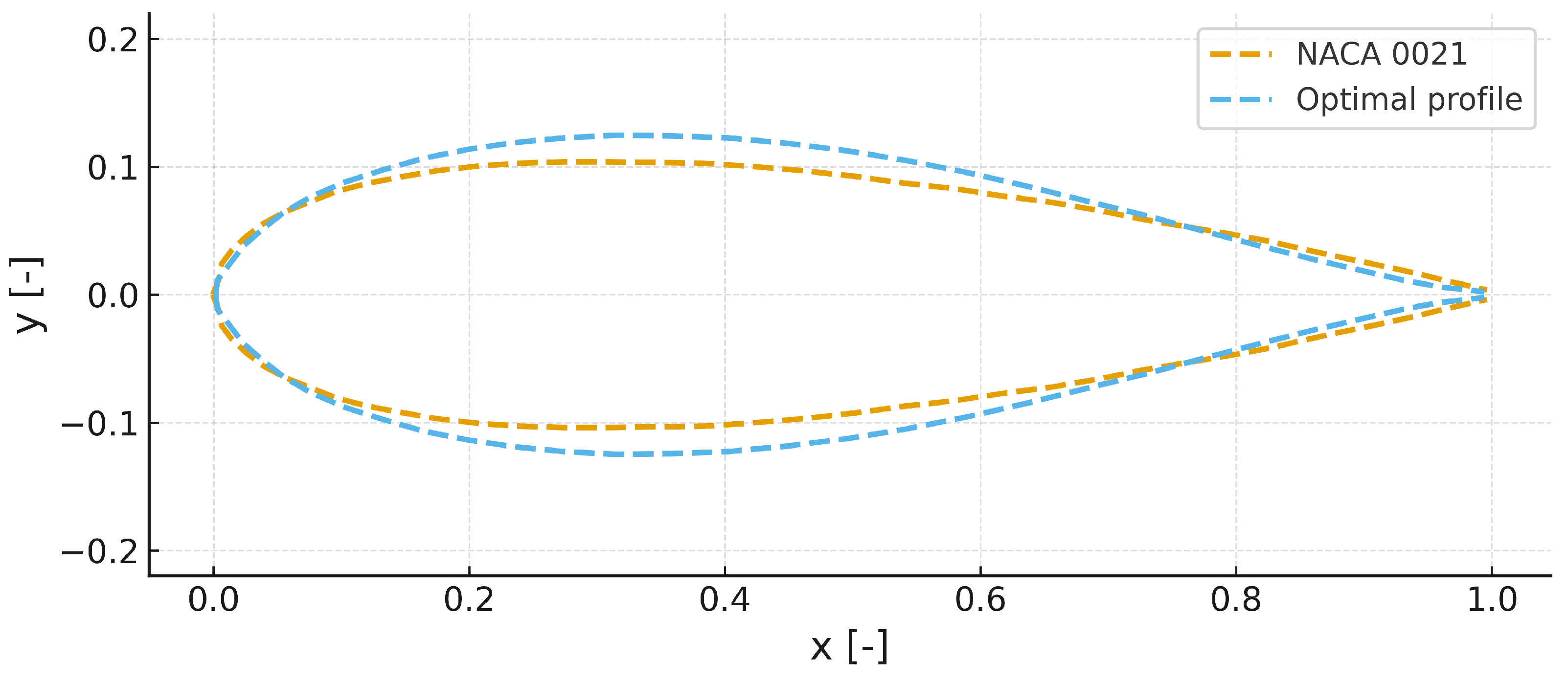
Comparison between the optimized airfoil and the baseline NACA 0021 profile. The optimized design features increased camber and a forward-shifted maximum thickness, improving flow attachment and aerodynamic efficiency.
Figure 16.
Comparison between the optimized airfoil and the baseline NACA 0021 profile. The optimized design features increased camber and a forward-shifted maximum thickness, improving flow attachment and aerodynamic efficiency.
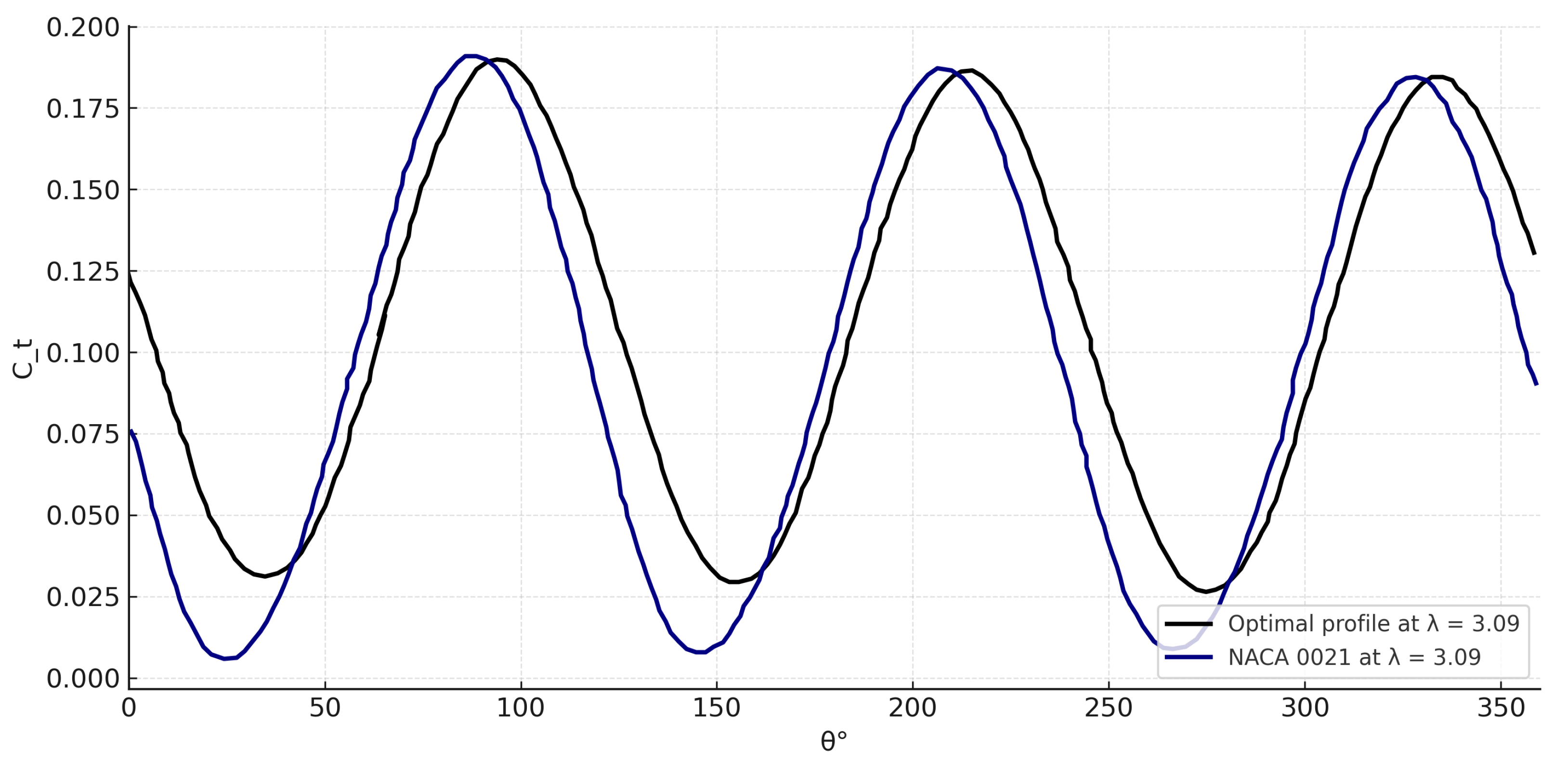
Figure 17.
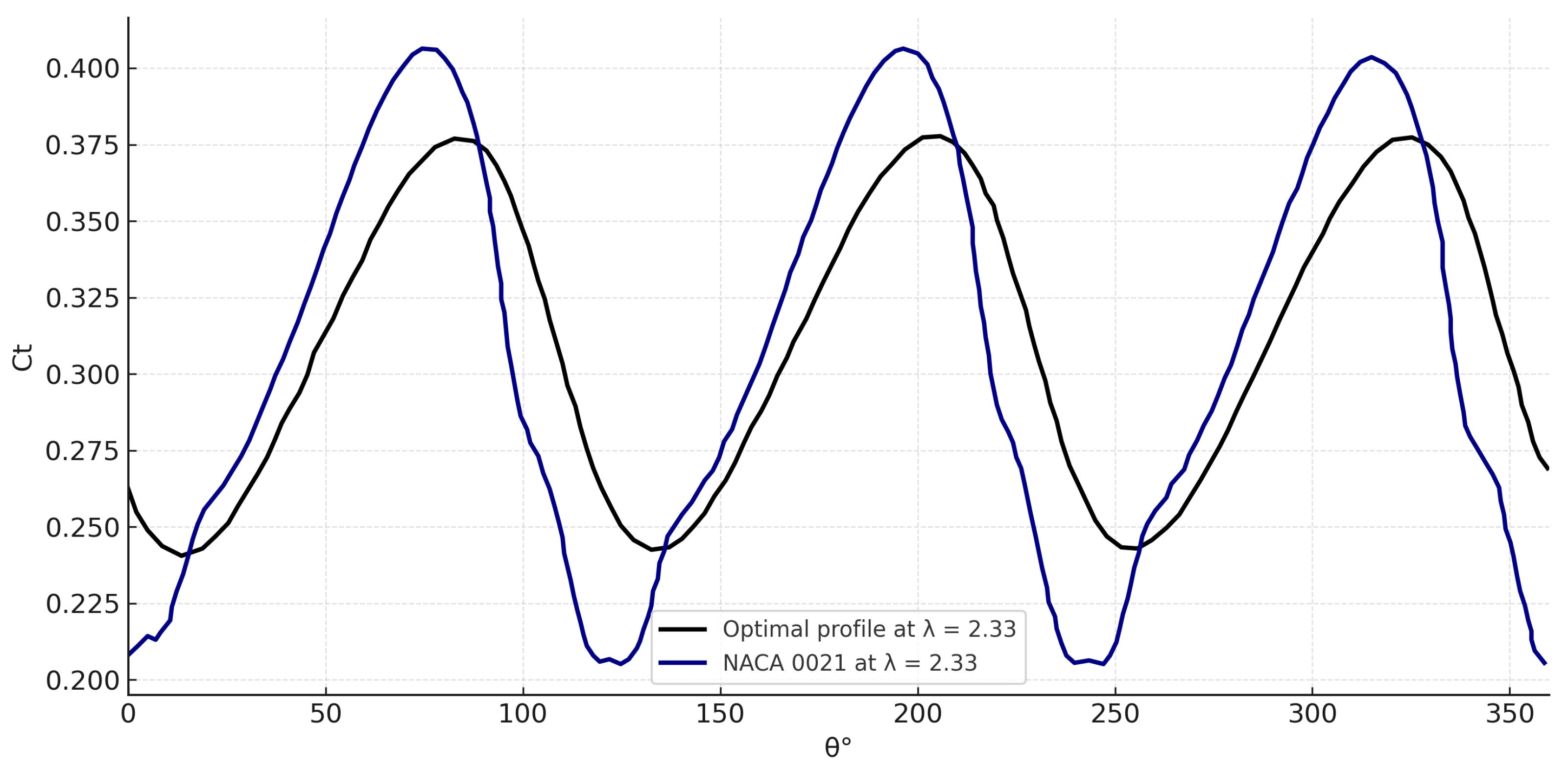
Instantaneous torque coefficient () for the NACA 0021 and optimized profiles at . The optimized profile exhibits reduced negative-torque regions and improved rotational consistency.
Figure 17.
Instantaneous torque coefficient () for the NACA 0021 and optimized profiles at . The optimized profile exhibits reduced negative-torque regions and improved rotational consistency.
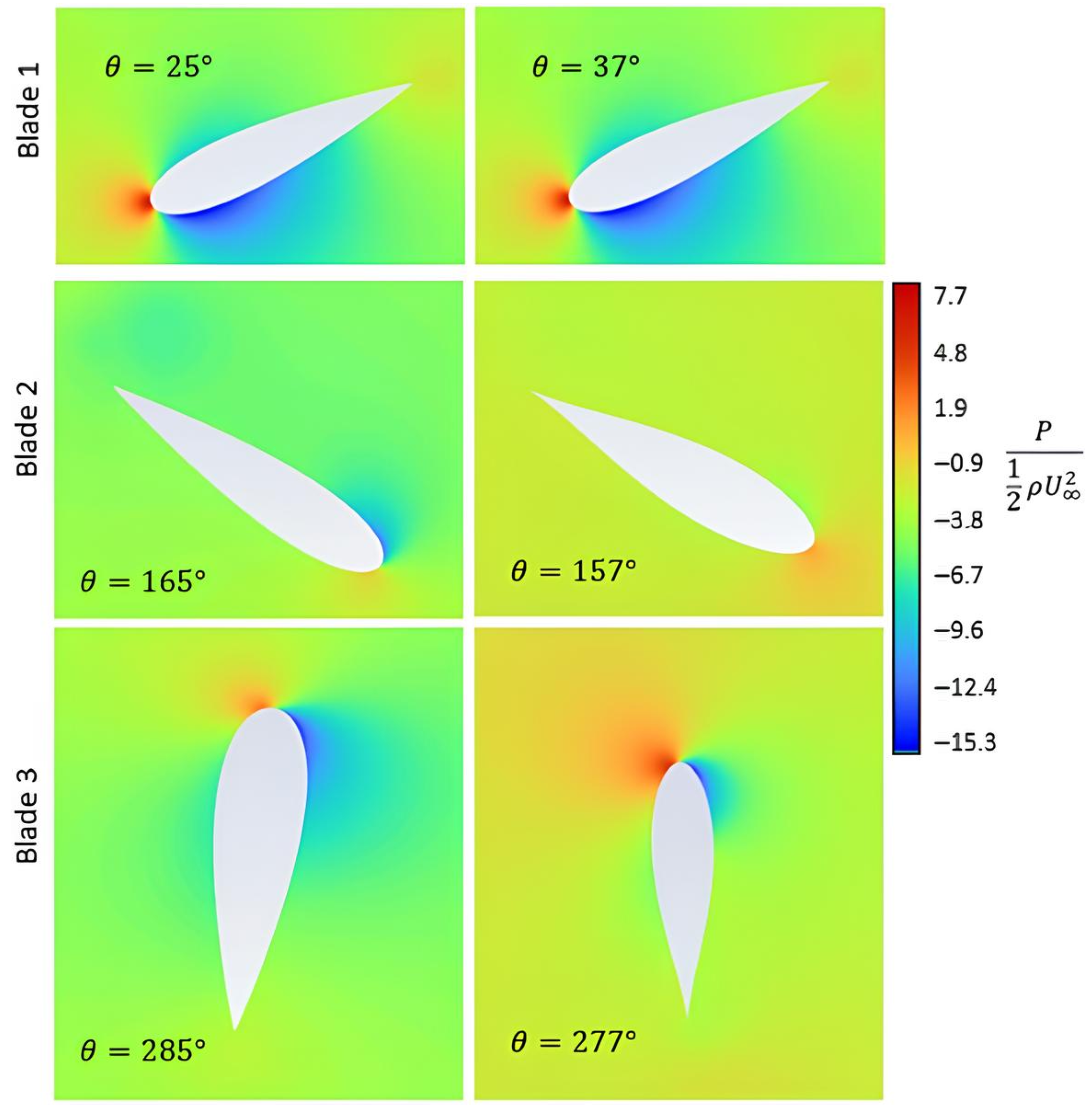
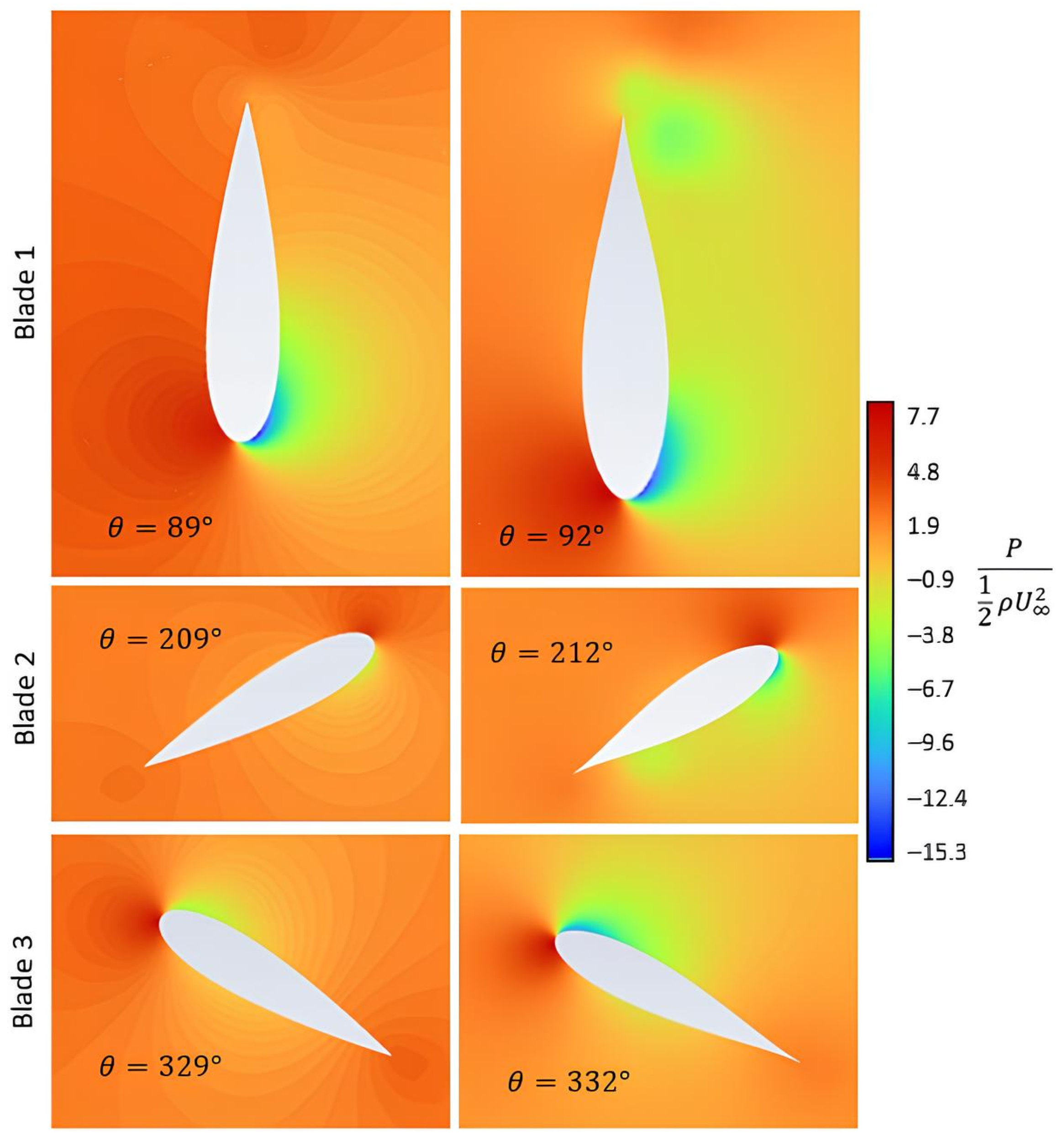
Figure 18.
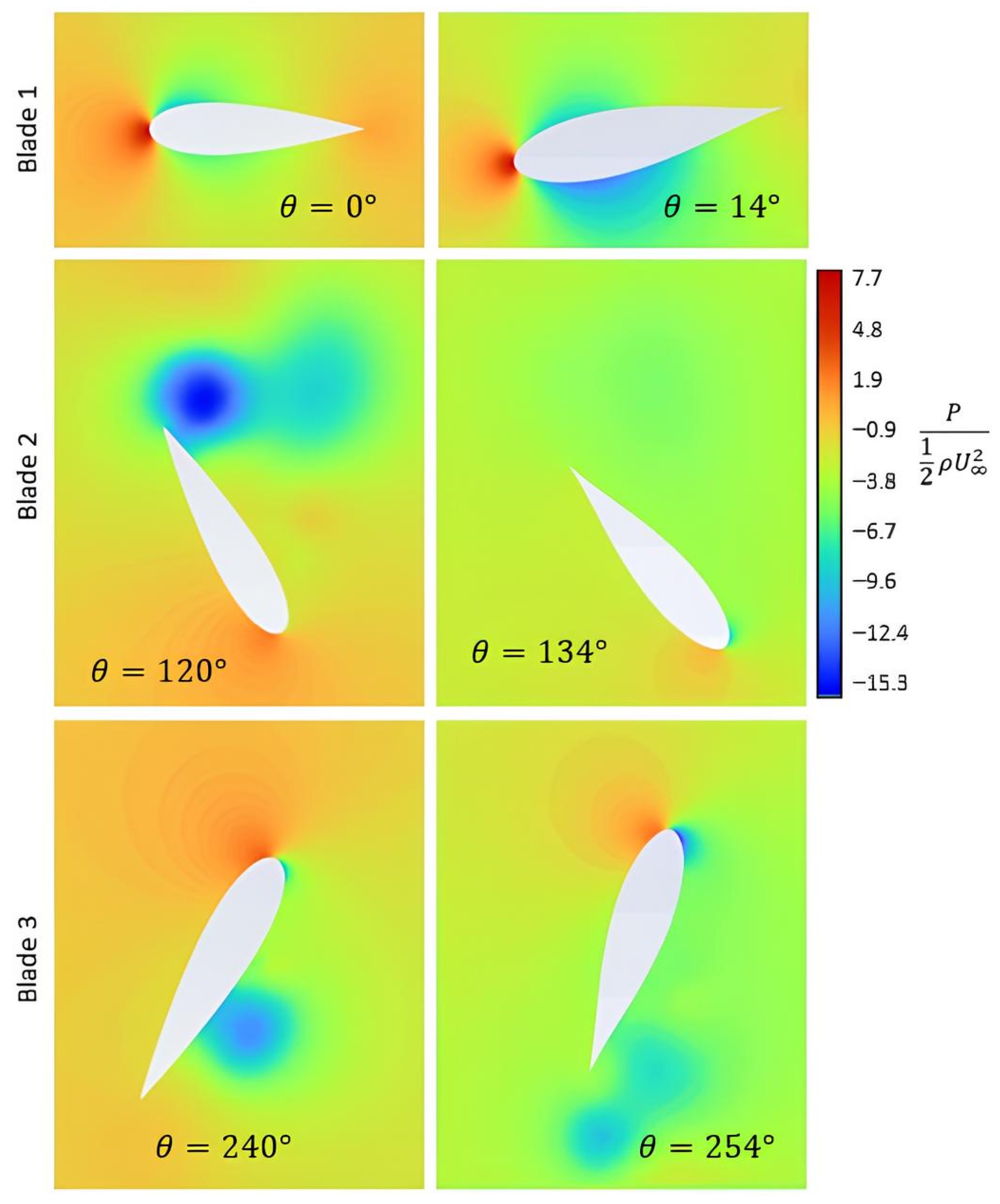
Dimensionless pressure contours at for the three blades of the NACA 0021 (left) and optimized profile (right) at the azimuth of lowest torque coefficient.
Figure 18.
Dimensionless pressure contours at for the three blades of the NACA 0021 (left) and optimized profile (right) at the azimuth of lowest torque coefficient.
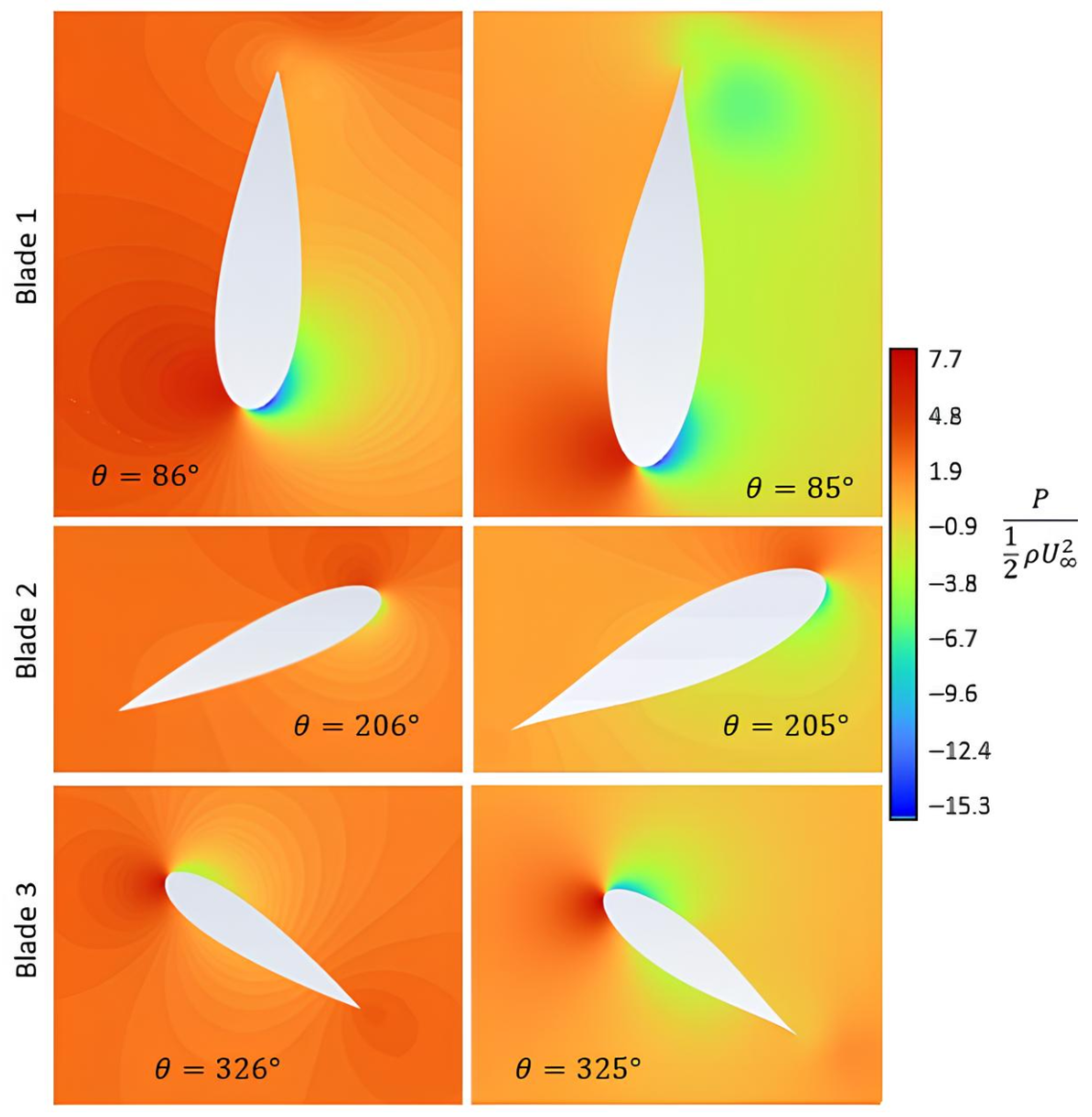
Figure 19.
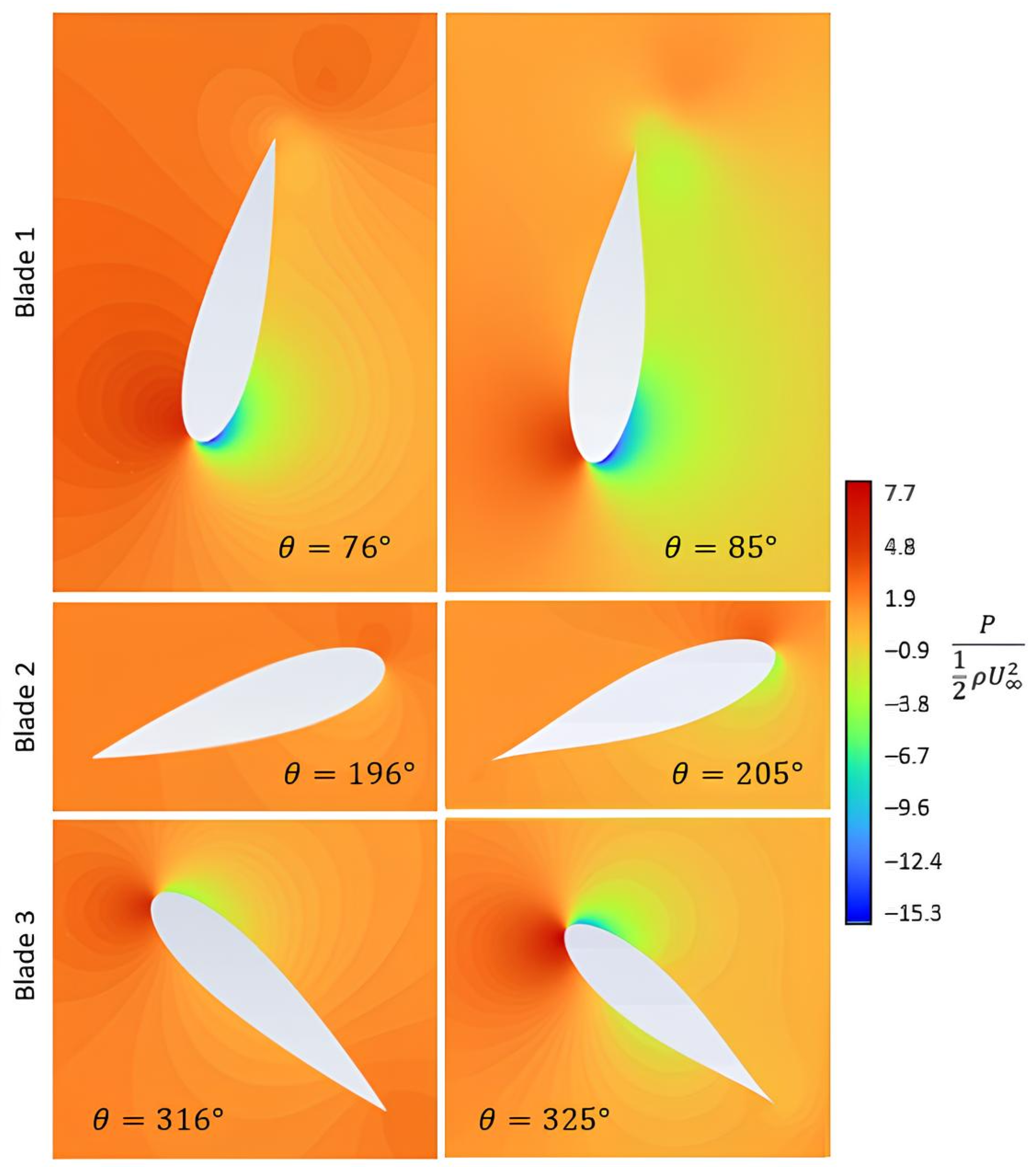
Dimensionless pressure contours at for the three blades of the NACA 0021 (left) and optimized profile (right) at the azimuth of the highest torque coefficient.
Figure 19.
Dimensionless pressure contours at for the three blades of the NACA 0021 (left) and optimized profile (right) at the azimuth of the highest torque coefficient.
Figure 20.
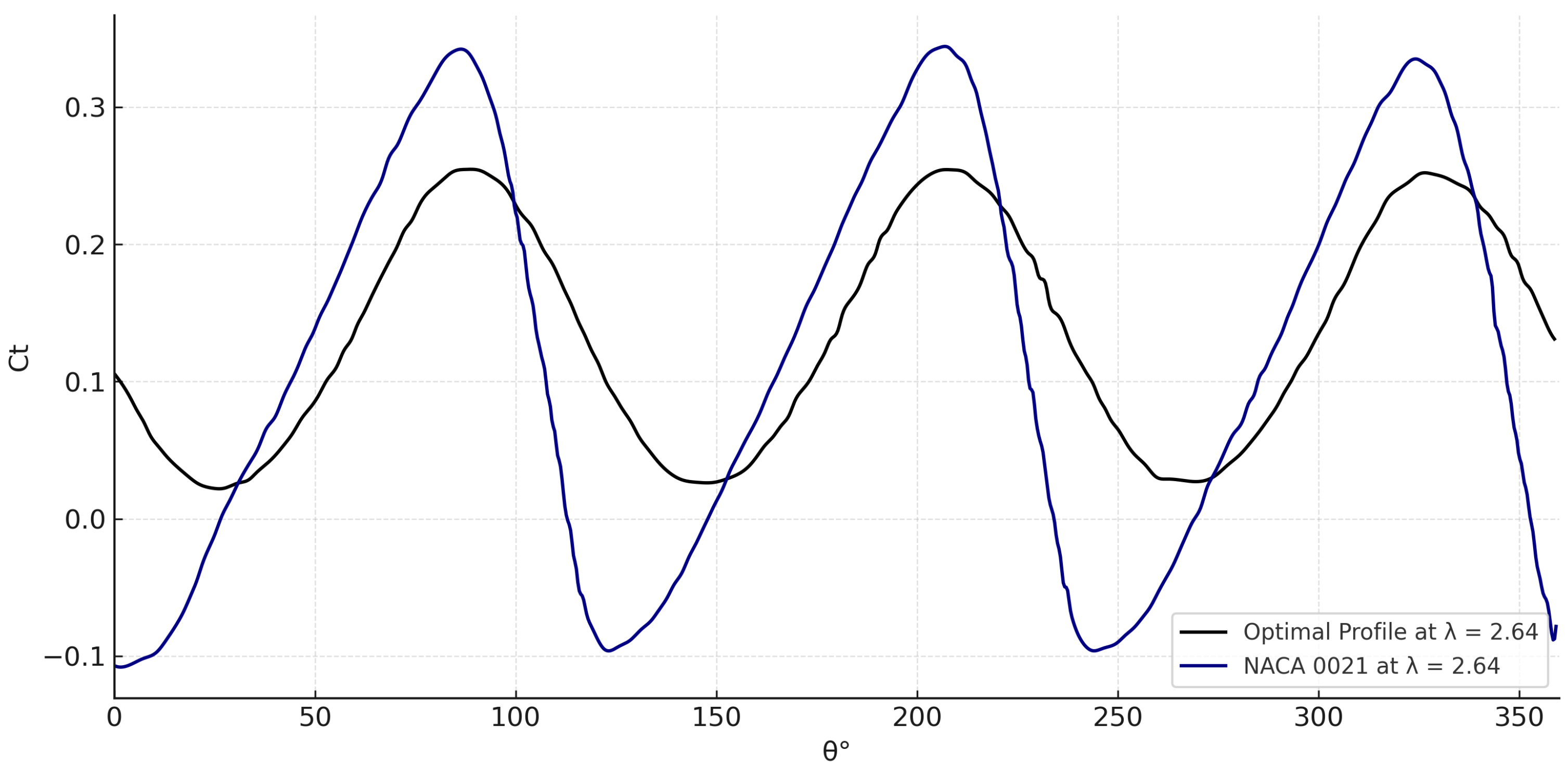
Instantaneous torque coefficient () for the NACA 0021 and optimized profiles at . The optimized design removes negative-torque dips present in the baseline.
Figure 20.
Instantaneous torque coefficient () for the NACA 0021 and optimized profiles at . The optimized design removes negative-torque dips present in the baseline.
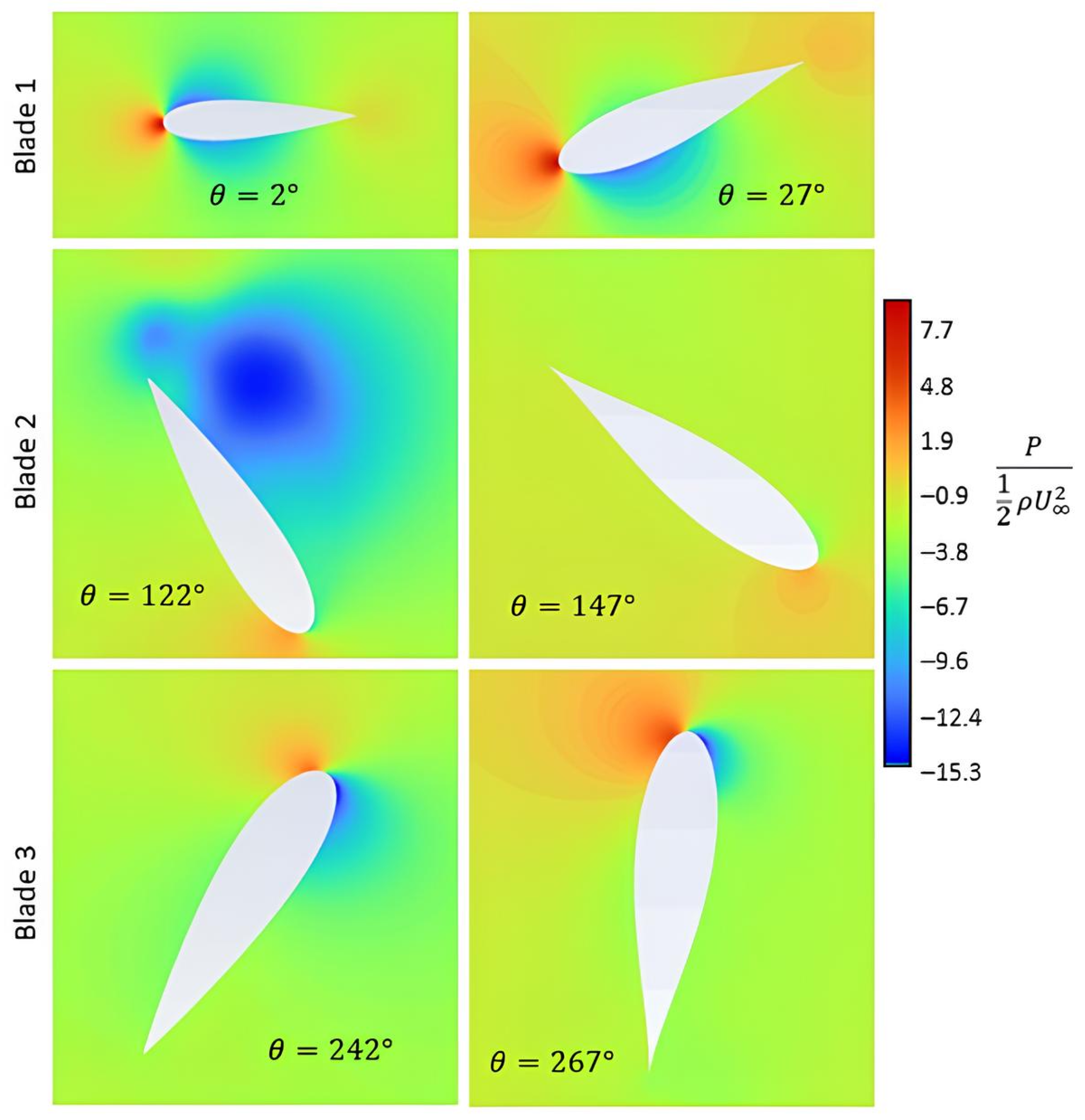
Figure 21.
Dimensionless pressure contours at for the NACA 0021 (left) and optimized profile (right) at the azimuth of lowest torque coefficient.
Figure 21.
Dimensionless pressure contours at for the NACA 0021 (left) and optimized profile (right) at the azimuth of lowest torque coefficient.
Figure 22.
Dimensionless pressure contours at for the NACA 0021 (left) and optimized profile (right) at the azimuth of the highest torque coefficient.
Figure 22.
Dimensionless pressure contours at for the NACA 0021 (left) and optimized profile (right) at the azimuth of the highest torque coefficient.
Figure 23.
Instantaneous torque coefficient () for the NACA 0021 and optimized profiles at . The optimized configuration sustains higher torque levels across the rotation.
Figure 23.
Instantaneous torque coefficient () for the NACA 0021 and optimized profiles at . The optimized configuration sustains higher torque levels across the rotation.
Figure 24.
Dimensionless pressure contours at for the NACA 0021 (left) and optimized profile (right) at the azimuth of lowest torque coefficient.
Figure 24.
Dimensionless pressure contours at for the NACA 0021 (left) and optimized profile (right) at the azimuth of lowest torque coefficient.
Figure 25.
Dimensionless pressure contours at for the NACA 0021 (left) and optimized profile (right) at the azimuth of the highest torque coefficient.
Figure 25.
Dimensionless pressure contours at for the NACA 0021 (left) and optimized profile (right) at the azimuth of the highest torque coefficient.
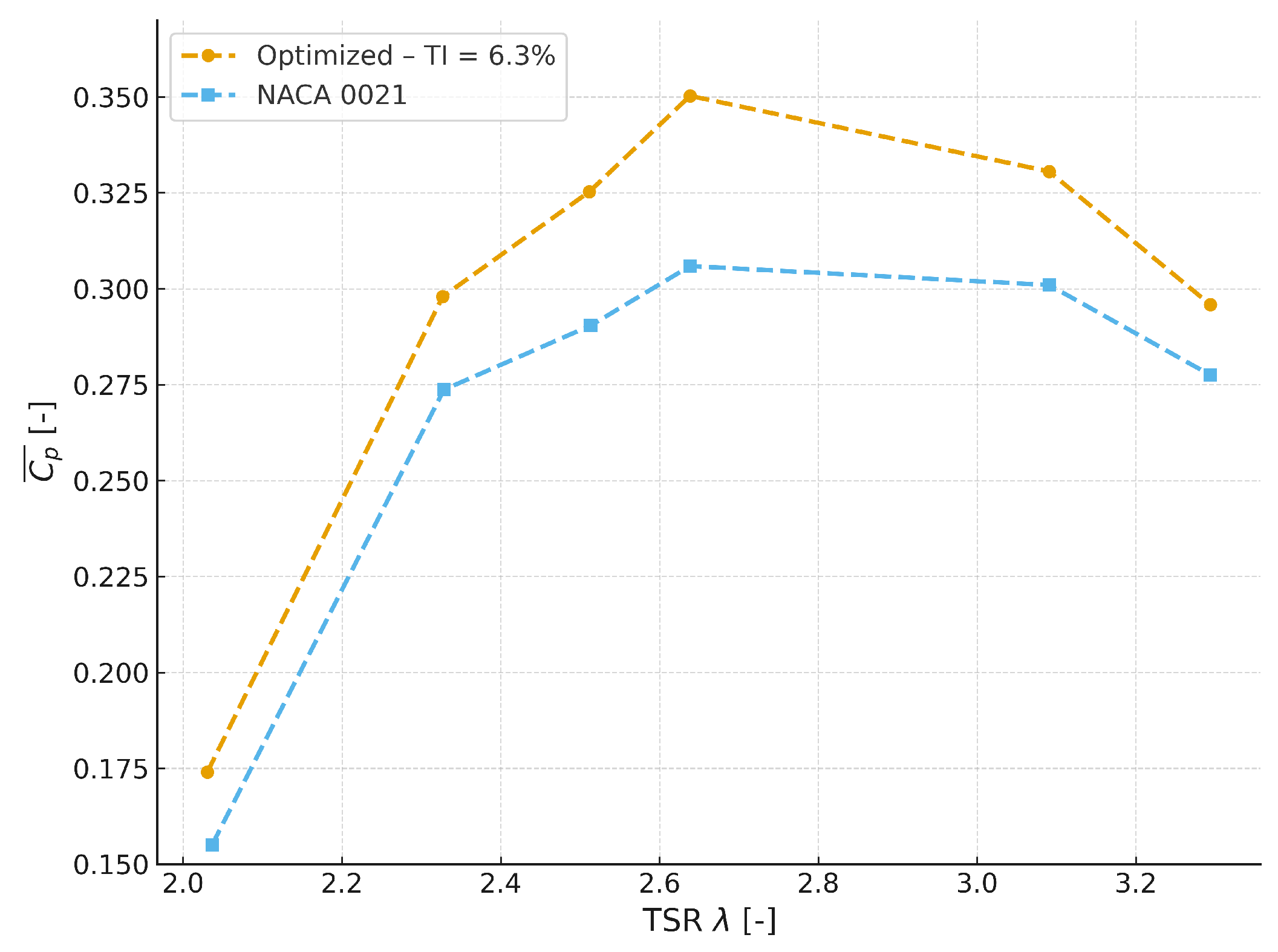
Figure 26.
Cycle-averaged power coefficient () for the NACA 0021 and optimized profiles across the studied tip-speed ratios. The optimized profile achieves 11–14% improvement, confirming the robustness of the multi-TSR optimization strategy.
Figure 26.
Cycle-averaged power coefficient () for the NACA 0021 and optimized profiles across the studied tip-speed ratios. The optimized profile achieves 11–14% improvement, confirming the robustness of the multi-TSR optimization strategy.
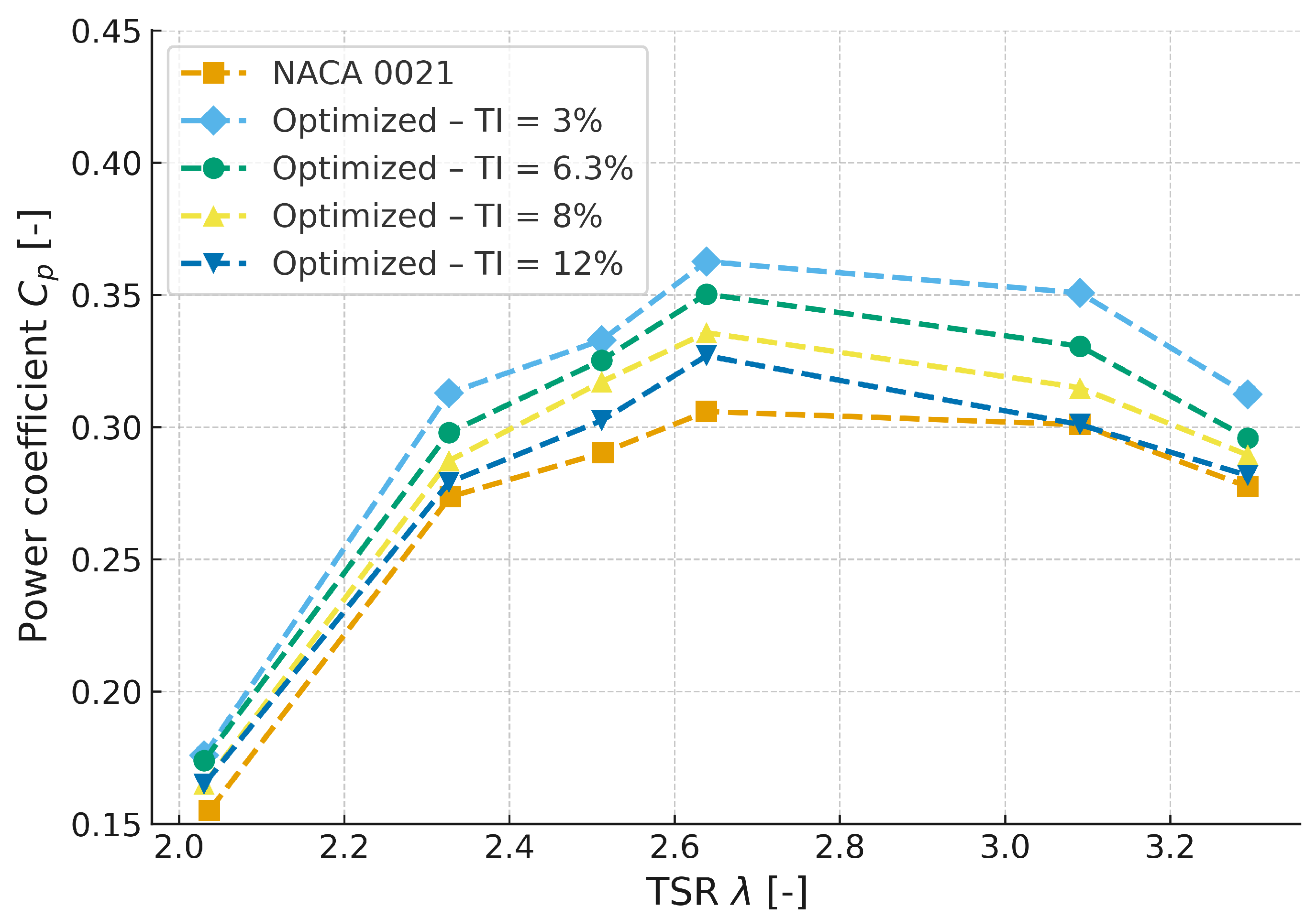
Figure 27.
Power coefficient as a function of tip-speed ratio for the optimized airfoil under different turbulence intensities (3%, 6.3%, 8%, 12%). Results for the baseline NACA 0021 profile are shown for comparison.
Figure 27.
Power coefficient as a function of tip-speed ratio for the optimized airfoil under different turbulence intensities (3%, 6.3%, 8%, 12%). Results for the baseline NACA 0021 profile are shown for comparison.
Table 1.
Main geometrical features of the H-Darrieus turbine.
Table 1.
Main geometrical features of the H-Darrieus turbine.
| Characteristics | Turbine |
|---|
| Number of blades, n | 3 |
| Diameter, D [m] | 1.03 |
| Height, H [m] | 1.00 |
| Swept area, A [m2] | 1.03 |
| Solidity, | 0.50 |
| Airfoil | NACA 0021 |
| Airfoil chord, C [mm] | 85.8 |
| Tip speed ratio, | 2.64 |
| Free-stream velocity [m/s] | 9.0 |
| Rotational speed [rad/s] | 46.14 |
| Max. thickness position | 30% |
| Profile thickness | 21% |
Table 2.
Summary of simulation settings.
Table 2.
Summary of simulation settings.
| Characteristics | Turbine |
|---|
| Fluid properties | Incompressible |
| Turbulence model | k– SST |
| Solver | Pressure-based |
| Gradient | Least Square Cell-Based |
| Momentum | Second Order Upwind |
| Turbulent Kinetic Energy | Second Order Upwind |
| Specific Dissipation Rate | Second Order Upwind |
| Pressure–velocity coupling | Coupled |
| Maximum residuals | |
Table 3.
Meshing metrics for orthogonal quality and skewness.
Table 3.
Meshing metrics for orthogonal quality and skewness.
| Metric | Min. | Max. | Average | Std. Dev. |
|---|
| Orthogonal Quality | 0.11345 | 0.99457 | 0.95897 | |
| Skewness | | 0.98231 | | |
Table 4.
Details of the mesh sensitivity analysis and discretization errors.
Table 4.
Details of the mesh sensitivity analysis and discretization errors.
| Parameter | Value |
|---|
| 395,145 |
| 224,220 |
| 119,665 |
| 1.328 |
| 1.369 |
| 3.0170 |
| 3.0227 |
| 3.1557 |
| 0.1903% |
Table 5.
Lower and upper bounds for the input variables.
Table 5.
Lower and upper bounds for the input variables.
| Input Variable | Lower Bound | Upper Bound |
|---|
| 0.95 | 1.09 |
| m | 0.03 | 0.053 |
| | 4 |
Table 6.
Summary of meta-models created for .
Table 6.
Summary of meta-models created for .
| Meta-Model Approximation | CoD | CoP |
|---|
| LRM (1st order) | 0.7556 | 0.7705 |
| LRM (2nd order) | 0.9999 | 0.99996 |
| MLS (1st order) | 0.9743 | 0.9448 |
| MLS (2nd order) | 0.9852 | 0.9950 |
| Kriging | 0.9790 | 0.9953 |
Table 7.
Summary of meta-models created for .
Table 7.
Summary of meta-models created for .
| Meta-Model Approximation | CoD | CoP |
|---|
| LRM (1st order) | 0.7820 | 0.7923 |
| LRM (2nd order) | 0.9999 | 0.9991 |
| MLS (1st order) | 0.9388 | 0.9267 |
| MLS (2nd order) | 0.9517 | 0.9740 |
| Kriging | 0.9504 | 0.9674 |
Table 8.
Summary of meta-models created for .
Table 8.
Summary of meta-models created for .
| Meta-Model Approximation | CoD | CoP |
|---|
| LRM (1st order) | 0.7669 | 0.7824 |
| LRM (2nd order) | 0.9993 | 0.9996 |
| MLS (1st order) | 0.9799 | 0.9516 |
| MLS (2nd order) | 0.9848 | 0.9864 |
| Kriging | 0.9900 | 0.9970 |
Table 9.
Consolidated performance of second-order LRM surrogate models across multiple .
Table 9.
Consolidated performance of second-order LRM surrogate models across multiple .
| Design Pts | Failed Pts | CoD | CoP | Highest | [%] |
|---|
| 2.33 | 97 | 3 | 0.99994 | 0.99996 | 0.3055 | 11.10 |
| 2.64 | 93 | 7 | 0.99992 | 0.99908 | 0.3512 | 14.36 |
| 3.09 | 95 | 5 | 0.99929 | 0.99964 | 0.3385 | 12.96 |
Table 10.
Optimized design parameters obtained from NLPQL and Downhill Simplex algorithms. Predicted and simulated values of the integrated differ by less than 0.4%, confirming the accuracy and reliability of the surrogate optimization framework.
Table 10.
Optimized design parameters obtained from NLPQL and Downhill Simplex algorithms. Predicted and simulated values of the integrated differ by less than 0.4%, confirming the accuracy and reliability of the surrogate optimization framework.
| Opt. Model | Optimal | Optimal m | Optimal [°] | Predicted | Simulated | MoE [%] |
|---|
| NLPQL | 1.054 | 0.0407 | | 0.2545 | 0.2540 | 0.2150 |
| SIMPLEX | 1.053 | 0.0408 | | 0.2532 | 0.2523 | 0.3560 |