Article

WIC Participation and Diversity of Dietary Exposures During Infancy Are Associated with Diet Quality at Age 2 Years

by
Vivian M. Drewelow
1,2,
Aleksandra S. Kristo
2,3,
Suzanne Phelan
1 and
Alison K. Ventura
1,*
1
Center for Health Research, Department of Kinesiology and Public Health, Phillip and Christina Bailey College of Science and Mathematics, California Polytechnic State University, San Luis Obispo, CA 93407, USA
2
Department of Food Science and Nutrition, College of Agriculture, Food, and Environmental Sciences, California Polytechnic State University, San Luis Obispo, CA 93407, USA
3
Department of Human Nutrition, Hospitality and Sport Management, College of Human Environmental Sciences, University of Alabama, Tuscaloosa, AL 35487, USA
*
Author to whom correspondence should be addressed.
Dietetics 2026, 5(1), 5; https://doi.org/10.3390/dietetics5010005
Submission received: 19 September 2025 / Revised: 23 November 2025 / Accepted: 28 December 2025 / Published: 8 January 2026

Abstract

The present work aimed to assess associations between food insecurity, WIC participation, diversity of dietary exposures, and diet quality in infancy. A secondary analysis was conducted of the WIC Infant and Toddler Feeding Practices Study-2 (WIC ITFPS-2), a national longitudinal study of WIC participation, feeding practices, and children’s health outcomes. Food security at 13 and 24 months, WIC participation at 13 and 24 months, diversity of dietary exposures between 5 and 13 months, and diet quality at 24 months were assessed in 1246 participants who had complete data on all variables of interest. Multivariable linear regression using weighted cases was used. Among families participating in WIC at 13 months, infants in families with low or very low food security had a greater diversity of dietary exposures (mean ± SE: 8.9 ± 0.3) compared to families with high or marginal food security (8.6 ± 0.2); the magnitude of this effect was small but significant (p = 0.03). In both food-insecure and -secure families, greater diversity of dietary exposures (b = 0.30, 95% CI 0.15, 0.44) and WIC participation at 24 months (b = 2.35, 95% CI 1.29, 3.40) were associated with higher diet quality at 24 months. Greater diversity of dietary exposures and participation in WIC may support improved diet quality during the first 2 years.

1. Introduction

Infancy and toddlerhood are critical periods of growth and development during which food preferences, eating behaviors, and dietary patterns develop [1]. Indeed, dietary patterns established during childhood persist into adulthood [2]. Thus, efforts to promote diet quality in childhood and beyond should focus on optimizing feeding practices and food environments during the first 2 years of life.
The United States (U.S.) Dietary Guidelines for Americans characterize high diet quality for children as adequate intakes of fruits, vegetables, whole grains, dairy products, and protein and limited intakes of sugar, fat, and highly processed foods [3]. Unfortunately, less than half of U.S. children meet these recommendations, and, in general, the diet quality of U.S. children is poor. Data from the National Health and Nutrition Examination Survey illustrate that, on average, children between the ages of 2 and 4 years achieve scores of 63 out of 100 on the Healthy Eating Index (HEI), a tool that assesses the extent to which an individual’s dietary patterns adhere to the Dietary Guidelines for Americans [4]. These trends are concerning because children and adolescents with poor diet quality are more likely to experience a wide variety of health issues, including excess adiposity, higher insulin resistance and blood pressure, delayed cognitive development, dental problems, and long-term risk of diabetes and cardiovascular disease [5,6,7,8,9].
One potential strategy for improving young children’s diet quality is to increase dietary diversity, which is defined as the number of different food groups or individual foods consumed during a specific period [10]. Dietary guidelines have long emphasized the importance of dietary variety and diversity for ensuring individuals will meet their nutrient requirements [3,11,12], and experimental research with infants and toddlers illustrates that repeatedly exposing young children to a variety of flavors and foods promotes their willingness to eat and preferences for healthy foods [13,14]. Among older children (6–12 years of age), higher dietary diversity is associated with a greater consumption of fruits, vegetables, and fiber, and a decreased consumption of ultra-processed foods [15]. Despite the well-established importance of the diversity of dietary exposures for shaping food preferences—a primary driver of eating behaviors during early childhood—few studies have directly examined whether and how diversity of dietary exposures is associated with diet quality during infancy.
Achieving high diet quality and diversity of dietary exposures can be more difficult for some families than others due to broader sociodemographic factors. In particular, children from food-insecure households have lower HEI scores compared to their food-secure peers [16,17,18,19]. Discrepancies in HEI scores between children from food-insecure versus food-secure households are driven, in part, by higher intakes of sugar [17], sugar-sweetened beverages [20], and refined grains [21], as well as decreased intakes of whole grains, fruits, and vegetables [17,19,22,23], among children in food-insecure households. Less diversity in dietary exposures may underlie poor diet quality. Low-income and food-insecure families often face inconsistent access to healthy foods, have less knowledge of infant and child feeding recommendations, and thus are less likely to repeatedly expose their children to a diverse array of foods [24,25,26].
Adverse effects of food insecurity on early dietary patterns may be ameliorated by participation in the Special Supplemental Nutrition Program for Women, Infants, and Children (WIC), a federal nutrition assistance program for low-income pregnant women and their children aged 5 years and younger. A central goal of WIC is to promote food security among low-income families by increasing food accessibility and providing nutrition education [27]. Recent analyses of the longitudinal WIC Infant and Toddler Feeding Practices Study-2 (WIC ITFPS-2) illustrate that longer participation in WIC predicts higher diet quality at ages 2 years [28], 3 years [29], and 5 years [30]. However, fewer studies have examined specific feeding practices, such as diversity of dietary exposures, that underlie associations between food security, WIC participation, and diet quality.
The present study examined whether household food insecurity and WIC participation during early infancy were associated with diversity of dietary exposures throughout the first year, as well as whether the combination of household food insecurity, WIC participation, and diversity of dietary exposures was associated with diet quality at age 2 years. The study aimed to answer the following research questions: (1) Is the combination of food insecurity and WIC participation during early infancy associated with diversity of dietary exposures during the first year? (2) Is the combination of food insecurity, WIC participation, and diversity of dietary exposures associated with diet quality at 2 years?

2. Materials and Methods

2.1. Participants

The present study was a secondary analysis of WIC ITFPS-2 data. Descriptions of the study participants, design, and measures have been published elsewhere [31,32]. In brief, this study captured nationally representative data on caregivers and their children. It assessed early life feeding practices, dietary composition, and associations between WIC participation and diet, nutrition, and health outcomes of children. Ninety-eight percent of participants were biological mothers; the remaining 2% were primary caregivers to the children included in the WIC ITFPS-2. At the time of the present study, data collection was ongoing through children’s 9th birthday; the current analysis focused on the enrollment through a 24-month dataset.
Between 2013 and 2018, participants across 27 states from 80 WIC sites were recruited for the WIC ITFPS-2. Caregivers who were currently enrolled in WIC were recruited for the study. Eligibility criteria for caregivers included newly enrolled in WIC and either currently pregnant or a mother of, or primary caregiver to an infant 2.5 months old or younger. New WIC enrollees were screened for study eligibility and enrolled in the study in person during the recruitment period, which varied across sites. A 10 min enrollment interview was conducted with eligible participants, and participants gave written and oral consent before participating. Data are available for 3777 WIC participants who completed postnatal interviews at 1 or 2 months. The present study included participants who completed all postnatal interviews between enrollment and 24 months and had complete data on all variables of interest, yielding a final sample size of 1246. Participants were compensated with $50 at enrollment and with $20 for each subsequent interview completed. The national study was approved by the Westat Institutional Review Board (IRB) and registered at clinicaltrials.gov as NCT02031978. Local study activities for the 80 WIC sites were approved by the local public health department and hospital IRBs, as needed. Given that the present study was a secondary analysis of publicly available deidentified data, the California Polytechnic State University IRB determined that this research did not require human subject review.

2.2. Design

Detailed information about the WIC ITFPS-2 study design has been published previously [32]. In brief, for the enrollment to 24-month dataset used in the present study, the majority of data collection was conducted via interviews (up to 10) across the first two years of the child’s life. Data were collected regardless of the study participants’ continued participation in WIC. Data were collected via telephone interviews with the participants in either English or Spanish. Dietary intake data were collected via 24-h recalls during the telephone interviews. Data were also collected from WIC administrative records and healthcare providers, WIC site employees through surveys, and from local and State agencies using both telephone and in-person interviews. For the present analysis, we focused on food security and WIC participation assessed at 13 and 24 months, dietary exposures assessed between 5 and 13 months, and diet quality assessed at 24 months.

2.3. Measures and Assessments

2.3.1. Food Insecurity

At 13 months and 24 months, the United States Department of Agriculture (USDA) 6-item Food Insecurity Survey was used to assess food insecurity [33]. Survey items assessed the household food situation, food affordability, and meal size. Participants’ responses to these items were coded and summed into a raw score ranging from 0 to 6. Scores were then categorized to represent levels of food security, with scores of 0 to 1 representing high or marginal food security, 2 to 4 representing low food security, and 5 to 6 representing very low food security. High food security was defined as no reported indications of food-access problems or limitations. Marginal food security was defined as one or two reported indications of food access problems or little or no indication of changes in diet or food intake. Low food security was defined as reports of reduced diet quality, variety, or desirability and little or no indication of reduced food intake. Very low food security was defined as reports of multiple indications of disrupted eating patterns and reduced food intake. Aligned with USDA reporting, food security status was recategorized as a binary variable in which high and marginal food security was categorized as food security and low or very low food security was categorized as food insecurity [34].

2.3.2. WIC Participation

Participants’ continued enrollment in WIC was assessed at 13- and 24-month interviews via the question “Are you currently getting WIC food or checks for yourself or [CHILD]?” with response options of “Yes” or “No”.

2.3.3. Diversity of Dietary Exposures and Diet Quality

Dietary data used to determine children’s diversity of dietary exposures between 5 and 13 months and diet quality at 24 months were obtained via telephone interviews during the 5-, 7-, 9-, 11-, 13-, and 24-month assessments. During these interviews, caregivers provided a 24-h dietary recall of their infant’s intake. The study staff used the USDA’s 24-h dietary recall system to collect data regarding past intake in the preceding 24 h. The USDA’s 24-h dietary recall system uses the Automated Multi-Pass Method (AMPM), which involves the caregiver systematically reporting their child’s intake. The caregiver verbally reported the child’s intake from the beginning to the end of the day and was asked to report all foods, beverages, and supplements throughout the day. The interviewer recorded the 24-h snapshot of the child’s intake and then coded and translated it into food group values, calories, and nutrients.
Diversity of dietary exposures between 5 and 13 months was assessed by totaling the number of food subgroups identified as healthful within the U.S. Dietary Guidelines for Americans [3] to which the infant had been exposed between the ages of 5 and 13 months old to create a diversity of dietary exposures score. These food groups also broadly align with many of the HEI Adequacy Components [35,36]. Food items included in the dietary recall were categorized into one of the following 19 subgroups: berries, melon, other fruit, 100% fruit juice, dark green vegetables, red and orange vegetables, peas, starchy vegetables, other vegetables, infant cereals, meats, poultry, beans, nuts and seeds, seafood, eggs, milk and non-dairy milk alternatives, yogurt and cheeses. For each subgroup, the infant received a score of 0 if they did not consume the food subgroup and a score of 1 if they did. More specifically, a score of 0 represented an infant having never consumed a food item from a given food subgroup between 5 and 13 months. A score of 1 represented an infant having consumed one or more food items from a given food subgroup one or more times between 5 and 13 months. The 0 or 1 scores from each food subgroup were summed up to create the total diversity of dietary exposures score. Total diversity of dietary exposures scores had a possible score range of 0 to 19, with higher scores indicating greater diversity. While this exact method of assessing diversity of dietary exposures has not previously been used, this method is similar to methods used in previous studies assessing dietary diversity and health outcomes in young children [10]. In addition, the subgroups used to calculate diversity of dietary exposures scores aligned with the USDA’s MyPlate food groups and subgroups and infant feeding recommendations [3,37,38].
The quality of children’s diets at 24 months was determined using the HEI-2015 [35,36]. The HEI-2015 is based on the 2015–2020 U.S. Dietary Guidelines for Americans [11] and assesses the extent of adherence to the recommended dietary patterns. The HEI-2015 includes 13 components that represent different food groups. Nine of the 13 components assess the adequacy of intakes of recommended food groups, including total fruits, whole fruits, total vegetables, greens and beans, whole grains, dairy, total protein foods, seafood and plant proteins, and fatty acids. The remaining four components assess the consumption of food groups to limit, including refined grains, sodium, added sugars, and saturated fats. Each of the 13 components is designated a maximum score and then all 13 scores are summed to produce a total HEI-2015 score. HEI-2015 scores range from 0 to 100, with higher scores indicating higher diet quality via greater adherence to dietary guidelines.

2.3.4. Covariates

Family demographics were self-reported by participants at enrollment.
Covariates included infant sex and birth weight category (defined as Low [<2.5 kg], Normal [2.5 to ≤4.5 kg], or High [>4.5 kg] birth weight); caregivers’ age at childbirth, race/ethnicity, marital status, parity, education level, nativity status, and BMI category at enrollment; number of children in the household; family income relative to poverty guidelines and participation in federal assistance programs other than WIC. Caregivers also reported infant feeding patterns, including breastfeeding duration and introduction of complementary foods and beverages (CFB), during surveys occurring at enrollment and when infants were 1 month, 3 months, 5 months, and 7 months old. To assess the timing of CFB introduction, caregivers were asked if they had introduced 16 different food groups to their infants and the exact age in weeks at which they introduced these foods within each food group. Food groups included soda or soft drinks, other sweetened beverages, 100% fruit juices, teas and broths, cow’s milk, dairy products, baby cereal, non-baby cereal, eggs, fruit, vegetables, beans, peanut butter, animal meat, salty snacks, and sweets. Given that current infant feeding guidelines recommend introducing CFB at about 6 months of age and recognize potential health risks associated with introduction before 4 months of age [3,37], early introduction of CFB was defined as having any “yes” responses to any food groups at the 1-month and 3-month assessments.

2.3.5. Statistical Analyses

Statistical analyses were performed using SPSS version 28.0 and SAS version 9.4. All analyses were weighted using the WIC ITFPS-2 sampling weights to adjust for the complex survey design, unequal sampling probabilities, and nonresponse. Descriptive statistics, including unweighted and weighted frequencies and weighted percentages, were calculated for all study variables.
Two multivariable linear regression models were then estimated. The first model examined whether food security status and WIC participation at 13 months were associated with diversity of dietary exposures between 5 and 13 months. We also tested for potential interaction effects between food security status and WIC participation. The second model examined whether the diversity of dietary exposures between 5 and 13 months, food security status at 24 months, and WIC participation at 24 months, were associated with HEI-2015 scores at 24 months. We also tested for potential interaction effects between diversity of dietary exposures, food security status, and WIC participation. Assumptions of linear regression were examined and met for all models.
Both models were adjusted for covariates assessed at enrollment, including infant sex and birth weight category; caregivers’ age at childbirth, race/ethnicity, marital status, parity, highest education level, nativity status, and BMI category at enrollment; number of children in the household; family income relative to poverty guidelines and participation in federal assistance programs other than WIC; as well as infant feeding history, including breastfeeding duration and timing of CFB introduction. An alpha level of 0.05 was used to determine statistical significance.

3. Results

Sample characteristics are presented in Table 1. Approximately 50% of infants included in the sample were male, and the majority (91%) had birth weights classified in the normal birth weight category. Half of caregivers reported that they were 26 years or older when their child was born, 44% were Hispanic, 64% were unmarried, 43% were primiparous, and 56% had overweight or obesity. Sixty-two percent reported their highest level of education was high school or less, 30% were not born in the United States, 30% had more than one child in their household, and 61% reported their family income was at or below 75% of the poverty guidelines. Eighteen percent reported that they did not participate in other assistance programs. Most infants (69%) breastfed for less than 6 months. The mean age of infants when the caregiver stopped breastfeeding was 4.4 months (SE = 5.2, range = 0–13.4 months). Most infants were introduced to CFB at or after 4 months of age (74%).
The percentage of caregivers reporting low or very low food security was 31% (unweighted n = 395, weighted n = 127,913) at 13 months and 28% (unweighted n = 355, weighted n = 116,219) at 24 months. The percentage of caregivers who reported they were currently receiving WIC for themselves, or their infant was 87% (unweighted n = 1085, weighted n = 357,395) at 13 months and 72% (unweighted n = 895, weighted n = 294,963) at 24 months.

3.1. Correlates of Diversity of Dietary Exposures During the First Year

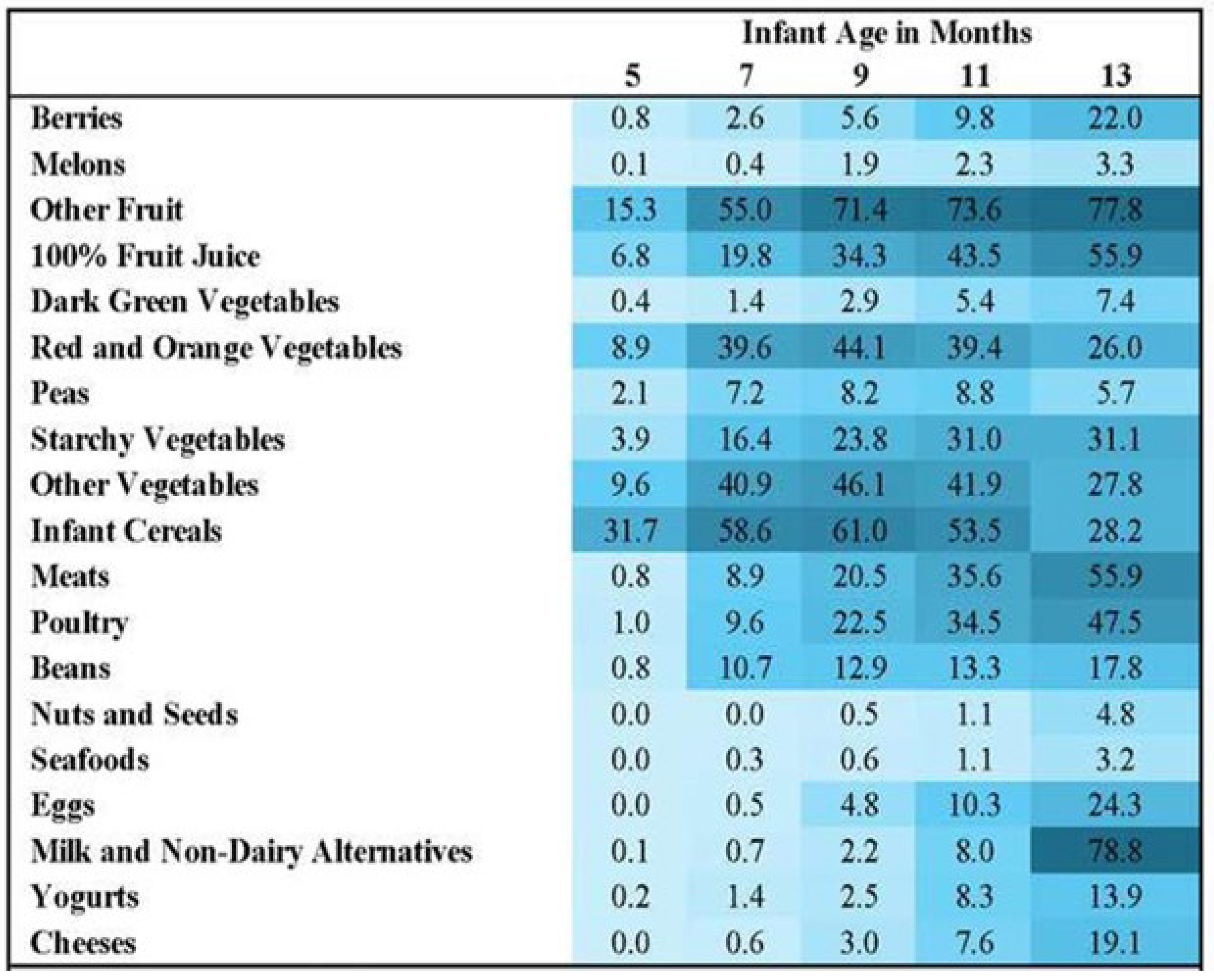
Figure 1 displays the weighted percentages of infants who consumed one or more foods from each dietary diversity subgroup between 5 and 13 months. At 5 months, 32% of infants consumed infant cereal, and 15% consumed fruits in the category of other fruits (i.e., fruits other than berries and melons); the percentage of infants consuming foods from all other subgroups was <10%. At 7, 9, and 11 months, infants’ most common foods and beverages included fruits in the category of other fruits, 100% fruit juice, red and orange vegetables, other vegetables, and infant cereals. At 13 months, most infants consumed other fruit, 100% fruit juice, meats, poultry, and milk or non-dairy alternatives.
The mean diversity of dietary exposures score, representing the number of healthy food subgroups to which infants had been exposed between 5 and 13 months, was 8.9 (SE = 0.1, observed range = 0–18).
There was a significant interaction between food security status and WIC participation at 13 months for the diversity of dietary exposures score (p = 0.03; Table 2).
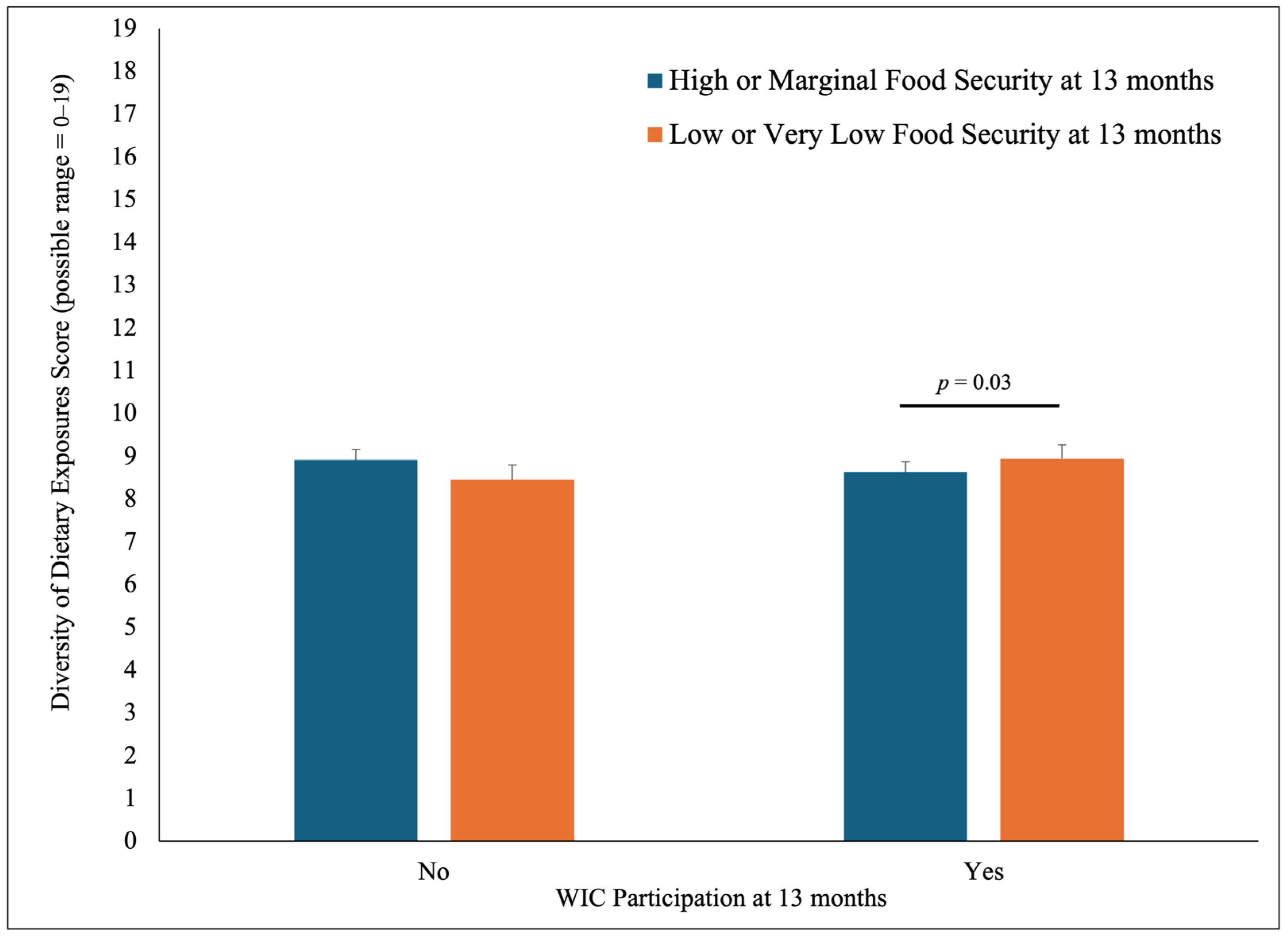
The interaction between food security status and WIC participation at 13 months is visualized in Figure 2, which presents adjusted least-squares means from the multivariable regression model shown in Table 2. Among families who were still participating in WIC at 13 months, infants in families with low or very low food security had higher diversity of dietary exposures scores (M = 8.9, SE = 0.3) compared to families with high or marginal food security (M = 8.6, SE = 0.2); the magnitude of this effect was small but significant (p = 0.03). Among families no longer participating in WIC at 13 months, the difference in diversity of dietary exposures scores for infants in families with high or marginal food security compared to those with low or very low food security did not reach significance.

3.2. Factors Associated with Diet Quality at 2 Years

The mean HEI-2015 score at 24 months was 59.2 (SE = 0.3, range = 26.8-90.2) out of a possible 100 points. Within models examining HEI-2015 scores, no significant interactions between food insecurity, WIC participation through 24 months, and diversity of dietary exposures scores were seen. Thus, the final model examined independent associations of food insecurity, WIC participation, and diversity of dietary exposures scores with HEI-2015 scores at 24 months (Table 3). WIC participation at 24 months was associated with HEI-2015 scores reflecting higher diet quality (b = 2.35, 95% CI 1.29, 3.40). In addition, greater diversity of dietary exposures between 5 and 13 months was associated with higher diet quality at 24 months (b = 0.30, 95% CI 0.15, 0.44). Food insecurity at 24 months was not significantly associated with HEI-2015 scores at 24 months.

4. Discussion

The present study examined associations between food insecurity, WIC participation, diversity of dietary exposures, and diet quality in the first two years of life. Among families still participating in WIC at 13 months, infants in families experiencing low or very low food security had significantly higher diversity of dietary exposures scores compared to families with high or marginal food security. In contrast, among families who no longer participated in WIC at 13 months, diversity of dietary exposures scores for infants in families with high or marginal food security were similar to infants in families with low or very low food security. Both higher diversity of dietary exposures between 5 and 13 months and WIC participation at 24 months were associated with higher diet quality at 24 months.
Previous research documents that families experiencing food insecurity have lower access to a diversity of foods and tend to prioritize quantity over quality when purchasing food, resulting in lower diet quality [26,39]. The present study adds to these findings by illustrating that associations between food security status and diversity of dietary exposures during infancy were modified by WIC participation, with WIC participation associated with greater diversity of dietary exposures for infants in families experiencing food insecurity. We interpret this finding with caution given the observational nature of the WIC ITFPS-2 and given the small magnitude of differences between families experiencing food security versus insecurity. However, one possible interpretation of these findings is that the higher-risk group—families experiencing food insecurity—experienced greater benefits from participating in WIC, which aligns with the Differential Susceptibility Theory [40]. According to this theory, individuals experiencing a greater number of risk factors are more susceptible to adverse outcomes due to these risk factors but are also more responsive to the beneficial effects of supportive interventions [40]. Hence, families in greater need may experience more benefits from assistance programs such as WIC.
It is also possible that associations between WIC participation, diversity of dietary exposures by 13 months, and diet quality at 24 months illustrate that WIC may have supported families in recognizing the importance of repeatedly exposing infants to a wide variety of healthy foods while supporting their ability to do so through nutrition assistance. Families with a higher diet quality may be more likely to participate in programs that support healthful eating, such as WIC. However, previous research also supports the benefits of WIC for shaping early dietary patterns. Indeed, Au and colleagues illustrated that the majority of foods consumed by toddlers between the ages of 13 and 24 months were WIC-eligible foods, with WIC-eligible foods providing over 40% of calories and close to 50% of macronutrients and micronutrients in their diet [41]. Similarly, other studies have illustrated that longer durations of WIC participation are associated with higher diet quality in early childhood [28,29,30]. Taken together, these findings suggest that WIC-eligible foods and participation in the WIC program positively impact children’s dietary patterns.
Our finding that food insecurity was not significantly associated with diet quality at 24 months is inconsistent with some previous studies reporting that food insecurity is associated with a lower diet quality for children [16,17,18]. Most available studies examining associations between food insecurity and diet quality in children focus on older children; thus, associations between food insecurity and child diet quality may differ for infants. During infancy, parents may prioritize providing high-quality foods for their young children, even when experiencing financial hardship, to protect their infants from the effects of food scarcity [42]. In contrast, as children grow older and household resources become more strained, maintaining diet quality may become increasingly challenging, which could explain why studies with older children tend to find stronger associations between food insecurity and poorer diet quality. In addition, it is possible that other risk factors not considered in the present study, such as parenting stress [43], mediate associations between economic hardship and diet quality. Future research should consider these factors when examining associations between food insecurity and diet quality during infancy.
We noted that the diversity of dietary exposures between 5 and 13 months was independently and significantly associated with diet quality at 24 months. Greater exposure to a variety of flavors and textures during infancy supports the development of taste preferences and children’s receptiveness to try novel foods [44,45], which may promote a higher diet quality later in childhood [46]. While some previous studies have found associations between dietary diversity and diet quality in toddlers and children [15,46], few studies have explored associations between diversity of dietary exposures and diet quality in the first two years of life among families enrolled in WIC. Within the present study, it was notable that exposure to certain food subgroups was low, with very few children (<10%) experiencing foods such as melons, dark green vegetables, peas, nuts and seeds, or seafood between 5 and 13 months. In addition, the average diversity of dietary exposures score was 9 out of 19, suggesting that many infants were not exposed to the full breadth of healthy foods available to shape their preferences and dietary patterns. Finally, consistent with previous studies, average HEI-2015 scores were relatively low at 24 months (59 out of 100) and were slightly lower than the national average of 62 reported for children aged 2–4 years in the 2017–2018 What We Eat in America, National Health and Nutrition Examination dataset [47], suggesting that the diet quality of children in this WIC-enrolled sample was generally comparable to, but somewhat below, that of the broader U.S. population of similar age. These findings also confirm that there is still much room for improvement regarding the diversity of dietary exposures infants experience and the quality of the diets they consume within the first 2 years [28,48,49]. Findings from the present study and others suggest that families may need more support to offer and encourage their infants’ preferences for and habitual intake of nutrient-dense foods, such as dark green vegetables [28,41,48,49]. Additional research investigating drivers of the diversity of dietary exposures in the first year and mechanisms underlying associations between diversity of exposures and later diet quality is needed to better understand the best ways to support low-income families navigating the transition to complementary foods and beverages with their infants.
A limitation of the present study is that all data were self-reported by caregivers, which increases the risk of bias and misreporting. Our measure of diversity of dietary exposures, while grounded in dietary guidelines and informed by prior measures of dietary diversity [3,10,37,38], has not been formally validated. In addition, the food exposures used to determine diversity of dietary exposures were assessed between infant ages 5 and 13 months, which did not cover a full year of exposures; thus, it is possible that seasonality in the availability of certain food groups may have affected some infants’ exposures and biased their diversity of dietary exposures score. Therefore, findings related to dietary diversity results should be interpreted with caution and considered preliminary until replicated using validated measures. A strength of this assessment tool is that it was specifically designed to address our research questions, and it capitalized on the strengths of the longitudinal WIC ITFPS-2 dataset. The measure was relatively simple, especially compared to more complex measures of dietary diversity that also consider within-group diversity and portion sizes [50]. In addition, our approach adds value by distinguishing specific fruits and vegetables with unique flavors, characteristics, and contributions to diet quality. For example, berries are considered a strong-tasting fruit and are a good source of antioxidants, while peas are a strong-tasting vegetable and a good source of starch [51]. This is particularly relevant in early childhood, when repeated exposures and variety can improve acceptance of such foods [51,52]. Thus, our measure provides a practical yet nuanced way to assess dietary diversity in young children that is centered on assessing intakes of a variety of fruits and vegetables, which is a key component of diet quality and a key concern during formative phases of food exploration and preference development.
Further research is needed to investigate best practices for assessing diversity of dietary exposures during infancy to elucidate whether and how diversity of dietary exposures during the first two years of life affects diet quality throughout childhood and adolescence. Future research studies can also address how food insecurity and WIC participation shape what and how families feed their young children and how these experiences may influence infants’ diversity of dietary exposures and diet quality. The present study highlighted deficits in young children’s early dietary exposures, suggesting that parents need additional education and support to ensure their infants are repeatedly exposed to a wide variety of healthy foods to create an important foundation for later diet quality. Within WIC practice, targeted enhancements to WIC educational materials and resources may further increase intakes of less commonly consumed food groups (e.g., dark green vegetables), diversity of dietary exposures, and diet quality for infants and toddlers. In addition, further work is needed to understand the specific WIC components (e.g., nutrition education, the composition of food packages) that most effectively support dietary diversity and preserve diet quality in food-insecure households. In addition, although this study did not assess whether WIC participation directly reduces household food insecurity, future research should examine how WIC’s educational and food benefit components jointly influence both dietary quality and food security among participating families. Given that early life diet quality predicts diet quality during later childhood and adolescence, and WIC participation is associated with better overall diet quality during early childhood, future studies should also continue to examine how to reduce barriers to WIC enrollment and participation.

Author Contributions

Conceptualization, V.M.D. and A.K.V.; Methodology, V.M.D., A.S.K., S.P. and A.K.V.; Writing—original draft, V.M.D. and A.K.V.; Writing—review and editing, V.M.D., A.S.K., S.P. and A.K.V. All authors have read and agreed to the published version of the manuscript.

Funding

This research received no external funding.

Institutional Review Board Statement

Ethical review and approval were waived for this study due to the present study being a secondary analysis of publicly available deidentified data.

Informed Consent Statement

Informed consent was obtained from all subjects involved in the primary study WIC ITFPS-2.

Data Availability Statement

No new data were created or analyzed in this study.

Conflicts of Interest

The authors declare no conflicts of interest.

Abbreviations

The following abbreviations are used in this manuscript:
WICSpecial Supplemental Nutrition Assistance Program for Women, Infants and Children
WIC ITFPS-2WIC Infant and Toddler Feeding Practices Study-2
HEIHealthy Eating Index
SNAPSupplemental Nutrition Assistance Program
CFBComplementary Foods and Beverages

References

  1. Birch, L.L.; Doub, A.E. Learning to eat: Birth to age 2 y. Am. J. Clin. Nutr. 2014, 99, 723S–728S. [Google Scholar] [CrossRef]
  2. Movassagh, E.; Baxter-Jones, A.; Kontulainen, S.; Whiting, S.; Vatanparast, H. Tracking Dietary Patterns over 20 Years from Childhood through Adolescence into Young Adulthood: The Saskatchewan Pediatric Bone Mineral Accrual Study. Nutrients 2017, 9, 990. [Google Scholar] [CrossRef] [PubMed]
  3. United States Department of Agriculture. Dietary Guidelines for Americans: 2020–2025. 2020. Available online: https://www.dietaryguidelines.gov/sites/default/files/2021-03/Dietary_Guidelines_for_Americans-2020-2025.pdf (accessed on 1 September 2025).
  4. Lerman, J.L.; Herrick, K.A.; Pannucci, T.E.; Shams-White, M.M.; Kahle, L.L.; Zimmer, M.; Mathieu, K.M.; Stoody, E.E.; Reedy, J. Evaluation of the Healthy Eating Index-Toddlers-2020. J. Acad. Nutr. Diet. 2023, 123, 1307–1319. [Google Scholar] [CrossRef]
  5. O’Neil, A.; Quirk, S.E.; Housden, S.; Brennan, S.L.; Williams, L.J.; Pasco, J.A.; Berk, M.; Jacka, F.N. Relationship between diet and mental health in children and adolescents: A systematic review. Am. J. Public Health 2014, 104, e31–e42. [Google Scholar] [CrossRef] [PubMed]
  6. Naveed, S.; Sallinen, T.; Eloranta, A.M.; Skog, H.; Jalkanen, H.; Brage, S.; Ekelund, U.; Pentikäinen, H.; Savonen, K.; Lakka, T.A.; et al. Effects of 2-year dietary and physical activity intervention on cognition in children—A nonrandomized controlled trial. Scand. J. Med. Sci. Sports 2023, 33, 2340–2350. [Google Scholar] [CrossRef]
  7. Lukomskyj, N.; Allman-Farinelli, M.; Shi, Y.; Rangan, A. Dietary exposures in childhood and adulthood and cardiometabolic outcomes: A systematic scoping review. J. Hum. Nutr. Diet. 2021, 34, 511–523. [Google Scholar] [CrossRef]
  8. Siddiqui, N.Z.; Nguyen, A.N.; Santos, S.; Voortman, T. Diet quality and cardiometabolic health in childhood: The Generation R Study. Eur. J. Nutr. 2022, 61, 729–736. [Google Scholar] [CrossRef]
  9. Nguyen, A.N.; Jen, V.; Jaddoe, V.W.V.; Rivadeneira, F.; Jansen, P.W.; Ikram, M.A.; Voortman, T. Diet quality in early and mid-childhood in relation to trajectories of growth and body composition. Clin. Nutr. 2020, 39, 845–852. [Google Scholar] [CrossRef]
  10. Venter, C.; Greenhawt, M.; Meyer, R.W.; Agostoni, C.; Reese, I.; du Toit, G.; Feeney, M.; Maslin, K.; Nwaru, B.I.; Roduit, C.; et al. EAACI position paper on diet diversity in pregnancy, infancy and childhood: Novel concepts and implications for studies in allergy and asthma. Allergy 2020, 75, 497–523. [Google Scholar] [CrossRef] [PubMed]
  11. United States Department of Agriculture. Dietary Guidelines for Americans: 2015–2020. 2015. Available online: https://health.gov/sites/default/files/2019-09/2015-2020_Dietary_Guidelines.pdf (accessed on 1 September 2025).
  12. Molani-Gol, R.; Kheirouri, S.; Alizadeh, M. Does the high dietary diversity score predict dietary micronutrients adequacy in children under 5 years old? A systematic review. J. Health Popul. Nutr. 2023, 42, 2. [Google Scholar] [CrossRef]
  13. Anzman-Frasca, S.; Ventura, A.K.; Ehrenberg, S.; Myers, K.P. Promoting healthy food preferences from the start: A narrative review of food preference learning from the prenatal period through early childhood. Obes. Rev. 2018, 19, 576–604. [Google Scholar] [CrossRef]
  14. Barends, C.; Weenen, H.; Warren, J.; Hetherington, M.M.; de Graaf, C.; de Vries, J.H.M. A systematic review of practices to promote vegetable acceptance in the first three years of life. Appetite 2019, 137, 174–197. [Google Scholar] [CrossRef]
  15. Dello Russo, M.; Formisano, A.; Lauria, F.; Ahrens, W.; Bogl, L.H.; Eiben, G.; De Henauw, S.; Hebestreit, A.; Intemann, T.; Hunsberger, M.; et al. Dietary Diversity and Its Association with Diet Quality and Health Status of European Children, Adolescents, and Adults: Results from the I.Family Study. Foods 2023, 12, 4458. [Google Scholar] [CrossRef]
  16. Dubois, L.; Bédard, B.; Goulet, D.; Prud’Homme, D.; Tremblay, R.E.; Boivin, M. Experiencing food insecurity in childhood: Influences on eating habits and body weight in young adulthood. Public Health Nutr. 2023, 26, 2396–2406. [Google Scholar] [CrossRef]
  17. McCarthy, M.; Vitolins, M.Z.; Skelton, J.A.; Ip, E.H.; Brown, C.L. A Pilot Study Examining the Association of Parental Stress and Household Food Insecurity with Dietary Quality in Pre-School-Aged Children. Nutrients 2023, 15, 3154. [Google Scholar] [CrossRef]
  18. Ortiz-Marrón, H.; Ortiz-Pinto, M.A.; Urtasun Lanza, M.; Pujadas, G.C.; Del Pino, V.V.; Cortés, S.B.; Gascón, T.G.; Gavín, M.O. Household food insecurity and its association with overweight and obesity in children aged 2 to 14 years. BMC Public Health 2022, 22, 1930. [Google Scholar] [CrossRef]
  19. Poulsen, M.N.; Bailey-Davis, L.; Pollak, J.; Hirsch, A.G.; Schwartz, B.S. Household Food Insecurity and Home Food Availability in Relation to Youth Diet, Body Mass Index, and Adiposity. J. Acad. Nutr. Diet. 2019, 119, 1666–1675. [Google Scholar] [CrossRef] [PubMed]
  20. Fernández, C.R.; Chen, L.; Cheng, E.R.; Charles, N.; Meyer, D.; Monk, C.; Baidal, J.W. Food Insecurity and Sugar-Sweetened Beverage Consumption Among WIC-Enrolled Families in the First 1,000 Days. J. Nutr. Educ. Behav. 2020, 52, 796–800. [Google Scholar] [CrossRef] [PubMed]
  21. Gregory, C.A.; Mancino, L.; Coleman-Jensen, A. Food Security and Food Purchase Quality Among Low-Income Households: Findings from the National Household Food Acquisition and Purchase Survey (FoodAPS); ERR-269; United States Department of Agriculture, Economic Research Service: Washington, DC, USA, 2019.
  22. Lee, J.; Kubik, M.Y.; Fulkerson, J.A. Diet Quality and Fruit, Vegetable, and Sugar-Sweetened Beverage Consumption by Household Food Insecurity among 8- to 12-Year-Old Children during Summer Months. J. Acad. Nutr. Diet. 2019, 119, 1695–1702. [Google Scholar] [CrossRef]
  23. Eicher-Miller, H.A.; Zhao, Y. Evidence for the age-specific relationship of food insecurity and key dietary outcomes among US children and adolescents. Nutr. Res. Rev. 2018, 31, 98–113. [Google Scholar] [CrossRef] [PubMed]
  24. Choudhury, S.; Headey, D.D.; Masters, W.A. First foods: Diet quality among infants aged 6–23 months in 42 countries. Food Policy 2019, 88, 101762. [Google Scholar] [CrossRef]
  25. Gross, R.S.; Mendelsohn, A.L.; Messito, M.J. Additive effects of household food insecurity during pregnancy and infancy on maternal infant feeding styles and practices. Appetite 2018, 130, 20–28. [Google Scholar] [CrossRef]
  26. Arlinghaus, K.R.; Laska, M.N. Parent Feeding Practices in the Context of Food Insecurity. Int. J. Environ. Res. Public Health 2021, 18, 366. [Google Scholar] [CrossRef] [PubMed]
  27. US Department of Agriculture Economic Research Service. WIC Program. Available online: https://www.ers.usda.gov/topics/food-nutrition-assistance/wic-program.aspx (accessed on 19 March 2021).
  28. Weinfield, N.S.; Borger, C.; Au, L.E.; Whaley, S.E.; Berman, D.; Ritchie, L.D. Longer Participation in WIC Is Associated with Better Diet Quality in 24-Month-Old Children. J. Acad. Nutr. Diet. 2020, 120, 963–971. [Google Scholar] [CrossRef]
  29. Borger, C.; Paolicelli, C.P.; Sun, B. Duration of Special Supplemental Nutrition Program for Women, Infants, and Children (WIC) Participation is Associated with Children’s Diet Quality at Age 3 Years. Am. J. Prev. Med. 2022, 62, e343–e350. [Google Scholar] [CrossRef] [PubMed]
  30. Anderson, C.E.; Martinez, C.E.; Ritchie, L.D.; Paolicelli, C.; Reat, A.; Borger, C.; E Whaley, S. Longer Special Supplemental Nutrition Program for Women, Infants, and Children (WIC) Participation Duration Is Associated with Higher Diet Quality at Age 5 Years. J. Nutr. 2022, 152, 1974–1982. [Google Scholar] [CrossRef] [PubMed]
  31. Harrison, G.G.; Hirschman, J.D.; Owens, T.A.; McNutt, S.W.; Sallack, L.E. WIC Infant and Toddler Feeding Practices Study: Protocol design and implementation. Am. J. Clin. Nutr. 2014, 99, 742S–746S. [Google Scholar] [CrossRef]
  32. Borger, C.; Weinfield, N.S.; Zimmerman, T.; MacAllum, C.; DeMatteis, J.; Whaley, S.; Ritchie, L.; Sallack, L.; Au, L.; Jenkins, F.; et al. WIC Infant and Toddler Feeding Practices Study-2: Second Year Report. 2018. Available online: https://www.fns.usda.gov/data-research?keywords=itfps&sort_bef_combine=created_1_DESC (accessed on 1 September 2025).
  33. Arteaga, I.; Wilde, P.E. Measuring Food Security in the United States for More Than 25 years: History, Methods, Findings, and Opportunities. J. Acad. Nutr. Diet. 2023, 123, S5–S19. [Google Scholar] [CrossRef]
  34. Economic Research Service, United States Department of Agriculture. Food Security in the US: Measurement. Available online: https://www.ers.usda.gov/topics/food-nutrition-assistance/food-security-in-the-u-s/measurement/ (accessed on 31 October 2024).
  35. Guenther, P.M.; Kirkpatrick, S.I.; Reedy, J.; Krebs-Smith, S.M.; Buckman, D.W.; Dodd, K.W.; Casavale, K.O.; Carroll, R.J. The Healthy Eating Index-2010 is a valid and reliable measure of diet quality according to the 2010 Dietary Guidelines for Americans. J. Nutr. 2014, 144, 399–407. [Google Scholar] [CrossRef]
  36. National Cancer Institute. Developing the Healthy Eating Index. Available online: https://epi.grants.cancer.gov/hei/developing.html (accessed on 11 September 2024).
  37. Perez-Escamilla, R.; Segura-Perez, S.; Lott, M. On behalf of the RWJF HER Expert Panel on Best Practices for Promoting Healthy Nutrition FP, and Weight Status for Infants and Toddlers from Birth to 24 Months. Feeding Guidelines for Infants and Young Toddlers: A Responsive Parenting Approach; Healthy Eating Research: Durham, NC, USA, 2017. [Google Scholar]
  38. United States Department of Agriculture. Choose MyPlate. Available online: http://www.choosemyplate.gov/ (accessed on 10 March 2015).
  39. Baxter, K.A.; Nambiar, S.; So, T.H.J.; Gallegos, D.; Byrne, R. Parental Feeding Practices in Families Experiencing Food Insecurity: A Scoping Review. Int. J. Environ. Res. Public Health 2022, 19, 5604. [Google Scholar] [CrossRef]
  40. Belsky, J.; Bakermans-Kranenburg, M.J.; van Ijzendoorn, M.H. For Better and For Worse: Differential Susceptibility to Environmental Influences. Curr. Dir. Psychol. Sci. 2007, 16, 300–304. [Google Scholar] [CrossRef]
  41. Au, L.E.; Paolicelli, C.; Gurzo, K.; Ritchie, L.D.; Weinfield, N.S.; Plank, K.R.; Whaley, S.E. Contribution of WIC-Eligible Foods to the Overall Diet of 13- and 24-Month-Old Toddlers in the WIC Infant and Toddler Feeding Practices Study-2. J. Acad. Nutr. Diet. 2019, 119, 435–448. [Google Scholar] [CrossRef]
  42. McIntyre, L.; Glanville, N.T.; Raine, K.D.; Dayle, J.B.; Anderson, B.; Battaglia, N. Do low-income lone mothers compromise their nutrition to feed their children? CMAJ 2003, 168, 686–691. [Google Scholar]
  43. Schuler, B.R.; Daundasekara, S.S.; Hernandez, D.C.; Dumenci, L.; Clark, M.; O Fisher, J.; Miller, A.L. Economic hardship and child intake of foods high in saturated fats and added sugars: The mediating role of parenting stress among high-risk families. Public Health Nutr. 2020, 23, 2781–2792. [Google Scholar] [CrossRef] [PubMed]
  44. Ventura, A.K.; Phelan, S.; Silva Garcia, K. Maternal Diet During Pregnancy and Lactation and Child Food Preferences, Dietary Patterns, and Weight Outcomes: A Review of Recent Research. Curr. Nutr. Rep. 2021, 10, 413–426. [Google Scholar] [CrossRef] [PubMed]
  45. Forestell, C.A. Flavor Perception and Preference Development in Human Infants. Ann. Nutr. Metab. 2017, 70, 17–25. [Google Scholar] [CrossRef]
  46. Switkowski, K.M.; Aris, I.M.; Gingras, V.; Oken, E.; Young, J.G. Estimated causal effects of complementary feeding behaviors on early childhood diet quality in a US cohort. Am. J. Clin. Nutr. 2022, 115, 1105–1114. [Google Scholar] [CrossRef]
  47. US Department of Agriculture, Food and Nutrition Service, Center for Nutrition Policy and Promotion. Average Healthy Eating Index-2015 Scores for Children and Adolescents by Age Groups. What We Eat In America; NHANES 2017–2018; USDA Food and Nutrition Service: Washington, DC, USA, 2021.
  48. Au, L.E.; Arnold, C.D.; Ritchie, L.D.; Frongillo, E.A. The Infant Diet Quality Index Predicts Dietary and Adiposity Outcomes in US Children 2 to 4 years old. J. Nutr. 2023, 153, 741–748. [Google Scholar] [CrossRef]
  49. Au, L.E.; Gurzo, K.; Paolicelli, C.; Whaley, S.E.; Weinfield, N.S.; Ritchie, L.D. Diet Quality of US Infants and Toddlers 7-24 Months Old in the WIC Infant and Toddler Feeding Practices Study-2. J. Nutr. 2018, 148, 1786–1793. [Google Scholar] [CrossRef]
  50. Kant, A.K.; Schatzkin, A.; Harris, T.B.; Ziegler, R.G.; Block, G. Dietary diversity and subsequent mortality in the First National Health and Nutrition Examination Survey Epidemiologic Follow-up Study. Am. J. Clin. Nutr. 1993, 57, 434–440. [Google Scholar] [CrossRef]
  51. Kähkönen, K.; Sandell, M.; Rönkä, A.; Hujo, M.; Nuutinen, O. Children’s Fruit and Vegetable Preferences Are Associated with Their Mothers’ and Fathers’ Preferences. Foods 2021, 10, 261. [Google Scholar] [CrossRef] [PubMed]
  52. Mennella, J.A.; Reiter, A.R.; Daniels, L.M. Vegetable and Fruit Acceptance during Infancy: Impact of Ontogeny, Genetics, and Early Experiences. Adv. Nutr. 2016, 7, 211S–219S. [Google Scholar] [CrossRef]
Figure 1. Percentage of infants who consumed one or more foods from each dietary subgroup between 5 and 13 months of age (unweighted n = 1246, weighted n = 409,431). Darker shading indicates higher percentages of infants consuming foods within that subgroup at each age. Values are weighted percentages.
Dietetics 05 00005 g001
Figure 2. Adjusted Least-Squares Means for Diversity of Dietary Exposures by Food Security Status and WIC Participation (unweighted n = 1246; weighted n = 409,431). Note: Values derived from the multivariable regression model controlling for infant sex, birth weight category, caregiver age at childbirth, race/ethnicity, marital status, parity, education level, nativity status, BMI category at screening, number of children in the household, poverty level, participation in other assistance programs, breastfeeding duration, and timing of complementary food and beverage introduction.
Dietetics 05 00005 g002
Table 1. Infant, Caregiver, and Family Characteristics for Participants in the WIC Infant and Toddler Feeding Practices Study-2 (unweighted n = 1246, weighted n = 409,431).
Unweighted nWeighted nWeighted Percent
Infant Characteristics
Sex
Female605202,22849.4
Male641207,20350.6
Birth weight category
Low (<2.5 kg)9131,6857.7
Normal (2.5 to ≤4.5 kg)1139373,20491.2
High (>4.5 kg)1645431.1
Caregiver and Family Characteristics
Age at childbirth
16–19 years old11141,88710.2
20–25 years old469164,31840.1
26 years or older666203,22749.6
Race/Ethnicity
Non-Hispanic White406124,35030.4
Non-Hispanic Black29781,30919.9
Non-Hispanic Other6222125.6
Hispanic481180,86044.2
Marital status
Married433147,43336.0
Not Married813261,99863.9
Primiparous
Yes505174,84542.7
No741234,58657.3
Highest education level
High school or less738252,18461.6
More than high school508157,24738.4
Nativity status
Born in the U.S.907288,33170.4
Not born in the U.S.339121,10029.6
BMI category at screening
Normal or underweight534182,66244.6
Overweight319107,37026.6
Obese393119,39929.2
Number of children in household
One382127,27770.4
More than one864282,15429.6
Poverty level
75% of poverty guidelines or below764251,53861.4
>75% and <130% of poverty guidelines359116,01628.3
>130% of poverty guidelines12341,87710.2
Participation in non-WIC programs
No participation20471,73417.5
SNAP or SNAP and others600194,89047.6
Other programs (not SNAP)442142,80734.9
Infant Feeding
Breastfeeding duration
Never20767,56716.5
Less than 6 months661215,89752.7
More than 6 months378125,96730.8
Timing of CFB introduction
Before 4 months of age (Early)357107,44326.2
At or after 4 months of age (On-Time)889301,99973.8
CFB, Complementary Foods and Beverages; SNAP, Supplemental Nutrition Assistance Program; WIC, Special Supplemental Nutrition Assistance Program for Women, Infants, and Children. Note: Unweighted n represents the actual number of study participants included in the analyses. Weighted estimates were derived using survey weights provided with the WIC ITFPS-2 dataset to account for the complex survey design, unequal sampling probabilities, and nonresponse, thereby allowing the results to represent the population of WIC-enrolled caregiver–child dyads [32].
Table 2. Factors Associated with Diversity of Dietary Exposures between 5 and 13 Months (unweighted n = 1246, weighted n = 409,431).
Estimate95% Confidence Intervalp-Value
Intercept8.727.71, 9.73<0.001
Food Security Status at 13 months
High or Marginal0.45−0.19, 1.100.17
Low or Very LowREF
WIC Participation at 13 months
Yes0.47−0.08, 1.040.09
NoREF
WIC Participation × Food Security−0.76−1.45, −0.070.03
Covariates
Infant Characteristics
Sex
Female−0.05−0.29, 0.200.7
MaleREF
Birth weight category
Low (<2.5 kg)REF
Normal (2.5 to ≤4.5 kg)0.500.15, 0.85<0.01
High (>4.5 kg)−0.37−1.54, 0.790.52
Caregiver and Family Characteristics
Age at childbirth
16–19 years oldREF
20–25 years old−0.33−0.72, 0.050.09
26 years or older−0.28−0.77, 0.210.25
Race/Ethnicity
Non-Hispanic White0.550.20, 0.89<0.01
Non-Hispanic Black0.02−0.37, 0.410.92
Non-Hispanic Other0.570.05, 1.080.03
HispanicREF
Marital status
Married0.12−0.14, 0.380.36
Not MarriedREF
Primiparous
YesREF
No−0.21−0.60, 0.190.29
Highest education level
High school or less REF
More than high school0.370.15, 0.59<0.01
Nativity
Born in the U.S.REF
Not born in the U.S.−0.45−0.82, −0.070.02
BMI category at enrollment
Normal or underweight−0.35−0.67, −0.030.03
Overweight−0.07−0.42, 0.270.67
ObeseREF
Number of children in household
One−0.07−0.33, 0.180.56
More than oneREF
Poverty level
75% of poverty guidelines or below−0.25−0.72, 0.210.28
>75% and <130% of poverty guidelines−0.25−0.69, 0.200.26
>130% of poverty guidelinesREF
Participation in non-WIC programs
SNAP or SNAP and others−0.20−0.54, 0.150.26
Other programs (not SNAP)−0.16−0.47, 0.150.30
No participationREF
Infant Feeding
Breastfeeding duration
NeverREF
Less than 6 months0.31−0.05, 0.680.09
More than 6 months0.610.19, 1.03<0.01
Timing of CFB introduction
Before 4 months of age (Early)REF
At or after 4 months of age (On-Time)−0.24−0.47, −0.010.04
CFB, Complementary Foods and Beverages; SNAP, Supplemental Nutrition Assistance Program; WIC, Special Supplemental Nutrition Assistance Program for Women, Infants, and Children. R-squared = 0.06.
Table 3. Factors Associated with Diet Quality at 24 Months (unweighted n = 1246, weighted n = 409,431).
Estimate95% Confidence Intervalp-Value
Intercept56.853.27, 60.32<0.001
Food Security Status at 24 months
High or marginal0.23−0.94, 1.400.69
Low or very lowREF
WIC Participation at 24 months
Yes2.351.29, 3.40<0.001
NoREF
Diversity of Dietary Exposures between 5 and 13 Months0.300.15, 0.44<0.001
Covariates
Infant Characteristics
Sex
Female−0.20−1.25, 0.840.70
MaleREF
Birth weight category
Low (<2.5 kg)REF
Normal (2.5 to ≤4.5 kg)−2.41−4.81, 0.010.05
High (>4.5 kg)−0.82−5.06, 3.420.69
Caregiver and Family Characteristics
Age at childbirth
16–19 years oldREF
20–25 years old−1.17−3.09, 0.740.22
26 years or older0.02−1.78, 1.830.98
Race/Ethnicity
Non-Hispanic White−2.34−3.23, −1.45<0.001
Non-Hispanic Black−0.76−1.94, 0.420.29
Non-Hispanic Other−2.77−4.66, −0.89<0.01
HispanicREF
Marital status
Married−0.72−1.74, 0.310.17
Not MarriedREF
Primiparous
YesREF
No0.22−1.11, 1.550.74
Highest education level
High school or lessREF
More than high school2.141.06, 3.21<0.001
Nativity status
Born in the U.S.REF
Not born in the U.S.2.200.87, 3.53<0.01
BMI category at screening
Normal or underweight−0.33−1.32, 0.660.50
Overweight−0.33−1.54, 0.880.59
ObeseREF
Number of children in household
One0.62−0.53, 1.760.28
More than oneREF
Poverty level
75% of poverty guidelines or below0.63−0.87, 2.140.40
>75% and <130% of poverty guidelines−0.04−1.88, 1.790.96
>130% of poverty guidelinesREF
Participation in non-WIC programs
SNAP or SNAP and others−1.01−2.56, 0.540.20
Other programs (not SNAP) −0.40−1.92, 1.130.60
No participationREF
Infant Feeding
Breastfeeding duration
NeverREF
Less than 6 months−0.82−2.12, 0.500.22
More than 6 months−0.59−2.05, 0.870.42
Timing of CFB introduction
Before 4 months of age (Early)REF
At or after 4 months of age (On-Time)1.470.63, 2.310.001
CFB, Complementary Foods and Beverages; SNAP, Supplemental Nutrition Assistance Program; WIC, Special Supplemental Nutrition Assistance Program for Women, Infants, and Children. R-squared = 0.08.
Disclaimer/Publisher’s Note: The statements, opinions and data contained in all publications are solely those of the individual author(s) and contributor(s) and not of MDPI and/or the editor(s). MDPI and/or the editor(s) disclaim responsibility for any injury to people or property resulting from any ideas, methods, instructions or products referred to in the content.