


Abstract
We investigate finite-size effects on the density-driven deconfinement phase transition in Quantum Chromodynamics (QCD) using a phase coexistence model of hadronic and quark–gluon plasma (QGP) phases in a finite size. The QGP is described via the MIT bag model, incorporating the color-singletness constraint to enforce exact color neutrality. In this study, we analyze the first- and second-order derivatives of the order parameter, defined as the mean hadronic volume fraction , with respect to the quark chemical potential at fixed temperature and for several system volumes , to identify the effective transition point. Our results show that the effective quark chemical potential increases as the volume decreases, and the transition becomes progressively smoother, with a width that broadens with decreasing volume.
1. Introduction
The phase transition from confined hadronic matter to a deconfined quark–gluon plasma (QGP) is a fundamental prediction of Quantum Chromodynamics (QCD) [1]. Such a transition is expected to occur under extreme conditions of high temperature and/or large quark chemical potential. While thermally driven deconfinement phase transitions (DPT) have been extensively investigated [2,3,4], density-driven transitions in finite systems remain less explored [5], despite their relevance to heavy-ion collision experiments, where the produced matter is finite in size and short-lived.
In this context, the phase coexistence model (PCM) [6] provides an effective framework for describing the mixed system of hadronic gas (HG) and QGP phases. The QGP sector is modeled using a modified MIT bag model that explicitly incorporates the color-singletness constraint [6,7], ensuring global color neutrality and yielding a more realistic description of the confinement–deconfinement transition in finite volumes.
As a continuation of our previous work [5], in the present study, we will analyze the first and second chemical derivatives of the order parameter across a range of quark chemical potentials (μ), at fixed temperature (T) and for several volume (V) selections, to determine the effective transition point in a finite volume. Extending earlier studies [3,4], we systematically examine finite-volume effects on the density-driven DPT within the framework of the PCM, and quantify the volume dependence of the transition point as well as its width. The obtained results provide a comprehensive understanding of how finite-volume constraints influence the QCD phase structure, offering important insights for interpreting results from heavy-ion collisions and other high-energy experiments where the system size is inherently limited.
2. The Mixed QGP–Hadronic Gas Equation of State at Non-Vanishing Quark Chemical Potential
We consider a mixed finite system of volume containing an HG phase in a fractional volume and a QGP phase in a fractional volume . Assuming noninteracting phases (separability of the energy spectra of the two phases) and using the PCM, the mean value of a physical quantity of the mixed system can be written as [6]:
where is the total thermodynamic quantity in the state
, given in the case of an extensive quantity by
and in the case of an intensive quantity by
where and are the contributions of the individual HG and QGP phases, respectively, and is the total partition function of the system in the state , whose detailed derivation is provided in Ref. [5], and reads
where is the weight function (Haar measure) for the
group integration:
and the function is defined by
where , with the two functions and , respectively, given by
where ( is the number of quark flavors) and are the degeneracy factors of quarks and gluons, respectively. The angles are given by
and is expressed as
The main quantities of interest in this study are the order parameter and its first and second derivatives with respect to chemical potential. The order parameter in this case is the mean value of the HG volume fraction in the PCM, which may be written as [6]:
The first-order chemical susceptibility is defined as the first derivative of the order parameter with respect to the quark chemical potential:
and the second-order derivative is given by
In the following section, we discuss the finite-size effects on the density-driven DPT at fixed temperature, under the color-singletness condition, by examining the behavior of the order parameter and its chemical susceptibilities as functions of the quark chemical potential for several system volumes.
3. Finite-Size Effects on the Density-Driven Phase Transition: Response Functions
In this section, we investigate the finite-size effects on the location of the transition point at finite volume by analyzing the behavior of some characteristic response functions, namely, the order parameter and its first- and second-order derivatives with respect to chemical potential, called chemical susceptibilities, over a range of quark chemical potentials around the transition point, at fixed temperature and for several finite volumes. The calculations are performed for volumes of 300, 500, 700, 900 and , which lie within the range of effective system sizes realized at the relativistic heavy-ion collider (RHIC), estimated to be approximately 268–2144 [8], where the QGP formation is expected in ultra-relativistic heavy-ion collisions. Throughout this work, the bag constant is fixed at , a value that lies within the typical range of . This choice reproduces the transition temperature at for an infinite volume, denoted as , which agrees with the value given by lattice QCD for two quark flavors. As an example, gives (see ref [7] and references therein). The transition parameters are conveniently obtained from the mechanical equilibrium condition following the Gibbs criterion. Also, the present study is carried out with varying chemical potential and at two specific temperatures, and , which are chosen so as to fall within the range of intermediate temperatures, since the transition parameters exhibit no significant dependence on the pion mass in this intermediate range (see [6]).
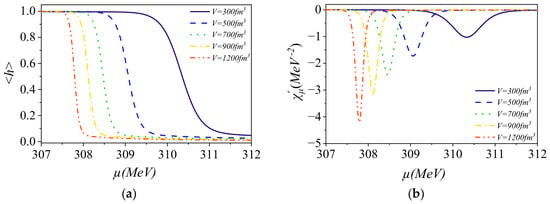
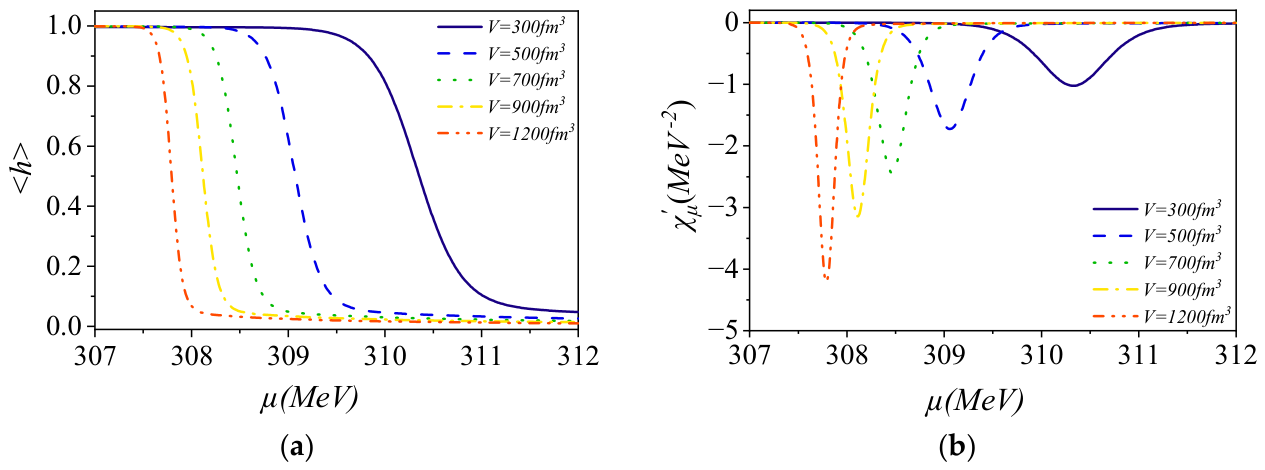
Figure 1 shows the behavior of (a) the order parameter and (b) the first-order chemical susceptibility as functions of the quark chemical potential , at , for several volume selections. One can see that the order parameter shows a pronounced decrease from values close to unity to nearly zero as increases, which clearly signals the transition from the hadronic phase to the deconfined QGP phase. Strong finite-size effects can clearly be observed: for small volumes, the transition is smoothed and broadened over a wider interval, while for larger volumes, the drop becomes significantly steeper, approaching a step-like behavior characteristic of a first-order transition in the thermodynamic limit. This interpretation is reinforced by the behavior of the first-order chemical susceptibility, which develops increasingly deep and localized negative peaks in the vicinity of the transition point as the volume increases. The sharpening and amplification of these extrema indicate enhanced critical fluctuations and a progressive reduction in finite-size smoothing. Also, a slight shift in the effective transition chemical potential to higher values when the volume decreases can be noted. This shift is induced by the color-singletness constraint, which was found to lead to a gradual freezing of the effective number of degrees of freedom in the QGP [2,9]. It can also be observed that the width over which the transition is broadened increases as the volume decreases.
Figure 1.
Variations in (a) the order parameter and (b) the first-order chemical susceptibility as functions of quark chemical potential, at , for several volume selections with .
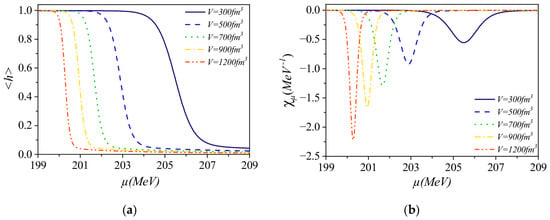
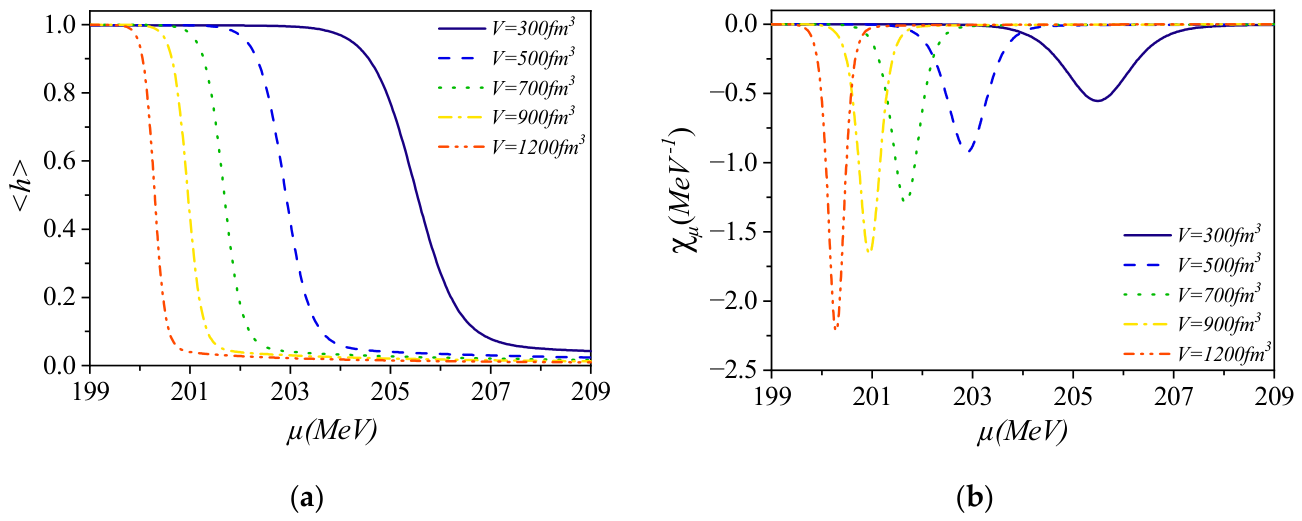
Figure 2 illustrates the same thermodynamic observables plotted in Figure 1, now analyzed at a higher temperature , allowing for a direct assessment of thermal effects on the transition. The order parameter still exhibits a rapid decrease with , confirming the persistence of the HG-QGP transition; however, the transition region at a fixed volume is systematically shifted towards lower chemical potentials compared to Figure 1, reflecting the expected thermal facilitation of deconfinement. While the same finite-size pattern is preserved, namely, smoother crossovers at small volumes and sharper transitions at larger volumes, the overall transition appears slightly less abrupt due to stronger thermal fluctuations at higher temperatures. Consistently, the susceptibility peaks remain volume-enhanced but are displaced to lower and are slightly more broadened, relatively to those in Figure 1. This comparative analysis demonstrates that the phase structure is governed by a combined interplay of temperature and finite-size effects: increasing volume drives the system toward a quasi-singular thermodynamic behavior, as already evidenced in Figure 1, whereas increasing temperature shifts the transition region and partially softens the transition without altering its underlying first-order-like character in finite systems. Moreover, the shift in the effective transition quark chemical potential and the transition width exhibit the same qualitative volume dependence as at , with the shift and width both increasing with increasing temperature at a fixed volume. Following the same approach, finite-volume effects in the QCD chiral phase diagram are studied by considering a cubic box [10].
Figure 2.
Variations in (a) the order parameter and (b) the first-order chemical susceptibility as functions of quark chemical potential at for several volume selections with .
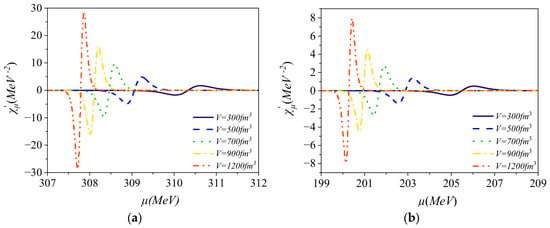
Figure 3 illustrates the variations in the second-order derivative of the order parameter as a function of the chemical potential, at (panel a) and (panel b), for various system volumes. In both panels, develops a pronounced peak–dip structure in the vicinity of the transition region, characterized by a negative minimum at a chemical potential , followed by a positive maximum at , with the gap between the two extrema locations defining the width of the transition region, . The amplitude and sharpness of these extrema increase significantly with increasing volume, while smaller volumes lead to smoother and broader curves with reduced amplitudes and slight shifts in the peak positions. This behavior clearly reflects finite-size effects, where the singular response expected in the thermodynamic limit is rounded into a volume-dependent pseudo-critical signal. Moreover, the transition signature is more prominent at , indicating stronger critical behavior, whereas at , the extrema become less intense and more damped, suggesting a weakening of the transition strength with increasing temperature. These results confirm that the second-order derivative of the order parameter provides a highly sensitive probe of the deconfinement transition and its finite-size scaling properties.
Figure 3.
Plots of the second-order derivative of the order parameter as a function of quark chemical potential, at (a) and (b) , for several volume selections with .
4. Conclusions
In this work, we numerically investigate a density-driven deconfinement phase transition from a hadronic gas composed of massless pions to a color-singlet QGP consisting of gluons and massless up and down quarks, along with their antiquarks. The analysis is carried out within a phase coexistence model (PCM) describing both phases in a finite volume, formulated in the framework of Quantum Chromodynamics (QCD).
The transition is studied by varying the quark chemical potential, which governs the baryon density, at fixed temperature values. Finite-size effects on the deconfinement transition are examined through the study of the quark chemical potential dependence of the order parameter and its first and second derivatives with respect to the quark chemical potential. These derivatives act as response functions that are highly sensitive to critical behavior and provide clear signatures of the transition region. The calculations are performed for several system volumes and for a bag constant value of .
Our results indicate that decreasing the system volume leads to a progressive smoothing of the order parameter across the transition region, around the transition chemical potential. In parallel, the first derivative exhibits pronounced peaks, while the second derivative shows rapid variations whose amplitudes and locations are strongly volume-dependent. These features signal a modification of the effective transition point due to finite-size effects and highlight the role of exact conservation constraints in small systems. The chemical behavior of the order parameter and its derivatives thus provides a reliable framework for characterizing the deconfinement transition in finite systems relevant to ultra-relativistic heavy-ion collisions at a fixed temperature and varying chemical potentials. Moreover, increasing the temperature at which the density-driven deconfining phase transition occurs shifts the transition chemical potential to lower values and partially softens the transition without altering its underlying first-order-like character in finite systems.
Author Contributions
Conceptualization, B.M., A.A.E.D. and M.A.L.; methodology, B.M., A.A.E.D. and M.A.L.; software, B.M.; validation, B.M., A.A.E.D. and M.A.L.; formal analysis, B.M.; investigation, B.M.; resources, B.M., A.A.E.D. and M.A.L.; data curation, B.M.; writing—original draft preparation, B.M.; writing—review and editing, A.A.E.D.; visualization, B.M.; supervision, A.A.E.D.; project administration, A.A.E.D. All authors have read and agreed to the published version of the manuscript.
Funding
This research received no external funding.
Institutional Review Board Statement
Not applicable.
Informed Consent Statement
Not applicable.
Data Availability Statement
Data are contained within the article.
Conflicts of Interest
The authors declare no conflicts of interest.
References
- Redlich, K.; Turko, L. Quantum gases with internal symmetry. Phys. Lett. B 1981, 104, 153–157. [Google Scholar] [CrossRef] [Scilit]
- Elze, H.-T.; Greiner, W.; Rafelski, J. Color degrees of freedom in a quark-glue plasma at finite baryon density. Z. Phys. C 1984, 24, 361–365. [Google Scholar] [CrossRef] [Scilit]
- Ladrem, M.; Ait-El-Djoudi, A. Finite-size effects and scaling for the thermal QCD deconfinement phase transition within the exact color-singlet partition function. Eur. Phys. J. C 2005, 44, 257–265. [Google Scholar] [CrossRef] [Scilit]
- Ait El Djoudi, A. Thermal QCD deconfining phase transition in a finite volume within color-singletness and excluded volume effects: A finite size scaling analysis using cumulants. Can. J. Phys. 2013, 91, 793–800. [Google Scholar] [CrossRef] [Scilit]
- Moussaoui, B.; Ait El Djoudi, A.; Tawfik, A. Finite-Size Effects Near QCD Critical Point: Quark Number Susceptibility. Int. J. Theor. Phys. 2022, 61, 181. [Google Scholar] [CrossRef] [Scilit]
- Spieles, C.; Stocker, H.; Greiner, C. Phase transition of a finite quark-gluon plasma. Phys. Rev. C 1998, 57, 908. [Google Scholar] [CrossRef] [Scilit]
- Spieles, C.; Bleicher, M.; Greiner, C. Susceptibilities of strongly interacting matter in a finite volume. J. Phys. G Nucl. Part. Phys. 2019, 46, 025101. [Google Scholar] [CrossRef] [Scilit]
- Zhang, Q.H. Constraints on the size of the quark-gluon plasma. arXiv 2001, arXiv:hep-ph/0106242. [Google Scholar]
- Elze, H.-T.; Greiner, W.; Rafelski, J. On the color-singlet quark-gluon plasma. Phys. Lett. B 1983, 124, 515–519. [Google Scholar] [CrossRef] [Scilit]
- Liu, R.-L.; Lai, M.-Y.; Shi, C.; Zong, H.-S. Finite volume effect on QCD susceptibilities with a chiral chemical potential. Phys. Rev. D 2020, 102, 014014. [Google Scholar] [CrossRef] [Scilit]
Disclaimer/Publisher’s Note: The statements, opinions and data contained in all publications are solely those of the individual author(s) and contributor(s) and not of MDPI and/or the editor(s). MDPI and/or the editor(s) disclaim responsibility for any injury to people or property resulting from any ideas, methods, instructions or products referred to in the content. |
© 2026 by the authors. Licensee MDPI, Basel, Switzerland. This article is an open access article distributed under the terms and conditions of the Creative Commons Attribution (CC BY) license.